Preparations for Next Moonwalk Simulations Underway (and Underwater)
NASA’s X-59 eXternal Vision System shows Mach 1.077 on Friday, June 5, 2026, marking the aircraft’s first time reaching supersonic speed in support of NASA’s Quesst mission. The moment represents a milestone for the aircraft as it transitions to include test flights faster than the speed of sound.
NASA
NASA’s experimentalX-59 aircraft marked a major milestone Friday, June 5, when it flew faster than the speed of sound for the first time, setting the stage for demonstrating its quiet supersonic capabilities later this year.
NASA test pilot Jim “Clue” Less took off and landed at Edwards Air Force Base in California, reaching a top speed of approximately Mach 1.1 (713 mph) and altitude of 43,400 feet. The X-59’s flight began at 11:08 a.m. PDT and lasted 81 minutes, with the team focusing on flying qualities at both subsonic and then supersonic speeds.
In the coming days, we expect to take the next step and push to Mach 1.4
jared isaacman
NASA Administrator
”X-59 is getting ready for its quiet supersonic debut. Since the aircraft’s first flight on Oct. 28, 2025, the team has made tremendous progress, flying 16 times in the last 90 days and getting into a steady test rhythm. In the coming days, we expect to take the next step and push to Mach 1.4,” said NASA Administrator Jared Isaacman “I’m grateful to the NASA team and Lockheed Martin Skunk Works for their help getting us to this point, and I hope this is the first of many collaborations as we rebuild NASA’s X-plane portfolio.”
The X-59 is designed to fly at supersonic speeds while creating only a quiet thump instead of a loud sonic boom. For this flight, a NASA F‑15 chase plane flew nearby to monitor the X‑59. The loud sonic booms from the F-15 obscured any sound made by the X-59.
“The X-59’s first supersonic flight is a testament to America’s enduring leadership in science, engineering, and aerospace innovation,” said Michael Kratsios, Assistant to the President for Science and Technology and Director of the Office of Science and Technology Policy. “This achievement comes as the Trump Administration continues work to unleash supersonic flight and enable American ingenuity.”
This first supersonic flight is a significant milestone, but an event even more critical to the mission is upcoming. In just days, the aircraft is expected to make its first “mission conditions” flight, reaching a cruising speed of Mach 1.4 (925 mph) and altitude of approximately 55,000 feet. The X-59 also will be accompanied by a chase plane for this flight.
NASA’s X-59 quiet supersonic research aircraft completed its first supersonic flight Friday, June 5, 2026, marking the first time the aircraft exceeded the speed of sound in support of NASA’s Quesst mission. The milestone represents a major step in flight testing as the aircraft expands into the supersonic portion of its flight envelope.
NASA / Lori Losey
This speed and altitude are the base conditions for the X-59 when it will eventually fly over several U.S. communities enabling NASA to gather data about how people may perceive its quiet thump. NASA will share this data with U.S. and international regulators to help establish new data-driven noise standards to enable a future viable market for supersonic commercial flight over land.
For the last several months, the X-59 has been participating in an ongoing series of flights where the plane has been flying at a wide range of speeds and altitudes – a process known as envelope expansion. These tests are the first phase of the X-59’s flight testing. They are focused on performance and involve chase plane monitoring. When the aircraft completes this phase it will enter another, focused on its sound profile in order to verify its quiet thump capability.
The X-59 is the centerpiece of NASA’s Quesst mission, which aims to demonstrate quiet supersonic flight and help enable commercial supersonic flight over land worldwide. These advancements will help travelers reach their preferred destinations faster, spending less time in the air.
Through Quesst’s development of the X-59, NASA also will deliver design tools and technology for quiet supersonic airliners that will achieve the high speeds desired by commercial operators without disturbing people on the ground. NASA will validate design tools through ground and flight testing, providing U.S. aircraft manufacturers the ability to explore new quiet supersonic concepts, and provide them with confidence that their resulting designs will meet quiet flight requirements.
NASA’s X-59 quiet supersonic research aircraft completed its first supersonic flight Friday, June 5, 2026, marking the first time the aircraft exceeded the s...
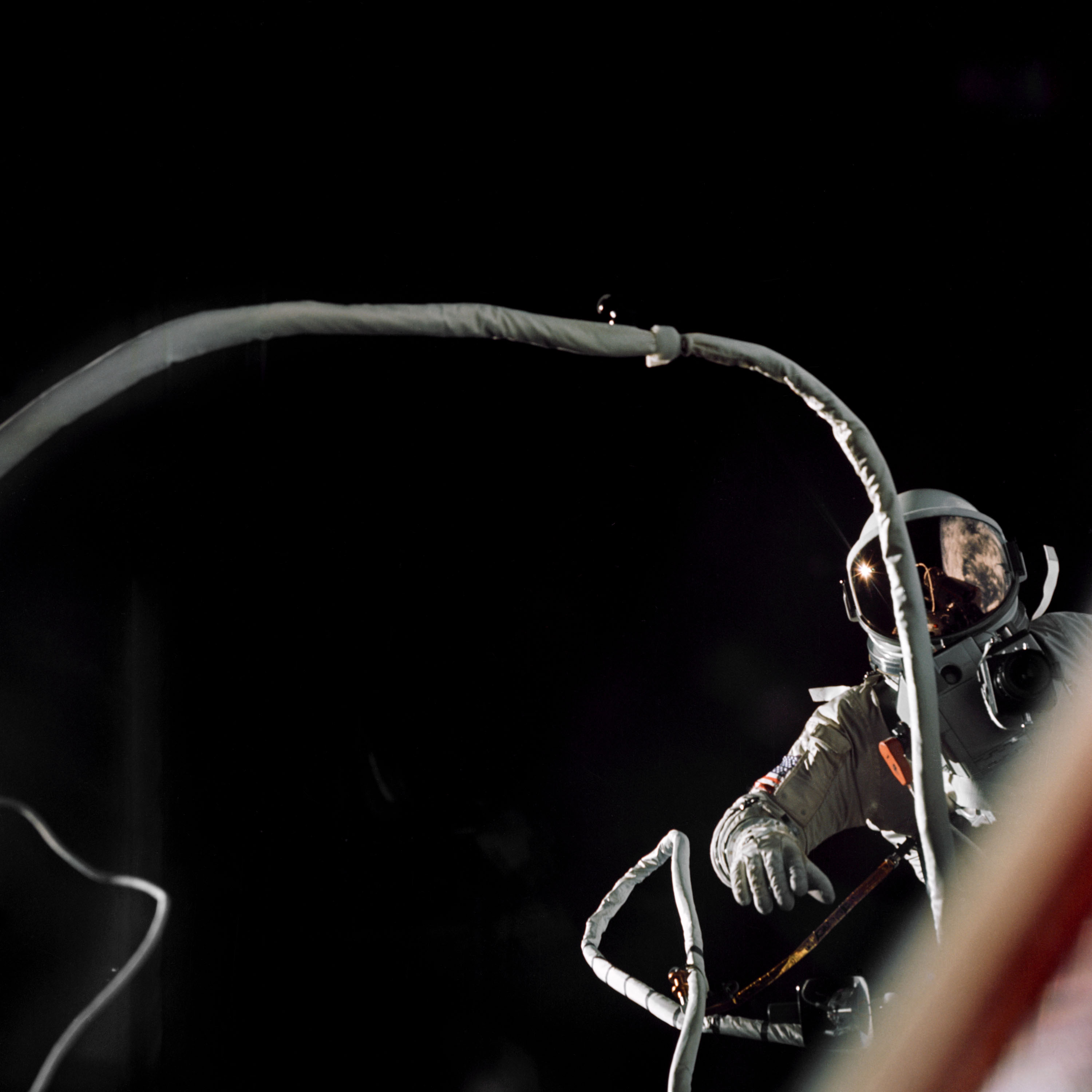
A year after America’s first spacewalk, Gemini IX-A Eugene Cernan stepped outside his spacecraft for an ambitious extravehicular activity scheduled for 167 minutes. The challenges he faced led NASA to reevaluate plans, equipment, and training for future spacewalks.
During its 61st close flyby of Jupiter on May 12, 2024, NASA's Juno spacecraft captured this color-enhanced view of the giant planet's northern hemisphere.
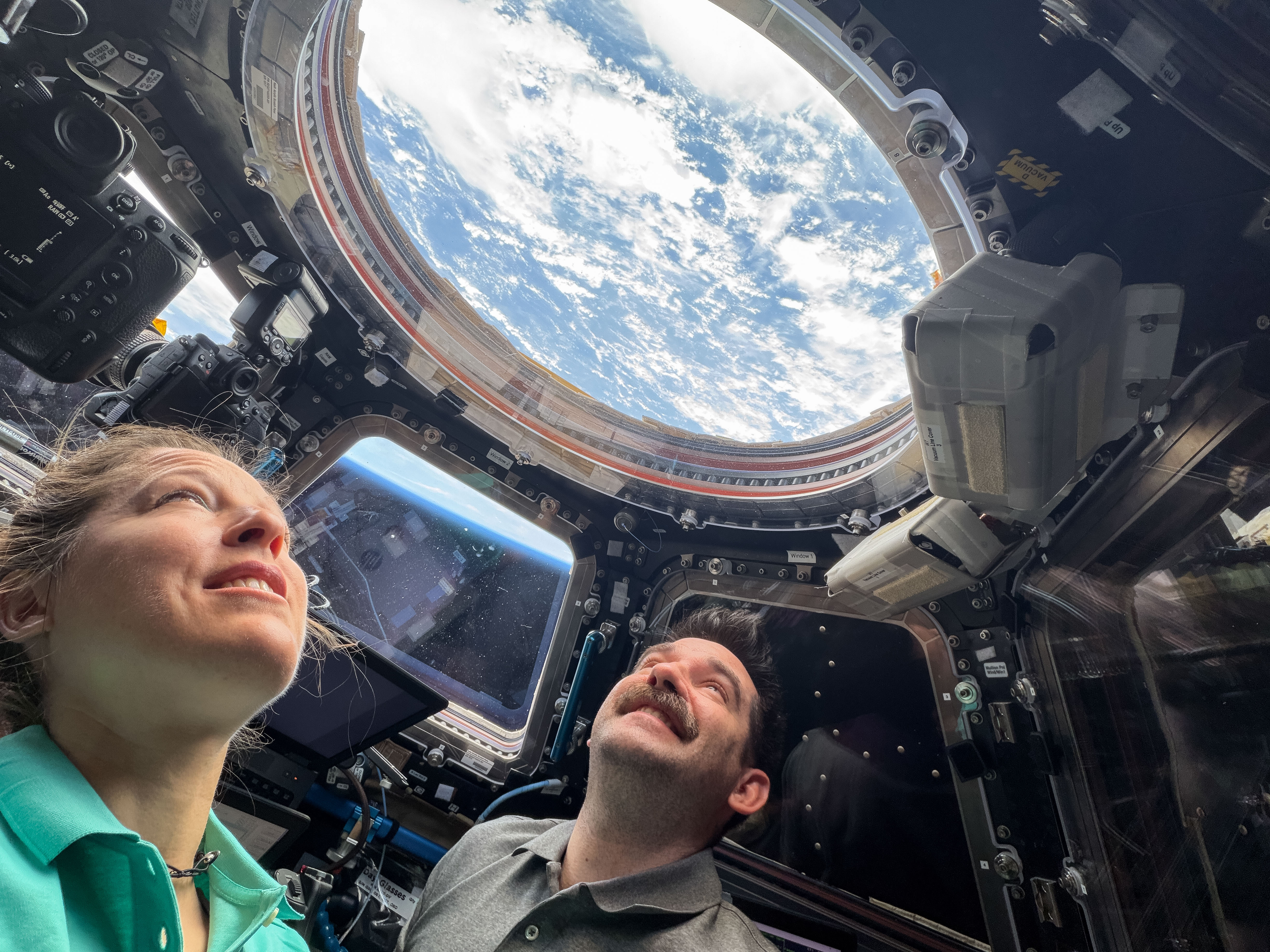
Astronauts Sophie Adenot of ESA (European Space Agency) and Jack Hathaway of NASA, both Expedition 74 flight engineers, look out a window in the cupola.
Astronauts Sophie Adenot of ESA (European Space Agency) and Jack Hathaway of NASA, both Expedition 74 flight engineers, look out a window in the cupola, monitoring the automated approach and docking of the SpaceX Dragon cargo spacecraft to the International Space Station on May 17, 2026. The orbital outpost was soaring 259 miles above the Indian Ocean just west of the Maldives at the time of this photograph.
NASA’s SpaceX Crew-11 astronauts gather together for a crew portrait wearing their Dragon pressure suits during a suit verification check inside the International Space Station’s Kibo laboratory module. Clockwise from bottom left are, NASA astronaut Mike Fincke, Roscosmos cosmonaut Oleg Platonov, NASA astronaut Zena Cardman, and JAXA (Japan Aerospace Exploration Agency) astronaut Kimiya Yui.
Credit: NASA
NASA will host a public event featuring three crew members from the agency’s SpaceX Crew-11 mission at 11 a.m. EDT Monday, June 1. The event, which takes place during the crew’s standard postflight visit, will be held in the Webb Auditorium at NASA Headquarters in the Mary W. Jackson building, 300 E. Street SW in Washington.
The crew members, including NASA astronauts Zena Cardman and Mike Fincke and JAXA (Japan Aerospace Exploration Agency) astronaut Kimiya Yui, will discuss their recent 167-day mission aboard the International Space Station, where they conducted a wide range of science experiments to benefit life on Earth and advance human space exploration as part of International Space Station Expedition 73/74.
The Crew-11 mission lifted off on Aug.1, 2025, from Launch Complex 39A at NASA’s Kennedy Space Center in Florida. The crew’s SpaceX Dragon spacecraft docked to the orbital outpost on Aug. 2.
During their mission, the three astronauts, along with crewmate Roscosmos cosmonaut Oleg Platonov, traveled nearly 71 million miles and completed more than 2,670 orbits around Earth. The Crew-11 mission was Fincke’s fourth spaceflight, Yui’s second, and the first for Cardman and Platonov. Fincke has logged 549 days in space, ranking him fourth among all NASA astronauts for cumulative days in space. The crew members returned to Earth on Jan. 15, splashing down off the coast of San Diego.
Along the way, Crew-11 logged hundreds of hours of research, maintenance, and technology demonstrations. The crew members also celebrated the 25th anniversary of continuous human presence aboard the orbiting laboratory on Nov. 2, 2025. Research conducted aboard the space station advances scientific knowledge and demonstrates new technologies that enable us to prepare for human exploration of the Moon and Mars.
Media interested in attending the event must RSVP by 8 a.m., June 1, by emailing the NASA Headquarters newsroom at hq-media@mail.nasa.gov. NASA’s media accreditation policy is online. Based on the crew’s schedule, NASA will not be able to accommodate interviews.
This opportunity also is part of NASA’s Frontiers Forum: Voices Shaping the Future of Space speaking series designed to convene bold thinkers and senior leaders at the forefront of exploration and innovation. The series will spotlight mission-critical priorities from advancing the Artemis campaign and strengthening commercial partnerships to shaping the future workforce and accelerating breakthrough technologies. The agency will share more details soon.
To learn more about the International Space Station and its research and crews, visit:
NASA’s SpaceX Crew-11 astronauts gather together for a crew portrait wearing their Dragon pressure suits during a suit verification check inside the International Space Station’s Kibo laboratory module. Clockwise from bottom left are, NASA astronaut Mike Fincke, Roscosmos cosmonaut Oleg Platonov, NASA astronaut Zena Cardman, and JAXA (Japan Aerospace Exploration Agency) astronaut Kimiya Yui.
Credit: NASA
NASA will host a public event featuring three crew members from the agency’s SpaceX Crew-11 mission at 11 a.m. EDT Monday, June 1. The event, which takes place during the crew’s standard postflight visit, will be held in the Webb Auditorium at NASA Headquarters in the Mary W. Jackson building, 300 E. Street SW in Washington.
The crew members, including NASA astronauts Zena Cardman and Mike Fincke and JAXA (Japan Aerospace Exploration Agency) astronaut Kimiya Yui, will discuss their recent 167-day mission aboard the International Space Station, where they conducted a wide range of science experiments to benefit life on Earth and advance human space exploration as part of International Space Station Expedition 73/74.
The Crew-11 mission lifted off on Aug.1, 2025, from Launch Complex 39A at NASA’s Kennedy Space Center in Florida. The crew’s SpaceX Dragon spacecraft docked to the orbital outpost on Aug. 2.
During their mission, the three astronauts, along with crewmate Roscosmos cosmonaut Oleg Platonov, traveled nearly 71 million miles and completed more than 2,670 orbits around Earth. The Crew-11 mission was Fincke’s fourth spaceflight, Yui’s second, and the first for Cardman and Platonov. Fincke has logged 549 days in space, ranking him fourth among all NASA astronauts for cumulative days in space. The crew members returned to Earth on Jan. 15, splashing down off the coast of San Diego.
Along the way, Crew-11 logged hundreds of hours of research, maintenance, and technology demonstrations. The crew members also celebrated the 25th anniversary of continuous human presence aboard the orbiting laboratory on Nov. 2, 2025. Research conducted aboard the space station advances scientific knowledge and demonstrates new technologies that enable us to prepare for human exploration of the Moon and Mars.
Media interested in attending the event must RSVP by 8 a.m., June 1, by emailing the NASA Headquarters newsroom at hq-media@mail.nasa.gov. NASA’s media accreditation policy is online. Based on the crew’s schedule, NASA will not be able to accommodate interviews.
This opportunity also is part of NASA’s Frontiers Forum: Voices Shaping the Future of Space speaking series designed to convene bold thinkers and senior leaders at the forefront of exploration and innovation. The series will spotlight mission-critical priorities from advancing the Artemis campaign and strengthening commercial partnerships to shaping the future workforce and accelerating breakthrough technologies. The agency will share more details soon.
To learn more about the International Space Station and its research and crews, visit:
Preparations for Next Moonwalk Simulations Underway (and Underwater)
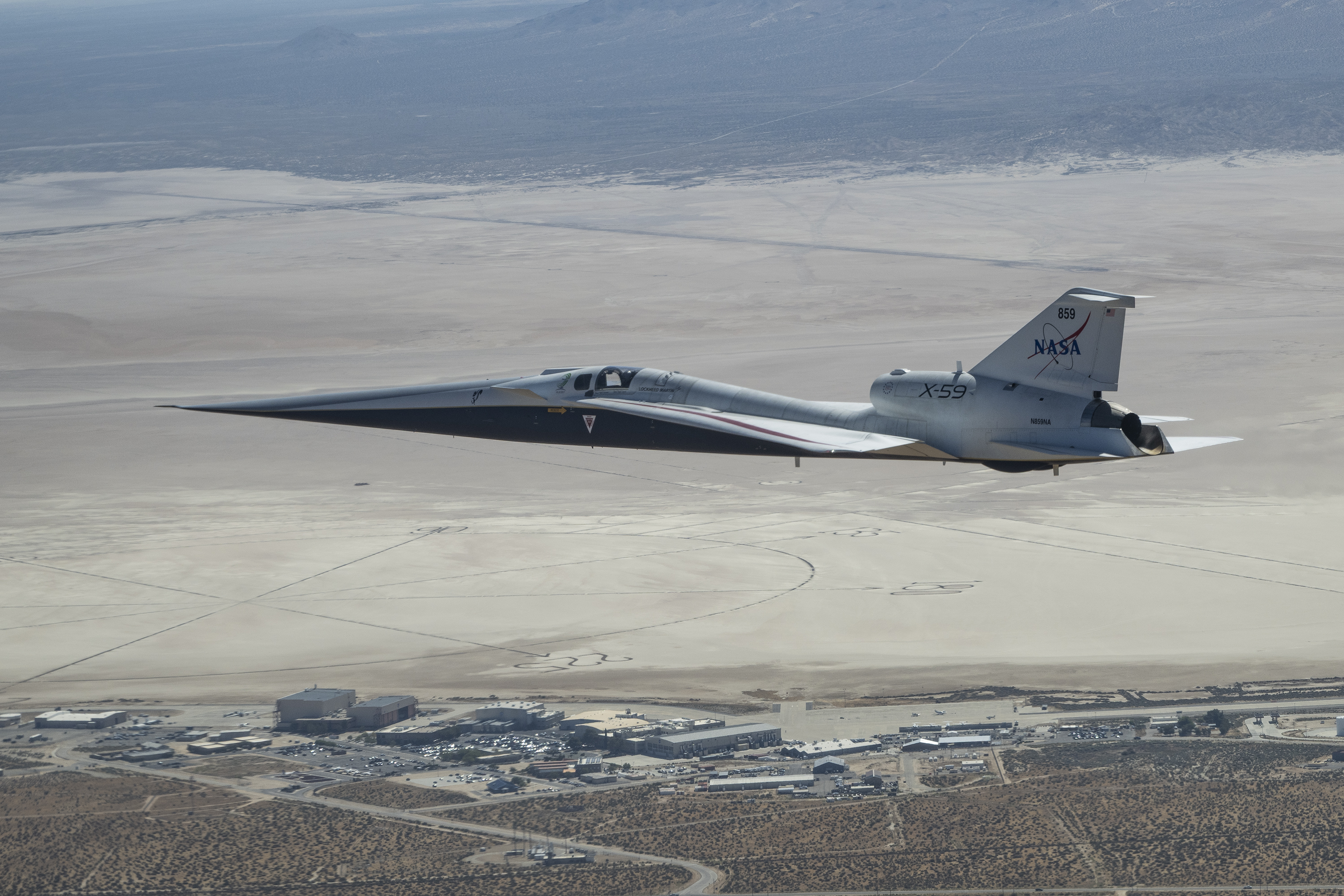
NASA’s X-59 quiet supersonic research aircraft flies over Rogers Dry Lake near NASA’s Armstrong Flight Research Center in Edwards, California, on Tuesday, May 12, 2026. NASA continues expanding the aircraft’s flight envelope through a series of lower-altitude and slower-speed flights ahead of upcoming flight tests at speeds faster than the speed of sound.
NASA/Jim Ross
NASA’s X-59 quiet supersonic research aircraft is preparing for some of its most significant flights yet. The X-plane is about to begin a new block of test flights that will include its first time flying faster than the speed of sound and other mission-critical objectives.
“What comes next is the first time this one-of-a-kind aircraft will fly supersonic,” said Cathy Bahm, project manager for NASA’s Low Boom Flight Demonstrator. “We are starting toward the mission conditions test point that X-59 was designed for.”
After months of flights, the X-59 team reviewed their progress in late May and now look toward the aircraft’s next series of flight tests, including higher altitudes and faster speeds. This will give engineers a look at how the X-59 handles under required operational conditions for NASA’s Quesst mission to eventually gather data on quiet supersonic flight.
The team expects the X-59 to fly supersonic – over 630 mph – for the first time at approximately 43,000 feet altitude during a series of test flights in early June, a major milestone for the aircraft. After that, it will conduct a “mission conditions” flight, where it will hit Mach 1.4 (925 mph) at approximately 55,000 feet. That speed and altitude are important because they’re NASA’s performance targets for the X-59 to eventually fly over U.S. communities to demonstrate quiet supersonic flight and collect feedback data about the aircraft’s quiet sonic “thump” from the public.
While the X-59 is designed to fly at supersonic speeds without producing a loud sonic boom, these early flights are not yet intended to demonstrate its quiet supersonic capabilities. The X-59 will be accompanied by a traditional supersonic chase plane, so any quiet thump it produces in the current phase of testing will be obscured by louder, traditional sonic booms from the chase. In supersonic flights this summer, the chase aircraft will also be outfitted with a specialized shock-sensing probe to take initial measurements of the X-59’s shock waves.
Completed flights
The X-59’s first block of flights successfully met several test goals, generating data for its team to analyze. After making its first flight in October 2025, it entered a scheduled period of maintenance before returning to the skies in March 2026. It has since completed 14 additional flights, marking milestones including:
Its first gear swing, or the retraction of its landing gear to show off its sleek design for the first time.
Reaching altitudes up to 43,000 feet and near supersonic speeds at Mach 0.95, approximately 627 mph.
Marking its first dual-flight day and then making those increasingly routine as the X-59 team increased flight cadence.
After a period of moving higher and faster, transitioning into lower and slower test flight conditions so engineers could gather information on the X-59’s behavior across a range of flight conditions.
Data collected during the X-59’s first block of test flights helped teams better assess critical systems, including fuel, hydraulics, environmental controls, and the eXternal Vision System, which is the aircraft’s unique series of cameras that feed into a monitor that allows the pilot to see forward instead of using a traditional windshield. Teams monitored how the aircraft behaved during takeoff, landing, and throughout flight. Strain gauges installed throughout the X-59 collected detailed information on the forces it experienced, and how its structure responded to them.
NASA’s X-59 quiet supersonic research aircraft flies above mountains near NASA’s Armstrong Flight Research Center in Edwards, California, on Tuesday, May 12, 2026. NASA continues expanding the aircraft’s flight envelope to evaluate how it performs across a range of flight conditions ahead of upcoming flight tests at speeds faster than the speed of sound in support of the agency’s Quesst mission.
NASA/Jim Ross
Next steps
During the X-59’s upcoming flights, pilots will run through test points while engineers watch the aircraft’s performance — but now in supersonic flight conditions.
“Flying at supersonic speeds is a major milestone for the X-59 team,” Bahm said. “Every step of envelope expansion brings us closer to demonstrating the quiet supersonic capability that is at the heart of the Quesst mission. Completing the first mission-conditions flight is especially meaningful – it’s the moment where we begin validating the aircraft in the environment it was designed for.”
In addition to reaching mission condition during this block of flight tests, the X-59 will also achieve its maximum speed of Mach 1.6 (1,218 mph) and altitude of 60,000 feet.
But just because the aircraft can go that fast doesn’t mean it always will fly supersonic. Testing will continue, including a mix of subsonic and lower-altitude flights so the team can continue monitoring it in varied conditions.
“These flights not only deepen our confidence in the X-59’s performance – they mark our progression toward the future phases of the mission that will ultimately help shape the future of supersonic travel,” Bahm said.
All flights so far and in the upcoming test block are part of Phase 1 of the X-59’s Quesst mission, focused on proving the performance and airworthiness of the aircraft. Some of those flights will include early deployment of equipment, including a probe mounted to one of NASA’s F-15 research aircraft that can measure the X-59’s unique shock wave signature.
Data gathered during those early probing flights will allow engineers to prepare for a new stage of work set to begin later this year: Quesst Phase 2, when teams will begin to measure the aircraft’s supersonic flight signature to verify that it’s producing a quiet supersonic thump, as designed.
“Aviation pioneer Otto Lilienthal said, ‘To design a flying machine is nothing. To build one is something. But to fly is everything.’ The 15 X-59 flights we’ve accomplished since March have been everything to this team and the mission,” Bahm said. “Every flight has pushed the boundaries of what’s possible, steadily expanding the envelope and strengthening our confidence in the aircraft.”
But, she said, rather than focusing on past progress, the team is already looking ahead.
“As we look ahead to the upcoming flights, we’re poised to open the envelope even further – moving boldly toward the mission test point this aircraft was built to achieve,” Bahm said. “Flying supersonic and reaching these milestones isn’t just progress; it’s the realization of years of perseverance, innovation, and teamwork. Each step brings us closer to Phase 2, and to the future of commercial supersonic flight.”
NASA’s X-59 quiet supersonic research aircraft is gearing up for some of its most significant flights yet as teams continue expanding the aircraft’s flight e...
NASA’s X-59 quiet supersonic research aircraft flies above NASA’s Armstrong Flight Research Center in Edwards, California, during testing focused on lower-speed and altitude flight conditions in support of NASA’s Quesst mission. NASA continues to include two-flight days in its envelope expansion as teams work to better understand how the aircraft responds throughout its operating range.
Tens of thousands of abandoned mines threaten waterways across the American West, but identifying which sites urgently need cleanup is slow and expensive. Now, NASA’s EMIT instrument can analyze the unique light signatures of mine waste from space to help focus remediation efforts where they’re needed most.
NASA astronaut Jessica Meir works on InSPA-StemCellEX-H2 inside the Life Sciences Glovebox. Microgravity samples will be frozen and returned to Earth for further analysis of stem cell expansion in space.
NASA
Expedition 74 astronauts aboard the International Space Station are continuing research efforts to manufacture large quantities of stem cells for therapies on Earth. Previous studies have focused on fine-tuning hardware that allows scientists to produce greater quantities of high-quality stem cells. Now, the InSPA-StemCellEX-H2 investigation is aiming to demonstrate large scale production of blood stem cells for pharmaceutical and clinical use.
Preflight microscopic image of hematopoietic stem cells for the InSPA-StemCellEX-H2 investigation. This investigation aims to produce stem cells in greater numbers with BioServe’s newly developed microgravity bioreactor.
Mayo Clinic
The research uses stem cells derived from the human body to produce large quantities of cells for patient use through a process called “expansion”. Although stem cells can be expanded in labs on Earth, they have limitations. For example, Earth-produced cells lose their ability to form the different cells in our blood system, like red and white blood cells or platelets, which are critical for leukemia patients that receive stem cells to build up their blood system after chemotherapy.
Dr. Tobias Niederwieser, assistant research professor at BioServe Space Technologies within the University of Colorado Boulder says, “The microgravity environment in space is much more suitable for keeping the stem cells in their high-quality state during expansion.” Scientists predict that growing cells in space may lead to higher expansion potential and a lower risk of rejection when used in patients on Earth. This research could create long-term cell supplies for patients suffering from fatal blood disorders, various blood cancers, or severe immune diseases, and enable more reliable and accessible therapies. “The end result is really to benefit patients in hospitals here on Earth,” Dr. Niederwieser says.
Space station research allows scientists and commercial companies around the world to test new technologies and innovative medical solutions that have the potential to greatly benefit life on Earth.
NASA astronaut Jessica Meir works on InSPA-StemCellEX-H2 inside the Life Sciences Glovebox. Microgravity samples will be frozen and returned to Earth for further analysis of stem cell expansion in space.
NASA
Expedition 74 astronauts aboard the International Space Station are continuing research efforts to manufacture large quantities of stem cells for therapies on Earth. Previous studies have focused on fine-tuning hardware that allows scientists to produce greater quantities of high-quality stem cells. Now, the InSPA-StemCellEX-H2 investigation is aiming to demonstrate large scale production of blood stem cells for pharmaceutical and clinical use.
Preflight microscopic image of hematopoietic stem cells for the InSPA-StemCellEX-H2 investigation. This investigation aims to produce stem cells in greater numbers with BioServe’s newly developed microgravity bioreactor.
Mayo Clinic
The research uses stem cells derived from the human body to produce large quantities of cells for patient use through a process called “expansion”. Although stem cells can be expanded in labs on Earth, they have limitations. For example, Earth-produced cells lose their ability to form the different cells in our blood system, like red and white blood cells or platelets, which are critical for leukemia patients that receive stem cells to build up their blood system after chemotherapy.
Dr. Tobias Niederwieser, assistant research professor at BioServe Space Technologies within the University of Colorado Boulder says, “The microgravity environment in space is much more suitable for keeping the stem cells in their high-quality state during expansion.” Scientists predict that growing cells in space may lead to higher expansion potential and a lower risk of rejection when used in patients on Earth. This research could create long-term cell supplies for patients suffering from fatal blood disorders, various blood cancers, or severe immune diseases, and enable more reliable and accessible therapies. “The end result is really to benefit patients in hospitals here on Earth,” Dr. Niederwieser says.
Space station research allows scientists and commercial companies around the world to test new technologies and innovative medical solutions that have the potential to greatly benefit life on Earth.
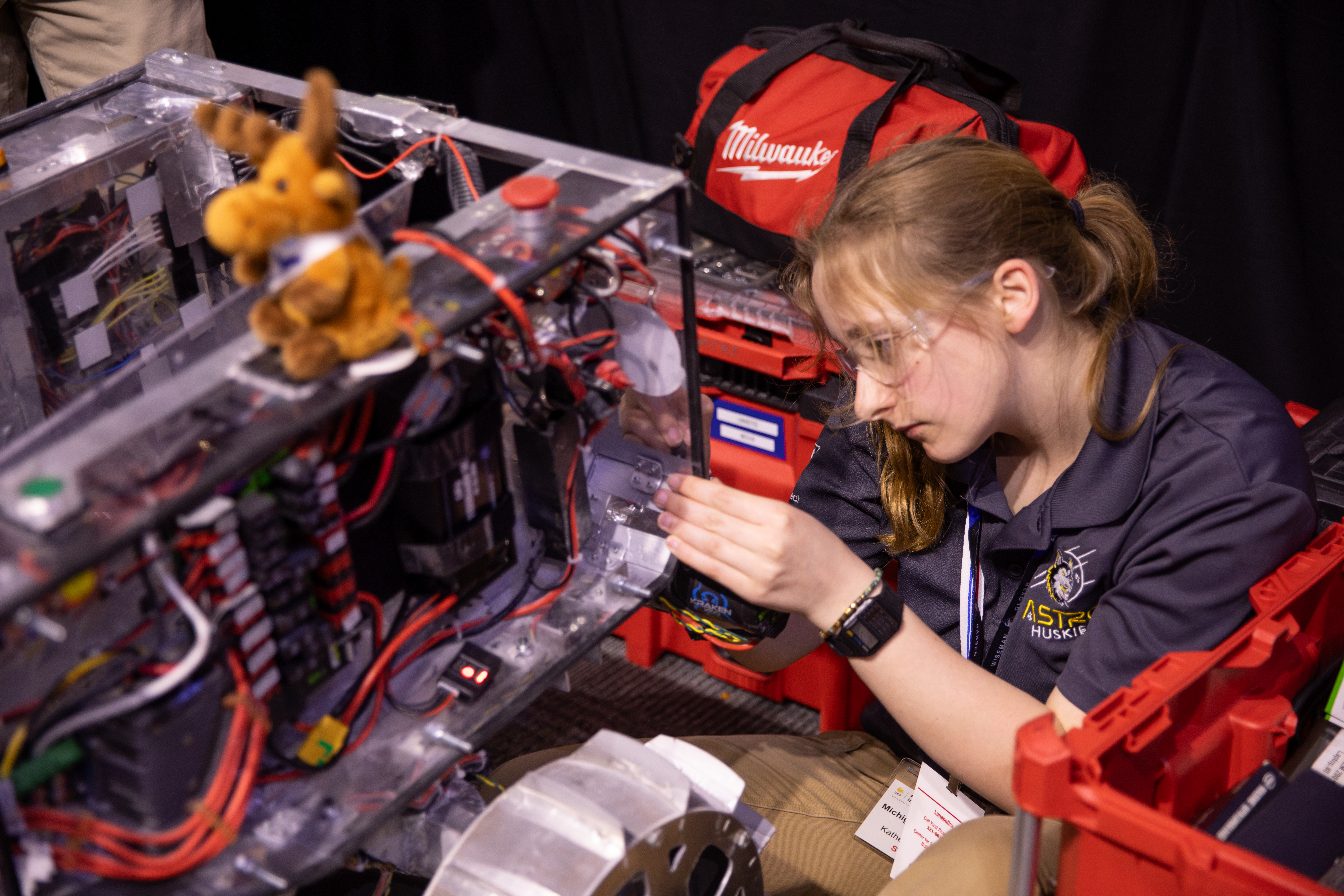
Katherine Rauscher, of Michigan Technological University, prepares her team’s prototype lunar robot for its turn during the finals for NASA’s 2026 Lunabotics Challenge competition on Tuesday, May 19, 2026, inside the Astronauts Memorial Foundation’s Center for Space Education at the Kennedy Space Center Visitor Complex in Florida. Forty-seven teams from around the U.S. designed and built remote-controlled robots capable of traversing challenging lunar terrain while constructing regolith-based berm under conditions similar to those the agency will face as it returns to the lunar surface through Artemis.
Preparations for Next Moonwalk Simulations Underway (and Underwater)
NASA astronaut and Expedition 74 flight engineer Jessica Meir configures research gear inside the Destiny laboratory module’s Microgravity Science Glovebox aboard the International Space Station.
Credit: NASA/Jessica Meir
Students in New York will hear from NASA astronaut Jessica Meir as she answers their prerecorded science, technology, engineering, and mathematics (STEM) questions while aboard the International Space Station.
The Earth-to-space call will begin at 11:05 p.m. EDT Thursday, May 28, and will stream live on the agency’s Learn With NASA YouTube channel.
This event is hosted by the Cradle of Aviation Museum in Garden City, New York, for students in grades K-12 and members of the community. This unique opportunity aims to deepen understanding of space exploration and enhance awareness of STEM careers.
Media interested in covering the event must RSVP no later than 5 p.m. EDT, Wednesday, May 27, to Jerelyn Zontini at: 516-567-0537 or jzontini@cradleofaviation.org.
For more than 25 years, astronauts have continuously lived and worked aboard the space station, testing technologies, performing science, and developing skills needed to explore farther from Earth. Astronauts communicate with NASA’s Mission Control Center in Houston 24 hours a day through SCaN’s (Space Communications and Navigation) Near Space Network.
Research and technology investigations taking place aboard the space station benefit people on Earth and lay the groundwork for other agency deep space missions. As part of NASA’s Artemis program, the agency will send astronauts to the Moon to prepare for future human exploration of Mars, inspiring the world through discovery in a new Golden Age of innovation and exploration.
For more information on NASA in-flight calls, visit:
Preparations for Next Moonwalk Simulations Underway (and Underwater)
NASA astronaut and Expedition 74 flight engineer Jessica Meir configures research gear inside the Destiny laboratory module’s Microgravity Science Glovebox aboard the International Space Station.
Credit: NASA/Jessica Meir
Students in New York will hear from NASA astronaut Jessica Meir as she answers their prerecorded science, technology, engineering, and mathematics (STEM) questions while aboard the International Space Station.
The Earth-to-space call will begin at 11:05 p.m. EDT Thursday, May 28, and will stream live on the agency’s Learn With NASA YouTube channel.
This event is hosted by the Cradle of Aviation Museum in Garden City, New York, for students in grades K-12 and members of the community. This unique opportunity aims to deepen understanding of space exploration and enhance awareness of STEM careers.
Media interested in covering the event must RSVP no later than 5 p.m. EDT, Wednesday, May 27, to Jerelyn Zontini at: 516-567-0537 or jzontini@cradleofaviation.org.
For more than 25 years, astronauts have continuously lived and worked aboard the space station, testing technologies, performing science, and developing skills needed to explore farther from Earth. Astronauts communicate with NASA’s Mission Control Center in Houston 24 hours a day through SCaN’s (Space Communications and Navigation) Near Space Network.
Research and technology investigations taking place aboard the space station benefit people on Earth and lay the groundwork for other agency deep space missions. As part of NASA’s Artemis program, the agency will send astronauts to the Moon to prepare for future human exploration of Mars, inspiring the world through discovery in a new Golden Age of innovation and exploration.
For more information on NASA in-flight calls, visit:
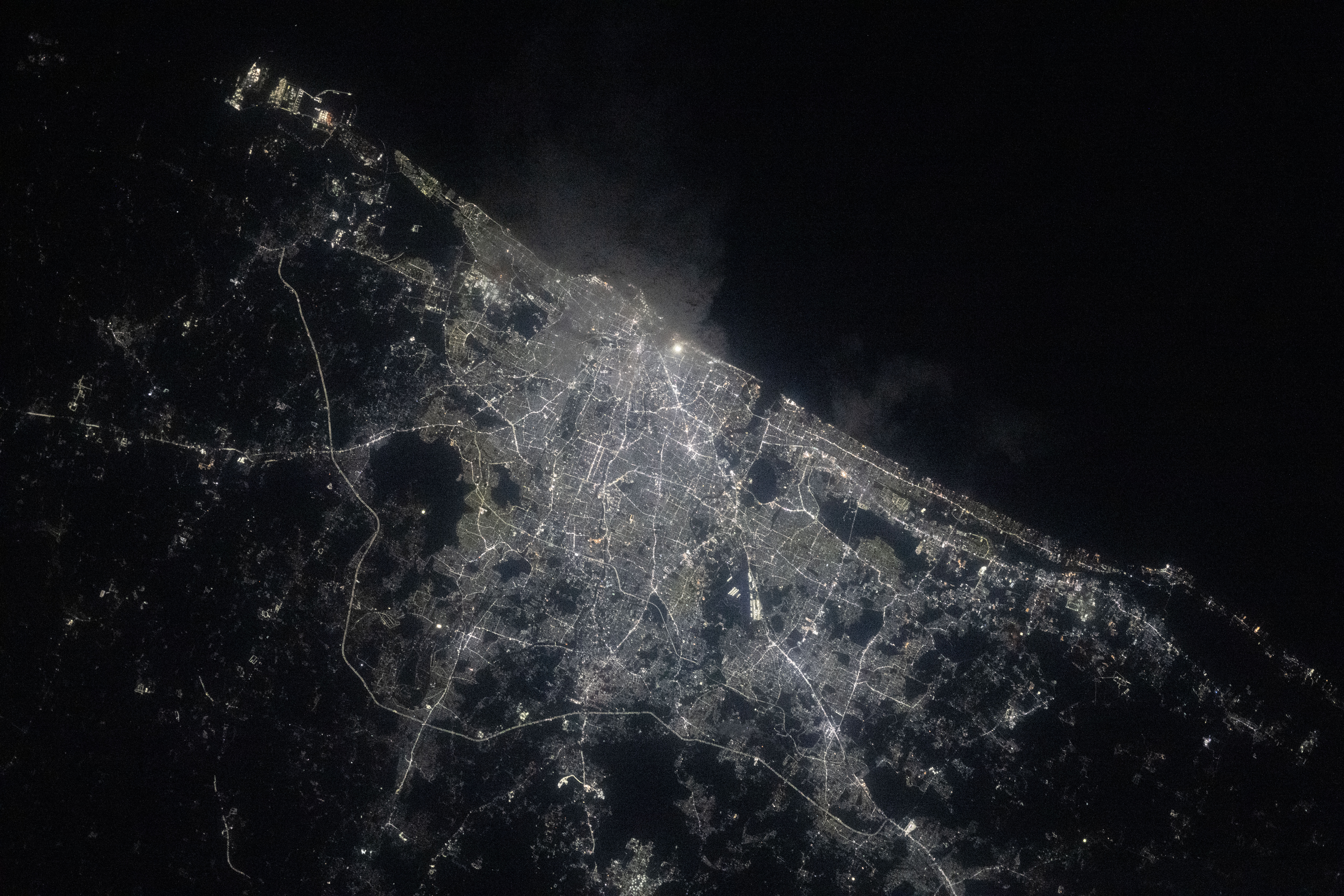
Chennai, on India's southern coast along the Bay of Bengal and with a metropolitan population of about 8.7 million, shines with white LED streetlights in this photograph taken at approximately 9:13 p.m. local time on May 2, 2026, from the International Space Station.
Preparations for Next Moonwalk Simulations Underway (and Underwater)
NASA crew chief Walt Kondracki checks an F-15 aircraft Tuesday, March 17, 2026, at NASA’s Armstrong Flight Research Center in Edwards, California. Ground crews, made of various roles, maintain the aircraft to be ready for each mission.
NASA/Carla Escamilla
From high‑speed research flights to high‑altitude science campaigns, NASA depends on aircraft that perform at their best and the ground crews who keep them mission ready.
At NASA’s Armstrong Flight Research Center in Edwards, California, specially trained maintenance crews are essential to keeping the agency’s aircraft flying safely and reliably.
This year, NASA added two F-15s and a Pilatus PC-12 to its fleet at Armstrong. These aircraft – alongside platforms such as the high-altitude ER-2s and NASA’s newest X-plane, the X-59 – reflect a wide range of capabilities. The maintenance staff is responsible for keeping each one mission ready.
NASA pilot Nils Larson, left, walks next to crew chief Walt Kondracki, right, by an F-15 aircraft Tuesday, Jan. 13, 2026, at NASA’s Armstrong Flight Research Center in Edwards, California. In the background, NASA mechanic Tim Logan secures the cockpit inside of the F-15, and flight test engineer A.J. Jaffe stands to the right.
NASA/Christopher LC Clark
“That’s the beauty of our Armstrong maintenance teams. They adapt to any type of change,” said Jose “Manny” Rodriguez, NASA Armstrong Gulfstream G-IV crew chief. “One day you could have an instrument being loaded, and the next day it may be aircraft reconfiguration, all while other aircraft systems may need fixing. They adapt and they overcome any situation.”
Each aircraft supports a specific mission, whether it’s conducting science research, serving as a support or chase aircraft, or assisting NASA rocket launches. The aircraft fly at different speeds, carry specialized hardware, and require maintenance crews to stay agile with fast-paced changes.
To ensure NASA can make aeronautics and science advancements safely, the crews work continuously, checking on the ejection seats, filling the tanks with fuel, and changing out brakes, wheels, wiring, and hardware constantly, all of which can degrade with each flight.
From left, NASA avionics technician Jesse Orellana; quality assurance employee Jose Prieto; mechanic Francisco Rodriguez; and mechanic Vincent Moreno work on an ER-2 aircraft Monday, Jan. 26, 2026, at NASA’s Armstrong Flight Research Center in Edwards, California.
NASA/Christopher LC Clark
On any given day, an aircraft may be flight-ready for a mission, undergoing scheduled maintenance or modifications, or down for longer-term care.
There are typically multiple NASA Armstrong aircraft in the air in one day. Currently, the center’s C-20A is flying in Peru and Panama, the X-59 is often flying twice per day with a chase plane, and the center’s ER-2 is flying in Colorado, supporting the Geological Earth Mapping Experiment (GEMx). All this work is happening at the same time, and Armstrong’s skilled maintenance staff is prepping and fixing aircraft as needed along the way.
The team includes mechanics with both military and civilian backgrounds, and the job involves a lot of on-the-job training.
Maintenance crews are composed of:
a crew chief – the person in charge of the airplane
an avionics technician, who specializes in navigation, communication, and flight control systems
quality assurance personnel, who oversee the work being done
additional mechanics assigned to each airplane
After the maintenance crew ensures the aircraft is in the best condition possible, the team tows it out to the flightline, and it becomes ready for operations. The NASA pilot assigned to the mission will walk around the aircraft with the assigned crew chief for a final safety check before flight.
“There is a crew chief assigned to every aircraft,” Rodriguez said. “The crew chief is responsible for the integrity of that aircraft, and at the end of the day, his signature and the pilot’s together are what constitutes that the aircraft is safe for flight.”
Maintenance crews track each flight to help ensure it completes the mission without returning early. If an aircraft does return to base early, the maintenance team stands ready. When it lands, the crew is right there again, helping the research team complete the mission and fixing whatever is needed to stay nimble and ready for the next flight.
“It’s difficult at times to work with different airplanes from both the civilian and military sides, but it’s very rewarding to see that we have the capability and the expertise to keep these aircraft flying,” Rodriguez said.
Editor’s Note: This advisory was updated May 22, 2026 to include a retirement.
NASA announced Friday an agencywide realignment to increase mission focus and move out on the National Space Policy. These changes position the agency to better deliver on the nation’s highest‑priority objectives with speed and efficiency.
During the Ignition event in late March, NASA Administrator Jared Isaacman and agency leaders outlined the most pressing objectives to deliver on the next chapter of American leadership in space. President Trump’s Executive Order Ensuring American Space Superiority, otherwise known as the National Space Policy, directed NASA to focus talent and resources on objectives including accelerating the Artemis program, establishing a Moon Base, developing a nuclear space reactor, igniting the orbital economy, and expanding missions of science and discovery.
To support the agency’s ambitious short- and long-term goals, NASA is taking action to increase specialization at centers and integrate mission directorates, elevating delivery of technically excellent work. Some of these actions include:
Center directors will continue reporting to Associate Administrator Amit Kshatriya, empowered to foster the unique capabilities of each center, and strengthen investments in infrastructure and the health of their workforce.
Mission directorates will now report directly to the administrator, ensuring focus on the mission and enabling them to leverage resources across centers, industry, and international partnerships with greater speed and efficiency.
The associate administrator also now serves as NASA chief engineer, reinforcing the agency’s technical backbone and ensuring continuity and autonomy in critical engineering decisions.
The agency continues to focus on rebuilding core competencies, insourcing contractors to civil servants where appropriate, strengthening the intern pipeline, and leveraging the agency’s joint recruitment initiative with the U.S. Office of Personnel Management, NASA Force, to build a strong, sustainable workforce for generations to come.
“This initiative reflects NASA’s extreme focus on executing the mission in direct support of the National Space Policy. We are focusing resources on the most pressing objectives only NASA is capable of undertaking and liberating the workforce from unnecessary bureaucracy and obstacles that impede progress. We aim to rebuild competencies and instill a culture that attracts the best and brightest capable of pursuing the most demanding engineering challenges and moving safely and urgently,” said Isaacman. “There will be no reduction in force, no program cancellations, no closures, but we will achieve cost savings through more efficient execution and taking an active role in delivering the outcomes the world has been waiting for from NASA. This is how we deliver on the mission, meet the moment, and continue to make history on behalf of the American people.”
Mission directorate realignment is as follows:
Human Spaceflight Mission Directorate (HSMD): With human spaceflight operational to both low Earth orbit and the Moon, the Exploration Systems Development Mission Directorate and Space Operations Mission Directorate will unify as HSMD.
Research and Technology Mission Directorate (RTMD): NASA will integrate the Aeronautics Research Mission Directorate and Space Technology Mission Directorate into the new RTMD. As a combined research, space technology, and aeronautics organization charged with nuclear power and propulsion development, RTMD will ensure NASA has the capabilities needed for the mission of today and the future.
Science Mission Directorate (SMD): Remains unchanged and continues to provide the foundation for NASA’s world‑leading scientific discovery.
Additional leadership roles, in alphabetical order, include:
John Bailey, associate administrator, Mission Support Directorate
Kevin Coggins, director, SCaN (Space Communications and Navigation), RTMD
Wesley Deadrick, director, Katherine Johnson IV&V Facility
Jamie Dunn, director, NASA’s Goddard Space Flight Center
Carlos García-Galán, program manager, Moon Base, HSMD
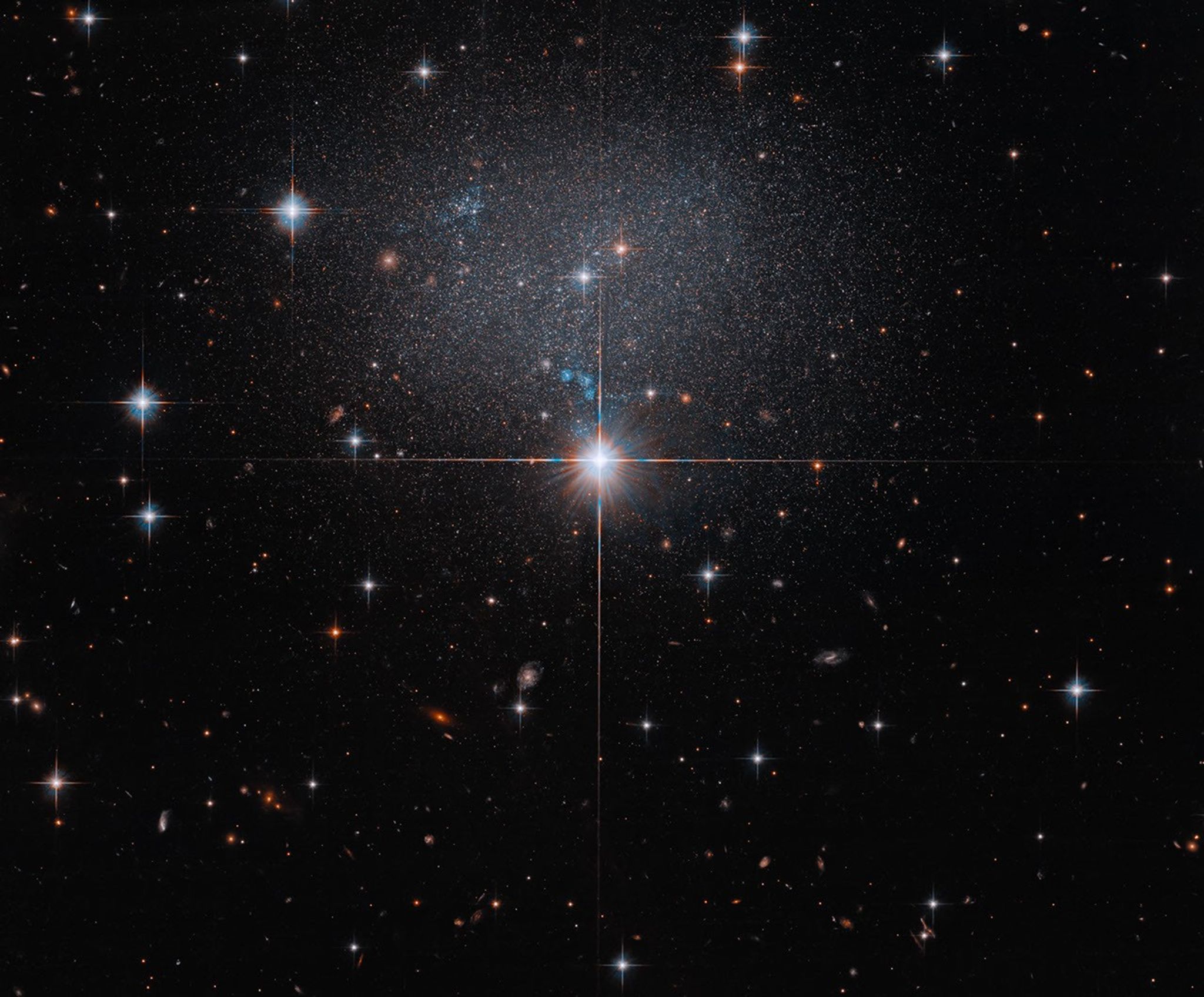
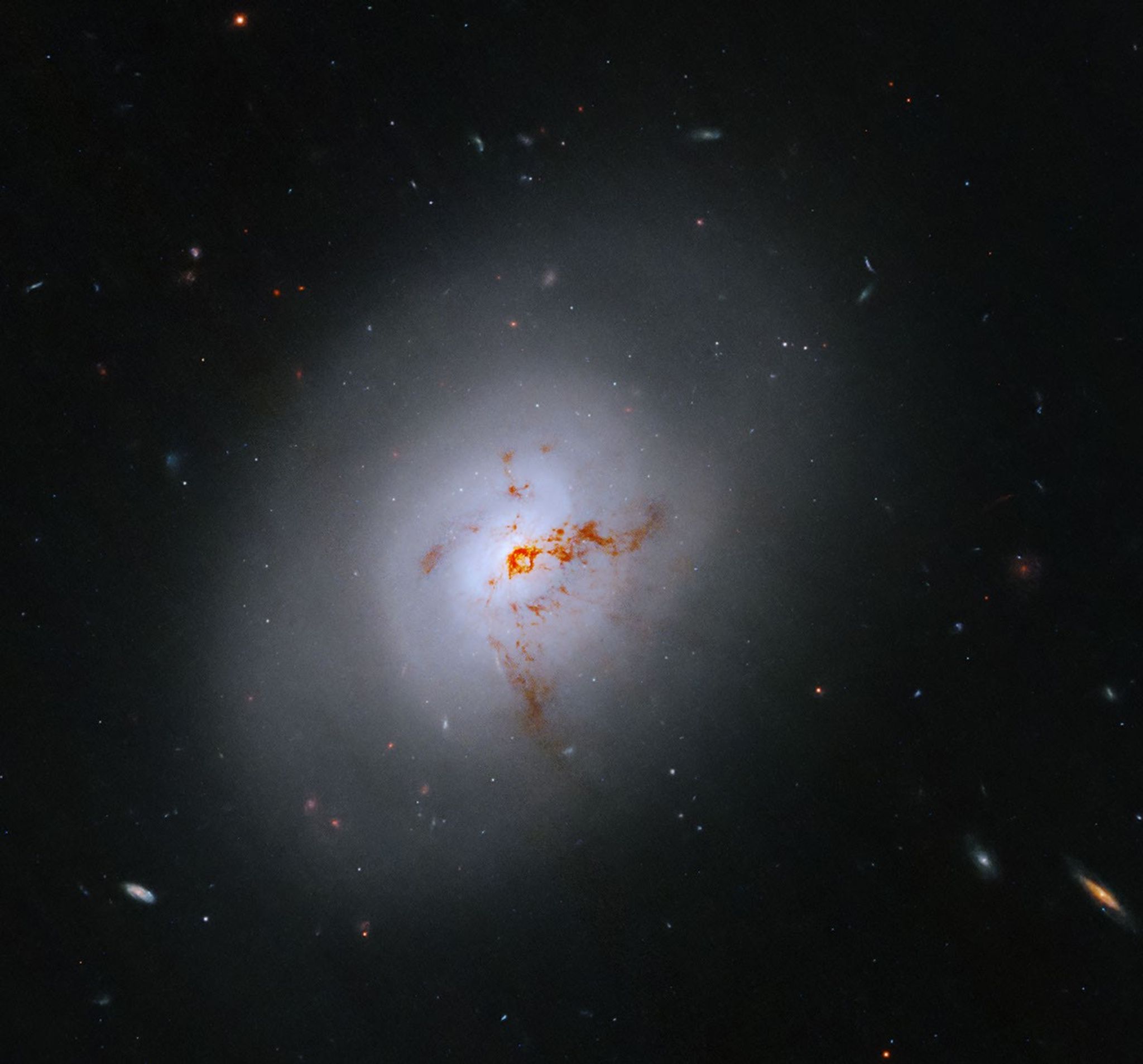
This NASA Hubble Space Telescope images reveals the lenticular galaxy, NGC 1266. This enigmatic post-starburst galaxy has a bright center and a face that hints at spiral structure, yet it holds no discernable spiral arms.
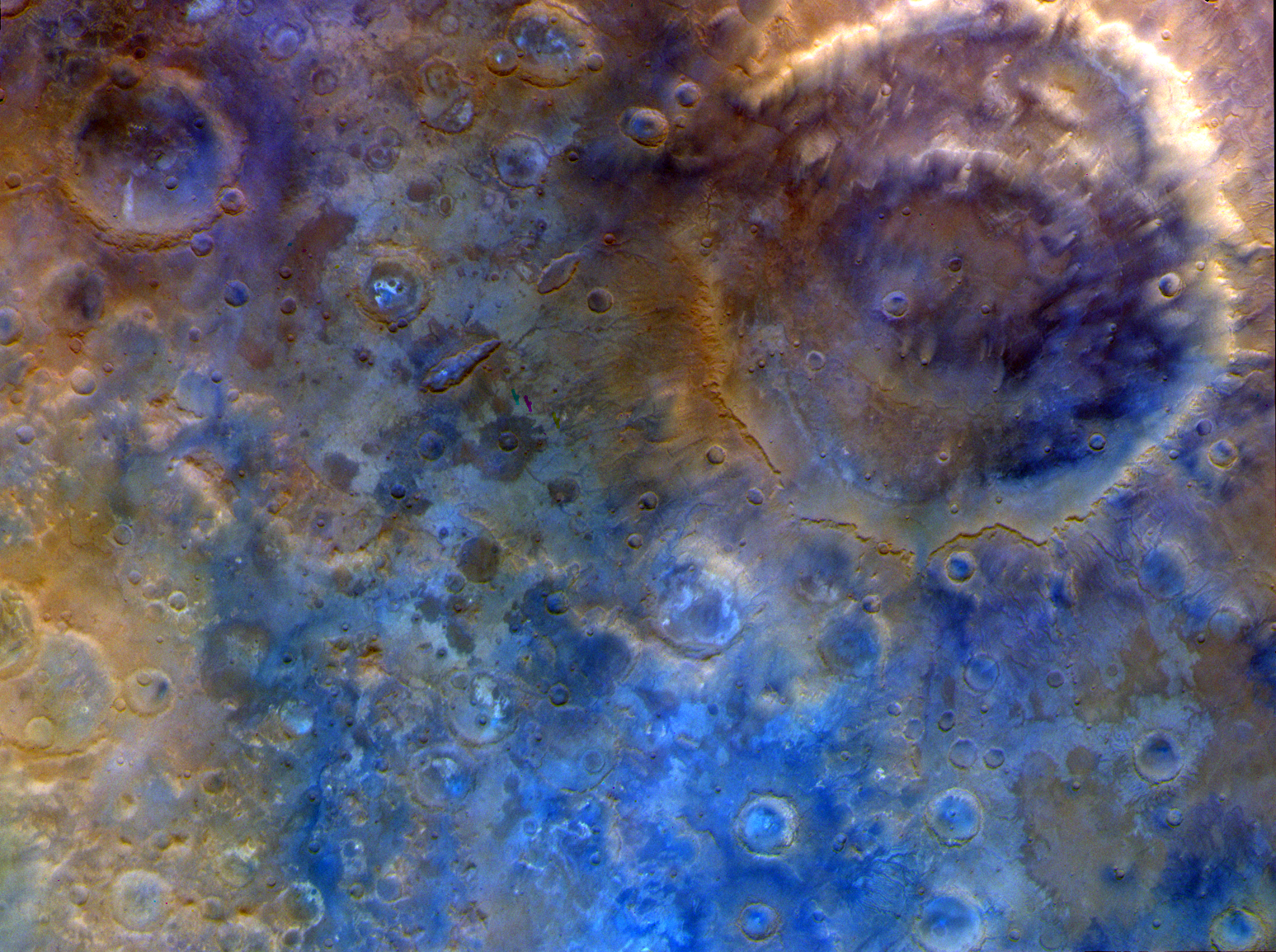
NASA’s Psyche spacecraft completed its close approach of Mars on May 15, capturing images as it came within 2,864 miles (4,609 kilometers) of the planet’s surface. This is an enhanced-color view of the large double-ring crater Huygens and the surrounding heavily cratered southern highlands.
Team WINGMAN from South Dakota State University, comprised of (from left to right) Todd Letcher (advisor), Matthew Wieberdink, Owen Diede, Christian Lee, and Anders Olsen, took home first place at the 2026 Gateways to Blue Skies Forum held at NASA’s Langley Research Center in Hampton, Virginia. Steven Holz, NASA sponsor and GBS Chair and judge, presented the award.
Credit: NASA/Mark Knopp
A South Dakota State University team took first place at NASA’s fifth annual Gateways to Blue Skies Competition, which challenged student teams to address a critical element of U.S. aviation: aircraft maintenance.
This year’s competition, RepAir: Advancing Aircraft Maintenance, asked teams of postsecondary students to develop innovative systems and practices that could advance commercial aircraft maintenance and repair operations by 2035. The competition, sponsored by NASA’s University Innovation project within the agency’s Aeronautics Research Mission Directorate, supported the agency’s objectives of fostering innovative research and strengthening the future aviation workforce.
“This year’s finalists proposed novel ideas to equip companies and their workers with innovative technologies to help keep our nation’s planes airworthy. This is especially critical in a time where flight safety is more commonly in the spotlight and where workforce shortages lead to challenges and opportunities in aviation,” said Steven Holz, associate project manager for NASA’s University Innovation Project and judging panel chair for Gateways to Blue Skies. “Our panel of industry and subject matter experts were excited about the possibilities these concepts could bring, as well as shared insights needed for these teams to push forward for real-world implementation.”
The winning project, WINGMAN, proposed augmented reality safety glasses equipped with voice-controlled manuals, automatic documentation, and photo recognition that could assist aircraft mechanics during routine daily servicing and minor repairs. The glasses would function as the mechanic’s “wingman,” enabling hands-free access to the information and reporting mechanisms required for line inspections.
The WINGMAN team presented their research along with seven finalists at the 2026 Gateways to Blue Skies Forum held May 18 and 19 at NASA’s Langley Research Center in Hampton, Virginia. The forum was judged by subject matter experts from NASA, the Federal Aviation Administration, and industry, including representatives from Southwest Airlines and American Airlines. Students at the forum had the opportunity to network with NASA and industry experts, tour the center, and gain insight into potential careers. The event was livestreamed, and the presentations were recorded.
The winning team members will have the opportunity to intern at one of NASA’s four aeronautics research centers during the 2026-27 academic year, including NASA Langley, NASA’s Glenn Research Center in Cleveland, NASA’s Ames Research Center in California’s Silicon Valley, and NASA’s Armstrong Flight Research Center in Edwards, California.
“It was super exciting to participate in Gateways to Blue Skies, especially with the really interesting concepts this year,” said Owen Diede, WINGMAN team lead. “We couldn’t have done it without the feedback and support from our faculty advisor, Dr. Todd Letcher, as well as our design review committee, Dr. Ruyi Lian and Dr. Cody Christensen. This was a fantastic opportunity to learn and grow, and we are incredibly thankful for the experience.”
Other recognitions included:
Best Infographic: University of California, Irvine Air Shield: Aircraft Structural Health Intelligence for Evaluation and Lifecycle Detection
Future Game-Changer: University of Georgia Quasar: Quantum Sensing Aerial Reporting
Safety Spotlight: South Dakota State University SPIDER (Surveying Platform and Inspection Device for Enclosed Regions)
The commercial aviation industry is a crucial component of the U.S. economy, yet it faces significant challenges due to a shortage of qualified maintenance workers and increasing demands to keep aircraft running for longer. NASA is dedicated to working with commercial, academic, and government partners to advance the capabilities and performance of U.S. aviation.
The Gateways to Blue Skies Challenge is part of the Transformative Aeronautics Concepts Program in NASA’s Aeronautics Research Mission Directorate. The NASA Tournament Lab, part of the Prizes, Challenges, and Crowdsourcing Program in the Space Technology Mission Directorate, manages the challenge through the National Institute of Aerospace on behalf of NASA.
For more information about NASA’s Aeronautics Research Mission Directorate, visit:
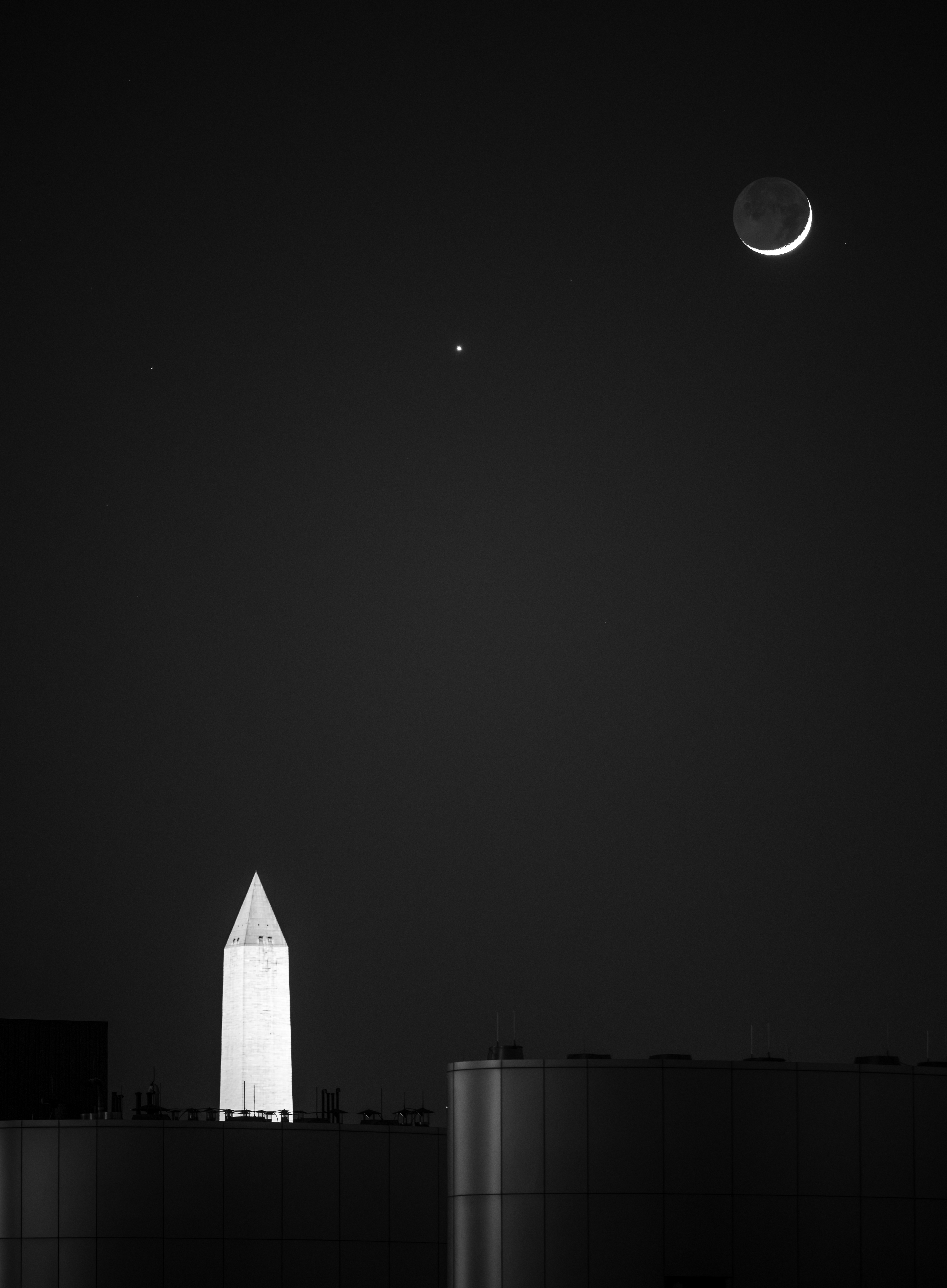
The Moon and Venus, center, are seen in conjunction above the Washington Monument, Monday, May 18, 2026, as viewed from the Mary W. Jackson NASA Headquarters Building in Washington.
This latest Picture of the Month from the NASA/ESA/CSA James Webb Space Telescope features Messier 77 (M77), a barred spiral galaxy famous and appreciated among astronomers for its combination of relative proximity and spectacular features to study. It is located 45 million light-years away in the constellation Cetus (The Whale).
NASA’s Curiosity Mars rover used its Mast Camera, or Mastcam, to capture this view of a rock nicknamed “Atacama” on May 6, 2026, the 4,877th Martian day, or sol, of the mission. The rock had gotten stuck to the drill on the end of Curiosity’s robotic arm on April 25.
You're allowed to play with your food when you're on the International Space Station! To celebrate a delivery of fresh food, NASA astronauts Jack Hathaway (bottom left), Jessica Meir (middle left), and Chris Williams (bottom right), and ESA (European Space Agency) astronaut Sophie Adenot (top right) pose for a group photo.
“Rise,” the Artemis II zero gravity indicator, is seen sitting on the dais as the Artemis II astronauts speak with congressional staff, Tuesday, May 12, 2026, in Washington.
NASA’s Perseverance Mars rover recently took a self-portrait against a sweeping backdrop of ancient Martian terrain at a location the science team calls “Lac de Charmes.”
NASA astronaut Jessica Meir poses with an Extravehicular Mobility Unit (EMU) spacesuit during an official portrait session at NASA's Johnson Space Center in Houston.
This celestial image captured from a window on a SpaceX Dragon spacecraft docked to the International Space Station highlights the Milky Way rising above Earth's atmospheric glow.
Preparations for Next Moonwalk Simulations Underway (and Underwater)
NASA’s X-59 quiet supersonic research aircraft flies above Palmdale and Edwards, California, during its first flight Tuesday, Oct. 28, 2025, accompanied by a NASA F/A-18 research aircraft serving as chase.
NASA/Jim Ross
NASA’s home for experimental flight is welcoming more flyers to its already high-performing fleet as it continues to support science and aeronautics test missions – continuing the legacy of pioneers like Neil Armstrong.
NASA’s Armstrong Flight Research Center in Edwards, California, added multiple aircraft this year: two F-15s supersonic jets, a Pilatus PC-12 utility plane, and a T-34 turboprop trainer, which the center will use to support the agency’s advancement of aerospace research.
“Armstrong has a rich history of flight research, but it’s the multidimensional skills of the people we have here, and the knowledge they’ve built to handle very unique aircraft maintenance and modifications, that stands out,” said Darren Cole, capabilities manager for the Flight Demonstrations and Capabilities project at NASA Armstrong.
Armstrong has a rich history of flight research, but it’s the multidimensional skills of the people we have here … that stands out.
Darren Cole
Capabilities Manager at NASA Armstrong
The center plays a pivotal role in worldwide airborne science missions, flying scientists and equipment from NASA, other government agencies, industry, and academia to collect measurements such as air pollution levels, glacier melt trends, and wildland fire mapping.
Scientists can manage experiments in real time aboard flying laboratories like the NASA ER-2, to collect important data with the help of Armstrong’s pilots and airborne science team.
“We all come together to make the science happen,” said Matt Berry, airborne research platforms branch chief at NASA Armstrong. “It is the agility of the Armstrong team that allows us to collaborate with scientists, get their equipment onboard, and to fly them to areas where they need to collect data.”
The center sits on Rogers Dry Lake, a 44-square-mile slat flat area used for aviation research and test operations. Rogers and the adjacent Rosamond Dry Lake have seen everything from space shuttle landings to emergency test flight recoveries. The Rogers lakebed continues to serve as an important piece of Armstrong’s test missions.
For NASA Armstrong, it all started with the first attempt by a human to fly faster than the speed of sound in the Bell X-1. In 1946, 13 employees from NASA’s predecessor agency, the National Advisory Committee for Aeronautics (NACA), arrived at what was then known as Muroc Army Airfield to prepare for the X-1 tests. A year later, NACA’s Muroc Flight Test Unit was established as a permanent facility at the airfield.
The center has gone by several names over the years, most recently changing from NASA’s Dryden Flight Research Center to NASA Armstrong in 2014. But its legacy has never shifted: The Bell X-1E, the last of the X-1 series of aircraft, now sits in front of NASA Armstrong, welcoming the newest test pilots, engineers, scientists, explorers, and dreamers. And they’re using the aircraft of today to break new barriers.
“I don’t think there is another place in the world with a more diverse fleet of aircraft. We have everything from a low-altitude powered glider to ER-2s, which are flying at high altitudes, and a multitude of aircraft in between,” Cole said.
From sourcing rare components to machining custom parts in-house, NASA Armstrong’s teams transform these aircraft into research workhorses. The center continues its crucial role in leading aeronautics testing, Earth science research, and supporting government and industry partners.
Preparations for Next Moonwalk Simulations Underway (and Underwater)
Students from Cornell University are shown working with an air transportation management tool in which a real drone flying over a remote field thinks its operating with imaginary drones flying in a simulated urban environment. Their work is the result of a NASA grant that is part of the agency’s University Student Research Challenge.
Cornell University / Mehrnaz Sabet
A team of Cornell University students are turning heads within industry and the federal government with the results of their research into creating a national air transportation management system in which thousands of drones could safely operate together.
NASA is sponsoring their work through the University Student Research Challenge (USRC), which provides grants to college students interested in helping the agency realize its aeronautical research goals.
“Looking at new traffic management systems for drones is not new,” said Mehrnaz Sabet, a doctoral student in the field of information science who serves as principal investigator on the grant and leads the Cornell team. “In fact, NASA has led that effort for years.”
Now, through USRC, NASA is giving Sabet and her team the chance to offer up innovative approaches to drone safety by managing their movements in the air, taking advantage of their young minds and fresh ideas.
The ultimate benefit of Cornell’s research in this area is the full realization of advanced air mobility, an area of industry focus that includes everything from urban flying taxis, more robust disaster response aircraft, and hot fresh pizza delivered right to your door.
The work also underscores the value NASA places on maturing cutting-edge technologies and helping to develop its future workforce through initiatives like USRC.
“Sabet and her team have demonstrated versatile skills involving software, algorithms, hardware, sensors development, laboratory tests, simulations, and actual flight tests – a rare combination,” said Parimal Koperdekar, acting director of NASA’s Airspace Operations and Safety Program.
Flying drones like we drive
Currently, drone operators must file plans that fully describes the intended flight path of the drone with a traffic management service. Those plans are checked with others to ensure there will be no collisions – what Sabet calls strategic deconfliction.
The challenge is that today’s air traffic management system is limited in its ability to handle the growing number of aircraft taking to the sky. Adding thousands of drones to the mix during the coming years risks over burdening the system, Sabet said.
What is needed in the air is essentially what we have on the ground – where millions of people drive on a road every day, she said.
As a driver you might know your whole “trajectory,” or the path you’d follow to reach your destination. But you would never coordinate your plan with every other driver on the road before you leave. Instead, traffic laws and infrastructure such as stop lights and traffic signs allow you to deconflict with other cars as you go.
Drone operators will still have to file flight plans saying where they intend to go, but the idea is to incorporate that car-like flexibility into drone operating systems, allowing them to be adaptable during their journeys.
“We need to ensure all these different types of drones can tactically deconflict with each other so that it is safe for them to operate like cars do on the ground. And that missing piece – tactical deconfliction – is at the center of our project,” Sabet said.
Mehrnaz Sabet, a doctoral candidate in the field of information science at Cornell University, leads a student team testing technologies used in a drone traffic management system under a grant from NASA’s University Student Research Challenge, She is seen during a drone traffic simulation exercise taking place in a rural field.
Cornell University
Two worlds joined
The key to the Cornell team’s research is the notion of integrating a simulated world with the real one to test and demonstrate how drones can learn to adapt to potentially hazardous conditions and make necessary corrections in their flight path on their own.
Knowing they could not go out and fly 100 drones at the same time to test their ideas for tactical deconfliction, the students decided to create an entirely virtual urban world to evaluate different high-volume traffic models, separation algorithms, and related data.
“Our first year of the project went into adapting and scaling that simulation engine and it all went very well,” Sabet said. “But we didn’t want to stick to a simulation. We wanted to see how the simulation translated to the real world, which mattered more.”
Still hampered by the limitations of how many drones they could operate and where they could fly – not many and basically in the middle of nowhere – they sought the best of both worlds, real and imagined.
“What we wound up doing was to embed the simulation into a real drone, so the drone thought it was flying in a dense urban environment although it was actually flying out in an open field where there wasn’t a real city in sight,” Sabet said.
before
after
A drone designed and built by Cornell University students hovers over an open field during a test of air traffic management system technologies in which the drone “thinks” its flying within an urban environment. The goal is to prove a system in which drones can safely react to unforeseen events and avoid each other in the sky without human intervention.
Cornell University
Several drones appear in a Cornell University computer graphic simulation of an urban environment in which an air traffic management system is tested to show how the drones can safely alter course on their own to avoid colliding.
Cornell University
A drone designed and built by Cornell University students hovers over an open field during a test of air traffic management system technologies in which the drone “thinks” its flying within an urban environment. The goal is to prove a system in which drones can safely react to unforeseen events and avoid each other in the sky without human intervention.
Cornell University
Several drones appear in a Cornell University computer graphic simulation of an urban environment in which an air traffic management system is tested to show how the drones can safely alter course on their own to avoid colliding.
Cornell University
before
after
drone flight test
Combing real and simulated worlds
The image at left (BEFORE) shows a Cornell University student-designed and built drone flying in the open above an isolated, rural field. The image at right (AFTER) shows the simulated urban environment the real drone “thinks” its flying in as it calculates all the imaginary drones’ flight paths (the blue and yellow lines) to find the best trajectory to safely avoid a collision. This combining of real and simulated worlds allows the drone to safely test its traffic avoidance technologies.
Real world lessons
This allowed the team to try out different traffic management tools and evaluate how drones might coordinate course corrections and avoid collisions with each other.
During the past year, they’ve taken the idea further by flying two real drones in the real world, each running the real-time simulation on board, allowing them to coordinate and “see” both simulated traffic and each other within the integrated test environment.
“We would then intentionally put them on a direct collision course to stress-test the detect and avoid and coordination models and see how well they react and coordinate the drone’s maneuvers to avoid hitting each other,” Sabet said.
“What’s impressive is that Cornell’s study included over 10,000 runs involving more than one million trajectories, and over 200,000 hours of experimentation to understand how multi-agent decentralized coordination would safely take place,” Kopardekar said.
Industry and the Federal Aviation Administration have also responded positively to this research and its potential. The team was asked to use its infrastructure and technology to virtually recreate an incident in 2025 in which a pair of drones collided with a stationary crane in Arizona. The team also showed how the accident could have been prevented.
The team was also asked to simulate recent, real-world fires in California to showcase how drones could better coordinate their movements both to provide situational awareness for public safety officials on the ground and to stay clear of fire-suppressing air tankers.
And according to the Cornell team, the FAA is interested in applying the project’s mix of virtual and real-world testing to evaluate drone operations under increasing levels of operational complexity.
“This kind of mixed-reality type of operational complexity enables them to test drone operations in a way that was not possible before,” Sabet said.
Thanks to NASA’s support through USRC, the Cornell team will continue to expand their capabilities and manage increasingly complex advanced air mobility operations.
“Our goal is to build the foundational systems that enable safe, large-scale autonomy in the skies,” Sabet said.
Jim Banke is a veteran aviation and aerospace communicator with more than 40 years of experience as a writer, producer, consultant, and project manager based at Cape Canaveral, Florida. He is part of NASA Aeronautics' Strategic Communications Team and is Managing Editor for the Aeronautics topic on nasa.gov. In 2007 he was recognized with a Distinguished Public Service Medal, NASA's highest honor for a non-government employee.
A newly discovered object may be a key to unlocking the true nature of a mysterious class of sources that astronomers have found in the early universe in recent years.
America’s first human spaceflight begins as the Mercury-Redstone 3 (MR-3) space vehicle, with astronaut Alan B. Shepard Jr. aboard, launches from Cape Canaveral, Florida on May 5, 1961.
This NASA Hubble Space Telescope image features the glittering spiral galaxy NGC 3137, located 53 million light-years away in the constellation Antlia (the Air Pump).
Nasdaq Chair and Chief Executive Officer Adena T. Friedman, left, and NASA’s Artemis II crew ring the closing bell of the Nasdaq market session, Thursday, April 30, 2026.
NASA’s SLS (Space Launch System) core stage for the Artemis III mission moves into the Vehicle Assembly Building at the agency's Kennedy Space Center in Florida on Tuesday, April 28, 2026.
Preparations for Next Moonwalk Simulations Underway (and Underwater)
A scale model of Boeing’s Subsonic Ultra Green Aircraft Research concept undergoes testing in a 5-meter wind tunnel operated by the company QinetiQ in December 2025.
QinetiQ
NASA and Boeing have completed wind tunnel testing to study an innovative advanced aircraft design intended to improve aerodynamic efficiency.
A truss-braced wing configuration, involving a long, thin wing with aerodynamically shaped structural supports, has the potential to reduce fuel and operational costs for future airliners, which is why NASA has collaborated with Boeing to advance the design.
But this kind of wing would be much more than a simple tweak to existing designs – for an aircraft the size of a passenger jet, it would be a revolutionary redesign, requiring extensive study from NASA and Boeing.
The most recent round of testing used a complex wind tunnel model to collect data on how air flows around a truss-braced wing model and the forces that would be exerted on such a wing in flight.
The test used a semispan model – essentially half an aircraft mounted on a wind tunnel floor. The model has features built in to simulate the mechanisms that increase the amount of lift a wing produces. By adjusting the model’s slats, flaps, and other moving control surfaces, the team can configure it to the low speed, high-lift settings of takeoff and landing conditions.
The model is part of a collaboration to test what’s known as Boeing’s Subsonic Ultra Green Aircraft Research (SUGAR) concept.
In December, teams completed testing of the model wind tunnel operated by the company QinetiQ in Farnborough, England. This large wind tunnel uses pressurized conditions to predict airplane behavior in takeoff and landing conditions.
The large size of the tunnel gives the model fidelity to better predict the behavior of a plane in flight. This capability allowed the team to confidently assess aerodynamic performance.
NASA and Boeing research teams analyzed data in real time to ensure the model performed as expected. Researchers are still reviewing the full results, but the test has already added valuable information to a growing body of research aimed at reducing fuel use in future aircraft designs.
The testing was just the latest stop for this research. NASA and Boeing have tested the concept at multiple NASA facilities to collect data as they work to build a comprehensive understanding of this advanced airframe concept.
This collaboration serves as an example of how NASA serves as an incubator for breakthrough technology with profound commercial applications. The transonic truss-braced wing concept originated from NASA aeronautics-supported research and NASA and Boeing engineers have worked together, test-by-test, to move this wing design from an idea to a practical reality.
The work began in NASA’s Advanced Air Vehicles Program and continues as part of the Subsonic Flight Demonstrator project under the Integrated Aviation Systems Program in the agency’s Aeronautics Research Mission Directorate.
Preparations for Next Moonwalk Simulations Underway (and Underwater)
NASA’s X-59 quiet supersonic airplane sits parked in front of its new hangar home at the agency’s Armstrong Flight Research Center in California. The facility originally was constructed in 1968 and for nearly 60 years has hosted a number of research aircraft and programs.
NASA/Christopher LC Clark
There’s no sign reading “home sweet home” in the hangar where the X‑59 now sits, but the sentiment is unmistakable among those tending to the quiet supersonic aircraft.
Located at NASA’s Armstrong Flight Research Center in Edwards, California, the X-59 hangar was built in 1968 but looks like new thanks to a full renovation and modernization. While the X-59 was being assembled in Palmdale, California, workers at NASA Armstrong gutted the hangar, adding new electrical wiring, a fire suppression system, office space, air conditioning, and other safety features.
“The whole team is incredibly proud of what we’ve accomplished in preparing this new home for the X-59,” said Bryan Watters, the NASA project manager at Armstrong who led the renovation effort. “The fact we could take a 1960s hangar and modernize it for use by a 2020’s X-plane is very special.”
The X-59 is the centerpiece of NASA’s Quesst mission to enable a new era of commercial supersonic air travel over land by reducing the sound of typically loud sonic booms to a much quieter sonic thump.
From the beginning of the program, knowing the X-59 would eventually need a new residence at NASA Armstrong, Quesst managers were on the hunt for somewhere to house the quiet supersonic demonstrator.
Like anyone looking for the ideal place to call home, the team made sure there would be enough space for the airplane and all its support equipment. But with the experimental jet measuring at just under 100 feet long and 30 feet wide, there were few options.
“We had to find a hangar that was long enough so that part of the X-59 wouldn’t hang outside, exposed to the elements,” Watters said.
Building 4826, as the hangar is officially designated, turned out to be the choice spot. “It was basically stripped down and gutted so that essentially it was just structural steel with siding. From that state it was rebuilt,” Watters said.
The feature they are perhaps most proud of is the hangar’s new floor. Covering more than 32,000 square feet, it is coated with epoxy that prevents any spills from seeping into the concrete.
From the hangar’s office windows, the view of the hangar floor can include the F-15 research jets that will be used as chase planes to support X-59 flights in the coming months. The renovation faced challenges along the way, chief among them being supply chain issues stemming from the COVID-19 pandemic. But there were some incredible, unforgettable moments too.
Circa 1990
Nov. 2025
On loan to NASA from the Air Force, an F-15 Eagle fighter jet was the focus of the Short Takeoff and Landing/Maneuver Technology Demonstrator research program, which concluded in 1991. The aircraft is seen here inside Building 4826, a hangar at NASA’s Armstrong Flight Research Center that was renovated and began use in 2025 as home for the X-59 quiet supersonic technology demonstrator.
NASA
NASA’s X-59 quiet supersonic technology demonstrator aircraft is seen parked inside its new hangar home at the agency’s Armstrong Flight Research Center in California.
NASA/Christopher LC Clark
On loan to NASA from the Air Force, an F-15 Eagle fighter jet was the focus of the Short Takeoff and Landing/Maneuver Technology Demonstrator research program, which concluded in 1991. The aircraft is seen here inside Building 4826, a hangar at NASA’s Armstrong Flight Research Center that was renovated and began use in 2025 as home for the X-59 quiet supersonic technology demonstrator.
NASA
NASA’s X-59 quiet supersonic technology demonstrator aircraft is seen parked inside its new hangar home at the agency’s Armstrong Flight Research Center in California.
NASA/Christopher LC Clark
Circa 1990
Nov. 2025
past and present
Hangar Updated to Continue Hosting Historic Research
This NASA hangar at Armstrong Flight Research Center originally was constructed in 1968 and since then has hosted a number of history-making programs. Compare the two images above to see how the hangar looked during the late 1980s when it hosted an F-15 research aircraft (left), and beginning in 2025 after it had been renovated and modernized to host the X-59 quite supersonic technology demonstrator aircraft.
Moved in
With X-59 now flying regularly and comfortably settled into its new digs, the Quesst team is gauging its performance on the way to quiet supersonic flight.
“This is truly a great time for Quesst and the X-59,” said Cathy Bahm, NASA’s project manager for the Low Boom Flight Demonstrator. “It’s also still a little surreal to be able to just walk down from your office and see the airplane in our hangar.”
For more than a year, the hangar refurbishment team worked through every detail of the X-59’s new home to make sure it would be safe and sound. But actually seeing the aircraft occupy that space is an adjustment for them, too.
“We’ve looked at X-59 models on our desk for years and then, you know, there’s the real thing right in front of us, in a hangar that we renovated,” Watters said.
A real thing in the hangar – and streaking across the California desert sky. The X-59’s transition from an idea into a working aircraft is a testament to the teams that help build out every aspect of its infrastructure.
NASA’s X-59 is supported under the agency’s Aeronautics Research Mission Directorate.
About the Author
Jim Banke
Managing Editor/Senior Writer
Jim Banke is a veteran aviation and aerospace communicator with more than 40 years of experience as a writer, producer, consultant, and project manager based at Cape Canaveral, Florida. He is part of NASA Aeronautics' Strategic Communications Team and is Managing Editor for the Aeronautics topic on nasa.gov. In 2007 he was recognized with a Distinguished Public Service Medal, NASA's highest honor for a non-government employee.
In this episode of The Quiet Crew, you’ll meet civil engineer Bryan Watters and learn about his role on the Quesst mission. Bryan has been supporting the mis...
Expedition 74 flight engineers Chris Williams of NASA and Sophie Adenot of the European Space Agency work together in the Kibo laboratory module’s Life Science Glovebox.
NASA celebrates Hubble’s 36th anniversary with a new image of the Trifid Nebula, a star-forming region it first captured in 1997. The telescope leveraged almost its full operational lifetime to show us changes in the nebula on human time scales with an improved camera.
Preparations for Next Moonwalk Simulations Underway (and Underwater)
For 10 years, a NASA initiative has helped the agency produce breakthrough aeronautical innovations while fostering the aviation workforce of tomorrow – and the University Leadership Initiative (ULI) is still flying high, making awards with the potential to change 21st century air travel.
Through ULI, NASA has supported more than 1,100 students at 100 schools, allowing them to pursue advancements in top priority areas for U.S. aviation, including high-speed flight, advanced air mobility, future airspace management and safety, and electrified propulsion.
Many of those students have used their ULI experience as a springboard to careers in aviation. And many of their ideas — such as designing more efficient wings or building supersonic aircraft that can change shape in flight — are either being investigated further by industry or the technologies adopted outright.
As it celebrates a decade of success, NASA’s ULI team is looking forward to leveraging student innovations with new awards in 2026 and beyond.
“Through ULI we’re building the workforce of the future and fostering the skill sets we so desperately need to compete globally,” said John Cavolowsky, director of NASA’s Transformative Aeronautics Concepts Program at NASA Headquarters in Washington.
Through ULI we're building the workforce of the future and fostering the skill set we so desperately need to compete globally.
john cavolowsky
Director, Transformative Aeronautics Concepts Program
What makes ULI unique from other NASA research projects, and especially appealing to universities, is that it provides the opportunity for university students and faculty to propose what research to conduct.
Usually, NASA determines the research it needs and then does the work itself or through partnerships and contracts. But with ULI, the agency shares its goals and universities consider how they can best help realize them.
“There are no better ways in my mind to help develop that talent within the students than to engage them in identifying big problems and then give them the resources they need to use their creativity to solve them,” Cavolowsky said.
ULI history
NASA’s relationship with academia and reliance on its research proficiency is written into NASA’s DNA going back to the days of the National Advisory Committee for Aeronautics, from which NASA was formed in 1958.
“For more than a century we have leaned on the brilliance and the capabilities of universities to help us think,” Cavolowsky said. “With ULI we can ensure they continue to bring their fresh ideas and young energy to the work we do at NASA Aeronautics.”
ULI evolved from an earlier project called Leading Edge Aeronautics Research for NASA (LEARN). NASA selected five LEARN teams in 2015 to pursue truly outside of the box ideas that showed promise but needed additional study.
One of those teams, for example, sought to take a cue from migrating flocks of birds by asking if airliners could save fuel by cruising in a giant ‘V’ formation. The numbers were intriguing and simple flight tests proved the concept, although the idea never made it to practice.
One of the earliest selected ULI teams was led by James Coder, who at the time was an aerospace engineering professor at the University of Tennessee in Knoxville. His team worked on technology that would smooth the airflow around a wing to make it more efficient.
Technically known as slotted natural laminar flow (SNLF) wings, Coder has called the idea a potential game changer for commercial airliners. The more efficient wing would mean less drag on an airplane, which in turn could help airlines save money on fuel.
Coder credits ULI for not only helping to prove the technology’s effectiveness – with the aid of wind tunnel testing at NASA’s Ames Research Center in California – but for providing students with an experience they couldn’t get elsewhere.
Three University of Tennessee/Knoxville students and co-investigator Dan Somers (in red jacket) prepare a slotted laminar flow wing section for testing in a wind tunnel at NASA’s Ames Research Center in California.
University of Tennessee/Knoxville
“After 10 years industry remains interested in the SNLF technology and I am optimistic for good reason about its future,” Coder said. “And project alumni have gone on to do many wonderful things and leverage what they did and learned through the ULI.”
With ULI experience prominent on their resumes, several of the students on Coder’s team wound up with jobs in industry – such as Boeing and Lockheed Martin – and government labs. One is currently a NASA Pathways intern working on his PhD.
Now at Pennsylvania State University, Coder remains a strong advocate for ULI.
“It goes above and beyond simple workforce development,” he said. “We recognized early on the value-add of ULI is the students themselves. While we could have just trained students en masse, we wanted to put them in the front seat of technical leadership on the project. I think this was a very successful strategy that benefited the project and the students as they embarked on their careers.”
Mighty morphing
Forrest Carpenter is another example of a student whose ULI support led to work after graduation – in this case at NASA.
“Working on the ULI project was an incredible experience, one I will always be thankful for and will remember fondly,” Carpenter said. “I think the project challenged me to be something more than ‘just an engineer;’ really helping my professional development and giving me a clearer focus on my passion.”
As a student at Texas A&M, he was part of a team selected by NASA in 2017 to research a novel idea in which a supersonic aircraft could alter its shape to fly more efficiently based on the atmospheric conditions in real time. Dimitris Lagoudas, now the university’s interim department head for aerospace engineering, led the team.
Members of a University Leadership Initiative round one team led by Texas A&M University participate in a status update meeting with NASA prior to their final review in 2022.
Texas A&M University / Jonathan Weaver-Rosen
A laser shooting out ahead of the aircraft would take measurements of the oncoming air and then the aircraft’s computer would command patches of shape memory alloys and other mechanisms to morph the aircraft’s outer shape.
One possible application of the technology could be in contributing to the reduction of the loudness of a sonic boom, expanding on the science behind NASA’s X-59 quiet supersonic technology demonstrator that seeks to reduce the sonic boom to a sonic thump.
“My main research role on the team was performing Computational Fluid Dynamics simulations of the various geometries we were looking at, including a pre-production version of X-59,” Carpenter said.
His work on the idea continues. A follow-on NASA project, GoSWIFT, will flight test the core technologies Carpenter and his ULI team worked on at Texas A&M. Only this time, Carpenter is the co-lead for the tests, which are targeted to take place at NASA’s Armstrong Flight Research Center in California in the near future.
Carpenter’s enthusiasm for his work and gratitude for how ULI led to his career with NASA resonates with many other ULI alumni.
“The number of students impacted, and how they were impacted, by a long-term project like ULI is huge,” Carpenter said. “NASA’s involvement in this kind of activity can only strengthen the research done in this country and to help inspire and develop the next generation of our workforce.”
Jim Banke is a veteran aviation and aerospace communicator with more than 40 years of experience as a writer, producer, consultant, and project manager based at Cape Canaveral, Florida. He is part of NASA Aeronautics' Strategic Communications Team and is Managing Editor for the Aeronautics topic on nasa.gov. In 2007 he was recognized with a Distinguished Public Service Medal, NASA's highest honor for a non-government employee.
Scientists have found that young stellar cousins of our Sun are calming down and dimming more quickly in their X-ray output than previously thought, according to a study using NASA’s Chandra X-ray Observatory.
This image, released in celebration of Earth Day, shows the terminator – the line between night and day – on Earth. The Artemis II astronauts captured this view on April 2, 2026, during their journey to the Moon.
Strappare ai tumori il loro mantello dell’invisibilità e costringerli a mostrarsi al sistema immunitario. È questa la direzione indicata da una ricerca internazionale pubblicata sulle pagine della rivista specializzata Cancer Discovery, firmata da gruppi di IFOM, Università di Torino e...
Curiosity ha individuato su Marte una nuova e ampia varietà di molecole organiche mai rilevate nei test condotti nel corso degli anni. Il risultato è stato ottenuto grazie a un esperimento di wet chemistry che, finora, non era mai stato eseguito fuori dalla Terra. In un campione roccioso raccolto...
This image that NASA’s Hubble Space Telescope captured of the Crab Nebula, paired with its past observations and those of other telescopes, allows astronomers to study how the supernova remnant is expanding and evolving over time.
Un gruppo di ricercatori cinesi ha trasformato il legno di balsa in un materiale capace di assorbire energia solare, immagazzinarla sotto forma di calore e restituirla dopo il tramonto, fino a generare elettricità attraverso un dispositivo termoelettrico. Lo studio, pubblicato su Advanced Energy...
An observation made by NASA’s SPHEREx mission reveals vast frozen complexes in the Cygnus X star-forming region of the Milky Way galaxy. The chemical signature of water ice is shown as bright blue structures, while polycyclic aromatic hydrocarbons are in orange.
A poco più di 10 anni luce dalla Terra, un team internazionale di astrofisici ha individuato una Super Terra che entra tra i candidati più interessanti nella ricerca di vita oltre il Sistema Solare. Il pianeta, chiamato GJ887d, ha una massa almeno sei volte superiore a quella terrestre e orbita...
Trasferire la città di Venezia per difenderla dall’innalzamento del livello del mare. È questa l’idea messa sul tavolo da un team internazionale di ricercatori guidato da Piero Lionello dell’Università del Salento e da Robert Nicholls dell’University of East Anglia, per far fronte a uno...
A portion of the Moon’s far side is seen along the terminator—the boundary between lunar day and night—where low-angle sunlight casts long shadows across the surface.
NASA’s Artemis II crew shared brief remarks with friends, family, and colleagues after they landed at Ellington Airport near NASA’s Johnson Space Center in Houston on Saturday, April 11, 2026, after a nearly 10-day journey around the Moon and back to Earth.
NASA astronaut Christina Koch, Artemis II mission specialist hugs the Orion spacecraft in the well deck of USS John P. Murtha, Saturday, April 11, 2026.
Nel 2011 lo speleologo russo Arthur Zemukov individua nel Caucaso un pozzo profondo oltre quaranta metri con pareti lisce e geometrie regolari, una struttura che i rilievi descrivono come incompatibile con una formazione naturale. La scoperta arriva dopo anni di ricerche tra archivi locali, mappe...
Nelle Alpi Apuane, dentro una comune cava di marmo di Carrara, è stato rinvenuto un campione di un minerale mai vista prima. I ricercatori dell’Università di Pisa, dopo approfondite analisi, hanno confermato si tratta di qualcosa di nuovo. Il minerale è stato battezzato dai ricercatori, e poi...
NASA astronauts Reid Wiseman, commander; left, Christina Koch, mission specialist; CSA (Canadian Space Agency) astronaut Jeremy Hansen, mission specialist; and NASA astronaut Victor Glover, Artemis II pilot, right, pose for a group photo after viewing the Orion spacecraft in the well deck of USS John P. Murtha, Saturday, April 11, 2026, in the Pacific Ocean off the coast of California. The quartet splashed down Friday, April 10 at 5:07 p.m. PDT (8:07p.m. EDT).
NASA’s Orion spacecraft with Artemis II crewmembers NASA astronauts Reid Wiseman, commander; Victor Glover, pilot; Christina Koch, mission specialist; and CSA (Canadian Space Agency) astronaut Jeremy Hansen, mission specialist aboard is seen under parachutes as it lands in the Pacific Ocean off the coast of California, Friday, April 10, 2026. NASA’s Artemis II mission took Wiseman, Glover, Koch, and Hansen on a 10-day journey around the Moon and back to Earth. Following a splashdown at 8:07 p.m. EDT, NASA, U.S. Navy, and U.S. Air Force teams are working to bring the crewmembers and Orion spacecraft aboard USS John P. Murtha.
Nel campione OREX-800066-3 dell’asteroide Bennu, un frammento di materiale grande poche centinaia di micrometri e con una massa dell’ordine dei milligrammi, sono presenti nello stesso volume molecole organiche, minerali formati dall’acqua e composti contenenti azoto, cioè tre ambienti...
Il tempo scandisce ogni gesto della nostra vita. Eppure la fisica contemporanea suggerisce qualcosa per molti versi inaspettato: questa dimensione potrebbe essere una costruzione, più che una componente fondamentale dell’Universo. Nei modelli classici il tempo appare come una variabile che...
The Moon, seen here backlit by the Sun during a solar eclipse on April 6, 2026, is photographed by one of the cameras on the Orion spacecraft’s solar array wings. Orion is visible in the foreground on the left.
A quasi 58 anni da Earthrise, lo scatto simbolo dell’era Apollo, l’umanità ha già la sua nuova immagine manifesto dello spazio profondo. Si chiama Earthset ed è il fotogramma che rischia di restare scolpito nella memoria collettiva: la Terra che tramonta dietro l’orizzonte lunare, ripresa...
NASA astronaut and Artemis II Commander Reid Wiseman peers out of one of the Orion spacecraft's main cabin windows on April 4, 2026, looking back at Earth, as the crew travels towards the Moon.
NASA astronaut Christina Koch is illuminated by a screen inside the darkened Orion spacecraft on the third day of the agency's Artemis II mission. To the right of the image's center, CSA (Canadian Space Agency) astronaut Jeremy Hansen is seen in profile peering out of one of Orion's windows. Lights are turned off to avoid glare on the windows.
This nighttime picture of Earth was taken on April 2, 2026, by an Artemis II crew member aiming a camera through a window of the Orion spacecraft. The image was captured after Orion completed its translunar injection burn, the critical maneuver that sent the spacecraft on its path toward the Moon and back.
NASA’s Space Launch System rocket carrying the Orion spacecraft with NASA astronauts Reid Wiseman, commander; Victor Glover, pilot; Christina Koch, mission specialist; and CSA (Canadian Space Agency) astronaut Jeremy Hansen, mission specialist onboard launches on the Artemis II mission, Wednesday, April 1, 2026, from Launch Complex 39B at NASA’s Kennedy Space Center in Florida.
L'ultima volta era il dicembre del 1972. Eugene Cernan, Harrison Schmitt e Ronald Evans erano a bordo dell'Apollo 17, l'ultima missione lunare della storia. Da allora, per oltre cinquant'anni, nessun essere umano si era più avventurato oltre l'orbita bassa terrestre. Martedì sera, alle 18.35 ora...
Nella notte tra l’1 e il 2 aprile tutti con il naso all'insù. Nel cielo stellato si potrà ammirare la Luna Rosa, il primo plenilunio dopo l’equinozio di primavera. Nei secoli è stata definita in vari modi: la luna “dell’erba che cresce”, perché è la prima luna piena dopo...
Un astronauta italiano camminerà sulla Luna: lo prevede l'accordo firmato a Washington dal ministro delle Imprese e del Made in Italy Adolfo Urso, con delega allo spazio, e dall'amministratore capo della Nasa Jared Isaacman. Lo scrive in un post su X il presidente dell'Agenzia Spaziale...
From left to right, NASA astronauts Andre Douglas, Victor Glover, and Christina Koch, CSA (Canadian Space Agency) astronauts Jenni Gibbons, NASA astronaut Reid Wiseman, and CSA astronaut Jeremy Hansen pose for a photo before the Artemis II crew proceed to a media event on March 27, 2026.
The Orion Crew Survival System suits that Commander Reid Wiseman, Pilot Victor Glover, and Mission Specialist Christina Koch from NASA, and Mission Specialist Jeremy Hansen from the CSA (Canadian Space Agency) will wear on the Artemis II test flight are seen in the suit-up room of the Neil A. Armstrong Operations and Checkout Building, Saturday, Jan. 17, 2026, at NASA’s Kennedy Space Center in Florida.
NASA’s IXPE observed the outer rim of the supernova remnant highlighted in purple in the inset. Data from IXPE is combined with data from NASA’s Chandra X-ray Observatory and ESA’s XMM-Newton.
Captured Nov. 29, 2024 by NASA’s James Webb Space Telescope, this infrared view of Saturn shows its glowing icy rings and layered atmosphere. Several moons are visible, including Janus, Dione, and Enceladus.
Moon rocks are seen during a March 24, 2026, event where NASA is outlining how the agency is executing the National Space Policy and accelerating preparations for America’s return to the surface of the Moon by 2028.
Sotto il fondale dell’Atlantico nord-occidentale si nasconde una vastissima riserva d’acqua dolce (o comunque poco salata). La Expedition 501 ha perforato il margine continentale a sud del Massachusetts e ha intercettato direttamente un sistema di “freshened water” intrappolato nei...
La primavera entra in scena con puntualità astronomica e un piccolo colpo di teatro celeste. Il 20 marzo 2026 alle 15:46 (ora italiana) cade l’equinozio, la soglia invisibile che chiude l’inverno e accende la stagione della luce. Ma quest’anno il sipario si alza con un bis serale: una danza...
L’idea che la vita possa nascere e prosperare lontano da qualsiasi stella sembra uscita da un romanzo di fantascienza. Eppure un nuovo studio internazionale suggerisce uno scenario sorprendente: lune simili alla Terra che orbitano attorno a pianeti vaganti potrebbero mantenere oceani di acqua...
Un nuovo strumento di osservazione sviluppato alla Stanford University sembra esser in grado di rivoluzionare il modo in cui gli scienziati studiano la vita a livello cellulare. Il dispositivo, chiamato Interferometric Image Scanning Microscopy (iISM), consente di osservare le cellule vive con...
E’ arrivato il giorno dell’eclissi totale di luna, primo grande evento astronomico del 2026. Sopranominata di sangue per il tipico colore rosso scuro del nostro satellite, avverrà quando Sole, Terra e disco lunare, saranno perfettamente allineati e il satellite entrerà nel cono d'ombra...
Importante scoperta in Transilvania, Romania, dove in una grotta di ghiaccio di Scarisoara, è stato rinvenuto un superbatterio preistorico. Anche se è rimasto sepolto in ghiacci risalenti a 5mila anni fa, il microrganismo è risultato resistente a 10 antibiotici moderni tra quelli più...
Ogni giorno milioni di litri di urina scorrono nei sistemi fognari del pianeta. Fin da piccoli siamo stati abituati a a considerarli un rifiuto, un qualcosa da eliminare in fretta. Eppure dentro quel flusso c’è una marea di energia chimica che il recente lavoro di un team di scienziati ha detto...
After years of anticipation and hard work by NASA’s OSIRIS-REx (Origins, Spectral Interpretation, Resource Identification and Security – Regolith Explorer) team, a capsule of rocks and dust collected from asteroid Bennu finally is on Earth. It landed at 8:52 a.m. MDT (10:52 a.m. EDT) on Sunday, in a targeted area of the Department of Defense’s Uta
NASA will host a media teleconference at 4 p.m. EDT on Tuesday, Sept. 26, to discuss the upcoming annular solar eclipse. The annular eclipse will cross the U.S. from Oregon to Texas on Saturday, Oct. 14, with a partial solar eclipse visible throughout the contiguous U.S.
The public is invited to a watch party at NASA’s Goddard Visitor Center, Greenbelt, Maryland to celebrate the first U.S. mission, OSIRIS-REx, to collect a sample from an asteroid and deliver it to Earth on Sept. 24, 2023.
The first asteroid sample collected in space and brought to Earth by the United States will be unveiled at NASA’s Johnson Space Center in Houston on Wednesday, Oct. 11, and media accreditation is now open.
A team led by NASA in Utah’s West Desert is in the final stages of preparing for the arrival of the first U.S. asteroid sample – slated to land on Earth in September.
Ya está abierto el proceso de acreditación de los medios de comunicación para el próximo lanzamiento de la nave espacial Psyche de la NASA en su misión a un asteroide único y rico en metales que orbita alrededor del Sol, entre Marte y Júpiter.
Media accreditation is now open for the upcoming launch of NASA’s Psyche spacecraft, for a mission to a unique metal-rich asteroid orbiting the Sun between Mars and Jupiter.
Media are invited to Utah’s western desert on Wednesday, Aug. 30, to learn about NASA preparations and readiness to receive America’s first asteroid sample collected in space.
NASA is commemorating the first year of science and discoveries from the agency’s James Webb Space Telescope, the largest, most powerful, and most complex space telescope ever built. To celebrate the anniversary, multiple events will take place online and live across the U.S.
Ahead of the first asteroid sample collected by the U.S. arriving on Earth in September, media are invited on Monday, July 24, to see NASA’s newly-built OSIRIS-REx Sample Curation Laboratory where the agency will study the sample at its Johnson Space Center in Houston.