Modalità di lettura

NASA Webb, Hubble Reveal History of Relic of Milky Way’s Formation

 
7 Min Read

NASA Webb, Hubble Reveal History of Relic of Milky Way’s Formation

A dramatically crowded starfield that looks like a just-shaken snow globe. The black background of space, which is clearer at the edges, is covered by thousands of tiny white, orange, and blue points of light, which are stars. The stars are most concentrated in the center, forming a roughly circular orb, and sparser at the edges of the image. Several larger orange stars, particularly those largest near the edges of the frame, have prominent diffraction spikes.
New observations from Webb combined with multiple observations from Hubble prove that Terzan 5 is a self-contained, self-enriching stellar system that contains up to four distinct star populations. It orbits within our Milky Way galaxy’s central bulge.
Credits:
Image: NASA, ESA, CSA, STScI, Giorgia Zullo (University of Bologna), Francesco Ferraro (University of Bologna); Image Processing: Alyssa Pagan (STScI)

Researchers using two of humanity’s most powerful observatories — NASA’s James Webb and Hubble Space Telescopes — have definitively shown that Terzan 5 is not a globular star cluster as it was once classified, offering new insight into how galaxies like our own form and evolve over time. A globular star cluster typically has only one ancient star population. New data not only confirms the existence of two distinct populations of stars in Terzan 5, but also provides evidence for two more recent rounds of star formation. Although located within the crowded bulge of our Milky Way, our galaxy’s central, spherical region of older stars, Terzan 5 was massive enough to maintain its separate identity while lighter weight systems spread out and mixed to form the bulge billions of years ago. It’s like a lump in an otherwise well-mixed cake batter.

“Webb’s new near-infrared observations, cross-referenced with Hubble’s archival observations, have given us a much clearer picture of the history of Terzan 5,” said Giorgia Zullo, who led the research and is a PhD student at the University of Bologna in Italy.

These results were presented at a press conference Tuesday at the 248th meeting of the American Astronomical Society in Pasadena, and were published in Astronomy & Astrophysics.

Image: Bulge Fossil Fragment Terzan 5 (Webb and Hubble Image)

A dramatically crowded starfield that looks like a just-shaken snow globe. The black background of space, which is clearer at the edges, is covered by thousands of tiny white, orange, and blue points of light, which are stars. The stars are most concentrated in the center, forming a roughly circular orb, and sparser at the edges of the image. Several larger orange stars, particularly those largest near the edges of the frame, have prominent diffraction spikes.
New observations from Webb combined with multiple observations from Hubble prove that Terzan 5 is a self-contained, self-enriching stellar system that contains up to four distinct star populations. It orbits within our Milky Way galaxy’s central bulge.
Image: NASA, ESA, CSA, STScI, Giorgia Zullo (University of Bologna), Francesco Ferraro (University of Bologna); Image Processing: Alyssa Pagan (STScI)

Four generations of stars

Discovered in 1968 by astronomer Azop Terzan, Terzan 5 resembles a globular cluster in many ways. However, in 2009 this system was discovered to harbor two distinct populations of stars. In 2016 Hubble provided the first estimate of their ages, showing that one formed roughly 12 billion years ago — as the Milky Way itself was assembling — and the other about 5 billion years ago, just before Earth started forming. This pointed to a more complex history than a typical globular cluster.

Studying Terzan 5 is complicated by its location in a region of our galaxy crowded with stars and heavily obscured by dust. This is where Webb stepped in. Its infrared view allowed the research team to peer through the dust and catalog many more stars, and fainter stars, than previous work. By measuring star colors and brightnesses, astronomers can classify them into populations of different ages and chemistries.

Webb was able to measure these key properties for every star within the field of view in the sky — both stars within Terzan 5 and unrelated foreground stars. To isolate the stars of Terzan 5, the team relied on the power and longevity of Hubble. The 12-year separation allowed the team to measure very small movements of individual stars, known as proper motions, to determine which stars belong to Terzan 5 and which are part of the Milky Way bulge.

By combining data from both Webb and Hubble, the researchers found strong evidence for two more stellar populations, one that formed 3.8 billion years ago and another only 2.5 billion years ago. They also were able to determine the ages of the previously known stellar populations with unprecedented precision, finding that they formed 12.5 billion and 4.7 billion years ago.

With the previously known two generations of stars, astronomers could not rule out the possibility that Terzan 5 interacted with another object, like a globular cluster or a giant molecular cloud, becoming enriched with new gas and dust that set off a second round of star formation. With four stellar generations, those explanations are ruled out.

Measurements of the stellar composition of Terzan 5 populations made at the W. M. Keck Observatory and European Southern Observatory’s Very Large Telescope also point toward very distinct populations. “Along with the ages of these populations, the cluster preserves a fossil record of progressive enrichment of heavy elements by supernovae,” said co-author R. Michael Rich, a research astronomer at the University of California, Los Angeles.

Terzan 5 formed multiple generations of stars because it was able to retain the necessary raw materials. There is evidence of powerful supernova explosions in Terzan 5 that forged heavier elements that were swept up by subsequent generations of stars. In lighter weight systems, the force of the explosions themselves could have ejected the resulting elements as well as sweeping out leftover gas and dust. The progenitor of Terzan 5 had enough mass to retain those stars’ ejections, allowing new generations of stars to form over billions of years.

‘Bulge fossil fragment’

The results show that Terzan 5 is most likely the remnant of a much more massive stellar system that initially formed 12.5 billion years ago. Terzan 5 is extraordinary because it survived — and never merged or fully “mixed in” with the Milky Way’s bulge. “For some reason, this peculiar clump of stars formed separately from the bulge and was not destroyed as the bulge itself formed,” said Francesco R. Ferraro, a professor at the University of Bologna and principal investigator of the Webb observations. “Terzan 5 is what we now call a bulge fossil fragment because it resembles the primordial clumps that contributed to the formation of the bulge.”

To date, there’s one other known cosmic object like Terzan 5. Liller 1 was the second to be reclassified from a globular star cluster to a bulge fossil fragment. It also contains multiple generations of stars. There may be more objects like it. Between 40 to 50 additional globular clusters that orbit within the bulge will be examined by Ferraro’s team to determine if their stellar populations are all the same, like globular clusters, or have several generations, like bulge fossil fragments. 

Video: Zoom to See Terzan 5 Near Our Milky Way Galaxy’s Bulge

Zoom in to Terzan 5, a star cluster that lies within the crowded central region of our Milky Way galaxy known as the bulge. The scene starts with a ground-based image of our Milky Way bulge and zooms in on and circles Terzan 5, ending with the composite image of the star system from the James Webb and Hubble Space Telescopes.
Video: NASA, ESA, CSA, Alyssa Pagan (STScI); Acknowledgment: ESO, Pan-STARRS, DSS2, Akira Fujii

Potential parallels for galaxy formation near, far

Ultimately, this research may improve what we know about how the central bulges of galaxies form over hundreds of millions of years. “Based on observations and in-depth simulations, we think that galaxies in the early universe had huge disks of gas that fragmented into clumps and formed stars. These clumps migrated to the center of the galaxies, and many merged to form their bulges,” said Barbara Lanzoni, a co-author and associate professor at the University of Bologna. For example, Webb has turned up several examples of “clumpy” galaxies that were actively forming when the universe was only a few hundred million years old, like the clumps in the Firefly Sparkle galaxy. “Terzan 5 may provide direct evidence that can help explain how bulges formed in galaxies throughout the universe,” Lanzoni said.

The James Webb Space Telescope is the world’s premier space science observatory. Webb is solving mysteries in our solar system, looking beyond to distant worlds around other stars, and probing the mysterious structures and origins of our universe and our place in it. Webb is an international program led by NASA with its partners, ESA (European Space Agency) and CSA (Canadian Space Agency).

The Hubble Space Telescope has been operating for over three decades and continues to make ground-breaking discoveries that shape our fundamental understanding of the universe. Hubble is a project of international cooperation between NASA and ESA (European Space Agency). NASA’s Goddard Space Flight Center in Greenbelt, Maryland, manages the telescope and mission operations. Lockheed Martin Space, based in Denver, also supports mission operations at Goddard. The Space Telescope Science Institute in Baltimore, which is operated by the Association of Universities for Research in Astronomy, conducts Hubble science operations for NASA.

To learn more about Webb, visit:

https://science.nasa.gov/webb

To learn more about Hubble, visit:

https://science.nasa.gov/hubble

Downloads & Related Information

The following sections contain links to download this article’s images and videos in all available resolutions followed by related information links, media contacts, and if available, research paper and Spanish translation links.

Related Images & Videos

A dramatically crowded starfield that looks like a just-shaken snow globe. The black background of space, which is clearer at the edges, is covered by thousands of tiny white, orange, and blue points of light, which are stars. The stars are most concentrated in the center, forming a roughly circular orb, and sparser at the edges of the image. Several larger orange stars, particularly those largest near the edges of the frame, have prominent diffraction spikes.

Bulge Fossil Fragment Terzan 5 (Webb and Hubble Image)

New observations from Webb combined with multiple observations from Hubble prove that Terzan 5 is a self-contained, self-enriching stellar system that contains up to four distinct star populations. It orbits within our Milky Way galaxy’s central bulge.

Image titled u201cJames Webb and Hubble Space Telescopes; Terzan 5,u201d with compass arrows and color key. A dramatically crowded starfield that looks like a just-shaken snow globe. The black background of space is covered by thousands of tiny white, orange, and blue points of light, which are stars. The stars are most concentrated in the center, forming a roughly circular orb. At the bottom left are compass arrows indicating the orientation of the image on the sky. The east arrow points toward 12 ou2019clock. The north arrow points toward 3 ou2019clock. At the bottom right is a scale bar labeled 2 light-years. The length of the scale bar is about one seventh of the total image. Below the image is a color key showing which Hubble ACS/WFC and Webb NIRCam filters were used to create the image, and which visible-light color is assigned to each filter. Hubble ACS filters, from left to right: F606W is blue and F814W is teal. Webb NIRCam filters: F115W is orange, F200W is red.

Terzan 5 (Webb and Hubble Compass Image)

This image of bulge fossil fragment Terzan 5 was captured by the James Webb and Hubble space telescopes. Webb’s data are from its NIRCam (Near-Infrared Camera) and Hubble’s from its Advanced Camera for Surveys (ACS). The image shows a scale bar, compass arrows, and co…

Telescope image shows the Milky Way. The Milky Wayu2019s central region runs from top left to bottom right and has dark lanes of dust overlapping bright regions of stars. At the center is a label, Milky Way Center. The entire image is mostly black with pinpoints of light throughout. Thin blue lines connect several stars of two constellations, including the shape of a teapot representing Sagittarius at left and a long, arced line representing Scorpius at right. On the left, a large illustration of a centaur represents Sagittarius, with the teapot over his right arm. On the right, a large illustration of a scorpion represents Scorpius, with the line running throughout the center of its body.

Zoom to See Terzan 5 Near Our Milky Way Galaxy’s Bulge

Zoom in to Terzan 5, a star cluster that lies within the crowded central region of our Milky Way galaxy known as the bulge. The scene starts with a ground-based image of our Milky Way bulge and zooms in on and circles Terzan 5, ending with the composite image of the star system f…

Related Links

Read more: Hubble’s star clusters

Explore more: ViewSpace | Forms of light: the Cluster Omega Centauri

Watch: Globular Clusters, Stellar Pockets

Watch: Sorting the Stars in Omega Centauri

Webb: News | Images | Science | Home Page

Hubble: News | Images | Science | Home Page


Share

Details

Last Updated
Jun 16, 2026
Contact
Media

Laura Betz
NASA’s Goddard Space Flight Center
Greenbelt, Maryland
laura.e.betz@nasa.gov

Christine Pulliam
Space Telescope Science Institute
Baltimore, Maryland

Claire Blome
Space Telescope Science Institute
Baltimore, Maryland

  •  

NASA’s Quantum Lab Aboard Space Station Gets Chilly Upgrade

Astronaut Jessica Meir inspects optical fibers while installing hardware updates to NASA’s Cold Atom Lab, or CAL, aboard the International Space Station on May 8, 2026. About the size of a minifridge, CAL enables researchers to explore quantum physics.
NASA

Astronauts aboard the International Space Station have switched on NASA’s newly upgraded Cold Atom Lab, a one-of-a-kind facility designed to improve how scientists explore the fundamental workings of matter and develop new quantum technologies. By leveraging the unique environment of microgravity in space, the lab can accomplish cutting-edge science impossible to do anywhere else.

Quantum science is the study of matter at the smallest scales, like atoms, electrons, and single particles of light. While it’s easy to imagine atoms as billiard balls bouncing off one another, they also exhibit wave-like behavior, can exist simultaneously in two places at once, and may even pass through one another.

About the size of a minifridge and operated from Earth, the Cold Atom Lab chills atoms to temperatures below minus 459 degrees Fahrenheit (minus 237 degrees Celsius). At this extreme cold, just above absolute zero, atoms form a large quantum object called a Bose‑Einstein condensate, or BEC, a collection of matter waves that is a fifth state of matter beyond solids, liquids, gases, and plasma. This object follows the rules of quantum mechanics despite being much larger than subatomic particles, and the microgravity of low Earth orbit helps make the waves even larger.

“At the coldest temperatures, matter behaves drastically different from anything we have experienced,” said Jason Williams, project scientist for Cold Atom Lab at NASA’s Jet Propulsion Laboratory in Southern California, which built the facility. “The wavelike nature of matter dominates, and ultracold matter can behave in ways that are not only unexpected, but that also enable extremely precise measurements of time, gravity, and motion. The lab has lots of tools — especially with this latest upgrade — to let us probe the nature of the universe.”

The project supports five international teams studying fundamental physics. It also tests the space-readiness of quantum tools that could support future Earth science and space exploration missions.

How it works

The heart of the Cold Atom Lab is a complex set of instruments called its science module. An upgraded module launched on April 11 as part of a Commercial Resupply Services mission to the space station, enabling new kinds of experiments.

For each experiment, a strip of rubidium or potassium metal is heated to as high as 750 F (400 C) — hot enough to form a gas within the facility’s vacuum chamber. Lasers tuned to specific frequencies are then fired at the gas, draining the energy from these atoms, and cooling them by slowing them down. Once this gas has completed the laser-cooling stage, a magnetic trap captures and holds the gas in place. Through a series of complex techniques, the laboratory reduces an atom cloud’s energy further, bringing it close to a standstill and maximizing its time in microgravity.

While facilities for studying ultracold gases exist on Earth, the Cold Atom Lab can study quantum gases in microgravity for longer periods of time and at even lower temperatures. Conducting these experiments in low gravity allows scientists to study larger quantum waves that also interact for longer times with gravity. To harness these benefits, the Cold Atom Lab essentially shrinks an atom physics lab, typically the size of an entire room filled with lasers and tabletop mirrors, to fit within an experiment rack aboard the space station.

“As the first project to create Bose-Einstein condensates in orbit, we’re demonstrating that we can make quantum technology work reliably in space,” said Ethan Elliott, deputy project scientist for Cold Atom Lab at JPL. “In the previous century, there was a quantum revolution that led to lasers, cellphones, and MRIs for medical imaging. We’re performing quantum 2.0 — direct manipulation of large quantum states — and we hope for similar gains in quantum tech by advancing this science in orbit.”

The latest upgrade is the fourth since the Cold Atom Lab arrived at the space station in 2018. Key improvements include a newly designed magnetic trap that changes the shape of the quantum gas clouds, allowing scientists to test different properties related to their atoms. The upgrade also features redesigned metal strips that act as sources for those gas clouds.

“It’s the closest thing we have to controlling the boundary of the quantum world,” said Kamal Oudrhiri, project manager of Cold Atom Lab at JPL, referring to those low temperatures. “This new upgrade pushes that boundary even further.”

The upgrade, Oudrhiri added, “demonstrates NASA’s ability to maintain U.S. leadership in space-based quantum technologies while maturing future quantum instruments, such as matter-wave interferometers for fundamental physics missions, positioning, navigation, timing, and gravity sensing of Earth, the Moon, and beyond.”

More about Cold Atom Lab

Managed by Caltech in Pasadena, JPL designed, built, and operates the Cold Atom Lab, which is sponsored by the Biological and Physical Sciences division of NASA’s Science Mission Directorate at the agency’s headquarters in Washington. The division pioneers scientific discovery and enables exploration by using space environments to conduct investigations that are not possible on Earth. Studying biological and physical phenomena under extreme conditions allows researchers to advance the fundamental scientific knowledge required to go farther and stay longer in space, while also benefiting life on Earth. 

To learn more about Cold Atom Lab, visit:

https://nasa.gov/cold-atom-laboratory/

Media Contact

Andrew Good
Jet Propulsion Laboratory, Pasadena, Calif.
818-393-2433
andrew.c.good@jpl.nasa.gov

2026-039

  •  

NASA’s Quantum Lab Aboard Space Station Gets Chilly Upgrade

Astronaut Jessica Meir inspects optical fibers while installing hardware updates to NASA’s Cold Atom Lab, or CAL, aboard the International Space Station on May 8, 2026. About the size of a minifridge, CAL enables researchers to explore quantum physics.
NASA

Astronauts aboard the International Space Station have switched on NASA’s newly upgraded Cold Atom Lab, a one-of-a-kind facility designed to improve how scientists explore the fundamental workings of matter and develop new quantum technologies. By leveraging the unique environment of microgravity in space, the lab can accomplish cutting-edge science impossible to do anywhere else.

Quantum science is the study of matter at the smallest scales, like atoms, electrons, and single particles of light. While it’s easy to imagine atoms as billiard balls bouncing off one another, they also exhibit wave-like behavior, can exist simultaneously in two places at once, and may even pass through one another.

About the size of a minifridge and operated from Earth, the Cold Atom Lab chills atoms to temperatures below minus 459 degrees Fahrenheit (minus 237 degrees Celsius). At this extreme cold, just above absolute zero, atoms form a large quantum object called a Bose‑Einstein condensate, or BEC, a collection of matter waves that is a fifth state of matter beyond solids, liquids, gases, and plasma. This object follows the rules of quantum mechanics despite being much larger than subatomic particles, and the microgravity of low Earth orbit helps make the waves even larger.

“At the coldest temperatures, matter behaves drastically different from anything we have experienced,” said Jason Williams, project scientist for Cold Atom Lab at NASA’s Jet Propulsion Laboratory in Southern California, which built the facility. “The wavelike nature of matter dominates, and ultracold matter can behave in ways that are not only unexpected, but that also enable extremely precise measurements of time, gravity, and motion. The lab has lots of tools — especially with this latest upgrade — to let us probe the nature of the universe.”

The project supports five international teams studying fundamental physics. It also tests the space-readiness of quantum tools that could support future Earth science and space exploration missions.

How it works

The heart of the Cold Atom Lab is a complex set of instruments called its science module. An upgraded module launched on April 11 as part of a Commercial Resupply Services mission to the space station, enabling new kinds of experiments.

For each experiment, a strip of rubidium or potassium metal is heated to as high as 750 F (400 C) — hot enough to form a gas within the facility’s vacuum chamber. Lasers tuned to specific frequencies are then fired at the gas, draining the energy from these atoms, and cooling them by slowing them down. Once this gas has completed the laser-cooling stage, a magnetic trap captures and holds the gas in place. Through a series of complex techniques, the laboratory reduces an atom cloud’s energy further, bringing it close to a standstill and maximizing its time in microgravity.

While facilities for studying ultracold gases exist on Earth, the Cold Atom Lab can study quantum gases in microgravity for longer periods of time and at even lower temperatures. Conducting these experiments in low gravity allows scientists to study larger quantum waves that also interact for longer times with gravity. To harness these benefits, the Cold Atom Lab essentially shrinks an atom physics lab, typically the size of an entire room filled with lasers and tabletop mirrors, to fit within an experiment rack aboard the space station.

“As the first project to create Bose-Einstein condensates in orbit, we’re demonstrating that we can make quantum technology work reliably in space,” said Ethan Elliott, deputy project scientist for Cold Atom Lab at JPL. “In the previous century, there was a quantum revolution that led to lasers, cellphones, and MRIs for medical imaging. We’re performing quantum 2.0 — direct manipulation of large quantum states — and we hope for similar gains in quantum tech by advancing this science in orbit.”

The latest upgrade is the fourth since the Cold Atom Lab arrived at the space station in 2018. Key improvements include a newly designed magnetic trap that changes the shape of the quantum gas clouds, allowing scientists to test different properties related to their atoms. The upgrade also features redesigned metal strips that act as sources for those gas clouds.

“It’s the closest thing we have to controlling the boundary of the quantum world,” said Kamal Oudrhiri, project manager of Cold Atom Lab at JPL, referring to those low temperatures. “This new upgrade pushes that boundary even further.”

The upgrade, Oudrhiri added, “demonstrates NASA’s ability to maintain U.S. leadership in space-based quantum technologies while maturing future quantum instruments, such as matter-wave interferometers for fundamental physics missions, positioning, navigation, timing, and gravity sensing of Earth, the Moon, and beyond.”

More about Cold Atom Lab

Managed by Caltech in Pasadena, JPL designed, built, and operates the Cold Atom Lab, which is sponsored by the Biological and Physical Sciences division of NASA’s Science Mission Directorate at the agency’s headquarters in Washington. The division pioneers scientific discovery and enables exploration by using space environments to conduct investigations that are not possible on Earth. Studying biological and physical phenomena under extreme conditions allows researchers to advance the fundamental scientific knowledge required to go farther and stay longer in space, while also benefiting life on Earth. 

To learn more about Cold Atom Lab, visit:

https://nasa.gov/cold-atom-laboratory/

Media Contact

Andrew Good
Jet Propulsion Laboratory, Pasadena, Calif.
818-393-2433
andrew.c.good@jpl.nasa.gov

2026-039

  •  

NASA’s Quantum Lab Aboard Space Station Gets Chilly Upgrade

Astronaut Jessica Meir inspects optical fibers while installing hardware updates to NASA’s Cold Atom Lab, or CAL, aboard the International Space Station on May 8, 2026. About the size of a minifridge, CAL enables researchers to explore quantum physics.
NASA

Astronauts aboard the International Space Station have switched on NASA’s newly upgraded Cold Atom Lab, a one-of-a-kind facility designed to improve how scientists explore the fundamental workings of matter and develop new quantum technologies. By leveraging the unique environment of microgravity in space, the lab can accomplish cutting-edge science impossible to do anywhere else.

Quantum science is the study of matter at the smallest scales, like atoms, electrons, and single particles of light. While it’s easy to imagine atoms as billiard balls bouncing off one another, they also exhibit wave-like behavior, can exist simultaneously in two places at once, and may even pass through one another.

About the size of a minifridge and operated from Earth, the Cold Atom Lab chills atoms to temperatures below minus 459 degrees Fahrenheit (minus 237 degrees Celsius). At this extreme cold, just above absolute zero, atoms form a large quantum object called a Bose‑Einstein condensate, or BEC, a collection of matter waves that is a fifth state of matter beyond solids, liquids, gases, and plasma. This object follows the rules of quantum mechanics despite being much larger than subatomic particles, and the microgravity of low Earth orbit helps make the waves even larger.

“At the coldest temperatures, matter behaves drastically different from anything we have experienced,” said Jason Williams, project scientist for Cold Atom Lab at NASA’s Jet Propulsion Laboratory in Southern California, which built the facility. “The wavelike nature of matter dominates, and ultracold matter can behave in ways that are not only unexpected, but that also enable extremely precise measurements of time, gravity, and motion. The lab has lots of tools — especially with this latest upgrade — to let us probe the nature of the universe.”

The project supports five international teams studying fundamental physics. It also tests the space-readiness of quantum tools that could support future Earth science and space exploration missions.

How it works

The heart of the Cold Atom Lab is a complex set of instruments called its science module. An upgraded module launched on April 11 as part of a Commercial Resupply Services mission to the space station, enabling new kinds of experiments.

For each experiment, a strip of rubidium or potassium metal is heated to as high as 750 F (400 C) — hot enough to form a gas within the facility’s vacuum chamber. Lasers tuned to specific frequencies are then fired at the gas, draining the energy from these atoms, and cooling them by slowing them down. Once this gas has completed the laser-cooling stage, a magnetic trap captures and holds the gas in place. Through a series of complex techniques, the laboratory reduces an atom cloud’s energy further, bringing it close to a standstill and maximizing its time in microgravity.

While facilities for studying ultracold gases exist on Earth, the Cold Atom Lab can study quantum gases in microgravity for longer periods of time and at even lower temperatures. Conducting these experiments in low gravity allows scientists to study larger quantum waves that also interact for longer times with gravity. To harness these benefits, the Cold Atom Lab essentially shrinks an atom physics lab, typically the size of an entire room filled with lasers and tabletop mirrors, to fit within an experiment rack aboard the space station.

“As the first project to create Bose-Einstein condensates in orbit, we’re demonstrating that we can make quantum technology work reliably in space,” said Ethan Elliott, deputy project scientist for Cold Atom Lab at JPL. “In the previous century, there was a quantum revolution that led to lasers, cellphones, and MRIs for medical imaging. We’re performing quantum 2.0 — direct manipulation of large quantum states — and we hope for similar gains in quantum tech by advancing this science in orbit.”

The latest upgrade is the fourth since the Cold Atom Lab arrived at the space station in 2018. Key improvements include a newly designed magnetic trap that changes the shape of the quantum gas clouds, allowing scientists to test different properties related to their atoms. The upgrade also features redesigned metal strips that act as sources for those gas clouds.

“It’s the closest thing we have to controlling the boundary of the quantum world,” said Kamal Oudrhiri, project manager of Cold Atom Lab at JPL, referring to those low temperatures. “This new upgrade pushes that boundary even further.”

The upgrade, Oudrhiri added, “demonstrates NASA’s ability to maintain U.S. leadership in space-based quantum technologies while maturing future quantum instruments, such as matter-wave interferometers for fundamental physics missions, positioning, navigation, timing, and gravity sensing of Earth, the Moon, and beyond.”

More about Cold Atom Lab

Managed by Caltech in Pasadena, JPL designed, built, and operates the Cold Atom Lab, which is sponsored by the Biological and Physical Sciences division of NASA’s Science Mission Directorate at the agency’s headquarters in Washington. The division pioneers scientific discovery and enables exploration by using space environments to conduct investigations that are not possible on Earth. Studying biological and physical phenomena under extreme conditions allows researchers to advance the fundamental scientific knowledge required to go farther and stay longer in space, while also benefiting life on Earth. 

To learn more about Cold Atom Lab, visit:

https://nasa.gov/cold-atom-laboratory/

Media Contact

Andrew Good
Jet Propulsion Laboratory, Pasadena, Calif.
818-393-2433
andrew.c.good@jpl.nasa.gov

2026-039

  •  

NASA Uses Machine Learning to Enhance Flash Flood Warnings

The Transient Artifact and Continuous Learning System (TACLS) leverages data from continuously operating satellite networks coupled with machine learning models to help meteorologists at the National Weather Service forecast flash floods more efficiently. This new software is the result of a collaboration between NASA’s Jet Propulsion Laboratory, the University of California, San Diego (UCSD), and the National Oceanic and Atmospheric Administration (NOAA) National Weather Service (NWS).

A visual analysis from a TACLS test prediction run using data from flash floods the week of Christmas, 2025. The image shows flash flood warning (FFW) probabilities generated by TACLS (in shades of red) and overlaid on areas that received flash flood warnings from the National Weather Service (in blue).
Credit: UCSD Scripps Institution of Oceanography

Created with support from NASA’s Earth Science Technology Office (ESTO), TACLS leverages machine learning to automatically locate evidence (unusual increases in atmospheric moisture) of impending flash flooding that meteorologists may otherwise miss as they analyze large amounts of data. TACLS flags that evidence, indicates where flash flooding could likely occur, and displays that information via a user-friendly visualization for human analysts to interpret. Those analysts can then decide whether to issue a flash flood warning or weather advisory.

This novel framework for tracking extreme weather events and predicting imminent flash floods operates in near real-time, producing forecasts in as little as fifteen minutes.

“That’s really what we wanted to do, to give meteorologists a tool to help decision making for flash flood warnings,” said Yehuda Bock, Distinguished Researcher at the UCSD Scripps Institution of Oceanography and principal investigator for TACLS.

In simulations testing, TACLS used data from diverse severe weather events—including atmospheric rivers, monsoonal convection, and tropical cyclone remnants—between 2017 and 2023 and successfully captured 93% of the issued flash-flood warnings. Meteorologists from the National Weather Service are currently working to incorporate TACLS into their existing systems for forecasting flash floods in Southern California.

A cyclone makes landfall across the California coast on November 19, 2024. TACLS will help give communities more time to prepare for impending severe weather.
Credit: NASA

This learning system has two main components. First, an analytic back-end software suite uses machine learning algorithms to process satellite data and determine areas at risk for flooding. Second, user-friendly visualization software highlights those areas for further analysis by humans.

The ACLS back-end software analyzes data from satellites in the Global Navigation Satellite System (GNSS), a constellation of satellite networks that drive navigation services around the world. Water vapor in the troposphere delays signals from these satellites as they travel to Earth. This signal delay can be analyzed to calculate the amount of water vapor in the atmosphere over a particular location on Earth.

The TACLS analytic back-end software suite features a machine learning model trained using more than 30 years of past GNSS data. This model is an anomaly detector that tracks unusual increases in atmospheric moisture. The model then carefully examines that atmospheric moisture data and determines whether it’s either an artifact (a false feature or distortion in the data) or a transient (a time-sensitive physical event, like heavy precipitation) that requires interpretation by human analysts.

If TACLS determines the data represents a transient, such as an extreme weather event that warrants a flash flood warning, it will forward that data to the TACLS visualization software (MGViz) for further evaluation by humans. The analysts use their judgement and experience to interpret these events and determine whether the flagged data indicates a flash flood is likely, and, if necessary, issue a flash flood warning.

Several past innovations developed at JPL are leveraged by TACLS to process GNSS data and present the results. The analytic back-end software suite incorporates elements from JPL’s Domain-agnostic Outlier Ranking Algorithms program and the Time-series Forecasting, Evaluation, and Deployment program. The TACLS visualizer is based on the Multi-Mission Geographic Information System, originally developed at JPL for NASA’s Mars missions.

The TACLS software binds all these components within a novel system that enhances existing methods to reduce the amount of time it takes for a human analyst to determine whether to issue a flash flood warning.

Both the TACLS software and the data used to train it will be open-source, allowing scientists to either tailor this model in response to their unique research needs or create their own model from scratch.

For additional details, see the entry for this project on NASA TechPort. 

Project Lead: Dr. Yehuda Bock, University of California, San Diego. 

Sponsoring Organization(s): NASA’s Earth Science Technology Office Advanced Information Systems Technology Program; JPL; NOAA; National Weather Service. 

  •  

Così nasce una gravastar

Le stelle brillano perché al loro interno avviene la fusione nucleare, che libera energia. Quando una stella massiccia esaurisce il proprio combustibile nucleare, la pressione di radiazione non è più in grado di controbilanciare la gravità e l’astro collassa fino a ridursi a un unico punto: la cosiddetta singolarità.

Sebbene la formazione di un buco nero appaia plausibile, i buchi neri restano una sfida notevole per la scienza. Come possono dieci miliardi di masse solari concentrarsi in un unico punto minuscolo? Come può lo spaziotempo curvarsi all’infinito in quel punto? Lì, nella singolarità, le leggi della fisica crollano, rendendo impossibile prevedere ciò che accade. Inoltre, i buchi neri nascondono ogni informazione all’osservatore: tutto, compresa la luce, scompare irrimediabilmente oltre l’orizzonte degli eventi.

È possibile che i buchi neri siano in realtà oggetti completamente diversi, come stelle ultracompatte che non possono essere osservate a causa della loro intensa gravità e, per questo, vengono chiamate gravastar. Oltre alla materia ordinaria presente nei loro strati esterni, sarebbero colme di energia oscura, che esercita una pressione verso l’esterno e ne stabilizza la massa, altrimenti tendente a collassare. Le gravastar sono più facili da accettare per i fisici rispetto ai buchi neri perché non coinvolgono né una singolarità né un orizzonte degli eventi e, tuttavia, sono quasi altrettanto massicce e compatte. Ciò che era rimasto poco chiaro, tuttavia, era come tali oggetti potessero formarsi in pratica.

Un mini universo in espansione potrebbe controbilanciare la materia in collasso di una stella, creando così una gravastar stabile. Crediti: Daniel Jampolski and Luciano Rezzolla, Goethe University Frankfurt

I due fisici teorici Daniel Jampolski e Luciano Rezzolla della Goethe University hanno ora presentato per la prima volta una soluzione dinamica alle equazioni di campo della relatività generale di Albert Einstein che descrive il collasso di una stella e la possibile formazione di una gravastar. La soluzione – pubblicata su Physical Review Dmostra come il collasso possa innescare la creazione di un mini-universo all’interno della materia che collassa, non molto diversamente dal Big Bang da cui è emerso il nostro universo. E come per il nostro universo, anche la sua espansione è guidata dall’energia oscura.

In questo modo, l’espansione del nuovo universo contrasta le forze gravitazionali e arresta il collasso della stella prima che possa formarsi un buco nero. Si instaura così un equilibrio tra il mini-universo in espansione e la materia in collasso, ed è proprio questo equilibrio a dare origine a una gravastar stabile. Con questa soluzione alla relatività generale, i fisici di Francoforte hanno fornito la prima risposta a una domanda dibattuta da 25 anni: come si formano le gravastar durante il collasso della materia ordinaria?

«Il Big Bang dell’universo nascente può verificarsi quando la stella è già collassata quasi al punto da diventare un buco nero», spiega Jampolski, che ha scoperto la soluzione nella sua tesi di laurea magistrale sotto la supervisione di Rezzolla, professore di astrofisica teorica alla Goethe University. Il comportamento della materia estremamente compressa, ancora non compreso, lascia spazio a una nuova fisica: «È più facile immaginare che il Big Bang avvenga solo in una fase molto avanzata, quando la materia è già stata compressa a un livello estremo, dando così origine a nuovi effetti».

«Cercare alternative ai buchi neri non dovrebbe suggerire scetticismo nei loro confronti, poiché essi rappresentano ancora la soluzione più naturale e semplice al destino del collasso gravitazionale», conclude Rezzolla. «Tuttavia, come scienziati in generale, e come fisici teorici in particolare, è essenziale mantenere un approccio imparziale verso ciò che non conosciamo ed esplorare quindi sia l’opinione diffusa sia le interpretazioni più esotiche. La storia ci insegna che non è insolito che queste ultime diventino le prime».

Per saperne di più:


  •  

Osservato il carburante delle prime galassie

Scoperto un enorme serbatoio di gas molecolare freddo in una galassia massiccia in piena fase di formazione nell’universo lontano. Il team di ricerca, guidato dall’Università di Leiden, ha osservato Rebels-25 quando l’universo aveva solo circa 700 milioni di anni, ovvero intorno al 5 per cento della sua età attuale. La galassia, infatti, si trova a un redshift di 7,3, corrispondente al cuore dell’epoca della Reionizzazione: un’era chiave in cui le prime stelle e galassie hanno trasformato l’universo oscuro e neutro in quello che vediamo oggi intorno a noi.

ll team di ricerca ha utilizzato il Very Large Array (Vla) della National Science Foundation statunitense (Nsf), un radiotelescopio situato nella contea di Socorro, nel New Mexico, combinandolo con i dati dell’Atacama Large Millimeter/submillimeter Array (Alma), nelle Ande cilene, per cercare la debole emissione radio delle molecole di monossido di carbonio (CO), firma del gas molecolare cosmico.

Immagine della galassia Rebels-25, scattata dall’Atacama Large Millimeter/submillimeter Array (Alma). Crediti: Aalm (Eso/Naoj/Nrao)/L. Rowland et al.

Le osservazioni hanno rivelato la presenza di una linea specifica del CO che traccia il gas freddo: si tratta della rilevazione di CO a bassa energia più distante nell’universo a oggi nota. La luminosità del segnale suggerisce che Rebels-25 possedesse già una grandissima riserva di materiale per la formazione stellare quando l’universo era molto giovane. I dati a più alta energia acquisiti con Alma, combinati con i risultati del Vla, hanno permesso di definire anche la densità e la temperatura del gas nelle condizioni dell’universo primordiale.

La sfida osservativa a cui ha dovuto far fronte il team di ricerca è quella di riuscire a rivelare le deboli linee di CO a bassa energia così indietro nella storia cosmica. Il fondo cosmico a microonde (Cmb) – la radiazione fossile risalente a poco dopo il Big Bang – agisce infatti come uno sfondo che riduce il contrasto dell’emissione del gas freddo. Questo effetto si accentua drasticamente ad alti redshift, dove il Cmb diventa significativamente più luminoso, rendendo queste osservazioni estremamente difficili.

Questa illustrazione traccia l’evoluzione dell’universo dal Big Bang ai giorni nostri, mettendo in evidenza Rebels-25, una galassia prontamente distante osservata durante l’epoca della reionizzazione, 13 miliardi di anni fa. Nuove e profonde osservazioni con il Vla e Alma rivelano che Rebels-25 possedeva già un enorme serbatoio di gas molecolare freddo — il combustibile diretto per la formazione stellare — quando l’universo aveva appena 700 milioni di anni. Crediti: Nsf/Aui/Nsf/Nrao/M.Weiss

Il lavoro mostra come le galassie con appena 700 milioni di anni di vita dopo il Big Bang contenessero già grandi serbatoi di gas freddo disponibili per la nascita di nuove stelle, offrendo una comprensione chiave di come i primi sistemi siano diventati così massicci così rapidamente. Rilevando il combustibile stesso della formazione stellare, gli astronomi possono ora misurare direttamente il gas che guida questa rapida crescita, anziché doverlo dedurre per via indiretta.

Questo risultato prefigura le potenzialità del Next-Generation Very Large Array (ngVla), un radiotelescopio pianificato dal National Radio Astronomy Observatory che includerà antenne in tutto il New Mexico, nel Texas occidentale, nell’Arizona orientale, nel Messico settentrionale e in tutto il Nord America. L’ngVla effettuerà questo tipo di misure circa dieci volte più velocemente, consentendo rilevazioni su campioni molto più ampi di galassie primordiali. Rebels-25 potrebbe essere solo la punta dell’iceberg: in coppia con Alma, l’ngVla permetterà di mappare nel dettaglio come le galassie abbiano accumulato carburante e siano cresciute durante l’alba cosmica.

Per saperne di piú:


  •  

Department of Health and Human Services Digital Stockpile & Manufacturing Response Network Challenge

Alexandre – stock.adobe.com

NASA’s Center of Excellence for Collaborative Innovation (CoECI) assists in the use of crowdsourcing across the federal government. CoECI’s NASA Tournament Lab offers the contract capability to run external crowdsourced challenges on behalf of NASA and other agencies.

Sponsored by the Administration for Strategic Preparedness and Response (ASPR), a division of the U.S. Department of Health and Human Services (HHS), this prize competition seeks forward-thinking solutions to strengthen the nation’s ability to rapidly produce and distribute critical medical supplies during public health emergencies and supply chain disruptions. Through three challenge phases, participants will develop an innovative conceptual systems design using technologies and frameworks that advance the future of resilient medical manufacturing, logistics, and digital coordination capabilities.

Phase 1: Participants will submit:

  • 8-page submission paper
  • 3-minute Pitch video
  • Blueprint supporting the key capabilities and structure of the solution

Submissions will be evaluated per challenge Judging Criteria. Following the Judge evaluation period, up to 8 Finalists will receive a $5,000 prize each and be invited to the hybrid (in-person and virtual) Pitch Event at ASPR headquarters in Washington, DC. Up to 3 Winners from the Pitch Event will receive a $150,000 prize each and be invited to the innovation development phase.

Phase 2: Two developmental milestones will monitor solution development and will include $75,000 additional prizes for each milestone complete (up to $150,000 in total milestone prize payments).

Phase 3: At the end of the development milestone period, up to 3 teams may be invited to the final Live Validation Event to test their solution under applicable real-world simulations and compete for a total prize purse up to $1,100,000.

‍Total Prizes: Up to $2.04 Million

Challenge Launch: June 15, 2026

Phase 1 Submissions Due: August 28, 2026

For more information, visit: https://www.expeditionhacks.com/challenges/digital-stockpile-challenge

  •  

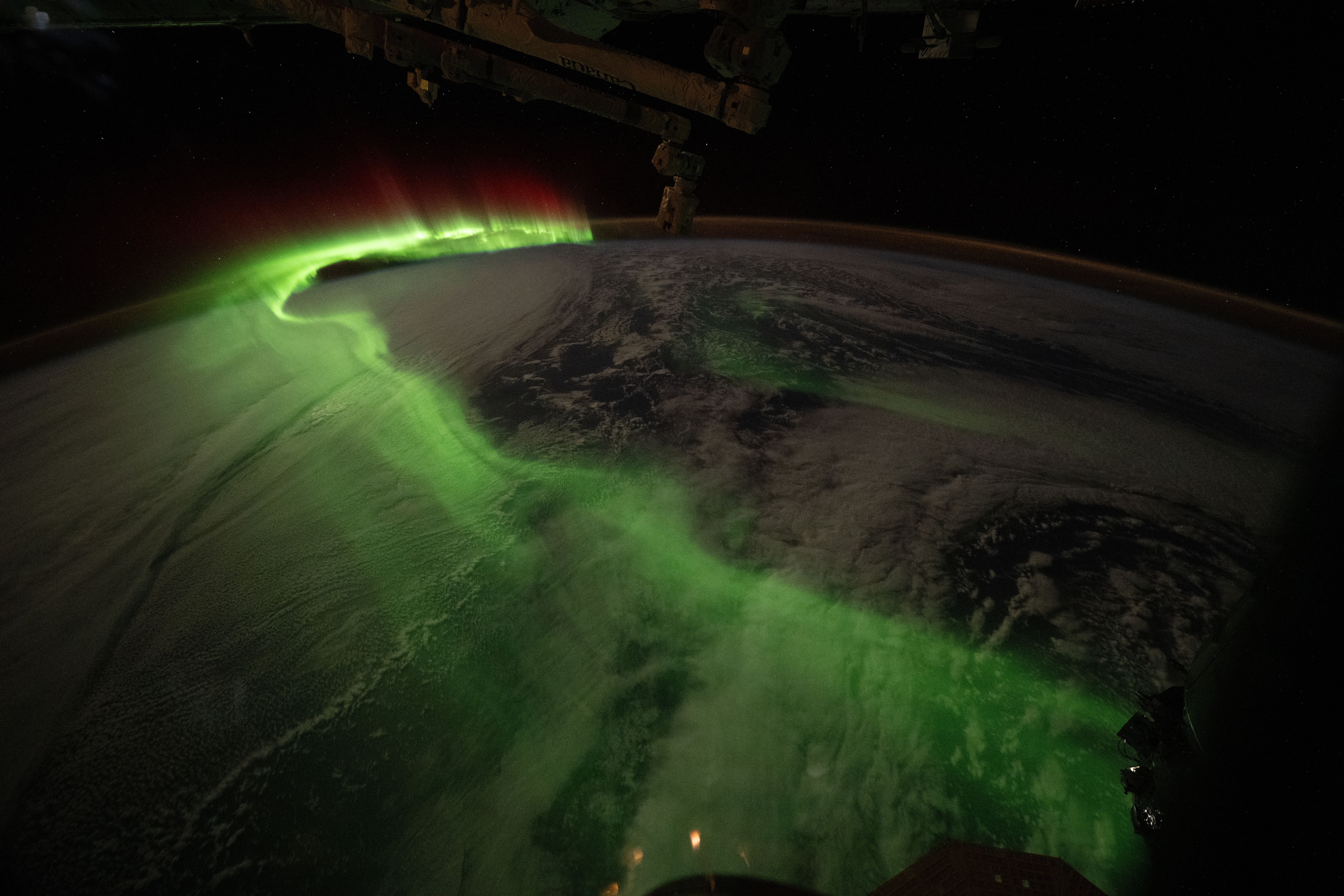
Aurora Australis

The aurora looks like a long, curving line of green mist arcing over Earth. Our home planet is dark, blending into the blackness of space on the right side of the image.
NASA/Jessica Meir

The aurora australis arcs over Earth during an active solar event in this photograph taken on June 5, 2026, from the International Space Station as it orbited 271 miles above the Indian Ocean southwest of Perth, Australia.

Auroras are colorful, dynamic, and often visually delicate displays of an intricate dance of particles and magnetism between the Sun and Earth called space weather.

Image credit: NASA/Jessica Meir

  •  

Aurora Australis

The aurora australis arcs over Earth during an active solar event in this photograph taken at approximately 11:32 p.m. local time from the International Space Station as it orbited 271 miles above the Indian Ocean southwest of Perth, Australia on June 5.

  •  

Espansione accelerata, arriva una nuova conferma

Lo scorso novembre un gruppo di astrofisici dell’Università Yonsei (Corea del Sud), guidato da Young-Wook Lee, pubblicò uno studio su Monthly Notices of the Royal Astronomical Society, ripreso anche qui su Media Inaf, nel quale si sosteneva che l’universo fosse già entrato in una fase di espansione rallentata almeno un miliardo di anni fa. Un’affermazione che, se confermata da successivi studi, avrebbe portato a una crisi del modello cosmologico standard Lambda-Cdm, che descrive un universo in espansione accelerata guidata dall’energia oscura. Ora però uno studio guidato da Phil Wiseman dell’Università di Southampton sembra aver scongiurato la crisi: l’articolo che riporta i risultati, pubblicato la settimana scorsa su Monthly Notices of the Royal Astronomical Society, conferma infatti l’espansione accelerata.

In particolare, lo studio si è basato sull’osservazione delle supernove di tipo Ia, utilizzate come candele standard per misurare le distanze cosmologiche grazie all’andamento standardizzabile della loro curva di luce. Misurando anche lo spostamento verso il rosso della luce osservata, è possibile ottenere la velocità di espansione in corrispondenza di diverse distanze spazio-temporali ed evidenziarne così l’accelerazione. Nel 1998, proprio grazie all’osservazione delle supernove di tipo Ia, Saul Perlmutter, Brian P. Schmidt e Adam Riess scoprirono l’espansione accelerata dell’universo, risultato che valse loro nel 2011 il premio Nobel per la fisica.

Questa immagine combina i dati provenienti da quattro telescopi spaziali per offrire una visione multibanda di ciò che resta di RCW 86, il più antico esempio documentato di supernova. Crediti raggi X: Nasa/Cxc/Sao & Esa; Infrarossi: Nasa/Jpl-Caltech/B. Williams (Ncsu)

«Affermazioni straordinarie richiedono verifiche particolarmente accurate», dice Riess, che, insieme a Schmidt, è anche fra i coautori del nuovo studio condotto da Wiseman. «Quello che abbiamo riscontrato è che, quando calibriamo queste supernove tenendo conto dei diversi ambienti che le ospitano e delle diverse popolazioni, le prove a sostegno dell’accelerazione cosmica rimangono straordinariamente coerenti».

Secondo lo studio del 2025 del team sudcoreano, infatti, con l’avanzare dell’età dell’universo le supernove Ia presentano luminosità massime diverse: questo indurrebbe gli astronomi a ritenere – erroneamente, stando agli autori del precedente articolo – che l’universo stia accelerando mentre in realtà starebbe rallentando. Lettura ora contestata dal team guidato da Wiseman, che ha individuato un errore nel modo in cui veniva stimata l’età delle stelle: in particolare, i risultati dello studio di novembre partivano dal presupposto – errato – che l’età di una galassia fosse la stessa dell’età della stella esplosa in supernova. Non solo: gli autori del nuovo articolo contestano allo studio sudcoreano il fatto di non tenere conto della massa delle galassie ospiti, una correzione standard utilizzata nella cosmologia moderna per dimostrare l’accuratezza.

«Le misurazioni precedenti, ampiamente accettate, erano in realtà corrette e la nostra attuale comprensione del destino dell’universo rimane solida», sostiene Wiseman. «Fortunatamente abbiamo scongiurato questa crisi, ma rimane il mistero sul perché il tasso di espansione dell’universo continui ad accelerare. Avendo dimostrato che le nostre misurazioni sono corrette, possiamo ora tornare a cercare di capire cosa sia effettivamente questa energia oscura, piuttosto che chiederci se esista davvero».

Anche se la crisi pare scongiurata, il fatto che teorie e osservazioni precedenti vengano messe in discussione è fondamentale per la scienza, sottolinea un altro fra i coautori del nuovo studio, Mark Sullivan, dell’Università di Southampton: «È così che si compiono progressi. Sebbene quest’idea non si sia rivelata corretta, ha aperto nuove vie di pensiero su come esplodono le supernove e su come possiamo misurare l’energia oscura in modo più accurato».

«Recentemente ci siamo concentrati molto sull’astrofisica delle esplosioni e su come queste influenzino la cosmologia», conclude Brodie Popovic, coautore dello studio. «Questa è stata una buona occasione per tornare indietro e rivedere tutte le nostre ipotesi: a quanto pare, sì, comprendiamo davvero questi fenomeni e ne teniamo conto nelle nostre misurazioni cosmologiche».

Per saperne di più:

  • Leggi su Monthly Notices of the Royal Astronomical Society l’articolo “Still accelerating: type Ia supernova cosmology is robust to host galaxy age evolution” di Phil Wiseman, Brodie Popovic, Mark Sullivan, Adam G. Riess, Dan Scolnic, Rebecca C. Chen, Tamara M. Davis, Lluís Galbany, Isobel M. Hook, Saurabh W. Jha, Lisa Kelsey, Yukei S. Murakami, Mickaël Rigault, Benjamin M. Rose, Brian Schmidt, Mat Smith e Maria Vincenzi


  •  

Nebraska’s Wide, Rolling Domain

The landscape in northwestern Nebraska has a rippled appearance, with tan parallel ridges running from left to right and green areas and small lakes filling the low-lying spaces in between.
The Nebraska Sandhills stretch across the north-central part of the state in this image acquired on August 19, 2025, with the OLI (Operational Land Imager) on Landsat 8.
NASA Earth Observatory/Lauren Dauphin

Editor’s Note: Today’s story is the answer to the June Puzzler.

The undulating landscape of north-central Nebraska may be easy to overlook among the iconic dune fields of the world. Far from any coast or desert, the Nebraska Sandhills—comprising the Western Hemisphere’s largest system of sand dunes—bring their own brand of beauty and value. Grasslands blanket the rolling hills, providing grazing grounds for livestock, while lakes and wetlands dot the landscape, supporting diverse plant and animal life.

Much of the sand forming the hills originated in the Rocky Mountains. Rivers carried the eroded material down from the mountains and deposited it across the Great Plains during the Pleistocene. In times of drought, winds blowing predominantly from the north or south lofted sand out of dried riverbeds, gradually building and shaping dunes. About 3,500 years ago, grassland vegetation stabilized the features. Today, the rippled pattern spans about 20,000 square miles (52,000 square kilometers), about one-quarter of the state of Nebraska.

A series of tan parallel ridges runs from left to right, with green areas and small lakes filling the low-lying spaces in between.
Some of the largest, grassland-covered dunes in the Nebraska Sandhills are found in the northwestern part of the region, shown in this image acquired on August 19, 2025, with the OLI (Operational Land Imager) on Landsat 8.
NASA Earth Observatory/Lauren Dauphin

Some of the largest dunes occur in and around the area shown in the detailed image above, near the northern edge of the Sandhills region. These transverse dunes stand as high as 400 feet (120 meters) and extend for several miles. Their northern slopes are gentler than their southern slopes, reflecting the dominant influence of northerly winds. In other areas, dunes are more symmetric, suggesting that winds blew with nearly equal strength from the north and south, alternating with the seasons.  

The grasslands that now cover the hills constitute pastureland for grazing livestock. Ranching expanded significantly in the area after passage of the Kinkaid Act in 1904, which allotted 640-acre parcels of land to ranchers who would settle it. Today, far more cattle than humans occupy the region, and half of Nebraska’s nearly 23 million acres of rangeland and pastureland are in the Sandhills. Some ranchers graze their cattle in patterns meant to approximate the large bison herds that once roamed the land.

Small, irregularly shaped lakes and marshy areas are interspersed among tan hills.
Lakes and wetlands fill the valleys between dunes in Crescent Lake National Wildlife Refuge, shown in this image acquired on August 19, 2025, with the OLI (Operational Land Imager) on Landsat 8.
NASA Earth Observatory/Lauren Dauphin

Though much of the land in the Sandhills is privately owned, some is set aside in protected public lands. One of these areas, Crescent Lake National Wildlife Refuge on the southwestern edge of the Sandhills region, is shown above. Wetlands, including shallow lakes, marshes, and wet meadows, fill some of the valleys between the dunes. The land here is sponge-like, with precipitation seeping down through the soil and recharging groundwater instead of flowing off through stream channels.

Located along the Central Flyway, the refuge is a haven for migratory birds, and dozens of species of waterfowl, marsh birds, and shorebirds utilize the area. Among other wildlife, several types of turtles thrive in the ponds and prairies. Wetlands across the Sandhills support rare species such as the whooping crane, western prairie fringed orchid, and Topeka shiner.

NASA Earth Observatory images by Lauren Dauphin, using Landsat data from the U.S. Geological Survey. Story by Lindsey Doermann.

Downloads

The landscape in northwestern Nebraska has a rippled appearance, with tan parallel ridges running from left to right and green areas and small lakes filling the low-lying spaces in between.

August 19, 2025

JPEG (10.71 MB)

References & Resources

You may also be interested in:

Stay up-to-date with the latest content from NASA as we explore the universe and discover more about our home planet.

Fires Tear Through Nebraska Grasslands

3 min read

Dry, warm, and windy conditions across the U.S. Great Plains led to extreme fire activity in March 2026.

Article

Farming in Ancient Lake Agassiz

3 min read

The glacial lake left a layer of silt and clay in southeastern Manitoba, creating fertile farmland that was divided during…

Article

America’s Emerald Isle

3 min read

Beaver Island is one in a string of verdant and scenic jewels in a northern Lake Michigan archipelago.

Article
  •  
❌