❌

Modalità di lettura

NASA to Host News Conference Previewing US Spacewalks 100, 101

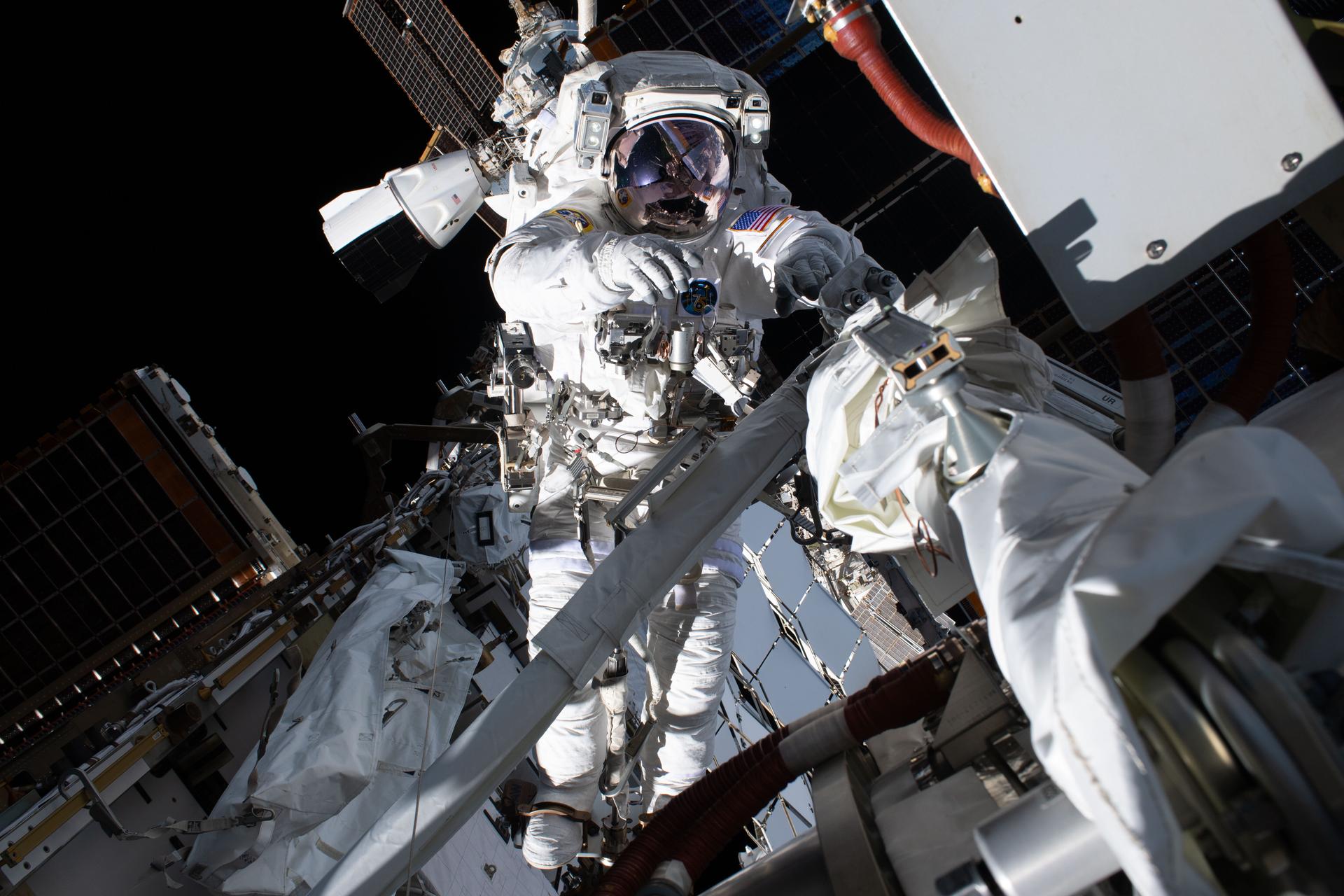
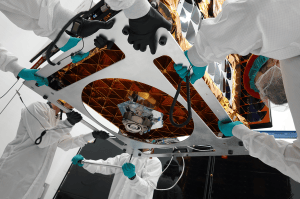
NASA astronaut and Expedition 75 flight engineer Anil Menon conducts a spacewalk to prepare the International Space Station for future upgrades to its power system. Menon helped build a modification kit on the station’s Starboard 6 truss segment where a roll out solar array is slated to be installed later this year.
NASA astronaut Anil Menon conducts a spacewalk on Aug. 6, 2026, to prepare the International Space Station for future upgrades to its power system.
Credit: NASA

NASA will preview two upcoming spacewalks to complete solar array installation and power augmentation of the International Space Station during a news conference at 2 p.m. EDT, Tuesday, Oct. 20, from NASA’s Johnson Space Center in Houston.

NASA will stream the event through a variety of platforms. Learn where to watch online:

https://www.nasa.gov/live

NASA participants in the news conference include:

  • Gaurang Patel, operations integration manager, Low Earth Orbit Program
  • Garrett Hehn, spacewalk flight director, Flight Operations Directorate

United States-based media interested in attending in person must contact the Johnson newsroom no later than 3 p.m., Monday, Oct. 19, at: jsccommu@mail.nasa.gov. Media joining by phone should request dial-in details by the same deadline. To ask a question, media must dial in no later than 15 minutes before the start of the news conference.

Thursday, Oct. 29

During U.S. spacewalk 100, NASA astronaut Anil Menon and CSA (Canadian Space Agency) astronaut Joshua Kutryk will exit the station’s Quest airlock to install and deploy an International Space Station Roll-Out Solar Array (IROSA) on the 2A electrical power channel. The solar array will be the seventh IROSA and will provide additional power to support critical station operations, including its safe and controlled deorbit.

Thursday, Nov. 5

During U.S. spacewalk 101, Menon and Kutryk will install and deploy the eighth and final IROSA on the 3B channel of the space station, completing the power augmentation upgrades.

The final two roll-out solar arrays will complete the space station’s power system augmentation. Together, the eight roll-out arrays will increase available power by up to 30%, boosting the station’s electric power generation capacity from 160 kilowatts to approximately 215 kilowatts.

NASA will share additional coverage details about U.S. spacewalks 100 and 101 closer to each operation on the agency’s live events web page and the space station blog. The spacewalks will be the 285th and 286th conducted in support of space station assembly, maintenance, and upgrades.

To learn more about International Space Station research, operations, and its crews, visit:

https://www.nasa.gov/station

-end-

Joshua Finch / Jimi Russell
Headquarters, Washington
202-358-1100
joshua.a.finch@nasa.gov / james.j.russell@nasa.gov

Sandra Jones / Anna Schneider
Johnson Space Center, Houston
281-483-5111
sandra.p.jones@nasa.gov / anna.c.schneider@nasa.gov

  •  

NASA to Host News Conference Previewing US Spacewalks 100, 101

NASA astronaut and Expedition 75 flight engineer Anil Menon conducts a spacewalk to prepare the International Space Station for future upgrades to its power system. Menon helped build a modification kit on the station’s Starboard 6 truss segment where a roll out solar array is slated to be installed later this year.
NASA astronaut Anil Menon conducts a spacewalk on Aug. 6, 2026, to prepare the International Space Station for future upgrades to its power system.
Credit: NASA

NASA will preview two upcoming spacewalks to complete solar array installation and power augmentation of the International Space Station during a news conference at 2 p.m. EDT, Tuesday, Oct. 20, from NASA’s Johnson Space Center in Houston.

NASA will stream the event through a variety of platforms. Learn where to watch online:

https://www.nasa.gov/live

NASA participants in the news conference include:

  • Gaurang Patel, operations integration manager, Low Earth Orbit Program
  • Garrett Hehn, spacewalk flight director, Flight Operations Directorate

United States-based media interested in attending in person must contact the Johnson newsroom no later than 3 p.m., Monday, Oct. 19, at: jsccommu@mail.nasa.gov. Media joining by phone should request dial-in details by the same deadline. To ask a question, media must dial in no later than 15 minutes before the start of the news conference.

Thursday, Oct. 29

During U.S. spacewalk 100, NASA astronaut Anil Menon and CSA (Canadian Space Agency) astronaut Joshua Kutryk will exit the station’s Quest airlock to install and deploy an International Space Station Roll-Out Solar Array (IROSA) on the 2A electrical power channel. The solar array will be the seventh IROSA and will provide additional power to support critical station operations, including its safe and controlled deorbit.

Thursday, Nov. 5

During U.S. spacewalk 101, Menon and Kutryk will install and deploy the eighth and final IROSA on the 3B channel of the space station, completing the power augmentation upgrades.

The final two roll-out solar arrays will complete the space station’s power system augmentation. Together, the eight roll-out arrays will increase available power by up to 30%, boosting the station’s electric power generation capacity from 160 kilowatts to approximately 215 kilowatts.

NASA will share additional coverage details about U.S. spacewalks 100 and 101 closer to each operation on the agency’s live events web page and the space station blog. The spacewalks will be the 285th and 286th conducted in support of space station assembly, maintenance, and upgrades.

To learn more about International Space Station research, operations, and its crews, visit:

https://www.nasa.gov/station

-end-

Joshua Finch / Jimi Russell
Headquarters, Washington
202-358-1100
joshua.a.finch@nasa.gov / james.j.russell@nasa.gov

Sandra Jones / Anna Schneider
Johnson Space Center, Houston
281-483-5111
sandra.p.jones@nasa.gov / anna.c.schneider@nasa.gov

  •  

NASA to Host News Conference Previewing US Spacewalks 100, 101

NASA astronaut and Expedition 75 flight engineer Anil Menon conducts a spacewalk to prepare the International Space Station for future upgrades to its power system. Menon helped build a modification kit on the station’s Starboard 6 truss segment where a roll out solar array is slated to be installed later this year.
NASA astronaut Anil Menon conducts a spacewalk on Aug. 6, 2026, to prepare the International Space Station for future upgrades to its power system.
Credit: NASA

NASA will preview two upcoming spacewalks to complete solar array installation and power augmentation of the International Space Station during a news conference at 2 p.m. EDT, Tuesday, Oct. 20, from NASA’s Johnson Space Center in Houston.

NASA will stream the event through a variety of platforms. Learn where to watch online:

https://www.nasa.gov/live

NASA participants in the news conference include:

  • Gaurang Patel, operations integration manager, Low Earth Orbit Program
  • Garrett Hehn, spacewalk flight director, Flight Operations Directorate

United States-based media interested in attending in person must contact the Johnson newsroom no later than 3 p.m., Monday, Oct. 19, at: jsccommu@mail.nasa.gov. Media joining by phone should request dial-in details by the same deadline. To ask a question, media must dial in no later than 15 minutes before the start of the news conference.

Thursday, Oct. 29

During U.S. spacewalk 100, NASA astronaut Anil Menon and CSA (Canadian Space Agency) astronaut Joshua Kutryk will exit the station’s Quest airlock to install and deploy an International Space Station Roll-Out Solar Array (IROSA) on the 2A electrical power channel. The solar array will be the seventh IROSA and will provide additional power to support critical station operations, including its safe and controlled deorbit.

Thursday, Nov. 5

During U.S. spacewalk 101, Menon and Kutryk will install and deploy the eighth and final IROSA on the 3B channel of the space station, completing the power augmentation upgrades.

The final two roll-out solar arrays will complete the space station’s power system augmentation. Together, the eight roll-out arrays will increase available power by up to 30%, boosting the station’s electric power generation capacity from 160 kilowatts to approximately 215 kilowatts.

NASA will share additional coverage details about U.S. spacewalks 100 and 101 closer to each operation on the agency’s live events web page and the space station blog. The spacewalks will be the 285th and 286th conducted in support of space station assembly, maintenance, and upgrades.

To learn more about International Space Station research, operations, and its crews, visit:

https://www.nasa.gov/station

-end-

Joshua Finch / Jimi Russell
Headquarters, Washington
202-358-1100
joshua.a.finch@nasa.gov / james.j.russell@nasa.gov

Sandra Jones / Anna Schneider
Johnson Space Center, Houston
281-483-5111
sandra.p.jones@nasa.gov / anna.c.schneider@nasa.gov

  •  

NASA Astronauts to Answer Questions from Florida Students

NASA astronaut Jessica Watkins assists NASA astronaut Luke Delaney as he practices suiting up in a spacesuit in an International Space Station airlock simulator on May, 5, 2026, at the agency's Johnson Space Center Space Vehicle Mockup Facility in Houston.
NASA astronaut Jessica Watkins assists NASA astronaut Luke Delaney as he practices suiting up in a spacesuit in an International Space Station airlock simulator on May 5, 2026, at the agency’s Johnson Space Center Space Vehicle Mockup Facility in Houston.
Credit: NASA

Editor’s Note: This article was updated Thursday, Oct. 15, 2026, to reflect a change to the event start time.

Students in Florida will hear from NASA astronauts Jessica Watkins and Luke Delaney as they answer prerecorded STEM questions while aboard the International Space Station.

The Earth-to-space call will begin at 12:30 p.m. EDT Friday, Oct. 16, and will stream live on the agency’s Learn With NASA YouTube channel.

This event is hosted by Sally Ride Elementary School in Orlando, Florida, for students in grades K-12, and the community. This unique opportunity aims to deepen understanding of space exploration and enhance awareness of STEM careers.

Media interested in covering the event must RSVP no later than 5 p.m. EDT, Thursday, Oct. 15, to Jenny Morgan at (407) 858-3100, or at jenny.morgan@ocps.net.

For more than 25 years, people have lived and worked continuously aboard the International Space Station, advancing scientific knowledge and making research breakthroughs not possible on Earth. The space station helps NASA understand and overcome the challenges of human spaceflight, expand commercial opportunities in low Earth orbit, and build on the foundation for long-duration missions to the Moon, as part of the Artemis program, and to Mars.

For more information on NASA in-flight calls, visit:

https://www.nasa.gov/stemonstation

  •  

NASA Astronauts to Answer Questions from Florida Students

NASA astronaut Jessica Watkins assists NASA astronaut Luke Delaney as he practices suiting up in a spacesuit in an International Space Station airlock simulator on May, 5, 2026, at the agency's Johnson Space Center Space Vehicle Mockup Facility in Houston.
NASA astronaut Jessica Watkins assists NASA astronaut Luke Delaney as he practices suiting up in a spacesuit in an International Space Station airlock simulator on May 5, 2026, at the agency’s Johnson Space Center Space Vehicle Mockup Facility in Houston.
Credit: NASA

Editor’s Note: This article was updated Thursday, Oct. 15, 2026, to reflect a change to the event start time.

Students in Florida will hear from NASA astronauts Jessica Watkins and Luke Delaney as they answer prerecorded STEM questions while aboard the International Space Station.

The Earth-to-space call will begin at 12:30 p.m. EDT Friday, Oct. 16, and will stream live on the agency’s Learn With NASA YouTube channel.

This event is hosted by Sally Ride Elementary School in Orlando, Florida, for students in grades K-12, and the community. This unique opportunity aims to deepen understanding of space exploration and enhance awareness of STEM careers.

Media interested in covering the event must RSVP no later than 5 p.m. EDT, Thursday, Oct. 15, to Jenny Morgan at (407) 858-3100, or at jenny.morgan@ocps.net.

For more than 25 years, people have lived and worked continuously aboard the International Space Station, advancing scientific knowledge and making research breakthroughs not possible on Earth. The space station helps NASA understand and overcome the challenges of human spaceflight, expand commercial opportunities in low Earth orbit, and build on the foundation for long-duration missions to the Moon, as part of the Artemis program, and to Mars.

For more information on NASA in-flight calls, visit:

https://www.nasa.gov/stemonstation

  •  

NASA Astronauts to Answer Questions from Florida Students

NASA astronaut Jessica Watkins assists NASA astronaut Luke Delaney as he practices suiting up in a spacesuit in an International Space Station airlock simulator on May, 5, 2026, at the agency's Johnson Space Center Space Vehicle Mockup Facility in Houston.
NASA astronaut Jessica Watkins assists NASA astronaut Luke Delaney as he practices suiting up in a spacesuit in an International Space Station airlock simulator on May 5, 2026, at the agency’s Johnson Space Center Space Vehicle Mockup Facility in Houston.
Credit: NASA

Editor’s Note: This article was updated Thursday, Oct. 15, 2026, to reflect a change to the event start time.

Students in Florida will hear from NASA astronauts Jessica Watkins and Luke Delaney as they answer prerecorded STEM questions while aboard the International Space Station.

The Earth-to-space call will begin at 12:30 p.m. EDT Friday, Oct. 16, and will stream live on the agency’s Learn With NASA YouTube channel.

This event is hosted by Sally Ride Elementary School in Orlando, Florida, for students in grades K-12, and the community. This unique opportunity aims to deepen understanding of space exploration and enhance awareness of STEM careers.

Media interested in covering the event must RSVP no later than 5 p.m. EDT, Thursday, Oct. 15, to Jenny Morgan at (407) 858-3100, or at jenny.morgan@ocps.net.

For more than 25 years, people have lived and worked continuously aboard the International Space Station, advancing scientific knowledge and making research breakthroughs not possible on Earth. The space station helps NASA understand and overcome the challenges of human spaceflight, expand commercial opportunities in low Earth orbit, and build on the foundation for long-duration missions to the Moon, as part of the Artemis program, and to Mars.

For more information on NASA in-flight calls, visit:

https://www.nasa.gov/stemonstation

  •  

NASA’s Chandra Breaks Down ‘Treble Clef’s’ Galaxy Cluster Collision

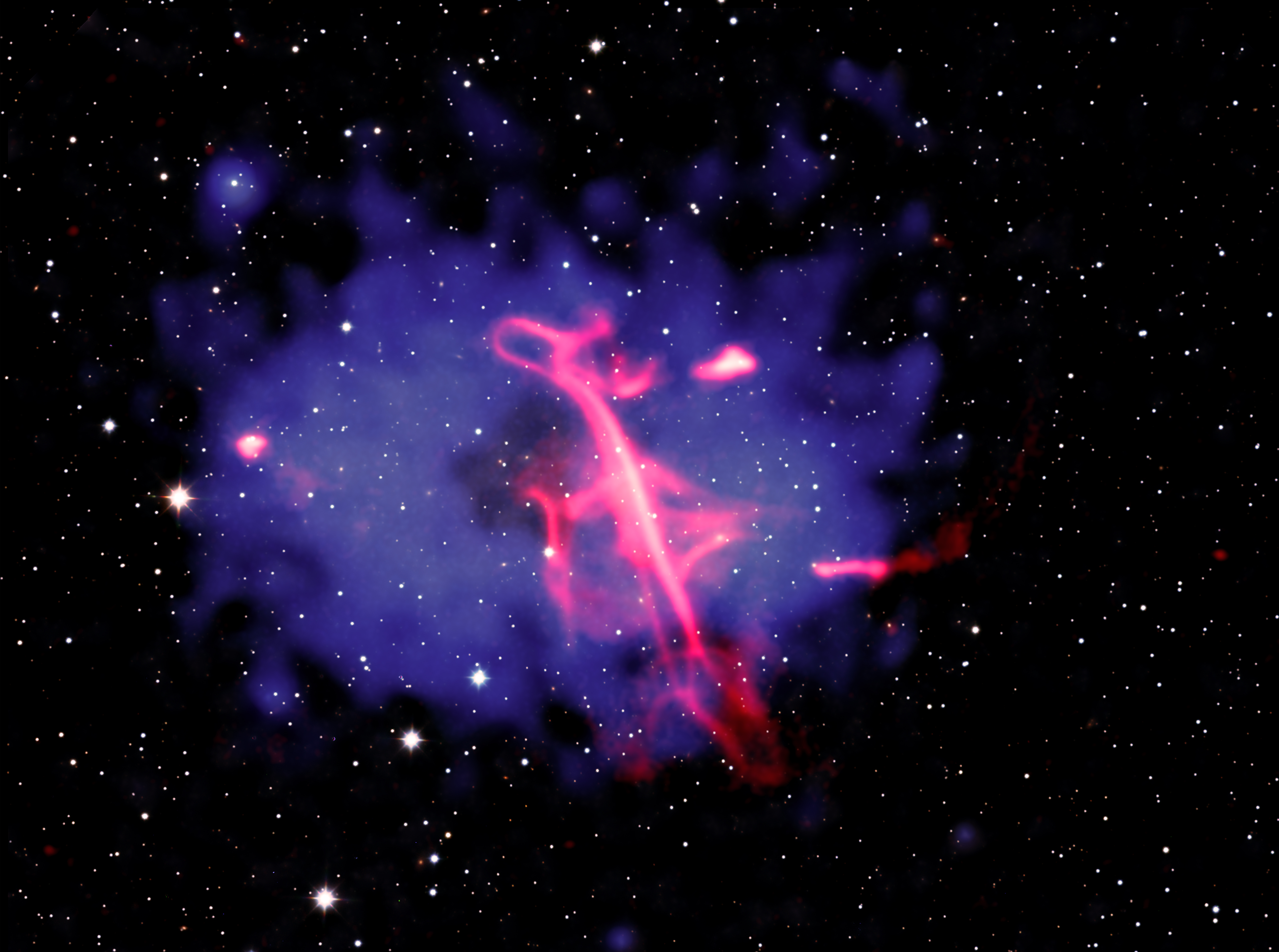
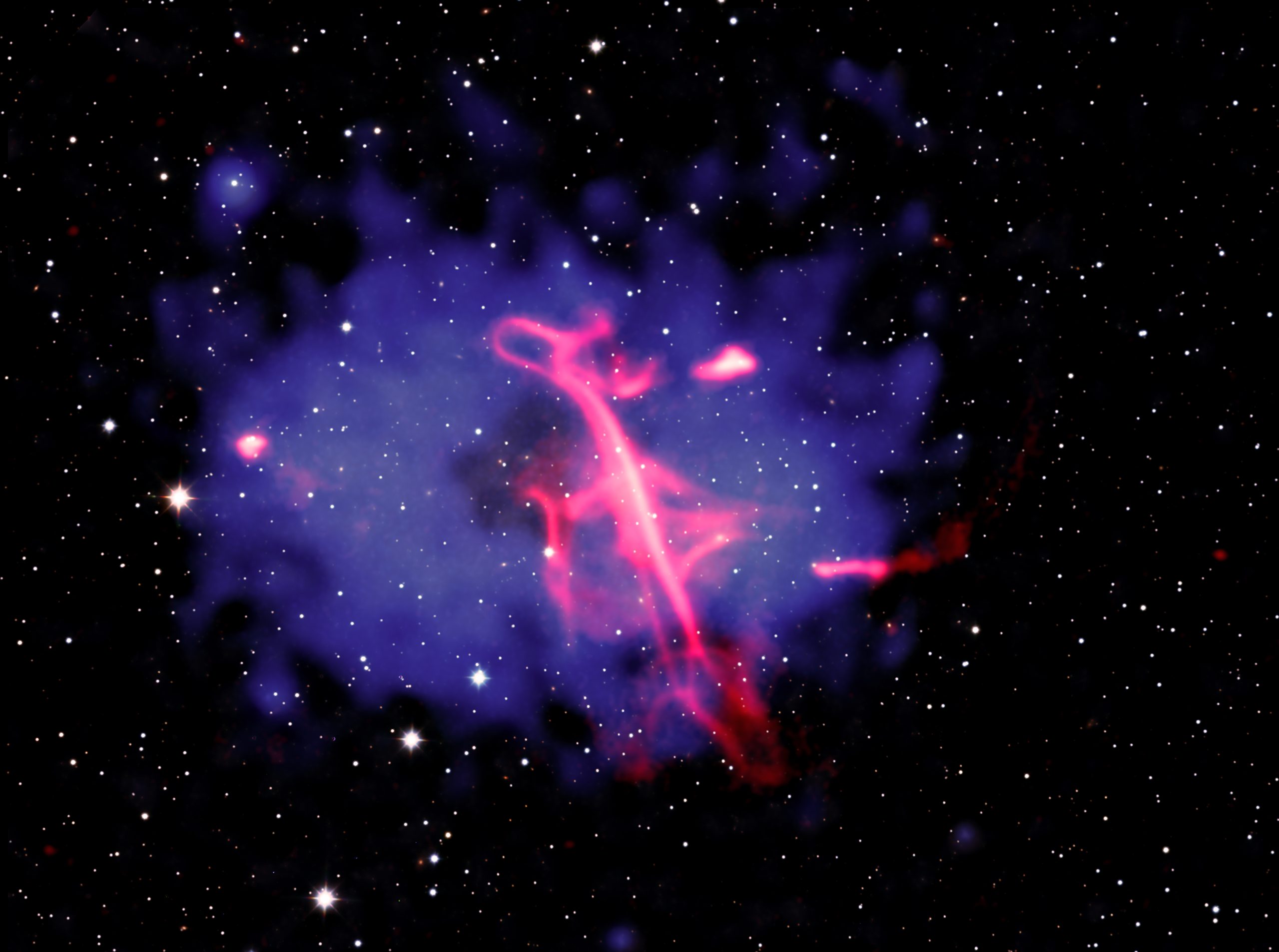
Using Chandra, astronomers have discovered that an outburst from a supermassive black hole, followed by a collision of two galaxy clusters, are the likely causes of an unusual formation in a galaxy cluster. The “Treble Clef” radio source was given its nickname because of a distinct shape in radio waves that resembles the musical symbol. This composite image of the Treble Clef and its galaxy cluster contains X-rays from Chandra and eROSITA, radio data from LOFAR, and infrared data from UKIRT.
X-ray: NASA/CXC/INAF-IRA/A. Botteon et al.; Infrared: UKIDSS-GPS ; Radio: ASTRON/LOFAR; Image processing: NASA/CXC/SAO/N. Wolk

Astronomers have used NASA’s Chandra X-ray Observatory to break down the cause of a remarkable formation of radio waves they have nicknamed the “Treble Clef” because its distinct shape strongly resembles the musical symbol.

The researchers discovered the Treble Clef is likely caused by an outburst from a supermassive black hole, followed by a collision of two galaxy clusters. A paper describing the findings, led by Andrea Botteon of the National Institute for Astrophysics, or INAF, in Italy, published Wednesday in the Astronomy & Astrophysics journal.

An explanation for the Treble Clef has been particularly difficult to find because the formation lies almost directly behind the plane of the Milky Way, meaning that stars, gas, and dust from our home galaxy largely block the view from Earth. However, by using telescopes that can peer through the intervening material, a team of researchers was able to identify what is responsible for this uncommon structure.

NASA’s Chandra and the German Extended RÖntgen Survey with an Imaging Telescope Array (eROSITA) X-ray telescope found diffuse, hot gas at the location of the Treble Clef, showing that a galaxy cluster hosts the object. The researchers also determined the galaxy cluster is, in fact, two clusters in the process of merging. Galaxy clusters are some of the largest structures in the universe, containing hundreds of individual galaxies and huge reservoirs of superheated gas.

This new composite image of the Treble Clef and its cluster shows the multimillion-degree gas detected in X-rays by Chandra and eROSITA in blue, with some of the Chandra data derived from a special technique the authors used to highlight important features in the Chandra data. Radio data shown in red from the LOw Frequency ARray (LOFAR), a large network of radio telescopes in Europe reveals the doppelganger of the musical notation. The final piece of the combined image comes from infrared data obtained by the United Kingdom Infrared Telescope, appearing mostly white.

The authors concluded that the Treble Clef likely formed in a two-stage process. First, an earlier outburst from a supermassive black hole in the galaxy cluster’s center drove clouds of charged particles and magnetic fields away at close to the speed of light. This led to a type of cosmic crescendo and initially produced bright radio waves that later faded as the particles lost energy. Next, the collision between the two clusters compressed or reenergized the cloud, which became brighter again in radio waves. Shock waves — similar to the sonic booms from supersonic jets — from the collision may have played a role in this reenergizing process.

To reveal evidence for the cluster collision in the Chandra data, the authors used a special technique that examined how much the cluster’s hot gas deviates from a symmetrical shape. Most of the hot gas is symmetrical and shaped approximately like an oval. The authors removed this symmetrical oval shape from the original X-ray image. The remaining X-ray emission in the residual image shows t is brightest on the left and right, and faintest in the center. The new composite image combines both the original X-ray and the residual X-ray images.

The brighter X-rays in the residual image, toward the left and right of the cluster’s center, imply that the collision between the two clusters likely occurred along the left-right direction as seen in the image. The researchers think the direct collision between the two clusters occurred a few hundred million years ago, and the clusters are now moving away from each other.

The resemblance to a treble clef is a case of pareidolia, the phenomenon when people see familiar shapes in random data, since there is no scientific connection to the musical notation.

NASA’s Marshall Space Flight Center in Huntsville, Alabama, manages the Chandra program. The Smithsonian Astrophysical Observatory’s Chandra X-ray Center controls science operations from Cambridge, Massachusetts, and flight operations from Burlington, Massachusetts.

To learn more about Chandra, visit:

https://nasa.gov/chandra

Visual Description

This release features a composite image of a remarkable radio wave formation that strongly resembles a treble clef musical symbol, hovering in the midst of two colliding galaxy clusters.

Here, galaxies in the galaxy clusters, plus foreground and background stars and galaxies, blanket the image with specks of light set against the blackness of space. At the center of the frame is a large, oval, blue-purple cloud with ragged edges. This is a multimillion-degree gas cloud in the two clusters detected in X-rays by Chandra and eROSITA, the Extended RÖntgen Survey with an Imaging Telescope Array.

In the middle of the purple field, tilting slightly to our left, is what appears to be a giant treble clef, loosely drawn with a neon pink marker. Like the musical notation for which it’s named, the formation has a strong vertical stroke with a continuous, fluid line swooping back and forth as it moves from top to bottom.

This radio wave formation appears to be the result of a two-stage process. First, charged particles and magnetic fields were driven from a supermassive black hole, producing bright radio waves. Those waves faded and lost energy over time, before being reenergized and compressed when the two galaxy clusters collided.

Share

Details

Last Updated
Oct 15, 2026
Editor
Lee Mohon
Contact
Location
Marshall Space Flight Center
  •  

Quel treno fermato dal Sole, 178 anni fa

18 ottobre 1841. Nella stazione ferroviaria di Exeter, in Inghilterra, un treno con partenza prevista alle 22:05 rimane fermo per 16 minuti. A causare il ritardo è un’improvvisa anomalia del sistema telegrafico utilizzato dagli operatori per comunicare il “via libera” al transito dei treni. Per oltre un secolo, questo episodio, descritto in un articolo pubblicato nel 1871 su Nature, è stato considerato il più antico caso documentato di interferenza del meteo spaziale sulle infrastrutture tecnologiche umane.
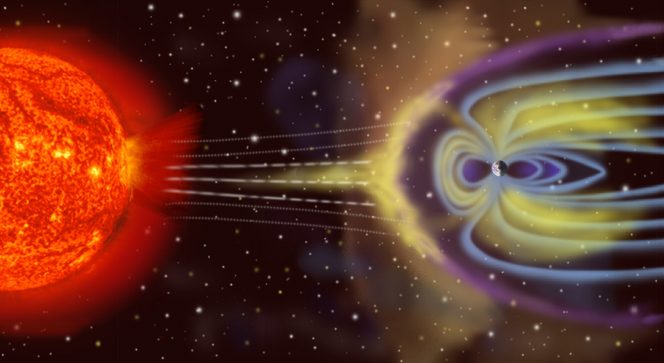
Rappresentazione artistica di una tempesta solare in viaggio verso la Terra. Crediti: Nasa

Una nuova indagine condotta da un team di ricerca della Lancaster University ha ora dimostrato che la ricostruzione riportata in quella pubblicazione contiene un errore fondamentale: nel 1841 quella linea ferroviaria non esisteva ancora. Incrociando documenti d’archivio, orari d’epoca dei treni riportati nei giornali locali e registrazioni geomagnetiche, i ricercatori hanno scoperto che l’evento si verificò in realtà il 18 ottobre del 1848, esattamente sette anni dopo rispetto alla data riportata sulla rivista scientifica britannica, probabilmente a causa di un refuso tipografico. I risultati sono pubblicati nella rivista Space Weather.

La meteorologia spaziale studia le condizioni ambientali nello spazio vicino alla Terra, con particolare attenzione ai fenomeni generati dall’attività solare – come i brillamenti e le espulsioni di massa coronali – e ai loro effetti sul campo magnetico terrestre. Negli ultimi due secoli, l’impatto di questi fenomeni sulla società è cresciuto di pari passo con il progresso tecnologico e con lo sviluppo delle infrastrutture moderne. Per millenni, l’attività solare ha influenzato la Terra, manifestandosi soprattutto attraverso le spettacolari e innocue aurore polari. La nascita delle prime infrastrutture elettriche e di comunicazione nell’Ottocento ha però cambiato radicalmente questo scenario.

È celebre ed emblematico, in questo ambito, l’evento di Carrington-Hodgson del 1859, considerato una delle tempeste geomagnetiche più intense documentate nella letteratura scientifica. È stato associato al brillamento solare più potente mai registrato. Sebbene all’epoca la tempesta solare abbia causato diffuse interruzioni del funzionamento dei sistemi telegrafici elettrici, l’evento non fu il primo caso documentato di interferenza tra l’attività solare e le infrastrutture tecnologiche. Sulla base delle testimonianze storiche disponibili, fino a oggi si riteneva che il primato spettasse all’evento di Exeter del 1841. La nuova indagine condotta dal team di ricerca guidato da James A. Wild, ricercatore alla Lancaster University, ha però messo in luce numerose incongruenze.

La vicenda trae origine da un articolo anonimo pubblicato nel numero di Nature del 5 ottobre 1871. Secondo quanto riportato nel documento, la sera del 18 ottobre 1841 il treno espresso delle 22:05 in partenza da Exeter verso Starcross, nel sud-ovest dell’Inghilterra, sarebbe stato trattenuto per 16 minuti a causa di intense perturbazioni magnetiche che hanno impedito ai controllori di verificare se il binario fosse libero. Il racconto includeva perfino una nota del capostazione, convinto che «qualcuno stesse giocando uno scherzo agli strumenti, impedendo loro di funzionare».
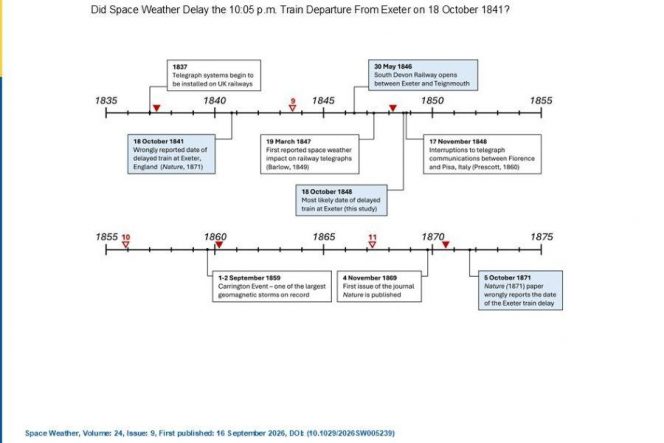
Cronologia delle principali date comprese tra il 1835 e il 1875 rilevanti per l’indagine. Le voci evidenziate si riferiscono agli eventi più significativi per ricostruire il ritardo di 16 minuti del treno di Exeter, come descritto nell’articolo di Nature. I triangoli vuoti e pieni indicano, rispettivamente, i minimi e i massimi dell’attività solare. I minimi sono identificati con il numero del ciclo solare successivo. Crediti: James A. Wild, Space Weather, 2026

Come anticipato, se fosse veritiero, l’episodio rappresenterebbe il primo caso documentato di interferenza del meteo spaziale con un sistema tecnologico. Tuttavia, il riesame della documentazione storica da parte del gruppo di ricerca ha dimostrato che la data riportata nell’articolo è errata.

«Questa ricerca evidenzia che il meteo spaziale non è una minaccia nuova, ma un rischio naturale presente da molto tempo», dice Jim Wild, ricercatore alla Lancaster University e primo autore dello studio. «La società sperimenta gli effetti della meteorologia spaziale sulla tecnologia fin dall’epoca in cui esistono le tecnologie elettriche. Il ritardo del treno a Exeter è una vicenda affascinante, perché si colloca proprio nel momento in cui le tecnologie emergenti cominciarono a confrontarsi con le condizioni dell’ambiente spaziale. Combinando documenti d’archivio e osservazioni scientifiche, siamo riusciti a dimostrare che l’evento si verificò quasi certamente nel 1848, anziché nel 1841».

Vediamo più nel dettaglio come si è arrivati a questa conclusione. Il primo indizio è emerso dai documenti relativi alla costruzione della linea ferroviaria. La ferrovia che collegava le cittadine di Exeter e Plymouth, spiegano i ricercatori, fu originariamente costruita e gestita dalla South Devon Railway Company. All’epoca della sua costruzione, la linea impiegava un innovativo sistema di propulsione che utilizzava aria compressa per spingere i treni. Dalle indagini documentali, risulta che la legge del Parlamento per la costruzione della ferrovia ottenne l’approvazione solo nel luglio del 1844 (South Devon Railway Act, 1844). Inoltre, la ferrovia fu costruita a tappe: il primo tratto della linea, tra la città di Exeter e la cittadina di Teignmouth, fu inaugurato e aperto al pubblico il 30 maggio del 1846. Nel 1841, dunque, la linea non esisteva e nessun treno avrebbe potuto percorrerla. Il treno citato nella pubblicazione non avrebbe potuto circolare in quell’anno. Pertanto, l’articolo di Nature non può essere accurato.

Un’ulteriore conferma che l’evento non si è verificato nel 1841 arriva dall’analisi degli orari ferroviari. Per risalire alla data corretta, i ricercatori hanno infatti consultato i quadri orari pubblicati sui quotidiani locali dell’epoca, individuando un’incongruenza nella datazione originaria. Le 22:05 erano infatti l’orario di partenza del treno serale da Exeter verso Starcross solo in un intervallo temporale ben preciso, compreso tra l’11 marzo 1848 e il 26 luglio 1849.

Ma è dall’esame dei magnetogrammi d’epoca dell’Osservatorio di Greenwich che emerge la prova decisiva della data effettiva dell’evento. Esaminati dai ricercatori, i tracciati rivelano una violenta tempesta geomagnetica proprio nella fascia oraria compresa tra le 22:00 e le 22:20, ora locale, del 18 ottobre 1848. I taccuini dell’astronomo e matematico Temple Chevallier, custoditi dalla Royal Astronomical Society, documentano che, nello stesso giorno, lo scienziato osservò e disegnò un imponente gruppo di macchie solari situato sotto l’equatore solare. Nelle stesse settimane, inoltre, diversi quotidiani riferirono di aurore boreali visibili in tutta Europa, compresa l’Italia, dove il fisico Carlo Matteucci registrò interruzioni delle comunicazioni telegrafiche tra Firenze e Pisa.

Utilizzando le informazioni contestuali e gli orari ferroviari per circoscrivere l’indagine a un periodo di quattro mesi del 1848, i ricercatori hanno individuato osservazioni solari, registrazioni geomagnetiche e testimonianze riportate dalla stampa dell’epoca che indicano un periodo di intensa attività meteorologica spaziale nel Regno Unito intorno al 18 ottobre 1848. Data, questa, che corrisponde esattamente al giorno e al mese indicati nell’articolo di Nature, ma sette anni più tardi. Tutte queste evidenze porterebbero a concludere che l’evento di Exeter non si verificò nel 1841, bensì nel 1848. Secondo gli autori dello studio, la data riportata nell’articolo di Nature sarebbe frutto di un refuso tipografico nel testo originale, che trasformò il “1848” in “1841”. Un errore non raro nelle pubblicazioni dell’epoca.

La rettifica della data dell’episodio di Exeter modifica la cronologia del primo caso documentato di interferenza tra la meteorologia spaziale e la tecnologia. Il primato passa ora a un evento del 19 marzo 1847 –  descritto da nella rivista Philosophical Transactions of the Royal Society, nel numero 139 del 1849 –  durante il quale le perturbazioni geomagnetiche bloccarono il sistema telegrafico della Midland Railway nei pressi di Derby, in Inghilterra. Ciononostante, l’episodio di Exeter rimane uno dei più antichi esempi conosciuti degli effetti della meteorologia spaziale sulle infrastrutture tecnologiche, verificatosi oltre un decennio prima del celebre evento di Carrington del 1859, che provocò diffuse interruzioni dei sistemi telegrafici.

Questo studio evidenzia l’importanza di utilizzare un’ampia varietà di fonti documentali e bibliografiche per valutare e confrontare le testimonianze storiche sugli eventi di meteorologia spaziale e sui loro effetti sulla società, concludono i ricercatori. Nei casi in cui la letteratura scientifica dell’epoca si è rivelata poco attendibile – e non mancano gli esempi – le testimonianze  pubblicate sui giornali locali dell’epoca si sono dimostrate preziosissime, soprattutto se confrontate con le osservazioni scientifiche conservate negli archivi.

Per saperne di più:

  •  

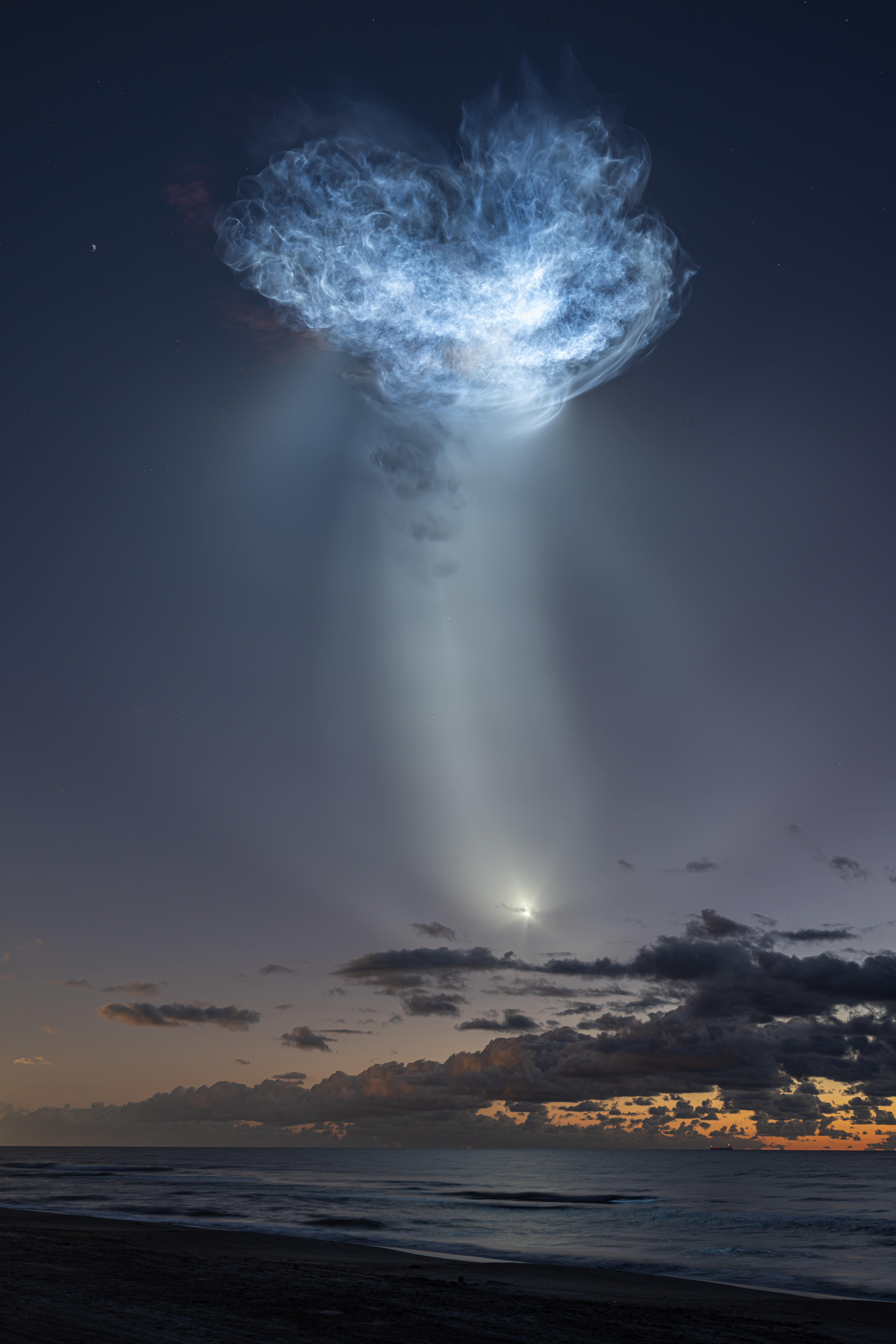
NASA’s SpaceX CRS-35 Launch Jellyfish

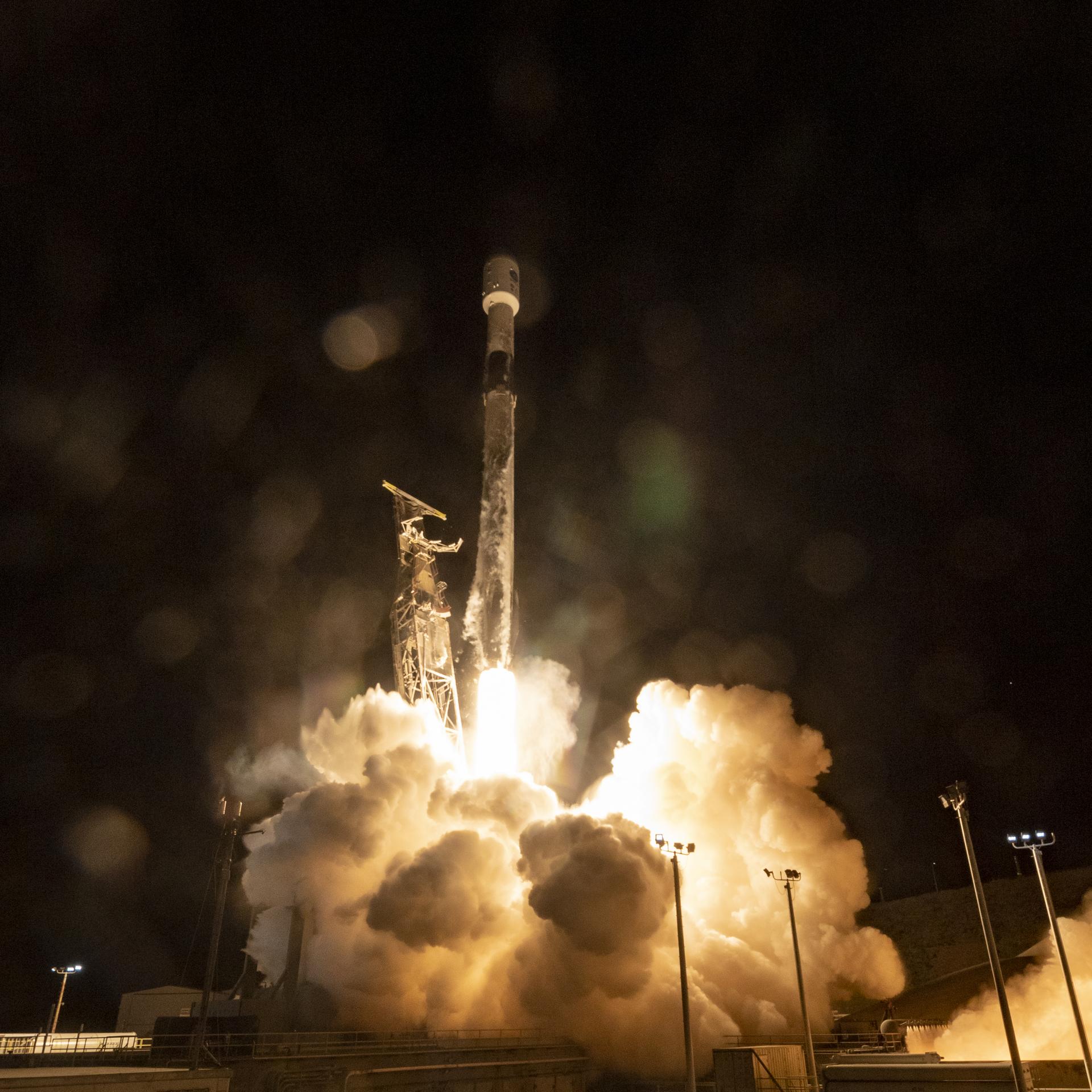
The exhaust plumes of a SpaceX Falcon 9 rocket carrying the company’s Dragon spacecraft are seen illuminated by sunlight against the predawn sky during the launch of NASA’s SpaceX CRS-35 mission, Tuesday, Oct. 13, 2026, as seen from Cocoa Beach, Florida. The light makes the plumes look like a jellyfish in the sky.

  •  

NASA’s Space X CRS-35 Launch Jellyfish

The exhaust plumes of a SpaceX Falcon 9 rocket carrying the company’s Dragon spacecraft are seen illuminated by sunlight against the predawn sky.
NASA/John Kraus

Sunlight illuminates the exhaust plumes of a SpaceX Falcon 9 rocket carrying the company’s Dragon spacecraft on Oct. 13, 2026. This visual phenomenon is known as a “jellyfish”; it happens near sunrise or sunset when the exhaust plume from the rocket becomes brightly illuminated, creating a glowing shape resembling a jellyfish.

The mission lifted off at 6:33 a.m. EDT from Space Launch Complex 40 at Cape Canaveral Space Force Station, carrying scientific investigations, supplies, and equipment to the International Space Station on SpaceX’s 35th commercial resupply services mission for NASA. The rocket’s exhaust plumes were visible across the eastern United States.

Watch the uncrewed Dragon spacecraft rendezvous with and dock to the International Space Station on Oct. 15. Coverage begins at 9:15 a.m. EDT.

Image credit: NASA/John Kraus

  •  

NASA Develops Batteries to Power Humanity’s Return to Moon

5 min read

Preparations for Next Moonwalk Simulations Underway (and Underwater)

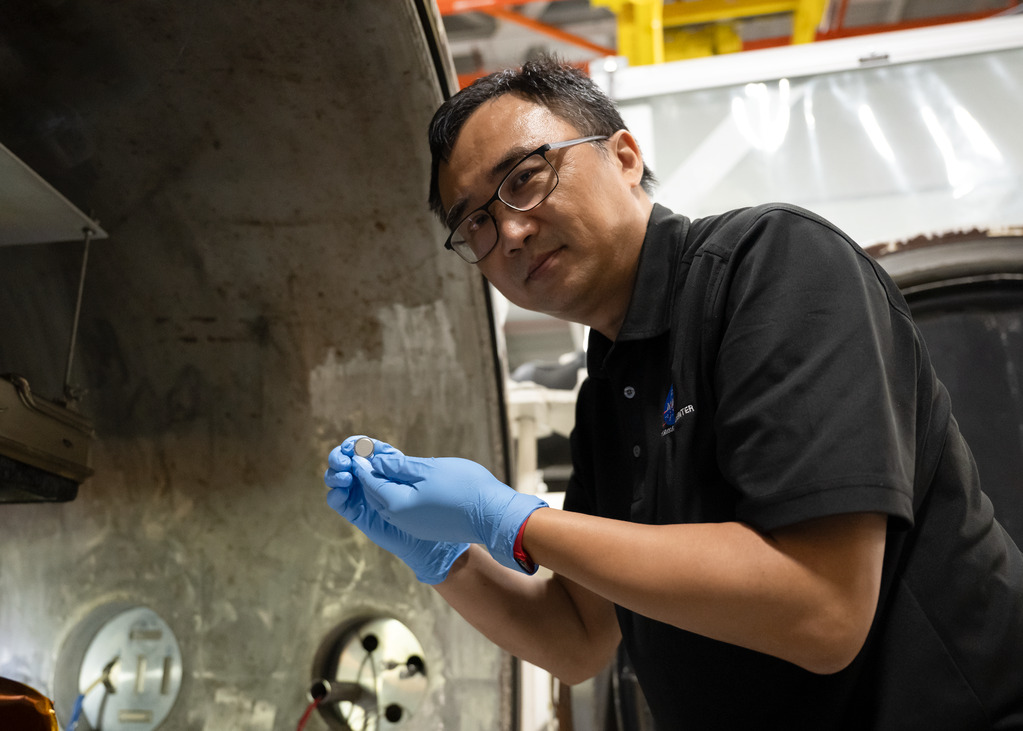
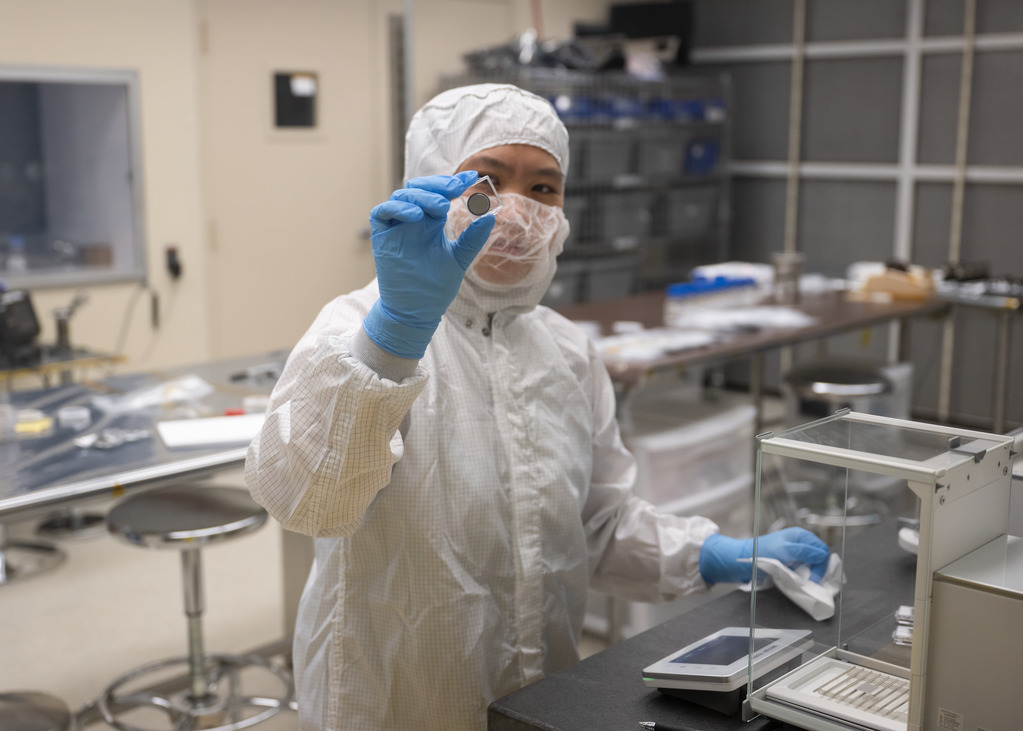
Yi Lin, SPEARS testing and research lead at NASA Langley, holds one of the small coin-cell batteries that had just undergone thermal vacuum testing.
NASA/Ryan Hill

If you’ve ever had your car start sluggishly, or not at all, on a particularly frigid winter morning, you know standard batteries do not like extreme cold. That’s why NASA researchers are working to develop a battery that could function in the brutal cold of the Moon’s South Pole, where nighttime temperatures plunge to minus 328 degrees Fahrenheit (minus 200 Celsius). 

For future lunar operations, a battery will need to work immediately when warmed up and be able to power everything from an astronaut’s emergency kit to a rover capable of exploring the Moon’s darkest craters — all without posing a fire hazard. 

A team of NASA researchers is working to make all that happen. The project is called Solid Power for Extreme Environment Adaptability and Resilience in Space (SPEARS), and it could provide NASA with an important tool to help power humanity’s sustained presence on the Moon through the Artemis campaign. 

“Batteries have become an important part of our lives here on Earth, which enable our laptops, cell phones, power tools, and even our vehicles,” said Donald Dornbusch, principal investigator for SPEARS at NASA’s Glenn Research Center in Cleveland, where the project is led. “We will need them on the Moon, too, and these batteries will be required to operate reliably and safely in this harsh environment. That’s why we’re working on this technology.” 

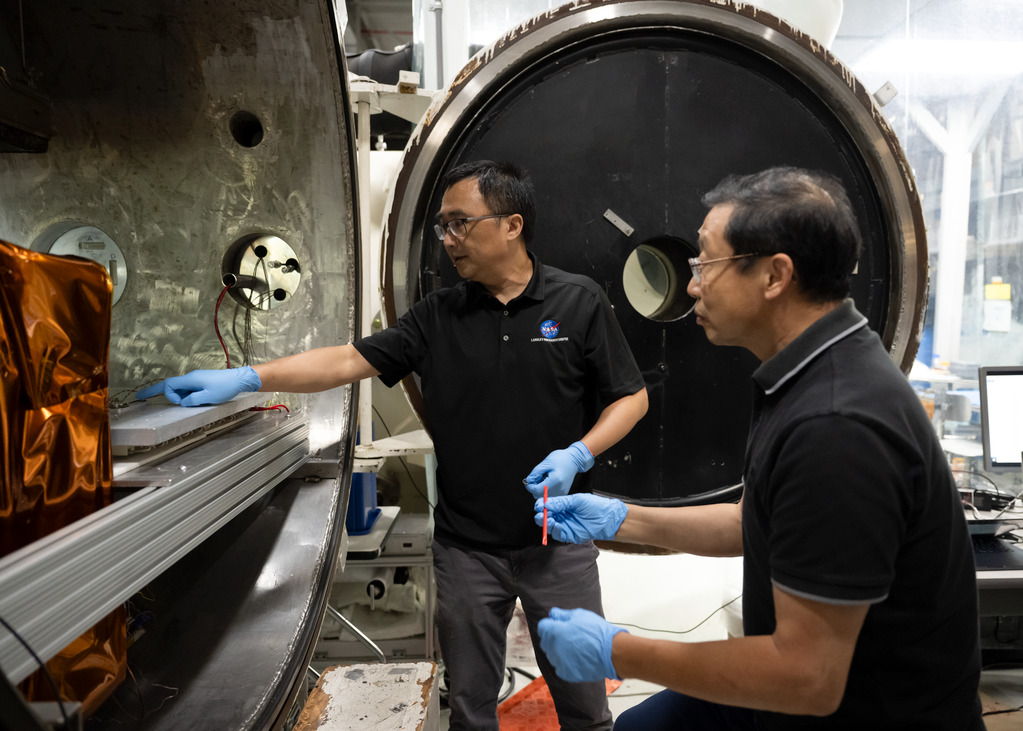
Yi Lin, left, SPEARS testing and research lead, and Ji Su, a polymer materials scientist and the task lead, during the removal of SPEARS batteries from thermal vacuum testing at NASA Langley.
NASA/Ryan Hill

Splashy problem, solid solution

Traditional lithium-ion batteries like those in your cell phone and laptop have a critical weakness: they rely on liquid electrolytes. Cool a conventional battery to the Moon’s nighttime temperatures, and that liquid would freeze, potentially damaging the battery. Heat it up too much — say, to daytime lunar temperatures of 212 F (100 C) — and it won’t work until cooled. Expose the liquid to the vacuum of space, and it evaporates. 

SPEARS batteries solve these problems by replacing the liquid electrolyte with a solid ceramic- or polymer-based material. This change could unlock several advantages. First and foremost, they could operate in the heat and extreme cold. 

During recent thermal vacuum testing at NASA’s Langley Research Center in Hampton, Virginia, small prototype battery cells operated well up to 176 F (80 C), down to minus 76 F (minus 60 C), and with slightly reduced performance down to minus 112 F (minus 80 C). 

“We proved for the first time that these cells can work down to minus 80 degrees Celsius,” said Yi Lin, SPEARS testing and research lead at NASA Langley.  

Lin also said he’s confident they can improve performance and maybe even expand that range in coming years. 

The batteries need to remain reliable through exposure to the Moon’s wild temperature swings between day and night. The thermal vacuum testing showed that after exposure to temperature extremes from 212 F (100 C) to minus 274 F (minus 170 C), SPEARS batteries don’t sustain damage.  

Just like the chemistry in your earbuds is different from the chemistry in your phone, which is different from the chemistry in your car, all these chemistries can still function with a solid electrolyte. We can tune for energy, tune for power, tune for durability, depending on the application.

Yi Lin

Yi Lin

SPEARS testing and research lead

Not even solid-state batteries will function while they’re at a temperature as low as minus 274 F, but because solid electrolytes don’t freeze like a liquid, the batteries can survive the extreme low temperatures.  

In order to get the batteries working again after exposure to such cold, small heaters come into play. SPEARS batteries wouldn’t need to be kept warm all the time, just warmed up to operational temperature. That could reduce the need for heavy thermal management systems in spacecraft and lunar habitats, allowing for lighter designs, lower costs, and longer mission durations. 

Nike Lin, a support engineer/technician on the thermal vacuum team, holds up a battery.
Nike Lin, a support engineer/technician on the thermal vacuum team, takes weight measurements of batteries following thermal vacuum testing.
NASA/Ryan Hill

Power for Moon, Earth

The applications for these solid-state batteries are nearly limitless, from small tools like drills that must operate in shadowed lunar craters, to rovers and emergency power packs for astronauts. They also could provide power solutions for long-duration scientific instruments. 

“We can tune the chemistry by using different electrode materials,” said Lin. “Just like the chemistry in your earbuds is different from the chemistry in your phone, which is different from the chemistry in your car, all these chemistries can still function with a solid electrolyte. We can tune for energy, tune for power, tune for durability, depending on the application.” 

While SPEARS is designed for space, the technology could be spun off into Earth-based applications. In fact, SPEARS evolved out of a previous battery project Lin and Dornbusch worked on that focused on aeronautic applications. 

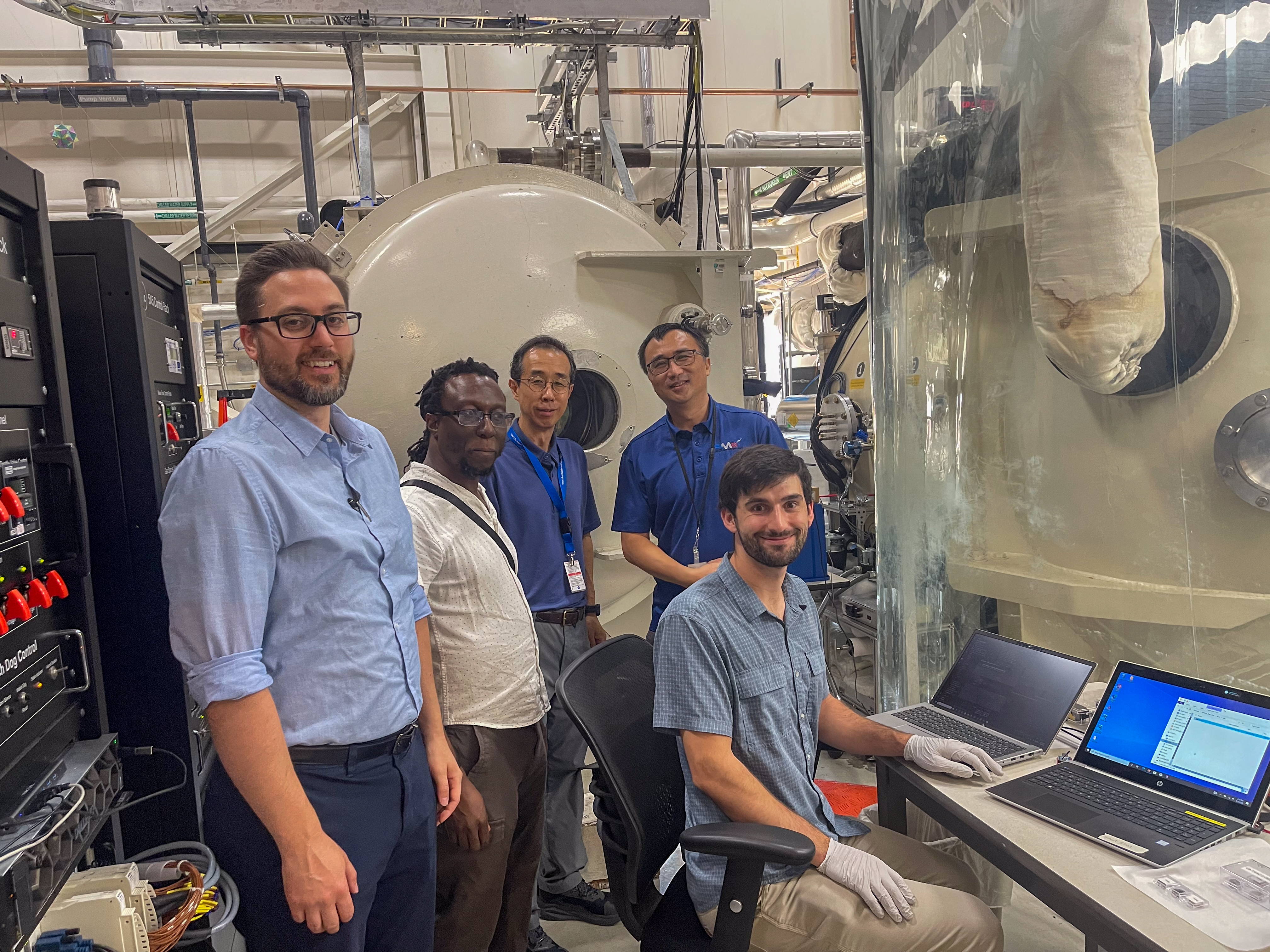
From left to right: Donald Dornbusch (NASA Glenn), Godfrey Sauti, Sang-Hyon Chu, Yi Lin (NASA Langley), and Malachi Mooney-Rivkin (NASA Ames), during a round of TVAC testing at NASA Langley.
NASA

“The potential market for solid-state batteries is very broad,” said Ji Su, a polymer materials scientist and the task lead at NASA Langley. “Automobiles, cell phones, communication devices, drones — anything that needs a portable power supply.” 

The SPEARS project began in 2026 with funding through the Advanced Research and Technology division within the agency’s Research and Technology Mission Directorate. The project is set to focus on technology development in its first stages before potentially shifting toward commercial collaboration. NASA’s Ames Research Center in California’s Silicon Valley is working to develop flight hardware such as test boards and electronics to help prepare the SPEARS batteries for spaceflight and test them in space environments. 

  •  

Chiave di violino cosmica dietro alla Via Lattea

Una chiave di violino cosmica è al centro della nuova immagine composita rilasciata dall’osservatorio a raggi X Chandra della Nasa. A disegnarne la forma del caratteristico simbolo musicale sono le onde radio osservate da Lofar (Low Frequency Array), una rete di decine di migliaia di antenne distribuite in Europa, mentre i raggi X dei telescopi spaziali Chandra ed eRosita rivelano il gas caldo dell’ammasso di galassie che la ospita. Completano l’immagine le osservazioni nell’infrarosso.

La radiosorgente Treble Clef. Crediti: Raggi X: Nasa/Cxc/Inaf-Ira/A. Botteon et al.; Infrarosso: Ukidss-Gps; Radio: Astron/Lofar; Elaborazione dell’immagine: Nasa/Cxc/Sao/N. Wolk

La nuova immagine composita si basa sulle osservazioni analizzate nello studio pubblicato recentemente su Astronomy & Astrophysics e guidato da Andrea Botteon, con Marisa Brienza come seconda autrice, entrambi dell’Istituto di radioastronomia (Ira) dell’Inaf di Bologna. Il lavoro è firmato da un gruppo internazionale e comprende anche contributi di altri membri dell’Ira e dell’Istituto di astrofisica spaziale e fisica cosmica dell’Inaf di Milano.

Il lavoro combina dati radio delle survey Lofar LoTss-Dr3 e LoLss-Dr2, quest’ultima di prossima pubblicazione, con nuove osservazioni del radiotelescopio indiano uGmrt e nei raggi X di Chandra. A questi si aggiungono dati nei raggi X di eRosita e nel vicino infrarosso di UkIrt, alle Hawaii. Il gruppo ha così caratterizzato per la prima volta l’ammasso che ospita la radiosorgente e ha indagato l’origine di quest’ultima, soprannominata Treble Clef, “chiave di violino”, appunto.

Operazione non facile questa, a causa della sua posizione: la sorgente si trova in una direzione in cui il nostro sguardo attraversa il disco della Via Lattea: stelle, gas e polveri presenti lungo questa linea di vista ostacolano fortemente le osservazioni dalla Terra e in particolare nella luce visibile. È stato quindi fondamentale combinare le osservazioni radio della sorgente con quelle spaziali nell’infrarosso, utili a individuare le galassie dell’ammasso, e nei raggi X, che ne rivelano il gas caldo.

Chandra e il telescopio tedesco per raggi X eRosita (Extended Röntgen Survey with an Imaging Telescope Array) hanno rilevato gas caldo e diffuso in corrispondenza della Treble Clef, confermandone l’associazione con un ammasso di galassie. L’analisi ha inoltre stabilito che il sistema è in realtà composto da due ammassi in fase di fusione (merging). Gli ammassi di galassie sono tra le più grandi strutture dell’universo: possono contenere centinaia o migliaia di galassie e immense riserve di gas a temperature di milioni di gradi.

La nuova immagine composita mostra in blu il gas a temperature di milioni di gradi rilevato nei raggi X dai telescopi spaziali Chandra ed eRosita. Una parte dei dati di Chandra è stata elaborata con una tecnica specifica per mettere in risalto alcune caratteristiche dell’emissione. In rosso sono invece rappresentate le osservazioni radio di Lofar. Completano l’immagine, i dati nell’infrarosso dello United Kingdom Infrared Telescope, rappresentati prevalentemente in bianco.

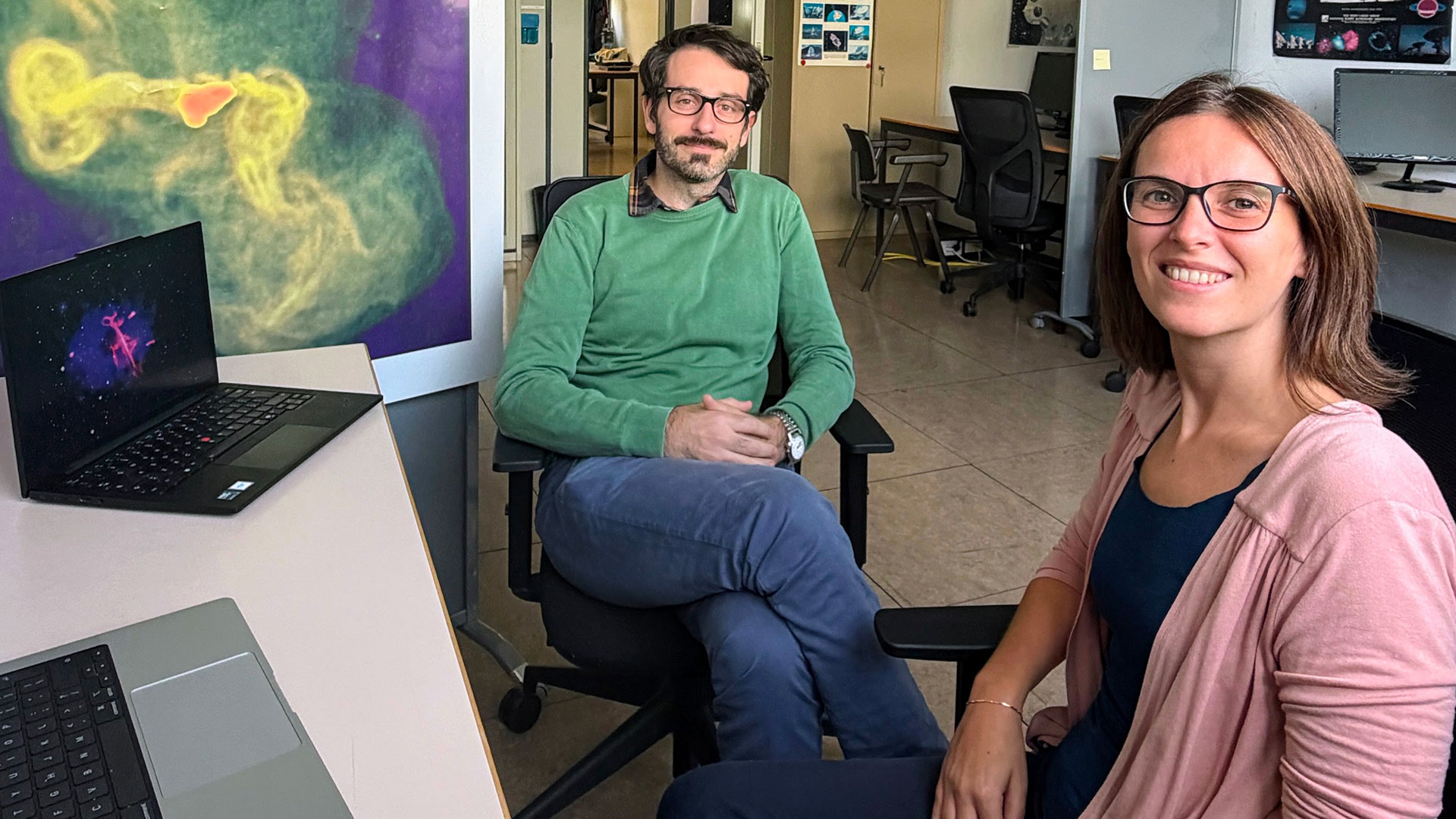
Andrea Botteon e Marisa Brienza dell’Istituto di Radioastronomia (Ira) dell’Inaf di Bologna

L’indagine è partita proprio dall’insolita struttura radio della sorgente. «Mentre esaminavamo i dati della survey LoTss-Dr3, ha attirato la nostra attenzione una sorgente brillante e ricca di filamenti», racconta Andrea Botteon. «Comprenderne l’origine, però, era difficile perché mancavano osservazioni complementari. Il primo passo è stato quindi proporre nuove osservazioni con il radiotelescopio uGmrt. La proposta è stata accettata e i nuovi dati hanno mostrato che l’emissione radio diminuisce rapidamente al crescere della frequenza: una caratteristica che descriviamo come uno spettro radio ripido. Insieme alla sua forma particolare, questo suggeriva che la sorgente fosse una “fenice radio” in un ammasso di galassie, un’interpretazione che abbiamo confermato analizzando nuove osservazioni nei raggi X».

Il nome “fenice radio” richiama un’emissione che torna a brillare dopo essersi affievolita. Secondo lo scenario proposto nello studio, la Treble Clef si sarebbe infatti formata in due fasi. Inizialmente, un buco nero supermassiccio, probabilmente ospitato nella galassia più brillante dell’ammasso, avrebbe espulso plasma a velocità prossime a quella della luce. Le particelle cariche del plasma, muovendosi nei campi magnetici, avrebbero prodotto emissione radio di sincrotrone, poi affievolitasi man mano che perdevano energia.

Successivamente, la collisione dell’ammasso che ospita la sorgente con un altro ammasso di galassie avrebbe “ravvivato” l’emissione radio, fornendo nuova energia alle particelle e/o amplificando i campi magnetici. Anche le onde d’urto generate dalla collisione — simili a quelle che producono i boati degli aerei supersonici — potrebbero aver contribuito a questo processo.

Per cercare indizi della collisione, il gruppo ha analizzato le irregolarità nella distribuzione del gas caldo osservato da Chandra. Dall’immagine nei raggi X è stato sottratto un modello ovale e simmetrico che descrive la distribuzione della maggior parte del gas dell’ammasso. Nell’immagine residua emergono così due zone di emissione più intensa, a sinistra e a destra di una regione centrale più debole. Questa disposizione suggerisce che la collisione sia avvenuta prevalentemente lungo la direzione destra-sinistra nell’immagine. Secondo lo scenario proposto, lo scontro tra i due ammassi risalirebbe a qualche centinaio di milioni di anni fa e i due sistemi starebbero ora allontanandosi l’uno dall’altro.

Se le osservazioni permettono di ricostruire la storia fisica della sorgente, la sua forma lascia spazio anche all’immaginazione. La chiave di violino che le ha dato il soprannome non è l’unica figura riconoscibile: nella stessa struttura radio si può intravedere anche un drago gallese visto di profilo. Entrambe le somiglianze sono esempi di pareidolia, il fenomeno che ci porta a riconoscere figure familiari in ciò che osserviamo.

Per saperne di più:

  • Leggi su Astronomy & Astrophysics l’articolo “The Treble Clef radio phoenix and its old nonthermal filaments”, di A. Botteon, M. Brienza, K. Rajpurohit, N. Lyskova, E. Churazov, I. Khabibullin, T. Pasini, E. O’Sullivan, G. Brunetti, F. De Gasperin, E. De Rubeis, F. Gastaldello, D. N. Hoang, R. Kraft, G. Schellenberger, R. Sunyaev, R. J. van Weeren e F. Vazza


  •  

NASA to Discuss Artemis Acceleration, Status of Upcoming Moon Missions

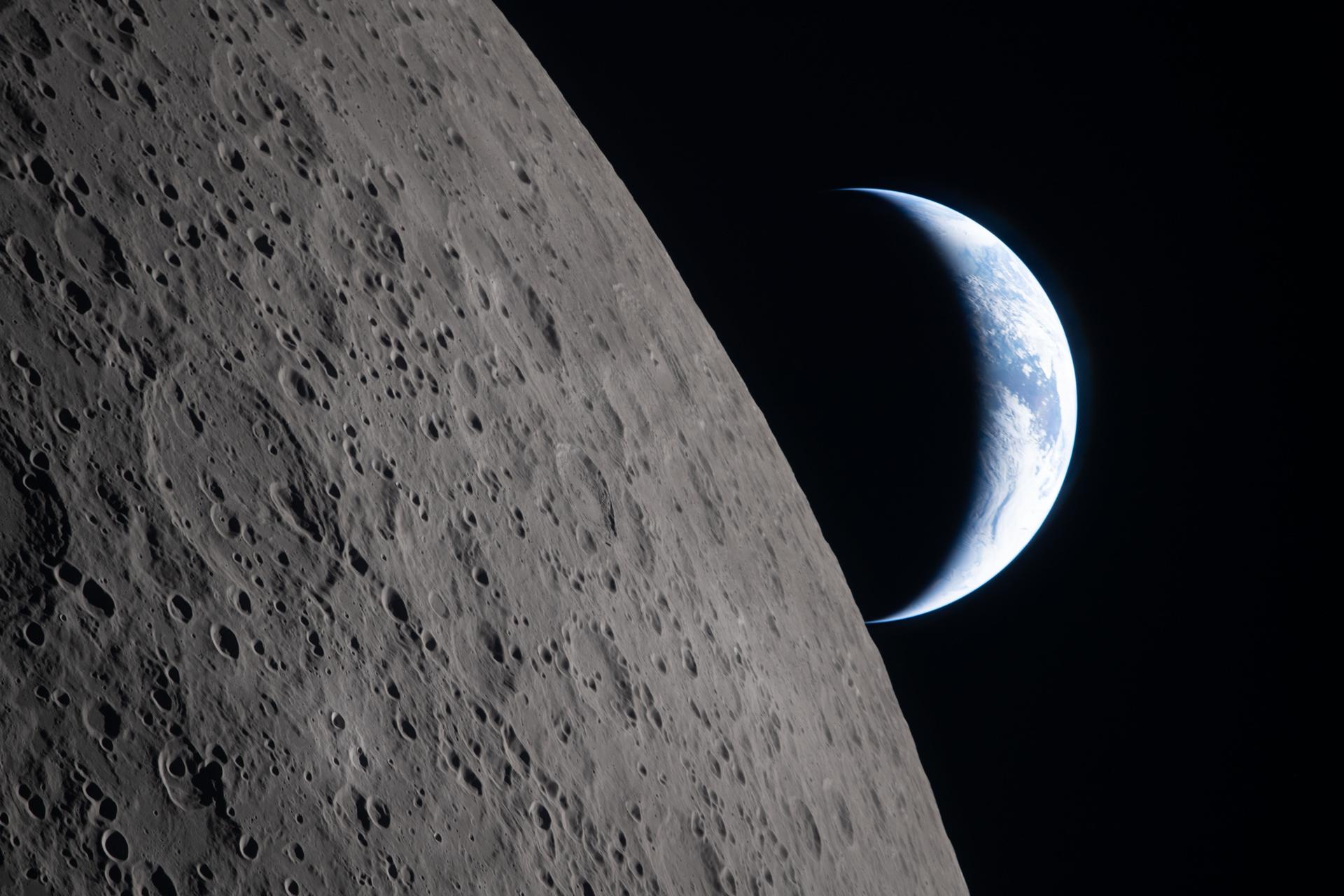
As the Artemis II crew members came close to passing behind the Moon and experiencing a planned loss of signal, they captured this image of a crescent Earth setting on the Moon’s limb on April 6, 2026. The edge of the visible surface of the Moon is called the “lunar limb."
As the Artemis II crew members came close to passing behind the Moon and experiencing a planned loss of signal, they captured this image of a crescent Earth setting on the Moon’s limb on April 6, 2026. The edge of the visible surface of the Moon is called the “lunar limb.”
Credit: NASA

NASA will provide an update on its plans to return American astronauts to the surface of the Moon by 2028 at 2 p.m. EDT, Friday, Oct. 23, at the agency’s Kennedy Space Center in Florida.

Learn where to watch online:

https://www.nasa.gov/live

Participants in the briefing include:

  • NASA Administrator Jared Isaacman
  • NASA Associate Administrator Amit Kshatriya
  • Jeremy Parsons, NASA’s Artemis program manager

The update will include details about NASA’s Artemis III mission that will send four astronauts to low Earth orbit next year to test critical systems needed for future lunar landings, and how plans to return American astronauts to the Moon by 2028 are progressing.

U.S. media interested in attending in person must apply online by 12 p.m., Friday, Oct. 16. To ask questions remotely, media must request the dial-in number from the Kennedy newsroom no later than one hour prior to the start of the update by emailing: ksc-newsroom@mail.nasa.gov. NASA’s media accreditation policy is online. 

As part of a Golden Age of innovation and exploration, NASA will send Artemis astronauts on increasingly difficult missions near the lunar South Pole to explore more of the Moon than ever before. In addition to providing economic benefits and advancing scientific discovery through its Moon missions, NASA will establish an enduring human presence on the lunar surface and build on the agency’s foundation for the first crewed mission to Mars.

Learn more about Artemis:

https://www.nasa.gov/artemis

-end-

Rachel Kraft
Headquarters, Washington
202-358-1600
rachel.h.kraft@nasa.gov

Tiffany Fairley
Kennedy Space Center, Fla.
321-867-2468
tiffany.l.fairley@nasa.gov

Share

Details

Last Updated
Oct 14, 2026
  •  

Su Westerlund 1 il bozzo d’uno scontro galattico

Gli ammassi stellari sono sistemi dinamici estremamente complessi e affascinanti. Cosa li rende così complicati? Innanzitutto, l’evoluzione sia dinamica sia fisica delle loro stelle. Stelle di massa diversa hanno tempi di vita differenti: quelle più massicce possono terminare la propria evoluzione esplodendo come supernove, mentre quelle di piccola massa stanno ancora evolvendo verso la “maturità” della sequenza principale. Inoltre, le stelle si muovono rapidamente all’interno dell’ammasso scambiando energia, precipitando verso il centro o “evaporando” man mano che si allontanano. A complicare il quadro interviene l’interazione tra gli ammassi e il loro ambiente circostante: altri ammassi stellari, nebulose e l’intera Via Lattea con il suo potenziale gravitazionale.

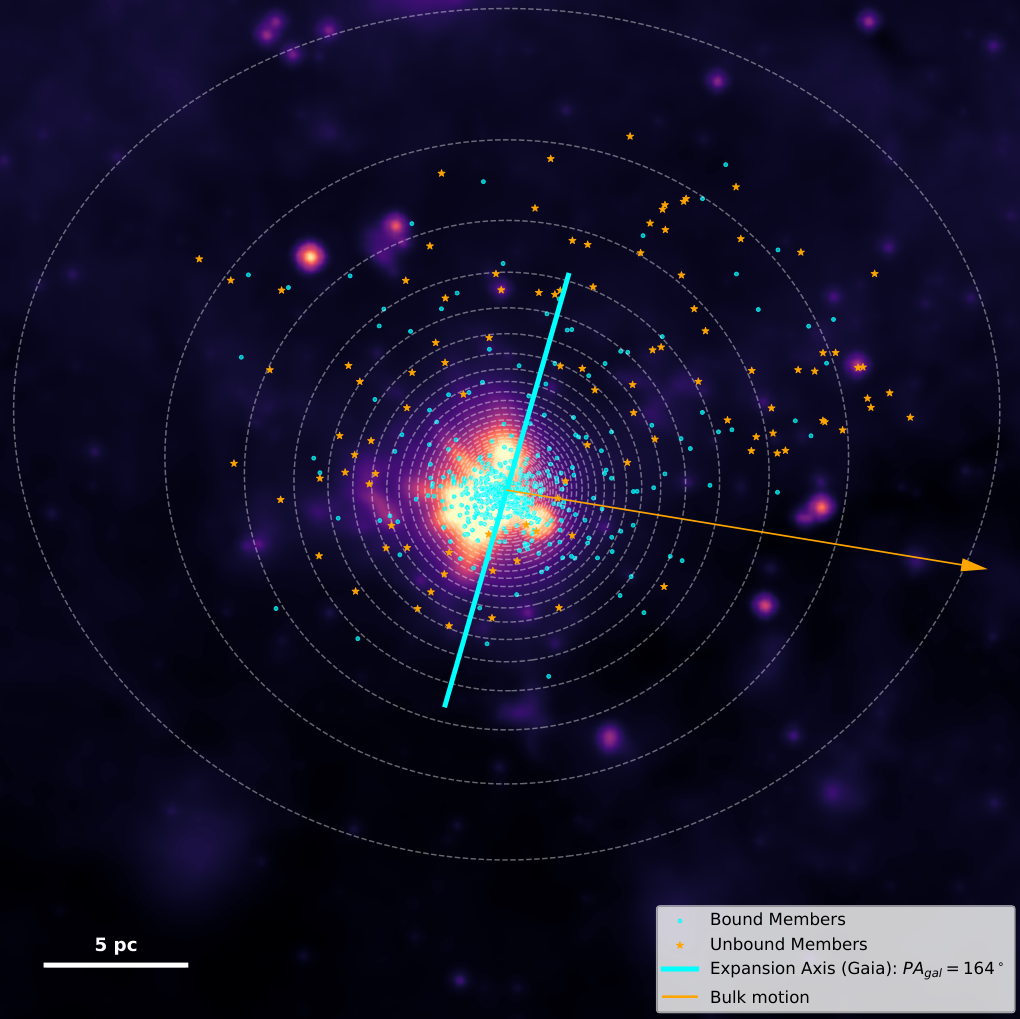
Distribuzione delle stelle di Westerlund 1 analizzate nello studio in uscita su A&A. Nel grafico si distinguono quelle ancora legate all’ammasso e quelle non legate, nonché la direzione di espansione e del moto di Westerlund 1, su un’immagine in medio infrarosso ottenuta dal satellite Wise. Le linee mostrano la configurazione del potenziale gravitazionale della Via Lattea. Crediti: L. Prisinzano et al., A&A, 2026

Tutto questo lascia impronte indelebili nella configurazione spaziale e dinamica che osserviamo oggi negli ammassi. Impronte che in questi anni siamo in grado di analizzare con grande precisione grazie al satellite Gaia dell’Agenzia spaziale europea. Il catalogo di osservazioni di Gaia contiene infatti informazioni accurate sulla posizione e sulla dinamica delle stelle, integrate da dati spettroscopici che permettono di risalire alla natura delle stelle. Analizzati con cura, i dati di Gaia permettono di ottenere un quadro completo della struttura e della dinamica degli ammassi e delle singole stelle che li compongono.

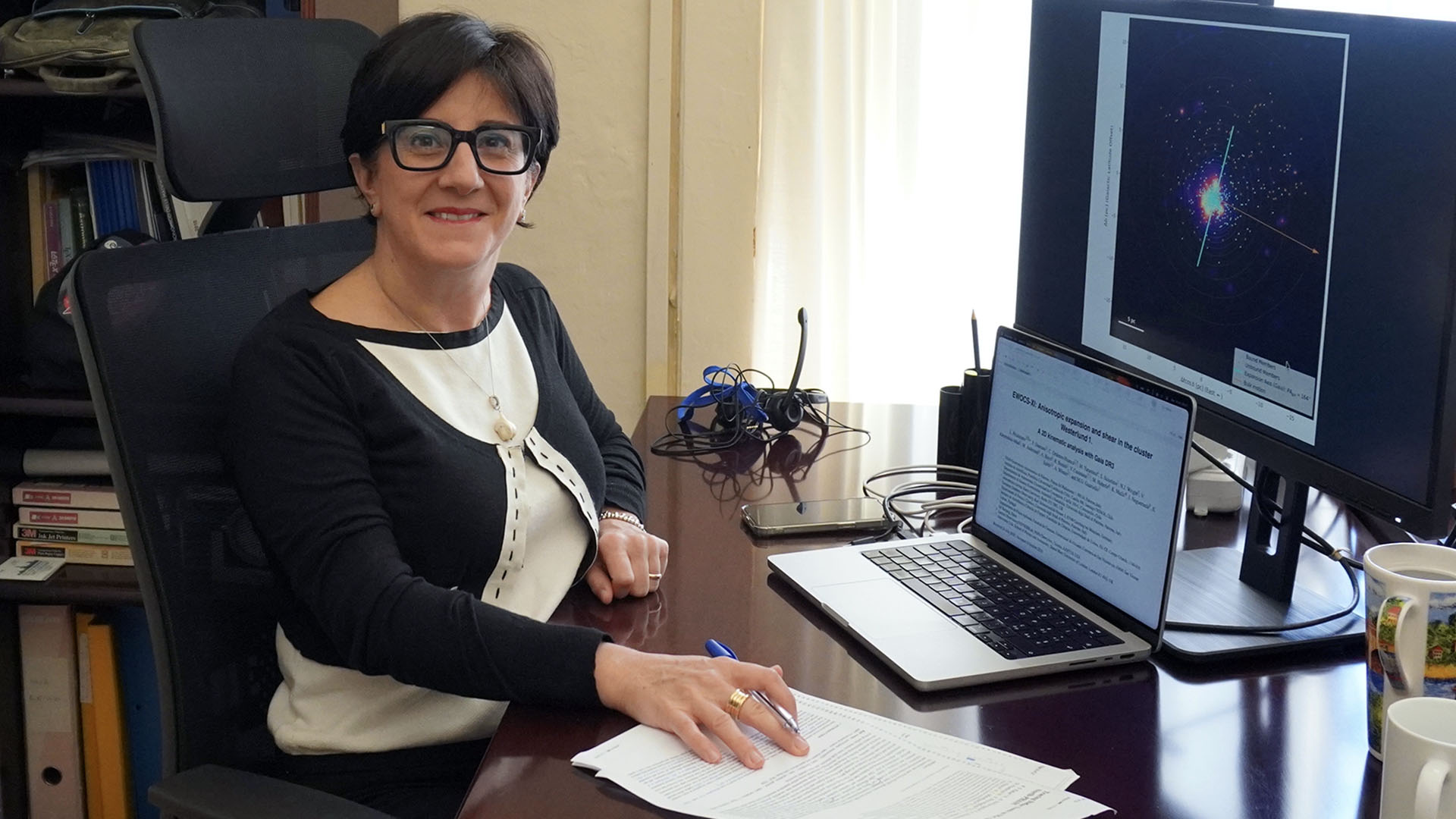
Un team di ricercatori guidato dall’astrofisica Loredana Prisinzano dell’Inaf di Palermo ha analizzato i dati di Gaia relativi alle stelle nella regione del superammasso Westerlund 1, oggetto del progetto Ewocs, guidato da Mario Guarcello. I ricercatori hanno isolato un campione di 559 stelle dell’ammasso con massa superiore a sette masse solari.

Queste stelle formano due gruppi cinematici distinti: 421 stelle sono ancora gravitazionalmente legate al nucleo dell’ammasso, mentre 103 se ne stanno allontanando (tra cui 14 “walk-away stars” con una velocità di allontanamento maggiore delle altre). I due gruppi si muovono con velocità diverse: la dispersione delle loro velocità è di circa 5 km/s per il primo gruppo e di 10-14 km/s per il secondo.

Loredana Prisinzano (Inaf Oa Palermo), prima autrice dello studio in uscita su A&A

L’espansione dell’ammasso è asimmetrica, come già dimostrato in altri studi pubblicati di recente. Tuttavia, l’analisi dei dati di Gaia ha permesso di stabilire che la regione esterna di Westerlund 1 è allungata in direzione perpendicolare al piano della Via Lattea, subendo una distorsione probabilmente causata dalle forze mareali della nostra galassia. Inoltre, il suo tempo di espansione cinematica (2.08 milioni di anni) corrisponde al momento in cui Westerlund 1 ha attraversato il piano galattico (2.1 milioni di anni fa). Tra i diversi fattori che potrebbero spiegare tale evoluzione dinamica, questa coincidenza temporale suggerisce una possibile conseguenza dell’interazione avvenuta circa due milioni di anni fa tra Westerlund 1 e la materia (stelle e nebulose) che popola il piano della Via Lattea.

«Questo studio è la dimostrazione lampante di come il satellite Gaia sia una vera e propria “macchina da guerra” per lo studio dei moti propri stellari», dice Prisinzano, «e Westerlund 1 ne rappresenta un banco di prova estremo. Situato a oltre 13mila anni luce di distanza e pesantemente oscurato dalle polveri interstellari, è un oggetto per il quale le parallassi misurate da Gaia presentano incertezze troppo elevate per fornire distanze precise. Tuttavia, la qualità dei moti propri rimane impressionante. È proprio grazie a queste piccolissime incertezze nei movimenti trasversali delle stelle che abbiamo potuto identificare i membri dell’ammasso e condurre un’analisi cinematica estremamente accurata. Questo ci ha permesso di svelare non solo le complesse dinamiche di espansione e distorsione di questo superammasso, ma anche di trovare prove evidenti di un processo di dissoluzione in atto».

Per saperne di più:


  •  

APOD: 2026 October 14 – Mars and the Beehive Under an Aurora

APOD

Astronomy Picture of the Day

Discover the cosmos! Each day a different image or photograph of our fascinating universe is featured, along with a brief explanation written by a professional astronomer.

The bright Mars is near the center of the Beehive cluster (M44) in the sky's horizon. A colorful aurora sits above in the sky, looking like a curtain of light. Dark trees and a river line the foreground.

Mars and the Beehive Under an Aurora

Explanation: What a cosmic coincidence! In today’s image, Mars joins the Beehive cluster (M44 or Praesepe) below an auroral curtain and above a horizon of happy little trees near Lansjärv, Sweden. An eruption off the Sun reached Earth on October 10th, 2026 causing strong disturbances in Earth’s magnetic field. Energetic particles from the eruption collide with and energize the molecules in Earth’s atmosphere, which release that extra energy as the colorful aurora captured here. Auroras, or guovssahasat in North Sámi, is traditionally viewed with respect by the Sámi people indigenous to Sweden and other Arctic regions. Coincidentally, Mars appeared closest to the center of the Beehive cluster in the sky at the time. Although bees have been to space, the Beehive cluster is actually a swarm of young stars. Their rotation periods have helped humanity learn about how stars spin slower over time as they lose mass through their stellar winds.

Tomorrow’s picture: open space

Date: October 14, 2026
Credit: Petr Horálek (Institute of Physics in Opava), Josef Kujal, Vojan Höfer
Authors & editors: Keighley Rockcliffe, Robert Nemiroff, Jerry Bonnell, Cecilia Chirenti
A service of: ASD at NASA / GSFC,
NASA Science Activation & Michigan Tech. U.
  •  

Hurricane Simon Lurks Off the Mexican Coast

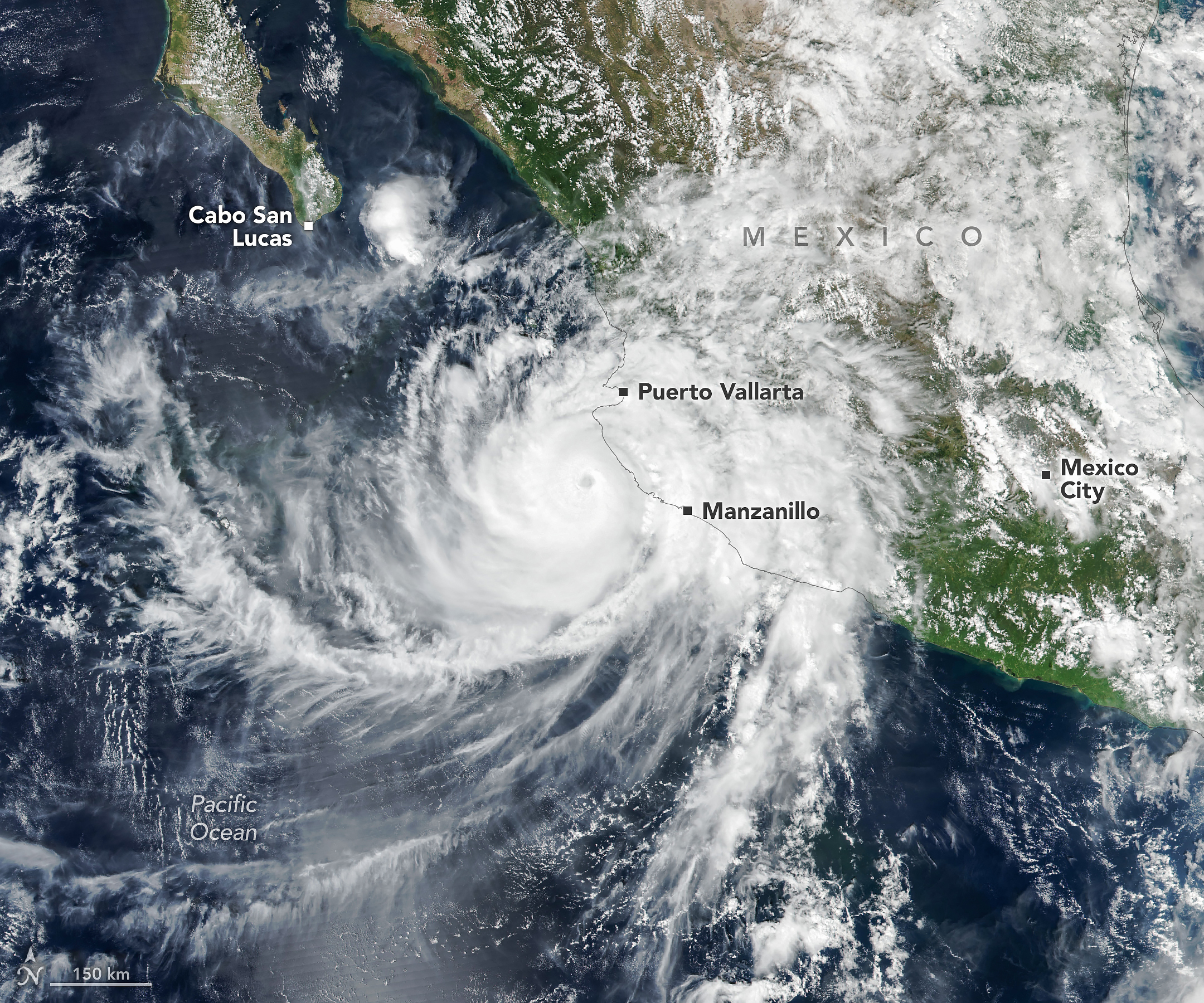
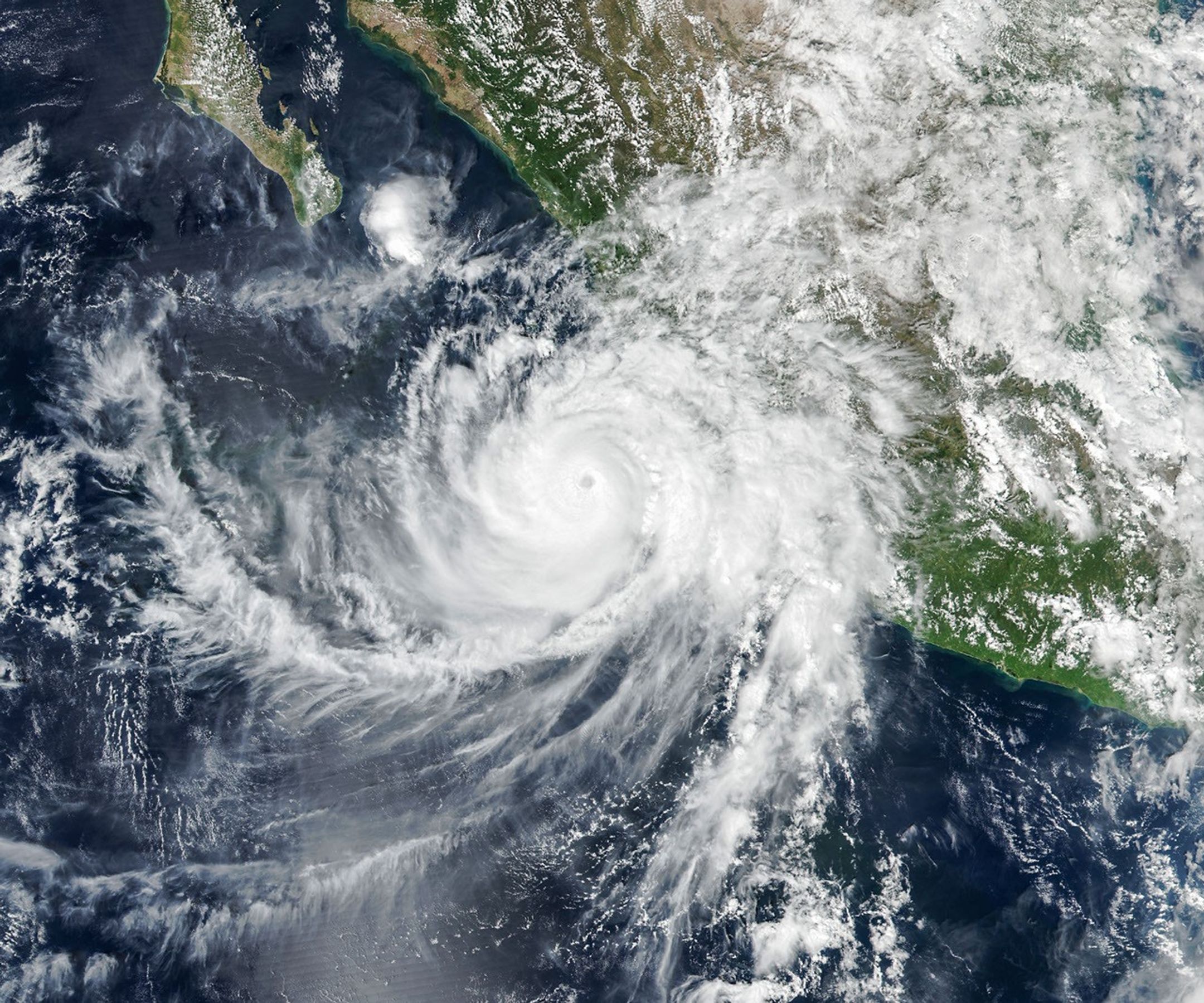
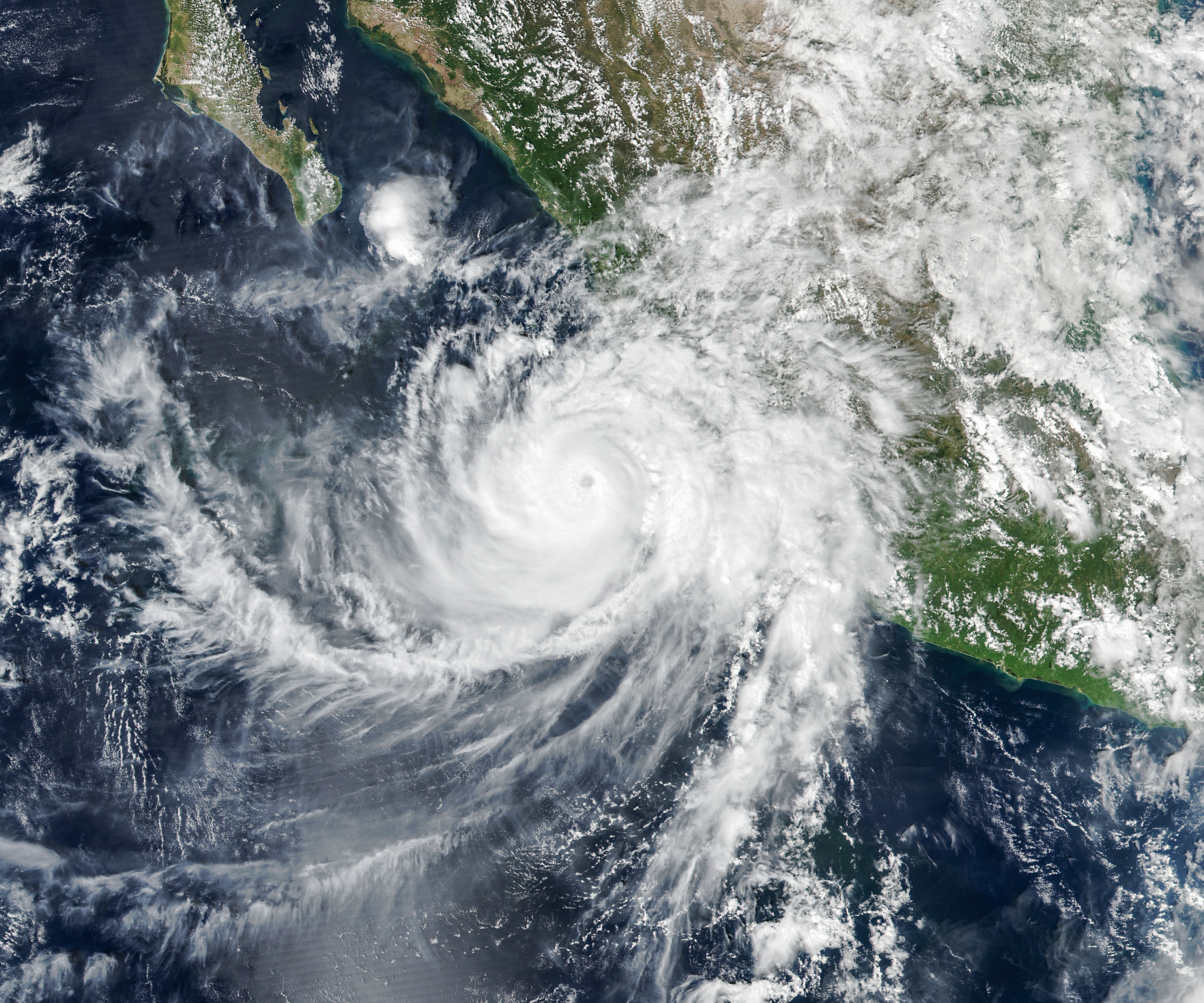
The well-defined eye of Hurricane Simon lies just off Mexico’s Pacific coast. Some outer cloud bands of the spiraling storm extend over land.
Hurricane Simon churns off Mexico’s Pacific coast in this image acquired with the VIIRS (Visible Infrared Imaging Radiometer Suite) on the Suomi NPP satellite on October 11, 2026.
NASA Earth Observatory/Michala Garrison

Hurricane Simon, the latest in a long progression of tropical cyclones in the Eastern Pacific this season, passed close to the Mexican coast as a category 4 storm on October 11, 2026. Sustained winds reached 250 kilometers (155 miles) per hour as it crept north-northwest.

Simon’s eye was about 50 kilometers (30 miles) offshore, between Manzanillo and Puerto Vallarta, when the VIIRS (Visible Infrared Imaging Radiometer Suite) on the Suomi NPP satellite acquired this image around 2:30 p.m. local time (20:30 Universal Time) on October 11.

By that time, sustained winds were about 210 kilometers (130 miles) per hour, according to the National Hurricane Center (NHC), and the storm’s inner core was brushing up against the coast. The topography of the Sierra Madre mountains appeared to temper the storm’s intensity somewhat and shrink the size of its wind field, the NHC noted. Still, the major hurricane delivered heavy rain and flooding to coastal areas, including the port city of Manzanillo, and raised the risk of mudslides in mountainous areas, according to news reports.

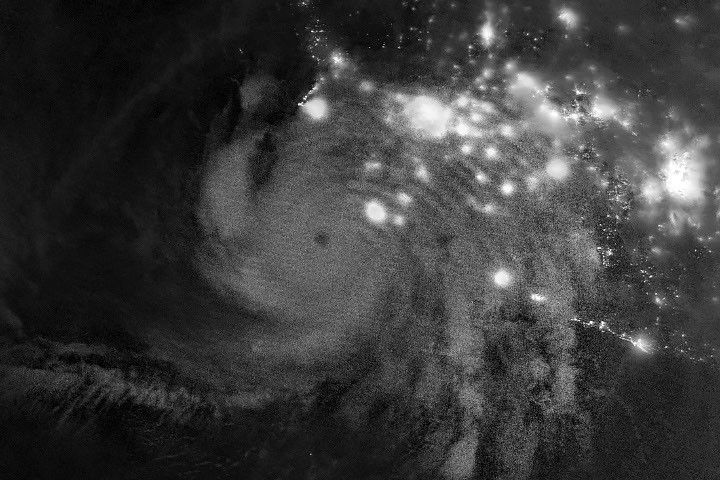
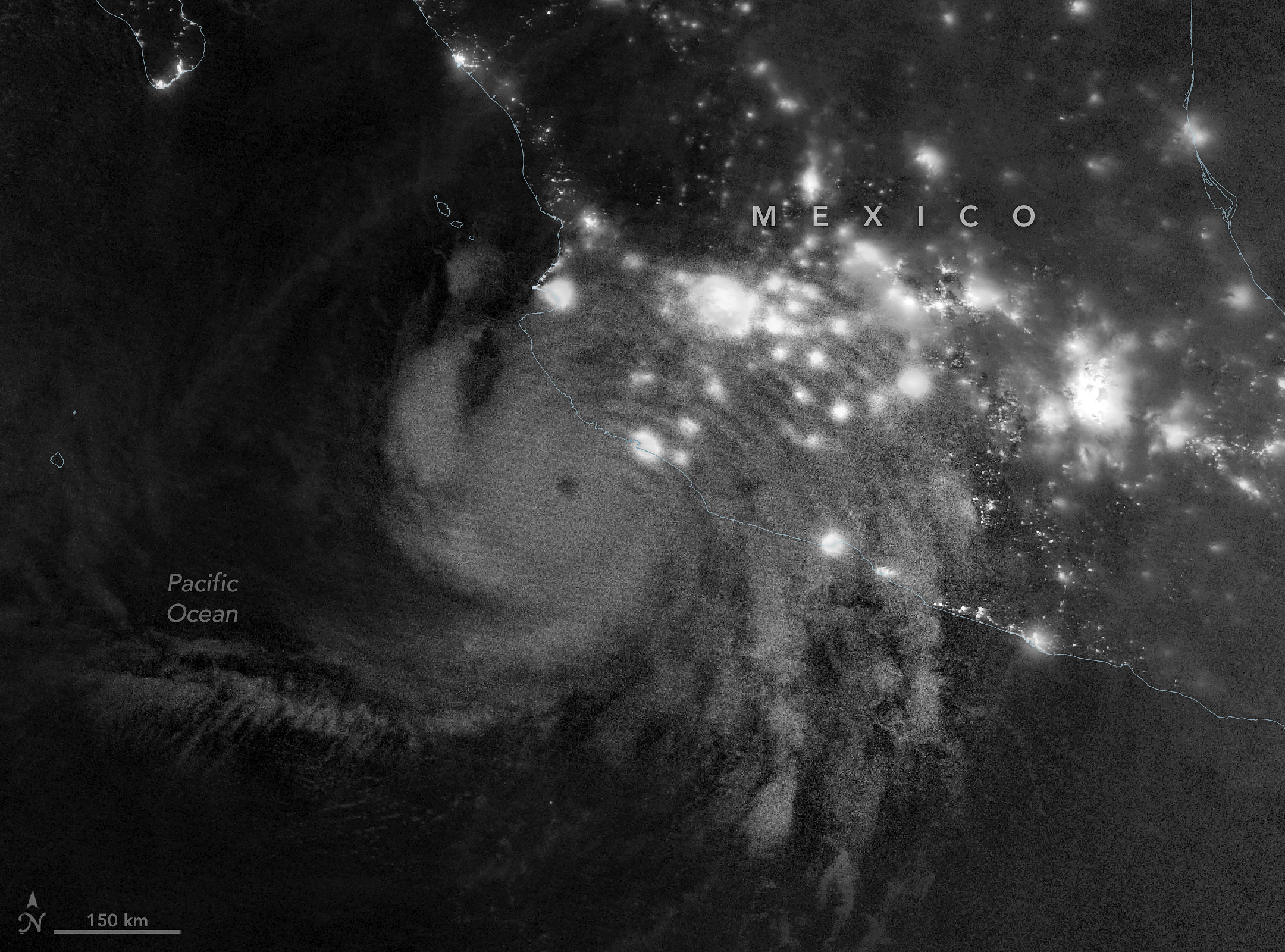
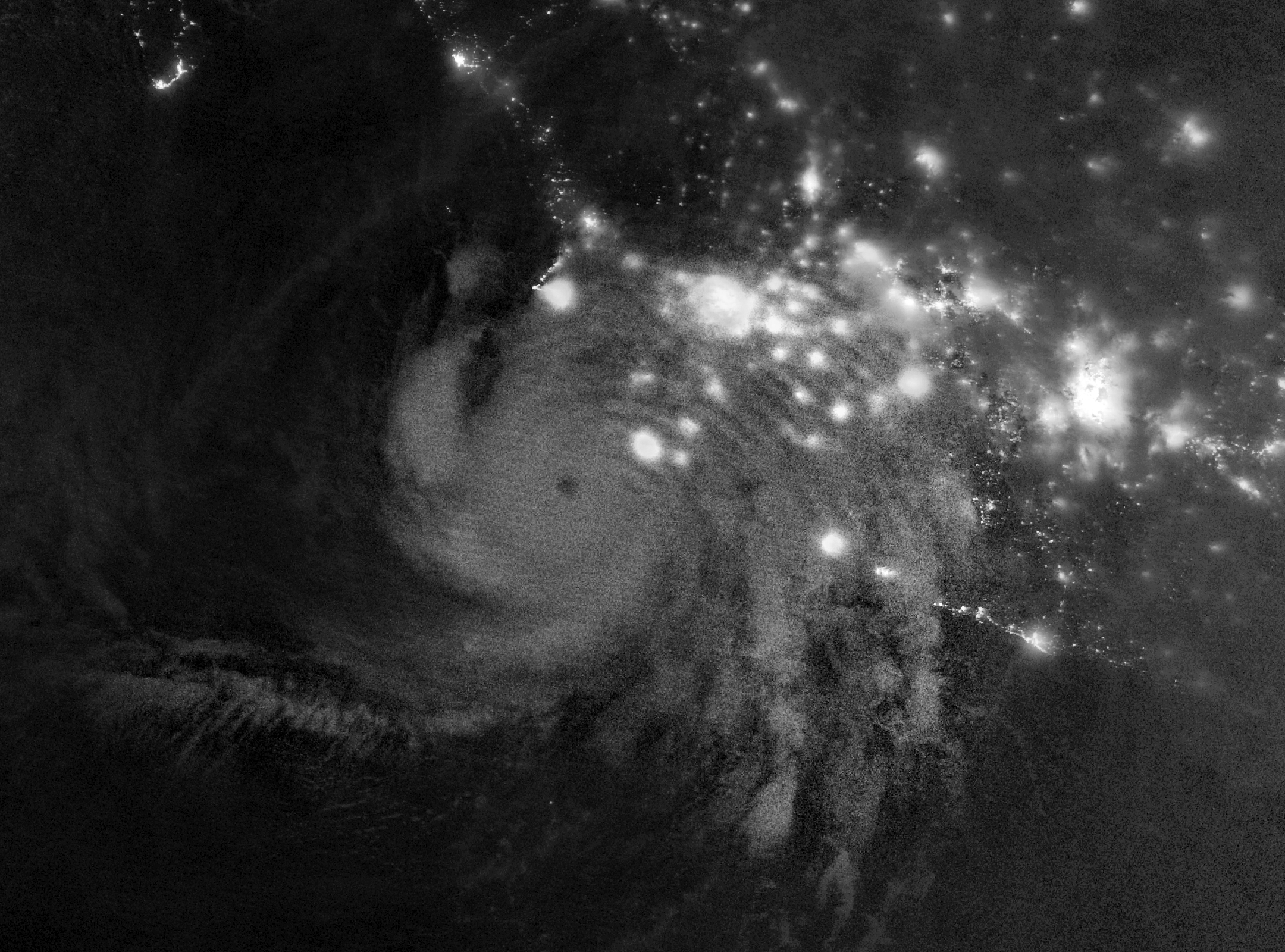
Gravity waves in the upper atmosphere appear as a semicircle of ripples in a nighttime, grayscale satellite image. Hurricane clouds and city lights in Mexico are also visible.
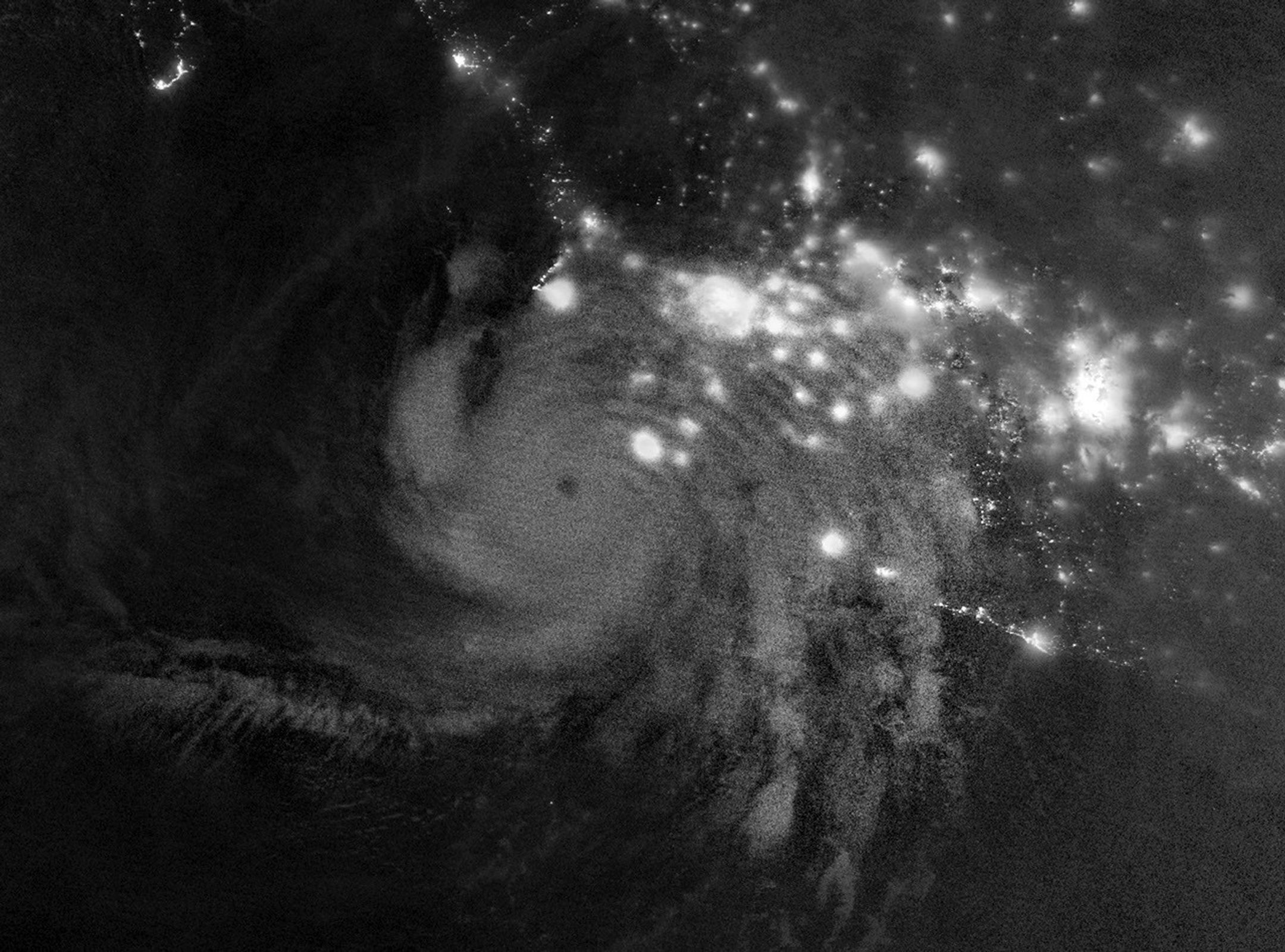
Atmospheric gravity waves generated by Hurricane Simon are visible via mesospheric airglow in this nighttime image acquired with the VIIRS (Visible Infrared Imaging Radiometer Suite) on the NOAA-21 satellite on October 11, 2026.
NASA Earth Observatory/Michala Garrison

In the early morning hours of October 11, satellites captured the storm’s effects extending into the upper atmosphere. This nighttime image (above), acquired with VIIRS on the NOAA-21 satellite, shows atmospheric gravity waves radiating from the hurricane. These ripples form when latent heat released near the tropical cyclone’s eyewall drives strong convection, building tall cumulonimbus clouds with updrafts that can send waves into the stratosphere and mesosphere.

But these waves are not always observable. Winds in the upper atmosphere can dissipate them before they reach the mesosphere, where they show up as ripples in airglow—faint light emitted by gases at those high altitudes. The VIIRS day-night band is sensitive to airglow but also detects reflected moonlight, which can wash it out. On the night this image was acquired, minimal illumination from the Moon helped the airglow stand out.

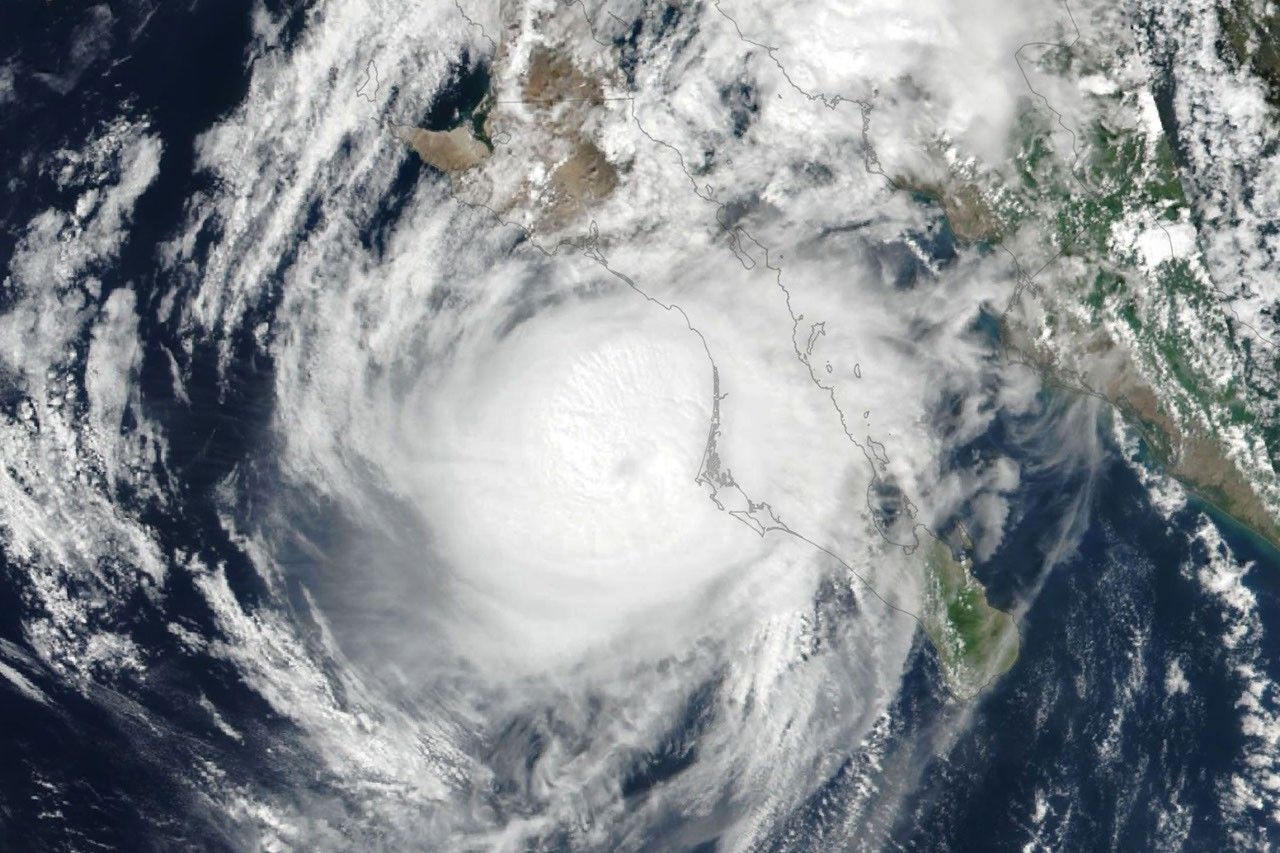
On the morning of October 13, forecasts of Simon’s intensity and path remained “very low confidence,” as the storm’s evolution continued to defy meteorologists’ expectations. The system may steer north and enter the Gulf of California before making landfall. Large swells causing dangerous nearshore conditions were expected along portions of the southwestern and west-central coasts of Mexico in the coming days.

NASA Earth Observatory images by Michala Garrison, using VIIRS data from NASA EOSDIS LANCE, GIBS/Worldview, the Suomi National Polar-orbiting Partnership, and the Joint Polar Satellite System (JPSS). Story by Lindsey Doermann.

Downloads

The well-defined eye of Hurricane Simon lies just off Mexico’s Pacific coast. Some outer cloud bands of the spiraling storm extend over land.

October 11, 2026: Suomi NPP

JPEG (3.05 MB)

Gravity waves in the upper atmosphere appear as a semicircle of ripples in a nighttime, grayscale satellite image. Hurricane clouds and city lights in Mexico are also visible.

October 11, 2026: NOAA-21

JPEG (1.86 MB)

References & Resources

You may also be interested in:

Stay up-to-date with the latest content from NASA as we explore the universe and discover more about our home planet.

Powerful Storms Continue to Prowl the Pacific

4 min read

Hurricanes Polo and Nolo sent destructive effects ashore amid an active season in the northeastern and central Pacific.

Article

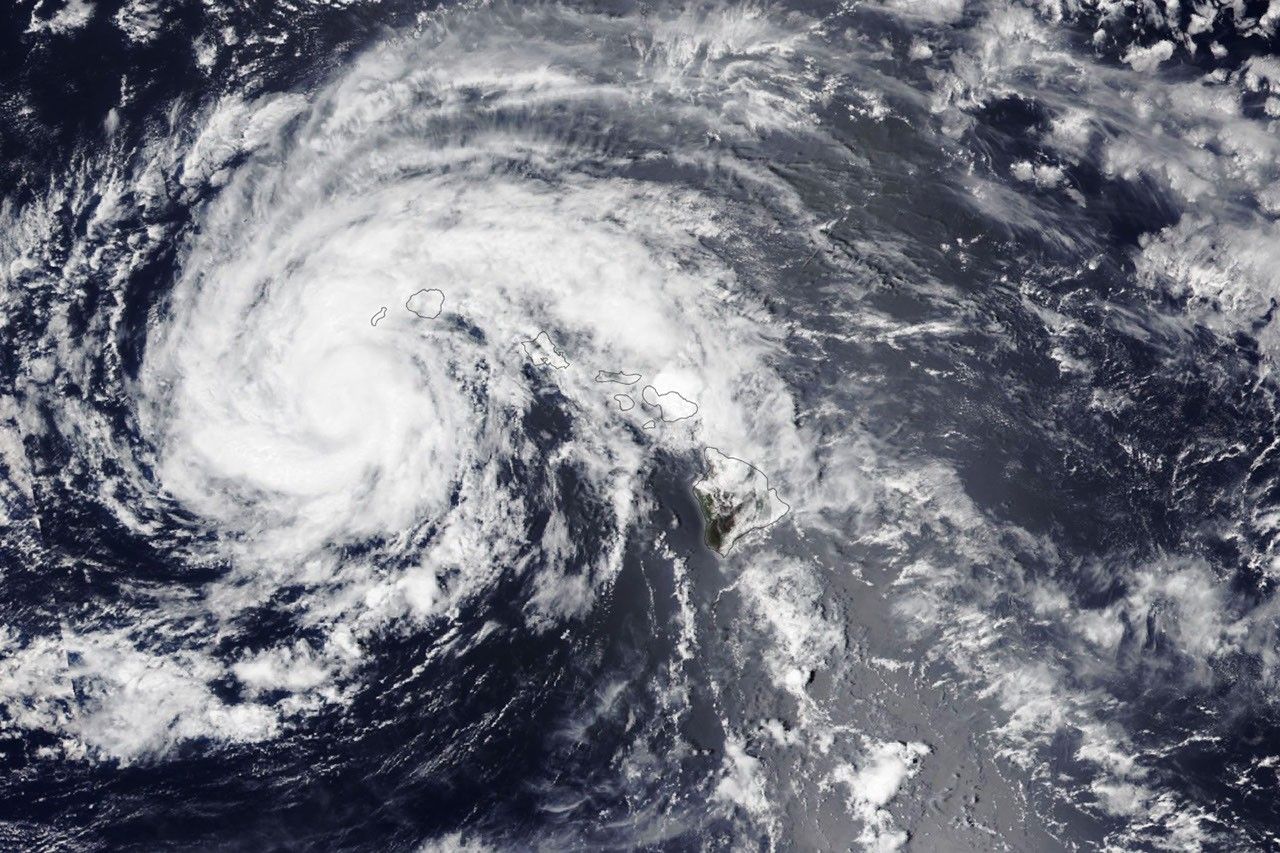
Lala Batters Hawaii

3 min read

The powerful storm delivered extreme rainfall and damaging winds to the state, passing the Island of Hawaiʻi as a category…

Article

Tropical Storm Arthur

2 min read

The first named storm of the 2026 Atlantic hurricane season brought intense rainfall and the threat of flash flooding to…

Article
  •  
❌