
Modalità di lettura

EU OS: A Bold Step Toward Digital Sovereignty for Europe

Image
EU OS

A new initiative, called "EU OS," has been launched to develop a Linux-based operating system tailored specifically for the public sector organizations of the European Union (EU). This community-driven project aims to address the EU's unique needs and challenges, focusing on fostering digital sovereignty, reducing dependency on external vendors, and building a secure, self-sufficient digital ecosystem.

What Is EU OS?

EU OS is not an entirely novel operating system. Instead, it builds upon a Linux foundation derived from Fedora, with the KDE Plasma desktop environment. It draws inspiration from previous efforts such as France's GendBuntu and Munich's LiMux, which aimed to provide Linux-based systems for public sector use. The goal remains the same: to create a standardized Linux distribution that can be adapted to different regional, national, and sector-specific needs within the EU.

Rather than reinventing the wheel, EU OS focuses on standardization, offering a solid Linux foundation that can be customized according to the unique requirements of various organizations. This approach makes EU OS a practical choice for the public sector, ensuring broad compatibility and ease of implementation across diverse environments.

The Vision Behind EU OS

The guiding principle of EU OS is the concept of "public money – public code," ensuring that taxpayer money is used transparently and effectively. By adopting an open-source model, EU OS eliminates licensing fees, which not only lowers costs but also reduces the dependency on a select group of software vendors. This provides the EU’s public sector organizations with greater flexibility and control over their IT infrastructure, free from the constraints of vendor lock-in.

Additionally, EU OS offers flexibility in terms of software migration and hardware upgrades. Organizations can adapt to new technologies and manage their IT evolution at a manageable cost, both in terms of finances and time.

However, there are some concerns about the choice of Fedora as the base for EU OS. While Fedora is a solid and reliable distribution, it is backed by the United States-based Red Hat. Some argue that using European-backed projects such as openSUSE or KDE's upcoming distribution might have aligned better with the EU's goal of strengthening digital sovereignty.

Conclusion

EU OS marks a significant step towards Europe's digital independence by providing a robust, standardized Linux distribution for the public sector. By reducing reliance on proprietary software and vendors, it paves the way for a more flexible, cost-effective, and secure digital ecosystem. While the choice of Fedora as the base for the project has raised some questions, the overall vision of EU OS offers a promising future for Europe's public sector in the digital age.

Source: It's FOSS
  •  

Linus Torvalds Acknowledges Missed Release of Linux 6.14 Due to Oversight

Linus Torvalds Acknowledges Missed Release of Linux 6.14 Due to Oversight

Linux kernel lead developer Linus Torvalds has admitted to forgetting to release version 6.14, attributing the oversight to his own lapse in memory. Torvalds is known for releasing new Linux kernel candidates and final versions on Sunday afternoons, typically accompanied by a post detailing the release. If he is unavailable due to travel or other commitments, he usually informs the community ahead of time, so users don’t worry if there’s a delay.

In his post on March 16, Torvalds gave no indication that the release might be delayed, instead stating, “I expect to release the final 6.14 next weekend unless something very surprising happens.” However, Sunday, March 23rd passed without any announcement.

On March 24th, Torvalds wrote in a follow-up message, “I’d love to have some good excuse for why I didn’t do the 6.14 release yesterday on my regular Sunday afternoon schedule,” adding, “But no. It’s just pure incompetence.” He further explained that while he had been clearing up unrelated tasks, he simply forgot to finalize the release. “D'oh,” he joked.

Despite this minor delay, Torvalds’ track record of successfully managing the Linux kernel’s development process over the years remains strong. A single day’s delay is not critical, especially since most Linux users don't urgently need the very latest version.

The new 6.14 release introduces several important features, including enhanced support for writing drivers in Rust—an ongoing topic of discussion among developers—support for Qualcomm’s Snapdragon 8 Elite mobile chip, a fix for the GhostWrite vulnerability in certain RISC-V processors from Alibaba’s T-Head Semiconductor, and a completed NTSYNC driver update that improves the WINE emulator’s ability to run Windows applications, particularly games, on Linux.

Although the 6.14 release went smoothly aside from the delay, Torvalds expressed that version 6.15 may present more challenges due to the volume of pending pull requests. “Judging by my pending pile of pull requests, 6.15 will be much busier,” he noted.

You can download the latest kernel here.

  •  

AerynOS 2025.03 Alpha Released with GNOME 48, Mesa 25, and Linux Kernel 6.13.8

Image
AerynOS

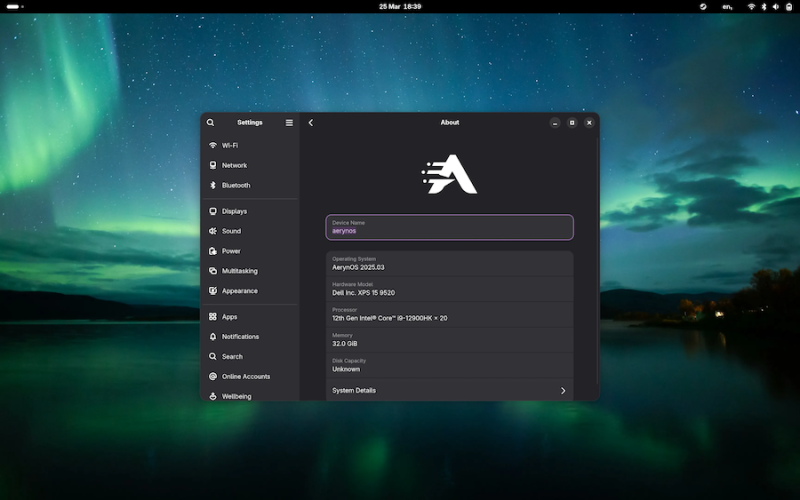
AerynOS 2025.03 has officially been released, introducing a variety of exciting features for Linux users. The release includes the highly anticipated GNOME 48 desktop environment, which comes with significant improvements like HDR support, dynamic triple buffering, and a Wayland color management protocol. Other updates include a battery charge limiting feature and a Wellbeing option aimed at improving user experience.

This release, while still in alpha, incorporates Linux kernel 6.13.8 and the updated Mesa 25.0.2 graphics stack, alongside tools like LLVM 19.1.7 and Vulkan SDK 1.4.309.0. Additionally, the Moss package manager now integrates os-info to generate more detailed OS metadata via a JSON file.

Future plans for AerynOS include automated package updates, easier rollback management, improved disk handling with Rust, and fractional scaling enabled by default. The installer has also been revamped to support full disk wipes and dynamic partitioning.

Although still considered an alpha release, AerynOS 2025.03 can be downloaded and tested right now from its official website.

Source: 9to5Linux

  •  

Xojo 2025r1: Big Updates for Developers with Linux ARM Support, Web Drag and Drop, and Direct App Store Publishing

Image
Xojo ARM

Xojo has just rolled out its latest release, Xojo 2025 Release 1, and it’s packed with features that developers have been eagerly waiting for. This major update introduces support for running Xojo on Linux ARM, including Raspberry Pi, brings drag-and-drop functionality to the Web framework, and simplifies app deployment with the ability to directly submit apps to the macOS and iOS App Stores.

Here’s a quick overview of what’s new in Xojo 2025r1:

1. Linux ARM IDE Support

Xojo 2025r1 now allows developers to run the Xojo IDE on Linux ARM devices, including popular platforms like Raspberry Pi. This opens up a whole new world of possibilities for developers who want to create apps for ARM-based devices without the usual complexity. Whether you’re building for a Raspberry Pi or other ARM devices, this update makes it easier than ever to get started.

2. Web Drag and Drop

One of the standout features in this release is the addition of drag-and-drop support for web applications. Now, developers can easily drag and drop visual controls in their web projects, making it simpler to create interactive, user-friendly web applications. Plus, the WebListBox has been enhanced with support for editable cells, checkboxes, and row reordering via dragging. No JavaScript required!

3. Direct App Store Publishing

Xojo has also streamlined the process of publishing apps. With this update, developers can now directly submit macOS and iOS apps to App Store Connect right from the Xojo IDE. This eliminates the need for multiple steps and makes it much easier to get apps into the App Store, saving valuable time during the development process.

4. New Desktop and Mobile Features

This release isn’t just about web and Linux updates. Xojo 2025r1 brings some great improvements for desktop and mobile apps as well. On the desktop side, all projects now include a default window menu for macOS apps. On the mobile side, Xojo has introduced new features for Android and iOS, including support for ColorGroup and Dark Mode on Android, and a new MobileColorPicker for iOS to simplify color selection.

5. Performance and IDE Enhancements

Xojo’s IDE has also been improved in several key areas. There’s now an option to hide toolbar captions, and the toolbar has been made smaller on Windows. The IDE on Windows and Linux now features modern Bootstrap icons, and the Documentation window toolbar is more compact. In the code editor, developers can now quickly navigate to variable declarations with a simple Cmd/Ctrl + Double-click. Plus, performance for complex container layouts in the Layout Editor has been enhanced.

What Does This Mean for Developers?

Xojo 2025r1 brings significant improvements across all the platforms that Xojo supports, from desktop and mobile to web and Linux. The added Linux ARM support opens up new opportunities for Raspberry Pi and ARM-based device development, while the drag-and-drop functionality for web projects will make it easier to create modern, interactive web apps. The ability to publish directly to the App Store is a game-changer for macOS and iOS developers, reducing the friction of app distribution.

How to Get Started

Xojo is free for learning and development, as well as for building apps for Linux and Raspberry Pi. If you’re ready to dive into cross-platform development, paid licenses start at $99 for a single-platform desktop license, and $399 for cross-platform desktop, mobile, or web development. For professional developers who need additional resources and support, Xojo Pro and Pro Plus licenses start at $799. You can also find special pricing for educators and students.

Download Xojo 2025r1 today at xojo.com.

Final Thoughts

With each new release, Xojo continues to make cross-platform development more accessible and efficient. The 2025r1 release is no exception, delivering key updates that simplify the development process and open up new possibilities for developers working on a variety of platforms. Whether you’re a Raspberry Pi enthusiast or a mobile app developer, Xojo 2025r1 has something for you.

  •  

Linux Celebrates 32 Years with the Release of 6.6-rc2 Version

Today marks the 32nd anniversary of Linus Torvalds introducing the inaugural Linux 0.01 kernel version, and celebrating this milestone, Torvalds has launched the Linux 6.6-rc2. Among the noteworthy updates are the inclusion of a feature catering to the ASUS ROG Flow X16 tablet's mode handling and the renaming of the new GenPD subsystem to pmdomain.

The Linux 6.6 edition is progressing well, brimming with exciting new features that promise to enhance user experience. Early benchmarks are indicating promising results, especially on high-core-count servers, pointing to a potentially robust and efficient update in the Linux series.

Here is what Linus Torvalds had to say in today's announcement:

Another week, another -rc.

I think the most notable thing about 6.6-rc2 is simply that it's
exactly 32 years to the day since the 0.01 release. And that's a round
number if you are a computer person.

Because other than the random date, I don't see anything that really
stands out here. We've got random fixes all over, and none of it looks
particularly strange. The genpd -> pmdomain rename shows up in the
diffstat, but there's no actual code changes involved (make sure to
use "git diff -M" to see them as zero-line renames).

And other than that, things look very normal. Sure, the architecture
fixes happen to be mostly parisc this week, which isn't exactly the
usual pattern, but it's also not exactly a huge amount of changes.

Most of the (small) changes here are in drivers, with some tracing
fixes and just random things. The shortlog below is short enough to
scroll through and get a taste of what's been going on.
  •  

New 'Mirrored' Network Mode Introduced in Windows Subsystem for Linux

Microsoft's Windows Subsystem for Linux (WSL) continues to evolve with the release of WSL 2 version 0.0.2. This update introduces a set of opt-in preview features designed to enhance performance and compatibility.

Key additions include "Automatic memory reclaim" which dynamically optimizes WSL's memory footprint, and "Sparse VHD" to shrink the size of the virtual hard disk file. These improvements aim to streamline resource usage.

Additionally, a new "mirrored networking mode" brings expanded networking capabilities like IPv6 and multicast support. Microsoft claims this will improve VPN and LAN connectivity from both the Windows host and Linux guest. 

Complementing this is a new "DNS Tunneling" feature that changes how DNS queries are resolved to avoid compatibility issues with certain network setups. According to Microsoft, this should reduce problems connecting to the internet or local network resources within WSL.

Advanced firewall configuration options are also now available through Hyper-V integration. The new "autoProxy" feature ensures WSL seamlessly utilizes the Windows system proxy configuration.

Microsoft states these features are currently rolling out to Windows Insiders running Windows 11 22H2 Build 22621.2359 or later. They remain opt-in previews to allow testing before final integration into WSL.

By expanding WSL 2 with compelling new capabilities in areas like resource efficiency, networking, and security, Microsoft aims to make Linux on Windows more performant and compatible. This evolutionary approach based on user feedback highlights Microsoft's commitment to WSL as a key part of the Windows ecosystem.

  •  

Linux Threat Report: Earth Lusca Deploys Novel SprySOCKS Backdoor in Attacks on Government Entities

The threat actor Earth Lusca, linked to Chinese state-sponsored hacking groups, has been observed utilizing a new Linux backdoor dubbed SprySOCKS to target government organizations globally. 

As initially reported in January 2022 by Trend Micro, Earth Lusca has been active since at least 2021 conducting cyber espionage campaigns against public and private sector targets in Asia, Australia, Europe, and North America. Their tactics include spear-phishing and watering hole attacks to gain initial access. Some of Earth Lusca's activities overlap with another Chinese threat cluster known as RedHotel.

In new research, Trend Micro reveals Earth Lusca remains highly active, even expanding operations in the first half of 2023. Primary victims are government departments focused on foreign affairs, technology, and telecommunications. Attacks concentrate in Southeast Asia, Central Asia, and the Balkans regions. 

After breaching internet-facing systems by exploiting flaws in Fortinet, GitLab, Microsoft Exchange, Telerik UI, and Zimbra software, Earth Lusca uses web shells and Cobalt Strike to move laterally. Their goal is exfiltrating documents and credentials, while also installing additional backdoors like ShadowPad and Winnti for long-term spying.

The Command and Control server delivering Cobalt Strike was also found hosting SprySOCKS - an advanced backdoor not previously publicly reported. With roots in the Windows malware Trochilus, SprySOCKS contains reconnaissance, remote shell, proxy, and file operation capabilities. It communicates over TCP mimicking patterns used by a Windows trojan called RedLeaves, itself built on Trochilus.

At least two SprySOCKS versions have been identified, indicating ongoing development. This novel Linux backdoor deployed by Earth Lusca highlights the increasing sophistication of Chinese state-sponsored threats. Robust patching, access controls, monitoring for unusual activities, and other proactive defenses remain essential to counter this advanced malware.

The Trend Micro researchers emphasize that organizations must minimize attack surfaces, regularly update systems, and ensure robust security hygiene to interrupt the tactics, techniques, and procedures of relentless threat groups like Earth Lusca.

  •  

Linux Kernel Faces Reduction in Long-Term Support Due to Maintenance Challenges

The Linux kernel is undergoing major changes that will shape its future development and adoption, according to Jonathan Corbet, Linux kernel developer and executive editor of Linux Weekly News. Speaking at the Open Source Summit Europe, Corbet provided an update on the latest Linux kernel developments and a glimpse of what's to come.

A major change on the horizon is a reduction in long-term support (LTS) for kernel versions from six years to just two years. Corbet explained that maintaining old kernel branches indefinitely is unsustainable and most users have migrated to newer versions, so there's little point in continuing six years of support. While some may grumble about shortened support lifecycles, the reality is that constantly backporting fixes to ancient kernels strains maintainers.

This maintainer burnout poses a serious threat, as Corbet highlighted. Maintaining Linux is largely a volunteer effort, with only about 200 of the 2,000+ developers paid for their contributions. The endless demands on maintainers' time from fuzz testing, fixing minor bugs, and reviewing contributions takes a toll. Prominent maintainers have warned they need help to avoid collapse. Companies relying on Linux must realize giving back financially is in their interest to sustain this vital ecosystem. 

The Linux kernel is also wading into waters new with the introduction of Rust code. While Rust solves many problems, it also introduces new complexities around language integration, evolving standards, and maintainer expertise. Corbet believes Rust will pass the point of no return when core features depend on it, which may occur soon with additions like Apple M1 GPU drivers. Despite skepticism in some corners, Rust's benefits likely outweigh any transition costs.

On the distro front, Red Hat's decision to restrict RHEL cloning sparked community backlash. While business considerations were at play, Corbet noted technical factors too. Using older kernels with backported fixes, as RHEL does, risks creating divergent, vendor-specific branches. The Android model of tracking mainline kernel dev more closely has shown security benefits. Ultimately, Linux works best when aligned with the broader community.

In closing, Corbet recalled the saying "Linux is free like a puppy is free." Using open source seems easy at first, but sustaining it long-term requires significant care and feeding. As Linux is incorporated into more critical systems, that maintenance becomes ever more crucial. The kernel changes ahead are aimed at keeping Linux healthy and vibrant for the next generation of users, businesses, and developers.

  •  

Introducing Bavarder: A User-Friendly Linux Desktop App for Quick ChatGPT Interaction

Want to interact with ChatGPT from your Linux desktop without using a web browser?

Bavarder, a new app, allows you to do just that.

Developed with Python and GTK4/libadwaita, Bavarder offers a simple concept: pose a question to ChatGPT, receive a response, and promptly copy the answer (or your inquiry) to the clipboard for pasting elsewhere.

With an incredibly user-friendly interface, you won't require AI expertise (or a novice blogger) to comprehend it. Type your question in the top box, click the blue send button, and wait for a generated response to appear at the bottom. You can edit or modify your message and repeat the process as needed.

During our evaluation, Bavarder employed BAI Chat, a GPT-3.5/ChatGPT API-based chatbot that's free and doesn't require signups or API keys. Future app versions will incorporate support for alternative backends, such as ChatGPT 4 and Hugging Chat, and allow users to input an API key to utilize ChatGPT3.

At present, there's no option to regenerate a response (though you can resend the same question for a potentially different answer). Due to the lack of a "conversation" view, tracking a dialogue or following up on answers can be challenging — but Bavarder excels for rapid-fire questions.

As with any AI, standard disclaimers apply. Responses might seem plausible but could contain inaccurate or false information. Additionally, it's relatively easy to lead these models into irrational loops, like convincing them that 2 + 2 equals 106 — so stay alert!

Overall, Bavarder is an attractive app with a well-defined purpose. If you enjoy ChatGPT and similar technologies, it's worth exploring.

  •  

LibreOffice 7.5.3 Released: Third Maintenance Update Brings 119 Bug Fixes to Popular Open-Source Office Suite

Today, The Document Foundation unveiled the release and widespread availability of LibreOffice 7.5.3, which serves as the third maintenance update to the current LibreOffice 7.5 open-source and complimentary office suite series.

Approximately five weeks after the launch of LibreOffice 7.5.2, LibreOffice 7.5.3 arrives with a new set of bug fixes for those who have successfully updated their GNU/Linux system to the LibreOffice 7.5 series.

LibreOffice 7.5.3 addresses a total of 119 bugs identified by users or uncovered by LibreOffice developers. For a more comprehensive understanding of these bug fixes, consult the RC1 and RC2 changelogs.

You can download LibreOffice 7.5.3 directly from the LibreOffice website or from SourceForge as binary installers for DEB or RPM-based GNU/Linux distributions. A source tarball is also accessible for individuals who prefer to compile the software from sources or for system integrators.

All users operating the LibreOffice 7.5 office suite series should promptly update their installations to the new point release, which will soon appear in the stable software repositories of your GNU/Linux distributions.

In early February 2023, LibreOffice 7.5 debuted as a substantial upgrade to the widely-used open-source office suite, introducing numerous features and improvements. These enhancements encompass major upgrades to dark mode support, new application and MIME-type icons, a refined Single Toolbar UI, enhanced PDF Export, and more.

Seven maintenance updates will support LibreOffice 7.5 until November 30th, 2023. The next point release, LibreOffice 7.5.4, is scheduled for early June and will include additional bug fixes.

The Document Foundation once again emphasizes that the LibreOffice office suite's "Community" edition is maintained by volunteers and members of the Open Source community. For enterprise implementations, they suggest using the LibreOffice Enterprise family of applications from ecosystem partners.

  •