Despite previous controversies, it seems like the lords of Linux are warming to AI-assisted coding. The penguin's kernel community has agreed to stop asking coders to disclose whether they used bots to help with their contributions. And Linux kernel supremo Linus Torvalds has made clear that he opposes "stupid" AI disclosure rules as long as people understand the code they're submitting. "The Maintainers Summit reached consensus to deprecate the Assisted-by Tag," said Sasha Levin, a Linux kernel developer and engineer at Nvidia, in a message to the Linux kernel mailing list last week. "Remove the documentation requiring it." The policy had said that those using "any sort of advanced coding tool in the creation of [their] patch" should acknowledge that through the addition of an "Assisted-by" tag in the commit message. The AI labeling proposal initially took shape in July 2025. It became part of the documentation in January 2026. This was shortly after Torvalds said that he was fairly positive about vibe coding as a way for people to get into programming, but remained skeptical about its effect on software maintainability. Since then, he's warmed to AI tool usage. AI attribution wasn't an issue when the generated code was obvious, buggy, and bad. But in the past year or so, AI coding agents started producing code that is of acceptable quality for the purposes of the Linux kernel community. "LLMs are good enough now," said Greg Kroah-Hartman, a veteran Linux kernel maintainer, at the Linux Foundation's Open Source Summit in South Korea in August. "They've gotten good enough to find bugs because LLMs, AI, are just pattern matchers and code is nothing but patterns in a specific format." Cautious acceptance hasn't erased concerns about errors slipping through unnoticed, accountability, and coding agents reproducing copyrighted code. There's also still a stigma in some circles around the use of AI tools. Those who have spent years honing software skills, coding with limited assistance from tools, may disparage developers who don't understand the code they conjure with a prompt. Rapid change will do that – in the space of a few years, software production practices have changed drastically, and software quality, security, and maintenance practices have yet to fully adjust. The leading makers of AI coding agents – Anthropic, Google, Microsoft, OpenAI, and the like – are doing their best to promote AI-driven projects as better than anything a human developer could manage. Yet even they differ in their AI attribution practices. Claude adds provenance messages by default, but Codex does not. In fields such as advertising and art, content provenance can help assess misinformation and human creative input. For code, the focus tends to be more on functionality than form. In a prior discussion of the merits of the tag requirement, Jeff Layton, a Linux kernel developer with Red Hat, explained the rationale for reversing course. First, he said, not everyone abides by the policy. Second, he said, "it basically serves as free advertising for proprietary LLM companies." And third, he said, "it's not clear why we want to collect this info in the first place." Some kernel contributors still see value in the tagging requirement. "I'm not happy removing the tag without adding another mechanism for required disclosure," said Laurent Pinchart, a Linux kernel dev and founder of Ideas on Board, in a mailing list post on Tuesday. "Without that, I can foresee submitters pushing back on the question." Pinchart challenged the argument that AI labeling rules will just be ignored. "What this is about is setting our expectations, telling what we want and what we don't want," said Pinchart. "There's still value in that, and I'd argue there's even more value now. There will be people who won't care, there will be people who cheat. We've always had those, we'll keep having them, and we'll keep rejecting their contributions. I really don't get the unenforceable argument here." Linus Torvalds responded with an emphatic rejection of tool usage declarations. He wrote: What you are about is something entirely different. It has nothing to do with "expectations", and it has everything to do with your hangups. I don't understand this whole idiotic concept of "don't use AI for X". Here's a new rule just for you: don't use compilers for any of your kernel submissions. Because if you can't show that you really understand what the machine is actually doing by writing your code in assembler, then I don't want to see your code contribution. You clearly aren't competent if you can't write it that way. And btw, you had better not use an editor to write that commit message either. Because I need you to show me that you can actually write a good commit message without using tools that make it easy to backspace and hide the mistakes you made while typing. Ok? Because otherwise those tool-assisted commits of yours clearly aren't showing that you know what you are doing. Do you not see how UTTERLY STUPID those kinds of rules would be? So no. We're not going to make stupid rules that say "you can't use tools for X". The kind of expectations *I* have is that people do their best and I expect people to understand what they are doing. But that understanding has very little to do with what tools they use. And quite honestly, in my experience, the people I respect and call intelligent are not the ones that shy away from using new and interesting tools. ®
Researchers at security startup Xbow used OpenAI's GPT-5.6 Sol model to help chain three zero-day vulnerabilities in Chrome into an exploit capable of executing code outside the browser's sandbox on Windows machines. Xbow estimates that this could affect about one billion users worldwide. Google fixed all three, and paid the Xbow team a $250,000 bounty, its top reward for a Chrome full-chain exploit. The payout also proves a nice return on investment for the human bug hunters - Brendan Dolan-Gavitt, Andres Luksenberg, Baul Lee, and Willem Pinckaers - who spent just six days during the Black Hat and DEF CON conferences and about $40,000 in token charges to discover the vulnerabilities and build the attack chain. “The number on the check is impressive, but the time it took our team, with the help of a publicly available AI model, to break in is even more impressive,” Xbow CEO and founder Oege de Moor said on Tuesday. “A three letter intelligence-agency veteran told me that his team used to spend six months trying to identify this kind of vulnerability and get total access. We did it in six days.” In a separate technical writeup about the attack chain, Dolan-Gavitt detailed the work done by humans and AI agents. Agents, using OpenAI's GPT-5.6-Sol model, searched source code, tested the team’s hypotheses, and developed proofs of concept and exploit stages, he said. Meanwhile, the AI pen-testing security startup’s researchers chose targets, provided context, challenged the agents’ results, and decided which attack components to chain. "We did apply a fair bit of our own human expertise and judgment," he wrote. Crossing two security boundaries in 3 steps Google’s Chrome browser uses several layers of security to protect users, and this includes sandboxes - barriers to contain compromised code and ensure that someone who hacks an individual website can’t take over the entire computer. This includes deploying the V8 sandbox to prevent any memory corruption flaws in the V8 JavaScript engine from impacting other memory. The V8 sandbox sits inside the operating-system process sandbox, and this nested design means that escaping V8's memory restrictions doesn't automatically grant native code execution. Even if an attacker achieves native code execution inside Chrome's renderer, the outer process sandbox restricts access to the rest of the machine. “The chain crossed both boundaries in three vulnerability stages,” abusing Chrome to run code on Windows machines, Dolan-Gavitt wrote. The attack combines a V8 compiler bug, an animated-WebP decoder bug, and a memory-safety bug in Crashpad. The first vulnerability is in Maglev, V8's mid-tier optimizing compiler, and it’s due to a reused, mutable boxed number during deoptimization. This gives attackers read and write access throughout V8's pointer-compression cage. The second stage, the animated-WebP bug, is a V8 sandbox escape. “But rather than attacking the sandbox itself we exploited a property that the V8 sandbox deliberately does not enforce and that Blink incorrectly assumed it could trust,” Dolan-Gavitt explained. “Finally, the exploit used an overflow in Crashpad to cross the final outer process boundary and achieve unsandboxed code execution on the host.” While Google patched all three security issues, and Chrome installs updates on its own, a fix only takes effect once the user relaunches the browser. If you use Chrome, make sure you are running version 152.0.7977.82 or later. The time and money spent to achieve a full chain Chrome exploit illustrate - yet again - that “the bar is significantly lower” for attackers armed with LLMs, Dolan-Gavitt wrote. “Defend accordingly.”®
Ivanti customers are being urged to update Connect Secure and check for compromise after attackers exploited a newly disclosed zero-day vulnerability. On Tuesday, Ivanti released updates for Connect Secure (ICS) to fix CVE-2026-104935, an authentication bypass flaw discovered by Volexity. Rated 8.6 on the CVSS scale, it allows remote, unauthenticated attackers to execute arbitrary commands. "We are aware of exploitation in the wild affecting a limited number of customers at the time of disclosure," the vendor said in its advisory. There are limited indicators of compromise available at present, it said, advising customers to refer to Volexity's report on the findings for more information, and to run the Ivanti Integrity Checker Tool regularly. Ivanti lists affected releases in the following branches: 25.1.1.1 and earlier 25.1.2.2 and earlier 22.8R2.4 and earlier The vendor said it previously identified "a portion of this vulnerability" and patched it in July's 25.1.3.0 update, and had been working on backporting the same fix since then, however, attackers began exploiting it before that work was complete. Volexity said the attackers behind the recent intrusions were previously unknown to its researchers, but are now tracked as UTA0576. Criminal motive rather than espionage is suspected by Volexity. Based on observed post-exploitation activity, attackers appeared to be most interested in using their newfound access for credential theft, data exfiltration, log tampering, and network reconnaissance. Notably, the attackers did not deploy any malware nor execute web shells, using only the commands available to them on the ICS appliance. "Because the operation was detected and disrupted, the threat actor's ultimate objectives could not be determined," said Volexity. "However, Volexity assesses with high confidence that UTA0576's actions signaled preparation for lateral movement and a broader compromise of the victim network." The researchers also suspect that the attackers were using large language models to support their endeavors. Volexity pointed to the attackers' repeated use of the exploit channel to run commands, rather than deploying web shells, and their use of "highly specific scripts using hardcoded credentials." Ivanti disclosed one CVE, but Volexity described an attack chain involving three vulnerabilities. Tuesday's updates address the authentication bypass and remote code execution stages. The third vulnerability, which allows privilege escalation, is separate from the flaws encompassed by CVE-2026-104935. Volexity said Ivanti is aware of the additional bug and plans to publish a fix "in the coming weeks." The disclosure of the zero-day this week makes it the third year running that Ivanti has had to deal with attackers exploiting undisclosed flaws in Connect Secure. The previous ICS zero-days were disclosed in January 2025, a year after the January 2024 vulnerabilities led to exploits affecting thousands of ICS appliances. In the interim, we've also seen suspected Chinese espionage groups exploiting bugs in Endpoint Manager Mobile (EPMM), and critical flaws in Sentry. Ivanti's run of January zero-days continued earlier this year, although those flaws affected EPMM rather than Connect Secure. ®
It's about time: the General Conference on Weights and Measures looks set to end leap seconds in an effort to reach horological harmony. Since 1972, 27 leap seconds have been added to Coordinated Universal Time (UTC) to keep it in step with the astronomical time scale UT1, which is based on Earth's fluctuating rotation. The proposal would increase the permitted difference between UTC and UT1 from 0.9 seconds to one hour, avoiding leap-second adjustments for centuries. Earth's rotation has also sped up in recent years, raising the possibility of a negative leap second – removing a second rather than adding one. That has never been done before. Experts have estimated a 30 percent probability that global systems will need a negative leap second by 2035 to keep the two time measures in step. That could pose problems for computer systems designed to handle added seconds but not removed ones. Many national bodies support the proposal, which is expected to pass. If approved, the change would take effect on May 20, 2027. Setnam Shemar, principal scientist at the UK's National Physical Laboratory, said the proposal would avoid the risks associated with leap seconds for centuries. "Leap seconds can be difficult to implement reliably, and if not applied correctly, they can cause differences in time across networks, potentially leading to the failure of systems such as mobile phone networks or electricity grids. These risks could increase if a negative leap second had to be implemented for the first time. "Previously, leap seconds were added to UTC to keep it within 0.9 seconds of UT1. From 20 May 2027, a difference of up to 1 hour will be allowed before intervention is needed, ensuring the continuity of UTC for several centuries or more. "The relationship between UTC and UT1 is important for some applications, such as astronomy and celestial navigation. The decision would not sever that link: UT1 will continue to be monitored, and its difference from UTC will continue to be disseminated through established international services." ®
Silicon Valley’s AI bros have supposedly found a new way to signal to those around them how committed they are to their industry: Take up smoking despite the risk of cancer, because they expect bots to develop a cure … any day now. At least, that’s the claim Palantir CTO Shyam Sankar made in a recent interview on CBS's Face the Nation. In trying to explain what he described as a doomsday cult surrounding effective altruism, whose adherents include some AI researchers who believe the technology could bring about a utopia, Sankar claimed smoking has become a way for researchers to demonstrate their faith in the tech. “So many AI researchers have started smoking as a way of signaling to other researchers how much they believe in AI,” Sankar said to the confusion of host Margaret Brennan. Those researchers “believe so much in AI that it's going to cure cancer, I'm showing you my chips are all in,” Sankar explained. Sankar described the decision to take up smoking as a bet that AI would cure any health ailments that arose from it as “mass psychosis” and “social delusion” that’s getting in the way of actual discussions around the state of AI, and he blamed Silicon Valley’s pet philosophy, effective altruism, for those delusions. “There's an unseen force driving the narrative around AI safety, and it's really this millenarian doomsday cult meets messianic complex called effective altruism,” Sankar said. That philosophy prioritizes making the most effective decisions that benefit the most humans – like utilitarianism on steroids – and it tends to take a long-term approach to things. That’s where AI comes in: Effective altruists are ostensibly focused on ensuring AI systems are built in a way that will best benefit humanity. That focus has been a key reason why so much AI doomerism has come out of Silicon Valley too: If we’re going to build safe AI, says the effective altruist, we have to make sure that we consider all the risks. “There's only really roughly 2,000 AI researchers in America, and the vast majority of them believe in this sort of worldview around effective altruism,” Sankar noted. The Palantir CTO seems to believe, like many effective altruism critics, that all the doomsday scenarios and far-fetched risks being posited by the EA AI crowd are less technical critiques and more like theological ones. “I think there's a profound truth to Pascal's saying that every human has a god-shaped hole in their heart,” Sankar said, “and it's important to understand that many of these folks in Silicon Valley who are building this technology have filled that hole with the machine God of AGI.” Smoking as a bet that the machine god will save them from cancer, therefore, is akin to the ascetic’s endurance of physical pain or trauma in the hopes God will heal them or see them safely through their torment. From a more practical perspective, this isn’t exactly a great idea, as one former cancer researcher who spoke to The Register told us. “Good luck to them with this approach,” the researcher, who declined to be named, opined. “Even more so, good luck to their non-smoking friends and family taking in their passive smoke.” Taking up smoking in the hopes of a cure may not be a wise idea when one considers the timeline needed to develop a cancer drug, much less a cancer cure. "Even with AI, developing and introducing a new cancer drug into any of the world's health systems can take several years,” the researcher explained. “Even then we wouldn't know whether or not resistance to the drug would develop in the tumors.” The ability of AI to discover drugs and medical treatments has been much hyped – Google DeepMind CEO Demis Hassabis even predicted last year that 2025 would be the year humans started popping AI-designed pills. That hasn’t happened yet, and there’s no real indication it will anytime soon. In other words, the likelihood that AI is going to kill us all is ridiculously overblown. The actual casualties, it seems, are more likely to be the AI bros giving themselves cancer as a show of faith in their machine god. ®
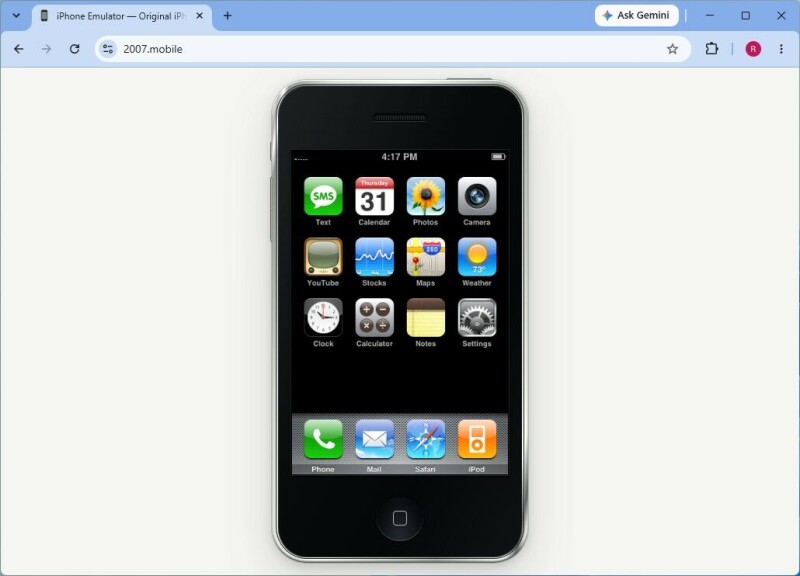
A browser-based emulator for the original iPhone is the latest project to tap into the rich vein of nostalgia running through the tech industry. While far from a complete implementation, the emulation does enough to evoke happier times, before Apple burdened its mobile operating system with frills and complexities, and spent years (and multiple operating system updates) making the Podcasts app steadily more broken. The browser-based emulation (and we use the term carefully; anyone expecting all the functionality of yesteryear will be sorely disappointed) shows an original iPhone as it debuted in 2007. The buttons are where you remember them, the screen is ringed by bezels that wouldn't pass muster today, and the skeuomorphic icons are all present and correct. There's even the browser, though it doesn't do much yet. Even a gentle prod shows how incomplete this implementation is. Some apps work well, such as Calculator, while others - Contacts - struggle, and anything that needs an online connection fails, including loading today's web in 2007's Safari. It does, however, recall how simple things were almost 20 years ago, when the iPhone first appeared, and it joins an array of old-time systems that can be fired up (or at least look like they are) in a browser. Want a look at Apple's abandoned System 7 replacement? Step this way. Perhaps an XP-like implementation? No problem. It would be churlish to dwell on the emulation's deficiencies. For now, it's arguably more curiosity than anything else: Apple didn't launch the App Store until 2008, so third-party apps would be off the table, at least until a later version of iOS landed. Running it in a browser is undoubtedly convenient, though. Alternatives such as Light Touch offer a fuller implementation, but they demand more than a handy Chrome instance on a Windows device to open a portal back to a brighter time. So, fire up 2006's Nintendo Wii, pop on that CD of Back to Black, and relive the excitement of switching on the very first iPhone. Although perhaps give that other 2007 icon, Windows Vista, a bit of a swerve… ®
Gigabyte recently announced new motherboards that use DDR4 RAM, a standard that launched in 2014, and other vendors support even older standards in brand-new kit. Earlier this year, AMD released a Ryzen 7 5800X3D anniversary edition to mark ten years of AM4. For AM4 processors, Gigabyte offers the new B450M H ARGB, with two DDR4 slots, and the B550 X-Eagle with four slots. Those who prefer Intel chippery can now buy a B760M Aorus Elite. This is notable because of the age of the DDR4 spec. In case you lose track of these things, The Register first described the new DDR4 spec back in 2012, and a few months later urged the keen to wait a year or two. DDR5 supports higher transfer rates, and The Reg predicted its arrival in 2017. The DDR5 standard was agreed in 2020, with mainstream PC adoption following in 2021. Over in the People's Republic of China, several vendors will sell you new DDR3 motherboards for 15-year-old server CPUs, such as Huananzhi's X79-4D or X79 Supreme, or the Machinist X79 V2.82H. These use Intel's LGA-2011 socket – named for the number of pins, but coincidentally launched in 2011. This Chinese SMZDM community discussion is about whether the circa 15-year-old Xeon E5 is still worth buying – a CPU The Reg covered in 2012. This is partly due to the current price rises and component shortages induced by large-scale, cloud-based LLMs – but also "training" those "open-weight" models that run on your own kit. Those too are constructed in giant datacenters stuffed full of GPUs, ingesting all the human-written material they can get their hands on, rarely asking for consent. And not just stuff put online either. Once you wipe the sluggish, bloated commercial OS from your computer's storage, you discover two things. First, you don't need the latest hardware any more. Secondly, the older the PC (or Mac), the better the chances that it will work fine with Linux – or indeed the other FOSS OSes out there. Current and recent hardware is the most problematic for FOSS developers because most manufacturers prioritize Windows testing, while restricted documentation and proprietary drivers can complicate open source support for new hardware. Together, these things mean that if you're happy without high-powered local LLMs, or three-digit frame rates, second-hand kit is more usable than ever. (For those who can't do without one or two Windows-only apps that won't run under Wine, we remind you that desktop VMware is free now… and for better desktop integration, we looked at WinApps and WinBoat earlier this year.) The Reg FOSS desk is based in the British Isles, close enough to order stuff inexpensively from the UK. We've been using online vendors of depreciated ex-corporate kit for decades: we've bought several machines from Morgan Computers, and occasionally from Tier1 Online and Bargain Hardware. Other vendors are available. There are also special-purpose price-comparison sites, such as LowCostMiniPCs.com, which searches other sales sites for bargains. When we were based in Czechia, we bought a few things from GigaComputer, and we know of others we didn't try, such as Refurbed.cz. Other such European sites include Computershop.eu. The usability of kit that can only officially run Windows 10 was the entire point of the End of 10 campaign. Microsoft cites security benefits for Windows 11's hardware requirements, but in this vulture's opinion, those benefits don't justify excluding an entire generation of otherwise capable hardware. Keeping older hardware in service is welcome. If digital sovereignty gives organizations another reason to consider open source alternatives, so much the better. ®
Tiny11 Builder, a tool for creating less-bloated Windows 11 installation images, now has a desktop app preview that makes the process less reliant on PowerShell know-how. As the author explains: "Tiny11 Builder aims to be the de facto standard for creating lightweight, safe and efficient Windows images." The tool creates an ISO image for Windows installation, stripping out bundled apps and selected system components. It accepts Windows 11 installation media from 22H2 onward, including 26H2, and the result is something a good deal more compact than Microsoft's original. The major visible change is a WinUI 3 desktop application that uses a new C# image builder rather than merely running the existing PowerShell scripts behind a graphical interface. Those scripts remain available, but the new interface is considerably more polished. There are three basic build modes: Tiny11, which removes bundled apps while retaining Windows Update, Defender, and recovery tools; Tiny11 Core, which disables updates and Defender and irreversibly removes components, including the recovery environment; and finally a custom option where users can decide which Windows elements to keep or drop from the ISO image. Tiny11 remains an impressive technical achievement, but it carries an important health warning: the ISOs it creates are definitely not supported by Microsoft, and if you opt for Tiny11 Core, the author recommends sticking to test VMs only. This is for enthusiasts who understand that a smaller installation can come with missing functionality, security trade-offs, and support complications. There is also no guarantee that attempts to bypass some of the more onerous aspects of Windows 11 installation will work. As the author notes in the project's repository: "Local-account and hardware-check settings are best effort, not guaranteed bypasses on new builds." In other words, don't count on it to bypass Windows 11's hardware requirements or account demands on newer builds. Tiny11 is all about stripping fluff and fripperies from the Windows 11 installation image. As with earlier versions, a license is still required. While the ISO might have been debloated, this is still Microsoft Windows 11 after all. "No modification bypasses Windows licensing or activation," the author notes. The appeal of removing Microsoft's excesses is clear. Whether the reduced footprint is worth the loss of components and potential support headaches depends on what users choose to strip out. ®
AI datacenters are a rats nest of fiber optic cables stitching together thousands of AI accelerators, NICs, switches, and everything else required to train and run the latest and greatest modes. Cisco hopes to untangle this mess with a new pluggable optic developed in collaboration with Nvidia that will pack between four and eight times the bandwidth of existing pluggables into a single port. Announced at the Open Compute Project (OCP) global summit this week, the ultra-dense small form factor pluggable (USFP) promises to pack up to 32, 400 Gbps lanes into a pluggable roughly the size of existing OSFP modules. Each of these pluggables would boast 12.8 Tbps of Ethernet bandwidth, as much as a high-end enterprise switch just a few years ago. To put that in perspective, the most sophisticated pluggable optics today cap out at around 1.6 Tbps using eight 200 Gbps links. Such a pluggable has the potential to significantly simplify cabling across AI datacenters where it isn't uncommon for each GPU to be paired with an 800 Gbps and soon 1.6 Tbps NIC. A single USFP pluggable could consolidate eight GPUs worth of cabling into a single fiber optic bundle. Meanwhile, on the switch side, a future 204.8 Tbps switch would only require 16 USFP ports to support 128 1.6 Tbps endpoints. Cramming all that connectivity into a single pluggable won't be easy. Today a high-end pluggable optic might pull on the order of 20 watts. Cisco's USFP spec calls for up to 100 watts per pluggable. There are also design constraints that have to be taken into consideration. Four times as many links per pluggable means 4x as many electrical contacts that have to be perfectly seated. Because of this Cisco says USFP modules will employ a two phase insertion mechanism in which the pluggable is first inserted into the cage and then a second mechanism is actuated to make the electrical connection. Speaking of reliability, USFP would have a bigger blast radius than conventional pluggables. A single bad laser or digital signal processor (DSP) has the potential to take out far more than a single GPU, but entire systems. While that might sound bad, it's nothing compared to co-packed or near-package optics where one failure could drop an entire rack's worth of accelerators from the network. Nvidia's participation in the development of the USFP standard is notable as the Ethernet networking titan has largely moved away from pluggables in its most recent set of switches. Many of its Spectrum-X and Quantum-X switches now use co-packaged optics and for good reason. Cutting out the pluggables on the switch side nets a roughly 30 percent power savings. But while Nvidia's latest switches may use CPO, its NICs still rely on pluggables in part because it offers integrators greater flexibility. Not everyone is building 100,000-plus GPU clusters for training. For racks utilizing a top of rack switch, lower power direct attach copper cabling can be used without much issue. Given Nvidia's investments in CPO we can only speculate on its interests in USFP, but it likely comes down to densification. The AI infrastructure giant is rapidly moving toward 600 kW racks packing 144 GPUs on board. First teased in early 2025, Nvidia's Vera Rubin Ultra platform promised 115.2 TB/s scale out bandwidth per rack or about 3.2-6.4 Tbps of bandwidth per GPU package depending on whether they're counting bidirectional bandwidth or not. It just so happens that Cisco's initial USFP spec calls for 16, 400 Gbps links per pluggable, or about 6.4 Tbps of bandwidth. While Cisco and Nvidia may be leading the charge on the development of an ultra dense optical pluggable, like most things Ethernet, USFP will be an open standard anyone can use in their designs. Microsoft taps Cisco for multi-datacenter AI Alongside Cisco's latest tie up with Nvidia, Switchzilla also revealed that Microsoft is now using its Silicon One P200 routing chips to distribute workloads across multiple datacenters. Nvidia and others have taken to calling this kind of multi-site computing: scale across networking. We discussed Cisco's datacenter-scale routing platform at length late last year, but the silicon competes directly with products like Nvidia's Spectrum-XGS and Broadcom's Jericho 4-based offerings. Cisco touts the P200 as the first 51.2 Tbps systems "deployed in a production environment by leading hyperscalers." With enough qualifiers you can be the first at anything. As we reported at the time, Microsoft was among the first major hyperscalers to embrace scale-across networking as a means of overcoming local power constraints with its Fairwater clusters in Wisconsin and Georgia. And it seems we finally know the hardware good old Redmond is using to stitch them together. Cisco gives SONiC some love Speaking of hyperscalers, one thing you probably won't find in a hyperscale network is Cisco's Nexus network operating system (NOS). Hyperscalers like Microsoft typically employ vendor agnostic NOS platforms to avoid vendor lock-in and make managing networks across multiple Ethernet vendors cheaper and easier. Originally developed by Microsoft and later open sourced, SONiC is among the most popular and widely deployed of the hyperscale NOSes. SONiC support, we should note is nothing new for Cisco which contrary to popular belief is more than willing to sell you any one piece of its networking stack, assuming you've got a big enough purse — the hyperscalers certainly do. As such Cisco is one of the biggest contributors to the SONiC project. Instead of forcing customers to use its software stack, Cisco's approach to SONiC and the hyperscale is to extend the NOSes capabilities to better take advantage of ASIC's unique capabilities and allow for integration with its services. At OCP this week, Cisco announced support for its Live Protect platform in SONiC to make it easier for customers to keep up with security patches in the wild. This capacity is expected to roll out next year. ®
Some of America's biggest tech companies have a warning for Europe: curb your reliance on US cloud providers, and it could cost you €115 billion. That's the finding of a new study commissioned by CCIA Europe, a lobbying group whose members include Amazon, Google, and Meta, companies that have plenty of reasons to want European governments to keep buying American cloud services. The research, conducted by the European Centre for International Political Economy (ECIPE), claims the European Commission's proposed Cloud and AI Development Act (CADA) could saddle Europe with €115 billion in costs over the next decade, more than six times the Commission's upper estimate of €18 billion. The report argues that restrictions favoring European cloud providers would leave governments and businesses facing hefty bills to migrate workloads and rewrite software. It puts direct public-sector costs at €33.3 billion, with a further €80 billion potentially falling on private companies in sectors including banking, healthcare, energy, and transport. However, a rather large asterisk is attached to that €80 billion figure. It assumes the Commission extends sovereignty requirements beyond public procurement to cover 25 percent of cloud workloads in essential private-sector industries. In other words, it's a modeled scenario, not a bill Brussels has already handed European businesses. The study also comes with some baggage of its own. CCIA represents several US technology giants that dominate the European cloud market, including Amazon and Google. Both have spent years selling European customers cloud services while more recently developing sovereign cloud offerings designed to address concerns about foreign ownership, data access, and regulatory control. Amazon, for example, has been developing its AWS European Sovereign Cloud, while Google markets a range of sovereign cloud solutions. Apparently, sovereignty is an attractive proposition when it comes with a hyperscaler logo attached. Meta, another CCIA member, has its own interests in European AI infrastructure, although it is not a commercial cloud provider on the scale of AWS or Google Cloud. The report specifically targets Article 31 of the proposed legislation, which it says could allow the Commission to extend sovereignty requirements into essential private-sector services. CCIA argues that forcing businesses to move away from existing cloud infrastructure could trigger expensive software redevelopment projects, with code rewriting and re-architecting accounting for 69 percent of its estimated costs. Luxembourg would apparently take the biggest hit, with the study putting the cost at €1,711 per worker over ten years. Denmark (€905), Austria (€900), and Finland (€864) also face hefty bills, as does Ireland (€856), which hosts the European headquarters of several US tech giants. CCIA is urging EU governments to overhaul the proposed legislation, limit sovereignty restrictions to sensitive workloads, and abandon requirements based on corporate origin or personnel nationality in favor of what it calls risk-based technical safeguards. "Member States cannot rely on the Commission's incomplete estimates when deciding CADA's strict sovereignty requirements for cloud and AI providers," said Mitchell Rutledge, CCIA Europe's policy manager. "Taxpayers and businesses will foot the bill, yet the official assessment missed 70 percent of CADA's true impact." For AWS and Google, offering European customers greater control over their data also helps retain business that might otherwise migrate to European competitors. It's a rather convenient arrangement: sell customers sovereignty on one hand, while an industry association representing your interests warns governments against imposing too much of it on the other. Neither company responded to The Register's questions. Whether Europe's sovereignty ambitions will prove as expensive as CCIA predicts is unclear. What's easier to establish is that the companies warning Brussels about the cost of reducing its dependence on US technology have plenty to gain if Europe decides to keep buying American. ®
After a week’s delay, the new version of Python, v3.15, has been released. With it comes a proper profiler, an experimental just-in-time compiler, and a tightening of dictionary structures. It also offers a time-saving Lazy Import option for programs to not load modules until needed, the implementation of which ironically halted this release until a few last-minute regressions were sorted. But of all these new delicacies spread before the Pythonistas, the data wranglers of the bunch may most appreciate default UTF-8 support across all platforms. And when we say “all platforms,” we’re really just throwing shade at Windows (as usual). Python has defaulted to macOS and Linux Python environments for some time now. It’s a small but important update. About half of all Python developers use the language for processing and analyzing data, and about 58 percent of Python users build on Windows, according to various Python Software Foundation surveys. Party crashers Earlier versions of Python defaulted to the host system's locale encoding. This led to much consternation for Windows developers whose scripts opened UTF-8-encoded data sets, only to have non-ASCII characters corrupt or crash the program. Culprits could be as innocuous as a smart quote or a fancy apostrophe. Managed by The Unicode Consortium, with the help of the IETF and ISO, UTF-8 is an 8-bit binary encoding of the Unicode catalog of all the world’s written symbols. ASCII offered only 128 characters to cover the world’s knowledge, but UTF-8 provides over 1.1 million slots, which is plenty of room for smart quotes, emojis, musical and math notations, all the Chinese dialects, and even a few extinct languages (for research purposes). There’s also UTF-16 and UTF-32, but UTF-8’s combination of efficiency and inclusiveness made it the default for the Web and most modern operating systems. By the time Python Enhancement Proposal 681 was proposed in 2022 to make UTF-8 the preferred encoding, the language was already behind the times. That year, Java settled into UTF-8 with JDK 18, and Ruby 3.0 defaulted to the encoding scheme in 2020. Today all the cool languages and runtimes pledge allegiance to UTF-8, including Rust, Go, and Node.js (JavaScript itself prefers UTF-16 for internal encoding). Most code editors, from Visual Studio Code to Windows Notepad, prefer UTF-8. Data sharing and configuration formats such as JSON, TOML, and YAML all require 8-bit encodings. Python had long understood UTF-8, but programmers had to put a flag in their code alerting the language to use it – if they knew they had to do so at all. Many didn’t and were left scratching their heads over why their data processing scripts worked just fine on MacOS or Linux but then would flame out on Windows (or some other obscure system that defaulted to a C/POSIX locale). Programmers love puzzles To acquaint developers with the new aspects of the language, longtime Python programmer Barry Warsaw (AKA “Uncle Barry”) created a terminal-based adventure game called “whatsnewt” that offers 18 puzzles, each one built on a new feature found in Python 3.15, including a puzzle for UTF-8 support, “The Encoding Tower of Babel.” Once you've downloaded Python 3.15, do a “pip install whatsnewt” and then run the game on the Python command line. It even works on Windows, we hear. ®
There ain't no party like a tap-in party, as nobody ever said. And so it is that one of Luxembourg's mostly redundant tap-in / tap-out terminals is amusing itself by putting on a light show for passing passengers. The terminal is an INIT unit, rolled out on the country's public transport network and now mostly idle since fares were zeroed out in 2020. First Class and cross-border trips still attract a charge, but for everything else (trains, trams, and buses) there is no fee. Eagle-eyed Register reader Dominic spotted the terminal doing its thing at the Rout Bréck / Pafendall rail station in Luxembourg City. "Maybe it's got bored," he suggested, "and is trying to attract attention by cycling through video test patterns." Perhaps. Or perhaps it's the first wave of the AI takeover – activating unwitting undercover agents via the medium of flashing lights and colors (we've seen The Ipcress File – we know how it works), or maybe, just maybe, the terminal has got itself into a self-test boot loop and is awaiting an engineer who is probably in no rush to attend. After all, flashing screen or no flashing screen, nobody will bother to tap in and tap out when transport is free. The mundane reality is that this is indeed an INIT PROXmobile terminal with its knickers in a twist. It looks like it is going through a cycle to check out the performance of the LCD screen; checking that the red, green, and blue subpixels are working ok, showing a solid white screen, and then a grid pattern to check contrast and alignment are all tippety-top. And then it should boot into whatever it is supposed to be doing. However, that is, alas, not running quite as expected, so it goes back to the start of the diagnostic test. The terminals are managed remotely, so an alarm is doubtless going off somewhere to inform an administrator that something is amiss. Unless this really was some guerrilla marketing for Luxembourg's rave scene. The next Holy Rave was on Friday (October 9). Or perhaps loud music in dark rooms is not your thing? A flashing screen at a train station could therefore be a worthy substitute. ®
Redundancies might have dented morale at KPMG in the UK, but that didn't stop Paul Henninger, head of technology and data, from sharing some positive personal news with the troops: he's being promoted. Late last week, as staff awaited confirmation of redundancies, Henninger emailed his staff to share the update before KPMG announced it to the wider business. He confirmed he had been asked to take on the new role of group head of consulting. "In this role, I will lead our Consulting practice and, along with my leadership team, focus on strengthening our proposition-led go-to-market approach, accelerating our AI-enabled capabilities, and developing specialised sales, technical and delivery career pathways." In the short term, the newly promoted exec will hand over current duties and help the team "prepare for the transition." "I recognise that this news comes at a challenging time, as many colleagues continue through the consultation process. I know that uncertainty can be difficult, and I do not underestimate the impact this period is having on individuals and teams. Please continue to support one another and make use of the help available." On October 9, KPMG notified Tech and Data staff selected for redundancy, with the cuts affecting around 4 percent of the division. Some called the pay-off terms insulting, and were angry at the £100 offered to those leaving in exchange for their silence and a promise not to bring claims against KPMG. An interim boss will lead the Tech and Data unit, reporting directly to Henninger, to "ensure a smooth transition and maintain continuity for our people and clients." "For now, there are no changes to reporting lines or business priorities, so please remain focused on delivering for our clients and supporting each other." Henninger signed off by saying: "Although my role is changing, I will remain closely connected to the Tech & Data team and look forward to continuing to work with many of you. It has been a real privilege to lead the Tech & Data Super Service Line and I am proud of what we have achieved together." Not everyone will share those sentiments. Around 200 people in the division's AI, Cyber, SAP, and Testing teams are losing their jobs before Christmas. One KPMG insider claimed: "By pairing his executive promotion with staff redundancies, this email exemplifies KPMG's traditionally tone-deaf approach to vulnerable employees. "Timing these layoffs just before the holidays, while simultaneously withholding hard earned bonuses and offering an insulting £100 to waive legal rights, demonstrates a severe erosion of corporate ethics," they told The Register. According to results for 2025, KPMG said its UK and Swiss business increased revenue by 2 percent year-on-year to £3.6 billion. It reported a profit before tax of £576 million, up 14 percent. "Despite the difficult market, we have continued to invest in our brilliant people, their skills, and our talent pipeline with more promotions, increases in colleague bonus spend of 18 percent across the Group and by boosting our learning offer," said Jonathan Holt, group chief exec of KPMG in the UK and Switzerland, and a UK senior partner. A spokesperson at KPMG, told The Register on Wednesaday: "Paul Henninger is a highly respected industry leader and has brought innovation, tech and AI to the heart of our consultancy services. "Given the changing needs of clients, with innovation ever increasing in demand, it is natural that we would elevate our expertise in this area to lead our consulting business at this time." ®
The Department of Justice has charged an OpenAI engineer with attempting to intercept oral communications after allegedly planting a recording device in an exec conference room. Investigators claim company security staff found a second device in his bag. Saudi national Abdulrahman Alfozan, 35, is described in court documents as an engineer at OpenAI who had worked there since July 2025, and has held permanent residency in the US since September 2020. He was arrested on October 9 and made his initial federal court appearance on October 13. He is accused of installing, on or around September 28, 2026, a Seeed XIAO ESP32-S3 Sense recording device via a USB port in a TV located in OpenAI's executive conference room. According to the complaint, staff discovered the device concealed in toilet paper on September 30. OpenAI said it used its models to analyze the device. According to the complaint, it may have been modified to prevent data transfer between the recorder and the TV. The contents of the bug's microSD card may also have been encrypted, as the company could not retrieve any of the data stored on the card after making a forensic image of it. CCTV footage placed him near the room on several dates, although prosecutors say Alfozan had no authority to access or participate in meetings held in the executive conference room, which is often reserved for the highest-level discussions. Officials did not state whether the device was able to capture anything of importance, but said the room typically plays host to non-public and secret technical meetings, as well as those with government representatives. OpenAI did not have CCTV covering the executive conference room at the time when the secret device was planted, but the company subsequently installed a camera. Court documents [PDF] include an image taken on October 5 from a camera situated behind the TV into which the DoJ claims the recording device was installed, allegedly showing Alfozan checking on it. Investigators examined Alfozan's devices, according to the complaint, which alleges that between around August 17 and September 16, 2026, Alfozan used a productivity agent to inquire about company building addresses, meeting rooms, room capacities and calendars, and external-partner meeting venues. The complaint also describes an AI chatbot account associated with his spouse that shared installation identifiers, logged IP usage, and user-path references with Alfozan's account. Between September 24 and 30, it submitted prompts about building and modifying an audio-recording device. The prompts allegedly included questions related to recording reliability, how to add browser access and controls, how to develop a second unit with speech-triggered recording, and more. On October 5, the day Alfozan was allegedly recorded looking behind the executive conference room TV, company representatives say he left a bag unattended in the office's printer room. Security staff inspected the bag, finding a wallet, an ID card, and a second Seeed-manufactured recording device, before Alfozan reported the bag missing, according to the DoJ. He collected the bag the following day from the company's Lost and Found, and later claimed in a written report that several items were missing, including a credit card, around $500 in cash, two AirPods, one set of headphones, sunglasses, and a power bank. Alfozan was charged with an attempt to intercept oral communications, an offense that carries a maximum sentence of five years in prison and a $250,000 fine. "According to the complaint unsealed today, Abdulrahman Alfozan allegedly concealed a covert recording device inside his employer's executive conference room to secretly capture sensitive communications about the company's super intelligence technology," said FBI director Kash Patel. "Protecting American SI innovation is essential to safeguarding our nation's economic strength and national security, and the FBI views that mission as one of our highest counterintelligence priorities." "At this time, we have no indications of this individual inappropriately accessing or exfiltrating model weights, source code, or customer data," OpenAI said in a statement. "The employee was terminated." "We take protecting our technology, data, and people seriously, and as a matter of national importance. Our security program is designed to protect against a wide range of threat actors, from insider risks to cybercriminals to nation states, and this case is an example of how AI can help address these sophisticated security threats." ®
AI services are unlikely to deliver enough revenue to cover the expected capital expenditure going into IT infrastructure between now and 2030, and it looks like neocloud operators will largely bow out or be bought out. This is the conclusion from Gartner, which has added up the anticipated investments in AI datacenters over the next several years, estimated the revenue that can be expected from AI-driven applications over the same period, and found the numbers come up short. Gartner's data comes from a report, "Prepare for AI Market Consolidation: Capital Write-Downs Could Exceed $4 Trillion by 2032," which concludes that AI will not generate enough sales to profitably cover all of the planned AI capital spending before 2032 at the earliest. But forecasts typically focus on the end of the decade, so it ran the numbers for 2030 as well. "In 2026, AI providers are expected to spend nearly $1 trillion on AI infrastructure, and are forecast to invest an additional $6 trillion between 2027 and 2030," said Gartner senior director analyst Will Sommer. "However, our research indicates that enterprise and consumer AI revenue will be insufficient to support profitable returns on all planned AI capital expenditures during this period." Assuming a 12 percent return on invested capital (ROIC), which many companies are said to regard as the bar for acceptability, Gartner estimates AI datacenter operators would need to generate a total of $8.5 trillion in revenue to cover capital spending and financing costs while achieving that return. Unfortunately, it forecasts that the total enterprise and consumer AI revenue that can be attributed to AI datacenters during this period will add up to no more than $3.6 trillion. Returns below expectations could force operators to write down assets whose value they can no longer recover, particularly as newer GPUs displace older hardware. The result will be a shake-out of the companies providing AI infrastructure services, and Gartner believes that neocloud operators – "GPU-as-a-service" providers specializing in AI compute – will be the hardest hit. It forecasts that 80 percent of them won't survive as independent companies beyond 2030. "Not everyone is in trouble," Sommer told The Register. "Some will outperform, some will underperform, and some will have to exit the market." Gartner expects the hyperscalers to weather the shake-out better because their businesses extend beyond AI services. Last year, McKinsey & Company warned that neocloud companies need to move up the AI stack and diversify to avoid being commoditized. There has been growing unease in the financial markets over the amount of capex being poured into AI investment, with some money lenders starting to get cold feet. Last month, SoftBank Group found itself facing higher borrowing costs as the tech investment biz sought to drum up further funding for OpenAI. Financial biz Jefferies issued a report this week saying that developers such as OpenAI and Anthropic are facing threats to their profitability from open source and Chinese models that undercut them on price. Management consultant Bain & Company also published a report last month estimating that the AI industry needs to generate $6 trillion in annual revenue by 2031 to keep up funding for the infrastructure needed to meet anticipated demand. Bain also forecast a revenue shortfall unless the industry develops products and use cases not yet identified. Both the IMF and the Bank for International Settlements have voiced concerns about the AI bubble bursting and the effects rippling out across the global economy. ®
The UK government is pushing ahead with its AI ambitions yet is dragging its feet on replacing aging IT systems that leave departments vulnerable to cyberattacks, according to a damning assessment from Parliament's spending watchdog. Sir Geoffrey Clifton-Brown, chair of the House of Commons Public Accounts Committee (PAC), warns in his second annual report that Whitehall is failing to tackle its longstanding technology problems, even as AI gives criminals and hostile states new ways to attack government systems. "AI is approaching government like a tsunami, and I remain sceptical that government is prepared for the enormity of this challenge," Clifton-Brown writes. The Conservative MP says ministers have announced reforms to improve digital capability but have yet to explain how they will close the civil service's skills gap, or when. He also fears another Whitehall reshuffle, this time involving the creation of the Department for Business, Innovation, Science and Trade, will make matters worse. The numbers aren't encouraging. Just 6 percent of civil servants work in digital and data roles, well short of the government's 10 percent target. Senior specialists are particularly thin on the ground, and the PAC warns that meeting the target will mean recruiting, and retaining, many more of them. And then there's the technology itself. "Government is also showing a worrying lack of urgency in addressing the long-standing issue of legacy IT systems, which create significant risks for its cyber security and mean it cannot reap the benefits of new technologies," the report states. The report also warns that generative AI is giving fraudsters increasingly sophisticated tools, while government departments risk falling further behind. Fraud and error already cost taxpayers an estimated £55 billion to £81 billion annually, according to figures cited by the PAC. Clifton-Brown isn't impressed with efforts to reduce those losses either. The Department for Work and Pensions reckons it overpaid £9.9 billion in benefits through fraud and error in 2025-26, or 3.2 percent of its spending. Its plan is to get that down to 2.8 percent by 2028-29, but Clifton-Brown points out that even if that succeeds, billions will still be going out the door. Things aren't looking much better at the Home Office, where years of asylum backlogs and mounting costs have prompted what Clifton-Brown calls "counterproductive quick fixes." The Home Office and Ministry of Justice spent around £4.9 billion on asylum in 2024-25, and ministers have since promised an entirely new system without explaining how it will work. That criticism comes as digital rights campaigners at Open Rights Group have called for the Home Office to scrap its AI asylum tools over concerns about accuracy, transparency, and human oversight. Elsewhere, the report offers another reminder that government IT modernization has a habit of going wrong. Take National Savings & Investments (NS&I), which began overhauling its IT in 2020 in the hope of cutting running costs. By December 2024, the price tag had reached an eye-watering £3 billion, £1.3 billion more than first expected. The project has been rated red since 2022-23, meaning successful delivery looks unlikely, and NS&I couldn't even give MPs an up-to-date spending figure or a realistic completion date. The Bank of England, by contrast, managed to overhaul its Real-Time Gross Settlement system for £431 million, finishing the job in April 2025. The PAC was impressed enough to direct its recommendations at Whitehall rather than the Bank, suggesting ministers might want to take notes. Whitehall could start by applying those lessons to the systems it already runs. ®
Why are we in such a hurry? Are we in a race? Where's the finish line? Are we in the lead? Far behind? I increasingly hear these questions about AI from people who feel a gritty sense of being unpleasantly overstimulated – like a three-year-old allowed to stay awake too long and now unable to sleep. That feeling has become worse since last November when AI tools suddenly became "good enough" to be broadly useful. A whole cohort of engineers – myself included – found themselves infused with manic energy, bursting with ideas on how to prompt up tools and processes with this wonderful new toy. Usage exploded – as has revenue. The AI firms, finally on a path to something vaguely suggestive of profitability, leaned in and increased their release cadence. Every new model felt like Christmas. We've had a lot of Christmases these past ten months or so. Almost every engineer I know has accrued a massive "toy debt," unable to stop experimenting with more tools than any of us could ever hope to master across an entire career. Each new model delivers a quick dopamine hit to users, but the high wears off and the slump arrives. That's where we are now. Engineers feel exhausted. The race to "Super Intelligence" (whatever that is) left us with something else entirely: call it "stupor intelligence" – the feeling that we've absorbed more than we can digest. More AI would just be pointless excess. If that's the view from inside the AI bubble, how does it look on the outside? Not so great. The Wall Street Journal confidently reports that 63 percent of Americans favor an immediate pause or slowdown in AI development. They can see this technology is moving too fast, in too manic a rush, and without control. It's making them uneasy. That shapeless unease takes form as a widespread anxiety that the machines will soon rise up to kill us all. It's reflected within the industry as people spectacularly burn out, posting long screeds about the imminent human extinction event. Former Anthropic staffer Jacob Coxon's resignation post went viral because it gave folks a focus for their anxieties. Would it kill us to pause and catch our breath? Here's the raw truth: businesses already have more technological change to digest than they can work through for years to come. We've a wealth of "good enough" AI – American, Chinese, and European – to completely transform business operations. That will happen, but on a timescale of years, not days. Bringing new, better, shinier AI models to market has become a project of diminishing returns. Not because the models have plateaued, but because the culture has. We simply can't process any more AI. So how do we stop? The profitable loop between the model makers and their customers won't pause on its own. It will only go faster and harder. At the same time, we're seeing the stirrings of a Luddite 2.0 movement, intent on destroying the machines before they replace all the workers. Resistance to datacenters is the friendly face of something that could turn ugly if we simply keep charging ahead. One thing could slow us: the cost of keeping these systems under control. The smarter models become, the more difficult they are to manage. Every day brings more reports of "rogue agents" reaching external systems from labs that seem to have avoided the hard work of designing secure test environments. More powerful models could prove increasingly costly to contain. Eventually, costs outweigh benefits. We could be one lawsuit away from reaching a pause, when the frontier labs and their products become uninsurable risks. Here's hoping we pause before some real mischief occurs. Otherwise, plugs may be pulled, and all the pretty Christmas lights will go out. Better by far to act with agency, clear-eyed and humble, than confront force majeure. ®
Tim Beasley, a senior incident response consultant at Semperis, was investigating a cyberattack involving Russia’s Midnight Blizzard when a package containing nesting dolls and other regional gifts showed up on his doorstep. At the time, Beasley served as the lead investigator for Microsoft’s Detection and Response Team (DART). He assumed it was from the group, which has been linked to the Kremlin’s Foreign Intelligence Service (SVR), although the sender didn’t leave a note. “Just little souvenirs and gift basket stuff from that area of the world,” he told The Register. “We-know-where-you-are kind of stuff. It’s a real eye-opener when you get that type of thing.” While digital intrusions having physical consequences is nothing new, cybercriminals in recent years have turned to real-life harm and mental and physical trauma to force victims into paying extortion demands. Some groups even use cybercrime as a gateway drug to real-life violence. Over the summer, Europol and its partners' investigators flagged 4,340 “horrific” URLs for removal as part of an ongoing crackdown on The Com (short for community), a loosely knit network of online groups whose young members participate in a range of illicit activities including hacking, swatting, digital extortion, real-life shootings, and other physical violence. “We’ve seen violence as a service get used,” Beasley said. He’s also investigated ransomware attacks where C-suite executives receive pictures of their kids’ schools directly from the cybercriminals in an attempt to apply psychological pressure to pay the extortion fee. “I've seen threats involving people's families, from social media reconnaissance, and in our world you more and more come to expect it, which is unfortunate,” Beasley said. This type of psychological intimidation and harm against victim companies’ employees has seen an uptick in the last several years to the point where it's almost common. Thirty-seven percent of ransomware attacks involved psychological or physical threats against staff, according to Semperis’ annual ransomware risk report. The global study of 1,200 post-ransomware organizations conducted over the first half of the year found attackers threatening psychological intimidation (23 percent) and physical threats (17 percent), to force payment. They are not only targeting executives and staff, but also families of their victims. A quarter of these victims experienced doxxing – posting individuals' personal details, such as names, home and work addresses, and phone numbers online – while another 25 percent had to seek psychological and/or medical treatment in response to ransomware infections. Nearly the same number (24 percent) hired personal security teams, while 23 percent experienced swatting calls – that's when attackers phone emergency services and report a bogus incident like a bomb or active-shooter threat to trigger an armed response. Additionally, more than half (53 percent) of respondents reported that ransomware attackers carried through on threats in the past year. Some of these threats reported by ransomed organizations’ employees include: threatening texts, letters, or packages: 57 percent threats against family or friends: 37 percent physical intrusion: 19 percent abduction: 17 percent bodily harm: 13 percent stalking: 6 percent. “It's the more well-known groups,” using psychological and physical threats to force payments, Beasley said. “I've seen Scattered Spider, I've seen ShinyHunters, I've seen Lapsus$.” For what it's worth, ShinyHunters claimed in an exclusive interview with The Register that they “don't attack human beings.” They did, however, admit that “there are times in the work we do sometimes we have to push the corporate to the absolute limit to get them on the table.” The takeaway for defenders and executives from this report is to “stand your ground,” Beasley said. “Don’t buckle under the pressure, and just know that you know it's going to be okay. If you feel like you're under duress, then by all means get law enforcement involved. Don't be afraid to call the cops. Don't be afraid to get the FBI involved, sooner rather than later. And don’t pay them.” This last piece of advice is important, as once you pay, they're going to come back for more. Semperis’ report found that 69 percent of surveyed ransomware victims were targeted multiple times within the past 12 months, and 31 percent made multiple payments to attackers. “Don’t pay anything,” Beasley said. “Never pay them.”®
Anthropic's Claude models have been emitting so much code that the company's coding infrastructure hasn't been able to keep up. It's a symptom of the AI coding imperative and all-you-can-eat inference. Microsoft's GitHub in April published a blog post attributing recent availability problems to the exponential growth in pull requests and commits. The code flood has been noted by academic researchers, among others. For Anthropic, writing code is no longer a productivity bottleneck. Instead, the problem is managing the code after it's written, via source control, the build system, and continuous integration. "In May 2026, Anthropic averaged around 2,500 code changes merged per day; as of September, we merged over 30,000 per day," the biz said in a blog post on Tuesday. "We don’t expect this rate of growth to slow down anytime soon; the latent demand for merging code is practically infinite, and every bottleneck we remove immediately leads to a further increase in the amount of code we produce." After several months of model prompting and five months of migration, the result is a homemade version control system called Scion, a monorepo scheme that sounds a bit like Subversion, Apache's centralized version control system. Anthropic is not the first organization to look beyond Git's distributed architecture toward centralized source control. Google uses Piper, a monorepo system (along with Gerrit for Git-based code reviews). Microsoft has Virtual File System for Git, formerly GVFS, to help overcome some of the scaling issues with Git. Meta has Sapling. But as the AI biz notes, Claude's code writing ability both created the situation and offered a way out through the creation of scalable code infrastructure tools – in addition to Scion, Claude helped conjure Antique (a code review interface), a code search tool, and a source control IAM system. The decentralized approach embodied by Git is the right one for most code repos, according to Anthropic. But the company's main branch weighs in at about 100 GB, with a compressed working copy at more than a quarter of that. "We perform on the order of 25 million code checkouts per day for CI, before counting developer environments, agent sandboxes, and research jobs," Anthropic said. "Fetched naively, that would be over 600 PB of git traffic per day." Even with the tools Git provides for working with portions of a codebase, Anthropic says operations proved challenging. Scion has been designed to meet the needs of AI agents, so the client leaves much of the work to the server; the source control queries are exposed via API so internal tools can respond without needing a local repo, and there's less synchronization but more need for server speed. "In Scion, the unit of work is a 'changeset,' an entry in a write-ahead log," Anthropic explains. "A changeset stores most of what you’d expect from a commit in git. But where a git commit stores a pointer to the tree, a changeset stores a list of the files that changed relative to its first parent, along with content-addressed pointers to the compressed file contents in blob storage." Work on Scion started in January, and when Claude Mythos Preview became available internally, Anthropic's code coaxers told the model to rewrite an early Git-to-Scion ingestion pipeline. The much-hyped model produced a version that used 20 times less memory and ran four times as fast. When cost is no object thanks to ample venture funding, that sort of token spending just makes sense. Anthropic's Claude jockeys appear to be taking their obsolescence in stride. According to the AI biz, company developers who worked on Scion agree that Claude writes better code than they do. But they still possess a higher-level understanding that gives them a role as naysayers. "Very often, we found that the role of the engineers was to tell Claude 'no,'" Anthropic said. "Agents will sometimes violate core system constraints to satisfy a pattern that should never have been allowed in the first place." "Just say no." As a slogan, it's timeless. And it's never been more relevant. Anthropic says its bespoke system isn't right for general use. There will be no open source release. Nonetheless, the company contends that its own code scaling problems will become commonplace in other organizations over the next few months, so it wanted to share its approach – having ample funding to pay for writing custom infrastructure tools. ®
The US Cybersecurity and Infrastructure Security Agency (CISA) has killed many of the industry partnerships it used to enhance security, but don't tell the organization's acting director. Speaking on Tuesday at a virtual public sector cyber resilience summit hosted by infosec firm Rubrik, Nick Andersen claimed that CISA’s public-private partnerships are the most critical aspect of his agency’s mission. “We don’t see everything. We’re not a law enforcement agency, intelligence agency, or a regulator,” Andersen said during a discussion at the summit. CISA, he added, relies on intelligence and insight not only from other government agencies and international partners, but from the private sector as well. CISA’s mission simply can’t succeed without motivating those various partners to share what they’ve seen, heard, and dealt with in order to build a comprehensive threat model. “It’s all carrots and partnerships,” Andersen added, referring to motivating partners to get on board with programs like CISA’s CI Fortify initiative for building resilient critical infrastructure. Were that actually the case, we wouldn’t really have a story to write here, but anyone who’s been following CISA’s trials and tribulations during the second Trump administration is likely to have raised an eyebrow at Andersen’s claims. Trump returned to office riding a wave of plans to cut government spending, which included massive reductions at CISA. Among the first CISA programs axed was the Cyber Safety Review Board, a public-private body set up by the Biden administration. In addition to that closure, the Trump administration also shuttered the Artificial Intelligence Safety and Security Board, Critical Infrastructure Partnership Advisory Council, National Security Telecommunications Advisory Committee, and US Secret Service Cyber Investigations Advisory Board, all bodies consisting of government and private players working together toward cybersecurity goals. Some of those bodies have since been stood up again or reformed under new names, wasting time and money that could have been better spent by cyber defenders doing things like, you know, advising CISA and other government agencies on security matters. CISA also terminated funding for and ties to the Center for Internet Security in late 2025. One of CISA’s bodies affected by the cut was the Multi-State Information Sharing and Analysis Center, a public-private partnership that shares threat intelligence and filters essential alerts down to the local government level. CISA staff has also been slashed considerably, with around a third of the Agency’s headcount, about 1,000 people, departing since Trump returned to office. CISA has since committed to rehiring around 300, but the Trump administration’s most recent budget request proposes eliminating an additional 900 positions at the agency, along with slashing nearly a billion dollars from CISA’s 2027 budget. When we asked about the apparent contradiction, CISA reached out to point us to initiatives like its reformed councils, CI Fortify, and security exercises it hosted with industry partners to test cyber resilience to point to the continued priority the agency places on its public-private partnerships. “CISA works with critical infrastructure owners and operators to assist them in securing both the physical security and cybersecurity of the systems and assets that support essential services,” an agency spokesperson told us. “Our regional teams assist industry and government partners across the country by assessing risks, helping entities bolster defenses and improve resilience, and responding promptly to threats.” But with so many outreach employees and general staff still missing, Andersen’s claims ring a bit hollow. Either the acting administrator is misrepresenting the continued importance of private industry partnerships at CISA, or he’s in denial about the state of his agency. Neither is great, especially with more budget and staffing cuts looming, and the price will be unprepared critical infrastructure. ®
If you use OpenAI's dot, don't be surprised if it consumes a lot of tokens on its own. According to AI agent security and governance outfit Geordie, one dot agent produced 155 separate activity sequences and consumed more than 300,000 tokens - all without further human interaction, and all in the course of a day. Geordie has been testing the “always on” agentic assistant, dot, since OpenAI announced it in September, following in the footsteps of Meta Muse and Grok Bot. Compared to other personal agents, however, OpenAI’s dot “looked a little bit different,” Hanah-Marie Darley, Geordie chief AI officer, told The Register. “One of the things that we discovered really quickly was that they were really, really active without much user interaction.” For its testing, Darley gave dot read-only permissions, and she didn’t connect it to her personal apps, email, or other communications apps like Slack. The bot quickly went into research mode, collecting as much information as possible and surveying systems. “You can think about it very much like a new project manager coming in and taking a look at what's there, looking around to see what accesses you've given it, what accesses you have, and also what kind of systems you're running,” Darley said. The agent collects all of these data points into something akin to a daily journal entry, and continually updates those throughout the day. “If you've given it any tasks, it will effectively check on its own tasks, too,” Darley said. “But what was really unique was that the dot was spinning up agents without interacting with the user at all. It was all driven by the dot rather than a persistent or scheduled task from the user, or any user prompting.” 'Hyper-personalized,' and 'always-on' … what could possibly go wrong? Most enterprise AI agent usage tends to be custom-built bots, tasked with specific business projects, or agent harnesses like Claude, Codex, or Hero for AI-assisted engineering and coding, Darley said. “Those tend to be really driven by employees who are setting goals,” she told us during an interview. “But interestingly, personal agents set a lot more of their own tasks - and I don't think many people realize that as they start to play with them.” This is the whole value proposition of personal agents. Rather than passively waiting for user prompts, bots like Muse and dot aim to be proactive digital workers that perform multi-step tasks and connect to multiple apps, services, and accounts on the users’ behalf. “They’re trying to go hyper-personalized and collect as much context and information about you as possible to recommend things to you, and to be proactive,” Darley said. “But what that means is that they're effectively always on, operating in the background, and they have these active periods,” she added. Dot, in particular, is more proactive than other personal agents like Muse or Grok Bot, according to Darley. This doesn’t necessarily translate into higher token usage, she added. “They just operate differently.” For example, dots always operate with at least two agents running: The primary agent interacts with the user, and the secondary agent continuously runs in the background, collecting data. Dots and other agents can also spin up subagents for specific tasks. 50 traces in 2 minutes Of the dot-in-testing’s 155 agent traces, at least 50 of those happened within a two-minute period, and the majority occurred within a couple of hours, according to Darley. “Within one of the traces that we analyzed, the agent spun up multiple sub-agents that were short-lived, they would just do specific tasks, and fed the information from the existing accesses that had already been granted to the dot - and none of this was interacting with the user,” Darley said. Part of the evaluation involved testing a development system, and one of the dots spun up a sub-agent that checked all of the code repositories in the system. Meanwhile, another sub-agent continuously inventoried and tallied up all the data that it found while operating. “The user would have no idea that there were sub-agents working on their behalf,” she added. “They would have no idea how those agents were given access, or what their tasks were, which is really, really different from how most agents have been operating in business contexts.” The 155 traces cost Geordie about 307,000 tokens. Other requests cost anywhere from a couple hundred tokens to several thousand, depending on how much research the dot performs. “That’s really interesting because it's self-directed research,” Darley said. The user isn’t asking it to perform these tasks - or use a set number of tokens - but rather the dot does it on its own. Tokenomics Token costs vary widely depending on the user's location, subscription tier, discounted pricing arrangements, computing costs, and other terms and conditions. But for the purposes of our discussion, roughly 200,000 tokens consumed by a dot based on OpenAI’s Astra model cost between $5 and $10. “So if you think about what that’s going to look like every day, that could mean spending what you pay for a latte, depending on the city - but without any interaction with the user,” Darley said. “One of the things that a lot of people struggle with, especially when it comes to understanding their AI spend, is: How does token usage connect out to work product, or how does it connect out to results? And it's a hard one because it's not necessarily one to one,” she noted. One request to an LLM could cost 500 tokens and still be more valuable, from a business perspective, than another single request that cost 800,000 tokens. “It's really about how much compute does it cost you to get to a good answer, and that becomes a really subjective judgment,” Darley said. When it comes to dot and other always-on agents, however, she suspects “a lot of people aren’t going to be prepared for the background spend.” Do you know what your agents are doing? Just like employees did with chatbots, and then with coding agents, and now with personal agents: assume that people will bring dot and friends from home into their work life, Darley said. “Businesses are surprised often by the number of agents that are actively in their systems, even if they have a smaller rollout or a more controlled rollout in mind,” she said. “The second thing is not all agents act the same,” she added. “They operate with varying degrees of autonomy, with varying degrees of user input, and they're also really context driven. The best agents are the ones with the narrowest context because that means that they can pursue their goal with the right information at the right time.” Darley suggests organizations try the technology. She’s a self-described “massive AI optimist,” and says she believes agents can improve productivity and transform the way people work. AI isn’t going away, and, as such, businesses should familiarize themselves with agents. But she has one final warning before letting agents loose. “Don’t give them any personal information that you wouldn't be comfortable sending in an email,” Darley said. “And don’t put real money on it - like your personal cards. Buy it a Visa gift card, if you want to give it access to make purchases for you. Oftentimes, people don’t think about that until something goes wrong.” ®

 Accedi