Modalità di lettura

NASA’s SpaceX Crew-11 to Discuss Space Station Science Mission

NASA’s SpaceX Crew-11 crew returns to Ellington Field’s Guppy Hangar in Houston on Jan. 16, 2026, from left to right is Roscosmos cosmonaut Oleg Platonov, NASA astronauts Mike Fincke, and Zena Cardman, and JAXA (Japan Aerospace Exploration Agency) astronaut Kimya Yui.
NASA

After 167 days in space, the crew members of NASA’s SpaceX Crew-11 mission will hold a news conference at 2:15 p.m. EST, Wednesday, Jan. 21, at the agency’s Johnson Space Center in Houston to discuss their science expedition aboard the International Space Station.

NASA astronauts Zena Cardman and Mike Fincke, JAXA (Japan Aerospace Exploration Agency) astronaut Kimiya Yui, and Roscosmos cosmonaut Oleg Platonov will answer questions about their mission. The crew members returned to Earth on Jan. 15, splashing down off the coast of San Diego, and arrived in Houston on Friday, where they will undergo standard postflight reconditioning and evaluations.

NASA will provide live coverage on the agency’s YouTube channel. Learn how to watch NASA content through a variety of additional online platforms, including social media.

Media are invited to attend in person or virtually. For in-person attendance, contact the NASA Johnson newsroom no later than 5 p.m. CST, Tuesday, Jan. 20, at jsccommu@mail.nasa.gov or 281-483-5111. Media participating by phone must dial into the news conference no later than 10 minutes prior to the start of the event to ask questions. Questions also may be submitted on social media using #AskNASA. A copy of NASA’s media accreditation policy is available on the agency’s website.

The crew spent more than five months in space, including 165 days aboard the orbiting laboratory, traveling nearly 71 million miles, and completing more than 2,670 orbits around Earth. While living and working aboard the station, the crew completed hundreds of science experiments and technology demonstrations.

Get the latest NASA space station news, images, and features on Instagram, Facebook, and X.

NASA’s Commercial Crew Program has delivered on its goal of safe, reliable, and cost-effective transportation to and from the International Space Station from the United States through a partnership with American private industry. This partnership is opening access to low Earth orbit and the space station to more people, more science, and more commercial opportunities. For more than 25 years, people have continuously lived and worked aboard the space station, advancing scientific knowledge and demonstrating new technologies that enable us to prepare for human exploration of the Moon as we prepare for Mars.

Learn more about NASA’s Commercial Crew Program at:

https://www.nasa.gov/commercialcrew

-end-

Joshua Finch / Jimi Russell
Headquarters, Washington
202-358-1100
joshua.a.finch@nasa.gov / james.j.russell@nasa.gov  

Anna Schneider / Shaneequa Vereen
Johnson Space Center, Houston
281-483-5111
anna.c.schneider@nasa.gov / shaneequa.y.vereen@nasa.gov

  •  

Out of This World Discoveries: Space Station Research in 2025

5 Min Read

Out of This World Discoveries: Space Station Research in 2025

693K9731.NEF

As Earth completed its orbit around the Sun to close out 2025, the International Space Station circled our planet more than 5,800 times. Serving as humanity’s unique laboratory in space, the station has hosted thousands of experiments and technology demonstrations, advancing science in ways that cannot be replicated on Earth.

In 2025 alone, more than 750 experiments supported exploration missions, improved life on Earth, and opened commercial opportunities in low Earth orbit. The space station continues to drive innovation by enabling human exploration of the Moon and Mars, transforming medical research, deepening our understanding of the universe, and fostering a growing commercial economy.

Read through just a handful of 2025’s innovative research achievements from the orbiting laboratory.

25 Years of humans researching in orbit

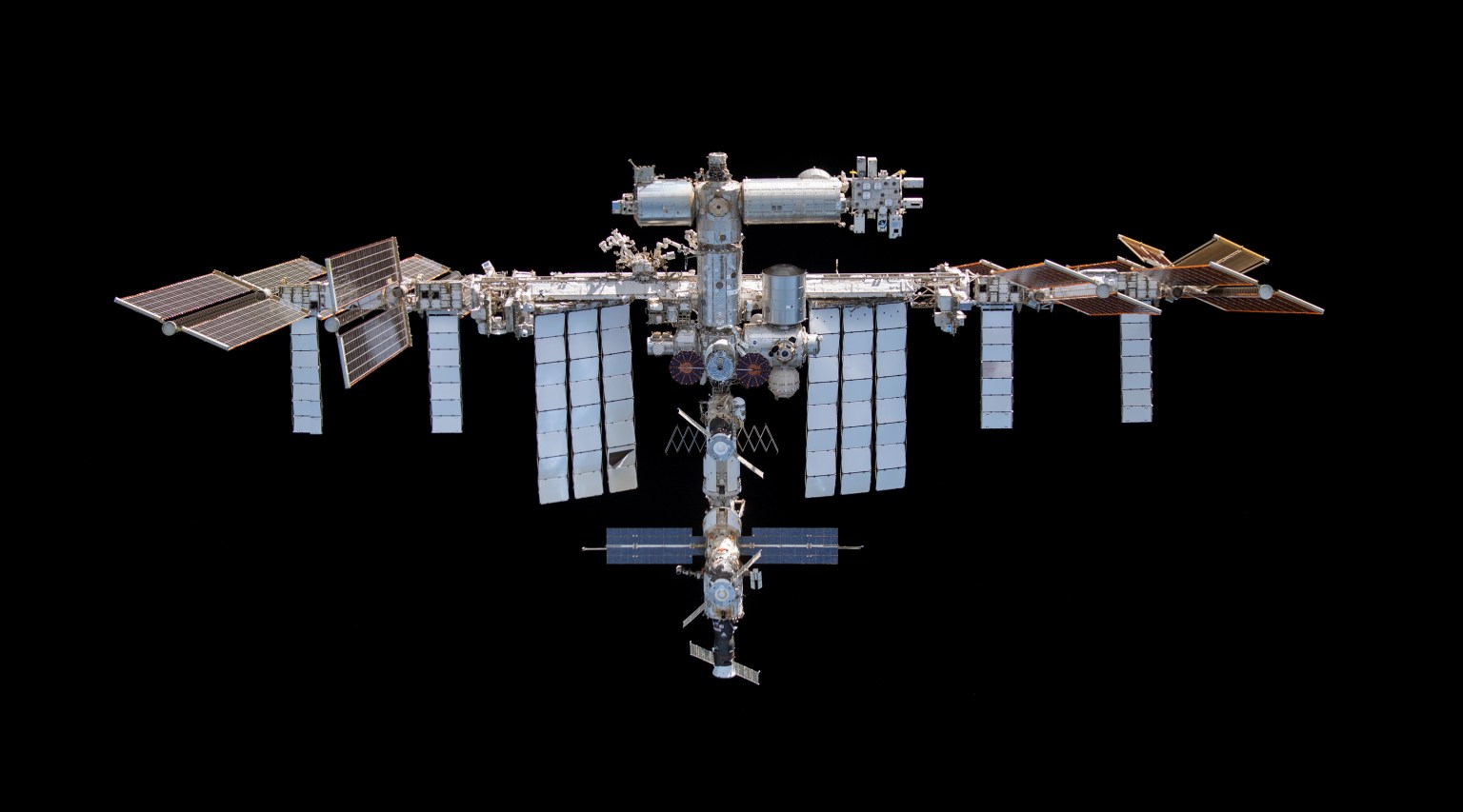
The International Space Station, backdropped against the darkness of space and Earth at its horizon, was photographed by the Expedition 1 crew in 2000, during a fly around aboard a Soyuz capsule.
The International Space Station photographed in 2000 by the Expedition 1 crew.
NASA

On Nov. 2, 2025, humanity reached a milestone of cosmic proportions: 25 years of continuous human presence aboard the International Space Station. Since the first crew arrived on Nov. 2, 2000, NASA and its partners from around the world have conducted more than 4,000 research investigations and technology demonstrations. More than 290 people from 26 countries have visited the space station, where continuous human presence enables research that surpasses the capabilities of satellites and autonomous platforms. The space station’s unique microgravity environment, paired with crew operations, continues to unlock discoveries and push the boundaries of humanity’s curiosity and innovation.

A breakthrough cancer treatment

European Space Agency astronaut Thomas Pesquet works inside the International Space Station, holding two black cylindrical experiment containers as part of the Protein Crystal Growth-5 study. Behind him, computer displays are mounted to the station’s wall, along with many other instruments, cables, and silver knobs.
ESA (European Space Agency) astronaut Thomas Pesquet conducts research aboard the International Space Station supporting the advancement of cancer therapeutics.
NASA

Research aboard the International Space Station helped inform the development of a newly FDA-approved injectable medication used to treat several types of early-stage cancers. The research yielded early insights into the structure and size of particles needed to develop the medication through protein crystal growth experiments. This new delivery method promises to lower costs and significantly reduce treatment time for patients and healthcare providers, while maintaining drug efficiency. Microgravity research can produce higher-quality, medically relevant crystals than Earth-based labs, enabling these types of medical advances. These developments showcase how space station research can drive innovation, improve lives, and foster commercial opportunities.

Medical implants printed in orbit

A rectangular, eight-pronged crystalline-yellow object is displayed on a metallic surface.
Eight medical devices for peripheral nerve repair were printed simultaneously aboard the International Space Station. Credit: Auxilium Biotechnologies.

Eight medical implants designed to support nerve regeneration were successfully 3D printed aboard the International Space Station for preclinical trials on Earth. When nerve damage occurs, these types of implants are designed to improve blood flow and enable targeted drug delivery. Printing in microgravity can prevent particle settling, resulting in more uniform and stable structures. In-space manufacturing is helping to advance medical treatments and other technologies while also enabling astronauts to print devices and tools on demand during future missions.

Learn more about InSPA-Auxilium Bioprinter.

A new understanding of our Sun

A color-coded heat map of the Sun's outer atmosphere showing a large, fan-like plume. Colors transitions from cool purple and blue on the left to greens in the middle to yellow and bright red on the right, indicating temperature changes over several days.
Using data from NASA’s CODEX (Coronal Diagnostic Experiment), this animated, color-coded heat map shows temperature changes of the Sun over the course of couple days, where red indicates hotter regions and purple indicates cooler ones.
NASA/KASI/INAF/CODEX
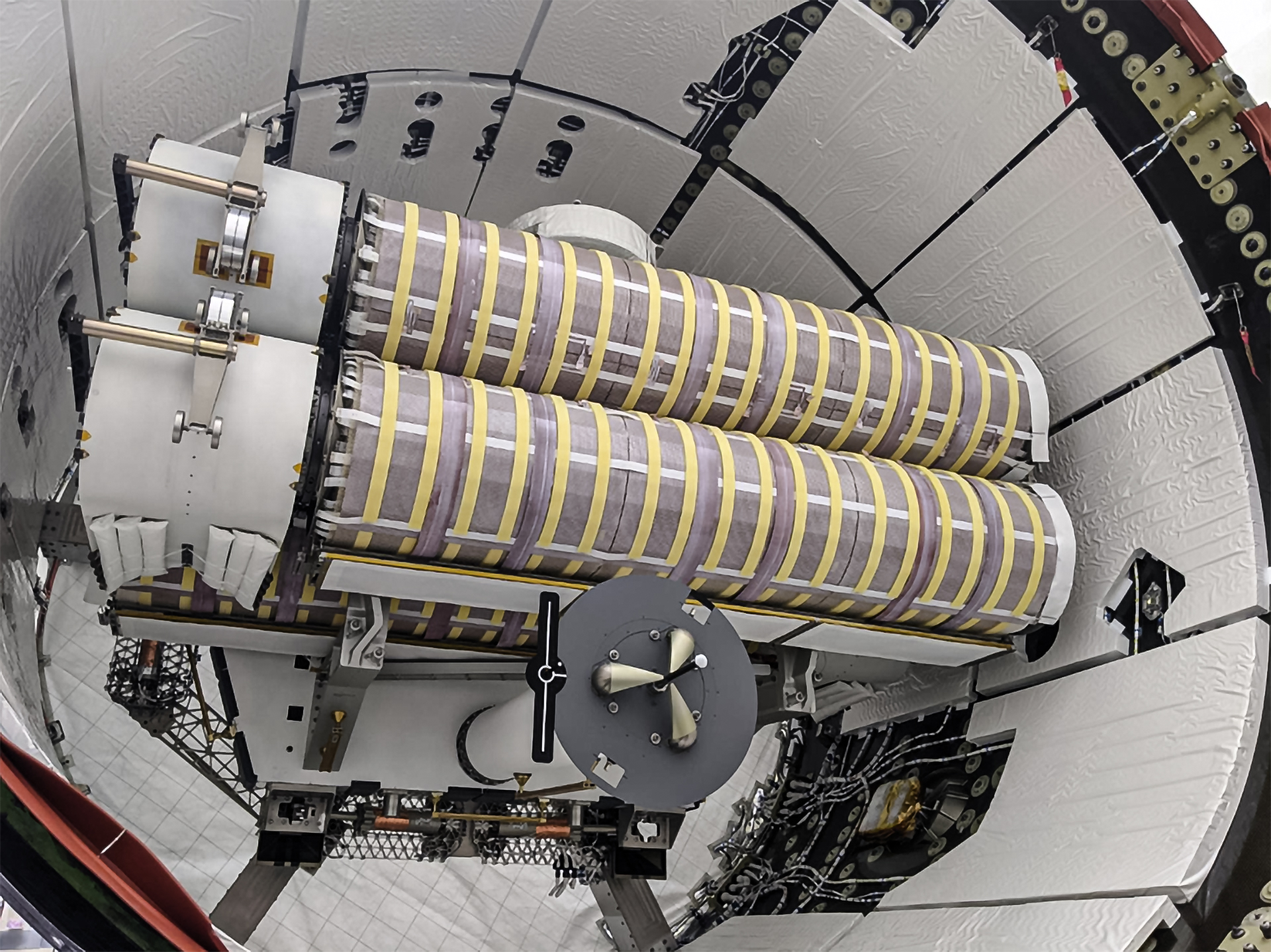
The robotic hand, better known as Dextre, attached to the white tube-like Canadarm2 robotic arm, carries the CODEX experiment after extracting the research hardware from the trunk of the SpaceX Dragon cargo spacecraft. The space station hardware’s white color contrasts against the black background of space.
Dextre, attached to the International Space Station’s Canadarm2 robotic arm, carries CODEX.
NASA

A solar coronagraph aboard the International Space Station captured its first unique images detailing the Sun’s outer atmosphere while measuring  solar wind temperature and speed. The instrument blocks the Sun’s bright light to reveal its faint outer atmosphere, or corona, where solar wind originates. Earlier experiments focused on the corona’s density, but this new device enables the study of what heats and accelerates the solar wind, offering a more complete picture of how energy moves through the Sun’s atmosphere. These observations help researchers understand how solar activity affects Earth and space-based technology, such as satellites, communications networks, and power systems.

Learn more about CODEX.

Hunting for microscopic space travelers

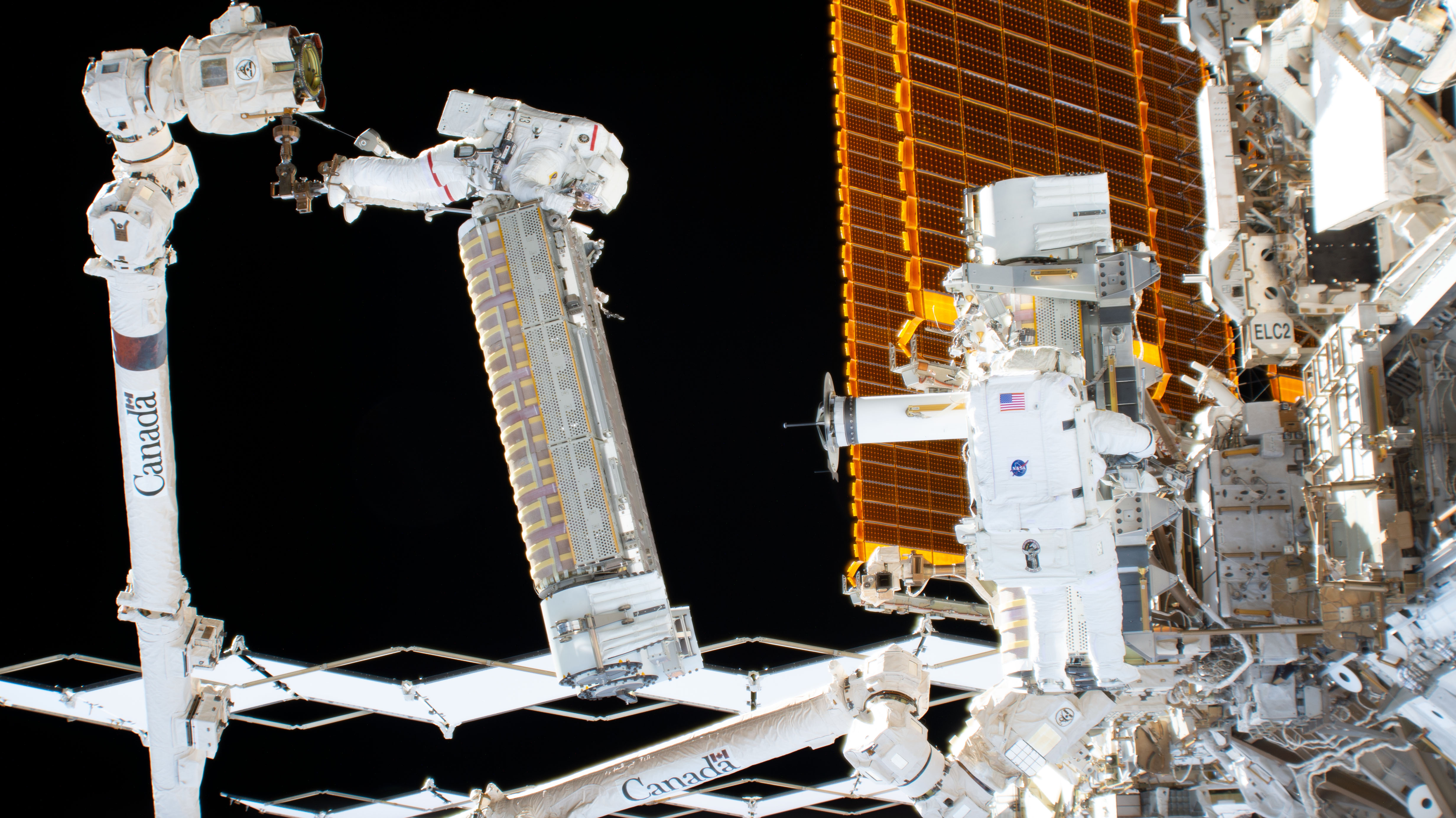
NASA astronaut Butch Wilmore wears a white spacesuit while performing a spacewalk outside the International Space Station. Wilmore is positioned horizontally against the station’s exterior. In the background, the black of space contrasts with the station’s copper-colored solar arrays and the white robotic Canadarm, which has "Canada" printed vertically in black letters.
NASA astronaut Butch Wilmore works outside the International Space Station on Jan. 30, 2025, during a five-hour and 26-minute spacewalk.
NASA

NASA astronaut Butch Wilmore collected microbiological samples during a spacewalk outside the International Space Station. Samples were taken near the life support system vents to see if the orbital complex releases microorganisms. This experiment helps researchers examine if and how these microorganisms survive and reproduce in the harsh space environment, as well as how they may behave at destinations such as the Moon and Mars. After returning to Earth, the samples underwent DNA extraction and sequencing. Another round of collections is planned for future spacewalks. The data could help determine whether changes are needed on crewed spacecraft and spacesuits to reduce biocontamination during missions to explore destinations where life may exist now or in the past.

Learn more about ISS External Microorganisms.

A fully docked space station

A shot from the International Space Station showing a long, white robotic arm maneuvering the cylindrical silver Cygnus XL cargo spacecraft. Earth’s blue oceans and white clouds are visible in the background. In the foreground, the HTVX-1 vehicle docked to the space station, covered in reflective gold foil with its silver solar panels visible.
Northrop Grumman’s Cygnus XL spacecraft is grappled by the International Space Station’s Canadarm2. In the background, JAXA’s (Japan Aerospace Exploration Agency) HTV-X1 cargo craft is docked to the orbital complex.
NASA
An artistic concept of the International Space Station, displaying its large gold solar arrays and eight different spacecraft attached to it, including the SpaceX Dragon cargo craft, the SpaceX Crew-11 Dragon spacecraft, JAXA’s HTV-X1 cargo craft, Northrop Grumman’s Cygnus XL cargo craft, the Soyuz MS-27 and MS-28 crew spacecraft, and the Progress 92 and 93 resupply ships.
The International Space Station visiting spacecraft configuration on Dec.1, 2025 showing eight spacecraft parked at the orbital complex.
NASA

For the first time in International Space Station history, all eight docking ports of the orbiting laboratory were occupied at once. Three crew spacecraft and five cargo resupply craft were attached to station, including JAXA’s new cargo vehicle HTV-X1 and Northrup Grumman’s new Cygnus XL. The eight spacecraft delivered astronauts, cargo, and scientific experiments from around the world to be conducted in the unique microgravity environment. This milestone highlights the space station’s evolution, inviting commercial partners and international collaboration to continue expanding the orbiting laboratory’s research capabilities.

Space station research meets the Moon’s surface

A split-screen image showing two different space missions. On the left, a silver box-shaped instrument with a grid of circular sensors, is attached to the International Space Station, with bright orange solar arrays in the background. On the right, an artist’s concept of a gold-foil-wrapped lunar lander with four thin legs stands on the grey, cratered Moon’s surface under a black, star-filled sky. The lander features a black stylized bird logo on its side.
NICER (Neutron Star Interior Composition Explorer) is shown mounted to the International Space Station in the image on the left, and LEXI (right) is shown attached to the top of Firefly Aerospace’s Blue Ghost in an artist’s concept.
NASA/Firefly Aerospace

Three experiments that landed on the Moon during Firefly Aerospace’s Blue Ghost Mission-1 were enabled by earlier research aboard the International Space Station. These studies help improve space weather monitoring, test computer recovery from radiation damage, and advance lunar navigation systems. The orbiting laboratory continues to lay the foundation for missions beyond low Earth orbit, driving exploration deeper into space. 

Learn more.  

The space station continues to deliver out-of-this-world achievements that cannot be replicated on Earth. Its research capabilities are a springboard for humanity’s future in innovation and testing the limits of what’s possible.

Here’s to 2026 — another year of defying physics and pushing the boundaries of science and exploration.

  •  

NASA’s SpaceX Crew-11 Wraps Up Space Station Science

4 Min Read

NASA’s SpaceX Crew-11 Wraps Up Space Station Science

Four SpaceX Crew-11 members gather together for a crew portrait wearing their Dragon pressure suits during a suit verification check inside the International Space Station's Kibo laboratory module. Clockwise from bottom left are, NASA astronaut Mike Fincke, Roscosmos cosmonaut Oleg Platonov, NASA astronaut Zena Cardman, and JAXA (Japan Aerospace Exploration Agency) astronaut Kimiya Yui.

NASA’s SpaceX Crew-11 mission with agency astronauts Zena Cardman and Mike Fincke, JAXA (Japan Aerospace Exploration Agency) astronaut Kimiya Yui, and Roscosmos cosmonaut Oleg Platonov returned to Earth after a long-duration mission aboard the International Space Station.

During their stay, Cardman, Fincke, and Yui contributed more than 850 hours of research to help prepare humanity for the return to the Moon and future missions to Mars, while improving life back on Earth.

Here’s a glimpse into the science completed during the Crew-11 mission:

Bolstering bone resilience

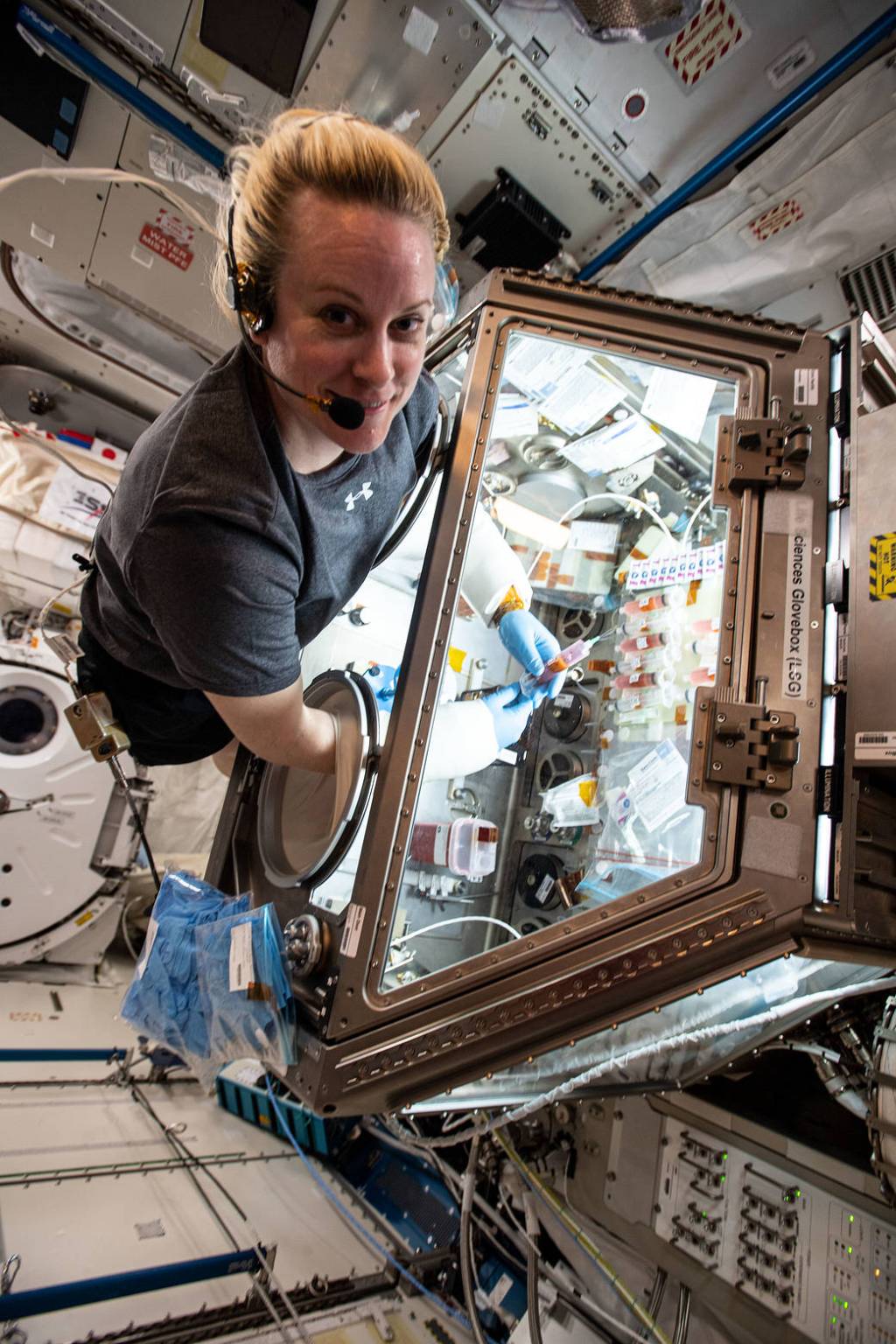
NASA astronaut Zena Cardman reaches into the clear, sealed Life Science Glovebox and holds a small packet. The inside of the rectangular workspace is illuminated by white light and is full of small containers and bags.

NASA astronaut Zena Cardman works with bone stem cells aboard the International Space Station to improve our understanding of how bone loss occurs during spaceflight. Studying bone cell activity in microgravity could help researchers learn how to control bone loss to protect astronauts’ bone density during future long-duration space missions and inform treatments for diseases like osteoporosis on Earth. 

Learn more about MABL-B.

Observing Earth and beyond

JAXA (Japan Aerospace Exploration Agency) astronaut Kimiya Yui, wearing a blue-and-white striped shirt, looksthrough a camera inside of the space station’s cupola. The blue Earth, speckled with clouds, can be seen through a circular window above and trapezoid-shaped windows in front of him.

JAXA (Japan Aerospace Exploration Agency) astronaut Kimiya Yui photographs the Earth from the International Space Station’s cupola. For more than 40 years, astronauts have used hand-held cameras to capture millions of images documenting Earth’s geographic features, weather patterns, urban growth, changes to its surface, and the impacts of natural disasters such as hurricanes and floods.

The blue curvature of the Earth’s atmosphere is visible with yellow, green, and red layers of airglow above it. In the center, just above Earth and peeking through the red haze, a blue collection of stars is visible.

Astronauts also use the cupola and other viewports aboard the space station to gaze into the cosmos without Earth’s atmospheric interference. Just as viewing Earth from 250 miles above provides a new perspective on our home planet, looking out into the stars from the orbiting laboratory offers a clearer view of our universe.

Space catch

NASA astronaut Mike Fincke floats in a cylindrical airlock. He wears blue latex gloves and gestures toward a silver box with a black, hexagonal shape in the center. He is surrounded by wires and various panels along the space station’s walls.

NASA astronaut Mike Fincke poses aboard the International Space Station with a new device designed to test an inflatable capture bag’s ability to open, close, and stay airtight in microgravity. This technology could be used to remove space debris from orbit, protecting future spacecraft and crew members. It also may enable trapping samples during exploration missions and support the capture and mining of small asteroids.

Learn more about Capture Bag Demo.

Tracking internal temperature

NASA astronaut Mike Fincke, wearing a black shirt and khaki pants, floats in the space station with his arms up and legs crossed. He wears the blue T-Mini headband. The surrounding walls of the space station are lined with equipment and wires.

NASA astronaut Mike Fincke wears a temperature-monitoring headband that tracks how the human body regulates its core temperature during spaceflight. Adjusting to living and working aboard the International Space Station can influence human temperature regulation. This headband provides an easy, non-invasive way to collect temperature data while astronauts conduct their daily activities. The sensor is also being tested on Earth and may help prevent hyperthermia in people working in high-temperature environments.

Learn more about T-Mini.

A new cargo vehicle

The cylinder-shaped HTV-X1 spacecraft is shown gripped by the Canadarm2. The surface of the vehicle is reflective gold, and a silver-colored solar array panel juts from either side. The Earth fills the background, with white streaky clouds covering much of the blue ocean.

JAXA’s (Japan Aerospace Exploration Agency) new cargo resupply spacecraft, HTV-X1, is shown after being captured by the International Space Station’s Canadarm2 robotic arm during the Crew-11 mission. The spacecraft launched from Tanegashima Space Center on Oct. 26, 2025, delivering approximately 12,800 pounds of science, supplies, and hardware to the orbital complex. New cargo spacecraft expand the station’s capability to support more research and receive critical supplies.

Making nutrients on demand

JAXA (Japan Aerospace Exploration Agency) astronaut Kimiya Yui, wearing a blue-and-white striped shirt, holds a tray with two rows of plastic bags. The top row has four bags filled with purple fluid, and the bottom row has eight bags filled with pale pink fluid.

JAXA (Japan Aerospace Exploration Agency) astronaut Kimiya Yui holds yogurt bags produced aboard the International Space Station that could provide important nutrients during missions far from Earth. Certain nutrients degrade when stored for long periods of time, and deficiency in even one can lead to illness. Researchers are building on previous experiments to develop a method for producing on-demand vitamins and nutrients in space using microorganisms.

Learn more about BioNutrients-3.

Celebrating a historic milestone

The seven-member Expedition 73 crew poses for a portrait, each of them in a light blue polo. In the front row from left are, NASA astronaut Jonny Kim, Roscosmos cosmonaut Sergey Ryzhikov, and Roscosmos cosmonaut Alexey Zubritsky. In the back row are, Roscosmos cosmonaut Oleg Platonov, NASA astronauts Mike Fincke and Zena Cardman, and JAXA (Japan Aerospace Exploration Agency) astronaut Kimiya Yui.

The Expedition 73 crew poses for a portrait to commemorate 25 years of continuous human presence aboard the International Space Station. In the front row from left, NASA astronaut Jonny Kim, Roscosmos cosmonaut Sergey Ryzhikov, and Roscosmos cosmonaut Alexey Zubritsky. In the back row, Roscosmos cosmonaut Oleg Platonov, NASA astronauts Mike Fincke and Zena Cardman, and JAXA (Japan Aerospace Exploration Agency) astronaut Kimiya Yui.

A truly global endeavor, the space station has been visited by more than 290 people from 26 countries, along with a variety of international and commercial spacecraft. Since the first crew arrived, NASA and its partners have conducted thousands of research investigations and technology demonstrations to advance exploration of the Moon and Mars and benefit life on Earth.

  •  

NASA’s SpaceX Crew-11 Mission Returns, Splashes Down off California

Roscosmos cosmonaut Oleg Platonov, left, NASA astronauts Mike Fincke, Zena Cardman, and JAXA (Japan Aerospace Exploration Agency) astronaut Kimiya Yui are seen inside the SpaceX Dragon Endeavour spacecraft onboard the SpaceX recovery ship SHANNON shortly after having landed in the Pacific Ocean off the coast of Long Beach, Calif., Thursday, Jan. 15, 2026. Cardman, Fincke, Yui, Platonov are returning after 167 days in space as part of Expedition 74 aboard the International Space Station.
NASA/Bill Ingalls

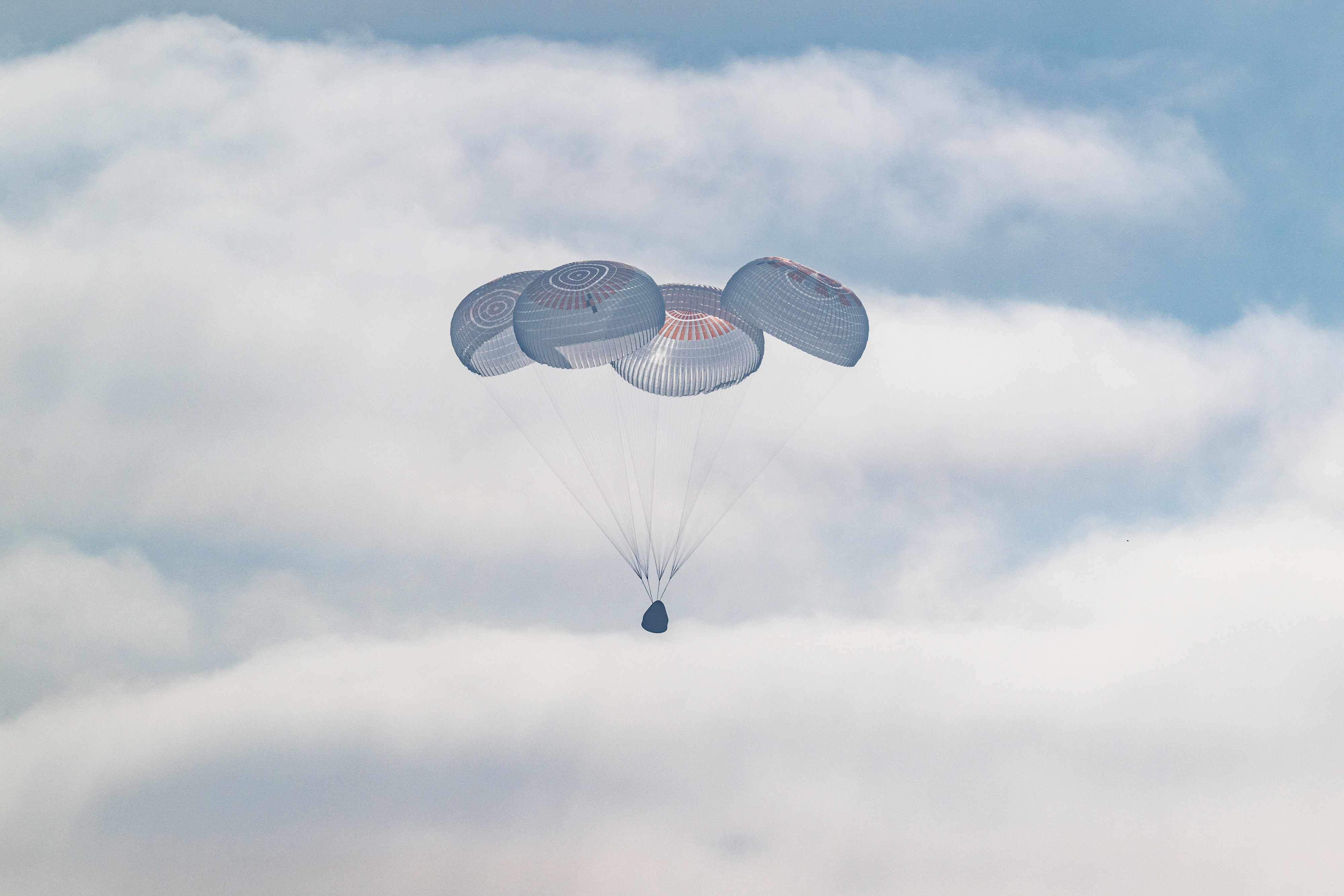
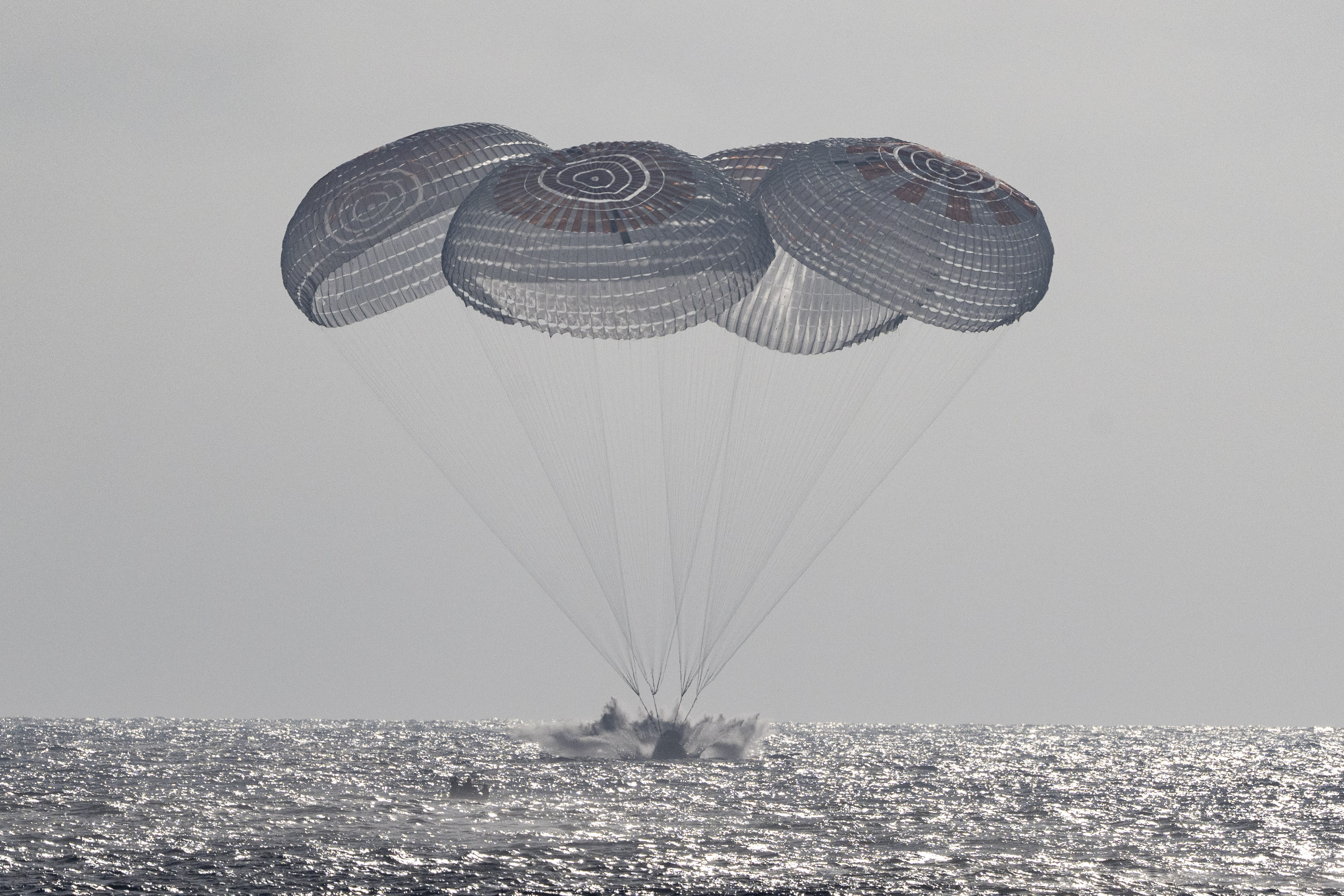
NASA’s SpaceX Crew-11 mission safely splashed down early Thursday morning in the Pacific Ocean off the coast of San Diego, concluding a more than five-month mission aboard the International Space Station.

NASA astronauts Zena Cardman and Mike Fincke, JAXA (Japan Aerospace Exploration Agency) astronaut Kimiya Yui, and Roscosmos cosmonaut Oleg Platonov returned to Earth at 12:41 a.m. PST. Teams aboard SpaceX recovery vessels retrieved the spacecraft and its crew shortly after landing.

“I couldn’t be prouder of our astronauts and the teams on the ground at NASA, SpaceX, and across our international partnerships,” said NASA Administrator Jared Isaacman. “Their professionalism and focus kept the mission on track, even with an adjusted timeline. Crew-11 completed more than 140 science experiments that advance human exploration. Missions like Crew-11 demonstrate the capability inherent in America’s space program—our ability to bring astronauts home as needed, launch new crews quickly, and continue pushing forward on human spaceflight as we prepare for our historic Artemis II mission, from low Earth orbit to the Moon and ultimately Mars.”

Crew-11 returned home about a month earlier than planned because of a medical concern teams are monitoring with one of the crew members, who remains stable. Due to medical privacy, it is not appropriate for NASA to share more details about the crew member. Prior to return, NASA previously coordinated for all four crew members to be transported to a local hospital for additional evaluation, taking advantage of medical resources on Earth to provide the best care possible.

Following the planned overnight hospital stay, the crew members will return to NASA’s Johnson Space Center in Houston and undergo standard postflight reconditioning and evaluations.

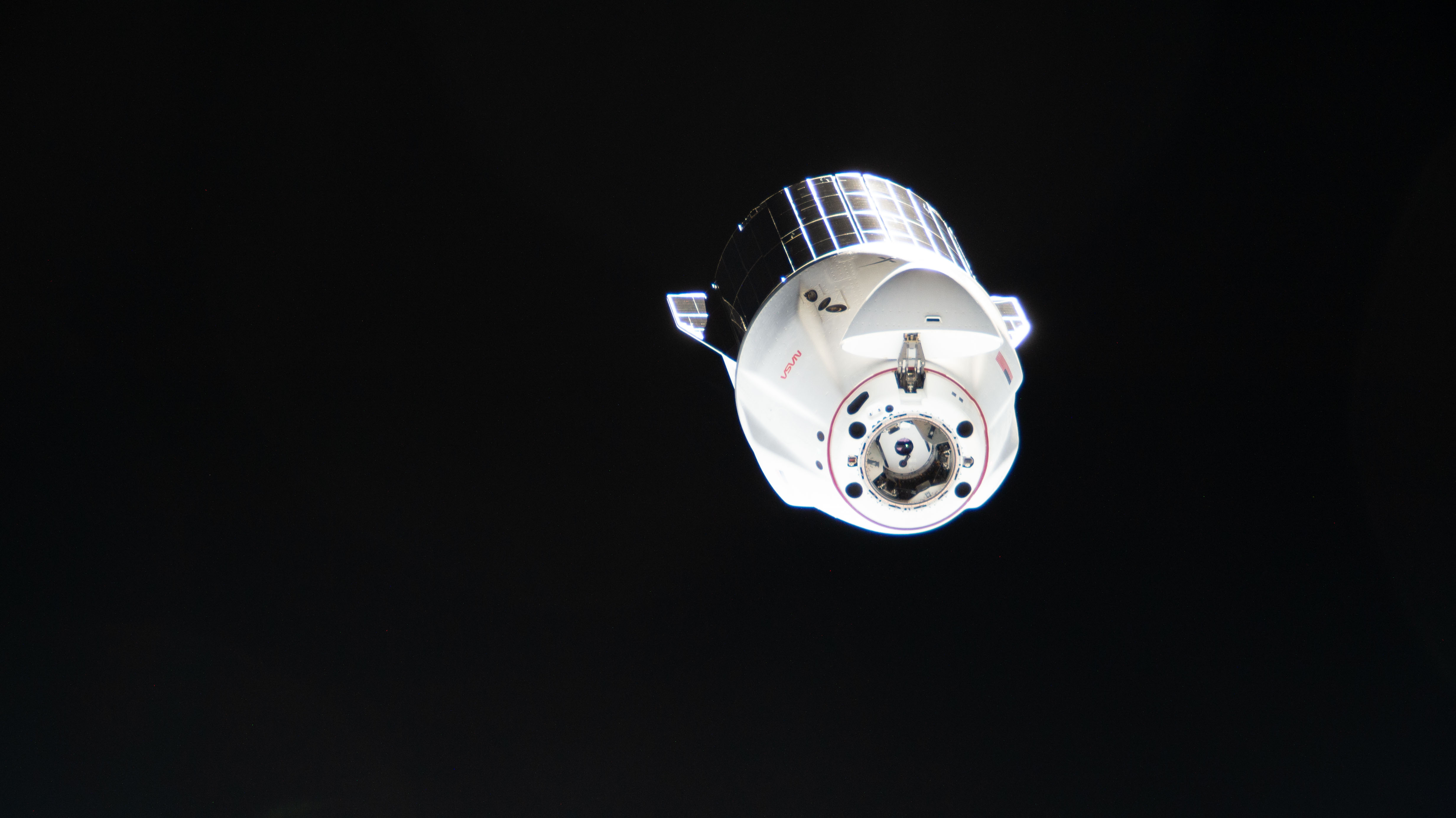
The Crew-11 mission lifted off at 11:43 a.m. EDT on Aug.1, 2025, from Launch Complex 39A at NASA’s Kennedy Space Center in Florida. About 15 hours later, the crew’s SpaceX Dragon spacecraft docked to the orbital outpost at 1:27 a.m. CDT on Aug. 2.

During their 167-day mission, the four crew members traveled nearly 71 million miles and completed more than 2,670 orbits around Earth. The Crew-11 mission was Fincke’s fourth spaceflight, Yui’s second, and the first for Cardman and Platonov. Fincke has logged 549 days in space, ranking him fourth among all NASA astronauts for cumulative days in space.

Along the way, Crew-11 logged hundreds of hours of research, maintenance, and technology demonstrations. The crew members also celebrated the 25th anniversary of continuous human presence aboard the orbiting laboratory on Nov. 2, 2025. Research conducted aboard the space station advances scientific knowledge and demonstrates new technologies that enable us to prepare for human exploration of the Moon and Mars.

NASA’s Commercial Crew Program provides reliable access to space, maximizing the use of the International Space Station for research and development by partnering with private U.S. companies, including SpaceX, to transport astronauts to and from the space station.

Learn more about NASA’s Commercial Crew Program at:

https://www.nasa.gov/commercialcrew

-end-

Joshua Finch / Jimi Russell
Headquarters, Washington
202-358-1100
joshua.a.finch@nasa.gov / james.j.russell@nasa.gov

Sandra Jones / Joseph Zakrzewski
Johnson Space Center, Houston
281-483-5111
sandra.p.jones@nasa.gov / joseph.a.zakrzewski@nasa.gov

Steven Siceloff
Kennedy Space Center, Florida
321-867-2468
steven.p.siceloff@nasa.gov

  •  

La NASA transmitirá en directo el regreso y el amerizaje de Crew 11

Los cuatro miembros de la tripulación SpaceX Crew-11 se juntaron para una foto de grupo con sus trajes presurizados Dragon durante una comprobación de dichos trajes en el módulo laboratorio Kibo de la Estación Espacial Internacional.
Los cuatro miembros de la tripulación SpaceX Crew-11 se juntaron para una foto de grupo con sus trajes presurizados Dragon durante una comprobación de dichos trajes en el módulo laboratorio Kibo de la Estación Espacial Internacional. En el sentido de las agujas del reloj, desde la parte inferior izquierda, aparecen el astronauta de la NASA Mike Fincke, el cosmonauta de Roscosmos Oleg Platonov, la astronauta de la NASA Zena Cardman y el astronauta de la JAXA (Agencia Japonesa de Exploración Aeroespacial) Kimiya Yui. 
Credit: NASA

Read this press release in English here.

La NASA y SpaceX prevén que, si las condiciones meteorológicas lo permiten, el desacoplamiento de la misión SpaceX Crew 11 de la agencia espacial estadounidense de la Estación Espacial Internacional se produzca no antes de las 5:05 p.m. EST (hora del este) del miércoles 14 de enero.

El 8 de enero, la NASA anunció su decisión de traer de vuelta a la Tierra antes de lo previsto a los integrantes de la misión SpaceX Crew 11 de la agencia desde la estación espacial, mientras los equipos técnicos siguen de cerca un problema médico que afecta a un miembro de la tripulación que actualmente vive y trabaja a bordo del laboratorio orbital. Debido a la confidencialidad médica, no es apropiado que la NASA comparta más detalles sobre el miembro de la tripulación, quien se encuentra estable.

Está planeado que los astronautas de la NASA Zena Cardman y Mike Fincke, el astronauta de JAXA (Agencia Japonesa de Exploración Aeroespacial) Kimiya Yui y el cosmonauta de Roscosmos Oleg Platonov americen frente a la costa de California a las 3:41 a.m. del jueves 15 de enero.

Los responsables de la misión continúan supervisando las condiciones en la zona de recuperación, ya que el desacoplamiento de la nave Dragon de SpaceX depende de las condiciones operativas de la nave espacial, la preparación del equipo de recuperación, las condiciones meteorológicas, el estado del mar y otros factores. La NASA y SpaceX seleccionarán una hora y un lugar concretos para el amerizaje cuando se acerque la fecha del desacoplamiento de la nave espacial de Crew 11.

La cobertura en directo (en inglés) de la NASA del regreso y las actividades relacionadas se retransmitirá en NASA+, Amazon Prime, y el canal de YouTube de la agencia. Aprenda cómo transmitir contenido de la NASA a través de diversas plataformas en línea, incluidas las redes sociales.

La cobertura de la NASA es la siguiente (todas las horas son del este y están sujetas a cambios en función de las operaciones en tiempo real):

Miércoles, 14 de enero

3 p.m. – Comienza la cobertura del cierre de escotilla en NASA+, Amazon Prime, y YouTube.

3:30 p.m. – Cierre de escotilla

4:45 p.m. – Comienza la cobertura del desacoplamiento en NASA+, Amazon Prime, y YouTube.

5:05 p.m. – Desacoplamiento

Tras la finalización de la cobertura del desacoplamiento, la NASA distribuirá las conversaciones (solo en formato audio) entre la tripulación Crew 11, la estación espacial y los controladores de vuelo durante el tránsito de la nave Dragon alejándose del complejo orbital.

Jueves, 15 de enero

2:15 a.m. – Comienza la cobertura del regreso en NASA+, Amazon Prime, y YouTube.

2:51 a.m. – Encendido de desorbitado

3:41 a.m. – Amerizaje

5:45 a.m. – El administrador de la NASA, Jared Isaacman, liderará una rueda de prensa sobre el regreso a la Tierra que se transmitirá en directo a través de NASA+, Amazon Prime, y el canal de YouTube de la agencia.

Para participar virtualmente en la conferencia de prensa, los medios de comunicación deben ponerse en contacto con la sala de prensa del Centro Espacial Johnson de la NASA para obtener los detalles de la llamada antes de las 5 p.m. CST (hora del centro) del 14 de enero, enviando un correo electrónico a jsccommu@mail.nasa.gov o llamando al +1 281-483-5111. Para hacer preguntas, los medios de comunicación deben llamar al menos 10 minutos antes del inicio de la conferencia. La política de acreditación de medios de comunicación de la agencia está disponible en línea (en inglés).

Encuentre la cobertura completa de la misión, el blog de tripulaciones comerciales de la NASA y más información sobre la misión Crew 11 (todo en inglés) en:

https://www.nasa.gov/commercialcrew

-fin-

Joshua Finch / Jimi Russell / María José Viñas
Sede central, Washington
+1 202-358-1100
joshua.a.finch@nasa.gov / james.j.russell@nasa.gov / maria-jose.vinasgarcia@nasa.gov  

Sandra Jones / Joseph Zakrzewski
Centro Espacial Johnson, Houston
+1 281-483-5111
sandra.p.jones@nasa.gov / joseph.a.zakrzewski@nasa.gov

Steve Siceloff
Centro Espacial Kennedy, Fla.
+1 321-867-2468
steven.p.siceloff@nasa.gov

Share

Details

Last Updated
Jan 13, 2026
Editor
Jennifer M. Dooren

  •  

NASA to Provide Live Coverage of Crew-11 Return, Splashdown

Four SpaceX Crew-11 members gather together for a crew portrait wearing their Dragon pressure suits during a suit verification check inside the International Space Station's Kibo laboratory module.
Four SpaceX Crew-11 members gather together for a crew portrait wearing their Dragon pressure suits during a suit verification check inside the International Space Station’s Kibo laboratory module. Clockwise from bottom left are, NASA astronaut Mike Fincke, Roscosmos cosmonaut Oleg Platonov, NASA astronaut Zena Cardman, and JAXA (Japan Aerospace Exploration Agency) astronaut Kimiya Yui.
Credit: NASA

Editor’s note: This advisory was updated on Wednesday, Jan. 14 to update the undocking time and coverage

Lee este comunicado de prensa en español aquí.

NASA and SpaceX are targeting no earlier than 5:20 p.m. EST, Wednesday, Jan. 14, for the undocking of the agency’s SpaceX Crew-11 mission from the International Space Station, pending weather conditions.

On Jan. 8, NASA announced its decision to return the agency’s SpaceX Crew-11 mission to Earth from the space station earlier than originally planned as teams monitor a medical concern with a crew member currently living and working aboard the orbital laboratory, who is stable. Due to medical privacy, it is not appropriate for NASA to share more details about the crew member.

NASA astronauts Zena Cardman and Mike Fincke, JAXA (Japan Aerospace Exploration Agency) astronaut Kimiya Yui, and Roscosmos cosmonaut Oleg Platonov are targeted to splash down off the coast of California at 3:41 a.m. on Thursday, Jan. 15.

Mission managers continue monitoring conditions in the recovery area, as undocking of the SpaceX Dragon depends on spacecraft readiness, recovery team readiness, weather, sea states, and other factors. NASA and SpaceX will select a specific splashdown time and location closer to the Crew-11 spacecraft undocking.

NASA’s live coverage of return and related activities will stream on NASA+, Amazon Prime, and the agency’s YouTube channel. Learn how to stream NASA content through a variety of online platforms, including social media.

NASA’s coverage is as follows (all times Eastern and subject to changed based on real-time operations):

Wednesday, Jan. 14

3 p.m. – Hatch closure coverage begins on NASA+, Amazon Prime, and YouTube.

3:30 p.m. – Hatch closing

5 p.m. – Undocking coverage begins on NASA+, Amazon Prime, and YouTube.

5:20 p.m. – Undocking

Following the conclusion of undocking coverage, NASA will distribute audio-only communications between Crew-11, the space station, and flight controllers during Dragon’s transit away from the orbital complex.

Thursday, Jan. 15

2:15 a.m. – Return coverage begins on NASA+, Amazon Prime, and YouTube.

2:51 a.m. – Deorbit burn

3:41 a.m. – Splashdown

5:45 a.m. – NASA Administrator Jared Isaacman will lead a Return to Earth news conference streaming live on NASA+, Amazon Prime, and the agency’s YouTube channel.

To participate virtually in the news conference, media must contact the NASA Johnson newsroom for call details by 5 p.m. CST, Jan. 14, at: jsccommu@mail.nasa.gov or 281-483-5111. To ask questions, media must dial in no later than 10 minutes before the start of the call. The agency’s media credentialing policy is available online.

Find full mission coverage, NASA’s commercial crew blog, and more information about the Crew-11 mission at:

https://www.nasa.gov/commercialcrew

-end-

Joshua Finch / Jimi Russell
Headquarters, Washington
202-358-1100
joshua.a.finch@nasa.gov / james.j.russell@nasa.gov

Sandra Jones / Joseph Zakrzewski
Johnson Space Center, Houston
281-483-5111
sandra.p.jones@nasa.gov / joseph.a.zakrzewski@nasa.gov

Steve Siceloff
Kennedy Space Center, Fla.
321-867-2468
steven.p.siceloff@nasa.gov

Share

Details

Last Updated
Jan 14, 2026
Editor
Jennifer M. Dooren
  •  

NASA, SpaceX Invite Media to Watch Crew-12 Launch to Space Station

Image shows a blue background featuring pictures of four astronauts that comprise of NASA's SpaceX Crew-12 mission. From left to right, NASA astronauts Jessica Meir and Jack Hathaway, ESA (European Space Agency) astronaut Sophie Adenot, and Roscosmos cosmonaut Andrey Fedyaev.
From left to right, NASA astronauts Jessica Meir and Jack Hathaway, ESA (European Space Agency) astronaut Sophie Adenot, and Roscosmos cosmonaut Andrey Fedyaev.
NASA

Media accreditation is open for the launch of NASA’s 12th rotational mission of a SpaceX Falcon 9 rocket and Dragon spacecraft carrying astronauts to the International Space Station for a science expedition from Space Launch Complex 40 at Cape Canaveral Space Force Station in Florida.

NASA announced it is targeting no earlier than Thursday, Jan. 15, for a splashdown of its Crew-11 mission. The agency also is working with SpaceX and international partners to advance the launch of Crew-12, which is currently slated for Sunday, Feb. 15.

The crew includes NASA astronauts Jessica Meir, commander, Jack Hathaway, pilot; ESA (European Space Agency) astronaut Sophie Adenot, mission specialist; and Roscosmos cosmonaut Andrey Fedyaev, mission specialist. This will be the second spaceflight for Meir and Fedyaev, and the first for Hathaway and Adenot to the orbiting laboratory.

Media accreditation deadlines for the Crew-12 launch as part of NASA’s Commercial Crew Program are as follows:

  • International media without U.S. citizenship must apply by 11:59 p.m. EST on Thursday, Jan. 15.
  • U.S. media and U.S. citizens representing international media organizations must apply by 11:59 p.m. on Sunday, Jan. 18.

All accreditation requests must be submitted online at:

https://media.ksc.nasa.gov

NASA’s media accreditation policy is online. For questions about accreditation or special logistical requests, email: ksc-media-accreditat@mail.nasa.gov. Requests for space for satellite trucks, tents, or electrical connections are due by Friday, Jan. 23.

For other questions, please contact NASA Kennedy’s newsroom at: 321-867-2468.

Para obtener información sobre cobertura en español en el Centro Espacial Kennedy o si desea solicitar entrevistas en español, comuníquese con Antonia Jaramillo: 321-501-8425, o Messod Bendayan: 256-930-1371.

For launch coverage and more information about the mission, visit:

https://www.nasa.gov/commercialcrew

-end-

Joshua Finch / Jimi Russell
Headquarters, Washington
202-358-1100
joshua.a.finch@nasa.gov / james.j.russell@nasa.gov

Steve Siceloff
Kennedy Space Center, Fla. 
321-867-2468 
steven.p.siceloff@nasa.gov

Joseph Zakrzewski
Johnson Space Center, Houston
281-483-5111
Joseph.a.zakrzewski@nasa.gov

Share

Details

Last Updated
Jan 12, 2026
Editor
Jennifer M. Dooren
  •  

A Quarter Century in Orbit: Science Shaping Life on Earth and Beyond 

For more than 25 years, humans have lived and worked continuously aboard the International Space Station, conducting research that is transforming life on Earth and shaping the future of exploration. From growing food and sequencing DNA to studying disease and simulating Mars missions, every experiment aboard the orbiting laboratory expands our understanding of how humans can thrive beyond Earth while advancing science and technology that benefit people around the world.  

Unlocking new cancer therapies from space

A woman conducts a research experiment aboard the International Space Station.
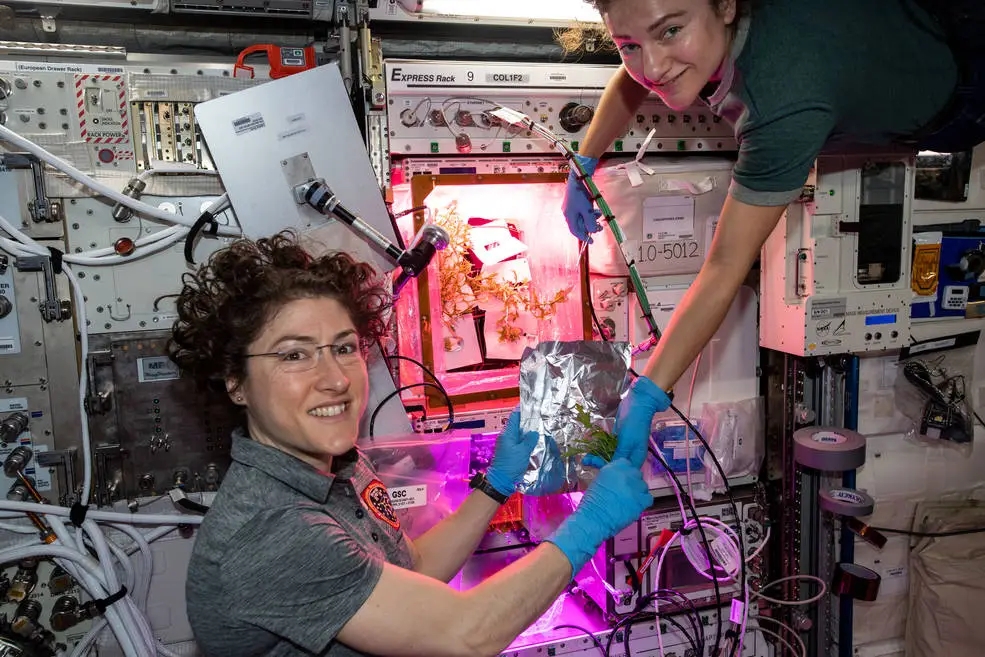
NASA astronaut Christina Koch works on MicroQuin’s protein crystallization research aboard the International Space Station.
NASA

The space station gives scientists a laboratory unlike any on Earth. In microgravity, cells grow in three dimensions, proteins form higher-quality crystals, and biological systems reveal details hidden by gravity. These conditions open new ways to study disease and develop treatments

Astronauts and researchers have used the orbiting laboratory to observe how cancer cells grow, test drug delivery methods, and examine protein structures linked to diseases such as Parkinson’s and Alzheimer’s. One example is the Angiex Cancer Therapy study, which tested a drug designed to target blood vessels that feed tumors. In microgravity, endothelial cells survive longer and behave more like they do in the human body, giving researchers a clearer view of how the therapy works and whether it is safe before human trials. 

Protein crystal growth (PCG) is another major area of cancer-related study. The NanoRacks-PCG Therapeutic Discovery and On-Orbit Crystals investigations have advanced research on leukemia, breast cancer, and skin cancers. Protein crystals grown in microgravity produce larger, better-organized structures that allow scientists to determine fine structural details that guide the design of targeted treatments. 

Studies in orbit have also provided insights about cardiovascular health, bone disorders, and how the immune system changes in space—knowledge that informs medicine on Earth and prepares astronauts for long missions in deep space. 

By turning space into a research lab, scientists are advancing therapies that benefit people on Earth and laying the foundation for ensuring crew health on future journeys to the Moon and Mars. 


Farming for the future 

NASA astronauts Jessica Watkins and Bob Hines work on the XROOTS space botany investigation, which used the station’s Veggie facility to test soilless hydroponic and aeroponic methods to grow plants. The space agricultural study could enable production of crops on a larger scale to sustain crews on future space explorations farther away from Earth.
NASA astronauts Jessica Watkins and Bob Hines work on the eXposed Root On-Orbit Test System (XROOTS) space botany investigation, which used the station’s Veggie facility to test soilless hydroponic and aeroponic methods to grow plants. The space agricultural study could enable production of crops on a larger scale to sustain crews on future space explorations farther away from Earth.
NASA

Feeding astronauts on long-duration missions requires more than packaged meals. It demands sustainable systems that can grow fresh food in space. The Vegetable Production System, known as Veggie, is a garden on the space station designed to test how plants grow in microgravity while adding fresh produce to the crew’s diet and improving well-being in orbit. 

To date, Veggie has produced three types of lettuce, Chinese cabbage, mizuna mustard, red Russian kale, and even zinnia flowers. Astronauts have eaten space-grown lettuce, mustard greens, radishes, and chili peppers using Veggie and the Advanced Plant Habitat, a larger, more controlled growth chamber that allows scientists to study crops in greater detail. 

These plant experiments pave the way for future lunar and Martian greenhouses by showing how microgravity affects plant development, water and nutrient delivery, and microbial interactions. They also provide immediate benefits for Earth, advancing controlled-environment agriculture and vertical farming techniques that help make food production more efficient and resilient in challenging environments. 

First year-long twin study 

Identical twin astronauts Mark and Scott Kelly
Mark and Scott Kelly, both former NASA astronauts, are photographed as part of NASA’s Twins Study.
NASA

Understanding how the human body changes in space is critical for planning long-duration missions. NASA’s Twins Study offered an unprecedented opportunity to investigate nature vs. nurture in orbit and on Earth. NASA astronaut Scott Kelly spent nearly a year aboard the space station while his identical twin, retired astronaut Mark Kelly, remained on Earth. 

By comparing the twins before, during, and after the mission, researchers examined changes at the genomic, physiological, and behavioral levels in one integrated study. The results showed most changes in Scott’s body returned to baseline after his return, but some persisted—such as shifts in gene expression, telomere length, and immune system responses. 

The study provided the most comprehensive molecular view to date of how a human body adapts to spaceflight. Its findings may guide NASA’s Human Research Program for years to come, informing countermeasures for radiation, microgravity, and isolation. The research may have implications for health on Earth as well—from understanding aging and disease to exploring treatments for stress-related disorders and traumatic brain injury. 

The Twins Study demonstrated the resilience of the human body in space and continues to shape the medical playbook for the Artemis campaign to the Moon and future journeys to Mars. 

Simulating deep space 

The 1,200 square foot sandbox located in the CHAPEA habitat at NASA's Johnson Space Center.
A view inside the sandbox portion of the Crew Health and Performance Analog, where research volunteers participate in simulated walks on the surface of Mars.
NASA/Bill Stafford

The space station, which is itself an analog for deep space, complements Earth-based analog research simulating the spaceflight environment. Space station observations, findings, and challenges, inform the research questions and countermeasures scientists explore on Earth.   

Such work is currently underway through CHAPEA (Crew Health and Performance Exploration Analog), a mission in which volunteers live and work inside a 1,700-square-foot, 3D-printed Mars habitat for about a year. The first CHAPEA crew completed 378 days in isolation in 2024, testing strategies for maintaining health, growing food, and sustaining morale under delayed communication. 

NASA recently launched CHAPEA 2, with a four-person crew who began their 378-day simulated Mars mission at Johnson on October 19, 2025. Building on lessons from the first mission and decades of space station research, they will test new technologies and behavioral countermeasures that will help future explorers thrive during long-duration missions, preparing Artemis astronauts for the journey to the Moon and laying the foundation for the first human expeditions to Mars. 

Keeping crews healthy in low Earth orbit 

NASA astronaut and Expedition 72 Flight Engineer Nick Hague pedals on the Cycle Ergometer with Vibration Isolation and Stabilization (CEVIS), an exercise cycle located aboard the International Space Station's Destiny laboratory module. CEVIS provides aerobic and cardiovascular conditioning through recumbent (leaning back position) or upright cycling activities.
NASA astronaut Nick Hague pedals on the Cycle Ergometer with Vibration Isolation and Stabilization (CEVIS), an exercise cycle located aboard the space station’s Destiny laboratory module. CEVIS provides aerobic and cardiovascular conditioning through recumbent or upright cycling activities.
NASA

Staying healthy is a top priority for all NASA astronauts, but it is particularly important while living and working aboard the orbiting laboratory.  

Crews often spend extended periods of time aboard the orbiting laboratory, with the average mission lasting about six months or more. During these long-duration missions, without the continuous load of Earth’s gravity, there are many changes to the human body. Proper nutrition and exercise are some of the ways these effects may be mitigated. 

NASA has a team of medical physicians, psychologists, nutritionists, exercise scientists, and other specialized medical personnel who collaborate to ensure astronauts’ health and fitness on the station. These teams are led by a NASA flight surgeon, who regularly monitors each crew member’s health during a mission and individualizes diet and fitness routines to prioritize health and safety while in space. 

Crew members are also part of the ongoing health and performance research being conducted to advance understanding of long-term spaceflight’s effects on the human body. That knowledge is applied to any crewed mission and will help prepare humanity to travel farther than ever before, including the Moon and Mars. 

Sequencing the future 

NASA astronaut Kate Rubins looking at DNA sample inside space station laboratory
NASA astronaut Kate Rubins checks a sample for air bubbles prior to loading it in the biomolecule sequencer. When Rubins’ expedition began, zero base pairs of DNA had been sequenced in space. Within just a few weeks, she and the Biomolecule Sequencer team had sequenced their one billionth base of DNA aboard the orbiting laboratory.
JAXA (Japan Aerospace Exploration Agency)/Takuya Onishi

In 2016, NASA astronaut Kate Rubins made history aboard the orbital outpost as the first person to sequence DNA in space. Using a handheld device called the MinION, she analyzed DNA samples in microgravity, proving that genetic sequencing could be performed in low Earth orbit for the first time. 

Her work advanced in-flight molecular diagnostics, long-duration cell culture, and molecular biology techniques such as liquid handling in microgravity. 

The ability to sequence DNA aboard the orbiting laboratory allows astronauts and scientists to identify microbes in real time, monitor crew health, and study how living organisms adapt to spaceflight. The same technology now supports medical diagnostics and disease detection in remote or extreme environments on Earth. 

This research continues through the Genes in Space program, where students design DNA experiments that fly aboard NASA missions. Each investigation builds on Rubins’ milestone, paving the way for future explorers to diagnose illness, monitor environmental health, and search for signs of life beyond Earth. 

Explore the timeline of space-based DNA sequencing

  •  

NASA to Provide Media with International Space Station Update Today

NASA insignia.
Credit: NASA

NASA will host a live news conference at 5 p.m. EST on Thursday from the agency’s headquarters in Washington to discuss the International Space Station and its crew.

On Jan. 7, the agency announced it was postponing a planned spacewalk originally scheduled for Jan. 8 while teams monitored a medical concern with a crew member currently living and working aboard the orbital laboratory.

The matter involved a single crew member, who is stable. Due to medical privacy, it is not appropriate for NASA to share more details about the crew member.

Participants in the news conference include:

  • NASA Administrator Jared Isaacman
  • Amit Kshatriya, associate administrator
  • Dr. James Polk, chief health and medical officer, NASA Headquarters

NASA will provide live coverage of the news conference on NASA+Amazon Prime, and the agency’s YouTube channel. Learn how to stream NASA content through a variety of online platforms, including social media.

To participate in the news conference virtually or in-person, media must RSVP for details no later than one hour before the start of the event to the NASA Newsroom at: hq-media@mail.nasa.gov. NASA’s media credentialing policy is online.

To learn more about the International Space Station, visit:

https://www.nasa.gov

-end-

Bethany Stevens / Cheryl Warner
Headquarters, Washington
202-358-1600
bethany.c.stevens@nasa.gov / cheryl.m.warner@nasa.gov

  •  

25 Years in Orbit: Science, Innovation, and the Future of Exploration 

NASA astronaut Jasmin Moghbeli retrieves media bags inside the International Space Station’s Kibo laboratory module for Emory University’s Project EAGLE investigation.
NASA

NASA and its partners have supported humans continuously living and working in space since November 2000. A truly global endeavor, the International Space Station has been visited by more than 290 people from 26 countries and a variety of international and commercial spacecraft. The unique microgravity laboratory has hosted more than 4,000 experiments from over 5,000 researchers from 110 countries. The space station also is facilitating the growth of a commercial market in low Earth orbit for research, technology development, and crew and cargo transportation. 

After a quarter of century of human presence in orbit, the station remains a symbol of international cooperation and a proving ground for humanity’s next giant leaps to the Moon and, eventually, Mars.  

September's full Moon, the Harvest Moon, is photographed from the International Space Station, perfectly placed in between exterior station hardware
September’s full Moon, the Harvest Moon, is photographed from the space station, placed in between exterior station hardware.
NASA

The microgravity environments aboard the space station unlocks discoveries that benefit life on Earth and prepare humans for deep space missions. NASA’s Human Research Program (HRP) works to understand the changes astronauts face aboard the orbital outpost and to develop interventions to keep crews healthy before, during, and after flight.  

Astronauts aboard the station exercise for roughly two hours a day to protect bone density, muscle strength, and the cardiovascular system, but the longer they are in microgravity, the harder it can be for the brain and body to readapt to gravity’s pull. After months in orbit, returning astronauts often describe Earth as heavy, loud, and strangely still. Some reacclimate within days, while other astronauts take longer to fully recover. 

Through HRP-led studies, scientists track these changes and test solutions—from improved exercise regimens to medical monitoring and nutritional strategies. The results inspire new medical technologies, while teaching scientists how the human body adapts to long-duration spaceflights—knowledge that helps keep astronauts healthy on future missions.

A woman runs on a treadmill in space.
In the Tranquility node of the orbiting laboratory, NASA astronaut Jessica Meir exercises on the Combined Operational Load Bearing External Resistance Treadmill (COLBERT), technically named the Treadmill 2 and abbreviated as T2.
NASA

The space station continues to be a critical platform for sharpening skills, technology, and understanding that will prepare humanity to return to the Moon with NASA’s Artemis campaign and journey on to Mars and beyond. 

Since space presents an entirely new physical environment with a distinct set of challenges, the orbiting laboratory is uniquely positioned to support research and preparations not possible on Earth. That includes: 

  • Mastering techniques for basic tasks like drinking water, sleeping, exercising, and handling various materials.  
  • Developing solutions to microgravity-induced changes to and challenges for the human body. 
  • Testing reliable technologies and self-sustaining ecosystems necessary for deep space travel, from life support systems to in-orbit agriculture and 3D printing of materials. 
  • Refining techniques and procedures for data and imagery collection and analysis.  

Read more about how the space station has enabled significant strides in our journey farther into the final frontier. 

The first decade of the space station was the decade of construction. The second decade moved from initial studies to fully using the orbiting laboratory. Now we are in the decade of results. 

With nearly 25 years of experiments conducted aboard the station, more breakthroughs are materializing than ever before. These scientific discoveries and technological advancements are benefiting humanity on the ground, contributing to the growing low Earth orbit economy, and helping to prepare for future exploration of the Moon and Mars.  

Innovations include: 

  • Advances in X-ray technologies, developed to create a space station telescope, are helping unravel the mysteries of our universe while improving medical devices on Earth. 
  • Temperature-change data that has been employed in efforts to reduce heat absorbed by city surfaces, reduce fire risk, and help farmers efficiently water their fields. 
  • Demonstrations of robotic technologies with the potential to relieve repetitive movement and other workplace-related stressors. 
  • Development of a small ultrasound unit for crew health monitoring that has since been adapted to provide diagnostic care in remote areas on Earth. 

Find more information about the space station’s benefits for humanity here

  •