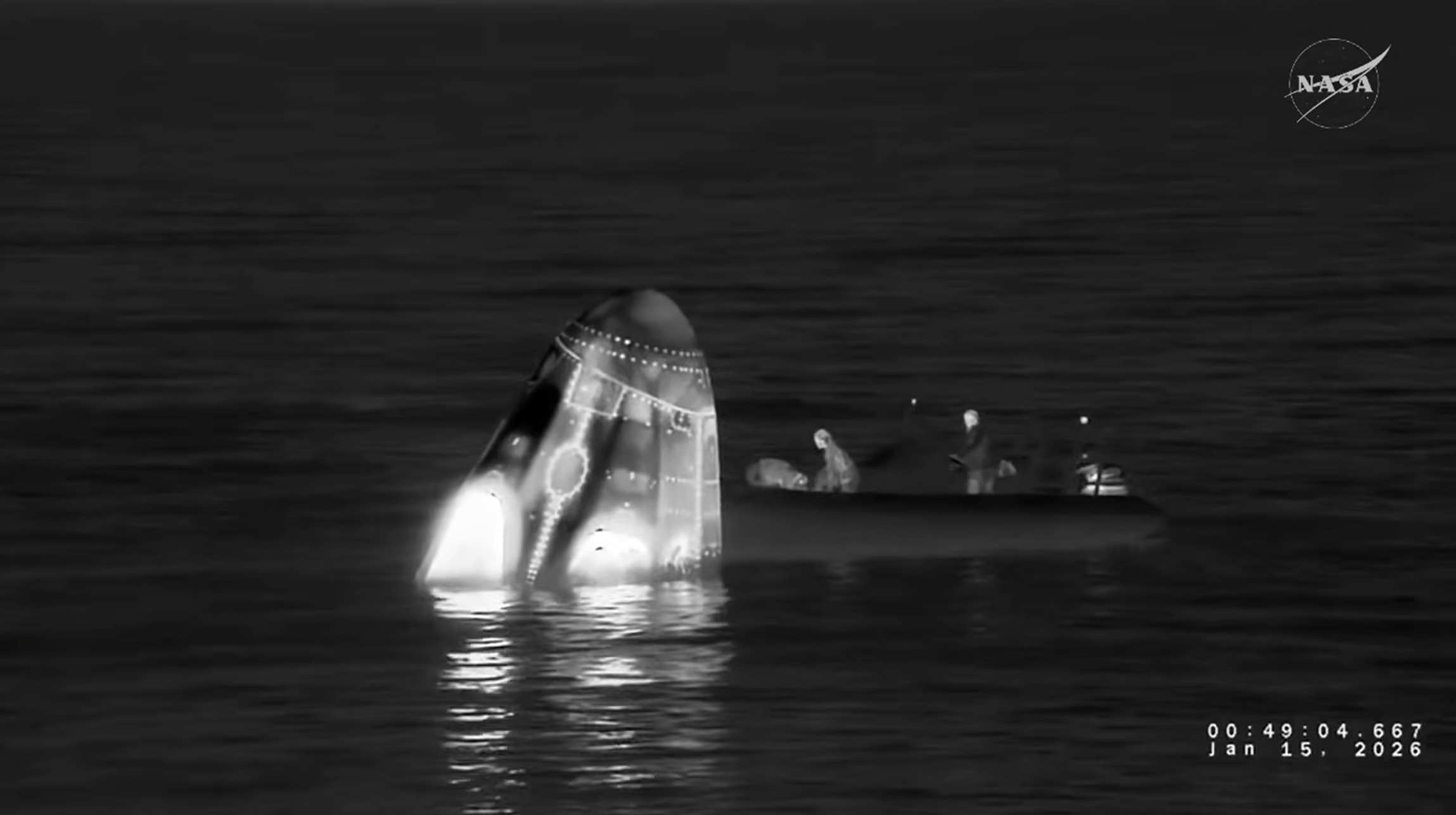
«Alle 3:41 del mattino, ora della costa orientale [le 9:41 ora italiana di oggi, ndr], la navicella Dragon Endeavor di SpaceX è ammarata con successo al largo della costa della California in condizioni meteorologiche ottimali. Questa missione ha riportato a casa sani e salvi i membri dell’equipaggio della Crew-11. Gli astronauti della Nasa Zena Cardman e Michael Fincke, l’astronauta della Jaxa Kimiya Yui e il cosmonauta della Roscosmos Oleg Platonov sono tutti in buona salute e di ottimo umore. Tutti i membri dell’equipaggio sono attualmente sottoposti alla consueta valutazione medica post-ammaraggio. Il membro dell’equipaggio che destava preoccupazione sta bene. Condivideremo aggiornamenti sul loro stato di salute non appena sarà opportuno farlo».
Immagine del recupero in mare della navicella Dragon Endeavor con a bordo i quattro astronauti della Crew-11, rientrati anticipatamente a causa di un problema medico di uno di loro. L’ammaraggio è avvenuto in condizioni nominali alle 09:41 di questa mattina (ora italiana) a largo di San Diego, in California, e i quattro astronauti sono ora in una clinica per le valutazioni mediche post-rientro. Crediti: Nasa
Comincia così la conferenza stampa tenuta questa mattina alla Nasa riguardo il rientro anticipato della Crew-11 dalla Stazione spaziale internazionale (Iss), dovuto a un problema medico di uno dei quattro membri dell’equipaggio. A parlare è l’amministratore dell’agenzia Jared Isaacman, che sottolinea come la Nasa fosse pronta a questa evenienza nonostante fosse la prima volta nella storia e come abbia saputo gestirla al meglio.
La permanenza della Crew-11 alla Iss è durata circa cinque mesi (167 giorni), durante i quali gli astronauti hanno dedicato oltre 850 ore a esperimenti e studi scientifici, tra cui ricerche sulla perdita ossea in microgravità e lo stoccaggio a lungo termine di fluidi criogenici nello spazio. Esperimenti che – sottolinea l’amministratore – avrebbero applicazioni dirette in campo medico e industriale e che hanno migliorato la nostra comprensione dei voli spaziali di lunga durata. I quattro astronauti si trovano ora in una clinica nella periferia di San Diego, in California, dove trascorreranno la notte per poi fare ritorno a Houston venerdì.
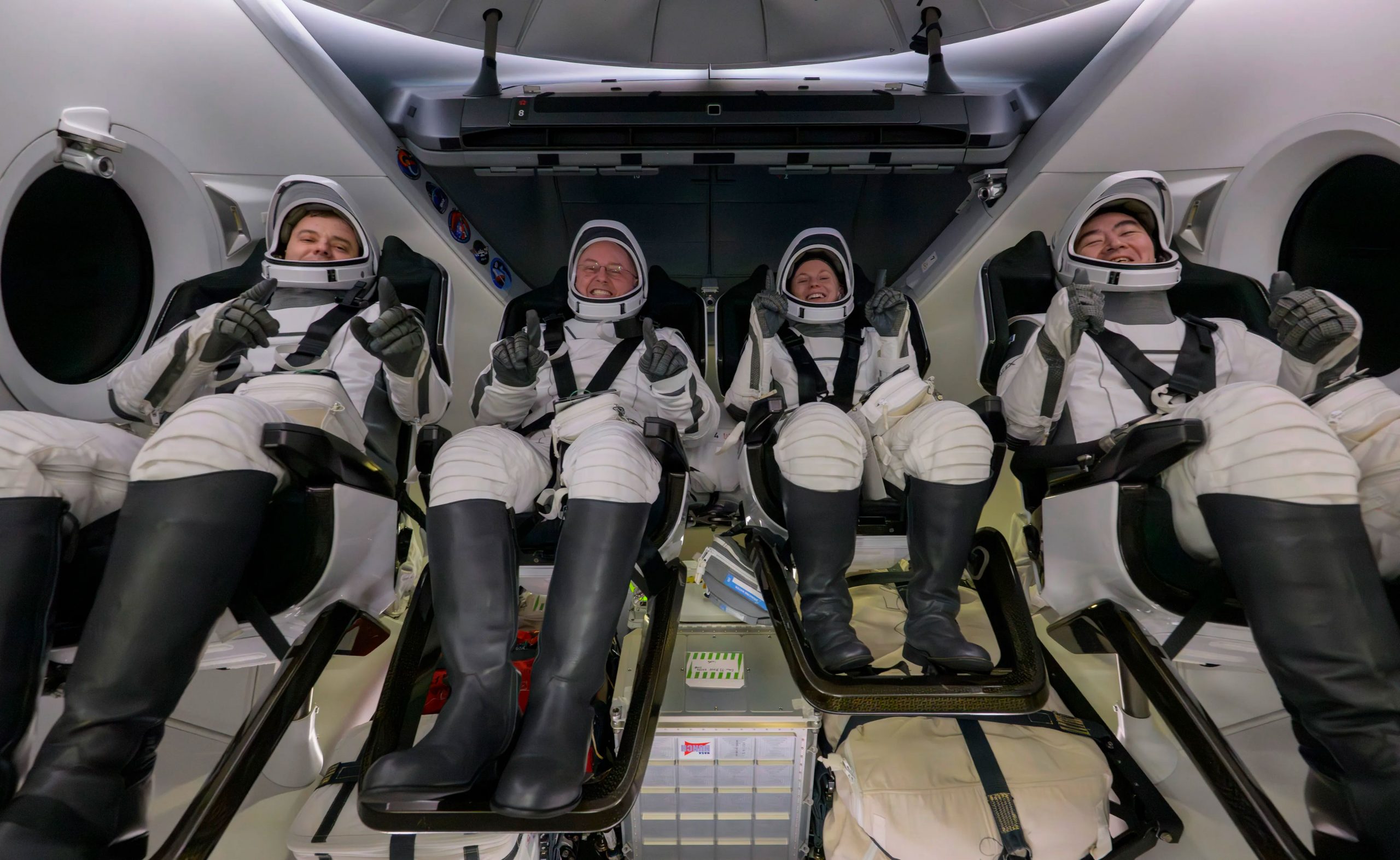
Da sinistra: Il cosmonauta della Roscosmos Oleg Platonov, gli astronauti della Nasa Mike Fincke e Zena Cardman e l’astronauta della Jaxa Kimiya Yui all’interno della navicella spaziale SpaceX Dragon Endeavour a bordo della nave di recupero Shannon di SpaceX poco dopo l’ammaraggio nell’Oceano Pacifico, al largo della costa di Long Beach, in California, giovedì 15 gennaio 2026. Crediti: Nasa/Bill Ingalls
Il prossimo mese vedrà due appuntamenti importanti per la Nasa e, più in generale, per il volo umano. Il 6 febbraio si apre la finestra di lancio di Artemis II, la missione che porterà quattro astronauti in orbita attorno alla Luna per la prima volta dopo le missioni Apollo. Si tratta del primo volo con equipaggio del razzo Space Launch System (Sls) e della navicella spaziale Orion. In questi giorni la Nasa sta preparando il trasferimento del veicolo completamente assemblato alla piattaforma di lancio 39B del Kennedy Space Center in Florida, che avverrà non prima di sabato 17 gennaio 2026. A seguire, il 15 febbraio si apre la finestra di lancio della Crew-12 per la Stazione spaziale internazionale, che vedrà fra i membri dell’equipaggio l’astronauta francese Sophie Adenot dell’Agenzia spaziale europea (Esa).
Guarda il video dell’ammaraggio della capsula Dragon con i quattro astronauti della Crew-11:
Preparations for Next Moonwalk Simulations Underway (and Underwater)
In 2025, NASA’s Armstrong Flight Research Center in Edwards, California, advanced work across aeronautics, Earth science, exploration technologies, and emerging aviation systems, reinforcing its role as one of the agency’s primary test sites for aeronautics research. From early concept evaluations to full flight test campaigns, teams enhanced measurement tools, refined safety systems, and generated data that supported missions across NASA. Operating from the Mojave Desert, NASA Armstrong continued applying engineering design with real-world performance, carrying forward research that informs how aircraft operate today and how new systems may function in the future.
The year’s progress also reflects the people behind the work – engineers, technicians, pilots, operators, and mission support staff who navigate complex tests and ensure each mission advances safely and deliberately. Their efforts strengthened partnerships with industry, small businesses, and universities while expanding opportunities for students and early career professionals. Together they sustained NASA Armstrong’s long-standing identity as a center where innovation is proven in flight and where research helps chart the course for future aviation and exploration.
“We executed our mission work safely, including flight of the first piloted NASA X-plane in decades, while under challenging conditions,” said Brad Flick, center director of NASA Armstrong. “It tells me our people embrace the work we do and are willing to maintain high levels of professionalism while enduring personal stress and uncertainty. It’s a testimony to the dedication of our NASA and contractor workforce.”
Teams continued advancing key projects, supporting partners, and generating data that contributes to NASA’s broader mission.
Quiet supersonic flight and the Quesst mission
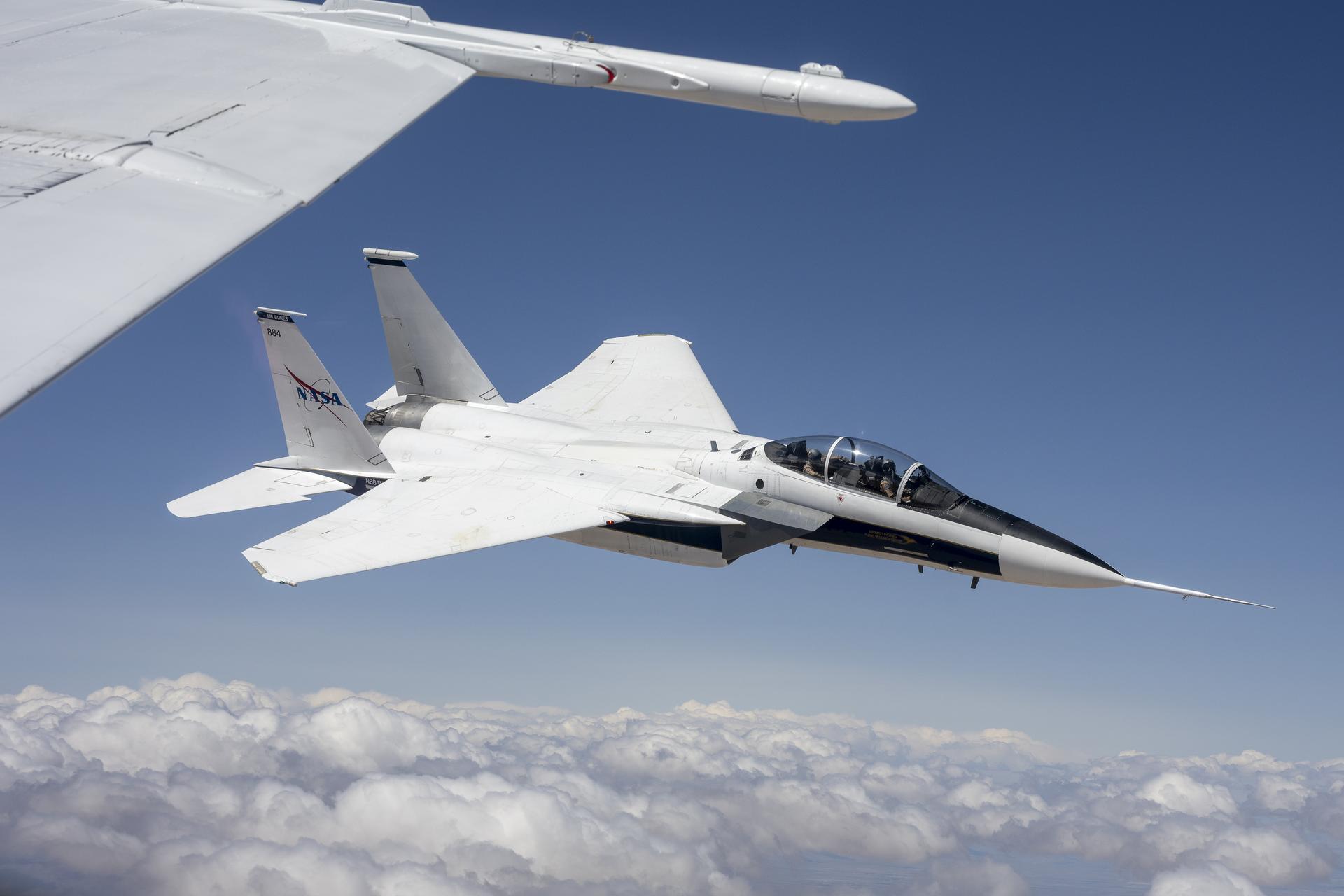
NASA’s F-15D research aircraft conducts a calibration flight of a shock-sensing probe near NASA’s Armstrong Flight Research Center in Edwards, California. The shock-sensing probe is designed to measure the signature and strength of shock waves in flight. The probe was validated during dual F-15 flights and will be flown behind NASA’s X-59 to measure small pressure changes caused by shock waves in support of the agency’s Quesst mission.
NASA/Jim Ross
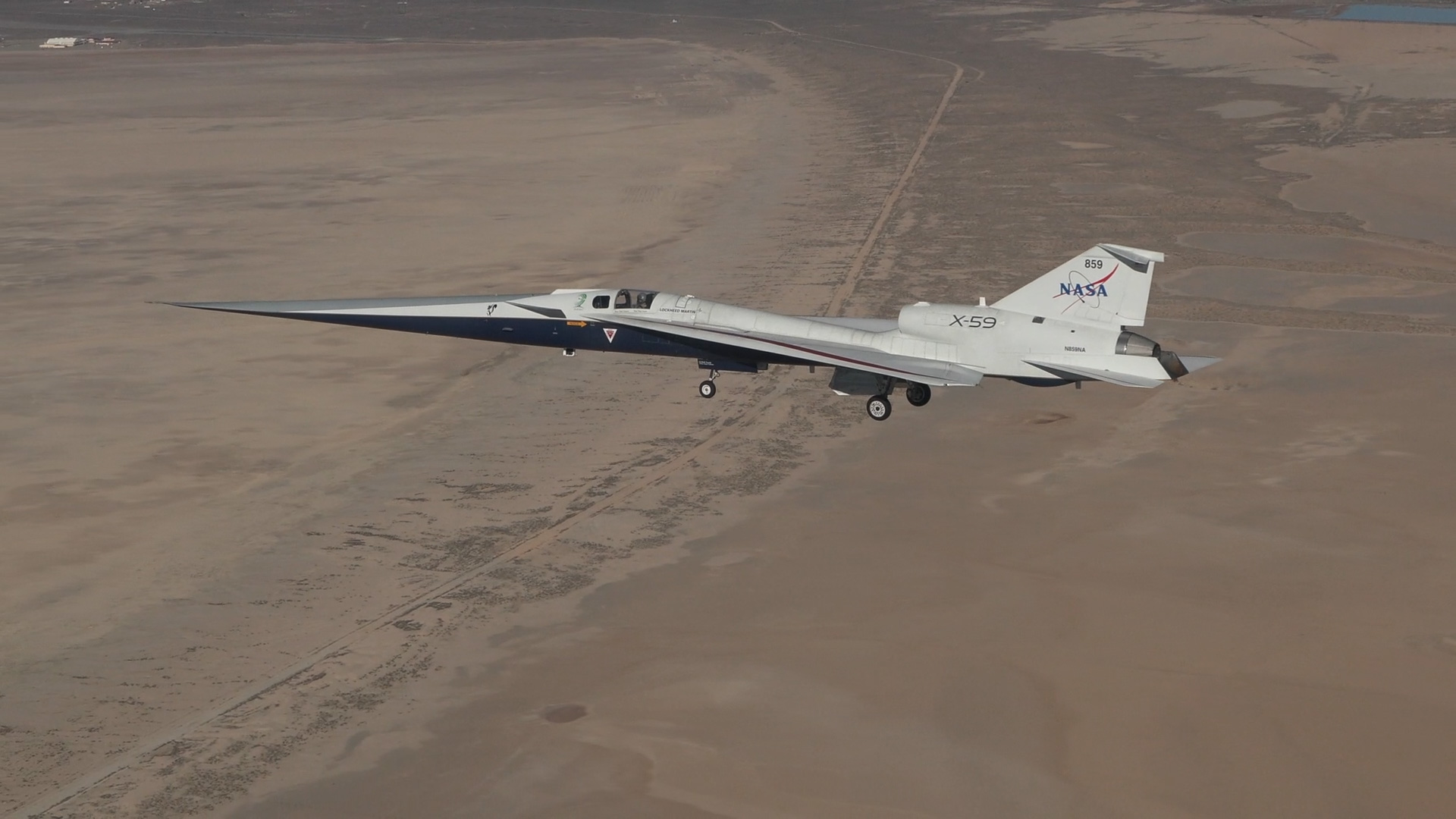
NASA Armstrong continued its quiet supersonic research, completing a series of activities in support of NASA’s Quesst mission. On the X-59 quiet supersonic research aircraft, the team performed electromagnetic interference tests and ran engine checks to prepare the aircraft for taxi tests. The Schlieren, Airborne Measurements, and Range Operations for Quesst (SCHAMROQ) team completed aircraft integration and shock-sensing probe calibration flights, refining the tools needed to characterize shock waves from the X-59. These efforts supported the aircraft’s progression toward its first flight on Oct. 28, marking a historic milestone and the beginning of its transition to NASA Armstrong for continued testing.
The center’s Commercial Supersonic Technology (CST) team also conducted airborne validation flights using NASA F-15s, confirming measurement systems essential for Quesst’s next research phase. Together, this work forms the technical backbone for upcoming community response studies, where NASA will evaluate whether quieter supersonic thumps could support future commercial applications.
The X-59 team completed electromagnetic interference testing on the aircraft, verifying system performance and confirming that all its systems could reliably operate together.
NASA’s X-59 engine testing concluded with a maximum afterburner test that demonstrated the engine’s ability to generate the thrust required for supersonic flight.
Engineers conducted engine speed-hold evaluations to assess how the X-59’s engine responds under sustained throttle conditions, generating data used to refine control settings for upcoming flight profiles.
NASA Armstrong’s CST team validated the tools that will gather airborne data in support the second phase of the agency’s Quesst mission.
NASA’s X-59 team advanced preparations on the aircraft through taxi tests, ensuring aircraft handling systems performed correctly ahead of its first flight.
NASA Armstrong’s photo and video team documented X-59 taxi tests as the aircraft moved under its own power for the first time.
The X-59 team evaluated braking, steering, and integrated systems performance after the completion of the aircraft’s low-speed taxi tests marking one of the final steps before flight.
NASA Armstrong teams advanced the X-59 toward first flight by prioritizing safety at every step, completing checks, evaluations, and system verifications to ensure the aircraft was ready when the team was confident it could move forward.
NASA and the Lockheed Martin contractor team completed the X-59’s historic first flight, delivering the aircraft to NASA Armstrong for the start of its next phase of research.
Ultra-efficient and high-speed aircraft research
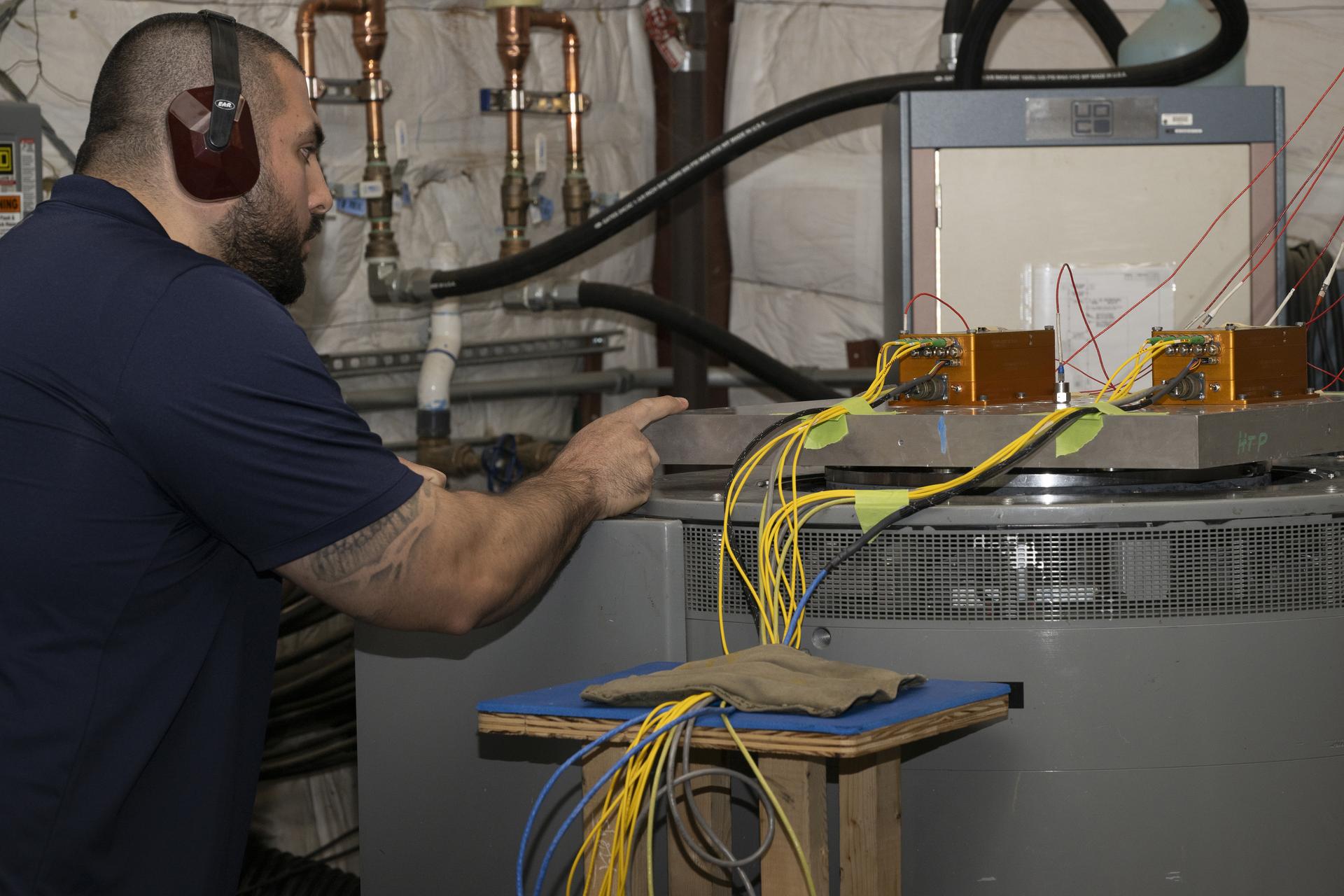
Jonathan Lopez prepares the hypersonic Fiber Optic Sensing System for vibration tests in the Environmental Laboratory at NASA’s Armstrong Flight Research Center in Edwards, California. Testing on a machine called a shaker proved that the system could withstand the severe vibration it will endure in hypersonic flight, or travel at five times the speed of sound.
NASA/Jim Ross
Across aeronautics programs, Armstrong supported work that strengthens NASA’s ability to study sustainable, efficient, and high-performance aircraft. Teams conducted aerodynamic measurements and improved test-article access for instrumentation, enabling more precise evaluations of advanced aircraft concepts. Engineers continued developing tools and techniques to study aircraft performance under high-speed and high-temperature conditions, supporting research in hypersonic flight.
The Sustainable Flight Demonstrator research team measured airflow over key wing surfaces in a series of wind tunnel tests, generating data used to refine future sustainable aircraft designs.
Technicians at NASA Armstrong installed a custom structural floor inside the X-66 demonstrator, improving access for instrumentation work and enabling more efficient modification and evaluation.
Transforming air mobility and new aviation systems
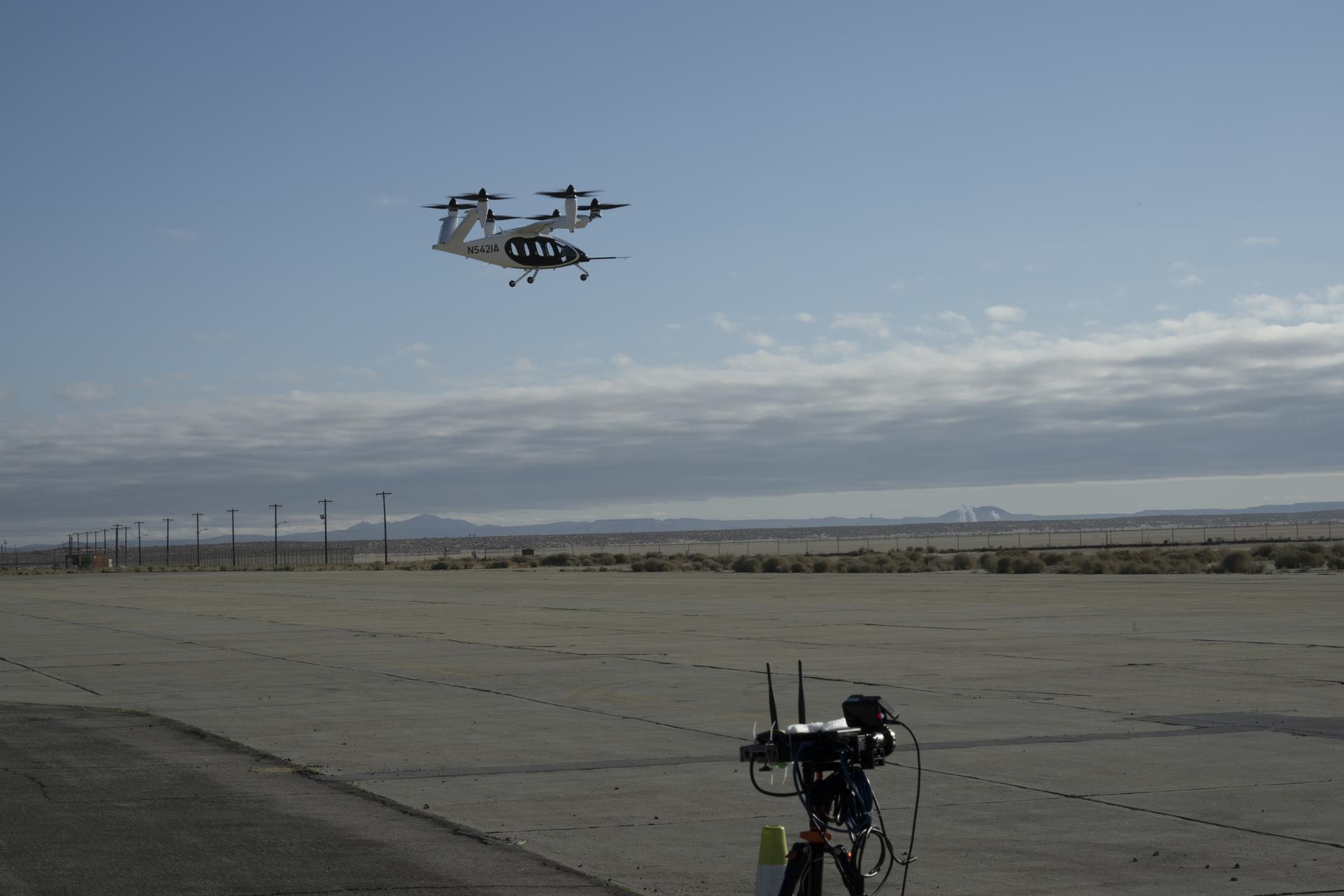
One of multiple NASA distributed sensing ground nodes is set up in the foreground while an experimental air taxi aircraft owned by Joby Aviation hovers in the background near NASA’s Armstrong Flight Research Center in Edwards, California, on March 12, 2025. NASA is collecting information during this study to help advance future air taxi flights, especially those occurring in cities, to track aircraft moving through traffic corridors and around landing zones.
NASA/Genaro Vavuris
NASA Armstrong supported multiple aspects of the nation’s growing air mobility ecosystem. Researchers conducted tests and evaluations to better understand aircraft performance, airflow, and passenger experience. Additional work included assessing drone-based inspection techniques, developing advanced communication networks, performing drop tests, and refining methods to evaluate emerging mobility aircraft.
These studies support NASA’s broader goal of integrating new electric, autonomous, and hybrid aircraft safely into the national airspace.
A small business partnership demonstrated drone-based inspection techniques that could reduce maintenance time and improve safety for commercial aircraft operations.
NASA Armstrong researchers tested air traffic surveillance technology against the demands of air taxis flying at low altitudes through densely populated cities, using the agency’s Pilatus PC-12 to support safer air traffic operations.
Researchers at NASA Armstrong collected airflow data from Joby using a ground array of sensors to examine how its circular wind patterns might affect electric air taxi performance in future urban operations.
NASA Armstrong’s Ride Quality Laboratory conducted air taxi passenger comfort studies in support of the agency’s Advanced Air Mobility mission to better understand how motion, vibration, and other factors affect ride comfort, informing the industry’s development of electric air taxis and drones.
Earth observation and environmental research
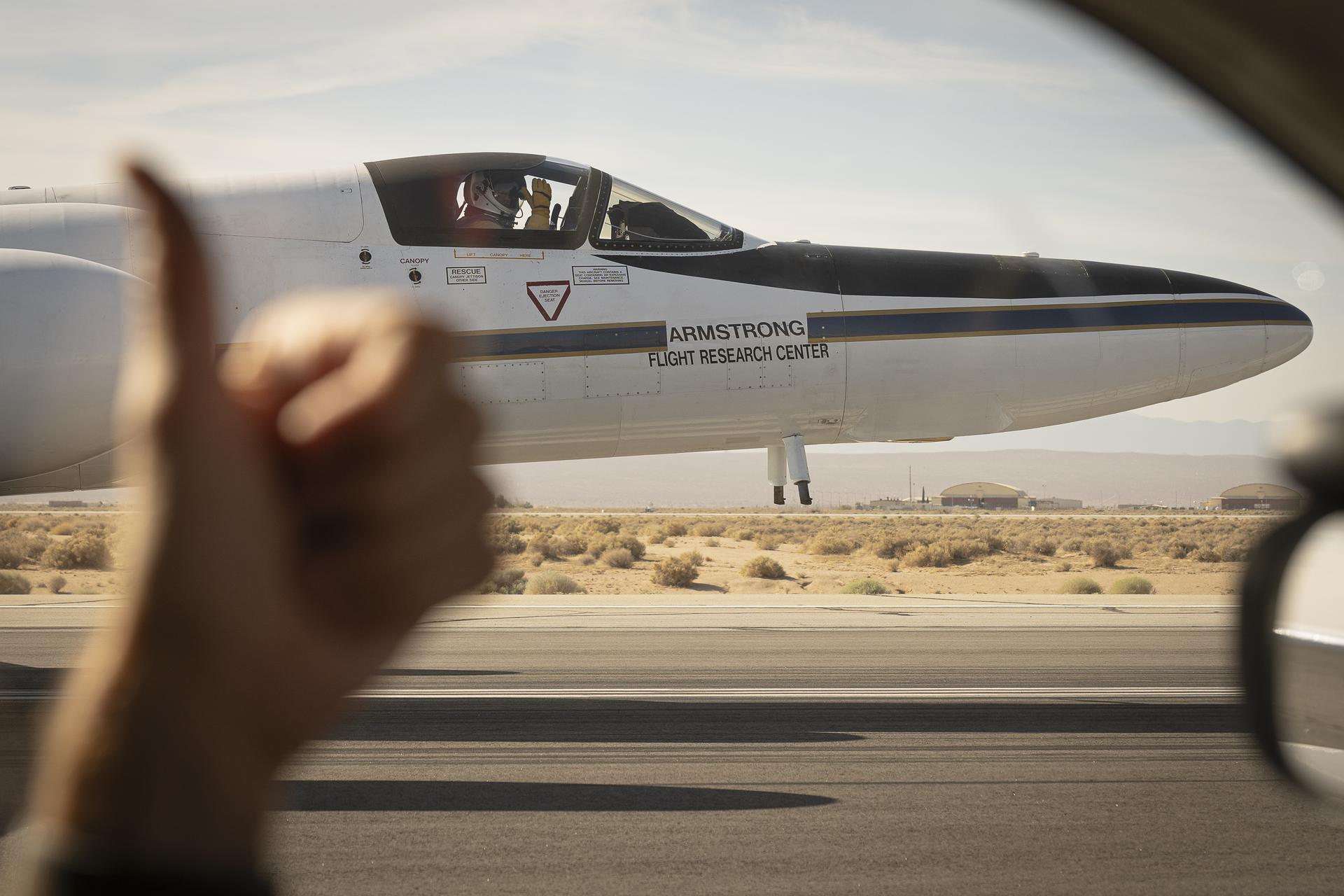
From the window of the ER-2 chase car, a crew member gives a thumbs up to the pilot as NASA Armstrong Flight Research Center’s ER-2 aircraft taxis at Edwards, California, on Thursday, Aug. 21, 2025. The gesture signals a final check before takeoff for the high-altitude mission supporting the Geological Earth Mapping Experiment (GEMx).
NASA/Christopher LC Clark
Earth science campaigns at NASA Armstrong contributed to the agency’s ability to monitor environmental changes and improve satellite data accuracy. Researchers tested precision navigation systems that keep high-speed aircraft on path, supporting more accurate atmospheric and climate surveys. Airborne measurements and drone flights documented wildfire behavior, smoke transport, and post-fire impacts while gathering temperature, humidity, and airflow data during controlled burns. These efforts also supported early-stage technology demonstrations, evaluating new wildfire sensing tools under real flight conditions to advance fire response research. High-altitude aircraft contributed to missions that improved satellite calibration, refined atmospheric measurements, and supported snowpack and melt studies to enhance regional water-resource forecasting.
Researchers at NASA Armstrong tested a new precision‑navigation system that can keep high‑speed research aircraft on exact flight paths, enabling more accurate Earth science data collection during airborne environmental and climate‑survey missions.
NASA’s B200 King Air flew over wildfire‑affected regions equipped with the Compact Fire Infrared Radiance Spectral Tracker (c‑FIRST), collecting thermal‑infrared data to study wildfire behavior, smoke spread, and post‑fire ecological impacts in near real time.
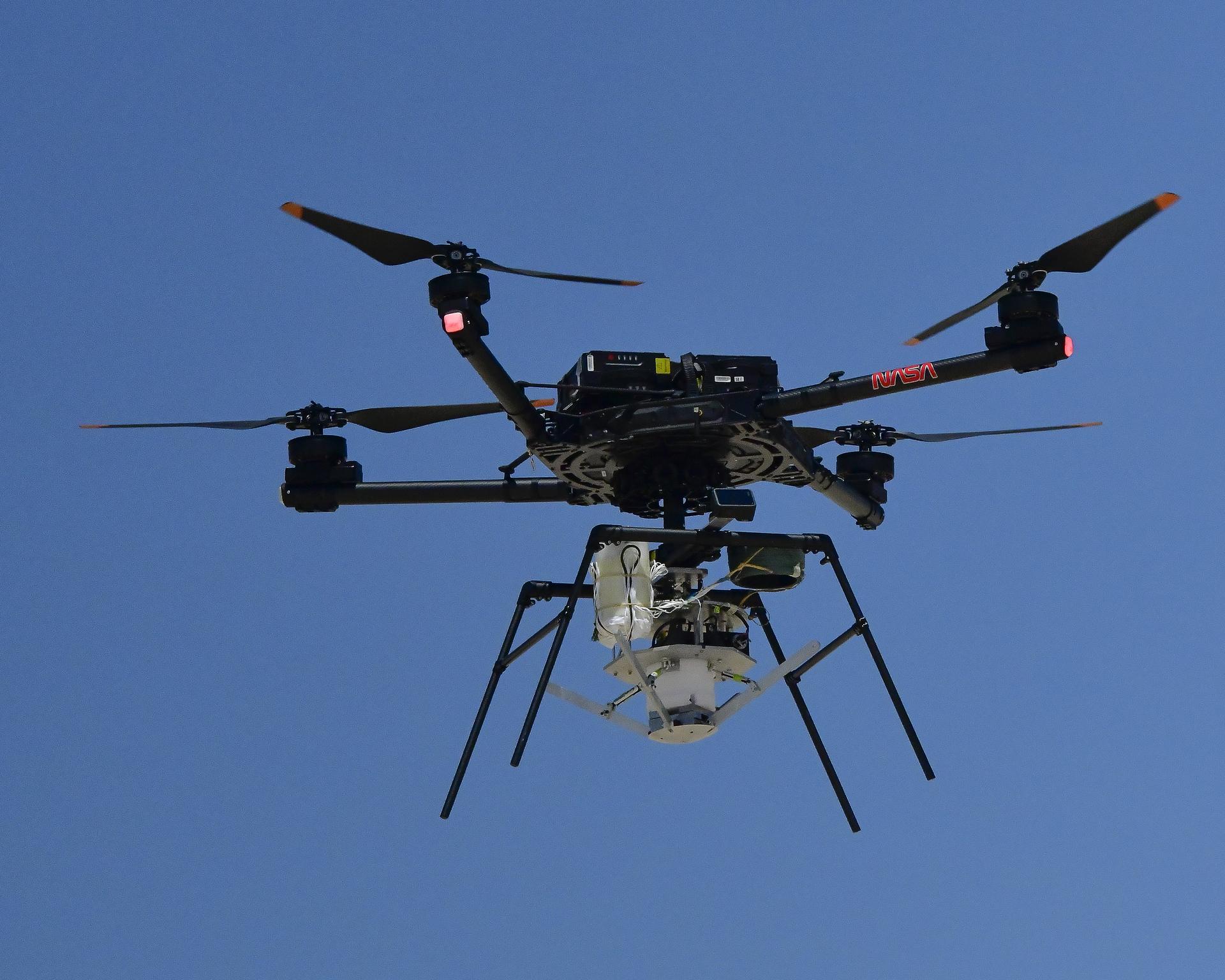
NASA Armstrong’s Alta X drone carried a 3D wind sensor and a radiosonde to measure temperature, pressure, humidity, and airflow during a prescribed burn in Geneva State Forest, gathering data to help improve wildland fire behavior models and support firefighting agencies.
NASA’s ER‑2 aircraft carried the Airborne Lunar Spectral Irradiance (air-LUSI) instrument on night flights, measuring moonlight reflectance to generate calibration data – improving the accuracy of Earth‑observing satellite measurements.
The center’s ER-2 also flew above cloud layers with specialized instrumentation to collect atmospheric and cloud measurements. These data help validate and refine Earth observing satellite retrievals, improving climate, weather, and aerosol observations.
Airborne campaigns at NASA Armstrong measured snowpack and melt patterns in the western U.S., providing data to improve water-resource forecasting for local communities.
Exploration technology and Artemis support
An Alta X drone is positioned at altitude for an air launch of the Enhancing Parachutes by Instrumenting the Canopy test experiment on June 4, 2025, at NASA’s Armstong Flight Research Center in Edwards, California. NASA researchers are developing technology to make supersonic parachutes safer and more reliable for delivering science instruments and payloads to Mars.
NASA/Christopher LC Clark
NASA Armstrong supported exploration technologies that will contribute to agency’s return to the Moon and future missions deeper into the solar system, including sending the first astronauts – American astronauts – to Mars. Teams advanced sensor systems and conducted high-altitude drop tests to capture critical performance data, supporting the need for precise entry, descent, and landing capabilities on future planetary missions.
Contributions from NASA Armstrong also strengthen the systems and technologies that help make Artemis – the agency’s top priority – safer, more reliable, and more scientifically productive, supporting a sustained human presence on the Moon and preparing for future human exploration of Mars.
The EPIC team at NASA Armstrong conducted research flights to advance sensor technology for supersonic parachute deployments, evaluating performance during high-speed, high-altitude drops relevant to future planetary missions.
Imagery from the EPIC test flights at NASA Armstrong highlights the parachute system’s high-altitude deployment sequence and demonstrated its potential for future Mars delivery concepts.
People, workforce, and community engagement
The center expanded outreach, education, and workforce development efforts throughout the year. Students visited NASA Armstrong for hands-on exposure to careers in aeronautics, while staff and volunteers supported a regional robotics competition that encouraged exploration of the field. Educators brought aeronautics concepts directly into classrooms across the region, and interns from around the country gained experience supporting real flight research projects.
NASA Armstrong also highlighted unique career pathways and recognized employees whose work showcases the human side of NASA missions. A youth aviation program launched with a regional museum provided additional opportunities for young learners to explore flight science, further strengthening the center’s community impact:
Students from Palmdale High School Engineering Club visited NASA Armstrong, where staff engaged with them to explore facilities, discuss aerospace work, and promote STEM careers as part of the center’s community outreach.
NASA Armstrong staff and volunteers mentored high school teams at the 2025 Aerospace Valley FIRST Robotics Competition, helping students build and test robots and providing hands-on experience with engineering to foster interest in STEM careers.
In April, NASA Armstrong expanded outreach in 2025 by bringing aeronautics concepts to students through classroom workshops, presentations, and hands-on activities, giving young learners direct exposure to NASA research and inspiring possible future careers in science and engineering.
Students from across the country participated in internships at NASA Armstrong, gaining hands-on experience in flight research and operations while contributing to real-world aerospace projects.
In May, a NASA Armstrong videographer earned national recognition for work that highlights the people behind the center’s research missions, showing how scientists, engineers, and flight crews collaborate to advance aeronautics and space exploration.
Daniel Eng, a systems engineer with NASA’s Air Mobility Pathfinders project, shared his career path from the garment industry to aerospace, illustrating how diverse experiences contribute to the center’s technical workforce and support its advanced flight research and engineering projects.
In June, NASA Armstrong recognized one of its interns for hands-on work with the center’s aircraft. With more than a decade in the auto industry, they demonstrated how early career engineers can gain real-world experience and develop skills for careers in aerospace and flight research.
NASA Armstrong partnered with a regional museum to create a youth aviation program that introduces students to flight science and operations, providing hands-on learning opportunities and inspiring interest in aerospace and STEM careers.
Center infrastructure and research capabilities
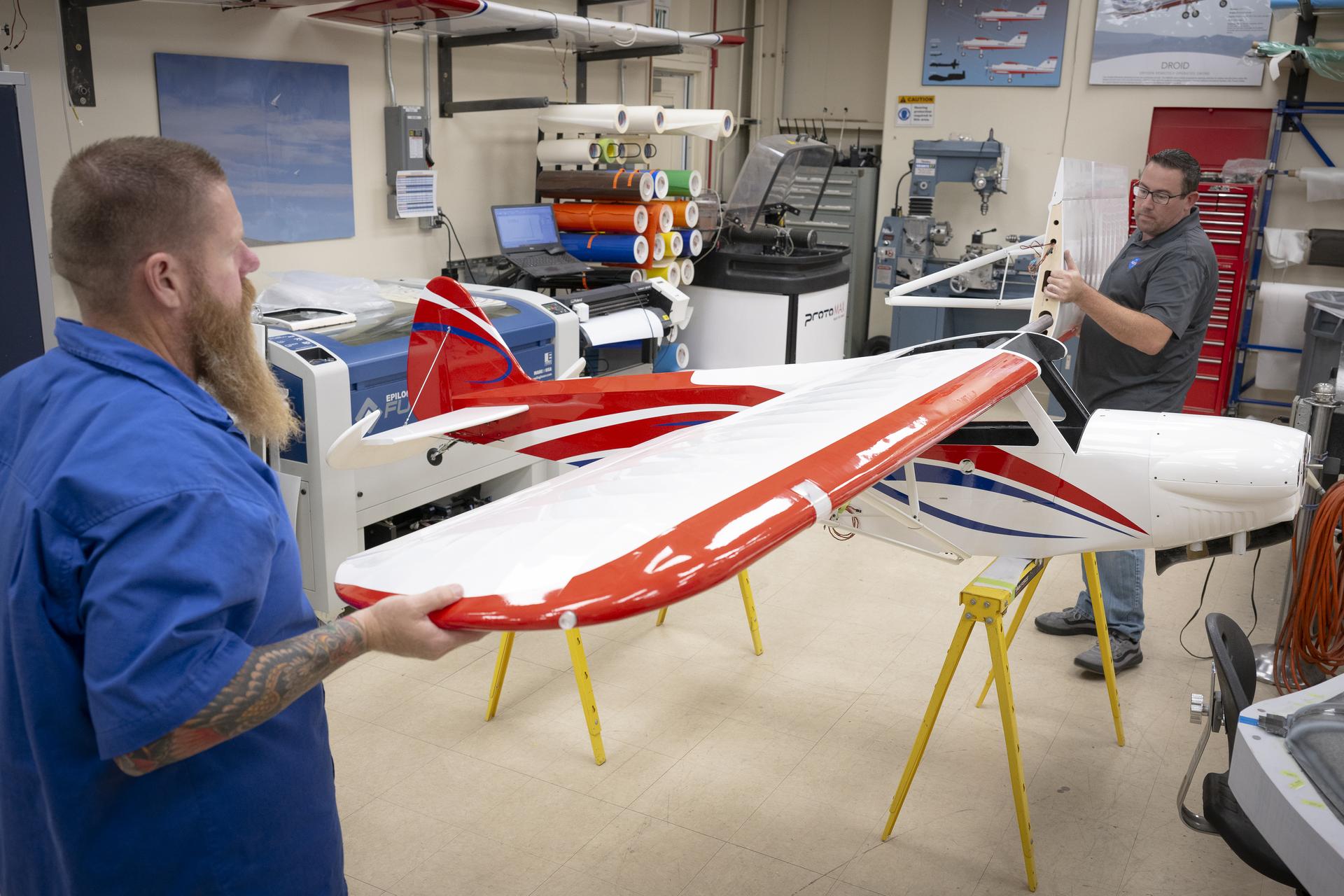
Justin Hall, left, and Justin Link attach the wings onto a subscale aircraft on Wednesday, Sept. 3, 2025, at NASA’s Armstong Flight Research Center in Edwards, California. Hall is chief pilot at the center’s Dale Reed Subscale Flight Research Laboratory and Link is a pilot for small uncrewed aircraft systems.
NASA/Christopher LC Clark
Facility improvements and new platforms strengthened NASA Armstrong’s research capabilities. A rooftop operation removed a historic telemetry pedestal to make way for updated infrastructure, while preserving an important artifact of the center’s flight test heritage. Engineers also completed a new subscale research aircraft, providing a flexible, cost-effective platform for evaluating aerodynamics, instrumentation, and flight control concepts in preparation for full-scale testing:
The center improved workspace access and supported a re-roofing project during a helicopter crew operation that removed a 2,500-pound telemetry pedestal from a building rooftop, preserving a piece of the center’s flight history heritage.
Engineers at NASA Armstrong built a new subscale experimental aircraft to replace the center’s aging MicroCub. The 14-foot wingspan, 60-pound aircraft provides a flexible, cost-effective platform for testing aerodynamics, instrumentation, and flight control concepts while reducing risk before full-scale or crewed flight tests.
Looking ahead
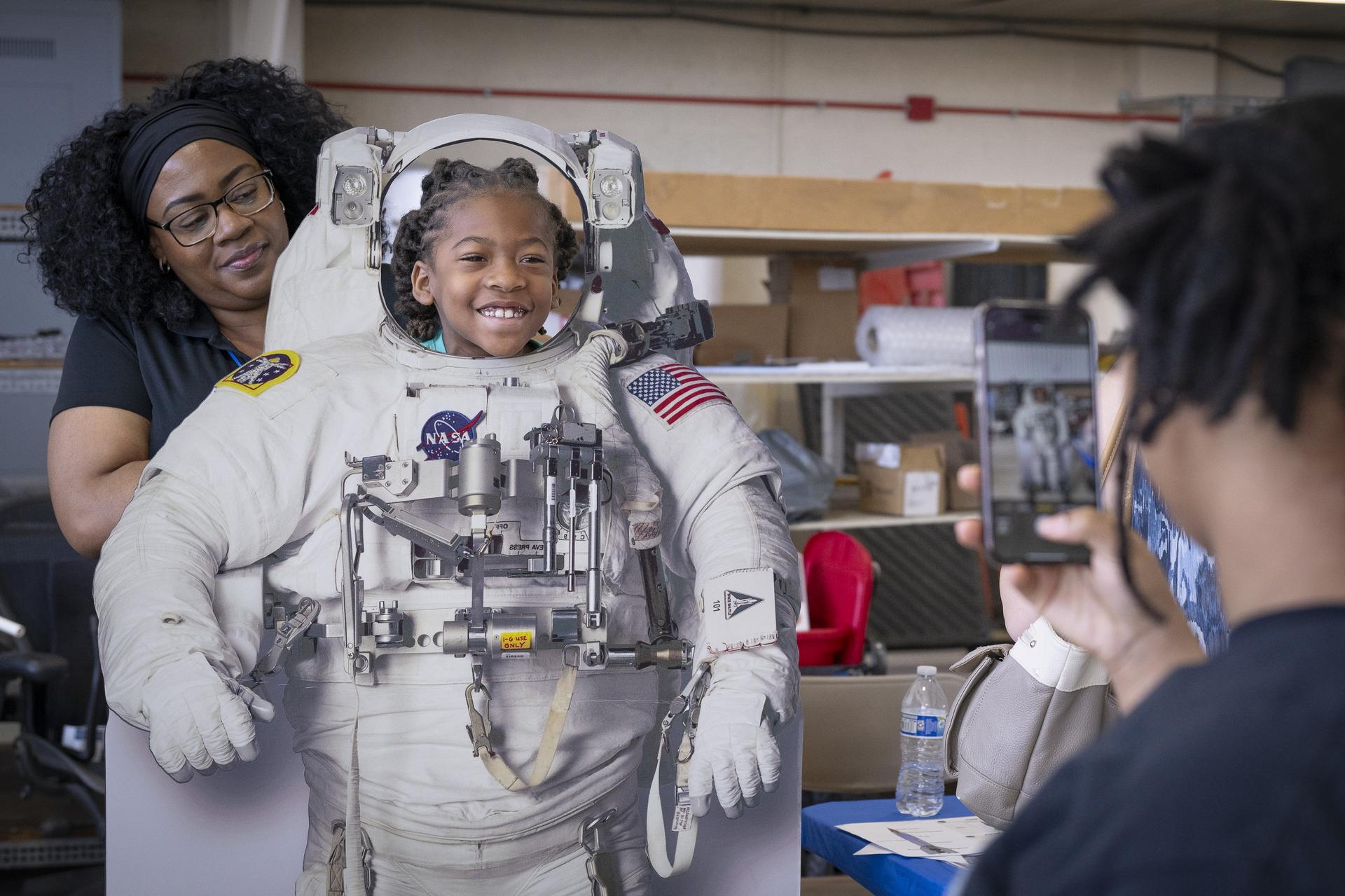
On June 17, 2025, NASA’s Armstrong Flight Research Center in Edwards, California, hosted Bring Kids to Work Day, offering hands-on activities that introduced children and their families to the exciting world of aeronautics and flight research.
NASA/Christopher LC Clark
NASA Armstrong will continue advancing flight research across aeronautics and Earth science, building on this year’s achievements. Upcoming efforts include additional X-59 flights, expanded quiet supersonic studies, new air mobility evaluations, high-altitude science campaigns, and maturing technologies that support hypersonic research and the Artemis program for future planetary missions.
“Next year will be a year of continuity, but also change,” Flick said. “The agency’s new Administrator, Jared Isaacman, will bring a renewed mission-first focus to the agency, and NASA Armstrong will push the boundaries of what’s possible. But the most important thing we can do is safely and successfully execute our portfolio of work within budget and schedule.”
For more than seven decades, NASA Armstrong has strengthened the nation’s understanding of flight. This year’s work builds on that legacy, helping shape the future of aviation and exploration through research proven in the air.
To explore more about NASA Armstrong’s missions, research, and discoveries, visit:
NASA videographer Jacob Shaw recently earned first place for outstanding documentation for his film, Reflections, which chronicles the 2024 Airborne Science ...
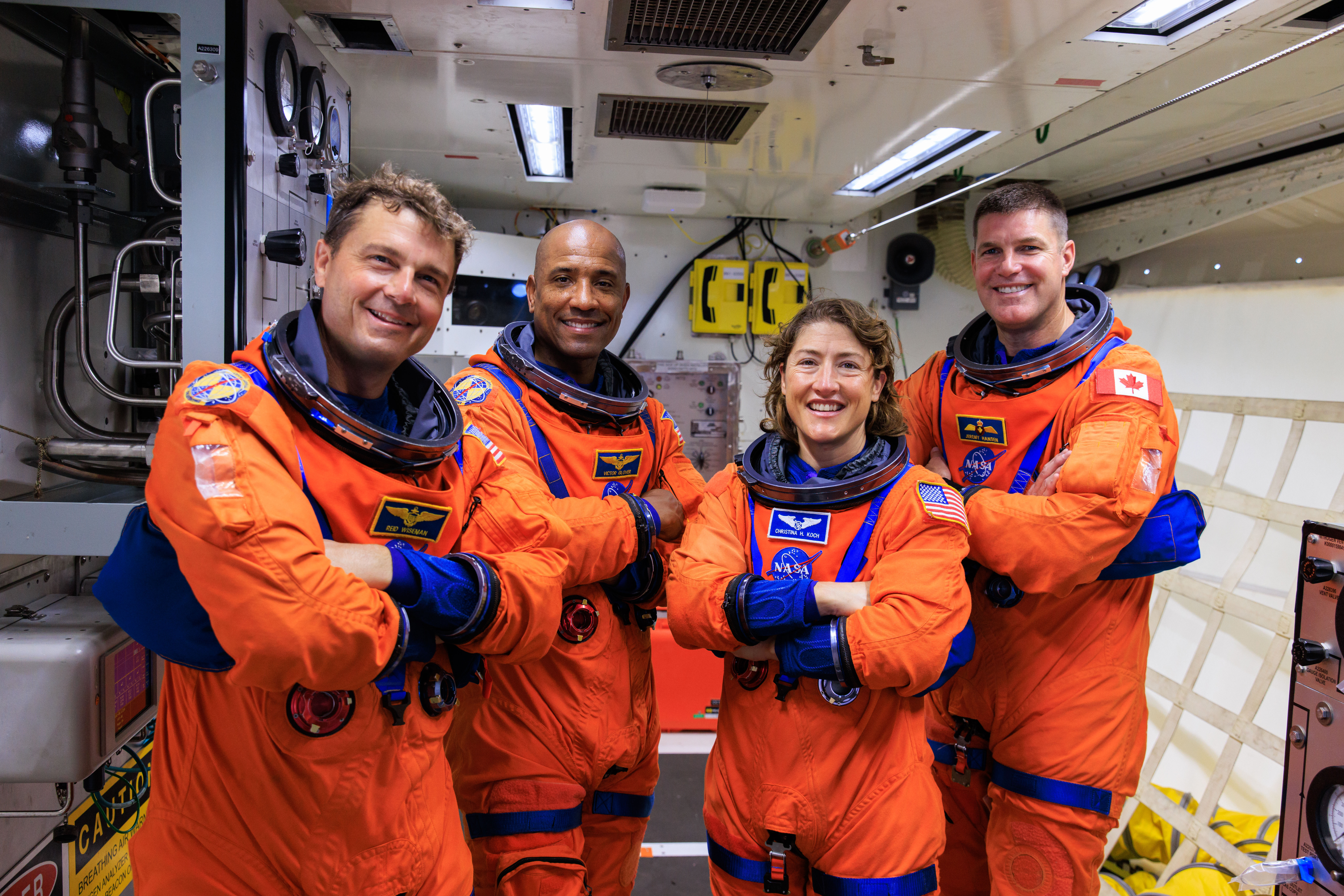
Artemis II NASA astronauts (left to right) Reid Wiseman, Victor Glover, and Christina Koch, and CSA (Canadian Space Agency) astronaut Jeremy Hansen stand in the white room on the crew access arm of the mobile launcher at Launch Pad 39B as part of an integrated ground systems test at the agency’s Kennedy Space Center in Florida on Sept. 20, 2023.
Credit: NASA/Frank Michaux
With a second Trump Administration at the helm in 2025, NASA marked significant progress toward the Artemis II test flight early next year, which is the first crewed mission around the Moon in more than 50 years, as well as built upon its momentum toward a human return to the lunar surface in preparation to send the first astronauts — Americans — to Mars.
As part of the agency’s Golden Age of innovation and exploration, NASA and its partners landed two robotic science missions on the Moon; garnered more signatories for the Artemis Accords with 59 nations now agreeing to safe, transparent, and responsible lunar exploration; as well as advanced a variety of medical and technological experiments for long-duration space missions like hand-held X-ray equipment and navigation capabilities.
NASA also led a variety of science discoveries, including launching a joint satellite mission with India to regularly monitor Earth’s land and ice-covered surfaces, as well as identifying and tracking the third interstellar object in our solar system; achieved 25 continuous years of human presence aboard the International Space Station; and, for the first time, flew a test flight of the agency’s X-59 supersonic plane that will help revolutionize air travel.
Sean Duffy, named by President Trump, is serving as the acting administrator while NASA awaits confirmation of Jared Isaacman to lead the agency. Isaacman’s nomination hearing took place in early December, and his nomination was passed out of committee with bipartisan support. The full Senate will consider Isaacman’s nomination soon. President Trump also nominated Matt Anderson to serve as deputy administrator, and Greg Autry to serve as chief financial officer, both of whom are awaiting confirmation hearings. NASA named Amit Kshatriya to associate administrator, the agency’s highest-ranking civil servant position.
Key accomplishments by NASA in 2025 include:
Astronauts exploring Moon, Mars is on horizon
Under Artemis, NASA will send astronauts on increasingly difficult missions to explore more of the Moon for scientific discovery, economic benefits, and to build upon our foundation for the first crewed mission to Mars. The Artemis II test flight is the first flight with crew under NASA’s Artemis campaign and is slated to launch in early 2026. The mission will help confirm systems and hardware for future lunar missions, including Artemis III’s astronaut lunar landing.
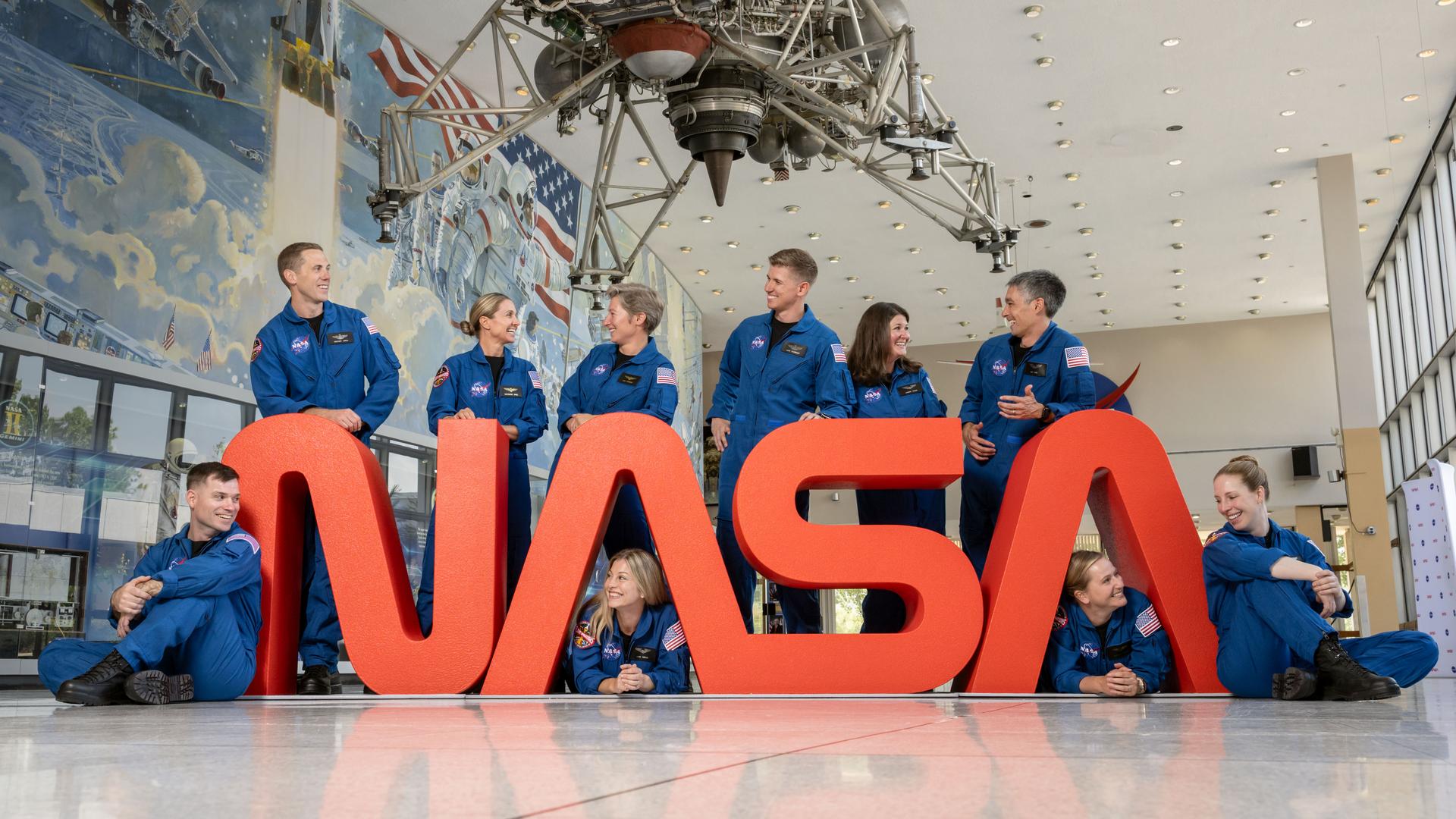
NASA also introduced 10 new astronaut candidates in September, selected from more than 8,000 applicants. The class is undertaking nearly two years of training for future missions to low Earth orbit, the Moon, and Mars.
Progress to send the first crews around the Moon and on the lunar surface under Artemis includes:
NASA completed stacking of its Space Launch System rocket and Orion spacecraft for Artemis II. Teams integrated elements manufactured across the country at NASA’s Kennedy Space Center in Florida, including the rocket’s boosters and core stage, as well as Orion’s stage adapter and launch abort system, to name a few.
Ahead of America’s 250th birthday next year, the SLS rocket’s twin-pair of solid rocket boosters showcases the America 250 emblem.
The Artemis II crew participated in more than 30 mission simulations alongside teams on the ground, ensuring the crew and launch, flight, and recovery teams are prepared for any situation that may arise during the test flight. Soon, crew will don their survival suits and get strapped into Orion during a countdown demonstration test, serving as a dress rehearsal for launch day.
The agency worked with the Department of War to conduct a week-long underway recovery test in preparation to safely collect the Artemis II astronauts after they splashdown following their mission.
To support later missions, teams conducted a booster firing test for future rocket generations, verified new RS-25 engines, test-fired a new hybrid rocket motor to help engineering teams better understand the physics of rocket exhaust and lunar landers, as well using various mockups to test landing capabilities in various lighting conditions. Teams also conducted human-in-the-loop testing in Japan with JAXA (Japan Aerospace Exploration Agency) with a rover mockup from their agency.
NASA also continued work with Axiom Space, to develop and test the company’s spacesuit, including completing a test run at the Neutral Buoyancy Laboratory at NASA Johnson ahead of using the suit for Artemis training. The spacesuit will be worn by Artemis astronauts during the Artemis III mission to the lunar South Pole.
On the Moon, future crew will use a lunar terrain vehicle, or LTV, to travel away from their landing zone. NASA previously awarded three companies feasibility studies for developing LTV, followed by a request for proposals earlier this year. The agency is expected to make an award soon to develop, deliver, and demonstrate LTV on the lunar surface later this decade. The agency also selected two science instruments that will be included on the LTV to study the Moon’s surface composition and scout for potential resources.
For operations around the Moon, NASA and its partners continued to develop Gateway to support missions between lunar orbit and the Moon’s surface. Construction and production of the first two elements, a power and propulsion system and habitation element, each progressed, as did development and testing of potential science and technology demonstrations operated from Gateway. International partners also continued work that may contribute technology to support those elements, as well as additional habitation capabilities and an airlock.
This past year, NASA’s Lunar Surface Innovation Consortium team collaborated with over 3,900 members from academia, industry, and government on key lunar surface capabilities. Members from across the U.S. and 71 countries participated in two biannual meetings, three lunar surface workshops, and monthly topic meetings, resulting in 10 studies, four reports, and nine conference presentations.
Building on previous missions and planning for the future, NASA will conduct more science and technology demonstrations on and around the Moon than ever before. Work toward effort included:
Selected a suite of science studies for the Artemis II mission, including studies that focus on astronauts’ health.
Launched two CLPS (Commercial Lunar Payload Services) flights with NASA as a key customer, including Firefly’s Blue Ghost Mission One, which landed on the Moon March 2, and Intuitive Machines’ Nova C lunar lander, which touched down on March 6.
Experiments and tech demos aboard these flights included an electrodynamic dust shield, lunar navigation system, high-performance computing, collection of more than 9,000 first-of-a-kind images of the lunar lander’s engine plumes, and more.
For future CLPS flights, NASA awarded Blue Origin a task order with an option to deliver the agency’s VIPER (Volatiles Investigating Polar Exploration Rover) to the lunar South Pole in late 2027, as well as awarded Firefly another flight, slated for 2030.
Teams studied regolith (lunar dirt and rocks) in a simulated lunar gravity environment and tested how solid materials catch fire in space.
The agency’s 55-pound CubeSat in lunar orbit, CAPSTONE, exceeded 1,000 days in space, serving as a testbed for autonomous navigation and in-space communications.
Published findings from this Artemis I experiment highlighting why green algae may be a very good deep space travel companion.
NASA announced its 2025 Astronaut Candidate Class on Sept. 22, 2025. The 10 candidates, pictured here at NASA’s Johnson Space Center in Houston are: U.S. Army CW3 Ben Bailey, Anna Menon, Rebecca Lawler, Katherine Spies, U.S. Air Force Maj. Cameron Jones, Dr. Lauren Edgar, U.S. Navy Lt. Cmdr. Erin Overcash, Yuri Kubo, Dr. Imelda Muller, and U.S. Air Force Maj. Adam Fuhrmann.
Credit: NASA/Josh Valcarcel
Technological and scientific steps toward humanity’s next giant leap on the Red Planet include:
Launched a pair of spacecraft, known as ESCAPADE, on a mission to Mars, arriving in September 2027, to study how its magnetic environment is impacted by the Sun. This data will better inform our understanding of space weather, which is important to help minimize the effects of radiation for future missions with crew.
NASA announced Steve Sinacore, from the agency’s Glenn Research Center in Cleveland, to lead the nation’s fission surface power efforts.
Selected participants for a second yearlong ground-based simulation of a human mission to Mars, which began in October, as well as tested a new deep space inflatable habitat concept.
Completed the agency’s Deep Space Optical Communications experiment, which exceeded all of its technical goals after two years. This type of laser communications has the potential to support high-bandwidth connections for long duration crewed missions in deep space.
NASA completed its fourth Entry Descent and Landing technology test in three months, accelerating innovation to achieve precision landings on Mars’ thin atmosphere and rugged terrain.
Through the Artemis Accords, seven new nations have joined the United States, led by NASA and the U.S. Department of State, in a voluntary commitment to the safe, transparent, and responsible exploration of the Moon, Mars, and beyond. With nearly 60 signatories, more countries are expected to sign in the coming months and years.
A NASA delegation participated in the 76th International Astronautical Congress in Sydney, Australia. During the congress, NASA co-chaired the Artemis Accords Principals’ Meeting, bringing together dozens of nations furthering discussions on their implementation.
Finally, NASA engaged the public to join its missions to the Moon and Mars through a variety of activities. The agency sought names from people around the world to fly their name on a SD card aboard Orion during the Artemis II mission. NASA also sponsored a global challenge to design the spacecraft’s zero gravity indicator, announcing 25 finalists this year for the mascot design. Artemis II crew members are expected to announce a winner soon.
NASA’s gold standard science benefits humanity
In addition to conducting science at the Moon and Mars to further human exploration in the solar system, the agency continues its quest in the search for life, and its scientific work defends the planet from asteroids, advances wildfire monitoring from its satellites, studies the Sun, and more.
Garnering significant interest this year, NASA has coordinated a solar system-wide observation campaign to follow comet 3I/ATLAS, the third known interstellar object to pass through our solar system. To date, 12 NASA spacecraft and space-based telescopes have captured and processed imagery of the comet since its discovery in the summer.
Astrobiology
A Perseverance sample found on Mars potentially contain biosignatures, a substance or structure that might have a biological origin but requires additional data and studying before any conclusions can be reached about the absence or presence of life.
Samples from asteroid Bennu revealed sugars, amino acids, and other life-building molecules.
Planetary Defense
In defense of Earth and protecting humanity, NASA has continued to monitor a near-Earth object that triggered potential impact notifications.
Scientists have worked to calculate more precise impact models, noting the asteroid, which poses no significant threat to Earth, has only a 0.0004% chance of hitting our planet. An international satellite determined NASA’s DART (Double Asteroid Redirect Test) released 35.5 million pounds of dust and rock from the mission’s impact in 2022.
In addition to launching the NISAR mission, here are other key science moments:
Completion of NASA’s next flagship observatory, the Nancy Grace Roman Space Telescope, is done, with final testing underway. The telescope will help answer questions about dark energy and exoplanets and will be ready to launch as early as fall of 2026.
The agency’s newest operating flagship telescope, James Webb Space Telescope, now in its third year, continued to transform our understanding of the universe, and Hubble celebrated its 35th year with a 2.5-gigapixel Andromeda galaxy mosaic.
Juno found a massive, hyper-energetic volcano on Jupiter’s moon Io.
NASA’s Parker Solar Probe team shared new images of the Sun’s atmosphere, taken closer to the star than ever captured before.
Lucy completed a successful rehearsal flyby of the asteroid Donaldjohanson.
NASA space telescopes including Chandra X-ray Observatory, IXPE, Fermi, Swift, and NuSTAR continued to reveal secrets in the universe from record-setting black holes to the first observations of the cosmos’ most magnetic objects.
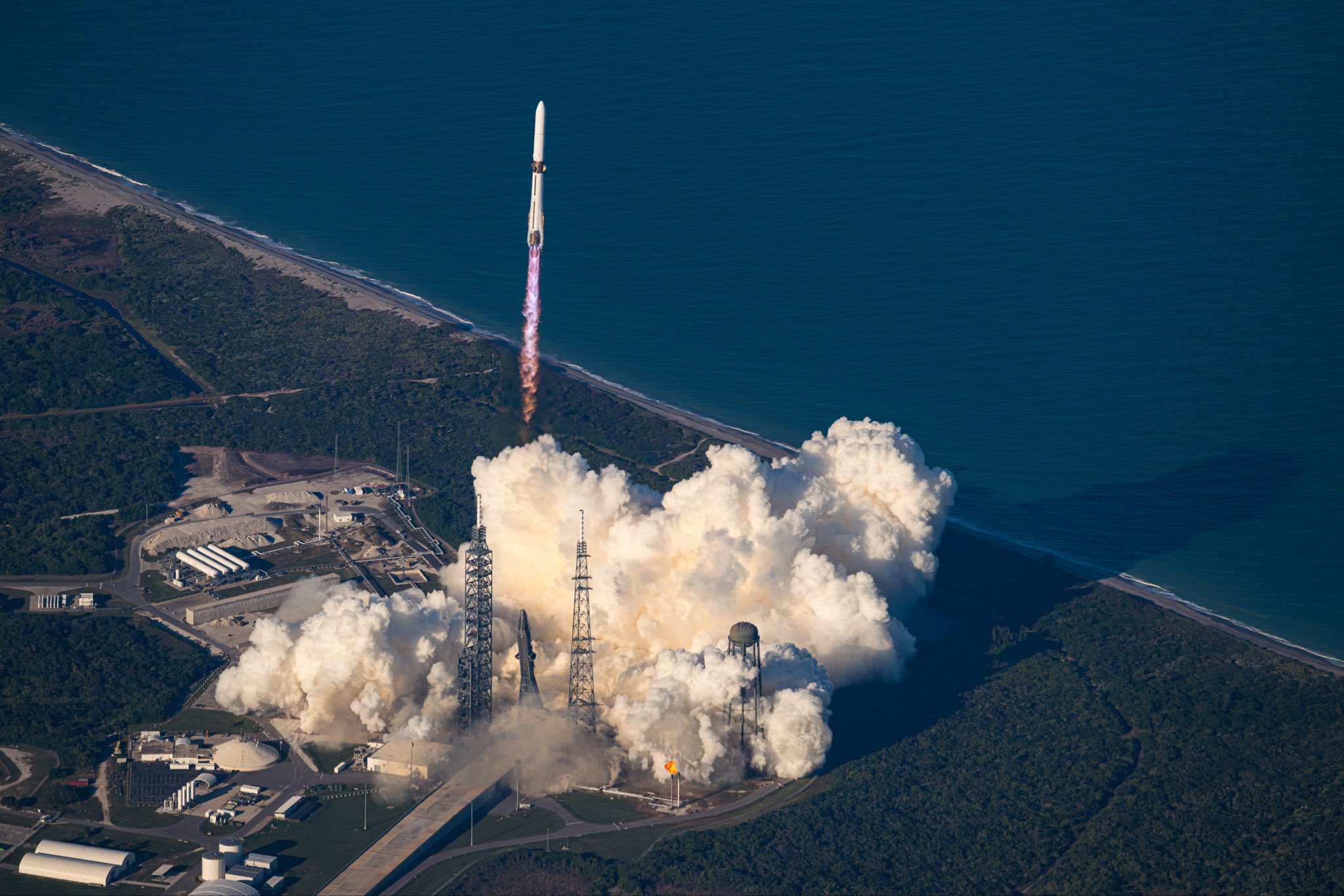
NASA’s ESCAPADE (Escape and Plasma Acceleration and Dynamics Explorers) mission launched on Nov. 13, 2025, atop a Blue Origin New Glenn rocket at Launch Complex 36 at Cape Canaveral Space Force Station.
Credit: Blue Origin
25 years of continuous presence in low Earth orbit
In 2025, the International Space Station celebrated 25 years of continuous human presence, a milestone achievement underscoring its role as a beacon of global cooperation in space. The orbital laboratory supported thousands of hours of groundbreaking research in microgravity in 2025, advancing commercial space development and preparing for future human exploration of the Moon and Mars.
For the first time, all eight docking ports were occupied by visiting spacecraft to close out the year, demonstrating the strength of NASA’s commercial and international partnerships. Twenty-five people from six countries lived and worked aboard the station this year. In all, 12 spacecraft visited the space station in 2025, including seven cargo missions delivering more than 50,000 pounds of science, tools, and critical supplies to the orbital complex.
Research aboard the International Space Station continues to benefit life on Earth and support deep space exploration.
Several studies with Crew-10 and Crew 11 aimed at understanding how the human body adapts to spaceflight, including a new study to assess astronauts’ performance, decision making, and piloting capabilities during simulated lunar landings.
In September, the U.S. Food and Drug Administration approved an early-stage cancer treatment, supported by research aboard the space station, that could reduce costs and shorten treatment times for patients.
Scientists also published findings in peer-reviewed journals on topics such as astronaut piloting performance after long missions, the use of biologically derived materials to shield against space radiation, robotic telesurgery in space, and how spaceflight affects stem cells, all advancing our understanding of human physiology in space and on Earth.
Researchers 3D-printed medical implants with potential to support nerve repair; advanced work toward large-scale, in-space semiconductor manufacturing; and researched the production of medical components with increased stability and biocompatibility that could improve medication delivery.
Additional notable space operations accomplishments included:
NASA’s SpaceX Crew-9 astronauts Nick Hague, Suni Williams, and Butch Wilmore returned in March after a long-duration mission, including more than eight months for Williams and Wilmore. The trio completed more than 150 scientific experiments and 900 hours of research during the stay aboard the orbiting laboratory. Williams also conducted two spacewalks, setting a new female spacewalking record with 62 hours, 6 minutes, and ranking her fourth all-time in spacewalk duration.
NASA astronaut Don Pettit returned in April with Roscosmos cosmonauts Alexey Ovchinin and Ivan Vagner, concluding a seven-month mission. Pettit, who turned 70 the day of his return, completed 400 hours of research during his flight, and has now logged 590 days in space across four missions.
SpaceX Dragon cargo missions 32 and 33 launched in April and August, delivering more than 11,700 pounds of cargo, while SpaceX 33 tested a new capability to help maintain the altitude of station.
Axiom Mission 4, the fourth private astronaut mission to the space station, concluded in July, furthering NASA’s efforts to support and advance commercial operations in low Earth orbit.
NASA SpaceX Crew-11 mission launched in August with NASA astronauts Zena Cardman and Mike Fincke, JAXA (Japan Aerospace Exploration Agency) astronaut Kimiya Yui, and Roscosmos cosmonaut Oleg Platonov aboard. The crew remains aboard the space station where they are conducting long-duration research to support deep space exploration and benefit life on Earth.
NASA’s SpaceX Crew-10 mission completed more than 600 hours of research before returning in August, when they became the first crewed SpaceX mission for NASA to splash down in the Pacific Ocean.
In September, the first Northrop Grumman Cygnus XL spacecraft arrived, delivering more than 11,000 pounds of cargo, including research supporting Artemis and Mars exploration.
NASA Glenn researchers tested handheld X-ray devices that could help astronauts quickly check for injuries or equipment problems during future space missions.
For nearly six years, NASA’s BioNutrients project has studied how to produce essential nutrients to support astronaut health during deep space missions, where food and vitamins have limited shelf lives. With its third experiment now aboard the International Space Station, the research continues to advance preparations for long-duration spaceflight.
NASA astronaut Chris Williams arrived with Roscosmos cosmonauts Sergey Kud-Sverchkov and Sergei Mikaev for an eight-month science mission aboard the station. Following their arrival, NASA astronaut Jonny Kim returned home, concluding his own eight-month mission.
NASA has worked with commercial companies to advance development of privately owned and operated space stations in low Earth orbit from which the agency, along with other customers, can purchase services and stimulate the growth of commercial activities in microgravity. This work is done in advance of the International Space Station’s retirement in 2030.
Among the many achievements made by our partners, recent advancements include:
Axiom Space has completed critical design review, machining activities, and the final welds, moving to testing for the primary structure of Axiom Station’s first module.
Completed testing of the trace contaminant control system for Vast’s Haven-1 space station using facilities at NASA Marshall, confirming the system can maintain a safe and healthy atmosphere.
Blue Origin’s Orbital Reef completed a human-in-the-loop testing milestone using individual participants or small groups to perform day-in-the-life walkthroughs in life-sized mockups of major station components.
The agency also continues to support the design and development of space stations and technologies through agreements with Northrop Grumman, Sierra Space, SpaceX, Special Aerospace Services, and ThinkOrbital.
On Nov. 2, 2025, the International Space Station celebrated 25 years of continuous human presence. Here, clouds swirl over the Gulf of Alaska and underneath the aurora borealis blanketing Earth’s horizon in this photograph from the space station as it orbited 261 miles above on March 12, 2025.
Credit: NASA
Pioneering aviation research
This year saw a major triumph for NASA’s aviation researchers, as its X-59 one-of-a-kind quiet supersonic aircraft made its historic first flight Oct 28. NASA test pilot Nils Larson flew the X-59 for 67 minutes up to an altitude of about 12,000 feet and an approximate top speed of 230 mph, precisely as planned. The flight capped off a year of engine testing including afterburner testing, taxi testing, and simulated flights from the ground — all to make sure first flight went safely and smoothly. The X-59 team will now focus on preparing for a series of flight tests where the aircraft will operate at higher altitudes and supersonic speeds. This flight test phase will ensure the X-59 meets performance and safety expectations. NASA’s Quesst mission also began testing the technologies that they will use to measure the X-59’s unique shock waves and study its acoustics during future mission phases.
Researchers also made other major strides to further aviation technologies that will benefit the public and first responders, including live flight testing of a new portable airspace management system with the potential to greatly improve air traffic awareness during wildland fire operations.
During the past year, the agency’s aeronautics researchers also:
Conducted live flight testing with aircraft performing simulated wildland fire response using NASA’s new portable airspace management system known as Advanced Capabilities for Emergency Response Operations (ACERO) project.
Used NASA’s Transonic Dynamics Tunnel in Virginia to test the performance of rotors designed for NASA’s Dragonfly rotorcraft, which will explore Saturn’s moon, Titan.
Performed wind tunnel tests to see how icing could affect longer, thinner wings on future airliners and to evaluate a tiltwing design likely to see wide usage in advanced air mobility vehicles.
Tested NASA-designed ultralight aerogel antennas that could be embedded into aircraft skin for more aerodynamic, reliable, satellite communications.
Worked to advance the airborne transportation of people and goods, including a collaboration with the Department of War to advance capabilities for long-distance cargo drones; a partnership to test a tool for remotely piloted urban air transportation; flight tests with partners exploring large-scale drone cargo flights; and work with ResilienX to enhance preflight planning for safer future skies.
Performed research to help with the integration of air taxis and similar future aircraft, such as producing real-world data to help understand their flight dynamics; dropping a full-scale fuselage model to test its materials upon impact; collecting to evaluate strategies for urban airspace integration; investigating passenger comfort; and testing 5G-based aviation network technology to boost air taxi connectivity. Evaluated a system that would help prevent collisions between air taxis and other future aircraft in urban environments.
Made advances to unsteady pressure sensitive paint wind tunnel technology, allowing it to measure air pressure on miniature aircraft and rocket models 10,000 times faster with 1,000 times higher resolution.
Collected data on mixed reality systems that allow users to interact with physical flight simulators while wearing virtual reality headsets.
Developed the GlennICE tool for U.S. researchers and aircraft developers to integrate icing-related considerations into aircraft design.
Supported research for safer and smoother airline and airport operations, including; developing a preflight rerouting tool to actively curb commercial airline delays and save fuel; demonstrating a unique air traffic management concept for safer aircraft operate at higher altitudes; and hosting technology testing to make runway taxiing safer and more efficient.
NASA’s X-59 quiet supersonic research aircraft lifts off for its first flight on Oct. 28, 2025, from U.S. Air Force Plant 42 in Palmdale, California. The aircraft’s first flight marks the start of flight testing for NASA’s Quesst mission, the result of years of design, integration, and ground testing.
Credit: NASA/Lori Losey
Technologies that advance exploration, support growing space economies
From spinoff technologies on Earth to accelerating development of technologies in low Earth orbit and at the Moon and Mars, NASA develops, demonstrates, and transfer new space technologies that benefit the agency, private companies, and other government agencies and missions.
Accomplishments by NASA and our partners in 2025 included:
NASA and Teledyne Energy Systems Inc. demonstrated a next-generation fuel cell system aboard a Blue Origin New Shepard mission, proving it can deliver reliable power in the microgravity environment of space.
Varda Space Industries licensed cutting-edge heatshield material from NASA, allowing it to be produced commercially for the company’s capsule containing a platform to process pharmaceuticals in microgravity. Through this commercial collaboration NASA is making entry system materials more readily available to the U.S. space economy and advancing the industries that depend on it.
The maiden flight of UP Aerospace’s Spyder hypersonic launch system demonstrated the U.S. commercial space industry’s capacity to test large payloads (up to 400 pounds) at five times the speed of sound. NASA’s support of Spyder’s development helped ensure the availability of fast-turnaround, lower cost testing services for U.S. government projects focused on space exploration and national security.
The NASA Integrated Rotating Detonation Engine System completed a test series for its first rotating detonation rocket engine technology thrust chamber assembly unit.
NASA successfully completed its automated space traffic coordination objectives between the agency’s four Starling spacecraft and SpaceX’s Starlink constellation. The Starling demonstration matured autonomous decision-making capabilities for spacecraft swarms using Distributed Spacecraft Autonomy software, developed by NASA’s Ames Research Center in California’s Silicon Valley.
NASA announced an industry partnership to design the Fly Foundational Robots mission to demonstrate use of Motiv Space Systems’ robotic arm aboard a hosted orbital flight test with Astro Digital.
The third spacecraft in the R5 (Realizing Rapid, Reduced-cost high-Risk Research) demonstration series launched aboard SpaceX’s Transporter-15 mission. This series of small satellites leverage terrestrial commercial off-the-shelf hardware to enable affordable, rapid orbital flight tests of rendezvous and proximity operations payloads.
The DUPLEX CubeSat developed by CU Aerospace deployed from the International Space Station to demonstrate two commercial micro-propulsion technologies for affordable small spacecraft propulsion systems.
Harnessing NASA’s brand power in real life, online
As one of the most recognized global brands and most followed on social media, NASA amplified its reach through force-multiplying engagement activities that generate excitement and support for the agency’s missions and help foster a Golden Age of innovators and explorers.
From collaborations with sport organizations and players to partnerships with world-renowned brands, these activities provide low-cost, high-impact avenues to engage an ever-expanding audience and reinforce NASA’s position as the world’s premier space agency. Engagement highlights from 2025 include:
Second Lady Usha Vance also kicked off her summer reading challenge at NASA’s Johnson Space Center in Houston, encouraging youth to seek adventure, imagination, and discovery in books, a sentiment close to NASA and everyone the agency inspires.
Reached nearly 5 million people through participation in hybrid and in-person events across the agency, including the White House’s Summer Reading Challenge, Open Sauce 2025, the Expedition 71 and 72 postflight visits, featuring NASA astronauts recently returned from missions aboard the space station, and more.
Participated in a variety of space policy conferences to include Space Symposium and the International Aeronautical Congress highlighting America’s leadership in human exploration to the Moon and Mars, responsible exploration under the Artemis Accords, and support for the commercial space sector.
In 2025, NASA also consolidated its social media accounts to improve clarity, compliance, and strategic alignment. After streamlining the number of active accounts, the agency grew its total following on these accounts by more than eight million, reaching nearly 367 million followers.
Other digital highlights included:
In 2025, NASA expanded access to its NASA+ streaming service by launching a free, ad-supported channel on Prime Video and announcing a new partnership with Netflix to stream live programming, including rocket launches and spacewalks, making its missions more accessible to global audiences and inspiring the next generation of explorers. As of November 2025, viewers have streamed more than 7.7 million minutes of NASA content on the Prime Video FAST channel.
NASA’s SpaceX Crew-9 return from the space station drew over 2.5 million live viewers, making it the agency’s most-watched event of 2025.
NASA aired live broadcasts for 17 launches in 2025, which have a combined 3.7 million views while live. NASA’s SpaceX Crew-10 and NISAR launches have the most views on YouTube, while crewed launches (Crew-10, Crew-11, and Axiom Mission 4) were the most-viewed while the broadcast was live.
The agency’s YouTube livestreams in 2025 surpassed 18.8 million total live views. The agency’s YouTube channel has more than 50.4 million total views for the year.
The agency’s podcasts were downloaded more than 2 million times in 2025 by more than 750,000 listeners.
Increased content production nearly tenfold for its science-focused website in Spanish, Ciencia de la NASA, and grew the website’s page views by 24% and visitor numbers by 25%. NASA’s Spanish language social media accounts experienced a 17% growth in followers in 2025.
The number of subscribers to NASA’s flagship and Spanish newsletters total more than 4.6 million.
NASA earned a spot on The Webby 30, a curated list celebrating 30 companies and organizations that have shaped the digital landscape.
More than 2.9 million viewers watched 38,400 hours of NASA’s on-demand streaming service NASA+ in 2025. November marked two years since NASA+ debuted.
Premiered “Planetary Defenders,” a new documentary that follows the dedicated team behind asteroid detection and planetary defense. The film debuted at an event at the agency’s headquarters with digital creators, interagency and international partners, and now is streaming on NASA+, YouTube, and X. In its first 24 hours, it saw 25,000 views on YouTube – 75% above average – and reached 4 million impressions on X.
“Cosmic Dawn,” a feature-length documentary following the creation of the James Webb Space Telescope, was released this year. The film has been viewed 1.6 million times on the agency’s YouTube channel.
Among agency awards:
NASA’s broadcast of the April 8, 2024, total solar eclipse won multiple Emmy Awards.
Received six Webby Awards and six People’s Voice Awards across platforms — recognition of America’s excellence in digital engagement and public communication.

 Accedi