❌

Modalità di lettura

Isaias Dims the Gulf Coast


August 2026 Composite
October 11, 2026

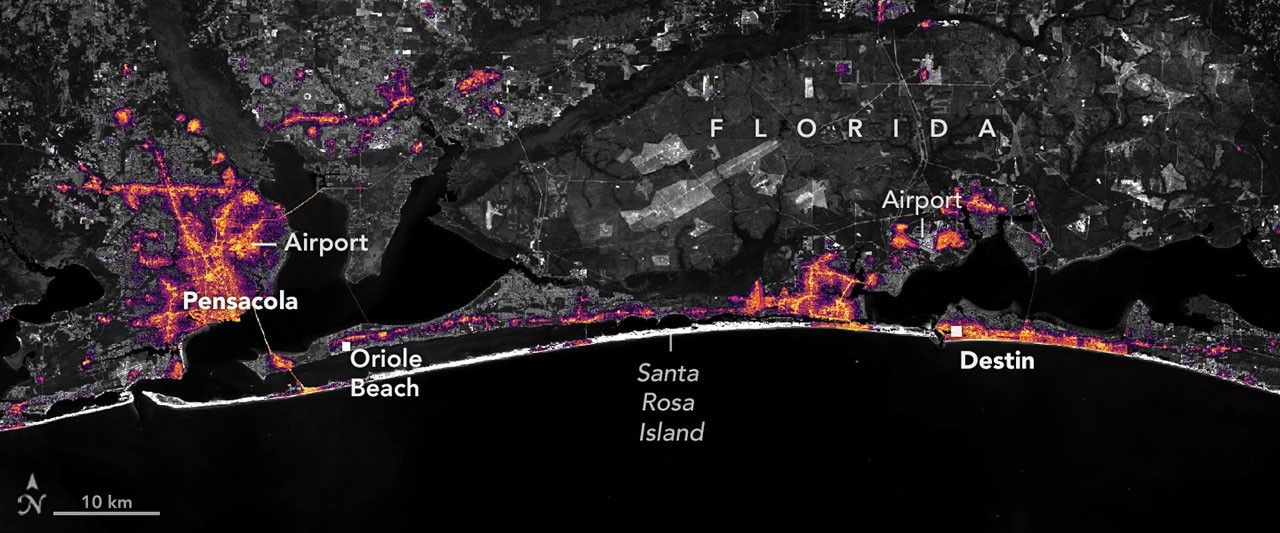
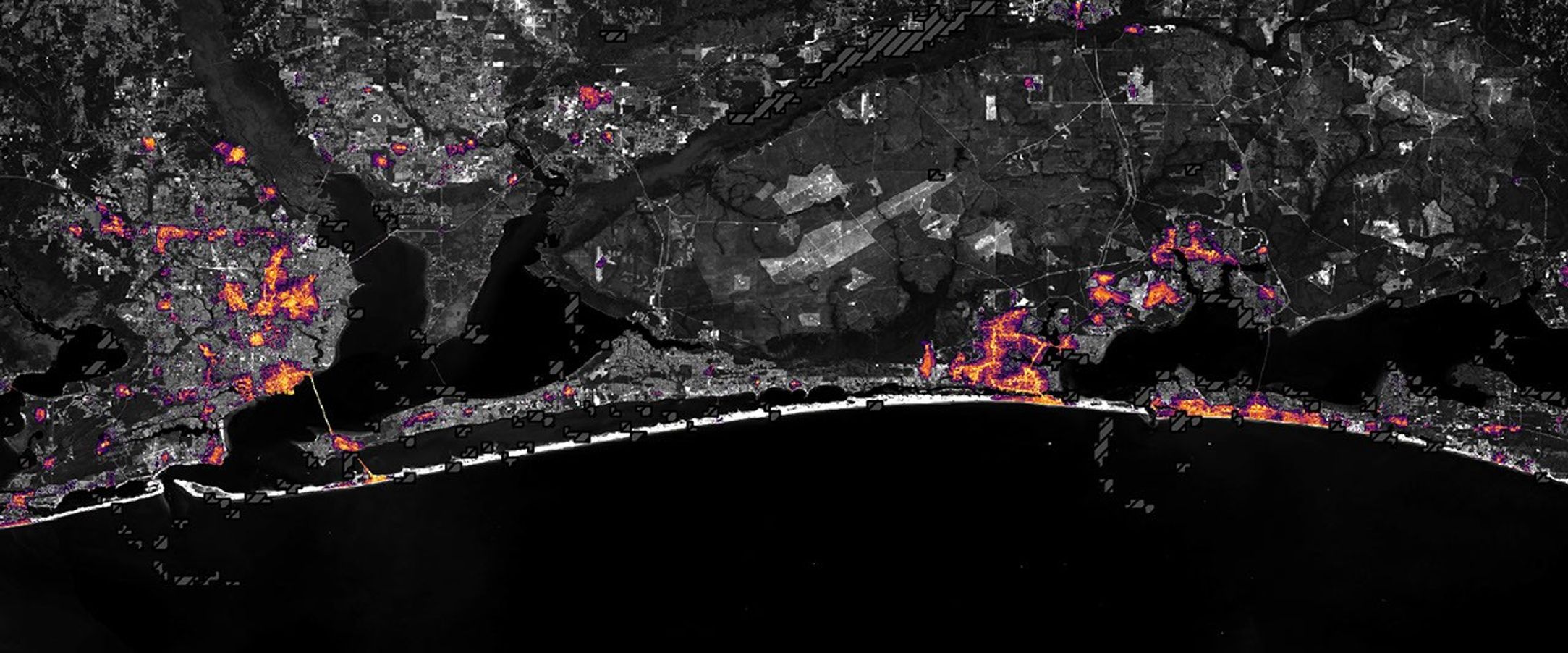
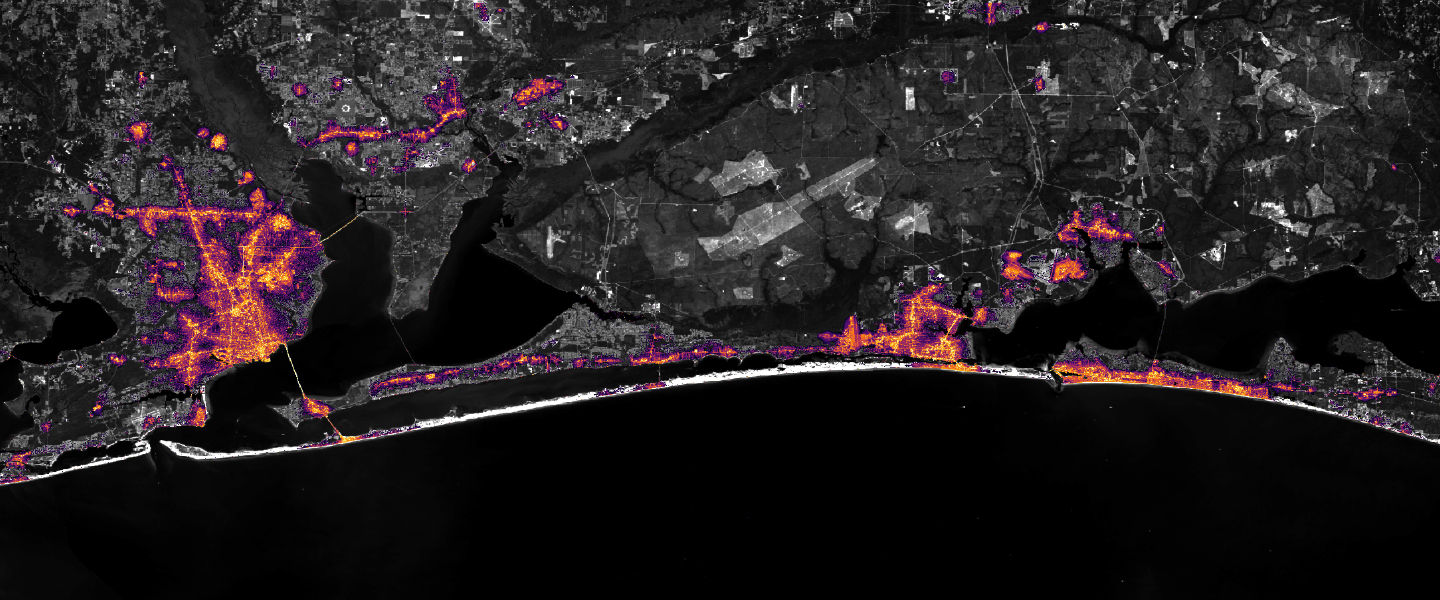
Nighttime lights along the Florida Panhandle coast in August 2026, brightest in Pensacola and Destin and along the road between them.
NASA Earth Observatory / Lauren Dauphin

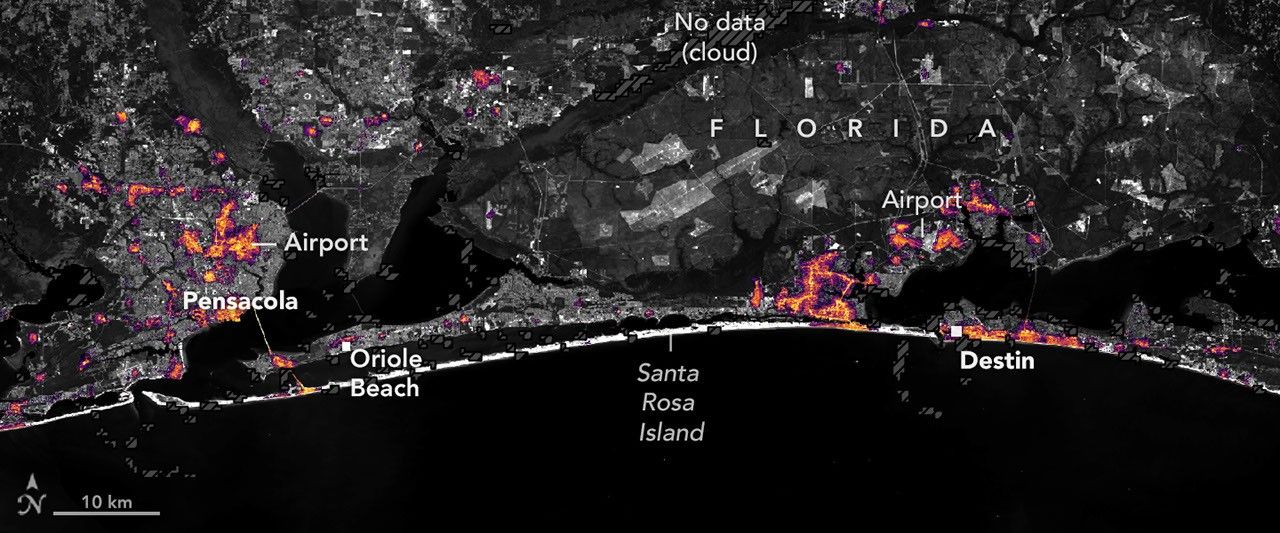
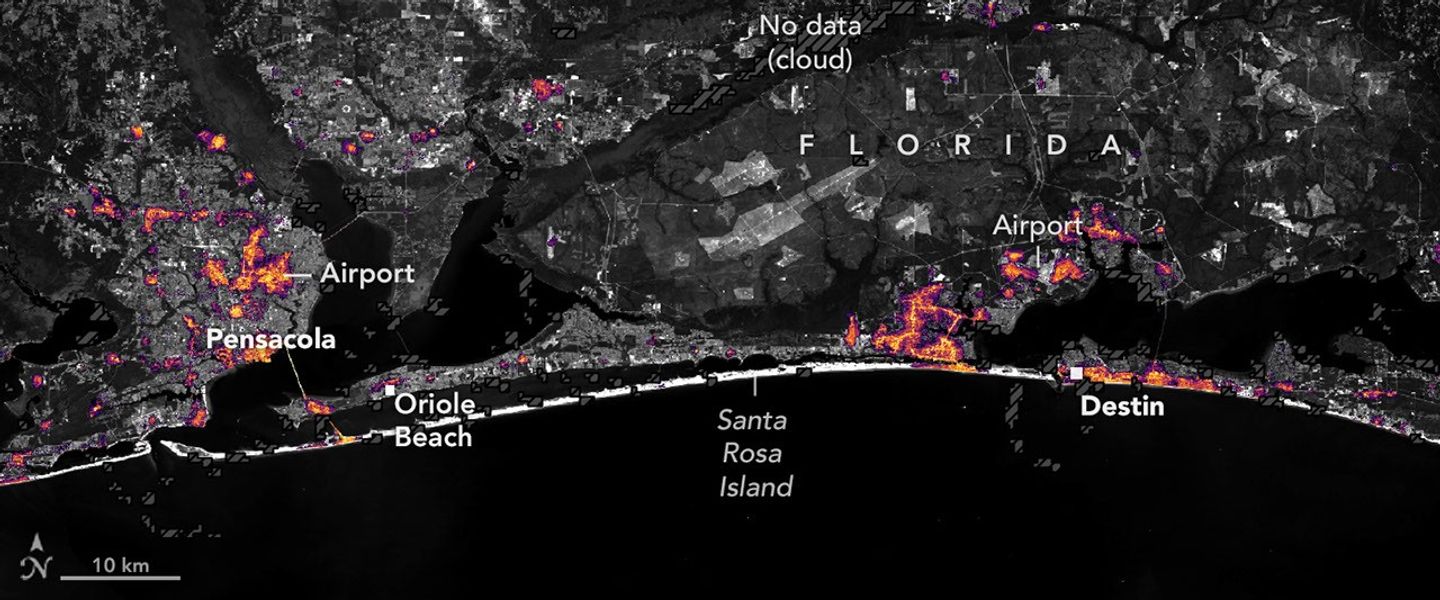
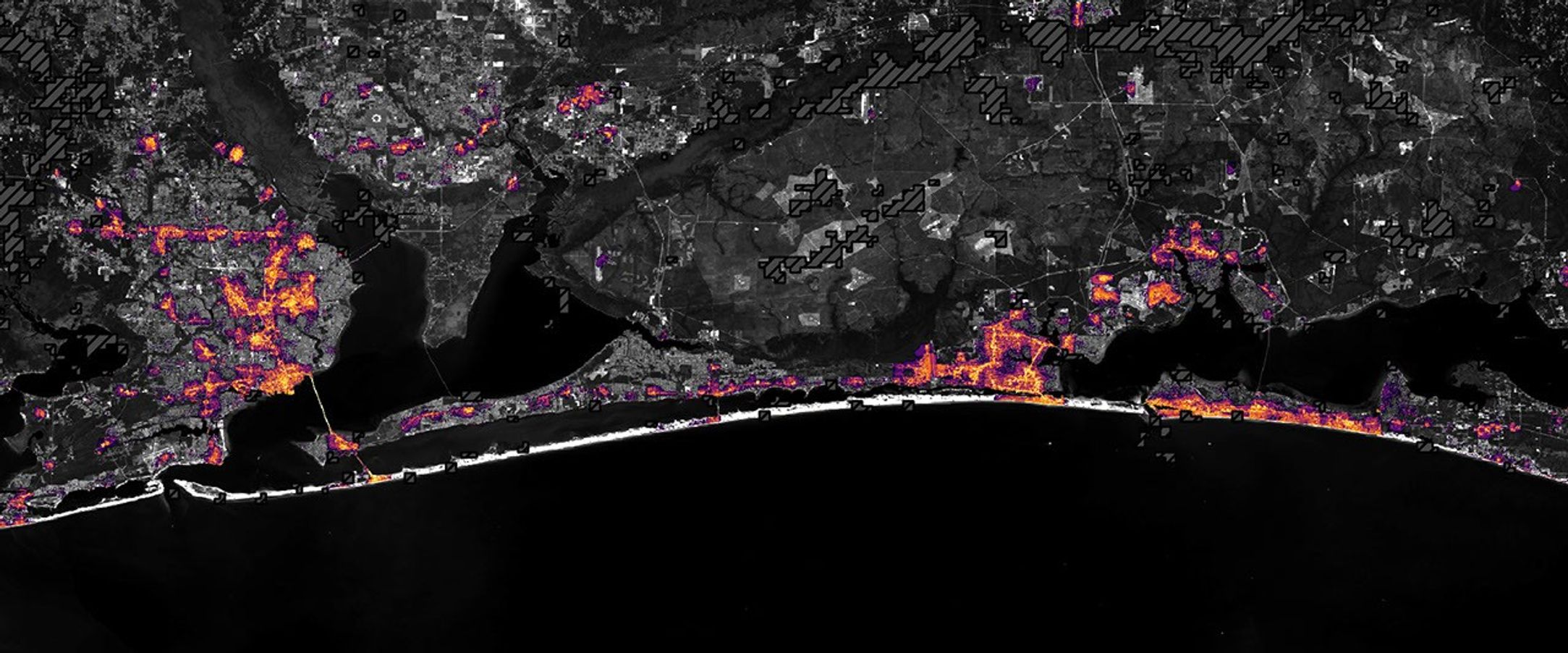
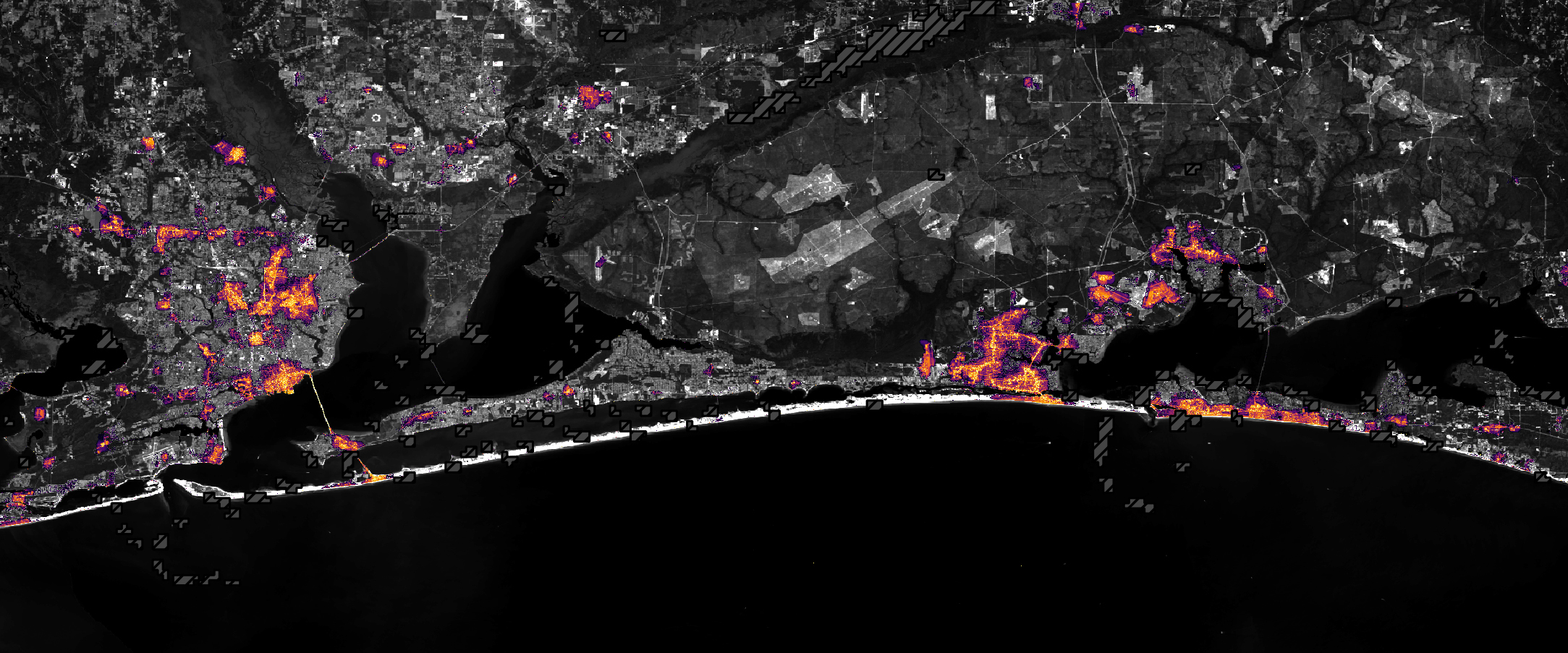
Nighttime lights along the Florida Panhandle coast on October 11, 2026, after Hurricane Isaias, with fewer and dimmer lights in Pensacola and Destin and gaps along the road between them.
NASA Earth Observatory / Lauren Dauphin

Nighttime lights along the Florida Panhandle coast in August 2026, brightest in Pensacola and Destin and along the road between them.
NASA Earth Observatory / Lauren Dauphin
Nighttime lights along the Florida Panhandle coast on October 11, 2026, after Hurricane Isaias, with fewer and dimmer lights in Pensacola and Destin and gaps along the road between them.
NASA Earth Observatory / Lauren Dauphin

August 2026 Composite

October 11, 2026


Lights around Pensacola, Florida, and along the U.S. Route 98 corridor toward Destin appear sharply reduced on October 11, 2026 (right), compared with typical conditions in August 2026 (left), suggesting widespread power outages after Hurricane Isaias. Images are from NASA’s Black Marble HD product.

After a quiet start to the 2026 Atlantic hurricane season, Isaias became the season’s first hurricane on October 8 as it tracked toward the U.S. Gulf Coast. The storm brought heavy rain and flash flooding to parts of the Southeast, including Alabama and the Florida Panhandle, and winds that toppled trees and downed power lines, leaving many people in the dark.

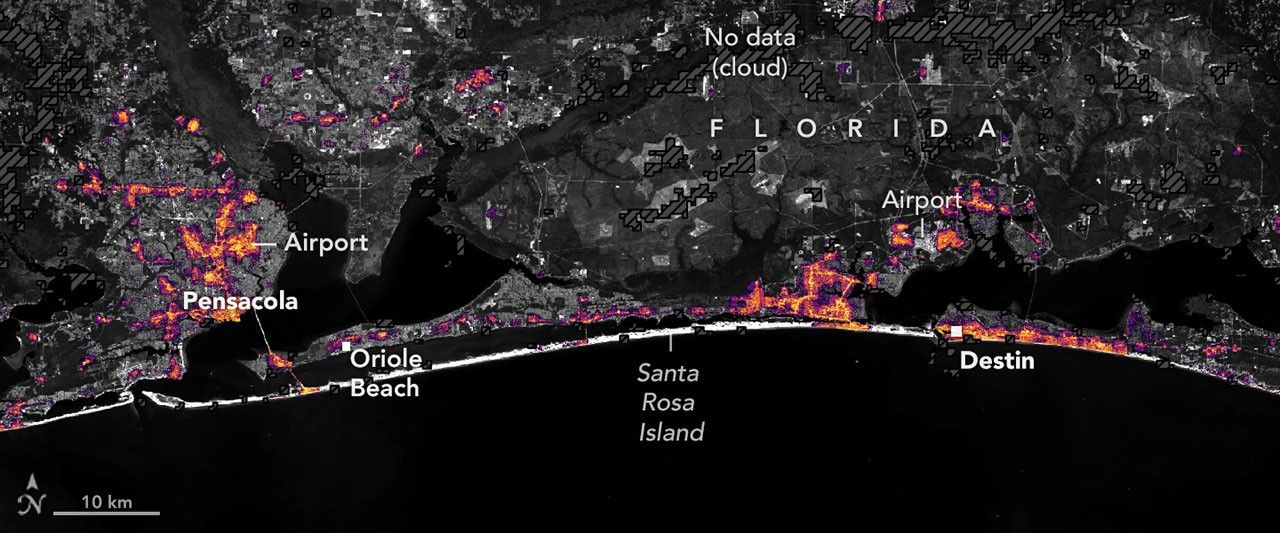
Isaias made landfall near Destin, Florida, on the evening of October 9 as a Category 2 hurricane with maximum sustained winds of 105 miles (170 kilometers) per hour. Gusts topped 100 miles per hour along a corridor west of the storm’s center, according to the National Weather Service, with preliminary reports showing a 117-mile-per-hour gust in Oriole Beach and a 102-mile-per-hour gust at Pensacola City Hall.

These areas of high winds overlapped a broader area west of the storm’s eye where satellite images showed substantial decreases in nighttime lights. The image pair above shows nighttime lights before and after the storm. The left image is a composite of August 2026 data representing typical conditions, and the right image shows lights on October 11, after most of the storm’s clouds had cleared.

The data depicted in the images, provided by Ranjay Shrestha of NASA’s Black Marble science team, come from the Black Marble HD product. The product uses data from the VIIRS (Visible Infrared Imaging Radiometer Suite) on the NOAA-20 satellite, which has a day-night band that detects light emitted and reflected at night. The team processed the data to account for changes in the landscape, the atmosphere, and phase of the Moon, and to filter out stray light that does not come from electric lights. Dark gray, hash-marked areas show where clouds prevented VIIRS from collecting data. The nighttime lights are shown over a base map from the Landsat 9 satellite.

“Standard Black Marble nighttime lights imagery, available through NASA Worldview, provides a broad picture of the storm’s immediate impacts,” Shrestha said. “Black Marble HD takes this a step further by allowing us to visualize these changes at a much finer spatial scale.”

At these finer scales, the images reveal lights decreasing sharply around parts of Pensacola, Florida, and along the U.S. Route 98 corridor toward Destin, suggesting widespread power disruptions. Shrestha also pointed out pockets where lights persisted, including Pensacola International Airport, Pensacola Christian College, and parts of downtown Pensacola. “These patterns could reflect backup power systems, differences in electrical infrastructure, or areas that maintained electricity during the storm, although the imagery alone cannot confirm the underlying reasons,” he said.
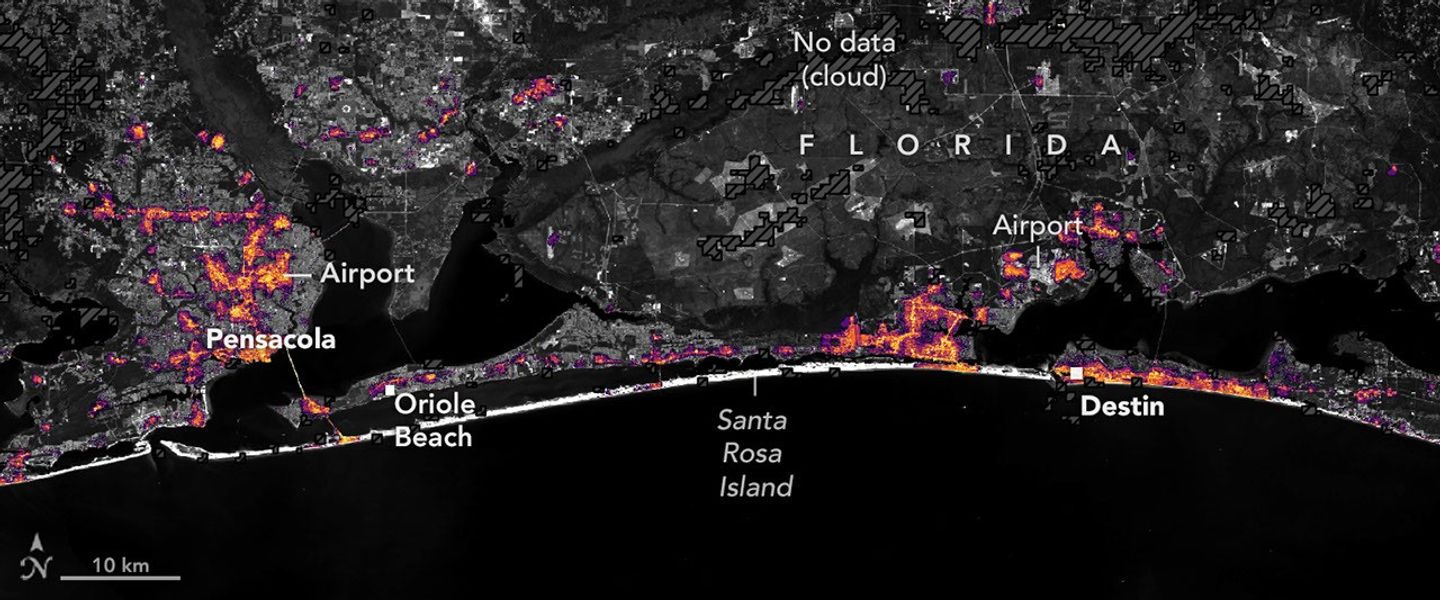


October 11, 2026
October 12, 2026

Nighttime lights along the Florida Panhandle coast on October 11, 2026, after Hurricane Isaias, with fewer and dimmer lights in Pensacola and Destin and gaps along the road between them.
NASA Earth Observatory / Lauren Dauphin

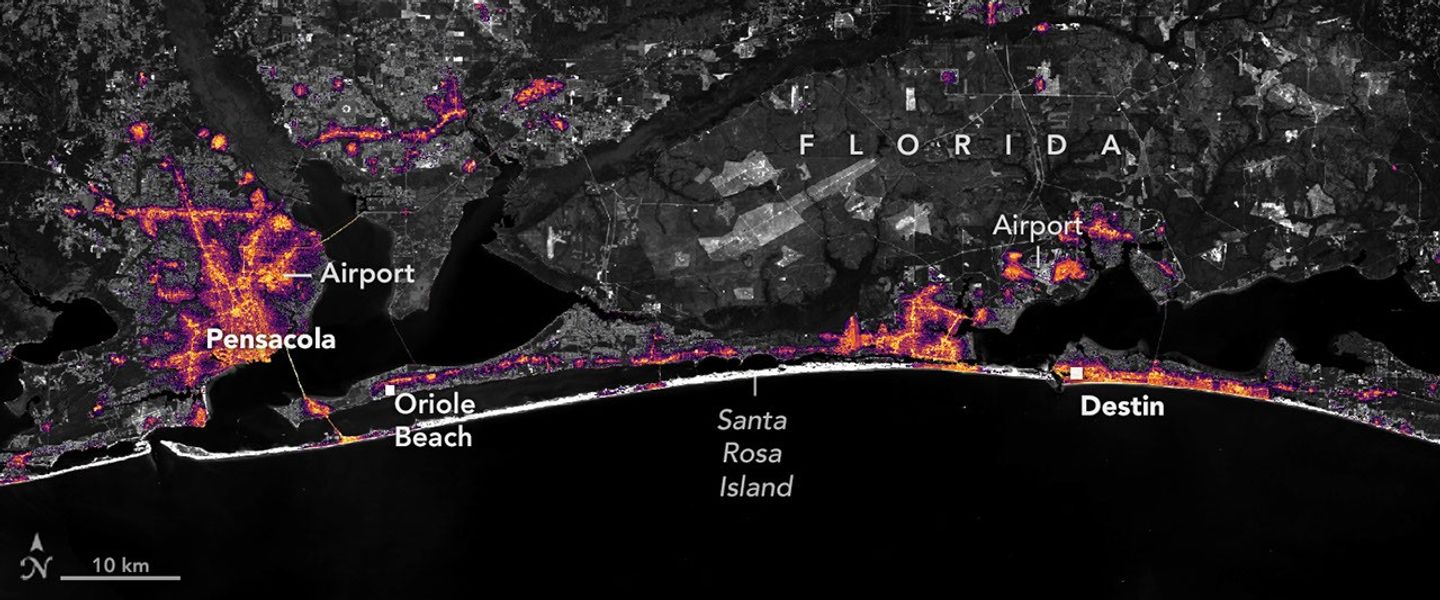
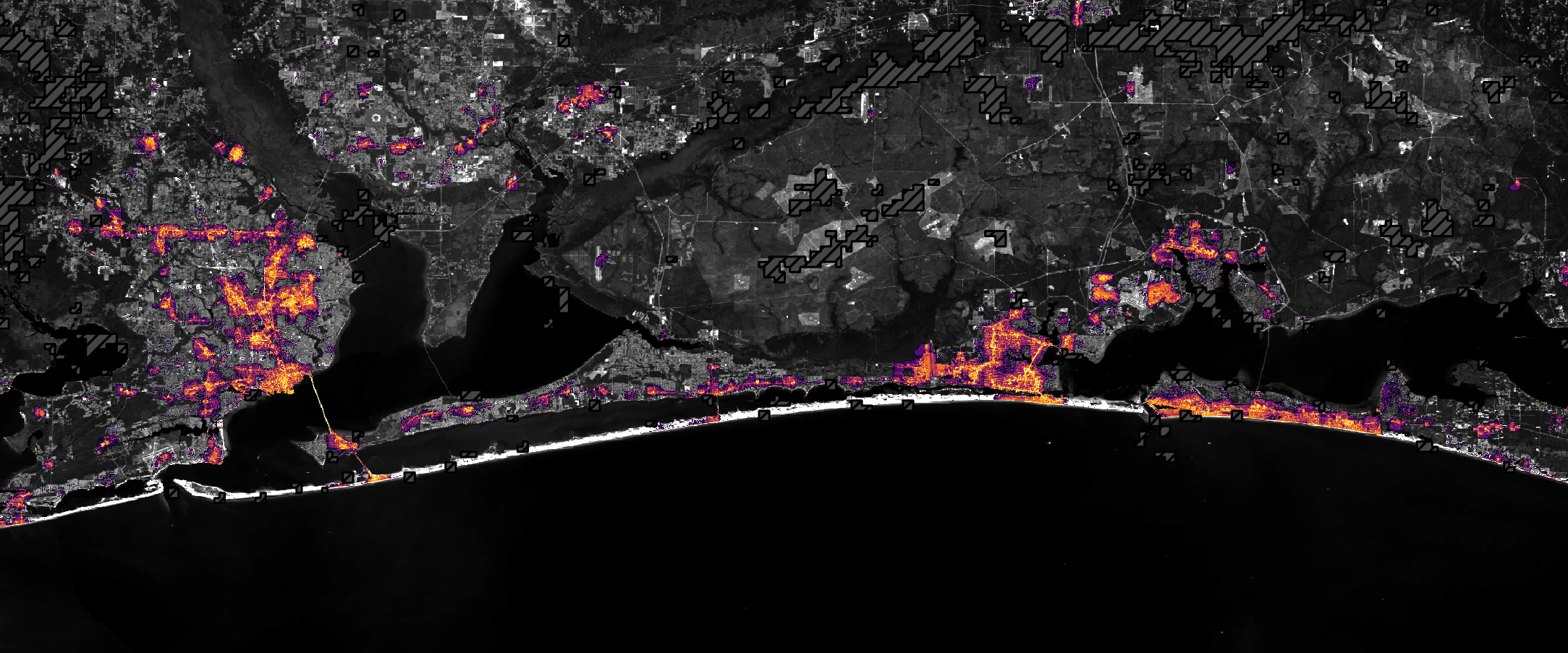
The same area on October 12, 2026, with lights in Pensacola and Destin and along the road between them closer to pre-storm levels.
NASA Earth Observatory / Lauren Dauphin

Nighttime lights along the Florida Panhandle coast on October 11, 2026, after Hurricane Isaias, with fewer and dimmer lights in Pensacola and Destin and gaps along the road between them.
NASA Earth Observatory / Lauren Dauphin
The same area on October 12, 2026, with lights in Pensacola and Destin and along the road between them closer to pre-storm levels.
NASA Earth Observatory / Lauren Dauphin

October 11, 2026

October 12, 2026


Widespread outages darken the region around Pensacola, Florida, and along the U.S. Route 98 corridor toward Destin on October 11, 2026 (left). By October 12 (right), lights have returned to some affected areas. Images are from NASA’s Black Marble HD product.

Black Marble HD images also reveal the pace and spatial patterns of recovery. The image pair above compares the same October 11 view (left) with one from October 12 (right), when lights had begun to return to some affected areas. By October 14, lighting patterns looked similar to pre-storm conditions.
 
“Understanding where recovery is progressing and where disruptions persist can help emergency responders and decision makers identify areas that may require additional attention, prioritize resources, and assess the effectiveness of restoration efforts,” Shrestha said.
 
Black Marble data complement ground-based outage reports rather than replace them, offering a more comprehensive view of disasters’ impacts and recovery. “Ultimately, this is where the value of Black Marble lies: turning nighttime Earth observations into actionable insights that support informed decisions and help bridge the gap between Earth science and action,” Shrestha said.
 
The NASA Disasters Program, in coordination with FEMA and the USGS Coastal Storms Team, is supporting the Alabama Red Cross and the Alabama Emergency Management Agency’s response to Hurricane Isaias. The team will be posting maps and data products on its open-access mapping portal as new information becomes available.

NASA Earth Observatory images by Lauren Dauphin, using Black Marble HD data courtesy of Ranjay Shrestha/NASA’s Goddard Space Flight Center and Landsat data from the U.S. Geological Survey. Story by Kathryn Hansen.

Downloads
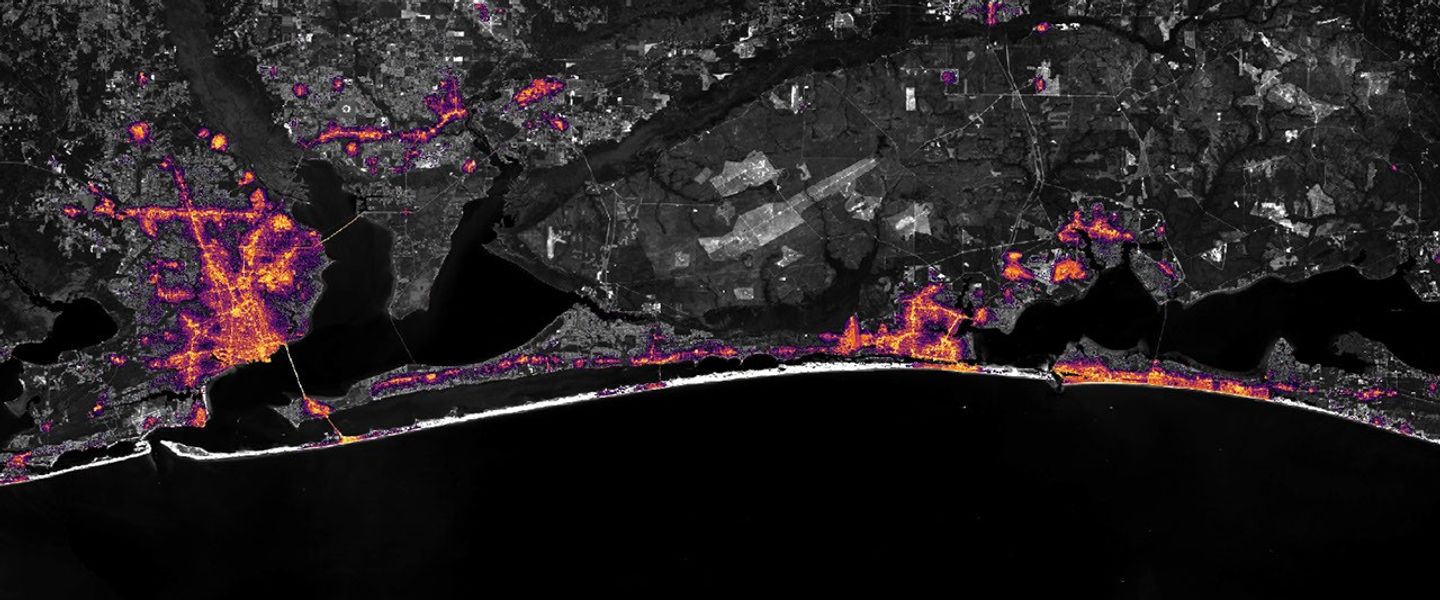
Nighttime lights along the Florida Panhandle coast in August 2026, brightest in Pensacola and Destin and along the road between them.

August 2026 Composite

JPEG (558.38 KB)

Nighttime lights along the Florida Panhandle coast on October 11, 2026, after Hurricane Isaias, with fewer and dimmer lights in Pensacola and Destin and gaps along the road between them.

October 11, 2026

JPEG (1.10 MB)

The same area on October 12, 2026, with lights in Pensacola and Destin and along the road between them closer to pre-storm levels.

October 12, 2026

JPEG (1.14 MB)

References & Resources

You may also be interested in:

Stay up-to-date with the latest content from NASA as we explore the universe and discover more about our home planet.
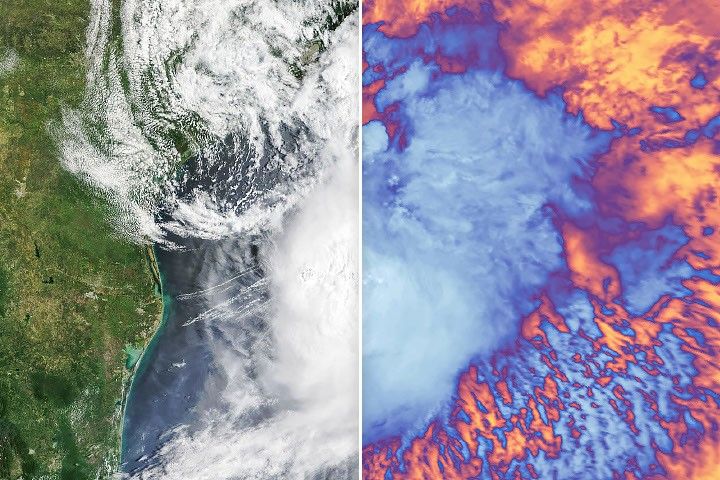
Tropical Storm Arthur

2 min read

The first named storm of the 2026 Atlantic hurricane season brought intense rainfall and the threat of flash flooding to…
Article

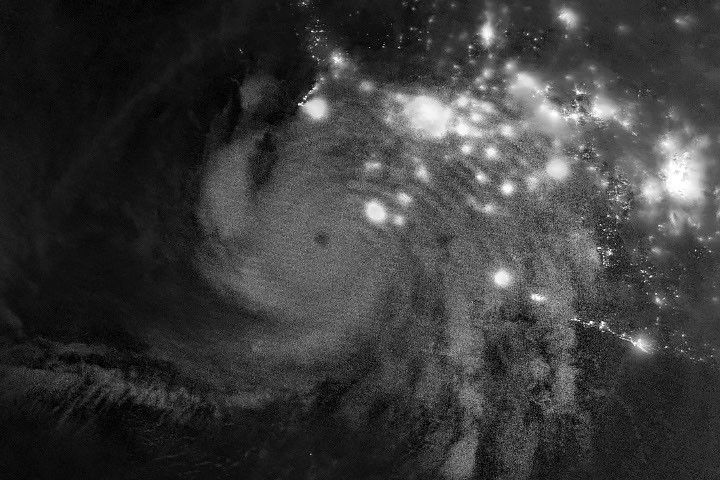
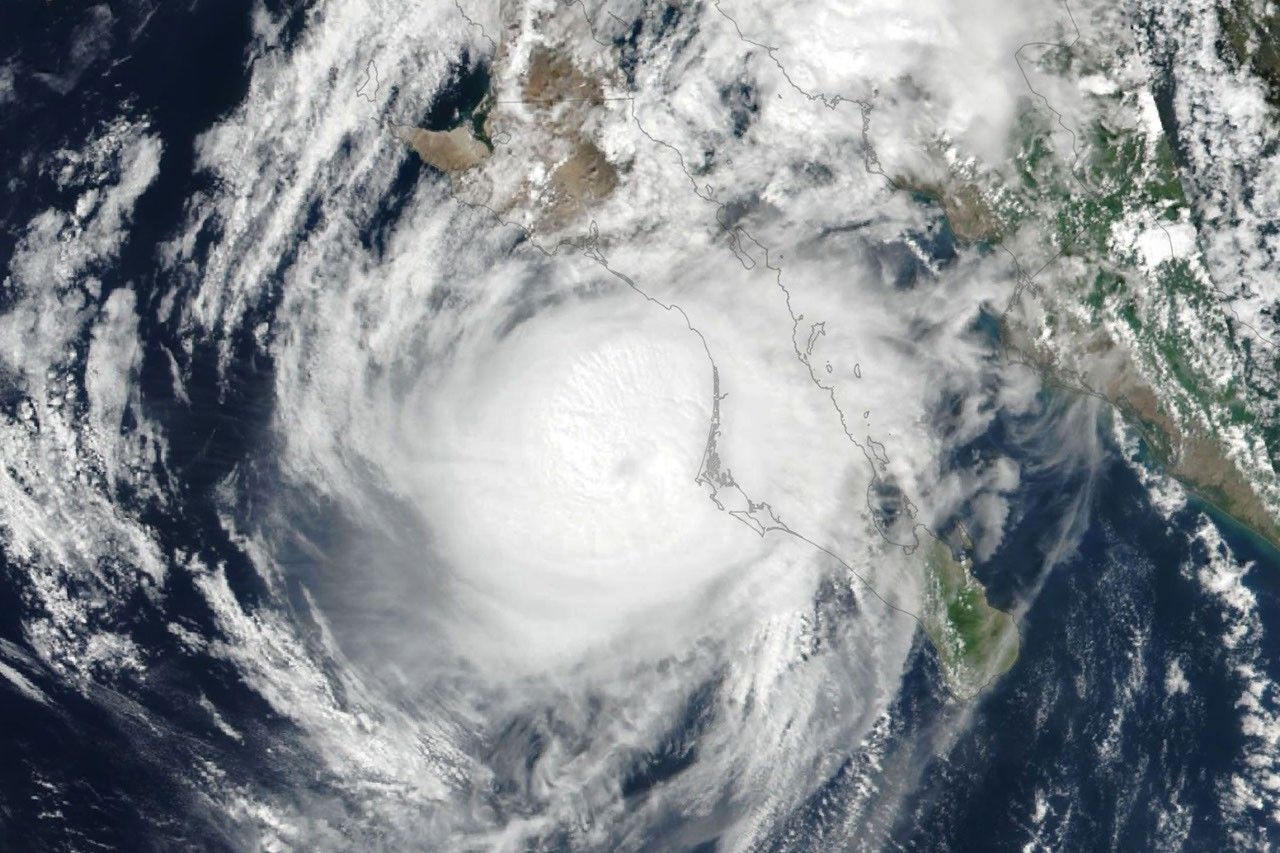
Hurricane Simon Lurks Off the Mexican Coast

3 min read

Though it remained offshore, the storm lashed coastal areas with high winds and flooding—and produced remarkable rippling patterns in the…
Article

Powerful Storms Continue to Prowl the Pacific

4 min read

Hurricanes Polo and Nolo sent destructive effects ashore amid an active season in the northeastern and central Pacific.

Article
  •  

The Network Evolves: ONE Summit Presents Collaborative and Transformative Program Across Networking, Edge, IoT

  • Industry experts will share their knowledge across 5G, factory floor, agriculture, government, Smart Home, and Robotics use cases
  • Speakers from  50+ companies, 20 end users, 16 countries during ONE Summit 
  • Industry experts across the expanding open networking and edge ecosystems confirmed to present insights during ONE Summit North America, November 15-16, in Seattle, WA

SAN FRANCISCO, August 31, 2022 — LF Networking, the facilitator of collaboration and operational excellence across open source networking projects, announced the ONE Summit North America 2022 session schedule is now available. Taking place in Seattle, WA November 15-16, ONE Summit is the one  industry event that brings together decision makers and implementers for two days of in-depth presentations and interactive conversations around 5G, Access, Edge, Telco, Cloud, Enterprise Networking, and more open source technology developments. 

“LF Networking is proud to set a high bar with the quality of content submissions for this year’s ONE Summit, and to offer an innovative line-up of diverse sessions,” said Arpit Joshipura, General Manager, Networking, Edge, and IoT, the Linux Foundation. “We will also touch on gaming, robotics, 5G network automation, factory floor, agriculture and more, with a strong program based on the power of connectivity.” 

The event will feature an extensive program of 70+ diverse business and technical sessions that cover cutting-edge topics across five presentation tracks: Industry 4.0; Security; The New Networking Stack; Operational Deployments (case studies, success & challenges); and Emerging Technologies and Business Models. 

Conference Session Highlights:

ONE Summit returns in-person for the first time in two years in its best format ever! The use-case driven content is strong in breadth and depth and includes sessions from open source users with whom LF Networking is engaged for the first time. Attendees will have a choose your own adventure experience as they select from a variety of content formats from interactive sessions, panels, in-depth tutorials, to lightning talk sessions with quick glances of future- looking thought processes. 

  • Real-world deployment stories of open source in action, from:
    • leading telco and enterprise organizations including TELUS, Google,  Deutsche Telekom, Red Hat, Verizon, Nokia, China Mobile, Equinix, Netgate, Pantheon and others. 
    • government and academic institutions including DARPA, the Naval Information Warfare Center (NWIC), UK Government, University of Southern California, Jeju National University, Georgia Tech, and others. 
  • Use case examples across the Metaverse, Robotics, Smart Home, Digital Twins, 5G Automation, Edge Orchestration, AI/ML, Kubernetes Orchestration, and more. 
  • Hands-on experiential learning and technical deep-dives in IoT and edge deployments led by expert practitioners.
  • Lightning talks offer the opportunity to quickly learn about security and emerging technologies.
  • Sessions contributing insight into open source projects across the ecosystem, including Akraino, CAMARA, eBPF, EdgeX Foundry, EVE, Nephio, OAI, OIF, ONAP, OpenSSF, ORAN-SC, SONiC, and more.

Registration

ONE Summit attendees engage directly with thought leaders across 5G, Cloud Native and Network Edge and expand knowledge of open source networking technology progression. Register today to gain fresh insights on technical and business collaboration shaping the future of networking, edge, and cloud computing.

Corporate registration is offered at the early price of US$995 through Sept. 9. Day passes are available for US$675 and Individual/Hobbyist (US$350) and  Academic/Student (US$100) passes are also available. Members of The Linux Foundation, LF Networking, and  LF Edge receive a 20 percent discount off registration and can contact events@linuxfoundation.org to request a member discount code. Members of the press who would like to request a press pass to attend should contact pr@lfnetworking.org. 

To register, visit  https://events.linuxfoundation.org/one-summit-north-america/register/. Corporate attendees should register before September 9, 2022 for the best rates. 

Developer & Testing Forum

ONE Summit will be followed by a complimentary, two-day LF Networking Developer and Testing Forum (DTF), a grassroots hands-on event organized by the LF Networking projects. ONE Summit attendees are encouraged to extend the experience, roll up sleeves, and join the incredible developer community to advance the open source networking and automation technologies of the future. Session videos from the Spring 2022 LFN Developer & Testing Forum, which took place June 13-16 in Porto, Portugal, are available here.

Sponsors

ONE Summit  is made possible thanks to generous sponsors, including: Diamond sponsor Dell Technologies; Gold sponsor kyndryl; Silver sponsor Futurewei Technologies; and Bronze sponsors Data Bank and Netris.ai. 

For information on becoming an event sponsor, click here or email for more information and to speak to the team.

About the Linux Foundation

Founded in 2000, the Linux Foundation is supported by more than 2,000 members and is the world’s leading home for collaboration on open source software, open standards, open data, and open hardware. Linux Foundation’s projects are critical to the world’s infrastructure including Linux, Kubernetes, Node.js, and more. Learn more at linuxfoundation.org.


The Linux Foundation has registered trademarks and uses trademarks. For a list of trademarks of The Linux Foundation, please see its trademark usage page: www.linuxfoundation.org/trademark-usage. Linux is a registered trademark of Linus Torvalds. ###

The post The Network Evolves: ONE Summit Presents Collaborative and Transformative Program Across Networking, Edge, IoT appeared first on Linux Foundation.

  •  
❌