Modalità di lettura

NASA Astronauts to Answer Questions from New Jersey Students

NASA astronauts Jessica Meir is pictured in the foreground wearing a black and white striped t-shirt. Her hair is curly and pulled up at the top of her head. She has a tablet in her lap and mittens on her hands as she faces the camera smiling. NASA astronaut Chris Williams is behind her wearing a black t-shirt and khaki pants, he has a tablet strapped to this upper leg. He is touching a white cube that sits in the middle of the space craft, while looking forward and smiling. The two astronauts are collecting frozen research samples while living and working aboard the International Space Station.
NASA astronauts Jessica Meir and Chris Williams collect frozen research samples while living and working aboard the International Space Station.
Credit: ESA/Sophie Adenot

Students in New Jersey will hear from NASA astronauts Chris Williams and Jessica Meir as they answer prerecorded STEM questions while aboard the International Space Station.

The Earth-to-space call will begin at 12:05 p.m. EDT, Thursday, June 18, and will stream live on the agency’s Learn With NASA YouTube channel.

This event is hosted by Newton Public Schools in Newton, New Jersey, for students in grades K-12 and members of the community. This unique opportunity aims to deepen understanding of space exploration and enhance awareness of STEM careers.

Media interested in covering the event must RSVP no later than 5 p.m. EDT, Wednesday, June 17, to Dr. Joseph Piccirillo at: 973-383-7392, x4229 or jpiccirillo@newtonnj.org.

For more than 25 years, astronauts have continuously lived and worked aboard the space station, testing technologies, performing science, and developing skills needed to explore farther from Earth. Astronauts communicate with NASA’s Mission Control Center in Houston 24 hours a day through SCaN’s (Space Communications and Navigation) Near Space Network.

Research and technology investigations taking place aboard the space station benefit people on Earth and lay the groundwork for other agency deep space missions. As part of NASA’s Artemis program, the agency will send astronauts to the Moon to prepare for future human exploration of Mars, inspiring the world through discovery in a new Golden Age of innovation and exploration.

For more information on NASA in-flight calls, visit:

https://www.nasa.gov/stemonstation

  •  

NASA Astronauts to Answer Questions from New Jersey Students

NASA astronauts Jessica Meir is pictured in the foreground wearing a black and white striped t-shirt. Her hair is curly and pulled up at the top of her head. She has a tablet in her lap and mittens on her hands as she faces the camera smiling. NASA astronaut Chris Williams is behind her wearing a black t-shirt and khaki pants, he has a tablet strapped to this upper leg. He is touching a white cube that sits in the middle of the space craft, while looking forward and smiling. The two astronauts are collecting frozen research samples while living and working aboard the International Space Station.
NASA astronauts Jessica Meir and Chris Williams collect frozen research samples while living and working aboard the International Space Station.
Credit: ESA/Sophie Adenot

Students in New Jersey will hear from NASA astronauts Chris Williams and Jessica Meir as they answer prerecorded STEM questions while aboard the International Space Station.

The Earth-to-space call will begin at 12:05 p.m. EDT, Thursday, June 18, and will stream live on the agency’s Learn With NASA YouTube channel.

This event is hosted by Newton Public Schools in Newton, New Jersey, for students in grades K-12 and members of the community. This unique opportunity aims to deepen understanding of space exploration and enhance awareness of STEM careers.

Media interested in covering the event must RSVP no later than 5 p.m. EDT, Wednesday, June 17, to Dr. Joseph Piccirillo at: 973-383-7392, x4229 or jpiccirillo@newtonnj.org.

For more than 25 years, astronauts have continuously lived and worked aboard the space station, testing technologies, performing science, and developing skills needed to explore farther from Earth. Astronauts communicate with NASA’s Mission Control Center in Houston 24 hours a day through SCaN’s (Space Communications and Navigation) Near Space Network.

Research and technology investigations taking place aboard the space station benefit people on Earth and lay the groundwork for other agency deep space missions. As part of NASA’s Artemis program, the agency will send astronauts to the Moon to prepare for future human exploration of Mars, inspiring the world through discovery in a new Golden Age of innovation and exploration.

For more information on NASA in-flight calls, visit:

https://www.nasa.gov/stemonstation

  •  

NASA Astronaut Anil Menon Available for Prelaunch Virtual Interviews

NASA astronaut and International Space Station Expedition 74/75 flight engineer Anil Menon poses for a portrait at NASA's Johnson Space Center in Houston.
NASA astronaut and International Space Station Expedition 74/75 flight engineer Anil Menon poses for a portrait at NASA’s Johnson Space Center in Houston.
NASA/James Blair

NASA astronaut Anil Menon will be available for limited media interviews beginning at 9 a.m. EDT Monday, June 22, to discuss his upcoming mission to the International Space Station as part of Expeditions 74/75.

The virtual interviews will take place from the Gagarin Cosmonaut Training Center in Star City, Russia, and will stream live on the agency’s YouTube channel.

Media interested in participating must submit a request to the newsroom at NASA’s Johnson Space Center in Houston no later than 5 p.m. Wednesday, June 17, by emailing jsccommu@mail.nasa.gov. A copy of NASA’s media accreditation policy is online.

Menon is scheduled to launch to the space station Tuesday, July 14, from the Baikonur Cosmodrome in Kazakhstan aboard the Roscosmos Soyuz MS-29 spacecraft with Roscosmos cosmonauts Pyotr Dubrov and Anna Kikina. The trio will spend about eight months aboard the orbiting laboratory before returning to Earth in spring 2027.

During his expedition, Menon will conduct scientific investigations and technology demonstrations to help humans prepare for future exploration missions to the Moon and Mars, and to provide benefits on Earth. Among the hundreds of experiments planned during his mission, he will participate in studies to better understand astronaut vein structure, blood flow, and blood composition in microgravity. He also will test producing intravenous fluids using the space station’s potable water.

The Soyuz MS-29 mission will be his first spaceflight after he was selected as part of NASA’s 2021 astronaut class. A native of Minneapolis, Menon is an emergency medicine physician, mechanical engineer, and colonel in the United States Space Force. He also has served as an expedition flight surgeon supporting the agency’s crew members aboard the space station.

For more than 25 years, people have lived and worked continuously aboard the International Space Station, advancing scientific knowledge and making research breakthroughs not possible on Earth. The space station helps NASA understand and overcome the challenges of human spaceflight, expand commercial opportunities in low Earth orbit, and build on the foundation for long-duration missions to the Moon, as part of the Artemis program, and to Mars.

To learn more about International Space Station research, operations, and its crews, visit: 

https://www.nasa.gov/station

-end- 

Jimi Russell  
Headquarters, Washington 
202-358-1100 
james.j.russell@nasa.gov

Anna Schneider / Mary Pfister
Johnson Space Center, Houston
281-483-5111
anna.c.schneider@nasa.gov / mary.m.pfister@nasa.gov

  •  

NASA Astronaut Anil Menon Available for Prelaunch Virtual Interviews

NASA astronaut and International Space Station Expedition 74/75 flight engineer Anil Menon poses for a portrait at NASA's Johnson Space Center in Houston.
NASA astronaut and International Space Station Expedition 74/75 flight engineer Anil Menon poses for a portrait at NASA’s Johnson Space Center in Houston.
NASA/James Blair

NASA astronaut Anil Menon will be available for limited media interviews beginning at 9 a.m. EDT Monday, June 22, to discuss his upcoming mission to the International Space Station as part of Expeditions 74/75.

The virtual interviews will take place from the Gagarin Cosmonaut Training Center in Star City, Russia, and will stream live on the agency’s YouTube channel.

Media interested in participating must submit a request to the newsroom at NASA’s Johnson Space Center in Houston no later than 5 p.m. Wednesday, June 17, by emailing jsccommu@mail.nasa.gov. A copy of NASA’s media accreditation policy is online.

Menon is scheduled to launch to the space station Tuesday, July 14, from the Baikonur Cosmodrome in Kazakhstan aboard the Roscosmos Soyuz MS-29 spacecraft with Roscosmos cosmonauts Pyotr Dubrov and Anna Kikina. The trio will spend about eight months aboard the orbiting laboratory before returning to Earth in spring 2027.

During his expedition, Menon will conduct scientific investigations and technology demonstrations to help humans prepare for future exploration missions to the Moon and Mars, and to provide benefits on Earth. Among the hundreds of experiments planned during his mission, he will participate in studies to better understand astronaut vein structure, blood flow, and blood composition in microgravity. He also will test producing intravenous fluids using the space station’s potable water.

The Soyuz MS-29 mission will be his first spaceflight after he was selected as part of NASA’s 2021 astronaut class. A native of Minneapolis, Menon is an emergency medicine physician, mechanical engineer, and colonel in the United States Space Force. He also has served as an expedition flight surgeon supporting the agency’s crew members aboard the space station.

For more than 25 years, people have lived and worked continuously aboard the International Space Station, advancing scientific knowledge and making research breakthroughs not possible on Earth. The space station helps NASA understand and overcome the challenges of human spaceflight, expand commercial opportunities in low Earth orbit, and build on the foundation for long-duration missions to the Moon, as part of the Artemis program, and to Mars.

To learn more about International Space Station research, operations, and its crews, visit: 

https://www.nasa.gov/station

-end- 

Jimi Russell  
Headquarters, Washington 
202-358-1100 
james.j.russell@nasa.gov

Anna Schneider / Mary Pfister
Johnson Space Center, Houston
281-483-5111
anna.c.schneider@nasa.gov / mary.m.pfister@nasa.gov

  •  

NASA to Cover 34th SpaceX Resupply Mission Space Station Departure

The SpaceX Dragon cargo spacecraft supporting the company’s 34th commercial resupply services mission for NASA approaches the International Space Station on May 17, 2026, carrying nearly 6,500 pounds of food, supplies, and equipment for the Expedition 74 crew.
Credit: NASA

NASA and its international partners are set to receive scientific research samples and hardware as a SpaceX Dragon spacecraft is scheduled to depart the International Space Station on Tuesday, June 16, for its return to Earth.

Watch NASA’s live undocking coverage beginning at 11:45 a.m. EDT on NASA+, Amazon Prime, and the agency’s YouTube channel. Learn how to watch NASA content through a variety of online platforms, including social media.

The Dragon spacecraft will undock from the forward port of the station’s Harmony module at about 12:05 p.m., after receiving a command from SpaceX ground controllers. The spacecraft then will fire its thrusters to move safely away from the orbiting complex.

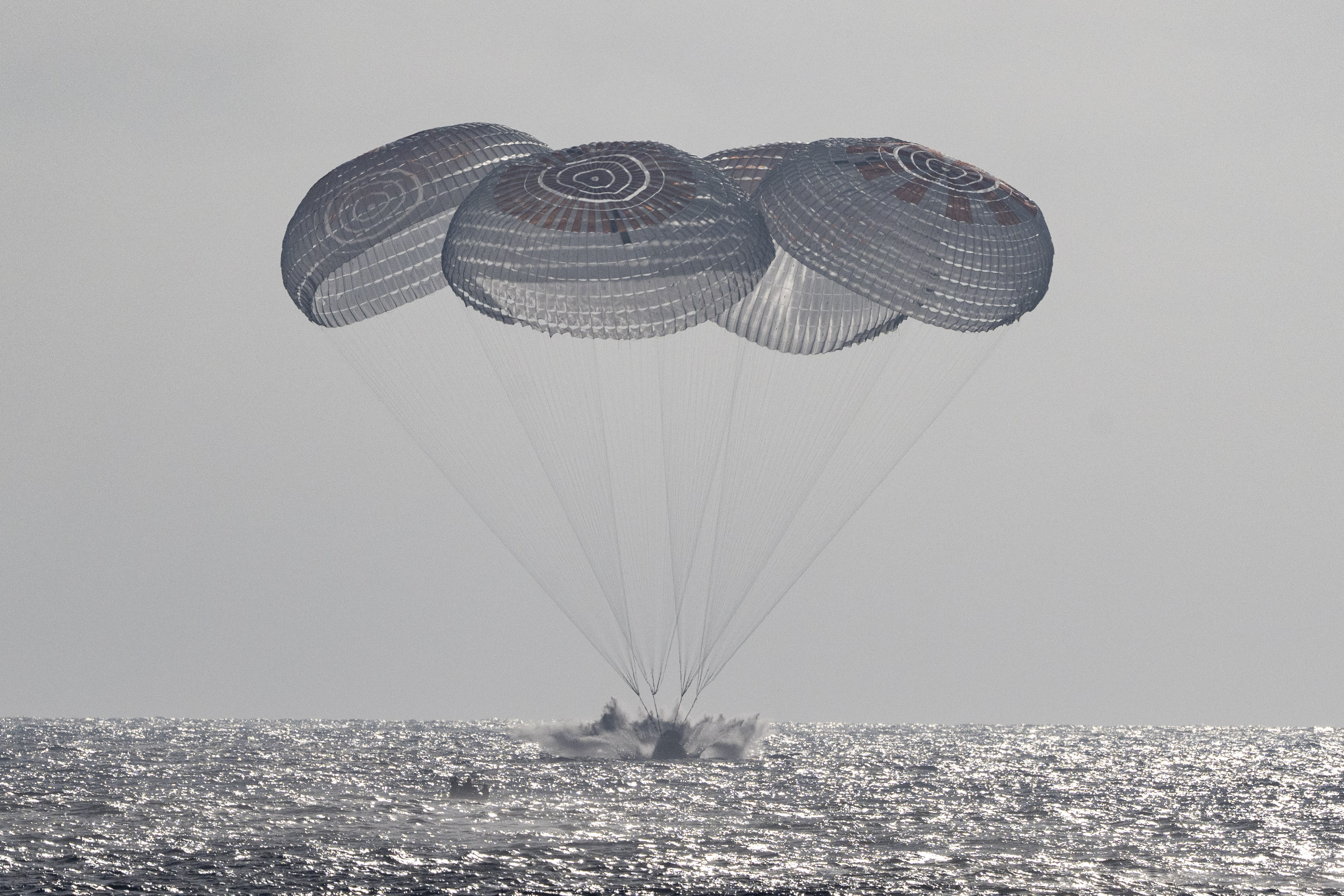
Following a June 16 departure, the spacecraft will reenter Earth’s atmosphere on Wednesday, June 17, before splashing down off the coast of California at approximately 5:08 a.m. PDT. NASA will not stream the splashdown but will post updates on its space station blog.

Dragon will return to Earth with thousands of pounds of cargo, carrying samples that could shape future space exploration and life on Earth. Research returning includes bioprinted organ and cartilage tissue, data on improving cryogenic fuel storage for future space missions, and DNA‑inspired materials to develop new cancer treatments. The returning hardware includes an ocular imaging device used to monitor crew members’ eye health, an absorbent bed that filters trace contaminants from cabin air, and a separator pump from the waste and hygiene compartment.

Loaded with nearly 6,500 pounds of crew cargo and science experiments, Dragon arrived at the station on May 17 after launching two days earlier on a Falcon 9 rocket from Space Launch Complex 40 at Cape Canaveral Space Force Station in Florida.

For more than 25 years, people have lived and worked continuously aboard the International Space Station, advancing scientific knowledge and making research breakthroughs not possible on Earth. The space station helps NASA understand and overcome the challenges of human spaceflight, expand commercial opportunities in low Earth orbit, and build on the foundation for long-duration missions to the Moon, as part of the Artemis program, and to Mars.

Get breaking news, images, and features from the space station on Instagram, Facebook, and X.

Learn more about International Space Station research and operations at:

https://www.nasa.gov/international-space-station

-end-

Jimi Russell
Headquarters, Washington
202-358-1100
james.j.russell@nasa.gov

Leah Cheshier
Johnson Space Center, Houston
281-483-5111
leah.d.cheshier@nasa.gov

  •  

NASA to Cover 34th SpaceX Resupply Mission Space Station Departure

The SpaceX Dragon cargo spacecraft supporting the company’s 34th commercial resupply services mission for NASA approaches the International Space Station on May 17, 2026, carrying nearly 6,500 pounds of food, supplies, and equipment for the Expedition 74 crew.
Credit: NASA

NASA and its international partners are set to receive scientific research samples and hardware as a SpaceX Dragon spacecraft is scheduled to depart the International Space Station on Tuesday, June 16, for its return to Earth.

Watch NASA’s live undocking coverage beginning at 11:45 a.m. EDT on NASA+, Amazon Prime, and the agency’s YouTube channel. Learn how to watch NASA content through a variety of online platforms, including social media.

The Dragon spacecraft will undock from the forward port of the station’s Harmony module at about 12:05 p.m., after receiving a command from SpaceX ground controllers. The spacecraft then will fire its thrusters to move safely away from the orbiting complex.

Following a June 16 departure, the spacecraft will reenter Earth’s atmosphere on Wednesday, June 17, before splashing down off the coast of California at approximately 5:08 a.m. PDT. NASA will not stream the splashdown but will post updates on its space station blog.

Dragon will return to Earth with thousands of pounds of cargo, carrying samples that could shape future space exploration and life on Earth. Research returning includes bioprinted organ and cartilage tissue, data on improving cryogenic fuel storage for future space missions, and DNA‑inspired materials to develop new cancer treatments. The returning hardware includes an ocular imaging device used to monitor crew members’ eye health, an absorbent bed that filters trace contaminants from cabin air, and a separator pump from the waste and hygiene compartment.

Loaded with nearly 6,500 pounds of crew cargo and science experiments, Dragon arrived at the station on May 17 after launching two days earlier on a Falcon 9 rocket from Space Launch Complex 40 at Cape Canaveral Space Force Station in Florida.

For more than 25 years, people have lived and worked continuously aboard the International Space Station, advancing scientific knowledge and making research breakthroughs not possible on Earth. The space station helps NASA understand and overcome the challenges of human spaceflight, expand commercial opportunities in low Earth orbit, and build on the foundation for long-duration missions to the Moon, as part of the Artemis program, and to Mars.

Get breaking news, images, and features from the space station on Instagram, Facebook, and X.

Learn more about International Space Station research and operations at:

https://www.nasa.gov/international-space-station

-end-

Jimi Russell
Headquarters, Washington
202-358-1100
james.j.russell@nasa.gov

Leah Cheshier
Johnson Space Center, Houston
281-483-5111
leah.d.cheshier@nasa.gov

  •  

NASA Hosts SpaceX Crew-11 Astronauts for Public Event at Headquarters

NASA's SpaceX Crew-11 astronauts gather together for a crew portrait wearing their Dragon pressure suits during a suit verification check inside the International Space Station's Kibo laboratory module. Clockwise from bottom left are, NASA astronaut Mike Fincke, Roscosmos cosmonaut Oleg Platonov, NASA astronaut Zena Cardman, and JAXA (Japan Aerospace Exploration Agency) astronaut Kimiya Yui.
NASA’s SpaceX Crew-11 astronauts gather together for a crew portrait wearing their Dragon pressure suits during a suit verification check inside the International Space Station’s Kibo laboratory module. Clockwise from bottom left are, NASA astronaut Mike Fincke, Roscosmos cosmonaut Oleg Platonov, NASA astronaut Zena Cardman, and JAXA (Japan Aerospace Exploration Agency) astronaut Kimiya Yui.
Credit: NASA

NASA will host a public event featuring three crew members from the agency’s SpaceX Crew-11 mission at 11 a.m. EDT Monday, June 1. The event, which takes place during the crew’s standard postflight visit, will be held in the Webb Auditorium at NASA Headquarters in the Mary W. Jackson building, 300 E. Street SW in Washington.

The crew members, including NASA astronauts Zena Cardman and Mike Fincke and JAXA (Japan Aerospace Exploration Agency) astronaut Kimiya Yui, will discuss their recent 167-day mission aboard the International Space Station, where they conducted a wide range of science experiments to benefit life on Earth and advance human space exploration as part of International Space Station Expedition 73/74.

The Crew-11 mission lifted off on Aug.1, 2025, from Launch Complex 39A at NASA’s Kennedy Space Center in Florida. The crew’s SpaceX Dragon spacecraft docked to the orbital outpost on Aug. 2.

During their mission, the three astronauts, along with crewmate Roscosmos cosmonaut Oleg Platonov, traveled nearly 71 million miles and completed more than 2,670 orbits around Earth. The Crew-11 mission was Fincke’s fourth spaceflight, Yui’s second, and the first for Cardman and Platonov. Fincke has logged 549 days in space, ranking him fourth among all NASA astronauts for cumulative days in space. The crew members returned to Earth on Jan. 15, splashing down off the coast of San Diego.

Along the way, Crew-11 logged hundreds of hours of research, maintenance, and technology demonstrations. The crew members also celebrated the 25th anniversary of continuous human presence aboard the orbiting laboratory on Nov. 2, 2025. Research conducted aboard the space station advances scientific knowledge and demonstrates new technologies that enable us to prepare for human exploration of the Moon and Mars.

Media interested in attending the event must RSVP by 8 a.m., June 1, by emailing the NASA Headquarters newsroom at hq-media@mail.nasa.gov. NASA’s media accreditation policy is online. Based on the crew’s schedule, NASA will not be able to accommodate interviews.

This opportunity also is part of NASA’s Frontiers Forum: Voices Shaping the Future of Space speaking series designed to convene bold thinkers and senior leaders at the forefront of exploration and innovation. The series will spotlight mission-critical priorities from advancing the Artemis campaign and strengthening commercial partnerships to shaping the future workforce and accelerating breakthrough technologies. The agency will share more details soon.

To learn more about the International Space Station and its research and crews, visit:

https://www.nasa.gov/station

-end-

Gerelle Dodson
Headquarters, Washington
202-358-1600
gerelle.q.dodson@nasa.gov

Share

Details

Last Updated
May 29, 2026
  •  

NASA Hosts SpaceX Crew-11 Astronauts for Public Event at Headquarters

NASA's SpaceX Crew-11 astronauts gather together for a crew portrait wearing their Dragon pressure suits during a suit verification check inside the International Space Station's Kibo laboratory module. Clockwise from bottom left are, NASA astronaut Mike Fincke, Roscosmos cosmonaut Oleg Platonov, NASA astronaut Zena Cardman, and JAXA (Japan Aerospace Exploration Agency) astronaut Kimiya Yui.
NASA’s SpaceX Crew-11 astronauts gather together for a crew portrait wearing their Dragon pressure suits during a suit verification check inside the International Space Station’s Kibo laboratory module. Clockwise from bottom left are, NASA astronaut Mike Fincke, Roscosmos cosmonaut Oleg Platonov, NASA astronaut Zena Cardman, and JAXA (Japan Aerospace Exploration Agency) astronaut Kimiya Yui.
Credit: NASA

NASA will host a public event featuring three crew members from the agency’s SpaceX Crew-11 mission at 11 a.m. EDT Monday, June 1. The event, which takes place during the crew’s standard postflight visit, will be held in the Webb Auditorium at NASA Headquarters in the Mary W. Jackson building, 300 E. Street SW in Washington.

The crew members, including NASA astronauts Zena Cardman and Mike Fincke and JAXA (Japan Aerospace Exploration Agency) astronaut Kimiya Yui, will discuss their recent 167-day mission aboard the International Space Station, where they conducted a wide range of science experiments to benefit life on Earth and advance human space exploration as part of International Space Station Expedition 73/74.

The Crew-11 mission lifted off on Aug.1, 2025, from Launch Complex 39A at NASA’s Kennedy Space Center in Florida. The crew’s SpaceX Dragon spacecraft docked to the orbital outpost on Aug. 2.

During their mission, the three astronauts, along with crewmate Roscosmos cosmonaut Oleg Platonov, traveled nearly 71 million miles and completed more than 2,670 orbits around Earth. The Crew-11 mission was Fincke’s fourth spaceflight, Yui’s second, and the first for Cardman and Platonov. Fincke has logged 549 days in space, ranking him fourth among all NASA astronauts for cumulative days in space. The crew members returned to Earth on Jan. 15, splashing down off the coast of San Diego.

Along the way, Crew-11 logged hundreds of hours of research, maintenance, and technology demonstrations. The crew members also celebrated the 25th anniversary of continuous human presence aboard the orbiting laboratory on Nov. 2, 2025. Research conducted aboard the space station advances scientific knowledge and demonstrates new technologies that enable us to prepare for human exploration of the Moon and Mars.

Media interested in attending the event must RSVP by 8 a.m., June 1, by emailing the NASA Headquarters newsroom at hq-media@mail.nasa.gov. NASA’s media accreditation policy is online. Based on the crew’s schedule, NASA will not be able to accommodate interviews.

This opportunity also is part of NASA’s Frontiers Forum: Voices Shaping the Future of Space speaking series designed to convene bold thinkers and senior leaders at the forefront of exploration and innovation. The series will spotlight mission-critical priorities from advancing the Artemis campaign and strengthening commercial partnerships to shaping the future workforce and accelerating breakthrough technologies. The agency will share more details soon.

To learn more about the International Space Station and its research and crews, visit:

https://www.nasa.gov/station

-end-

Gerelle Dodson
Headquarters, Washington
202-358-1600
gerelle.q.dodson@nasa.gov

Share

Details

Last Updated
May 29, 2026
  •  

Growing Stem Cells in Space to Improve Cancer and Disease Treatments

Jessica Meir wears a headset while handling samples inside of the Life Sciences Glovebox. The image is framed by darkness on the left and right, with the light from the glovebox illuminating Jessica's face and the work area inside the box. Her hands are inserted into the clear box through gloves, and she holds a thin, plastic rectangle with red interior.
NASA astronaut Jessica Meir works on InSPA-StemCellEX-H2 inside the Life Sciences Glovebox. Microgravity samples will be frozen and returned to Earth for further analysis of stem cell expansion in space.
NASA

Expedition 74 astronauts aboard the International Space Station are continuing research efforts to manufacture large quantities of stem cells for therapies on Earth. Previous studies have focused on fine-tuning hardware that allows scientists to produce greater quantities of high-quality stem cells. Now, the InSPA-StemCellEX-H2 investigation is aiming to demonstrate large scale production of blood stem cells for pharmaceutical and clinical use.

Dozens of small, white cells cover a dark grey background. There are clusters of cells that are touching, and some are spread apart. Some of the cells have brighter areas in the middle, and some appear dull as if they are further away.
Preflight microscopic image of hematopoietic stem cells for the InSPA-StemCellEX-H2 investigation. This investigation aims to produce stem cells in greater numbers with BioServe’s newly developed microgravity bioreactor.
Mayo Clinic

The research uses stem cells derived from the human body to produce large quantities of cells for patient use through a process called “expansion”. Although stem cells can be expanded in labs on Earth, they have limitations. For example, Earth-produced cells lose their ability to form the different cells in our blood system, like red and white blood cells or platelets, which are critical for leukemia patients that receive stem cells to build up their blood system after chemotherapy.

Dr. Tobias Niederwieser, assistant research professor at BioServe Space Technologies within the University of Colorado Boulder says, “The microgravity environment in space is much more suitable for keeping the stem cells in their high-quality state during expansion.” Scientists predict that growing cells in space may lead to higher expansion potential and a lower risk of rejection when used in patients on Earth. This research could create long-term cell supplies for patients suffering from fatal blood disorders, various blood cancers, or severe immune diseases, and enable more reliable and accessible therapies. “The end result is really to benefit patients in hospitals here on Earth,” Dr. Niederwieser says.

Space station research allows scientists and commercial companies around the world to test new technologies and innovative medical solutions that have the potential to greatly benefit life on Earth.

  •  
❌