Modalità di lettura

LA CATABASI IMPERIALE

Benché sia una delle cose che capitano più di frequente, non bisognerebbe mai dimenticare la lezione di von Clausewitz, la guerra come proseguimento della politica con altri mezzi. Dunque non solo la guerra – ogni guerra – è già di per sé un atto politico, ma i suoi obiettivi, benché si cerchi di conseguirli attraverso lo strumento militare, sono e restano di natura politica. Dunque, una guerra che fallisce i suoi obiettivi politici è una guerra persa, anche se ha prevalso in ogni battaglia.

La guerra ucraina, ad esempio, è cominciata con obiettivi politici ovviamente diversi, per l’una e l’altra parte; ma soprattutto, ad un certo punto ha visto la Russia modificare i suoi, o meglio ancora, l’ha vista modificare la strategia militare attraverso cui conseguirli. Tra questi obiettivi, le conquiste territoriali sono sempre state secondarie, mentre il focus principale è sempre stato sulla smilitarizzazione dell’Ucraina (e la sua denazificazione). Obiettivo che Mosca ha dovuto alfine perseguire attraverso la via più radicale, ovvero la distruzione materiale delle forze armate ucraine. Obiettivo ormai quasi completamente conseguito, ed ottenuto applicando una tattica ed una strategia basata sul logoramento massivo del nemico. Non una blitzkrieg, né una campagna distruttiva devastante, seguita da un’azione conclusiva delle truppe di terra. Entrambe queste strade, a parte ogni altra considerazione, non avrebbero in realtà inferto il colpo duraturo che era invece necessario infliggere. Quindi, per quanto questo procedere abbia un costo più elevato, è stata scelta una via basata sul fattore tempo. Più tempo, più logoramento della forza nemica, maggiori risultati; e soprattutto, di più lunga durata. Mosca ha scommesso ancora una volta sulla propria capacità di sfruttare questo fattore meglio di chiunque altro, ed ha vinto la scommessa.

A ben vedere, ciò che sta accadendo in Palestina è assai simile. Anche se i rapporti di forza appaiono invertiti, rispetto al fronte ucraino, la strategia messa in atto dal Fronte della Resistenza (in senso ampio, non solo quella palestinese) ricalca in qualche modo quella adottata dai russi in Ucraina.
Le forze della Resistenza sanno che il nemico ha bisogno di concludere in fretta, per una serie di motivi che vanno dagli aspetti economici agli equilibri interni ed internazionali. Per questo, l’asse USA-Israele sta mettendo in campo uno sforzo considerevole, cercando di ottenere delle vittorie quantomeno tattiche, che le consentano di accelerare la conclusione del conflitto – o quanto meno di congelarlo temporaneamente per riprendere fiato.
Ovviamente, il problema gigantesco con cui devono confrontarsi gli israelo-americani, ancor prima della Resistenza armata, è la mancanza di obiettivi politici reali, e quindi di una strategia elaborata in funzione di questi. E per reali si intende realisticamente perseguibili, quindi politici in senso proprio, e non certo i sogni messianici con cui li stanno sostituendo. Per tacere poi del fatto che i due poli dell’asse hanno oltretutto interessi ed obiettivi non sovrapponibili, anche se per molti versi coincidenti.

Va tenuto presente che l’operazione della Resistenza è molto più vasta di quanto appaia. Non solo c’è un completo coordinamento tra le formazioni politico-militari della Resistenza palestinese, che hanno una Joint Operations Room (il centro di comando e coordinamento delle varie brigate) operativo su Gaza. Da tempo è presente in Libano un ulteriore centro di coordinamento, in cui sono rappresentate – oltre alle formazioni palestinesi – anche alcune delle milizie irachene e siriane, ed ovviamente Hezbollah. Non ci sono notizie certe sulla presenza anche di Ansarullah (Yemen). In tal modo, tutte le forze della Resistenza possono coordinare le proprie azioni a livello strategico, calibrando la pressione su Israele e sugli USA, ed alternandola tra i vari fronti aperti – Gaza, confine israelo-libanese, mar Rosso…
L’intento è quello di tenere impegnate le forze israeliane in una guerra d’attrito, il cui livello d’intensità varia nel tempo – così da risultare tatticamente imprevedibile – e nello spazio; può acuirsi a Shuja’iya come a Khan Younis, a Metula oppure ad Eilat, sulle alture del Golan o a Kiryat Shmona.
Tutte le formazione che fanno parte del Fronte della Resistenza sono in grado di sviluppare un attacco assai più intenso e massiccio contro il territorio israeliano, ma non è questo l’intento – poiché qualsiasi accelerazione produrrebbe una reazione altrettanto intensa e massiccia; l’obiettivo è invece risparmiare al massimo possibile le proprie forze, e puntare sul logoramento di Tsahal su tempi medio lunghi.

La situazione per le forze israeliane, nonostante i bombardamenti genocidi sulla Striscia di Gaza facciano da cortina fumogena, è di crescente difficoltà. Le perdite, in uomini e mezzi, cominciano a diventare significative, e soprattutto emerge sempre più la difficoltà – da parte dell’IDF – nel gestire tatticamente il confronto. Sul fronte libanese, sono costretti a tenere impegnate una parte significativa delle forze di terra e dell’aviazione; e nonostante abbiano schierate ben 8 delle 12 batterie di Iron Dome (di cui due certamente già distrutte o danneggiate), la minaccia dei missili di Hezbollah è così significativa che gran parte degli insediamenti e delle città vicine al confine sono state evacuate – con i conseguenti danni all’economia, e le crescenti tensioni interne.
Il blocco dello stretto di Bab el-Mandeeb per le navi dirette in Israele, oltre agli attacchi verso Eilat e gli insediamenti vicini, sono praticamente senza difesa, a difficilmente l’operazione navale Prosperity Guardian riuscirà a risolverli, se non a prezzo di mettere seriamente in pericolo le flotte NATO, e rischiare un blocco totale anche sullo Stretto di Hormuz – un disastro per le economie occidentali.

La situazione non è certo migliore nella Striscia di Gaza, dove le truppe israeliane devono confrontarsi con un nemico sfuggente, di cui non riescono a prendere le misure, e che mantiene intatta la capacità non solo di resistere ai tentativi di penetrazione, ma anche di sviluppare offensive tattiche. I periodici lanci di missili verso Ashkelon o Tel Aviv, le sanguinose imboscate contro le unità IDF, il continuo martellamento – a distanza ravvicinata – contro i corazzati israeliani, testimoniano il permanere di una significativa potenza di fuoco, e soprattutto di un inalterato coordinamento tattico.
Le fonti informative israeliane testimoniano che il numero dei morti e dei feriti è tenuto coperto, e viene comunicato solo parzialmente. Il ritiro della Brigata Golani, forse la migliore unità dell’IDF, per via delle perdite subite, così come il mancato conseguimento degli obiettivi tattici dati continuamente per raggiunti (la rete di tunnel sotterranei è chiaramente ancora perfettamente operativa, non è stato scoperto un solo centro comando, un solo deposito di armi, una sola delle fabbriche che producono i missili…), non sono che i più evidenti segni di tale difficoltà.

A più di due mesi dall’inizio dei combattimenti, non solo l’IDF non è ancora penetrato in tutte le aree urbane della Striscia, ma continua ad essere impegnato in scontri a fuoco anche laddove la penetrazione è avvenuta. Nessuno dei prigionieri è stato liberato manu militari – i due soli tentativi sono tragicamente falliti, e l’unico caso di cui avrebbero potuto menar vanto è stato azzerato da una applicazione ottusa delle regole d’ingaggio. Da almeno un paio di settimane viene data per imminente la morte di Yahya Sinwar, che invece continua a sfuggire.
Nonostante tutta la potenza di cui dispone (aviazione, carri armati e corazzati, artiglieria, intelligence elettronica…), Tsahal non riesce a prevalere.
Persino la guerra della comunicazione vede chiaramente in vantaggio le forze della Resistenza, che documentano inequivocabilmente in video gli attacchi portati contro le forze israeliane, mentre queste inanellano figure barbine una dopo l’altra, mostrando filmati propagandistici per di più malamente costruiti su veri e propri set.

Esattamente come in Ucraina, quindi, anche in Palestina le forze che combattono contro l’imperialismo USA-NATO mettono in campo una strategia di logoramento delle forze avversarie, ed in entrambe i casi puntano sul fattore tempo per mettere in difficoltà il nemico. Che, oltretutto, si trova oggi ad essere impegnato su due fronti, con le difficoltà dell’uno che si riverberano sull’altro, mentre i suoi avversari agiscono separatamente.
A riprova che la geografia è ineludibile, e che la politica non può prescinderne. Ed oggi la situazione globale è che i tradizionali strumenti del dominio imperiale anglo-americano, la potenza talassocratica e la proiezione a grande distanza, hanno fatto il loro tempo e risultano inadeguati. L’impero è costretto a combattere guerre assai problematiche ed impegnative, su fronti diversi; e sia la potenza navale, che quella derivante dalla più estesa rete di basi militari della storia, rischiano di risolversi in un problema più che in un atout. Per la semplice ragione che i nemici non sono più così deboli da poter essere rapidamente schiacciati (ma anzi possono a loro volta colpire), e che sanno scegliere le strategie e le tattiche più efficaci per combattere.

L’impero ha perso la sua arma più potente, la capacità di deterrenza. E, costretto ad usare la forza in tempi e modi che non gli sono congeniali, arretra. I suoi nemici, invece, lo sfidano, non arretrano più dinanzi alla minaccia. Ingaggiano il combattimento, ne impongono i tempi ed i modi. E per vincere, gli basta resistere un minuto in più.

L'articolo LA CATABASI IMPERIALE proviene da Giubbe Rosse News.

  •  

LA GUERRA PERDUTA

Quella che si sta combattendo in Medio Oriente, e che per via del delirio che si è impossessato delle classi dirigenti occidentali potrebbe ancora sfociare in una terribile guerra regionale-mondiale, è qualcosa che le leadership sioniste israeliane rifiutano di riconoscere come tale, e con loro l’intero occidente, che alla loro narrativa si abbevera.
Quello che Israele non sa né vuole capire, anzitutto perché ha una classe dirigente assolutamente mediocre, un mix di bigotti fanatici e grassi squali della politica, è che spezzettare la Storia, frammentarla in segmenti separati secondo il proprio comodo, non solo non serve realmente a frantumarla, ma impedisce di coglierne il senso, la direzione; misconoscere il passato inibisce la capacità di comprendere il futuro, di averne una visione.

Sin dalla fondazione dello stato di Israele – che, non va dimenticato, è uno specifico progetto del sionismo – la popolazione autoctona palestinese è sempre stata considerata esclusivamente come un problema [1], negandone in nuce l’umanità. Un problema perché possedeva la terra che loro bramavano, perché era troppo numerosa, perché non chinava abbastanza la testa. Da lì a considerarli apertamente animali il passo è stato più breve di quanto si creda.
Salvo rare, quanto lodevoli ma inascoltate eccezioni, le leadership israeliane sono sempre state vittime di questa distorsione prospettica, che li ha poi portate – appunto – ad una lettura della propria storia nazionale in cui gli arabi sono soltanto un ostacolo, bestie feroci che rendono difficile stabilire la pace nella terra promessa. Questa incapacità di guardare la storia anche dalla parte palestinese, ha fatto sì che non vedessero la Storia, ma solo una serie di incresciosi contrattempi.

Per Israele, il 7 ottobre 2023 è solo l’ultimo – questi maledetti animali, che non accettano la soma e invece di lavorare per noi ci aggrediscono! – e nella sua visione monca ad esso non può che seguire una punizione esemplare. Magari anche risolutiva.
Israele pensa ora di poter completare il lavoro iniziato nel 1948, e poi portato avanti nel 1967. Per ristabilire l’ordine naturale delle cose.
Per questo non riesce a comprendere due cose fondamentali: quella che si sta combattendo è una guerra di liberazione (come quella algerina, come quella indocinese, come quella sudafricana…), e quel 7 ottobre è la data che segna la svolta, dopo la quale nulla sarà mai più come prima.
Non importa quante bestie feroci uccidi, se dimentichi che sono fiere.

Le potenze coloniali diventano feroci, quando il loro dominio viene messo in discussione. Ed i popoli che si vogliono liberare pagano sempre un prezzo enorme. Gli algerini ebbero 2 milioni di morti, quasi un quinto della popolazione. I vietnamiti 3 milioni di morti. Ma alla fine i francesi dovettero andarsene.
Il dominio coloniale finisce quando la potenza dominante paga un prezzo che non riesce più a sostenere. Ed è questa la differenza. Per i dominanti, il prezzo massimo accettabile è molto basso, ma per i dominati, che lottano per la propria libertà e per quella delle generazioni future, sarà sempre molto più alto.
Liquidare la Resistenza palestinese come una questione di terrorismo – dimenticando tra l’altro di aver fondato Israele facendo larghissimo ricorso a questa pratica… – è ciò che impedirà agli israeliani di capire la Storia di cui fanno parte. E quindi di affrontarla.

Come diceva il non compianto Henry Kissinger, a proposito della guerra del Vietnam, “abbiamo combattuto una guerra militare; i nostri avversari ne hanno combattuto una politica. Abbiamo cercato il logoramento fisico; i nostri avversari miravano al nostro esaurimento psicologico. In questo modo abbiamo perso di vista una delle massime cardinali della guerra partigiana: la guerriglia vince se non perde. L’esercito convenzionale perde se non vince.” E l’IDF, non sta affatto vincendo. Non può vincere. La Resistenza non ha bisogno di infliggere al nemico una sconfitta militare tale che, in sé, ne determini il crollo. Non ha bisogno di vincerlo strategicamente sul campo di battaglia. È sufficiente che riesca a mantenere nel tempo la sua capacità di combattimento, che riesca ad infliggere delle sconfitte tattiche.
L’operazione al-Aqsa flood è l’equivalente palestinese di Dien Bien-Phu per i vietminh, dell’offensiva del Tet per i vietcong.

L’approccio storico-culturale con cui Israele affronta il conflitto, ancor prima che quello strategico e tattico, è il limite insormontabile per Tel Aviv. Ed è la causa da cui derivano gli errori che sta commettendo nella guerra. Non capisce che affrontare le formazioni della Resistenza come se fossero delle gang criminali non la porterà da nessuna parte. Non capisce che imporre domani l’amministrazione militare a Gaza è un enorme favore ad Hamas, che sarà sgravata dall’onere del governo e potrà concentrarsi nella lotta. Non capisce che l’ondata di attacchi militari in Cisgiordania, e l’ulteriore delegittimazione dell’ANP (che è il governo dei suoi ascari), sono un assist per Hamas, che vuole più di ogni cosa riunificare i fronti di Resistenza. Non capisce che minacciare continuamente i suoi vicini non farà che spingerli a saltarle addosso al primo momento di debolezza.
Non capisce che non è più il 1967 né il 1973, e che il suo nemico non sono gli eserciti giordano, siriano ed egiziano, ma un fronte di guerriglia esteso, capace di mettere in campo almeno altrettanti uomini di quanti ne può mobilitare Israele.

L’illusione di potenza, il disconoscimento dei cambiamenti che intervengono nel mondo intorno a noi, sono costante causa di sanguinose avventure. Paradigmatica, sotto questo profilo, è la storia dell’avventura ucraina. Benché sia stata lungamente studiata e preparata, si è – prevedibilmente, verrebbe da dire – risolta in un disastro. È vero che ha troncato, almeno per qualche decennio a venire, i proficui rapporti tra Europa e Russia, ma non solo non ha affatto indebolito quest’ultima, ma ne ha addirittura determinato il rafforzamento – e più in generale, proprio in termini geopolitici, ha prodotto la saldatura politica, economica e militare tra i principali nemici annoverati dagli USA: la Russia, la Cina, l’Iran e la Corea del Nord.
Una delle tante connessioni esistenti [2], infatti, tra la guerra in Ucraina e quella in Palestina, è che entrambe sono state affrontate dalle potenze occidentali con la convinzione di poterle quantomeno gestire, se non vincerle. E che invece hanno entrambe segnato un giro di boa, quel punto della Storia oltre il quale tutto cambia, per sempre.

Oltretutto, ed anche questo sembra incredibilmente sfuggire alla leadership israeliana, la strategia politico-militare adottata per fronteggiare la crisi innescata dall’attacco del 7 ottobre, rischia seriamente di minare alle fondamenta l’esistenza stessa dello stato di Israele in quanto stato ebraico.
Aver scelto infatti la via genocidaria, come strumento presuntamente risolutivo sia del terrorismo palestinese che della minaccia demografica araba, significa al tempo stesso aver portato all’estremo possibile la strategia millenaristica del sionismo. Al di là dell’ecatombe nucleare – che travolgerebbe Israele quanto e più che i suoi nemici – non c’è più un oltre possibile: il genocidio è il limite estremo raggiungibile. E quando si rivelerà inefficace (e ancora una volta, nessuno meglio degli ebrei dovrebbe sapere che non può essere diversamente), metterà in crisi l’idea fondativa di Israele, la sua ideologia nazionale.

Il sogno di una patria esclusiva, degli ebrei e solo per gli ebrei, così come l’illusione perpetrata per ottant’anni che tale sogno fosse effettivamente realizzabile, crollerà. Quando la società israeliana avrà sedimentato nella propria coscienza l’impossibilità materiale, concreta, di realizzarlo – perché i palestinesi non si arrenderanno mai, non smetteranno mai di essere di più, non accetteranno mai di vivere come bestie – allora tutto cambierà anche lì. Certo, non domani. Ci vorranno forse dieci anni (e saranno anni sanguinosi e dolorosi), ma sul medio periodo questo significherà la morte politica del progetto sionista. La liberazione della Palestina libererà dalle sue ossessioni anche Israele. La sua guerra è perduta.


1 – La parola d’ordine su cui il sionismo costruì dapprima l’idea, e poi lo stato israeliano, era la famosa doppia menzogna “una terra senza popolo per un popolo senza terra”. Doppia perché quella terra era abitata dal popolo di Palestina da migliaia di anni, e perché – molto semplicemente – gli ebrei non sono un popolo, ma semplicemente i seguaci di una religione. E seppure questa religione è assai esclusiva (gli ebrei non fanno proselitismo, si è tali per nascita), resta il fatto che i suoi adepti si sono sparsi per il mondo da oltre duemila anni, durante i quali l’etnicità semitica si è sicuramente annacquata assai più di quanto non sia accaduto agli arabi palestinesi – che sono a loro volta semiti. Non a caso, gran parte degli attuali leader israeliani sono polacchi, russi, rumeni… E tra gli ebrei che vivono in Israele ci sono ben due comunità per nulla semitiche, quella dei falascià (ebrei di origine etiope) e quella degli ebrei di origine indiana.
2 – Su questo aspetto di entrambe i conflitti, cfr. “Due guerre”, Giubbe Rosse News e “Info-warfare: la ‘terza guerra’”, Giubbe Rosse News

L'articolo LA GUERRA PERDUTA proviene da Giubbe Rosse News.

  •  

bitume - parliamo d_altro - podcast

✇unit
di: Unit

Bitume, trasmissione radiofonica aperiodica, impreparata e inaspettata, a "cura" di Unit hacklab Milano.

logo-bitume

Mercoledì 21 giugno 2023, dallo studio radio di ZAM

Parliamo d'altro!

  • Moderatori di Reddit in sciopero (hanno ragione)

  • Gossipz dai socialz

  • Il sottomarino fermo a 3000 mm di profondità usa un Logitech game joystick

  • Apple Computers denuncia …

  •  

bitume - distro dramma n.1 - podcast

✇unit
di: Unit

Bitume, trasmissione radiofonica aperiodica, impreparata e inaspettata, a cura di Unit hacklab di Milano.

logo-bitume

Mercoledì 23 febbraio 2022, dallo studio radio di ZAM

Distro dramma n.1 - Installazione Debian GNU/Linux su Mac AIR/Piccolo

durata: 59 minuti

L'approfondimento satirico della …

  •  

Autodifesa digitale a ZAM

✇unit
di: Unit

Sabato 11 dicembre 2021 alle ore 17:00

  • Phreak Phone Forensics (clinica di controllo dei cellulari android)
  • Come scaricare film e altri media da internet

a seguire dalle 19:00 acheritivo e live music by unit electric assembly

unit hacklab @zam via sant'abbondio 4, milano

audio

audio su Radio Zeta-AM …

  •  

Seminario Laboratoriale su Pure Data

✇unit
di: Unit

Mercoledì 24 marzo dalle ore 20.45 alle 23 circa

Manuale Minimo di Sopravvivenza a Pure Data n. 1

Seminario Laboratoriale su Pure Data
durata: due ore circa
a cura di k_, Unit hacklab

semlab-puredata

Introduzione e storia, Setup dell'installazione, collegamenti e definizioni: oggetti, box, counter, bang e sequencer. Arriveremo all'oscillatore …

  •  

Fedeli alla linea (di comando)

✇unit
di: Unit

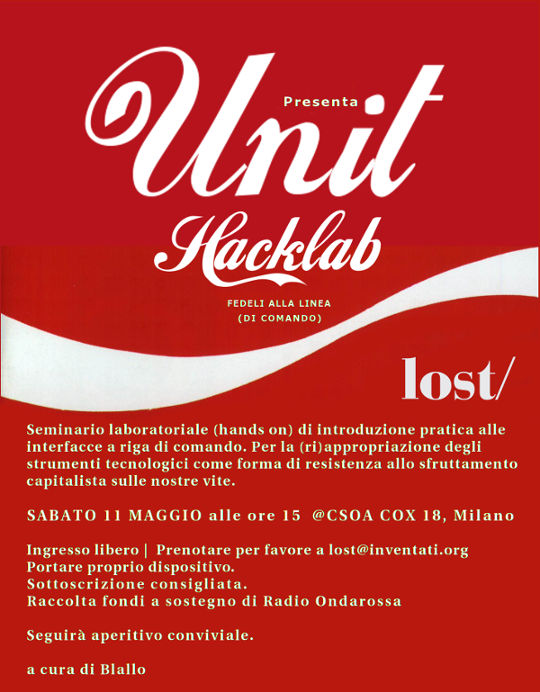
Sabato 11 maggio alle ore 15 presso CSOA COX 18 in Via Conchetta 18, Milano

LOST, le Lunghe Ombre della Scienza e della Tecnica e Unit hacklab presentano:

Fedeli alla linea (di comando)

registrazione audio a cura di cox18stream e Archivio Primo Moroni

Introduzione al terminale e alla riga di …

  •  

Connessioni Caotiche 2019

✇unit
di: Unit

cc-2019

Venerdi 3 e Sabato 4 Maggio 2019 torna Connessioni Caotiche a Macao

Hacking, attivismo, seminari laboratoriali e presentazioni frattali. Making e Breaking in festival nella due giorni in contemporanea ai festeggiamenti per il compleanno del Nuovo Centro per le Arti, la Cultura e la Ricerca Macao a Milano.

Connessioni Caotiche …

  •  

Benvenuto pellicano

✇unit
di: Unit

Il sito e' stato convertito a pelican, un software per generare siti statici in html.

  •  

SIAMO AL BIVIO DI UNA ESCALATION MOLTO PERICOLOSA TRA DUE ELEZIONI : MAGGIO 23 E GENNAIO 24. UNO POTREBBE PERDERE LA TESTA.

TRA LE ELEZIONI PRESIDENZIALI TURCHE DEL 14 MAGGIO E QUELLE DI TAIWAN DEL PROSSIMO GENNAIO SI GIOCA CON TORTUOSE ALLEANZE NELLE URNE IL DESTINO DELLA PACE.

Il primo e l’ultimo scoglio da superare senza finire in un allargamento del conflitto, riguardano entrambi il proibire l’accesso ai mari aperti per Russia ( il Mediterraneo) e Cina ( il Pacifico).

L’Asia, potenza terrestre bicefala, ha bisogno di impadronirsi di porti e rotte marittime non soffocate dalle potenze marinare – USA e alleati- mentre queste spendono risorse , intessono reti, ricorrono alla pirateria, per evitare che la Cina , la fabbrica del pianeta, e la Russia, miniera del mondo, riescano a bypassarli sui liberi mercati e ne rendano inutili gli sforzi ultradecennali per mantenere l’ intermediazione progettuale, commerciale , finanziaria, valutaria e di difesa che li ha arricchiti per tutto lo scorso secolo, caratterizzato dalla disponibilità di lavoro asindacalizzato e materie prime a basso costo che l’Asia fornisce grazie a istituzioni robustamente condotte su sudditi rassegnati.

Il sistema si é retto sulla bipartizione del lavoro: occidente che possiede, finanzia e commercializza in nome del principio della libertà di commercio e oriente che produce e accetta crescite economiche al rallentatore.

Da qualche anno, lo abbiamo raccontato negli articoli pubblicati sul blog questa settimana ( su Cina e Giappone) i paesi asiatici, in questo secolo, hanno imparato la lezione dalla violenza subita per abbracciare il libero commercio , sono diventati da imitatori, innovatori, hanno abbandonato ogni ideologia e sono diventati formidabili concorrenti commerciali dei paesi occidentali che credevano intoccabili le loro posizioni privilegiate.

Si é verificato in grande, insomma, quel che é avvenuto da noi in Italia, nella grande distribuzione: la Cirio o la Barilla hanno aperto nuovi mercati di prodotti e i supermercati, gestendone la clientela, conoscendo i produttori e la logistica, la politica dei prezzi, hanno creato prodotti identici a costo inferiore, senza affrontare le spese di ricerca, personale comunicazione e riducendo i costi di intermediazione grazie alla conoscenza del paese e la distribuzione dei clienti.

  •  

ANCHE IL GIAPPONE FU CONVINTO AL LIBERO COMMERCIO CON LA FLOTTA E IL SUO SUPER SUCCESSO AL NUOVO GIOCO, SCHIACCIATO CON LE ATOMICHE.

CENTOSETTANTA ANNI FA, IL COMMODORO MATTEW PERRY DELLA MARINA USA CONVINSE MANU MILITARI IL GIAPPONE AD APRIRSI AI COMMERCI. DA ALLORA LO STOP AND GO CON CUI TENTANO DI RALLENTARNE LA CRESCITA.

Una decina di anni dopo che la flotta inglese piegò la Cina alle esigenze del «  libero commercio » , specie dell’oppio, la Marina da guerra USA, si presentò con quattro navi da guerra e – a nome del presidente Millard Fillmore– consegnò una lettera ultimatum: accettate il libero scambio o vi bombardiamo.

Il Giappone, come la Cina, surclassati dalla superiorità tecnologica anglosassone, si piegarono a firmare trattati di commercio «  ineguali » e iniziarono il loro processo di ammodernamento, specie delle FFAA.

Mezzo secolo dopo, la flotta giapponese sbaragliava quella Russa a Tsushima allarmando il mondo occidentale che tentò in un primo momento negoziati limitativi del nuovo arrivato e quaranta anni dopo li annichiliva con due bombe atomiche sganciate in quattro giorni.

Schiacciati i « paesi giovani » ( Germania, Giappone e Italia) e regolato il nuovo ordine mondiale per ottanta anni, gli USA hanno fatto appello proprio agli sconfitti della seconda guerra mondiale per attuare una politica di «  Containement » a carico di due dei vincitori della guerra passata che a loro volta brigano per un posto al sole: CIna e Russia.

Degli accadimenti occidentali e del riarmo tedesco e italiano, sappiamo l essenziale. Meno noto quel che sta avvenendo in Oriente, dove il Giappone – ottenuto il via libera dagli USA- ha stanziato 315 miliardi di dollari per il prossimo quinquennio raddoppiando gli stanziamenti della Difesa, per far fronte all « espansionismo cinese» assieme alla Corea del Sud e alle Filippine, ma é fuori dubbio che la decisione USA di riarmare il Giappone ( col triplo dei fondi stanziati dalla Germania) é la notizia più importante dell’emisfero ed ha suscitato più sospetti tra gli alleati ( Taiwan, Corea del Sud, Filippine, Indonesia, tutti vittime dei giapponesi nel conflitto scorso), che tra i cinesi.

Si tratta del secondo grande contrordine lanciato al Giappone. All’indomani della guerra, non si lesinarono sforzi per ottenere la conversione delle industrie belliche dalla produzione di carri armati a quella di automobili, e lavatrici. L’azzeramento dei bilanci della difesa produsse un effetto moltiplicatore sulle produzioni «  civili » e oggi Hiroshima e Nagasaki si presentano come due modernissime città rispetto a New York che mostra segni di obsolescenza in tutti i servizi pubblici ( dalla raccolta dei rifiuti e a traporti e illuminazione ) .

Gli anni ottanta videro già un Giappone capace di produrre a costi minori merci e servizi di maggior pregio coi quali invasero anche gli USA.

Il secondo «  contrordine » sta arrivando e – complice la periodica minaccia della Corea del Nord e dei suoi periodici test missilistici a lunga gittata, il Giappone ha fatto più volte proposta di riarmare e mirato a diventare una potenza nucleare.

Finora la resistenza americana in materia ha tenuto, ma l’annuncio del mega stanziamento giapponese e il nuovo ruolo della Cina nell’agone internazionale , le sue ambizioni geostrategiche, il riarmo navale lasciano ritenere che una escalation nell’area del Pacifico sia imminente e , con essa, l’autorizzazione ad esercitare l’opzione nucleare anche per i figli del Sol Levante.

315 miliardi di dollari sul quinquennio rappresentano il terzo stanziamento del mondo per armamenti , dopo gli USA e la Cina e già l’Australia h appena ottenuto di dotarsi di sommergibili a propulsione nucleare. Il primo ministro nipponico Fumio Mishida in un discorso alla base militare di Asaka ( a nord di Tokyo) ha parlato alle truppe di « progressi tecnologici impensabili » Fino a pochi anni fa.

Di certo, non pensava alle alabarde.

  •  

I CINESI CERCANO LA RIVINCITA SULLA LIBERTÀ DI COMMERCIO DAL 1842. VI RICORDA QUALCOSA?

di Mario Maldini

TRARRE DALLA CINA LE RISORSE PER TENERE L’INDIA……questa sentenza, mirabile nella sua sintesi, venne pensata da qualcuno, in Inghilterra, all’inizio dell Ottocento.

Mentre in Europa infuriavano le guerre napoleoniche. e gli inglesi combattevano per la vita e per la morte, quelli fra loro che si occupavano di Oriente guardavano lontano dal vecchio continente, consapevoli che la sorgente del loro potere e della loro ricchezza stava da quelle parti.

Dominare l’India, per gli inglesi che l’avevano presa da pochi anni in modo fortunoso, quasi fortuito, era come per un gatto dominare un cinghiale: occorreva aguzzare l’ingegno. Tanto per cominciare occorreva avere le risorse per pagare gli indiani mansueti e castigare quelli riottosi alla dominazione britannica.

La Cina era, già allora, la nazione più popolosa del mondo, e anche la più ricca: un mercato ( come pensano gli anglo ) di trecento e trenta milioni abitanti. I cinesi però non desideravano trafficare con gli stranieri, erano dominati da un Imperatore disinteressato a quel che accadeva fuori dai suoi confini, vendevano sì molti prodotti ai mercanti europei, ma non compravano  da loro quasi niente. Così, ogni anno, fiumi di argento e oro fluivano da tutto il mondo per acquistare merci cinesi; non si poteva continuare in questo modo. I cinesi avevano anche uno sguardo razzista sugli europei; al massimo erano barbari cotti ( che avevano assorbito qualcosa di cinese), ma di solito erano barbari crudi  ( tutti gli altri ). Massimo disinteresse, insomma, da parte dell’Impero Celeste, verso la crescente penetrazione europea in Asia, in un tempo nel quale le cineserie erano di gran moda in Inghilterra, Francia  e negli altri paesi.  

Così, dopo qualche decennio di tentativi e falliti approcci tesi ad aprire la Cina al commercio europeo e inglese, questi ultimi passarono all’azione. Nel 1839 inizia la Guerra dell’Oppio; britannici ( e francesi ) bombardano i porti cinesi, nel 1841 prendono Canton e la restituiscono dietro pagamento di un riscatto.   Gli europei hanno navi e cannoni potenti, sulle coste fanno quel che vogliono, vincono sempre, umiliano i cinesi, che cominciano a pensare che l’Imperatore Manchu  avesse perso il favore del Cielo, il che in Cina significava la fine della dinastia.

I cinesi si oppongono alla penetrazione europea soprattutto su un punto: il libero commercio dell’oppio nel loro paese, il modo scelto per riequilibrare la bilancia dei pagamenti. I cinesi comprano quantità enormi di oppio, il consumo si diffonde, gli europei glielo portano dall’India, se lo fanno pagare bene; come gradito sottoprodotto ottengono la disgregazione della società locale e possono sostenere che i cinesi sono inferiori perché sono un popolo di drogati marci.

Fra i più accaniti nel volere la guerra, il liberale Lord Palmerston, capo del governo inglese. Dopo varie tragedie, nel 1860 il consumo dell’oppio diventa legale in Cina. Nel frattempo era scoppiata la Rivoluzione Tai Ping ( significa Regno della Pace) ; 

 un profeta autoproclamato che sosteneva di essere fratello di Gesù, incendia la Cina profonda con istanze comunitarie e contadine. Venne represso da inglesi, francesi ed eserciti imperiali cinesi ( in tal caso d’accordo ) che massacrarono decine di milioni di persone.La libertà di commercio e la libertà di delinquere coincidono, in questa lunga storia cinese, che loro chiamano Il Secolo dell’Umiliazione;  lo schema può essere assimilato alla sequenza Rivoluzione Colorata – Intervento Militare straniero – Riclassificazione dell’Illecito che diviene Diritto e Norma.

Non per una volta ma di continuo; occorre vendere “ prodotti sconosciuti ieri, indispensabili oggi, superati domani “   come notò un contemporaneo.  Fiacca la risposta dei cinesi che avevano tutto contro: a fine secolo i patrioti si organizzano e danno vita alla Società del Pugno e dell’Armonia, che gli europei chiamarono con disprezzo Rivolta dei Boxer, come se si fosse trattato di una sommossa di sportivi invasati.

 Le successive generazioni cinesi, che si trovarono a vivere in un paese asservito allo straniero, impoverito, umiliato, sprofondato nella dipendenza dalla droga, seppero trovare la via della Riscossa.

Nel 1911 l’Imperatore fu deposto, e fu proclamata la Repubblica, guidata da Sun Yat Sen, dichiarato estimatore di Mazzini e Garibaldi.

Poi le guerre contro i giapponesi, la proclamazione del regime comunista, la rinascita della Nazione, a prezzo di un mare di morti.

Nella Cina moderna non entra più l’oppio britannico, gli stranieri che commettono reati non vengono più giudicati da tribunali del loro paese. Le navi, i magazzini e gli edifici di ogni genere che inalberassero una bandiera di qualche stato europeo ( si potevano comprare tranquillamente) erano sottratti ad ogni norma di diritto cinesi; oggi sono lontani ricordi, non dimenticati però.

 Europei e cinesi ricchi vivevano in paradiso, il 99 per cento dei cinesi era precipitato all’inferno, noi chiamammo questo Libertà di Commercio. Era soprattutto   Libertà di Delinquere: oggi  chiamiamo GLOBALIZZAZIONE  e  AFFERMAZIONE  DEI DIRITTI CIVILI  le stesse cose.

  •  

E’ LA VALMY ASIATICA. LA CINA SI FA PORTAVOCE DI DUE TERZI DEL MONDO: DALLA RUSSIA ALL’INDIA, DALL’AZERBAJAN ALLO YEMEN.

Nel ventesimo anniversario dell’attacco all’Irak, Il Presidente cinese XI Jinping ha piazzato tre “ banderillas” sul dorso del toro americano distratto dal panno rosso: la ripresa delle relazioni diplomatiche tra Iran e Arabia Saudita, la visita di Stato a Mosca ad onta del “ mandato d’arresto” CPI a Putin e la visita in Cina dell’ex presidente di Taiwan.

A conclusione, la ciliegina sulla torta : “ Nessun paese può dettare l’ordine mondiale,” vecchio o nuovo che sia. Non si poteva dir meglio.

L’annuncio della ripresa dei rapporti diplomatici tra sauditi e iraniani con la mediazione cinese, mi ha ricordato la battaglia di Valmy contro la prima coalizione.

Non successe praticamente nulla, cannoneggiamenti lontani, una scaramuccia con quattrocento morti, ma gli storici l’hanno identificata come il momento in cui la rivoluzione francese fece il suo ingresso in Europa.

Il compromesso Iran-Arabia ha identica valenza. Ha dato diritto di cittadinanza alla politica di rifiuto dell’uso della forza, alla scelta indiana della neutralità e rivitalizzato i paesi non allineati a partire dall’Azerbaijan ultima recluta. La prossima tentazione potrebbe averla la Turchia.

Con questa mossa. La Cina é comparsa sul palcoscenico del mondo mediorientale come autorevole arbitro imparziale, partner affidabile e patrono dell’idea di sicurezza collettiva. Non c’é stato bisogno di sconfessare le politiche dei vari Kerry, Bush, Obama, Clinton, Trump, Biden. A ricordarli, é rimasto solo Netanyahu, sconfessato dall’ex capo del Mossad Efraim Halevy ( su Haaretz) che propone un appeasement con l’Iran con toni che riecheggiano Kissinger.

Con la visita a Mosca XI Jinping ha delegittimato la pagliacciata della Camera Penale Internazionale, ormai specializzatasi nei mandati di arresto a carico dei nemici degli Stati Uniti ( Hissen Habré, Gheddafi, Milosevic, ) e gestita da un mercante di cavalli pakistano tipo Mahboub Ali.

Poi, con la prossima visita di dieci giorni dell’ex presidente di Taiwan, Ma Ying Jeou, ha mostrato di non aver bisogno di dar voce al cannone per affermare la consustanziazione tra l’isola e il continente e di considerare superato l’uso della forza in politica estera, inutile l’accerchiamento dell’AUKUS nel Pacifico, assennando con questo un colpo contemporaneo anche alla mania russa di imitare servilmente gli americani anche – e sopratutto- nei difetti.

Da giovedì, Putin dovrà scegliere tra l’accettazione dei dodici punti del piano di pace cinese e l’isolamento internazionale. La strategia sarà però quella cinese che considera la guerra uno strumento obsoleto e non la brutalità cosacca vista finora.

Come potrà l’ONU rifiutare il ruolo di sede arbitrale del mondo che la Cina gli offre senza squalificarsi definitivamente ? I paesi del Vicino e Medio Oriente, dopo i pesantissimi tributi di sangue pagati per decenni, sono ormai tutti consapevoli e convinti della inutilità delle guerre – dirette come con lo Yemen o per procura come con la Siria- e della cruda realtà delle rapine fatte a turno a ciascuno di loro:Iran, Irak, Libia, Siria, con la violenza e agli altri paesi dell’area con forniture , spesso inutili, a prezzi stratosferici: Katar, Arabia Saudita, o col selvaggio impadronirsi di risorse minerarie come col Sudan e la Somalia.

Certo, senza il conflitto in atto che ha predisposto alcuni schieramenti ( specie africani) e senza la capacità di mobilitazione di quindici milioni di uomini, la voce della Cina non risuonerebbe alta come rischia di accadere, ma anche con questo accorgimento, assieme alla discrezione assoluta di cui hanno goduto i colloqui di Pechino, l’effetto sarebbe minore, ma ugualmente evocativo in un mondo che non sente il bisogno di una dittatura a matrice primitiva.

Ora Biden, tra un peto e l’altro, dovrà decidersi a leggere i dodici punti di XI e smettere di litigare con Trump sul costo di una puttana, oppure affrontare il mondo intero col sostegno di Sunak e Meloni.

  •  

BIDEN ABBASSA LA CRESTA. DA “CI SARANNO CONSEGUENZE” A ” VOGLIAMO COMPETERE”

ALL’INTERVENTO A MUSO DURO DEL NUOVO MINISTRO DEGLI ESTERI QUIN GANG , IL GOVERNO USA ABBASSA I TONI E CERCA DI RAFFREDDARE LA POLEMICA. SI RIVELA LA TIGRE DI CARTA PROFETIZZATA DA MAO.

Il tono minaccioso e la lista delle posizioni criticabili della Cina rispetto alla guerra Ucraina ( mancata condanna della Russia all’ONU, rafforzamento della collaborazione economica russo-cinese, possibilità di invio di armi e munizioni ai russi) si sono dissolte come neve al sole.

Il tono irritante del dipartimento di stato e i solenni avvertimenti a non toccare Taiwan anche. Lo sceriffo si é reso conto di avere a che fare con un osso duro ed é diventato più conciliante. Niente più oscure minacce di ritorsioni: qua la mano !

Nel link sottostante troverete il testo che Biden finse di snobbare, inducendo molti alla imitazione, e che adesso dovrà imparare a memoria. E’ il decalogo cinese per essere coerenti col concetto di pace.

https://corrieredellacollera.wordpress.com/wp-admin/post.php?post=35641&action=edit

In effetti, la storia degli Stati Uniti é caratterizzata dalla violenza e dall’espansione il suo budget assomma al 40% di quello di tutti i paesi del mondo messi insieme ed hanno 800 basi militari sparse in paesi esteri, senza contare le flotte. Difficile dire che lo fanno per la pace.

Aver fatto notare queste verità che sono sotto gli occhi di tutti, la Cina si é vista sbeffeggiare dal presidente Joe Biden che ha snobbato il documento, implacabile ma pacato. Poco dopo il nuovo ministro degli Esteri cinese, ha cambiato il tono ed ha dichiarato che se gli USA continueranno con questi comportamenti miranti a soggiogare, prima psicologicamente, poi economicamente, la Cina, ” lo scontro sarebbe inevitabile”. Una notizia d’agenzia ha fatto circolare la cifra dei coscritti possibili: 20 milioni.

Gli USA – che sono già stati impressionati dal richiamo alle armi di trecentomila uomini fatto dalla Russia e memori della definizione di “unwise” data da Henri Kissinger all’atteggiamento bullesco di affrontare due crisi in contemporanea – hanno cambiato tono e smesso di cercare di stanare la Cina. Ancor oggi non sono riusciti a capire fino a che punto il celeste impero sia coinvolto con l’impero del male. Il timone punta a neutrale.

XI JINPING ha infatti confermato che non c’é stata nessuna cessione di armi ai duellanti, non ha dedicato una sola riga all’Europa e si é concentrato sui temi anticinesi degli USA: Taiwan, TIK TOK vessata quotidianamente, Huawei, le strumentali campagne per i diritti umani a favore degli Uiguri ( una delle sedici etnie presenti in Cina); la costruzione di una catena strategica attorno alla Cina ( AUKUS) , mirante a mortificarla nel suo mare, l’appoggio dato alla Filippine per il contenzioso per le isole Spratly, il riarmo accelerato giapponese. Tutte questioni sollevate ( o risollevate) dagli USA nell’ultimo anno miranti a indebolire XI.

La superiorità intellettuale cinese ha fatto fronte a tutte questi ostacoli affrontati senza ai usare toni aggressivi.

In questo secondo link troverete un estratto di un documento americano che tratta a un dipresso degli stessi temi del cinese, ma lo fa concentrandosi sulla Russia, al punto che affronta la situazione globale senza mai nominare Cina e India, nel tentativo di affrontare un avversario alla volta. Forse pensano che i cinesi siano tanto sciocchi da non averci pensato.

https://corrieredellacollera.wordpress.com/wp-admin/post.php?post=35317&action=edit

L’ultimo link é al più completo documento Rand sulla Russia: Extending Russia ci ho messo un pò a capire che intendevano l’espansione delle spese russe a causa di guerre e rivolte ( indicate analiticamente) fino al punto da provocarne il crollo. Ed é qui che risalta il concetto di competitive advantage, ossia ottenere un vantaggio competitivo provocando una proxy war ( guerra per procura). Non si sono resi conto che , a partire da oggi, molti, sentendo parlare di competition la prenderanno per un sinonimo di guerra. Dovranno spolverare il vocabolario.

https://www.rand.org/pubs/research_reports/RR3063.html

  •  

34 comandi utili che ogni utente di Windows dovrebbe conoscere

Un modo semplice e veloce per utilizzare la vasta gamma di strumenti di Windows è tramite i relativi comandi “Run”. Infatti conoscere il comando corrispondente ad uno strumento o ad una funzionalità rappresenta il modo più rapido per accedevi ed utilizzarla. Quello che segue è l’elenco dei nostri comandi “Run” preferiti che vi aiuteranno ad… Leggi tutto »34 comandi utili che ogni utente di Windows dovrebbe conoscere
  •  

A. Einstein: Non possiamo pretendere che le cose cambino, se continuiamo a fare le stesse cose

Nei momenti di crisi, di difficoltà e di ansia per l’incertezza del domani come quello che stiamo vivendo oggi a causa della pandemia da Covid-19 mi torna in mente la famosa riflessione di Albert Einstein che ci ricorda che è proprio ora, nei momenti di maggior pericolo o crisi, che noi esseri umani con tutti… Leggi tutto »A. Einstein: Non possiamo pretendere che le cose cambino, se continuiamo a fare le stesse cose
  •  

11 App per guardare film e video insieme agli amici online

È sempre bello ritrovarsi con gli amici o la famiglia e sdraiarsi sul divano per guardare un film o godersi l’ultima imperdibile serie TV. E quando è difficile o non è possibile riunire tutti nella stessa stanza… ecco una serie di servizi che ci permettono comunque di goderci i nostri contenuti preferiti online (ad esempio… Leggi tutto »11 App per guardare film e video insieme agli amici online
  •  

Come inviare informazioni sensibili su Internet in modo sicuro

L’invio di credenziali di accesso, di informazioni sugli account, di numeri di carta di credito o di altre informazioni sensibili via Internet, e-mail o un’applicazione di messaggistica spesso non sarebbe l’idea migliore, ma a volte può essere l’unico modo di procedere. In questi casi ci viene in aiuto la crittografia su cui si basano i… Leggi tutto »Come inviare informazioni sensibili su Internet in modo sicuro
  •  

Linux Foundation Announces an Intent to Form the OpenWallet Foundation

A Consortium of Companies and Non Profit Organizations Collaborating to Create an Open Source Software Stack to Advance a Plurality of Interoperable Wallets

DUBLIN—September 13, 2022—The Linux Foundation, a global nonprofit organization enabling innovation through open source, today announced the intention to form the OpenWallet Foundation (OWF), a new collaborative effort to develop open source software to support interoperability for a wide range of wallet use cases. The initiative already benefits from strong support including leading companies across technology, public sector, and industry vertical segments, and standardization organizations.

The mission of the OWF is to develop a secure, multi-purpose open source engine anyone can use to build interoperable wallets. The OWF aims to set best practices for digital wallet technology through collaboration on open source code for use as a starting point for anyone who strives to build interoperable, secure, and privacy-protecting wallets.

The OWF does not intend to publish a wallet itself, nor offer credentials or create any new standards. The community will focus on building an open source software engine that other organizations and companies can leverage to develop their own digital wallets.  The wallets will support a wide variety of use cases from identity to payments to digital keys and aim to achieve feature parity with the best available wallets.

Daniel Goldscheider, who started the initiative, said, “With the OpenWallet Foundation we push for a plurality of wallets based on a common core. I couldn’t be happier with the support this initiative has received already and the home it found at the Linux Foundation.”

Linux Foundation Executive Director Jim Zemllin said, “We are convinced that digital wallets will play a critical role for digital societies. Open software is the key to interoperability and security. We are delighted to host the OpenWallet Foundation and excited for its potential.”

OpenWallet Foundation will be featured in a keynote presentation at Open Source Summit Europe on 14 September 2022 at 9:00 AM IST (GMT +1) and a panel at 12:10 PM IST (GMT +1). In order to participate virtually and/or watch the sessions on demand, you can register here

Pramod Varma, Chief Architect Aadhaar & India Stack, said, “Verifiable credentials are becoming an essential digital empowerment tool for billions of people and small entities. India has been at the forefront of it and is going all out to convert all physical certificates into digitally verifiable credentials via the very successful Digilocker system. I am very excited about the OWF effort to create an interoperable and open source credential wallet engine to supercharge the credentialing infrastructure globally.”

“Universal digital wallet infrastructure will create the ability to carry tokenized identity, money, and objects from place to place in the digital world. Massive business model change is coming, and the winning digital business will be the one that earns trust to directly access the real data in our wallets to create much better digital experiences,” said David Treat, Global Metaverse Continuum Business Group & Blockchain lead, Accenture. “We are excited to be part of the launch and development of an open-source basis for digital wallet infrastructure to help ensure consistency, interoperability, and portability with privacy, security, and inclusiveness at the core by design.”

Drummond Reed, Director of Trust Services at Avast, a brand of NortonLifeLock, said, “We’re on a mission to protect digital freedom for everyone. Digital freedom starts with the services used by the individual and the ability to reclaim their personal information and reestablish trust in digital exchanges. Great end point services start with the core of digital identity wallet technology. We are proud to be a founding supporter of the OpenWallet Foundation because collaboration, interoperability, and open ecosystems are essential to the trusted digital future that we envision.”

“The mobile wallet industry has seen significant advances in the last decade, changing the way people manage and spend their money, and the tasks that these wallets can perform have rapidly expanded. Mobile wallets are turning into digital IDs and a place to store documents whereby the security requirements are further enhanced,” said Taka Kawasaki CoFounder of Authlete Inc. “We understand the importance of standards that ensure interoperability as a member of the OpenID Foundation and in the same way we are excited to work with the Linux Foundation to develop a robust implementation to ensure the highest levels in security.”

“Providing secure identity and validated credential services are key for enabling a high assurance health care service. The OpenWallet Foundation could contribute a key role in promoting the deployment of highly effective secure digital health care systems that benefits the industry,” said Robert Samuel, Executive Director of Technology Research & Innovation, CVS Health.

“Daon provides the digital identity verification/proofing and authentication technology that enables digital trust at scale and on a global basis”, said Conor White, President – Americas at Daon, “Our experience with VeriFLY demonstrated the future importance of digital wallets for consumers and we look forward to supporting the OpenWallet Foundation.”

“We are building and issuing wallets for decentralized identity applications for several years now. Momentum and interest for this area has grown tremendously, far beyond our own community. It is now more important than ever that a unified wallet core embracing open standards is created, with the ambition to become the global standard. The best industry players are pulling together under the OpenWallet Foundation. esatus AG is proud to be among them as experience, expertise, and technology contributor,” said Dr. Andre Kudra, CIO, esatus AG 

Kaliya Young, Founder & Principal, Identity Woman in Business, said, “As our lives become more and more digital, it is critical to have strong and interoperable digital wallets that can properly safeguard our digital properties, whether it is our identities, data, or money. We are very excited to see the emergence of the OpenWallet Foundation, particularly its mission to bring key stakeholders together to create a core wallet engine (instead of another wallet) that can empower the actual wallet providers to build better products at lower cost. We look forward to supporting this initiative by leveraging our community resources and knowledge/expertise to develop a truly collaborative movement.”

Masa Mashita, Senior Vice President, Strategic Innovations, JCB Co., Ltd. said, “Wallets for the identity management as well as the payment will be a key function for the future user interface. The concept of OpenWallet will be beneficial for the interoperability among multiple industries and jurisdictions.”

“Secure and open wallets will allow individuals the world over to store, combine and use their credentials in new ways – allowing them to seamlessly assert their identity, manage payments, access services, etc., and empower them with control of their data. This brings together many of our efforts in India around identity, payments, credentials, data empowerment, health, etc. in an open manner, and will empower billions of people around the world,” said Sanjay Jain, Chairman of the Technology Committee of MOSIP.

“The Open Identity Exchange (OIX) welcomes and supports the creation of the OpenWallet Foundation. The creation of open source components that will allow wallet providers to work to standards and trust framework policies in a consistent way is entirely complementary to our own work on open and interoperable Digital Identities. OIX’s Global Interoperability working group is already defining a ‘trust framework policy characteristics methodology,’ as part of our contribution to GAIN. This will allow any trust framework to systematically describe itself to an open wallet, so that a ‘smart wallet’ can seamlessly adapt to the rules of a new framework within which the user wants to assert credentials,” said Nick Mothershaw, Chief Identity Strategist, OIX.

“Okta’s vision is to enable anyone to safely use any technology”, says Randy Nasson, Director of Product Management at Okta. “Digital wallets are emerging as go-to applications for conducting financial transactions, providing identity and vital data, and storing medical information such as vaccination status. Wallets will expand to include other credentials, including professional and academic certifications, membership status, and more. Digital credentials, including their issuance, storage in wallets, and presentation, will impact the way humans authenticate and authorize themselves with digital systems in the coming decade. Okta is excited about the efforts of the OpenWallet Foundation and the Linux Foundation to provide standards-based, open wallet technology for developers and organizations around the world.”

“The OpenID Foundation welcomes the formation of the OpenWallet Foundation and its efforts to create an open-source implementation of open and interoperable technical standards, certification and best practices.” – Nat Sakimura, Chairman, OpenID Foundation.

 “We believe the future of online trust and privacy starts with a system for individuals to take control over their digital identity, and interoperability will create broad accessibility,” says Rakesh Thaker, Chief Development Officer at Ping Identity. “We intend to actively participate and contribute to creating common specifications for secure, robust credential wallets to empower people with control over when and with whom they share their personal data.”

Wallet technologies that are open and interoperable are a key factor in enabling citizens to protect their privacy in the digital world. At polypoly – an initiative backed by the first pan-European cooperative for data – we absolutely believe that privacy is a human right! We are already working on open source wallets and are excited to collaborate with others and to contribute to the OpenWallet Foundation,” said Lars Eilebrecht, CISO, polypoly.

“Digital credentials and the wallets that manage them form the trust foundation of a digital society. With the future set to be characterised by a plurality of wallets and underlying standards, broad interoperability is key to delivering seamless digital interactions for citizens. Procivis is proud to support the efforts of the OpenWallet Foundation to build a secure, interoperable, and open wallet engine which enables every individual to retain sovereignty over their digital identities,”  Daniel Gasteiger, Chief Executive Officer, Procivis AG.

“It is essential to cross the boundaries between humans, enterprises, and systems to create value in a fully connected world. There is an urgent need for a truly portable, interoperable identity & credentialing backbone for all digital-first processes in government, business, peer-to-peer, smart city systems, and the Metaverse. The OpenWallet Foundation will establish high-quality wallet components that can be assembled into SW solutions unlocking a new universe of next-level digitization, security, and compliance,” said Dr. Carsten Stöcker, CEO Spherity & Chairman of the Supervisory Board IDunion SCE.

“Transmute has long promoted open source standards as the foundation for building evolved solutions that challenge the status quo. Transmute believes any organization should be empowered to create a digital wallet that can securely manage identifiers, credentials, currencies, and payments while complying with regulatory requirements regarding trusted applications and devices. Transmute supports a future of technology that will reflect exactly what OpenWallet Foundation wants to achieve: one that breaks with convention to foster innovation in a secure, interoperable way, benefitting competitive companies, consumers, and developers alike,” said Orie Steele, Co-Founder and CTO of Transmute.

“The Trust Over IP (ToIP) Foundation is proud to support the momentum of an industry-wide open-source engine for digital wallets. We believe this can be a key building block in our mission to establish an open standard trust layer for the Internet. We look forward to our Design Principles and Reference Architecture benefitting this endeavor and collaborating closely with this new Linux Foundation project,” said Judith Fleenor, Director of Strategic Engagement, Trust Over IP Foundation.

For more information about the project and how to participate in this work, please visit: openwallet.foundation

About the Linux Foundation

Founded in 2000, the Linux Foundation and its projects are supported by more than 3,000 members. The Linux Foundation is the world’s leading home for collaboration on open source software, hardware, standards, and data. Linux Foundation projects are critical to the world’s infrastructure including Linux, Kubernetes, Node.js, ONAP, Hyperledger, RISC-V, PyTorch, and more. The Linux Foundation’s methodology focuses on leveraging best practices and addressing the needs of contributors, users, and solution providers to create sustainable models for open collaboration. For more information, please visit us at linuxfoundation.org.

###

The Linux Foundation has registered trademarks and uses trademarks. For a list of trademarks of The Linux Foundation, please see our trademark usage page:  https://www.linuxfoundation.org/trademark-usage. Linux is a registered trademark of Linus Torvalds.

Media Contact:

Dan Whiting
for the Linux Foundation
+1 202-531-9091
dwhiting@linuxfoundation.org

The post Linux Foundation Announces an Intent to Form the OpenWallet Foundation appeared first on Linux Foundation.

  •  

Welcoming PyTorch to the Linux Foundation

Today we are more than thrilled to welcome PyTorch to the Linux Foundation. Honestly, it’s hard to capture how big a deal this is for us in a single post but I’ll try. 

TL;DR — PyTorch is one of the most important and successful machine learning software projects in the world today. We are excited to work with the project maintainers, contributors and community to transition PyTorch to a neutral home where it can continue to enjoy strong growth and rapid innovation. We are grateful to the team at Meta, where PyTorch was incubated and grew into a massive ecosystem, for trusting the Linux Foundation with this crucial effort. The journey will be epic.

The AI Imperative, Open Source and PyTorch

Artificial Intelligence, Machine Learning, and Deep Learning are critical to present and future technology innovation. Growth around AI and ML communities and the code they generate has been nothing short of extraordinary. AI/ML is also a truly “open source-first” ecosystem. The majority of popular AI and ML tools and frameworks are open source. The community clearly values transparency and the ethos of open source. Open source communities are playing and will play a leading role in development of the tools and solutions that make AI and ML possible — and make it better over time. 

For all of the above reasons, the Linux Foundation understands that fostering open source in AI and ML is a key priority. The Linux Foundation already hosts and works with many projects that are either contributing directly to foundational AI/ML projects (LF AI & Data) or contributing to their use cases and integrating with their platforms. (e.g., LF Networking, AGL, Delta Lake, RISC-V, CNCF, Hyperledger). 

PyTorch extends and builds on these efforts. Obviously, PyTorch is one of the most important foundational platforms for development, testing and deployment of AI/ML and Deep Learning applications. If you need to build something in AI, if you need a library or a module, chances are there is something in PyTorch for that. If you peel back the cover of any AI application, there is a strong chance PyTorch is involved in some way. From improving the accuracy of disease diagnosis and heart attacks, to machine learning frameworks for self-driving cars, to image quality assessment tools for astronomers, PyTorch is there.

Originally incubated by Meta’s AI team, PyTorch has grown to include a massive community of contributors and users under their community-focused stewardship. The genius of PyTorch (and a credit to its maintainers) is that it is truly a foundational platform for so much AI/ML today, a real Swiss Army Knife. Just as developers built so much of the technology we know today atop Linux, the AI/ML community is building atop PyTorch – further enabling emerging technologies and evolving user needs. As of August 2022, PyTorch was one of the five-fastest growing open source software communities in the world alongside the Linux kernel and Kubernetes. From August 2021 through August 2022, PyTorch counted over 65,000 commits. Over 2,400 contributors participated in the effort, filing issues or PRs or writing documentation. These numbers place PyTorch among the most successful open source projects in history.  

Neutrality as a Catalyst

Projects like PyTorch that have the potential to become a foundational platform for critical technology benefit from a neutral home. Neutrality and true community ownership are what has enabled Linux and Kubernetes to defy expectations by continuing to accelerate and grow faster even as they become more mature. Users, maintainers and the community begin to see them as part of a commons that they can rely on and trust, in perpetuity. By creating a neutral home, the PyTorch Foundation, we are collectively locking in a future of transparency, communal governance, and unprecedented scale for all.

As part of the Linux Foundation, PyTorch and its community will benefit from our many programs and support communities like training and certification programs (we already have one in the works), to community research (like our Project Journey Reports) and, of course, community events. Working inside and alongside the Linux Foundation, the PyTorch community also has access to our LFX collaboration portal, enabling mentorships and helping the PyTorch community identify future leaders, find potential hires, and observe shared community dynamics. 

PyTorch has gotten to its current state through sound maintainership and open source community management. We’re not going to change any of the good things about PyTorch. In fact, we can’t wait to learn from Meta and the PyTorch community to improve the experiences and outcomes of other projects in the Foundation. For those wanting more insight about our plans for the PyTorch Foundation, I invite you to join Soumith Chintala (co-creator of PyTorch) and Dr. Ibrahim Haddad (Executive Director of the PyTorch Foundation) for a live discussion on Thursday entitled, PyTorch: A Foundation for Open Source AI/ML.

We are grateful for Meta’s trust in “passing us the torch” (pun intended). Together with the community, we can build something (even more) insanely great and add to the global heritage of invaluable technology that underpins the present and the future of our lives. Welcome, PyTorch! We can’t wait to get started!

The post Welcoming PyTorch to the Linux Foundation appeared first on Linux Foundation.

  •  

Meta Transitions PyTorch to the Linux Foundation, Further Accelerating AI/ML Open Source Collaboration

PyTorch Foundation to foster an ecosystem of vendor-neutral projects alongside founding members AMD, AWS, Google Cloud, Meta, Microsoft Azure, and NVIDIA 

DUBLIN – September 12, 2022 –  The Linux Foundation, a global nonprofit organization enabling innovation through open source, today announced PyTorch is moving to the Linux Foundation from Meta where it will live under the newly-formed PyTorch Foundation. Since its release in 2016, over 2400 contributors and 18,0000 organizations have adopted the PyTorch machine learning framework for use in academic research and production environments. The Linux Foundation will work with project maintainers, its developer community, and initial founding members of PyTorch to support the ecosystem at its new home.

Projects like PyTorch—that have the potential to become a foundational platform for critical technology—benefit from a neutral home. As part of the Linux Foundation, PyTorch and its community will benefit from many programs and support infrastructure like training and certification programs, research, and local to global events. Working inside and alongside the Linux Foundation, PyTorch will have access to the LFX collaboration portal—enabling mentorships and helping the PyTorch community identify future leaders, find potential hires, and observe shared project dynamics. 

“Growth around AI/ML and Deep Learning has been nothing short of extraordinary—and the community embrace of PyTorch has led to it becoming one of the five-fastest growing open source software projects in the world,” said Jim Zemlin, executive director for the Linux Foundation. “Bringing PyTorch to the Linux Foundation where its global community will continue to thrive is a true honor. We are grateful to the team at Meta—where PyTorch was incubated and grown into a massive ecosystem—for trusting the Linux Foundation with this crucial effort.”

“Some AI news: we’re moving PyTorch, the open source AI framework led by Meta researchers, to become a project governed under the Linux Foundation. PyTorch has become one of the leading AI platforms with more than 150,000 projects on GitHub built on the framework. The new PyTorch Foundation board will include many of the AI leaders who’ve helped get the community where it is today, including Meta and our partners at AMD, Amazon, Google, Microsoft, and NVIDIA. I’m excited to keep building the PyTorch community and advancing AI research,” said Mark Zuckerberg, Founder & CEO, Meta.

The Linux Foundation has named Dr. Ibrahim Haddad, its Vice President of Strategic Programs, as the Executive Director of the PyTorch Foundation.  The PyTorch Foundation will support a strong member ecosystem with a diverse governing board including founding members: AMD, Amazon Web Services (AWS), Google Cloud, Meta, Microsoft Azure and NVIDIA. The project will promote continued advancement of the PyTorch ecosystem through its thriving maintainer and contributor communities. The PyTorch Foundation will ensure the transparency and governance required of such critical open source projects, while also continuing to support its unprecedented growth.

Member Quotes

AMD

“Open software is critical to advancing HPC, AI and ML research, and we’re ready to bring our experience with open software platforms and innovation to the PyTorch Foundation,” said Brad McCredie, corporate vice president, Data Center and Accelerated Processing, AMD. “AMD Instinct accelerators and ROCm software power important HPC and ML sites around the world, from exascale supercomputers at research labs to major cloud deployments showcasing the convergence of HPC and AI/ML. Together with other foundation members, we will support the acceleration of science and research that can make a dramatic impact on the world.”

Amazon Web Services

“AWS is committed to democratizing data science and machine learning, and PyTorch is a foundational open source tool that furthers that goal,” said Brian Granger, senior principal technologist at AWS. “The creation of the PyTorch Foundation is a significant step forward for the PyTorch community. Working alongside The Linux Foundation and other foundation members, we will continue to help build and grow PyTorch to deliver more value to our customers and the PyTorch community at large.”

Google Cloud

“At Google Cloud we’re committed to meeting our customers where they are in their digital transformation journey and that means ensuring they have the power of choice,” said Andrew Moore, vice president and general manager of Google Cloud AI and industry solutions. “We’re participating in the PyTorch Foundation to further demonstrate our commitment of choice in ML development. We look forward to working closely on its mission to drive adoption of AI tooling by building an ecosystem of open source projects with PyTorch along with our continued investment in JAX and Tensorflow.”

Microsoft Azure

“We’re honored to participate in the PyTorch Foundation and partner with industry leaders to make open source innovation with PyTorch accessible to everyone,” Eric Boyd, CVP, AI Platform, Microsoft, said. “Over the years, Microsoft has invested heavily to create an optimized environment for our customers to create, train and deploy their PyTorch workloads on Azure. Microsoft products and services run on trust, and we’re committed to continuing to deliver innovation that fosters a healthy open source ecosystem that developers love to use. We look forward to helping the global AI community evolve, expand and thrive by providing technical direction based on our latest AI technologies and research.”

NVIDIA

“PyTorch was developed from the beginning as an open source framework with first-class support on NVIDIA Accelerated Computing”, said Ian Buck, General Manager and Vice President of Accelerated Computing at NVIDIA. “NVIDIA is excited to be an originating member of the PyTorch Foundation to encourage community adoption and to ensure using PyTorch on the NVIDIA AI platform delivers excellent performance with the best experience possible.”

Additional Resources:

  • Visit pytorch.org to learn more about the project and the PyTorch Foundation
  • Read Jim Zemlin’s blog discussing the PyTorch transition
  • Read Meta AI’s blog about transitioning PyTorch to the Linux Foundation
  • Read this blog from Soumith Chintala, PyTorch Lead Maintainer and AI Researcher at Meta, about the future of the project
  • Join Soumith Chintala and Dr. Ibahim Haddad for a fireside chat on Thursday, September 15, at 3pm GMT / 11am ET / 8am PT
  • Learn more about PyTorch training opportunities from the Linux Foundation
  • Follow PyTorch on Facebook, LinkedIn, Spotify, Twitter, and YouTube

About the Linux Foundation

Founded in 2000, the Linux Foundation and its projects are supported by more than 3,000 members. The Linux Foundation is the world’s leading home for collaboration on open source software, hardware, standards, and data. Linux Foundation projects are critical to the world’s infrastructure including Linux, Kubernetes, Node.js, ONAP, Hyperledger, RISC-V, PyTorch, and more. The Linux Foundation’s methodology focuses on leveraging best practices and addressing the needs of contributors, users, and solution providers to create sustainable models for open collaboration. For more information, please visit us at linuxfoundation.org.

###

The Linux Foundation has registered trademarks and uses trademarks. For a list of trademarks of The Linux Foundation, please see our trademark usage page:  https://www.linuxfoundation.org/trademark-usage. Linux is a registered trademark of Linus Torvalds.

Media Contact

Dan Whiting

for the Linux Foundation

202-531-9091

dwhiting@linuxfoundation.org

The post Meta Transitions PyTorch to the Linux Foundation, Further Accelerating AI/ML Open Source Collaboration appeared first on Linux Foundation.

  •  

Les abonnements Rhizome pour le semestre P17 sont lancés !

Les abonnements Rhizome pour le semestre P17 sont lancés !

Rhizome peut accueillir de nouveaux abonnements ce semestre. Pour t'inscrire ? Rien de plus simple, il suffit de te connecter sur https://boutures.rhizome-fai.net et de répondre à quelques questions sur la localisation de ton logement.

Pour ceux qui ne connaissent pas Rhizome, nous sommes un fournisseur d'accès internet associatif et étudiant. Et il y a plein de raison de nous rejoindre !

  • Abonnement à petit prix
  • Pas de durée d'engagement
  • Pas de frais de résiliation
  • Un accès internet éthique, respectueux de la vie privée et de la neutralité du net
  • Un contact humain avec les bénévoles toujours là pour vous aider :)

Ce semestre les tarifs sont toujours les mêmes :

  • 16,50 €/mois pour l'abonnement d'une personne.
  • +9,50 €/mois par personne supplémentaire profitant de l'abonnement
    (ex: collocation de 2 = 26€/mois)

Aux tarifs ci-dessus s'ajoutent 2€ semestriel de cotisation à l'association. Cette cotisation vous donne entre autre le droit de vote sur les décisions de l'association. C'est aussi ça Rhizome : un FAI démocratique !

Alors n'hésitez plus et foncez vous inscrire et ajouter votre logement sur notre site ! Nous vous confirmerons votre éligibilité très rapidement.

Si vous souhaitez vous renseigner sur l'association, devenir bénévoles, ou simplement nous contacter, n'hésitez pas à envoyer un mail à contact AT rhizome-fai.net.

  •  

Les abonnements Rhizome pour le semestre P16 sont lancés !

Rhizome peut accueillir de nouveaux abonnés supplémentaires ce semestre. Pour t'inscrire ? Rien de plus simple, il suffit de te connecter sur http://www.rhizome-fai.net/membres et de répondre à quelques questions sur la localisation de ton logement.

Pour ceux qui ne connaissent pas Rhizome, nous sommes un fournisseur d'accès internet associatif et étudiant. Et il y a plein de raison de nous rejoindre !

  • Abonnement à petit prix
  • Pas de durée d'engagement
  • Pas de frais de résiliation
  • Un accès internet éthique, respectueux de la vie privée et de la neutralité du net
  • Un contact humain avec les bénévoles toujours là pour vous aider :)

Ce semestre les tarifs sont toujours les mêmes :

  • 16,50 €/mois pour l'abonnement d'une personne.
  • +9,50 €/mois par personne supplémentaire profitant de l'abonnement
    (ex: collocation de 2 = 26€/mois)

Aux tarifs ci-dessus s'ajoutent 2€ semestriel de cotisation à l'association. Cette cotisation vous donne entre autre le droit de vote sur les décisions de l'association. C'est aussi ça Rhizome : un FAI démocratique !

Alors n'hésitez plus et foncez vous inscrire et ajouter votre logement sur notre site ! Nous vous confirmerons votre éligibilité très rapidement.

Si vous souhaitez vous renseigner sur l'association, devenir bénévoles, ou simplement nous contacter, n'hésitez pas à envoyer un mail à contact AT rhizome-fai.net.

  •  

Les abonnements Rhizome pour P15 sont lancés !

Rhizome peut accueillir quelques abonnés supplémentaires ce semestre. Pour t'inscrire ? Rien de plus simple, il suffit de te connecter sur http://boutures.rhizome-fai.net et de répondre à quelques questions sur la localisation de ton logement.

Pour ceux qui ne connaissent pas Rhizome, nous sommes un fournisseur d'accès internet associatif et étudiant. Nous proposons des contrats à petits prix, sans engagement, et sans frais de résiliation ! Les tarifs sont toujours les mêmes :

  • 16,50 €/mois pour l'abonnement d'une personne.
  • +9,50 €/mois par personne supplémentaire profitant de l'abonnement
    (ex: collocation de 2 = 26€/mois)

Nous vous confirmerons votre éligibilité très rapidement.

Si vous souhaitez vous renseigner sur l'association, ou souhaitez devenir bénévoles, n'hésitez pas à envoyer un mail à contact AT rhizome-fai.net.

  •  

35 Podcasts Recommended by People You Can Trust

recommended podcasts from people you trust

Because of my position as Executive Producer and host of The Untold Stories of Open Source, I frequently get asked, “What podcasts do you listen to when you’re not producing your own.” Interesting question. However, my personal preference, This American Life, is more about how they create their shows, how they use sound and music to supplement the narration, and just in general, how Ira Glass does what he does. Only podcast geeks would be interested in that, so I reached out to my friends in the tech industry to ask them what THEY listen to.

The most surprising thing I learned was people professing to not listen to podcasts. “I don’t listen to podcasts, but if I had to choose one…”, kept popping up. The second thing was people in the industry need a break and use podcasts to escape from the mayhem of their day. I like the way Jennifer says it best, “Since much of my role is getting developers on board with security actions, I gravitate toward more psychology based podcasts – Adam Grant’s is amazing (it’s called WorkLife).”

Now that I think of it, same here. This American Life. Revisionist History. Radio Lab. The Moth. You get the picture. Escaping from the mayhem of the day.

Without further digression, here are the podcasts recommended by the people I trust, no particular order. No favoritism.

The Haunted Hacker

The Haunted Hacker

Hosted by Mike Jones and Mike LeBlanc

Mike Jones and Mike LeBlanc built the H4unt3d Hacker podcast and group from a really grass roots point of view. The idea was spawned over a glass of bourbon on the top of a mountain. The group consists of members from around the globe and from various walks of life, religions, backgrounds and is all inclusive. They pride themselves in giving back and helping people understand the cybersecurity industry and navigate through the various challenges one faces when they decide cybersecurity is where they belong.

“I think he strikes a great balance between newbie/expert, current events and all purpose security and it has a nice vibe” – Alan Shimel, CEO, Founder, TechStrong Group

Risky Biz Security Podcast

Risky Biz Security Podcast

Hosted by Patrick Gray

Published weekly, the Risky Business podcast features news and in-depth commentary from security industry luminaries. Hosted by award-winning journalist Patrick Gray, Risky Business has become a must-listen digest for information security professionals. We are also known to publish blog posts from time to time.

“My single listen-every-week-when-it-comes out is not that revolutionary: the classic Risky Biz security podcast. As a defender, I learn from the offense perspective, and they also aren’t shy about touching on the policy side.” – Allan Friedman, Cybersecurity and Infrastructure Security Agency

Security Weekly Podcast

Application Security Weekly

Hosted by Mike Shema, Matt Alderman, and John Kinsella

If you’re looking to understand DevOps, application security, or cloud security, then Application Security Weekly is your show! Mike, Matt, and John decrypt application development  – exploring how to inject security into the organization’s Software Development Lifecycle (SDLC); learn the tools, techniques, and processes necessary to move at the speed of DevOps, and cover the latest application security news.

“Easily my favorite hosts and content. Professional production, big personality host, and deeply technical co-host. Combined with great topics and guests.” – Larry Maccherone, Dev[Sec]Ops Transformation Architect, Contrast Security

Azure DevOps Podcast

Hosted by Jeffrey Palermo

The Azure DevOps Podcast is a show for developers and devops professionals shipping software using Microsoft technologies. Each show brings you hard-hitting interviews with industry experts innovating better methods and sharing success stories. Listen in to learn how to increase quality, ship quickly, and operate well.

“I am pretty focused on Microsoft Azure these days so on my list is Azure DevOps” – Bob Aiello CM Best Practices Founder, CTO, and Principal Consultant

Chaos Community Broadcast

Chaos Community Broadcast

Hosted by Community of Chaos Engineering Practitioners

We are a community of chaos engineering practitioners. Chaos Engineering is the discipline of experimenting on a system in order to build confidence in the system’s capability to withstand turbulent conditions in production.

“This is so good, it’s hardly even fair to compare it to other podcasts!” – Casey Rosenthal, CEO, Co-founder, Verica

Daily Beans Podcast

The Daily Beans. News. With Swearing

Hosted by Allison Gill (A.G.)

The Daily Beans is a women-owned and operated progressive news podcast for your morning commute brought to you by the webby award-winning hosts of Mueller, She Wrote. Get your social justice and political news with just the right amount of snark.

The Daily Beans covers political news without hype. The host is a lawyer and restricts her coverage to what can actually happen while other outlets are hyping every possibility under the sun including possibilities that get good ratings but will never happen. She mostly covers the former president’s criminal cases.” – Tom Limoncelli, Manager, Stack Overflow

Software Engineering Radio

Software Engineering Radio

Hosted by Community of Various Contributors

Software Engineering Radio is a podcast targeted at the professional software developer. The goal is to be a lasting educational resource, not a newscast. Now a weekly show, we talk to experts from throughout the software engineering world about the full range of topics that matter to professional developers. All SE Radio episodes feature original content; we don’t record conferences or talks given in other venues.

The one that I love to keep tabs on is called Software Engineering Radio, published by the IEEE computer society. It is absolutely a haberdashery of new ideas, processes, lessons learned. It also ranges from very practical action oriented advice the whole way over to philosophical discussions that are necessary for us to drive innovation forward. Professionals from all different domains contribute. It’s not a platform for sales and marketing pitches!” – Tracy Bannon, Senior Principal/ Software Architect & DevOps Advisor, MITRE

Cybrary Podcast

Cybrary Podcast

Hosted by Various Contributors

Join thousands of other listeners to hear from the current leaders, experts, vendors, and instructors in the IT and Cybersecurity fields regarding DevSecOps, InfoSec, Ransomware attacks, the diversity and the retention of talent, and more. Gain the confidence, consistency, and courage to succees at work and in life.

Relaxed chat, full of good info, and they got right to the point. Would recommend.” – Wendy Nather, Head of Advisory CISOs, CISCO

Open Source Underdogs Podcast

Open Source Underdogs

Hosted by Michael Schwartz

Open Source Underdogs is the podcast for entrepreneurs about open source software. In each episode, we chat with a founder or leader to explore how they are building thriving businesses around open source software. Our goal is to demystify how entrepreneurs can stay true to their open source objectives while also building sustainable, profitable businesses that fuel innovation and ensure longevity.

Mike Schwartz’s podcast is my favourite. Really good insights from founders.” – Amanda Brock, CEO, OpenUK

Ten Percent Happier

Hosted by Dan Harris

Ten Percent Happier publishes a variety of podcasts that offer relatable wisdom designed to help you meet the challenges and opportunities in your daily life.

I listen to Ten Percent Happier as my go-to podcast. It helps me with mindfulness practice, provides a perspective on real-life situations, and makes me a kinder person. That is one of the most important traits we all need these days.” – Arun Gupta, Vice President and General Manager for Open Ecosystem, Intel

Making Sense Podcast

Making Sense

Hosted by Sam Harris

Sam Harris is the author of five New York Times best sellers. His books include The End of Faith, Letter to a Christian Nation, The Moral Landscape, Free Will, Lying, Waking Up, and Islam and the Future of Tolerance (with Maajid Nawaz). The End of Faith won the 2005 PEN Award for Nonfiction. His writing and public lectures cover a wide range of topics—neuroscience, moral philosophy, religion, meditation practice, human violence, rationality—but generally focus on how a growing understanding of ourselves and the world is changing our sense of how we should live.

Sam dives deep on topics rooted in our culture, business, and minds. The conversations are very approachable and rational. With some episodes reaching an hour or more, Sam gives topics enough space to cover the necessary angles.” – Derek Weeks, CMO, The Linux Foundation

Darknet Diaries

Darknet Diaries

Hosted by Jack Rhysider

Darknet Diaries produces audio stories specifically intended to capture, preserve, and explain the culture around hacking and cyber security in order to educate and entertain both technical and non-technical audiences.

This is a podcast about hackers, breaches, shadow government activity, hacktivism, cybercrime, and all the things that dwell on the hidden parts of the network.

Darknet Diaries would be my recommendation. Provided insights into the world of hacking, data breaches and cyber crime. And Jack Rhysider is a good storyteller ” – Edwin Kwan, Head of Application Security and Advisory, Tyro Payments

Under the Skin

Under the Skin

Hosted by Russel Brand

Under the Skin asks: what’s beneath the surface – of the people we admire, of the ideas that define our times, of the history we are told. Speaking with guests from the world of academia, popular culture and the arts, they’ll teach us to see the ulterior truth behind or constructed reality. And have a laugh.

“He interviews influential people from all different backgrounds and covers everything from academia to tech to culture to spiritual issues” – Ashleigh Auld, Global Director Partner Marketing, Linnwood

Cyberwire Daily

Hosted by Dave Bittner

The daily cybersecurity news and analysis industry leaders depend on. Published each weekday, the program also included interviews with a wide spectrum of experts from industry, academia, and research organizations all over the world.

“I’d recommend the CyberWire daily podcast has got most relevant InfoSec news items and stories industry pros care about. XX” – Ax Sharma, Security Researcher, Tech Reporter, Sonatype

7 Minute Security Podcast

Hosted by Brian Johnson

7 Minute Security is a weekly audio podcast (once in a while with video!) released on Wednesdays and covering topics such Penetration testing, Blue teaming, and Building a career in security.

In 2013 I took on a new adventure to focus 100% on information security. There’s a ton to learn, so I wanted to write it all down in a blog format and share with others. However, I’m a family man too, and didn’t want this project to offset the work/family balance.

So I thought a podcast might fill in the gaps for stuff I can’t – or don’t have time to – write out in full form. I always loved the idea of a podcast, but the good ones are usually in a longer format, and I knew I didn’t have time for that either. I was inspired by the format of the 10 Minute Podcast and figured if it can work for comedy, maybe it can work for information security!

Thus, the 7 Minute Security blog and its child podcast was born.

7 Minute Security Podcast – because Brian makes the best jingles!” – Björn Kimminich, Product Group Lead Architecture Governance, Kuehne + Nagel (AG & Co.) KG

Continuous Delivery

Continuous Delivery

Hosted by Dave Farley

Explores ideas that help to produce Better Software Faster: Continuous Delivery, DevOps, TDD and Software Engineering.

Hosted by Dave Farley – a software developer who has done pioneering work in DevOps, CD, CI, BDD, TDD and Software Engineering. Dave has challenged conventional thinking and led teams to build world class software.

Dave is co-author of the award wining book – “Continuous Delivery”, and a popular conference speaker on Software Engineering. He built one of the world’s fastest financial exchanges, is a pioneer of BDD, an author of the Reactive Manifesto, and winner of the Duke award for open source software – the LMAX Disruptor.

Dave Farley’s videos are a treasure trove of knowledge that took me and others years to uncover when we were starting out. His focus on engineering and business outcomes rather than processes and frameworks is a breath of fresh air. If you only have time for one source of information, use his.Bryan Finster, Value Stream Architect, Defense Unicorns

The Prof G Show

The Prof G Show

Hosted by Scott Galloway

A fast and fluid weekly thirty minute show where Scott tears into the taxonomy of the tech business with unfiltered, data-driven insights, bold predictions, and thoughtful advice.

Very current very modern. Business and tech oriented. Talks about markets and economics and people and tech.” – Caroline Wong, Chief Strategy Officer, Cobalt

Open Source Security Podcast

Open Source Security Podcast

Hosted by Josh Bressers and Kurt Seifried

Open Source Security is a collaboration by Josh Bressers and Kurt Seifried. We publish the Open Source Security Podcast and the Open Source Security Blog.

We have a security tabletop game that Josh created some time ago. Rather than play a boring security tabletop exercise, what if had things like dice and fun? Take a look at the Dungeons and Data tabletop game

It has been something I’ve been listening to a lot lately with all of the focus on Software Supply Chain Security and Open Source Security. The hosts have very deep software and security backgrounds but keep the show light-hearted and engaging as well. ” – Chris Hughes, CISO, Co-Founder Aquia Inc

Pivot Podcast

Pivot

Hosted by Kara Swisher and Professor Scott Galloway

Every Tuesday and Friday, tech journalist Kara Swisher and NYU Professor Scott Galloway offer sharp, unfiltered insights into the biggest stories in tech, business, and politics. They make bold predictions, pick winners and losers, and bicker and banter like no one else. After all, with great power comes great scrutiny. From New York Magazine and the Vox Media Podcast Network.

As a rule, I don’t listen to tech podcasts much at all, since I write about tech almost all day. I check out podcasts about theater or culture — about as far away from my day job as I can get. However, I follow a ‘man-about-town’ guy named George Hahn on social media, who’s a lot of fun. Last year, he mentioned he’d be a guest host of the ‘Pivot’ podcast with Kara Swisher and Scott Galloway, so I checked out Pivot. It’s about tech but it’s also about culture, politics, business, you name it. So that’s become the podcast I dip into when I want to hear a bit about tech, but in a cocktail-party/talk show kind of way.” – Christine Kent, Communications Strategist, Christine Kent Communications

The Idealcast

The Idealcast

Hosted by Gene Kim

Conversations with experts about the important ideas changing how organizations compete and win. In The Idealcast, multiple award-winning CTO, researcher and bestselling author Gene Kim hosts technology and business leaders to explore the dangerous, shifting digital landscape. Listeners will hear insights and gain solutions to help their enterprises thrive in an evolving business world.

“I like this because it has a good balance of technical and culture/leadership content.” – Courtney Kissler, CTO, Zulily

Trustedsec Security Podcast

TrustedSec Security Podcast

Hosted by Dave Kennedy and Various Team Contributors

Our team records a regular podcast covering the latest security news and stories in an entertaining and informational discussion. Hear what our experts are thinking and talking about.

I LOVE LOVE LOVE the TrustedSec Security Podcast. Dave Kennedy’s team puts on a very nice and often deeply technical conversation every two weeks. The talk about timely topics from today’s headlines as well as jumping into purple team hackery which is a real treat to listen in and learn from.” – CRob Robinson, Director of Security Communications Intel Product Assurance and Security, Intel

Profound Podcast

Profound Podcast

Hosted by John Willis

Ramblings about W. Edwards Deming in the digital transformation era. The general idea of the podcast is derived from Dr. Demming’s seminal work described in his New Economics book – System of Profound Knowledge ( SoPK ). We’ll try and get a mix of interviews from IT, Healthcare, and Manufacturing with the goal of aligning these ideas with Digital Transformation possibilities. Everything related to Dr. Deming’s ideas is on the table (e.g., Goldratt, C.I. Lewis, Ohno, Shingo, Lean, Agile, and DevOps).

I don’t listen to podcasts much these days (found that consuming books via audible was more useful… but I guess it all depends on how emerging the topics are you are interested in). I only mention this as I am thin I recommendations. I’d go with John Willis’s Profound or Gene Kim’s Idealcast. Some overlap in (world class) guests but different interview approaches and perspectives.” – Damon Edwards, Sr. Director, Product PagerDuty

Security Now Podcast

Security Now

Hosted by Steve Gibson and Leo Laporte

Stay up-to-date and deepen your cybersecurity acumen with Security Now. On this long-running podcast, cybersecurity authority Steve Gibson and technology expert Leo Laporte bring their extensive and historical knowledge to explore digital security topics in depth. Each week, they take complex issues and break them down for clarity and big-picture understanding. And they do it all in an approachable, conversational style infused with their unique sense of humor. Listen and subscribe, and stay on top of the constantly changing world of Internet security. Security Now records every Tuesday afternoon and hits your podcatcher later that evening.

“The shows cover a wide range of security topics, from the basics of technologies such as DNSSec & Bitcoin, to in depth, tech analysis of the latest hacks hitting the news, The main host, Steve Gibson, is great at breaking down tech subjects over an audio . It’s running at over 800 episodes now, regular as clockwork every week, so you can rely on it. Funnily Steve Gibson has often reminded me of you – able to assess what’s going on with a subject, calmly find the important points, and describe them to the rest of us in way that’s engaging and relatable.medium – in a way you can follow and be interested in during your commute or flight.” – Gary Robinson, Chief Security Officer, Ulseka

The Jordan Harbinger Show Podcast

The Jordan Harbinger Show

Hosted by Jordan Harbinger

Today, The Jordan Harbinger Show has over 15 million downloads per month and features a wide array of guests like Kobe Bryant, Moby, Dennis Rodman, Tip “T.I.” Harris, Tony Hawk, Cesar Millan, Simon Sinek, Eric Schmidt, and Neil deGrasse Tyson, to name a few. Jordan continues to teach his skills, for free, at 6-Minute Networking. In addition to hosting The Jordan Harbinger Show, Jordan is a consultant for law enforcement, military, and security companies and is a member of the New York State Bar Association and the Northern California Chapter of the Society of Professional Journalists.

Excellent podcasts where he interviews people from literally every walk of life, how they have become successful, why they have failed (if they have) as well as great personal development coaching ideas.” – Jeff DeVerter, CTO, Products and Services, RackSpace

WorkLife Podcast

WorkLife with Adam Grant

Hosted by Adam Grant

Adam hosts WorkLife, a chart-topping TED original podcast. His TED talks on languishing, original thinkers, and givers and takers have been viewed more than 30 million times. His speaking and consulting clients include Google, the NBA, Bridgewater, and the Gates Foundation. He writes on work and psychology for the New York Times, has served on the Defense Innovation Board at the Pentagon, has been honored as a Young Global Leader by the World Economic Forum, and has appeared on Billions.

I don’t listen to many technical podcasts. I like Caroline Wongs and have listened to it a number of times (Humans of InfoSec) but since much of my role is getting developers on board with security actions, I gravitate toward more psychology based podcasts – Adam Grant’s is amazing (it’s called WorkLife).” – Jennifer Czaplewski, Senior Director, Cyber Security, Target

You know lately I have been listening to WorkLife with Adam Grant. Not a tech podcast but a management one.” – Paula Thrasher, Senior Director Infrastructure, PagerDuty

SRE Podcast

SRE Prodcast

Hosted by Core Team Members:  Betsy Beyer, MP English, Salim Virji, Viv

The Google Prodcast Team has gone through quite a few iterations and hiatuses over the years, and many people have had a hand in its existence. For the longest time, a handful of SREs produced the Prodcast for the listening pleasure of the other engineers here at Google.

We wanted to make something that would be of interest to folks across organizations and technical implementations. In his last act as part of the Prodcast, JTR put us in touch with Jennifer Petoff, Director of SRE Education, in order to have the support of the SRE organization behind us.

The SRE Prodcast is Google’s podcast about Site Reliability Engineering and production software. In Season 1, we discuss concepts from the SRE Book with experts at Google.” – Jennifer Petoff, Director, Program Management, Cloud Technical Education Google

Make Me Smart Podcast

Make Me Smart

Hosted by Kai Ryssdal And Kimberly Adams

Every weekday, Kai Ryssdal and Kimberly Adams break down the news in tech, the economy and culture. How do companies make money from disinformation? How can we tackle student debt? Why do 401(k)s exist? What will it take to keep working moms from leaving the workforce? Together, we dig into complex topics to help make today make sense

I literally learn 3 new things about topics i never would have tried to learn about.” – Kadi Grigg, Enablement Specialist, Sonatype

EconTalk

EconTalk

Hosted by Russ Roberts

Conversations for the Curious is an award-winning weekly podcast hosted by Russ Roberts of Shalem College in Jerusalem and Stanford’s Hoover Institution. The eclectic guest list includes authors, doctors, psychologists, historians, philosophers, economists, and more. Learn how the health care system really works, the serenity that comes from humility, the challenge of interpreting data, how potato chips are made, what it’s like to run an upscale Manhattan restaurant, what caused the 2008 financial crisis, the nature of consciousness, and more.

The only podcast I listen to is actually EconTalk, which has nothing to do with tech!” – Kelly Shortridge, Senior Principal, Product Technology, Fastly

Leading the Future of Work

Leading the Future of Work

Hosted by Jacob Morgan

The Future of Work With Jacob Morgan is a unique show that explores how the world of
work is changing, and what we need to do in order to thrive. Each week several episodes are
released which range from long-form interviews with the world’s top business leaders and
authors to shorter form episodes which provide a strategy or tip that listeners can apply to
become more successful.

The show is hosted by 4x best-selling author, speaker and futurist Jacob Morgan and the
goal is to give listeners the inspiration, the tools, and the resources they need to succeed
and grow at work and in life.

Episodes are not scripted which makes for fun, authentic, engaging, and educational
episodes filled with insights and practical advice.

It is hard for me to keep up with podcasts. The one I listen to regularly is “Leading The Future of Work” by Jacob Morgan. I know it is not technical, but I think it is extremely important for technical people to understand what the business thinks and is concerned about.” – Keyaan Williams, Managing Director, CLASS-LLC

Hacking Humans Podcast

Hacking Humans

Hosted by Dave Bittner and Joe Carrigan

Deception, influence, and social engineering in the world of cyber crime.

Join Dave Bittner and Joe Carrigan each week as they look behind the social engineering scams, phishing schemes, and criminal exploits that are making headlines and taking a heavy toll on organizations around the world.

In case we needed any reminders that humanity is a scary place.” – Matt Howard, SVP and CMO, Virtu

Cloud Security Podcast

Cloud SecurityPodcast

Hosted by Ashish Rajan, Shilpi Bhattacharjee, and Various Contributors

Cloud Security Podcast is a WEEKLY Video and Audio Podcast that brings in-depth cloud security knowledge to you from the best and brightest cloud security experts and leaders in the industry each week over our LIVE STREAMs.

We are the FIRST podcast that carved the niche for Cloud Security in late 2019. As of 2021, the large cloud service providers (Azure, Google Cloud, etc.) have all followed suit and started their own cloud security podcasts. While we recommend you listen to their podcasts as well, we’re the ONLY VENDOR NEUTRAL podcast in the space and will preserve our neutrality indefinitely.

I really love Ashish’s cloud security podcast, listened to it for a while now. He gets really good people on it and it’s a nice laid back listen, too.” – Simon Maple, Field CTO, Snyk

DSO Overflow Podcast

DSO Overflow

Hosted by Glenn Wilson, Steve Giguere, Jessica Cregg

In depth conversations with influencers blurring the lines between Dev, Sec, and Ops!

We speak with professionals working in cyber security, software engineering and operations to talks about a number of DevSecOps topics. We discuss how organisations factor security into their product delivery cycles without compromising the value of doing DevOps and Agile.

One of my favourite meetups in London ‘DevSecOps London Gathering’ has a podcast where they invite their speakers https://dsolg.com/#podcast” – Stefania Chaplin, Solutions Architect UK&I, GitLab

Pardon the Interruption

Pardon the Interruption

Hosted by Tony Kornheiser and Mike Wilbon

Longtime sportswriters Tony Kornheiser and Mike Wilbon debate and discuss the hottest topics, issues and events in the world of sports in a provocative and fast-paced format.

Similar in format to Gene Siskel and Roger Ebert‘s At the Movies,[2][3] PTI is known for its humorous and often loud tone, as well as the “rundown” graphic which lists the topics yet to be discussed on the right-hand side of the screen. The show’s popularity has led to the creation of similar shows on ESPN and similar segments on other series, and the rundown graphic has since been implemented on the morning editions of SportsCenter, among many imitators.[4] – Wikipedia

I’m interested in sports, and Tony and Mike are well-informed, amusing, and opinionated. It also doesn’t hurt any that I’ve known them since they were at The Washington Post and I was freelancing there. What you see on television, or hear on their podcast, is exactly how they are in real life. This sincerity of personality is a big reason why they’ve become so successful.” – Steven Vaughan-Nichols, Technology and business journalist and analyst. Red Ventures

The post 35 Podcasts Recommended by People You Can Trust appeared first on Linux Foundation.

  •  

You want content? We’ve got your content right here!

ONE Summit LF Networking November 15-16

ONE Summit Agenda is now live!

This post originally appeared on LF Networking’s blog. The author, Heather Kirksey, is VP Community & Ecosystem. ONE Summit is the Linux Foundation Networking event that focuses on the networking and automation ecosystem that is transforming public and private sector innovation across 5G network edge, and cloud native solutions. Our family of open source projects address every layer of infrastructure needs from the user edge to the cloud/core. Attend ONE Summit to get the scoop on hot topics for 2022!

Today LF Networking announced our schedule for ONE Summit, and I have to say that I’m extraordinarily excited. I’m excited because it means we’re growing closer to returning to meeting in-person, but more importantly I was blown away by the quality of our speaking submissions. Before I talk more about the schedule itself, I want to say that this quality is all down to you: You sent us a large number of thoughtful, interesting, and innovative ideas; You did the work that underpins the ideas; You did the work to write them up and submit them. The insight, lived experience, and future-looking thought processes humbled me with its breadth and depth. You reminded me why I love this ecosystem and the creativity within open source. We’ve all been through a tough couple of years, but we’re still here innovating, deploying, and doing work that improves the world. A huge shout out to everyone across every company, community, and project that made the job of choosing the final roster just so difficult.

Now onto the content itself. As you’ve probably heard, we’ve got 5 tracks: Industry 4.0, Security and Privacy, The New Networking Stack, Operationalizing Deployment, and Emerging Technologies and Business Models:

  • “Industry 4.0” looks at the confluence of edge and networking technologies that enable technology to uniquely improve our interactions with the physical world, whether that’s agriculture, manufacturing, robotics, or our homes. We’ve got a great line-up focused both on use cases and the technologies that enable them.
  • “Security and Privacy” are the most important issues with which we as global citizens and we as an ecosystem struggle. Far from being an afterthought, security is front and center as we look at zero-trust and vulnerability management, and which technologies and policies best serve enterprises and consumers.
  • Technology is always front and center for open source groups and our “New Networking Stack” track dives deep into the technologies and components we will all use as we build the infrastructure of the future. In this track we have a number of experts sharing their best practices, as well as ideas for forward-looking usages.
  • In our “Operationalizing Deployment” track, we learn from the lived experience of those taking ideas and turning them into workable reality. We ask questions like,  How do you bridge cultural divides? How do you introduce and truly leverage DevOps? How do you integrate compliance and reference architectures? How do you not only deploy but bring in Operations? How do you automate and how to you use tools to accomplish digital transformation in our ecosystem(s)?
  • Not just content focusing only on today’s challenges and success, we look ahead with “Emerging Technologies and Business Models.” Intent, Metaverse, MASE, Scaling today’s innovation to be tomorrow’s operations, new takes on APIs – these are the concepts that will shape us in the next 5-10 years; we  talk about how we start approaching and understanding them?

Every talk that made it into this program has unique and valuable insight, and I’m so proud to be part of the communities that proposed them. I’m also honored to have worked with one of the best Programming Committees in open source events ever. These folks took so much time and care to provide both quantitative and qualitative input that helped shape this agenda. Please be sure to thank them for their time because they worked hard to take the heart of this event to the next level. If you want to be in the room and in the hallway with these great speakers, there is only ONE place to be. Early bird registration ends soon, so don’t miss out and register now!

And please don’t forget to sponsor. Creating a space for all this content does cost money, and we can’t do it without our wonderful sponsors. If you’re still on the fence, please consider how amazing these sessions are and the attendee conservations they will spark. We may not be the biggest conference out there, but we are the most focused on decision makers and end users and the supply chains that enable them. You won’t find a more engaged and thoughtful audience anywhere else.

The post You want content? We’ve got your content right here! appeared first on Linux Foundation.

  •  

Is it time for an OSPO in your organization?

Is your organization consuming open source software, or is it starting to contribute to open source projects? If so, perhaps it’s time for you to start an OSPO: an open source program office.

At the LF, we’re dedicating resources to improving your understanding of all things open source, such as our Guide to Enterprise Open Source and the Evolution of the Open Source Program Office, published the last year. 

In a new Linux Foundation Research report, A Deep Dive into Open Source Program Offices, published in partnership with the TODO Group, authored by Dr. Ibrahim Haddad, Ph.D, showcases the many forms of OSPOs, their maturity models, responsibilities, and challenges they face in open source enterprise adoption, and also their staffing requirements are discussed in detail. 

“The past two decades have accelerated open source software adoption and increased involvement in contributing to existing projects and creating new projects. Software is where a lot of value lies and the vast majority of software developed is open source software providing access to billions of dollars worth of external R&D. If your organization relies on open source software for products or services and does not have a formalized OSPO yet ​​to manage all aspects of working with open source, please consider this report a call to establish your OPSO and drive for leadership in the open source areas that are critical to your products and services.”Ibrahim Haddad, Ph.D., General Manager, LF AI & Data Foundation

Here are some of the report’s important lessons:

An OSPO can help you manage and track your company’s use of open source software and assist you when interacting with other stakeholders. It can also serve as a clearinghouse for information about open source software and its usage throughout your organization.

Your OSPO is the central nervous system for an organization’s open source strategy and provides governance, oversight, and support for all things related to open source.

OSPOs create and maintain an inventory of your open source software (OSS) assets and track and manage any associated risks. The OSPO also guides how to best use open source software within the organization and can help coordinate external contributions to open source projects.

To be effective, the OSPO needs to have a deep understanding of the business and the technical aspects of open source software. It also needs to work with all levels of the organization, from executives to engineers.

An OSPO is designed to:

  • Be the center of competency for an organization’s open source operations and structure,
  • Place a strategy and set of policies on top of an organization’s open source efforts.

This can include creating policies for code use, distribution, selection, auditing, and other areas; training developers; ensuring legal compliance, and promoting and building community engagement to benefit the organization strategically.

An organization’s OSPO can take many different forms, but typically it is a centralized team that reports to the company’s executive level. The size of the team will depend on the size and needs of the organization, and how it is adopted also will undergo different stages of maturity.

When starting, an OSPO might just be a single individual or a very small team. As the organization’s use of open source software grows, the OSPO can expand to include more people with different specialties. For example, there might be separate teams for compliance, legal, and community engagement.

This won’t be the last we have to say about the OSPO in 2022. There are further insights in development, including a qualitative study on the OSPO’s business value across different sectors, and the TODO group’s publication of the 2022 OSPO Survey results will take place during OSPOCon in just a few weeks. 

There is no board template to build an OSPO. Its creation and growth can vary depending on the organization’s size, culture, industry, or even its milestones.

That’s why I keep seeing more and more open source leaders finding critical value in building connections with other professionals in the industry. OSPOCon is an excellent networking and learning space where those working (or willing to work) in open source program offices that rely on open source technologies come together to learn and share best practices, experiences, and tools to overcome challenges they face.” Ana Jiménez, OSPO Program Manager at TODO Group

Join us there and be sure to read the report today to gain key insights into forming and running an OSPO in your organization. 

The post Is it time for an OSPO in your organization? appeared first on Linux Foundation.

  •  

Addressing Cybersecurity Challenges in Open Source Software: What you need to know

by Ashwin Ramaswami

June 2022 saw the publication of Addressing Cybersecurity Challenges in Open Source Software, a joint research initiative launched by the Open Source Security Foundation in collaboration with Linux Foundation Research and Snyk. The research dives into security concerns in the open source ecosystem. If you haven’t read it, this article will give you the report’s who, what, and why, summarizing its key takeaways so that it can be relevant to you or your organization.

Who is the report for?

This report is for everyone whose work touches open source software. Whether you’re a user of open source, an OSS developer, or part of an OSS-related institution or foundation, you can benefit from a better understanding of the state of security in the ecosystem.

Open source consumers and users: It’s very likely that you rely on open source software as dependencies if you develop software. And if you do, one important consideration is the security of the software supply chain. Security incidents such as log4shell have shown how open source supply chain security touches nearly every industry. Even industries and organizations that have traditionally not focused on open source software now realize the importance of ensuring their OSS dependencies are secure. Understanding the state of OSS security can help you to manage your dependencies intelligently, choose them wisely, and keep them up to date.

Open source developers and maintainers: People and organizations that develop or maintain open source software need to ensure they use best practices and policies for security. For example, it can be valuable for large organizations to have open source security policies. Moreover, many OSS developers also use other open source software as dependencies, making understanding the OSS security landscape even more valuable. Developers have a unique role to play in leading the creation of high-quality code and the respective governance frameworks and best practices around it.

Institutions: Institutions such as open source foundations, funders, and policymaking groups can benefit from this report by understanding and implementing the key findings of the research and their respective roles in improving the current state of the OSS ecosystem. Funding and support can only go to the right areas if priorities are informed by the problems the community is facing now, which the research assists in identifying.

What are the major takeaways?

The data from this report was collected by conducting a worldwide survey of:

  • Individuals who contribute to, use, or administer OSS;
  • Maintainers, core contributors, and occasional contributors to OSS;
  • Developers of proprietary software who use OSS; and
  • Individuals with a strong focus on software supply chain security

The survey also included data collected from several major package ecosystems by using Snyk Open Source, a static code analysis (SCA) tool free to use for individuals and open source maintainers.

Here are the major takeaways and recommendations from the report:

  • Too many organizations are not prepared to address OSS security needs: At least 34% of organizations did not have an OSS security policy in place, suggesting these organizations may not be prepared to address OSS security needs.
  • Small organizations must prioritize developing an OSS security policy: Small organizations are significantly less likely to have an OSS security policy. Such organizations should prioritize developing this policy and having a CISO and OSPO (Open Source Program Office).
  • Using additional security tools is a leading way to improve OSS security: Security tooling is available for open source security across the software development lifecycle. Moreover, organizations with an OSS security policy have a higher frequency of security tool use than those without an OSS security policy.
  • Collaborate with vendors to create more intelligent security tools: Organizations consider that one of the most important ways to improve OSS security across the supply chain is adding greater intelligence to existing software security tools, making it easier to integrate OSS security into existing workflows and build systems.
  • Implementing best practices for secure software development is the other leading way to improve OSS security: Understanding best practices for secure software development, through courses such as the OpenSSF’s Secure Software Development Fundamentals Courses, has been identified repeatedly as a leading way to improve OSS supply chain security.
  • Use automation to reduce your attack surface: Infrastructure as Code (IaC) tools and scanners allow automating CI/CD activities to eliminate threat vectors around manual deployments.
  • Consumers of open source software should give back to the communities that support them: The use of open source software has often been a one-way street where users see significant benefits with minimal cost or investment. For larger open source projects to meet user expectations, organizations must give back and close the loop by financially supporting OSS projects they use.

Why is this important now?

Open source software is a boon: its collaborative and open nature has allowed society to benefit from various innovative, reliable, and free software tools. However, these benefits only last when users contribute back to open source software and when users and developers exercise due diligence around security. While the most successful open source projects have gotten such support, other projects have not – even as open source use has continued to be more ubiquitous.

Thus, it is more important than ever to be aware of the problems and issues everyone faces in the OSS ecosystem. Some organizations and open source maintainers have strong policies and procedures for handling these issues. But, as this report shows, other organizations are just facing these issues now.

Finally, we’ve seen the risks of not maintaining proper security practices around OSS dependencies. Failure to update open source dependencies has led to costs as high as $425 million. Given these risks, a little investment in strong security practices and awareness around open source – as outlined in the report’s recommendations – can go a long way.

We suggest you read the report – then see how you or your organization can take the next step to keep yourself secure!

The post Addressing Cybersecurity Challenges in Open Source Software: What you need to know appeared first on Linux Foundation.

  •  
❌