Accedi
NASA Announces Winners in University Aeronautics Competition
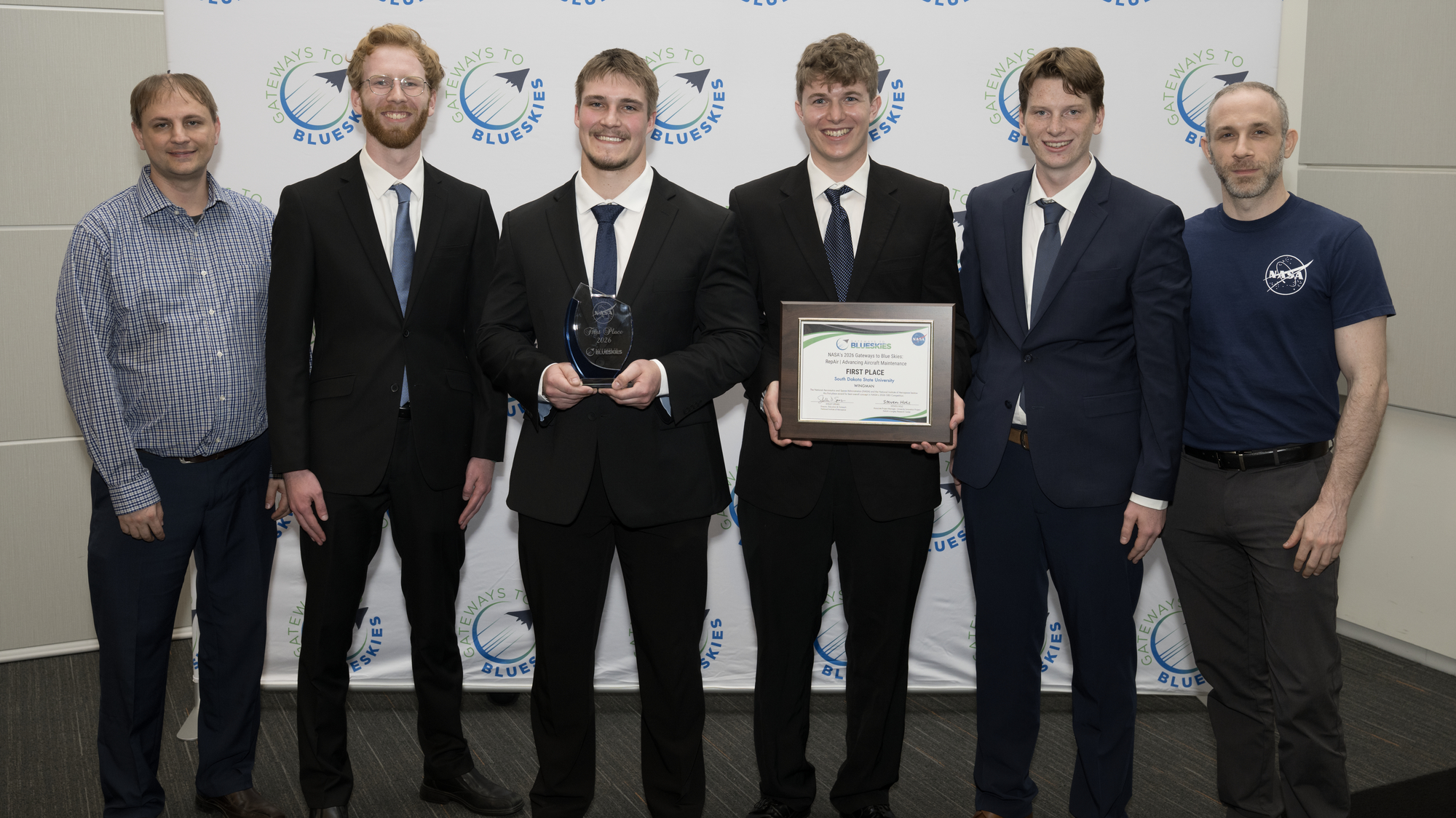
A South Dakota State University team took first place at NASA’s fifth annual Gateways to Blue Skies Competition, which challenged student teams to address a critical element of U.S. aviation: aircraft maintenance.
This year’s competition, RepAir: Advancing Aircraft Maintenance, asked teams of postsecondary students to develop innovative systems and practices that could advance commercial aircraft maintenance and repair operations by 2035. The competition, sponsored by NASA’s University Innovation project within the agency’s Aeronautics Research Mission Directorate, supported the agency’s objectives of fostering innovative research and strengthening the future aviation workforce.
“This year’s finalists proposed novel ideas to equip companies and their workers with innovative technologies to help keep our nation’s planes airworthy. This is especially critical in a time where flight safety is more commonly in the spotlight and where workforce shortages lead to challenges and opportunities in aviation,” said Steven Holz, associate project manager for NASA’s University Innovation Project and judging panel chair for Gateways to Blue Skies. “Our panel of industry and subject matter experts were excited about the possibilities these concepts could bring, as well as shared insights needed for these teams to push forward for real-world implementation.”
The winning project, WINGMAN, proposed augmented reality safety glasses equipped with voice-controlled manuals, automatic documentation, and photo recognition that could assist aircraft mechanics during routine daily servicing and minor repairs. The glasses would function as the mechanic’s “wingman,” enabling hands-free access to the information and reporting mechanisms required for line inspections.
The WINGMAN team presented their research along with seven finalists at the 2026 Gateways to Blue Skies Forum held May 18 and 19 at NASA’s Langley Research Center in Hampton, Virginia. The forum was judged by subject matter experts from NASA, the Federal Aviation Administration, and industry, including representatives from Southwest Airlines and American Airlines. Students at the forum had the opportunity to network with NASA and industry experts, tour the center, and gain insight into potential careers. The event was livestreamed, and the presentations were recorded.
The winning team members will have the opportunity to intern at one of NASA’s four aeronautics research centers during the 2026-27 academic year, including NASA Langley, NASA’s Glenn Research Center in Cleveland, NASA’s Ames Research Center in California’s Silicon Valley, and NASA’s Armstrong Flight Research Center in Edwards, California.
“It was super exciting to participate in Gateways to Blue Skies, especially with the really interesting concepts this year,” said Owen Diede, WINGMAN team lead. “We couldn’t have done it without the feedback and support from our faculty advisor, Dr. Todd Letcher, as well as our design review committee, Dr. Ruyi Lian and Dr. Cody Christensen. This was a fantastic opportunity to learn and grow, and we are incredibly thankful for the experience.”
Other recognitions included:
- Best Infographic: University of California, Irvine
Air Shield: Aircraft Structural Health Intelligence for Evaluation and Lifecycle Detection - Future Game-Changer: University of Georgia
Quasar: Quantum Sensing Aerial Reporting - Safety Spotlight: South Dakota State University
SPIDER (Surveying Platform and Inspection Device for Enclosed Regions)
The commercial aviation industry is a crucial component of the U.S. economy, yet it faces significant challenges due to a shortage of qualified maintenance workers and increasing demands to keep aircraft running for longer. NASA is dedicated to working with commercial, academic, and government partners to advance the capabilities and performance of U.S. aviation.
The Gateways to Blue Skies Challenge is part of the Transformative Aeronautics Concepts Program in NASA’s Aeronautics Research Mission Directorate. The NASA Tournament Lab, part of the Prizes, Challenges, and Crowdsourcing Program in the Space Technology Mission Directorate, manages the challenge through the National Institute of Aerospace on behalf of NASA.
For more information about NASA’s Aeronautics Research Mission Directorate, visit: