Modalità di lettura

Keeping NASA Flying: Ground Crews Ensure Aircraft Readiness

4 min read

Preparations for Next Moonwalk Simulations Underway (and Underwater)
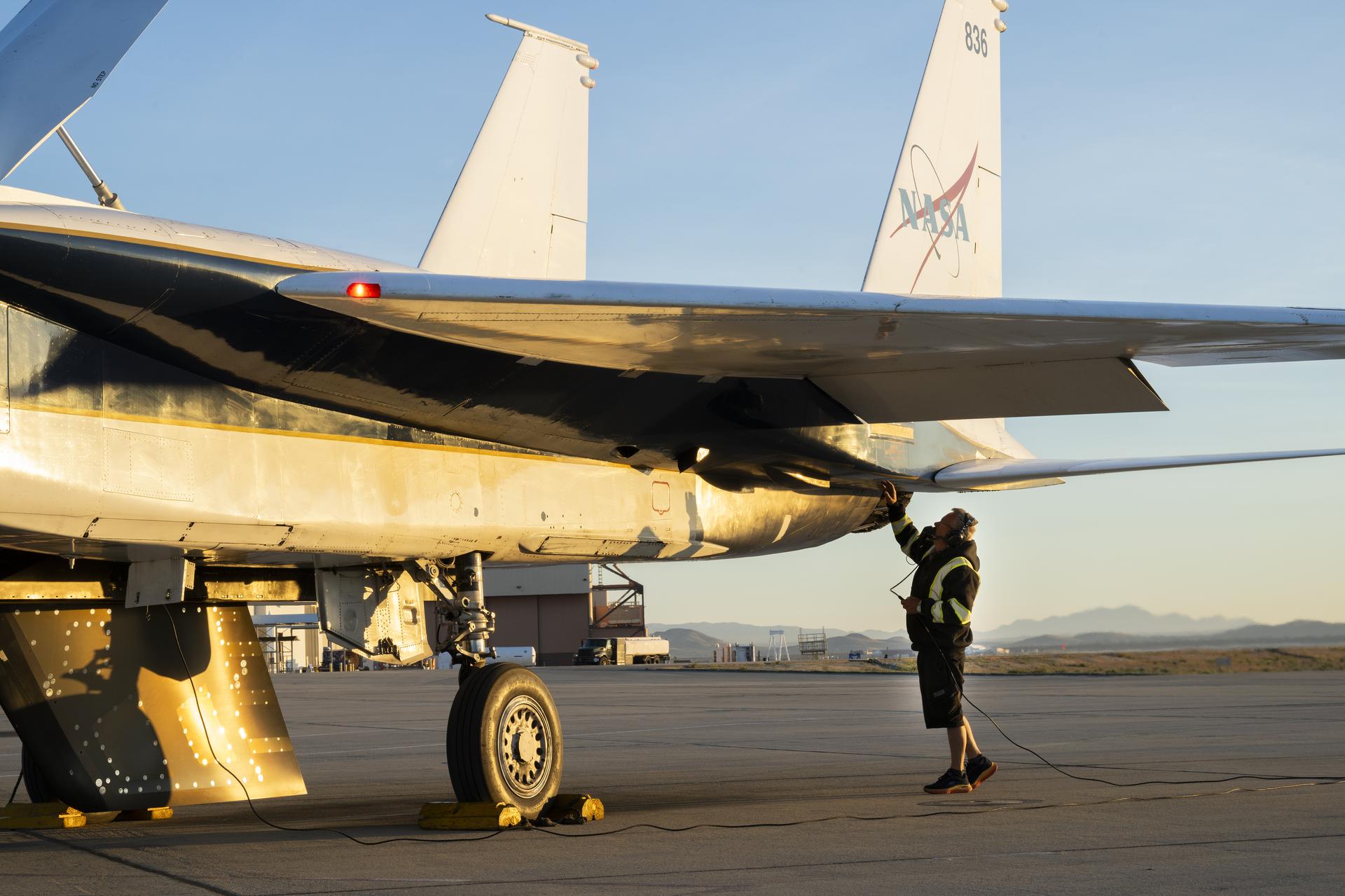
The back of a white jet aircraft’s wing and tails are seen in this image. One wheel and an attached test object, shaped like a wing, hangs from the bottom of the jet. A man in a black jacket, with yellow reflective coating, stands underneath and raises one hand to the aircraft. The man is wearing ear protection. Desert sand and mountains are seen in the background.
NASA crew chief Walt Kondracki checks an F-15 aircraft Tuesday, March 17, 2026, at NASA’s Armstrong Flight Research Center in Edwards, California. Ground crews, made of various roles, maintain the aircraft to be ready for each mission.
NASA/Carla Escamilla

From high‑speed research flights to high‑altitude science campaigns, NASA depends on aircraft that perform at their best and the ground crews who keep them mission ready.

At NASA’s Armstrong Flight Research Center in Edwards, California, specially trained maintenance crews are essential to keeping the agency’s aircraft flying safely and reliably.

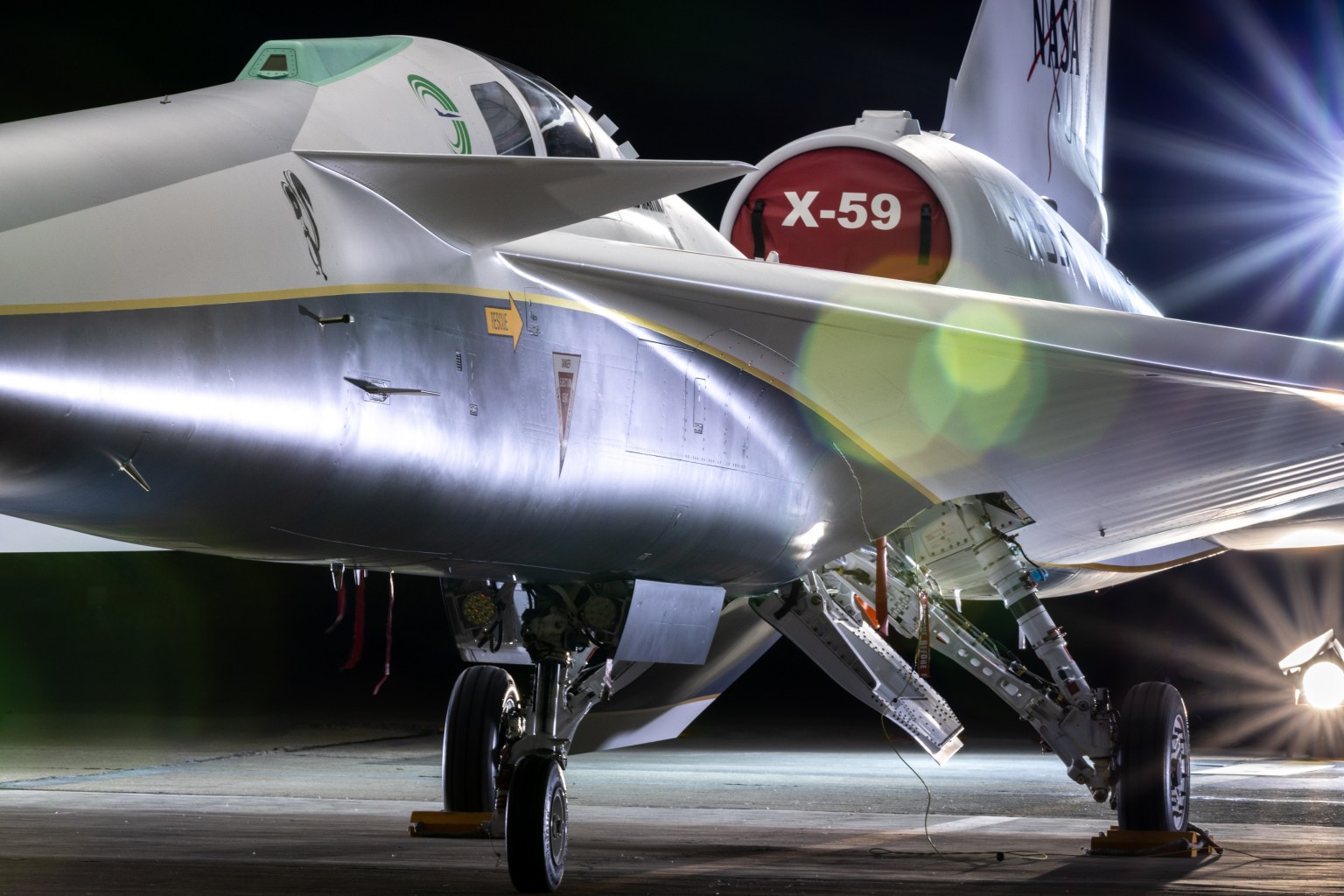
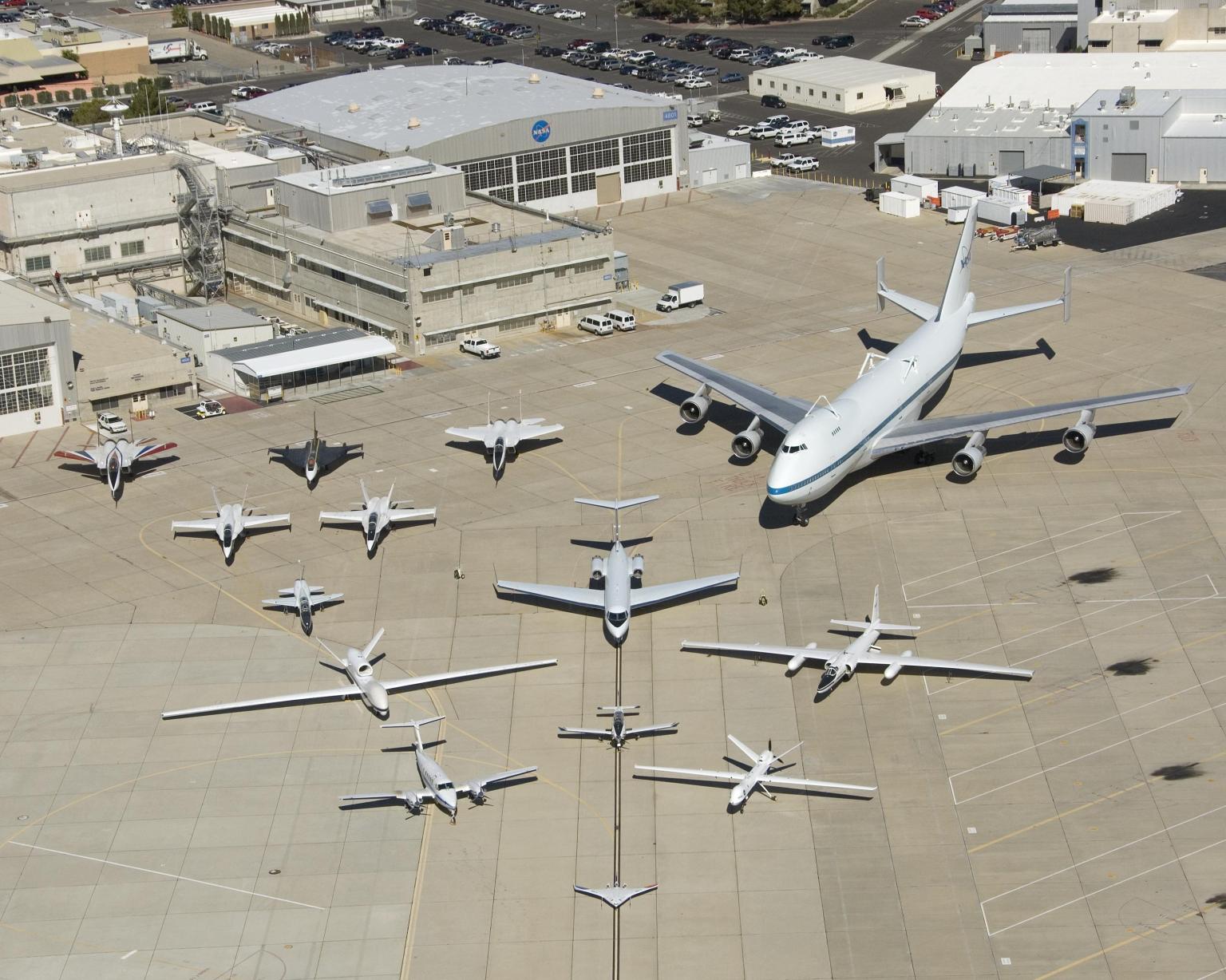
This year, NASA added two F-15s and a Pilatus PC-12 to its fleet at Armstrong. These aircraft – alongside platforms such as the high-altitude ER-2s and NASA’s newest X-plane, the X-59 – reflect a wide range of capabilities. The maintenance staff is responsible for keeping each one mission ready.
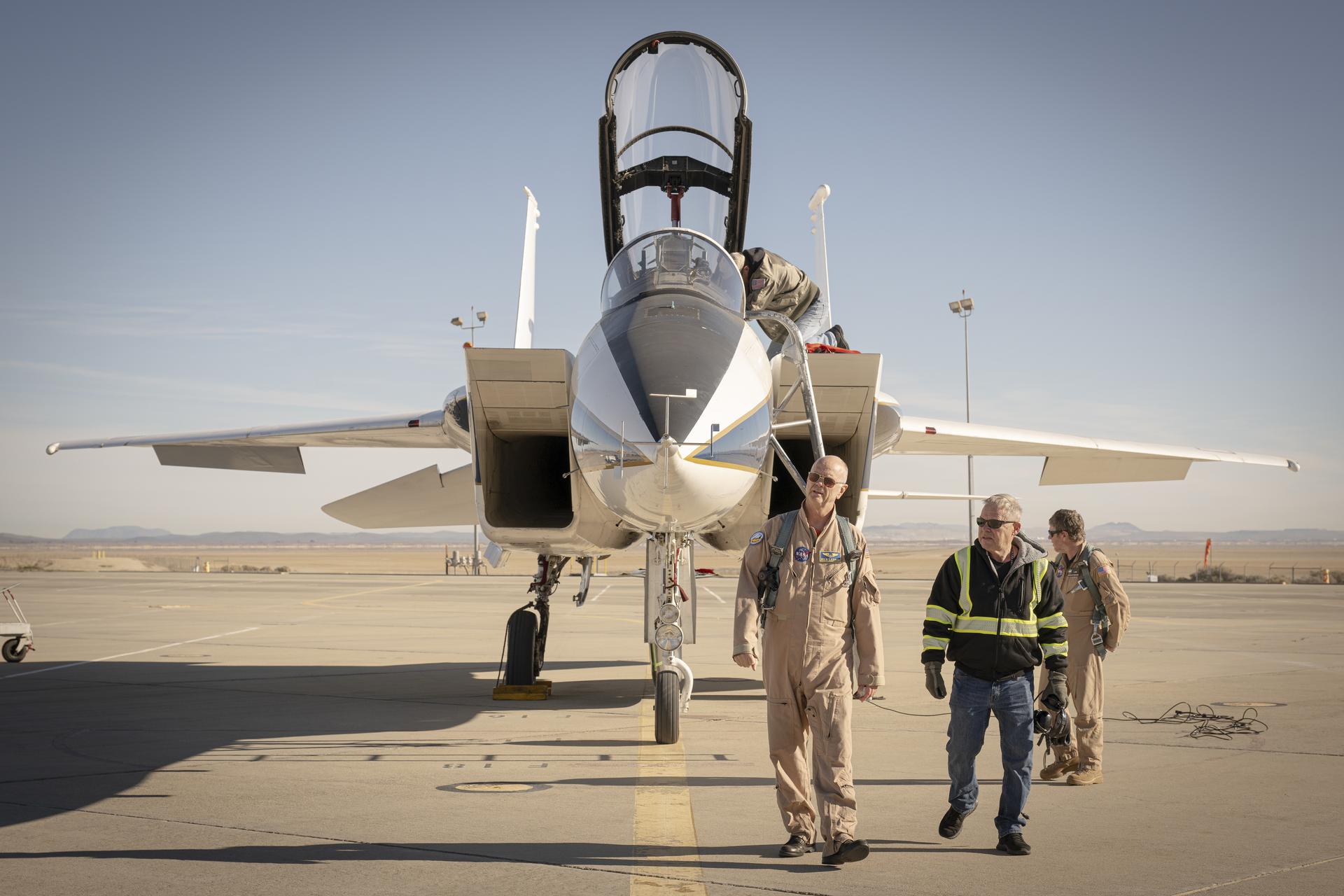
Three men, two wearing tan flight suits, and one wearing a black jacket with stripes of reflective yellow coating, walk to the right side of a jet aircraft. The aircraft faces forward and the canopy is open. Two wheels, intakes, wings, and tails are in view of the white aircraft. The aircraft sits on a concrete ramp with desert sand and mountains in the background.
NASA pilot Nils Larson, left, walks next to crew chief Walt Kondracki, right, by an F-15 aircraft Tuesday, Jan. 13, 2026, at NASA’s Armstrong Flight Research Center in Edwards, California. In the background, NASA mechanic Tim Logan secures the cockpit inside of the F-15, and flight test engineer A.J. Jaffe stands to the right.
NASA/Christopher LC Clark

“That’s the beauty of our Armstrong maintenance teams. They adapt to any type of change,” said Jose “Manny” Rodriguez, NASA Armstrong Gulfstream G-IV crew chief. “One day you could have an instrument being loaded, and the next day it may be aircraft reconfiguration, all while other aircraft systems may need fixing. They adapt and they overcome any situation.”

Each aircraft supports a specific mission, whether it’s conducting science research, serving as a support or chase aircraft, or assisting NASA rocket launches. The aircraft fly at different speeds, carry specialized hardware, and require maintenance crews to stay agile with fast-paced changes.

To ensure NASA can make aeronautics and science advancements safely, the crews work continuously, checking on the ejection seats, filling the tanks with fuel, and changing out brakes, wheels, wiring, and hardware constantly, all of which can degrade with each flight.
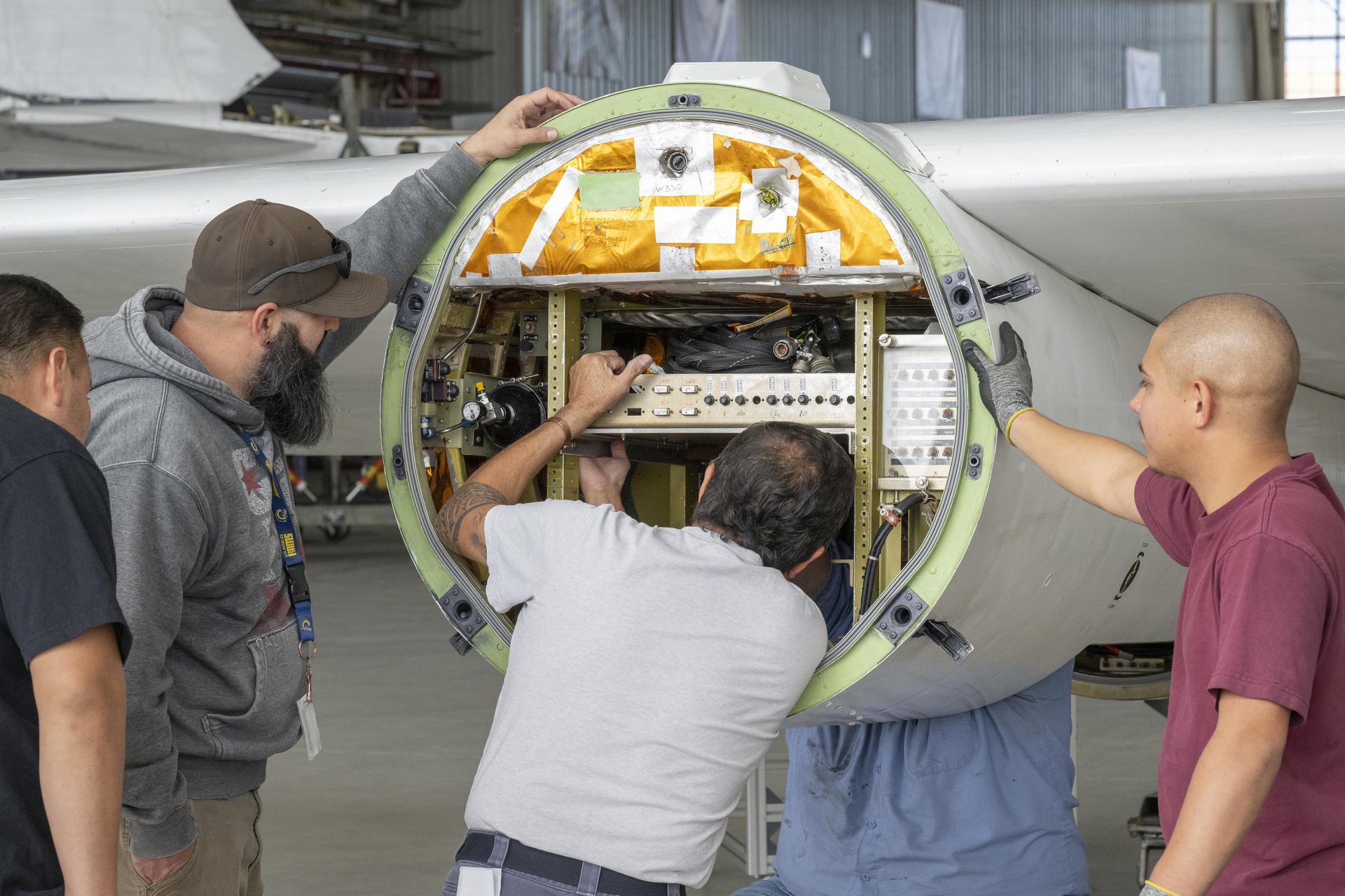
Four men surround a round object attached to an aircraft wing with shelves and wiring inside. One man’s arms are inside of the object, and he is adjusting a gold-colored piece of metal equipment. The other men watch as he works on the hardware.
From left, NASA avionics technician Jesse Orellana; quality assurance employee Jose Prieto; mechanic Francisco Rodriguez; and mechanic Vincent Moreno work on an ER-2 aircraft Monday, Jan. 26, 2026, at NASA’s Armstrong Flight Research Center in Edwards, California.
NASA/Christopher LC Clark

On any given day, an aircraft may be flight-ready for a mission, undergoing scheduled maintenance or modifications, or down for longer-term care.

There are typically multiple NASA Armstrong aircraft in the air in one day. Currently, the center’s C-20A is flying in Peru and Panama, the X-59 is often  flying twice per day with a chase plane, and the center’s ER-2 is flying in Colorado, supporting the Geological Earth Mapping Experiment (GEMx). All this work is happening at the same time, and Armstrong’s skilled maintenance staff is prepping and fixing aircraft as needed along the way.

The team includes mechanics with both military and civilian backgrounds, and the job involves a lot of on-the-job training.

Maintenance crews are composed of:

  • a crew chief – the person in charge of the airplane
  • an avionics technician, who specializes in navigation, communication, and flight control systems
  • quality assurance personnel, who oversee the work being done
  • additional mechanics assigned to each airplane

After the maintenance crew ensures the aircraft is in the best condition possible, the team tows it out to the flightline, and it becomes ready for operations. The NASA pilot assigned to the mission will walk around the aircraft with the assigned crew chief for a final safety check before flight.

“There is a crew chief assigned to every aircraft,” Rodriguez said. “The crew chief is responsible for the integrity of that aircraft, and at the end of the day, his signature and the pilot’s together are what constitutes that the aircraft is safe for flight.”

Maintenance crews track each flight to help ensure it completes the mission without returning early. If an aircraft does return to base early, the maintenance team stands ready. When it lands, the crew is right there again, helping the research team complete the mission and fixing whatever is needed to stay nimble and ready for the next flight.

“It’s difficult at times to work with different airplanes from both the civilian and military sides, but it’s very rewarding to see that we have the capability and the expertise to keep these aircraft flying,” Rodriguez said.
Keep Exploring

Discover More Topics From NASA

  •  

Meet the Fleet: NASA Armstrong Continues Legacy of Flight Research

3 min read

Preparations for Next Moonwalk Simulations Underway (and Underwater)

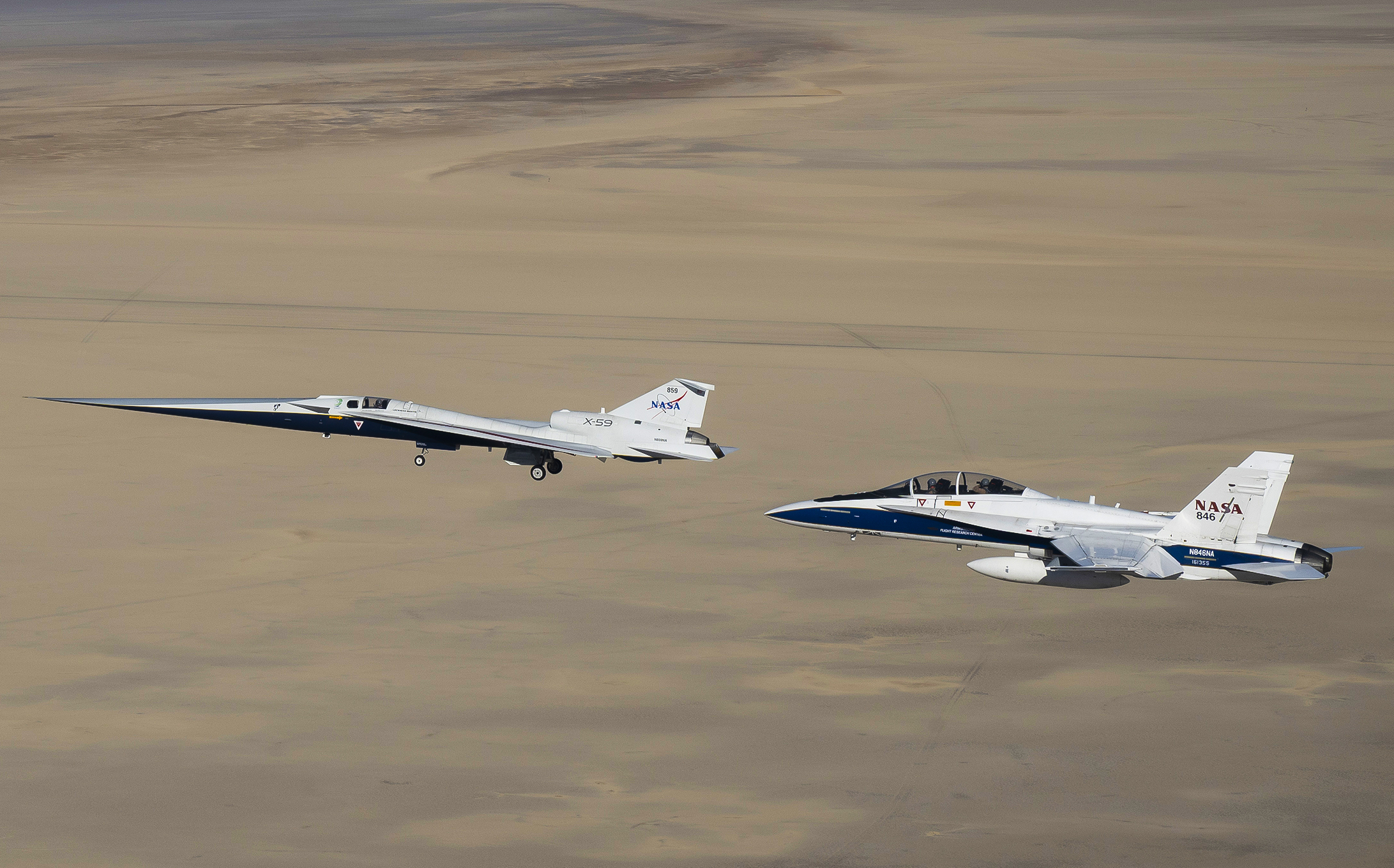
NASA’s X-59 flies above the Mojave Desert with a NASA F/A-18 chase aircraft nearby.
NASA’s X-59 quiet supersonic research aircraft flies above Palmdale and Edwards, California, during its first flight Tuesday, Oct. 28, 2025, accompanied by a NASA F/A-18 research aircraft serving as chase.
NASA/Jim Ross

NASA’s home for experimental flight is welcoming more flyers to its already high-performing fleet as it continues to support science and aeronautics test missions – continuing the legacy of pioneers like Neil Armstrong.

NASA’s Armstrong Flight Research Center in Edwards, California, added multiple aircraft this year: two F-15s supersonic jets, a Pilatus PC-12 utility plane, and a T-34 turboprop trainer, which the center will use to support the agency’s advancement of aerospace research.

Throughout the center’s history, pilots have flown everything from large aircraft like the 747 Shuttle Carrier Aircraft and rocket-powered airplanes like the X-15 to high-speed repurposed fighter jets like the F-18. And after almost 80 years, flight research is still going strong in the desert today.

“Armstrong has a rich history of flight research, but it’s the multidimensional skills of the people we have here, and the knowledge they’ve built to handle very unique aircraft maintenance and modifications, that stands out,” said Darren Cole, capabilities manager for the Flight Demonstrations and Capabilities project at NASA Armstrong.

Armstrong has a rich history of flight research, but it’s the multidimensional skills of the people we have here … that stands out.

Darren Cole

Darren Cole

Capabilities Manager at NASA Armstrong

The center plays a pivotal role in worldwide airborne science missions, flying scientists and equipment from NASA, other government agencies, industry, and academia to collect measurements such as air pollution levels, glacier melt trends, and wildland fire mapping.

Scientists can manage experiments in real time aboard flying laboratories like the NASA ER-2, to collect important data with the help of Armstrong’s pilots and airborne science team.

“We all come together to make the science happen,” said Matt Berry, airborne research platforms branch chief at NASA Armstrong. “It is the agility of the Armstrong team that allows us to collaborate with scientists, get their equipment onboard, and to fly them to areas where they need to collect data.”

The center sits on Rogers Dry Lake, a 44-square-mile slat flat area used for aviation research and test operations. Rogers and the adjacent Rosamond Dry Lake have seen everything from space shuttle landings to emergency test flight recoveries. The Rogers lakebed continues to serve as an important piece of Armstrong’s test missions.

For NASA Armstrong, it all started with the first attempt by a human to fly faster than the speed of sound in the Bell X-1. In 1946, 13 employees from NASA’s predecessor agency, the National Advisory Committee for Aeronautics (NACA), arrived at what was then known as Muroc Army Airfield to prepare for the X-1 tests. A year later, NACA’s Muroc Flight Test Unit was established as a permanent facility at the airfield.

The center has gone by several names over the years, most recently changing from NASA’s Dryden Flight Research Center to NASA Armstrong in 2014. But its legacy has never shifted: The Bell X-1E, the last of the X-1 series of aircraft, now sits in front of NASA Armstrong, welcoming the newest test pilots, engineers, scientists, explorers, and dreamers. And they’re using the aircraft of today to break new barriers.

“I don’t think there is another place in the world with a more diverse fleet of aircraft. We have everything from a low-altitude powered glider to ER-2s, which are flying at high altitudes, and a multitude of aircraft in between,” Cole said.

From sourcing rare components to machining custom parts in-house, NASA Armstrong’s teams transform these aircraft into research workhorses. The center continues its crucial role in leading aeronautics testing, Earth science research, and supporting government and industry partners.

  •  

NASA, Boeing Advance Truss-Braced Wing Research in Test

3 min read

Preparations for Next Moonwalk Simulations Underway (and Underwater)

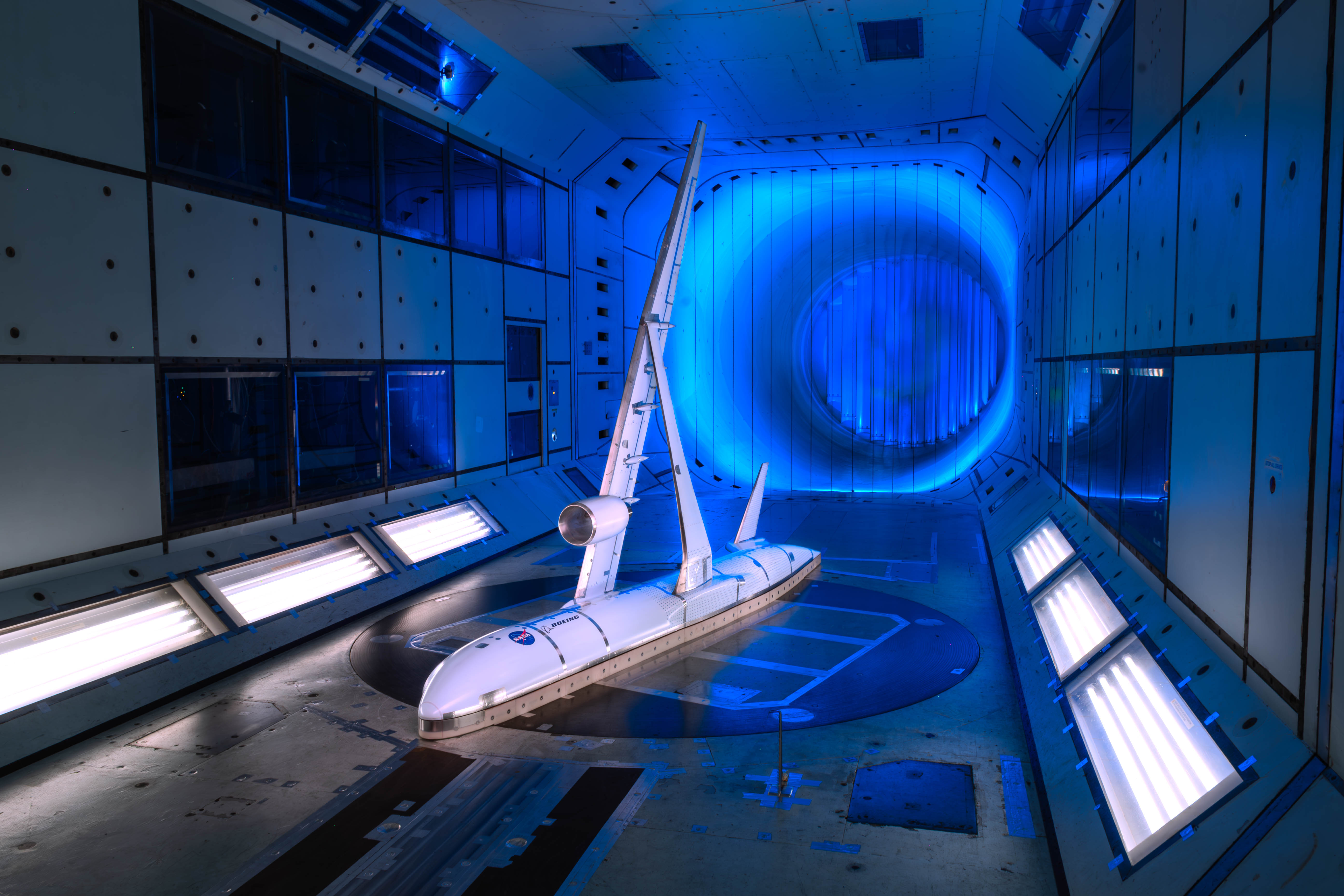
A scale model of a subsonic aircraft is tested inside a wind tunnel.
A scale model of Boeing’s Subsonic Ultra Green Aircraft Research concept undergoes testing in a 5-meter wind tunnel operated by the company QinetiQ in December 2025.
QinetiQ

NASA and Boeing have completed wind tunnel testing to study an innovative advanced aircraft design intended to improve aerodynamic efficiency.

A truss-braced wing configuration, involving a long, thin wing with aerodynamically shaped structural supports, has the potential to reduce fuel and operational costs for future airliners, which is why NASA has collaborated with Boeing to advance the design.

But this kind of wing would be much more than a simple tweak to existing designs – for an aircraft the size of a passenger jet, it would be a revolutionary redesign, requiring extensive study from NASA and Boeing.

The most recent round of testing used a complex wind tunnel model to collect data on how air flows around a truss-braced wing model and the forces that would be exerted on such a wing in flight.

The test used a semispan model – essentially half an aircraft mounted on a wind tunnel floor. The model has features built in to simulate the mechanisms that increase the amount of lift a wing produces. By adjusting the model’s slats, flaps, and other moving control surfaces, the team can configure it to the low speed, high-lift settings of takeoff and landing conditions.

The model is part of a collaboration to test what’s known as Boeing’s Subsonic Ultra Green Aircraft Research (SUGAR) concept.

In December, teams completed testing of the model wind tunnel operated by the company QinetiQ in Farnborough, England. This large wind tunnel uses pressurized conditions to predict airplane behavior in takeoff and landing conditions.

The large size of the tunnel gives the model fidelity to better predict the behavior of a plane in flight. This capability allowed the team to confidently assess aerodynamic performance.

NASA and Boeing research teams analyzed data in real time to ensure the model performed as expected. Researchers are still reviewing the full results, but the test has already added valuable information to a growing body of research aimed at reducing fuel use in future aircraft designs.

The testing was just the latest stop for this research. NASA and Boeing have tested the concept at multiple NASA facilities to collect data as they work to build a comprehensive understanding of this advanced airframe concept.

This collaboration serves as an example of how NASA serves as an incubator for breakthrough technology with profound commercial applications. The transonic truss-braced wing concept originated from NASA aeronautics-supported research and NASA and Boeing engineers have worked together, test-by-test, to move this wing design from an idea to a practical reality.

The work began in NASA’s Advanced Air Vehicles Program and continues as part of the Subsonic Flight Demonstrator project under the Integrated Aviation Systems Program in the agency’s Aeronautics Research Mission Directorate.

  •  
❌