Modalità di lettura

NASA Hosts SpaceX Crew-11 Astronauts for Public Event at Headquarters
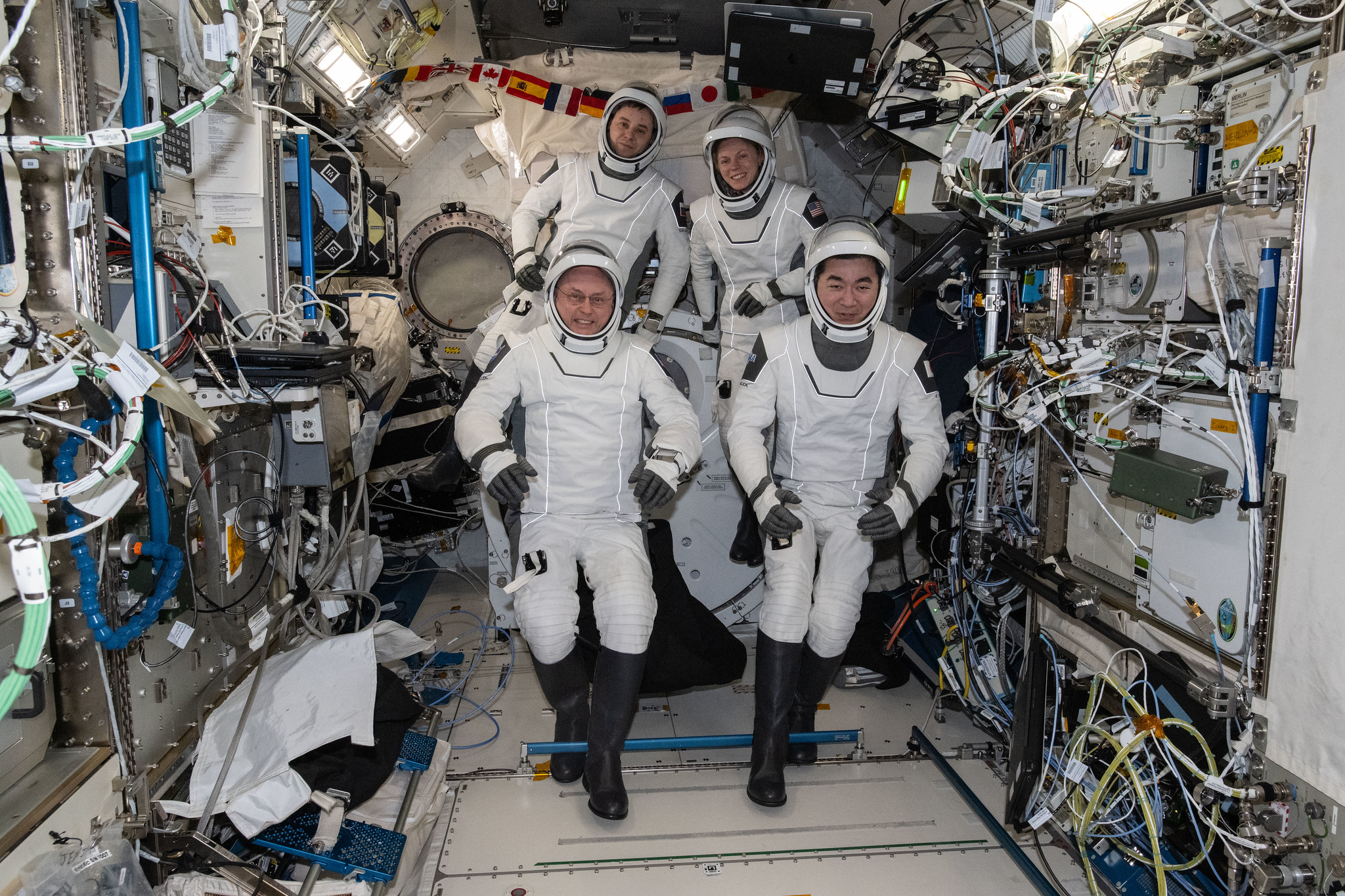
NASA's SpaceX Crew-11 astronauts gather together for a crew portrait wearing their Dragon pressure suits during a suit verification check inside the International Space Station's Kibo laboratory module. Clockwise from bottom left are, NASA astronaut Mike Fincke, Roscosmos cosmonaut Oleg Platonov, NASA astronaut Zena Cardman, and JAXA (Japan Aerospace Exploration Agency) astronaut Kimiya Yui.
NASA’s SpaceX Crew-11 astronauts gather together for a crew portrait wearing their Dragon pressure suits during a suit verification check inside the International Space Station’s Kibo laboratory module. Clockwise from bottom left are, NASA astronaut Mike Fincke, Roscosmos cosmonaut Oleg Platonov, NASA astronaut Zena Cardman, and JAXA (Japan Aerospace Exploration Agency) astronaut Kimiya Yui.
Credit: NASA

NASA will host a public event featuring three crew members from the agency’s SpaceX Crew-11 mission at 11 a.m. EDT Monday, June 1. The event, which takes place during the crew’s standard postflight visit, will be held in the Webb Auditorium at NASA Headquarters in the Mary W. Jackson building, 300 E. Street SW in Washington.

The crew members, including NASA astronauts Zena Cardman and Mike Fincke and JAXA (Japan Aerospace Exploration Agency) astronaut Kimiya Yui, will discuss their recent 167-day mission aboard the International Space Station, where they conducted a wide range of science experiments to benefit life on Earth and advance human space exploration as part of International Space Station Expedition 73/74.

The Crew-11 mission lifted off on Aug.1, 2025, from Launch Complex 39A at NASA’s Kennedy Space Center in Florida. The crew’s SpaceX Dragon spacecraft docked to the orbital outpost on Aug. 2.

During their mission, the three astronauts, along with crewmate Roscosmos cosmonaut Oleg Platonov, traveled nearly 71 million miles and completed more than 2,670 orbits around Earth. The Crew-11 mission was Fincke’s fourth spaceflight, Yui’s second, and the first for Cardman and Platonov. Fincke has logged 549 days in space, ranking him fourth among all NASA astronauts for cumulative days in space. The crew members returned to Earth on Jan. 15, splashing down off the coast of San Diego.

Along the way, Crew-11 logged hundreds of hours of research, maintenance, and technology demonstrations. The crew members also celebrated the 25th anniversary of continuous human presence aboard the orbiting laboratory on Nov. 2, 2025. Research conducted aboard the space station advances scientific knowledge and demonstrates new technologies that enable us to prepare for human exploration of the Moon and Mars.

Media interested in attending the event must RSVP by 8 a.m., June 1, by emailing the NASA Headquarters newsroom at hq-media@mail.nasa.gov. NASA’s media accreditation policy is online. Based on the crew’s schedule, NASA will not be able to accommodate interviews.

This opportunity also is part of NASA’s Frontiers Forum: Voices Shaping the Future of Space speaking series designed to convene bold thinkers and senior leaders at the forefront of exploration and innovation. The series will spotlight mission-critical priorities from advancing the Artemis campaign and strengthening commercial partnerships to shaping the future workforce and accelerating breakthrough technologies. The agency will share more details soon.

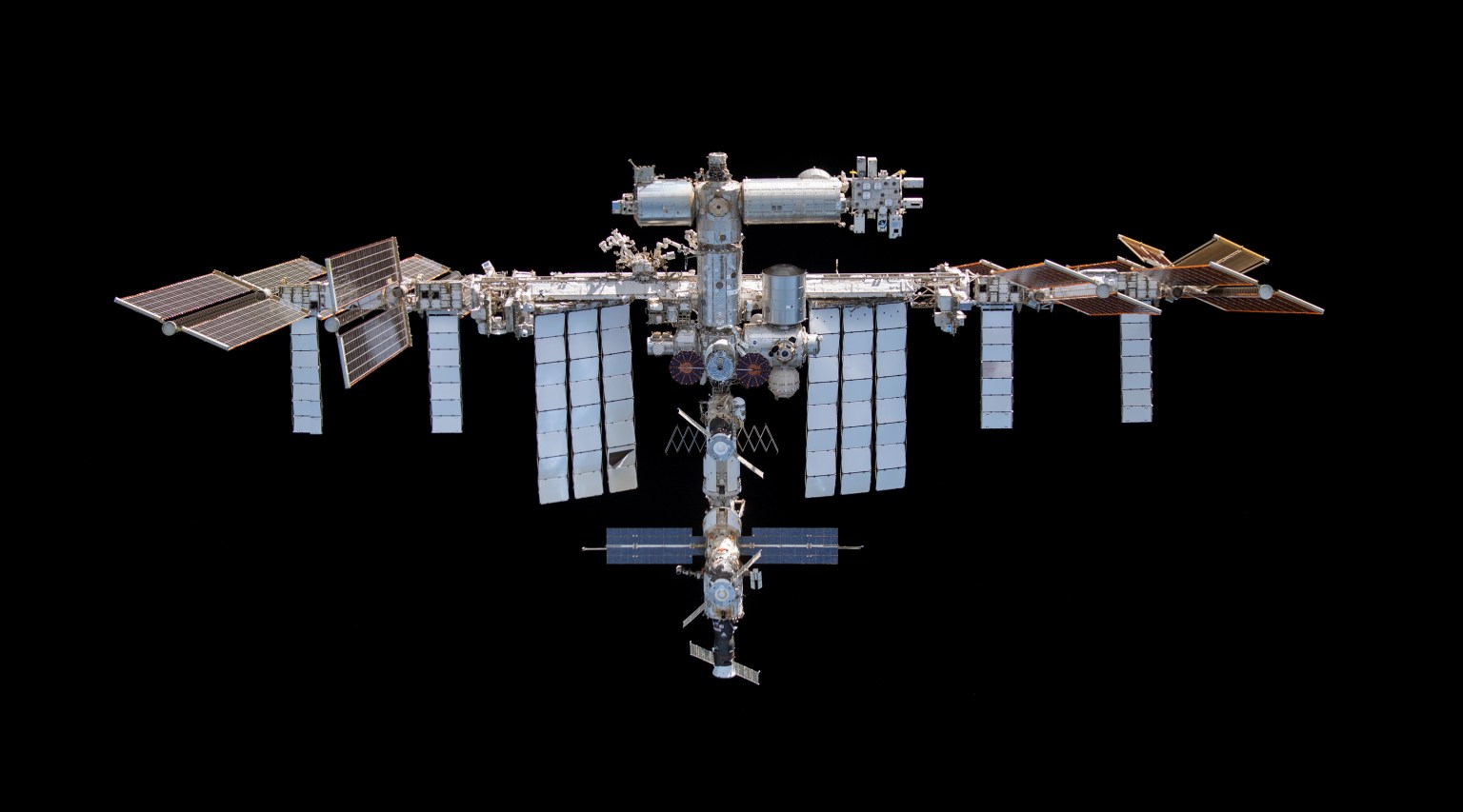
To learn more about the International Space Station and its research and crews, visit:

https://www.nasa.gov/station

-end-

Gerelle Dodson
Headquarters, Washington
202-358-1600
gerelle.q.dodson@nasa.gov
Share

Details

Last Updated
May 29, 2026
  •  

NASA Hosts SpaceX Crew-11 Astronauts for Public Event at Headquarters

NASA's SpaceX Crew-11 astronauts gather together for a crew portrait wearing their Dragon pressure suits during a suit verification check inside the International Space Station's Kibo laboratory module. Clockwise from bottom left are, NASA astronaut Mike Fincke, Roscosmos cosmonaut Oleg Platonov, NASA astronaut Zena Cardman, and JAXA (Japan Aerospace Exploration Agency) astronaut Kimiya Yui.
NASA’s SpaceX Crew-11 astronauts gather together for a crew portrait wearing their Dragon pressure suits during a suit verification check inside the International Space Station’s Kibo laboratory module. Clockwise from bottom left are, NASA astronaut Mike Fincke, Roscosmos cosmonaut Oleg Platonov, NASA astronaut Zena Cardman, and JAXA (Japan Aerospace Exploration Agency) astronaut Kimiya Yui.
Credit: NASA

NASA will host a public event featuring three crew members from the agency’s SpaceX Crew-11 mission at 11 a.m. EDT Monday, June 1. The event, which takes place during the crew’s standard postflight visit, will be held in the Webb Auditorium at NASA Headquarters in the Mary W. Jackson building, 300 E. Street SW in Washington.

The crew members, including NASA astronauts Zena Cardman and Mike Fincke and JAXA (Japan Aerospace Exploration Agency) astronaut Kimiya Yui, will discuss their recent 167-day mission aboard the International Space Station, where they conducted a wide range of science experiments to benefit life on Earth and advance human space exploration as part of International Space Station Expedition 73/74.

The Crew-11 mission lifted off on Aug.1, 2025, from Launch Complex 39A at NASA’s Kennedy Space Center in Florida. The crew’s SpaceX Dragon spacecraft docked to the orbital outpost on Aug. 2.

During their mission, the three astronauts, along with crewmate Roscosmos cosmonaut Oleg Platonov, traveled nearly 71 million miles and completed more than 2,670 orbits around Earth. The Crew-11 mission was Fincke’s fourth spaceflight, Yui’s second, and the first for Cardman and Platonov. Fincke has logged 549 days in space, ranking him fourth among all NASA astronauts for cumulative days in space. The crew members returned to Earth on Jan. 15, splashing down off the coast of San Diego.

Along the way, Crew-11 logged hundreds of hours of research, maintenance, and technology demonstrations. The crew members also celebrated the 25th anniversary of continuous human presence aboard the orbiting laboratory on Nov. 2, 2025. Research conducted aboard the space station advances scientific knowledge and demonstrates new technologies that enable us to prepare for human exploration of the Moon and Mars.

Media interested in attending the event must RSVP by 8 a.m., June 1, by emailing the NASA Headquarters newsroom at hq-media@mail.nasa.gov. NASA’s media accreditation policy is online. Based on the crew’s schedule, NASA will not be able to accommodate interviews.

This opportunity also is part of NASA’s Frontiers Forum: Voices Shaping the Future of Space speaking series designed to convene bold thinkers and senior leaders at the forefront of exploration and innovation. The series will spotlight mission-critical priorities from advancing the Artemis campaign and strengthening commercial partnerships to shaping the future workforce and accelerating breakthrough technologies. The agency will share more details soon.

To learn more about the International Space Station and its research and crews, visit:

https://www.nasa.gov/station

-end-

Gerelle Dodson
Headquarters, Washington
202-358-1600
gerelle.q.dodson@nasa.gov

Share

Details

Last Updated
May 29, 2026
  •  

Growing Stem Cells in Space to Improve Cancer and Disease Treatments

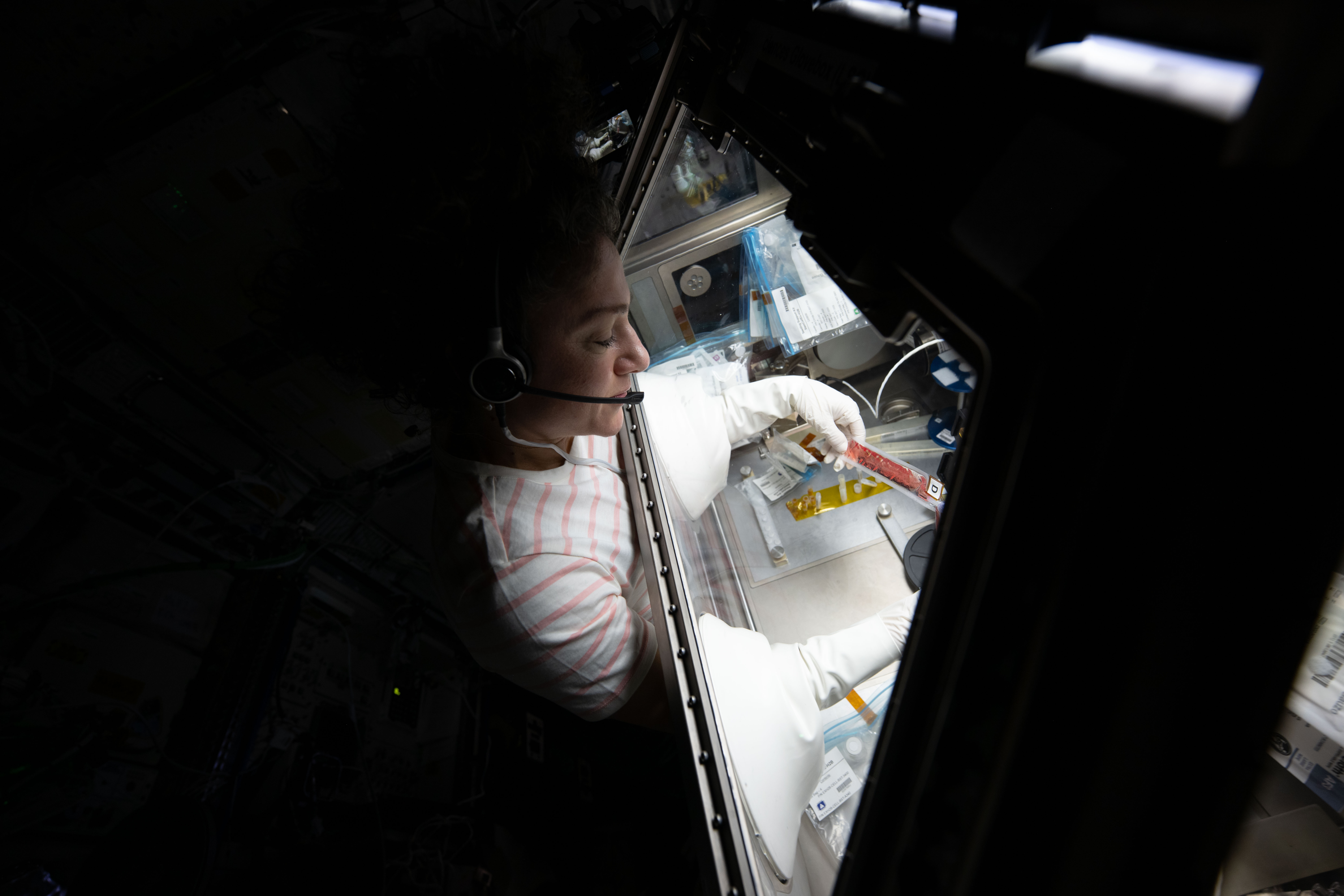
Jessica Meir wears a headset while handling samples inside of the Life Sciences Glovebox. The image is framed by darkness on the left and right, with the light from the glovebox illuminating Jessica's face and the work area inside the box. Her hands are inserted into the clear box through gloves, and she holds a thin, plastic rectangle with red interior.
NASA astronaut Jessica Meir works on InSPA-StemCellEX-H2 inside the Life Sciences Glovebox. Microgravity samples will be frozen and returned to Earth for further analysis of stem cell expansion in space.
NASA

Expedition 74 astronauts aboard the International Space Station are continuing research efforts to manufacture large quantities of stem cells for therapies on Earth. Previous studies have focused on fine-tuning hardware that allows scientists to produce greater quantities of high-quality stem cells. Now, the InSPA-StemCellEX-H2 investigation is aiming to demonstrate large scale production of blood stem cells for pharmaceutical and clinical use.

Dozens of small, white cells cover a dark grey background. There are clusters of cells that are touching, and some are spread apart. Some of the cells have brighter areas in the middle, and some appear dull as if they are further away.
Preflight microscopic image of hematopoietic stem cells for the InSPA-StemCellEX-H2 investigation. This investigation aims to produce stem cells in greater numbers with BioServe’s newly developed microgravity bioreactor.
Mayo Clinic

The research uses stem cells derived from the human body to produce large quantities of cells for patient use through a process called “expansion”. Although stem cells can be expanded in labs on Earth, they have limitations. For example, Earth-produced cells lose their ability to form the different cells in our blood system, like red and white blood cells or platelets, which are critical for leukemia patients that receive stem cells to build up their blood system after chemotherapy.

Dr. Tobias Niederwieser, assistant research professor at BioServe Space Technologies within the University of Colorado Boulder says, “The microgravity environment in space is much more suitable for keeping the stem cells in their high-quality state during expansion.” Scientists predict that growing cells in space may lead to higher expansion potential and a lower risk of rejection when used in patients on Earth. This research could create long-term cell supplies for patients suffering from fatal blood disorders, various blood cancers, or severe immune diseases, and enable more reliable and accessible therapies. “The end result is really to benefit patients in hospitals here on Earth,” Dr. Niederwieser says.

Space station research allows scientists and commercial companies around the world to test new technologies and innovative medical solutions that have the potential to greatly benefit life on Earth.

  •  

IL RUOLO DELLA LOTTA DI CLASSE OPERAIA NEL CONTESTO NAZIONALE

Straordinaria giornata a Gallarate sabato 23 maggio nella sede del Sindacato Generale di Classe che ha convocato una Conferenza Operaia a cui hanno partecipato avanguardie di lotta da tutta Italia.

Ero presente con altri compagni del nostro Partito per ascoltare e approfondire il rapporto con la classe operaia.

Sono stati trattati diversi temi e relazioni su luoghi specifici, ma in ognuno di essi emergeva il nesso generale che lega le lotte di queste avanguardie.

Il tema del salario, il tema della sicurezza del lavoro e il tema della guerra imperialista.

Con mio grande piacere alla fine sono stato anche invitato a portare il saluto del Partito. Ho quindi fatto emergere qualcosa che è implicito nei discorsi fatti durante la giornata, ossia il ruolo nazionale che la classe operaia svolge nel nostro Paese, così come negli altri.

Perché la rivendicazione salariale non è un tema corporativo, ma coinvolge l’interesse di sviluppo e innovazione di una nazione?

Il padronato è sempre stato bravo a demonizzare le rivendicazioni salariali in nome del superiore interesse dell’azienda. È il vecchio apologo di Menenio Agrippa, in cui lo stomaco esalta la propria funzione indispensabile rispetto alle varie membra. In realtà, vediamo che l’abbassamento della conflittualità e la costante compressione dei salari nei decenni ha fatto fare enormi passi indietro all’intera economia nazionale, in quanto la competizione rispetto ai costi non viene sviluppata attraverso innovazione e ricerca, ma solo abbassando la qualità del prodotto. i padroni si lamentano della bassa produttività italiana, di cui però sono loro gli unici responsabili e non chi esegue i lavori. Essendosi impossessati in prima persona delle leve della politica e avendo ridotto questa a mera cinghia di trasmissione dei loro diktat, tutti i governi che si sono succeduti non hanno svolto alcuna funzione dirigente. Gravissima quindi anche la corresponsabilità che portano i sindacati concertativi, avendo avallato questa tendenza che ha portato alla situazione di sottosviluppo odierna.

Perché le privatizzazioni fanno male alla società?

I lavoratori dell’ATM di Milano rappresentano un baluardo di lotta anche contro il tentativo di privatizzare una delle più antiche e prestigiose aziende italiane. La loro lotta difende non solo il loro posto di lavoro, ma il servizio pubblico per tutti i cittadini. Si osservi come, dopo avere spolpato le aziende pubbliche, in tutto il mondo occidentale si sta facendo un passo indietro. Portiamo come esempio quello delle ferrovie inglesi, privatizzate dalla Thatcher e ora al collasso. Ma la situazione di sanità, trasporti, ecc. è ormai una evidenza incontestabile. Naturalmente, solo il controllo operaio all’interno dell’azienda pubblica può garantire che essa non venga piegata a interessi clientelari.

Perché la sicurezza nelle aziende non garantisce solo i lavoratori all’interno, ma tutti i cittadini all’esterno?

In Italia 3 morti al giorno sul lavoro. E la tendenza non diminuisce. Si vedono anche casi in cui a perire sono anche i piccoli padroncini che prendono appalti sotto costo, anche da commesse pubbliche, e poi tagliano i costi nell’unico modo che la parte debole può fare, la sicurezza, un tiro di dadi sperando che vada bene. Per le grandi aziende invece impunità più totale. Ma se si taglia sulla sicurezza, vuol dire che si è tagliato anche su tutto il resto della qualità del prodotto o del servizio. E quindi è tutto il sistema che è compromesso. Sicurezza per i lavoratori, significa qualità, qualità di ciò che si produce, che si crea, barriera contro chi inquina il lavoro offrendosi sottocosto.

Perché contro la guerra?

Perché, quando si smette di produrre auto e si passa a produrre carri armati, si distrugge ricchezza e l’intera nazione ne paga le conseguenze. Non è solo furto da parte dei padroni delle aziende produttrici di armi, è saccheggio con distruzione di ricchezza. Non lasciamoci ingannare dal “keynesismo militare”, esso ha funzionato nel centro della cittadella imperialista, quando lo ha pagato tutto il resto del mondo sottomesso.

Perché la classe operaia è l’unica che può dichiararsi classe “nazionale”?

Perché è l’unica che può incarnare l’interesse generale di una nazione. Perché i suoi interessi – il salario, lo sviluppo, la sicurezza, il benessere, la pace – sono gli interessi di tutti e non di una sempre più ristretta minoranza.

Il Partito Comunista si batte perché la classe operaia riprenda la propria coscienza del proprio ruolo storico, così come lo avuto nel recente passato, al di là delle sconfitte momentanee.


Condividi !

Shares

L'articolo IL RUOLO DELLA LOTTA DI CLASSE OPERAIA NEL CONTESTO NAZIONALE proviene da IL PARTITO COMUNISTA - Sito Ufficiale.

  •  

BIDEN ABBASSA LA CRESTA. DA “CI SARANNO CONSEGUENZE” A ” VOGLIAMO COMPETERE”

ALL’INTERVENTO A MUSO DURO DEL NUOVO MINISTRO DEGLI ESTERI QUIN GANG , IL GOVERNO USA ABBASSA I TONI E CERCA DI RAFFREDDARE LA POLEMICA. SI RIVELA LA TIGRE DI CARTA PROFETIZZATA DA MAO.

Il tono minaccioso e la lista delle posizioni criticabili della Cina rispetto alla guerra Ucraina ( mancata condanna della Russia all’ONU, rafforzamento della collaborazione economica russo-cinese, possibilità di invio di armi e munizioni ai russi) si sono dissolte come neve al sole.

Il tono irritante del dipartimento di stato e i solenni avvertimenti a non toccare Taiwan anche. Lo sceriffo si é reso conto di avere a che fare con un osso duro ed é diventato più conciliante. Niente più oscure minacce di ritorsioni: qua la mano !

Nel link sottostante troverete il testo che Biden finse di snobbare, inducendo molti alla imitazione, e che adesso dovrà imparare a memoria. E’ il decalogo cinese per essere coerenti col concetto di pace.

https://corrieredellacollera.wordpress.com/wp-admin/post.php?post=35641&action=edit

In effetti, la storia degli Stati Uniti é caratterizzata dalla violenza e dall’espansione il suo budget assomma al 40% di quello di tutti i paesi del mondo messi insieme ed hanno 800 basi militari sparse in paesi esteri, senza contare le flotte. Difficile dire che lo fanno per la pace.

Aver fatto notare queste verità che sono sotto gli occhi di tutti, la Cina si é vista sbeffeggiare dal presidente Joe Biden che ha snobbato il documento, implacabile ma pacato. Poco dopo il nuovo ministro degli Esteri cinese, ha cambiato il tono ed ha dichiarato che se gli USA continueranno con questi comportamenti miranti a soggiogare, prima psicologicamente, poi economicamente, la Cina, ” lo scontro sarebbe inevitabile”. Una notizia d’agenzia ha fatto circolare la cifra dei coscritti possibili: 20 milioni.

Gli USA – che sono già stati impressionati dal richiamo alle armi di trecentomila uomini fatto dalla Russia e memori della definizione di “unwise” data da Henri Kissinger all’atteggiamento bullesco di affrontare due crisi in contemporanea – hanno cambiato tono e smesso di cercare di stanare la Cina. Ancor oggi non sono riusciti a capire fino a che punto il celeste impero sia coinvolto con l’impero del male. Il timone punta a neutrale.

XI JINPING ha infatti confermato che non c’é stata nessuna cessione di armi ai duellanti, non ha dedicato una sola riga all’Europa e si é concentrato sui temi anticinesi degli USA: Taiwan, TIK TOK vessata quotidianamente, Huawei, le strumentali campagne per i diritti umani a favore degli Uiguri ( una delle sedici etnie presenti in Cina); la costruzione di una catena strategica attorno alla Cina ( AUKUS) , mirante a mortificarla nel suo mare, l’appoggio dato alla Filippine per il contenzioso per le isole Spratly, il riarmo accelerato giapponese. Tutte questioni sollevate ( o risollevate) dagli USA nell’ultimo anno miranti a indebolire XI.

La superiorità intellettuale cinese ha fatto fronte a tutte questi ostacoli affrontati senza ai usare toni aggressivi.

In questo secondo link troverete un estratto di un documento americano che tratta a un dipresso degli stessi temi del cinese, ma lo fa concentrandosi sulla Russia, al punto che affronta la situazione globale senza mai nominare Cina e India, nel tentativo di affrontare un avversario alla volta. Forse pensano che i cinesi siano tanto sciocchi da non averci pensato.

https://corrieredellacollera.wordpress.com/wp-admin/post.php?post=35317&action=edit

L’ultimo link é al più completo documento Rand sulla Russia: Extending Russia ci ho messo un pò a capire che intendevano l’espansione delle spese russe a causa di guerre e rivolte ( indicate analiticamente) fino al punto da provocarne il crollo. Ed é qui che risalta il concetto di competitive advantage, ossia ottenere un vantaggio competitivo provocando una proxy war ( guerra per procura). Non si sono resi conto che , a partire da oggi, molti, sentendo parlare di competition la prenderanno per un sinonimo di guerra. Dovranno spolverare il vocabolario.

https://www.rand.org/pubs/research_reports/RR3063.html

  •  
❌