di Lorenzo Pisaneschi [E’ uscito ieri per Arcipelago Itaca Un’evidenza semplice, libro di Lorenzo Pisaneschi vincitore dell’undicesima edizione del Premio “Arcipelago itaca” per una raccolta inedita di versi – Opera prima. Presentiamo alcuni testi, seguiti dalla prefazione di Francesco Brancati]. I – E intanto, Valentina I. E intanto Valentina si …
A rural area off Highway 14 just north of the small town of Moorcroft, in eastern Wyoming
They were pillars of their church, congregants in a little-known denomination that sets itself apart from the world and teaches that even the most unconscionable acts can be wiped away — not just forgiven, but forgotten and never spoken of again.
So it went in a rural Wyoming church, where a man was accused of sexually abusing young girls hundreds of times in the pews during Sunday services. Though the preacher knew of the abuse, he never reported it to police, local prosecutors said. Instead, he told the man to seek therapy.
In Minnesota, a man from the same faith admitted that he began entering the bedrooms of his daughter and son at night around the time each of them turned 12. He and his siblings grew up in the church and were sexually abused themselves, and then he repeated the abuse with his own children.
And in Washington state, preachers knew a member of their congregation had sexually abused several young boys. Instead of reporting him to police, they allowed him to ask for forgiveness, according to a family member, and he continued to sexually abuse children. He was later found guilty of raping the 9-year-old son of a church member and sentenced to life in prison.
The abusers and victims all belonged to the Old Apostolic Lutheran Church, or the OALC, a Scandinavian-rooted revivalist church that teaches its followers that heaven is reserved just for them. To get there, according to current and former members, they must follow a strict doctrine, which emphasizes asking for forgiveness for their sins and says that being forgiven by a fellow church member washes away those sins.
What’s more, the church teaches that once a perpetrator is forgiven, anyone who speaks about the wrongdoing — including the victim — can be accused of harboring an unforgiving heart. Those who have left the church, as well as some who are still with it, say this means the burden of sin shifts from the person who committed the act to the person who refuses to let the matter rest.
Sexual abuse survivors say these rituals have created a culture where allegations of abuse are resolved outside of the criminal justice system and the victims must bear their pain alone or risk going to hell. In some families, sexual abuse stretches across generations, ensnaring a parent, child and grandchild.
“This is what I would call institutionalism of abuse of young women and children,” said DaNece Day, the prosecuting attorney for Crook County in Wyoming, whose office has charged two OALC members in the past two years.
In Wyoming, Crook County Attorney DaNece Day’s office has brought charges against members of the Old Apostolic Lutheran Church.
Day and other prosecutors said one of the biggest obstacles to breaking the cycle is the way church members move among congregations spread across the U.S. and Canada, often hundreds of miles apart but tightly bound by large, multigenerational family networks.
Last fall, ProPublica and the Minnesota Star Tribune reported that preachers in Minnesota had known for years about allegations that one of its members, a man named Clint Massie, had sexually abused young girls in the congregation. But instead of reporting it to police, church leaders urged some of the victims to take part in sessions where they were brought face-to-face with Massie and encouraged to forgive the abuse.
Now, new reporting by the two news organizations shows how the sexual abuse of children in the OALC, as well as the failure by church leaders to report it to authorities, is a persistent and national problem.
Some current and former OALC members are calling on elders from what the church regards as its mother congregation in Sweden — where the church originated — to intervene. In fact, those elders, who don’t have authority over the American church but wield considerable influence, are coming to the U.S. and Canada this summer to meet with congregations. What they’ll find are a growing number of criminal cases against church members and increasing legal scrutiny of leaders for failing to report allegations of sexual abuse to police.
In a statement, representatives from the Swedish church said the cases are isolated incidents and they didn’t “observe any pattern” among the tens of thousands of members in 34 OALC congregations in the U.S. and Canada. They said sexual abuse should be reported to authorities and that it was possible “some matters have been handled improperly or without sufficient knowledge.” And they acknowledged that church guidelines “are being reviewed with the American missionary pastors in order to ensure compliance.”
Representatives of the OALC in the U.S. and Canada said in an email that they also “do not perceive there to be a general pattern of behavior,” describing sexual abuse as a serious and persistent problem across society. They acknowledged that bringing a victim to face their abuser, as a pastor for the OALC church did with Massie, can be traumatic. But they defended the church’s doctrine of forgiveness, saying it was not a means to conceal wrongdoing or to shield offenders from legal consequences, and no one is coerced to forgive or to ask for forgiveness. If those teachings had been misapplied or misunderstood in some cases, they said, it “does not reflect an error in our doctrine.”
ProPublica and the Star Tribune interviewed 20 people who said they were sexually abused, almost all as children, in OALC communities, along with parents of victims as young as 3. Reporters also traveled to OALC churches around the country and reviewed court and police documents from at least eight cases, along with victims’ statements to local authorities.
Their abusers were family members, other children or men who were trusted to be alone with children because they are part of the same insular faith community. Some victims spoke anonymously for fear of retribution from the church or their own families. Others identified themselves as well as their abusers publicly, unafraid of the repercussions.
Many of those victims said church leaders pressured them to keep quiet. In Minnesota, police records describe a woman telling a young girl that her abuse, which began when she was around 5 or 6 years old, was not a big deal and she “needed to get over it.” In Washington state, a police report notes a woman told law enforcement that her preacher had, for “spiritual reasons,” discouraged her from contacting authorities after her daughter told her she’d been raped by three men from church.
“We’re always told that what the preachers tell us, that’s coming from God,” explained one woman, who said she, too, was told not to speak of her abuse. “Who’s going to argue with that?”
The Old Apostolic Lutheran Church in Moorcroft
Sexual abuse in the OALC has sometimes been a legacy passed from one generation to the next — hidden, quietly endured, repeated. Lorie Peldo was sexually abused for eight years by her older brother, starting when she was only 2, she said in an interview. A quarter century later, after the memories began to resurface during therapy, Peldo’s mother told her that she’d known about the abuse. But on the advice of her preacher in Battle Ground, Washington, her parents didn’t report the crimes to the police. Instead, they took her brother to a doctor, she said.
Peldo said she eventually confronted her brother, who said that it had haunted him his entire life. She tried to forgive him, she said, but the weight of what he’d done did not lift. She fell into such deep despair that she tried to commit suicide. She said she ended up in a psychiatric hospital. Her brother later died; her parents are also deceased.
It didn’t stop there. On a church road trip, Clint Massie — who was sentenced for child abuse in Duluth, Minnesota, last year — sexually abused Peldo’s daughter, Tonya, when she was 11 and he was a teenager, according to Tonya Peldo’s statements to law enforcement. Peldo’s case was included in the police file involving Massie, but it wasn’t charged criminally, according to a prosecutor, because the statute of limitations had run out. Massie has not responded to repeated requests for comment.
Tonya Peldo told investigators from the St. Louis County Sheriff’s Office in Duluth that she didn’t see Massie again until some two decades later, after she moved to the city and recognized him passing out candy to kids at the church.
She said she told the pastors about what he’d done to her, yet one of the preachers told her to ask Massie for forgiveness, as if she had wronged him. “I was like, ‘No. No!’” she said in an interview. It would be more than a decade before Massie was charged with sexual abuse crimes.
In 2019, Tonya’s daughter was also sexually abused, making her the third generation of Peldo girls to be victims. The daughter was 14 when a 25-year-old relative, Blake Nelson, bought her a pack of cigarettes and then invited her into his trailer in Clark County, Washington, so that he could teach her how to give a massage, according to court records.
Tonya Peldo, her mother and her daughter all say they were abused by members of the OALC.
Nelson pleaded guilty to charges of communication with a minor for immoral purposes and fourth-degree assault in the case involving Tonya Peldo’s daughter. At his sentencing, Tonya told the judge how church leaders had tried to keep her daughter from reporting the abuse to police. Nelson’s own lawyer, Michele Michalek, said the pastors repeatedly called her law office to insist the case should be handled internally.
“They think that law enforcement shouldn’t be involved,” Michalek said.
A judge in Minnesota commented on the cyclical nature of abuse in 2023, when a man from an OALC family turned himself in to police after repeatedly abusing his son and daughter. At his sentencing, the judge took into account that the man and his siblings, who grew up in the church, had also been victims of child sexual abuse. She said she found it “almost incomprehensible” that the adults in his life didn’t know about the abuse he and his siblings had suffered as children.
“All I can see are the ripples of consequences for you and all of your siblings, who were abused or abusers, and then for your children,” the judge said.
A clipping from a 1951 newspaper showing Eija Marttinen, seen second from right and then called Tanninen, and her family after arriving in Nova Scotia from Finland, shortly before her father started the first OALC church in Canada.Courtesy of the Marttinen/Tanninen family
The OALC church is a branch of a broader faith called Laestadianism, a conservative Christian revival movement that began in the mid-1800s in northern Scandinavia. In the 19th and early 20th centuries, as millions of Scandinavians migrated to the U.S., some followers of the Laestadian movement brought with them more than language, traditions and religious devotion.
Alongside the faith came a deeply insular church culture shaped by strict obedience and a doctrine of forgiveness that critics and former members say enabled the concealment of wrongdoing.
One of them was Eija Marttinen. A photo in a newspaper in 1951 shows Marttinen as a little girl wearing a Finnish sailor suit and braids, standing alongside 14 family members and several large suitcases. Her family had just arrived in Nova Scotia from Finland, and they would soon launch Canada’s first Old Apostolic Lutheran Church. In the photo, Marttinen is smiling brightly toward the horizon, as if spellbound by the endless possibilities of a new world.
But even then, at age 9, Marttinen harbored a secret that would be the source of a lifetime of emotional pain. Now 84 and living in Sault Ste. Marie, Ontario, she said in an interview that her older brother sexually assaulted her starting when she was 5. Another brother soon started abusing her, too, she said. Both brothers are now dead.
Years later, Marttinen said she came to learn that there were other predators in the church. She kept silent about her abuse for most of her life, fearing she would be forced to forgive and still live with the stigma if she came forward. She only told her own daughter about the extent of the abuse in recent months, after reading the ProPublica and Star Tribune stories.
“They can do whatever they want and you have to forgive them. That’s not right. But you go along because you were brought up in it.
“I wish I wasn’t,” she added.
The Laestadian churches in Scandinavia have faced their own reckonings. From 2009 to 2011, a Finnish child welfare scholar, Johanna Hurtig, documented widespread sexual abuse cases among Finnish church members and found that the concept of forgiveness of sins had been warped into a tool to silence victims.
At first, church leaders were defensive, according to news reports. But they later acknowledged “serious mistakes” in how the church handled sexual abuse, including pressuring victims to forgive offenders instead of reporting them. They urged members to report abuse to police and child welfare authorities.
Several men were convicted in Finnish courts and sentenced to long prison terms.
In 2017, Norwegian police documented 151 cases of rape and abuse, many with child victims, in a remote northern village of some 2,000 people. Following a newspaper investigation, the police said they tied many of the cases to members of Laestadianism, with some incidents dating to 1953. The police found the practice of forgiving and forgetting often led to abuse being considered “settled” internally, effectively silencing victims and protecting perpetrators.
Moorcroft is small but home to a thriving OALC congregation.
The church’s emphasis on large families has created booms in places like Minnesota, Wyoming and southern Washington. Families rely heavily on one another socially, financially and spiritually while keeping their distance from what members often call “the world” — outsiders and secular influences viewed as dangerous or corrupting. Even ordinary activities like watching TV and dancing are treated as transgressions that must be confessed. One abuse victim said she felt anxious every time she turned on her car radio, fearing that if she listened to a pop song and died in a crash before asking forgiveness, she could go to hell.
Some church members hope the Swedish elders address sexual abuse during their visit, including the mother of a 15-year-old girl who revealed in May 2025 that her father had been abusing her for years. It happened both in Minnesota and after they moved to Washington, according to court records. The mother, according to child protection services reports, said she told her preacher about the abuse.
Authorities did not learn of the allegations until August, when her daughter saw a therapist after weeks of her mother trying to get help through church channels, according to the reports. That visit triggered an investigation by child protection authorities in Washington, who substantiated the complaint. Prosecutors in Minnesota charged the father with criminal sexual conduct, but he hasn’t been charged in Washington. The father has asked the court for a public defender and has not yet entered a plea. He did not respond to voice and text messages seeking comment.
Asked why church officials did not immediately contact law enforcement, a spokesperson for the church declined to answer, saying the case was “complex” and in authorities’ hands. However, he said that, in general, spiritual advisers need to use counselors and other professionals “to determine if there is a reasonable cause to report as dictated by law.”
But the mother said it was she — not the church — who set up the therapy session.
“Their job is to pick up the phone and say, ‘Hi, I’ve got some confusing, conflicting information but I’m concerned for the safety of this person,’” she said. “They don’t have to be investigators, all they need to do is tell somebody.”
The mother said she plans to raise the church’s failure to notify police with elders when they visit this summer. Nonetheless, she plans to remain in the church. Asked why, she said, “Because I want to go to heaven.”
An Old Apostolic Lutheran Church in Brush Prairie, Washington
Last summer, in the rural expanse of eastern Wyoming, Moorcroft police drove up the long dirt road leading to the OALC church, a large brick building on the edge of town with a white cross emblazoned under the eaves.
The investigators were looking for records that could verify the membership of a man who several children said had abused them during services. His name was Charles Massie — the brother of Clint Massie, who had pleaded guilty to similar crimes in Minnesota months earlier.
Over 10 years, authorities alleged, Charles Massie had sexually abused at least seven girls. Some of the abuse occurred at his house and some at his businesses, where young girls worked part time. But the vast majority of the abuse occurred at church, according to court documents. Investigators tallied 832 incidents where Massie sat near the girls’ parents, allegedly fondling the girls’ genitals and breasts. One victim, who told the police she was 5 or 6 years old when she was abused by Massie, said that he “raped me with his fingers.”
Wyoming has charged Charles Massie with nine counts of sexual abuse and sexual battery. He is being held in jail in Nebraska, where prosecutors also have charged him in connection with sexual assaults. He has pleaded not guilty in both states. He could not be reached for comment.
When investigators in Moorcroft contacted families of the victims, they learned that the families already knew about the abuse. One had learned of it three years earlier, according to charges. But according to court records, none of them had told the police. Instead, the charges say, the father of some of the victims had told their preacher, David Lindberg, about the abuse in 2024. Charles Massie would later turn himself in, but not for another year.
Day, the top prosecutor in Crook County, Wyoming, said there was “no support” for victims and the church did nothing to punish Charles Massie. “There are no consequences for him,” she said. “He’s allowed to sit in church with them every Sunday, even after they’ve come forward and said, ‘This man has been hurting us.’” She said Charles Massie turned himself in to the Moorcroft police after he admitted to a mental health provider that he had abused children; the provider told him that they would report Massie if he didn’t go to police.
Lindberg disputed the characterization that he did not act when Charles Massie confessed to him. “All I can say is, when I first heard about it, he came to me and he had a problem, so I told him he needs to go get therapy and turn himself in to the police,” Lindberg said. “And he did.”
He referred additional questions to a church spokesperson, Troy Massie, who is a relative of Charles and Clint Massie. In written responses, Troy Massie said the church told Charles to stop attending services after he confessed to Lindberg, though he could listen to services on the phone.
“We continue to improve our efforts as needed to protect all children,” he wrote.
OALC Member Speaks During His Sentencing for Rape
During his sentencing hearing in 2017, Carsie Tikka, who had been convicted of raping a child, lashed out at his lawyer, the judge and his accusers.Obtained by ProPublica and the Minnesota Star Tribune
The Wyoming church isn’t the only one to face accusations that it failed to report abusers. In southwestern Washington in 2017, a jury convicted church member Carsie Tikka of raping a 9-year-old boy. But one woman, who was a member of the church at the time, said that years before he was charged, Tikka had assaulted her stepchildren and the leaders had done nothing to stop him. Instead, Tikka asked her family for forgiveness.
After Tikka was convicted at trial, a court-ordered psychiatrist wrote in a report that Tikka had “a history of offending 29 males,” an allegation that Tikka denied in court. At his sentencing, Tikka said his conscience was clean. He said he had already “received the testimony of sins forgiven” by one of God’s disciples.
“You clearly by your statement here are not remorseful,” the judge remarked before sentencing him to life in prison without parole. “You put the blame on everyone else.”
Then Tikka illustrated the central problem facing prosecutors and victims alike — a powerful religious culture that prioritizes spiritual absolution over secular justice — with his final, defiant words:
“My sins have been forgiven,” Tikka told the judge. “Have yours?”
Il prossimo primo giugno Mario Sanna comincerà l’ennesimo sciopero della fame. Mario Sanna è un uomo di cultura, un artista, ma è anche un padre, il padre di Filippo, una delle vittime del terremoto di Amatrice. A dieci anni da quel sisma Mario Sanna continua una battaglia civile, finora inascoltata dai vari governi che si sono succeduti, e racconta come dal dolore sia nata un’associazione che trasforma la memoria in impegno culturale e sociale.
Il terremoto che ha colpito Amatrice e il Centro Italia il 24 agosto 2016 alle 3:36 del mattino ha devastato interi paesi, provocando 299 vittime, oltre 400 feriti e decine di migliaia di sfollati. Amatrice è stata quasi completamente distrutta: l’80% del centro storico è crollato o diventato inagibile. I danni complessivi stimati superano i 23 miliardi di euro, rendendo quel terremoto uno dei più gravi disastri sismici della storia recente italiana.
Sanna, ci racconti di questa sua decisione.
La mia è una decisione non nuova, oramai sono nove anni che porto avanti questa protesta. È il quarto sciopero della fame che faccio per rivendicare quello che credo sia un diritto negato, ovvero l’istituzione di un fondo in favore delle vittime e dei familiari delle vittime del terremoto del 2016 nel Centro Italia. Perché lo Stato ha pensato a tutti, tranne che a coloro che hanno subito il danno più grande, e cioè la perdita di un proprio caro. E questo in barba alla Costituzione, che parla di condivisione, di aiuto ai più deboli, che parla di diritti dell’uomo e anche in barba ai diritti delle persone e soprattutto al diritto alla vita. Perché quello che è capitato a noi non è la semplice perdita, chiamiamola semplice, perdita di un proprio caro: a noi è morto un figlio di ventidue anni. È lo sconvolgimento di una vita, è un azzerare una vita precedente e ricominciarne una nuova. E in questo lo Stato non ci ha aiutato in nessun modo. E in tutte le risoluzioni che ha adottato in favore dei terremotati, i familiari delle vittime non ci sono, non esistono, come se fossero una parte di popolazione che ha subito il terremoto che non deve essere considerata.
In occasione della cerimonia di premiazione del concorso dedicato alla memoria di Filippo – il concorso letterario Filippo Sanna, giunto alla sua ottava edizione – lei ha raccontato quanti leader politici, quanti commissari alla ricostruzione ha incontrato, quanti appelli e quante lettere ha inviato, regalando ai giovani intervenuti un momento di vita vera, di denuncia e democrazia.
Nel corso di questi anni, io e Stefania, mia moglie, abbiamo incontrato tutti i cinque commissari che si sono succeduti, sia di sinistra, sia di destra. Abbiamo incontrato il presidente Conte, abbiamo incontrato il presidente Draghi. Molte promesse, molto impegno verbale, ma poi nei fatti non è accaduto nulla, per una soluzione che io ritengo semplice, che loro hanno prospettato, invece, come difficile. Perché nel momento in cui si stanziano 13 miliardi per la ricostruzione del terremoto, io credo che non ci siano grandi difficoltà ad accantonarne 100 milioni per fare un fondo. Non mi sembra una cosa così incredibile. Però le risposte che noi abbiamo ricevuto sono veramente esilaranti. Per esempio, ci è stato detto che lo Stato non è responsabile della morte dei terremotati perché sono morti in case private. Ma io mi chiedo: chi ha autorizzato a costruire quelle case in quel modo? Sono nate abusivamente? E se sono nate abusivamente è ancora peggio, perché le amministrazioni non solo non hanno dato le autorizzazioni, ma non hanno neanche controllato. Ci è stato detto che siccome i morti sono stati tanti, diventa troppo oneroso per lo Stato farsene carico. Quindi in una calamità, se muoiono poche persone lo Stato interviene perché non deve spendere molto, ma se muoiono tante persone lo Stato se ne lava le mani. Questa è la cosa che fa più rabbia, perché noi siamo cittadini di questo Stato e abbiamo subito un danno gravissimo.
Sono passati dieci anni da quel terremoto e le ultime commemorazioni hanno visto un’assenza particolare che lei aveva denunciato nel corso della manifestazione.
Il 24 agosto vedremo cosa succederà: magari per il decennale qualcuno in più si farà vedere. Ma in questi quattro anni di governo della presidente Meloni noi non abbiamo avuto il piacere di incontrarla: non si è mai degnata di venire alla messa di commemorazione per le morti del terremoto. Anche questa è una mancanza grave, perché la presidente del Consiglio rappresenta tutti gli italiani. Non sono gli italiani che devono rappresentare i governi: sono i governi che devono rappresentare gli italiani ed essere al loro servizio. La Presidente ha pensato bene di disertare per tutti questi anni la commemorazione. Vedremo se il 24 agosto ce la farà, e se ce la farà vedremo se acconsentirà a parlare con me e mia moglie per spiegare il perché della nostra protesta.
Lei ha spiegato più di una volta che la richiesta di questo fondo non è una questione economica: è una questione di principio, una questione morale, di sostegno a famiglie che sono state distrutte e hanno dovuto ricominciare da zero.
Certo. Qualcuno ha insinuato che noi facessimo questa cosa per soldi. Ma voi mi dite quanti soldi ci dovrebbe dare lo Stato per la perdita di un figlio di 22 anni? Io credo che non ci siano soldi sufficienti per recuperare un valore così grande. Già di per sé è un’affermazione che non ha senso. Noi non facciamo questa battaglia per denaro: la facciamo perché è una questione di civiltà. Uno Stato non può abbandonare le persone che più hanno sofferto in una calamità naturale, soprattutto in un Paese come l’Italia dove le calamità sono ricorrenti. Lo Stato dovrebbe pensare alla prevenzione prima del soccorso. Faccio un esempio: in Italia il 70%, forse l’80% delle scuole non è a norma antisismica. E nessuno si preoccupa di colmare questo gap. Questo la dice lunga sulle responsabilità della politica, di destra, sinistra e centro. Ci è stato anche detto: “Perché pensare a questo terremoto? Facciamo un fondo per le prossime calamità”. È un continuo rimandare. Ma noi abbiamo avuto i morti in questo terremoto e i morti non si possono dimenticare.
Uno dei concetti che spesso ripete è che il terremoto, in realtà, è un evento con responsabilità umana.
Sì, assolutamente. È un luogo comune dire che la calamità non si può governare o prevedere. Non si può prevedere il giorno, ma si può prevedere la probabilità. C’è una mappatura del territorio, c’è uno storico. Lo Stato non può pensare di prendere provvedimenti il giorno prima: deve fare prevenzione, per ridurre i danni e soprattutto le perdite umane. Questo luogo comune dell’evento imprevedibile non è giustificabile. Il Giappone ha una frequenza e una magnitudo di terremoti molto più alta della nostra, eppure i grattacieli non crollano e i morti non ci sono. Perché? Perché hanno fatto prevenzione. Le case vengono riammodernate o abbattute e ricostruite ogni 50-60 anni. Questo è il livello di civiltà. E le tecnologie che usano, indovina da dove vengono? Dall’Italia. Oltre al danno, la beffa.
Lei e sua moglie avete fatto del vostro dolore un atto culturale, oltre che civile e politico, in memoria di Filippo.
Sì. Nella grande disperazione abbiamo deciso di non affondare completamente e di mantenere vivo il ricordo di Filippo attraverso le nostre azioni. Abbiamo fondato l’associazione Il Sorriso di Filippo, con la quale abbiamo fatto molte cose: borse di studio per ragazzi come lui, che si dedicavano anche alla musica, tornei sportivi, una rassegna libri annuale dedicata a temi sociali e di denuncia. E poi c’è il premio letterario nazionale, il nostro fiore all’occhiello, che vede partecipare ragazzi da tutta Italia dai 14 ai 18 anni. Ogni anno si cimentano su un tema diverso: amicizia, coraggio, responsabilità, bellezza, viaggi, musica, amore. Quest’anno il tema era la speranza. Perché nonostante tutto la speranza deve darci la spinta per migliorare questa società, che sembra andare verso il baratro ma che può ritrovare una strada, nella condivisione e nell’aiuto ai più deboli. L’associazione è diventata anche una famiglia. Si sono create reti di amicizia e solidarietà.
In questo nuovo sciopero della fame avrà qualcuno al suo fianco?
Avrò sicuramente dei sostenitori, la rete che abbiamo costruito in questi anni e che è diventata una famiglia allargata. Mi auguro che anche i mezzi di comunicazione mettano in evidenza questa battaglia, perché riguarda tutti. Sono convinto che se fosse capitato a un parlamentare, si sarebbero mossi eccome.
Vuole fare un appello?
Qualcuno mi esorta a non iniziare questo ennesimo sciopero della fame, ma io mi conosco molto bene. L’unica arma che ho per interloquire con chi finora ha innalzato un muro di gomma è questa. Noi cittadini non abbiamo molti mezzi per entrare nel palazzo e parlare con chi, una volta entrato, forse si scorda della sua vita passata. Io faccio questo sciopero perché voglio parlare con queste persone e indurle a decidere qualcosa che serve a noi, ma serve anche a loro. Quando capita un evento così drammatico, riguarda tutti, non solo a chi ha perso qualcuno.
Canadian authorities on Wednesday arrested a 23-year-old Ottawa man on suspicion of building and operating Kimwolf, a fast spreading Internet-of-Things botnet that enslaved millions of devices for use in a series of massive distributed denial-of-service (DDoS) attacks over the past six months. KrebsOnSecurity publicly named the suspect in February 2026 after the accused launched a volley of DDoS, doxing and swatting campaigns against this author and a security researcher. He now faces criminal hacking charges in both Canada and the United States.
A criminal complaint unsealed today in an Alaska district court charges Jacob Butler, a.k.a. “Dort,” of Ottawa, Canada with operating the Kimwolf DDoS botnet. A statement from the Department of Justice says the complaint against Butler was unsealed following the defendant’s arrest in Canada by the Ontario Provincial Police pursuant to a U.S. extradition warrant. Butler is currently in Canadian custody awaiting an initial court hearing scheduled for early next week.
The government said Kimwolf targeted infected devices which were traditionally “firewalled” from the rest of the internet, such as digital photo frames and web cameras. The infected systems were then rented to other cybercriminals, or forced to participate in record-smashing DDoS attacks, as well as assaults that affected Internet address ranges for the Department of Defense. Consequently, the DoD’s Defense Criminal Investigative Service is investigating the case, with assistance from the FBI field office in Anchorage.
“KimWolf was tied to DDoS attacks which were measured at nearly 30 Terabits per second, a record in recorded DDoS attack volume,” the Justice Department statement reads. “These attacks resulted in financial losses which, for some victims, exceeded one million dollars. The KimWolf botnet is alleged to have issued over 25,000 attack commands.”
On March 19, U.S. authorities joined international law enforcement partners in seizing the technical infrastructure for Kimwolf and three other large DDoS botnets — named Aisuru, JackSkid and Mossad — that were all competing for the same pool of vulnerable devices.
On February 28, KrebsOnSecurity identified Butler as the Kimwolf botmaster after digging through his various email addresses, registrations on the cybercrime forums, and posts to public Telegram and Discord servers. However, Dort continued to threaten and harass researchers who helped track down his real-life identity and dramatically slow the spread of his botnet.
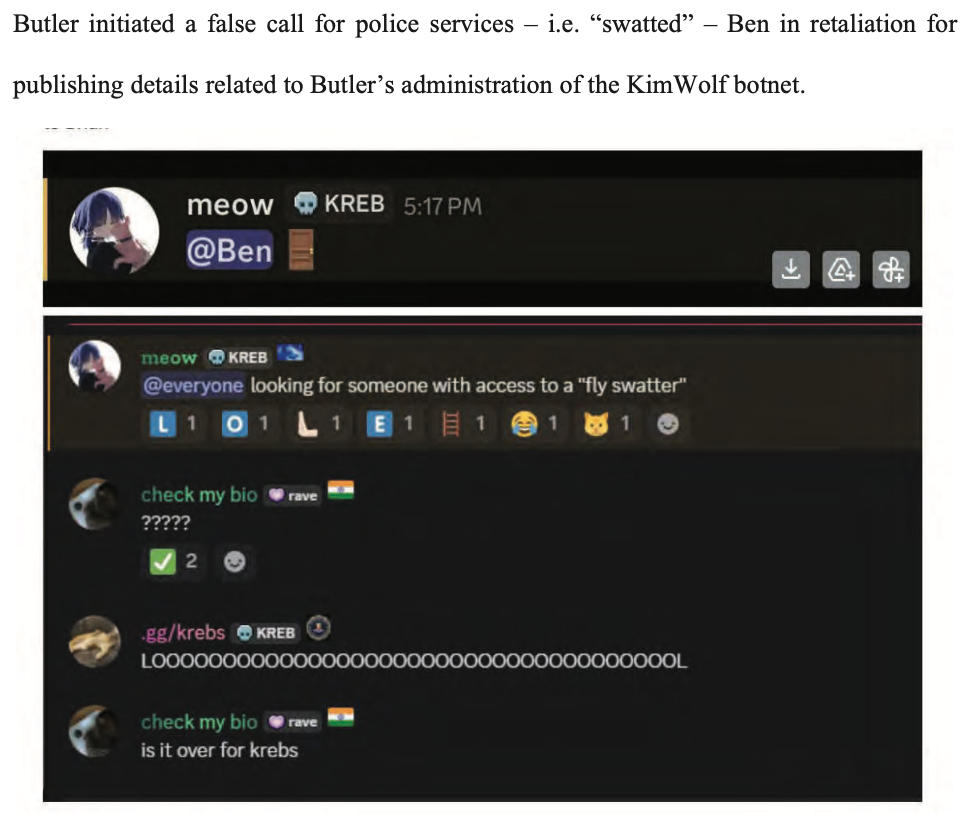
Dort claimed responsibility for at least two swatting attacks targeting the founder of Synthient, a security startup that helped to secure a widespread critical security weakness that Kimwolf was using to spread faster and more effectively than any other IoT botnet out there. Synthient was among many technology companies thanked by the Justice Department today, and Synthient’s founder Ben Brundage told KrebsOnSecurity he’s relieved Butler is in custody.
“Hopefully this will end the harassment,” Brundage said.
An excerpt from the criminal complaint against Butler, detailing how he ordered a swatting attack against Ben Brundage, the founder of the security firm Synthient.
The government says investigators connected Butler to the administration of the KimWolf botnet through IP address, online account information, transaction records, and online messaging application records obtained through the issuance of legal process. The criminal complaint against Butler (PDF) shows he did little to separate his real-life and cybercriminal identities (something we demonstrated in our February unmasking of Dort).
In April, the Justice Department joined authorities across Europe in seizing domain names tied to nearly four-dozen DDoS-for-hire services, although because of a bureaucratic mix-up the list of seized domains has remain sealed until today. The DOJ said at least one of those services collaborated with Butler’s Kimwolf botnet.
A statement from the Ontario Provincial Police said a search warrant was executed on March 19 at Butler’s address in Ottawa, where they seized multiple devices. As a result of that investigation, Butler was arrested and charged this week with unauthorized user of computer; possession of device to obtain unauthorized use of computer system or to commit mischief; and mischief in relation to computer data. He is scheduled to remain in custody until a hearing on May 26.
In the United States, Butler is facing one count of aiding and abetting computer intrusion. If extradited, tried and convicted in a U.S. court, Butler could face up to 10 years in prison, although that maximum sentence would likely be heavily tempered by considerations in the U.S. Sentencing Guidelines, which make allowances for mitigating factors such as youth, lack of criminal history and level of cooperation with investigators.
Un attacco informatico basato su una vulnerabilità sconosciuta nei router enterprise di Huawei avrebbe causato nel 2025 uno dei più gravi incidenti infrastrutturali europei degli ultimi anni, provocando il collasso temporaneo dell’intera rete telecom del Lussemburgo. Secondo quanto riportato da Recorded Future News, l’incidente avrebbe coinvolto un comportamento non documentato del sistema operativo di rete […]
Prima puntata di bitume, trasmissione radiofonica aperiodica a cura di unit
hacklab di Milano.
L'approfondimento satirico della rivoluzione digitale.
Bitume parla di diritti digitali, di nuove forme di protesta incentrate sulla
tecnologia, di media caldi e freddi, di server liberi, di hacking, di sicurezza …
Prima puntata di bitume, trasmissione radiofonica aperiodica a cura di unit
hacklab di Milano.
L'approfondimento satirico della rivoluzione digitale.
Bitume parla di diritti digitali, di nuove forme di protesta incentrate sulla
tecnologia, di media caldi e freddi, di server liberi, di hacking, di sicurezza …

 Accedi