Radiomacher Wolf-Dieter, DL2MCD, hat auf Radio DARC berichtet, wie sich die USKA gegen die im Ernstfall drohende Beschlagnahmung der Funkanlagen der Schweizer Funkamateure wehrt.
Der Bund greift nach den Funkgeräten der Schweizer Funkamateurinnen und Funkamateure. Am 26.7.2026 schilderte Wolf-Dieter, DL2MCD, auf Radio DARC (KW: 6070 kHz und 9670 kHz) die Pläne des Eidgenössischen Departements für Verteidigung, Bevölkerungsschutz und Sport (VBS).
Die geplante Requisitionsverordnung erlaubt der Armee im Ernstfall den Zugriff auf technische Anlagen. Das VBS will die Ausrüstung im Krisenfall schlicht abholen. In ihrer Vernehmlassung fordert die USKA Kooperation statt Enteignung.
From left, Expedition 74 flight engineers Anna Kikina and Pyotr Dubrov of Roscosmos, and Anil Menon of NASA pose for a July 18, 2026, photo while holding a cake celebrating their recent arrival aboard the International Space Station. The trio arrived at the space station on July 14, 2026, after launching from the Baikonur Cosmodrome in Kazakhstan earlier the same day.
Kikina, Dubrov, and Menon are in the second week of their planned eight-and-a-half-month mission. They are using their new skills to conduct space research while still familiarizing themselves with living and working in space.
From left, Expedition 74 flight engineers Anna Kikina and Pyotr Dubrov of Roscosmos, and Anil Menon of NASA pose for a July 18, 2026, photo while holding a cake celebrating their recent arrival aboard the International Space Station. The trio arrived at the space station on July 14, 2026, after launching from the Baikonur Cosmodrome in Kazakhstan earlier the same day.
Kikina, Dubrov, and Menon are in the second week of their planned eight-and-a-half-month mission. They are using their new skills to conduct space research while still familiarizing themselves with living and working in space.
The home appliance giant LG Electronics USA said this week it plans to suspend any apps built for its smart TVs that turn one’s television into an always-on residential proxy node. The move comes less than a month after researchers found that more than 42 percent of games and other apps available for download on LG’s webOS store allow unknown third-parties to route their Internet traffic through a user’s TV.
Proxy SDK prevalence among smart TV apps for LG (webOS) and Samsung (Tizen OS) televisions. Image: Spur.us.
On July 2, we featured research by the security firm Spur that examined the prevalence of residential proxy software development kits (SDKs) in smart TV apps. Spur found more than 42 percent of apps available for download on LG smart TVs include SDKs that turn one’s television in a proxy node indefinitely, and that more than a quarter of the apps made for Samsung’s Tizen operating system had similar residential proxy components.
Responding to questions about Spur’s research, LG Senior Vice President John Taylor told KrebsOnSecurity the company was working with app developers to remove the residential proxy option from their apps on the webOS platform. Developers that fail to comply, he said, will find their apps suspended.
“A residential proxy network is not an intended use for LG smart TVs, and LG Electronics is working with developers to remove the residential proxy option from their apps on the webOS platform,” Taylor said. “If this option is not removed, these apps will be suspended.”
Taylor said LG is committed to keeping residential proxy networks out of its smart TV apps going forward, and that the company’s review of those apps is “well underway now.”
“As part of our ongoing efforts to enhance platform quality and the user experience, LG will continue to strengthen our evaluation process for developer-submitted apps, including those that incorporate residential proxy SDKs,” Taylor wrote in an emailed statement.
App makers looking for ways to monetize their creations can turn to residential proxy providers, which pay developers to include SDKs that turn the user’s device into a residential proxy node that is rented to paying customers. In the case of LG and Samsung smart TVs, Spur found residential proxy SDKs bundled with everything from simple games like Pac-Man to screensavers and file utilities.
A Pac-Man smart TV app from Bright Data offers users the choice between viewing ads in the game or agreeing to allow their TV to serve as a residential proxy node. Image: Spur.us.
Spur’s report found the residential proxy network Bright Data accounted for a majority of proxy SDKs across both Samsung and LG smart TVs. In a statement shared with KrebsOnSecurity, Bright Data said its network is built on consent and responsibility and operates by LG and Samsung terms.
“Every peer opts in through a dedicated screen and receives value in return; every customer is vetted, and our practices have now undergone a second independent audit by PwC,” the statement reads. “We remain committed to an open, transparent internet where legitimate businesses, researchers, and institutions can responsibly access data that lives in the public domain.”
Bright Data and other proxy providers named in Spur’s report all say they follow rigorous know-your-customer processes to validate legitimate uses of their services, which is often heavily tied to content-scraping activities by said customers. The proxy companies also say they incorporate technological countermeasures to prevent proxy service customers from being able to interact with and control other devices on the proxy user’s local network.
Spur argues the problem is not that residential proxy networks exist, but rather that they are being embedded at scale in devices that most consumers do not think of as computers and are not equipped to audit.
“A one-time consent prompt buried in a TV app is not a substitute for meaningful transparency, ongoing control, and platform oversight,” Spur’s Trevor Sutter wrote. “The risk is amplified when consent comes from individuals within the household who use the device but shouldn’t give consent, such as minors.”
LG’s announcement that it is culling residential proxy SDKs from its app store is welcome news, but the company recently came under fire for another questionable partnership: Pimping McAfee security products via software drivers included in its high-end LCD monitors.
Earlier this week, the Youtube channel Gamers Nexus showed that certain LG LCD monitors will automatically install an app that promotes paid McAfee antivirus subscriptions, and that the app arrives through Windows Update without an approval prompt.
Update, July 22, 1:06 p.m. ET: Added statement from Bright Data.
Per anni l’idea di un attacco informatico condotto interamente da un agente di Intelligenza Artificiale è rimasta confinata ai laboratori di ricerca e alle presentazioni dei vendor. Oggi non è più così. La piattaforma Hugging Face, punto di riferimento mondiale per lo sviluppo e la distribuzione di modelli AI open source, ha confermato di essere […]
Baseline, flusso ambientale, abbigliamento e comportamento: come adattarsi al contesto senza trasformarsi in un personaggio
Nella prima parte dello Speciale AIP dedicato al Grey Man abbiamo chiarito che la discrezione non consiste nel diventare invisibili e che non esiste un abbigliamento universalmente adatto a passare inosservati.
Ciò che appare normale in un luogo può risultare insolito in un altro.
Ma come si traduce questo principio nella vita reale?
La risposta non comincia dall’acquisto di uno zaino o dalla scelta di un colore.
Comincia dall’osservazione.
La linea di base: comprendere ciò che è normale
Possiamo utilizzare il termine baseline, o linea di base, per indicare l’insieme dei comportamenti, dei ritmi e delle caratteristiche che, in un determinato luogo e momento, appaiono ordinari.
Entrando in una stazione ferroviaria potremmo osservare persone che:
consultano i tabelloni;
utilizzano il telefono;
trascinano valigie;
aspettano sedute;
camminano verso i binari;
si fermano davanti ai distributori;
parlano a volume moderato.
In uno stadio, in una biblioteca, in un mercato o durante un’evacuazione, la linea di base sarà completamente diversa.
Osservare una baseline significa chiedersi:
come sono vestite mediamente le persone;
cosa trasportano;
a quale velocità si muovono;
quanto parlano;
dove si fermano;
quale livello di agitazione appare normale;
quali direzioni seguono;
quali comportamenti vengono accettati senza particolare attenzione.
Concetto AIP
Prima di cercare di confondersi con un ambiente, bisogna comprenderne la normalità.
La baseline non è però una formula matematica.
Una folla è composta da persone diverse. All’interno della normalità esiste sempre una certa variabilità.
Lo scopo non è diventare una copia degli altri, ma evitare incoerenze inutilmente evidenti.
Il flusso ambientale
Ogni ambiente possiede anche un proprio flusso: il modo in cui persone, mezzi e attività si muovono nello spazio.
In una stazione durante l’ora di punta il flusso può essere rapido e direzionale.
In una piazza turistica può essere lento e irregolare.
In una fila è quasi immobile.
Durante un’evacuazione può diventare veloce, confuso e mutevole.
Una persona può attirare l’attenzione non perché è vestita diversamente, ma perché interrompe il flusso.
Per esempio:
si ferma improvvisamente nel mezzo di un passaggio;
procede nella direzione opposta alla maggioranza;
cambia continuamente percorso;
cammina molto più velocemente o lentamente degli altri;
si volta ripetutamente;
rimane immobile dove tutti stanno lasciando il luogo.
Nessuno di questi comportamenti indica automaticamente un’intenzione ostile.
Può però rendere una persona più riconoscibile.
Il principio pratico è:
Comprendere il ritmo dell’ambiente ed evitare di interromperlo senza una ragione necessaria.
La sicurezza viene comunque prima della discrezione. Se il movimento della folla conduce verso un pericolo, seguirlo soltanto per non distinguersi sarebbe un errore.
La coerenza: quando qualcosa non torna
Spesso l’attenzione non viene attirata da un singolo elemento vistoso, ma da una contraddizione tra ciò che una persona sembra essere e ciò che sta facendo.
Per esempio:
appare rilassata ma controlla continuamente le uscite;
porta una borsa ordinaria ma la protegge in modo ossessivo;
sembra aspettare qualcuno ma osserva sempre lo stesso punto;
è vestita come gli altri ma si muove con un ritmo completamente diverso;
tenta di apparire distratta mentre controlla sistematicamente l’ambiente.
Questi comportamenti non permettono di conoscere le intenzioni della persona.
Rendono però la sua presenza meno facilmente spiegabile e quindi potenzialmente più interessante.
Per il Grey Man, aspetto e comportamento dovrebbero raccontare una storia semplice e coerente.
Non serve inventare una falsa identità.
Spesso basta non rendere misterioso ciò che non ha bisogno di esserlo.
Ridurre la descrivibilità
Immaginiamo di chiedere a qualcuno di descrivere una persona vista pochi minuti prima.
Probabilmente utilizzerà gli elementi più distintivi:
“quello con la giacca gialla”;
“quello con lo zaino militare”;
“quello con il cappello rosso”;
“quello che continuava a voltarsi”;
“quello che parlava ad alta voce”.
Questi elementi diventano appigli descrittivi.
Quando la discrezione è utile, può essere ragionevole ridurre:
grandi loghi;
scritte particolarmente provocatorie;
colori molto insoliti rispetto al luogo;
accessori appariscenti;
equipaggiamento tecnico esposto;
comportamenti ripetitivi;
voce eccessivamente alta;
ostentazione di oggetti costosi.
L’obiettivo non è cancellare la propria identità, ma evitare di creare senza necessità una caratteristica che permetta di essere immediatamente classificati.
Domanda pratica
Se qualcuno dovesse descrivermi tra dieci minuti, quale sarebbe la prima caratteristica che utilizzerebbe?
Il paradosso dell’equipaggiamento tattico
Uno degli errori più comuni consiste nel credere che uno zaino tattico diventi discreto semplicemente perché è nero, grigio o verde oliva.
Può comunque essere riconoscibile per:
pannelli MOLLE;
velcro per patch;
tasche modulari;
cinghie esterne molto evidenti;
moschettoni;
torce o utensili agganciati;
struttura particolarmente rigida.
In determinate circostanze questo non rappresenta alcun problema.
In altre può comunicare:
“Questa persona potrebbe trasportare attrezzatura interessante.”
Il materiale tattico non deve essere demonizzato. Deve essere scelto in base alla funzione e al contesto.
Una comune borsa urbana può contenere:
acqua;
torcia;
power bank;
kit di primo soccorso;
documenti;
radio compatta;
piccoli strumenti di emergenza.
Le capacità restano disponibili, ma non vengono necessariamente dichiarate.
Errore comune
Pensare che esista uno “zaino Grey Man” universale.
La discrezione non è una caratteristica assoluta dell’oggetto. Nasce dalla relazione tra oggetto, persona, comportamento e ambiente.
Scarpe, accessori e piccoli dettagli
Anche elementi apparentemente secondari contribuiscono alla percezione complessiva.
Le calzature devono essere funzionali, ma anche plausibili rispetto al contesto.
Scarponi da montagna sono normali su un sentiero, meno comuni in altri ambienti. Scarpe eleganti possono essere adatte a un centro direzionale e completamente inadatte durante un’evacuazione su terreno fangoso.
Lo stesso vale per:
orologi costosi;
gioielli;
grandi loghi;
accessori tecnici;
profumi particolarmente intensi;
oggetti rumorosi;
strumenti appesi all’esterno dello zaino.
Non è necessario eliminare ogni elemento personale.
Bisogna però ricordare che la nostra presenza viene comunicata attraverso l’insieme dei dettagli.
Il corpo comunica prima delle parole
Una persona che desidera essere discreta potrebbe commettere l’errore di:
evitare ossessivamente il contatto visivo;
mantenere sempre il capo abbassato;
camminare sistematicamente vicino ai muri;
controllare continuamente chi si trova alle spalle;
cambiare bruscamente direzione;
osservare insistentemente uscite e telecamere;
stringere lo zaino al petto;
apparire eccessivamente rigida.
Questi comportamenti possono attirare più attenzione di un atteggiamento naturale.
Il Grey Man non dovrebbe sembrare furtivo.
L’ambiente può essere osservato anche attraverso azioni normali: consultare un tabellone, guardare una vetrina, scegliere un punto con una buona visuale o cambiare posizione con calma.
Anche il contatto visivo deve rimanere naturale.
Fissare insistentemente le persone può risultare invasivo. Evitare ostentatamente lo sguardo di chiunque può apparire altrettanto insolito.
La consapevolezza può essere elevata internamente senza essere ostentata esternamente.
Anche la voce comunica
La discrezione non è soltanto visiva.
Ogni ambiente possiede un proprio livello sonoro.
In una biblioteca si parla diversamente rispetto a uno stadio. In un vagone ferroviario silenzioso, una telefonata ad alta voce può rendere una persona immediatamente memorabile.
Durante una situazione di emergenza, discutere pubblicamente delle proprie scorte, delle attrezzature possedute o della destinazione scelta può comunicare informazioni non necessarie.
La voce può rivelare:
agitazione;
intenzioni;
destinazioni;
disponibilità di risorse;
competenze;
informazioni familiari.
Essere Grey Man non significa non parlare.
Significa valutare quanto, come e con chi parlare.
Discrezione non significa vulnerabilità
Il Grey Man viene talvolta descritto come una persona che dovrebbe sembrare debole, povera o priva di risorse.
Questa interpretazione può essere controproducente.
In alcuni ambienti, apparire eccessivamente vulnerabili potrebbe aumentare il rischio di essere selezionati come bersaglio.
La discrezione non coincide con la sottomissione.
Un atteggiamento equilibrato comprende:
postura sicura ma non aggressiva;
movimenti calmi;
attenzione all’ambiente;
capacità di mantenere una distanza adeguata;
decisioni semplici e tempestive;
assenza di provocazioni;
disponibilità ad allontanarsi prima che una situazione peggiori.
Preparare le decisioni
L’indecisione può rendere più visibili.
Fermarsi improvvisamente, tornare più volte sui propri passi, controllare continuamente il telefono o discutere animatamente su cosa fare può attirare attenzione.
Conoscere in anticipo:
le principali uscite;
un punto di incontro familiare;
modalità alternative di comunicazione;
percorsi secondari;
ciò che deve essere portato con sé;
le condizioni che suggeriscono di lasciare un luogo;
può ridurre l’incertezza.
La preparazione riduce il numero di decisioni che devono essere improvvisate sotto stress.
Un piano non deve essere rigido. Deve fornire opzioni.
Grey Man e consapevolezza situazionale
Grey Man e consapevolezza situazionale sono collegati, ma non equivalenti.
La consapevolezza situazionale riguarda la capacità di:
percepire ciò che accade;
comprenderne il significato;
valutarne la possibile evoluzione;
decidere come comportarsi.
Il Grey Man riguarda soprattutto la gestione di ciò che la propria presenza comunica agli altri.
Una persona può essere discreta ma totalmente inconsapevole di ciò che accade.
Un’altra può essere molto attenta, ma manifestare la propria vigilanza in modo così evidente da attirare l’attenzione.
La condizione ideale consiste nel combinare le due capacità:
osservare senza fissare;
valutare senza giudicare troppo rapidamente;
decidere senza agitarsi;
muoversi senza attirare inutilmente attenzione.
Le sette domande del Grey Man
Prima di entrare in un ambiente o affrontare uno spostamento può essere utile chiedersi:
1. Qual è la linea di base?
Come sono vestite le persone? Cosa trasportano? Come si comportano?
2. Qual è il flusso?
Dove si muovono? A quale velocità? Dove si fermano?
3. Cosa attira l’attenzione?
Oggetti costosi, abbigliamento incongruo, movimenti nervosi o voce alta?
4. Cosa comunica il mio equipaggiamento?
Suggerisce valore, capacità, autorità, vulnerabilità o disponibilità di risorse?
5. Il mio comportamento è coerente?
Ciò che faccio appare naturale rispetto al luogo e alla situazione?
6. Come sarei descritto?
Quale sarebbe la prima caratteristica utilizzata per identificarmi?
7. In questo scenario è davvero utile essere discreti?
Oppure sarebbe più sicuro rendersi visibili, chiedere aiuto o identificarsi chiaramente?
Queste domande non producono una risposta universale.
Producono qualcosa di più utile:
Una decisione adattata al contesto.
Gli errori più comuni
Cercare di essere invisibili
Il Grey Man non si nasconde necessariamente. Si adatta.
Utilizzare sempre colori scuri
Nero, grigio e verde oliva non sono automaticamente discreti.
Indossare un’uniforme da “uomo grigio”
Pantaloni tecnici, cappellino e zaino tattico possono diventare essi stessi uno stereotipo.
Osservare tutto in modo evidente
La vigilanza ostentata può richiamare attenzione.
Evitare sistematicamente lo sguardo
Può risultare più insolito di un breve contatto visivo naturale.
Pensare soltanto all’abbigliamento
Voce, postura, gesti e movimento possono essere più riconoscibili dei vestiti.
Interpretare ogni anomalia come una minaccia
Una deviazione dalla linea di base è un’informazione, non una prova.
La discrezione è adattamento
La pratica del Grey Man non consiste nell’acquistare un prodotto.
Consiste nel comprendere il contesto, osservare prima di agire, scegliere ciò che è funzionale senza ostentarlo e mantenere consapevolezza senza trasformarla in comportamento artificiale.
La discrezione deve sempre rimanere subordinata alla sicurezza.
Continua lo Speciale AIP
Parte 3 — Grey Man, OPSEC e sicurezza digitale
Nella terza parte analizzeremo ciò che comunichiamo senza rendercene conto: scorte, energia, equipaggiamenti, conversazioni, social network e informazioni personali.
Preparations for Next Moonwalk Simulations Underway (and Underwater)
A modified Saab 340B aircraft in flight powered in part by a hybrid electric system built by GE Aerospace, along with NASA, BETA Technologies, and Boeing.
GE Aerospace
An aircraft powered by a megawatt-class hybrid-electric engine developed in collaboration with NASA and built by GE Aerospace, demonstrated flight of an innovation that can inform new generations of fuel-saving aircraft power systems.
Mounted to a Saab 340B aircraft, the engine flew at Farnborough International Air Show in the United Kingdom. It was the public debut of a system that has in recent months made historic test flights, becoming the first hybrid electric-powered aircraft to fly above 30,000 feet.
“This achievement reflects what NASA does best in aeronautics: we explore bold possibilities, validate them through rigorous research and testing, and work with industry to turn breakthrough ideas into technologies that bring real value for the American people,” said Laurie Grindle, director of the Aeronautics Division within the agency’s Research and Technology Mission Directorate at NASA Headquarters in Washington.
The testing leveraged work done through NASA’s former Electrified Powertrain Flight Demonstration project and the agency’s ongoing Subsonic Vehicle Technologies and Tools project – years of collaborative research that included key testing at NASA test facilities.
The engine integrates electric motors, a gas turbine, and energy storage capabilities. It was designed to demonstrate the capacity to power an aircraft around the size of a regional-class jet, reducing fuel burn and costs without sacrificing performance. The unit’s technology and designs are expected to be used to help develop future hybrid systems that could lower airline operating costs.
The demonstration flight came after years of rapid development for the technology. For NASA, it also validates work that stretches back to a time when hybrid aviation propulsion seemed almost beyond the horizon of possibility.
This achievement reflects what NASA does best in aeronautics: we explore bold possibilities, validate them through rigorous research and testing, and work with industry to turn breakthrough ideas into technologies that bring real value for the American people.
LAURIE A. GRINDLE
Director of the Aeronautics Division within the agency's Research and Technology Mission Directorate
“This is the culmination of more than 15 years of work, and we did that because it’s going to have an impact for aircraft that will help reduce energy use and help U.S. companies and the public,” said Ralph Jansen, aerospace engineer at NASA’s Glenn Research Center in Cleveland. “It’s about having a vision that no one believes can happen and then doing the work to define and execute the research and development needed to make it happen.”
This accomplishment was possible because of the collaborative effort of hundreds of people working on Electrified Powertrain Flight Demonstration and Subsonic Vehicle Technologies and Tools projects across NASA centers, in conjunction with GE Aerospace and its partner companies.
Hybird-Electric Evolves
In recent years, aviation has seen a boom in small aircraft and drones powered by electrical systems drawing from batteries. But large passenger and cargo planes require complex engines capable of supplying massive amounts of power. So more than a decade ago when NASA began contemplating hybrid systems, just the possibility of using electric motors to supplement some energy was a daunting engineering challenge.
NASA spent about seven years performing preliminary research, working with small businesses and other partners to consider technological obstacles and the potential commercial viability of hybrid systems. During that time, the agency addressed several barriers to implementation including the power, thermal, and battery technology, and the integration of the power system, engine, and aircraft.
Through the agency’s Electrified Powertrain Flight Demonstration award, GE Aerospace and NASA worked with researchers to develop lighter and more efficient power systems and shrink key components – sometimes dramatically.
NASA and GE Aerospace also leveraged agency facilities and resources to further their research. In 2022, GE Aerospace tested an integrated version of its propulsion system at NASA’s Electric Aircraft Testbed at the agency’s Neil A. Armstrong Test Facility in Sandusky, Ohio. Testing allowed the system to operate in conditions simulating 45,000 feet in altitude, the range in which commercial single-aisle aircraft fly.
The team added components, including electric motors, power converters, propellers, and a GE Aerospace commercial engine, followed by more ground tests and eventual flight tests. For the researchers who’d spent years on the concept, seeing the engine powering an aircraft in flight was a major step in a long journey.
“I’ve got to say, I was pretty touched seeing it fly. It was just awesome,” Jansen said. “It’s just like a regular plane, which is probably the best thing of all.”
NASA’s current support for this research is through the Aeronautics Division of its Research and Technology Mission Directorate.
ULTIMO ALLENAMENTO PRIMA DELLA PAUSA ESTIVA - accorrette pazzu ribellu in erba!
Vieni con noi, padroneggia la grande arte del clowneggiamento ribelle e della cospirazione approssimativa :O)
Cos'è Clown ARMY?? È una tecnica di piazza spontanea e autogestita nata con l'intento di inviare messaggi irriverenti e gestire i nostri colleghi delle forze dell'ordine.
Lanciamo una grande campagna di arruolamento aperto a tutt*, che più siamo meglio è!
Ci vediamo ogni secondo e quarto mercoledì del mese nella palestra del mani, a cui lasciamo un contributo volontario per le spese.
Ogni incontro alterniamo allenamento di tecniche improbabili e ridicole da usare in piazza e discussioni deliranti in cui ci rilanciamo le idee pazze a vicenda.
LA CLOWN ARMY CERCA ✨TE ✨
MA ESSENDO FORZA DEL (DIS)ORDINE NON RIESCE A TROVARTI
RENDILE IL LAVORO FACILE E UNISCITI A LEI DIRETTAMENTE grazie
Quando:
Mercoledì 24 giugno
dalle 20.30 alle 22.30
Dove:
Al CLIM (Manituana), in Largo Maurizio Vitale 113 To)
Ministers hold a series of meetings in parliamentary committees to present the priorities of the Irish Presidency of the Council in the relevant policy fields. Committee on Constitutional Affairs Committee on Foreign Affairs Committee on Agriculture and Rural Development Committee on Culture and Education Committee on Development Committee on Economic and Monetary Affairs Committee on Employment and Social Affairs Committee on the Environment, Public Health and Food Safety Committee on Women’s Rights and Gender Equality Committee on International Trade Committee on Civil Liberties, Justice and Home Affairs Committee on Fisheries Committee on Regional Development Committee on Public Health Committee on Security and Defence Committee on Transport and Tourism
NASA Uses Subscale Aircraft to Accelerate Flight Innovation
An atmospheric probe model attached upside down to a quad rotor remotely piloted aircraft ascends with the Moon visible on Oct. 22, 2024. The quad rotor aircraft released the probe above Rogers Dry Lake, a flight area adjacent NASA’s Armstrong Flight Research Center in Edwards, California. The probe was designed and built at the center.
Credits: NASA/Steve Freeman
Testing new aerospace concepts in flight remains one of NASA’s most effective ways to advance knowledge and reduce risk.
The Dale Reed Subscale Flight Research Laboratory at NASA’s Armstrong Flight Research Center in Edwards, California, supports this mission by using small, remotely piloted and autonomous aircraft as cost‑effective platforms to mature innovative ideas, accelerate learning, and enable smoother transitions to full‑scale flight.
When experiments require a flight platform, several NASA remotely piloted aircraft are available: the Alta‑X quadrotor; the Dryden Remotely Operated Integrated Drone (DROID) with its 10‑foot wingspan; and the Multi‑Use Cub, a 14‑foot‑span fixed‑wing aircraft with an expandable payload capacity for flight experiments. For electric vertical takeoff and landing testing, the HQ‑90 quadrotor provides an additional option.
Once aircraft and experiments are cleared for operations, laboratory pilots support the mission, including ground operations and flight activities.
Justin Link, left, holds the subscale aircraft in place, while Justin Hall manages engine speed during preliminary engine tests on Friday, Sept. 12, 2025, at NASA’s Armstong Flight Research Center in Edwards, California. Link is a pilot for small uncrewed aircraft systems at the center’s Dale Reed Subscale Flight Research Laboratory and Hall is the chief pilot.
NASA/Christopher LC Clark
Flight expertise
Each staff member serves as an experienced and certified subscale aircraft pilot and is prepared to fly unique one-of-a-kind or modified commercial aircraft wherever the mission requires.
NASA’s FireSense project conducted flights in the Geneva State Forest, located about 100 miles south of Montgomery, Alabama. NASA Armstrong flight research staff integrated the instrument onto an Alta-X drone and tested the system before deployment. Two team members then transported the drone and sensor to the forest, prepared the vehicle for flight, and operated it during the mission. The NASA sensor was flown on the drone to demonstrate how remotely piloted aircraft can gather localized weather data that influences smoke movement and fire behavior. This information may help operational agencies improve wildfire decision-making and better allocate firefighters and resources.
Other missions occur closer to NASA Armstrong, such as the Enhancing Parachutes by Instrumenting the Canopy (EPIC) project. EPIC involved air‑launching a capsule containing a parachute and flexible sensor from the Alta‑X. Laboratory staff piloted the flights, supported flight operations, and worked with the EPIC team to design and integrate the parachute‑drop mechanism and safety system into the aircraft.
These tests demonstrated that a flexible sensor could help researchers study supersonic parachutes. Continuation of this work can help fill gaps in computer models, making supersonic parachutes safer and more reliable for delivering science instruments and payloads to Mars.
Justin Link, left, pilot for small uncrewed aircraft systems, and Justin Hall, chief pilot for small uncrewed aircraft systems, install weather instruments on NASA’s Alta X drone at the agency’s Armstrong Flight Research Center in Edwards, California. Members of the center’s Dale Reed Subscale Flight Research Laboratory used the Alta X to support the agency’s FireSense project in March 2025 for a prescribed burn in Geneva State Forest, which is about 100 miles south of Montgomery, Alabama.
NASA/Steve Freeman
Advancing challenging research
The Dale Reed Subscale Flight Research Laboratory uses rapid design and testing capabilities to help small aircraft fly big ideas. These concepts could lead to future breakthroughs that support NASA’s missions across aeronautics, science, and exploration.
For decades, NASA and its partners have advanced Automatic Collision Avoidance Technology. The research demonstrated an autopilot could detect and recover from an imminent ground collision – a capability now helping save lives in high‑performance U.S. military jets. NASA Armstrong had key roles in that work and developed a simplified version, the Automatic Ground Collision Avoidance System, which was installed on the DROID for testing.
The system demonstrated on the DROID — developed to assist general aviation pilots as well as remotely piloted and autonomous aircraft — performed well and led to further research toward a version that provides alerts and steering cues. The NASA Armstrong Technology Transfer Office is working to license the technology for U.S. businesses to develop the system as a commercial product.
The Prandtl‑D (Preliminary Research Aerodynamic Design to Lower Drag) flying‑wing glider was also designed, fabricated, and flown at NASA Armstrong. Researchers found that its twisted wing design could reduce drag and generate thrust at the wingtips, advancing concepts that may support greater fuel economy for future aircraft. The original Prandtl‑D is now part of the Smithsonian National Air and Space Museum collection in Washington, and the Prandtl-D3 is at the California Science Center in Los Angeles. Researchers continue developing the next generation of the design in the laboratory.
A wide range of capabilities in the laboratory help transform promising concepts into flight-ready test structures. These include rapid prototyping using traditional and advanced 3D manufacturing techniques, as well as composite and conventional fabrication processes. The team of engineers and technicians also provides custom component design and specialized fabrication to meet unique research needs.
The laboratory supports electrical and mechanical design, hardware and software integration, and the safety and flight-readiness processes required for successful missions. Additional technical facilities, such as the Experimental Fabrication Branch and the Environmental Laboratory at NASA Armstrong, further enhance these capabilities. Together, they support development, testing, and validation activities that advance NASA’s aeronautics and exploration goals.
Deborah Jackson, Al Bowers and Abbigail Waddell successfully launch the subscale Prandtl-D 3C glider.
NASA researchers are developing technology to close knowledge gaps and make supersonic parachutes safer and more reliable for delivering science instruments ...
Le persone vengono prima del linguaggio o, almeno in parte, nascono dentro di esso? Da Ulisse a Jung, da Vico a Wittgenstein, attraversiamo una domanda antica e inquietante: che cosa esiste quando esiste soltanto nelle parole, nei racconti e nella memoria condivisa? Personaggi letterari, nazioni, leggi, identità personali, figure interiori e intelligenze artificiali sembrano appartenere […]
Die erste Schweizer Outdoor-Radio Aktivitätswoche lockt vom 24. Juli bis zum 2. August 2026 Funkamateure an die Funkgeräte und in die Alpen – aber nicht nur.
Das Schweizer HBBOTA-Programm ist jung und verlangt nach Aufmerksamkeit. Deswegen schicken die Verantwortlichen die Szene im Sommer in die Festungsbauten des Landes. Das Ziel ist simpel: Jäger und Aktivatoren sollen die Schweizer Bunker in die Logbücher bringen.
WWBOTA
Die Aktion startet international. Vom 24. bis 26. Juli 2026 organisiert WWBOTA das weltweite Bunkerfest. Funkerinnen und Funker aus den europäischen Nachbarländern lauern auf Verbindungen mit den eidgenössischen Anlagen.
Wer hier punkten will, muss die Spielregeln kennen. Für den WWBOTA-Award zählt jeweils nur ein Bunker gleichzeitig. Funkkontakte von Bunker zu Bunker versprechen an diesen drei Tagen eine hohe Erfolgsquote, weil die europäischen Untergruppen koordiniert ausschwärmen.
HBBOTA
Nach dem internationalen Auftakt folgt die nationale Verlängerung. Die Organisatoren dehnen die Aktivitätswoche bewusst über den Nationalfeiertag bis zum 2. August aus. Am eigentlichen HBBOTA-Wochenende vom 1. und 2. August rückt die Kombination verschiedener Diplome in den Fokus der Funkbetriebstechnik.
Sylvia HB9INY verweist auf logistische Highlights: Es existieren Standorte in der Schweiz, an denen Operator mit einer einzigen Antennenkonstruktion gleichzeitig Punkte für SOTA, POTA und BOTA einfahren. Ein Berggipfel, der in einem Naturpark liegt und eine alte Militärfestung beherbergt, macht diese Triple-Aktivierung möglich.
Details auf der Website
Wer die Standorte dieser kombinierten Zonen sucht oder die genauen Award-Bedingungen studieren will, findet die Details auf der BOTA-Webseite. Die Betreiber aktualisieren die Datenlisten und Aktivierungshinweise laufend.
A NASA F-15 aircraft flies above Washington on Saturday, July 4, 2026, as part of a flyover to celebrate America’s 250th birthday. This aircraft is from NASA’s Armstrong Flight Research Center in Edwards, California, and it joined other NASA aircraft for the flyover.
NASA/Jim Ross
In honor of America’s 250th birthday, two of NASA’s most iconic aircraft got a fresh coat of red, white, and blue paint ahead of a flyover in Washington on July 4, 2026, with other NASA aircraft.
An F-15 and an F/A-18 from NASA’s Armstrong Flight Research Center in Edwards, California, recently were repainted in patriotic colors as a tribute to the past and a salute to the future.
The red, white, and blue commemorative paint and Freedom 250 logo will remain on these aircraft for at least the next year, so be sure to catch these at local air shows and events.
Follow along on social media and at https://www.nasa.gov/freedom250/ to learn more about where to spot the aircraft (dependent upon availability and flying schedules):
NASA’s F-15, right, and F/A-18 aircraft are shown at International Aerospace Coatings Inc.’s facility in Spokane, Washington, on Thursday, July 2, 2026, with new red, white, and blue paint to celebrate America’s 250th birthday. The aircraft, from NASA’s Armstrong Flight Research Center in Edwards, California, participated in the Freedom 250 flyover in Washington on Saturday, July 4, 2026, with other NASA and military aircraft. NASA/Jim Ross
NASA/Jim Ross
NASA’s F-15 aircraft is shown at International Aerospace Coatings Inc.’s facility in Spokane, Washington, on Thursday, July 2, 2026, with new red, white, and blue paint to celebrate America’s 250th birthday. The aircraft, from NASA’s Armstrong Flight Research Center in Edwards, California, participated in the Freedom 250 flyover in Washington on Saturday, July 4, 2026, with other NASA and military aircraft. NASA/Jim Ross
NASA/Jim Ross
NASA’s F-18 aircraft is shown at International Aerospace Coatings Inc.’s facility in Spokane, Washington, on Thursday, July 2, 2026, with new red, white, and blue paint to celebrate America’s 250th birthday. The aircraft, from NASA’s Armstrong Flight Research Center in Edwards, California, participated in the Freedom 250 flyover in Washington on Saturday, July 4, 2026, with other NASA and military aircraft. NASA/Jim Ross
Cos’è realmente la Grey Man Theory, cosa può insegnarci la psicologia dell’attenzione e perché passare inosservati non significa diventare invisibili
Quando si parla di preparazione alle emergenze, l’immaginario collettivo tende spesso ad associare il prepper a un’estetica immediatamente riconoscibile: abbigliamento tattico, zaino dotato di sistema MOLLE, scarponi robusti, numerose tasche, strumenti visibili e un atteggiamento costantemente vigile.
Questo tipo di equipaggiamento può essere perfettamente funzionale in determinati ambienti. In una stazione ferroviaria, in un centro commerciale o durante uno spostamento urbano, però, potrebbe comunicare più informazioni di quanto sia opportuno.
Potrebbe suggerire che una persona è organizzata, preparata o in possesso di attrezzature e risorse utili. In condizioni ordinarie ciò potrebbe essere irrilevante. In uno scenario caratterizzato da tensione, scarsità o disordine, invece, attirare inutilmente l’attenzione potrebbe diventare un fattore di rischio.
Da questa considerazione nasce ciò che nel mondo del prepping, del survival e della sicurezza personale viene comunemente chiamato Grey Man, letteralmente “uomo grigio”.
Il Grey Man, però, non è necessariamente vestito di grigio.
Non è invisibile.
E non è una spia.
Il principio può essere riassunto in modo molto più semplice:
Quando la situazione lo richiede, evitare di diventare inutilmente rilevanti agli occhi degli altri.
In breve
Il Grey Man non cerca necessariamente di non essere visto.
Cerca di non offrire ragioni particolari per essere osservato più attentamente, ricordato o selezionato.
Non esiste un colore, un abbigliamento o uno zaino capace di rendere una persona invisibile. La discrezione dipende dalla relazione tra individuo, comportamento, equipaggiamento e ambiente.
Una strategia pratica, non una teoria scientifica
L’espressione Grey Man Theory è molto diffusa negli ambienti prepper e survival, ma non indica una teoria scientifica formalizzata con una definizione accademica condivisa.
Non risulta inoltre prudente attribuirle un’unica origine militare, di intelligence o storica senza disporre di fonti primarie sufficientemente solide.
È più corretto considerarla una strategia pratica composta da principi provenienti da ambiti differenti, tra cui:
Un suggerimento nato dall’esperienza può essere ragionevole senza rappresentare una legge scientifica. Allo stesso modo, uno studio di psicologia non deve essere utilizzato per dimostrare qualcosa che non ha esaminato direttamente.
Vedere non significa necessariamente notare
Ogni giorno siamo esposti a una quantità enorme di informazioni: volti, movimenti, suoni, veicoli, colori, cartelli, oggetti e conversazioni.
Il cervello non elabora tutto con la stessa profondità. L’attenzione seleziona una parte delle informazioni disponibili, privilegiando ciò che appare pertinente rispetto al compito che stiamo svolgendo, ai nostri obiettivi e alle nostre aspettative.
Uno dei fenomeni più conosciuti in questo ambito è la cecità da disattenzione, o inattentional blindness.
Nel celebre studio pubblicato nel 1999 da Daniel Simons e Christopher Chabris, i partecipanti dovevano osservare un filmato e contare i passaggi effettuati da alcuni giocatori. Durante la scena compariva un evento inatteso e molto evidente, che una parte consistente degli osservatori non riferiva di aver notato. Lo studio è diventato noto attraverso il cosiddetto esperimento del “gorilla invisibile”. L’esperimento non dimostra la Grey Man Theory e non prova che una persona possa rendersi volontariamente invisibile.
Dimostra qualcosa di diverso:
Essere presenti nel campo visivo di qualcuno non significa necessariamente diventare il centro della sua attenzione.
Il lavoro di Arien Mack e Irvin Rock sulla cecità da disattenzione ha contribuito a mostrare quanto la percezione cosciente dipenda dall’attenzione dedicata agli stimoli presenti.
Essere visibili, essere notati ed essere ricordati non sono necessariamente la stessa cosa.
L’attenzione non è un interruttore
Sarebbe però sbagliato concludere che sia sufficiente confondersi con lo sfondo per non essere notati.
Ciò che richiama l’attenzione dipende da molti fattori:
ciò che una persona sta cercando;
ciò che si aspetta di vedere;
il compito che sta svolgendo;
le caratteristiche dello stimolo;
la posizione rispetto al punto osservato;
l’esperienza dell’osservatore;
il contesto complessivo.
Anche la posizione di uno stimolo rispetto al centro dell’attenzione può influire sulla probabilità che venga rilevato. Grey Man non può essere ridotto a una formula del tipo:
Colori neutri uguale invisibilità.
Il colore è soltanto una variabile. Possono essere altrettanto importanti:
la forma dello zaino;
la postura;
il modo di camminare;
la velocità dei movimenti;
la direzione dello sguardo;
il tono della voce;
gli oggetti trasportati;
la coerenza complessiva con il luogo.
La domanda corretta non è quindi:
“Quale colore mi rende meno visibile?”
La domanda più utile è:
“Che cosa, in questo specifico ambiente, potrebbe rendermi insolitamente interessante?”
La normalità è contestuale
Non esiste un abbigliamento Grey Man valido ovunque.
Una persona con scarponi, pantaloni tecnici e zaino da escursionismo può essere assolutamente ordinaria all’inizio di un sentiero montano.
Lo stesso abbigliamento potrebbe risultare più riconoscibile in un ambiente professionale o durante una serata elegante.
Un completo formale può essere normale in un centro direzionale e insolito durante un’attività di volontariato in una zona alluvionata.
Persino un colore acceso non è sempre incompatibile con la discrezione. Durante una festa o un evento sportivo, presentarsi completamente vestiti di nero, grigio o verde oliva potrebbe rendere una persona più riconoscibile rispetto a chi indossa i colori diffusi tra i partecipanti.
Il concetto fondamentale è quindi quello della normalità contestuale.
Essere Grey Man non significa adottare un’uniforme. Significa capire che ciò che appare normale in un luogo può risultare insolito in un altro.
Errore comune
Pensare che esista un “look Grey Man”.
Pantaloni tecnici, cappellino neutro, occhiali scuri e zaino tattico possono creare un nuovo stereotipo facilmente riconoscibile.
Non invisibili, ma meno rilevanti
Il termine “invisibile” viene spesso utilizzato nella divulgazione sul Grey Man. È efficace dal punto di vista narrativo, ma rischia di essere fuorviante.
Nessuna tecnica può garantire che una persona:
non venga osservata;
non venga ricordata;
non venga riconosciuta;
non venga ripresa da una telecamera;
non richiami l’attenzione di qualcuno.
Il Grey Man deve essere considerato un tentativo di ridurre la rilevanza non necessaria della propria presenza, non una tecnica di invisibilità.
In termini semplici:
Non diventare la cosa più interessante nell’ambiente, quando non esiste una buona ragione per esserlo.
Il Grey Man non è un travestimento
Trasformare la discrezione in una recita può produrre l’effetto opposto.
Un abbigliamento può apparire formalmente coerente, mentre il comportamento racconta qualcosa di completamente diverso.
Una persona può vestirsi come un escursionista, ma muoversi in modo evidentemente inesperto.
Può utilizzare uno zaino urbano, ma proteggerlo ossessivamente come se contenesse qualcosa di eccezionale.
Può cercare di apparire rilassata, controllando però in continuazione ciò che accade alle proprie spalle.
La discrezione efficace non nasce necessariamente dalla costruzione di una falsa identità.
Nasce soprattutto dalla coerenza tra aspetto, comportamento e contesto.
Un’anomalia non è una prova
Un’altra interpretazione problematica del Grey Man consiste nel considerare ogni persona o comportamento insolito come una possibile minaccia.
Questo approccio può generare valutazioni errate, ipervigilanza e reazioni sproporzionate.
Una persona può deviare dalla normalità di un ambiente per numerose ragioni innocue:
non conosce il luogo;
ha una disabilità;
sta cercando qualcuno;
è in ritardo;
ha ricevuto una telefonata importante;
è semplicemente distratta.
La consapevolezza situazionale richiede osservazione e valutazione, non conclusioni immediate.
Principio AIP
Un’anomalia è un’informazione, non una prova.
I limiti del Grey Man
Il Grey Man:
non garantisce anonimato;
non elimina i rischi;
non sostituisce la consapevolezza situazionale;
non rende invisibili alle tecnologie di sorveglianza;
non impedisce a un osservatore attento di notare una persona;
non è adatto a tutte le emergenze.
Durante una ricerca o un soccorso, essere visibili può salvare la vita.
In ambiente naturale, colori facilmente individuabili possono facilitare il ritrovamento.
Durante un incendio, un’alluvione o un incidente, segnalare chiaramente la propria posizione può essere prioritario.
La discrezione è quindi uno strumento situazionale, non una regola universale.
Comprendere prima di applicare
Il valore del Grey Man non consiste nell’insegnare alle persone a nascondersi.
Consiste nel ricordare che comunichiamo continuamente informazioni attraverso:
l’aspetto;
il comportamento;
ciò che trasportiamo;
il modo in cui ci muoviamo;
il modo in cui interagiamo.
Il Grey Man non è un colore.
Non è uno zaino.
Non è una tecnica infallibile.
È, nella sua interpretazione più ragionevole, una forma di adattamento consapevole al contesto.
E per adattarsi a un ambiente, prima bisogna imparare a leggerlo.
Continua lo Speciale AIP
Parte 2 — Grey Man nella pratica: ambiente, comportamento ed equipaggiamento
Nella seconda parte analizzeremo come osservare la linea di base e il flusso di un ambiente, come scegliere equipaggiamento e abbigliamento coerenti e quali comportamenti possono attirare involontariamente l’attenzione.
Nota metodologica
La Grey Man Theory è un concetto divulgativo diffuso soprattutto negli ambienti prepper, survival e della sicurezza personale, non una teoria scientifica formalizzata.
Gli studi sulla cecità da disattenzione vengono citati per illustrare alcuni meccanismi dell’attenzione umana. Non costituiscono una dimostrazione sperimentale dell’efficacia complessiva del Grey Man.
Fonti essenziali
Simons, D. J., & Chabris, C. F. (1999). Gorillas in our midst: Sustained inattentional blindness for dynamic events. Perception, 28(9), 1059–1074. DOI: 10.1068/p281059.
Preparations for Next Moonwalk Simulations Underway (and Underwater)
Matt Kamlet, an employee at NASA’s Armstrong Flight Research Center in Edwards, California, sits atop the virtual reality passenger ride quality simulator during a study of air taxi motion Monday, Dec. 15, 2025. NASA recently completed a multi-year study to understand how large, sudden air taxi motion affects ride comfort.
NASA/Christopher LC Clark
No one wants to get into an uncomfortable aircraft. NASA research could help the emerging industry of air taxis —small, vertical-takeoff-and-landing aircraft meant for short trips — understand the relationship between comfort and willingness to fly.
That’s where NASA comes in, with data that can help identify how to plan air taxi rides that can keep travelers feeling good.
NASA was able to gather that data by putting its own employees through some rough virtual flights. At the agency’s Armstrong Flight Research Center in Edwards, California, volunteers have been strapping into a virtual reality motion simulator to experience the sudden shifts and tilts that tomorrow’s air taxis could encounter, showing researchers those moments feel from a passenger’s point of view.
Their reactions are giving NASA new insight into how aircraft motion influences comfort and confidence in flight — for instance, that certain kinds of large, sudden motions can be especially bothersome. Using that data, the team developed new models linking those sudden motions to passengers’ willingness to fly. The models can help guide future aircraft design and flight operations, letting producers know what maneuvers will be too jarring for future air taxi riders.
Large, sudden movements can also come from gusting winds or landings. The NASA data allows researchers to estimate when passengers may begin to feel uncomfortable as motion increases, giving them the ability to shape aircraft designs and operations to minimize the impact of those situations.
“Through this study and others, we are starting to identify passenger comfort thresholds for aggressive flight motion,” said Curtis Hanson, NASA Armstrong lead researcher for this effort. “We can begin to make predictions about how air taxis should fly so that most passengers will find the experience enjoyable and want to ride again, which will benefit the public and the industry.”
In the simulator, each participant experienced four levels of their aircraft pitching up and down, tilting from side-to-side, rotating, or accelerating quickly into a climb or a dive during flights from downtown San Francisco to Alcatraz Island in California. Even moderate changes in these motions reduced comfort for some participants, while others remained comfortable at higher levels. Participants rated each flight on a five-point scale and identified which motions felt uncomfortable.
Participants were asked whether they would take a real air taxi flight with motion they find uncomfortable. Their answers suggested that today’s travelers may be less tolerant of rough motion than airline passengers 50 years ago, based on comparisons with earlier NASA ride-quality research.
This latest feedback builds on a multiyear NASA study to better understand air taxi passenger comfort. The overall research effort found clear relationships between specific aircraft motions and how comfortable people feel during flight.
This work is currently led under the Subsonic Vehicle Technologies and Tools project in NASA’s Research and Technology Mission Directorate and contributes to the agency’s advanced air mobility research.
The Cybersecurity and Infrastructure Security Agency (CISA) has issued a postmortem on a recent data leak in which a contractor published dozens of internal CISA credentials — including AWS Govcloud keys — in a public GitHub repository for almost six months before being notified by KrebsOnSecurity. Experts say the gaps identified in the agency’s initial response provide important lessons that all security teams should absorb.
On May 15, 2026, the security firm GitGuardian asked for help in notifying CISA about the existence of a public GitHub repository called “Private CISA” that included 844 MB of sensitive CISA-related data. One of the exposed files, titled “importantAWStokens,” included the administrative credentials to three Amazon AWS GovCloud servers. Another file — “AWS-Workspace-Firefox-Passwords.csv” — listed plaintext usernames and passwords for dozens of internal CISA systems.
CISA quickly acknowledged our initial alert, but took more than 48 hours to invalidate the AWS keys and many other important secrets leaked in the GitHub repo. In its report on the data leak, CISA said the complexities of the agency’s systems and interconnections with federal and industry partners caused its key rotation to take longer than anticipated.
“Drawing on this experience, CISA encourages others to maintain mature and well-tested key management capabilities,” the report notes.
CISA also admitted it can do better when it comes to responding to security incident notifications from external parties. The postmortem stresses that clear and distinct reporting channels are essential to ensure that incidents affecting the organization itself are handled differently from those involving its products or customers.
“In CISA’s case, these channels were not well defined, leading the security researcher to try multiple avenues – including emailing the contractor, submitting through CISA’s vulnerability disclosure platform (which is intended for vulnerabilities impacting the broader cybersecurity community), and ultimately involving a reporter,” reads the analysis written by Preston Werntz and Brad Libbey, the acting chief information officer and acting chief information security officer at CISA, respectively.
CISA said it is refining its reporting channels to make them easier and faster for researchers. “Additionally, while many researchers rely on the security.txt file, organizations can ensure clarity by publishing reporting instructions in multiple prominent locations,” the CISA authors wrote.
Guillaume Valadon, the GitGuardian researcher who first contacted KrebsOnSecurity about the exposed CISA credentials, said CISA ignored nine automated alerts about the exposed credentials prior to our notification on May 15. Valadon’s company constantly scans public code repositories at GitHub and elsewhere for exposed secrets, automatically alerting the offending accounts of any apparent sensitive data exposures.
“Letting nine notification emails go unanswered is how a one-day incident becomes a six-month exposure,” Valadon wrote in an analysis of CISA’s report. “Make it trivial to report a leak about you, not just about your products. The person reporting a leak to you is not the threat. Publish a security.txt, but do not stop there. Put reporting instructions in several prominent places, and make sure a report about your own infrastructure does not land in a product-bug queue.”
The report’s authors also emphasized the importance of continuously scanning public code repositories like GitHub for exposed secrets, and said CISA has since rotated all secrets and created an action plan to improve management of developer secrets and to better monitor for them going forward.
The report notes that while CISA had developed a playbook for responding to cybersecurity incidents, that playbook somehow didn’t include what to do in situations involving GitHub or other cloud services. Valadon said the report validates the need to scan continuously — not just quarterly — for exposed secrets.
“The Private-CISA repository sat public for six months,” Valadon wrote. “Continuous monitoring of public GitHub surfaced it. Comprehensive internal scanning could have caught the plaintext passwords and committed backups long before they left the building.”
CISA gave itself passing grades on several areas of security preparedness that it said helped the agency gauge the scope and impact of the exposed secrets, including enhanced logging capabilities, and the adoption of zero-trust principles in both its production and development systems. CISA said those detailed logs allowed it to show that no customer or mission data was exposed, and that the leaked credentials were not used outside of CISA’s environments. The agency said the contractor who exposed the secrets had their system access revoked.
Valadon reckons the biggest takeaway is the CISA postmortem itself, and praised the agency for being transparent about what worked and what didn’t.
“To my knowledge, it is also the first time a national cybersecurity agency has publicly advocated for secrets scanning and for simplifying relations with security researchers,” Valadon wrote. “That is exactly the incident communication we should expect from every organization.”
Preparations for Next Moonwalk Simulations Underway (and Underwater)
NASA photographer Jim Ross flies above the Washington Monument in Washington on Saturday, July 4, 2026, in an F-18 aircraft, as part of a flyover to celebrate America’s 250th birthday. This aircraft is from NASA’s Armstrong Flight Research Center in Edwards, California, and it joined other NASA aircraft for the flyover.
NASA/Jim Ross
NASA flight photographers capture history from a perspective few ever experience, getting a rare bird’s-eye view of the agency’s missions in action. Their photos document key NASA research and give the public a front-row seat to the work happening behind the scenes.
Jim Ross, a photographer at NASA’s Armstrong Flight Research Center in Edwards, California, flew over Washington during the Fourth of July celebration to document a NASA flyover commemorating America’s 250th birthday. He’s captured some of the agency’s most exhilarating milestones, like early SR-71 flights, the delivery flight of Space Shuttle Endeavour to Los Angeles, and first flights of NASA’s X-59 quiet supersonic research aircraft.
“I grew up in Bozeman, Montana, when it was still considered a small town, so if someone told that little kid that he would be flying in a F-18 over the National Mall, he would have never believed it,” Ross said. “I love documenting history, and having the opportunity to capture flights and launches has kept me doing it for almost 37 years.”
Ross began his aviation photography career in 1989 when he joined the staff at NASA Armstrong (then Dryden). He became the photo lead in 1997, a title he retains.
NASA photographer Jim Ross takes a selfie from the rear seat of a NASA F/A‑18 during a cross‑country flight from Spokane, Washington, to Washington, D.C., on Thursday, July 2, 2026. The agency’s F‑15, flying alongside the aircraft, is visible through the window. Both aircraft, from NASA’s Armstrong Flight Research Center in Edwards, California, participated in the Freedom 250 flyover with other NASA and military aircraft on Saturday, July 4, 2026.
NASA/Jim Ross
NASA photographer Jim Ross flies above Washington on Saturday, July 4, 2026, in an F-18 aircraft, as part of a flyover to celebrate America’s 250th birthday. This aircraft is from NASA’s Armstrong Flight Research Center in Edwards, California, and it joined other NASA aircraft for the flyover. A NASA F-15 is seen flying to the side of the NASA F-18.
Der Funkamateur-Club Basel (FACB) verwandelt die SSA Sichern in ein Zentrum für Funkbegeisterte und Neugierige.
Wer glaubt, Funktechnik sei ein verstaubtes Relikt aus dem letzten Jahrhundert, täuscht sich gewaltig. Die Faszination der drahtlosen Kommunikation zieht nach wie vor Menschen jeden Alters in ihren Bann. Ein perfektes Beispiel liefert der Funkamateur-Club Basel (FACB) am Sonntag, 30. August 2026. Von 10 bis 16 Uhr öffnen die Clubmitglieder die Türen der SSA Sichern in Liestal für einen Erlebnistagmit vollem Programm.
Live-Betrieb
Die Veranstalter setzen voll auf die Praxis. Funkamateurinnen und Funkamateure sowie technikbegeisterte Gäste können den Live-Funkbetrieb aus nächster Nähe mitverfolgen, Mikrofone in die Hand nehmen und die Atmosphäre spüren. Die Swiss CB Organisation (SCBO) ist ebenfalls präsent, und der Stand von Lutz-Electronics dürfte die Herzen von Technikfans höher schlagen lassen.
Happy Radio Basel vor Ort
Ein weiterer Publikumsmagnet wird das mobile Studio von Happy Radio Basel. Die Radiomacher des DAB+-Senders senden live vom Festgelände via Link über den Sender Chrischona und erfüllen die Musikwünsche der Besucher/-innen direkt vor Ort.
Fuchsjagd und Löten
«Wir wollen den Funk greifbar machen», sagt ein Mitglied des Organisationskomitees. Das gilt ganz besonders für den Nachwuchs. Die Funker/-innen von morgen jagen bei einer Schnitzeljagd mit Empfängern versteckten Peilsendern hinterher oder bauen an der Lötstation ihr erstes eigenes Souvenir zusammen. Wer lieber nach Schätzen aus der Fundgrube oder Ersatzteilen sucht, wird auf dem Flohmarkt fündig.
Kulinarische reiches Angebot
Ganz wichtig: Niemand muss den Tag mit leerem Magen verbringen. Die Küche fährt mit Risotto, Pommes und Grilladen gross auf, flankiert von kühlen Getränken und einem reichhaltigen Kuchenbuffet.
Die Logistik steht. Autofahrer/-innen nutzen die gratis Parkplätze direkt vor Ort. Wer mit der Bahn anreist, steigt am Bahnhof Liestal bequem in den kostenlosen Shuttlebus um, der die Festgemeinde direkt zum Areal bringt.
Giovedì, l’Aula ha deciso di avviare i negoziati con il Consiglio sulla creazione dell’euro digitale, con l’obiettivo di ridurre la dipendenza da fornitori extra-UE. Commissione per i problemi economici e monetari
A cybersecurity startup dangling millions of dollars to acquire zero-day security vulnerabilities in popular software is run by a pair of far-right conspiracy theorists and convicted felons whose most recent ventures included fake intelligence companies and a now-defunct AI-based lobbying platform they operated under assumed names.
The X/Twitter account IRIS C2 (@C2IRIS) has gained more than 4,000 followers since its creation in January 2025, posting frequently about security vulnerabilities, AI and software exploits. IRIS C2 says it is a company in McLean, Va. that sells offensive cybersecurity capabilities.
The IRIS C2 website dangles the possibility of million-dollar payouts for exploits to attract talent.
“Our business model is this,” reads a pinned post on top of the IRIS C2 account on X. “Attract the very best vulnerability researchers and exploit developers in the world to join our company. This mostly revolves around junior engineers with raw talent/extremely high IQ. We don’t care if they have a college degree/industry experience.”
The website linked in that profile — irisc2[.]com — says the company is hiring for a number of open positions, and a recent post on its LinkedIn page enthuses about an overwhelming number of applications from potential employees. The website claims IRIS C2 is in the business of acquiring “zero-day exploits, individual primitives, partial chains, and full capabilities across all major platforms. Payouts range from $10,000 to $7 million depending on target, reliability, and operational value.”
The government contracting portal g2exchange.comreports that irisc2[.]com is operated by a business based in Virginia called Calvexa Group LLC. The “contact” link on the website for Calvexa Group — calvexagroup[.]com — forwards visitors to irisc2[.]com. G2Exchange shows that while Calvexa Group LLC is registered as a federal contractor, it does not appear to be working on any direct government contracts.
A search on the Arlington, Va. address listed in the incorporation records for Calvexa Group LLC finds the property is occupied by Jack Burkman, the 60-year-old founder and managing partner of the lobbying firm Burkman & Associates. When approached with questions about IRIS C2, Burkman referred further inquiries to his longtime associate, 28-year-old Jacob Wohl.
Jack Burkman (left) and Jacob Wohl, at a press conference in August 2020. Image: Wikipedia.
Burkman and Wohl have a storied history of creating fake intelligence companies and using them to spread false claims about and frame public figures, including fabricated sexual assault claims against then FBI director Robert Mueller, and Pete Buttigieg, then mayor of South Bend, Indiana and a Democratic candidate for the presidency. In 2019, Burkman and Wohl held press conferences falsely alleging extramarital affairs by Sen. Elizabeth Warren (D-Mass.) and then-2020 presidential candidate Kamala Harris.
In the wake of the 2020 presidential election, Wohl and Burkman were prosecuted by multiple U.S. states for making thousands of robocalls to residents of battleground states and disseminating false claims about mail-in ballots. They were indicted in Cleveland on 15 felony counts of orchestrating a robocall scheme aimed at suppressing the black vote in Detroit, and were sentenced in late 2025 to probation after their appeals to dismiss the charges were rejected.
In 2022, Wohl and Burkman both pleaded guilty to a single felony charge of telecommunications fraud in Ohio, and sentenced to a fine, probation, and community service. In March 2023, a judge in a New York civil case ruled that Wohl and Burkman had violated federal and state civil rights laws, and the two agreed to pay a $1 million settlement.
In June 2023, the Federal Communications Commission (FCC) imposed a $5.1 million fine against Wohl and Burkman for their robocall campaigns, at the time the largest fine ever sought by the FCC under the Telephone Consumer Protection Act.
Jacob “Jay” Wohl’s GitHub account.
By the age of 17, Wohl had started multiple investment firms, and cultivated the nickname “Wohl of Wall Street” after appearing on Fox News in 2015 to discuss his new hedge funds. In 2017, the Arizona Corporation Commission charged Wohl and his investment funds with 14 counts of securities fraud, and ordered him to pay $35,000 in restitution. In 2019, Wohl pleaded guilty in California to four felony counts of selling unregistered securities and was sentenced to two years of probation.
The market for previously unknown security vulnerabilities has always been populated by a colorful mix of researchers, academics, charlatans, clout-chasers and people actively involved in cybercrime communities. But the market for selling offensive security services to the U.S. government tends to be far more circumspect. Plenty of government contractors recruit vulnerability researchers and pay for the exclusive rights to novel software exploits, yet none of them do so quite as brazenly and openly as IRIS C2.
Recent posts from the Twitter/X account IRISC2 (@c2iris).
Indeed, KrebsOnSecurity was unaware of IRIS C2 until last month, when an attendee at a regional cybersecurity conference shared that Wohl and Calvexa Group were pestering people at the conference about selling their vulnerability research.
In an interview with KrebsOnSecurity, Wohl said Mr. Burkman was not involved in the day-to-day operations of IRIS C2. Wohl shared that IRIS C2 originally began as a penetration testing company, but shifted its focus recently to selling phone-hacking services to the government. Several times throughout the interview, Mr. Wohl mentioned working on federal government contracts, but when pressed for specifics said he was not at liberty to speak publicly about them.
Mr. Wohl said he does not have any formal education or training in computer science or information security, and that most of his knowledge on the matter is self-taught.
“I know more about tech than anyone,” Wohl bragged. “My background has always been extremely technical, and I’ve always been deeply into tech. People know me as someone who is able to create spectacularly exquisite capabilities that would make your head spin.”
Wohl said security researchers bring the company unique vulnerability findings “on a regular basis,” but that in many cases those findings are preliminary and not fully fleshed-out.
“Let’s say someone finds a flaw in a media decoder on a phone,” Wohl said. “A lot of times what we receive is an exploit primitive, where the idea is there but the [execution] needs work. You need that exploit to be stable and reliable, and that’s what we do.”
Wohl claims IRIS C2 has approximately 40 employees, although he said none of them are allowed to list their employment on LinkedIn for operational security reasons. In May, the author of the IRIS C2 account on X said that his girlfriend had no idea what he did for a living. But if IRIS C2 has any other employees, they may be similarly unaware of Mr. Wohl’s history of outright fabrications — or even his real name.
In September 2024, Politicoreported that Burkman and Wohl were bragging about big companies supposedly buying services from their now-defunct company LobbyMatic, which claimed to use artificial intelligence to assist in political lobbying efforts. However, Politico found the pair were running the company using pseudonyms, with Wohl reportedly adopting the name “Jay Klein” and Burkman using the moniker “Bill Sanders.” Politico reported that two of the former LobbyMatic employees resigned after learning of their true identities, while other employees only learned after they had left the company.
Update, July 9, 9:44 a.m. ET: Several readers pointed our attention to a March 31 publication from journalist Molly White, which reported that Burkman and Wohl were paid a $300,000 retainer by a Canadian cryptocurrency fraudster wanted by the United States and several other countries for allegedly stealing $65 million from the crypto platforms KyberSwap and Indexed Finance. According to that report, the two were hired to pursue a “presidential pardon to avert a miscarriage of justice” on behalf of the accused hacker, who has not yet been convicted.
Risarcimenti più semplici e veloci per i ritardi, posti gratuiti per i bambini e bagaglio a mano incluso entrano nella nuova legge UE sui diritti dei passeggeri aerei. Commissione per i trasporti e il turismo
clamav-unofficial-sigs fornisce un modo semplice di scaricare, testare e aggiornare database verificati di terze parti forniti da Sanesecurity, FOXHOLE, OITC, Scamnailer, BOFHLAND, CRDF, Porcupine, Securiteinfo, MalwarePatrol, Yara-Rules Project, urlhaus, etc. Lo script genera e installa anche cron, logrotate, e i file man.
Aggiornamento
L'aggiornamento alla versione major 8.0.0 a partire dalla versione 7.x semplice:
L’intelligenza artificiale sta entrando nelle aziende con una velocità che non ha precedenti, ma la sua diffusione sta facendo emergere una realtà che molti responsabili della sicurezza stanno iniziando a sperimentare direttamente: i tradizionali strumenti di difesa non sono stati progettati per proteggere sistemi che ragionano attraverso il linguaggio naturale. Firewall, Web Application Firewall e […]
Perché, dopo quasi cinquecento anni, il Castello interiore di Santa Teresa d’Avila continua a parlare all’uomo contemporaneo? Un viaggio filosofico tra coscienza, conoscenza di sé, libertà e interiorità, alla scoperta di uno dei capolavori assoluti della spiritualità occidentale. 🎬 Premiere05/07/2026 [riservato agli abbonati a Scorribande filosofiche]👉https://youtu.be/vlSZN7a857E Il Castello interiore è molto più di un classico […]
Die USKA wehrt sich gegen die pauschale Beschlagnahmung von Amateurfunkanlagen in Krisenzeiten, wie sie die geplante Requisitionsverordnung des Bundes vorsieht.
Das Eidgenössische Departement für Verteidigung, Bevölkerungsschutz und Sport (VBS) plant eine neue Requisitionsverordnung. Die Vorlage greift extrem weit und erlaubt es der Armee, im Ernstfall technische Anlagen und Dienstleistungen ohne klare Einschränkungen zu beschlagnahmen. Für Funkamateure und Funkamateurinnen bedeutet das im schlimmsten Fall: Das VBS holt die Ausrüstung ab.
Vernehmlassung
Aus diesem Grund hat die USKA im Rahmen der Vernehmlassung am 30. Juni 2026 eine Stellungnahme eingereicht. Die USKA fordert, dass Anlagen und Betriebsmittel des Amateurfunkdienstes inklusive der lizenzierten Betreiber/-innen explizit von der Requisition ausgenommen werden, sofern sie für die Not- und Krisenkommunikation vorgesehen sind.
Der Wert einer Funkstation entsteht nicht durch das Blechgehäuse. Erst das Zusammenspiel von Gerät, Antenne, Stromversorgung und der jahrelangen Erfahrung der Funkamateurinnen und Funkamateure bringt im Krisenfall den Nutzen. Ein requiriertes Gerät in den Händen eines ungeschulten Soldaten ist völlig nutzlos.
Eingespielte Infrastruktur
Demgegenüber garantieren wir eine dezentrale, eingespielte Infrastruktur. Wir betreiben in der Schweiz mehr als 250 Relais-Standorte auf Höhen wie dem Säntis, Pilatus oder Chasseral. Diese Netze funktionieren dank Notstromversorgung für mindestens drei Tage autark.
Die Behörden in den Kantonen und Gemeinden haben das verstanden. Es existieren bereits mehr als ein Dutzend Zusammenarbeitsvereinbarungen mit dem Zivilschutz oder den Feuerwehren.
Bund gefährdet Kommunikationssicherheit
Wenn der Bund diese Strukturen durch eine Requisition zerschlägt, gefährdet er die Kommunikationssicherheit der Schweiz. Unsere Funkgeräte laufen mit einfachen Batterien oder kleinen Solarpanels. Wir sind in der Lage, innert kürzester Zeit nach einem Totalausfall der kommerziellen Netze erste Kontakte aus einem Krisengebiet zu aktivieren.
USKA bietet Hand für Kooperation
Die USKA vertritt über 3000 der rund 5000 Funkamateure im Land. Wir bieten dem Bund Hand für eine Kooperation, fordern aber im Gegenzug den Schutz unserer technischen Ressourcen. Fakt ist: Der Amateurfunk hilft dem Land am meisten, wenn man ihn arbeiten lässt.
The Federal Bureau of Investigation (FBI) said today it worked with industry partners to seize hundreds of domains associated with NetNut, a sprawling residential proxy service operated by the publicly-traded Israeli company Alarum Technologies [NASDAQ: ALAR]. The action comes roughly two weeks after KrebsOnSecurity published findings from multiple security firms connecting NetNut to the Popa botnet, a collection of at least two million devices that have been compromised by malicious software with little or no consent from victims.
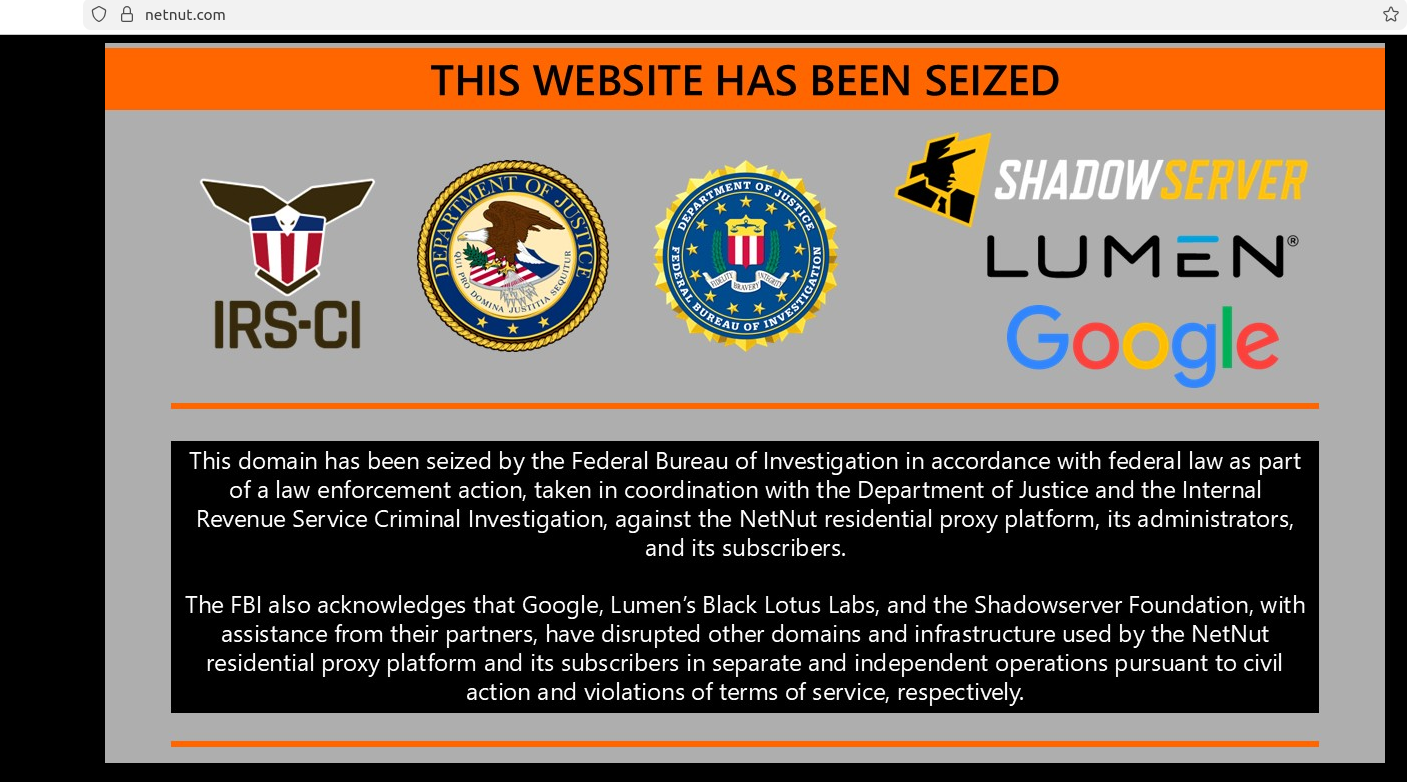
The NetNut homepage today was replaced by this seizure banner from the FBI.
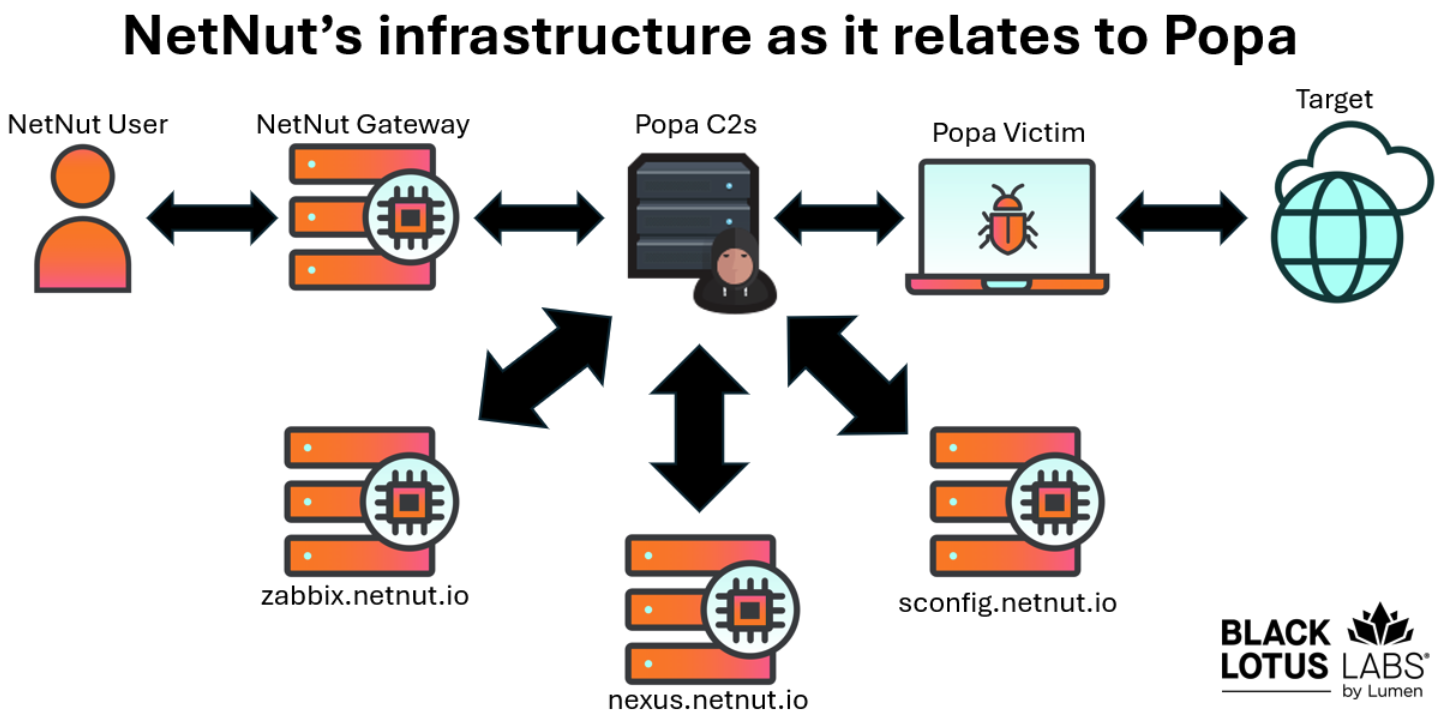
On June 19, three different security firms issued similar findings: That NetNut is a residential proxy network which populates a botnet called Popa, and distributes software for devices commonly found in homes, such as smart TVs and streaming boxes. NetNut’s software turns those systems into always-on residential proxy nodes that are rented to others, who predominantly use them to relay abusive and intrusive Internet traffic, such as mass content scraping, advertising fraud, and account takeover activity.
Earlier today, NetNut’s homepage was replaced with a seizure notice from the FBI and the Internal Revenue Service Criminal Investigation division. The seizure notice thanked Google, Lumen, Shadowserver and other industry partners for their help in dismantling hundreds of domains tied to the Popa botnet, which experts say has long been synonymous with NetNut’s residential proxy infrastructure.
In a blog post published today, the GoogleThreat Intelligence Group (GTIG) said NetNut’s proxy network is widely resold and white-labeled by a number of third-party proxy providers, and that its services are heavily sought out by cybercriminals seeking to obfuscate the source of their malicious traffic. The GTIG said that in a single week during June 2026, they observed 316 distinct clusters of threat actors using suspected NetNut exit nodes, including cybercriminal and espionage groups.
“These bad actors can use NetNut to mask their origin IP address when accessing victim environments, accessing their own infrastructure, and conducting password spray attacks,” Google’s GTIG wrote. “Furthermore, when a consumer device becomes an exit node, unauthorized network traffic passes through it. This means bad actors can access other private devices on the same home network, effectively exposing them to Internet threats.”
Google said it disabled Google accounts and services used by NetNut for malware command and control, and that it shared technical intelligence on NetNut’s software development kits (SDKs) and backend infrastructure with platform providers, law enforcement and research firms. The company also disabled apps known to bundle NetNut’s various SDKs.
Omer Weiss, legal counsel for NetNut parent Alarum Technologies, said the company was aware of the FBI seizure and cooperating with investigators.
“Alarum takes this matter seriously and will fully cooperate with law enforcement to ensure any misuse of its infrastructure is thoroughly investigated and those responsible are held to account,” Weiss said in a written statement.
Benjamin Brundage is founder of the proxy tracking service Synthient, one of the companies that published evidence last month linking the Popa botnet to NetNut and Alarum Technologies. Brundage said the domain seizures appear to have disrupted both the Popa botnet and the NetNut proxy network that rides on top of it.
Brundage said NetNut’s apparent demise is likely to be a great disadvantage for the cybercrime community, which was already reeling from legal actions by Google earlier this year that seized infrastructure for NetNut’s biggest competitor — IPIDEA.
“I think this takedown is going to have a big impact, because NetNut gained significant popularity after the IPIDEA takedown,” he said. “Also NetNut has been incredibly common among resellers, and they were on par with IPIDEA in terms of their daily traffic, quality, size, price per gigabyte, all of it.”
NetNut’s infrastructure, in a nutshell. Image: Black Lotus Labs, Lumen.
The NetNut and Popa botnet takedown may have another added benefit, Brundage said: Lessening the impact of large distributed denial-of-service botnets that have been built on the backs of poorly configured residential proxy services. In January, Synthient revealed how cybercriminals had built the world’s largest DDoS botnet (Kimwolf) by tunneling through IPIDEA proxy connections into the local networks of TV box owners, and infecting other Android-based devices behind the victim’s firewall.
While many of the bigger proxy providers took steps to block this activity, resellers of the major proxy networks have been far slower to respond to the threat, Brundage said.
“In terms of all these TV box devices getting compromised from the proxy network, it will have an impact on the DDoS botnets out there,” he said.
For its part, Google reckons today’s actions have caused “significant degradation to NetNut’s proxy network and its business operations, reducing the available pool of devices for the proxy operator by millions.” But the company warns that proxy networks can rebuild themselves by effectively reselling other proxy services, as IPIDEA has done over the past few months.
“Google has high confidence that many popular residential proxy brands are in fact whitelabeling the NetNut botnet,” the GTIG report concludes. “While we expect this disruption to have a larger ripple effect across the residential proxy ecosystem, observations after the disruption of IPIDEA proved that individual networks can appear resilient. What we have observed is that when faced with the degradation of their own botnet, proxy operators begin buying capacity from their competitors, effectively becoming a reseller. We recognize that creating a lasting disruption in this fluid ecosystem means we must scale our efforts to target the infrastructure of several interconnected providers.”
As KrebsOnSecurity has warned repeatedly, most of the no-name TV streaming boxes for sale on the major e-commerce websites either come pre-installed with residential proxy software, or require the installation of proxy SDKs in order to use the device for its stated purpose (streaming pirated movies, sporting events and TV shows). Google’s advice here is sound: When it comes to TV boxes, stick to name brands from reputable manufacturers, and then be sparing and judicious with any apps you choose to install.
The sketchy TV boxes that are being commandeered by the Popa botnet and other threats all come with or require the user to install unofficial Android operating systems that do not operate within the confines of Google’s Official Play Protect store. Google says consumers can confirm whether or not a device is built with the official Android TV OS and Play Protect certification by following these instructions.
Even people without TV streaming boxes can find their smart TVs enrolled in residential proxy networks, just by installing one of thousands of apps available for download on Samsung and LG smart TVs. In a report released last month, the proxy tracking company Spur found 42 percent of apps available for download via the webOS operating system on LG smart TVs include SDKs that turn one’s television into an always-on residential proxy node. More than a quarter of the apps made for Samsung’s Tizen operating system had similar residential proxy components, Spur found.
Image: Spur.us.
Update, 4:24 p.m. ET: Included a statement shared post-publication from an attorney representing NetNut parent Alarum Technologies.
Update, July 8, 2:34 p.m. ET: The website for Alarum Technologies — alarum[.]io — now also features a seizure notice from the FBI. The company’s stock has taken a beating since the FBI action, and is currently trading at $2.62 a share, a roughly 67 percent decline over the past week.
Am zweiten Juli-Wochenende funkt das Schweizer Nationalteam unter dem Rufzeichen HB9HQ um den Einzug in die Top Ten.
Am Samstag, 11. Juli 2026, exakt um 14.00 Uhr Schweizer Sommerzeit, fällt der Startschuss. 24 Stunden lang läuft die «IARU HF World Championship». Die USKA schickt wie jedes Jahr die Headquarter-Station HB9HQ ins Rennen, um die Schweiz im globalen Gesamtklassement möglichst weit nach vorne zu bringen. Ziel für 2026 ist das Knacken der Top-Ten-Ränge.
Strategie
Das Prinzip dieses sportlichen Grossereignisses verlangt strategisches Geschick. Die über 160 Landesverbände der International Amateur Radio Union schicken ihre HQ-Stationen auf die Jagd nach Punkten. In der Luft herrscht dann dichtes Gedränge. Wer HB9HQ anruft, loggt einen wertvollen Multiplikator. Die offiziellen Verbandsstationen senden neben dem üblichen Signalrapport das Kürzel ihrer Landesverbände, im Schweizer Fall also «USKA». Andere Nationen antworten mit «DARC», «ARRL» oder «JARL». Eine Besonderheit gilt für Funktionäre des Weltverbandes. Die Vorstands- und Aufsichtsratsmitglieder verteilen als Multiplikatoren ihre jeweilige Region. So sendet beispielsweise IARU Region 1-Kassier Andy HB9JOE den Zusatz «R1» für die IARU-Region 1.
Für alle gewöhnlichen Teilnehmerinnen und Teilnehmer gilt eine andere Regel. Sie tauschen im QSO neben der Signalstärke die ITU-Zone ihres Standorts aus. Wer von Schweizer Boden aus funkt, übergibt die Ziffer «28». Der Rapport lautet im Idealfall 5928 in Phonie oder 59928 in Telegrafie. Beim modernen Remote-Betrieb entscheidet übrigens nicht der Sitzplatz des Operateurs vor dem Bildschirm, sondern der physische Standort der Antenne, die das Signal in die Ionosphäre schickt.
Jedes QSO zählt
Der Erfolg des Schweizer Nationalteams hängt massiv von den hiesigen Funkamateurinnen und Funkamateuren ab. Jedes einzelne QSO aus der Schweiz stärkt dem Team den Rücken. Die genaue Aufteilung, welche Funkteams auf den Bändern von 160 bis 10 m in welchen Betriebsarten (CW und SSB) das Rufzeichen HB9HQ benützen, ist auf der USKA-Website aufgeführt. Wer teilnimmt, sammelt Punkte für das beliebte HB9HQ-Award, das die USKA wieder in vier Leistungsklassen ausgibt.
Preparations for Next Moonwalk Simulations Underway (and Underwater)
NASA flight test engineer A.J. Jaffe and pilot Nils Larson walk on the ramp before a flight Tuesday, Jan. 13, 2026, at NASA’s Armstrong Flight Research Center in Edwards, California. The two support the agency’s Crossflow Attenuated Natural Laminar Flow (CATNLF) project, which aims to lower fuel costs for future commercial aircraft by testing a scale-model wing designed to improve laminar flow.
NASA/Christopher LC Clark
Flight testing is a team sport. For nearly 80 years, teams at NASA’s Armstrong Flight Research Center in Edwards, California, have used flight testing to push the limits of aerodynamics and advance aviation.
Earlier this year, NASA’s Crossflow Attenuated Natural Laminar Flow (CATNLF) initiative tested a wing concept that would maximize the smooth flow of air known as laminar flow, which could lower fuel costs for future airliners. During flight testing, researchers strapped a scale-model CATNLF wing to the bottom of a NASA F-15 aircraft.
Here’s what a day of CATNLF flight testing looked like.
NASA ground crew prepares the agency’s F-15 research aircraft and Cross Flow Attenuated Natural Laminar Flow (CATNLF) test article ahead of its first high-speed taxi test on Tuesday, Jan. 12, 2026, at NASA’s Armstrong Flight Research Center in Edwards, California. The CATNLF design aims to reduce drag on wing surfaces to improve efficiency and, in turn, reduce fuel burn.
NASA/Christopher LC Clark
5 a.m. — Aircraft staging
Ground crews ready the aircraft for the mission. If the operation involves a chase plane — a second aircraft to monitor the test flight — it would also be prepared, along with its crew.
6 a.m. — Crew brief
Pilots, engineers, maintenance techs, project leads, researchers, photographers, and videographers meet to review the flight’s goals, weather reports, and final details.
NASA researchers Mike Frederick, right, and Michelle Banchy, left, along with Ashante Jordan and intern Phillip Nguyen, sit in a control room and prepare for a flight test Thursday, Jan. 29, 2026, at NASA’s Armstrong Flight Research Center in Edwards, California. The agency’s Crossflow Attenuated Natural Laminar Flow (CATNLF) project aims to lower fuel costs for future commercial aircraft by testing a scale-model wing designed to improve laminar flow.
NASA/Christopher LC Clark
6:30 a.m. — Control room checks, air crew suit-up
Researchers head to the control room to complete day-of checks, confirming all communications, displays, and instruments are functioning.
Pilots suit up in life support, including custom‑fit pressure suits, harnesses, helmets, and masks. If a photographer, videographer, or flight test engineer will be in the aircraft’s back seat, they do the same.
6:45 a.m. — Air crew steps, control room preparations
The pilot completes preflight checks with the crew chief and technicians for the aircraft’s electrical systems. The pilot and the crew chief sign a flight preparedness report confirming the aircraft is ready to fly.
Inside the control room, the team prepares to monitor the flight using the same set of test cards, a step-by-step plan for the flight.
7 a.m. — Pilot secured in jet
The pilot and backseat crew member climb into their seats, strap in, and secure any gear they’ve brought for the test. The pilot completes preflight ground checks.
7:15 a.m. — Aircraft taxi
The pilot communicates with the control tower and taxis to the runway. Control room teams at NASA Armstrong monitor the aircraft via radio.
7:30 a.m. — Takeoff
The pilot accelerates down the runway and, at the proper speed, pulls back on the stick to take off. Once airborne, the pilot coordinates with air traffic control at Edwards Air Force Base and the NASA Armstrong control room while flying to the designated test area.
A F-15 aircraft owned by NASA’s Armstrong Flight Research Center in Edwards, California, flies above a mountain range on Tuesday, April 21, 2026. The agency’s Crossflow Attenuated Natural Laminar Flow (CATNLF) test article is attached to the bottom of this F-15. This project aims to lower fuel costs for future commercial aircraft by testing a scale-model wing designed to improve laminar flow.
NASA/Jim Ross
7:30 to 8:30 a.m. — Flight
At the test location, the team coordinates with the pilot on altitude, speed, and maneuvers. The test conductor relays each task, and the pilot completes them one-by-one. The pilot and control room monitor the performance of the hardware, instruments, aircraft, or software throughout the sequence. After completing the test points, the pilot returns to base.
8:45 a.m. — Landing, towing
The pilot lands and taxis to the ramp at NASA Armstrong, where the crew chief meets the jet. After the pilot exits, the aircraft is towed into the hangar for maintenance.
9:30 a.m. — Crew debrief
The pilot, project team, and mission controlstaff return to the briefing room tocapture lessons learned and document items for follow-up.
10 a.m. — Data download, second flight prep
Teams download flight data for analysis. If two flights are scheduled, preparations begin immediately for the second.
Four NASA employees walk toward a hangar after a flight Thursday, Feb. 4, 2026, at NASA’s Armstrong Flight Research Center in Edwards, California. The team supports the agency’s Crossflow Attenuated Natural Laminar Flow (CATNLF) project, which aims to lower fuel costs for future commercial aircraft by testing a scale-model wing designed to improve laminar flow.
Drei Tage lang traf sich die internationale Amateurfunk-Gemeinschaft an der Ham Radio in Friedrichshafen. Für die Schweizer YLs und OM stand das Wochenende vom 26. bis 28. Juni 2026 ganz im Zeichen des Netzwerkens: Alte Freunde treffen und neue Kontakte knüpfen prägten das Geschehen am Stand der USKA.
Der direkte Austausch stand im Mittelpunkt. Viele angereiste Funkbegeisterte nutzten die Gelegenheit, um Fachgespräche zu vertiefen und bestehende Kontakte aufzufrischen. «Der persönliche Schwatz hier in den Hallen ist wirklich etwas sehr Spezielles, vor allem, wenn man sich sonst nur über den Transceiver trifft», bilanzierte ein Schweizer Besucher am Samstagabend.
Anstossen auf den Ham-Spirit
Zu den Höhepunkten des Messeprogramms gehörten die traditionellen Apéros am Stand der USKA, die am Freitag und am Samstag stattfanden (im Bild: Apéro am Samstag). Die Resonanz war an beiden Anlässen sehr gross: Jeweils rund 200 Gäste haben miteinander auf den Ham-Spirit angestossen.
Angesichts der hohen Temperaturen an diesem Wochenend griffen die Besucher neben Wein, Orangensaft und Knabbersnacks vor allem zu einer Erfrischung: viel Wasser. Die Logistik vor Ort funktionierte reibungslos und bot den passenden Rahmen, um ungezwungen miteinander ins Gespräch zu kommen.
Rundum gelungene Messe
Nach drei intensiven Messetagen bleibt ein positives Fazit. Ein grosses Dankeschön geht an alle Teilnehmerinnen und Teilnehmer, die die Veranstaltung mit Leben gefüllt haben. Gleichzeitig verdient die Leistung der Messeleitung Anerkennung: Ein grosses Kompliment geht an die Verantwortlichen in Friedrichshafen für die Organisation einer einmal mehr rundum gelungenen Ham Radio.
La rapida diffusione degli Agenti AI sta creando un ecosistema sempre più complesso nel quale modelli linguistici, strumenti esterni e componenti aggiuntivi collaborano per svolgere attività operative. Questa architettura modulare, però, sta aprendo una nuova superficie di attacco che ricorda da vicino le vulnerabilità già viste nel mondo open source e nei marketplace di applicazioni. […]
Nell’aprile del 2025, la penisola Iberica con gran parte della Francia, affronta un blackout su larga scala per diverse ore, causato da un malfunzionamento della linea di distribuzione elettrica.
All’epoca parlammo già di questo episodio con un articolo ad hoc.
Quest’anno, purtroppo, è toccato al nostro paese.
Negli ultimi giorni diverse zone del Nord Italia sono rimaste improvvisamente senza energia elettrica. Guasti alle linee e cabine elettriche hanno lasciato centinaia di famiglie al buio per diverse ore. Episodi simili sono stati segnalati in numerose aree del Paese.
Per molti si è trattato semplicemente di un disagio temporaneo: qualche ora senza luce, il condizionatore fermo e il frigorifero spento. Ma questi eventi rappresentano anche un’occasione per fermarsi a riflettere su un aspetto che spesso diamo per scontato: quanto dipendiamo dall’energia elettrica?
Fino a pochi decenni fa un’interruzione della corrente significava principalmente accendere una candela e attendere il ritorno dell’energia. Oggi la situazione è completamente diversa. La nostra vita quotidiana ruota attorno all’elettricità: lavoriamo da casa, comunichiamo attraverso Internet, paghiamo con strumenti elettronici, utilizziamo cancelli automatici, pompe dell’acqua, sistemi di allarme, elettrodomestici e dispositivi medici. Basta osservare una normale abitazione per rendersi conto di quanto ogni attività dipenda, direttamente o indirettamente, dalla presenza della corrente.
Naturalmente nessuno può affermare che questi blackout siano il segnale di un imminente collasso della rete elettrica italiana. Sarebbe una conclusione affrettata e priva di fondamento. Tuttavia è altrettanto vero che le reti di distribuzione stanno affrontando nuove sfide. Le estati sempre più calde comportano un utilizzo massiccio dei climatizzatori, gli eventi meteorologici estremi diventano più frequenti e molte infrastrutture, realizzate decenni fa, richiedono continui interventi di manutenzione e ammodernamento. In questo contesto è ragionevole aspettarsi che episodi di interruzione dell’energia possano verificarsi con maggiore frequenza rispetto al passato.
La preparazione, però, non nasce dalla paura. Nasce dal buon senso.
Uno dei principi fondamentali del prepping consiste proprio nel prepararsi agli eventi più probabili, non necessariamente a quelli più catastrofici. Un blackout di alcune ore è infinitamente più probabile di molti altri scenari di cui spesso si parla sui social. Eppure sono proprio questi piccoli eventi a coglierci impreparati.
Provate ad immaginare una normale serata estiva. Fuori ci sono oltre trenta gradi, il sole è appena tramontato e improvvisamente tutta la casa rimane al buio. Il condizionatore si spegne, il Wi-Fi scompare, il cancello automatico non si apre più e la batteria del telefono è quasi scarica. Se l’interruzione dovesse protrarsi per qualche ora, anche il frigorifero inizierebbe lentamente a perdere la propria capacità di conservazione e molte persone inizierebbero a chiedersi semplicemente: “E adesso cosa faccio?”
Perché aumentano i blackout?
Le principali cause sono:
temperature sempre più elevate;
utilizzo contemporaneo di milioni di climatizzatori;
infrastrutture elettriche datate in alcune aree;
temporali, vento e alberi che danneggiano le linee;
guasti improvvisi alle cabine di trasformazione.
In molti casi non è la produzione di energia a mancare, ma è la rete di distribuzione locale ad andare in difficoltà.
Nota Ecologica
Caldo, blackout e città sempre più invivibili: non è un caso.
I cavi elettrici che portano energia nelle case passano sottoterra.
Quando aumenta l’uso dei condizionatori, si surriscaldano e devono disperdere più calore.
Il problema? Coprendo il suolo naturale con asfalto e cemento, nelle città le temperature salgono molto di più (a Torino oltre 65°C sull’asfalto). Questo impedisce ai cavi di raffreddarsi.
Risultato:
blackout
cibo che si rovina
allarmi che impazziscono
Persone fragili a rischio vita
E non finisce qui:
Temperature più alte = nubifragi più violenti
Strade, cantine e garage allagati
Altri danni, altri costi.
Il punto è semplice: Il consumo di suolo non è progresso. Il È uno spreco che crea problemi reali per tutti. (nota personale a cura di Lavino Pasquale)
Cosa succede durante un blackout?
Molti pensano semplicemente:
“Si spegne la luce.”
In realtà gli effetti possono essere molto più ampi.
Ad esempio:
il frigorifero smette di raffreddare;
il congelatore inizia lentamente a scongelarsi;
modem e Wi-Fi si spengono;
cancelli elettrici potrebbero non aprirsi;
ascensori fuori servizio;
pompe dell’acqua ferme dove presenti;
POS e bancomat potrebbero non funzionare;
distributori di carburante temporaneamente inutilizzabili;
difficoltà nelle comunicazioni se le batterie delle antenne si esauriscono.
La differenza tra vivere questa situazione con tranquillità oppure con ansia spesso dipende da pochi semplici accorgimenti preparati in anticipo. Avere una torcia facilmente raggiungibile evita di cercare una candela al buio. Una power bank mantenuta carica consente di utilizzare il telefono anche dopo diverse ore. Una piccola radio portatile permette di ricevere informazioni nel caso in cui le reti dati risultino congestionate o temporaneamente non disponibili. Sono oggetti di uso comune, economici e facilmente reperibili, ma che acquistano un valore enorme proprio quando vengono realmente utilizzati.
Anche il comportamento durante un blackout può fare la differenza. Una delle prime reazioni istintive è quella di aprire continuamente il frigorifero per controllare il cibo. In realtà ogni apertura disperde il freddo accumulato, riducendo il tempo di conservazione degli alimenti. Se lo sportello rimane chiuso, un frigorifero moderno riesce generalmente a mantenere una temperatura sicura per circa quattro ore, mentre un congelatore pieno può conservare gli alimenti anche per uno o due giorni.
Frigo e Congelatore – la prima preoccupazione
in caso di disservizio elettrico (blackout), il frigorifero è l’elettrodomestico che occupa il primo posto nei nostri pensieri. Per ovvie ragioni perderà relativamente velocemente la capacità di raffreddamento degli alimenti, così come quella di congelamento, la cosa sarà più celere nel momento in cui apriamo lo sportello. Ebbene c’è una alternativa di backup anche per questo. Il pozzetto congelatore ad apertura verticale lavora meglio. Il frigorifero ha lo sportello ad apertura frontale, per tanto l’aria fredda incamerata, essendo più pesante e posizionata sul fondo della camera, ad ogni apertura uscirà completamente facendo entrare aria più calda. Il pozzetto congelatore invece aprendosi verso l’alto mantiene più facilmente l’aria fredda incamerata, oltre a consumare meno corrente di un qualsiasi frigorifero.
Il dubbio spontaneo che sorge è: il pozzetto però congela! È possibile con qualche accorgimento intelligente adattarne l’uso come frigorifero.
Prima di tutto occorre procurarsi una presa termostata con sonda, quest’ultima andrà inserita all’interno del congelatore in modo da rilevare la temperatura.
La presa poi va collegata ad una power station in modo da alimentare il pozzetto in caso di blackout.
Impostare la temperatura della presa termostata sui 4°\6° che è orientativamente quella del frigorifero.
Collegare poi un pannello solare alla power station.
Come funziona il tutto? Il pozzetto comincerà a raffreddare, ma quando raggiungerà la temperatura impostata sulla presa, questa toglierà alimentazione fino a quando la temperatura del pozzetto non incomincia ad essere più alta di quella impostata
Le prime cose da fare
Quando manca la corrente:
mantenere la calma
verificare se il blackout riguarda solo casa propria
controllare il contatore
osservare se anche i vicini sono senza corrente
evitare di aprire continuamente frigorifero e congelatore
scollegare gli apparecchi elettronici più delicati
lasciare accesa una sola luce per capire quando ritorna l’energia
Vale la pena ricordare anche che non tutti i sistemi di pagamento continuano a funzionare durante un’interruzione prolungata. Alcuni negozi potrebbero non riuscire ad utilizzare i terminali POS, i distributori di carburante potrebbero essere fuori servizio e perfino la rete telefonica, se il blackout dovesse protrarsi a lungo, potrebbe iniziare a risentirne con il progressivo esaurimento delle batterie di backup installate presso le stazioni radio base.
Per questo motivo l’Associazione Italiana Prepper invita da sempre a sviluppare una cultura della resilienza domestica. Non significa riempire il garage di attrezzature costose o immaginare scenari apocalittici. Significa semplicemente essere in grado di affrontare serenamente le prime ventiquattro o quarantotto ore di un imprevisto, riducendo lo stress e aumentando la sicurezza della propria famiglia.
Prepararsi ad un blackout è probabilmente una delle forme di prevenzione più semplici, economiche e concrete che ogni cittadino possa mettere in pratica. Una torcia, una radio, una riserva d’acqua, qualche alimento pronto al consumo e una fonte di energia portatile rappresentano un investimento minimo rispetto alla tranquillità che possono offrire quando tutto, improvvisamente, si spegne.
Il kit anti-blackout
L’Associazione Italiana Prepper consiglia di predisporre un piccolo kit dedicato.
Illuminazione
torcia LED
lampada ricaricabile
batterie di ricambio
Energia
power bank
batterie ricaricabili
caricatore da auto
power station
Comunicazioni
radio AM/FM
radio PMR446
telefono sempre carico
Alimentazione
acqua potabile
alimenti che non richiedono cottura
Sicurezza
candele (solo se utilizzate con attenzione)
fiammiferi
accendino
Comfort
ventilatore USB
ghiaccio sintetico per frigorifero
coperta termica (utile sia in inverno che in estate)
In fondo è proprio questa la filosofia del prepping: non aspettare che si verifichi un’emergenza per iniziare a chiedersi cosa sarebbe stato utile avere. Prepararsi prima significa affrontare dopo qualsiasi imprevisto con maggiore lucidità, sicurezza e consapevolezza. Perché la resilienza non si improvvisa nel momento del bisogno: si costruisce un piccolo passo alla volta, molto prima che si spengano le luci.
Box AIP – La Checklist del Blackout
Puoi affrontare serenamente 24 ore senza corrente?
☐ Ho almeno due torce funzionanti.
☐ Ho batterie di ricambio.
☐ Ho una power bank sempre carica.
☐ Ho una power station sempre carica.
☐ Ho una radio a batterie.
☐ Ho acqua potabile per almeno tre giorni.
☐ Ho alimenti pronti al consumo.
☐ Tutta la famiglia sa dove si trova il kit di emergenza.
☐ So come aprire manualmente il cancello o il garage.
☐ Ho salvato sul telefono i numeri utili del distributore di energia.
Two men pleaded guilty in the United Kingdom this week to criminal charges stemming from an August 2024 cyberattack that crippled Transport for London, the entity responsible for the public transport network in the Greater London area. The duo were key members of a prolific cybercrime group known as Scattered Spider, and their guilty pleas came on the first day of what was expected to be a six-week trial.
Owen Flowers (left) 18, and Thalha Jubair, 20. Image: UK National Crime Agency (NCA).
Thalha Jubair, 20, of East London and 18-year-old Owen Flowers of Walsall admitted conspiring to commit unauthorized acts against Transport for London computer systems and causing risk of serious damage to human welfare. According to a report from the BBC, Flowers alone admitted to being part of a conspiracy to hack into U.S. based healthcare providers SSM Health Care Corporation and Sutter Health in September 2024.
Jubair is also wanted by U.S. law enforcement agencies. In September 2025, prosecutors in New Jersey unsealed an indictment alleging Jubair and other Scattered Spider members committed computer fraud, wire fraud, and money laundering in relation to 120 computer network intrusions involving 47 U.S. entities between May 2022 and September 2025, and that the group’s victims paid at least $115 million in ransom payments.
In July 2025, KrebsOnSecurity reported that Flowers and Jubair were arrested in the United Kingdom in connection with Scattered Spider ransom attacks against the retailers Marks & Spencer and Harrods, and the British food retailer Co-op Group. Multiple sources familiar with those investigations said Flowers was the Scattered Spider member who anonymously gave interviews to the media in the days after the group’s September 2023 ransomware attacks disrupted operations at Las Vegas casinos operated by MGM Resorts and Caesars Entertainment.
According to prosecutors, Jubair co-ran a bustling Telegram channel called Star Chat, the home of a SIM-swapping group that used voice- and SMS-based phishing attacks to steal credentials from employees at the major wireless providers in the U.S. and U.K. The group would then use that access to sell a service that could redirect a target’s phone number to a device the attackers controlled and intercept the victim’s calls and text messages (including one-time codes for multi-factor authentication).
A receipt from Star Fraud Chat’s SIM-swapping service targeting a T-Mobile customer after the group gained access to internal T-Mobile employee tools. “Rocket Ace” was one of Jubair’s hacker handles, according to U.S. prosecutors.
New Jersey prosecutors also allege Jubair also was involved in a mass SMS phishing campaign during the summer of 2022 that stole single sign-on credentials from employees at hundreds of companies. That weeks-long SMS phishing campaign led to intrusions and data thefts at more than 130 organizations, including LastPass, DoorDash, Mailchimp, Plex and Signal.
KrebsOnSecurity reported last year that one of Jubair’s alter egos at age 15 was “Everlynn,” a hacker who sold fraudulent “emergency data requests” that used compromised police and government email addresses to demand subscriber data (e.g. username, IP/email address) from major tech companies, claiming the requests concerned urgent matters of life and death and could not wait for a court order.
In April 2026, 24-year-old British national and Scattered Spider member Tyler “Tylerb” Buchananpleaded guilty to wire fraud conspiracy and aggravated identity theft for participating in the group’s SMS phishing spree in the summer of 2022. The government said Buchanan, Jubair and others used the credentials harvested in that phishing campaign to steal at least $8 million in cryptocurrency from victims throughout the United States. Buchanan is currently scheduled to be sentenced on October 2.
In August 2025, 20-year-old Scattered Spider member from Florida named Noah Michael Urban was sentenced to 10 years in federal prison and ordered to pay $13 million in restitution, after pleading guilty to charges of wire fraud and conspiracy.
The U.S. Department of Justice says three alleged Scattered Spider defendants indicted along with Buchanan still face charges, including Ahmed Hossam Eldin Elbadawy, 24, a.k.a. “AD,” of College Station, Texas; Evans Onyeaka Osiebo, 21, of Dallas, Texas; and Joel Martin Evans, 26, a.k.a. “joeleoli,” of Jacksonville, North Carolina.
Flowers and Jubair are slated to be sentenced in a London court on July 15, 2026.
La computazione quantistica è una delle tecnologie più discusse degli ultimi anni e l’idea di costruire sistemi di calcolo basati sui fenomeni della fisica quantistica continua ad alimentare aspettative enormi. Eppure il quantum computing resta lontano dall’essere una tecnologia matura. Non soltanto perché molti problemi scientifici devono ancora essere risolti, ma anche perché, al momento, manca una filiera industriale in grado di produrre in modo scalabile, e a costi sostenibili, l’hardware necessario a far funzionare un computer quantistico.
Come si può immaginare, costruire un hardware simile è molto complesso. Servono materie prime rare, chimica avanzata, sistemi criogenici sofisticati, ottica di precisione e componenti prodotti da un numero ristretto di aziende specializzate.
Il problema fondamentale è che un computer quantistico non deve semplicemente “calcolare”. Deve riuscire a “mantenere in vita” stati fisici estremamente fragili e utilizzarli per il calcolo. La grande promessa del quantum computing – sfruttare fenomeni quantistici come la sovrapposizione e l’entanglement per eseguire operazioni impraticabili per i computer tradizionali – dipende infatti dalla capacità di isolare gli effetti quantistici dalle interferenze del mondo esterno. Il problema, come anticipato anche da Heisenberg, è che gli stati quantistici sono incredibilmenteinstabili. Basta pochissimo per distruggerli: una vibrazione microscopica, una minima interferenza elettromagnetica, una variazione termica impercettibile. Questo significa che la prima e principale sfida da affrontare per produrre un computer quantistico è quella di costruire una specie di guscio che isoli il processo di calcolo dal “rumore” dell’ambiente esterno.
La sfida del freddo
Una delle interferenze più difficili da controllare è il calore. Per questo molti computer quantistici – in particolare quelli basati su circuiti superconduttori, una delle architetture oggi più sviluppate da aziende come IBM e Google — operano a temperature vicinissime allo zero assoluto, inferiori persino a quelle dello spazio profondo. Per raggiungerle servono sofisticati sistemi criogenici chiamati dilution refrigerator (refrigeratore a diluizione): strutture metalliche, simili a candelabri barocchi, che sono diventate una delle immagini simbolo del quantum computing.
Uno degli elementi chiave per il funzionamento di questi refrigeratori è invece l’elio-3. Rarissimo sulla Terra, l’elio-3 è un isotopo in proporzione più abbondante sulla superficie lunare, dove si è accumulato per miliardi di anni a causa del bombardamento del vento solare. I depositi di elio-3 diffusi nella regolite lunare alimentano da decenni miti tecnologici su future miniere sulla Luna che oggi, nell’era del “capitalismo spaziale”, paiono meno fantascientifici di un tempo. E del resto si può facilmente immaginare come un eventuale aumento della domanda di questo isotopo, connessa alla crescita del quantum computing, potrebbe rendere ancora più allettante l’avvio di attività estrattive lunari. Nell’attesa, gran parte dell’elio-3 disponibile sul nostro pianeta deriva indirettamente dal decadimento del trizio prodotto nei vecchi programmi nucleari militari, creando così un cortocircuito tra una tecnologia di frontiera e i residui industriali della guerra fredda.
Questa dipendenza da materie prime estremamente specializzate rende la filiera dei refrigeratori a diluzione molto fragile. A produrre queste macchine, infatti, sono pochissime aziende al mondo. La finlandese Bluefors, per esempio, è diventata in pochi anni uno dei principali fornitori dell’industria quantistica globale, ma anche uno degli snodi più delicati dell’intera catena produttiva. Se oggi si osserva la struttura industriale del quantum computing, ci si accorge infatti che il settore assomiglia meno all’industria informatica classica e più a un ecosistema di nicchie iperspecializzate, dove pochi attori controllano componenti essenziali e difficilmente sostituibili.
Una pluralità di approcci
Un ulteriore problema del quantum computing è che, almeno per ora, non esiste un’unica architettura dominante. Coesistono approcci diversi, ciascuno dei quali richiede infrastrutture, materiali e competenze specifici. Se i computer quantistici basati su circuiti superconduttori richiedono criogenia avanzata, i computer quantistici basati sugli “ioni intrappolati” dipendono invece da laser ad altissima stabilità, vuoto ultra-spinto e componenti fotonici delicatissimi. Altri approcci ancora – come quelli basati sui qubit fotonici o sugli atomi neutri (atomi privi di carica elettrica controllati tramite laser) – richiedono invece fibre e circuiti ottici a bassissima perdita, sorgenti luminose avanzate, specchi e cavità ottiche ad altissima qualità e, in alcuni casi, dispositivi microfabbricati costruiti con tolleranze estremamente ridotte.
Questo significa che, al momento, non esiste una singola frontiera industriale del quantum, ma molte frontiere sovrapposte. Per certi versi, la situazione ricorda alcune fasi iniziali dell’elettronica e dell’informatica del dopoguerra, quando convivevano tubi a vuoto, relè, transistor, memorie magnetiche e soluzioni architetturali diverse. Al tempo, l’industria elettronica era quindi un ecosistema frammentato, popolato da soluzioni incompatibili e processi produttivi difficili da standardizzare. La crescita esplosiva del settore arrivò solo quando emersero componenti, architetture e processi produttivi condivisi, capaci di trasformare dispositivi sperimentali in prodotti scalabili. È una lezione storica importante anche per il quantum computing.
Oggi il settore si trova ancora in una fase pre-standardizzazione: nessuno sa davvero quale architettura diventerà dominante, quali materiali saranno indispensabili o quali componenti potranno essere prodotti industrialmente su larga scala. E finché questa convergenza non avverrà, la computazione quantistica rischia di rimanere in un limbo “proto-industriale”, in cui ogni laboratorio tende a costruire il proprio ecosistema tecnologico come una specie di artigianato scientifico avanzatissimo.
Il problema del talento
La conseguenza di questo fatto è che molti processi produttivi necessari dipendono dall’esperienza accumulata da piccoli gruppi di tecnici altamente specializzati e sono, al momento, difficili da riprodurre serialmente.
La costruzione di un refrigeratore a diluzione, per esempio, richiede tecnici capaci di assemblare manualmente sistemi criogenici estremamente delicati, minimizzando vibrazioni, dispersioni termiche e impurità microscopiche. Si tratta di processi che dipendono ancora da forme di conoscenza pratica accumulate negli anni più che da standard industriali codificati. Dinamiche simili esistono anche nel campo dei semiconduttori avanzati e della litografia estrema. ASML, l’azienda olandese che produce le macchine EUV utilizzate per realizzare i chip più sofisticati al mondo, dipende a sua volta da una rete ristrettissima di fornitori iper-specializzati che, a loro volta, si avvalgono dell’esperienza di pochissimi “super-esperti” in singoli problemi tecnici altamente specifici.
Il vero collo di bottiglia “industriale” della computazione quantistica non riguarda solo le macchine, i materiali o la fisica, ma anche – e forse soprattutto – la disponibilità di talento tecnico adeguato alla portata della sfida produttiva che il quantum computing rappresenta. Per costruire un computer quantistico non basta infatti disporre di buoni fisici teorici o di eccellenti ingegneri. Serve la capacità di integrare competenze molto rare e diverse tra loro: criogenia estrema, scienza dei materiali, ottica avanzata, microfabbricazione, elettronica a radiofrequenza, software di controllo, vuoto ultra-spinto, chimica ultrapura. E soprattutto serve farlo in modo coordinato, continuo e riproducibile. La vera difficoltà non è solo inventare una tecnologia funzionante, ma costruire una massa critica di persone capaci di trasformarla in un sistema industriale.
Per questo il futuro “industriale” del quantum computing è anche un gigantesco problema di scala umana. Non basta avere qualche centinaio di ricercatori eccellenti sparsi nel mondo accademico. Affinché la tecnologia diventi industriale servono migliaia di tecnici, ingegneri e operatori altamente qualificati distribuiti lungo filiere produttive estremamente sofisticate (un fatto che la Cina sembra aver compreso prima di tutti). Servirà cioè trasformare competenze oggi quasi artigianali in capacità industriali diffuse.
La scienza alla base di tecnologie importanti può certamente nascere da un piccolo gruppo di persone eccezionalmente dotate, ma un’industria richiede la capacità di riprodurre sistematicamente quel livello di competenza su larga scala. Ancora una volta ci si può rivolgere alla storia della microelettronica per capirlo. Il vero salto nella produzione seriale di hardware informatici non avvenne infatti quando un gruppo di pionieri ai Bell Labs inventò i transistor, ma quando gli Stati Uniti cominciarono a formare enormi quantità di ingegneri in grado di capire come funzionavano e come si potevano migliorare transistor e circuiti integrati.
In questo senso la vera sfida per il futuro della computazione quantistica non è soltanto costruire una macchina capace di funzionare. È costruire le condizioni industriali, economiche e umane per trasformare una tecnologia sperimentale fragile in un’infrastruttura produttiva stabile.
Il nuovo assetto geopolitico mondiale ha messo a nudo una serie di problematiche che sono state trascurate troppo a lungo. In pratica, quello che per anni abbiamo visto accadere nel software, ovvero l’entusiasmo per le nuove feature che andava a coprire la necessità di rendere sicuro il loro utilizzo, si è applicato anche in mille […]
Jul 6, 2026 - clamav-unofficial-sigs upgraded to v. 8.0.0 - roundcube upgraded to v 1.7.2
Jul 1, 2026 - I added notes on how to install an hCaptcha filter on mailman/Postorius
May 10, 2026 roundcube upgraded to v. 1.7.1 (security release)
May 14, 2026 - dovecot upgraded to v. 2.4.4
May 10, 2026 roundcube upgraded to v. 1.7.0
Apr 7, 2026 - qmail v. 2026.04.07
Mar 30, 2026 - dovecot 2.4.3 released
Mar 4, 2026 - clamav upgraded to v 1.5.2
Feb 11, 2026 - vpopmail upgraded to v. 5.6.13 - vqadmin upgraded to v. 2.4.6
Feb 8, 2026 - vpopmail upgraded to v. 5.6.12 - roundcube update to v. 16.13
Feb 3, 2026 - qmail upgrade
Jan 31, 2025 - vqadmin upgraded to v 2.4.5
Jan 8, 2026 - qmail upgraded to v2026.01.08
Dec 14, 2025 - roundcube upgraded to version 1.6.12
Nov 28, 2025 - qmailadmin upgraded to v1.2.27
Nov 26, 2025 - ezmlm-idx moved to my git space. Patched to compile with modern compilers. Fixed mysql documentation.
Nov 22, 2025 - dovecot: quota driver switched to 'count' - vpopmail upgraded to v.5.6.11
Nov 8, 2025 - qmailadmin upgraded to v 1.2.26 - log file modified accordingly in fail2ban filter
Oct 30, 2025 - vpopmail updated to v. 5.6.10 - dovecot ugraded to v. 2.4.2 - dovecot-pigeonhole ugraded to v. 2.4.2
Oct 22, 2025 - qmailadmin updated to v 1.2.25
Oct 18, 2025 - clamav upgraded to v 1.5.1
Oct 11, 2025 - clamav upgraded to v 1.5.0. A recent version of rust is needed (successfully using 1.88 here). Just reinstall as explained below. No particular change is needed in the config files.
3 ottobre 2025: - Aggiunta la sezione Data Query Service nella pagina relativa a RBL, che risolve il problema del ban di spamhaus da connessioni fatte con DNS pubblico.
Sep 30, 2025 - daemontools v0.82: Fixed crash in multilog caused by invalid buffer access when read() returned -1
Sep 8, 2025 - daemontools v. 0.81 compiles with latest gcc 15.2 - qmail updated to v. 2025.09.08
Sep 1, 2025 vpopmail v5.6.9 - added -std=gnu17 to gain compatibility with gcc-15 (PR #6) - pw_clear_passwd field enlarged to varchar(128) to create room for long passwords (tx Ricardo Brisighelli) c54688d
Aug 31, 2025 - upgraded ucspi-tcp6 and ucspi-ssl to v. 0.13.5
Aug 19, 2025 - netqmail-1.07.1: now compiles with gcc 15.2
Aug 18, 2025 spamassassin's bayesian filter: improved the "Training Bayes" section
Jul 10, 2025 qmail update - Authentication-Results: header support (Andreas Gerstlauer) - DKIM: added ERROR_FD=2 in control/filterargs to send error output of qmail-dkim in stderr when acting as a qmail-remote filter (Andreas Gerstlauer) - improved qmail-dkim error reporting when signing outgoing messages (Andreas Gerstlauer) - helodnscheck.cpp:qmail dir determined dinamically - qmHandle: Add -x and -X parametr for remove email by To/Cc/Bcc (by Stetinac)
Jun 9, 2025 qmail v.2025.06.09 - CRLF fix for fastremote-3 patch (thanks Andreas Gerstlauer) - Bug fix to the greetdelay program (thanks Andreas Gerstlauer): qmail-smtpd crashes if SMTPD_GREETDELAY is defined with no DROP_PRE_GREET defined.
Jun 04, 2025 - roundcube updated to v. 1.6.11 - simscan updated to v. 1.4.6
Apr 19, 2025 - sauserprefs upgraded to v. 1.20.2
Apr 18, 2025 - qmail v2025.04.18: added script config-all.sh to automate the qmail core configuration (testing)
Apr 19, 2025 - sauserprefs upgraded to v. 1.20.2
4 aprile 2025 - pubblicata una pagina con l'illustrazione del funzionamento di qmail, per quanto riguarda la configurazione suggerita in questa guida
Mar 29, 2025 - dovecot and dovecot-pigeonhole updated to v. 2.4.1-4 - vpopmail updated to v. 2.6.8 (have a look at the release notes)
Mar 23, 2025 (v. 5.6.7) - bug fix in vpopmaild.c: Crypted[64] enlarged to Crypted[128] to make room for SHA-512 passwords. This restores the usability of the RoundCube's 'password' plugin (commit) - fixed quota calculation in sql procedures for dovecot (tx Hakan Cakiroglu) (commit) - minor changes to the usage function of vmakedotqmail.c (commit)
Mar 19, 2025 daemontools version 0.79 This version does not add new features nor corrects bugs. It's just a reorganizations of the files in the source dir - daemontools will be installed in /var/qmail/daemontools - Moved 'package' and 'src' to the top dir - Version grabbed from 'VERSION' in package/upgrade
Mar 17, 2025 - added a patch to qmail-spp greylisting plugin to solve a compilation break on rocky 8 (tx Shailendra Shukla)
Mar 15, 2025 -dovecot config: added quota warning messages handling
Mar 12, 2025 - autorespond v 2.0.9: bug fix in memory allocation which caused a segfault when To: address has be used (tx Stephan for the hint)
Mar 9, 2025 - dovecot: fixed quota calculation in sql queries (tx Hakan Cakiroglu) - Roundcube recognizes unlimited quota
Mar 5, 2025 - solr upgraded to v. 9.8.0
Feb 22, 2025 - Dovecot: Bug fix in 90-sieve.conf: global script to move spam into Junk now working - Let’s Encrypt have announced that they will end their free alerting service. Added a script to do the same internally.
Feb 15, 2025 - vpopmail upgraded to v. 5.6.6. bug fix: pwstr.h was not installed by Makefile (tx Bai Borko)
Fedb 11, 2025 qmail v. 2025.02.11 - Several adjustments to get freeBSD and netBSD compatibility. More info in the commit history. Hints/comments are welcome. - freeBSD users have to comment out the "LIBRESOLV" variable from the very beginning of the Makefile, as libresolv.so in not needed on freeBSD. - Dropped files install-big.c, idedit.c and BIN.* files. - Dropped files byte_diff.c, str_cpy.c, str_diff.c, str_diffn.c and str_len.c, which break compilation on clang and can be replaced by the functions shipped by the compiler (tx notqmail). - Old documentation moved to the "doc" dir. install.c and hier.c modified accordingly - conf-cc and conf-ld now have -L/usr/local/lib and -I/usr/local/include to look for srs2 library - conf-cc and conf-ld now have -L/usr/pkg/lib and -I/usr/pkg/include to satisfy netBSD - vpopmail-dir.sh: minor correction to vpopmail dir existence check - srs.c: #include <srs2.h> now without path
Feb 9, 2025 - some packages updated to compile on FreeBSD/clang: daemontools, vpopmail, autorespond, qmailadmin - roundcube updated to v. 1.6.10
Jan 30, 2025 - dovecot and dovecot-pigeonhole updated to v. 2.4.0
Dec 31, 2024 the default driver for the Roundcube password plugin is now sql, as vpopmaild doesn't work when SHA-512 passwords have been enabled on vpopmail (--disable-sha512-passwords). All SQL queries have been updated.
Dec 20, 2024 vpopmail upgraded to v. 5.6.4 - Password strength enforcement PR #5 (grabbed from Matt Brookings' 5.5.0-dev version) - Dropped min pwd length feature. - vmysql.h: tables' layout changed in order to have VARCHAR instead of CHAR. Fields containing ip addresses enlarged to VARCHAR(39), to create room for ipv6. Unix timestamps definition changed from BIGINT(20) to INT(11). (commit 44bad58) Have a look to the upgrade notes below.
Dec 06, 2024 - vqadmin v. 2.4.3: added a patch to highlight users with restrictions and with admin privileges (thanks Bai Borko)
Dec 01, 2024 (More info here) qmail v2024.12.01 - Added support for EAI (RFC 5336 SMTP Email Address Internationalization) (#13). Thanks to https://github.com/arnt/qmail-smtputf8/tree/smtputf8-tls. - chkuser is now smtputf8 compliant. It accepts utf8 characters in sender and recipient addresses provided that the remote server advertises the SMTPUTF8 verb in MAIL FROM, otherwise it allows only ASCII characters plus additional chars from the CHKUSER_ALLOWED_CHARS set. (#15#16) * dropped variables CHKUSER_ALLOW_SENDER_CHAR_xx CHKUSER_ALLOW_RCPT_CHAR_xx (replaced by CHKUSER_ALLOWED_CHARS) * dropped variables CHKUSER_ALLOW_SENDER_SRS and CHKUSER_ALLOW_RCPT_SRS, as we are always accepting '+' and '#' characters * added variables CHKUSER_INVALID_UTF8_CHARS and CHKUSER_ALLOWED_CHARS
Nov 15, 2024 - dovecot: added a postlogin script to update the vpopmail.lastauth SQL table on login (see 10-master.conf, thanks kengheng)
Oct 26, 2024 - qmail upgraded to v. 2024.10.26 * qmail-remote.c patched to dinamically touch control/notlshosts/<fqdn> if control/notlshosts_auto contains any number greater than 0 in order to skip the TLS connection for remote servers with an obsolete TLS version. (tx Alexandre Fonceca) (commit) * defined CHKUSER_DISABLE_VARIABLE "RELAYCLIENT" in chkuser_settings.h * enabled CHKUSER_SENDER_NOCHECK_VARIABLE "RELAYCLIENT" in chkuser_settings.h * fixed several compilation breaks/warnings on later gcc compilers (tx Pablo Murillo) * invalid auth fix in qmail-smtpd.c's smtp_auth function (tx Alexandre Fonceca for the advice) (commit) * qmail path determined dinamically in conf-policy * added a patch to remove chkuser and the vpopmail dependency (patches dir)
Oct 19, 2024 vpopmail v.5.6.3 - bug fixed: passwords with length > 8 were denied if sha-512 was disabled - fixed a configure break where a trivial C test program exits on error with gcc-14.1 due to missing headers - vusaged/domain.c: fixed -Wimplicit-function-declaration compilation warning - vmysql.h: dropped the multicolumn PRIMARY KEY in valias table to allow multiple forwards for a given alias.
Oct 9, 2024 - daemontools-0.78.2: added -ltr to conf-ld to restore compatibility with systems with glibc prior to v. 2.17 like RHEL6/CentOS6, where the librt.so library is not linked
Sep 22, 2024 -fehqlibs updated to v. 25c -ucspi-tcp6 updated to v. 1.13.01 -ucspi-ssl updated to v. 0.13.02
Sep 7, 2024 - daemontools-0.78: fixed a .gitignore issue which was preventing the package/compile script upload (thanks Ivelin Topalov) - RC updated to v. 1.6.9 - clamav updated to v. 1.4.1 - qmailadmin upgraded to v. 1.2.23 (tx Nathanaël Semhoun) * Added support for qmail-autoresponder * Fixed load lang not retrieved
Aug 16, 2024 - upgraded dovecot to v. 2.3.21.1 - upgraded pigeonhole to v. 0.5.21.1
Jul 31, 2024 multilog uses "d" flag as default to gain compatibility with the readable datetime format of multilog in daemontools-0.78. Change it with the "t" flag if you prefer to have timestamps.
Jul 29, 2024 (version 0.78) - multilog prints a readable datetime if used with "d" flag, it prints timestamps if used in the usual way with the "t" flag (80f2133) - fixed several compilation warnings and/or breaks on gcc-14.1
Jul 26, 2024 vqadmin (version 2.4.1): Fixed configure break. Trivial C test program breaks on gcc-14.1 due to missing headers (commit)
July 17, 2024 qmailadmin updated to v.1.2.22 * owner no longer required in autorespond * template.c code optimization
July 15, 2024 simscan 1.4.4 released: attachment size limit to be passed to spamassassin now handled by the size_limit variable in control/simcontrol, instead of the control/simsizelimit file.
Jun 8, 2024 qmail patch upgraded to v. 2024.06.08: * conf-channels: default number of channels increased to 4 (was 2). Now qmail offers 2 additional channels with respect to the 2 offered by default (local and remote). More info here * maxrcpt: error code changed to 452 due to RFC 4.5.3.1 (was 553). If DISABLE_MAXRCPT is defined it skips the check, otherwise outgoing messages from mailing lists would be rejected. (commit)
Jun 7, 2024 - vusaged: the header files of libev are now installed in /usr/local/include/libev (was /usr/local/include) to avoid conflicts with libevent (they both have an event.h header file). vusaged configure command was adjusted accordingly.
Jun 1, 2024 - clamav upgraded to v. 1.3.1
May 26, 2024 - Added Mailman installation howto - qmail patch upgraded to v. 2024.05.16 (changelog) - Roundcube upgraded to 1.6.7 (security fix) - Spamassassin upgraded to v. 4.0.1 - Spamassassin: Razor-agents upgraded to v. 2.86 (fork of the original (dead?) project)
Mar 27, 2024 qmailadmin updated to v. 1.2.21
Mar 4, 2024 - Solr updated to v. 9.5.0 - the documentation has been revised a bit
Feb 12, 2024 qmail update - DKIM patch upgraded to v. 1.48 * fixed minor bug using filterargs for local deliveries (commit) - Fixed several compilation warnings (commit) - Fixed incompatible redeclaration of library function 'log2' in qmail-send.c qsutil.c as showed by notqmail friends here - removed FILES, shar target from Makefile
Feb 11, 2024 clamav updated to v. 1.3.0
Feb 6, 2024 qmail: DKIM patch upgraded to v. 1.47 * fixed a bug which was preventing filterargs' wildcards to work properly on sender domain
Jan 27, 2024 simscan upgraded to v 1.4.3: fixed several compilation and autotools warnings
Jan 21, 2024 - qmail: liberal-lf: bare LF are no longer allowed by default due to smuggling vulnerability CVE-2023-51765. Bare LF can be allowed by defining ALLOW_BARELF in tcprules or in run file. - tcprules moved to /var/qmail/control
Jan 15, 2024 qmail update: - TLS patch by F. Vermeulen upgraded to version 20231230 (more info at https://inoa.net/qmail-tls/ tx Greg Bell for the patch) * support to openssl 3.0.11
Jan 11, 2024 - qmail: dkim patch upgraded to version 1.46
Jan 4, 2024 qmail patch: DKIM patch upgraded to v. 1.44 - fixed an issue with filterargs where spawn-filter is trying to execute remote:env xxxxx.... dk-filter. This issue happens when FILTERARGS environment variable is not defined in the qmail-send rc script. - dkim.c fix: https://notes.sagredo.eu/en/qmail-notes-185/configuring-dkim-for-qmail-92.html#comment3668 - dkfilter fix: correctly selects the domain to sign in case of sieve bounces - adjustments fo dk-filter and dknewkey man pages
Dec 30, 2023 - spamassassin/DMARC filter: now DMARC_REJECT is not hit if SPF_HELO_PASS is true
Dec 26, 2023 - qmailadmin upgraded to v1.2.18 - Pyzor installed from github, as version 1.0.0 is not python3 compliant (thanks Mike)
Dec 11, 2023 qmail, vpopmail, daemontools, qmailadmin, simscan and vqadmin source code moved to github
Nov 20, 2023 -qmail patch updated. dkim: * The patch now by default excludes X-Arc-Authentication-Results * dkim can additionally use the environment variable EXCLUDE_DKIMSIGN to include colon separated list of headers to be excluded from signing (just like qmail-dkim). If -X option is used with dk-filter, it overrides the value of EXCLUDE_DKIMSIGN.
Nov 5., 2023 -bug fix: vpopmail defaultdelivery patch: it won't create the .qmail file in case control/defaultdelivery already has vdelivermail, in order to prevent a vpopmail loop -qmailforward RC plugin: it won't create the copy record if $config['qmailforward_defaultdelivery'] contains 'vdelivermail'
Oct 13, 2023 - vpopmail: added "s/qmail cdb" patch, which gets vpopmail to locate correctly the qmail assign.cdb for s/qmail users. s/qmail users should configure vpopmail with --enable-sqmail-cdb
Oct 6, 2023 - clamav updated to v. 1.2.0
Sep 26, 2023 new qmail combined patch: -surblfilter logs the rejected URL in the qmail-smtpd log. It can now inspect both http and https URLs. -Improvements in man dkim.9, qmail-dkim.9 and surblfilter.9
Sep 17, 2023 - dovecot upgraded to v 2.3.21 - pigeonhole upgraded to v 0.5.21
Sep 14, 2023 - simscan now defines the maximum size of messages to be passed to spamassassin via control/simsizelimit file
Sep 5, 2023 -new qmail patch and DKIM patch upgraded to v. 1.42 *dk-filter.sh: "source $envfn" has been replaced with ". $envfn" in oder to work for pure bourne shells *minor corrections to the man pages -vpopmail: changed configuration option --enable-logging=e (was p). Now failed attempts will be logged with no password shown.
Sep 3, 2023 -daemontools: Buffer Overflow fixed in timestamp.c (patch multilog-readable_datetime, Ubuntu 22.04). It was causing empty log files everywhere. (thanks Bai Borko and KPC)
Aug 27, 2023 - nuova patch per vpopmail e nuovo plugin qmailforward per Roundcube che vanno a risolvere diverse problematiche. Maggiori informazioni nella pagina dedicata..
Aug 20, 2023 (diff) -qmail combined patch: install a sample control/smtpplugins file in case it does not exist yet, to avoid "unable to read control" crash.
Aug 17, 2023 - helodnscheck: * C++ version (testing). * bug fix: segfault in case of no result in DNS record. * default action changed to GNLR
5 agosto 2023 L'installzione del certificato Let's Encrypt è ora basata su dehydrated. La vecchia documentazione basata su certbot non verrà più aggiornata.
Jul 18, 2023 vqadmin: patch updated - Italian translation file html/it updated, following the patch by Ali Erturk TURKER - the vqadmin source directory has been cleaned of unnececessary files
Jul 15, 2023 - fail2ban: l'installazione e la configurazione è stata rivista per funzionare su Debian, dove python2 non è presente (grazie a Gabriel Torres)
Jun 30, 2023 -daemontools: added my multilog-readable_datetime patch which replace the timestamp in the log lines with a human readable datetime. Do not install it if you prefer to stick with the timestamp. -if you install this patch you have to download again the convert-multilog program. In case you decide to stick with the original timestamp, then use the original convert-multilog. (diff) -qmail combiend patch: DKIM patch upgraded to v. 1.41 *dknewkey will allow domains in control/domainkey *Made a few adjustments to the man pages and dkimsign.cpp for DKIMDOMAIN to work with qmail-smtpd (in case some configures qmail-smtpd to sign instead of the usual dk-filter/qmail-remote) -The broken link based on pobox.com in the default SPF error explanation was changed to https://mxtoolbox.com/SuperTool.aspx?action=spf
Jun 25, 2023 - Spamassassin: The ExtractText notes have been revised and corrected by Gabriel Torres
Jun 18, 2023 * qmail combined patch (diff) -vpopmail uid and gid are determined dinamically instead of assigning 89:89 ids by default -vpopmail install directory determined dinamically (was /home/vpopmail). Now the variable in the conf-cc file is determined as well. Feel free to post any issue in the comments as I'm not sure that /bin/sh will work in all Linux. * qmail run scripts: -defined the variable QMAILDIR in all run scripts in order to manage installations of qmail in directories different from default /var/qmail -/home/vpopmail is now ~vpopmail in order to manage installations of vpopmail in directories different from default /home/vpopmail -defined the variable TCPRULES_DIR on top of all run scripts
May 18, 2023 -certbot/letsencrypt: added the option --key-type rsa to the certbot command, to avoid that certbot will silently default to ECDSA the private key format, which results not understandable by my openssl-1.1. In this way the format of the private key will be RSA. More info here.
May 17, 2023 -SURBL: Top level domains URL is changed. So we have to adjust the update_tlds.sh script accordingly
Apr, 26, 2023 -new combined patch and dkim patch updated to v. 1.40 -qmail-dkim uses CUSTOM_ERR_FD as file descriptor for errors (more info here)
Apr 25, 2023 - qmailadmin cracklib patch: bug fix in qmailadmin/passwd: it was changing the password also in case of cracklib alert (tx Alexandre Fonseca) - new qmailadmin combined patch released
Mar 27, 2023 qmail combined patch (diff here) -chkuser.c: double hyphens "--" are now allowed also in the rcpt email (tx Ali Erturk TURKER) -chkuser_settings.h CHKUSER_SENDER_NOCHECK_VARIABLE commented out. Sender check is now enabled also for RELAYCLIENT -removed a couple of redundant log lines caused by qmail-smtpd-logging
Mar 18, 2023 - new qmail combined patch * bugfix in dkimverify.cpp: now it checks if k= tag is missing (tx Raisa for providing detailed info) * redundant esmtp-size patch removed, as the SIZE check is already done by the qmail-authentication patch (tx Ali Erturk TURKER) diff here
Mar 14, 2023 - qmail combined patch: the split_str function in dknewkey was modified in order to work on debian 11 (tx J)
Mar 12, 2023 - qmail patch updated: the mail headers will change from "ESMTPA" to "ESMTPSA" when the user is authenticated via starttls/smtps (tx Ali Erturk TURKER) diff here
Mar 1, 2023 - qmail combined patch updated: added qmail-fastremote patch (tx Ali Erturk TURKER for the advise). qmail-remote CRLF removed (replaced by fastremote)
Feb 27, 2023 - qmail combined patch updated: now qmail-remote is rfc2821 compliant even for implicit TLS (SMTPS) connections (tx Ali Erturk TURKER)
Feb 24, 2023 - qmail combined patch updated: several missing references to control/badmailto and control/badmailtonorelay files were corrected to control/badrcptto and control/badrcpttonorelay (tx Ali Erturk TURKER) diff here
Feb 20, 2023 - qmail combined patch updated ---- dkim patch upgraded to v. 1.37 ------ ed25519 support (RFC 8463) ------ old yahoo's domainkeys stuff removed (no longer need the libdomainkeys.a library)
Feb 18, 2023 -vpopmail: added a patch by Ali Erturk TURKER which fixes several issues -vqadmin: added a patch by Ali Erturk TURKER which, among the other things, makes vqadmin aware of mysql-limits
Feb 10, 2023 -dovecot: added a patch to restore the old vpopmail-auth driver (tx Ali Erturk TURKER)
Jan 31,2023 -bug fix in qmail-smtpd.c. 4096 bit RSA key cannot be open (tx Ali Erturk TURKER)
Jan 4, 2023 -Solr upgraded to version 9.1.0 -The SOlr page has been improved as far as configuration, security and testing are concerned
Jan 1, 2023 -ClamAV upgraded to version 1.0.0 -new qmail combined patch released. Bug fix in dk-filter. It was calling a non existent function (tx Andreas).
Dic 17, 2022 -qmail combined patch release * chkuser receipt check won't be disabled for RELAYCLIENT * CHKUSER_DISABLE_VARIABLE commented out from chkuser_settings.h
Nov 20, 2022 -switched all actions to nftables, as it has now replaced iptables and fail2ban has support for it.
2022.10.02 -dkim patch updated to v. 1.30 and new qmail combined patch released * bug fix: it was returning an error in case of domains with no key.
Sep 29, 2022 -bug fixed in the domainkey script: it wasn't creating the symbolic link of the selector name to the private key in case of a custom selector defined in the file control/dkimkeys Sep 28, 2022 -qmail combined patch updated with new dkim patch v. 1.29. More info here -Roundcube webmail updated to v. 1.6.0
Aug 12, 2022 -dovecot: improved the sql stuff in case of --disable-many-domains (tx kengheng). -dovecot-pwd_query patch for vpopmail: added a procedure for the user_query (needed for dovecot/LDA) -dovecot-pwd_query patch for vpopmail renamed to dovecot-sql-procedures -combined patch for vpopmail updated
Aug 08, 2022 -qmailctl script improved. Now the script exits if services are not started with svscanboot or a supervise script is missing -roundcube/password plugin: the cracklib patch has been improved. Now it can retrieve the correct cracklib-check path
Jul 28, 2022 -The Roundcube plugins' page has been revised and polished. A couple of plugins have been added.
May 22, 2022 qmail patch: "qmail-smtpd pid, qp log" patch (http://iain.cx/qmail/patches.html#smtpd_pidqp) removed, as its log informations are already contained in the qlogreceived line. (diff) -improved a couple of read_failed error messages
May 12, 2022 -clamav: updated to v. 0.105 -qmailctl: a few modifications to avoid error strings in the service uptime when service is stopped. qmail-smtpsd was added to svclist -qmail-smtpsd support added
Apr 22, 2022 -dovecot: added Solr support
Apr 17, 2022 -dovecot/auth-sql.conf.ext: changed the userdb lookup for LDA from static to sql, as the home dir was not retrieved correctly if positioned in a subfolder (i.e. domains/0/domainname).
Apr 9, 2022 qmailadmin: --enable-imageurl=/files is now --enable-imageurl=/qmailadmin/files (no need to have an alias on apache config). Added --disable-catchall, which is bad for spam. Tx Gabriel Torres
Apr 01, 2022 -qmailadmin: new combined patch. It now logs to stderr when qma-auth.log file can't be opened in write mode. It was returning a white screen
Mar 17, 2022 -vpopmail: new combiend patch: fixed a compilation break in vmysql.c with Debian 11 / gcc-10
Feb 26, 2022 -added REJECTNULLSENDERS environment variable (diff)
Feb 18, 2022 -fail2ban: added a couple of new rules to the qmail-smtpd.conf filter
Feb 13, 2022 -fixed a TLS Renegotiation DoS vulnerability. Disabled all renegotiation in TLSv1.2 and earlier. (diff here)
Feb 1, 2022 -added a plugin to qmail to filter bad DNS HELOs (more info here) -Roundcube upgraded to v. 1.5.2
Jan 17, 2022 -new qmail combined patch (diff here): * now qmail-smtpd logs rejects when client tries to auth when auth is not allowed, or it's not allowed without TLS (a closed connection with no log at all appeared before). * added qmail-spp.o to the TARGET file so that it will be purged with "make clean".
Dec 19, 2021 -new qmail combined patch: added qmail-spp patch
Oct 21, 2021 roundcube updated to v. 1.5.0
Sep 28, 2021 clamav updated to v. 0.104. The new version installation is based on cmake (autotools abandoned)
Sep 27, 2021 -new qmail combined patch: now chkuser allows double hyphens "--" in the sender email, like in y--s.co.jp (diff here)
Sep 8, 2021 fail2ban updated to v. 0.11.2 and rc.fail2ban moved to /usr/local/bin/fail2banctl. The dovecot filter has been improved
Sep 2, 2021 -an issue in vusaged configure arised. I cured it with a patch, while Luca in the comments found a different solution.
Aug 22, 2021 -minor fix to qmail patch/qlog: now it logs the auth-type correctly (diff)
Aug 15, 2021 at the bottom of the qmail/testing page I added a note to the testssl script by Dirk Wetter, which allows you to inspect your SSL connection in detail.
July 28, 2021 simscan: my attachments-size-limit patch added. It allows you to overcome a limitation where simscan doesn't pass messages over 250k to spamassassin.
July 16, 2021 spamassassin: bayes_token.token database field changed to binary(5). It was char(5).
Jul 12, 2021 -spamassassin/userprefe: the "preference" varchar length in the database "userprefs" table was increased to 50 (was 30) to create space for long label such as "bayes_auto_learn_threshold_spam", which resulted truncated before the modification.
June 20, 2021 -spamassassin: created a script to process the spam/ham for the learning and reporting system (more info here) -dovecot 15-mailboxes.conf: added mailboxes for the learning and reporting system
June 19, 2021 new qmail combined patch released -chkuser: defined extra allowed characters in sender/rcpt addresses and added the slash to the list (tx Thomas). -RSA key and DH parameters are created 4096 bit long also in Makefile-cert. qmail-smtpd.c and qmail-remote.c updated accordingly (tx Eric Broch). -Makefile-cert: the certs will be owned by vpopmail:vchkpw
March 27, 2021 - bug fixes in the vpopmail/defaultdelivery patch: increased the buffer for the .qmail-default file path, as in particular cases of long path/domain names it will result truncated. Fixed another bug where the .qmail.default file where opened twice. - now if vdelivermail is installed the "delete" option will be used instead of "bounce-no-mailbox", which is not reasonable anymore
March 21, 2021 qmail combined patch updated. update_tmprsadh.sh: RSA key and DH parameters increased to 4096 bits
March 9, 2021 vpopmail: the patch now installs the sql code needed for "one table per domain" (--disable-many-domains) in ~/vpopmail/etc/pwd-query_disable-many-domains.sql and creates the sql procedure if needed. Of course this add-on to vpopmail will be completely transparent when you compile with the default option --enable-many-domains
Feb 26, 2021 vpopmail: added a defaultdelivery patch, which makes vpopmail to copy your preferred delivery agent (stored in QMAILDIR/control/defauldelivery) into the .qmail-default file of any newly created domains, overriding the default vpopmail's behaiviour, where vpopmail copies its delivery agent vdelivermail. Feb 5, 2021 - vpopmail: the patch has been improved. The sql-aliasdomains stuff is now done by means of the vpopmail's C programs and functions. Feb 3, 2021 - vpopmail: new patch and script released. Just configure --enable-sql-aliasdomains (default) and forget. The dbtable will be created the first time you will create an aliasdomain.
Jan 29, 2021 - dovecot/auth-sql.conf.ext now uses the userdb's prefetch driver in order to perform one single query when doing the auth - dovecot/dovecot-sql.conf.ext has been modified to allow authentication both with real and alias domains, provided that you patched vpopmail accordingly. More info in this page. - vpopmail: sql-aliasdomains and combined patch released (new aliasdomains dbtable has to be created!)
Jan 13, 2021 - vpopmail/dovecot: added support for sql aliasdomains
Gen 5, 2021 - dovecot upgraded to v. 2.3.13 (vpopmail-auth removed by dovecot's developers) - pigeonhole upgraded to v. 0.5.13
Gen 3, 2021 - Roundcube: Upgraded to v. 1.4.10 - Roundcube: disabled the SMTP authentication when sending messages via RC. SMTP port changed to 25.
Gen 2, 2021 - ucspi-tcp6: upgraded to latest version - fehQlibs have to be installed as a prerequisite of ucspi-tcp6
Dec 4, 2020 - combined patch for qmail updated to solve compatibility problems with new gcc-10 - a patch was also released to get vpopmail compiled with gcc-10 - Tony Fung suggested a script to expunge messages, which can be very useful in case you need to expunge differently depending on your mailboxes/domains.
Nov 18, 2020 spamassassin: - solved some priviledge problems with the reports of the RC's markasjunk plugin, which is going to write inside the log dir and read the razor's identity file. - moved all log files into /var/log/spamassassin (apache group now has +w priv). spamdctl and logrotate scripts modified accordingly
2020.10.30 Clamav: added clamav-unofficial-sigs (tx Tony Fung for the suggestion). Updated clamdctl and freshclamctl scripts to allow the restart function, needed by clamav-unofficial-sigs script
2020.10.28 modified the spamassassin's DMARC rule. Now it passes emails with one between DKIM and SPF valid, according to RFC7489 (thanks Marcel Veldhuizen and Iulian for the hints)
2020.10.08 rcptcheck-overlimit.sh: bug fix (tx Tony Fung)
2020.09.02 spamassassin/DMARC: corrected the askDNS rule as it was not triggering the reject in the event that only one of DKIM or SPF failed (tx A F)
2020.09.01 qmailadmin: minor adjustments to the skin patch
2020.08.12 dovecot: upgraded to v. 2.3.11.3 dovecot-pigeonhole: upgraded to v. 0.5.11
2020.08.11 Roundcube: upgrade to v. 1.4.8
2020.08.10 - new qmailadmin skin/combined patch released: mod_user.html: added the "value" attribute to the name/gecos input tag (tx Pablo Murillo)
2020.08.04 - simscan: upgraded to v. 1.4.1
2020.08.02 - several clarifications in the simscan page; - revised the ripMIME installation as the dev version of the program is now downloaded from github, to solve complation breaks.
2020.07.29 - new combined patch * dk-filter: corrected a bug where dk-filter was using DKIMDOMAIN unconditionally. Now it uses DKIMDOMAIN only if _SENDER is null (tx Manvendra Bhangui).
2020.07.15 - spamassassin: added Razor2, Pyzor, Spamcop configuration - Roundcube/markasjunk plugin has now info about the cmd_learn and the multi_driver drivers (tx Gabriel Torres)
2020.07.03 Roundcube/password plugin: added a patch to make it work in combination with cracklib, to enforce password strenght (tx Tony Fung)
2020.06.10 Roundcube: upgrade to v. 1.4.5
2020.05.22 new qmailadmin skin/combined patch released
2020.05.05 -qmailadmin * patched qmailadmin to provide a new responsive skin for the control panel. * combined patch released
2020.04.25 -combined patch updated * qmail-smtpd.c: added rcptcount = 0; in smtp_rset function to prevent the maxrcpto error if control/maxrcpt limit has been exceeded in multiple messages sent sequentially rather than in a single mail (tx Alexandre Fonceca)
2020.04.16 - new combined patch: qmail-remote-logging patch added (more info here)
2020.04.10 - new combined patch: DKIM patch updated to v. 1.28 * outgoing messages from null sender ("<>") will be signed as well with the domain in env variable DKIMDOMAIN * declaring NODK env variable disables old domainkeys signature, while defining NODKIM disables DKIM.
2020.03.31 - DKIM configuration: added UNSIGNED_SUBJECT variable to the run files, which can be useful to declare if one wants to allow messages without the sign of the subject (more info here) 2020.03.19 dovecot: added the autoexpunge setting in 15-mailbox.conf. The expunge via cronjob in not needed anymore
2020.02.26 vqAdmin: fixed a problem which was preventing the patch to be applied (tx Marco Varanda)
2020.02.25 dovecot: modified 10-master.conf to set up stats' service priviledges and correct an error which appeared in qmail-send
2020.02.11 table spamassassin.txrep modified as the column "count" was renamed (tx Tony Fung).
2020.02.06 queue-repair.py: applied a patch to make the program python3 compliant (tx Tony Fung)
2020.02.04 dovecot-sql.conf.ext: adjusted the user_query string to get compatibility with mariadb-10.3 (tx Tony Fung)
2020.01.11 - new combined patch: qmail-tls patch updated to v. 20200107 * working client cert authentication with TLSv1.3
2019.12.12 spamassassin: upgraded to v. 3.4.3
2019.12.08 - big patch updated * qmail-smtpd.c: now TLS is defined before chkuser.h call, to avoid errors on closing the db connection (tx ChangHo.Na) - domainkeys script improved: it now manages 2048 bit long key (tx Tatsuya Yokota)
2019.12.01 dovecot: upgraded to v. 2.3.8 dovecot-pigeonhole: upgraded to v. 0.5.8 Roundcube: upgraded to v. 1.4.1 (mobile responsive skin released!) Roundcube plugins: updated
2019.09.18 spamassassin: added a page concerning TxRep and another one concerning DMARC filter
2019.09.09 dovecot: now the SQL user_query retrieves the quota as well (tx Alexandre Fonceca, more info here)
2019.08.07 - a couple of adjustments to chkuser (tx Luca Franceschini, more info here) * BUG - since any other definition of starting_string ends up as "DOMAIN", if starting_string is otherwise defined, chkuser will be turned off. * CHKUSER_ENABLE_ALIAS_DEFAULT, CHKUSER_VAUTH_OPEN_CALL and CHKUSER_DISABLE_VARIABLE are now defined in chkuser_settings.h * Now CHKUSER_DISABLE_VARIABLE, CHKUSER_SENDER_NOCHECK_VARIABLE, CHKUSER_SENDER_FORMAT_NOCHECK, CHKUSER_RCPT_FORMAT_NOCHECK and CHKUSER_RCPT_MX_NOCHECK can be defined at runtime level as well.
2019.06.19 - DKIM patch updated to v. 1.26 * BUG - honor body length tag in verification
2019.05.24 - qmail-tls patch updated to v. 20190517 * bug: qmail-smtpd ssl_free before tls_out error string (K. Wheeler)
2019.05.23 - DKIM patch updated to v. 1.25 * SIGSEGV - when the txt data for domainkeys is very large exposed a bug in the way realloc() was used incorrectly. * On 32 bit systems, variable defined as time_t overflows. Now qmail-dkim will skip expiry check in such conditions.
2019.04.25 * bug fixed on qmail-smtpd.c: it was selecting the wrong openssl version on line 2331 (tx ChangHo.Na) 2019.04.09 - qmail-tls patch updated to v. 20190408 * make compatible with openssl 1.1.0 (Rolf Eike Beer, Dirk Engling, Alexander Hof) * compiler warnings on char * casts (Kai Peter)
2019.03.22 - new combined patch: fixed a bug causing crashes of qmail-remote when using openssl-1.1 (tx Luca Franceschini)
2019.02.27 - port to openssl-1.1 - DKIM patch updated to v. 1.24 * bug fix: restored signaturedomains/nosignaturedomains functionalities.
2019.02.26 simscan: patch updated (tx Pablo Murillo) vQadmin: some adjustments into apache config and it's working again under apache-2.4 (tx Erald)
2019.02.01 fail2ban upgraded to v. 0.10.4
2018.09.23 spamassassin upgraded to v. 3.4.2
2018.08.25 -DKIM patch updated to v. 1.23 * fixed a bug where including round brackets in the From: field ouside the double quotes (From: "Name Surname (My Company)" <name.surname@company.com>) results in a DKIMContext structure invalid error (tx Mirko Buffoni). * qmail-dkim and dkim were issuing a failure for emails which had multiple signature with at least one good signature. Now qmail-dkim and dkim will issue a success if at least one good signature is found.
2018.08.23 -logging patch updated to v. 5 * fixed a bugin logit and logit2 functions where a RSET command and a subsequent brutal quit of the smtp conversation ^] by the client cause a segfault (tx Mirko Buffoni, more info here)
2018.08.02 ezmlm-web: Ricardo Brisighelli sent me two patches which solves compilation breaks with gcc-7
2018.06.22 -clamav updated to v. 0.100.0
2018.04.06 -added a patch to daemontools to extend the log file size limit to 100MB (tx Sam Tang)
2018.04.04 -qmailctl script updated (tx Sam Tang) * "qmailctl stat" now shows something like "0 days, 00 hours 16 mins" * can assign another service which related qmail for monitoring, like dovecot, clamd, freshclam... * change "up" and "down" to green and red color.
2018.04.03 -DKIM patch updated to v. 1.22 * openssl 1.1.0 port * various improvements, bug fixes
2018-03-21 added a new page to explain how to install a letsencrypt certificate for qmail and dovecot here
2018-02-07 clamav updated to v. 0.99.3 (bug fix, tx to Bob Greco)
2018-01-10 == combined patch updated -maildir++ * fixed a bug where the filesize part of the S=<filesize> component of the Maildir++ compatible filename is wrong (tx MG). More info here and here. -qmail-queue-extra * removed, because it was causing more problems than advantages, as the domain of the log@yourdomain.tld had to match the system domain inside control/me and can't be a virtual domain as well. == dovecot: upgraded to v. 2.3.0 == dovecot-pigeonhole: upgraded to v. 0.5.0.1
2017-10-24 new patch arrived (tx Luca Franceschini) -qlogfix (diff here) * log strings should terminate with \n to avoid trailing ^M using splogger * bug reporting custom errors from qmail-queue in qlog -added dnscname patch -added rcptcheck patch added rcptcheck-overlimit.sh (tx Luca Franceschini) added a page about rcptcheck-overlimit.sh usage
2017-09-05 Roundcube upgraded to v. 1.3.1. The enigma plugin requires Crypt_GPG-1.6.2
2017-08-24 -fail2ban: the qmail-smtpd.conf filter has been simplyfied and is now based on the "qlogenvelope" lines
2017-08-18 -combined patch updated: qmail-smtpd now retains authentication upon rset (tx to Andreas)
2017-07-05 -roundcube upgraded to v. 1.3.0
2017-05-14
Combined patch updated: DKIM patch updated to v. 1.20 It now manages long TXT records, avoiding the rejection of some hotmail.com messages.
2016-12-19 -Several new patches and improvements added (thanks to Luca Franceschini) More info here http://notes.sagredo.eu/node/178
2016-12-14 simscan: bug fix and new combined patch (thanks to Bob Greco, more info here)
2016-12-02 -fixed BUG in qmail-remote.c: in case of remote server who doesn't allow EHLO the response for an alternative HELO was checked twice, making the connection to die. (Thanks to Luca Franceschini) Patch applied: http://notes.sagredo.eu/files/qmail/patches/fix_sagredo_remotehelo.patch
2016-09-19 -big patch updated: qmail-tls patch updated to v. 20160918 * bug: qmail-remote accepting any dNSName, without checking that is matches (E. Surovegin) * bug: documentation regarding RSA and DH keys (K. Peter, G. A. Bofill)
2016-05-31 -roundcube upgraded to v. 1.2.0. All plugins updated as well
2016-05-15 -force-tls patch improved (a big thanks to Marcel Telka). Now qmail-smtpd avoids to write the auth verb if the the STARTTLS command was not sent by the client
2016-03-09 -combined patch updated * dkim patch updated to v. 1.19: verification will not fail when a dkim signature does not include the subject provided that the UNSIGNED_SUBJECT environment variable is declared. More info here.
2016-01-18 -removed the line "DKIMKEY=/var/qmail/control/domainkeys/%/default" from the qmail rc config file, as DKIMKEY is actually ignored by dk-filter, which will look for the key in that location by default. Use DKIMSIGN instead to define yor domainkey location (thanks to Steffen for the hint)
2015-12-26 qmail-tls updated to v. 20151215 * typo in #if OPENSSL_VERSION_NUMBER for 2015-12-08 patch release (V. Smith) * add ECDH to qmail-smtpd * increase size of RSA and DH pregenerated keys to 2048 bits * qmail-smtpd sets RELAYCLIENT if relaying allowed by cert more info here -roundcube upgraded to v. 1.1.4 (security fixes, more info here)
2015-12-15 -DKIM patch updated to v. 1.18 (a big thank to Manvendra Bhangui for his kind support). More info here 2015-11-23 qmail-submission/run modified: SMTPAUTH="!" to enable the submission feature (auth required). Now incoming msg can be received only on standard 25 port
2015-10-06 -fail2ban upgraded to v. 0.9.3
2015-10-03 -new combiend patch released: qmail-authentication updated to v. 0.8.3
2015-09-02 dovecot: the user query on the auth is now able to manage pop3/imap/webmail vpopmail limits (thanks to Arturo Blanco)
2015-02-25 the home page graphic of qmailadmin has copyright issues as shown here (thanks to Marc for the hint)
2015-02-17 roundcube: upgraded to v. 1.1.0. All plugins have been upgraded as well
2015-01-10 roundcube: added carddav plugin
2014-11-20 combined patch updated: -the SSLv3 connection upon the auth was switched off because of security reasons (thanks to Florian).
2014-11-15 combined patch updated: -modified the QUEUE_EXTRA variable in extra.h to record the Message-ID in the qmail-send's log (thanks to Simone for the hint). Look here for details.
2014-11-08 simscan has been improved with the jms patch. The work dir is mounted as a ramdisk now
2014-10-29 fail2ban: qmail-smtp.conf filter updated to look for GREETDELAY lines
2014-10-14 SSLv3 disabled on dovecot because of security reasons (more info here)
2014-10-14 dovecot upgraded to v. 2.2.14 dovecot-pigeonhole recompiled
2014-10-04 dovecot upgraded to v. 2.2.14.rc1 dovecot-pigeonhole upgraded to v. 0.4.3 the global sieve folder was moved to /usr/local/dovecot/etc/sieve/
2014-09-29 roundcube upgraded to v. 1.0.3. added a roundcube-auth filter to fail2ban
2014-08-26 roundcube upgraded to v. 1.0.2. Fixed some errors in the relative page, as sometime the $config variable was still $rcmail_config as in the past, and all the config files are now merged into config.inc.php (thanks to Otto)
2014-08-24 the log rotation of qmail is managed by the jms' https://qmail.jms1.net/scripts/convert-multilog. Thanks to Marc for the suggestion
2014-05-13 clamav upgraded to v. 0.98.3 roundcube upgraded to v. 1.0.1 ezmlm-idx upgraded to v. 7.2.2 qmailadmin recompiled against ezmlm-idx-7.2.2
2014-05-03 ezmlm-idx upgraded to v. 7.2.0 Bruce Guenter has released a new version of ezmlm-idx, getting the program to be compliant with the Yahoo DMARC Policy Change. You have to recompile qmailadmin against ezmlm as well.
2014-04-14 combined patch updated: -added qmail-maxrcpt patch, which allows you to set a limit on how many recipients are specified
2014-04-08 roundcube upgraded to v. 1.0.0
2014-03-10 combined patch updated: -added qmail-smtpd-liberal-lf patch, which allows qmail-smtpd to accept messages that are terminated with a single \n instead of the required \r\n sequence. This should avoid some "read failed" reject.
2014-02-14 spamassassin upgraded to v. 3.4.0
2014-01-10 roundcube upgraded to v. 1.0-rc. Plugins have been upgraded as well
2014-01-24 ucspi-tcp6 upgraded to v. 1.00: fixed problems when compiling with C99 compilers
2013-12-30 combined patch updated: -added qmail-SRS patch. You must install libsrs2 now. -the character "=" in the sender address is now considered valid by chkuser in order to accept SRS
2013-12-20 combined patch update (more info here): -added qmail-date-localtime patch -added qmail-hide-ip patch -the original greetdelay by e.h. has been replaced with the improved patch by John Simpson. Now communications trying to send commands before the greeting will be closed. Premature disconnections will be logged as well. More info here -modified the configuration of qmail-smtpd and qmail-submission according to the new greetdelay patch -updated the page concerning greetdelay -CHKUSER_SENDER_FORMAT enabled to reject fake senders without any domain declared (like ) -chkuser logging: I slightly modified the log line adding the variables' name just to facilitate its interpretation -added qmail-moreipme patch -added qmail-dnsbl patch (more info here) -added a page concerning qmail-dnsbl patch
2013-12-05 added two patches to my combined patch to make qmail rfc2821 compliant
2013-11-23 any-to-cname patch added to the combined patch
2013-10-30 Added two contributions by Costel Balta: -how to avoid to be "cut off" from spamhaus.org (read here) -adding the foxhole db to clamav (on the bottom of the clamav page)
2013-09-27 -DKIM patch upgraded to v. 1.17. Defined -DHAVE_SHA_256 while compiling dkimverify.cpp in the Makefile. This solved an issue while verifying signatures using sha256.
2013-09-16 Minor fixes to the DKIM patch
2013-09-14 -new combined patch released. The DKIM patch has been upgraded to v. 1.16; the signing at qmail-remote level has been revised by its author. -I added notes about qmail-remote signing in the DKIM page of this guide. -the domainkey program now gives ownership of the domainkey to qmailr, which runs qmail-remote
2013-08-22 ucspi-tcp6: upgraded to v. 0.99. The current version includes an hack by Manvendra Bhangui from indimail.org which gets tcpserver and qmail's spfcheck to be IPv4-mapped IPv6 addresses compliant, provided that you install his modified qmail-spf patch (my combined patch already has this adjustment to spf). Fot those interested, a few days ago Manvendra Bhangui released a package of patches including now not only DKIM and SURBL but also SPF and the entire qmail totally IPv6 compliant. The upgrade for me is not so straightforward, but I'm planning to have it in my big patch soon or later. For the moment you can play with it downloading from http://sourceforge.net/projects/indimail/files/netqmail-addons/qmail-dkim-1.0/
2013-08-21 -big patch updated: fixed a bug in hier.c which caused the installation not to build properly the queue/todo dir structure (thanks to Scott Ramshaw)
2013-08-19 -DKIM-SURBL patch by Manvendra Bhangui updated to v. 1.14 -added a page about SURBL configuration
2013-08-12 -DKIM patch upgraded to v. 1.12. The new patch adds surblfilter functionality. -added qmail-smtpd pid, qp log patch
2013-08-08 -qmail-SPF modified by Manvendra Bhangui to make it IPv4-mapped IPv6 addresses compliant. In order to have it working with such addresses you have to patch tcpserver.c accordingly. You can use a patch fot ucspi-tcp6-0.98 by Manvendra Bhangui at http://notes.sagredo.eu/files/qmail/patches/tcpserver-ipv6mapped_ipv4.patch or wait for v. 0.99 relase of ucspi-tcp6 -added outgoingip patch -added qmail-bounce patch
2013-05-20 dovecot: upgraded to v. 2.2.2 dovecot-pigeonhole: rebuilt
2013-05-18 Roundcube: upgraded to v. 0.9.1
2013-05-09 -dovecot-pigeonhole: upgraded to stable 0.4.0 version
2013-05-06 -dovecot: upgraded to v. 2.2.1 The configuration has been modified to use the sql/mysql driver in place of the vpopmail one; the password is now sended in plain text -dovecot-pigeonhole: upgraded to latest development version -RoundCube: imap_auth_type has been set to NULL to send the password in plain text and make dovecot's auth happy -the dovecot's expunge shell script was simplyfied. Using the sql driver solved all issues of the old vpopmail backend related to the missing iteration feature.
2013-04-16 Roundcube: upgraded to v. 0.9.0 All rc plugins have been updated as well
2013-03-31 new combined patch: qmail-auth updated to latest v. 0.8.1 Added authentication by recipient domain for qmail-remote. Look at README.auth for further details
2013-02-11 new combined patch: some code adjustments in qmail-smtpd.c smtpd_ehlo() to restore total compatibility with esmtp-size patch
2013.01.28 new combined patch released: fixed an issue on qmail-pop3d which was causing a double +OK after the pass command (thanks to Rakesh, Orbit and Simplex for helping in testing and troubleshooting)
2013.01.27 ucspi-tpc6: updated to v. 0.97
2013.01.06 ucspi-tpc6 0.96 by E.Hoffmann replace the ucspi-tcp 0.88 by DJB. It provides IPv6 and rblsmtpd greetdelay support combined patch modified. The variable GREETDELAY was renamed to SMTPD_GREETDELAY just to avoid conflicts with the GREETDELAY variable inside rblsmtpd qmail-smtpd/run file modified accordingly
2012.11.14 Roundcube: upgraded to v. 0.8.4
2012.11.10 Roundcube: upgraded to v. 0.8.3. Autologon plugin: modified
2012-10-31 new combined patch: qmail-auth has been updated to the latest v. 0.7.5. Look at README.auth for further details The qmail-forcetls patch was simplyfied accordingly.
2012.10.25 vpopmail: upgraded to v. 5.4.33 (now marked as stable). Be aware that you have to recompile netqmail, qmailadmin and vqadmin as well. qmailadmin: upgraded to v. 1.2.16
2012.10.19 Roundcube: added context menu, autologon and logout_redirect plugins
2012.10.18 Roundcube: upgraded to v. 0.8.2
2012.10.11 dovecot: upgraded to v. 2.1.10 dovecot-pigeonhole: upgraded to v.0.3.3
2012.09.04 zipdownload Roundcube's plugin: modified to gain compatibility to v. 0.8.1 (thanks to taki)
2012.08.31 Roundcube: upgraded to v. 0.8.1 dovecot: upgraded to v. 2.1.9 dovecot-pigeonhole: recompiled
2012.08.11 Roundcube: upgraded to v. 0.8.0
2012.05.26 dovecot-pigeonhole: upgraded to v 0.3.1
2012.05.24 dovecot: upgraded to v. 2.1.6
2012-04-25 new combined patch: added qmail-remote CRLF (thanks to Pierre Lauriente for the help on testing and troubleshooting) The qmail-remote CRLF patch solved a problem of broken headers after sieve forwarding that was caused by a bad handling of the CR (carriage return) by qmail-remote. The issue is also reported here http://www.dt.e-technik.uni-dortmund.de/~ma/qmail-bugs.html
2012.04.16 qmail-tap added to my combined patch
2012.03.03 dovecot: upgraded to v. 2.1.1 The configuration files have been updated: the most important change was the location of auth_socket_path variable inside 10-mail.conf
2012.02.17 dovecot: upgraded to v. 2.1.0 dovecot-pigeonhole: upgraded to v.0.3.0
2012.02.08: esmtp-size patch added to my combined patch
2012.01.29: New combined patch released: added doublebounce-trim patch
2012.01.21 Roundcube: updated to v. 0.7.1. All plugins have been updated to latest version as well.
2011.12.13 dnsbl.sorbs.org is not on my RBL examples anymore, as it proved to be a bad list. It's rejecting gmail's IPs and also confusing the IP of my own server as dynamic.
2011.12.12 New combined patch released. -modified update_tmprsadh to chown the .pem files to vpopmail to avoid hang-ups during the smtp conversation on port 587 caused by permission problems.
2011.10.06 New combined patch released. -fixed qmail-remote.c which was not going into tls on authentication (thanks to Krzysztof Gajdemski) -force-tls now quits if the starttls command is not provided when required (thanks to Jacekalex)
2011.09.30 Dovecot: upgraded to v. 2.0.15 dovecot-pigeonhole: upgraded to v . 0.2.4 ICU: upgraded to v. 4.8.1
2011.09.29 RoundCube: upgraded to v. 0.6. All plugins have been updated to latest version
2011.08.13 RoundCube: upgraded to v. 0.5.4 (security fix)
2011.07.27: Big patch updated. My force-tls patch allows the management of STARTTLS and CRAM-MD5 variables in the run file, so that there's no need to recompile each time anymore. I also added the "qmail-inject-null-sender" patch by Stéphane Cottin, which addresses a bug on qmail-inject
2011.07.23 The configuration of dovecot was updated to allow maildir++ (thanks to Nicolas) on files 90-quota.conf and 20-imap.conf
2011.07.15 The combined patch has been updated: an issue which caused the compilation's break down of qmail on 64b platforms has been fixed
2011.07.03 Added support for rblsmtpd. Added a page about the greetdelay patch.
2011.06.29 New combined patch released. Added ext-todo and big-todo patches, which adress the "silly qmail syndrome" on big servers.
2011.06.24 Spamassassin: updated to v. 3.3.2
2011.06.02 Roundcube: updated to v. 0.5.3 (2 important bug fixes)
2011.05.29 Dovecot: added a page concerning the purging of expired emails from Trash/Junk
2011.05.25 RoundCube: updated to v. 0.5.2. Updated almost all roundcube's plugin to latest version.
Apr 27, 2026 - qmailforward upgraded to v1.0.5 (bug fix: sql call is not done if the forward is not a valid email address)
Dec 19, 2025 - composer is now installed in /usr/local/bin and not in RC dir
Apr 19, 2025 - sauserprefs aggiornato alla versione 1.20.2
23 marzo 2025 - il driver vpopmaild del plugin password è nuovamente funzionante, ora che il problema è stato sistemato dal lato vpopmail (versione 5.6.7 in poi).
Le SURBL sono liste di siti web che appaiono nel corpo della posta indesiderata. Diversamente dalla maggior parte delle liste non sono liste di indirizzi IP.
I siti web che appaiono nei messaggi di posta indesiderata tendono ad essere più stabili rispetto agli indirizzi IP in rapido cambiamento dei botnet che sono soliti inviare la maggior parte di questi messaggi. Le liste di IP come zen.spamhaus.org possono essere usate in un primo stadio di filtraggio per aiutare a identificare da circa l'80% al 90% dei messaggi di posta indesiderata. Le liste SURBL possono contribuire a eliminare il restante 75% della posta indesiderata in un successivo stadio di filtraggio. Usate insieme alle liste di IP (RBL), le SURBL risultano un metodo molto efficace per identificare fino al 95% della posta indesiderata.
Changelog
Mar 29, 2026 - aggiunta una nota sui control file
Feb 17, 2026 - added notes to testing section
Sep 26, 2023 -surblfilter logs the rejected URL in the qmail-smtpd log. It can now inspect both http and https URLs. -Improvements in man dkim.9, qmail-dkim.9 and surblfilter.9
May 17, 2023 -Top level domains URL is changed. So you have to adjust the update_tlds.sh script accordingly
A leggere il nuovo “2026 Cloud Security Report” realizzato da Check Point insieme a Cybersecurity Insiders, sembra proprio che l’adozione dell’intelligenza artificiale nelle aziende stia crescendo più rapidamente della capacità delle organizzazioni di proteggerla. Il report, basato sulle risposte di 1.042 professionisti IT e cybersecurity provenienti da organizzazioni di tutto il mondo, mostra un quadro […]
qmail-spp provides plug-in support for qmail-smtpd. It allows you to write external programs and use them to check SMTP command argument validity. The plug-in can trigger several actions, like denying a command with an error message, logging data, adding a header and much more.
Today I played for the first time with an ancient patch for qmail: qmail-spp. I was really impressed for the ease of use and the elegance of its code, which is inserted inside qmail-smtpd.c with a few touches, despite of the many things that it can do when installed and enabled.
It can run a custom plugin in any language and at any level of the smtp session, grabbing the environment variables, writing into stderr or blocking the smtp session with a return error for the sender.
In no time at all I managed to understand its logic and write a small plugin by adapting a c program I wrote for s/qmail a few months ago to check the validity of the recipient.
Of course I decided to add this patch to my combo. I've just modified the way it has to be enabled, just not to bother those who don't want to touch their run scripts. So, while the original patch is enabled by default, I modified things a little bit so that you have to manually enable it by exporting the variable ENABLE_SPP in your run scripts. Therefore the original NOSPP variable is useless.
Ora che abbiamo preparato i filtri antispam dobbiamo addestrare il nostro sistema bayesiano e inviare i report a Razor, Pyzor e Spamcop.
La cosa più ovvia che può venirci in mente di fare a questo punto è forse quella di lanciare sa_learn e spamassassin --report uno dopo l'altro al click sul bottone "Marca come Spam" della webmail Roundcube (vedere i driver cmd_learn e multi_driver del plugin markasjunk), ma questa scelta ha alcuni svantaggi importanti:
il processo di addestramento, la conseguente sincronizzazione del journal e la connessione ai vari network per il reporting può richiedere anche una decina di secondi, un tempo che i nostri utenti non sono disposti ad attendere.
cosa anche più grave, quando essi cliccano sul bottone "Marca come Spam" non è sempre detto che si tratti di un vero messaggo di posta indesiderata. Prendiamo ad esempio il classico caso delle newsletter a cui si sono regolarmente iscritti e che non vogliono più leggere, e che decidono di eliminare etichettandole come spamming anzichè inoltrare una regolare richiesta di cancellazione.
E' qundi più corretto eseguire questi due compiti durante la notte per mezzo di un cronjob (primo problema risolto), processando i soli messaggi di vero spam/ham che l'utente ha consapevolmente copiato in una cartella apposita (secondo problema).
Massive Christmas present by my italian friend Luca Franceschini of digitalmind. He merged his combo with my combined patch (2016.12.02 version) adding several (heavily customized) patches and functionalities. Luca is a C programmer and an expert system administrator who manages big servers.
Mastodon continua a crescere. Alle soglie dei 3 milioni e mezzo di utenti si aggiungono continuamente nuove Istanze le quali, connettendosi o meno tra loro, contribuiscono a creare reti sempre più articolate all’interno del Fediverso. Le nuove Istanze (ossia server Mastodon indipendenti, ognuno dei quali con le proprie regole, caratteristiche e policy) sono per forza di cose diversissime tra loro ed hanno esigenze, approcci e idee su “come dovrebbe essere un social” spesso assai distanti tra loro, per non parlare dei temi che trattano. Di questi “nuovi arrivi” su Mastodon, due in particolare hanno fatto discutere molto negli ultimi mesi.
Il secondo, più serio, riguarda invece Gab, sul quale é necessario spendere qualche parola. Gab é un social network per nazifascisti nato negli Stati Uniti nel 2016 e che fin dalla nascita é stato raggiungibile oltre che dal proprio sito web anche da apposite App per iOS ed Android. Data la sua natura, i contenuti che diffonde, il suo utilizzo da parte degli organizzatori di Charlottesville ed altri disgustosi personaggi, Gab é stato fin da subito al centro di diverse polemiche che si son protratte fino al punto che qualche mese fa le sue App sono state rimosse dal Play Store e dall’App Store ed é stato rescisso unilateralmente il contratto che Gab aveva col suo fornitore di hosting (colui che affittava il server che reggeva il social).
Gli amministratori del social neonazista, dunque, lasciati a piedi e banditi da ogni piattaforma, si son trovati in condizione di dover trovare una soluzione alternativa che li rendesse indipendenti dai ban dei provider tecnologici. Ed hanno adottato Mastodon.
GAB E’ORA UN’ISTANZA MASTODON
Questa scelta, dal punto di vista degli amministratori del social neonazista, presenta soprattutto due enormi vantaggi:
1: anziché dover creare, aggiornare ed ottimizzare un proprio software da zero, gli admin di Gab possono avvantaggiarsi del lavoro open source degli sviluppatori e contributors di Mastodon. Questo perché essendo software aperto é liberamente utilizzabile e modificabile da chiunque.
2: invece di dover sviluppare e far approvare delle App specifiche per il proprio social, possono appoggiarsi a diverse altre App per Mastodon già esistenti e presenti negli App Store. App che non vengono bannate perché non specifiche per Gab: bannarle sarebbe come bannare un browser perché ti permette di accedere a siti neonazisti.
Al solito, come abituale strategia dei nazifascisti, il tutto é avvenuto negando la loro natura di nazifascisti e mascherando il loro desiderio di seminare odio e falsità invocando “libertà d’espressione”.
La nuova Istanza Gab é grossa; i suoi amministratori affermano addirittura di avere già oltre un milione di account anche se esiste il forte sospetto che molti di questi possano essere account fasulli creati per far apparire il network molto più grande di quanto effettivamente sia. Ma veri o falsi che siano i suoi account, in ogni caso Gab resta un’Istanza di dimensioni considerevoli.
Va pure ricordato che non si tratta della prima istanza neonazista che ha adottato Mastodon ma di certo é la più grossa, nota ed aggressiva.
GRIDI D’ALLARME
L’arrivo di Gab su Mastodon non poteva che generare scompiglio e curiosità: Mastodon si é caratterizzato fin da subito come uno strumento utile a creare ambienti molto favorevoli alle comunità LGBT, anarchiche e libertarie, per cui l’arrivo di Gab é stato visto soprattutto dal di fuori del Fediverso un po come una sorta di “fine dei giochi” per il progetto Mastodon (il che é un po’una costante: é da quando Mastodon esiste che alcuni commentatori colgono ogni occasione per dire che il progetto “é finito” nonostante in realtà continui a crescere costantemente)
In effetti, sapere che una certa piattaforma social é usata da un gran numero di nazifascisti suona decisamente allarmante e se non sai come funziona una rete federata il primo pensiero che viene a chiunque é star lontano da quel social. Da questo punto di vista la notizia dell’arrivo dei nazisti su ha portato indubbiamente cattiva pubblicità a Mastodon.
C’é però qualcosa che non torna in questo grido d’allarme (e chi già sa come funzionano Mastodon ed il Fediverso lo sa bene): giusto per fare un esempio, chi scrive, pur utilizzando Mastodon su base quotidiana, di Gab ed i suoi contenuti non ha mai visto manco l’ombra.
Per capire come ciò sia possibile é necessario fare un passo indietro.
NON ESISTE -UN- SOCIAL CHIAMATO MASTODON: CI SONO TANTE ISTANZE MASTODON CHE INTERAGISCONO FRA LORO
Qui bisogna ricordare nuovamente un concetto base su come Mastodon é strutturato e funziona:
Ogni Istanza Mastodon é un social network indipendente che funziona indifferentemente dalle altre Istanze: é installato su un proprio server, ha i suoi admin, i suoi utenti e le sue regole e potrebbe benissimo funzionare anche se tutte le altre Istanze del mondo non esistessero.
Dopodiché, ognuna di queste Istanze, se lo vuole, é in grado di dialogare con le altre ma é altrettanto libera di bloccare o limitare i contatti con le Istanze che non gli son gradite.
Per fare un esempio: non ne abbiamo la certezza, ma possiamo scommettere un nichelino che rcsocial.net, un’Istanza Mastodon che si propone come spazio di discussione per utenti cattolici, abbia bloccato le Istanze porno-erotiche citate sopra. Questo vuol dire che gli utenti di rcsocial.net potranno interagire tra loro e magari con utenti di altre Istanze Mastodon ma non entreranno mai in contatto con gli utenti ed i contenuti erotici di sinblr.com o humblr.social.
Il punto é che:
“Mastodon” non é un social network ma una tecnologia condivisa da diversi social autonomi e indipendenti chiamati “Istanze” che possono essere in contatto a vicenda o meno.
Parlare di “Mastodon” come di un’unica entità é assurdo così come descrivere la tecnologia chiamata “email” come se fosse un social network.
DIVERSI LIVELLI DI INTERAZIONE E BLOCCO
Il modo migliore per capire come funziona Mastodon é ragionare sempre partendo dal punto di vista della tua Istanza (quella che hai scelto o che hai creato personalmente). Nel caso più comune tu sei un utente che si é iscritto ad una Istanza di tuo gradimento, le cui policy (regole) sono sostanzialmente in linea con quelle che ti saresti dato tu.
Nei confronti delle altre Istanze con cui c’é un rapporto paritario ed amichevole, la connessione con la tua Istanza é bilaterale: utenti e contenuti delle due Istanze possono interagire liberamente tra loro.
Ci sono però anche delle Istanze che la tua Istanza ritiene inaccettabili, vuoi perché spammano o sono popolate da troll, perché sono Istanze nazistoidi che diffondono contenuti d’odio o contenuti contrari alle policy che la tua Istanza s’é data. In questo caso gli admin della tua Istanza la possono bloccare cosicché nessuno degli utenti della tua Istanza entrerà mai in contatto con utenti e contenuti dell’Istanza inaccettabile.
C’é poi il caso delle Istanze discutibili: quelle i cui contenuti non sono ben visti/tollerati dalla tua Istanza, ma non sono tanto gravi da necessitare di un vero e proprio blocco. In questo caso gli admin possono silenziarle, ossia impostarne l’interazione in modo tale tu utente possa tranquillamente interagire con utenti e contenuti di queste Istanze discutibili, ma tali interazioni non saranno visibili agli altri utenti della tua Istanza. Per intenderci: se rispondi o boosti (“retwitti” / “riposti” / “condividi” ) contenuti di queste Istanze, questi non saranno visibili da tutti i membri della tua Istanza ma solo da quelli che già seguono chi hai boostato.
Con le Istanze amiche c’é interazione bidirezionale pura; le Istanze discutibili possono essere silenziate in modo da non dare visibilità condivisa all’interazione ma senza impedirla; le Istanze discutibili possono essere bloccate in modo tale che per gli utenti della tua Istanza é come se non esistezzero più
Non solo: ogni singolo utente é libero di decidere di bloccare solo per sé singoli utenti o intere Istanze. C’é un’Istanza che gli admin della tua Istanza ritengono amica ma che tu non sopporti? Puoi tranquillamente bloccarla e non vederne mai più alcun contenuto!
L’unica cosa che tu come utente non puoi decidere autonomamente fare é interagire con Istanze che gli admin della tua Istanza hanno bloccato.
OGNI ISTANZA CREA LA PROPRIA RETE CON CHI VUOLE E LASCIA FUORI CHI NON VUOLE.
Il risultato é che se sei utente di un’Istanza come sinblr.com, probabilmente avrai tantissime interazioni con altre Istanze in cui viene pubblicato materiale erotico-pornografico, con le quali interagirai bilateralmente senza problemi, mentre al contrario se sei membro di un’Istanza di ultracattolici tradizionalisti avrai rapporti con diverse altre Istanze ma coi contenuti di sinblr.com non avrai alcun contatto. Ogni Istanza, dunque, crea una propria rete personalizzata lasciando fuori coloro con cui proprio non vuole entrare in contatto.
Questo vuol dire che potrebbe perfettamente esserci una rete Mastodon di Istanze incentrate sul porno che non ha alcun contatto con una seconda rete di Istanze Mastodon di stampo tradizionalista. La logica conseguenza di questo meccanismo é che non esiste necessariamente UNA rete Mastodon:
Possono esistere molte reti Mastodon separate che non hanno alcuna interazione fra loro
Su Bida (mastodon.bida.im) i contenuti erotici-pornografici di per sé non sono vietati a patto che vengano postati con la maschera CW (“Content Warning”: avviso sul contenuto).
Toot con immagine coperta da maschera CW ed il messaggio d’avviso “Materiale sensibile”
In pratica i contenuti sensibili vengono postati con una “maschera” che oscura le immagini in questione e per vederle l’utente deve cliccarci appositamente sopra. Se un utente di Bida postasse ripetutamente contenuti senza maschera CW verrebbe ripreso dalla comunità, dagli admin ed in caso estremo bannato. Se un utente di Bida venisse in contatto con una diversa Istanza Mastodon in cui questo tipo di contenuti vengono postati senza alcuna maschera CW, con una segnalazione agli admin di Bida questa verrebbe bloccata.
Questo é il tipo di approccio che ha Bida con contenuti sensibili ma altre Istanze potrebbero avere approcci assai diversi. Per esempio una certa Istanza potrebbe pretendere il CW su immagini porno ma non su semplici nudi né su disegni erotici, mente un’altra Istanza potrebbe avere come regola quella di bannare pure i quadri rinascimentali che mostrano nudi.
Ecco perché é di fondamentale importanza scegliere la propria Istanza (o Istanze) di riferimento: a seconda che ci si iscriva ad un’Istanza o un’altra ci si può trovare con reti, contatti ed approcci lontanissimi tra loro perché, come ribadito sopra, ogni Istanza é sostanzialmente un social network diverso ed a seconda di quale vien scelto ci si può ritrovare in una rete assai ristretta in cui non c’é alcuna apertura e tolleranza verso posizioni distanti oppure in una rete indifferenziata ed indifferente alla presenza di contenuti odio, troll e spam o invece in una rete che si é ritagliata un mix di apertura e chiusura abbastanza vicina alle proprie esigenze.
Gab not Welcome
TORNIAMO A GAB
Ricapitolato il meccanismo su cui é basato Mastodon é ora facile intuire che peso possa avere Gab sulle altre Istanze/community di Mastodon che non vogliono entrare in contatto con i nazifascisti: quasi zero. Praticamente tutte le Istanze antifasciste hanno fin da subito bloccato Gab così come già avevano bloccato altre Istanze dai contenuti simili. Anche gli admin di Bida (mastodon.bida.im) hanno bloccato Gab nonappena si é saputo del suo arrivo su Mastodon e così facendo, su Bida, i contenuti neonazisti di Gab non si son praticamente mai visti. Inoltre diversi utenti si sono mobilitati per presidiare le proprie Istanze da eventuali utenti provocatori di Gab e segnalare eventuali micro-Istanze create solo per diffondere per vie traverse i contenuti di Gab. Le istanze amiche che condividono principi etici comuni si scambiano informazioni sulle Istanze che diffondono messaggi d’odio o materiali sensibili privi di maschere CW, tenendosi sempre aggiornate sull’ecosistema umano delle proprie reti.
In sostanza le reti Mastodon antifasciste hanno retto benissimo alla presenza di nazisti e provocatori, molto meglio di social commerciali e centralizzati come Facebook o Twitter.
Allarmarsi perché dei nazifascisti hanno creato un server social usando Mastodon non é troppo diverso dall’allarmarsi perché un gruppo di neonazisti ha messo su un server mail, IRC, XMPP, o un sito web utilizzando strumenti open source.
Insomma: di per sé non é possibile impedire che si crei una rete Mastodon nera. La si può magari isolare, mettere in un angolo e complicargli la vita in diversi modi (che adesso vedremo) ma impedirne del tutto l’esistenza é impossibile: se fosse possibile impedire l’esistenza di una rete nera attraverso strumenti tecnici, quegli stessi strumenti potrebbero essere altresì usati per impedire l’esistenza di qualsiasi rete o bloccare l’accesso a diversi contenuti che a programmatori o host non sono graditi.
Non ha senso criminalizzare di per sé l’email, il telefono, la stampa o altri sistemi di comunicazione liberi perché sono tecnicamente utilizzabili anche dai nazifascisti e dunque non ha senso criminalizzare la piattaforma tecnologica Mastodon perché viene utilizzata da questi.
Tuttavia seppur questi strumenti tecnologici non sono colpevolizzabili di per sé é anche vero che, volendo, é pur sempre possibile far in modo che quegli stessi strumenti non siano comodamente usufruibili per certi utilizzi, ma la cosa genera diversi problemi di ordine pratico ed etico.
Logo di Fedilab, client Mastodon al centro di polemiche perché non ha bloccato l’accesso a Gab
LA POSIZIONE DELLE APP
Uno strumento software open source é sostanzialmente un attrezzo che chiunque può utilizzare e modificare a piacimento e questo vale sia per il software di Mastodon che per quello di diverse App per utilizzare Mastodon su smartphone.
(NB: queste App sono chiamate in gergo client, termine che identifica applicazioni il cui scopo é quello di mettere l’utente in contatto con un server sul quale stanno effettivamente i contenuti)
Come già visto, le App per accedere a Gab erano state rimosse da App Store di iOS e Play Store di Android, ma si trattava di App specifiche per quel social e quello solamente. Al contrario le principali App per Mastodon non sono specifiche per una certa Istanza, ma sono utilizzabili per accedere a qualsiasi le Istanze che uno vuole, così come un browser può accedere anche a siti neonazisti ed un client Mail può essere usato per accedere ad un mailserver neofascista.
Questo crea un effetto non voluto: dopo che Apple e Google hanno bannato Gab in quanto bubbone seminatore di odio pestilenziale, proprio le le tecnologie open di Mastodon hanno permesso a a Gab di continuare ad essere alla portata di click su qualsiasi smartphone.
Se criminalizzare Mastodon in quanto strumento non ha senso, più discutibile é la posizione delle App. Non esistono App “ufficiali” di Mastodon per Smartphone, bensì diverse App realizzate da programmatori e software house indipendenti tra cui scegliere.
Qui sorge una domanda: é eticamente corretto che i programmatori di una App (magari open source) atta a connettersi ad una piattaforma social (questa certamente sì open source), possano decidere di impedire all’App di connettersi con certe Istanze? Può un browser impedirti di visitare un certo sito? O un software di mail impedirti di scambiarti le mail con certi indirizzi?
La questione é complessa e sul Fediverso, da diversi mesi si susseguono discussioni su questo argomento.
Le posizioni vanno dal “No: lo strumento deve essere liberamente aperto ed utilizzabile” al “E’ perfettamente legittimo che un programmatore crei software open al cui interno vi siano dei blocchi a contenuti fascisti: proprio perché é uno strumento open, se i fascisti vogliono utilizzarlo sono liberi di crearsi il proprio fork(*)”
(*) il fork é la versione modificata di un software.
Quest’ultima posizione é quella che all’atto pratico meglio potrebbe rispondere all’esigenza di isolare contenuti velenosi (o perlomeno renderne un po’ più complicata la diffusione) ma al tempo stesso potrebbe fungere da pericoloso precedente (in base alla stessa logica potrebbe essere realizzato un browser che non accede a siti il cui contenuto non é gradito ai programmatori).
Il fatto é che blocchi di questo tipo già esistono per quanto riguarda contenuti tecnici nocivi: un browser può avere dei filtri che gli impediscono d’accedere a siti che contengono codice malevolo (o perlomeno mostrano una serie di avvisi molto espliciti). Può aver senso applicare questa stessa logica a contenuti tossici?
Il punto é che la logica del blocco (o avviso di sicurezza) può essere applicata solo (1) riconoscendo l’eccezionalità dei contenuti fascisti nel loro non essere “opinione” ma totale negazione del dialogo e con i quali, dunque, non é possibile avere alcuna interazione sana; (2) esponendo con chiarezza le caratteristiche che definiscono i contenuti di questo tipo.
Il contenuto d’odio, insomma, potrebbe essere trattato come un contenuto criminale tout court (ad esempio come i siti per pedofili) o un malware (come per i siti affetti da virus e codice malevolo), magari con filtri a più livelli (finestre d’avviso per i casi discutibili e via via fino al blocco per i casi più gravi)?
In ogni caso va ribadito che l’idea di poter impedire la diffusione di messaggi d’odio solamente grazie a soluzioni software é pura illusione. Tuttalpiù questi possono servire per impedire a tali contenuti di esser diffusi con troppa semplicità.
QUINDI?
Se la gestione di contenuti da parte delle Istanze é intrinsecamente risolta dalla stessa struttura di Mastodon, la questione dei client genera ancora moltissima discussione esponendo approcci legittimi ma spesso contrastanti e che non verranno certo districate da questo post. Quel che però é certo é che su Mastodon, se non vuoi incontrare i nazisti, non ne incontrerai (giusto qualcuno magari, ma a malapena per il tempo necessario a bloccarlo e con lui l’intera Istanza che gli ha permesso di pubblicare i suoi contenuti tossici
Hai dei file a cui vuoi poter accedere facilmente da qualsiasi device? Li puoi caricare su NextCloud! Devi scrivere un testo assieme ad un’altra persona che vive lontano? C’é Etherpad! Vuoi inviare un file in modo riservato? Puoi usare Lufi! Ti serve una mappa online? Ma c’é OpenStreetMap! Vuoi condividere uno status ma solo con alcuni amici intimi? Puoi farlo con Friendica! Devi cercare qualcosa sul web? C’é SearX!
Insomma: chi te lo fa fare di usare servizi centralizzati il cui solo scopo é carpire informazioni su di te, se ci sono provider online che mettono a disposizione i migliori software open source?
SIAM PASSATI DALL’ESSER PERSONE CHE UTILIZZANO STRUMENTI AD ESSER CLIENTI DI SERVIZI CHE CI USANO
La maggior parte degli utenti possiede dei device (smartphone, tablet, computer fisso o portatile…) ma non ha in casa un proprio server personale con cui gestisce ed archivia i propri contenuti. Questo perché esistono dei fornitori commerciali di servizi online (provider come Google, Apple o Facebook) che mettono comodamente e spesso “gratuitamente” a disposizione tutta quella serie di servizi che altrimenti bisognerebbe installare/impostare/aggiornare/riparare da sé. Affidarsi a provider esterni, dunque, a primo acchito risulta comodo perché libera dall’onere di imparare a gestire gli strumenti su cui si regge la propria vita digitale.
E’soprattutto nella seconda metà degli anni 2000 che si affermano i principali provider di servizi online. É in quel momento che si sviluppano aziende e strumenti come Dropbox, Evernote, Facebook, Google Docs, iCloud, Twitter, Whatsapp, YouTube ecc. Nel giro di pochi anni però, tramite acquisizioni e battaglie commerciali, la situazione che si é venuta a creare é che i principali servizi online sono proprietà di soli cinque colossi americani: Amazon, Apple, Facebook, Google, Microsoft.
Cinque aziende commerciali che hanno nelle proprie mani la vita digitale di ogni individuo del pianeta, alcune delle quali sono state fondate con l’esplicito scopo di raccogliere, analizzare e vendere tutte le informazioni che possono sui propri utenti.
Non tutti ci han fatto caso, ma mentre questi provider nascevano e si facevano ogni giorno più forti é avvenuto nelle nostre vite un importantissimo doppio cambio di paradigma. Il tutto é avvenuto in maniera esplicita, alla luce del sole e nient’affatto misteriosa, solo che é avvenuto tanto in fretta e con un tale hype nei confronti della “tecnologia del futuro” che la maggior parte delle persone non se n’é curata: 1) si é passati dallo “strumento come strumento” allo “strumento come servizio” ed alla 2) cessione volontaria dei propri dati sensibili in cambio dell’utilizzo di tali servizi.
Il concetto, insomma, é che si é passati dal “possiedo carta e penna su cui scrivo quel che mi pare e poi se voglio lo tengo chiuso in un cassetto oppure lo consegno a chi mi pare ma sempre senza dover render conto a nessuno della mia scelta” al “Posso usare la fantastica penna di lusso e la fantastica carta della ditta X per scrivere tutto quel che mi pare, alla sola condizione che la ditta X leggerà tutto ciò che scrivo e ne farà quel che vorrà”.
Tu, utente, non “hai” Whatsapp. Quando dici che “hai Whatsapp” stai dicendo una stronzata.
Non hai idea di quali informazioni su di te il software di Whatsapp trasmette ai server di Facebook(i millisecondi che sei stato fermo su una foto? se ne hai allargato un dettaglio? se l’hai salvata? se hai salvato una schermata con quella porzione di chat? quanti errori grammaticali fai? in quali ore dormi? quali sono le persone di cui cancelli le chat?).
Non sai in che modo questi dati vengono interpretati (il numero di emoji usati in relazione alle volte in cui usi certe parole? quali sono le parole che usi solo con certe persone? i tuoi riferimenti culturali più comuni in relazione con la mappa dei tuoi spostamenti? le opinioni che hanno su di te i tuoi “amici” e che si scambiano nei messaggi privati?).
Non sai in che modo Whatsapp ti profila (ha intuito che forse tra te e una certa persona c’é una tresca in base all’analisi dei vostri tracciati GPS ed ai messaggi fasulli che avete inviato? ha dedotto le tue debolezze emotive utilizzabili come grimaldello propagandistico da una forza politica che avversi per confonderti le idee?)
L’ultimo punto probabilmente é il più importante. Si sa, che spesso il problema non é in chi trasmette informazioni (tu), ma in chi le legge (Facebook). Se Facebook interpretasse dalla tua attività online che sei potenzialmente una minaccia per il governo in carica e questa informazione fosse venduta proprio a qualcuno che lavora per il governo in carica beh, a seconda della natura di tale governo potresti passare decisamente dei brutti momenti.
LA SOLUZIONE IDEALE É AVERE IL PROPRIO SERVER A CASA
Possiamo girarci attorno finché si vuole, ma la verità é che l’unico software su cui puoi avere la massima fiducia é software FLOSS installato da te su un tuo device di proprietà, a cui solo tu hai accesso.
Idealmente, dunque, un web veramente libero dovrebbe essere composto da innumerevoli device e server personali su cui sono installati gli strumenti software che ognuno preferisce e per far sì che questo non porti ad una eccessiva frammentazione delle piattaforme, idealmente e pur mantenendo la propria indipendenza, queste dovrebbero comunque possedere un certo grado di interoperabilità (ad essempio costituendo una rete federata). Si tratta di uno scenario tecnicamente realistico, molto vicino a quello delle prime reti BBS all’alba di Internet e che qualcuno sta effettivamente cercando di far prender nuovamente piede. Gli strumenti ci sono e funzionano già a dovere. Quel che gli manca é solamente un’adozione massiccia.
Certo é pur vero che l’idea di fare self-hosting (ossia il possedere un proprio server personalizzato) può spaventare molte persone, nonostante gli strumenti per realizzarlo siano sempre più alla portata di chiunque (come ad esempio YuNoHost un sistema operativo pensato proprio per server casalinghi gestiti da un utente inesperto, già predisposto per ospitare un’Istanza Nextcloud, Matrix, Mastodon, XMPP, WordPress, SearX, Tiny Tiny RSS, Wallabag e praticamente tutto quel che riguarda la vita digitale di ognuno).
Capiamoci: siamo nel 2019; i computer esistono ormai da eoni, ma anche a voler restare stretti e concentrarci solo sul periodo in cui questi sono entrati in massa nelle case, stiam parlando comunque di 25-30 annima la conoscenza media di questi strumenti é perlopiù limitata all’utilizzo più superficiale. La situazione può essere paragonata allo scenario in cui milioni di automobilisti che, pur sapendo guidare, ignorassero totalmente cosa siano il motore, le pastiglie dei freni o la batteria, ma si accontentassero di sapere che girare il volante a sinistra fa girare a sinistra anche le ruote, credendo così di sapere come funziona un’automobile.
Il fatto é che, come già detto, siamo nel 2019: non si pretende certo che tutti diventino dei provetti meccanici-hacker, ma almeno che si diffonda una conoscenza generale giusto un minimo più accorta. Insomma: basterebbe che si sapesse che sotto il cofano c’é una cosa chiamata motore e più o meno in base a quali princìpi funziona.
La cosa ancor più drammatica é che le conoscenze base per potersi muovere in campo informatico (una spolverata di teoria, imparare ad installare un sistema operativo, compiere operazioni di maintenance, usare motori di ricerca come si deve ed alcuni concetto-base di sicurezza informatica) possono essere apprese con un corso di sette giorni, meno che per la patente, ma nonostante l’utilizzo dei device informatici sia una costante su base quotidiana per milioni di persone, ancora troppo poche hanno “fatto il corso di sette giorni”.
STRUMENTI FLOSS
Come già esposto in altri articoli, esistono da anni diversi strumenti FLOSS (ossia software aperto, gratuito e liberamente utilizzabile) che non hanno nulla da invidiare ai loro corrispettivi commerciali. Anzi, in molti casi gli strumenti FLOSS sono pure tecnicamente più avanzati delle loro controparti, tanto che moltissimo software che utilizziamo quotidianamente (come Chrome o Whatsapp) non é che una versione modificata di software FLOSS. L’unica pecca del software FLOSS, semmai, deriva dal fatto che essendo utilizzao da meno utenti, spesso ha una quantità minore di contenuti: la quantità di roba che vien pubblicata sui social open durante una giornata equivale forse a quella che su Facebook vien pubblicato in un minuto. Di conseguenza vi é anche minor spinta a venir incontro agli interessi di un pubblico che si trova altrove. Si tratta della classica situazione del gatto che cerca di mordersi la coda: gli utenti non adottano un sistema se non ci son gran quantità di contenuti, ma non possono esserci gran quantità di contenuti se non ci sono utenti.
Per dirla in altro modo, tornando alla metafora automobilistica: finché tutti continueranno a voler usare ruote di legno, quel tizio strano che ha avuto l’idea di fare ruote di gomma resterà confinato nella sua bottega a fare le ruote di gomma una-ad-una per i suoi clienti affezionati, ma non riuscirà mai a metter su una fabbrica per produrle in serie. Questo a meno che non ci sia una forte spinta ad adottare in massa tali ruote di gomma, ma si tratta di una spinta che non verrà mai dalle grandi aziende produttrici di ruote di legno.
Una selezione di strumenti e piattaforme commerciali libere e la loro controparte commerciale
SERVIZI VISIBILI vs. VANTAGGI INVISIBILI
Una delle difficoltà maggiori riguardanti il software FLOSS é il riuscir a far capire il loro valore ad una popolazione che, come già detto, ha giusto delle vaghe conoscenze informatiche. Spiegare i vantaggi degli strumenti FLOSS a chi é privo di ogni base informatica spesso suona difficile come cercar di spiegare com’é possibile che gli aerei si librino nell’aria ad una popolazione vive nel terrore che la Luna caschi dal cielo.
Per esempio: quando si parla di privacy e protezione dei dati personali sul web, solitamente l’immagine che viene evocata dall’utente comune é quella del tizio parte-hacker-parte-007-parte-esattore-di-Equitalia che traffica sul web per carpire informazioni piccanti o spiacevoli sulla tua persona, ossia uno scenario da film complottista che, pur non essendo impossibile, nella maggior parte dei casi risulta alquanto improbabile: a chi mai interessa cosa faccia nella vita privata il signor Gino del quinto piano? Certo però che quelle stesse informazioni diventano estremamente interessanti se acquisibili in massa assieme a quelle di milioni di altre persone…
In realtà ciò che avviene nella maggior parte dei casi é che le informazioni dettagliatissime che hai fornito su di te vengono utilizzate all’interno dei cosiddetti big data per impostare argomentazioni politiche, saggiare il terreno su certi argomenti senza tener conto dello scarto fra vita reale e vita sul web e soprattutto, per modificare il discorso pubblico prevalente su determinate questioni.
Il tuo profilo, il tuo singolo profilo utente, di per sé ha scarso valore (a meno che tu non sia un VIP o un noto criminale). Ma se il tuo profilo fa parte di un bouquet di milioni di profili allora la cosa cambia!
Quel che avviene é che i committenti hanno modo di influenzare quali e quante informazioni riceverai, facendo sì che sui social certe notizie appaiano nella tua Timeline ma non in quella del tuo vicino o che ti venga suggerito si seguire certi contatti e non altri. Le informazioni che hai fornito su di te sono uno strumento impagabile affinché queste modifiche riescano ad essere cucite proprio apposta per te.
Non é un caso se milioni di persone vengono portate a credere a cose del tutto false o a consolidare idee che, se non ci fosse controllo sui contenuti che ricevono, non sarebbero difese con tanta irrazionalità. Chi manipola quel ti vien detto, non fa altro che indirizzare il tuo modo di pensare.
In poche parole, scegliere di utilizzare le grosse piattaforme centralizzate del data-mining (letteralmente “estrazione dati”, ossia ciò che fanno Facebook, Google ecc) equivale a buttarsi nel mare in cui viene effettuata la più imponente e specialistica pesca a strascico del mondo: una pesca a strascico smart che se da un lato coinvolge tutti i pesci nel mare, nessuno escluso, dall’altro non uccide i pesci, ma li lascia in acqua, studiandoli tanto a fondo da capire come fare a far sì che ogni singolo pesce poi nuoti nella direzione che il pescatore desidera.
In sostanza più informazioni personali forniamo alle grandi compagnie di data mining e più aiutiamo chi manipola le informazioni sui media mainstream; più aiutiamo chi vuole seminare odio in maniera mirata; più aiutiamo le società di marketing a renderci dipendenti dai loro prodotti. Un esempio su tutti? In Italia, da anni, il numero di crimini violenti é in calo costante. Non é una novità: ogni anno i quotidiani pubblicano i nuovi dati e da anni, appunto, si annuncia che sono calati rispetto all’anno prima. Eppure la percezione diffusa é che invece siano in aumento. Stessa cosa per il numero di stranieri residenti in Italia: oltre il 73% degli italiani ne sovrastima il numero. Certo, la percezione pubblica non viene modificata dai soli social, anche i media hanno un ruolo fondamentale in questo, ma é innegabile che oggi il grosso di questo lavoro avvenga proprio sui social.
I recenti scandali legati a Facebook, Cambridge Analytica, la Brexit,il Russiagate ed i sospetti di intervento esterno sui social durante diverse campagne elettorali non sono che l’aspetto più macroscopico e noto dell’intreccio fra big data, politica e manipolazione dell’opinione pubblica.
Ecco, tutto questo fa parte di ciò che l’utente medio fa fatica a vedere e tra un’app per mandare immagini di gattini con musichette carine ed un’app che fa lo stesso ma meno pubblicizzata e usata da meno utenti, sceglierà la prima, anche se la seconda ha caratteristiche migliori ed é più adatta a proteggerne le informazioni personali.
Socialità quantitativa e strumenti che necessitano apprendimento raso-zero sono, purtroppo, i fattori determinanti per la scelta delle piattaforme da utilizzare. Restando all’esempio automobilistico, é come dire che il mondo preferisce le auto senza specchietti, frecce, cinture di sicurezza ed altri dispositivi di protezione “perché é roba da nerd maniaci” e si é adattato a ritenere che beh, é normale che ogni automobilisca faccia qualche incidente e perda qualche arto.
PROVIDER OPEN SOURCE
Se proprio non si ha modo o voglia di self-hostare i propri strumenti software, un buon compromesso fra self-hosting ed il ricorso ai provider di servizi commerciali come Facebook o Google é quello di rivolgersi a dei provider online di software open source. In pratica, se Google mette a disposizione i suoi strumenti (Google Calendari, Contatti, Drive, Mail, Ricerca, Documenti, Fogli, Presentazioni, ecc…) ed anche Apple fa altrettanto con i propri (iCloud, Contatti, Pages, Numbers, ecc…), così come fa Facebook (Facebook, Messenger, Instagram, Whatsapp) e tutti quei provider che mettono a disposizione il proprio unico strumento (L’azienda Evernote mette a disposizione lo strumento Evernote, l’azienda Twitter mette a disposizione lo strumento Twitter ecc.) esistono anche diversi provider che invece mettono a disposizione applicazioni FLOSS che, se l’utente volesse, potrebbe tranquillamente scaricarsi e installare su un tuo server personale, essendo tutto software aperto e liberamente scaricabile (quindi, chiunque abbia le necessarie competenze tecniche, può verificare cosa fa davvero il software “sotto il cofano” e come).
La comodità di questa soluzione é indubbia: hai un server sempre attivo accessibile 24/24 che viene mantenuto efficiente, aggiornato e riparato da qualcun’altro cosicché tu possa accedervi senza problemi.
L’idea alla base dei provider di applicazioni FLOSS é che anziché esserci solo 4 o 5 colossali provider cui si rivolgono tutti, possano invece esserci centinaia, migliaia, milioni di server che offrono una vastità di strumenti che però siano compatibili tra loro o addirittura federati.
Una piccola digressione: Framasoft é un provider che fornisce una propria Istanza Mastodon, mentre Bida é un altro provider che fa altrettanto. Pur essendo due provider distinti (sotto un certo punto di vista é come dire Apple e Facebook) entrambi mettono a disposizione lo stesso strumento, Mastodon, che ha la peculiarità di essere federato. Ciò significa che gli utenti che usano l’Istanza Mastodon di Framasoft e quelli che usano l’Istanza Mastodon di Bida potranno interagire fra loro come se fossero su un’unica grande chat. Volendo fare un paragone, sia iChat che Whatsapp, i software di chat di Apple e Facebook, sono stati entrambisviluppati in base ad XMPP, che é software FLOSS. Questo vuol dire che tecnicamente sarebbe semplicissimo far dialogare tra loro Whatsapp ed iMessage, ma ciò non avviene puramente a causa di bagarre commerciali.
A questo punto però sorge spontanea una domanda: perché non fidarsi di Facebook e Google ma fidarsi di un provider open source? Si tratta pur sempre di dover riporre fiducia in qualcuno che (presumibilmente) non si conosce ed a cui si affidano i propri dati personali. L’osservazione é in effetti corretta e l’unica risposta sensata é che così come non ci si può fidare dell’uno non ci si dovrebbe fidare nemmeno dell’altro.
Ma ci sono dei “ma”.
Innanzitutto i maggiori provider di servizi commerciali come Facebook e Google sono ESPLICITAMENTE basati sulla lettura, analisi e compravendita dei contenuti che noi forniamo. Da cosa guadagnano Facebook e Google? Qualcosina sì dalla pubblicità, ma il grosso dei guadagni, quello che ha rende Mark Zuckerberg uno degli uomini più ricchi del mondo, é la vendita delle informazioni degli utenti.
ETICA DICHIARATA: Dall’altra, la maggior parte dei provider open source é realizzata e mantenuta da persone, comunità e collettivi che esplicitamente combattono l’utilizzo a fini commerciali delle informazioni degli utenti. Ci si può fidare o meno, ma rivolgersi ai big equivale alla certezza che la vendita dei propri dati avvenga.
SOFTWARE NON TRACCIANTE: Il software utilizzato é caratterizzato dal fatto di chiedere solo i dati strettamente necessari per funzionare (talvolta non chiedono proprio nulla) in modo da ridurre al minimo le possibilità di profilazione dell’utente. Certo, un provider potrebbe aver modificato il software sul suo server senza dichiararlo, ma come vedremo nei prossimi punti, potrebbe essere un’opzione poco interessante per il provider stesso.
FRAMMENTAZIONE INTERNA: I vari servizi offerti dai provider di software open source sono spesso scollegati fra loro. Questo significa che di solito non c’é un’unico nome utente e password per tutti i servizi. In questo modo se anche usassi in contemporanea l’Istanza Mastodon ed i fogli di calcolo dello stesso provider, lui potrebbe credere che ciò venga fatto da due utenti diversi.
FRAMMENTAZIONE PERSONALE: Nulla t’impedisce di rivolgerti a più provider contemporaneamente, frammentando le tue informazioni personali un pò qua ed un po là. Se due o più profider forniscono gli stessi software (per esempio NextCloud), usare l’uno o l’altro non comporterà alcuna difficoltà di apprendimento. Ad esempio puoi usare l’Istanza Mastodon del provider A, il server Matrix del provider B e gli strumenti office del provider C e gestirli come se fossero di tre utenti differenti, in modo che nessuno di questi abbia la totalità delle informazioni sul tuo conto.
FRAMMENTAZIONE GLOBALE: Se le informazioni di tutti stanno su Facebook e Google, é sufficiente acquistare informazioni da quei due provider per avere un database su milioni di persone. Se invece questi milioni di utenti fossero sparpagliati su migliaia di server interconnessi da poche migliaia di utenti l’uno, chi volesse farsi un database altrettanto massiccio dovrebbe contattare (o hackerare) uno-ad-uno migliaia di server. Lo sforzo sarebbe di per sé immane. Se poi si considera che, come visto, le informazioni che si troverebbero in mano sarebbero molto meno dettagliate ed interessanti di quelle fornite da Facebook, é chiaro che i server di servizi FLOSS risultano strutturalmente poco utili per chi vuol commerciare informazioni personali.
CHE STRUMENTI VENGONO MESSI A DISPOSIZIONE?
Gli strumenti messi a disposizione dai provider sono un’infinità e spaziano dagli strumenti per ufficio (scrittura collaborativa, fogli di calcolo, mappe mentali), web hosting (tipo Dropbox, iCloud, Google Drive ecc.), social, chat personali, strumenti per programmatori… Per farla breve: pensa ad un servizio online che usi comunemente ed e sappi che ne esiste anche la versione libera e aperta, fatta eccezione giusto per i fornitori di media mainstream coperti da copyright come Spotify o Netflix e iTunes, ecco, ma se pensi a Evernote, Dropbox, Twitter, Facebook, Google Maps, Gmail, Whatsapp, le ricerche su Google, iWork e tutti quegli strumenti che usi quotidianamente online beh, ognuno di questi ha la sua controparte libera!
Alcuni di questi strumenti sono parzialmente sovrapponibili; un esempio é l’applicazione Turtl che é sia un gestore appunti (Notebook) che uno strumento per archiviare link interessanti (Bookmark manager) che fa dunque un pò quello che fa Evernote ed un pò quello che fa Pocket. Questo per dire che in alcuni casi la definizione usata per classificare questi strumenti può essere poco esaustiva.
Altra cosa interessare é che uno stesso provider può mettere a disposizione più strumenti che fanno la stessa cosa (ad esempio due diversi tipi di calendario o di strumenti di scrittura). La cosa può confondere un attimo chi non é abituato a dover scegliere tra opzioni diverse con uno stesso provider, ma va tutta a favore della personalizzazione (ti trovi scomodo ad usare EtherPad? Nessun problema: abbiamo anche PadLand!)
Certi strumenti software sono molto popolari e vengono messi a disposizione da diversi provider (per esempio, chi offre un servizio di data hosting nel 99% dei casi utilizza NextCloud), che però ne personalizzano un pò l’estetica, a volte alcune funzioni e spesso anche il nome (per esempio, il server Nextcloud messo a disposizione da Framapiaf viene chiamato “Framadrive”). Altri invece, sono più rari.
ELENCO PROVIDER OPEN SOURCE
Questo post non é incentrato sulle funzionalità dei singoli strumenti software e qui si vuol solo elencare una serie di provider di strumenti FLOSS che, volendo, un utente potrebbe anche installarsi su un proprio server. Pertanto l’elenco non comprende siti che mettono a disposizione un unico strumento software (tipo mastodon.social che mette a disposizione solamente la propria Istanza Mastodon) e/o strumenti software non hostabili privatamente (tipo DuckDuckgo)
A/I é il principale riferimento italiano per quanto riguarda collettivi antagonisti e anticapitalisti impegnati per i diritti digitali. Offre tutta una serie di strumenti con un fortissimo occhio di riguardo a sicurezza e protezione dati.
Disroot é un’organizzazione di hacktivisti di impronta libertaria impegnata a far conoscere le tecnologie aperte ed a diffondere una maggior cultura della privacy informatica.
Framasoft é un’importante associazione francese il cui scopo é quello di diffondere l’uso di tecnologia FLOSS. Framasoft organizza incontri, corsi ed un gran numero di attività diverse. In particolare sta portando avanti il progetto di de-googleizzare il web, facendo conoscere tutti gli strumenti già esistenti ed utilizzabili anche senza dover per forza rivolgersi alle big company dell’informatica. Gli strumenti che offre Framasoft sono davvero tantissimi e non sarà possibile elencarli tutti, ma ci si prova. Una caratteristica particolare é che Framasoft ribattezza gran parte degli strumenti offerti “Frama(qualcosa)”. Il sito é in francese ma gran parte é tradotto in inglese e sempre più pagine sono tradotte anche in italiano.
Librem é il marchio dei prodotti e servizi open dell’azienda Purism. Purism produce computer desktop e smartphone di alta fascia che promettono una alta attenzione al rispetto della privacy e della sicurezza informatica. I servizi della linea Librem derivano da strumenti FLOSS che però vengono fortemente personalizzati e rinominati “Librem(qualcosa)”; per esempio, il server Mastodon offerto da Framasoft si chiama FramaPiaf.
Nixnet é creato e gestito apparentemente da una sola persona, Amolith, che mette a disposizione gli stessi strumenti che lui utilizza. Molto servizi sono utilizzabili anche attraverso TOR e c’é forte attenzione su sicurezza e criptatura dei messaggi.
RiseUp é un collettivo di Seattle ma con membri sparsi in tutto il mondo. É attivo dal 1999 e si adopera per una società libera ed una lete altrettanto libera.
Per quanto riguarda le funzioni base, Mastodon si comporta in modo molto simile a Twitter: commentare un post, boostarlo, seguirne l’autore, silenziarlo ecc.
La ricerca e scoperta di altri utenti in apparenza é abbastanza simile: se vuoi seguire un utente basta cliccare su “+” o “follow” e per cercare altri utenti basta digitare nel campo di ricerca.
C’é però un limite: le Timeline di Mastodon mostreranno sempre e solo account che la tua Istanza già conosce.
Come funziona dunque la ricerca ed aggiunta di utenti su Istanze diverse?
RETI SOCIALI PERSONALIZZATE
Qui é necessario ripassare un concetto già esposto nei post in cui é illustrato cos’é Mastodon e cos’é il Fediverso: ogni Istanza conosce solamente i propri utenti e gli utenti di altre Istanze con cui é venuta in contatto.
Le diverse Istanze, per poter interagire fra loro, devono essere a conoscenza l’una dell’altra
Per questo motivo, Mastodon (ma lo stesso vale per tutto il Fediverso) non é un’unica rete sociale indifferenziata ma, al contrario, ogni singola Istanza costruisce la propria rete sociale e questo in base a quali sono le altre Istanze con cui viene in contatto, quelle che blocca ecc.
La cosa poi diventa ancora più complessa perché lo stesso schema si ripete a livello di singoli utenti: se siamo sull’Istanza A ed entriamo in contatto con un utente dell’Istanza B di nome Laura, che però non ci presenta mai gli altri membri della sua Istanza (ossia: non boosta i loro post, non linka i loro messaggi, non li cita nei suoi Toot), dell’Istanza B conosceremo solo Laura.
Da questo punto di vista, Mastodon premia le Istanze i cui utenti interagiscono maggiormente: una piccola Istanza con utenti che interagiscono molto fra loro, aumenta le possibilità di tessere un maggior numero di contatti con altre Istanze, attraverso il meccanismo dell’amico che presenta un amico.
AGGANCIARE ALTRE RETI
Questa cosa però ha un limite: non permette di entrare in contatto con utenti che non siano già conosciuti da chi già conosco. Nella prima immagine precedente, ad esempio, le Istanze sulla rete a sinistra (quella coi collegamenti rossi), non han modo di entrare in contatto con le Istanze della rete a destra (quella coi collegamenti azzurri), né quelle della rete in basso (quella coi collegamenti verdi).
É questo il punto su cui si innestano diversi discorsi inerenti alle filter bubble, ai pericoli delle reti chiuse ecc. Non é del tutto sbagliato: chi sta su una certa rete e non cerca confronti, voci dissonanti e idee diverse dalle proprie, resterà confinato nella propria cerchia e al tempo stesso non farà uscire le proprie idee. Chi invece si muove in senso opposto, stabilirà contatti con Istanze le cui comunità sono molto diverse dalla propria. Detto altrimenti: Mastodon non ti obbliga a convivere con chi non vuoi, ma se vuoi differenziare la tua cerchia di contatti puoi farlo, a costo di un minimo sforzo.
Ciò si traduce in un meccanismo che é in effetti un pò macchinoso e che sarebbe decisamente necessario rendere più pratico. Tuttavia il Fediverso é strutturato in modo tale che, probabilmente, una minima dose di macchinosità in questo passaggio sarà sempre presente (ci arriviamo…)
Un aspetto interessante da notare é che la connessione con utenti ed Istanze prima sconosciuti é un qualcosa che può fare ogni singolo utente ma che influirà sull’intera Istanza: se decidi di seguire un utente dell’ Istanza B, i suoi toot compariranno nella TL federata della tua Istanza; in questo modo anche i membri della tua Istanza potranno entrare in contatto con i membri dell’Istanza B che l’account che hai aggiunto boosterà ecc. Più contatti “sconosciuti” porterai nella tua Istanza, più questa crescerà.
Sta dunque alla maturità degli utenti scegliere come e quanto differenziare i propri contatti. Se sei su un’Istanza che non tollera determinati argomenti riguardo ai quali vorresti avere qualche confronto, forse l’Istanza su cui ti trovi non é quella più adatta a te e potrebbe essere il caso di aprire un secondo account su un’Istanza differente.
(Non é raro aprire un primo account Mastodon su un’Istanza per poi capire che preferisci stare su un’Istanza diversa. Per questo motivo esistono funzioni di import/export per trasferirti su Istanze diverse).
MA COME LI TROVO?
Si, ma, insomma… COME e DOVE li dovrei trovare questi utenti e Istanze sconosciuti sia a me che ai contatti che ho già?
Per capire la procedura “tecnica” (ci arriviamo, ci arriviamo…) é necessario capire prima il concetto che v’é alla base e che mostra ancora una volta come il Fediverso sia strutturato in modo molto più simile alle reti sociali umane di quanto non lo siano i social centralizzati: nella tua vita reale, quella di tutti i giorni, con te in carne ed ossa, come trovi persone nuove che nessuno dei tuoi amici e conoscenti conosce già?
Fondamentalmente uscendo dai tuoi giri andando in luoghi nuovi. Questi “luoghi” possono essere anche eventi, manifestazioni o orari (provare a fare la camminata del mattino in ore serali, ad esempio). Più questi “luoghi” sono diversi e lontani dai propri, maggiore sarà probabilmente il tasso di differenziazione cui si andrà incontro (la tua vita ruota intorno a manga, filosofia greca e corsi da sommelier? Se vuoi conoscere davvero persone, realtà ed idee diverse dalle tue, anziché girare per fumetterie ed enoteche prova ad uscire dai soliti giri e, ad esempio, collaborare per qualche tempo con i responsabili di un centro di accoglienza per senzatetto e migranti…).
Ecco, nel Fediverso la cosa funziona esattamente allo stesso modo: per conoscere contatti “sconosciuti” bisogna uscire dalla propria rete e provarne una diversa per poi rientrare, portando dentro alla propria Istanza i contatti che interessano.
Questo uscire si traduce materialmente in due modi:
usare altri account su Istanze o piattaforme federate diverse
cercare al di fuori del Fediverso stesso
IN & OUT
Questo uscire e rientrare dalla propria rete é proprio ciò che maggiormente differenzia una rete federata come il Fediverso dalle reti centralizzate cui si é solitamente abituati. Ne é al tempo stesso la grande forza e debolezza: forza perché permette che si sviluppino reti locali differenziate, ognuna con una propria comunità e cultura specifica, anziché appiattire tutti gli utenti ad un’unica macro-comunità (vedi Twitter) e debolezza perché l’idea di dover continuamente uscire e rientrare dalla propria rete risulta ostica ad una gran parte delle persone.
Come già visto, ogni nuovo account che segui, diventa automaticamente contattabile da tutti i membri della tua Istanza. All’interno di una Istanza bastano pochi utenti “esploratori” perché questa abbia una serie di contatti ben differenziati, più o meno come quando nella vita reale conosci una persona, vi scambiate i contatti e la aggiungi ad un gruppo Matrix (o Whatsapp) in cui ci sono altri tuoi amici.
Puoi venire a conoscenza di nuovi contatti e Istanze praticamente ovunque! Su un blog che segui, su siti vari, forum, articoli vari, reti sociali non federate o altri canali ancora. Puoi cercarle appositamente (ad esempio su Instances.social, Joinmastodon o Distsn).
A più fonti attingerai, più possibilità ci sono di trovare contatti distanti dalla tua rete.
Fare account multipli, esplorare altre Istanze/comunità dal loro interno, interagire con persone diverse senza il bagaglio derivante dalle relazioni già maturate, é un qualcosa di ampiamente promosso nel Fediverso. Le principali App per accedere al Fediverso da dispositivi mobili supportano difatti account multipli. Non é un obbligo avere più account così come non c’é alcun obbligo a mantenere lo stesso nome utente o chissà che altro: ognuno può gestire i propri account come preferisce. Vuoi usare un solo account e non doverti sbattere a cercare alcunché al di fuori delle cerchie condivise dalla tua Istanza? Va bene. Vuoi avere diversi account scollegati fra loro? Ok. Preferisci avere un account principale ed altri solo d’esplorazione? Va bene anche quello.
Una bella immagine riguardante gli account multipli é collegata alla figura già vista dei luoghi differenti: così come hai una cerchia di conoscenze di lavoro, un’altra per via del tuo hobby, un’altra ancora fatta di amici stretti e un’altra ancora fatta di persone che hai conosciuto in una vacanza, ogni account può esser visto come il tuo “io” di ogni diversa cerchia. Puoi tenerle separate (multi-account), metterle assieme (account unico), portare solo alcuni membri di una cerchia in contatto con quelli di un’altra…
OK, MA POI, TECNICAMENTE…
Tecnicamente, quando si incontra un utente mentre si é al di fuori della propria rete, vuoi perché loggati in un’Istanza o piattaforma diversa, oppure perché ci si trova proprio fuori dal Fediverso, i modi per followare questo contatto possono essere diversi. Va però detto (e qui un punto dolente) che tutti questi metodi risultano decisamente più praticabili da Desktop che non da dispositivi portatili.
COPIA/INCOLLA DELL’URL
Il primo metodo, il più comune, consiste nel copiare l’URL della pagina del profilo dell’utente in questione o l’URL di un suo post ed incollarlo nel box di ricerca di Mastodon. Dopo aver dato invio, il box di ricerca restituirà l’icona del profilo ed il pulsante “+” per followarlo (NB: se l’Istanza “non é federata come si deve” il pulsante potrebbe non apparire, mostrare una clessidra o altro)
URL copiata su Friendica…
…e incollata su Mastodon
Il meccanismo del copia/incolla dell’URL funziona con tutte le piattaforme federate e, come dicevamo, funziona sia con l’URL dell’utente che con l’URL di un suo post/contenuto.
L’URL di un video su Peertube…
…su Mastodon restituisce il post del video ed il profilo dell’utente che l’ha postato.
TASTO “SEGUI”
Un altro metodo per followare un utente Mastodon trovato al di fuori del Fediverso é quello di premere sul pulsante “segui” sul suo profilo. Questo metodo però funziona solo per seguire su Mastodon altri utenti Mastodon. Basta premere il pulsante “segui” e loggarsi.
DAL NOME UTENTE ALL’URL
L’ultimo, invece, é il caso più antipatico che può capitare:
Se, all’esterno del Fediverso, si viene a conoscenza dell’account federato di un utente (@NomeUtente@NomeIstanza), il modo più immediato per followarlo é copia/incollarlo nel box di ricerca della propria Istanza Mastodon, ma se l’Istanza non conosce già questo utente, non restituirà alcun risultato. Bisognerà allora ottenere l’URL del profilo utente partendo dall’account.
Innanzitutto, conoscendo il nome dell’Istanza risaliamo all’URL dell’Istanza stessa scrivendone il nome nella barra di ricerca del browser. Cerchiamo ad esempio un utente su mastodon.gamedev.place
Il metodo più rapido per capire come sono composte le URL su una data Istanza é cliccare sul profilo dell’admin (che é quasi sempre presente sulla home dell’Istanza) e sostituire nell’url il nome dell’admin con quello desiderato.
DA ISTANZA A ISTANZA
Una situazione in cui ci si può trovare é quella di essere loggati nell’ Istanza B e venire in contatto con uno o più utenti che si vorrebbe seguire dall’Istanza A.
É possibile aprire le pagine profilo di ogni singolo utente (click su Vedi profilo completo), sloggarsi, entrare nell’Istanza A e da qui followarli nei modi che abbiamo appena visto.
IN CONCLUSIONE
Seguire utenti esterni alla propria rete é dunque un’operazione basata principalmente su copia/incolla, il che, se su Desktop é tutto sommato ancora gestibile, sui dispositivi mobili é qualcosa di improponibile ad un grande pubblico.
Si sente decisamente la mancanza di un qualche plugin/widget/pulsante tipo “segui da…” in cui specificare l’Istanza e/o piattaforma da cui si vuole seguire tale utente.
Se da un lato non va dimenticato che il Fediverso é un network estremamente variegato ed in via di costruzione, in cui sono diversi gli elementi da tenere in considerazione ed armonizzare perché il dialogo fra piattaforme diverse funzioni, dall’altro l’attuale macchinosità che s’incontra nel connettere utenti di reti diverse, é decisamente una grossa pecca: agli utenti di social centralizzati viene già chiesto lo sforzo culturale di capire cosa sia e come funziona una rete federata (sforzo che già é di per sé una debolezza) ma finché proprio la pratica di connessione che é alla base della federazione rimarrà così ostica é comprensibile che la maggior parte degli utenti, questo doppio sforzo, non lo vorrà nemmeno tentare.
Sbrigativamente si può dire che Mastodon é un’alternativa a Twitter, ma utilizzare l’uno non significa affatto dover abbandonare l’altro: anzi!
In modo molto semplice é possibile far convivere i due strumenti ottenendo vantaggi da entrambi!
Abbiamo già visto cos’é Mastodon e che dialoga con diverse piattaforme molto diverse fra loro (solo per citarne alcune: Peertube, Pixelfed, Friendica, Hubzilla, Nextcloud, che sono a loro volta paragonabili a YouTube, Instagram, Facebook, Dropbox e iCloud), le quali, assieme, formano una sorta di mega-rete chiamata Fediverso.
Numeri ottimi, ma molto distanti da quelli dei social commerciali. Twitter ad esempio ha circa 335 milioni di utenti attivi (a luglio 2018).
Non é un mistero che chi utilizza una certa piattaforma può decidere di passare ad un altra se solo questa presenta caratteristiche migliori o assenti in quella che già conosce.
UN DIVERSO PARADIGMA
Qui incontriamo una difficoltà: Mastodon presenta sì delle caratteristiche che su Twitter sono inedite (il livello di privacy dei messaggi, il Content Warning) ma presenta soprattutto un cambio di paradigma nel rapporto coi social che spesso spiazza chi vi si approccia.
Capire che Mastodon non é UN social, ma un conglomerato di comunità diversissime che decidono volontariamente se interagire tra di loro e come, é un concetto talmente distante dall’immagine di social a cui si é abituati da non esser facilmente capito.
Altro concetto che risulta di non immediata comprensione sono ad esempio le potenzialità di poter creare il proprio server Mastodon con le proprie regole(vorresti un social su cui é vietato parlare di politica e religione? Nessun problema: si può creare un’Istanza Mastodon che abbia questo divieto tra le sue policy e raccogliere utenti che hanno lo stesso approccio)
Si ha difficoltà a capire che un’Istanza é sia un server che una comunità.
Di altrettanta difficile comprensione é che possono crearsi delle reti di Istanze Mastodon completamente scollegate fra loro (Ci sono Istanze piene di nazisti che dialogano solamente fra di loro e che non hanno alcun contatto con Istanze antifasciste).
Non si tratta di cose difficili da capire di per sé, ma risultano difficili a chi conosce solo i più noti social network commerciali centralizzati e non é mai stato esposto all’idea di reti dal funzionamento del tutto diverso. E’un po come il caso della persona che fa sempre lo stesso tragitto e dopo anni gli vien rivelato che a breve distanza esiste un percorso alternativo di cui non aveva mai nemmeno sospettato l’esistenza.
A volte si descrive Mastodon come uno strumento atto a creare comunità chiuse nelle loro filter bubble, senza capire che un’Istanza può avere diversi livelli di apertura e chiusura alle altre: una Istanza/comunità sana, interessata a comunicare apertamente con chiunque che ha tra i suoi princìpi anche dei “no” come ad esempio razzismo e sessismo é cosa diversa da chi vive in una filter bubble.
Al tempo stesso, vi sono alcuni meccanismi di Mastodon che in parte necessitano oggettivamente di qualche miglioramento ed in parte ha senso che risultino un po’ macchinosi, proprio in base alle sue peculiarità (ad esempio la ricerca di utenti su Istanze diverse o l’assenza di trend topic).
UN’INTERAZIONE PIÚ UMANA
Queste differenze di approccio ai rapporti via social sono certamente interessanti: le caratteristiche di Mastodon tendono a premiare le interazioni umane (l’argomento più discusso su un’Istanza é quello di cui messaggiano tutti e non quello che appare su una classifica di trend topic gonfiata da bot e troll; l’ordine dei messaggi é quello cronologico reale e non viene alterato da algoritmi; si interagisce dialogando; la gamification é ridotta in modo drammatico) pur introducendo alcuni strumenti tipici della comunicazione elettronica (stelline, retweet/boost ecc.).
Si può invece notare che chi proviene da piattaforme commerciali tende spesso a sentire come una mancanza proprio le caratteristiche che rendono la comunicazione meno umana (rincorsa all’hashtag, trend topic, contatori, retweet con commento ecc.)
É sempre illuminante osservare come spesso sulla propria Istanza Mastodon nessuno abbia alcun interesse verso un argomento frivolo che, su Twitter, occupa magari tutti i tweet della giornata.
Qui la cosa può farsi straniante: chi si approccia a Mastodon continuando a ragionare in termini di gamification (ottenere tanti like! centinaia di retweet! inventare una battuta di successo!) probabilmente non ne trarrà molto gradimento perché come abbiam visto su Mastodon tutto é studiato per minimizzare questo tipo di interazione “meccanica”.
Tutto dipende dalla qualità della comunità/Istanza: più gli utenti collaborano a “creare comunità” sulla propria Istanza e meglio questa funziona. Se l’Istanza/comunità é solo un punto d’incontro casuale tra utenti privi di un progetto/idea/interesse comune, allora Mastodon sarà solo un “Twitter un pò diverso”, ma se al contrario v’é un approccio propositivo e di comunità, ecco che le caratteristiche strutturali di Mastodon riveleranno immediatamente tutte le loro potenzialità.
Per esempio, un’Istanza comunitaria può decidere assieme le policy, chi bannare o semplicemente silenziare, come finanziare il server, le attività in comune, quali strumenti aggiungere/personalizzare, come gestire la moderazione…
“MA SONO TUTTI DALL’ALTRA PARTE”
Una difficoltà che tocca diversi strumenti informatici alternativi a quelli più diffusi e commerciali é quello dell’omnipresenza di questi ultimi. Se sei su Twitter, insomma, ci pensi due volte a passare ad una piattaforma in cui non troverai i tuoi contatti/follower/amici. Al di là del fatto che ci sono ottimi motivi per mollare a piè pari le piattaforme delle Big Tech Companies, é comprensibile che non tutti siano disposti a fare di punto in bianco un “grande salto”, vuoi per timore, vuoi per oggettiva riduzione dei contatti.
Esistono tuttavia diversi strumenti per far convivere Mastodon e Twitter ottenendo il meglio da entrambi e permettendo una transazione soft!
CROSSPOST CON MASTO.DONTE
Masto.donte é un crossposter, ossia uno strumento che permette di sincronizzare il proprio account Twitter col proprio account Mastodon.
Il funzionamento é semplice: ci si logga con entrambi gli account e lo si imposta come si preferisce! Le opzioni a disposizione sono diverse, ad esempio lo si può impostare perché i post su Mastodon vengano replicati su Twitter ma non da Twitter verso Mastodon, o il contrario, oppure ancora lo si può impostare perché funzioni in entrambi i sensi. Qui ognuno é libero di sperimentare la formula che preferisce.
Ci sono alcuni limiti (le risposte ad altri utenti non possono essere crosspostate ed i boost su Mastodon non vengono twittati) ma i propri post originali possono viaggiare sempre in entrambe le direzioni.
Ci sono anche alcuny bypass: é possibile far sì che messaggi contenenti una certa parola (o un certo hashtag) non vengano mai crosspostati.
IFTTT contiene diversi Applet in grado di crosspostare messaggi da una piattaforma all’altra. Gli Applet sono diversi e conviene provarli direttamente.
ACTIVITYPUB.ACTOR
ActivityPub.Actor é uno strumento ancora in lavorazione (questo il profilo del suo sviluppatore) che si propone di sincronizzare gli account di diverse piattaforme commerciali centralizzate con ActivityPub, il protocollo di comunicazione condiviso dalle piattaforme del Fediverso e dunque anche da Mastodon.
La piattaforma su cui maggiormente viene sperimentato é proprio Twitter, ma tra quelle che gli sviluppatori dicono di voler considerare in futuro vediamo anche Facebook, Instagram, Reddit ecc.
In sostanza ActivityPub.Actor porterebbe i contenuti di questi social nel Fediverso e viceversa, fungendo grossomodo come uno dei bridge già osservati riguardo a Matrix.
Pur essendo uno strumento non ancora funzionante ha già fatto discutere un po’ all’interno del Fediverso, riguardo l’opportunità di accogliere potenzialmente una valanga di contenuti non originali con i quali probabilmente non sarebbe possibile interagire.
I VANTAGGI DEL CROSSPOSTING
Uno dei primi vantaggi del crossposting ce l’ha ben presente chi, per un motivo o per l’altro, é stato silenziato/sospeso/bannato da Twitter.
BYPASSARE I BAN DI TWITTER Crosspostando con Mastodon, nel caso di una sospensione si può continuare a comunicare su Mastodon e la propria pagina pubblica di Mastodon con tutti i propri messaggi, rimarrà comunque visibile. Volendo, puoi collegare temporaneamente il tuo account Mastodon ad un account temporaneo di Twitter.
500 CARATTERI Scrivendo su Mastodon puoi avere fino a 500 caratteri (alcune Istanze anche di più). Crosspostando, Twitter mosterà i primi 280 caratteri e per leggere il resto aggiunge il link web al post Mastodon.
THREAD MULTIPLI Un post crosspostato può generare una discussione su Twitter con un certo tono ed una discussione enormemente diversa su Mastodon. A volte il risultato può essere stupefacente!
BACKUP Avere i tuoi post archiviati su un diverso server può essere un modo di backuparli!
Il crossposting può essere visto male nel Fediverso se viene usato in modo unidirezionale e senza interazione. Per intenderci: se stai sempre su Twitter, crossposti su Mastodon ma poi su Mastodon non vieni mai, non interagisci, non rispondi, beh, la cosa é vista molto male perché anche se sei una persona in carne e ossa, così facendo nel Fediverso ti comporteresti come un BOT e certe Istanze potrebbero silenziarti o bannarti.
Tieni conto che per etichetta, nel Fediverso, i BOT si dichiarano per quel che sono. Un account che funge da BOT per un sito postando in automatico i suoi contenuti può svolgere un servizio comodo ma é giusto che gli utenti sappiano che si tratta di un “utente meccanico” cosicché possano agire di conseguenza.
Account di utenti reali che però agiscono solo come BOT sono invece un qualcosa di assai irritante, anche perché spesso collegati ad operazioni di trolling. Se vuoi solo che i tuoi contenuti girino nel Fediverso senza interagire non c’é problema, a patto che ciò sia detto esplicitamente. Nelle preferenze del tuo account Mastodon c’é una casella da spuntare in cui indichi che il tuo account é un BOT e, per maggior chiarezza, non sarebbe male lo segnalassi anche nel nome utente e/o nella bio. Volendo, esiste anche un’Istanza apposita: https://botsin.space/creata proprio per ospitare solamente account BOT. Così come ogni cosa nel Fediverso, ogni Istanza sceglie come rapportarsi con Botsin Space: chi la blocca, chi la silenzia e chi interagisce senza problemi.
CERCHI CHE SI ALLARGANO
Le prime comunità su una piattaforma digitale sono solitamente le comunità degli sviluppatori. Hacker, programmatori e appassionati di tecnologia che si divertono a smanettare su strumenti nuovi, migliorarli, ecc.
In una seconda fase la piattaforma si popola delle prime comunità per cui la piattaforma é stata pensata. Mastodon però da un lato non é pensato per una qualche comunità specifica (per fare un esempio: il social Gab ha delle policy che permettono alle comunità neonaziste di utilizzarla liberamente e dunque si é popolata proprio di neonazisti, alt/right ecc) e dall’altro il suo sviluppatore ha imposto una chiara policy antifascista sul suo server, mastodon.social. Di conseguenza le prime comunità ad aver popolato Mastodon e creato le proprie Istanze hanno avuto una forte componente antifascista.
Una grossa fetta di utenti ed Istanze poi é andata a formarsi grazie agli esuli di Twitter: chi non poteva o voleva interagire rispettandone le policy (utenti giapponesi, appassionati di anime e manga che, per differenze culturali, non potevano interagire su Twitter) comunità che su sui social generalisti perdono più tempo a difendersi da molestie e trollaggio e che han creato le proprie Istanze Mastodon dove han trovato casa (comunità LGBTQ, Furry, ecc).
Col tempo poi sono arrivati anche i nazi ed i fondamentalisti cristiani, che si son fatti le proprie Istanze indipendenti, così come sono arrivati appassionati di erotismo e pornografia transfughi da Tumblr. Ci sono pure Istanze sex-work friendly.
La struttura stessa di Mastodon fa sì che ogni utente e comunità possa scegliere se e come interagire con le altre. Mastodon dunque non é UN social di antifascisti, furry, nazi, sex-worker, anarchici e tecnoilluminati ma un calderone pieno di comunità diversissime che interagiscono o s’ignorano in modi assai variegati, creando reti complesse adatte alle singole comunità.
In questo momento stanno nascendo diverse Istanze dedicate a mestieri specifici come Istanze per avvocati ed educatori. Al tempo stesso stanno nascendo Istanze specifiche per una certa regione.
MASTODON IN ITALIA
In Italia le Istanze stanno nascendo nell’ambito di collettivi autonomi, circoli anarchici e centri sociali legati alle città d’origine:
Non mancano alcune Istanze personali (cioé create solo per ospitare il loro proprietario o poco più) ed un’Istanza generalista attualmente popolata solo da bot commerciali.
Molti utenti italiani tuttavia sono registrati su mastodon.social o in altre Istanze, perlopiù tedesche o francesi, come ad esempio l’assai cosmopolita mastodon.partecipa.
PRIMI PASSI E CONVIVENZA CON TWITTER
Cresce dunque l’interesse per lo strumento ed al tempo stesso si affronta la titubanza di chi s’approccia a Mastodon avendo alle spalle solo l’esperienza dei social commerciali ed ha dunque bisogno di un’introduzione ed un avvicinamento lento. Far convivere le due piattaforme con l’uso di un crossposter é probabilmente una formula che in questo senso può aiutare.
Riassumendo molto brevemente: Matrix é un protocollo di comunicazione aperto e liberamente utilizzabile da chiunque (ognuno puà farsi il suo server Matrix) creando una rete di chat potenzialmente infinita, le cui caratteristiche di sicurezza ed espansione permettono e promettono di fare un sacco di cose. Insomma: si tratta di uno strumento estremamente interessante.
Una delle caratteristiche più interessanti é la capacità di Matrix di dialogare con altre piattaforme. Detto in soldoni: con Matrix si può creare un “gruppo” in cui possono dialogare utenti Matrix, utenti Whatsapp, Telegram, IRC ecc. lasciando che ognuno usi l’App che preferisce. Questo é il “bridging”
(Una nota: questo articolo vuole solamente spiegare il concetto di “bridge” dando giusto un accenno terra-terra a come funziona e non vuol certo essere un manuale sull’utilizzo dei bridge)
Chi ha già letto gli articoli precedenti sa che Matrix non é un servizio di chat come Twitter ma é un protocollo, come l’email: Gmail, ProtonMail, Hotmail sono tutti servizi che usano i protocolli email, ognuno coi propri server e con caratteristiche personali che però, interagiscono fra loro (da Gmail puoi mandare una email a Hotmail, giusto?).
Non ti “registri all’email” ma “crei un account su ProtonMail”. Non ti “registri a Matrix”, ma “crei un account su un server Matrix”.
Prendiamo dunque ad esempio il server Matrix di Feneas: https://chat.feneas.org, Una volta registrati si può dialogare con qualsiasi utente registrato su qualsiasi server Matrix (ancora una volta: se ti registri su Yahoo puoi scambiarti le email con chiunque abbia un indirizzo email, indifferentemente dal server a cui si é registrato).
In Matrix ogni conversazione avviene in “stanze”. Sono sostanzialmente come i gruppi di Whatsapp, solo che qui anche la chat tra te ed una sola altra persona avviene in una stanza.
Qui incontriamo dunque i “bridge”, ossia quegli strumenti che permettono di collegare una stanza Matrix con il proprio corrispettivo su altre piattaforme.
Un “bridge” (letteralmente “ponte”) é sostanzialmente un programma che si occupa di sincronizzare Matrix con una certa piattaforma in modo da farli comunicare assieme.
Per ogni piattaforma dunque servità un bridge apposito. Dunque ce ne sono diversi. Non solo: per certe piattaforme esiste più di un bridge che magari adottano soluzioni e caratteristiche diverse. Bisogna tener conto che tutto il processo di bridging tra Matrix e le altre piattaforme é ancora un work in progress: alcuni bridge funzionano bene, altri così-così, ed insomma, la “scena” del bridging é ancora molto attiva. Alcune piattaforme sono fatte in modo da poter essere, almeno sulla carta, facilmente collegabili con un bridge mentre altre sono decisamente più ostiche.
Il funzionamento ideale di una stanza Matrix “bridged” (da qui in poi renderò “bridged” con “sincronizzata”) con una piattaforma diversa, ad esempio Telegram, dovrebbe essere abbastanza banale: io che ho un account Matrix entro nella stanza e chatto normalmente, da Matrix, mentre un’altra persona che ha Telegram vedrà quel che ho scritto nella stanza, a cui però accede attraverso Telegram.
Un esempio lo si può vedere nella stanza pubblica Telegram-FOSS. La stanza é sincronizzata con Telegram ed IRC, pertanto gli utenti che vi partecipano lo fanno da tutte e tre le piattaforme.
Questa é la stanza pubblica Telegram-FOSS così come viene visualizzata online. Sono visibili le interazioni fra utenti Telegram (segnalati tra parentesi) ed IRC (privi di indicazione tra parentesi perché la stanza nasce come stanza IRC e dunque sono gli altri account a dover specificare la loro piattaforma)
Si, ma, in soldoni, come funzionano questi bridge? Come si installano e come si attivano?
Dunque, ogni bridge é un programma che va a dialogare con Matrix: non é parte integrante di Matrix! Questo vuol dire che se creo un account su un server Matrix non é scontato che questo abbia anche dei bridge e se ne ha, non é detto che li abbia tutti!
La maggior parte dei server Matrix offre perlopiù il solo bridge ad alcuni server IRC (Freenode e pochi altri ancora).
Come dicevamo, la “scena” riguardante la realizzazione dei bridge é ancora un work in progress e dunque é probabile che nel giro di qualche tempo sempre più server avranno di default un numero maggiore di bridge.
Come si fa allora ad usare un bridge se i server Matrix non li offrono di default? La prima soluzione possibile é quella di farsi il proprio server Matrix installandoci tutti i bridge che si desiderano, ma ovviamente per fare ciò é necessario avere un server e saperci mettere le mani.
Ma esiste un altro modo: un bridge, dicevamo, é un programma che sincronizza una stanza Matrix con l’equivalente di una diversa piattaforma (canale IRC, gruppo Whatsapp ecc…), ma non é indispensabile che il bridge si trovi sullo stesso server Matrix che deve sincronizzare.
Potenzialmente, dunque, un bridge potrebbe essere installato sui server di Whatsapp per offrire ai propri utenti la possibilità di interagire con gli utenti Matrix (ok, Facebook aborre un’idea del genere e dunque non succederà mai, ma tecnicamente la cosa sarebbe possibile).
Ma il bridge può anche essere installato su un server che non c’entra nulla con gli altri due. Un esempio é t2bot.io, che offre alcuni bridge per Matrix.
i bridge offerti da t2bot.io
Si, ma, materialmente, per fare questa sincronizzazione, dal lato utente come funziona? Cosa clicco? Dove devo digitare?
Beh, qui la cosa cambia da bridge a bridge: ognuno ha un approccio diverso così come caratteristiche e funzionamento. Due diversi bridge per Whatsapp possono funzionare in modo molto diverso, per intenderci.
Ma giusto per dare un’idea vediamo un esempio di sincronizzazione con Telegram usando il bridge messo a disposizione di t2bot.io
SU TELEGRAM
Creare un canale Telegram
Invitare il bot @matrix_t2bot nel canale (basta digitare @matrix_t2bot nella casella di ricerca per trovatlo)
Nel gruppo, digitare il comando /id Il Bot fornirà un <codice>
SU MATRIX
Creare una stanza Matrix (la stanza deve essere accessibile da chiunque ed avere un indirizzo locale)
Invitare il bot @telegram:t2bot.io nella stanza
Nella stanza, digitare il comando !tg bridge <codice>
Il bot chiederà una conferma. Digitare !tg continue
Fatta! Adesso in quel canale potranno dialogare sia utenti Telegram che utenti Matrix. (Maggiori dettagli qui: https://t2bot.io/telegram )
A questo punto quel che vien scritto in quella stanza Matrix apparirà nella stanza Telegram e viceversa. Tuttavia i messaggi provenienti dall’ “altra piattaforma” appariranno come se fossero pubblicati dal bot e non dalla persona che li ha scritti (Telegram Bot ha scritto: “ciao!”). Per far si che i messaggi vengano attribuiti all’utente che li ha effettivamente scritti, ora che si son sincronizzate le stanze vanno sincronizzati gli account!
SU MATRIX
Aprire una chat privata con l’utente @telegram:t2bot.io
Digitare il comando !tg login ed attendere un pò
Dopo una certa attesa il bot fornirà delle istruzioni da seguire; solitamente contenenti un link ad una pagina in cui bisognerà scrivere il numero di telefono del proprio account Telegram (+39 12 34567890) ed il proprio account Matrix (@nomeutente:nomeserver)
A questo punto il bot sincronizzerà i due account ed inviterà a sincronizzare anche altre stanze/gruppi. Questo, va ricordato, é UN bridge Matrix/Telegram e nulla toglie che ne possano essere sviluppati degli altri che funzionino in modo più semplice ed intuitivo.
Idealmente in una stanza Matrix con tutti i bridge immaginabili, si potrebbe far dialogare assieme utenti Mastodon, Whatsapp, IRC, XMPP, Matrix, Telegram, Slack, Discord, iMessage, Skype. Ma potrebbero intervenire anche utenti via SMS ed Email.
Con il bridge Mastodon o un eventuale bridge ActivityPub inoltre Matrix verrebbe definitivamente a far parte del Fediverso e l’abbinata Matrix-ActivityPub potrebbe in effetti fungere da vero nodo collettore tra innumerevoli piattaforme decentralizzate, federandole.
Per chi non avesse letto gli altri post, qui basterà ricordate solo una cosa: Matrix é il nome della piattaforma, Riot é l’applicazione che ci accede e matrix.org é il più noto fornitore della piattaform.
Per fare un paragone:
Matrix – La piattaforma; come dire l’email
matrix.org – Uno dei server della piattaforma Matrix; come dire email.it o gmail.com
Riot – é come dire Outlook Express o Thunderbird o Apple Mail.
Il paragone con l’email spiega bene le diverse soluzioni possibili con Matrix: così come puoi decidere il server mail che preferisci e registrarti a tua scelta su Hotmail, Libero o Protonmail sapendo che in ogni caso potrai scambiare mail con persone registrate anche su altri server, su Matrix ti registri al server che preferisci e da lì chatti con persone che possono anche essere registrate su server diversi dal tuo, essendo tutti utilizzatori della piattaforma “email”.
Una volta che ci si é registrati al server email che si é scelto, ad esempio Gmail, si può decidere se accederci dal browser su gmail.com, o scaricando l’app chiamata Gmail o impostando Outlook Express. Allo stesso modo, con Matrix, una volta scelto il server, ci si può accedere da browser o usando l’app Riot o un’altra delle diverse Applicazioni disponibili (ce ne sono diverse, ma questo tutorial tratterà solo la più comune, Riot)
CREARE L’ACCOUNT
1) Da computer fisso, andare su https://riot.im/app/ (A dire il vero l’account si può creare benissimo direttamente da smartphone, ma per qualche oscuro motivo a me inspiegabile, ho riscontrato che molte persone si perdono in questo passaggio e quindi opto per indicare la soluzione che va meglio per tutti)
NOTA IMPORTANTE: Per usare Matrix, come già spiegato, basta registrarsi ad uno qualsiasi dei suoi server pubblici. Questo tutorial ed i link che contiene, si riferiscono al server matrix.org, attualmente il più usato. Tuttavia é possibile che matrix.org limiti le registrazioni. In questo caso basterà scegliere un altro server.
Un elenco incompleto di server pubblici utilizzabili é disponibile suhello-matrix.net
Due di questi server che possono essere vivamente consigliati, sono i seguenti:
Opencloud (Lussemburgo) https://riot.opencloud.lu/#/welcome (NB: il server é in Lussemburgo ma gli admin sono italiani, il che può aiutare in caso doveste chiedere informazioni o aiuto)
2) Apparirà questa schermata. Clicca su [CREATE ACCOUNT]
3) Scegliere uno [USERNAME] ed una [PASSWORD]. Scegli una password seria! Mi raccomando che contenga lettere, numeri, simboli, maiuscole e minuscole! E segnatela da qualche parte! Non é obbligatorio ma é meglio inserire anche il proprio indirizzo [EMAIL].
4) A questo punto va risolto il Captcha [NON SONO UN ROBOT]
5) Accettare [TERMINI E CONDIZIONI]
6) FATTA: L’ACCOUNT É STATO CREATO! La sua forma, senza gli spazi, é questa:
@ nomeutente : matrix . org
7) In questo momento stai usando la versione web di Riot, ma volendo puoi scaricare la sua Applicazione per PC Windows, Mac, o Linux da quihttps://about.riot.im/downloads/ Puoi anche scaricare l’App Riot.im per Android da Google Play e da F-Droid o per iOS dall’ App Store.
8) Riot in versione web (o Applicazione) da per computer fisso permette di fare molte più cose della versione per smartphone. In questa guida iniziale però viene spiegato solo il funzionamento da smartphone.
9) L’App di Android e quella di iOS hanno delle leggere differenze fra loro, perciò le schermate ed i menù di Riot sul tuo telefono potrebbero non essere del tutto uguali a quelle descritte qui.
10) Scarica l’App sullo smartphone
11) Dal momento che hai creato il tuo account aspetta almeno 2 o 3 minuti e poi puoi accedere all’App con il nome utente e password che hai creato.
12) Se hai dato il tuo indirizzo mail ti sarà arrivata una email di verifica. Se non la vedi controlla nell’antispam.
USARE RIOT
A questo punto ci si può loggare da smartphone. Banalmente, basta inserire il nome utente e la password. Non serve mettere il nome utente completo di formattazione (invece che scrivere @:mionomeutente:nomeserver.org basterà scrivere mionomeutente)
Se si é scelto un server diverso da matrix.org, questo va indicato nella schermata di Login
L’app per smartphone Riot.im, di default intende che tu abbia un account su matrix.org. Se così non fosse bisognerà selezionare “Custom server” ed inserire il suo dominio. (Se il l’account é su Opencloud bisognerà scrivere https://riot.opencloud.lu)
Una volta loggato nell’App ti ritroverai una schermata come questa:
Schermata iniziale al primo utilizzo
Non appare granché perché devi ancora aggiungere i tuoi contatti. A questo punto, se non l’hai ancora fatto, sarebbe bene leggere il post Cos’é Matrix per comprendere i concetti base di come funzionano le cose da queste parti. É facile, ma se finora hai usato solo App tipo Whatsapp, Facebook, Telegram e Viber, che sono iper-semplificate ed estremamente simili fra loro, molto probabilmente hai bisogno di ripassarti due-tre concetti su sicurezza e comunicazione digitale che le App che hai usato finora tendono a eliminare.
OGNI CHAT É UNA STANZA
La cosa principale da ricordare é che su Riot si comunica a STANZE. Hai presente un gruppo Whatsapp? Beh, qui su Riot un “gruppo” é chiamato stanza e funziona più o meno allo stesso modo. Ma su Riot anche la comunicazione tra te ed un’altra persona deve avvenire in una stanza!
Se Andrea chatta con Sabrina non é semplicemente una comunicazione diretta tra Andrea e Sabrina ma é una comunicazione che avviene in una stanza che ha come membri… solo Andrea e Sabrina!
Riot permette di dividere le stanze in quattro tipi: FAVOURITES, PEOPLE, ROOMS e LOW PRIORITY. Questa cosa all’inizio può confondere: si tratta sempre di stanze! Non importa se tu classifichi una stanza “people” o “room”: resta sempre e solo una stanza! Io, per esempio, trovo comodo classificare “people” le stanze con solo me ed un’altra persona, “room” quelle con 3 o più persone, “favourite” le preferite e “low priority” quelle con persone o gruppi con cui non mi sento spesso.
Quando premi il pulsante [+] ti vengono fornite tre opzioni. [START CHAT] e [CREATE ROOM] sono fondamentalmente la stessa cosa! Solamente, funzionano in modo un pò diverso: “Start chat” é più veloce, selezioni subito le persone con cui chattare ed appena l’hai fatto inizi la conversazione in una stanza senza nome. “Create room” invece ti chiede prima di impostare la stanza, dargli un nome, selezionare diverse opzioni e solo quando hai fatto tutto puoi invitare chi vuoi nella stanza.
Altra grossa differenza: con “Start chat” tu e le altre persone nella discussione siete tutte parimenti amministratrici della stanza di discussione. Con “Create room” tu amministri e gli altri utenti no.
La terza opzione, [JOIN ROOM] serve ad entrare in stanze create da altri. Ma questa opzione non viene trattata in questa guida
PRIMO IMPATTO
Come quando si indossa un nuovo paio di scarpe o si guida una nuova moto, all’inizio bisognerà prendere confidenza con certe funzioni basilari: quello che su un altra App sai fare a occhi chiusi, qui devi un po’ re-impararlo: é normale! Fai qualche prova, gira qua e là tra i menù, esplora. E non farti problemi a sperimentare: che vuoi che succeda di così grave?
Impara a disabilitare le notifiche, trova le impostazioni generali e quelle di ogni singola stanza, creare stanze, unirti a stanze già esistenti ed abbandonarle…
ACCOUNT E RUBRICA
Se hai già letto il post Cos’é Matrix sai che l’intero sistema Riot/Matrix é estremamente attento a privacy e sicurezza. Qui tutto é pensato perché non vengano diffuse informazioni su di te. Per questo quando hai creato il tuo account Matrix non era obbligatorio mettere la tua email o il numero di cellulare: qui nessuno ti obbliga a collegare il tuo account alla tua identità reale. Nelle istruzioni sulla creazione dell’account ho suggerito di inserire comunque un indirizzo email perché nel caso perdessi la tua password, con un’email puoi ancora riuscire ad entrare in Riot mentre senza, ahimé, non avresti alcun modo di recuperarla.
Se entri nelle preferenze di Riot però vedrai che ci sono i campi per inserire i tuoi dati personali: il nome visualizzato, il numero di telefono ed appunto, una o due email. Puoi scegliere tu se metterli o meno: se li inserisci, chi conosce il tuo vero nome, email o numero di telefono, riuscirà a trovarti facilmente qui su Riot; se invece non li inserisci, qui su Riot verrai contattato solo da chi conosce il tuo account esatto.
Logo “Impostazioni”
Sempre nelle impostazioni ti verrà chiesto se vuoi che Riot possa accedere alla Rubrica del tuo telefono per vedere se ci sono, appunto, indirizzi email o numeri di telefono di qualcuno che li ha abbinati al suo account Riot.
LISTA CONTATTI DI RIOT
Su Riot, se hai notato, non hai una tua lista dei contatti Matrix. Questa é la seconda cosa che risulta un pò spiazzante per chi viene da Whatsapp ed altre App simili ma che ti appare chiara se hai letto il post Cos’é Matrix. Si tratta difatti di una scelta voluta per un fatto di sicurezza: Riot non vuole memorizzare i dati dei tuoi contatti. Al contrario, quando ti iscrivi a WhatsApp, tu fai sapere a Facebook tutti i numeri di telefono ed indirizzi email che hai memorizzato sul tuo telefono.
Il concetto base é che i tuoi contatti devono stare solo sulla tua Rubrica del telefono mentre le chat devono stare solo sull’app di chat (in questo caso Riot)
Ti chiederai “Ma allora, quell’impostazione per permettere a Riot di accedere ai miei contatti?”. Beh, qui é una questione di fiducia: ti fidi a dare accesso a Matrix.org alla tua Rubrica e leggere tutti i numeri di telefono, le email ed i nomi collegati? Anche qui, hai la possibilità di scegliere.
Se scegli di NON permettere a Riot di accedere alla Rubrica, i tuoi contatti potranno essere recuperati solo all’interno delle stanze in cui avete dialogato.
Se scegli di permettere a Riot di accedere alla Rubrica, l’App mostrerà al suo interno i tuoi contatti, ma identificherà solo quelli già iscritti a Riot e che hanno fornito l’email o il numero di telefono che hai sulla tua Rubrica.
Questo sistema ha una mancanza: se un utente che ha un account Matrix, NON ha fornito il suo numero di telefono o email, Riot non lo “conoscerà”. Se qualcuno ti da il suo indirizzo Matrix, il modo migliore per archiviarlo é dunque segnarselo manualmente in Rubrica! Così facendo, quando cercherai il suo nome da Riot, vedrai il suo numero di telefono, l’email… e l’account Matrix!
LE RUBRICHE DEL TELEFONO
Bisogna spendere due parole sulle Rubriche del telefono e sul loro modo di gestire i contatti. Banalmente: esiste una sorta di “standard” che però nessuno rispetta veramente e dunque i “Contatti” su iOS sono gestiti in modo diverso che su Android e lo stesso vale per PC, Mac, LInux.
Questo vuol dire che ogni telefono ha un modo un pò suo di gestire la cosa.
Per esempio, su iOS, l’indirizzo Matrix va inserito tra le email e non tra i contatti social.
Detto altrimenti: potresti dover fare un paio di tentativi per capire qual’é il modo migliore per segnarti gli indirizzi Matrix in Rubrica.
LE FUNZIONI AVANZATE DI RIOT/MATRIX
Questo articolo serve giusto per spiegare i primissimi passi con Riot/Matrix. Le funzioni speciali, la differenza tra l’App per smartphone e quella per computer fisso, la crittografia end-to-end sono invece ciò che rende Matrix speciale e possono essere affrontate solo dopo aver compiuto questi primi passi. Una cosa però é chiara: per poter capire le funzioni avanzate é indispensabile aver letto Cos’é Matrix ed aver appreso i concetti fondamentali su cui si regge.
É impossibile essere in Asia senza metter piede in un paese asiatico, ma se si é in un paese asiatico allora si é in Asia. E’impossibile essere su Mastodon senza essere iscritti ad un’Istanza, ma se si é iscritti ad un’Istanza allora si é su Mastodon!
Non ci si “iscrive all’email”: ci si iscrive a un provider email (Gmail, Protonmail, Autistici.org, RiseUp.net, HushMail.com).Non ci si “iscrive a Mastodon”: ci si iscrive ad un’Istanza Mastodon (Bida, Partecipa, Cisti).
La grossa differenza però é che se gli email provider si differenziano solamente per la qualità dei servizi, le Istanze sono anche delle comunità di persone che hanno regole e caratteristiche peculiari. Se ti iscrivi a Gmail te ne frega ben poco di chi siano gli altri che usano Gmail e la tua esperienza con il provider sarà solamente tecnica. Al contrario, a seconda dell’Istanza da cui accedi alla rete Mastodon, le cose possono cambiare notevolmente.
In un articolo precedente si era già discusso di cos’é Mastodon ed in un secondo articolo si era discusso di cos’é il Fediverso, ossia la “rete allargata” di cui la rete Mastodon é solo una parte. In questo terzo articolo si vuole invece puntare maggiormente l’attenzione sulla centralità delle Istanze.
Un’Istanza, materialmente, é un server, un computer sempre acceso su cui gira il software di Mastodon. Per poter accedere alla rete Mastodon bisogna scegliersi una tra le migliaia di Istanze già esistenti. Su questo server dunque saranno registrati diversi utenti (ci sono Istanze da 1 solo utente ed Istanze da centinaia di migliaia di utenti, ma a naso la maggior parte delle Istanze ha all’incirca tra i 100 ed i 3000 utenti). Questi utenti formano la comunità locale. Quando ti iscrivi ad un’Istanza hai dunque accesso immediato a tutti i messaggi pubblici postati dai membri di quella stessa Istanza, anche se non li segui. E’la cosiddetta Timeline locale. Ogni Istanza é indipendente dalle altre e decide da sé come finanziarsi, come moderarsi e in base a quali princìpi, in che modo la comunità e gli amministrazioni si rapportano. Dunque deciderà pure quali altre Istanze bloccare, quali argomenti o atteggiamenti vietare ecc. Inoltre ogni singola Istanza ha la possibilità di modificare il proprio software in modo da abilitare funzioni, disabilitarne o aggiungerne di nuove (il tutto ovviamente entro la necessaria compatibilità con i protocolli della rete Mastodon)
Sempre più spesso comunità impossibilitate ad esprimersi liberamente sui social sociali commerciali si son create dei propri spazi da sé mettendo su Istanze Mastodon personalizzate. Altre comunità invece rifuggono i social commerciali perché preoccupati per la propria privacy o per altri motivi ancora. Tali comunità sono spesso diversissime fra loro: ci sono numerose Istanze caratterizzate da hacktivismo correlato a movimenti LGBT+, Istanze generaliste, Istanze nazistoidi ecc.
Il bello dell’ecosistema di Mastodon é che essendo tutte indipendenti possono molto facilmente evitare di rompersi le scatole a vicenda scegliendo di silenziare o addirittura “oscurare” (bannare) le Istanze con cui non vi é alcuna possibilità di dialogo reciproco.
DECENTRALIZZAZIONE, OSSIA PERSONALIZZAZIONE
L’idea di fondo di tale ecosistema é che un’Istanza piccola ma tecnicamente solida e con un’identità ben definita, sia preferibile a Istanze enormi e indefinite in cui l’utente si perde. Un’Istanza con meno di 5000 utenti, con una policy assai specifica su certi argomenti e con un rapporto diretto tra utente ed amministratore vuol dire un tipo di servizio che nessun social commerciale con milioni di utenti potrà mai dare ai propri membri.
La personalizzazione e la vicinanza agli admin fanno sì che nella scelta dell’Istanza , l’utente presenti una serie di quesiti che non era abituato a porsi (si considera sempre l’esempio dell’utente di social commerciale non avvezzo a piattaforme decentrate e federate). Scegliere un’Istanza che ha maggiore solidità tecnica o una in cui si parla la mia lingua? Iscriversi ad un’Istanza locale o ad una che sottostà a leggi di un paese che offre maggiori garanzie di privacy?
Se sono una persona che ama discutere di diversi temi ma non sopporta le azioni di disturbo di un certo tipo di commentatori-provocatori potrei preferire un’Istanza caratterizzata da forte moderazione ed una bassa tolleranza per i molestatori online. Al contrario, se fossi una persona più interessata a far un pò di caciara con un’ironia spesso estrema e non apprezzata dalla maggioranza delle persone, potrei preferire un’Istanza più aperta a tali comportamenti. Oppure potrei preferire un’Istanza che ha rimosso stelle e contatori dei post per alimentare un approccio più umano ai contenuti.
Per fare un paragone grossolano per descrivere la funzione delle diverse Istanze all’interno dell’ecosistema di Mastodon, immaginiamo l’esistenza di un social disponibile in più versioni, ad esempio Twitter: Twitter Green, Twitter Yellow, Twitter Orange, Twitter Pink, Twitter Red e Twitter Purple. Sono tutti Twitter fondamentalmente simili tra loro e possono ancheinteragire ma ognuno ha caratteristiche proprie che ne alterano la natura. Ad esempio Twitter Green accetta solo contenuti adatti ai bambini, Twitter Yellow accetta anche contenuti per adulti ma non i bot, Twitter Orange accetta i bot ma non i contenuti per adulti, Twitter Pink non permette di rispondere ai post ma solo di stellinarli e retwittarli, Twitter Red accoglie tutti i contenuti tranne quelli visibili su Twitter Green, mentre Twitter Purple non ha regole ma non può interagire con gli altri Twitter)
La scelta dell’Istanza é dunque una scelta FON-DA-MEN-TA-LE nel determinare il tipo di esperienza online.
PROMUOVERE LE ISTANZE PER DIFFONDERE MASTODON
Chi scrive ritiene che al momento l’attuale di Mastodon pecchi nella promozione delle Istanze. La comunicazione attuale é incentrata sul far “passare a Mastodon” gli utenti. Un esempio é il sito stesso di Mastodon, https://joinmastodon.org che pur spiegando chiaramente all’utente appena arrivato che “l’unica cosa da fare é scegliere un server”, lo mette subito dinnanzi alla necessità di una scelta tra migliaia e migliaia di Istanze caratterizzate solo da pochissime informazioni: nome, logo, numero di utenti ed una riga di descrizione. Cliccando su ognuna delle Istanze dell’elenco si aprirà la relativa pagina. Qui l’utente potrebbe trovare una pagina ricca di informazioni così come una scarna paginetta dalla quale non traspare nulla sull’identità dell’Istanza stessa.
L’utente, dunque, é chiamato a fare una scelta di cui non ha ancora ben chiare le implicazioni e si trova a dover compiere una scelta fondamentale avendo a disposizione ben pochi mezzi.
Non c’é da stupirsi se l’utente, dopo aver scelto un’Istanza che non gli si confà, abbandoni del tutto Mastodon ritenendo che l’esperienza di quell’Istanza corrisponda all’esperienza dell’intero Mastodon! E’cosa nota che gran parte dei nuovi iscritti a Mastodon scelga, nel dubbio, di iscriversi a mastodon.social, l’Istanza gestita dal creatore di Mastodon. Pur non essendo una scelta in sé sbagliata, é indice di una certa diffidenza col concetto di Istanze federate e di incapacità di scelta.
Alla luce di queste osservazioni é’forse necessario far sì che:
Le singole Istanze descrivano meglio sé stesse
Le Istanze promuovano sé stesse in quanto provider Mastodon
LE ISTANZE DESCRIVANO MEGLIO SÉ STESSE
Ciò che differenzia un’Istanza da tutte le altre é ciò che la rende unica, sia che si tratti di aspetti culturali che tecnici. In primo luogo va ricordato che quando si parla di Istanze si parla spesso di piccole realtà portate avanti grazie a lavoro volontario e dunque anche certe informazioni tecniche che sono date per scontate quando si parla di grandi social commerciali, qui scontate non sono. L’hardware é buono o é un vecchio PC recuperato che gira per miracolo in una cantina umida? Ci sono dei backup? In quanti si occupano della manutenzione? Che versione di Mastodon viene usata? Sono state apportate modifiche? Poco esportare i miei dati?
Poi va ricordato che l’utente ha spesso la necessità di conoscere in modo chiaro alcuni dettagli sul tipo di moderazione che troverà: l’Istanza accetta contenuti NSFW? L’Istanza tollera contenuti razzisti o fascisti? E i Bot? Ci sono temi preponderanti sull’Istanza? O lingue maggiormente usate? Posso sapere se l’Istanza ha bloccato o é stata bloccata da altre Istanze? Quali? Posso sapere come funzionano le decisioni interne all’amministrazione dell’Istanza?
Nella maggior parte dei casi sono informazioni che possono essere facilmente codificate/taggate e comunicate anche in forma riassuntiva e stringata.
La presenza di policy e di un regolamento pubblico é un altro tassello fondamentale nel caratterizzare l’Istanza. (NB: non sarebbe male avere per le diverse Istanze delle policy di riferimento; una cosa simile alle licenze CC. Ad esempio, poter sapere che un’Istanza usa la policy n°5 anziché la n°3 (che permette contenuti razzisti) sarebbe un modo efficiente per capire come relazionarcisi)
Altro elemento importante é la preview della TL locale: il fatto che l’utente abbia modo di farsi un’idea dei contenuti che girano su una certa Istanza é un modo assai pratico per farsi un’idea di “come siano le cose da quelle parti”.
Se un’Istanza non sa comunicare la propria unicità é solo una fra le tante: sostituibile e priva d’interesse. Scegliere un’Istanza senza conoscerne le caratteristiche é come scegliere un’automobile conoscendone solo il nome. Al contrario, un’Istanza che abbia e comunichi le proprie peculiarità stimola un rapporto più forte con i propri (futuri) membri: se m’iscrivo ad un’Istanza magari anche piccola ma che porta avanti progetti e idee che m’interessano e con cui condivido principi etici e politici, il legame con i membri di tale Istanza sarà certo molto più sentito che non con i membri di una grossa Istanza generalista.
LE ISTANZE PROMUOVANO SÉ STESSE IN QUANTO PROVIDER MASTODON
Oggi la promozione di Mastodon é una cosa del tipo “Iscriviti all’Email!” a cui segue uno scarno “adesso scegli tra Gmail, Autistici.org, ecc”. Si promuove Mastodon per poi far scegliere all’utente un’Istanza. É forse necessario spostare maggiormente l’attenzione sulle Istanze affinché promuovano sé stesse in base alle proprie caratteristiche specifiche, ossia una comunicazione del tipo “Per le tue comunicazioni social passa a mastodon.bida.im : un’Istanza Mastodon anarchica e autogestita! Bida é un punto d’incontro per…”.
Ovviamente allo stato attuale la diffusione ancora minoritaria di Mastodon fa sì che sia necessario promuovere al tempo stesso l’Istanza e Mastodon stesso, ma al contrario della promozione generica di Mastodon, così facendo l’utente non viene lasciato in balìa di sé stesso a dover poi cercarsi un’Istanza a caso, ma gli viene indicato fin da subito una “piazza” molto specifica su cui appoggiarsi (in articoli precedenti le Istanze son state paragonate a pianeti di un sistema solare o club di una rete di locali). Inoltre, la promozione Istanza per Istanza ha il pregio di trasmettere immediatamente l’idea che le Istanze sono sì realtà indipendenti e diverse le une dalle altre, ma pure tutte uguali nel loro potersi interfacciare le une alle altre. Promuovendo l’Istanza, a latere, si promuove anche la piattaforma.
Un esempio sono le distro Linux: con l’utente inesperto che ne capisce poco di informatica funziona poco il generico “passa a Linux” che lascia l’utente da solo di fronte alla scelta della distribuzione da installare. Al contrario un “Installa Mint Cinnamon: per te é l’ideale” é molto meglio.
E’ la differenza tra colui che vuol andare in vacanza “in Asia” finendo in Mongolia pensando confusamente di trovarci pagode thailandesi, sushi e lottatori di kung-fu, e colui che sceglie di andare specificamente in Corea per una scelta informata.
Pagina d’accesso di mastodon.partecipa.digital
La principale fonte di informazioni su di una Istanza é la sua pagina d’accesso. Se la pagina é ben fatta lì vi si troverà una descrizione dell’Istanza, il suo scopo, le sue policy, una serie di informazioni tecniche, la lista delle istanze bloccate e così via. Spesso la pagina offre la possibilità di scorrere la Timeline locale senza la necessità di essere iscritti. Ma per arrivare alla pagina delle singole Istanze, attualmente ci sono questi strumenti:
Joinmastodon.org É IL sito di Mastodon. Creato dall’autore del software, é il principale punto d’accesso a ciò che é Mastodon. Di ogni Istanza mostra solo nome e logo, una riga di descrizione, il numero di utenti iscritti e lo status delle iscrizioni (aperte o chiuse). Chi si affaccia a Mastodon solitamente viene su questo sito e da qui sceglie su che Istanza iscriversi.
the-federation.info E’ un sito che si prefigge di mostrare uno strumento che scopre tutte le Istanze che formano il Fediverso. Delle singole Istanze offre solo info tecniche come il numero di utenti, il numero di utenti attivi ed il numero di post.
https://instances.socialE’un sito che permette una ricerca molto specifica delle Istanze: é possibile filtrare la ricerca in base alle lingue usate sull’Istanza, il numero di utenti ed una serie di policy sui contenuti. Dopodiché il sito offre diverse informazioni tecniche che permettono una valutazione sull’affidabilità materiale dell’Istanza. Il design é crudo e le informazioni sulle istanze non sono sempre affidabili, ma ciononostante é al momento lo strumento più completo per cercare Istanze di ogni genere: dall’Istanza dei cristiani messianici a quella dei metallari tedeschi.
ALCUNE ISTANZE
Qui di seguito sono elencate alcune Istanze Mastodon. Si tratta di una selezione casuale, fornita giusto per dare un’idea della varietà di scelta disponibile. Non si tratta né di Istanze consigliate né di Istanze particolarmente rappresentative: l’elenco va inteso solo a titolo di esempio.
LEGENDA:
DESCRIZIONI
Le brevi descrizioni inserite tra parentesi vanno spesso intese giusto come una traccia generica: ogni Istanza é una realtà a sé che spesso non é riassumibile in poche parole e due Istanze formalmente simili possono avere in realtà stili ed atmosfere interne assai diverse.
UTENTI
Il numero di utenti é spesso arrotondato e serve giusto a dare un’idea delle dimensioni della comunità dell’Istanza.
POLICY PUBBLICA
Per “Policy pubblica” qui si intendono genericamente regole interne e di moderazione, impostazioni generali di condotta o di etica: può essere esser solo un elenco di norme legali di moderazione, una linea generale riassunta in poche righe, un regolamento dettagliato o un vero e proprio atto d’intenti dell’Istanza. Ciò che conta é che dia un’idea chiara dell’indirizzo (o non-indirizzo) dell’Istanza e dei principi etici a cui si attiene. Una policy poco definita potrebbe causare fraintendimenti e malumori, mentre una policy pubblica molto definita può far sì che un’Istanza generalista si concentri su temi assai specifici, rendendola di fatto un’Istanza tematica (non c’é una divisione netta su cosa sia un’Istanza generica ed un’Istanza tematica: si tratta giusto di una distinzione di massima). In ogni caso, un rapporto aperto e trasparente tra amministratori dell’Istanza ed utenti é sempre preferibile. Il fatto che un’Istanza sia priva di policy pubblica non significa che questa sia priva di regole: significa solo che queste non sono state definite e messe per iscritto e rese pubbliche dagli amministratori. Un’Istanza priva di policy pubblica, tuttavia moderata con criterio, può essere un ambiente migliore di un’Istanza con una bella policy che però non viene osservata dalla sua comunità.
NSFW
Ogni utente ed Istanza ha un approccio personale coi contenuti per adulti. In generale, qui, si considera che un’Istanza che tolleri contenuti per adulti privi di Content Warning sia di fatto un’Istanza NSFW. Allo stesso tempo, un’Istanza i cui contenuti, di fatto, siano solo in minima parte NSFW ed abbiano il CW, oppure trattino temi affini a contenuti NSFW ma perlopiù senza la necessità di ricorrere al CW, non é considerata un’Istanza NSFW.
MASTODON.SOCIAL
mastodon.social é l’Istanza gestita da Eugen Rochko, il programmatore che ha creato Mastodon. Chi si approccia a Mastodon spesso lo fa aprendo un account proprio su mastodon.social e proprio per questo motivo é una delle Istanze più grandi. Per molti utenti che si affacciano a Mastodon, mastodon.social É Mastodon stesso. Lo stesso Rochko cerca di promuovere l’iscrizione ad Istanze diverse, tuttavia vi é qualche difficoltà a far comprendere il concetto (da qui la ragione di questo post)
Il numero di Istanze Mastodon italiane si conta su una mano ed a farla da padrone é Bida, ma la comunità che la anima é attiva ed interessata allo sviluppo e promozione della piattaforma, ossia si muove attivamente nel far sì che altre Istanze possano nascere nei prossimi tempi
BIDA
(Istanza bolognese creata e gestita dal collettivo Bida)
Utenti: 1.6k
Policy pubblica: si https://mastodon.bida.im
PARTECIPA
(IT, Open Source, Linux. L’Istanza é gestita da un admin italiano, ma in realtà ha un’utenza assai cosmopolita)
Utenti: 250
Policy pubblica: no https://mastodon.partecipa.digital/about
Le Istanze generaliste non nascono con l’idea di discutere su argomenti specifici o rivolgersi a comunità specifiche. Tuttavia i membri della comunità che ospita, possono far sì che col tempo una singola Istanza generalista sviluppi di fatto una propria cultura interna. Alcune Istanze sono legate a blog o associazioni specifiche di cui seguono le policy, tuttavia, se queste policy non sono chiaramente segnalate o linkate nella pagina di registrazione all’Istanza, viene indicato che questa non ha una sua policy pubblica. Le Istanze generaliste possono essere molto diverse fra loro. Questo dipende principalmente dalle policy che adottano, dalla comunità che ospita e dalla moderazione. Per intenderci: una certa Istanza generalista può avere norme molto severe atte a minimizzare i conflitti mentre un’altra può limitarsi a bannare solo i contenuti strettamente illegali.
SOCIAL WIUWIU DE
(Istanza tedesca che promette che il server é alimentato da energia pulita)
Utenti: 200
Policy pubblica: no https://social.wiuwiu.de/about
FRAMAPIAF
(É l’Istanza creata e gestita dll’associazione francese Framasoft)
Utenti: 7k
Policy pubblica: no https://framapiaf.org/about
MAMOT
(Istanza dell’associazione francese La Quadrature du Net)
Utenti: 11k
Policy pubblica: no https://mamot.fr/about
SCIFI!
(Il nome farebbe supporre un’Istanza incentrata sulla fantascienza ma in realtà non si direbbe)
Utenti: 1.5k
Policy pubblica: no https://scifi.fyi/about
HOSTUX SOCIAL
(Istanza generalista perlopiù francese)
Utenti: 3k
Policy pubblica: no https://hostux.social
KNZK.ME
(Istanza con utenti che parlano inglese e giapponese. Promette alta affidabilità dal punto di vista tecnico)
Utenti: 2.7k
Policy pubblica: no https://knzk.me/about
TEMATICHE
Un’Istanza tematica si caratterizza dal fatto di nascere con l’intento di essere un punto d’incontro e dialogo gravitanti attorno a dei temi specifici. La policy dell’Istanza contribuisce molto nel determinare la natura di questi temi. A volte un’Istanza nata con intenti specifici diventa di fatto un’Istanza generalista. A volte il “tema” é assai generico mentre a volte é decisamente molto specifico. Certi temi lasciano presagire il tipo di policy che l’Istanza adotta, tuttavia, se la policy non é stata pubblicata esplicitamente, é indicata come assente.
MASTODON ART
(all kind of art)
Utenti: 7k
Policy pubblica: si https://mastodon.art
MASTODON SCHOLAR
(Studi, ricerca scolastica ed accademica)
Utenti: 2.5k
Policy pubblica: si https://scholar.social/about
RUBY SOCIAL
(Ruby – Istanza “gemellata” con Toot café di cui utilizza l’elenco Istanze bloccate e sospese)
Utenti: 900
Policy pubblica: si https://ruby.social/about
TOOT CAT
(Gatti – Non ha una vera Policy pubblica ma comunica i propri log tecnici e l’elenco delle Istanze bloccate)
Utenti: 1.2k
Policy pubblica: no https://toot.cat/about
Le Istanze elencate qui si caratterizzano per avere una grossa fetta dei propri contenuti di tipo NSFW. Alcune delle Istanze elencate qui sono esplicitamente incentrate su questi contenuti NSFW mentre altre lo sono di fatto.
A breve distanza dalla prima panoramica su Mastodon é già possibile aggiungere alcune nuove osservazioni.
In primo luogo va notato che diverse persone, già ben avvezze all’uso dei maggiori social network commerciali (Facebook, Twitter, Instagram…) siano inizialmente spaesate dal concetto di “decentralizzazione” e di “network federato”.
Questo perché l’idea diffusa e radicata di social network é quella di un luogo unitario, indifferenziato, monolitico, con regole e meccanismi rigidamente uguali per tutti. In sostanza il fatto stesso di poter concepire un universo di Istanze separate e indipendenti é per molti un cambio di paradigma di non immediata comprensione.
[l’articolo é stato aggiornato dopo la pubblicazione iniziale]
Nell’articolo precedente in cui si era descritto il social network Mastodon, il concetto di Istanze federate era stato paragonato ad una rete di club/circoli privati associati fra loro.
Alcuni aspetti esposti nell’articolo é forse necessario chiarirli ulteriormente a chi si avvicina al concetto di network federato:
Non ci si iscrive “a Mastodon”, ma ci si iscrive ad una Istanza Mastodon!Qui torna comodo il paragone con i club/circoli: l’iscrizione ad un circolo permette di entrare in contatto con tutti gli altri che fanno parte della stessa rete: non ci si iscrive alla piattaforma, ma ci si iscrive ad uno dei club della piattaforma e che assieme agli altri club ne forma la rete. La piattaforma é software, é un qualcosa che esiste solo virtualmente mentre un’Istanza che usa tale piattaforma é il suo aspetto reale, materiale. É un server che si trova fisicamente da qualche parte, gestito da persone in carne ed ossa che lo gestiscono ed amministrano. Dunque ci si registra ad una Istanza e poi, da questa, si entra in contatto con le altre.
Le diverse istanze hanno la possibilità tecnica di entrare in contatto fra loro ma non é detto che lo facciano.Metti caso ci sia un’istanza composta da 500 utenti italiani appassionati di letteratura chiamata mastodon.letteratura: questi utenti si conoscono fra loro proprio perché sono membri della stessa istanza ed ognuno riceve i post pubblici degli altri altri membri. Ecco, ognuno di loro avrà probabilmente anche altri contatti tra utenti registrati su Istanze diverse (abbiamo tutti degli amici che esulano dal nostro “solito giro”, no?). Se ognuno dei 500 utenti di mastodon.letteratura seguisse ad esempio 10 membri di altre Istanze, l’Istanza mastodon.letteratura avrebbe sì una rete locale di 500 utenti, ma anche una rete federata di ben 5000 utenti! Bene. mettiamo che tra questi 5000 non ci sia nemmeno un solo membro dell’Istanza giapponese incentrata sulla fisica nucleare japan.nuclear.physics: quest’altra istanza potrebbe avere magari 800 membri ed avere una rete federata di ben 8000, ma se tra la rete “italiana” e quella “giapponese” non vi fosse nemmeno un amico in comune, queste potrebbero teoricamente non venire mai a contatto l’una con l’altra. In realtà, per la legge dei grandi numeri, é abbastanza raro che Istanze di una certa dimensione non entrino mai in contatto fra loro, ma l’esempio serve a far capire i meccanismi su cui si regge un network federato (che anzi, proprio basandosi sulla legge dei grandi numeri e sui principi dei gradi di separazione, conferma il presupposto che più la rete é grande e meno saranno isolati utenti ed Istanze).
Ogni singola Istanza può decidere volontariamente di non entrare in contatto con un’altra, in base a proprie scelte, regole e policy interne.Questo punto é evidentemente poco capito dai diversi commentatori che non riescono ad uscire dall’idea del “social monolitico”. Se su Mastodon vi fosse un’alta concentrazione di suprematisti bianchi orfani di Gab, o blogger porno orfani di Tumblr, ciò non significa che l’intero social network chiamato Mastodon diventerebbe un “social network per suprematisti bianchi e porno”, ma solo alcune Istanze che probabilmente non entreranno mai in contatto con Istanze antifasciste o ultrareligiose. Le difficoltà di far comprendere tale concetto rendono di conseguenza difficile far capire anche le potenzialità di una struttura di questo tipo. In un network federato, una volta data la possibilità tecnica di interagire tra Istanze e utenti, ognuno di questi può poi regolarsi in maniera del tutto indipendente sul come utilizzarla. Possiamo supporre ad esempio: ISTANZA ECOLOGISTA, creata, mantenuta e supportata economicamente da un gruppo di appassionati che vuol avere un luogo per discutere di natura ed ecologia, stabilisce che sull’Istanza non si postano link esterni né immagini pornografiche;ISTANZA COMMERCIALE, creata da una piccola azienda che ha un buon server ed una capacità di banda pazzesca ed a cui ci si iscrive a pagamento e le cui regole le ha stabilite già in precedenza l’azienda; ISTANZA SOCIALE, creata da un centro sociale i cui utenti sono perlopiù i frequentatori del centro stesso e che si conoscono anche di persona; ISTANZA VIDEOGIOCHI, nata come Istanza interna dei dipendenti di un’azienda tecnologica ma di fatto aperta a chiunque si interessi di videogiochi. In questo scenario a quattro Istanze già é possibile descrivere alcune interazioni interessanti: l’Istanza ecologista potrebbe consultare i propri utenti e decidere di bannare l’istanza commerciale perché al suo interno é ampiamente diffusa una cultura contraria all’ecologismo, mentre l’Istanza sociale potrebbe invece mantenere i contatti con l’Istanza commerciale ma scegliere di silenziarla preventivamente sulla propria timeline, lasciando ai suoi singoli membri la scelta personale di entrare in contatto con i suoi utenti o meno. Sempre l’Istanza sociale potrebbe però bannare l’istanza videogiochi perché forte serbatoio di mentalità reazionaria. In sostanza, i contatti “insostenibili/inaccettabili” vengono spontaneamente limitati dalle singole Istanze in base alle proprie policy. Qui il quadro d’insieme inizia a diventare molto complesso, ma basta osservarlo da una sola Istanza, la propria, per capirne i vantaggi: le Istanze che ospitano troll, disturbatori e gente con cui proprio non si riesce a discutere le abbiamo bannate, mentre quelle con cui non c’é molta affinità ma neanche motivi di astio, le abbiamo silenziate, in modo che se uno di noi le vuol segue non c’é problema ma sarò una sua scelta personale
Ogni utente può decidere di silenziare altri utenti ma pure intere Istanze.Se hai particolare interesse ad evitare i contenuti diffusi dagli utenti di una certa Istanza che però non viene bannata dall’Istanza che ti ospita (metti caso che la tua Istanza non chiuda le porte ad un’Istanza chiamata meme.videogamez.lulz la cui comunità tollera comportamenti molto sopra le righe ed in aria di trolling pesante che però alcuni trovano divertente), tu sei comunque libero di silenziarla per te soltanto. Sostanzialmente, in presenza di gruppi di utenti a te non graditi provenienti da una stessa Istanza/comunità, é possibile bloccarne in un colpo solo diverse decine o centinaia bloccando (per te) l’intera Istanza. Se la tua Istanza non avesse un accordo unanime su come comportarsi nei confronti di un’altra Istanza, si potrebbe facilmente lasciare la scelta agli iscritti dato che hanno comunque questo potente strumento. Un’Istanza potrebbe anche scegliere di moderare solo i propri utenti o non moderare affatto alcunché, lasciando ogni utente completamente libero di silenziare o bannare chi gli pare e piace senza mai interferire o imporre una propria etica.
Il Fediverso
Logo del Fediverso
Messi meglio a fuoco questi aspetti, possiamo ora affrontare il passo successivo. Come già anticipato nel post precedente, Mastodon é parte di un qualcosa di più ampio chiamato Fediverso (Federazione + Universo).
In sostanza, Mastodon é una rete federata che usa alcuni strumenti di comunicazione (si tratta di diversi protocolli ma i principali sono chiamati ActivityPub, Ostatus e Diaspora, ognuno dei quali ha i propri vantaggi, svantaggi, sostenitori e detrattori) utilizzati anche da altre realtà federate (social network, piattaforme di blogging ecc) che le mette in contatto l’una con l’altra a formare un’unico grande universo di reti federate.
Per dare un’idea, é come se Mastodon fosse un sistema planetario che ruota attorno ad una certa stella (la stella é Mastodon ed i pianeti sono le singole Istanze), ma questo sistema planetario fa parte di un universo in cui esistono numerosi sistemi planetari tutti diversi ma in comunicazione gli uni con gli altri.
Tutti i pianeti di un dato sistema planetario (le Istanze, i “club”) ruotano attorno ad un sole comune (la piattaforma software). L’utente può scegliersi il pianeta che preferisce ma non può certo stare sul sole (“non ci si iscrive alla piattaforma, ma ci si iscrive ad uno dei club della piattaforma che assieme agli altri club ne forma la rete”).
All’interno di questo universo, Mastodon é semplicemente il “sistema planetario” più grosso (é quello di maggior successo e col maggior numero di utenti) ma non é detto che sarà sempre così: altri “sistemi planetari” si stanno irrobustendo ed ingrandendo.
[NB: ogni singola piattaforma qui discussa usa nomi propri per definire i Server indipendenti su cui é ospitata. Mastodon li chiama Istanze, Hubzilla li chiama Hub e Diaspora li chiama Pod. Tuttavia, per semplicità e linearità con l’articolo precedente, nell’articolo si userà solo il termine “Istanza” per tutti].
La struttura dell’intero Fediverso
Su Kum.io é possibile trovare una rappresentazione interattiva del Fediverso così come appare al momento. Ogni “ciuffo” rappresenta una rete diversa (o “sistema planetario”). Sono le diverse piattaforme che compongono la federazione. Mastodon é solo una di questi, quella più grossa, in basso.
Le interazioni di Mastodon con le altre reti
Selezionando Mastodon é possibile vedere con quali altri network/sistemi del Fediverso é in grado di interagire. Come si può osservare, interagisce con gran parte degli altri network ma non proprio con tutti.
Le interazioni di GNU Social con le altre reti
Selezionando invece un’altro social network, GNU Social, si osserverà che questo ha interazioni diverse: condivide il grosso delle interazioni di Mastodon ma ne ha alcune in più ed altre in meno.
Questo dipende principalmente dal tipo di strumenti di comunicazione (protocolli) che ogni singola rete utilizza. Una rete può utilizzare anche più di un protocollo per avere il massimo numero di interazioni, ma ovviamente ciò li rende più complessi da gestire. Questa ad esempio é la strada scelta da Friendica e GNU Social.
A causa dei diversi protocolli utilizzati, dunque, alcuni network non possono interagire proprio con tutti gli altri. Il caso più importante é Diaspora, che utilizza un proprio protocollo (chiamato a sua volta Diaspora), che può interagire solo con Friendica e Gnu Social ma non con le reti basate su ActivityPub come Mastodon.
Le cose all’interno del Fediverso sono però in costante evoluzione e la fotografia appena mostrata potrebbe dover essere aggiornata già a breve. Al momento la maggior parte dei network sembrerebbe si stia indirizzando verso l’adozione di ActivityPub come strumento unico. Non sarebbe affatto male avere un protocollo di comunicazione unico che permettesse davvero ogni tipo di connessione!
Torniamo però un attimo all’immagine dei sistemi planetari. Kum.io mostra le connessionitecnicamentepossibili tra ogni diverso “sistema planetario” e per farlo collega genericamente i diversi soli. Ma come abbiamo ben visto le connessioni reali avvengono tra i pianeti e non tra i soli! Una mappa stellare che mostrasse le connessioni reali dovrebbe mostrare per ogni singolo pianeta (ossia ogni singolo “baffo” dei ciuffi di Kum.io), decine o centinaia di linee di connessione con altrettanti pianeti/baffi, sia tra le Istanze della propria piattaforma che tra Istanze di piattaforme diverse! La quantità e complessità delle connessioni, come ben immaginabile, formerebbe un groviglio da mal di testa e graficamente illeggibile. Solo immaginarlo rende l’idea della quantità e complessità delle connessioni possibili.
E non finisce qui: ogni singolo pianeta può stabilire o interrompere i contatti con gli altri pianeti del proprio sistema solare (ossia, l’Istanza Mastodon A può decidere di non aver contatti con l’Istanza Mastodon B), ed allo stesso modo può stabilire o interrompere i contatti con i pianeti di sistemi solari differenti (l’Istanza Mastodon A può entrare in contatto o interrompere i contatti con l’Istanza Pleroma B)! Per fare un’esempio drastico si può ipotizzare di avere dei cugini stronzi, ma stronzi davvero, che abbiamo cacciato dal nostro pianeta (mastodon.terra) e allora se ne sono costruito uno proprio (mastodon.saturno) stando comunque nelle nostre vicinanze perché boh, si trovano bene col nostro sole “Mastodon”. Fin da subito decidiamo di ignorarci a vicenda. Questi cugini però sono davvero tanto stronzi, tanto che anche i nostri parenti ed amici vicini dei pianeti vicini (mastodon.giove, mastodon.venere ecc.) ignorano i cugini stronzi di mastodon.saturno. Nessun pianeta del sistema Mastodon se li caga. I cugini però non sono del tutto privi di rapporti ed anzi, hanno tanti contatti con pianeti di sistemi solari diversi. Ad esempio sono in contatto con alcuni pianeti del sistema Peertube peertube.10287, peertube.gattini, peertube.cartoni, ma anche con pleroma.pizza del sistema Pleroma e friendica.giardinaggio del sistema Friendica. Di fatto ai cugini stronzi sta bene vivere sul loro pianetino nel sistema Mastodon ma preferiscono avere contatti con pianeti di sistemi diversi.
Dei loro pianeti amici, a noi di mastodon.terra, non ce ne può fregar di meno: sono stronzi tanto quanto i nostri cugini ed abbiamo bloccato pure loro. Tranne uno. Su pleroma.pizza ci sono degli utenti nostri amici che sono contemporaneamente anche amici di alcuni dei cugini stronzi di mastodon.saturno. Ma non é un problema: eccheccavolo! Abbiamo collegamenti interstellari e ci dovremmo preoccupare di una cosa così? Nientaffatto! Il blocco che abbiamo attivato su mastodon.saturno é tipo una barriera energetica che funziona in tuuuutto l’universo! Se fossimo coinvolti in una conversazione in cui partecipano sia un amico di pleroma.pizza che un cugino stronzo di mastodon.saturno, semplicemente, il cugino stronzo non sentirebbe quel che esce dalla nostra bocca e noi non sentiremmo quel che esce dalla sua. Ognuno dei due saprà che l’altro é lì, ma nessuno dei due potrà mai vedere l’altro né sentirlo. Certo, potremmo dedurre qualcosa da ciò che dirà il nostro amico comune di pleroma.pizza ma vabbé, più di così che cosa si può pretendere?
Quest’immagine, può fornire un’idea del modo in cui le Istanze (pianeti) si connettono tra loro. Se poi si considera che le Istanze del Fediverso conosciute sono migliaia, la complessità del quadro é ben immaginabile. Un aspetto interessante é proprio il fatto che le connessioni tra Istanza e Istanza non dipendono dalla piattaforma usata. Osserviamo nell’immagine l’Istanza mastodon.mercurio: é un’istanza piuttosto isolata rispetto alla rete di Istanze Mastodon, i cui unici contatti sono mastodon.nettuno, peertube.gattini e pleroma.pizza. Nulla vieta che mastodon.mercurio venga a conoscenza di tutte le altre Istanze Mastodon non attraverso scambi di messaggi con mastodon.nettuno, ma attraverso i commenti ai video di peertube.gattini. Anzi, é addirittura più probabile perché mastodon.nettuno é in contatto solamente con altre tre Istanze Mastodon ma peertube.gattini é in contatto con tutte le Istanze Mastodon. Cercar dì immaginare le vie attraverso cui possano venire in contatto le diverse Istanze di quest’immagine che “non si conoscono” permette di farsi un’ulteriore idea del livello di complessità che si può raggiungere. In un sistema abbastanza grande, dotato di un vasto numero di utenti ed Istanze, isolarne una parte non comprometterà in alcun modo la ricchezza di connessioni possibili. Una volta create tutte le connessioni possibili é anche possibile fare un’esperimento diverso, ossia immaginare connessioni che s’interrompono fino a formare due o più reti perfettamente separate, contenenti ognuna delle Istanze Mastodon, Pleroma e Peertube.
E per aggiungere complessità alla complessità, possiamo fare un’esperimento ulteriore, ragionando non più a livello di Istanze ma a livello di singoli utenti delle Istanze (ipotizzare 5 utenti per Istanza potrebbe bastare a rendere le diverse casistiche). Alcuni casi ipotizzabili: 1) siamo su un’Istanza Mastodon e l’utente Anna ha appena scoperto attraverso il commento ad un video su Peertube l’esistenza di una nuova Istanza Pleroma, quindi adesso lei ne conosce l’esistenza ma, scegliendo di non seguire tale Istanza, di fatto non rende nota la scoperta agli altri membri della sua Istanza; 2) sulla stessa Istanza Mastodon l’utente Luca blocca l’unica Istanza Pleroma conosciuta. Così facendo, se quest’Istanza Pleroma facesse conoscere altre Istanze Pleroma con cui é in contatto, Luca dovrebbe aspettare che un’altro membro della sua Istanza gliele facesse conoscere perché si é precluso la possibilità di essere tra i primi dell’Istanza a venirne a conoscenza. 3) In realtà, il primo utente dell’Istanza ad entrare in contatto con le altre Istanze Pleroma é Mario. Ma non le viene a conoscere dall’Istanza Pleroma con cui sono già in contatto (quella che Luca ha bloccato), ma attraverso il suo unico contatto su GNU Social.
Sembra complesso ma in realtà non é altro che una replica di meccanismi umani cui siamo tanto abituati da darli per scontati: potremmo tradurre i diversi esempi appena esposti: 1) La nostra amica Anna, habitué del nostro bar, va in piazza ed incontra una persona che gli dice di essere habitué di un nuovo bar di una città poco distante. Anna però non si scambia il numero di telefono col tizio e quindi non saprà dare informazioni agli amici del suo bar riguardo al nuovo bar dell’altra città. 2) Nel solito bar, Luca di Milano evita Lara di Ferrara. Quando Lara porta nel bar le altre sue amiche ferraresi Mara e Sara, non le presenta a Luca. Solo più avanti, gli amici del bar che hanno stretto amicizia con Mara e Sara, potranno poi presentarle a Luca indipendentemente da Lara. 3) In realtà Mario aveva già conosciuto Mara e Sara, ma non grazie a Lara, bensì attraverso Filippo, il suo unico amico di Rovigo.
Per avere un’idea dell’ampiezza del Fediverso, si può dare un’occhiata a diversi siti che cercano di fornirne una fotografia completa. Oltre al già citato Kum.io, che cerca di rappresentarlo con una elegante veste grafica che ne evidenzia le interazioni, c’é anche Fediverse.network che tenta di elencare ogni singola Istanza esistente indicando per ognuna di esse i protocolli usati e lo stato del servizio, o Fediverse.party, che é un vero e proprio portale da cui partire per scegliere quale piattaforma usare e registrarcisi. Anche Switching.social, una pagina che illustra tutte le alternative libere ai social e sistemi di comunicazione proprietari, indica alcune reti federate tra le alternative a Twitter e Facebook.
(Per completezza: inizialmente si tendeva a dividere tutta questa megarete in tre “universi” sovrapposti: chiamati “Federazione” quello per le reti basate sul protocollo di Diaspora, “Fediverso” per quelle che usavano Ostatus e “ActivityPub” quelle che usavano… ActivityPub. Oggi invece sono considerati tutti parte del Fediverso anche se a volte lo si chiama pure Federazione)
Tanti Network…
Vediamo dunque le principali piattaforme/network e cos’hanno di diverso tra loro. Giusto un paio di premesse: alcuni di queste piattaforme sono pienamente attive mentre altre sono in via di sviluppo più o meno avanzato. Per questo motivo in alcuni casi l’interazione tra le diverse reti non é ancora pienamente funzionante. Inoltre, data la natura open e indipendente dei diversi network, é possibile che singole Istanze apportino modifiche e personalizzazioni “non standard” (un esempio é la lunghezza caratteri su Mastodon: lo standard é di 500 caratteri ma un’Istanza può decidere di impostare il limite che vuole; un’altro é l’uso di stelline e retweet, che un’Istanza può permettere e l’altra vietare). In questo paragrafo, di base, non si son tenute in conto queste personalizzazioni ed incompatibilità.
Mastodon (simile a: Twitter)
Mastodon é una piattaforma di microblogging molto simile a Twitter perché é basato su post molto brevi. E’il più famoso network del Fediverso. E’accessibile da smartphone attraverso un certo numero di App sia per Android che iOS. Uno dei punti di forza é il design ben concepito ed il fatto di avere già un “parco utenti” abbastanza corposo (quasi 2 milioni di utenti nel mondo, di cui alcune migliaia in Italia). Da desktop si mostra come una serie di colonne personalizzabili, ognuna delle quali mostra le diverse Timeline, sulla falsariga di Tweetdeck. Al momento Mastodon é l’unica piattaforma social federata accessibile con applicazioni Android ed iOS.
Pleroma (simile a: Twitter e DeviantArt)
Pleroma é la rete “sorella” di Mastodon: fondamentalmente sono la stessa cosa in due versioni un po diverse. Pleroma offre qualche funzione in più riguardo alla gestione delle immagini e permette di base post più lunghi. A differenza di Mastodon, su desktop Pleroma mostra un’unica colonna con la Timeline selezionata, rendendolo molto più simile a Twitter. Attualmente molte Istanze Pleroma hanno un gran numero di utenti che s’interessano di illustrazione e manga, pertanto come ambiente può ricordare vagamente DeviantArt. Le App di Mastodon per smartphone possono essere usate per accedere anche a Pleroma.
Misskey (simile a: un mix tra Twitter e DeviantArt)
Misskey é una sorta di Twitter che vuol ruotare principalmente attorno alle immagini. Offre un livello di personalizzazione maggiore di Mastodon e Pleroma ed una maggior attenzione alle gallerie immagini. E’una piattaforma che ha ottenuto buon successo in Giappone e tra gli appassionati di manga (e si vede!)
Friendica (simile a: Facebook)
Friendicaé un network estremamente interessante. Riprende grossomodo la struttura grafica di Facebook (con amici, notifiche ecc) ma in più permette l’interazione con diversi network commerciali che non fanno parte del Fediverso. E’dunque possibile connettere il proprio account Friendica a Facebook, Twitter, Tumblr, WordPress oltre che generare feed RSS ecc. Insomma, Friendica si propone come una sorta di hub di contenuti da diffondere su tutte le reti disponibili, siano esse federate o no. In sostanza Friendica é l’asso-piglia-tutto del Fediverso: un’Istanza Friendica al massimo delle sue funzioni si connette con tutti e dialoga con tutti.
Osada (simile a: un mix tra Twitter e Facebook)
Osada é un’altro network che per impostazione può ricordare una via di mezzo tra Twitter e Facebook. Tra le piattaforme che ricordano Facebook questa é quella dal design più pulito.
GNUsocial (simile a: un mix tra Twitter e Facebook)
GNUsocial é un po’ il “nonno” di tutte le reti sociali qui elencate; in particolare di Friendica ed Osada (di cui é il predecessore).
Aardwolf (simile a: Twitter, forse…)
Aardwolf non é ancora pronto, ma si prospetta come una sorta di alternativa a Mastodon. Stiamo a vedere.
PeerTube (simile a: Youtube)
PeerTube é la rete federata di hosting video molto, ma molto simile a YouTube, Vimeo e altri servizi simili. Con un catalogo in via di costruzione, Peertube appare già un progetto molto solido.
Pixelfed (simile a: Instagram)
Pixelfedé sostanzialmente l’Instagram della Federazione. E’in fase di sviluppo ma pare essere a buon punto. Gli mancano solo delle App per smartphone per poter essere adottato come alternativa. Pixelfed ha il potenziale per diventare un membro molto, ma molto importante della Federazione!
NextCloud (simile a: iCloud, Dropbox, GDrive)
Nextcloud é un servizio di file hosting (nato dal precedente ownCloud) molto simile a Dropbox. Ognuno può far girare NextCloud su un proprio server che offre inoltre servizi di condivisione contatti (CardDAV), calendari (CalDAV), media streaming, bookmarking, backup ed altro. Gira pure su Windows e OSX ed é accessibile da smartphone attraverso App ufficiali. E’parte del Fediverso poiché utilizza ActivityPub per comunicare diverse informazioni ai propri utenti come cambiamenti ai file, attività calendario ecc.
Diaspora (simile a: Facebook e un pò anche Tumblr)
Diaspora é un po il “cugino” del Fediverso. Funziona attraverso un protocollo di comunicazione tutto suo e dialoga con il resto del Fediverso principalmente attraverso GNU social ed all’asso-piglia-tutto Friendica, anche se sembra stia circolando l’idea di far usare a Diaspora (l’applicazione) sia il proprio protocollo che ActivityPub. Si tratta di un gran bel progetto con una solida base di utenti affezionati. Al primo impatto può ricordare una versione estremamente minimalista di Facebook, ma l’attenzione alle immagini ed un interessante sistema di organizzazione dei post per tag permette di paragonarlo in qualche modo anche a Tumblr.
Funkwhale (simile a: SoundCloud e Grooveshark)
Funkwhale assomiglia a SounCloud, Grooveshark o altri servizi simili. Come uno YouTube per l’audio, permette di condividere tracce audio ma su rete federata. Con qualche implementazione potrebbe diventare anche un ottimo servizio di hosting per Podcast audio
Plume, Write Freely e Write.as (piattaforme di blogging)
PlumeWrite freely e Write.as sono piattaforme di blogging molto minimali che fanno parte della Federazione. Non hanno la ricchezza di funzioni, temi e personalizzazioni di WordPress o Blogger ma fanno il proprio dovere in modo leggero.
Hubzilla (simile a: ….TUTTO!!)
Hubzilla é un progetto ricchissimo e complesso che permette di gestire sia social network che data storage, calendari condivisi, web hosting, il tutto in maniera decentrata. Hubzilla insomma si propone di fare in una volta sola quello che fanno diversi dei servizi qui elencati. Come avere un’unica Istanza che ti faccia da Friendica, Peertube e NextCloud. Non male! E’da tenere sott’occhio!
GetTogether (simile a: MeetUp)
GetTogether é una piattaforma utile a pianificare eventi. Simile a MeetUp, serve a far fare rete a persone diverse unite da un’interesse comune e portare tale interesse nel mondo reale. Attualmente GetTogether non é ancora parte del Fediverso, ma sta implementando ActivityPub e quindi a breve sarà dei nostri.
Mobilizon (simile a: MeetUp)
Mobilizon é una nuova piattaforma in via di sviluppo che si propone come alternativa libera a MeetUp ed altri software utili ad organizzare meeting ed incontri di vario genere. Il progetto nasce fin da subito con l’intento di usare ActivityPub e far parte del Fediverso, in linea con i valori di Framasoft, associazione francese nata con lo scopo di diffondere l’uso di software libero e di reti decentrate. Qui la presentazione di Mobilzon in italiano.
Prismo é un’applicazione ancora in fase di sviluppo che si propone di diventare una sorta di versione decentralizzata di Reddit, ossia una rete sociale incentrata sulla condivisione di link ma che potenzialmente potrebbe evolvere in forme simili a Pocket o Evernote. Le funzioni base sono già funzionanti.
Socialhome
Socialhome é un social network che utilizza una visualizzazione a “blocchi”, inserendo i singoli post come in un collage di fotografie di Pinterest. Al momento comunica sono attraverso il protocollo di Diaspora ma dovrebbe implementare a breve ActivityPub
E non solo!
Ci sono ancora altre app e reti sociali che adottano o stanno per adottare ActivityPub, rendendo ancor più strutturato il Fediverso. Alcune sono molto simili a quelle già elencate, mentre altre sono ancora in fase di sviluppo e non sono ancora pronte per essere consigliate come alternativa ai sistemi commerciali più noti. Ci sono pure piattaforme già pronte e funzionanti che potrebbero entrare nel Fediverso implementando ActivityPub: NextCloud ne é un esempio (era già una realtà solida quando ha deciso di entrare nel Fediverso); il plugin di WordPress é a sua volta uno strumento che permette di federare una piattaforma già esistente; GetTogether é un’altra realtà che si sta federando. Piattaforme già consolidate (penso a Gitter, ma é giusto un’esempio tra i tanti) potrebbero trarre vantaggio dal federarsi diventando parte di una grande famiglia allargata). Insomma: c’é movimento dentro ed attorno al Fediverso!
…un solo Grande Network!
Fin qui abbiamo visto tante versioni alternative di strumenti noti che, presi singolarmente possono anche essere interessanti, ma che danno il meglio quando collaborano. Qui viene il bello: il fatto che condividano gli stessi protocolli di comunicazione elimina l’effetto “gabbia dorata” del singolo network!
Ora che sono state descritte le singole piattaforme é possibile fare qualche esempio veramente concreto:
Sono su Mastodon e mi appare il post di una persona che seguo. Nulla di strano, se non fosse che quella persona non é un utente di Mastodon, ma un utente di Peertube! Difatti si tratta di un video di un panorama. Sempre da Mastodon io commento scrivendo “bello” e questa persona vedrà comparire il mio commento sotto il suo video, su Peertube.
Sono su Osada e posto una riflessione aperta un po lunga. Questa riflessione viene letta da una mia amica su Friendica che la boosta ai suoi followers, alcuni dei quali sono su Friendica, ma altri sono su altre piattaforme, ad esempio uno che sta su Pleroma che mi risponde e con cui inizio a dialogare.
Pubblico una foto su Pixelfed e viene vista e commentata da un mio follower su Mastodon.
In sostanza ognuno può mantenere i contatti con i propri amici/followers dal proprio network preferito anche se questi ne frequentano di diversi.
Facendo un paragone con i social commerciali, é come poter ricevere su Facebook i tweet di un amico che sta su Twitter, le immagini postate da un’altra persona su Instagram, i video di un canale YouTube, le tracce audio su SoundCloud ed i nuovi post da diversi blog e siti personali e commentare e interagire con ognuno di essi perché tutti questi network collaborano assieme formando un’unico grande network!
Ognuna di queste reti potrà scegliere il modo in cui vuole gestire queste interazioni (ad esempio, se volessi una vita social monodirezionale potrei scegliere un’Istanza Pixelfed in cui gli altri utenti possono contattarmi solo commentando le foto che io pubblico, oppure potrei scegliere un’Istanza Peertube e pubblicare video che non possono essere commentati ma che potranno girare in tutto il Fediverso, o scegliere un’Istanza Mastodon che obbliga i miei interlocutori a comunicare con me in maniera concisa.
Certi dettagli vanno ancora definiti (per esempio: potrei inviare un messaggio diretto da Mastodon ad una piattaforma che non permette ai suoi utenti di ricevere messaggi diretti, senza esser mai avvertito del fatto che il destinatario manco avrà modo di sapere che gli ho inviato qualcosa). Si tratta di situazioni ben comprensibili all’interno di un ecosistema che deve adattarsi a realtà tanto diverse ma nella maggior parte dei casi si tratta di dettagli di facile gestione. Quel che importa é che le possibilità di interazione sono potenzialmente infinite!
Connettività totale, esposizione dosata
Tutta questa connettività condivisa va osservata tenendo a mente che nonostante i vari network sian stati qui trattati per semplicità come dei network centralizzati, sono in realtà reti di Istanze indipendenti che interagiscono direttamente con le Istanze degli altri network: la mia Istanza Mastodon filtrerà le Istanze Peertube che postano video razzisti ma si connetterà con tutte le Istanze Peertube che ne rispettano la policy; se seguo un certo mio amico su Pixelfed io vedrò solo i suoi post, senza che nessuno mi obblighi a vedere tutte le foto di tramonti e gattini dei suoi amici su quel social!
La combinazione di Istanze autonome, massima interoperabilità tra le stesse e libertà di scelta permette una serie di combinazioni estremamente interessanti che i social commerciali non si possono nemmeno sognare: l’utente é qui membro di un’unica grossa rete in cui può scegliere:
Lo strumento di accesso preferito (Mastodon, Pleroma, Friendica)
La comunità in cui più si sente a suo agio (l’Istanza)
La chiusura a comunità indesiderate e l’apertura a comunità che gli interessano
Tutto questo senza però rinunciare ad interconnettersi con utenti che hanno scelto strumenti e comunità diverse. Ad esempio posso scegliere una certa Istanza Pleroma perché mi piace il design, la comunità che ospita, le policy e la sicurezza generale ma da qui, seguire ed interagire principalmente con utenti di una certa Istanza Pixelfed portandone contenuti ed estetica nella mia Istanza.
A questo si aggiunge il fatto che le singole Istanze possono essere letteralmente installate ed amministrate da ogni singolo utente su proprie macchine, permettendo un controllo totale dei contenuti. Minuscole istanze casalinghe e solide Istanze di lavoro, Istanze scolastiche ed Istanze collettive, Istanze con migliaia di utenti ed Istanze da un solo utente, Istanze di quartiere e di condominio, tutte unite a formare una rete complessa e personalizzabile, che permette virtualmente di collegare chiunque ma al tempo stesso di evitare il sovraccarico d’informazioni. E’una sorta di ritorno alle origini di Internet, ma un ritorno maturo, da web 2.0, che si porta dietro l’esperienza dell’esser passati attraverso la centralizzazione della comunicazione nelle mani di pochi grossi attori internazionali che ha rafforzato con ancor più convinzione la certezza che la struttura decentrata é quella umanamente più sana e proficua.
In the late 1990s, the DHCP (Dynamic Host Configuration Protocol) quietly catalyzed a revolution in digital connectivity. Before DHCP was introduced, connecting devices to a network involved manual entry of IP addresses, DNS servers, subnet masks, and gateways. Networks were fragile, prone to errors, and severely limited in scalability. The introduction of DHCP changed everything and became a game-changer for networking.
With widespread adoption across operating systems, DHCP made networking a plug-and-play experience. This fundamental change accelerated the adoption of Wi-Fi, standardized enterprise networks using DHCP-based addressing, and propelled the mobile Internet to viability. While DHCP simplified network connectivity by automating IP address assignments, it also introduced the world to the essence of effortless connectivity.
Fast forward to today, connectivity remains effortless, yet escalating threats continuously challenge digital trust. Just as DHCP revolutionized connectivity, we are primed for a transformation of equal magnitude concerning digital trust. The solution is clear: we must automate trust through Secure Zero-Touch Provisioning (SZTP).
SZTP: Secure Zero-Touch Provisioning
Modern digital infrastructure, spanning cloud nodes, edge systems, IoT sensors, industrial robotics, home gateways, and AI-centered factories, necessitates robust security measures. To maintain secure environments, each device in this extensive ecosystem must autonomously verify its needs. This includes self-authentication, receiving verified firmware, installing necessary credentials, and joining orchestrated environments without human intervention, which DHCP alone cannot accomplish.
Secure Zero-Touch Provisioning (SZTP), as defined in RFC 8572, steps up to address these needs in our complex digital reality. It builds trust by automating the exchange of essential artifacts and certificates required for seamless device bootstrapping: verifying hardware identity, delivering trusted firmware and OS images, applying patches, injecting cryptographic credentials, and setting up a complete runtime environment automatically, without manual interaction.
SZTP is based on open standards, making it vendor-neutral and ideal for large-scale deployments. As digital ecosystems grow in complexity, SZTP promises a future in which AI agents can autonomously request and deploy secure infrastructure within minutes, enhancing operational efficiency and security simultaneously.
Step-by-Step: Implementing SZTP in Your Infrastructure
Device Identification and Authentication
Begin by integrating SZTP in your network infrastructure. Once a device powers on, it must first establish identity through a secure channel. This is typically done using hardware-based security measures, such as a TPM (Trusted Platform Module), to provide hardware attestation.
Firmware Verification and Secure Image Delivery
Implement policies to verify firmware integrity. Use cryptographic signatures to ensure firmware authenticity. SZTP can fetch secure firmware and OS images from trusted repositories. For instance, create a policy that requires all devices to verify their firmware against a centralized manifest.
Credential Injection and Environment Initialization
Devices securely receive cryptographic credentials and configuration files. Use automated scripts to distribute these credentials from a central management server. Next, deploy containerized workloads using tools such as Kubernetes to orchestrate the environment.
Lifecycle Management and Patch Automation
With SZTP, configure automated patch management systems to apply security patches and software updates. Implement CI/CD pipelines that automatically redeploy updated firmware images, ensuring devices run the latest software versions.
SZTP is ideal for AI and Edge Clouds
AI factories rely on specialized processors, such as DPUs, to offload networking, storage, and security tasks from GPUs. Linux Foundation’s OPI project has adopted SZTP as a standard initialization method for these devices.
Here’s how SZTP simplifies AI and edge cloud deployment:
Device Identity and Trust Management
SZTP serves DPUs like DHCP did for laptops, answering questions crucial to trust: “Who are you?” and “Can you be trusted?” Use open-source libraries to develop trust protocols integrated with SZTP, enhancing the security posture.
Automated Secure Provisioning
Ensure your infrastructure is secure by default. Initiate hardware attestation, verify boot components, and use automated tools to deliver secure images and deploy cryptographic credentials. Platforms like HashiCorp Vault can manage secrets during this process.
Comprehensive Software Stack Deployment
SZTP allows for defining a device’s mission by automating the deployment of OS components, runtimes, and security agents. Leverage Docker and Kubernetes to handle container runtimes and orchestration, ensuring efficient management of service mesh layers and logging telemetries.
Scalable Client Implementations
Establish open-source client initiatives to enhance adoption. Encourage device manufacturers and OS vendors to integrate this client to promote SZTP adoption further and reduce integration complexity.
Conclusion
Open clients enabled DHCP to transform networking, and they will guide SZTP in defining secure, automated infrastructure’s next era for AI-enabled applications. Automate your edge and AI factory environments with SZTP, elevating digital trust to unprecedented levels.
By following these steps and leveraging SZTP technology, organizations can enhance their network security, automate deployment processes, and prepare their infrastructure for a future driven by AI and IoT.
In the transformative years of the late 1990s, a quiet revolution took place, fundamentally altering how we connect to networks. The introduction of DHCP answered a crucial question, “Where are you on the network?”, by automating IP address assignment. This innovation eradicated the manual configuration nightmares, paving the way for seamless connectivity. Today, as digital trust becomes increasingly vital, a new revolution is emerging—one that demands an equally transformative approach: Secure Zero-Touch Provisioning (SZTP).
Trust: The Next Frontier
As we stand on the brink of this next wave of innovation, we recognize a pressing need to automate trust. Much like DHCP revolutionized connectivity, SZTP is poised to redefine security and trust in modern networking infrastructures. The digital landscape is evolving; spanning from cloud nodes and IoT sensors to AI-driven systems and intelligent robotics, the future of secure networking lies in our ability to trust devices automatically and unequivocally.
SZTP: Pioneering the Trust Paradigm
SZTP, as defined in RFC 8572, represents a groundbreaking shift in how we establish trust across diverse digital infrastructures. This open standard is vendor-neutral, heralding a universally adoptable solution fit for large-scale deployment. It automates trust by managing the exchange of secure artifacts and certificates, ushering in an era in which devices self-authenticate, receive verified firmware, and securely initialize without human intervention.
For organizations navigating the complexities of modern digital ecosystems, SZTP is more than a protocol; it’s a strategic approach equipped to handle the challenges of autonomous, scalable, and secure operations.
Unlocking Potential: AI and Edge Clouds
One of the most compelling use cases for SZTP is its application within AI data centers—environments now likened to future-ready AI factories. Here, devices such as DPUs (Data Processing Units) and IPUs (Infrastructure Processing Units) perform critical tasks by offloading networking and security operations from traditional GPUs, running complex, containerized workloads. With SZTP, these environments are provisioned and secured at unprecedented scales, aligning perfectly with the Linux Foundation’s Open Programmable Infrastructure (OPI) project’s standards.
Additionally, edge clouds represent a burgeoning frontier. As AI-driven applications demand lower latency, bringing operations geographically closer to end users becomes crucial. With SZTP, deployment at tens of thousands of sites becomes feasible, secure, and remarkably efficient, empowering next-generation applications from autonomous vehicles to immersive synthetic realities.
Strategic Pillars of SZTP Implementation
From Addresses to Identity
Just as DHCP provides basic network connectivity, SZTP redefines the initial handshake with devices, answering the questions “Who are you?” and “What role do you play?” This trust-centric evolution reflects an essential shift towards identity verification and operational certainty from the outset.
Secure-by-Default Provisioning
Establishing secure-by-default infrastructures is increasingly critical. SZTP ensures onboarding initiates with hardware attestation, swiftly evolving devices into secure nodes through verified boot processes, secure image delivery, and cryptographic credential injection.
From Firmware to Mission-Centric Deployments
In advanced environments, SZTP delivers a complete software stack—it not only defines device roles across domains such as XR workloads and IoT pipelines but also simulates workloads pre-deployment to ensure readiness and optimal performance.
Scaling Through Open Clients and Adoption
Industry-wide adoption of SZTP mirrors DHCP’s trajectory, necessitating robust open-source client solutions. The availability of open-source SZTP clients under permissive licenses is accelerating adoption across the ecosystem.
Driving the Secure Future
As digital networks extend their reach and capabilities, securing these environments becomes not just a priority but a necessity. SZTP shines as a beacon of innovation, demonstrating that with open standards and robust automation, trust can be as effortless as connectivity once was.
By nurturing open client ecosystems, SZTP doesn’t just promise enhanced digital trust; it actively defines what secure, automated infrastructure looks like in an AI-enabled world of applications. It lays the groundwork for what digital trust should be in future network paradigms, leading the charge into a new era of connectivity redefined by trust.
Moreover, adopting SZTP empowers organizations to innovate confidently, knowing their infrastructure is resilient and agile enough to handle growth and complexity. As businesses shift toward data-driven models and consumers demand more sophisticated digital interactions, SZTP ensures security and performance are uncompromised. Organizations embracing this strategy will secure operations and cultivate trust, enhancing customer relationships and accelerating digital transformation.
Looking ahead, SZTP is more than an implementation; it is pivotal for future-proofing the digital economy, setting new benchmarks for security, efficiency, and trust in the evolving technological ecosystem.
The US operation in Venezuela on 3 January 2026 marked a turning point in Chinese strategy towards Washington. Beijing interpreted the failure of Chinese-manufactured JY-27A radars to detect F-35s and…
The Linux Foundation has announced a second year of sponsorship for the ongoing maintenance of the Linux manual pages (man-pages) project, led by Alejandro (Alex) Colomar. This critical initiative is made possible through the continued support of Google, Hudson River Trading, and Meta, who have renewed their sponsorship to ensure the long-term health of one of the most fundamental resources in the Linux ecosystem.
Since 2020, Alex Colomar has been the lead maintainer of the man-pages, providing detailed documentation for system calls, library functions, and other core aspects of the Linux API. While Alex initially maintained the project voluntarily, sponsorship beginning in 2024—supported by Google, Hudson River Trading, Meta, and others—has enabled him to dedicate more time and focus to improving the quality, accessibility, and accuracy of the Linux man-pages.
Expanding and Modernizing the Man-Pages
Over the last year, Alex’s work has resulted in major improvements that benefit both developers and maintainers across the Linux ecosystem. Highlights include:
Enhanced readability and structure: The SYNOPSIS sections of many pages now include clearer parameter names and array bounds, while large pages such as fcntl(2), futex(2), and keyctl(2) have been refactored into more focused, maintainable units.
Build system improvements: Updates make packaging easier for distributions and introduce new diagnostic checks that help identify inconsistencies across pages.
New documentation for GCC and Clang attributes: These additions reduce the documentation burden on the LLVM project while helping developers better understand compiler-specific features.
Coverage of POSIX.1-2024 and ISO C23 updates: Nearly all recent standard changes have been documented, with more updates in progress.
Developer tools and scripts: Utilities such as diffman-git(1), mansect(1), and pdfman(1) help developers compare versions, extract specific sections, and generate printable documentation. Some are now included by default in major Linux distributions.
Historical preservation: Documentation now includes guidance for producing PDF books of manual pages and the ongoing project of recreating original Unix manuals to compare modern APIs against historical references.
Upstream fixes and contributions: Beyond man-pages, Alex has submitted patches to groff, the Linux kernel, and GCC, and contributed to improving the spatial memory safety of C through the ISO C Committee, including by adding the new _Countof()operator which will continue to evolve in the coming years.
Enabling Sustainability Through Collaboration
The man-pages project continues to be one of the most relied-upon open documentation resources in computing, providing millions of developers with accurate and accessible information directly from the command line. Its continued maintenance is vital to the long-term health of Linux and open source software at large.
At dawn on January 3, 2026, as Caracas awakened to the roar of explosions tearing through the darkness above the Fuerte Tiuna military complex, President Nicolás Maduro and his wife…
The script of perpetual war unfolds simultaneously across four global fronts — Ukraine, Iran, Taiwan, and Venezuela — where the Pentagon’s machinery manufactures crisis, denies evidence, and transforms sovereignty into…
Identity, which should serve as private refuge against the world’s indifference, periodically transforms into a weapon of war, and history proceeds in cycles where this metamorphosis repeats with minimal variations…
One could begin with a rhetorical question, but that would be a waste of time that nobody has any desire left to invest in useless formalities, because the answer is…
There is no need to wait for a dystopian future, because that future is already operational in Californian laboratories where billionaires with more money than sense of restraint have decided…
In Part One of this series, we examined how the SONiC control plane and the VPP data plane form a cohesive, software-defined routing stack through the Switch Abstraction Interface.
We outlined how SONiC’s Redis-based orchestration and VPP’s user-space packet engine come together to create a high-performance, open router architecture.
In this second part, we’ll turn theory into practice. You’ll see how the architecture translates into a working environment, through a containerized lab setup that connects two SONiC-VPP routers and Linux hosts.
Reconstructing the L3 Routing Demo
Understanding the architecture is foundational, but the true power of this integration becomes apparent through a practical, container-based lab scenario.
The demo constructs a complete L3 routing environment using two SONiC-VPP virtual routers and two Linux hosts, showcasing how to configure interfaces, establish dynamic routing, and verify end-to-end connectivity.
Lab Environment and Topology
The demonstration is built using a containerized lab environment, orchestrated by a tool like Containerlab. This approach allows for the rapid deployment and configuration of a multi-node network topology from a simple declarative file. The topology consists of four nodes:
router1: A SONiC-VPP virtual machine acting as the gateway for the first LAN segment.
router2: A second SONiC-VPP virtual machine, serving as the gateway for the second LAN segment.
PC1: A standard Linux container representing a host in the first LAN segment.
PC2: Another Linux container representing a host in the second LAN segment.
These nodes are interconnected as follows:
An inter-router link connects router1:eth1 to router2:eth1.
PC1 is connected to router1 via PC1:eth2 and router1:eth2.
PC2 is connected to router2 via PC2:eth2 and router2:eth2.
Initial Network Configuration
Once the lab is deployed, a startup script applies the initial L3 configuration to all nodes.
Host Configuration: The Linux hosts, PC1 and PC2, are configured with static IP addresses and routes.
PC1 is assigned the IP address 10.20.1.1/24 and is given a static route for the 10.20.2.0/24 network via its gateway, router1 (10.20.1.254).
PC2 is assigned the IP address 10.20.2.1/24 and is given a static route for the 10.20.1.0/24 network via its gateway, router2 (10.20.2.254).
Router Interface Configuration: The SONiC-VPP routers are configured using the standard SONiC CLI.
router1:
The inter-router interface Ethernet0 is configured with the IP 10.0.1.1/30.
The LAN-facing interface Ethernet4 is configured with the IP 10.20.1.254/24.
router2:
The inter-router interface Ethernet0 is configured with the IP 10.0.1.2/30.
The LAN-facing interface Ethernet4 is configured with the IP 10.20.2.254/24.
After IP assignment, each interface is brought up using the sudo config interface startup command.
Dynamic Routing with BGP
With the interfaces configured, dynamic routing is established between the two routers using the FRRouting suite integrated within SONiC. The configuration is applied via the vtysh shell.
iBGP Peering: An internal BGP (iBGP) session is established between router1 and router2 as they both belong to the same Autonomous System (AS) 65100.
router1 (router-id 10.0.1.1) is configured to peer with router2 at 10.0.1.2.
router2 (router-id 10.0.1.2) is configured to peer with router1 at 10.0.1.1.
Route Advertisement: Each router advertises its connected LAN segment into the BGP session.
router1 advertises the 10.20.1.0/24 network.
router2 advertises the 10.20.2.0/24 network.
This BGP configuration ensures that router1 learns how to reach PC2’s network via router2, and router2 learns how to reach PC1’s network via router1.
Verification and Data Path Analysis
The final phase is to verify that the configuration is working correctly at every layer of the stack.
Control Plane Verification: The BGP session status and learned routes can be checked from within vtysh on either router. On router1, the command show ip bgp summary would confirm an established peering session with router2. The command show ip route would display the route to 10.20.2.0/24 learned via BGP from 10.0.1.2.
Data Plane Verification: To confirm the route has been programmed into the VPP data plane, an operator would access the VPP command-line interface (vppctl) inside the syncd container. The command show ip fib would display the forwarding table, which should include the BGP-learned route to 10.20.2.0/24, confirming that the state has been successfully synchronized from the control plane.
End-to-End Test: The ultimate test is to generate traffic between the hosts. A simple ping 10.20.2.1 from PC1 should succeed. This confirms that the entire data path is functional: PC1 sends the packet to its gateway (router1), router1 performs a lookup in its VPP FIB and forwards the packet to router2, which then forwards it to PC2. The return traffic follows the reverse path, validating the complete, integrated solution.
This practical demonstration, using standard container tooling and declarative configurations, powerfully illustrates the operational simplicity and robustness of the SONiC-VPP architecture for building high-performance, software-defined L3 networks.
Performance Implications and Future Trajectories
The elegance of the SONiC-VPP integration is matched by its impressive performance and its applicability to a wide range of modern networking challenges.
By offloading the data plane from the kernel to a highly optimized user-space framework, this solution unlocks capabilities that are simply unattainable with traditional software-based routing.
The performance gains are impressive.
VPP is consistently benchmarked as being much faster than kernel-based forwarding, with some sources claiming a 10x to 100x improvement in packet processing throughput.2
This enables use cases like “Terabit IPSec” on multi-core COTS servers, a feat that would have been unthinkable just a few years ago.3 Real-world deployments have validated this potential.
A demonstration at the ONE Summit 2024 showcased a SONiC-VPP virtual gateway providing multi-cloud connectivity between AWS and Azure. The performance testing revealed a round-trip time of less than 1 millisecond between application workloads and the cloud provider on-ramps (AWS Direct Connect and Azure ExpressRoute), highlighting its suitability for high-performance, low-latency applications.4
This level of performance opens the door to a variety of demanding use cases:
High-Performance Edge Routing: As a virtual router or gateway, SONiC-VPP can handle massive traffic volumes at the network edge, serving as a powerful and cost-effective alternative to proprietary hardware routers.5
Multi-Cloud and Hybrid Cloud Connectivity: The solution is ideal for creating secure, high-throughput virtual gateways that interconnect on-premises data centers with multiple public clouds, as demonstrated in the ONE Summit presentation.4
Integrated Security Services: The performance of VPP makes it an excellent platform for computationally intensive security functions. Commercial offerings based on this architecture, like AsterNOS-VPP, package the solution as an integrated platform for routing, security (firewall, IPsec VPN, IDS/IPS), and operations.5
While the raw throughput figures are compelling, a more nuanced benefit lies in the nature of the performance itself.
The Linux kernel, for all its power, is a general-purpose operating system. Its network stack is subject to non-deterministic delays, caused by system interrupts, process scheduling, and context switches. This introduces unpredictable latency, which can be detrimental to sensitive applications.12
VPP, by running in user space on dedicated cores and using poll-mode drivers, sidesteps these sources of unpredictability. This provides not just high throughput, but consistent, low-latencyperformance. For emerging workloads at the edge, such as real-time IoT data processing, AI/ML inference, and 5G network functions, this predictable performance is often more critical than raw aggregate bandwidth.16 The key value proposition, therefore, is not just being “fast,” but being “predictably fast.”
The SONiC-VPP project is not static; it is an active area of development within the open-source community.
A key focus for the future is to deepen the integration by extending the SAI API to expose more of VPP’s rich feature set to the SONiC control plane. Currently, SAI primarily covers core L2/L3 forwarding basics.
However, VPP has a vast library of advanced features. Active development efforts are underway to create SAI extensions for features like Network Address Translation (NAT) and advanced VxLAN multi-tenancy capabilities, which would allow these functions to be configured and managed directly through the standard SONiC interfaces.6
A review of pull requests on thesonic-platform-vpp GitHub repository shows ongoing work to add support for complex features like VxLAN BGP EVPN and to improve ACL testing, indicating a healthy and forward-looking development trajectory.6
The Future is Software-Defined and Open
The integration of the SONiC control plane with the VPP data plane is far more than a clever engineering exercise.
It is a powerful testament to the maturity and viability of the disaggregated networking model. This architecture successfully combines the strengths of two of the most significant open-source networking projects, creating a platform that is flexible, performant, and free from the constraints of proprietary hardware.
It proves that the separation of the control and data planes is no longer a theoretical concept but a practical, deployable reality that offers unparalleled architectural freedom.
The synergy between SONiC and FD.io VPP, both flagship projects of the Linux Foundation, highlights the immense innovative power of collaborative, community-driven development.1
This combined effort has produced a solution that fundamentally redefines the router, transforming it from a monolithic hardware appliance into a dynamic, high-performance software application that can be deployed on commodity servers.
Perhaps most importantly, this architecture provides the tools to manage network infrastructure with the same principles that govern modern software development.
As demonstrated by the L3 routing demo’s lifecycle-building from code, configuring with declarative files, and deploying as a versioned artifact, the SONiC-VPP stack paves the way for true NetDevOps. It enables network engineers and operators to embrace automation, version control, and CI/CD pipelines, finally treating network infrastructure as code. 7
In doing so, it delivers on the ultimate promise of software-defined networking – a network that is as agile, scalable, and innovative – as the applications it supports.
The networking industry is undergoing a fundamental architectural transformation, driven by the relentless demands of cloud-scale data centers and the rise of software-defined infrastructure. At the heart of this evolution is the principle of disaggregation: the systematic unbundling of components that were once tightly integrated within proprietary, monolithic systems.
This movement began with the separation of network hardware from the network operating system (NOS), a paradigm shift championed by hyperscalers to break free from vendor lock-in and accelerate innovation.
In this blog post, we will explore how disaggregated networking takes shape, when the SONiC control plane meets the VPP data plane. You’ll see how their integration creates a fully software-defined router – one that delivers ASIC-class performance on standard x86 hardware, while preserving the openness and flexibility of Linux-based systems.
Disaggregation today extends to the software stack, separating the control plane from the data plane. This decoupling enables modular design, independent component selection, and more efficient performance and cost management.
The integration of Software for Open Networking in the Cloud (SONiC) and the Vector Packet Processing (VPP) framework represents the peak of this disaggregated model.
SONiC, originally developed by Microsoft and now a thriving open-source project under the Linux Foundation, has established itself as the de facto standard for a disaggregated NOS, offering a rich suite of L3 routing functionalities hardened in the world’s largest data centers.1 Its core design philosophy is to abstract the underlying switch hardware, allowing a single, consistent software stack to run on a multitude of ASICs from different vendors. This liberates operators from the constraints of proprietary systems and fosters a competitive, innovative hardware ecosystem.
Complementing SONiC’s control plane prowess is VPP, a high-performance, user-space data plane developed by Cisco and now part of the Linux Foundation’s Fast Data Project (FD.io).
VPP’s singular focus is to deliver extraordinary packet processing throughput on commodity commercial-off-the-shelf (COTS) processors. By employing techniques like vector processing and bypassing the traditional kernel network stack, VPP achieves performance levels previously thought to be the exclusive domain of specialized, expensive hardware like ASICs and FPGAs.
The fusion of these two powerful open-source projects creates a new class of network device: a fully software-defined router that combines the mature, feature-rich control plane of SONiC with the blistering-fast forwarding performance of VPP.
This architecture directly addresses a critical industry need for a network platform that is simultaneously programmable, open, and capable of line-rate performance without relying on specialized hardware.
The economic implications are profound. By replacing vertically integrated, vendor-locked routers with a software stack running on standard x86 servers, organizations can fundamentally alter their procurement and operational models. This shift transforms network infrastructure from a capital-expenditure-heavy (CAPEX) model, characterized by large upfront investments in proprietary hardware, to a more agile and scalable operational expenditure (OPEX) model.
The ability to leverage COTS hardware drastically reduces total cost of ownership (TCO) and breaks the cycle of vendor lock-in, democratizing access to high-performance networking and enabling a more dynamic, cost-effective infrastructure strategy.
Deconstructing the Components: A Tale of Two Titans
To fully appreciate the synergy of the SONiC-VPP integration, it is essential to first understand the distinct architectural philosophies and capabilities of each component. While they work together to form a cohesive system, their internal designs are optimized for entirely different, yet complementary, purposes. SONiC is engineered for control, abstraction, and scalability at the management level, while VPP is purpose-built for raw, unadulterated packet processing speed.
SONiC: The Cloud-Scale Control Plane
SONiC is a complete, open-source NOS built upon the foundation of Debian Linux. Its architecture is a masterclass in modern software design, abandoning the monolithic structure of traditional network operating systems in favor of a modular, containerized, microservices-based approach. This design provides exceptional development agility and serviceability.
Key networking functions, such as:
Border Gateway Protocol (BGP) routing stack
Link Layer Discovery Protocol (LLDP)
platform monitoring (PMON)
each run within their own isolated Docker container. This modularity allows individual components to be updated, restarted, or replaced without affecting the entire system, a critical feature for maintaining high availability in large-scale environments.
The central nervous system of this distributed architecture is an in-memory Redis database engine, which serves as the single source of truth for the switch’s state.
Rather than communicating through direct inter-process communication (IPC) or rigid APIs, SONiC’s containers interact asynchronously by publishing and subscribing to various tables within the Redis database. This loosely coupled communication model is fundamental to SONiC’s flexibility. Key databases include:
CONFIG_DB: Stores the persistent, intended configuration of the switch.
APPL_DB: A high-level, application-centric representation of the network state, such as routes and neighbors.
STATE_DB: Holds the operational state of various components.
ASIC_DB: A hardware-agnostic representation of the forwarding plane’s desired state.
The cornerstone of SONiC’s hardware independence, and the very feature that makes the VPP integration possible, is the Switch Abstraction Interface (SAI). SAI is a standardized C API that defines a vendor-agnostic way for SONiC’s software to control the underlying forwarding elements. A dedicated container, syncd, is responsible for monitoring the ASIC_DB. Upon detecting changes, making the corresponding SAI API calls to program the hardware. Each hardware vendor provides a libsai.so library that implements this API, translating the standardized calls into the specific commands required by their ASIC’s SDK. This elegant abstraction allows the entire SONiC control plane to remain blissfully unaware of the specific silicon it is running on.
VPP: The User-Space Data Plane Accelerator
While SONiC manages the high-level state of the network, VPP is singularly focused on the task of moving packets as quickly as possible. As a core component of the FD.io project, VPP is an extensible framework that provides the functionality of a router or switch entirely in software. Its remarkable performance is derived from several key architectural principles.
Vector Processing
The first and most important is vector processing. Unlike traditional scalar processing, where the CPU processes one packet at a time through the entire forwarding pipeline, VPP processes packets in batches, or “vectors”. A vector typically contains up to 256 packets. The entire vector is processed through the first stage of the pipeline, then the second, and so on. This approach has a profound impact on CPU efficiency. The first packet in the vector effectively “warms up” the CPU’s instruction cache (i-cache), loading the necessary instructions for a given task. The subsequent packets in the vector can then be processed using these cached instructions, dramatically reducing the number of expensive fetches from main memory and maximizing the benefits of modern superscalar CPU architectures.
User-Space Orientation & Kernel Bypass
The second principle is user-space operation and kernel bypass. The Linux kernel network stack, while powerful and flexible, introduces performance overheads from system calls, context switching between kernel and user space, and interrupt handling. VPP avoids this entirely by running as a user-space process. It typically leverages the Data Plane Development Kit (DPDK) to gain direct, exclusive access to network interface card (NIC) hardware. Using poll-mode drivers (PMDs), VPP continuously polls the NIC’s receive queues for new packets, eliminating the latency and overhead associated with kernel interrupts. This direct hardware access is a critical component of its high-throughput, low-latency performance profile.
Packet Processing Graph
Finally, VPP’s functionality is organized as a packet processing graph. Each feature or operation-such as an L2 MAC lookup, an IP4 route lookup, or an Access Control List (ACL) check-is implemented as a “node” in a directed graph. Packets flow from node to node as they are processed. This modular architecture makes VPP highly extensible. New networking features can be added as plugins that introduce new graph nodes or rewire the existing graph, without requiring changes to the core VPP engine.
The design of SAI was a stroke of genius, originally intended to abstract the differences between various hardware ASICs.
However, its true power is revealed in its application here. The abstraction is so well-defined, that it can be used to represent not just a physical piece of silicon, but a software process. The SONiC control plane does not know or care whether the entity on the other side of the SAI API is a Broadcom Tomahawk chip or a VPP instance running on an x86 CPU. It simply speaks the standardized language of SAI.
This demonstrates that SAI successfully abstracted away not just the implementation details of a data plane, but the very notion of it being physical, allowing a purely software-based forwarder to be substituted with remarkable elegance.
Feature
SONiC
VPP
Primary Function
Control Plane & Management Plane
Data Plane
Architectural Model
Containerized Microservices
Packet Processing Graph
Key Abstraction
Switch Abstraction Interface (SAI)
Graph Nodes & Plugins
Operating Environment
Kernel/User-space Hybrid (Linux-based)
Pure User-space (Kernel Bypass)
Core Performance Mechanism
Distributed State Management via Redis
Vector Processing & CPU Cache Optimization
Primary Configuration Method
Declarative (config_db.json, Redis)
Imperative (startup.conf, Binary API)
Creating a High-Performance Software Router
The integration of SONiC and VPP is a sophisticated process that transforms two independent systems into a single, cohesive software router.
The architecture hinges on SONiC’s decoupled state management and a clever translation layer that bridges the abstract world of the control plane with the concrete forwarding logic of the data plane. Tracing the lifecycle of a single route update reveals the elegance of this design.
The End-to-End Control Plane Flow
The process begins when a new route is learned by the control plane. In a typical L3 scenario, this happens via BGP.
Route Reception: An eBGP peer sends a route update to the SONiC router. This update is received by the bgpd process, which runs within the BGP container. SONiC leverages the well-established FRRouting (FRR) suite for its routing protocols, so bgpd is the FRR BGP daemon.
RIB Update: bgpd processes the update and passes the new route information to zebra, FRR’s core component that acts as the Routing Information Base (RIB) manager.
Kernel and FPM Handoff: zebra performs two critical actions. First, it injectsa route into the host Linux kernel’s forwarding table – via a Netlink message. Second, it sends the same route information to the fpmsyncd process using the Forwarding Plane Manager (FPM) interface, a protocol designed for pushing routing updates from a RIB manager to a forwarding plane agent.
Publishing to Redis: The fpmsyncd process acts as the first bridge between the traditional routing world and SONiC’s database-centric architecture. It receives the route from zebra and writes it into the APPL_DB table in the Redis database. At this point, the route has been successfully onboarded into the SONiC ecosystem.
Orchestration and Translation: The Orchestration Agent (orchagent), a key process within the Switch State Service (SWSS) container, is constantly subscribed to changes in the APPL_DB. When it sees the new route entry, it performs a crucial translation. It converts the high-level application intent (“route to prefix X via next-hop Y”) into a hardware-agnostic representation and writes this new state to the ASIC_DB table in Redis.
Synchronization to the Data Plane: The final step in the SONiC control plane is handled by the syncd container. This process subscribes to the ASIC_DB. When it detects the new route entry created by orchagent, it knows it must program this state into the underlying forwarding plane.
This entire flow is made possible by the architectural decision to use Redis as a central, asynchronous message bus.
In a traditional, monolithic NOS, the BGP daemon might make a direct, tightly coupled function call to a forwarding plane driver. This creates brittle dependencies. SONiC’s pub/sub model, by contrast, ensures that each component is fully decoupled. The BGP container’s only responsibility is to publish routes to the APPL_DB; it has no knowledge of who will consume that information.
This allows the final consumer the data plane-to be swapped out with zero changes to any of the upstream control plane components. This decoupled architecture is what allows VPP to be substituted for a hardware ASIC so cleanly and implies that other data planes could be integrated in the future – simply by creating a new SAI implementation.
The Integration Foundation: libsaivpp.so
The handoff from syncd to the data plane is where the specific SONiC-VPP integration occurs.
In a standard SONiC deployment on a physical switch, the syncd container would be loaded with a vendor-provided shared library (e.g., libsai_broadcom.so). When syncd reads from the ASIC_DB, it calls the appropriate standardized SAI API function (e.g., sai_api_route->create_route_entry()), and the vendor library translates this into proprietary SDK calls, to program the physical ASIC.
In the SONiC-VPP architecture, this vendor library is replaced by a purpose-built shared library: libsaivpp.so. This library is the critical foundationof the entire system. It implements the full SAI API, presenting the exact same interface tosyncd as any hardware SAI library would.
However, its internal logic is completely different. When syncd calls a function like create_route_entry(), libsaivpp.so does not communicate with a hardware driver. Instead, it translates the SAI object and its attributes into a binary API message that the VPP process understands.
It then sends this message to the VPP engine, instructing it to add the corresponding entry to its software forwarding information base (FIB). This completes a “decision-to-execution” loop, bridging SONiC’s abstract control plane with VPP’s high-performance software data plane.
Component (Container)
Key Process(es)
Role in Integration
BGP Container
bgpd
Receives BGP updates from external peers using the FRRouting stack.
SWSS Container
zebra, fpmsyncd
zebra manages the RIB. fpmsyncd receives route updates from zebra and publishes them to the Redis APPL_DB.
Database Container
redis-server
Acts as the central, asynchronous message bus for all SONiC components. Hosts the APPL_DB and ASIC_DB.
SWSS Container
orchagent
Subscribes to APPL_DB, translates application intent into a hardware-agnostic format, and publishes it to the ASIC_DB.
Syncd Container
syncd
Subscribes to ASIC_DB and calls the appropriate SAI API functions to program the data plane.
VPP Platform
libsaivpp.so
The SAI implementation for VPP. Loaded by syncd, it translates SAI API calls into VPP binary API messages.
VPP Process
vpp
The user-space data plane. Receives API messages from libsaivpp.so and programs its internal forwarding tables accordingly.
In the second part of our series, we will move from architecture to action – building and testing a complete SONiC-VPP software router in a containerized lab.
We’ll configure BGP routing, verify control-to-data planesynchronization, and analyze performance benchmarks that showcase the real-world potential of this disaggregated design.
When teams consider deploying Kubernetes, one of the first questions that arises is: where should it run? The default answer is often the public cloud, thanks to its flexibility and ease of use. However, a growing number of organizations are revisiting the advantages of running Kubernetes directly on bare metal servers. For workloads that demand maximum performance, predictable latency, and direct hardware access, bare metal Kubernetes can achieve results that virtualized or cloud-hosted environments simply cannot match.
Why Bare Metal Still Matters
Virtualization and cloud abstractions have delivered convenience, but they also introduce overhead. By eliminating the virtualization layer, applications gain direct access to CPUs, memory, storage devices, and network interfaces. This architectural difference translates into tangible benefits:
Near-Native Performance – Applications can leverage the full power of the hardware, experiencing minimal overhead from hypervisors or cloud APIs. (Cloud Native Bare Metal Report, CNCF 2023)
Predictable Latency – A critical factor in industries such as real-time analytics, telecommunications, and financial trading, where even microseconds matter.
Efficient Hardware Utilization – GPUs, NVMe storage, or SmartNICs can be accessed directly, without restrictions or performance bottlenecks introduced by virtualization.
Cost Optimization – For workloads that are steady and long-term, owning and operating bare metal servers can be significantly more cost-effective than continuously paying cloud provider bills (IDC: Bare Metal Economics).
Deep Infrastructure Control – Operators can configure firmware, tune networking, and manage storage directly, without depending on the abstractions and limitations imposed by cloud environments.
Bare metal provides power and control, but it comes with its own challenge: managing servers at scale. This is precisely where Bare Metal as a Service (BMaaS) steps in.
Bare Metal as a Service with metal-stack.io
metal-stack is an open-source platform that makes bare metal infrastructure as easy to consume as cloud resources. It provides a self-service model for physical servers, automating provisioning, networking, and lifecycle management. Essentially, it transforms racks of hardware into a cloud-like environment—while retaining the performance advantages of bare metal.
Automated Provisioning – Servers can be deployed with clean, reproducible operating system images, similar to how VMs are created in cloud environments.
Integrated Networking – With BGP-based routing and compatibility with Kubernetes CNI plugins like Cilium or Calico, metal-stack ensures high-performance and secure networking. Load balancing can be handled with MetalLB.
Multi-Tenant Support – Physical machines can be securely assigned to different teams or projects, enabling isolation and resource fairness.
Open Source Foundation – The entire stack is open source (MIT/AGPL), ensuring transparency, avoiding vendor lock-in, and allowing teams to adapt the system to their unique needs.
By using metal-stack.io, organizations don’t need to compromise between the raw speed of bare metal and the automation of cloud infrastructure—they can have both.
Building the Bare Metal Kubernetes Stack
Deploying Kubernetes on bare metal requires assembling several components into a complete ecosystem. With metal-stack at the foundation, additional layers ensure resilience, security, and operational visibility:
Networking – Pair metal-stack’s BGP routing with a Kubernetes CNI like Cilium for low-latency, policy-driven communication.
Storage – Tools like Rook (Ceph) or OpenEBS create distributed, high-speed storage pools that can survive node failures.
Observability – Monitoring with Prometheus, and logging with Loki or ELK, provide the insights needed to manage both hardware and workloads effectively.
Security – Without the isolation of virtualization, it becomes essential to enforce RBAC, Pod Security Standards, and strict network policies.
Lifecycle Management – While metal-stack automates the server lifecycle, Kubernetes operators and GitOps tools (e.g., ArgoCD or Flux) help automate application deployment and ongoing operations.
This layered approach turns bare metal clusters into production-ready platforms capable of handling enterprise-grade workloads.
Real-World Use Cases
Bare metal Kubernetes shines in scenarios where hardware performance and low latency are non-negotiable. Some standout use cases include:
AI/ML Training – Direct access to GPUs accelerates machine learning model training and inference workloads (NVIDIA on Bare Metal).
Telecom & 5G Networks – Edge deployments and network functions demand ultra-low latency and predictable performance.
Financial Services – High-frequency trading and other time-sensitive platforms benefit from microsecond-level predictability.
Enterprise Databases – Systems like PostgreSQL or Cassandra achieve higher throughput and stability when running directly on bare metal.
In each of these cases, bare metal Kubernetes provides both the performance edge and the flexibility of modern orchestration.
Getting Started with metal-stack.io
For organizations interested in exploring this model, the path forward is straightforward:
Benchmark workloads against equivalent cloud-based environments to validate performance gains.
Scale gradually, adding automation and expanding infrastructure as the needs grow.
This incremental approach reduces risk and allows teams to build confidence before moving critical workloads.
Conclusion & Next Steps
Running Kubernetes on bare metal delivers unmatched performance, efficiency, and control—capabilities that virtualized and cloud-based environments cannot fully replicate. Thanks to open-source solutions like metal-stack.io, organizations no longer need to choose between raw power and operational simplicity. Bare Metal as a Service (BMaaS) extends the agility of the cloud to physical servers, enabling DevOps teams to manage Kubernetes clusters that are faster, more predictable, and fully under their control.
For high-performance computing, latency-sensitive applications, and hardware-intensive workloads, Kubernetes on bare metal is not just an alternative—it is often the best choice.
Un’analisi del Centro Studi Assoprovider sulle differenze regolamentari tra Italia e Unione Europea Il Centro Studi Assoprovider ha pubblicato il primo di una serie di report dedicati al confronto tra la normativa italiana e quella degli altri Paesi dell’Unione Europea, con particolare attenzione agli impatti sugli operatori di prossimità. Questo primo approfondimento riguarda la Delibera […]
📣 AssoTG – Primo notiziario internazionale Italia-Spagna sulle TLC! In seguito all'accordo di collaborazione con AOTEC annunciato oggi, siamo orgogliosi di presentare la prima edizione internazionale di AssoTG con contenuti bilingue italiano-spagnolo e sezione in inglese per i partner internazionali. 🔍 Nella puntata del 27 luglio 2025: • L'accordo quadro AssoProvider-AOTEC e le sue implicazioni […]
Assoprovider e AOTEC alleate per la regolamentazione digitale UE
Assoprovider ha firmato un accordo con AOTEC, principale associazione spagnola degli operatori locali di telecomunicazioni.
Obiettivo: rafforzare la voce degli operatori di prossimità, condividere buone pratiche e contribuire alla definizione della futura regolamentazione digitale europea, inclusa la consultazione sul Digital Networks Act
Achieving and maintaining compliance with regulatory frameworks can be challenging for many organizations. Managing security controls manually often leads to excessive use of time and resources, leaving less available for strategic initiatives and business growth.
Standards such as CMMC, HIPAA, PCI DSS, SOC2 and GDPR demand ongoing monitoring, detailed documentation, and rigorous evidence collection. Solutions like UTMStack, an open source Security Information and Event Management (SIEM) and Extended Detection and Response (XDR) solution, streamlines this complex task by leveraging its built-in log centralization, correlation, and automated compliance evaluation capabilities. This article explores how UTMStack simplifies compliance management by automating assessments, continuous monitoring, and reporting.
Understanding Compliance Automation with UTMStack
UTMStack inherently centralizes logs from various organizational systems, placing it in an ideal position to dynamically assess compliance controls. By continuously processing real-time data, UTMStack automatically evaluates compliance with critical controls. For instance, encryption usage, implementation of two-factor authentication (2FA) and user activity auditing among many others can be evaluated automatically.
Figure 1: Automated evaluation of Compliance framework controls.
Example Compliance Control Evaluations:
Encryption Enforcement: UTMStack continuously monitors logs to identify instances where encryption is mandatory (e.g., data in transit or at rest). It evaluates real-time compliance status by checking log events to confirm whether encryption protocols such as TLS are actively enforced and alerts administrators upon detection of potential non-compliance. The following event, for example would trigger an encryption control failure:
“message”: [{“The certificate received from the remote server was issued by an untrusted certificate authority. Because of this, none of the data contained in the certificate can be validated. The TLS connection request has failed. The attached data contains the server certificate”.}]
Two-Factor Authentication (2FA): By aggregating authentication logs, UTMStack detects whether 2FA policies are consistently enforced across the enterprise. Compliance is assessed in real-time, and automated alerts are generated if deviations occur, allowing immediate remediation. Taking Office365 as an example, the following log would confirm the use of 2FA in a given use authentication attempt:
User Activity Auditing: UTMStack processes comprehensive activity logs from applications and systems, enabling continuous auditing of user and devices actions. This includes monitoring privileged account usage, data access patterns, and identifying anomalous behavior indicative of compliance risks. This is a native function of UTMSatck and automatically checks the control if the required integrations are configured.
No-Code Compliance Automation Builder
One of UTMStack’s standout features is its intuitive, no-code compliance automation builder. Organizations can easily create custom compliance assessments and automated monitoring workflows tailored to their unique regulatory requirements without any programming experience. This flexibility empowers compliance teams to build bespoke compliance frameworks rapidly that update themselves and send reports on a schedule.
Figure 2: Compliance Framework Builder with drag and drop functionality.
Creating Custom Compliance Checks
UTMStack’s no-code interface allows users to:
Define custom compliance control logic visually.
Establish automated real-time monitoring of specific compliance conditions.
Generate and schedule tailored compliance reports.
This approach significantly reduces the administrative overhead, enabling compliance teams to respond swiftly to evolving regulatory demands.
Unified Compliance Management and Integration
Beyond automation, UTMStack serves as a centralized compliance dashboard, where controls fulfilled externally can be manually declared compliant within the platform. This unified “pane of glass” ensures that all compliance assessments—automated and manual—are consolidated into one comprehensive view, greatly simplifying compliance audits.
Moreover, UTMStack offers robust API capabilities, facilitating easy integration with existing Governance, Risk, and Compliance (GRC) tools, allowing seamless data exchange and further enhancing compliance management.
Sample Use Case: CMMC Automation
For CMMC compliance, organizations must demonstrate rigorous data security, availability, processing integrity, confidentiality, and privacy practices. UTMStack automatically evaluates controls related to these areas by analyzing continuous log data, such as firewall configurations, user access patterns, and audit trails.
Automated reports clearly detail compliance status, including specific control numbers and levels, enabling organizations to proactively address potential issues, dramatically simplifying CMMC assessments and future audits.
Figure 3: CMMC Compliance Control details
Compliance Control Evidence Remediation
When a framework control is identified as compliant, UTMStack automatically gathers the necessary evidence to demonstrate compliance. This evidence includes logs extracted from source systems and a dedicated, interactive dashboard for deeper exploration and analysis. Conversely, if the control evaluation identifies non-compliance, UTMStack employs an AI-driven technique known as Retrieval-Augmented Generation to provide remediation steps to security analysts and system engineers.
Compliance controls for each framework are not only evaluated but also provide dashboards for better understanding and navigation:
Figure 4: Compliance automation dashboards.
API-First Compliance Integration
UTMStack’s API-first approach enables compliance automation workflows to integrate effortlessly into existing IT ecosystems. Organizations leveraging various GRC platforms can easily synchronize compliance data, automate reporting, and centralize compliance evidence, thus minimizing manual data handling and significantly improving accuracy and efficiency.
Summary
Compliance management doesn’t have to be complicated or resource-draining. UTMStack’s open source SIEM and XDR solution simplifies and automates compliance with major standards such as CMMC, HIPAA, PCI DSS, SOC2, GDPR, and GLBA. By continuously monitoring logs, dynamically assessing compliance controls, and providing a user-friendly, no-code automation builder, UTMStack dramatically reduces complexity and enhances efficiency.
Organizations can easily customize and automate compliance workflows, maintain continuous monitoring, and integrate seamlessly with existing compliance tools, making UTMStack an invaluable resource for streamlined compliance management.
Join Our Community
We’re continuously improving UTMStack and welcome contributions from the cybersecurity and compliance community.
GitHub Discussions: Explore our codebase, submit issues, or contribute enhancements.
Discord Channel: Engage with other users, share ideas, and collaborate on improvements.
Your participation helps shape the future of compliance automation. Join us today!
ATTENZIONE, MESSAGGIO IMPORTANTE!
Ad aprile il sito photographers.it risulterà inaccessibile, poiché migreremo su piattaforma WP e ci vorranno alcune settimane per riattivare la fruizione del sito.
È un’operazione praticamente indispensabile, data la vetusta situazione del cms attuale.
Con la nuova release verranno progressivamente ripristinate le funzioni lato utente, ma occorrerà riregistrarsi per poter pubblicare contenuti.
Ci scusiamo fin d’ora per i disagi, siamo sicuri di poter tornare online con una veste più performante ed attuale😊
ATTENZIONE, MESSAGGIO IMPORTANTE!
Ad aprile il sito photographers.it risulterà inaccessibile, poiché migreremo su piattaforma WP e ci vorranno alcune settimane per riattivare la fruizione del sito.
È un’operazione praticamente indispensabile, data la vetusta situazione del cms attuale.
Con la nuova release verranno progressivamente ripristinate le funzioni lato utente, ma occorrerà riregistrarsi per poter pubblicare contenuti.
Ci scusiamo fin d’ora per i disagi, siamo sicuri di poter tornare online con una veste più performante ed attuale😊
Anche se il quadro del conflitto in Medio Oriente si presenta estremamente articolato e complesso, nonché foriero di pericolose escalation, è impossibile non osservare come l’Asse della Resistenza – ed in particolar modo l’Iran ed Hezbollah – abbia sinora mostrato una grande capacità di gestione strategica e tattica del conflitto, calibrando con grande attenzione ogni mossa. Ragion per cui ha destato non poco stupore il molteplice attacco iraniano dell’altro giorno, proprio perché sembra essere una rottura di quella capacità di equilibrio sinora manifestata. Ma è davvero così?
Consideriamo innanzi tutto gli aspetti principali dell’attacco. Ad essere stati colpiti sono obiettivi ostili in Siria (ISIS) ed Iraq (Mossad), due paesi più che amici, e Pakistan (Jaish Ul-Adl), un paese con cui Teheran ha buoni rapporti – in questi giorni, era addirittura programmata una esercitazione navale congiunta. Di là dal fatto che l’Iraq, e soprattutto il Pakistan, abbiano protestato in modo significativo, cosa peraltro quasi obbligata sotto il profilo politico-diplomatico, resta il fatto che questi attacchi sono stati portati a termine senza che vi fosse un tentativo di reazione; infatti in alcun caso è stato attivato il sistema di difesa anti-missile. Ciò significa che, certamente per quanto riguarda la Siria (e quindi la Russia) ed il Pakistan, i paesi sul cui territorio si trovavano i bersagli sono stati preavvertiti. Per quanto riguarda l’Iraq, il cui governo sicuramente era stato allertato, c’è da aggiungere una ulteriore considerazione: i missili balistici utilizzati hanno compiuto un volo di oltre 1200 km, poiché sono stati volutamente lanciati da una posizione lontana, nel sud dell’Iran, laddove trovandosi il bersaglio nel kurdistan iracheno sarebbe stato assai più semplice colpire a partire dall’omologa regione iraniana. Questa scelta ha avuto un doppio valore, politico e militare, ovvero dimostrare la capacità iraniana di colpire con grande precisione ed a grande distanza (messaggio rivolto soprattutto ad Israele), ma anche che i sistemi di intercettazione e difesa anti-missile statunitensi, largamente presenti sia in Iraq che in Siria, sono stati colti di sorpresa/bypassati.
Per quanto riguarda l’attacco alla base del Mossad ad Erbil, va aggiunto che (nonostante la regione del kurdistan iracheno sia una enclave largamente autonoma, e fortemente legata sia agli USA che ad Israele) è evidente che ha mostrato anche la capacità di penetrazione dell’intelligence di Teheran. La questione dell’attacco sul Belucistan pakistano, alla luce della forte reazione di Islamabad, appare più complessa, ma anche qui – oltre alla mancata attivazione delle difese anti-missile – va tenuto conto della particolare natura dello stato pakistano, al cui interno sicuramente agiscono poteri (interni ed esterni) anche assai diversi e conflittuali. Le forze armate, ed i servizi segreti (ISI), sono molto ben collegati con gli Stati Uniti, sin dai tempi della guerriglia anti-sovietica in Afghanistan, ma anche abbastanza permeati da influenza fondamentaliste islamiche, mentre il governo (anche in funzione anti-indiana, storicamente filo russa) ci tiene a mantenere un rapporto privilegiato con Washington. Vale appena la pena di ricordare come, proprio su mandato statunitense, sia stato liquidato il presidente scomodo Imran Khan… È assai probabile, quindi, che alcune delle forze interne non abbiano gradito la mossa iraniana, ed abbiano imposto una reazione adeguata. È di oggi la notizia che il Pakistan ha effettuato una serie di attacchi mirati contro i “nascondigli terroristici” in Iran; specularmente a Teheran, Islamabad ha dichiarato che rispetta la sovranità dell’Iran, e la sua è una azione esclusivamente antiterroristica. Ed anche in questo caso, le difese iraniane non sono state attivate…
Tornando quindi alla questione iniziale, se siamo di fronte o no ad un venir meno della moderazione iraniana, aggiungendo al quadro la rivendicazione dell’attacco a due navi israeliane nell’Oceano Indiano, ma anche l’assenza di mosse dirette contro gli USA, credo si possa affermare che siamo di fronte a qualcos’altro. L’Iran ha davanti a sé grandi prospettive, derivanti non solo dagli stretti rapporti con la Russia e la Cina, entrambe capofila della spinta al multipolarismo, ma anche dai grandi vantaggi che la sua posizione geografica strategica offre nella prospettiva dei corridoi euroasiatici. Non ha pertanto interesse ad arrivare allo scontro con gli Stati Uniti, e preferisce di gran lunga esercitare – come sta efficacemente facendo – una forte pressione finalizzata ad espellerne le basi militari dalla regione, senza arrivare al conflitto aperto. Ma, al tempo stesso, e proprio nella prospettiva di cui prima, avverte sia la necessità di affermare il proprio ruolo di potenza regionale di primo piano, sia che sono maturate le condizioni interne ed internazionali perché ciò avvenga. In questo senso, la mossa iraniana va letta come un segnale alle altre potenze regionali – Arabia saudita e Turchia innanzi tutto – nonché allo storico nemico israeliano, perché comincino a misurarsi con l’idea che l’Iran (a più di quarant’anni dalla rivoluzione khomeinista), non solo non è liquidabile né emarginabile, ma è un soggetto geopolitico con cui devono fare i conti, e con cui è meglio cercare una pacifica convivenza piuttosto che inseguire il sogno di rovesciarne il governo. Vedremo chi e come recepirà il messaggio.
Per tutta la prima fase del rinnovato conflitto palestinese, a partire dall’attacco della Resistenza del 7 ottobre, la stampa israeliana ha martellato sul pericolo costituito da Hezbollah; del resto, quando Israele tentò di invadere (nuovamente) il Libano, nel 2006, prese una bella batosta proprio dalla milizia sciita, che all’epoca era assai meno potente. Non a caso, oltre 230.000 israeliani sono stati fatti sfollare dal nord del paese, proprio per timore degli attacchi dal Libano, e l’IDF mantiene lì gran parte dei suoi sistemi antimissile Iron Dome.
Il governo israeliano è ben consapevole che un confronto con Hezbollah è potenzialmente devastante, anche perché mobiliterebbe immediatamente, ad un livello ben maggiore dell’attuale, tutte le formazioni dell’Asse della Resistenza; non solo in Libano, ma anche in Iraq, in Yemen ed in Siria. Già ora si ritiene che nel paese dei cedri vi siano alcune migliaia di combattenti iracheni. E chiaramente il supporto americano – che certamente non mancherebbe – non potrebbe andare molto oltre un appoggio aereo-navale: le poche migliaia di militari statunitensi presenti nell’area sono praticamente quasi ovunque circondati da forze ostili.
Di fondo, quindi, per quanto potrebbe piacergli, a Tel Aviv sanno bene che una guerra con Hezbollah avrebbe un costo assai elevato; ma, oltre al desiderio di eliminare quella che considerano una spina nel fianco, l’ambizione maggiore è riuscire a colpire l’Iran, almeno in modo tale da rinviare il più possibile la possibilità di costruire un ordigno nucleare, e di effettuare un first-strike contro Israele. Ma anche l’Iran non è più quello di qualche anno fa, ed un conflitto con Teheran avrebbe costi enormi per Israele. A meno, ovviamente, di trascinarvi dentro anche gli USA. O meglio, il calcolo israeliano prevede comunque di subire grossi danni, ma grazie all’intervento americano – ritiene – il potenziale bellico (nucleare e non) iraniano verrebbe annientato, e quindi il gioco varrebbe la candela.
Il punto è che a Washington non sono affatto dell’idea di farsi coinvolgere in un conflitto del genere, adesso. Intanto, perché paralizzerebbe le rotte commerciali e farebbe salire alle stelle il prezzo del petrolio: Bab el Mandeeb ed Hormuz verrebbero immediatamente chiusi totalmente al traffico marittimo. Poi perché stanno ancora cercando come uscire dal pantano ucraino, e Israele dipende al 100% dai rifornimenti statunitensi. Per non parlare del fatto che in quell’area gli USA hanno moltissime basi militari, che si trasformerebbero in un attimo in altrettanti obiettivi. E non per i razzetti con cui le punzecchiano le milizie irachene, ma con gli ipersonici iraniani. E non solo le basi in Iraq e Siria, ma quelle strategiche a Gibuti ed in Qatar. Gli USA vogliono distruggere il regime degli ayatollah almeno quanto gli israeliani, ma non adesso.
Il problema è che Israele è in un cul-de-sac. La campagna genocida nella Striscia di Gaza ha chiaramente fallito l’obiettivo di provocare un esodo dei palestinesi verso l’Egitto o altrove, non solo perché non se ne vanno, ma anche perché il progetto di una nuova Nakba appare inaccettabile persino ai migliori amici di Israele. La guerra contro la Resistenza poi è un fallimento totale. A quasi tre mesi dal 7 ottobre, l’IDF non è riuscita né a prendere il controllo della Striscia, né a distruggere la rete infrastrutturale di Hamas e degli altri gruppi armati, né tanto meno a liberare anche un solo prigioniero. Al contrario, le perdite – per quanto cerchino di nasconderle – sono elevatissime, sia in termini di uomini che di mezzi. Nei primi tre giorni dell’anno, l’IDF ha ammesso la perdita di oltre 70 militari ed ufficiali. Un disastro, preludio alla sconfitta conclamata.
Da qui, l’urgenza spostare non solo l’attenzione, ma l’intero asse del conflitto. Tutta la banda di fanatici estremisti che governa il paese sa bene di avere i giorni contati, e che la fine della guerra significa anche la loro fine politica; tanto più se dovesse finire appunto con una sconfitta. Uno shock per l’intera Israele, che all’inizio si scaricherebbe proprio sui vertici politici e militari. Dunque, mentre gli Stati Uniti ritirano dal Mediterraneo orientale la squadra navale guidata dalla portaerei G. Ford, e balbettano alle porte del mar Rosso con la fallimentare ‘missione navale internazionale’, ecco che vengono messi a segno in brevissimo tempo tre attacchi miratissimi (anche e soprattutto in senso politico): un attacco aereo in Siria uccide un alto generale dei Guardiani della Rivoluzione iraniani, poi l’uccisione del numero due di Hamas a Beirut, nel cuore di un quartiere controllato da Hezbollah, ed infine il devastante attentato terroristico in Iran (oltre 100 morti) a pochi passi dalla tomba del generale Soleimani e nel giorno dell’anniversario dell’attentato in cui fu ucciso. L’intento di provocare una reazione è smaccatamente evidente, e lo scopo è proprio quello di rilanciare per coprire il fatto che Israele sta perdendo.
Una mossa azzardatissima, che rischia di scatenare un conflitto potenzialmente devastante bel oltre l’ambito regionale, e che darebbe fuoco alle polveri in un’area di interesse strategico mondiale, in cui tra l’altro militari russi e americani si trovano a pochi chilometri gli uni dagli altri (in Siria). Senza dimenticare che, se per gli USA è inimmaginabile lasciar distruggere Israele, per la Russia (ma anche per la Cina) è inaccettabile lasciar distruggere l’Iran; che, non va dimenticato, è non solo un importante partner militare – soprattutto per Mosca – ed un membro dei BRICS+, ma anche uno snodo fondamentale nelle rotte commerciali euroasiatiche che Russia e Cina stanno sviluppando.
Scatenare un conflitto in quell’area, in cui si intrecciano molteplici interessi strategici, sarebbe una vera e propria follia. Ma Israele ha sempre mostrato di essere totalmente disinteressata al resto del mondo, e di considerare solo e soltanto quello che crede il proprio interesse. Per di più, in questa fase lo stato ebraico si trova in una congiuntura particolare, con un governo fanatico ma fragile, con le forze armate che hanno perso in 48 ore l’aura di invincibilità e che annaspano in palese difficoltà, e con un paese stordito e spaventato, che si rifugia nel fanatismo religioso e nel razzismo esasperato come antidoto alla paura.
Siamo insomma ad un passaggio in cui le possibilità di evitare un disastro epocale sono quasi esclusivamente in carico a coloro che consideriamo barbari, autocrati e terroristi, poiché è dalla loro lungimiranza, dalla loro capacità di non cadere nelle gravissime provocazioni, che dipende l’esplosione o meno del conflitto più prossimo ad una guerra mondiale. Fortunatamente per noi, Khamenei, Nasrallah, Haniyeh, Jibril e gli altri, hanno sinora dimostrato di possedere questa capacità. Resta da vedere sin dove si spingerà Israele, se questo non dovesse bastare, e quanto loro sapranno e potranno non prestare il fianco al nemico.
La guerra di Corea è probabilmente l’ultima che gli Stati Uniti abbiano combattuto con l’intento strategico e la volontà di vincerla sul campo. Come sappiamo, è finita in un pareggio. Da quel momento in avanti, gli USA – che pure sono certamente il paese più guerrafondaio dell’era moderna – hanno fatto delle forze armate, e quindi della guerra, essenzialmente uno strumento di deterrenza, volto a contenere i nemici comunisti – URSS, Repubblica Popolare Cinese – nella loro espansione politico-ideologica oltre i confini (rispettivamente) dell’est europeo e della Cina continentale. A partire dalla fine degli anni cinquanta del novecento, gli Stati Uniti non hanno mai preso seriamente in considerazione l’ipotesi di uno scontro diretto con una delle due potenze socialiste; hanno ovviamente ingaggiato un confronto per cercare di raggiungere la supremazia nucleare, ed altrettanto ovviamente hanno elaborato strategie e tattiche in funzione di un ipotetico scontro di tal genere, ma si è trattato di pure ipotesi di scuola. Sul piano concreto, questa possibilità non è mai stata veramente considerata possibile, né tantomeno desiderabile.
Fintanto che è esistita l’Unione Sovietica, questa ha anzi costituito uno dei pilastri su cui si è fondata l’egemonia americana sull’Europa occidentale. Fedele agli accordi spartitori di Yalta, Washington non è mai intervenuta direttamente contro Mosca, anche quando (Berlino ‘53, Budapest ‘56, Praga ‘68) ne avrebbe avuto un ottimo pretesto. E quando il confronto militare c’è stato, si è collocato in periferia, ed è sempre stato indiretto. Vietnam ed Afghanistan docet. Se guardiamo alla storia dell’espansionismo militare statunitense, ed alla infinita serie di guerre e guerricciole che ha alimentato, dalla seconda metà del secolo scorso in avanti, ci rendiamo però conto di come le vittorie militari, quelle sul campo di battaglia e quelle strategiche, non solo non si sono quasi mai concretizzate, ma probabilmente non erano nemmeno messe in conto. La grande strategia egemonica americana si è basata sulla deterrenza, piuttosto che sulla vittoria. Tutti i paesi che, per una ragione o per un’altra, si sono trovati a dover confrontarsi militarmente con gli USA, hanno pagato un prezzo elevatissimo, che ha quasi sempre comportato la devastazione pressoché completa. E quanto più alta e duratura è stata la sfida all’egemone, tanto più è stato duro il prezzo da pagare.
Oltre ai già citati Vietnam ed Afghanistan, ricordiamo l’Iraq, la Siria, la Libia… Tutte guerre che, da un punto di vista strategico, possiamo considerare perdute. Ma che sono costate a quei paesi un prezzo tale che, a distanza di decenni, non ha consentito loro di riprendersi. Questo è l’assioma su cui si è costruita la strategia imperialista americana: semplicemente, la deterrenza del potere distruttivo. Nei confronti delle potenze avverse – Russia e Cina – la strategia prevedeva il contenimento (da qui l’enorme rete di basi militari lungo i confini di questi due paesi), nella convinzione che prima o poi sarebbe avvenuta la loro caduta per strangolamento, o che – nella peggiore delle ipotesi – sarebbero rimaste confinate nei propri spazi. Ragione per cui le forze armate degli Stati Uniti non si sono mai veramente preparate a scontrarsi con le forze armate sovietiche o con quelle cinesi – men che meno con entrambe.
Il conflitto in Ucraina, da questo punto di vista, rappresenta un giro di boa. Gli Stati Uniti, e la loro armata imperiale allargata, la NATO, non si erano mai impegnati in questa misura in un confronto diretto con una delle potenze antagoniste. Non si erano mai impegnati in un conflitto che non fosse marcatamente asimmetrico. Non si erano mai impegnati in una guerra d’attrito prolungata. E lo hanno fatto senza prima mettersi in condizione di condurre e sostenere un conflitto di tal genere. Non erano pronti strategicamente (capacità di produzione bellica industriale, riserve di armi e munizioni), non erano pronti al combattimento (sistemi d’arma mai effettivamente testati sul campo, misconoscenza delle capacità del nemico), non erano pronti sotto il profilo dottrinario (strategie e tattiche, strutturazione delle forze armate, sostanzialmente identiche a quelle dei precedenti conflitti asimmetrici). La battuta d’arresto era inevitabile.
Il conflitto russo-ucraino segna, per la prima volta dalla seconda guerra mondiale, il passaggio ad una fase in cui la deterrenza viene destrutturata, la devastazione si registra nel campo occidentale, e l’inadeguatezza della potenza imperiale si manifesta nella sua piena evidenza. Questo passaggio, parzialmente oscurato dal difficile scontro politico interno nel paese egemone, richiede pertanto una radicale riconversione complessiva delle politiche imperiali, che deve necessariamente investire sia il piano logistico-strutturale che quello più squisitamente operativo militare. Un processo, questo, che non può chiaramente essere portato a termine in breve tempo, e che quindi apre ad una stagione di interludio, in cui la capacità dello strumento militare non è più in grado di esercitare la propria storica funzione deterrente, e non è ancora in grado di passare ad una in cui la deterrenza viene sostituita dalla capacità di sconfiggere il nemico sul campo.
Il mutamento del quadro geopolitico e strategico complessivo, di cui questa crisi militare statunitense è in parte il prodotto, ma che ne è al tempo stesso causa, finisce pertanto col determinare una estrema instabilità – di cui ciò che accade in Palestina è la manifestazione più evidente – che a sua volta va ad incidere sui tempi e sui modi con cui gli USA cercheranno di rispondere alla crisi. Ciò che possiamo vedere già adesso, comunque, è la direzione di massima intrapresa. E che potremmo riassumere nel passaggio dalla guerra come deterrenza alla guerra come soluzione. La prossima guerra Washington la deve vincere, deve sconfiggere il nemico e metterlo in ginocchio. E poiché non sarà un paese debole, ma una delle grandi potenze belliche del pianeta, e quindi tra l’altro dotato di armamenti nucleari tali da distruggere l’America, non sarà per niente facile. Lo schema, con ogni probabilità, sarà lo stesso della seconda guerra mondiale. Il grosso delle truppe lo dovrà mettere l’Europa, e sarà questo il campo di battaglia.
Benché sia una delle cose che capitano più di frequente, non bisognerebbe mai dimenticare la lezione di von Clausewitz, la guerra come proseguimento della politica con altri mezzi. Dunque non solo la guerra – ogni guerra – è già di per sé un atto politico, ma i suoi obiettivi, benché si cerchi di conseguirli attraverso lo strumento militare, sono e restano di natura politica. Dunque, una guerra che fallisce i suoi obiettivi politici è una guerra persa, anche se ha prevalso in ogni battaglia.
La guerra ucraina, ad esempio, è cominciata con obiettivi politici ovviamente diversi, per l’una e l’altra parte; ma soprattutto, ad un certo punto ha visto la Russia modificare i suoi, o meglio ancora, l’ha vista modificare la strategia militare attraverso cui conseguirli. Tra questi obiettivi, le conquiste territoriali sono sempre state secondarie, mentre il focus principale è sempre stato sulla smilitarizzazione dell’Ucraina (e la sua denazificazione). Obiettivo che Mosca ha dovuto alfine perseguire attraverso la via più radicale, ovvero la distruzione materiale delle forze armate ucraine. Obiettivo ormai quasi completamente conseguito, ed ottenuto applicando una tattica ed una strategia basata sul logoramento massivo del nemico. Non una blitzkrieg, né una campagna distruttiva devastante, seguita da un’azione conclusiva delle truppe di terra. Entrambe queste strade, a parte ogni altra considerazione, non avrebbero in realtà inferto il colpo duraturo che era invece necessario infliggere. Quindi, per quanto questo procedere abbia un costo più elevato, è stata scelta una via basata sul fattore tempo. Più tempo, più logoramento della forza nemica, maggiori risultati; e soprattutto, di più lunga durata. Mosca ha scommesso ancora una volta sulla propria capacità di sfruttare questo fattore meglio di chiunque altro, ed ha vinto la scommessa.
A ben vedere, ciò che sta accadendo in Palestina è assai simile. Anche se i rapporti di forza appaiono invertiti, rispetto al fronte ucraino, la strategia messa in atto dal Fronte della Resistenza (in senso ampio, non solo quella palestinese) ricalca in qualche modo quella adottata dai russi in Ucraina. Le forze della Resistenza sanno che il nemico ha bisogno di concludere in fretta, per una serie di motivi che vanno dagli aspetti economici agli equilibri interni ed internazionali. Per questo, l’asse USA-Israele sta mettendo in campo uno sforzo considerevole, cercando di ottenere delle vittorie quantomeno tattiche, che le consentano di accelerare la conclusione del conflitto – o quanto meno di congelarlo temporaneamente per riprendere fiato. Ovviamente, il problema gigantesco con cui devono confrontarsi gli israelo-americani, ancor prima della Resistenza armata, è la mancanza di obiettivi politici reali, e quindi di una strategia elaborata in funzione di questi. E per reali si intende realisticamente perseguibili, quindi politici in senso proprio, e non certo i sogni messianici con cui li stanno sostituendo. Per tacere poi del fatto che i due poli dell’asse hanno oltretutto interessi ed obiettivi non sovrapponibili, anche se per molti versi coincidenti.
Va tenuto presente che l’operazione della Resistenza è molto più vasta di quanto appaia. Non solo c’è un completo coordinamento tra le formazioni politico-militari della Resistenza palestinese, che hanno una Joint Operations Room (il centro di comando e coordinamento delle varie brigate) operativo su Gaza. Da tempo è presente in Libano un ulteriore centro di coordinamento, in cui sono rappresentate – oltre alle formazioni palestinesi – anche alcune delle milizie irachene e siriane, ed ovviamente Hezbollah. Non ci sono notizie certe sulla presenza anche di Ansarullah (Yemen). In tal modo, tutte le forze della Resistenza possono coordinare le proprie azioni a livello strategico, calibrando la pressione su Israele e sugli USA, ed alternandola tra i vari fronti aperti – Gaza, confine israelo-libanese, mar Rosso… L’intento è quello di tenere impegnate le forze israeliane in una guerra d’attrito, il cui livello d’intensità varia nel tempo – così da risultare tatticamente imprevedibile – e nello spazio; può acuirsi a Shuja’iya come a Khan Younis, a Metula oppure ad Eilat, sulle alture del Golan o a Kiryat Shmona. Tutte le formazione che fanno parte del Fronte della Resistenza sono in grado di sviluppare un attacco assai più intenso e massiccio contro il territorio israeliano, ma non è questo l’intento – poiché qualsiasi accelerazione produrrebbe una reazione altrettanto intensa e massiccia; l’obiettivo è invece risparmiare al massimo possibile le proprie forze, e puntare sul logoramento di Tsahal su tempi medio lunghi.
La situazione per le forze israeliane, nonostante i bombardamenti genocidi sulla Striscia di Gaza facciano da cortina fumogena, è di crescente difficoltà. Le perdite, in uomini e mezzi, cominciano a diventare significative, e soprattutto emerge sempre più la difficoltà – da parte dell’IDF – nel gestire tatticamente il confronto. Sul fronte libanese, sono costretti a tenere impegnate una parte significativa delle forze di terra e dell’aviazione; e nonostante abbiano schierate ben 8 delle 12 batterie di Iron Dome (di cui due certamente già distrutte o danneggiate), la minaccia dei missili di Hezbollah è così significativa che gran parte degli insediamenti e delle città vicine al confine sono state evacuate – con i conseguenti danni all’economia, e le crescenti tensioni interne. Il blocco dello stretto di Bab el-Mandeeb per le navi dirette in Israele, oltre agli attacchi verso Eilat e gli insediamenti vicini, sono praticamente senza difesa, a difficilmente l’operazione navale Prosperity Guardian riuscirà a risolverli, se non a prezzo di mettere seriamente in pericolo le flotte NATO, e rischiare un blocco totale anche sullo Stretto di Hormuz – un disastro per le economie occidentali.
La situazione non è certo migliore nella Striscia di Gaza, dove le truppe israeliane devono confrontarsi con un nemico sfuggente, di cui non riescono a prendere le misure, e che mantiene intatta la capacità non solo di resistere ai tentativi di penetrazione, ma anche di sviluppare offensive tattiche. I periodici lanci di missili verso Ashkelon o Tel Aviv, le sanguinose imboscate contro le unità IDF, il continuo martellamento – a distanza ravvicinata – contro i corazzati israeliani, testimoniano il permanere di una significativa potenza di fuoco, e soprattutto di un inalterato coordinamento tattico. Le fonti informative israeliane testimoniano che il numero dei morti e dei feriti è tenuto coperto, e viene comunicato solo parzialmente. Il ritiro della Brigata Golani, forse la migliore unità dell’IDF, per via delle perdite subite, così come il mancato conseguimento degli obiettivi tattici dati continuamente per raggiunti (la rete di tunnel sotterranei è chiaramente ancora perfettamente operativa, non è stato scoperto un solo centro comando, un solo deposito di armi, una sola delle fabbriche che producono i missili…), non sono che i più evidenti segni di tale difficoltà.
A più di due mesi dall’inizio dei combattimenti, non solo l’IDF non è ancora penetrato in tutte le aree urbane della Striscia, ma continua ad essere impegnato in scontri a fuoco anche laddove la penetrazione è avvenuta. Nessuno dei prigionieri è stato liberato manu militari – i due soli tentativi sono tragicamente falliti, e l’unico caso di cui avrebbero potuto menar vanto è stato azzerato da una applicazione ottusa delle regole d’ingaggio. Da almeno un paio di settimane viene data per imminente la morte di Yahya Sinwar, che invece continua a sfuggire. Nonostante tutta la potenza di cui dispone (aviazione, carri armati e corazzati, artiglieria, intelligence elettronica…), Tsahal non riesce a prevalere. Persino la guerra della comunicazione vede chiaramente in vantaggio le forze della Resistenza, che documentano inequivocabilmente in video gli attacchi portati contro le forze israeliane, mentre queste inanellano figure barbine una dopo l’altra, mostrando filmati propagandistici per di più malamente costruiti su veri e propri set.
Esattamente come in Ucraina, quindi, anche in Palestina le forze che combattono contro l’imperialismo USA-NATO mettono in campo una strategia di logoramento delle forze avversarie, ed in entrambe i casi puntano sul fattore tempo per mettere in difficoltà il nemico. Che, oltretutto, si trova oggi ad essere impegnato su due fronti, con le difficoltà dell’uno che si riverberano sull’altro, mentre i suoi avversari agiscono separatamente. A riprova che la geografia è ineludibile, e che la politica non può prescinderne. Ed oggi la situazione globale è che i tradizionali strumenti del dominio imperiale anglo-americano, la potenza talassocratica e la proiezione a grande distanza, hanno fatto il loro tempo e risultano inadeguati. L’impero è costretto a combattere guerre assai problematiche ed impegnative, su fronti diversi; e sia la potenza navale, che quella derivante dalla più estesa rete di basi militari della storia, rischiano di risolversi in un problema più che in un atout. Per la semplice ragione che i nemici non sono più così deboli da poter essere rapidamente schiacciati (ma anzi possono a loro volta colpire), e che sanno scegliere le strategie e le tattiche più efficaci per combattere.
L’impero ha perso la sua arma più potente, la capacità di deterrenza. E, costretto ad usare la forza in tempi e modi che non gli sono congeniali, arretra. I suoi nemici, invece, lo sfidano, non arretrano più dinanzi alla minaccia. Ingaggiano il combattimento, ne impongono i tempi ed i modi. E per vincere, gli basta resistere un minuto in più.
Quella che si sta combattendo in Medio Oriente, e che per via del delirio che si è impossessato delle classi dirigenti occidentali potrebbe ancora sfociare in una terribile guerra regionale-mondiale, è qualcosa che le leadership sioniste israeliane rifiutano di riconoscere come tale, e con loro l’intero occidente, che alla loro narrativa si abbevera. Quello che Israele non sa né vuole capire, anzitutto perché ha una classe dirigente assolutamente mediocre, un mix di bigotti fanatici e grassi squali della politica, è che spezzettare la Storia, frammentarla in segmenti separati secondo il proprio comodo, non solo non serve realmente a frantumarla, ma impedisce di coglierne il senso, la direzione; misconoscere il passato inibisce la capacità di comprendere il futuro, di averne una visione.
Sin dalla fondazione dello stato di Israele – che, non va dimenticato, è uno specifico progetto del sionismo – la popolazione autoctona palestinese è sempre stata considerata esclusivamente come un problema [1], negandone in nuce l’umanità. Un problema perché possedeva la terra che loro bramavano, perché era troppo numerosa, perché non chinava abbastanza la testa. Da lì a considerarli apertamente animali il passo è stato più breve di quanto si creda. Salvo rare, quanto lodevoli ma inascoltate eccezioni, le leadership israeliane sono sempre state vittime di questa distorsione prospettica, che li ha poi portate – appunto – ad una lettura della propria storia nazionale in cui gli arabi sono soltanto un ostacolo, bestie feroci che rendono difficile stabilire la pace nella terra promessa. Questa incapacità di guardare la storia anche dalla parte palestinese, ha fatto sì che non vedessero la Storia, ma solo una serie di incresciosi contrattempi.
Per Israele, il 7 ottobre 2023 è solo l’ultimo – questi maledetti animali, che non accettano la soma e invece di lavorare per noi ci aggrediscono! – e nella sua visione monca ad esso non può che seguire una punizione esemplare. Magari anche risolutiva. Israele pensa ora di poter completare il lavoro iniziato nel 1948, e poi portato avanti nel 1967. Per ristabilire l’ordine naturale delle cose. Per questo non riesce a comprendere due cose fondamentali: quella che si sta combattendo è una guerra di liberazione (come quella algerina, come quella indocinese, come quella sudafricana…), e quel 7 ottobre è la data che segna la svolta, dopo la quale nulla sarà mai più come prima. Non importa quante bestie feroci uccidi, se dimentichi che sono fiere.
Le potenze coloniali diventano feroci, quando il loro dominio viene messo in discussione. Ed i popoli che si vogliono liberare pagano sempre un prezzo enorme. Gli algerini ebbero 2 milioni di morti, quasi un quinto della popolazione. I vietnamiti 3 milioni di morti. Ma alla fine i francesi dovettero andarsene. Il dominio coloniale finisce quando la potenza dominante paga un prezzo che non riesce più a sostenere. Ed è questa la differenza. Per i dominanti, il prezzo massimo accettabile è molto basso, ma per i dominati, che lottano per la propria libertà e per quella delle generazioni future, sarà sempre molto più alto. Liquidare la Resistenza palestinese come una questione di terrorismo – dimenticando tra l’altro di aver fondato Israele facendo larghissimo ricorso a questa pratica… – è ciò che impedirà agli israeliani di capire la Storia di cui fanno parte. E quindi di affrontarla.
Come diceva il non compianto Henry Kissinger, a proposito della guerra del Vietnam, “abbiamo combattuto una guerra militare; i nostri avversari ne hanno combattuto una politica. Abbiamo cercato il logoramento fisico; i nostri avversari miravano al nostro esaurimento psicologico. In questo modo abbiamo perso di vista una delle massime cardinali della guerra partigiana: la guerriglia vince se non perde. L’esercito convenzionale perde se non vince.” E l’IDF, non sta affatto vincendo. Non può vincere. La Resistenza non ha bisogno di infliggere al nemico una sconfitta militare tale che, in sé, ne determini il crollo. Non ha bisogno di vincerlo strategicamente sul campo di battaglia. È sufficiente che riesca a mantenere nel tempo la sua capacità di combattimento, che riesca ad infliggere delle sconfitte tattiche. L’operazione al-Aqsa flood è l’equivalente palestinese di Dien Bien-Phu per i vietminh, dell’offensiva del Tet per i vietcong.
L’approccio storico-culturale con cui Israele affronta il conflitto, ancor prima che quello strategico e tattico, è il limite insormontabile per Tel Aviv. Ed è la causa da cui derivano gli errori che sta commettendo nella guerra. Non capisce che affrontare le formazioni della Resistenza come se fossero delle gang criminali non la porterà da nessuna parte. Non capisce che imporre domani l’amministrazione militare a Gaza è un enorme favore ad Hamas, che sarà sgravata dall’onere del governo e potrà concentrarsi nella lotta. Non capisce che l’ondata di attacchi militari in Cisgiordania, e l’ulteriore delegittimazione dell’ANP (che è il governo dei suoi ascari), sono un assist per Hamas, che vuole più di ogni cosa riunificare i fronti di Resistenza. Non capisce che minacciare continuamente i suoi vicini non farà che spingerli a saltarle addosso al primo momento di debolezza. Non capisce che non è più il 1967 né il 1973, e che il suo nemico non sono gli eserciti giordano, siriano ed egiziano, ma un fronte di guerriglia esteso, capace di mettere in campo almeno altrettanti uomini di quanti ne può mobilitare Israele.
L’illusione di potenza, il disconoscimento dei cambiamenti che intervengono nel mondo intorno a noi, sono costante causa di sanguinose avventure. Paradigmatica, sotto questo profilo, è la storia dell’avventura ucraina. Benché sia stata lungamente studiata e preparata, si è – prevedibilmente, verrebbe da dire – risolta in un disastro. È vero che ha troncato, almeno per qualche decennio a venire, i proficui rapporti tra Europa e Russia, ma non solo non ha affatto indebolito quest’ultima, ma ne ha addirittura determinato il rafforzamento – e più in generale, proprio in termini geopolitici, ha prodotto la saldatura politica, economica e militare tra i principali nemici annoverati dagli USA: la Russia, la Cina, l’Iran e la Corea del Nord. Una delle tante connessioni esistenti [2], infatti, tra la guerra in Ucraina e quella in Palestina, è che entrambe sono state affrontate dalle potenze occidentali con la convinzione di poterle quantomeno gestire, se non vincerle. E che invece hanno entrambe segnato un giro di boa, quel punto della Storia oltre il quale tutto cambia, per sempre.
Oltretutto, ed anche questo sembra incredibilmente sfuggire alla leadership israeliana, la strategia politico-militare adottata per fronteggiare la crisi innescata dall’attacco del 7 ottobre, rischia seriamente di minare alle fondamenta l’esistenza stessa dello stato di Israele in quanto stato ebraico. Aver scelto infatti la via genocidaria, come strumento presuntamente risolutivo sia del terrorismo palestinese che della minaccia demografica araba, significa al tempo stesso aver portato all’estremo possibile la strategia millenaristica del sionismo. Al di là dell’ecatombe nucleare – che travolgerebbe Israele quanto e più che i suoi nemici – non c’è più un oltre possibile: il genocidio è il limite estremo raggiungibile. E quando si rivelerà inefficace (e ancora una volta, nessuno meglio degli ebrei dovrebbe sapere che non può essere diversamente), metterà in crisi l’idea fondativa di Israele, la sua ideologia nazionale.
Il sogno di una patria esclusiva, degli ebrei e solo per gli ebrei, così come l’illusione perpetrata per ottant’anni che tale sogno fosse effettivamente realizzabile, crollerà. Quando la società israeliana avrà sedimentato nella propria coscienza l’impossibilità materiale, concreta, di realizzarlo – perché i palestinesi non si arrenderanno mai, non smetteranno mai di essere di più, non accetteranno mai di vivere come bestie – allora tutto cambierà anche lì. Certo, non domani. Ci vorranno forse dieci anni (e saranno anni sanguinosi e dolorosi), ma sul medio periodo questo significherà la morte politica del progetto sionista. La liberazione della Palestina libererà dalle sue ossessioni anche Israele. La sua guerra è perduta.
1 – La parola d’ordine su cui il sionismo costruì dapprima l’idea, e poi lo stato israeliano, era la famosa doppia menzogna “una terra senza popolo per un popolo senza terra”. Doppia perché quella terra era abitata dal popolo di Palestina da migliaia di anni, e perché – molto semplicemente – gli ebrei non sono un popolo, ma semplicemente i seguaci di una religione. E seppure questa religione è assai esclusiva (gli ebrei non fanno proselitismo, si è tali per nascita), resta il fatto che i suoi adepti si sono sparsi per il mondo da oltre duemila anni, durante i quali l’etnicità semitica si è sicuramente annacquata assai più di quanto non sia accaduto agli arabi palestinesi – che sono a loro volta semiti. Non a caso, gran parte degli attuali leader israeliani sono polacchi, russi, rumeni… E tra gli ebrei che vivono in Israele ci sono ben due comunità per nulla semitiche, quella dei falascià (ebrei di origine etiope) e quella degli ebrei di origine indiana. 2 – Su questo aspetto di entrambe i conflitti, cfr. “Due guerre”, Giubbe Rosse News e “Info-warfare: la ‘terza guerra’”, Giubbe Rosse News
Venerdi 3 e Sabato 4 Maggio 2019 torna Connessioni Caotiche a Macao
Hacking, attivismo, seminari laboratoriali e presentazioni frattali. Making e Breaking in festival nella due giorni in
contemporanea ai festeggiamenti per il compleanno del Nuovo Centro per le Arti, la Cultura e la Ricerca
Macao a Milano.
TRA LE ELEZIONI PRESIDENZIALI TURCHE DEL 14 MAGGIO E QUELLE DI TAIWAN DEL PROSSIMO GENNAIO SI GIOCA CON TORTUOSE ALLEANZE NELLE URNE IL DESTINO DELLA PACE.
Il primo e l’ultimo scoglio da superare senza finire in un allargamento del conflitto, riguardano entrambi il proibire l’accesso ai mari aperti per Russia ( il Mediterraneo) e Cina ( il Pacifico).
L’Asia, potenza terrestre bicefala, ha bisogno di impadronirsi di porti e rotte marittime non soffocate dalle potenze marinare – USA e alleati- mentre queste spendono risorse , intessono reti, ricorrono alla pirateria, per evitare che la Cina , la fabbrica del pianeta, e la Russia, miniera del mondo, riescano a bypassarli sui liberi mercati e ne rendano inutili gli sforzi ultradecennali per mantenere l’ intermediazione progettuale, commerciale , finanziaria, valutaria e di difesa che li ha arricchiti per tutto lo scorso secolo, caratterizzato dalla disponibilità di lavoro asindacalizzato e materie prime a basso costo che l’Asia fornisce grazie a istituzioni robustamente condotte su sudditi rassegnati.
Il sistema si é retto sulla bipartizione del lavoro: occidente che possiede, finanzia e commercializza in nome del principio della libertà di commercio e oriente che produce e accetta crescite economiche al rallentatore.
Da qualche anno, lo abbiamo raccontato negli articoli pubblicati sul blog questa settimana ( su Cina e Giappone) i paesi asiatici, in questo secolo, hanno imparato la lezione dalla violenza subita per abbracciare il libero commercio , sono diventati da imitatori, innovatori, hanno abbandonato ogni ideologia e sono diventati formidabili concorrenti commerciali dei paesi occidentali che credevano intoccabili le loro posizioni privilegiate.
Si é verificato in grande, insomma, quel che é avvenuto da noi in Italia, nella grande distribuzione: la Cirio o la Barilla hanno aperto nuovi mercati di prodotti e i supermercati, gestendone la clientela, conoscendo i produttori e la logistica, la politica dei prezzi, hanno creato prodotti identici a costo inferiore, senza affrontare le spese di ricerca, personale comunicazione e riducendo i costi di intermediazione grazie alla conoscenza del paese e la distribuzione dei clienti.
CENTOSETTANTA ANNI FA, IL COMMODORO MATTEW PERRY DELLA MARINA USA CONVINSE MANU MILITARI IL GIAPPONE AD APRIRSI AI COMMERCI. DA ALLORA LO STOP AND GO CON CUI TENTANO DI RALLENTARNE LA CRESCITA.
Una decina di anni dopo che la flotta inglese piegò la Cina alle esigenze del « libero commercio » , specie dell’oppio, la Marina da guerra USA, si presentò con quattro navi da guerra e – a nome del presidente MillardFillmore– consegnò una lettera ultimatum: accettate il libero scambio o vi bombardiamo.
Il Giappone, come la Cina, surclassati dalla superiorità tecnologica anglosassone, si piegarono a firmare trattati di commercio « ineguali » e iniziarono il loro processo di ammodernamento, specie delle FFAA.
Mezzo secolo dopo, la flotta giapponese sbaragliava quella Russa a Tsushima allarmando il mondo occidentale che tentò in un primo momento negoziati limitativi del nuovo arrivato e quaranta anni dopo li annichiliva con due bombe atomiche sganciate in quattro giorni.
Schiacciati i « paesi giovani » ( Germania, Giappone e Italia) e regolato il nuovo ordine mondiale per ottanta anni, gli USA hanno fatto appello proprio agli sconfitti della seconda guerra mondiale per attuare una politica di « Containement » a carico di due dei vincitori della guerra passata che a loro volta brigano per un posto al sole: CIna e Russia.
Degli accadimenti occidentali e del riarmo tedesco e italiano, sappiamo l essenziale. Meno noto quel che sta avvenendo in Oriente, dove il Giappone – ottenuto il via libera dagli USA- ha stanziato 315 miliardi di dollari per il prossimo quinquennio raddoppiando gli stanziamenti della Difesa, per far fronte all « espansionismo cinese» assieme alla Corea del Sud e alle Filippine, ma é fuori dubbio che la decisione USA di riarmare il Giappone ( col triplo dei fondi stanziati dalla Germania) é la notizia più importante dell’emisfero ed ha suscitato più sospetti tra gli alleati ( Taiwan, Corea del Sud, Filippine, Indonesia, tutti vittime dei giapponesi nel conflitto scorso), che tra i cinesi.
Si tratta del secondo grande contrordine lanciato al Giappone. All’indomani della guerra, non si lesinarono sforzi per ottenere la conversione delle industrie belliche dalla produzione di carri armati a quella di automobili, e lavatrici. L’azzeramento dei bilanci della difesa produsse un effetto moltiplicatore sulle produzioni « civili » e oggi Hiroshima e Nagasaki si presentano come due modernissime città rispetto a New York che mostra segni di obsolescenza in tutti i servizi pubblici ( dalla raccolta dei rifiuti e a traporti e illuminazione ) .
Gli anni ottanta videro già un Giappone capace di produrre a costi minori merci e servizi di maggior pregio coi quali invasero anche gli USA.
Il secondo « contrordine » sta arrivando e – complice la periodica minaccia della Corea del Nord e dei suoi periodici test missilistici a lunga gittata, il Giappone ha fatto più volte proposta di riarmare e mirato a diventare una potenza nucleare.
Finora la resistenza americana in materia ha tenuto, ma l’annuncio del mega stanziamento giapponese e il nuovo ruolo della Cina nell’agone internazionale , le sue ambizioni geostrategiche, il riarmo navale lasciano ritenere che una escalation nell’area del Pacifico sia imminente e , con essa, l’autorizzazione ad esercitare l’opzione nucleare anche per i figli del Sol Levante.
315 miliardi di dollari sul quinquennio rappresentano il terzo stanziamento del mondo per armamenti , dopo gli USA e la Cina e già l’Australia h appena ottenuto di dotarsi di sommergibili a propulsione nucleare. Il primo ministro nipponico Fumio Mishida in un discorso alla base militare di Asaka ( a nord di Tokyo) ha parlato alle truppe di « progressi tecnologici impensabili » Fino a pochi anni fa.
TRARRE DALLA CINA LE RISORSE PER TENERE L’INDIA……questa sentenza, mirabile nella sua sintesi, venne pensata da qualcuno, in Inghilterra, all’inizio dell Ottocento.
Mentre in Europa infuriavano le guerre napoleoniche. e gli inglesi combattevano per la vita e per la morte, quelli fra loro che si occupavano di Oriente guardavano lontano dal vecchio continente, consapevoli che la sorgente del loro potere e della loro ricchezza stava da quelle parti.
Dominare l’India, per gli inglesi che l’avevano presa da pochi anni in modo fortunoso, quasi fortuito, era come per un gatto dominare un cinghiale: occorreva aguzzare l’ingegno. Tanto per cominciare occorreva avere le risorse per pagare gli indiani mansueti e castigare quelli riottosi alla dominazione britannica.
La Cina era, già allora, la nazione più popolosa del mondo, e anche la più ricca: un mercato ( come pensano gli anglo ) di trecento e trenta milioni abitanti. I cinesi però non desideravano trafficare con gli stranieri, erano dominati da un Imperatore disinteressato a quel che accadeva fuori dai suoi confini, vendevano sì molti prodotti ai mercanti europei, ma non compravano da loro quasi niente. Così, ogni anno, fiumi di argento e oro fluivano da tutto il mondo per acquistare merci cinesi; non si poteva continuare in questo modo. I cinesi avevano anche uno sguardo razzista sugli europei; al massimo erano barbari cotti ( che avevano assorbito qualcosa di cinese), ma di solito erano barbari crudi ( tutti gli altri ). Massimo disinteresse, insomma, da parte dell’Impero Celeste, verso la crescente penetrazione europea in Asia, in un tempo nel quale le cineserie erano di gran moda in Inghilterra, Francia e negli altri paesi.
Così, dopo qualche decennio di tentativi e falliti approcci tesi ad aprire la Cina al commercio europeo e inglese, questi ultimi passarono all’azione. Nel 1839 inizia la Guerra dell’Oppio; britannici ( e francesi ) bombardano i porti cinesi, nel 1841 prendono Canton e la restituiscono dietro pagamento di un riscatto. Gli europei hanno navi e cannoni potenti, sulle coste fanno quel che vogliono, vincono sempre, umiliano i cinesi, che cominciano a pensare che l’Imperatore Manchu avesse perso il favore del Cielo, il che in Cina significava la fine della dinastia.
I cinesi si oppongono alla penetrazione europea soprattutto su un punto: il libero commercio dell’oppio nel loro paese, il modo scelto per riequilibrare la bilancia dei pagamenti. I cinesi comprano quantità enormi di oppio, il consumo si diffonde, gli europei glielo portano dall’India, se lo fanno pagare bene; come gradito sottoprodotto ottengono la disgregazione della società locale e possono sostenere che i cinesi sono inferiori perché sono un popolo di drogati marci.
Fra i più accaniti nel volere la guerra, il liberale Lord Palmerston, capo del governo inglese. Dopo varie tragedie, nel 1860 il consumo dell’oppio diventa legale in Cina. Nel frattempo era scoppiata la Rivoluzione Tai Ping ( significa Regno della Pace) ;
un profeta autoproclamato che sosteneva di essere fratello di Gesù, incendia la Cina profonda con istanze comunitarie e contadine. Venne represso da inglesi, francesi ed eserciti imperiali cinesi ( in tal caso d’accordo ) che massacrarono decine di milioni di persone.La libertà di commercio e la libertà di delinquere coincidono, in questa lunga storia cinese, che loro chiamano Il Secolo dell’Umiliazione; lo schema può essere assimilato alla sequenza Rivoluzione Colorata – Intervento Militare straniero – Riclassificazione dell’Illecito che diviene Diritto e Norma.
Non per una volta ma di continuo; occorre vendere “ prodotti sconosciuti ieri, indispensabili oggi, superati domani “ come notò un contemporaneo. Fiacca la risposta dei cinesi che avevano tutto contro: a fine secolo i patrioti si organizzano e danno vita alla Società del Pugno e dell’Armonia, che gli europei chiamarono con disprezzo Rivolta dei Boxer, come se si fosse trattato di una sommossa di sportivi invasati.
Le successive generazioni cinesi, che si trovarono a vivere in un paese asservito allo straniero, impoverito, umiliato, sprofondato nella dipendenza dalla droga, seppero trovare la via della Riscossa.
Nel 1911 l’Imperatore fu deposto, e fu proclamata la Repubblica, guidata da Sun Yat Sen, dichiarato estimatore di Mazzini e Garibaldi.
Poi le guerre contro i giapponesi, la proclamazione del regime comunista, la rinascita della Nazione, a prezzo di un mare di morti.
Nella Cina moderna non entra più l’oppio britannico, gli stranieri che commettono reati non vengono più giudicati da tribunali del loro paese. Le navi, i magazzini e gli edifici di ogni genere che inalberassero una bandiera di qualche stato europeo ( si potevano comprare tranquillamente) erano sottratti ad ogni norma di diritto cinesi; oggi sono lontani ricordi, non dimenticati però.
Europei e cinesi ricchi vivevano in paradiso, il 99 per cento dei cinesi era precipitato all’inferno, noi chiamammo questo Libertà di Commercio. Era soprattutto Libertà di Delinquere: oggi chiamiamo GLOBALIZZAZIONE e AFFERMAZIONE DEI DIRITTI CIVILI le stesse cose.
Nel ventesimo anniversario dell’attacco all’Irak, Il Presidente cinese XI Jinping ha piazzato tre “ banderillas” sul dorso del toro americano distratto dal panno rosso: la ripresa delle relazioni diplomatiche tra Iran e Arabia Saudita, la visita di Stato a Mosca ad onta del “ mandato d’arresto” CPI a Putin e la visita in Cina dell’ex presidente di Taiwan.
A conclusione, la ciliegina sulla torta : “ Nessun paese può dettare l’ordine mondiale,” vecchio o nuovo che sia. Non si poteva dir meglio.
L’annuncio della ripresa dei rapporti diplomatici tra sauditi e iraniani con la mediazione cinese, mi ha ricordato la battaglia di Valmy contro la prima coalizione.
Non successe praticamente nulla, cannoneggiamenti lontani, una scaramuccia con quattrocento morti, ma gli storici l’hanno identificata come il momento in cui la rivoluzione francese fece il suo ingresso in Europa.
Il compromesso Iran-Arabia ha identica valenza. Ha dato diritto di cittadinanza alla politica di rifiuto dell’uso della forza, alla scelta indiana della neutralità e rivitalizzato i paesi non allineati a partire dall’Azerbaijan ultima recluta. La prossima tentazione potrebbe averla la Turchia.
Con questa mossa. La Cina é comparsa sul palcoscenico del mondo mediorientale come autorevole arbitro imparziale, partner affidabile e patrono dell’idea di sicurezza collettiva. Non c’é stato bisogno di sconfessare le politiche dei vari Kerry, Bush, Obama, Clinton, Trump, Biden. A ricordarli, é rimasto solo Netanyahu, sconfessato dall’ex capo del Mossad Efraim Halevy ( su Haaretz) che propone un appeasement con l’Iran con toni che riecheggiano Kissinger.
Con la visita a Mosca XI Jinping ha delegittimato la pagliacciata della Camera Penale Internazionale, ormai specializzatasi nei mandati di arresto a carico dei nemici degli Stati Uniti ( Hissen Habré, Gheddafi, Milosevic, ) e gestita da un mercante di cavalli pakistano tipo Mahboub Ali.
Poi, con la prossima visita di dieci giorni dell’ex presidente di Taiwan, Ma Ying Jeou, ha mostrato di non aver bisogno di dar voce al cannone per affermare la consustanziazione tra l’isola e il continente e di considerare superato l’uso della forza in politica estera, inutile l’accerchiamento dell’AUKUS nel Pacifico, assennando con questo un colpo contemporaneo anche alla mania russa di imitare servilmente gli americani anche – e sopratutto- nei difetti.
Da giovedì, Putin dovrà scegliere tra l’accettazione dei dodici punti del piano di pace cinese e l’isolamento internazionale. La strategia sarà però quella cinese che considera la guerra uno strumento obsoleto e non la brutalità cosacca vista finora.
Come potrà l’ONU rifiutare il ruolo di sede arbitrale del mondo che la Cina gli offre senza squalificarsi definitivamente ? I paesi del Vicino e Medio Oriente, dopo i pesantissimi tributi di sangue pagati per decenni, sono ormai tutti consapevoli e convinti della inutilità delle guerre – dirette come con lo Yemen o per procura come con la Siria- e della cruda realtà delle rapine fatte a turno a ciascuno di loro:Iran, Irak, Libia, Siria, con la violenza e agli altri paesi dell’area con forniture , spesso inutili, a prezzi stratosferici: Katar, Arabia Saudita, o col selvaggio impadronirsi di risorse minerarie come col Sudan e la Somalia.
Certo, senza il conflitto in atto che ha predisposto alcuni schieramenti ( specie africani) e senza la capacità di mobilitazione di quindici milioni di uomini, la voce della Cina non risuonerebbe alta come rischia di accadere, ma anche con questo accorgimento, assieme alla discrezione assoluta di cui hanno goduto i colloqui di Pechino, l’effetto sarebbe minore, ma ugualmente evocativo in un mondo che non sente il bisogno di una dittatura a matrice primitiva.
Ora Biden, tra un peto e l’altro, dovrà decidersi a leggere i dodici punti di XI e smettere di litigare con Trump sul costo di una puttana, oppure affrontare il mondo intero col sostegno di Sunak e Meloni.
CAMBIA IL QUADRO IN YEMEN, LIBANO SIRIA. TUTTI I PAESI DELL’AREA SPERANO IN SVILUPPI POSITIVI. ANCHE ISRAELE. NIENTE É’ CAMBIATO MA ADESSO TUTTO PUÒ’ CAMBIARE.
ALL’INTERVENTO A MUSO DURO DEL NUOVO MINISTRO DEGLI ESTERI QUIN GANG , IL GOVERNO USA ABBASSA I TONI E CERCA DI RAFFREDDARE LA POLEMICA. SI RIVELA LA TIGRE DI CARTA PROFETIZZATA DA MAO.
Il tono minaccioso e la lista delle posizioni criticabili della Cina rispetto alla guerra Ucraina ( mancata condanna della Russia all’ONU, rafforzamento della collaborazione economica russo-cinese, possibilità di invio di armi e munizioni ai russi) si sono dissolte come neve al sole.
Il tono irritante del dipartimento di stato e i solenni avvertimenti a non toccare Taiwan anche. Lo sceriffo si é reso conto di avere a che fare con un osso duro ed é diventato più conciliante. Niente più oscure minacce di ritorsioni: qua la mano !
Nel link sottostante troverete il testo che Biden finse di snobbare, inducendo molti alla imitazione, e che adesso dovrà imparare a memoria. E’ il decalogo cinese per essere coerenti col concetto di pace.
In effetti, la storia degli Stati Uniti é caratterizzata dalla violenza e dall’espansione il suo budget assomma al 40% di quello di tutti i paesi del mondo messi insieme ed hanno 800 basi militari sparse in paesi esteri, senza contare le flotte. Difficile dire che lo fanno per la pace.
Aver fatto notare queste verità che sono sotto gli occhi di tutti, la Cina si é vista sbeffeggiare dal presidente Joe Biden che ha snobbato il documento, implacabile ma pacato. Poco dopo il nuovo ministro degli Esteri cinese, ha cambiato il tono ed ha dichiarato che se gli USA continueranno con questi comportamenti miranti a soggiogare, prima psicologicamente, poi economicamente, la Cina, ” lo scontro sarebbe inevitabile”. Una notizia d’agenzia ha fatto circolare la cifra dei coscritti possibili: 20 milioni.
Gli USA – che sono già stati impressionati dal richiamo alle armi di trecentomila uomini fatto dalla Russia e memori della definizione di “unwise” data da Henri Kissinger all’atteggiamento bullesco di affrontare due crisi in contemporanea – hanno cambiato tono e smesso di cercare di stanare la Cina. Ancor oggi non sono riusciti a capire fino a che punto il celeste impero sia coinvolto con l’impero del male. Il timone punta a neutrale.
XI JINPING ha infatti confermato che non c’é stata nessuna cessione di armi ai duellanti, non ha dedicato una sola riga all’Europa e si é concentrato sui temi anticinesi degli USA: Taiwan, TIK TOK vessata quotidianamente, Huawei, le strumentali campagne per i diritti umani a favore degli Uiguri ( una delle sedici etnie presenti in Cina); la costruzione di una catena strategica attorno alla Cina ( AUKUS) , mirante a mortificarla nel suo mare, l’appoggio dato alla Filippine per il contenzioso per le isole Spratly, il riarmo accelerato giapponese. Tutte questioni sollevate ( o risollevate) dagli USA nell’ultimo anno miranti a indebolire XI.
La superiorità intellettuale cinese ha fatto fronte a tutte questi ostacoli affrontati senza ai usare toni aggressivi.
In questo secondo link troverete un estratto di un documento americano che tratta a un dipresso degli stessi temi del cinese, ma lo fa concentrandosi sulla Russia, al punto che affronta la situazione globale senza mai nominare Cina e India, nel tentativo di affrontare un avversario alla volta. Forse pensano che i cinesi siano tanto sciocchi da non averci pensato.
L’ultimo link é al più completo documento Rand sulla Russia: Extending Russia ci ho messo un pò a capire che intendevano l’espansione delle spese russe a causa di guerre e rivolte ( indicate analiticamente) fino al punto da provocarne il crollo. Ed é qui che risalta il concetto di competitive advantage, ossia ottenere un vantaggio competitivo provocando una proxy war ( guerra per procura). Non si sono resi conto che , a partire da oggi, molti, sentendo parlare di competition la prenderanno per un sinonimo di guerra. Dovranno spolverare il vocabolario.
Un modo semplice e veloce per utilizzare la vasta gamma di strumenti di Windows è tramite i relativi comandi “Run”. Infatti conoscere il comando corrispondente ad uno strumento o ad una funzionalità rappresenta il modo più rapido per accedevi ed utilizzarla. Quello che segue è l’elenco dei nostri comandi “Run” preferiti che vi aiuteranno ad… Leggi tutto »34 comandi utili che ogni utente di Windows dovrebbe conoscere
È sempre bello ritrovarsi con gli amici o la famiglia e sdraiarsi sul divano per guardare un film o godersi l’ultima imperdibile serie TV. E quando è difficile o non è possibile riunire tutti nella stessa stanza… ecco una serie di servizi che ci permettono comunque di goderci i nostri contenuti preferiti online (ad esempio… Leggi tutto »11 App per guardare film e video insieme agli amici online
L’invio di credenziali di accesso, di informazioni sugli account, di numeri di carta di credito o di altre informazioni sensibili via Internet, e-mail o un’applicazione di messaggistica spesso non sarebbe l’idea migliore, ma a volte può essere l’unico modo di procedere. In questi casi ci viene in aiuto la crittografia su cui si basano i… Leggi tutto »Come inviare informazioni sensibili su Internet in modo sicuro
A Consortium of Companies and Non Profit Organizations Collaborating to Create an Open Source Software Stack to Advance a Plurality of Interoperable Wallets
DUBLIN—September 13, 2022—The Linux Foundation, a global nonprofit organization enabling innovation through open source, today announced the intention to form the OpenWallet Foundation (OWF), a new collaborative effort to develop open source software to support interoperability for a wide range of wallet use cases. The initiative already benefits from strong support including leading companies across technology, public sector, and industry vertical segments, and standardization organizations.
The mission of the OWF is to develop a secure, multi-purpose open source engine anyone can use to build interoperable wallets. The OWF aims to set best practices for digital wallet technology through collaboration on open source code for use as a starting point for anyone who strives to build interoperable, secure, and privacy-protecting wallets.
The OWF does not intend to publish a wallet itself, nor offer credentials or create any new standards. The community will focus on building an open source software engine that other organizations and companies can leverage to develop their own digital wallets. The wallets will support a wide variety of use cases from identity to payments to digital keys and aim to achieve feature parity with the best available wallets.
Daniel Goldscheider, who started the initiative, said, “With the OpenWallet Foundation we push for a plurality of wallets based on a common core. I couldn’t be happier with the support this initiative has received already and the home it found at the Linux Foundation.”
Linux Foundation Executive Director Jim Zemllin said, “We are convinced that digital wallets will play a critical role for digital societies. Open software is the key to interoperability and security. We are delighted to host the OpenWallet Foundation and excited for its potential.”
OpenWallet Foundation will be featured in a keynote presentation at Open Source Summit Europe on 14 September 2022 at 9:00 AM IST (GMT +1) and a panel at 12:10 PM IST (GMT +1). In order to participate virtually and/or watch the sessions on demand, you can register here.
Pramod Varma, Chief Architect Aadhaar & India Stack, said, “Verifiable credentials are becoming an essential digital empowerment tool for billions of people and small entities. India has been at the forefront of it and is going all out to convert all physical certificates into digitally verifiable credentials via the very successful Digilocker system. I am very excited about the OWF effort to create an interoperable and open source credential wallet engine to supercharge the credentialing infrastructure globally.”
“Universal digital wallet infrastructure will create the ability to carry tokenized identity, money, and objects from place to place in the digital world. Massive business model change is coming, and the winning digital business will be the one that earns trust to directly access the real data in our wallets to create much better digital experiences,” said David Treat, Global Metaverse Continuum Business Group & Blockchain lead, Accenture. “We are excited to be part of the launch and development of an open-source basis for digital wallet infrastructure to help ensure consistency, interoperability, and portability with privacy, security, and inclusiveness at the core by design.”
Drummond Reed, Director of Trust Services at Avast, a brand of NortonLifeLock, said, “We’re on a mission to protect digital freedom for everyone. Digital freedom starts with the services used by the individual and the ability to reclaim their personal information and reestablish trust in digital exchanges. Great end point services start with the core of digital identity wallet technology. We are proud to be a founding supporter of the OpenWallet Foundation because collaboration, interoperability, and open ecosystems are essential to the trusted digital future that we envision.”
“The mobile wallet industry has seen significant advances in the last decade, changing the way people manage and spend their money, and the tasks that these wallets can perform have rapidly expanded. Mobile wallets are turning into digital IDs and a place to store documents whereby the security requirements are further enhanced,” said Taka Kawasaki CoFounder of Authlete Inc. “We understand the importance of standards that ensure interoperability as a member of the OpenID Foundation and in the same way we are excited to work with the Linux Foundation to develop a robust implementation to ensure the highest levels in security.”
“Providing secure identity and validated credential services are key for enabling a high assurance health care service. The OpenWallet Foundation could contribute a key role in promoting the deployment of highly effective secure digital health care systems that benefits the industry,” said Robert Samuel, Executive Director of Technology Research & Innovation, CVS Health.
“Daon provides the digital identity verification/proofing and authentication technology that enables digital trust at scale and on a global basis”, said Conor White, President – Americas at Daon, “Our experience with VeriFLY demonstrated the future importance of digital wallets for consumers and we look forward to supporting the OpenWallet Foundation.”
“We are building and issuing wallets for decentralized identity applications for several years now. Momentum and interest for this area has grown tremendously, far beyond our own community. It is now more important than ever that a unified wallet core embracing open standards is created, with the ambition to become the global standard. The best industry players are pulling together under the OpenWallet Foundation. esatus AG is proud to be among them as experience, expertise, and technology contributor,” said Dr. Andre Kudra, CIO, esatus AG
Kaliya Young, Founder & Principal, Identity Woman in Business, said, “As our lives become more and more digital, it is critical to have strong and interoperable digital wallets that can properly safeguard our digital properties, whether it is our identities, data, or money. We are very excited to see the emergence of the OpenWallet Foundation, particularly its mission to bring key stakeholders together to create a core wallet engine (instead of another wallet) that can empower the actual wallet providers to build better products at lower cost. We look forward to supporting this initiative by leveraging our community resources and knowledge/expertise to develop a truly collaborative movement.”
Masa Mashita, Senior Vice President, Strategic Innovations, JCB Co., Ltd. said, “Wallets for the identity management as well as the payment will be a key function for the future user interface. The concept of OpenWallet will be beneficial for the interoperability among multiple industries and jurisdictions.”
“Secure and open wallets will allow individuals the world over to store, combine and use their credentials in new ways – allowing them to seamlessly assert their identity, manage payments, access services, etc., and empower them with control of their data. This brings together many of our efforts in India around identity, payments, credentials, data empowerment, health, etc. in an open manner, and will empower billions of people around the world,” said Sanjay Jain, Chairman of the Technology Committee of MOSIP.
“The Open Identity Exchange (OIX) welcomes and supports the creation of the OpenWallet Foundation. The creation of open source components that will allow wallet providers to work to standards and trust framework policies in a consistent way is entirely complementary to our own work on open and interoperable Digital Identities. OIX’s Global Interoperability working group is already defining a ‘trust framework policy characteristics methodology,’ as part of our contribution to GAIN. This will allow any trust framework to systematically describe itself to an open wallet, so that a ‘smart wallet’ can seamlessly adapt to the rules of a new framework within which the user wants to assert credentials,” said Nick Mothershaw, Chief Identity Strategist, OIX.
“Okta’s vision is to enable anyone to safely use any technology”, says Randy Nasson, Director of Product Management at Okta. “Digital wallets are emerging as go-to applications for conducting financial transactions, providing identity and vital data, and storing medical information such as vaccination status. Wallets will expand to include other credentials, including professional and academic certifications, membership status, and more. Digital credentials, including their issuance, storage in wallets, and presentation, will impact the way humans authenticate and authorize themselves with digital systems in the coming decade. Okta is excited about the efforts of the OpenWallet Foundation and the Linux Foundation to provide standards-based, open wallet technology for developers and organizations around the world.”
“The OpenID Foundation welcomes the formation of the OpenWallet Foundation and its efforts to create an open-source implementation of open and interoperable technical standards, certification and best practices.” – Nat Sakimura, Chairman, OpenID Foundation.
“We believe the future of online trust and privacy starts with a system for individuals to take control over their digital identity, and interoperability will create broad accessibility,” says Rakesh Thaker, Chief Development Officer at Ping Identity. “We intend to actively participate and contribute to creating common specifications for secure, robust credential wallets to empower people with control over when and with whom they share their personal data.”
Wallet technologies that are open and interoperable are a key factor in enabling citizens to protect their privacy in the digital world. At polypoly – an initiative backed by the first pan-European cooperative for data – we absolutely believe that privacy is a human right! We are already working on open source wallets and are excited to collaborate with others and to contribute to the OpenWallet Foundation,” said Lars Eilebrecht, CISO, polypoly.
“Digital credentials and the wallets that manage them form the trust foundation of a digital society. With the future set to be characterised by a plurality of wallets and underlying standards, broad interoperability is key to delivering seamless digital interactions for citizens. Procivis is proud to support the efforts of the OpenWallet Foundation to build a secure, interoperable, and open wallet engine which enables every individual to retain sovereignty over their digital identities,” Daniel Gasteiger, Chief Executive Officer, Procivis AG.
“It is essential to cross the boundaries between humans, enterprises, and systems to create value in a fully connected world. There is an urgent need for a truly portable, interoperable identity & credentialing backbone for all digital-first processes in government, business, peer-to-peer, smart city systems, and the Metaverse. The OpenWallet Foundation will establish high-quality wallet components that can be assembled into SW solutions unlocking a new universe of next-level digitization, security, and compliance,” said Dr. Carsten Stöcker, CEO Spherity & Chairman of the Supervisory Board IDunion SCE.
“Transmute has long promoted open source standards as the foundation for building evolved solutions that challenge the status quo. Transmute believes any organization should be empowered to create a digital wallet that can securely manage identifiers, credentials, currencies, and payments while complying with regulatory requirements regarding trusted applications and devices. Transmute supports a future of technology that will reflect exactly what OpenWallet Foundation wants to achieve: one that breaks with convention to foster innovation in a secure, interoperable way, benefitting competitive companies, consumers, and developers alike,” said Orie Steele, Co-Founder and CTO of Transmute.
“The Trust Over IP (ToIP) Foundation is proud to support the momentum of an industry-wide open-source engine for digital wallets. We believe this can be a key building block in our mission to establish an open standard trust layer for the Internet. We look forward to our Design Principles and Reference Architecture benefitting this endeavor and collaborating closely with this new Linux Foundation project,” said Judith Fleenor, Director of Strategic Engagement, Trust Over IP Foundation.
For more information about the project and how to participate in this work, please visit: openwallet.foundation.
About the Linux Foundation
Founded in 2000, the Linux Foundation and its projects are supported by more than 3,000 members. The Linux Foundation is the world’s leading home for collaboration on open source software, hardware, standards, and data. Linux Foundation projects are critical to the world’s infrastructure including Linux, Kubernetes, Node.js, ONAP, Hyperledger, RISC-V, PyTorch, and more. The Linux Foundation’s methodology focuses on leveraging best practices and addressing the needs of contributors, users, and solution providers to create sustainable models for open collaboration. For more information, please visit us at linuxfoundation.org.
###
The Linux Foundation has registered trademarks and uses trademarks. For a list of trademarks of The Linux Foundation, please see our trademark usage page: https://www.linuxfoundation.org/trademark-usage. Linux is a registered trademark of Linus Torvalds.
Media Contact:
Dan Whiting for the Linux Foundation +1 202-531-9091 dwhiting@linuxfoundation.org
Today we are more than thrilled to welcome PyTorch to the Linux Foundation. Honestly, it’s hard to capture how big a deal this is for us in a single post but I’ll try.
TL;DR — PyTorch is one of the most important and successful machine learning software projects in the world today. We are excited to work with the project maintainers, contributors and community to transition PyTorch to a neutral home where it can continue to enjoy strong growth and rapid innovation. We are grateful to the team at Meta, where PyTorch was incubated and grew into a massive ecosystem, for trusting the Linux Foundation with this crucial effort. The journey will be epic.
The AI Imperative, Open Source and PyTorch
Artificial Intelligence, Machine Learning, and Deep Learning are critical to present and future technology innovation. Growth around AI and ML communities and the code they generate has been nothing short of extraordinary. AI/ML is also a truly “open source-first” ecosystem. The majority of popular AI and ML tools and frameworks are open source. The community clearly values transparency and the ethos of open source. Open source communities are playing and will play a leading role in development of the tools and solutions that make AI and ML possible — and make it better over time.
For all of the above reasons, the Linux Foundation understands that fostering open source in AI and ML is a key priority. The Linux Foundation already hosts and works with many projects that are either contributing directly to foundational AI/ML projects (LF AI & Data) or contributing to their use cases and integrating with their platforms. (e.g., LF Networking, AGL, Delta Lake, RISC-V, CNCF, Hyperledger).
PyTorch extends and builds on these efforts. Obviously, PyTorch is one of the most important foundational platforms for development, testing and deployment of AI/ML and Deep Learning applications. If you need to build something in AI, if you need a library or a module, chances are there is something in PyTorch for that. If you peel back the cover of any AI application, there is a strong chance PyTorch is involved in some way. From improving the accuracy of disease diagnosis and heart attacks, to machine learning frameworks for self-driving cars, to image quality assessment tools for astronomers, PyTorch is there.
Originally incubated by Meta’s AI team, PyTorch has grown to include a massive community of contributors and users under their community-focused stewardship. The genius of PyTorch (and a credit to its maintainers) is that it is truly a foundational platform for so much AI/ML today, a real Swiss Army Knife. Just as developers built so much of the technology we know today atop Linux, the AI/ML community is building atop PyTorch – further enabling emerging technologies and evolving user needs. As of August 2022, PyTorch was one of the five-fastest growing open source software communities in the world alongside the Linux kernel and Kubernetes. From August 2021 through August 2022, PyTorch counted over 65,000 commits. Over 2,400 contributors participated in the effort, filing issues or PRs or writing documentation. These numbers place PyTorch among the most successful open source projects in history.
Neutrality as a Catalyst
Projects like PyTorch that have the potential to become a foundational platform for critical technology benefit from a neutral home. Neutrality and true community ownership are what has enabled Linux and Kubernetes to defy expectations by continuing to accelerate and grow faster even as they become more mature. Users, maintainers and the community begin to see them as part of a commons that they can rely on and trust, in perpetuity. By creating a neutral home, the PyTorch Foundation, we are collectively locking in a future of transparency, communal governance, and unprecedented scale for all.
As part of the Linux Foundation, PyTorch and its community will benefit from our many programs and support communities like training and certification programs (we already have one in the works), to community research (like our Project Journey Reports) and, of course, community events. Working inside and alongside the Linux Foundation, the PyTorch community also has access to our LFX collaboration portal, enabling mentorships and helping the PyTorch community identify future leaders, find potential hires, and observe shared community dynamics.
PyTorch has gotten to its current state through sound maintainership and open source community management. We’re not going to change any of the good things about PyTorch. In fact, we can’t wait to learn from Meta and the PyTorch community to improve the experiences and outcomes of other projects in the Foundation. For those wanting more insight about our plans for the PyTorch Foundation, I invite you to join Soumith Chintala (co-creator of PyTorch) and Dr. Ibrahim Haddad (Executive Director of the PyTorch Foundation) for a live discussion on Thursday entitled, PyTorch: A Foundation for Open Source AI/ML.
We are grateful for Meta’s trust in “passing us the torch” (pun intended). Together with the community, we can build something (even more) insanely great and add to the global heritage of invaluable technology that underpins the present and the future of our lives. Welcome, PyTorch! We can’t wait to get started!
PyTorch Foundation to foster an ecosystem of vendor-neutral projects alongside founding members AMD, AWS, Google Cloud, Meta, Microsoft Azure, and NVIDIA
DUBLIN – September 12, 2022 – The Linux Foundation, a global nonprofit organization enabling innovation through open source, today announced PyTorch is moving to the Linux Foundation from Meta where it will live under the newly-formed PyTorch Foundation. Since its release in 2016, over 2400 contributors and 18,0000 organizations have adopted the PyTorch machine learning framework for use in academic research and production environments. The Linux Foundation will work with project maintainers, its developer community, and initial founding members of PyTorch to support the ecosystem at its new home.
Projects like PyTorch—that have the potential to become a foundational platform for critical technology—benefit from a neutral home. As part of the Linux Foundation, PyTorch and its community will benefit from many programs and support infrastructure like training and certification programs, research, and local to global events. Working inside and alongside the Linux Foundation, PyTorch will have access to the LFX collaboration portal—enabling mentorships and helping the PyTorch community identify future leaders, find potential hires, and observe shared project dynamics.
“Growth around AI/ML and Deep Learning has been nothing short of extraordinary—and the community embrace of PyTorch has led to it becoming one of the five-fastest growing open source software projects in the world,” said Jim Zemlin, executive director for the Linux Foundation. “Bringing PyTorch to the Linux Foundation where its global community will continue to thrive is a true honor. We are grateful to the team at Meta—where PyTorch was incubated and grown into a massive ecosystem—for trusting the Linux Foundation with this crucial effort.”
“Some AI news: we’re moving PyTorch, the open source AI framework led by Meta researchers, to become a project governed under the Linux Foundation. PyTorch has become one of the leading AI platforms with more than 150,000 projects on GitHub built on the framework. The new PyTorch Foundation board will include many of the AI leaders who’ve helped get the community where it is today, including Meta and our partners at AMD, Amazon, Google, Microsoft, and NVIDIA. I’m excited to keep building the PyTorch community and advancing AI research,” said Mark Zuckerberg, Founder & CEO, Meta.
The Linux Foundation has named Dr. Ibrahim Haddad, its Vice President of Strategic Programs, as the Executive Director of the PyTorch Foundation. The PyTorch Foundation will support a strong member ecosystem with a diverse governing board including founding members: AMD, Amazon Web Services (AWS), Google Cloud, Meta, Microsoft Azure and NVIDIA. The project will promote continued advancement of the PyTorch ecosystem through its thriving maintainer and contributor communities. The PyTorch Foundation will ensure the transparency and governance required of such critical open source projects, while also continuing to support its unprecedented growth.
Member Quotes
AMD
“Open software is critical to advancing HPC, AI and ML research, and we’re ready to bring our experience with open software platforms and innovation to the PyTorch Foundation,” said Brad McCredie, corporate vice president, Data Center and Accelerated Processing, AMD. “AMD Instinct accelerators and ROCm software power important HPC and ML sites around the world, from exascale supercomputers at research labs to major cloud deployments showcasing the convergence of HPC and AI/ML. Together with other foundation members, we will support the acceleration of science and research that can make a dramatic impact on the world.”
Amazon Web Services
“AWS is committed to democratizing data science and machine learning, and PyTorch is a foundational open source tool that furthers that goal,” said Brian Granger, senior principal technologist at AWS. “The creation of the PyTorch Foundation is a significant step forward for the PyTorch community. Working alongside The Linux Foundation and other foundation members, we will continue to help build and grow PyTorch to deliver more value to our customers and the PyTorch community at large.”
Google Cloud
“At Google Cloud we’re committed to meeting our customers where they are in their digital transformation journey and that means ensuring they have the power of choice,” said Andrew Moore, vice president and general manager of Google Cloud AI and industry solutions. “We’re participating in the PyTorch Foundation to further demonstrate our commitment of choice in ML development. We look forward to working closely on its mission to drive adoption of AI tooling by building an ecosystem of open source projects with PyTorch along with our continued investment in JAX and Tensorflow.”
Microsoft Azure
“We’re honored to participate in the PyTorch Foundation and partner with industry leaders to make open source innovation with PyTorch accessible to everyone,” Eric Boyd, CVP, AI Platform, Microsoft, said. “Over the years, Microsoft has invested heavily to create an optimized environment for our customers to create, train and deploy their PyTorch workloads on Azure. Microsoft products and services run on trust, and we’re committed to continuing to deliver innovation that fosters a healthy open source ecosystem that developers love to use. We look forward to helping the global AI community evolve, expand and thrive by providing technical direction based on our latest AI technologies and research.”
NVIDIA
“PyTorch was developed from the beginning as an open source framework with first-class support on NVIDIA Accelerated Computing”, said Ian Buck, General Manager and Vice President of Accelerated Computing at NVIDIA. “NVIDIA is excited to be an originating member of the PyTorch Foundation to encourage community adoption and to ensure using PyTorch on the NVIDIA AI platform delivers excellent performance with the best experience possible.”
Additional Resources:
Visit pytorch.org to learn more about the project and the PyTorch Foundation
Founded in 2000, the Linux Foundation and its projects are supported by more than 3,000 members. The Linux Foundation is the world’s leading home for collaboration on open source software, hardware, standards, and data. Linux Foundation projects are critical to the world’s infrastructure including Linux, Kubernetes, Node.js, ONAP, Hyperledger, RISC-V, PyTorch, and more. The Linux Foundation’s methodology focuses on leveraging best practices and addressing the needs of contributors, users, and solution providers to create sustainable models for open collaboration. For more information, please visit us at linuxfoundation.org.
###
The Linux Foundation has registered trademarks and uses trademarks. For a list of trademarks of The Linux Foundation, please see our trademark usage page: https://www.linuxfoundation.org/trademark-usage. Linux is a registered trademark of Linus Torvalds.
Rhizome peut accueillir de nouveaux abonnements ce semestre. Pour t'inscrire ? Rien de plus simple, il suffit de te connecter sur https://boutures.rhizome-fai.net et de répondre à quelques questions sur la localisation de ton logement.
Pour ceux qui ne connaissent pas Rhizome, nous sommes un fournisseur d'accès internet associatif et étudiant. Et il y a plein de raison de nous rejoindre !
Abonnement à petit prix
Pas de durée d'engagement
Pas de frais de résiliation
Un accès internet éthique, respectueux de la vie privée et de la neutralité du net
Un contact humain avec les bénévoles toujours là pour vous aider :)
Ce semestre les tarifs sont toujours les mêmes :
16,50 €/mois pour l'abonnement d'une personne.
+9,50 €/mois par personne supplémentaire profitant de l'abonnement (ex: collocation de 2 = 26€/mois)
Aux tarifs ci-dessus s'ajoutent 2€ semestriel de cotisation à l'association. Cette cotisation vous donne entre autre le droit de vote sur les décisions de l'association. C'est aussi ça Rhizome : un FAI démocratique !
Alors n'hésitez plus et foncez vous inscrire et ajouter votre logement sur notre site ! Nous vous confirmerons votre éligibilité très rapidement.
Si vous souhaitez vous renseigner sur l'association, devenir bénévoles, ou simplement nous contacter, n'hésitez pas à envoyer un mail à contact AT rhizome-fai.net.
Rhizome peut accueillir de nouveaux abonnés supplémentaires ce semestre. Pour t'inscrire ? Rien de plus simple, il suffit de te connecter sur http://www.rhizome-fai.net/membres et de répondre à quelques questions sur la localisation de ton logement.
Pour ceux qui ne connaissent pas Rhizome, nous sommes un fournisseur d'accès internet associatif et étudiant. Et il y a plein de raison de nous rejoindre !
Abonnement à petit prix
Pas de durée d'engagement
Pas de frais de résiliation
Un accès internet éthique, respectueux de la vie privée et de la neutralité du net
Un contact humain avec les bénévoles toujours là pour vous aider :)
Ce semestre les tarifs sont toujours les mêmes :
16,50 €/mois pour l'abonnement d'une personne.
+9,50 €/mois par personne supplémentaire profitant de l'abonnement (ex: collocation de 2 = 26€/mois)
Aux tarifs ci-dessus s'ajoutent 2€ semestriel de cotisation à l'association. Cette cotisation vous donne entre autre le droit de vote sur les décisions de l'association. C'est aussi ça Rhizome : un FAI démocratique !
Alors n'hésitez plus et foncez vous inscrire et ajouter votre logement sur notre site ! Nous vous confirmerons votre éligibilité très rapidement.
Si vous souhaitez vous renseigner sur l'association, devenir bénévoles, ou simplement nous contacter, n'hésitez pas à envoyer un mail à contact AT rhizome-fai.net.
Rhizome peut accueillir quelques abonnés supplémentaires ce semestre. Pour t'inscrire ? Rien de plus simple, il suffit de te connecter sur http://boutures.rhizome-fai.net et de répondre à quelques questions sur la localisation de ton logement.
Pour ceux qui ne connaissent pas Rhizome, nous sommes un fournisseur d'accès internet associatif et étudiant. Nous proposons des contrats à petits prix, sans engagement, et sans frais de résiliation ! Les tarifs sont toujours les mêmes :
16,50 €/mois pour l'abonnement d'une personne.
+9,50 €/mois par personne supplémentaire profitant de l'abonnement (ex: collocation de 2 = 26€/mois)
Nous vous confirmerons votre éligibilité très rapidement.
Si vous souhaitez vous renseigner sur l'association, ou souhaitez devenir bénévoles, n'hésitez pas à envoyer un mail à contact AT rhizome-fai.net.
Because of my position as Executive Producer and host of The Untold Stories of Open Source, I frequently get asked, “What podcasts do you listen to when you’re not producing your own.” Interesting question. However, my personal preference, This American Life, is more about how they create their shows, how they use sound and music to supplement the narration, and just in general, how Ira Glass does what he does. Only podcast geeks would be interested in that, so I reached out to my friends in the tech industry to ask them what THEY listen to.
The most surprising thing I learned was people professing to not listen to podcasts. “I don’t listen to podcasts, but if I had to choose one…”, kept popping up. The second thing was people in the industry need a break and use podcasts to escape from the mayhem of their day. I like the way Jennifer says it best, “Since much of my role is getting developers on board with security actions, I gravitate toward more psychology based podcasts – Adam Grant’s is amazing (it’s called WorkLife).”
Mike Jones and Mike LeBlanc built the H4unt3d Hacker podcast and group from a really grass roots point of view. The idea was spawned over a glass of bourbon on the top of a mountain. The group consists of members from around the globe and from various walks of life, religions, backgrounds and is all inclusive. They pride themselves in giving back and helping people understand the cybersecurity industry and navigate through the various challenges one faces when they decide cybersecurity is where they belong.
“I think he strikes a great balance between newbie/expert, current events and all purpose security and it has a nice vibe” – Alan Shimel, CEO, Founder, TechStrong Group
Published weekly, the Risky Business podcast features news and in-depth commentary from security industry luminaries. Hosted by award-winning journalist Patrick Gray, Risky Business has become a must-listen digest for information security professionals. We are also known to publish blog posts from time to time.
“My single listen-every-week-when-it-comes out is not that revolutionary: the classic Risky Biz security podcast. As a defender, I learn from the offense perspective, and they also aren’t shy about touching on the policy side.” – Allan Friedman, Cybersecurity and Infrastructure Security Agency
Hosted by Mike Shema, Matt Alderman, and John Kinsella
If you’re looking to understand DevOps, application security, or cloud security, then Application Security Weekly is your show! Mike, Matt, and John decrypt application development – exploring how to inject security into the organization’s Software Development Lifecycle (SDLC); learn the tools, techniques, and processes necessary to move at the speed of DevOps, and cover the latest application security news.
“Easily my favorite hosts and content. Professional production, big personality host, and deeply technical co-host. Combined with great topics and guests.” – Larry Maccherone, Dev[Sec]Ops Transformation Architect, Contrast Security
The Azure DevOps Podcast is a show for developers and devops professionals shipping software using Microsoft technologies. Each show brings you hard-hitting interviews with industry experts innovating better methods and sharing success stories. Listen in to learn how to increase quality, ship quickly, and operate well.
“I am pretty focused on Microsoft Azure these days so on my list is Azure DevOps” – Bob Aiello CM Best Practices Founder, CTO, and Principal Consultant
Hosted by Community of Chaos Engineering Practitioners
We are a community of chaos engineering practitioners. Chaos Engineering is the discipline of experimenting on a system in order to build confidence in the system’s capability to withstand turbulent conditions in production.
“This is so good, it’s hardly even fair to compare it to other podcasts!” – Casey Rosenthal, CEO, Co-founder, Verica
The Daily Beans is a women-owned and operated progressive news podcast for your morning commute brought to you by the webby award-winning hosts of Mueller, She Wrote. Get your social justice and political news with just the right amount of snark.
“The Daily Beans covers political news without hype. The host is a lawyer and restricts her coverage to what can actually happen while other outlets are hyping every possibility under the sun including possibilities that get good ratings but will never happen. She mostly covers the former president’s criminal cases.” – Tom Limoncelli, Manager, Stack Overflow
Software Engineering Radio is a podcast targeted at the professional software developer. The goal is to be a lasting educational resource, not a newscast. Now a weekly show, we talk to experts from throughout the software engineering world about the full range of topics that matter to professional developers. All SE Radio episodes feature original content; we don’t record conferences or talks given in other venues.
“The one that I love to keep tabs on is called Software Engineering Radio, published by the IEEE computer society. It is absolutely a haberdashery of new ideas, processes, lessons learned. It also ranges from very practical action oriented advice the whole way over to philosophical discussions that are necessary for us to drive innovation forward. Professionals from all different domains contribute. It’s not a platform for sales and marketing pitches!” – Tracy Bannon, Senior Principal/ Software Architect & DevOps Advisor, MITRE
Join thousands of other listeners to hear from the current leaders, experts, vendors, and instructors in the IT and Cybersecurity fields regarding DevSecOps, InfoSec, Ransomware attacks, the diversity and the retention of talent, and more. Gain the confidence, consistency, and courage to succees at work and in life.
“Relaxed chat, full of good info, and they got right to the point. Would recommend.” – Wendy Nather, Head of Advisory CISOs, CISCO
Open Source Underdogs is the podcast for entrepreneurs about open source software. In each episode, we chat with a founder or leader to explore how they are building thriving businesses around open source software. Our goal is to demystify how entrepreneurs can stay true to their open source objectives while also building sustainable, profitable businesses that fuel innovation and ensure longevity.
“Mike Schwartz’s podcast is my favourite. Really good insights from founders.” – Amanda Brock, CEO, OpenUK
Ten Percent Happier publishes a variety of podcasts that offer relatable wisdom designed to help you meet the challenges and opportunities in your daily life.
“I listen to Ten Percent Happier as my go-to podcast. It helps me with mindfulness practice, provides a perspective on real-life situations, and makes me a kinder person. That is one of the most important traits we all need these days.” – Arun Gupta, Vice President and General Manager for Open Ecosystem, Intel
Sam Harris is the author of five New York Times best sellers. His books include The End of Faith, Letter to a Christian Nation, The Moral Landscape, Free Will, Lying, Waking Up, and Islam and the Future of Tolerance (with Maajid Nawaz). The End of Faith won the 2005 PEN Award for Nonfiction. His writing and public lectures cover a wide range of topics—neuroscience, moral philosophy, religion, meditation practice, human violence, rationality—but generally focus on how a growing understanding of ourselves and the world is changing our sense of how we should live.
“Sam dives deep on topics rooted in our culture, business, and minds. The conversations are very approachable and rational. With some episodes reaching an hour or more, Sam gives topics enough space to cover the necessary angles.” – Derek Weeks, CMO, The Linux Foundation
Darknet Diaries produces audio stories specifically intended to capture, preserve, and explain the culture around hacking and cyber security in order to educate and entertain both technical and non-technical audiences.
This is a podcast about hackers, breaches, shadow government activity, hacktivism, cybercrime, and all the things that dwell on the hidden parts of the network.
“Darknet Diaries would be my recommendation. Provided insights into the world of hacking, data breaches and cyber crime. And Jack Rhysider is a good storyteller ” – Edwin Kwan, Head of Application Security and Advisory, Tyro Payments
Under the Skin asks: what’s beneath the surface – of the people we admire, of the ideas that define our times, of the history we are told. Speaking with guests from the world of academia, popular culture and the arts, they’ll teach us to see the ulterior truth behind or constructed reality. And have a laugh.
“He interviews influential people from all different backgrounds and covers everything from academia to tech to culture to spiritual issues” – Ashleigh Auld, Global Director Partner Marketing, Linnwood
The daily cybersecurity news and analysis industry leaders depend on. Published each weekday, the program also included interviews with a wide spectrum of experts from industry, academia, and research organizations all over the world.
“I’d recommend the CyberWire daily podcast has got most relevant InfoSec news items and stories industry pros care about. XX” – Ax Sharma, Security Researcher, Tech Reporter, Sonatype
7 Minute Security is a weekly audio podcast (once in a while with video!) released on Wednesdays and covering topics such Penetration testing, Blue teaming, and Building a career in security.
In 2013 I took on a new adventure to focus 100% on information security. There’s a ton to learn, so I wanted to write it all down in a blog format and share with others. However, I’m a family man too, and didn’t want this project to offset the work/family balance.
So I thought a podcast might fill in the gaps for stuff I can’t – or don’t have time to – write out in full form. I always loved the idea of a podcast, but the good ones are usually in a longer format, and I knew I didn’t have time for that either. I was inspired by the format of the 10 Minute Podcast and figured if it can work for comedy, maybe it can work for information security!
Thus, the 7 Minute Security blog and its child podcast was born.
“7 Minute Security Podcast – because Brian makes the best jingles!” – Björn Kimminich, Product Group Lead Architecture Governance, Kuehne + Nagel (AG & Co.) KG
Explores ideas that help to produce Better Software Faster: Continuous Delivery, DevOps, TDD and Software Engineering.
Hosted by Dave Farley – a software developer who has done pioneering work in DevOps, CD, CI, BDD, TDD and Software Engineering. Dave has challenged conventional thinking and led teams to build world class software.
Dave is co-author of the award wining book – “Continuous Delivery”, and a popular conference speaker on Software Engineering. He built one of the world’s fastest financial exchanges, is a pioneer of BDD, an author of the Reactive Manifesto, and winner of the Duke award for open source software – the LMAX Disruptor.
“Dave Farley’s videos are a treasure trove of knowledge that took me and others years to uncover when we were starting out. His focus on engineering and business outcomes rather than processes and frameworks is a breath of fresh air. If you only have time for one source of information, use his. – Bryan Finster, Value Stream Architect, Defense Unicorns
A fast and fluid weekly thirty minute show where Scott tears into the taxonomy of the tech business with unfiltered, data-driven insights, bold predictions, and thoughtful advice.
“Very current very modern. Business and tech oriented. Talks about markets and economics and people and tech.” – Caroline Wong, Chief Strategy Officer, Cobalt
We have a security tabletop game that Josh created some time ago. Rather than play a boring security tabletop exercise, what if had things like dice and fun? Take a look at the Dungeons and Data tabletop game
“It has been something I’ve been listening to a lot lately with all of the focus on Software Supply Chain Security and Open Source Security. The hosts have very deep software and security backgrounds but keep the show light-hearted and engaging as well. ” – Chris Hughes, CISO, Co-Founder Aquia Inc
Hosted by Kara Swisher and Professor Scott Galloway
Every Tuesday and Friday, tech journalist Kara Swisher and NYU Professor Scott Galloway offer sharp, unfiltered insights into the biggest stories in tech, business, and politics. They make bold predictions, pick winners and losers, and bicker and banter like no one else. After all, with great power comes great scrutiny. From New York Magazine and the Vox Media Podcast Network.
“As a rule, I don’t listen to tech podcasts much at all, since I write about tech almost all day. I check out podcasts about theater or culture — about as far away from my day job as I can get. However, I follow a ‘man-about-town’ guy named George Hahn on social media, who’s a lot of fun. Last year, he mentioned he’d be a guest host of the ‘Pivot’ podcast with Kara Swisher and Scott Galloway, so I checked out Pivot. It’s about tech but it’s also about culture, politics, business, you name it. So that’s become the podcast I dip into when I want to hear a bit about tech, but in a cocktail-party/talk show kind of way.” – Christine Kent, Communications Strategist, Christine Kent Communications
Conversations with experts about the important ideas changing how organizations compete and win. In The Idealcast, multiple award-winning CTO, researcher and bestselling author Gene Kim hosts technology and business leaders to explore the dangerous, shifting digital landscape. Listeners will hear insights and gain solutions to help their enterprises thrive in an evolving business world.
“I like this because it has a good balance of technical and culture/leadership content.” – Courtney Kissler, CTO, Zulily
Hosted by Dave Kennedy and Various Team Contributors
Our team records a regular podcast covering the latest security news and stories in an entertaining and informational discussion. Hear what our experts are thinking and talking about.
“I LOVE LOVE LOVE the TrustedSec Security Podcast. Dave Kennedy’s team puts on a very nice and often deeply technical conversation every two weeks. The talk about timely topics from today’s headlines as well as jumping into purple team hackery which is a real treat to listen in and learn from.” – CRob Robinson, Director of Security Communications Intel Product Assurance and Security, Intel
Ramblings about W. Edwards Deming in the digital transformation era. The general idea of the podcast is derived from Dr. Demming’s seminal work described in his New Economics book – System of Profound Knowledge ( SoPK ). We’ll try and get a mix of interviews from IT, Healthcare, and Manufacturing with the goal of aligning these ideas with Digital Transformation possibilities. Everything related to Dr. Deming’s ideas is on the table (e.g., Goldratt, C.I. Lewis, Ohno, Shingo, Lean, Agile, and DevOps).
“I don’t listen to podcasts much these days (found that consuming books via audible was more useful… but I guess it all depends on how emerging the topics are you are interested in). I only mention this as I am thin I recommendations. I’d go with John Willis’s Profound or Gene Kim’s Idealcast. Some overlap in (world class) guests but different interview approaches and perspectives.” – Damon Edwards, Sr. Director, Product PagerDuty
Stay up-to-date and deepen your cybersecurity acumen with Security Now. On this long-running podcast, cybersecurity authority Steve Gibson and technology expert Leo Laporte bring their extensive and historical knowledge to explore digital security topics in depth. Each week, they take complex issues and break them down for clarity and big-picture understanding. And they do it all in an approachable, conversational style infused with their unique sense of humor. Listen and subscribe, and stay on top of the constantly changing world of Internet security. Security Now records every Tuesday afternoon and hits your podcatcher later that evening.
“The shows cover a wide range of security topics, from the basics of technologies such as DNSSec & Bitcoin, to in depth, tech analysis of the latest hacks hitting the news, The main host, Steve Gibson, is great at breaking down tech subjects over an audio . It’s running at over 800 episodes now, regular as clockwork every week, so you can rely on it. Funnily Steve Gibson has often reminded me of you – able to assess what’s going on with a subject, calmly find the important points, and describe them to the rest of us in way that’s engaging and relatable.medium – in a way you can follow and be interested in during your commute or flight.” – Gary Robinson, Chief Security Officer, Ulseka
Today, The Jordan Harbinger Show has over 15 million downloads per month and features a wide array of guests like Kobe Bryant, Moby, Dennis Rodman, Tip “T.I.” Harris, Tony Hawk, Cesar Millan, Simon Sinek, Eric Schmidt, and Neil deGrasse Tyson, to name a few. Jordan continues to teach his skills, for free, at 6-Minute Networking. In addition to hosting The Jordan Harbinger Show, Jordan is a consultant for law enforcement, military, and security companies and is a member of the New York State Bar Association and the Northern California Chapter of the Society of Professional Journalists.
“Excellent podcasts where he interviews people from literally every walk of life, how they have become successful, why they have failed (if they have) as well as great personal development coaching ideas.” – Jeff DeVerter, CTO, Products and Services, RackSpace
Adam hosts WorkLife, a chart-topping TED original podcast. His TED talks on languishing, original thinkers, and givers and takers have been viewed more than 30 million times. His speaking and consulting clients include Google, the NBA, Bridgewater, and the Gates Foundation. He writes on work and psychology for the New York Times, has served on the Defense Innovation Board at the Pentagon, has been honored as a Young Global Leader by the World Economic Forum, and has appeared on Billions.
“I don’t listen to many technical podcasts. I like Caroline Wongs and have listened to it a number of times (Humans of InfoSec) but since much of my role is getting developers on board with security actions, I gravitate toward more psychology based podcasts – Adam Grant’s is amazing (it’s called WorkLife).” – Jennifer Czaplewski, Senior Director, Cyber Security, Target
“You know lately I have been listening to WorkLife with Adam Grant. Not a tech podcast but a management one.” – Paula Thrasher, Senior Director Infrastructure, PagerDuty
Hosted by Core Team Members: Betsy Beyer, MP English, Salim Virji, Viv
The Google Prodcast Team has gone through quite a few iterations and hiatuses over the years, and many people have had a hand in its existence. For the longest time, a handful of SREs produced the Prodcast for the listening pleasure of the other engineers here at Google.
We wanted to make something that would be of interest to folks across organizations and technical implementations. In his last act as part of the Prodcast, JTR put us in touch with Jennifer Petoff, Director of SRE Education, in order to have the support of the SRE organization behind us.
“The SRE Prodcast is Google’s podcast about Site Reliability Engineering and production software. In Season 1, we discuss concepts from the SRE Book with experts at Google.” – Jennifer Petoff, Director, Program Management, Cloud Technical Education Google
Every weekday, Kai Ryssdal and Kimberly Adams break down the news in tech, the economy and culture. How do companies make money from disinformation? How can we tackle student debt? Why do 401(k)s exist? What will it take to keep working moms from leaving the workforce? Together, we dig into complex topics to help make today make sense
“I literally learn 3 new things about topics i never would have tried to learn about.” – Kadi Grigg, Enablement Specialist, Sonatype
Conversations for the Curious is an award-winning weekly podcast hosted by Russ Roberts of Shalem College in Jerusalem and Stanford’s Hoover Institution. The eclectic guest list includes authors, doctors, psychologists, historians, philosophers, economists, and more. Learn how the health care system really works, the serenity that comes from humility, the challenge of interpreting data, how potato chips are made, what it’s like to run an upscale Manhattan restaurant, what caused the 2008 financial crisis, the nature of consciousness, and more.
“The only podcast I listen to is actually EconTalk, which has nothing to do with tech!” – Kelly Shortridge, Senior Principal, Product Technology, Fastly
The Future of Work With Jacob Morgan is a unique show that explores how the world of
work is changing, and what we need to do in order to thrive. Each week several episodes are
released which range from long-form interviews with the world’s top business leaders and
authors to shorter form episodes which provide a strategy or tip that listeners can apply to
become more successful.
The show is hosted by 4x best-selling author, speaker and futurist Jacob Morgan and the
goal is to give listeners the inspiration, the tools, and the resources they need to succeed
and grow at work and in life.
Episodes are not scripted which makes for fun, authentic, engaging, and educational
episodes filled with insights and practical advice.
“It is hard for me to keep up with podcasts. The one I listen to regularly is “Leading The Future of Work” by Jacob Morgan. I know it is not technical, but I think it is extremely important for technical people to understand what the business thinks and is concerned about.” – Keyaan Williams, Managing Director, CLASS-LLC
Deception, influence, and social engineering in the world of cyber crime.
Join Dave Bittner and Joe Carrigan each week as they look behind the social engineering scams, phishing schemes, and criminal exploits that are making headlines and taking a heavy toll on organizations around the world.
“In case we needed any reminders that humanity is a scary place.” – Matt Howard, SVP and CMO, Virtu
Hosted by Ashish Rajan, Shilpi Bhattacharjee, and Various Contributors
Cloud Security Podcast is a WEEKLY Video and Audio Podcast that brings in-depth cloud security knowledge to you from the best and brightest cloud security experts and leaders in the industry each week over our LIVE STREAMs.
We are the FIRST podcast that carved the niche for Cloud Security in late 2019. As of 2021, the large cloud service providers (Azure, Google Cloud, etc.) have all followed suit and started their own cloud security podcasts. While we recommend you listen to their podcasts as well, we’re the ONLY VENDOR NEUTRAL podcast in the space and will preserve our neutrality indefinitely.
“I really love Ashish’s cloud security podcast, listened to it for a while now. He gets really good people on it and it’s a nice laid back listen, too.” – Simon Maple, Field CTO, Snyk
Hosted by Glenn Wilson, Steve Giguere, Jessica Cregg
In depth conversations with influencers blurring the lines between Dev, Sec, and Ops!
We speak with professionals working in cyber security, software engineering and operations to talks about a number of DevSecOps topics. We discuss how organisations factor security into their product delivery cycles without compromising the value of doing DevOps and Agile.
“One of my favourite meetups in London ‘DevSecOps London Gathering’ has a podcast where they invite their speakers https://dsolg.com/#podcast” – Stefania Chaplin, Solutions Architect UK&I, GitLab
Longtime sportswriters Tony Kornheiser and Mike Wilbon debate and discuss the hottest topics, issues and events in the world of sports in a provocative and fast-paced format.
Similar in format to Gene Siskel and Roger Ebert‘s At the Movies,[2][3]PTI is known for its humorous and often loud tone, as well as the “rundown” graphic which lists the topics yet to be discussed on the right-hand side of the screen. The show’s popularity has led to the creation of similar shows on ESPN and similar segments on other series, and the rundown graphic has since been implemented on the morning editions of SportsCenter, among many imitators.[4] – Wikipedia
“I’m interested in sports, and Tony and Mike are well-informed, amusing, and opinionated. It also doesn’t hurt any that I’ve known them since they were at The Washington Post and I was freelancing there. What you see on television, or hear on their podcast, is exactly how they are in real life. This sincerity of personality is a big reason why they’ve become so successful.” – Steven Vaughan-Nichols, Technology and business journalist and analyst. Red Ventures
This post originally appeared on LF Networking’s blog. The author, Heather Kirksey, is VP Community & Ecosystem. ONE Summit is the Linux Foundation Networking event that focuses on the networking and automation ecosystem that is transforming public and private sector innovation across 5G network edge, and cloud native solutions. Our family of open source projects address every layer of infrastructure needs from the user edge to the cloud/core. Attend ONE Summit to get the scoop on hot topics for 2022!
Today LF Networking announced our schedule for ONE Summit, and I have to say that I’m extraordinarily excited. I’m excited because it means we’re growing closer to returning to meeting in-person, but more importantly I was blown away by the quality of our speaking submissions. Before I talk more about the schedule itself, I want to say that this quality is all down to you: You sent us a large number of thoughtful, interesting, and innovative ideas; You did the work that underpins the ideas; You did the work to write them up and submit them. The insight, lived experience, and future-looking thought processes humbled me with its breadth and depth. You reminded me why I love this ecosystem and the creativity within open source. We’ve all been through a tough couple of years, but we’re still here innovating, deploying, and doing work that improves the world. A huge shout out to everyone across every company, community, and project that made the job of choosing the final roster just so difficult.
Now onto the content itself. As you’ve probably heard, we’ve got 5 tracks: Industry 4.0, Security and Privacy, The New Networking Stack, Operationalizing Deployment, and Emerging Technologies and Business Models:
“Industry 4.0” looks at the confluence of edge and networking technologies that enable technology to uniquely improve our interactions with the physical world, whether that’s agriculture, manufacturing, robotics, or our homes. We’ve got a great line-up focused both on use cases and the technologies that enable them.
“Security and Privacy” are the most important issues with which we as global citizens and we as an ecosystem struggle. Far from being an afterthought, security is front and center as we look at zero-trust and vulnerability management, and which technologies and policies best serve enterprises and consumers.
Technology is always front and center for open source groups and our “New Networking Stack” track dives deep into the technologies and components we will all use as we build the infrastructure of the future. In this track we have a number of experts sharing their best practices, as well as ideas for forward-looking usages.
In our “Operationalizing Deployment” track, we learn from the lived experience of those taking ideas and turning them into workable reality. We ask questions like, How do you bridge cultural divides? How do you introduce and truly leverage DevOps? How do you integrate compliance and reference architectures? How do you not only deploy but bring in Operations? How do you automate and how to you use tools to accomplish digital transformation in our ecosystem(s)?
Not just content focusing only on today’s challenges and success, we look ahead with “Emerging Technologies and Business Models.” Intent, Metaverse, MASE, Scaling today’s innovation to be tomorrow’s operations, new takes on APIs – these are the concepts that will shape us in the next 5-10 years; we talk about how we start approaching and understanding them?
Every talk that made it into this program has unique and valuable insight, and I’m so proud to be part of the communities that proposed them. I’m also honored to have worked with one of the best Programming Committees in open source events ever. These folks took so much time and care to provide both quantitative and qualitative input that helped shape this agenda. Please be sure to thank them for their time because they worked hard to take the heart of this event to the next level. If you want to be in the room and in the hallway with these great speakers, there is only ONE place to be. Early bird registration ends soon, so don’t miss out and register now!
And please don’t forget to sponsor. Creating a space for all this content does cost money, and we can’t do it without our wonderful sponsors. If you’re still on the fence, please consider how amazing these sessions are and the attendee conservations they will spark. We may not be the biggest conference out there, but we are the most focused on decision makers and end users and the supply chains that enable them. You won’t find a more engaged and thoughtful audience anywhere else.
Is your organization consuming open source software, or is it starting to contribute to open source projects? If so, perhaps it’s time for you to start an OSPO: an open source program office.
In a new Linux Foundation Research report, A Deep Dive into Open Source Program Offices, published in partnership with the TODO Group, authored by Dr. Ibrahim Haddad, Ph.D, showcases the many forms of OSPOs, their maturity models, responsibilities, and challenges they face in open source enterprise adoption, and also their staffing requirements are discussed in detail.
“The past two decades have accelerated open source software adoption and increased involvement in contributing to existing projects and creating new projects. Software is where a lot of value lies and the vast majority of software developed is open source software providing access to billions of dollars worth of external R&D. If your organization relies on open source software for products or services and does not have a formalized OSPO yet to manage all aspects of working with open source, please consider this report a call to establish your OPSO and drive for leadership in the open source areas that are critical to your products and services.” – Ibrahim Haddad, Ph.D., General Manager, LF AI & Data Foundation
An OSPO can help you manage and track your company’s use of open source software and assist you when interacting with other stakeholders. It can also serve as a clearinghouse for information about open source software and its usage throughout your organization.
Your OSPO is the central nervous system for an organization’s open source strategy and provides governance, oversight, and support for all things related to open source.
OSPOs create and maintain an inventory of your open source software (OSS) assets and track and manage any associated risks. The OSPO also guides how to best use open source software within the organization and can help coordinate external contributions to open source projects.
To be effective, the OSPO needs to have a deep understanding of the business and the technical aspects of open source software. It also needs to work with all levels of the organization, from executives to engineers.
An OSPO is designed to:
Be the center of competency for an organization’s open source operations and structure,
Place a strategy and set of policies on top of an organization’s open source efforts.
This can include creating policies for code use, distribution, selection, auditing, and other areas; training developers; ensuring legal compliance, and promoting and building community engagement to benefit the organization strategically.
An organization’s OSPO can take many different forms, but typically it is a centralized team that reports to the company’s executive level. The size of the team will depend on the size and needs of the organization, and how it is adopted also will undergo different stages of maturity.
When starting, an OSPO might just be a single individual or a very small team. As the organization’s use of open source software grows, the OSPO can expand to include more people with different specialties. For example, there might be separate teams for compliance, legal, and community engagement.
This won’t be the last we have to say about the OSPO in 2022. There are further insights in development, including a qualitative study on the OSPO’s business value across different sectors, and the TODO group’s publication of the 2022 OSPO Survey results will take place during OSPOCon in just a few weeks.
“There is no board template to build an OSPO. Its creation and growth can vary depending on the organization’s size, culture, industry, or even its milestones.
That’s why I keep seeing more and more open source leaders finding critical value in building connections with other professionals in the industry. OSPOCon is an excellent networking and learning space where those working (or willing to work) in open source program offices that rely on open source technologies come together to learn and share best practices, experiences, and tools to overcome challenges they face.” Ana Jiménez, OSPO Program Manager at TODO Group
Join us there and be sure to read the report today to gain key insights into forming and running an OSPO in your organization.
June 2022 saw the publication of Addressing Cybersecurity Challenges in Open Source Software, a joint research initiative launched by the Open Source Security Foundation in collaboration with Linux Foundation Research and Snyk. The research dives into security concerns in the open source ecosystem. If you haven’t read it, this article will give you the report’s who, what, and why, summarizing its key takeaways so that it can be relevant to you or your organization.
Who is the report for?
This report is for everyone whose work touches open source software. Whether you’re a user of open source, an OSS developer, or part of an OSS-related institution or foundation, you can benefit from a better understanding of the state of security in the ecosystem.
Open source consumers and users: It’s very likely that you rely on open source software as dependencies if you develop software. And if you do, one important consideration is the security of the software supply chain. Security incidents such as log4shell have shown how open source supply chain security touches nearly every industry. Even industries and organizations that have traditionally not focused on open source software now realize the importance of ensuring their OSS dependencies are secure. Understanding the state of OSS security can help you to manage your dependencies intelligently, choose them wisely, and keep them up to date.
Open source developers and maintainers: People and organizations that develop or maintain open source software need to ensure they use best practices and policies for security. For example, it can be valuable for large organizations to have open source security policies. Moreover, many OSS developers also use other open source software as dependencies, making understanding the OSS security landscape even more valuable. Developers have a unique role to play in leading the creation of high-quality code and the respective governance frameworks and best practices around it.
Institutions: Institutions such as open source foundations, funders, and policymaking groups can benefit from this report by understanding and implementing the key findings of the research and their respective roles in improving the current state of the OSS ecosystem. Funding and support can only go to the right areas if priorities are informed by the problems the community is facing now, which the research assists in identifying.
What are the major takeaways?
The data from this report was collected by conducting a worldwide survey of:
Individuals who contribute to, use, or administer OSS;
Maintainers, core contributors, and occasional contributors to OSS;
Developers of proprietary software who use OSS; and
Individuals with a strong focus on software supply chain security
The survey also included data collected from several major package ecosystems by using Snyk Open Source, a static code analysis (SCA) tool free to use for individuals and open source maintainers.
Here are the major takeaways and recommendations from the report:
Too many organizations are not prepared to address OSS security needs: At least 34% of organizations did not have an OSS security policy in place, suggesting these organizations may not be prepared to address OSS security needs.
Small organizations must prioritize developing an OSS security policy: Small organizations are significantly less likely to have an OSS security policy. Such organizations should prioritize developing this policy and having a CISO and OSPO (Open Source Program Office).
Using additional security tools is a leading way to improve OSS security: Security tooling is available for open source security across the software development lifecycle. Moreover, organizations with an OSS security policy have a higher frequency of security tool use than those without an OSS security policy.
Collaborate with vendors to create more intelligent security tools: Organizations consider that one of the most important ways to improve OSS security across the supply chain is adding greater intelligence to existing software security tools, making it easier to integrate OSS security into existing workflows and build systems.
Implementing best practices for secure software development is the other leading way to improve OSS security: Understanding best practices for secure software development, through courses such as the OpenSSF’s Secure Software Development Fundamentals Courses, has been identified repeatedly as a leading way to improve OSS supply chain security.
Use automation to reduce your attack surface: Infrastructure as Code (IaC) tools and scanners allow automating CI/CD activities to eliminate threat vectors around manual deployments.
Consumers of open source software should give back to the communities that support them: The use of open source software has often been a one-way street where users see significant benefits with minimal cost or investment. For larger open source projects to meet user expectations, organizations must give back and close the loop by financially supporting OSS projects they use.
Why is this important now?
Open source software is a boon: its collaborative and open nature has allowed society to benefit from various innovative, reliable, and free software tools. However, these benefits only last when users contribute back to open source software and when users and developers exercise due diligence around security. While the most successful open source projects have gotten such support, other projects have not – even as open source use has continued to be more ubiquitous.
Thus, it is more important than ever to be aware of the problems and issues everyone faces in the OSS ecosystem. Some organizations and open source maintainers have strong policies and procedures for handling these issues. But, as this report shows, other organizations are just facing these issues now.
Finally, we’ve seen the risks of not maintaining proper security practices around OSS dependencies. Failure to update open source dependencies has led to costs as high as $425 million. Given these risks, a little investment in strong security practices and awareness around open source – as outlined in the report’s recommendations – can go a long way.
We suggest you read the report – then see how you or your organization can take the next step to keep yourself secure!

 Accedi
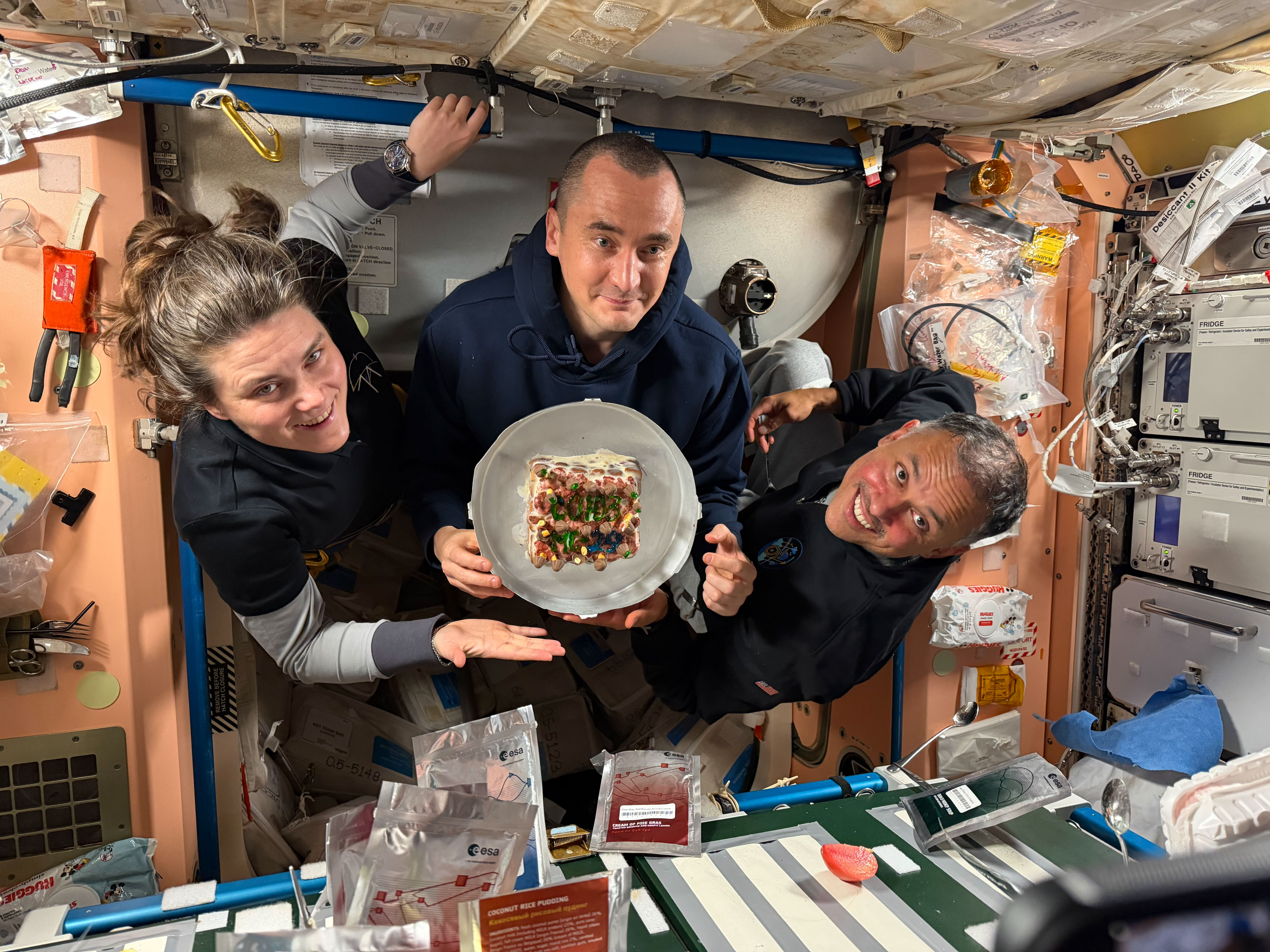











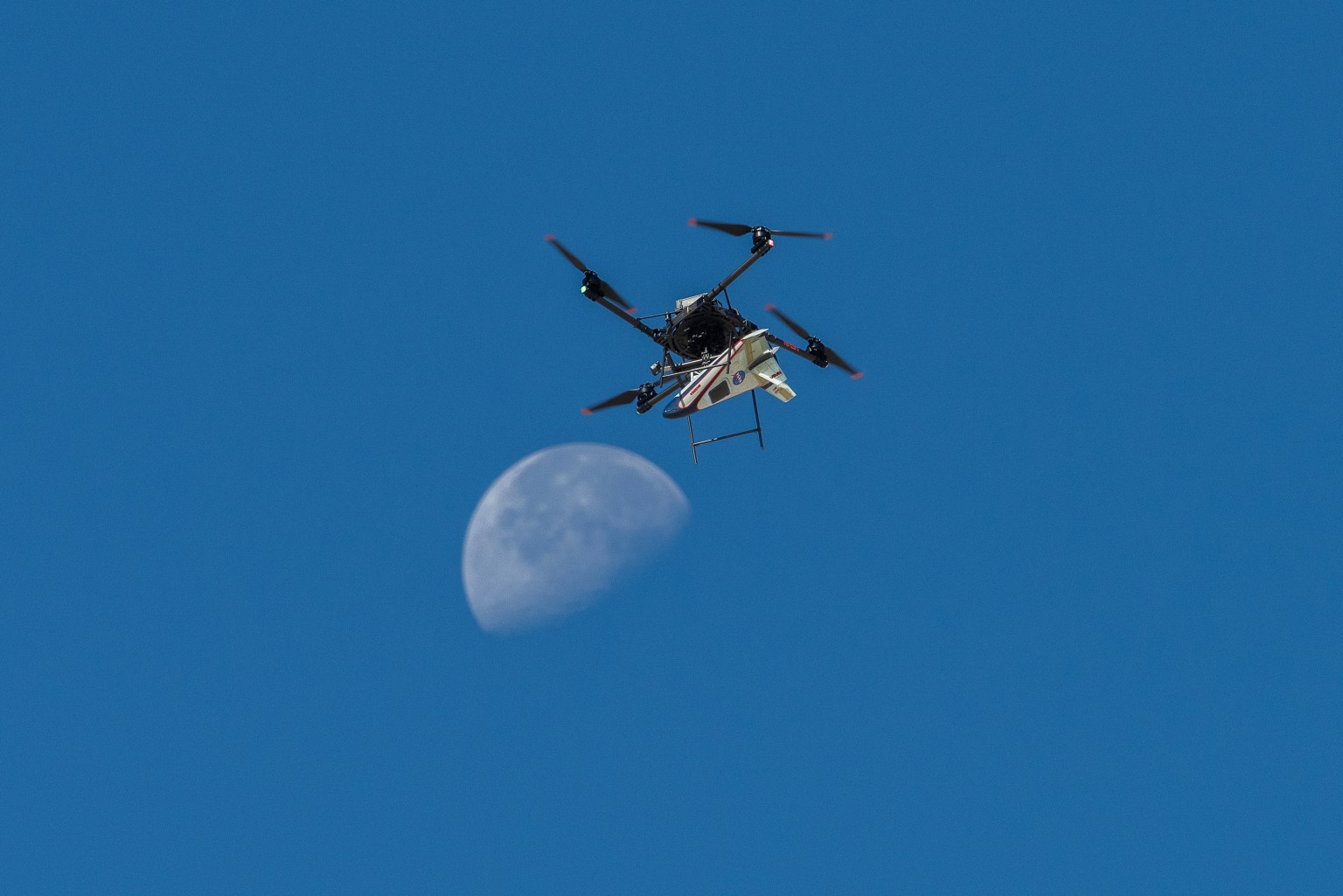










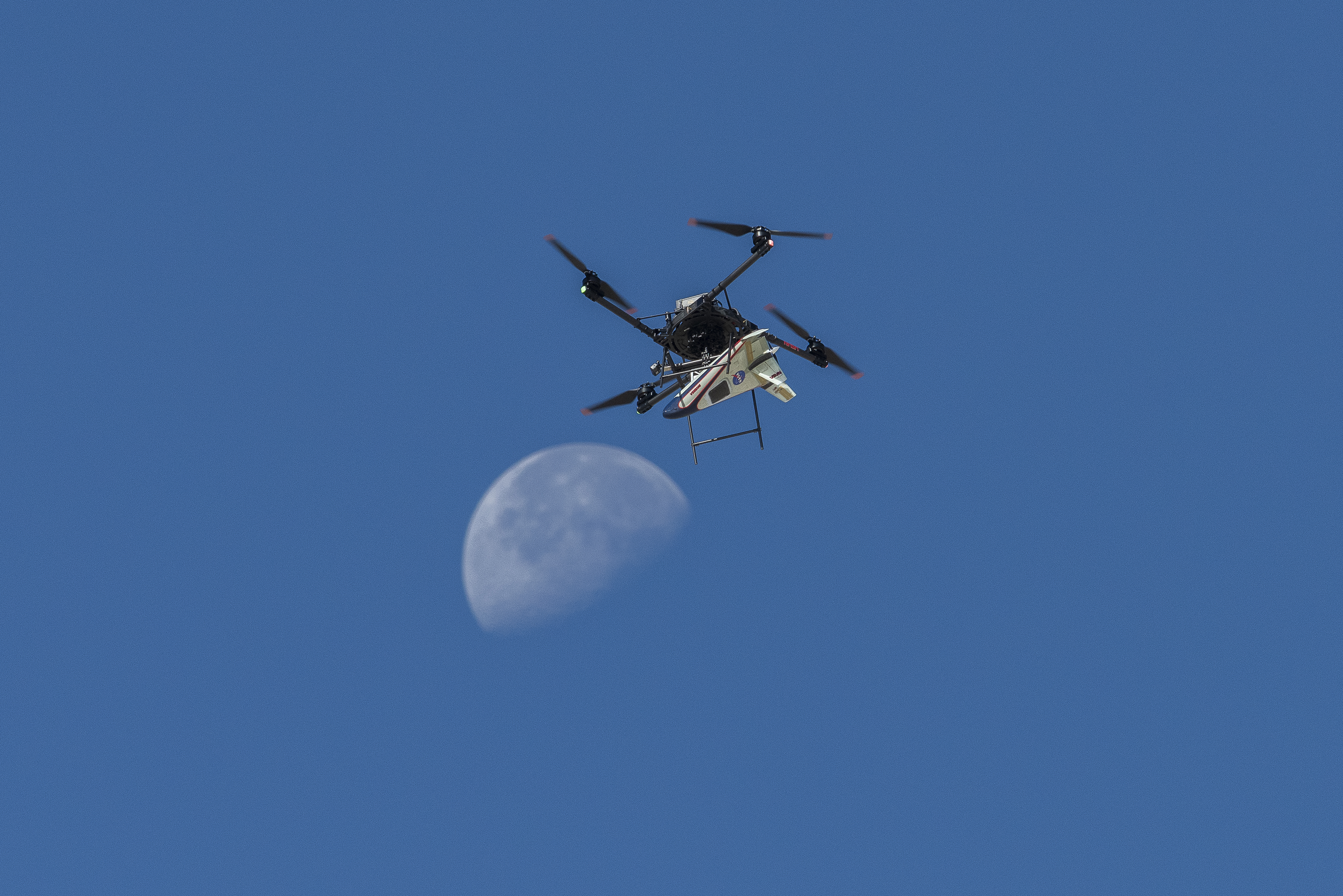



















 Risarcimenti più semplici e veloci per i ritardi, posti gratuiti per i bambini e bagaglio a mano incluso entrano nella nuova legge UE sui diritti dei passeggeri aerei.