❌

Modalità di lettura

NASA Modernizes Commercial Airline Systems

4 min read

Preparations for Next Moonwalk Simulations Underway (and Underwater)
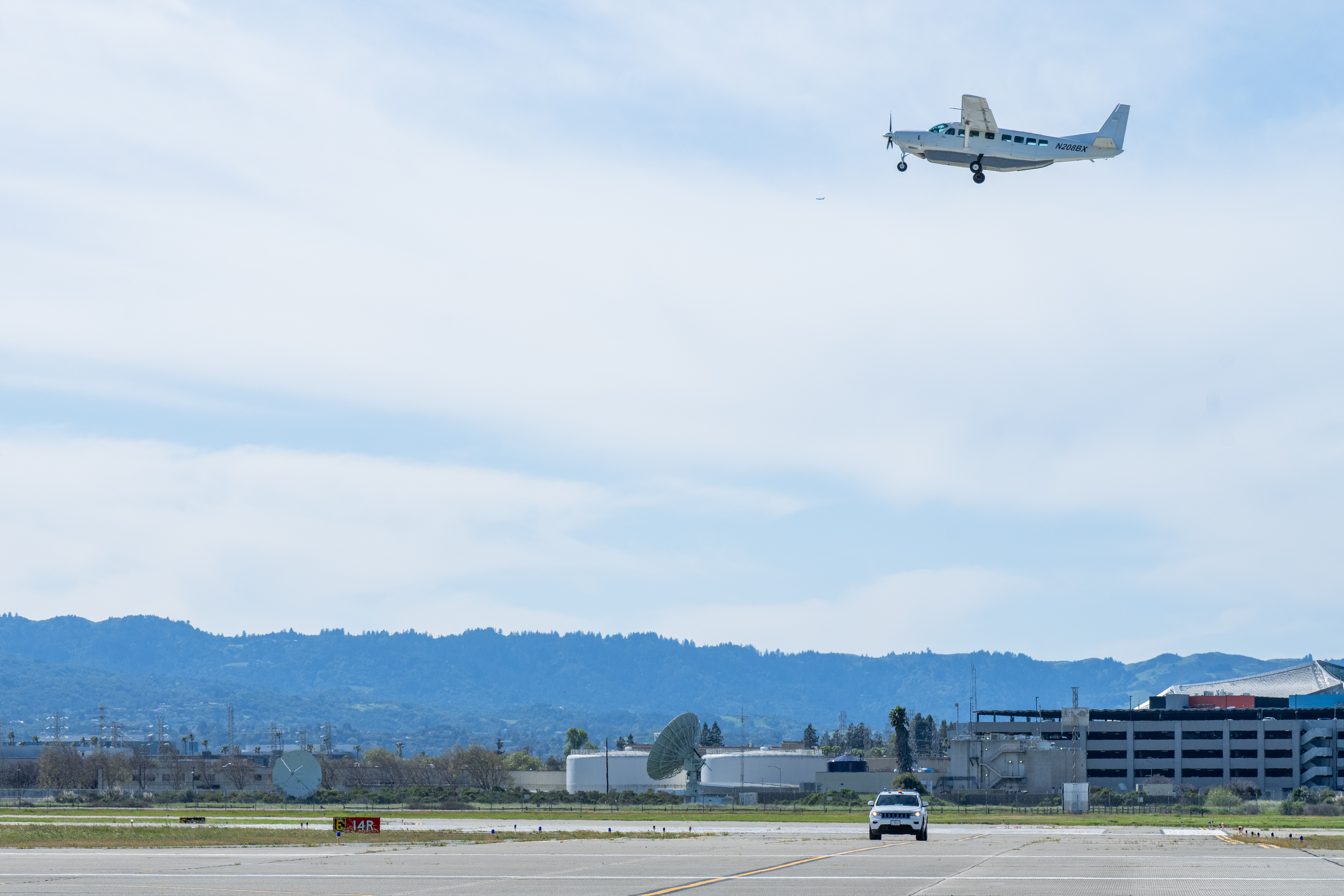
Testing at NASA’s Ames Research Center in California’s Silicon Valley in March 2026 demonstrated autonomous technology that could identify an incursion – a vehicle, wayward suitcase, or other runway obstacle that could impact an aircraft’s safe landing.
NASA/Brandon Torres-Navarrete

NASA’s researchers know that when you settle into your seat on a commercial flight, you expect a smooth takeoff, views over the clouds, a steady descent, and hopefully an early arrival at your destination. But when your flight gets delayed on the tarmac instead of lifting off, or it ends up in a holding pattern rather than landing on time, things start to change. Your experience goes from smooth to anxiety-inducing as you worry about making your connection or getting home in time for dinner.

Large airports are among the busiest, most complex environments in aviation, with aircraft, ground crews, and service vehicles sharing crowded taxiways. Researchers at NASA’s Ames Research Center in California’s Silicon Valley recently worked with Boeing to advance three types of field tests – digital taxi information, safe taxiway, and safe runways – that could lead to safer, more efficient runway environments at airports.

During the digital taxi tests, pilots were given taxiway guidance directly on cockpit displays or tablets, instead of verbally from air traffic controllers. Aircraft autonomously followed digital routes while researchers monitored a suite of sensors designed to identify vehicles or other aircraft impeding the taxi path and runway. The system reduced pilot and air traffic controller workloads and the risk of verbal errors.  

Safe runway technology testing can also improve situational awareness for approaching aircraft. While preparing to land a Boeing aircraft during testing, the same sensors successfully flagged a vehicle on the runway, providing additional awareness to ensure pilots could avoid potential collisions or other safety concerns.

Together, these NASA capabilities aim to reduce miscommunication, ease pilot workloads, and keep airport traffic moving smoothly. Future testing will integrate the sensor and digital taxi systems into a simulated air traffic control environment to evaluate how the technologies can benefit overall management of the airspace.

For years, NASA has worked to improve your experience when flying by developing new technologies to modernize the commercial airline system. Key NASA technologies streamline and digitize the flying experience – from the departure gate, to the skies, to your safe arrival at your destination.

“Aviation safety is key to NASA’s research,” said Parimal Kopardekar, director of NASA’s Airspace Operations and Safety project. “Technology that can provide additional autonomy and support a future airspace with multiple aircraft operating in harmony is key to advancing the National Airspace System.”

NASA’s research innovations continue after your flight takes off. Modern flights constantly respond to shifting weather, turbulence, and traffic. Even small changes in direction or altitude can affect when a plane arrives. These changes can force flights into holding patterns while air traffic controllers attempt to rebalance the busy airspace.

NASA’s air traffic management researchers have been working for years to reduce those situations. In a 2025 collaborative effort with Boeing, United Airlines, and international partners, NASA evaluated real‑time trajectory sharing on domestic and transoceanic flights.

During that testing, a United Airlines Boeing 737 aircraft shared frequent flight information with airline operations centers and air traffic control. NASA used the data to understand how frequently those updates should be sent and what details matter most for generating accurate arrival predictions. Better information helps controllers sequence traffic more precisely, which means fewer holding patterns and more direct descents for passengers.

A computer display of a map shows several lines which represent possible air traffic routes for an airplane to follow.
Digital rerouting technology could reduce workloads for controllers, suggesting new routes to prevent or avoid delays without the back-and-forth needed to adjust flight paths manually.
NASA

Pre-departure rerouting technology and digital exchange tools developed at NASA allow dispatchers and controllers to see the same digital picture of flights preparing to depart.

When a better route becomes available, controllers could coordinate the change digitally instead of relying on verbal communication between pilots, controllers, and dispatchers. The technology could lead to fewer delays, reduced fuel consumption, and more predictable operations for passengers.

NASA has now transferred the routing technology to the Federal Aviation Administration (FAA) and airlines will continue to test it. These tools build on decades of NASA contributions to national airspace modernization.

In coordination with the FAA, NASA has advanced automation concepts, improved how arrival and departure flows are managed, and introduced data‑driven software that commercial airlines use every day.

By working closely with airlines, manufacturers, and global partners, NASA is helping to improve every phase of flight to make air travel safer and more reliable, now and in the future.
  •  

Passion Meets Precision at NASA’s Flight Research Lab

4 min read

Preparations for Next Moonwalk Simulations Underway (and Underwater)

One man communicates with a hand-held radio, as two other men wait to the side for the go-ahead command to fly an experiment on a drone.
Derek Abramson, Dale Reed Subscale Flight Research Laboratory chief engineer, left, communicates with the Edwards Air Force Base air traffic control tower for approval to fly the Alta-X drone near NASA’s Armstrong Flight Research Center in Edwards, California, on Thursday, Aug. 27, 2026. Justin Link, small uncrewed aircraft pilot, second from left, and laboratory chief pilot Justin Hall await flight clearance. Researchers at NASA’s Johnson Space Center in Houston developed the advanced guidance and navigation system known as the Safe and Precise Landing – Integrated Capabilities Evolution (SPLICE) experiment, which is installed on the Alta-X. SPLICE will help spacecraft land precisely and detect and avoid potential hazards, which is critical for NASA missions to the Moon and to Mars.
NASA/Ryan Kline

Long before they helped shape NASA’s future aerospace breakthroughs, Derek Abramson, Justin Hall, and Justin Link were in their garages and homes building radio‑controlled aircraft, testing new ideas, and flying their creations at hobby events. That early passion now fuels the work of NASA’s Dale Reed Subscale Flight Research Laboratory at the agency’s Armstrong Flight Research Center in Edwards, California.

At NASA Armstrong’s subscale flight lab, the team turns that lifelong enthusiasm into mission-focused innovation. The laboratory supports research that ranges from advanced navigation systems for future landings on the Moon and Mars to emerging aeronautics concepts that need quick, low-cost evaluation. NASA’s small, remotely piloted and autonomous aircraft allow engineers to explore ideas that could be difficult, risky or expensive to test at full scale.

Skilled team

Abramson, Hall, and Link play key roles in that work. Abramson serves as the laboratory’s chief engineer. Hall is the chief pilot. Link is a drone pilot. Together, they integrate emerging aerospace technologies with the lab’s subscale aircraft fleet and, when needed, design and build aircraft or flight experiments to evaluate new concepts.

A boy holds a large radio-controlled black-and-yellow helicopter.
Derek Abramson, chief engineer at the Dale Reed Subscale Flight Research Laboratory at NASA’s Armstrong Flight Research Center in Edwards, California, is shown with his Kalt Cyclone radio-controlled helicopter in the mid-1980s. Abramson loved flying this aircraft as a child, and he has been an aviation enthusiast for as long as he can remember.
Derek Abramson

Abramson’s expertise, built through service in the U.S. Navy and the aerospace industry, centers on technical oversight, management, and system design. Hall is known for creative approaches to problem solving and uses practical methods to address technical challenges and maintain flight safety. Link specializes in designing and fabricating research vehicles and draws on extensive hands-on experience to understand what works, and what does not, in flight. 

On weekends, the team often tinkers in their garages or hangars building radio-control aircraft, researching hobby trends, or exploring new technologies. You might see them flying their creations at hobby events or attending trade shows. Their passion for flight brought Abramson, Hall, and Link together years before they one-by-one joined NASA more than a decade ago, though each discovered that spark in a different way.

Early influences

Abramson’s interest began as a child with rubber-band powered stick and tissue aircraft and radio-controlled models. His early aviation pursuits led to his first solo flight while in high school and a pilot’s license. In the Navy, he worked on multiple aircraft, including EA-6B and the F-18, as an avionics technician. As an engineer, he supported the B-1 and CV-22 Osprey aircraft flight tests. As an intern at NASA Armstrong, he used his operational and engineering experience on remotely piloted and autonomous aircraft.

Hall’s interest grew after seeing historic aircraft including the Mach 3 SR-71 fly over his elementary school playground and watching Space Shuttle Challenger land from above his dad’s shoulders. He has built and flown model and remotely piloted aircraft for as long as he can remember. His reputation flying radio-controlled hobby aircraft at fly-ins and trade events led to an offer to fly subscale aircraft at NASA.

Two men stand by a yellow and black radio-controlled aircraft.
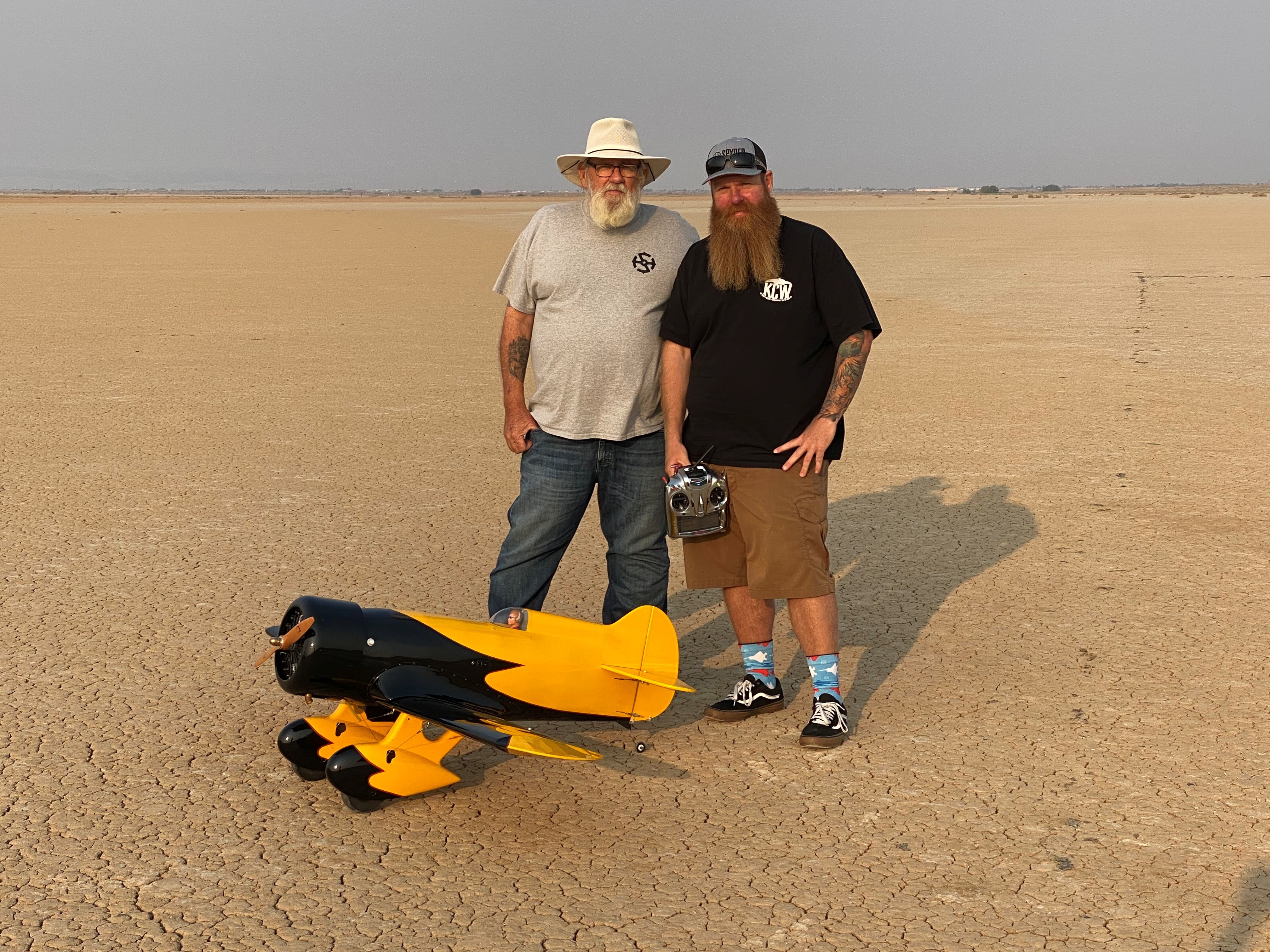
Justin Hall, chief pilot at the Dale Reed Subscale Flight Research Laboratory at NASA’s Armstrong Flight Research Center in Edwards, California, stands in front of a radio-controlled aircraft with his dad, David Hall, in August 2020. David Hall built the Gee Bee aircraft years earlier but was unable to fly it due to his health. He asked his son to fly the aircraft so he could see it in the air, which Justin did the day of this photo. Shortly afterward, David Hall passed away.
Justin Hall
Two men hold a large radio-controlled aircraft. The aircraft is red with white and black stripes.
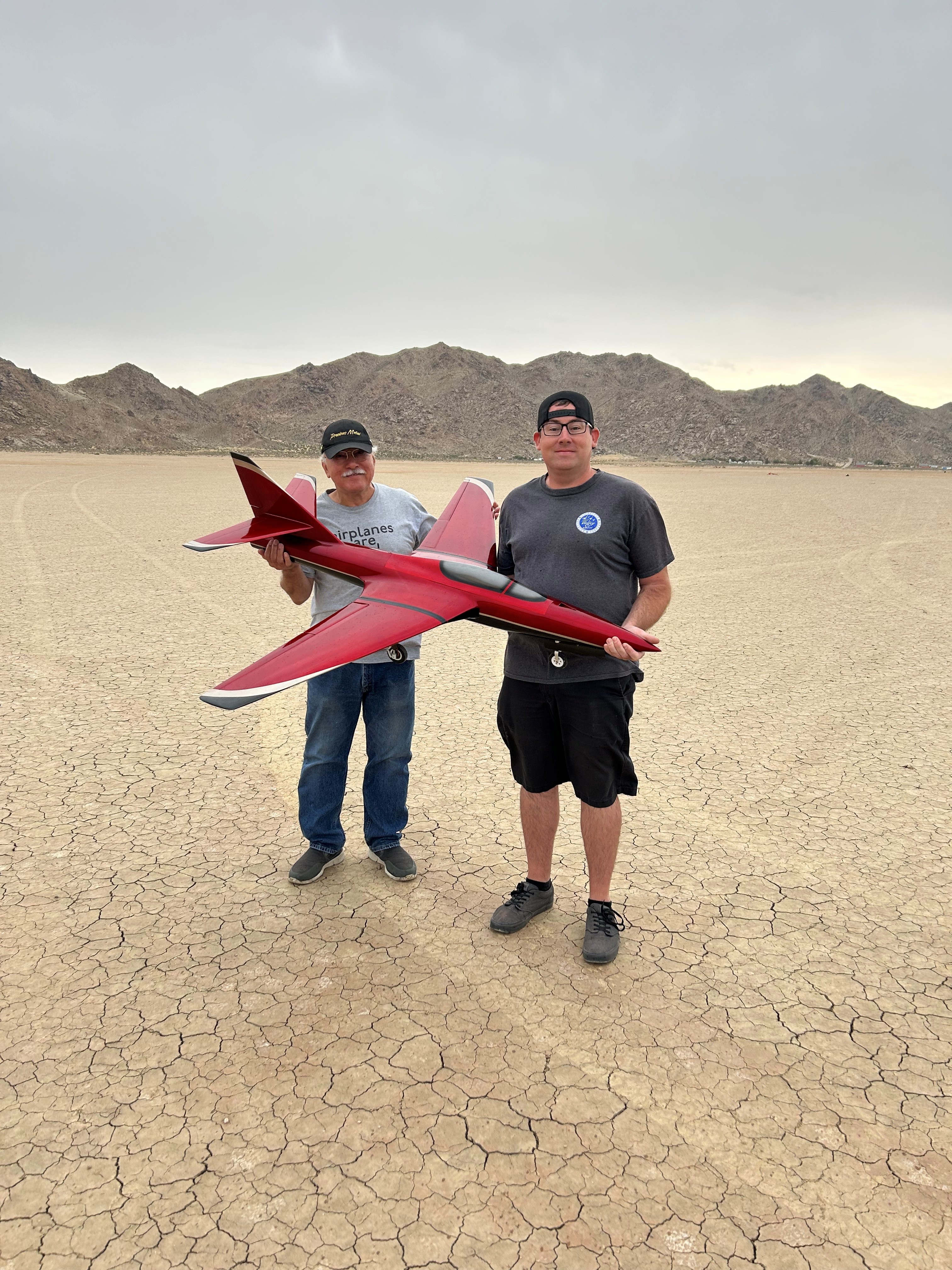
Justin link, drone pilot at the Dale Reed Subscale Flight Research Laboratory at NASA’s Armstrong Flight Research Center in Edwards, California, and his dad, Don Link, hold a Firebird radio-controlled aircraft on the day of its first flight in September 2023. It was a project they worked on together. Don Link reduced the dimensions of the original larger-scale model aircraft and drew the plans, while Justin Link manufactured composite molds and built the aircraft from scratch.
Justin Link

Link was five years old when he built balsa-wood aircraft with his dad and flew them in a field near their home. As he grew older, his hobby expanded to include radio-controlled cars, boats, helicopters, and aircraft. Aviation runs deep in Link’s family. His great grandfather served in the U.S. Army Air Corps, his grandfathers served in the U.S. Air Force, and his dad was an Air Force avionics technician. Link raced sailplanes, competed with scaled warbird aircraft, and was encouraged by family and friends to pursue an aviation profession. He has worked with large drones for more than 11 years, focusing on research and development, composite materials, and specialized fabrication methods.

Together, the team applies its experience and knowledge in rapid design, fabrication, integration and flight testing to bring new ideas to flight. Their work continues to support NASA’s missions across aeronautics, science, and exploration.

  •  

Meta Transitions PyTorch to the Linux Foundation, Further Accelerating AI/ML Open Source Collaboration

PyTorch Foundation to foster an ecosystem of vendor-neutral projects alongside founding members AMD, AWS, Google Cloud, Meta, Microsoft Azure, and NVIDIA 

DUBLIN – September 12, 2022 –  The Linux Foundation, a global nonprofit organization enabling innovation through open source, today announced PyTorch is moving to the Linux Foundation from Meta where it will live under the newly-formed PyTorch Foundation. Since its release in 2016, over 2400 contributors and 18,0000 organizations have adopted the PyTorch machine learning framework for use in academic research and production environments. The Linux Foundation will work with project maintainers, its developer community, and initial founding members of PyTorch to support the ecosystem at its new home.

Projects like PyTorch—that have the potential to become a foundational platform for critical technology—benefit from a neutral home. As part of the Linux Foundation, PyTorch and its community will benefit from many programs and support infrastructure like training and certification programs, research, and local to global events. Working inside and alongside the Linux Foundation, PyTorch will have access to the LFX collaboration portal—enabling mentorships and helping the PyTorch community identify future leaders, find potential hires, and observe shared project dynamics. 

“Growth around AI/ML and Deep Learning has been nothing short of extraordinary—and the community embrace of PyTorch has led to it becoming one of the five-fastest growing open source software projects in the world,” said Jim Zemlin, executive director for the Linux Foundation. “Bringing PyTorch to the Linux Foundation where its global community will continue to thrive is a true honor. We are grateful to the team at Meta—where PyTorch was incubated and grown into a massive ecosystem—for trusting the Linux Foundation with this crucial effort.”

“Some AI news: we’re moving PyTorch, the open source AI framework led by Meta researchers, to become a project governed under the Linux Foundation. PyTorch has become one of the leading AI platforms with more than 150,000 projects on GitHub built on the framework. The new PyTorch Foundation board will include many of the AI leaders who’ve helped get the community where it is today, including Meta and our partners at AMD, Amazon, Google, Microsoft, and NVIDIA. I’m excited to keep building the PyTorch community and advancing AI research,” said Mark Zuckerberg, Founder & CEO, Meta.

The Linux Foundation has named Dr. Ibrahim Haddad, its Vice President of Strategic Programs, as the Executive Director of the PyTorch Foundation.  The PyTorch Foundation will support a strong member ecosystem with a diverse governing board including founding members: AMD, Amazon Web Services (AWS), Google Cloud, Meta, Microsoft Azure and NVIDIA. The project will promote continued advancement of the PyTorch ecosystem through its thriving maintainer and contributor communities. The PyTorch Foundation will ensure the transparency and governance required of such critical open source projects, while also continuing to support its unprecedented growth.

Member Quotes

AMD

“Open software is critical to advancing HPC, AI and ML research, and we’re ready to bring our experience with open software platforms and innovation to the PyTorch Foundation,” said Brad McCredie, corporate vice president, Data Center and Accelerated Processing, AMD. “AMD Instinct accelerators and ROCm software power important HPC and ML sites around the world, from exascale supercomputers at research labs to major cloud deployments showcasing the convergence of HPC and AI/ML. Together with other foundation members, we will support the acceleration of science and research that can make a dramatic impact on the world.”

Amazon Web Services

“AWS is committed to democratizing data science and machine learning, and PyTorch is a foundational open source tool that furthers that goal,” said Brian Granger, senior principal technologist at AWS. “The creation of the PyTorch Foundation is a significant step forward for the PyTorch community. Working alongside The Linux Foundation and other foundation members, we will continue to help build and grow PyTorch to deliver more value to our customers and the PyTorch community at large.”

Google Cloud

“At Google Cloud we’re committed to meeting our customers where they are in their digital transformation journey and that means ensuring they have the power of choice,” said Andrew Moore, vice president and general manager of Google Cloud AI and industry solutions. “We’re participating in the PyTorch Foundation to further demonstrate our commitment of choice in ML development. We look forward to working closely on its mission to drive adoption of AI tooling by building an ecosystem of open source projects with PyTorch along with our continued investment in JAX and Tensorflow.”

Microsoft Azure

“We’re honored to participate in the PyTorch Foundation and partner with industry leaders to make open source innovation with PyTorch accessible to everyone,” Eric Boyd, CVP, AI Platform, Microsoft, said. “Over the years, Microsoft has invested heavily to create an optimized environment for our customers to create, train and deploy their PyTorch workloads on Azure. Microsoft products and services run on trust, and we’re committed to continuing to deliver innovation that fosters a healthy open source ecosystem that developers love to use. We look forward to helping the global AI community evolve, expand and thrive by providing technical direction based on our latest AI technologies and research.”

NVIDIA

“PyTorch was developed from the beginning as an open source framework with first-class support on NVIDIA Accelerated Computing”, said Ian Buck, General Manager and Vice President of Accelerated Computing at NVIDIA. “NVIDIA is excited to be an originating member of the PyTorch Foundation to encourage community adoption and to ensure using PyTorch on the NVIDIA AI platform delivers excellent performance with the best experience possible.”

Additional Resources:

  • Visit pytorch.org to learn more about the project and the PyTorch Foundation
  • Read Jim Zemlin’s blog discussing the PyTorch transition
  • Read Meta AI’s blog about transitioning PyTorch to the Linux Foundation
  • Read this blog from Soumith Chintala, PyTorch Lead Maintainer and AI Researcher at Meta, about the future of the project
  • Join Soumith Chintala and Dr. Ibahim Haddad for a fireside chat on Thursday, September 15, at 3pm GMT / 11am ET / 8am PT
  • Learn more about PyTorch training opportunities from the Linux Foundation
  • Follow PyTorch on Facebook, LinkedIn, Spotify, Twitter, and YouTube

About the Linux Foundation

Founded in 2000, the Linux Foundation and its projects are supported by more than 3,000 members. The Linux Foundation is the world’s leading home for collaboration on open source software, hardware, standards, and data. Linux Foundation projects are critical to the world’s infrastructure including Linux, Kubernetes, Node.js, ONAP, Hyperledger, RISC-V, PyTorch, and more. The Linux Foundation’s methodology focuses on leveraging best practices and addressing the needs of contributors, users, and solution providers to create sustainable models for open collaboration. For more information, please visit us at linuxfoundation.org.

###

The Linux Foundation has registered trademarks and uses trademarks. For a list of trademarks of The Linux Foundation, please see our trademark usage page:  https://www.linuxfoundation.org/trademark-usage. Linux is a registered trademark of Linus Torvalds.

Media Contact

Dan Whiting

for the Linux Foundation

202-531-9091

dwhiting@linuxfoundation.org

The post Meta Transitions PyTorch to the Linux Foundation, Further Accelerating AI/ML Open Source Collaboration appeared first on Linux Foundation.

  •  
❌