
Modalità di lettura

BAD DRIVERS OF ITALY dashcam compilation 5.7 - LA RISSA

💾

Trova la tua prossima DASHCAM https://sicurisullastrada.it/dashcam/
Dubbi o domande? Trovi qui le RISPOSTE https://sicurisullastrada.it/dashcam-5-minuti-per-sapere-tutto/
Vuoi inviarci le clip della TUA DASHCAM? Guarda come fare su https://bit.ly/inviavideo
Seguici sui canali BDOI per essere AGGIORNATO e vedere le MIGLIORI CLIP https://bit.ly/canalibdoi
Hai domande o curiosità? COMMENTA sotto al video oppure CONTATTACI https://bit.ly/contattabdoi
- - - - - - - - - - - - - - - - - - - - - - - - - - - - - - - - - - - - - - - - - - - - -
This video shows DANGEROUS behaviors not to imitate! Always drive carefully!
Do you want to send us the clips of YOUR DASHCAM? See how on https://bit.ly/inviavideo
Follow us on BDOI channels to be UPDATED and see the BEST CLIPS https://bit.ly/canalibdoi
Do you have any questions or curiosities? COMMENT below the video or CONTACT US https://bit.ly/contattabdoi

#baddriversofitaly #dashcam #compilation
  •  

Cornell Students Aid NASA with Drone Safety in Sky

6 min read

Preparations for Next Moonwalk Simulations Underway (and Underwater)

Two students sit at a table with a laptop and large monitor that displays a simulation of a drone flying in an urban environment.
Students from Cornell University are shown working with an air transportation management tool in which a real drone flying over a remote field thinks its operating with imaginary drones flying in a simulated urban environment. Their work is the result of a NASA grant that is part of the agency’s University Student Research Challenge.
Cornell University / Mehrnaz Sabet

A team of Cornell University students are turning heads within industry and the federal government with the results of their research into creating a national air transportation management system in which thousands of drones could safely operate together.

NASA is sponsoring their work through the University Student Research Challenge (USRC), which provides grants to college students interested in helping the agency realize its aeronautical research goals.

“Looking at new traffic management systems for drones is not new,” said Mehrnaz Sabet, a doctoral student in the field of information science who serves as principal investigator on the grant and leads the Cornell team. “In fact, NASA has led that effort for years.”

Now, through USRC, NASA is giving Sabet and her team the chance to offer up innovative approaches to drone safety by managing their movements in the air, taking advantage of their young minds and fresh ideas.

The ultimate benefit of Cornell’s research in this area is the full realization of advanced air mobility, an area of industry focus that includes everything from urban flying taxis, more robust disaster response aircraft, and hot fresh pizza delivered right to your door.

The work also underscores the value NASA places on maturing cutting-edge technologies and helping to develop its future workforce through initiatives like USRC.

“Sabet and her team have demonstrated versatile skills involving software, algorithms, hardware, sensors development, laboratory tests, simulations, and actual flight tests – a rare combination,” said Parimal Koperdekar, acting director of NASA’s Airspace Operations and Safety Program.

Flying drones like we drive

Currently, drone operators must file plans that fully describes the intended flight path of the drone with a traffic management service. Those plans are checked with others to ensure there will be no collisions – what Sabet calls strategic deconfliction.

The challenge is that today’s air traffic management system is limited in its ability to handle the growing number of aircraft taking to the sky. Adding thousands of drones to the mix during the coming years risks over burdening the system, Sabet said.

What is needed in the air is essentially what we have on the ground – where millions of people drive on a road every day, she said.

As a driver you might know your whole “trajectory,” or the path you’d follow to reach your destination. But you would never coordinate your plan with every other driver on the road before you leave. Instead, traffic laws and infrastructure such as stop lights and traffic signs allow you to deconflict with other cars as you go.

Drone operators will still have to file flight plans saying where they intend to go, but the idea is to incorporate that car-like flexibility into drone operating systems, allowing them to be adaptable during their journeys.

“We need to ensure all these different types of drones can tactically deconflict with each other so that it is safe for them to operate like cars do on the ground. And that missing piece – tactical deconfliction – is at the center of our project,” Sabet said.

A young woman in black shirt, pants, and baseball cap stands under a tent in an open field with a table full of laptop computers used to operate a drone traffic management simulation.
Mehrnaz Sabet, a doctoral candidate in the field of information science at Cornell University, leads a student team testing technologies used in a drone traffic management system under a grant from NASA’s University Student Research Challenge, She is seen during a drone traffic simulation exercise taking place in a rural field.
Cornell University

Two worlds joined

The key to the Cornell team’s research is the notion of integrating a simulated world with the real one to test and demonstrate how drones can learn to adapt to potentially hazardous conditions and make necessary corrections in their flight path on their own.

Knowing they could not go out and fly 100 drones at the same time to test their ideas for tactical deconfliction, the students decided to create an entirely virtual urban world to evaluate different high-volume traffic models, separation algorithms, and related data.

“Our first year of the project went into adapting and scaling that simulation engine and it all went very well,” Sabet said. “But we didn’t want to stick to a simulation. We wanted to see how the simulation translated to the real world, which mattered more.”

Still hampered by the limitations of how many drones they could operate and where they could fly – not many and basically in the middle of nowhere – they sought the best of both worlds, real and imagined.

“What we wound up doing was to embed the simulation into a real drone, so the drone thought it was flying in a dense urban environment although it was actually flying out in an open field where there wasn’t a real city in sight,” Sabet said.

before
after
A drone with four helicopter-like blades hovers over a rural green field amidst a bright partly cloudy sky.
A drone designed and built by Cornell University students hovers over an open field during a test of air traffic management system technologies in which the drone “thinks” its flying within an urban environment. The goal is to prove a system in which drones can safely react to unforeseen events and avoid each other in the sky without human intervention.
Cornell University
In a screengrab from a video, about a dozen drones are seen maneuvering over a city building, their paths shown with blue or yellow lines.
Several drones appear in a Cornell University computer graphic simulation of an urban environment in which an air traffic management system is tested to show how the drones can safely alter course on their own to avoid colliding.
Cornell University
A drone with four helicopter-like blades hovers over a rural green field amidst a bright partly cloudy sky.
A drone designed and built by Cornell University students hovers over an open field during a test of air traffic management system technologies in which the drone “thinks” its flying within an urban environment. The goal is to prove a system in which drones can safely react to unforeseen events and avoid each other in the sky without human intervention.
Cornell University
In a screengrab from a video, about a dozen drones are seen maneuvering over a city building, their paths shown with blue or yellow lines.
Several drones appear in a Cornell University computer graphic simulation of an urban environment in which an air traffic management system is tested to show how the drones can safely alter course on their own to avoid colliding.
Cornell University
before
after

drone flight test

Combing real and simulated worlds

The image at left (BEFORE) shows a Cornell University student-designed and built drone flying in the open above an isolated, rural field. The image at right (AFTER) shows the simulated urban environment the real drone “thinks” its flying in as it calculates all the imaginary drones’ flight paths (the blue and yellow lines) to find the best trajectory to safely avoid a collision. This combining of real and simulated worlds allows the drone to safely test its traffic avoidance technologies.

Real world lessons

This allowed the team to try out different traffic management tools and evaluate how drones might coordinate course corrections and avoid collisions with each other.

During the past year, they’ve taken the idea further by flying two real drones in the real world, each running the real-time simulation on board, allowing them to coordinate and “see” both simulated traffic and each other within the integrated test environment.

“We would then intentionally put them on a direct collision course to stress-test the detect and avoid and coordination models and see how well they react and coordinate the drone’s maneuvers to avoid hitting each other,” Sabet said.

Their success struck a chord with NASA experts in Unmanned Aircraft Systems Traffic Management (UTM).

“What’s impressive is that Cornell’s study included over 10,000 runs involving more than one million trajectories, and over 200,000 hours of experimentation to understand how multi-agent decentralized coordination would safely take place,” Kopardekar said.

Industry and the Federal Aviation Administration have also responded positively to this research and its potential. The team was asked to use its infrastructure and technology to virtually recreate an incident in 2025 in which a pair of drones collided with a stationary crane in Arizona. The team also showed how the accident could have been prevented.

The team was also asked to simulate recent, real-world fires in California to showcase how drones could better coordinate their movements both to provide situational awareness for public safety officials on the ground and to stay clear of fire-suppressing air tankers.

And according to the Cornell team, the FAA is interested in applying the project’s mix of virtual and real-world testing to evaluate drone operations under increasing levels of operational complexity.

“This kind of mixed-reality type of operational complexity enables them to test drone operations in a way that was not possible before,” Sabet said.

Thanks to NASA’s support through USRC, the Cornell team will continue to expand their capabilities and manage increasingly complex advanced air mobility operations.

“Our goal is to build the foundational systems that enable safe, large-scale autonomy in the skies,” Sabet said.

USRC is an opportunity within NASA’s Transformative Aeronautics Concepts Program under the agency’s Aeronautics Research Mission Directorate.

About the Author

Jim Banke

Jim Banke

Managing Editor/Senior Writer

Jim Banke is a veteran aviation and aerospace communicator with more than 40 years of experience as a writer, producer, consultant, and project manager based at Cape Canaveral, Florida. He is part of NASA Aeronautics' Strategic Communications Team and is Managing Editor for the Aeronautics topic on nasa.gov. In 2007 he was recognized with a Distinguished Public Service Medal, NASA's highest honor for a non-government employee.

Keep Exploring

Discover More Topics From NASA

Share

Details

Last Updated
May 06, 2026
Editor
Jim Banke
Contact
  •  

Roberto Bolle and Friends a Milano

L’eleganza della danza torna a incantare il pubblico nel 2026 con Roberto Bolle and Friends,
il celebre gala internazionale che ogni anno riunisce sul palco alcune delle stelle più importanti del balletto mondiale.

Ancora una volta protagonista sarà Roberto Bolle,
tra i danzatori italiani più conosciuti e stimati nel panorama internazionale.


La tournée prenderà il via da Milano, dove lo spettacolo
sarà in programma dal 21 al 24 maggio 2026 presso il Teatro Arcimboldi.

In seguito, la produzione farà tappa anche in altre città italiane, confermando il grande successo di uno degli eventi più attesi dagli appassionati di danza.


Come da consuetudine, Roberto Bolle and Friends porterà in scena un mix di tecnica,
raffinatezza ed emozione attraverso uno spettacolo esclusivo.
Sul palco si esibiranno étoile e primi ballerini provenienti dai teatri più prestigiosi del mondo.
Il pubblico potrà inoltre ammirare coreografie classiche e contemporanee, create per esaltare tutta la potenza espressiva dell’arte della danza.


Dopo i grandi risultati ottenuti nelle edizioni precedenti, anche il 2026 si prospetta come un anno significativo per questo format. Roberto Bolle si conferma infatti una figura di riferimento a livello internazionale, grazie a una carriera che lo ha visto protagonista tra il Teatro alla Scala e l’American Ballet Theatre.


Anche nel 2026, Roberto Bolle and Friends si conferma quindi un appuntamento capace di avvicinare il grande pubblico al mondo della danza. Un’opportunità unica per assistere a uno spettacolo di altissimo profilo nel cuore di Milano.

TICKETS :
https://www.ticketone.it/artist/roberto-bolle/roberto-bolle-and-friends-3623474/

Credits Photo Pagina Facebook di Roberto Bolle

L'articolo Roberto Bolle and Friends a Milano proviene da InfoMilano.news.

  •  

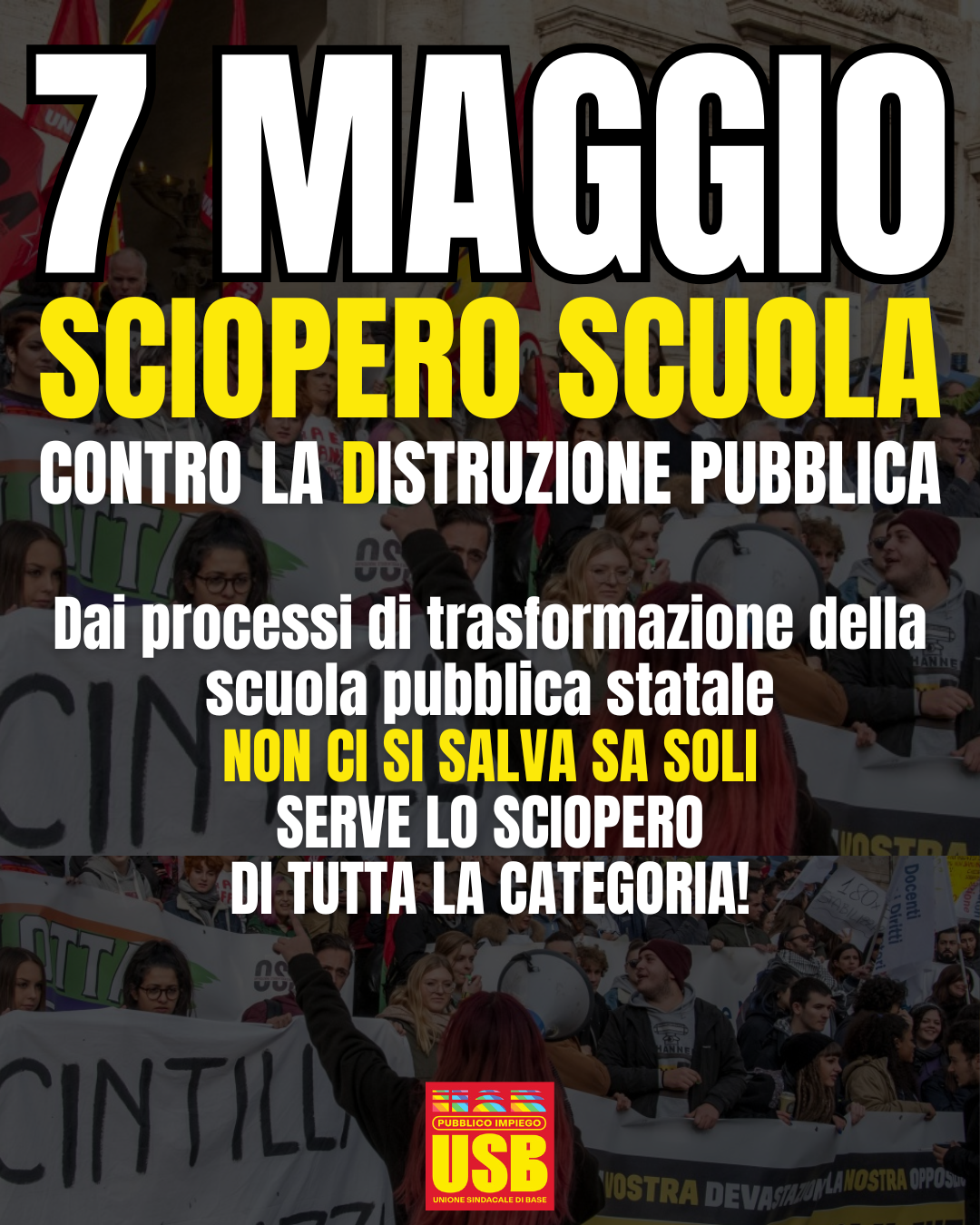
7 maggio Sciopero della Scuola. Contro la leva, la guerra e la scuola di Valditara: una sola riforma classista, dai tecnici alle nuove linee guida dei licei

MANIFESTAZIONE A LIVORNO ORE 9:30 PIAZZA CAVOUR

Il 7 maggio lavoratrici e lavoratori della scuola incroceranno le braccia insieme a studentesse e studenti, con manifestazioni territoriali in decine di città. L'appuntamento a Roma è alle ore 9:00 al MIM in viale Trastevere.

Lo sciopero, proclamato anche per il 6 maggio per garantire la massima copertura al personale, chiama al boicottaggio delle prove INVALSI e raccoglie l'invito alla mobilitazione dell'assemblea internazionale giovanile We do not enlist.
Scioperiamo contro la militarizzazione della scuola e della società, contro la leva obbligatoria, contro la riforma degli istituti tecnici e professionali che consegna la formazione delle classi popolari direttamente nelle mani delle imprese, contro le nuove linee guida dei licei e contro un rinnovo contrattuale che propone salari vergognosi mentre l'inflazione cresce, trascinata dai costi di guerre che non abbiamo voluto e non vogliamo.
La scuola di Valditara non è la nostra. Le sue politiche reazionarie, classiste, repressive e di militarizzazione sono nemiche di studenti e lavoratori. Riprendiamoci spazi di democrazia e di organizzazione politica e sociale a partire dalle scuole, lottiamo per una scuola statale al servizio di chi la fa e la vive. Cancelliamo quasi quarant'anni di controriforme.
Né "capitale umano" né manodopera ideologizzata!
Scioperiamo perché la scuola non deve essere ridotta a produttrice di "capitale umano" da immettere sul mercato del lavoro secondo le logiche della competitività e del profitto. Rifiutiamo la retorica delle competenze, strumento ideologico con cui si svuotano i saperi critici e si addestrano menti flessibili, adattabili, sfruttabili. Rifiutiamo ancora una volta la formazione scuola-lavoro, sfruttamento di lavoro minorile travestito da esperienza formativa, che è già costata la vita a troppi giovani.
In questo quadro si innesta la riforma degli istituti tecnici e professionali. I nuovi percorsi 4+2 e i nuovi quadri orari piegano i programmi alle esigenze produttive dei territori, erodono la formazione generale e critica, e avviano gli studenti delle classi popolari – quelli che storicamente frequentano i tecnici e i professionali – a diventare manodopera qualificata su misura per il distretto industriale di turno. Non è orientamento, è selezione di classe. Non è innovazione didattica, è privatizzazione strisciante del sapere.
Le nuove Indicazioni per i Licei: l'altra faccia dello stesso progetto classista.
Mentre i tecnici e i professionali vengono consegnati alle imprese, il 22 aprile il ministero ha pubblicato il testo delle nuove Indicazioni Nazionali per i Licei: l'altra metà del disegno. Non un'operazione separata, ma il complemento ideologico della stessa controriforma. Ai figli delle classi popolari avviati nei "licei agrari", "chimici" o "tessili" – la trovata semantica con cui Valditara annuncia di voler smantellare la distinzione formale tra licei e tecnici – si vuole consegnare la formazione professionalizzante; ai licei tradizionali, frequentati in gran parte dalla borghesia e dai ceti medi, si destina invece la costruzione di una "coscienza" identitaria dichiaratamente eurocentrica e nazionalista.
La centralità della storia dell'Italia e dell'Occidente, la soppressione della geostoria, la ridefinizione dell'inclusione come "architrave della cultura occidentale moderna": non sono scelte didattiche neutre, ma una precisa operazione politica. Si riscrive il canone in chiave identitaria, si restringe lo sguardo storico proprio mentre si chiede ai nostri ragazzi di diventare carne da cannone in guerre globali, si svuotano gli strumenti critici per leggere il presente – il colonialismo, le migrazioni, il genocidio in corso – riducendoli a marginalità rispetto a un nucleo "euro-occidentale" presentato come depositario universale di diritti e civiltà. È la stessa narrazione bellicista che giustifica l'aumento delle spese militari e la riduzione del welfare, trasferita dentro i programmi scolastici. L'irruzione dell'intelligenza artificiale "in attuazione della Legge 132/2025 e dell'AI Act", senza alcuna formazione strutturata per il personale e senza investimenti reali, completa il quadro: parole d'ordine modernizzanti su un impianto culturalmente regressivo.
E come già accaduto per le Indicazioni del primo ciclo, la "consultazione" è una farsa: il questionario predisposto dal ministero non prevede neanche l'opzione del parere negativo. La fase di ascolto è una messa in scena, come lo è la riforma stessa.
Tecnici e licei, dunque, non sono due capitoli distinti: sono il dritto e il rovescio dello stesso progetto. Una scuola che separa, che gerarchizza, che addestra i figli del lavoro al lavoro precario e i figli delle élite a una "missione di civiltà" funzionale alla retorica di guerra. Va respinta tutta intera.
Inclusione, salari, contratto
Scioperiamo per la scuola che include e non separa, capace di rispondere ai tagli agli organici di sostegno e ai servizi per gli alunni con disabilità previsti dal decreto legislativo 62/2024 – scelte di cinica contabilità fatte sulla pelle di studenti, famiglie e lavoratori, mentre i soldi pubblici vengono trasferiti all'industria militare. Rivendichiamo la stabilizzazione dei precari, l'internalizzazione degli educatori delle cooperative sociali, salari adeguati all'inflazione, un contratto degno.
Contro la leva, contro la guerra!
Davanti al rischio di escalation della guerra in Iran e alle sue ricadute globali, mentre il genocidio del popolo palestinese continua nel silenzio complice dei governi occidentali e delle complicità con lo Stato di Israele, dobbiamo riconnettere scuola e società reale. La scuola rischia di essere risucchiata nella spirale folle innescata dagli USA di Trump, con il silenzio-assenso degli altri governi occidentali, e di essere ridotta a funzione del processo di militarizzazione.
In molti paesi europei si è già reintrodotta o ci si avvia a reintrodurre la leva militare obbligatoria. Anche contro la leva dobbiamo scioperare: gli studenti non sono carne da cannone, non sono forza lavoro disponibile, non sono risorse umane da ottimizzare per l'economia di guerra. Il progetto di reintroduzione della coscrizione non è separabile dall'escalation bellica, dall'aumento delle spese per gli armamenti a scapito del welfare, dalla narrazione che vuole trasformare le nostre scuole in anticamere delle caserme.
Non a caso il 7 maggio sarà anche il giorno dello sciopero dei lavoratori portuali di USB contro la privatizzazione e la militarizzazione dei porti: una convergenza che riconnette i protagonisti delle mobilitazioni dello scorso autunno e dà forza a un progetto alternativo.
Il 7 maggio si sciopera. Studenti e lavoratori uniti, contro la guerra, contro la leva, contro la scuola classista di Valditara – tecnici e licei. Per una nuova scuola pubblica, statale, democratica e antifascista.
  •  
❌