Modalità di lettura

Soccer Meets Space Science

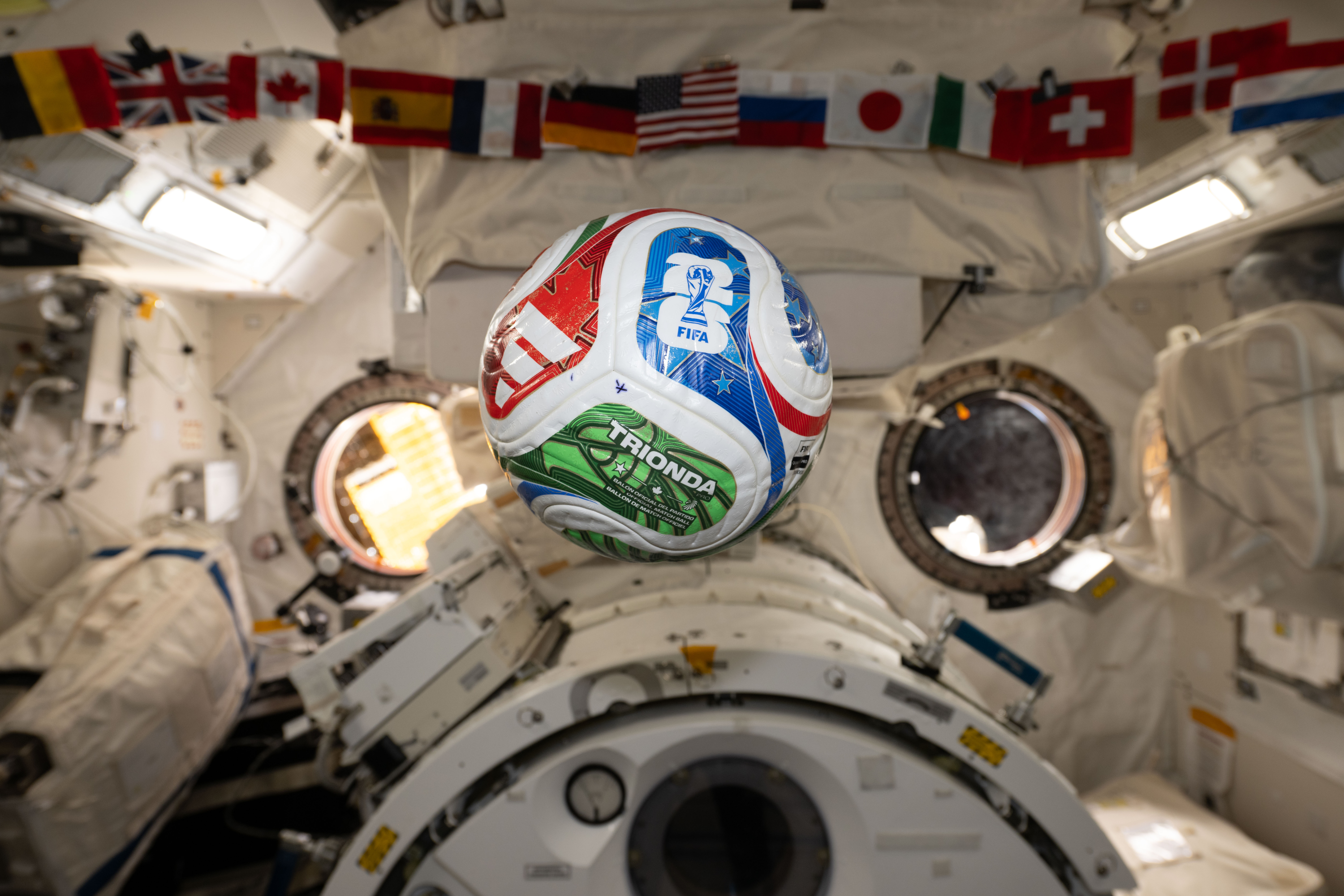
A white, red, blue, and green soccer ball floats inside the International Space Center. The FIFA logo is visible in the blue part of the ball facing the camera. The area in the background is mostly white, with a banner of country flags at the top of the photo.
NASA

A soccer ball floats in microgravity in this March 2, 2026, picture from the International Space Station. The space station crew tested soccer balls to study how internal mass affects motion and stability in microgravity. The findings have improved understanding of how embedded technologies, including match-ball sensors, can influence performance during play.

Through research aboard the International Space Station and technology developed for exploration, NASA continues to demonstrate how discoveries made for space can benefit people on Earth—including athletes and fans participating in the world’s most popular sport.

Image credit: NASA

  •  

Soccer Meets Space Science

A white, red, blue, and green soccer ball floats inside the International Space Center. The FIFA logo is visible in the blue part of the ball facing the camera. The area in the background is mostly white, with a banner of country flags at the top of the photo.
NASA

A soccer ball floats in microgravity in this March 2, 2026, picture from the International Space Station. The space station crew tested soccer balls to study how internal mass affects motion and stability in microgravity. The findings have improved understanding of how embedded technologies, including match-ball sensors, can influence performance during play.

Through research aboard the International Space Station and technology developed for exploration, NASA continues to demonstrate how discoveries made for space can benefit people on Earth—including athletes and fans participating in the world’s most popular sport.

Image credit: NASA

  •  

Discovery of IPv6 Router Addresses Using Subnet-Router Anycast

Brute-force IPv6 scanning doesn't scale, and ICMPv6 rate limiting can undermine topology measurements. Maynard Koch and colleagues show how Subnet-Router Anycast (SRA) probing discovers more router addresses, delivers more stable results, and expands the IPv6 measurement toolbox.
  •  
❌