The team behind the AI Octopus Euro 2024 predictor has updated its simulator for the 2026 FIFA World Cup, this time allowing users to throw natural-language scenarios at the model and see how the tournament might shake out. "Sensible questions work – a red card, a key injury, a heat wave, a squad switching base camp – but so do the daft ones, e.g. 'What if the tournament were played with rugby rules?'" said Luzmo CTO and co-founder Haroen Vermylen. The system is simple: enter a scenario in a prompt box, and the predictor spits out how the results might go. The raw data includes squad quality based on player information, heat and altitude factors, injury data, and so on. A Monte Carlo simulation of the tournament is used to generate win/lose/draw probabilities, and the score line is derived from 5,000 match runs. The engine behind the Euro 2024 AI Octopus was written in TypeScript. This time around, the team used Rust. "We moved to Rust to also be able to run things more quickly, as now there is a real-time component to this," Vermylen told The Register. "Before it could run for five minutes or so. Now we want the predictions to actually come out within two to three seconds of actual simulation time." OpenAI models parse the request and generate summaries, and an agent is used to create or transform scenarios, call the calculation engine, answer questions, and so on. A user doesn't need to be a data scientist to ask questions and understand the answers. It's certainly rapid, recalculating the results based on suggested scenarios (even one in which we pondered the effect of politically dubious emissions from a certain world leader). Not that all scenarios will work. Vermylen told us that filtering was in place to ignore profanities and "to avoid scenarios that would just be harmful to certain groups." And then there is the age-old issue of an AI parser simply not understanding the prompt. Clarity is key. Using natural language is a great alternative to a UI with settings and sliders, but that ease of use can result in misunderstandings. As the tournament progresses, the data will be refined. At the time of writing, the baseline reckons that Spain will beat England in the final. Spain currently has an 18 percent chance of lifting the trophy and a 26.8 percent chance of reaching the finals. Those figures can, of course, be altered by feeding in scenarios. For example, we asked: "What if the Spanish team eats a bad paella?" Spain's chance of winning the tournament then dropped to 1.5 percent, with France as the projected champion. We also asked it what would happen if we replaced the England team with Register writers. Suffice to say that scenario did not end well. We asked Vermylen what was next. "The Olympics would be nice… or the Eurovision. We'd like to give the United Kingdom a win." ®
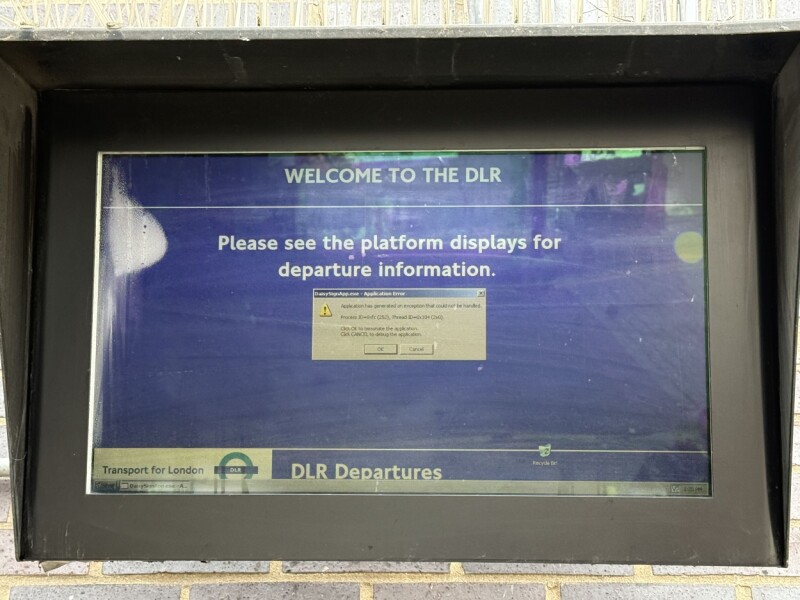
BORK!BORK!BORK! We're big fans of retro computing here at Vulture Central, and so it is with a certain delight that we can report XP-era Windows has been spotted disgracing itself on London's Docklands Light Railway. Spotted by Register reader Tim Hayward, the wonderfully named DaisySignApp.exe has thrown up an application error. While the Windows shell might be shorn of all of XP's fripperies, the Recycle Bin icon hints at the operating system's origins. Hayward reckoned that XP was stalking the DLR, but it could also be Windows Server 2003. Support for Windows Server 2003 finally ended in 2015. XP was sunset in 2014, so the DLR display is rather out of date. Then again, as any IT administrator would admit, if something isn't broken, there's no point fixing it, no matter how much Microsoft would encourage them to. In this case, it is unlikely that the operating system is at fault (although one could argue that it should handle a misbehaving application more discreetly), and DaisySignApp.exe should be dealing with its own dirty laundry rather than throwing an exception in commuters' faces at Limehouse station. Limehouse connects London's Docklands Light Railway (DLR) to the UK's National Rail services. It was one of the first DLR stations and predates the borked operating system by more than a decade. Indeed, at the time of the DLR's opening in 1987, Microsoft was preparing to inflict Windows 2.0 upon the world – the delights of later versions and the company's GUI dominance were still a few years in the future. The DLR also seemed like a glimpse into the future back in the 1980s. However, a fair chunk of its underpinnings, such as formerly disused railway viaducts, hark back to an earlier era. Anyone looking at today's iteration of Windows might wonder how much of it dates back to what's on display at Limehouse. ®

 Accedi