
Modalità di lettura

NASA Astronauts to Answer Questions from New Jersey Students
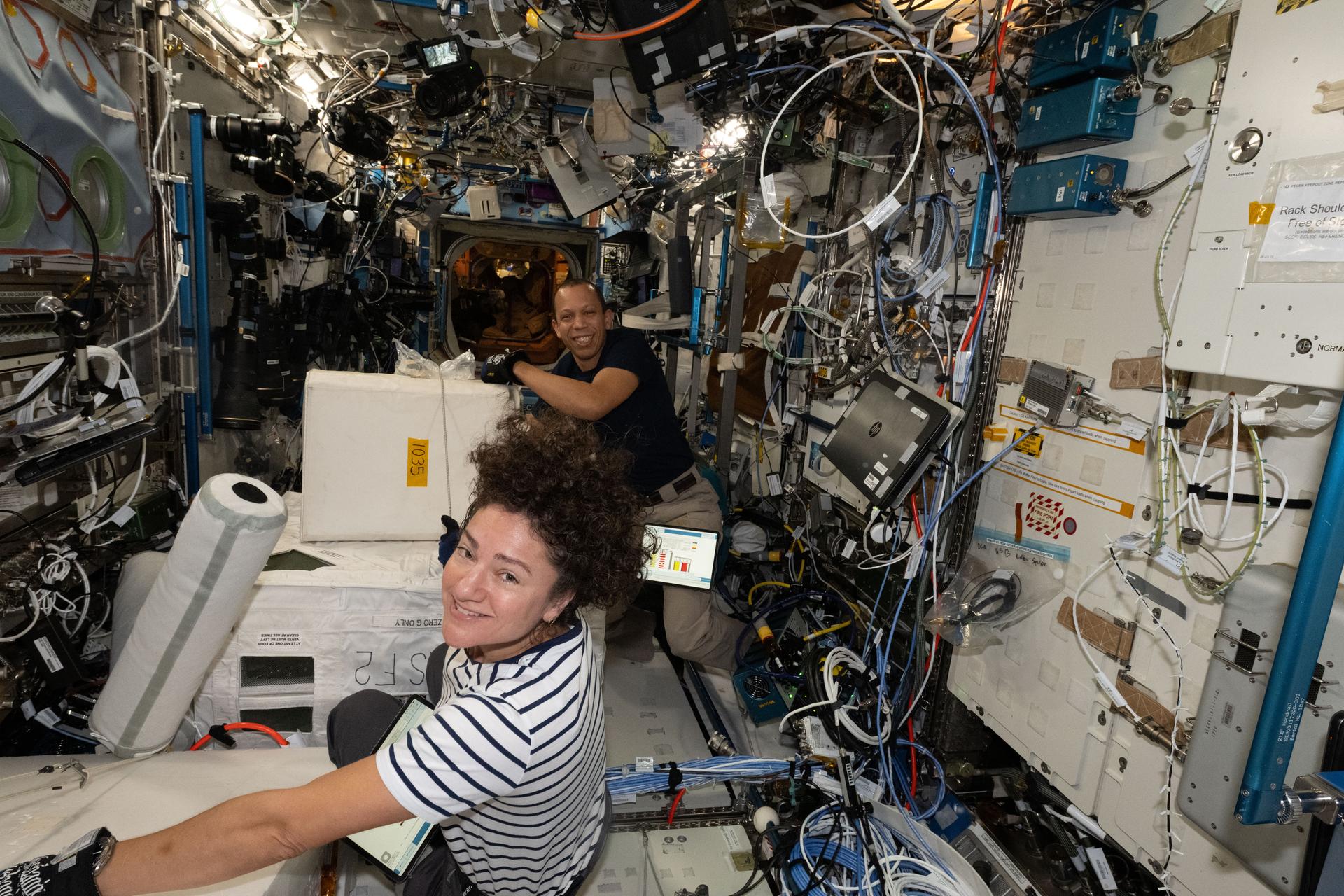
NASA astronauts Jessica Meir is pictured in the foreground wearing a black and white striped t-shirt. Her hair is curly and pulled up at the top of her head. She has a tablet in her lap and mittens on her hands as she faces the camera smiling. NASA astronaut Chris Williams is behind her wearing a black t-shirt and khaki pants, he has a tablet strapped to this upper leg. He is touching a white cube that sits in the middle of the space craft, while looking forward and smiling. The two astronauts are collecting frozen research samples while living and working aboard the International Space Station.
NASA astronauts Jessica Meir and Chris Williams collect frozen research samples while living and working aboard the International Space Station.
Credit: ESA/Sophie Adenot

Students in New Jersey will hear from NASA astronauts Chris Williams and Jessica Meir as they answer prerecorded STEM questions while aboard the International Space Station.

The Earth-to-space call will begin at 12:05 p.m. EDT, Thursday, June 18, and will stream live on the agency’s Learn With NASA YouTube channel.

This event is hosted by Newton Public Schools in Newton, New Jersey, for students in grades K-12 and members of the community. This unique opportunity aims to deepen understanding of space exploration and enhance awareness of STEM careers.

Media interested in covering the event must RSVP no later than 5 p.m. EDT, Wednesday, June 17, to Dr. Joseph Piccirillo at: 973-383-7392, x4229 or jpiccirillo@newtonnj.org.

For more than 25 years, astronauts have continuously lived and worked aboard the space station, testing technologies, performing science, and developing skills needed to explore farther from Earth. Astronauts communicate with NASA’s Mission Control Center in Houston 24 hours a day through SCaN’s (Space Communications and Navigation) Near Space Network.

Research and technology investigations taking place aboard the space station benefit people on Earth and lay the groundwork for other agency deep space missions. As part of NASA’s Artemis program, the agency will send astronauts to the Moon to prepare for future human exploration of Mars, inspiring the world through discovery in a new Golden Age of innovation and exploration.

For more information on NASA in-flight calls, visit:

https://www.nasa.gov/stemonstation
  •  

NASA Astronauts to Answer Questions from New Jersey Students

NASA astronauts Jessica Meir is pictured in the foreground wearing a black and white striped t-shirt. Her hair is curly and pulled up at the top of her head. She has a tablet in her lap and mittens on her hands as she faces the camera smiling. NASA astronaut Chris Williams is behind her wearing a black t-shirt and khaki pants, he has a tablet strapped to this upper leg. He is touching a white cube that sits in the middle of the space craft, while looking forward and smiling. The two astronauts are collecting frozen research samples while living and working aboard the International Space Station.
NASA astronauts Jessica Meir and Chris Williams collect frozen research samples while living and working aboard the International Space Station.
Credit: ESA/Sophie Adenot

Students in New Jersey will hear from NASA astronauts Chris Williams and Jessica Meir as they answer prerecorded STEM questions while aboard the International Space Station.

The Earth-to-space call will begin at 12:05 p.m. EDT, Thursday, June 18, and will stream live on the agency’s Learn With NASA YouTube channel.

This event is hosted by Newton Public Schools in Newton, New Jersey, for students in grades K-12 and members of the community. This unique opportunity aims to deepen understanding of space exploration and enhance awareness of STEM careers.

Media interested in covering the event must RSVP no later than 5 p.m. EDT, Wednesday, June 17, to Dr. Joseph Piccirillo at: 973-383-7392, x4229 or jpiccirillo@newtonnj.org.

For more than 25 years, astronauts have continuously lived and worked aboard the space station, testing technologies, performing science, and developing skills needed to explore farther from Earth. Astronauts communicate with NASA’s Mission Control Center in Houston 24 hours a day through SCaN’s (Space Communications and Navigation) Near Space Network.

Research and technology investigations taking place aboard the space station benefit people on Earth and lay the groundwork for other agency deep space missions. As part of NASA’s Artemis program, the agency will send astronauts to the Moon to prepare for future human exploration of Mars, inspiring the world through discovery in a new Golden Age of innovation and exploration.

For more information on NASA in-flight calls, visit:

https://www.nasa.gov/stemonstation

  •  

NASA Astronaut Anil Menon Available for Prelaunch Virtual Interviews

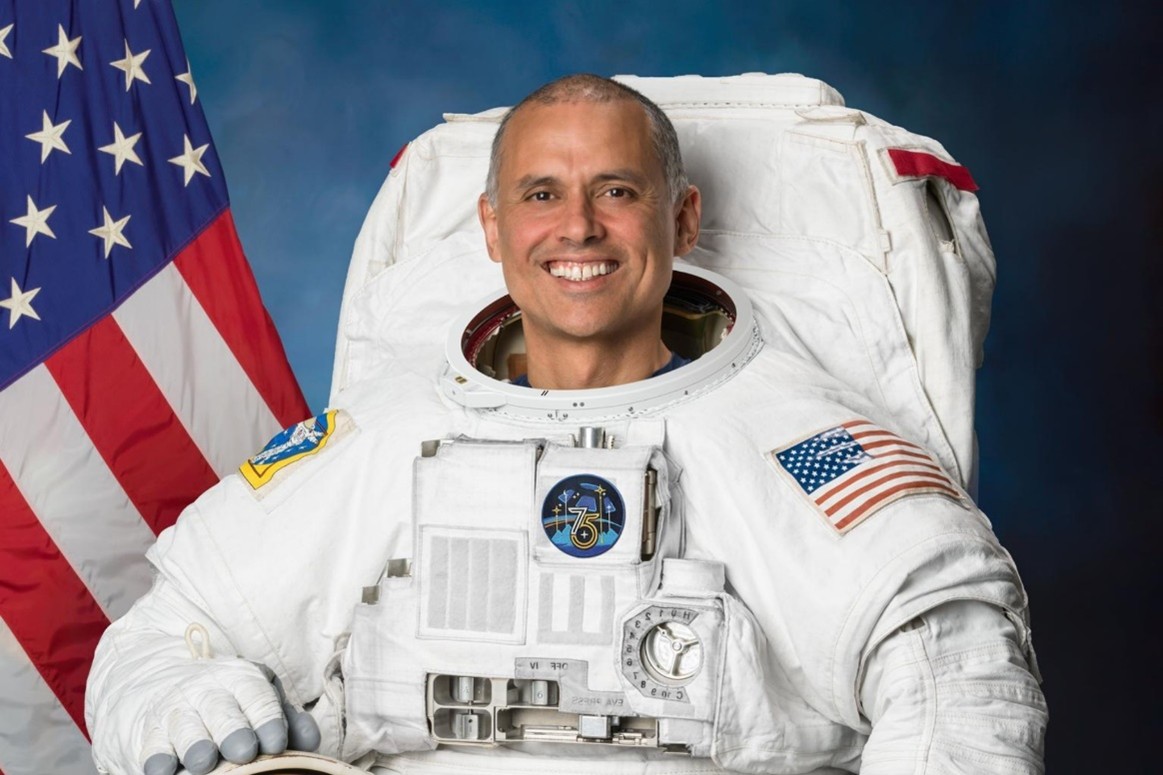
NASA astronaut and International Space Station Expedition 74/75 flight engineer Anil Menon poses for a portrait at NASA's Johnson Space Center in Houston.
NASA astronaut and International Space Station Expedition 74/75 flight engineer Anil Menon poses for a portrait at NASA’s Johnson Space Center in Houston.
NASA/James Blair

NASA astronaut Anil Menon will be available for limited media interviews beginning at 9 a.m. EDT Monday, June 22, to discuss his upcoming mission to the International Space Station as part of Expeditions 74/75.

The virtual interviews will take place from the Gagarin Cosmonaut Training Center in Star City, Russia, and will stream live on the agency’s YouTube channel.

Media interested in participating must submit a request to the newsroom at NASA’s Johnson Space Center in Houston no later than 5 p.m. Wednesday, June 17, by emailing jsccommu@mail.nasa.gov. A copy of NASA’s media accreditation policy is online.

Menon is scheduled to launch to the space station Tuesday, July 14, from the Baikonur Cosmodrome in Kazakhstan aboard the Roscosmos Soyuz MS-29 spacecraft with Roscosmos cosmonauts Pyotr Dubrov and Anna Kikina. The trio will spend about eight months aboard the orbiting laboratory before returning to Earth in spring 2027.

During his expedition, Menon will conduct scientific investigations and technology demonstrations to help humans prepare for future exploration missions to the Moon and Mars, and to provide benefits on Earth. Among the hundreds of experiments planned during his mission, he will participate in studies to better understand astronaut vein structure, blood flow, and blood composition in microgravity. He also will test producing intravenous fluids using the space station’s potable water.

The Soyuz MS-29 mission will be his first spaceflight after he was selected as part of NASA’s 2021 astronaut class. A native of Minneapolis, Menon is an emergency medicine physician, mechanical engineer, and colonel in the United States Space Force. He also has served as an expedition flight surgeon supporting the agency’s crew members aboard the space station.

For more than 25 years, people have lived and worked continuously aboard the International Space Station, advancing scientific knowledge and making research breakthroughs not possible on Earth. The space station helps NASA understand and overcome the challenges of human spaceflight, expand commercial opportunities in low Earth orbit, and build on the foundation for long-duration missions to the Moon, as part of the Artemis program, and to Mars.

To learn more about International Space Station research, operations, and its crews, visit: 

https://www.nasa.gov/station

-end- 

Jimi Russell  
Headquarters, Washington 
202-358-1100 
james.j.russell@nasa.gov

Anna Schneider / Mary Pfister
Johnson Space Center, Houston
281-483-5111
anna.c.schneider@nasa.gov / mary.m.pfister@nasa.gov

  •  

NASA Astronaut Anil Menon Available for Prelaunch Virtual Interviews

NASA astronaut and International Space Station Expedition 74/75 flight engineer Anil Menon poses for a portrait at NASA's Johnson Space Center in Houston.
NASA astronaut and International Space Station Expedition 74/75 flight engineer Anil Menon poses for a portrait at NASA’s Johnson Space Center in Houston.
NASA/James Blair

NASA astronaut Anil Menon will be available for limited media interviews beginning at 9 a.m. EDT Monday, June 22, to discuss his upcoming mission to the International Space Station as part of Expeditions 74/75.

The virtual interviews will take place from the Gagarin Cosmonaut Training Center in Star City, Russia, and will stream live on the agency’s YouTube channel.

Media interested in participating must submit a request to the newsroom at NASA’s Johnson Space Center in Houston no later than 5 p.m. Wednesday, June 17, by emailing jsccommu@mail.nasa.gov. A copy of NASA’s media accreditation policy is online.

Menon is scheduled to launch to the space station Tuesday, July 14, from the Baikonur Cosmodrome in Kazakhstan aboard the Roscosmos Soyuz MS-29 spacecraft with Roscosmos cosmonauts Pyotr Dubrov and Anna Kikina. The trio will spend about eight months aboard the orbiting laboratory before returning to Earth in spring 2027.

During his expedition, Menon will conduct scientific investigations and technology demonstrations to help humans prepare for future exploration missions to the Moon and Mars, and to provide benefits on Earth. Among the hundreds of experiments planned during his mission, he will participate in studies to better understand astronaut vein structure, blood flow, and blood composition in microgravity. He also will test producing intravenous fluids using the space station’s potable water.

The Soyuz MS-29 mission will be his first spaceflight after he was selected as part of NASA’s 2021 astronaut class. A native of Minneapolis, Menon is an emergency medicine physician, mechanical engineer, and colonel in the United States Space Force. He also has served as an expedition flight surgeon supporting the agency’s crew members aboard the space station.

For more than 25 years, people have lived and worked continuously aboard the International Space Station, advancing scientific knowledge and making research breakthroughs not possible on Earth. The space station helps NASA understand and overcome the challenges of human spaceflight, expand commercial opportunities in low Earth orbit, and build on the foundation for long-duration missions to the Moon, as part of the Artemis program, and to Mars.

To learn more about International Space Station research, operations, and its crews, visit: 

https://www.nasa.gov/station

-end- 

Jimi Russell  
Headquarters, Washington 
202-358-1100 
james.j.russell@nasa.gov

Anna Schneider / Mary Pfister
Johnson Space Center, Houston
281-483-5111
anna.c.schneider@nasa.gov / mary.m.pfister@nasa.gov

  •  
❌