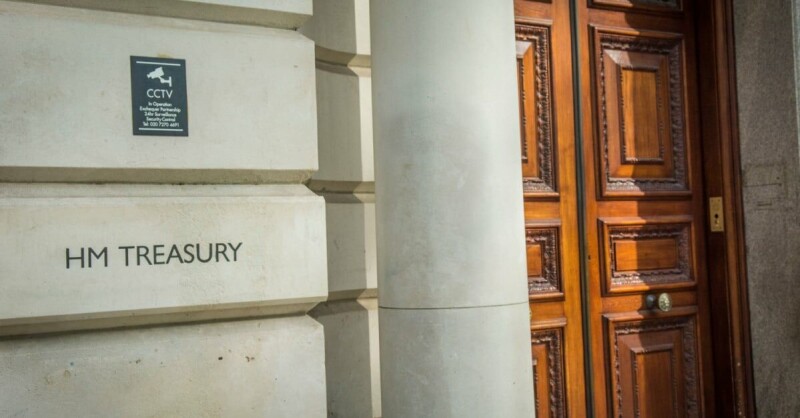
His Majesty's Treasury (HMT) is looking for a new chief technology officer, offering an annual salary of up to £77,000 – less than some elite graduates might expect in their first job at a tech vendor. HMT promises "an exciting opportunity to influence decision making that affects the whole of the UK." The successful candidate also gets a generous civil service pension, with an employer contribution of nearly 30 percent. The salary range is from £69,820 to £77,000 for a role that can be based in London, Darlington (North East England), or Norwich (East Anglia). "HMT is a fast‑paced, policy‑driven organisation with a diverse user base of several thousand staff, including ministers, senior officials and analysts, all reliant on secure, resilient and responsive digital services," the job ad says. The role offers "a unique opportunity to work at the centre of government, operating at pace, influencing major decisions, and ensuring technology effectively supports ministers and the Treasury's critical role in stewarding the UK economy." These are the kinds of users less forgiving of tech problems, as they are responsible for controlling public spending, directing the UK's economic policy, and achieving sustainable economic growth at a time when the public expects both good services and low taxes. The incoming CTO will do all this with a "predominantly Microsoft‑based technology ecosystem, including Microsoft 365, Azure and associated security and endpoint tooling, delivered through a largely outsourced, multi‑tower operating model." Leading technical staff and dealing with multiple strategic suppliers, the lucky individual is expected to define technology strategy, standards, and architecture, all while giving taxpayers value for money. Weighty expectations also come with the people side of the job, since the CTO needs to be "a trusted technical adviser to enable informed decisions" both inside HMT and across other Whitehall departments. This being 2026, the job ad mentions AI as one of the technologies the role is expected to champion. What the ad does not mention is another looming headache: HMT must decide by December whether to move its finance and HR systems from Oracle Fusion to Workday, or stick with Oracle and diverge from the government's overarching £1.7 billion shared services strategy – which HMT signed off. No pressure, then. ®
Experts have welcomed the UK government's decision to review its contract with Palantir to provide software central to tackling the elective care backlog. The US spy-tech biz has, for some, been a controversial presence at the heart of the National Health Service in England since it was awarded a contract for just £1 to help provide data tools during the pandemic. It later won £60 million in uncontested deals. After the pandemic, it won a £330 million award – with other companies as partners – to provide the Federated Data Platform (FDP) under a SaaS model for the former Conservative government. NHS England defended the decision to award the FDP contract to Palantir after a competitive tender, saying it would help provide increased productivity necessary to help the NHS recover from its mammoth post-pandemic elective care backlog. Since Labour took office, however, the Palantir deal has looked less comfortable. The company was founded with backing from CIA-linked venture capital firm In-Q-Tel and provides technology to ICE and other controversial US security agencies. Attention has begun to focus on a contractual break clause next February, with the UK government saying it is planning to review the contract. Lord Paul Drayson, a member of the House of Lords Science and Technology Committee, welcomed the decision to review the contract. Speaking at the Digital and AI Sovereignty event organized by open source advocates OpenUK last week, he claimed the decision to appoint Palantir to the NHS England deal did not meet the standards of clear rules and fair deals. "The issues relating to values really go to the heart of it. It's great there's being a review. The UK has the technology to do federated data platforms, and it's an example of the shift in the politics that's taking place," said Drayson, founder and former CEO of UK clinical AI and digital healthcare company Arcturis Data. Palantir said the results of its technology in the NHS were already evident as 110,078 additional patients have undergone procedures in hospital theatres since the FDP product was implemented. Nearly 7 percent more patients with referrals for suspected cancer were now receiving answers within 28 days compared to the 12 months before FDP, it said. However, experts at the OpenUK event expressed concern that the decision to give Palantir the FDP deal reflected poor decisions in shaping the UK tech market and poor stewardship of NHS data as a UK asset. Mike Bracken, partner at consultancy Public Digital and former Cabinet Office executive director for digital, said NHS England had a 15-year history of failing to set a standard health data taxonomy and classification in order to develop a thriving supply market. "That was the complete failure of NHSE," Bracken said. "We've heard talk about market shaping. Where we are now is a 15-year failure to shape a market around common standards and platforms. It really is not difficult. We're in a current position where the absence of doing that allows any single entity or company to own that taxonomy and that federated model that is not healthy for this country." "It is not actually about Palantir. If you look around our public sector, our officials believe in market orthodoxy, and our markets are little short of oligopolies and monopolies, and this is just another example. If we generally want market activity, competition, innovation, you have to create markets. You do not create markets by handing single control of federated platforms, in this case, to single companies, Palantir or otherwise." Secretary of State for Health and Social Care James Murray was asked about the FDP during a recent interview on BBC Radio 4's Today program. "The FDP is a single contract with Palantir, and it's being reviewed at the moment ahead of its breakpoint next year," he said. Speaking at the OpenUK meeting, Laura Gilbert, Senior Director for AI at the Tony Blair Institute and former director of data science in the Prime Minister's Office, said the FDP was exactly the use case that you don't outsource, and certainly not outside the country. The UK has the skills to build its own NHS data systems, which could lead to benefits for the wider tech and healthcare economy, she said. "Locking down to a single vendor is clearly risky when it is something so important. Once again you're in a place where you are not just giving the money away offshore but the benefit of the data – some going back to the patient, which is great – but we should be learning from that data and building a better health service, not allowing an offshore company to learn and build better products they can sell to somebody else." The Tony Blair Institute has received funding from Larry Ellison, co-founder of Oracle, which was part of one of the losing FDP bids. The next few months will be critical for Palantir's involvement in the NHS. With the writing on the wall for UK Prime Minister Sir Keir Starmer, frontrunner to replace him is Andy Burnham, currently the mayor of Manchester. The Greater Manchester Integrated Care Board has rejected the FDP, preferring to use the system it built on Microsoft Azure with technology from data pipeline vendor Matillion, analytics and data lake company Snowflake, data visualization firm Tableau, University of Manchester's eLab, and others. A report last year claimed it "exceeds anything the FDP currently offers." ®

 Accedi