
❌

Modalità di lettura

NASA’s SpaceX Crew‑12 Splashes Down, Sets Briefing to Discuss Mission
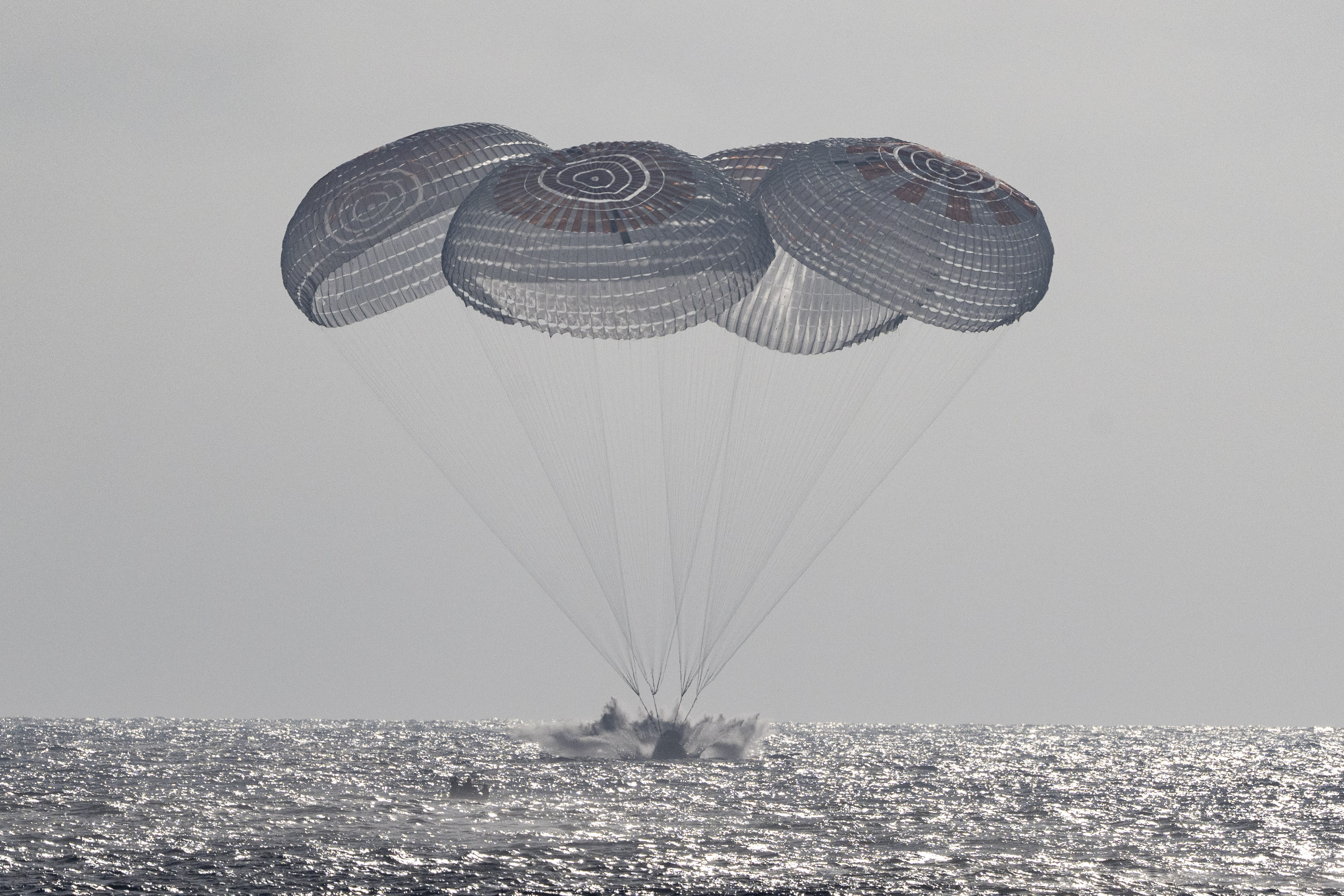
The SpaceX Crew Dragon Freedom spacecraft is seen as it lands with NASA astronauts Jessica Meir, Jack Hathaway, ESA (European Space Agency) astronaut Sophie Adenot, and Roscosmos cosmonaut Andrey Fedyaev aboard in the Pacific Ocean off the coast of Los Angeles on Oct. 8, 2026.
Credit: NASA/Keegan Barber

After more than seven months aboard the International Space Station, NASA’s SpaceX Crew-12 mission safely splashed down Thursday in the Pacific Ocean off the coast of Los Angeles. The crew members will discuss their science mission during a news conference at 3:30 p.m. EDT, Thursday, Oct. 15, at the agency’s Johnson Space Center in Houston.

“Jessica, Jack, Sophie, and Andrey spent 237 days living and working in orbit, traveled more than 100 million miles, advanced important science, and returned safely home because of the extraordinary expertise and competence of thousands across NASA, SpaceX, and our international partners,” said NASA Administrator Jared Isaacman. “Building the capability, experience, and confidence to do this repeatedly is exactly what will allow us to go farther, and I am grateful to Crew-12 and their families for their service to humanity’s greatest adventure.”

NASA astronauts Jessica Meir and Jack Hathaway, ESA (European Space Agency) astronaut Sophie Adenot, and Roscosmos cosmonaut Andrey Fedyaev returned to Earth at 8:34 a.m. PDT. Teams aboard SpaceX recovery vessels retrieved the spacecraft and its crew shortly after. Following standard postflight medical screenings, the crew will fly to shore before returning to NASA’s Johnson Space Center in Houston.

“NASA’s activities supporting the International Space Station — transporting crew, conducting impactful research, and maintaining critical national assets — enable the science, engineering, and risk‑reduction needed for future missions across the solar system,” said Dana Weigel, manager of NASA’s Low Earth Orbit Program at the agency’s Johnson Space Center. “We’re grateful for the dedication across the human spaceflight team that makes this possible, and we’re thrilled to welcome Jessica, Jack, Sophie, and Andrey home.”

During their 237-day mission, the four crew members traveled more than 100 million miles and completed more than 3,792 orbits around Earth. The mission was the second for Meir and Fedyaev and the first for Hathaway and Adenot. Crew-12 lifted off at 5:15 a.m. EST on Feb. 13 and docked to the orbiting laboratory a day later.

Crew‑12 logged hundreds of hours of scientific research to support human exploration beyond low Earth orbit and advance benefits for people on Earth. The crew members’ work included testing stem cell production for cell‑based therapies, demonstrating on‑demand IV fluid generation for future missions, and studying how the bacteria that causes pneumonia can lead to long‑term heart damage. The crew also conducted nutrition-focused research and examined how physical characteristics may affect blood flow during spaceflight to help keep astronauts safe and healthy on future missions. Research conducted aboard the space station advances knowledge and demonstrates new technologies that enable us to prepare for human exploration of the Moon and Mars.

Meir completed four spacewalks, bringing her career total to seven. That places her third all-time in total spacewalks among women at NASA, behind former agency astronauts Peggy Whitson and Suni Williams. Adenot completed three spacewalks, becoming the first French woman to venture outside the orbital outpost.

United States-based media interested in attending the crew news conference in person with Meir, Hathaway, and Fedyaev, must contact the NASA Johnson newsroom no later than 5 p.m. EDT, Tuesday, Oct. 13, at jsc-newsroom@mail.nasa.gov. Media joining by phone must request dial-in details by 9:30 a.m., Oct. 15. To ask a question, media must join no later than 15 minutes before the start of the news conference. The agency’s media credentialing policy is available online. Adenot will return to Europe and not be available during the news conference.

NASA’s Low Earth Orbit Program provides reliable access to space, maximizing the use of the International Space Station for research and development by partnering with private U.S. companies, including SpaceX, to transport astronauts to and from the space station.

Learn more about NASA’s SpaceX Crew-12 at:

https://www.nasa.gov/commercialcrew

-end-

Joshua Finch / Jimi Russell
Headquarters, Washington
202-358-1100
joshua.a.finch@nasa.gov / james.j.russell@nasa.gov

Sandra Jones / Joseph Zakrzewski
Johnson Space Center, Houston
281-483-5111
sandra.p.jones@nasa.gov / joseph.a.zakrzewski@nasa.gov

Steven Siceloff
Kennedy Space Center, Florida
321-867-2468
steven.p.siceloff@nasa.gov

  •  

NASA’s SpaceX Crew‑12 Splashes Down, Sets Briefing to Discuss Mission

The SpaceX Crew Dragon Freedom spacecraft is seen as it lands with NASA astronauts Jessica Meir, Jack Hathaway, ESA (European Space Agency) astronaut Sophie Adenot, and Roscosmos cosmonaut Andrey Fedyaev aboard in the Pacific Ocean off the coast of Los Angeles on Oct. 8, 2026.
Credit: NASA/Keegan Barber

After more than seven months aboard the International Space Station, NASA’s SpaceX Crew-12 mission safely splashed down Thursday in the Pacific Ocean off the coast of Los Angeles. The crew members will discuss their science mission during a news conference at 3:30 p.m. EDT, Thursday, Oct. 15, at the agency’s Johnson Space Center in Houston.

“Jessica, Jack, Sophie, and Andrey spent 237 days living and working in orbit, traveled more than 100 million miles, advanced important science, and returned safely home because of the extraordinary expertise and competence of thousands across NASA, SpaceX, and our international partners,” said NASA Administrator Jared Isaacman. “Building the capability, experience, and confidence to do this repeatedly is exactly what will allow us to go farther, and I am grateful to Crew-12 and their families for their service to humanity’s greatest adventure.”

NASA astronauts Jessica Meir and Jack Hathaway, ESA (European Space Agency) astronaut Sophie Adenot, and Roscosmos cosmonaut Andrey Fedyaev returned to Earth at 8:34 a.m. PDT. Teams aboard SpaceX recovery vessels retrieved the spacecraft and its crew shortly after. Following standard postflight medical screenings, the crew will fly to shore before returning to NASA’s Johnson Space Center in Houston.

“NASA’s activities supporting the International Space Station — transporting crew, conducting impactful research, and maintaining critical national assets — enable the science, engineering, and risk‑reduction needed for future missions across the solar system,” said Dana Weigel, manager of NASA’s Low Earth Orbit Program at the agency’s Johnson Space Center. “We’re grateful for the dedication across the human spaceflight team that makes this possible, and we’re thrilled to welcome Jessica, Jack, Sophie, and Andrey home.”

During their 237-day mission, the four crew members traveled more than 100 million miles and completed more than 3,792 orbits around Earth. The mission was the second for Meir and Fedyaev and the first for Hathaway and Adenot. Crew-12 lifted off at 5:15 a.m. EST on Feb. 13 and docked to the orbiting laboratory a day later.

Crew‑12 logged hundreds of hours of scientific research to support human exploration beyond low Earth orbit and advance benefits for people on Earth. The crew members’ work included testing stem cell production for cell‑based therapies, demonstrating on‑demand IV fluid generation for future missions, and studying how the bacteria that causes pneumonia can lead to long‑term heart damage. The crew also conducted nutrition-focused research and examined how physical characteristics may affect blood flow during spaceflight to help keep astronauts safe and healthy on future missions. Research conducted aboard the space station advances knowledge and demonstrates new technologies that enable us to prepare for human exploration of the Moon and Mars.

Meir completed four spacewalks, bringing her career total to seven. That places her third all-time in total spacewalks among women at NASA, behind former agency astronauts Peggy Whitson and Suni Williams. Adenot completed three spacewalks, becoming the first French woman to venture outside the orbital outpost.

United States-based media interested in attending the crew news conference in person with Meir, Hathaway, and Fedyaev, must contact the NASA Johnson newsroom no later than 5 p.m. EDT, Tuesday, Oct. 13, at jsc-newsroom@mail.nasa.gov. Media joining by phone must request dial-in details by 9:30 a.m., Oct. 15. To ask a question, media must join no later than 15 minutes before the start of the news conference. The agency’s media credentialing policy is available online. Adenot will return to Europe and not be available during the news conference.

NASA’s Low Earth Orbit Program provides reliable access to space, maximizing the use of the International Space Station for research and development by partnering with private U.S. companies, including SpaceX, to transport astronauts to and from the space station.

Learn more about NASA’s SpaceX Crew-12 at:

https://www.nasa.gov/commercialcrew

-end-

Joshua Finch / Jimi Russell
Headquarters, Washington
202-358-1100
joshua.a.finch@nasa.gov / james.j.russell@nasa.gov

Sandra Jones / Joseph Zakrzewski
Johnson Space Center, Houston
281-483-5111
sandra.p.jones@nasa.gov / joseph.a.zakrzewski@nasa.gov

Steven Siceloff
Kennedy Space Center, Florida
321-867-2468
steven.p.siceloff@nasa.gov

  •  

Stop al conflitto e al riarmo: quattro proposte al «campo largo»

Armare l’Ucraina o no? La discussione nel “campo largo” si è incagliata, ma che la questione non si ponga in questi termini lo sta chiarendo il dibattito aperto sul manifesto dall’articolo di Francesco Strazzari, con Francesco Vignarca e l’intervista a Pasquale Tridico.

Il problema vero è come mettere fine alla guerra tra Russia e Ucraina, offrendo una soluzione di lungo periodo per la pace e la stabilità in tutta Europa. Un’esigenza tanto più urgente di fronte agli attacchi russi e ucraini sulle città e le infrastrutture civili, con l’illusione di entrambe le parti che qualche drone (o Patriot) in più possa piegare l’avversario. Quello che l’escalation produce è invece l’estensione della guerra, anche in quelle forme ibride che rischiano di coinvolgere direttamente altri paesi europei. Un grave pericolo che va fermato al più presto, non con le armi ma con la politica. Ad esempio, quella del centrosinistra: il “campo largo” potrebbe convenire su quattro punti.

LA GUERRA VA FERMATA AL PIÙ PRESTO. Ha causato morti e distruzioni terribili in Ucraina e in Russia, ed è stata il pretesto per una militarizzazione dell’Europa che ne stravolge la natura, fa arretrare la democrazia e moltiplica l’instabilità. Entrambe le parti hanno esaurito le risorse per alimentare la guerra. L’Ucraina dipende interamente dal sostegno finanziario esterno sia per le azioni militari che per il funzionamento del paese, sette milioni di ucraini sono rifugiati all’estero, anche per sfuggire al servizio militare. La Russia concentra le risorse sullo sforzo bellico, mettendo in crisi il resto dell’economia, e deve trovare soldati in Corea del nord o in Africa. Entrambi i paesi sono divisi al loro interno; le voci contro la guerra sono soppresse, ma esistono; è la continuazione della guerra che rinsalda Putin e Zelensky.

Una guerra alimentata dall’esterno, può essere fermata dall’esterno. Per quattro anni e mezzo l’Europa non è stata capace di una proposta di pace. Forniamo supporto bellico senza alcuna trasparenza: non sappiamo quali armi l’Italia fornisce a Kiev, che presenza militare c’è, che accordi ci sono. L’imprevedibilità di Trump – che offre armi a Kiev, promette accordi, fa affari con la Russia – è una ragione in più per un’iniziativa europea. Il segretario generale della Nato Rutte non potrà far nulla contro le priorità degli Stati uniti: il cancelliere tedesco Merz è stato l’ultimo leader europeo a riconoscere questa scomoda verità.

VA PRESENTATA UNA PROPOSTA EUROPEA DI NEGOZIATO TRA RUSSIA E UCRAINA. Ogni aiuto – finanziario o militare – all’Ucraina dovrà essere condizionato all’accettazione da parte di Kiev della proposta europea. La coalizione di centrosinistra italiana può avanzare questa proposta, confrontarsi con i partiti e la società civile di altri paesi, discuterla al parlamento europeo. Il progetto potrà tener conto degli accordi Minsk I e II che erano stati sviluppati con l’Osce – l’Organizzazione per la sicurezza e la cooperazione in Europa, con sede a Vienna – per evitare la guerra prima del 2022. Il negoziato potrà svolgersi sotto l’egida dell’Osce e potrà utilizzare la possibile mediazione di autorità neutrali, come il Vaticano. Stati uniti e i governi europei non dovranno sedere al tavolo delle trattative. Le Nazioni unite e la Cina potrebbero essere coinvolte per sostenere il progetto di trattative.

In queste condizioni la Russia avrebbe rassicurazioni sulle possibilità di un negoziato costruttivo; la riduzione delle tensioni fermerebbe la spirale tra attacchi e ritorsioni, lo scambio di prigionieri porterebbe a un miglioramento della fiducia, una tregua potrebbe essere raggiunta. Se rifiutasse di prendere questa strada, Mosca si troverebbe di fronte l’insostenibilità interna e una pressione internazionale molto più ampia, questa volta anche dalla Cina.

Chi pensa – in Italia e in Europa – che la spesa per il riarmo dell’Occidente sia sufficiente per scoraggiare l’aggressività russa è già stato smentito. Un’Europa militarista ma frammentata, con strategie divergenti tra i paesi maggiori, aggressiva ma dipendente dagli Stati uniti, non può costruire una deterrenza sul piano puramente militare; è la strada della politica che può garantire una sicurezza comune, come ricordava su queste pagine Fabrizio Coticchia, e come argomentiamo nelle nostre conclusioni al volume Se l’Europa va alla guerra (Feltrinelli).

L’ITALIA CONGELA L’AUMENTO DELLA SPESA MILITARE. Come segno di distensione, rifiuta l’impegno chiesto dalla Nato di aumentare fino al 5% del Pil la spesa militare – su questo il campo largo è già d’accordo – e rifiuta di chiedere a Bruxelles i prestiti per gli acquisti di armi previsti dal programma Safe di debito comune europeo. Per il periodo di svolgimento dei negoziati, il centrosinistra potrebbe chiedere un congelamento dei programmi di riarmo dell’Unione europea. La corsa a spendere per armi 800 miliardi di euro nei paesi europei e 130 miliardi del bilancio Ue potrebbe avere una pausa, la spesa sociale e ambientale potrebbero risollevarsi, un’Europa diversa dal militarismo potrebbe risvegliarsi.

L’ITALIA PROPONE ALLA UE NUOVE FORME DI ASSOCIAZIONE PER L’UCRAINA E ALTRI PAESI. Nonché la riapertura dei rapporti economici con la Russia. Sono contributi alla ricerca di una pace stabile. Questo esito può rappresentare l’obiettivo che più può incoraggiare le parti a raggiungere un accordo. L’Ucraina si troverebbe legata alla Ue – ma non alla Nato – e sostenuta nella sua ricostruzione, senza tuttavia le rigidità dell’adesione formale. La Russia, senza le sanzioni, potrebbe tornare a esportare gas e petrolio in Europa, ritrovare il proprio ruolo, rilanciare la crescita, stabilizzare la situazione sociale.

Un’agenda di questo tipo per il campo largo avrebbe effetti rilevanti per tutta l’Europa. Una proposta di pace darebbe uno sbocco politico ai sentimenti contro la guerra che sono largamente diffusi, anche – ad esempio – tra le spinte populiste che in Germania hanno contribuito al voto per l’estrema destra. Con una proposta politica di pace e sicurezza comune, le forze progressiste in Europa potrebbero recuperare una parte dei consensi perduti in questi anni di sostegno alla guerra. Ma non solo, di fronte alla possibilità di governi di estrema destra dopo le elezioni in Spagna, Francia e Italia dei prossimi dodici mesi, un accordo di pace in Ucraina e uno stop al riarmo europeo eviterebbe che il dito sul grilletto di una guerra europea sia quello di leader reazionari.

Questo articolo è comparso su il Manifesto del 7 ottobre 2026

  •  
❌