❌

Modalità di lettura

APOD: 2026 October 17 – 3D 67P

APOD

Astronomy Picture of the Day

Discover the cosmos! Each day a different image or photograph of our fascinating universe is featured, along with a brief explanation written by a professional astronomer.

Red/blue stereo anaglyph of comet 67P.

3D 67P

Explanation: Put on your red/blue glasses and float next to the jagged and double-lobed nucleus of Churyumov-Gerasimenko, also known as Comet 67P . The stereo anaglyph was created by combining two images from the Rosetta spacecraft’s narrow angle OSIRIS camera taken on July 25, 2015 from a distance of 184 kilometers. Numerous jets are emanating from the small solar system world’s active surface near its closest approach to the Sun. The larger lobe is around 4 kilometers in diameter, joined to a smaller, 2.5 kilometer diameter lobe by a narrow neck. Rosetta’s mission to the comet ended in September 2016 when the spacecraft was commanded to a controlled impact with the comet’s surface . Keep those 3D glasses on though. You can check out a catalog of nearly 1400 stereo anaglyphs created from Rosetta image data on this website.

Tomorrow’s picture: open space

Date October 17, 2026
Credit: ESA , Rosetta , MPS , OSIRIS – Stereo Anaglyph: Philippe Lamy and The Team
Authors & editors: Jerry Bonnell, Cecilia Chirenti, Robert Nemiroff, Keighley Rockcliffe
A service of: ASD at NASA / GSFC,
NASA Science Activation & Michigan Tech. U.
  •  

APOD: 2026 October 16 – Chasing the International Space Station

APOD

Astronomy Picture of the Day

Discover the cosmos! Each day a different image or photograph of our fascinating universe is featured, along with a brief explanation written by a professional astronomer.

Chasing the International Space Station

Explanation: Blasting into the predawn sky on Tuesday, October 13, a Falcon 9 rocket and Dragon spacecraft are headed for low Earth orbit in this stunning timelapse video captured from Indian Harbour Beach, Florida. Starting with a launch from Space Launch Complex 40 at Cape Canaveral Space Force Station, Falcon and Dragon are chasing the International Space Station on NASA’s 35th Commercial Resupply Services mission. On cue, the space station itself enters the frame from the top. Almost 8 seconds into the 30 second timelapse. the bright streak of the ISS appears heading “down” toward the horizon. The first and second stages of the Falcon 9 are separating as the spectacular exhaust plume jellyfish grows, already catching the light of the rising Sun. The visible sequence of first stage boost back, re-entry, and landing burns begins around 20 seconds into the video. With the second stage following the ISS toward the distant horizon, the jellyfish plume continues to drift in the predawn sky, even after the successful first stage landing at planet Earth’s Landing Zone 40.

Tomorrow’s picture: pixels in space

Date October 16, 2026
Video Credit: Eric Holland
Authors & editors: Jerry Bonnell, Cecilia Chirenti, Robert Nemiroff, Keighley Rockcliffe
A service of: ASD at NASA / GSFC,
NASA Science Activation & Michigan Tech. U.
  •  

APOD: 2026 October 15 – The Milky Way over Manhattan

APOD

Astronomy Picture of the Day

Discover the cosmos! Each day a different image or photograph of our fascinating universe is featured, along with a brief explanation written by a professional astronomer.

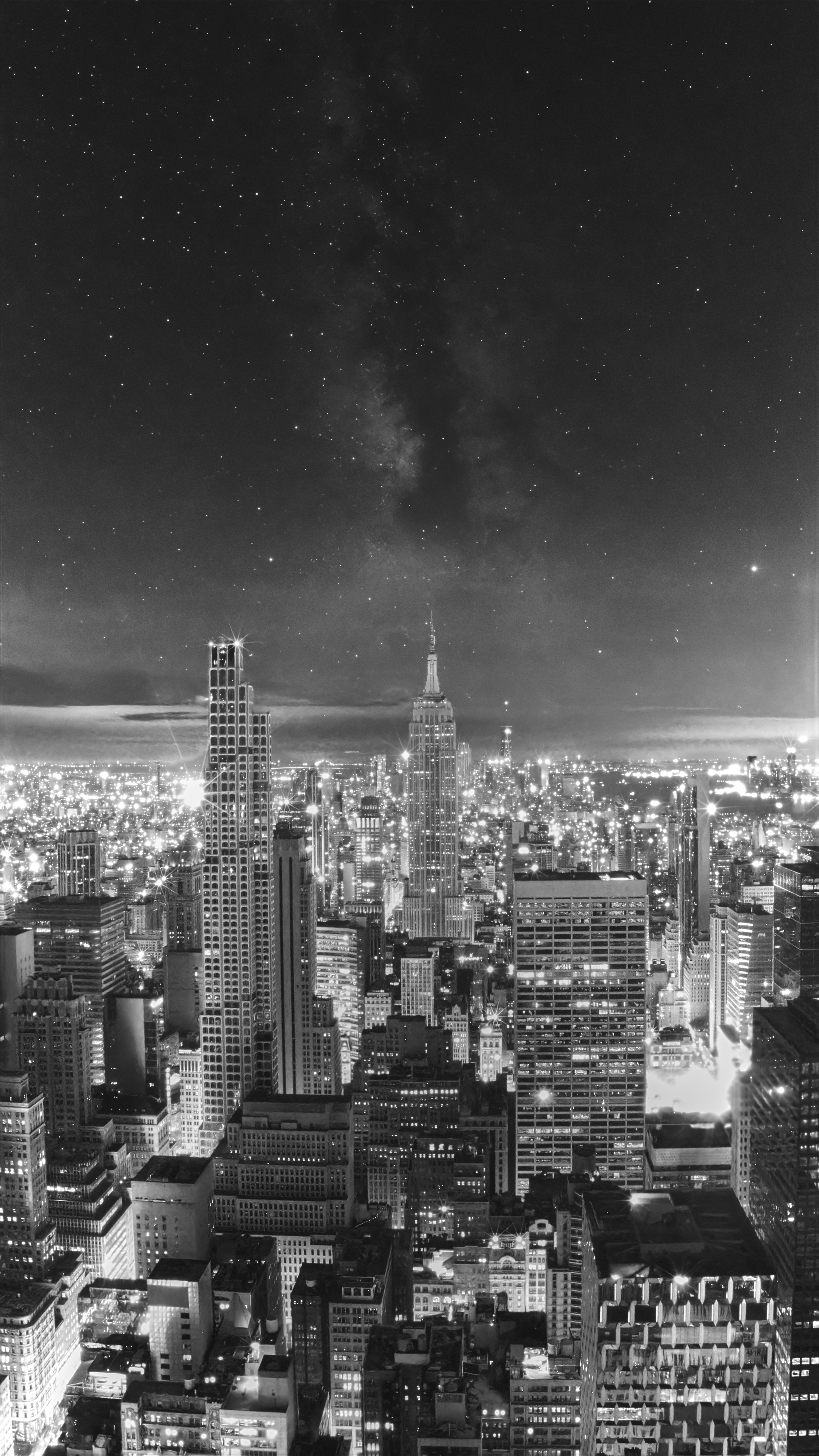
A black and white view of the Manhattan skyline merges into a night sky with stars and a visible, though faint, Milky Way. Please see explanation for more details.

The Milky Way over Manhattan

Explanation: The city lights outshine the stars in the City That Never Sleeps. Who would have thought that the Milky Way could be visible in this sky? This image was taken with a filter that blocks most visible light, capturing instead only light in the near-infrared region of the electromagnetic spectrum (with lower energy than visible light). The astrophotographer’s clever setup blocks most of the light pollution from the city: old incandescent light bulbs and some neon lights are still bright in the near-infrared, but fluorescent and LED light bulbs are not. Of course, stars are also bright in the near-infrared! This image is a reminder that we all live under the same sky, and astronomy allows all of us to learn more about humanity’s place in the Cosmos.

Tomorrow’s picture: Chasing the ISS

Date October 15, 2026
Credit & Copyright Jason Kurth, Ty Buckley
Authors & editors: Cecilia Chirenti, Robert Nemiroff, Jerry Bonnell, Keighley Rockcliffe
A service of: ASD at NASA / GSFC,
NASA Science Activation & Michigan Tech. U.
  •  

APOD: 2026 October 14 – Mars and the Beehive Under an Aurora

APOD

Astronomy Picture of the Day

Discover the cosmos! Each day a different image or photograph of our fascinating universe is featured, along with a brief explanation written by a professional astronomer.

The bright Mars is near the center of the Beehive cluster (M44) in the sky's horizon. A colorful aurora sits above in the sky, looking like a curtain of light. Dark trees and a river line the foreground.

Mars and the Beehive Under an Aurora

Explanation: What a cosmic coincidence! In today’s image, Mars joins the Beehive cluster (M44 or Praesepe) below an auroral curtain and above a horizon of happy little trees near Lansjärv, Sweden. An eruption off the Sun reached Earth on October 10th, 2026 causing strong disturbances in Earth’s magnetic field. Energetic particles from the eruption collide with and energize the molecules in Earth’s atmosphere, which release that extra energy as the colorful aurora captured here. Auroras, or guovssahasat in North Sámi, is traditionally viewed with respect by the Sámi people indigenous to Sweden and other Arctic regions. Coincidentally, Mars appeared closest to the center of the Beehive cluster in the sky at the time. Although bees have been to space, the Beehive cluster is actually a swarm of young stars. Their rotation periods have helped humanity learn about how stars spin slower over time as they lose mass through their stellar winds.

Tomorrow’s picture: open space

Date: October 14, 2026
Credit: Petr Horálek (Institute of Physics in Opava), Josef Kujal, Vojan Höfer
Authors & editors: Keighley Rockcliffe, Robert Nemiroff, Jerry Bonnell, Cecilia Chirenti
A service of: ASD at NASA / GSFC,
NASA Science Activation & Michigan Tech. U.
  •  
❌