SpaceX Launches New NASA Telescope to Help JWST Study Exoplanets
Read more of this story at Slashdot.
“Un vincitore del Premio Nobel per la Pace non può condividere il premio con altri, né trasferirlo una volta annunciato”. Il Comitato per il Premio Nobel per la Pace ha espresso forte indignazione in merito al gesto di María Corina Machado, che ha consegnato la sua medaglia a Donald Trump, definendo l’atto come una violazione delle norme che regolano il premio. La dichiarazione ufficiale del Comitato ha sottolineato con fermezza che un vincitore del Premio Nobel non può trasferire il premio ad altre persone né condividerlo, e che una volta che il premio è stato assegnato, esso non può essere revocato. Nonostante non abbia fatto riferimento esplicito né a Machado né a Trump, il Comitato ha ribadito che la decisione è definitiva e non può essere modificata dalle azioni del vincitore. Il 3 gennaio il blitz Usa, voluto da Trump, ha portato alla cattura di Nicola Maduro.
Il Comitato ha poi specificato che la medaglia, il diploma e il premio in denaro che accompagnano il Nobel sono simboli che appartengono al vincitore, ma che, sebbene questi oggetti possano essere donati o venduti, l’identità del destinatario del premio rimane immutata nella storia. Tra i vari esempi, il comitato ha citato il caso di Kofi Annan, che ha donato la propria medaglia all’Ufficio delle Nazioni Unite a Ginevra, e quello del giornalista Dmitry Muratov, che ha venduto la propria medaglia per sostenere i bambini ucraini. Gesti molto diversi da quelli dell’attivista e con un valore totalmente differente.
Il gesto di Machado, leader dell’opposizione venezuelana, è stato visto come un “momento emozionante” e simbolico, in quanto, secondo le sue parole, ha deciso di donare la medaglia a Trump per riconoscere il suo impegno a favore della libertà in Venezuela e in tutta la regione. Tuttavia, la sua spiegazione non ha placato le polemiche. Donald Trump, dal canto suo, ha espresso un tono di rispetto nei confronti di Machado, definendola una “donna molto gentile” e sottolineando che l’atto di ricevere la medaglia è stato per lui un “gesto molto carino”. Il presidente statunitense – che più volte ha sostenuto di meritare il premio (che Barack Obama ottenne “sulla fiducia” nel 2009, ndr) ha affermato di essere rimasto colpito dal suo impegno e ha voluto esternare la sua gratitudine per aver ricevuto il premio.
L'articolo L’indignazione del comitato per il Nobel dopo che Machado ha consegnato la medaglia a Trump: “Non si può condividere il premio” proviene da Il Fatto Quotidiano.
Read more of this story at Slashdot.


© RaiNews
Read more of this story at Slashdot.
After 167 days in space, the crew members of NASA’s SpaceX Crew-11 mission will hold a news conference at 2:15 p.m. EST, Wednesday, Jan. 21, at the agency’s Johnson Space Center in Houston to discuss their science expedition aboard the International Space Station.
NASA astronauts Zena Cardman and Mike Fincke, JAXA (Japan Aerospace Exploration Agency) astronaut Kimiya Yui, and Roscosmos cosmonaut Oleg Platonov will answer questions about their mission. The crew members returned to Earth on Jan. 15, splashing down off the coast of San Diego, and arrived in Houston on Friday, where they will undergo standard postflight reconditioning and evaluations.
NASA will provide live coverage on the agency’s YouTube channel. Learn how to watch NASA content through a variety of additional online platforms, including social media.
Media are invited to attend in person or virtually. For in-person attendance, contact the NASA Johnson newsroom no later than 5 p.m. CST, Tuesday, Jan. 20, at jsccommu@mail.nasa.gov or 281-483-5111. Media participating by phone must dial into the news conference no later than 10 minutes prior to the start of the event to ask questions. Questions also may be submitted on social media using #AskNASA. A copy of NASA’s media accreditation policy is available on the agency’s website.
The crew spent more than five months in space, including 165 days aboard the orbiting laboratory, traveling nearly 71 million miles, and completing more than 2,670 orbits around Earth. While living and working aboard the station, the crew completed hundreds of science experiments and technology demonstrations.
Get the latest NASA space station news, images, and features on Instagram, Facebook, and X.
NASA’s Commercial Crew Program has delivered on its goal of safe, reliable, and cost-effective transportation to and from the International Space Station from the United States through a partnership with American private industry. This partnership is opening access to low Earth orbit and the space station to more people, more science, and more commercial opportunities. For more than 25 years, people have continuously lived and worked aboard the space station, advancing scientific knowledge and demonstrating new technologies that enable us to prepare for human exploration of the Moon as we prepare for Mars.
Learn more about NASA’s Commercial Crew Program at:
https://www.nasa.gov/commercialcrew
-end-
Joshua Finch / Jimi Russell
Headquarters, Washington
202-358-1100
joshua.a.finch@nasa.gov / james.j.russell@nasa.gov
Anna Schneider / Shaneequa Vereen
Johnson Space Center, Houston
281-483-5111
anna.c.schneider@nasa.gov / shaneequa.y.vereen@nasa.gov
After 167 days in space, the crew members of NASA’s SpaceX Crew-11 mission will hold a news conference at 2:15 p.m. EST, Wednesday, Jan. 21, at the agency’s Johnson Space Center in Houston to discuss their science expedition aboard the International Space Station.
NASA astronauts Zena Cardman and Mike Fincke, JAXA (Japan Aerospace Exploration Agency) astronaut Kimiya Yui, and Roscosmos cosmonaut Oleg Platonov will answer questions about their mission. The crew members returned to Earth on Jan. 15, splashing down off the coast of San Diego, and arrived in Houston on Friday, where they will undergo standard postflight reconditioning and evaluations.
NASA will provide live coverage on the agency’s YouTube channel. Learn how to watch NASA content through a variety of additional online platforms, including social media.
Media are invited to attend in person or virtually. For in-person attendance, contact the NASA Johnson newsroom no later than 5 p.m. CST, Tuesday, Jan. 20, at jsccommu@mail.nasa.gov or 281-483-5111. Media participating by phone must dial into the news conference no later than 10 minutes prior to the start of the event to ask questions. Questions also may be submitted on social media using #AskNASA. A copy of NASA’s media accreditation policy is available on the agency’s website.
The crew spent more than five months in space, including 165 days aboard the orbiting laboratory, traveling nearly 71 million miles, and completing more than 2,670 orbits around Earth. While living and working aboard the station, the crew completed hundreds of science experiments and technology demonstrations.
Get the latest NASA space station news, images, and features on Instagram, Facebook, and X.
NASA’s Commercial Crew Program has delivered on its goal of safe, reliable, and cost-effective transportation to and from the International Space Station from the United States through a partnership with American private industry. This partnership is opening access to low Earth orbit and the space station to more people, more science, and more commercial opportunities. For more than 25 years, people have continuously lived and worked aboard the space station, advancing scientific knowledge and demonstrating new technologies that enable us to prepare for human exploration of the Moon as we prepare for Mars.
Learn more about NASA’s Commercial Crew Program at:
https://www.nasa.gov/commercialcrew
-end-
Joshua Finch / Jimi Russell
Headquarters, Washington
202-358-1100
joshua.a.finch@nasa.gov / james.j.russell@nasa.gov
Anna Schneider / Shaneequa Vereen
Johnson Space Center, Houston
281-483-5111
anna.c.schneider@nasa.gov / shaneequa.y.vereen@nasa.gov
After 167 days in space, the crew members of NASA’s SpaceX Crew-11 mission will hold a news conference at 2:15 p.m. EST, Wednesday, Jan. 21, at the agency’s Johnson Space Center in Houston to discuss their science expedition aboard the International Space Station.
NASA astronauts Zena Cardman and Mike Fincke, JAXA (Japan Aerospace Exploration Agency) astronaut Kimiya Yui, and Roscosmos cosmonaut Oleg Platonov will answer questions about their mission. The crew members returned to Earth on Jan. 15, splashing down off the coast of San Diego, and arrived in Houston on Friday, where they will undergo standard postflight reconditioning and evaluations.
NASA will provide live coverage on the agency’s YouTube channel. Learn how to watch NASA content through a variety of additional online platforms, including social media.
Media are invited to attend in person or virtually. For in-person attendance, contact the NASA Johnson newsroom no later than 5 p.m. CST, Tuesday, Jan. 20, at jsccommu@mail.nasa.gov or 281-483-5111. Media participating by phone must dial into the news conference no later than 10 minutes prior to the start of the event to ask questions. Questions also may be submitted on social media using #AskNASA. A copy of NASA’s media accreditation policy is available on the agency’s website.
The crew spent more than five months in space, including 165 days aboard the orbiting laboratory, traveling nearly 71 million miles, and completing more than 2,670 orbits around Earth. While living and working aboard the station, the crew completed hundreds of science experiments and technology demonstrations.
Get the latest NASA space station news, images, and features on Instagram, Facebook, and X.
NASA’s Commercial Crew Program has delivered on its goal of safe, reliable, and cost-effective transportation to and from the International Space Station from the United States through a partnership with American private industry. This partnership is opening access to low Earth orbit and the space station to more people, more science, and more commercial opportunities. For more than 25 years, people have continuously lived and worked aboard the space station, advancing scientific knowledge and demonstrating new technologies that enable us to prepare for human exploration of the Moon as we prepare for Mars.
Learn more about NASA’s Commercial Crew Program at:
https://www.nasa.gov/commercialcrew
-end-
Joshua Finch / Jimi Russell
Headquarters, Washington
202-358-1100
joshua.a.finch@nasa.gov / james.j.russell@nasa.gov
Anna Schneider / Shaneequa Vereen
Johnson Space Center, Houston
281-483-5111
anna.c.schneider@nasa.gov / shaneequa.y.vereen@nasa.gov
Vladimir Putin: “Le Nazioni Unite svolgono il ruolo chiave e fondamentale negli affari mondiali, e questo ruolo va rafforzato. La NATO ha più volte ingannato la Russia, violando le proprie promesse pubbliche di non avanzamento ad Est, rappresentando la minaccia alla sicurezza del nostro stato. La Russia ha promosso delle iniziative per costruire una nuova, affidabile e giusta architettura europea e sicurezza globale, in base alle quali potrebbe risolversi pacificamente il conflitto in Ucraina. Kiev e le potenze occidentali, i suoi sostenitori, non sono pronti alla soluzione pacifica. Le relazioni con le potenze occidentali in generale, e con l’Italia in particolare, sono ai minimi storici. La Russia è pronta al ripristino delle relazioni con esse ai massimi livelli. Il compito degli ambasciatori, compreso quello dell’Italia, di contribuire proficuamente alla normalizzazione delle relazioni bilaterali.”
L'articolo Putin: “Pronti per una pace duratura in Ucraina con garanzie di sicurezza per tutti” proviene da Visione TV.

As Earth completed its orbit around the Sun to close out 2025, the International Space Station circled our planet more than 5,800 times. Serving as humanity’s unique laboratory in space, the station has hosted thousands of experiments and technology demonstrations, advancing science in ways that cannot be replicated on Earth.
In 2025 alone, more than 750 experiments supported exploration missions, improved life on Earth, and opened commercial opportunities in low Earth orbit. The space station continues to drive innovation by enabling human exploration of the Moon and Mars, transforming medical research, deepening our understanding of the universe, and fostering a growing commercial economy.
Read through just a handful of 2025’s innovative research achievements from the orbiting laboratory.
On Nov. 2, 2025, humanity reached a milestone of cosmic proportions: 25 years of continuous human presence aboard the International Space Station. Since the first crew arrived on Nov. 2, 2000, NASA and its partners from around the world have conducted more than 4,000 research investigations and technology demonstrations. More than 290 people from 26 countries have visited the space station, where continuous human presence enables research that surpasses the capabilities of satellites and autonomous platforms. The space station’s unique microgravity environment, paired with crew operations, continues to unlock discoveries and push the boundaries of humanity’s curiosity and innovation.
Research aboard the International Space Station helped inform the development of a newly FDA-approved injectable medication used to treat several types of early-stage cancers. The research yielded early insights into the structure and size of particles needed to develop the medication through protein crystal growth experiments. This new delivery method promises to lower costs and significantly reduce treatment time for patients and healthcare providers, while maintaining drug efficiency. Microgravity research can produce higher-quality, medically relevant crystals than Earth-based labs, enabling these types of medical advances. These developments showcase how space station research can drive innovation, improve lives, and foster commercial opportunities.
Eight medical implants designed to support nerve regeneration were successfully 3D printed aboard the International Space Station for preclinical trials on Earth. When nerve damage occurs, these types of implants are designed to improve blood flow and enable targeted drug delivery. Printing in microgravity can prevent particle settling, resulting in more uniform and stable structures. In-space manufacturing is helping to advance medical treatments and other technologies while also enabling astronauts to print devices and tools on demand during future missions.
Learn more about InSPA-Auxilium Bioprinter.


A solar coronagraph aboard the International Space Station captured its first unique images detailing the Sun’s outer atmosphere while measuring solar wind temperature and speed. The instrument blocks the Sun’s bright light to reveal its faint outer atmosphere, or corona, where solar wind originates. Earlier experiments focused on the corona’s density, but this new device enables the study of what heats and accelerates the solar wind, offering a more complete picture of how energy moves through the Sun’s atmosphere. These observations help researchers understand how solar activity affects Earth and space-based technology, such as satellites, communications networks, and power systems.
Learn more about CODEX.
NASA astronaut Butch Wilmore collected microbiological samples during a spacewalk outside the International Space Station. Samples were taken near the life support system vents to see if the orbital complex releases microorganisms. This experiment helps researchers examine if and how these microorganisms survive and reproduce in the harsh space environment, as well as how they may behave at destinations such as the Moon and Mars. After returning to Earth, the samples underwent DNA extraction and sequencing. Another round of collections is planned for future spacewalks. The data could help determine whether changes are needed on crewed spacecraft and spacesuits to reduce biocontamination during missions to explore destinations where life may exist now or in the past.
Learn more about ISS External Microorganisms.


For the first time in International Space Station history, all eight docking ports of the orbiting laboratory were occupied at once. Three crew spacecraft and five cargo resupply craft were attached to station, including JAXA’s new cargo vehicle HTV-X1 and Northrup Grumman’s new Cygnus XL. The eight spacecraft delivered astronauts, cargo, and scientific experiments from around the world to be conducted in the unique microgravity environment. This milestone highlights the space station’s evolution, inviting commercial partners and international collaboration to continue expanding the orbiting laboratory’s research capabilities.
Three experiments that landed on the Moon during Firefly Aerospace’s Blue Ghost Mission-1 were enabled by earlier research aboard the International Space Station. These studies help improve space weather monitoring, test computer recovery from radiation damage, and advance lunar navigation systems. The orbiting laboratory continues to lay the foundation for missions beyond low Earth orbit, driving exploration deeper into space.
Learn more.
The space station continues to deliver out-of-this-world achievements that cannot be replicated on Earth. Its research capabilities are a springboard for humanity’s future in innovation and testing the limits of what’s possible.
Here’s to 2026 — another year of defying physics and pushing the boundaries of science and exploration.

As Earth completed its orbit around the Sun to close out 2025, the International Space Station circled our planet more than 5,800 times. Serving as humanity’s unique laboratory in space, the station has hosted thousands of experiments and technology demonstrations, advancing science in ways that cannot be replicated on Earth.
In 2025 alone, more than 750 experiments supported exploration missions, improved life on Earth, and opened commercial opportunities in low Earth orbit. The space station continues to drive innovation by enabling human exploration of the Moon and Mars, transforming medical research, deepening our understanding of the universe, and fostering a growing commercial economy.
Read through just a handful of 2025’s innovative research achievements from the orbiting laboratory.
On Nov. 2, 2025, humanity reached a milestone of cosmic proportions: 25 years of continuous human presence aboard the International Space Station. Since the first crew arrived on Nov. 2, 2000, NASA and its partners from around the world have conducted more than 4,000 research investigations and technology demonstrations. More than 290 people from 26 countries have visited the space station, where continuous human presence enables research that surpasses the capabilities of satellites and autonomous platforms. The space station’s unique microgravity environment, paired with crew operations, continues to unlock discoveries and push the boundaries of humanity’s curiosity and innovation.
Research aboard the International Space Station helped inform the development of a newly FDA-approved injectable medication used to treat several types of early-stage cancers. The research yielded early insights into the structure and size of particles needed to develop the medication through protein crystal growth experiments. This new delivery method promises to lower costs and significantly reduce treatment time for patients and healthcare providers, while maintaining drug efficiency. Microgravity research can produce higher-quality, medically relevant crystals than Earth-based labs, enabling these types of medical advances. These developments showcase how space station research can drive innovation, improve lives, and foster commercial opportunities.
Eight medical implants designed to support nerve regeneration were successfully 3D printed aboard the International Space Station for preclinical trials on Earth. When nerve damage occurs, these types of implants are designed to improve blood flow and enable targeted drug delivery. Printing in microgravity can prevent particle settling, resulting in more uniform and stable structures. In-space manufacturing is helping to advance medical treatments and other technologies while also enabling astronauts to print devices and tools on demand during future missions.
Learn more about InSPA-Auxilium Bioprinter.


A solar coronagraph aboard the International Space Station captured its first unique images detailing the Sun’s outer atmosphere while measuring solar wind temperature and speed. The instrument blocks the Sun’s bright light to reveal its faint outer atmosphere, or corona, where solar wind originates. Earlier experiments focused on the corona’s density, but this new device enables the study of what heats and accelerates the solar wind, offering a more complete picture of how energy moves through the Sun’s atmosphere. These observations help researchers understand how solar activity affects Earth and space-based technology, such as satellites, communications networks, and power systems.
Learn more about CODEX.
NASA astronaut Butch Wilmore collected microbiological samples during a spacewalk outside the International Space Station. Samples were taken near the life support system vents to see if the orbital complex releases microorganisms. This experiment helps researchers examine if and how these microorganisms survive and reproduce in the harsh space environment, as well as how they may behave at destinations such as the Moon and Mars. After returning to Earth, the samples underwent DNA extraction and sequencing. Another round of collections is planned for future spacewalks. The data could help determine whether changes are needed on crewed spacecraft and spacesuits to reduce biocontamination during missions to explore destinations where life may exist now or in the past.
Learn more about ISS External Microorganisms.


For the first time in International Space Station history, all eight docking ports of the orbiting laboratory were occupied at once. Three crew spacecraft and five cargo resupply craft were attached to station, including JAXA’s new cargo vehicle HTV-X1 and Northrup Grumman’s new Cygnus XL. The eight spacecraft delivered astronauts, cargo, and scientific experiments from around the world to be conducted in the unique microgravity environment. This milestone highlights the space station’s evolution, inviting commercial partners and international collaboration to continue expanding the orbiting laboratory’s research capabilities.
Three experiments that landed on the Moon during Firefly Aerospace’s Blue Ghost Mission-1 were enabled by earlier research aboard the International Space Station. These studies help improve space weather monitoring, test computer recovery from radiation damage, and advance lunar navigation systems. The orbiting laboratory continues to lay the foundation for missions beyond low Earth orbit, driving exploration deeper into space.
Learn more.
The space station continues to deliver out-of-this-world achievements that cannot be replicated on Earth. Its research capabilities are a springboard for humanity’s future in innovation and testing the limits of what’s possible.
Here’s to 2026 — another year of defying physics and pushing the boundaries of science and exploration.

As Earth completed its orbit around the Sun to close out 2025, the International Space Station circled our planet more than 5,800 times. Serving as humanity’s unique laboratory in space, the station has hosted thousands of experiments and technology demonstrations, advancing science in ways that cannot be replicated on Earth.
In 2025 alone, more than 750 experiments supported exploration missions, improved life on Earth, and opened commercial opportunities in low Earth orbit. The space station continues to drive innovation by enabling human exploration of the Moon and Mars, transforming medical research, deepening our understanding of the universe, and fostering a growing commercial economy.
Read through just a handful of 2025’s innovative research achievements from the orbiting laboratory.
On Nov. 2, 2025, humanity reached a milestone of cosmic proportions: 25 years of continuous human presence aboard the International Space Station. Since the first crew arrived on Nov. 2, 2000, NASA and its partners from around the world have conducted more than 4,000 research investigations and technology demonstrations. More than 290 people from 26 countries have visited the space station, where continuous human presence enables research that surpasses the capabilities of satellites and autonomous platforms. The space station’s unique microgravity environment, paired with crew operations, continues to unlock discoveries and push the boundaries of humanity’s curiosity and innovation.
Research aboard the International Space Station helped inform the development of a newly FDA-approved injectable medication used to treat several types of early-stage cancers. The research yielded early insights into the structure and size of particles needed to develop the medication through protein crystal growth experiments. This new delivery method promises to lower costs and significantly reduce treatment time for patients and healthcare providers, while maintaining drug efficiency. Microgravity research can produce higher-quality, medically relevant crystals than Earth-based labs, enabling these types of medical advances. These developments showcase how space station research can drive innovation, improve lives, and foster commercial opportunities.
Eight medical implants designed to support nerve regeneration were successfully 3D printed aboard the International Space Station for preclinical trials on Earth. When nerve damage occurs, these types of implants are designed to improve blood flow and enable targeted drug delivery. Printing in microgravity can prevent particle settling, resulting in more uniform and stable structures. In-space manufacturing is helping to advance medical treatments and other technologies while also enabling astronauts to print devices and tools on demand during future missions.
Learn more about InSPA-Auxilium Bioprinter.


A solar coronagraph aboard the International Space Station captured its first unique images detailing the Sun’s outer atmosphere while measuring solar wind temperature and speed. The instrument blocks the Sun’s bright light to reveal its faint outer atmosphere, or corona, where solar wind originates. Earlier experiments focused on the corona’s density, but this new device enables the study of what heats and accelerates the solar wind, offering a more complete picture of how energy moves through the Sun’s atmosphere. These observations help researchers understand how solar activity affects Earth and space-based technology, such as satellites, communications networks, and power systems.
Learn more about CODEX.
NASA astronaut Butch Wilmore collected microbiological samples during a spacewalk outside the International Space Station. Samples were taken near the life support system vents to see if the orbital complex releases microorganisms. This experiment helps researchers examine if and how these microorganisms survive and reproduce in the harsh space environment, as well as how they may behave at destinations such as the Moon and Mars. After returning to Earth, the samples underwent DNA extraction and sequencing. Another round of collections is planned for future spacewalks. The data could help determine whether changes are needed on crewed spacecraft and spacesuits to reduce biocontamination during missions to explore destinations where life may exist now or in the past.
Learn more about ISS External Microorganisms.


For the first time in International Space Station history, all eight docking ports of the orbiting laboratory were occupied at once. Three crew spacecraft and five cargo resupply craft were attached to station, including JAXA’s new cargo vehicle HTV-X1 and Northrup Grumman’s new Cygnus XL. The eight spacecraft delivered astronauts, cargo, and scientific experiments from around the world to be conducted in the unique microgravity environment. This milestone highlights the space station’s evolution, inviting commercial partners and international collaboration to continue expanding the orbiting laboratory’s research capabilities.
Three experiments that landed on the Moon during Firefly Aerospace’s Blue Ghost Mission-1 were enabled by earlier research aboard the International Space Station. These studies help improve space weather monitoring, test computer recovery from radiation damage, and advance lunar navigation systems. The orbiting laboratory continues to lay the foundation for missions beyond low Earth orbit, driving exploration deeper into space.
Learn more.
The space station continues to deliver out-of-this-world achievements that cannot be replicated on Earth. Its research capabilities are a springboard for humanity’s future in innovation and testing the limits of what’s possible.
Here’s to 2026 — another year of defying physics and pushing the boundaries of science and exploration.

NASA’s SpaceX Crew-11 mission with agency astronauts Zena Cardman and Mike Fincke, JAXA (Japan Aerospace Exploration Agency) astronaut Kimiya Yui, and Roscosmos cosmonaut Oleg Platonov returned to Earth after a long-duration mission aboard the International Space Station.
During their stay, Cardman, Fincke, and Yui contributed more than 850 hours of research to help prepare humanity for the return to the Moon and future missions to Mars, while improving life back on Earth.
Here’s a glimpse into the science completed during the Crew-11 mission:
NASA astronaut Zena Cardman works with bone stem cells aboard the International Space Station to improve our understanding of how bone loss occurs during spaceflight. Studying bone cell activity in microgravity could help researchers learn how to control bone loss to protect astronauts’ bone density during future long-duration space missions and inform treatments for diseases like osteoporosis on Earth.
Learn more about MABL-B.
JAXA (Japan Aerospace Exploration Agency) astronaut Kimiya Yui photographs the Earth from the International Space Station’s cupola. For more than 40 years, astronauts have used hand-held cameras to capture millions of images documenting Earth’s geographic features, weather patterns, urban growth, changes to its surface, and the impacts of natural disasters such as hurricanes and floods.
Astronauts also use the cupola and other viewports aboard the space station to gaze into the cosmos without Earth’s atmospheric interference. Just as viewing Earth from 250 miles above provides a new perspective on our home planet, looking out into the stars from the orbiting laboratory offers a clearer view of our universe.
NASA astronaut Mike Fincke poses aboard the International Space Station with a new device designed to test an inflatable capture bag’s ability to open, close, and stay airtight in microgravity. This technology could be used to remove space debris from orbit, protecting future spacecraft and crew members. It also may enable trapping samples during exploration missions and support the capture and mining of small asteroids.
Learn more about Capture Bag Demo.
NASA astronaut Mike Fincke wears a temperature-monitoring headband that tracks how the human body regulates its core temperature during spaceflight. Adjusting to living and working aboard the International Space Station can influence human temperature regulation. This headband provides an easy, non-invasive way to collect temperature data while astronauts conduct their daily activities. The sensor is also being tested on Earth and may help prevent hyperthermia in people working in high-temperature environments.
Learn more about T-Mini.
JAXA’s (Japan Aerospace Exploration Agency) new cargo resupply spacecraft, HTV-X1, is shown after being captured by the International Space Station’s Canadarm2 robotic arm during the Crew-11 mission. The spacecraft launched from Tanegashima Space Center on Oct. 26, 2025, delivering approximately 12,800 pounds of science, supplies, and hardware to the orbital complex. New cargo spacecraft expand the station’s capability to support more research and receive critical supplies.
JAXA (Japan Aerospace Exploration Agency) astronaut Kimiya Yui holds yogurt bags produced aboard the International Space Station that could provide important nutrients during missions far from Earth. Certain nutrients degrade when stored for long periods of time, and deficiency in even one can lead to illness. Researchers are building on previous experiments to develop a method for producing on-demand vitamins and nutrients in space using microorganisms.
Learn more about BioNutrients-3.
The Expedition 73 crew poses for a portrait to commemorate 25 years of continuous human presence aboard the International Space Station. In the front row from left, NASA astronaut Jonny Kim, Roscosmos cosmonaut Sergey Ryzhikov, and Roscosmos cosmonaut Alexey Zubritsky. In the back row, Roscosmos cosmonaut Oleg Platonov, NASA astronauts Mike Fincke and Zena Cardman, and JAXA (Japan Aerospace Exploration Agency) astronaut Kimiya Yui.
A truly global endeavor, the space station has been visited by more than 290 people from 26 countries, along with a variety of international and commercial spacecraft. Since the first crew arrived, NASA and its partners have conducted thousands of research investigations and technology demonstrations to advance exploration of the Moon and Mars and benefit life on Earth.

NASA’s SpaceX Crew-11 mission with agency astronauts Zena Cardman and Mike Fincke, JAXA (Japan Aerospace Exploration Agency) astronaut Kimiya Yui, and Roscosmos cosmonaut Oleg Platonov returned to Earth after a long-duration mission aboard the International Space Station.
During their stay, Cardman, Fincke, and Yui contributed more than 850 hours of research to help prepare humanity for the return to the Moon and future missions to Mars, while improving life back on Earth.
Here’s a glimpse into the science completed during the Crew-11 mission:
NASA astronaut Zena Cardman works with bone stem cells aboard the International Space Station to improve our understanding of how bone loss occurs during spaceflight. Studying bone cell activity in microgravity could help researchers learn how to control bone loss to protect astronauts’ bone density during future long-duration space missions and inform treatments for diseases like osteoporosis on Earth.
Learn more about MABL-B.
JAXA (Japan Aerospace Exploration Agency) astronaut Kimiya Yui photographs the Earth from the International Space Station’s cupola. For more than 40 years, astronauts have used hand-held cameras to capture millions of images documenting Earth’s geographic features, weather patterns, urban growth, changes to its surface, and the impacts of natural disasters such as hurricanes and floods.
Astronauts also use the cupola and other viewports aboard the space station to gaze into the cosmos without Earth’s atmospheric interference. Just as viewing Earth from 250 miles above provides a new perspective on our home planet, looking out into the stars from the orbiting laboratory offers a clearer view of our universe.
NASA astronaut Mike Fincke poses aboard the International Space Station with a new device designed to test an inflatable capture bag’s ability to open, close, and stay airtight in microgravity. This technology could be used to remove space debris from orbit, protecting future spacecraft and crew members. It also may enable trapping samples during exploration missions and support the capture and mining of small asteroids.
Learn more about Capture Bag Demo.
NASA astronaut Mike Fincke wears a temperature-monitoring headband that tracks how the human body regulates its core temperature during spaceflight. Adjusting to living and working aboard the International Space Station can influence human temperature regulation. This headband provides an easy, non-invasive way to collect temperature data while astronauts conduct their daily activities. The sensor is also being tested on Earth and may help prevent hyperthermia in people working in high-temperature environments.
Learn more about T-Mini.
JAXA’s (Japan Aerospace Exploration Agency) new cargo resupply spacecraft, HTV-X1, is shown after being captured by the International Space Station’s Canadarm2 robotic arm during the Crew-11 mission. The spacecraft launched from Tanegashima Space Center on Oct. 26, 2025, delivering approximately 12,800 pounds of science, supplies, and hardware to the orbital complex. New cargo spacecraft expand the station’s capability to support more research and receive critical supplies.
JAXA (Japan Aerospace Exploration Agency) astronaut Kimiya Yui holds yogurt bags produced aboard the International Space Station that could provide important nutrients during missions far from Earth. Certain nutrients degrade when stored for long periods of time, and deficiency in even one can lead to illness. Researchers are building on previous experiments to develop a method for producing on-demand vitamins and nutrients in space using microorganisms.
Learn more about BioNutrients-3.
The Expedition 73 crew poses for a portrait to commemorate 25 years of continuous human presence aboard the International Space Station. In the front row from left, NASA astronaut Jonny Kim, Roscosmos cosmonaut Sergey Ryzhikov, and Roscosmos cosmonaut Alexey Zubritsky. In the back row, Roscosmos cosmonaut Oleg Platonov, NASA astronauts Mike Fincke and Zena Cardman, and JAXA (Japan Aerospace Exploration Agency) astronaut Kimiya Yui.
A truly global endeavor, the space station has been visited by more than 290 people from 26 countries, along with a variety of international and commercial spacecraft. Since the first crew arrived, NASA and its partners have conducted thousands of research investigations and technology demonstrations to advance exploration of the Moon and Mars and benefit life on Earth.

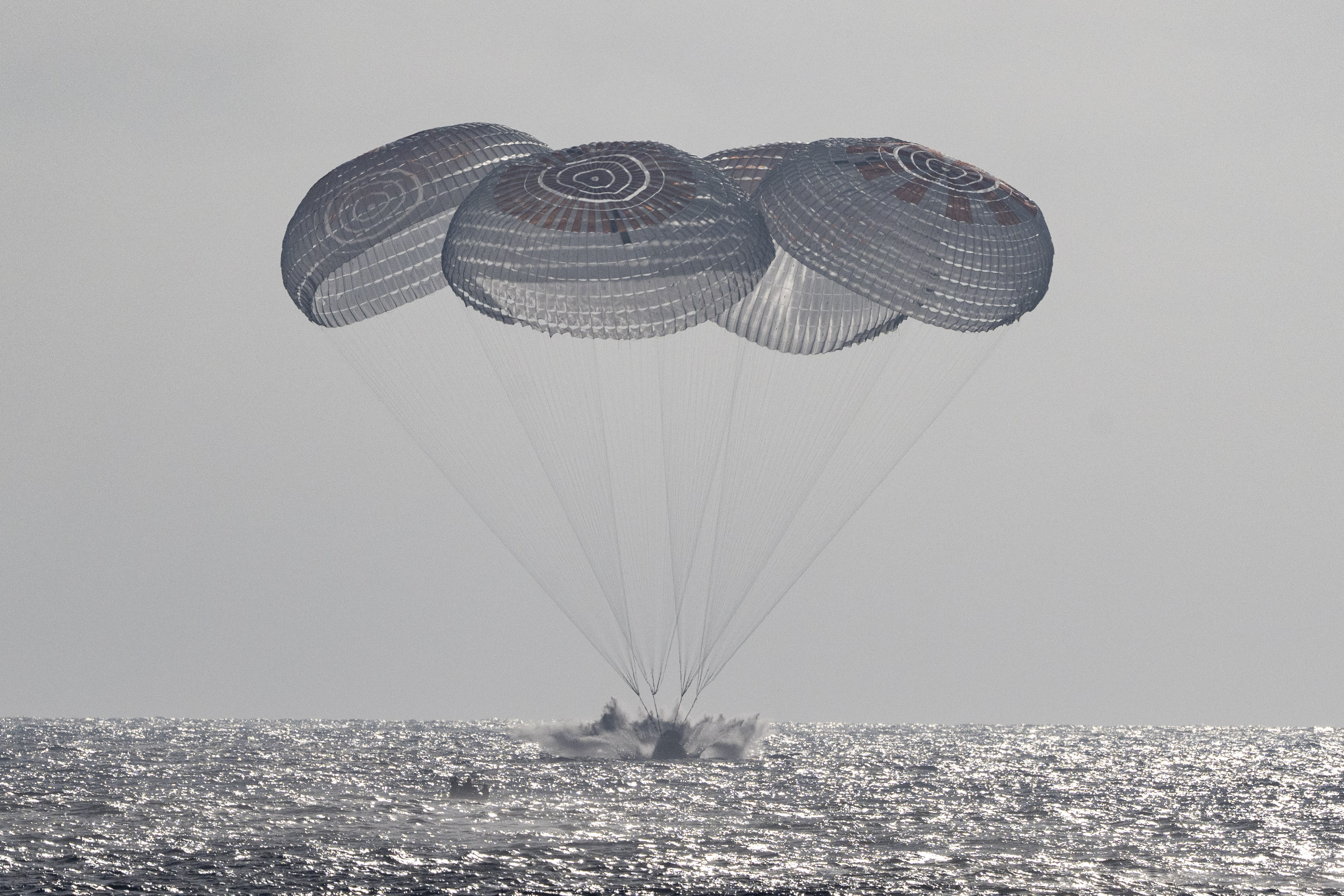
NASA’s SpaceX Crew-11 mission safely splashed down early Thursday morning in the Pacific Ocean off the coast of San Diego, concluding a more than five-month mission aboard the International Space Station.
NASA astronauts Zena Cardman and Mike Fincke, JAXA (Japan Aerospace Exploration Agency) astronaut Kimiya Yui, and Roscosmos cosmonaut Oleg Platonov returned to Earth at 12:41 a.m. PST. Teams aboard SpaceX recovery vessels retrieved the spacecraft and its crew shortly after landing.
“I couldn’t be prouder of our astronauts and the teams on the ground at NASA, SpaceX, and across our international partnerships,” said NASA Administrator Jared Isaacman. “Their professionalism and focus kept the mission on track, even with an adjusted timeline. Crew-11 completed more than 140 science experiments that advance human exploration. Missions like Crew-11 demonstrate the capability inherent in America’s space program—our ability to bring astronauts home as needed, launch new crews quickly, and continue pushing forward on human spaceflight as we prepare for our historic Artemis II mission, from low Earth orbit to the Moon and ultimately Mars.”
Crew-11 returned home about a month earlier than planned because of a medical concern teams are monitoring with one of the crew members, who remains stable. Due to medical privacy, it is not appropriate for NASA to share more details about the crew member. Prior to return, NASA previously coordinated for all four crew members to be transported to a local hospital for additional evaluation, taking advantage of medical resources on Earth to provide the best care possible.
Following the planned overnight hospital stay, the crew members will return to NASA’s Johnson Space Center in Houston and undergo standard postflight reconditioning and evaluations.
The Crew-11 mission lifted off at 11:43 a.m. EDT on Aug.1, 2025, from Launch Complex 39A at NASA’s Kennedy Space Center in Florida. About 15 hours later, the crew’s SpaceX Dragon spacecraft docked to the orbital outpost at 1:27 a.m. CDT on Aug. 2.
During their 167-day mission, the four crew members traveled nearly 71 million miles and completed more than 2,670 orbits around Earth. The Crew-11 mission was Fincke’s fourth spaceflight, Yui’s second, and the first for Cardman and Platonov. Fincke has logged 549 days in space, ranking him fourth among all NASA astronauts for cumulative days in space.
Along the way, Crew-11 logged hundreds of hours of research, maintenance, and technology demonstrations. The crew members also celebrated the 25th anniversary of continuous human presence aboard the orbiting laboratory on Nov. 2, 2025. Research conducted aboard the space station advances scientific knowledge and demonstrates new technologies that enable us to prepare for human exploration of the Moon and Mars.
NASA’s Commercial Crew Program provides reliable access to space, maximizing the use of the International Space Station for research and development by partnering with private U.S. companies, including SpaceX, to transport astronauts to and from the space station.
Learn more about NASA’s Commercial Crew Program at:
https://www.nasa.gov/commercialcrew
-end-
Joshua Finch / Jimi Russell
Headquarters, Washington
202-358-1100
joshua.a.finch@nasa.gov / james.j.russell@nasa.gov
Sandra Jones / Joseph Zakrzewski
Johnson Space Center, Houston
281-483-5111
sandra.p.jones@nasa.gov / joseph.a.zakrzewski@nasa.gov
Steven Siceloff
Kennedy Space Center, Florida
321-867-2468
steven.p.siceloff@nasa.gov

NASA’s SpaceX Crew-11 mission safely splashed down early Thursday morning in the Pacific Ocean off the coast of San Diego, concluding a more than five-month mission aboard the International Space Station.
NASA astronauts Zena Cardman and Mike Fincke, JAXA (Japan Aerospace Exploration Agency) astronaut Kimiya Yui, and Roscosmos cosmonaut Oleg Platonov returned to Earth at 12:41 a.m. PST. Teams aboard SpaceX recovery vessels retrieved the spacecraft and its crew shortly after landing.
“I couldn’t be prouder of our astronauts and the teams on the ground at NASA, SpaceX, and across our international partnerships,” said NASA Administrator Jared Isaacman. “Their professionalism and focus kept the mission on track, even with an adjusted timeline. Crew-11 completed more than 140 science experiments that advance human exploration. Missions like Crew-11 demonstrate the capability inherent in America’s space program—our ability to bring astronauts home as needed, launch new crews quickly, and continue pushing forward on human spaceflight as we prepare for our historic Artemis II mission, from low Earth orbit to the Moon and ultimately Mars.”
Crew-11 returned home about a month earlier than planned because of a medical concern teams are monitoring with one of the crew members, who remains stable. Due to medical privacy, it is not appropriate for NASA to share more details about the crew member. Prior to return, NASA previously coordinated for all four crew members to be transported to a local hospital for additional evaluation, taking advantage of medical resources on Earth to provide the best care possible.
Following the planned overnight hospital stay, the crew members will return to NASA’s Johnson Space Center in Houston and undergo standard postflight reconditioning and evaluations.
The Crew-11 mission lifted off at 11:43 a.m. EDT on Aug.1, 2025, from Launch Complex 39A at NASA’s Kennedy Space Center in Florida. About 15 hours later, the crew’s SpaceX Dragon spacecraft docked to the orbital outpost at 1:27 a.m. CDT on Aug. 2.
During their 167-day mission, the four crew members traveled nearly 71 million miles and completed more than 2,670 orbits around Earth. The Crew-11 mission was Fincke’s fourth spaceflight, Yui’s second, and the first for Cardman and Platonov. Fincke has logged 549 days in space, ranking him fourth among all NASA astronauts for cumulative days in space.
Along the way, Crew-11 logged hundreds of hours of research, maintenance, and technology demonstrations. The crew members also celebrated the 25th anniversary of continuous human presence aboard the orbiting laboratory on Nov. 2, 2025. Research conducted aboard the space station advances scientific knowledge and demonstrates new technologies that enable us to prepare for human exploration of the Moon and Mars.
NASA’s Commercial Crew Program provides reliable access to space, maximizing the use of the International Space Station for research and development by partnering with private U.S. companies, including SpaceX, to transport astronauts to and from the space station.
Learn more about NASA’s Commercial Crew Program at:
https://www.nasa.gov/commercialcrew
-end-
Joshua Finch / Jimi Russell
Headquarters, Washington
202-358-1100
joshua.a.finch@nasa.gov / james.j.russell@nasa.gov
Sandra Jones / Joseph Zakrzewski
Johnson Space Center, Houston
281-483-5111
sandra.p.jones@nasa.gov / joseph.a.zakrzewski@nasa.gov
Steven Siceloff
Kennedy Space Center, Florida
321-867-2468
steven.p.siceloff@nasa.gov
Media accreditation is open for the launch of NASA’s 12th rotational mission of a SpaceX Falcon 9 rocket and Dragon spacecraft carrying astronauts to the International Space Station for a science expedition from Space Launch Complex 40 at Cape Canaveral Space Force Station in Florida.
NASA announced it is targeting no earlier than Thursday, Jan. 15, for a splashdown of its Crew-11 mission. The agency also is working with SpaceX and international partners to advance the launch of Crew-12, which is currently slated for Sunday, Feb. 15.
The crew includes NASA astronauts Jessica Meir, commander, Jack Hathaway, pilot; ESA (European Space Agency) astronaut Sophie Adenot, mission specialist; and Roscosmos cosmonaut Andrey Fedyaev, mission specialist. This will be the second spaceflight for Meir and Fedyaev, and the first for Hathaway and Adenot to the orbiting laboratory.
Media accreditation deadlines for the Crew-12 launch as part of NASA’s Commercial Crew Program are as follows:
All accreditation requests must be submitted online at:
NASA’s media accreditation policy is online. For questions about accreditation or special logistical requests, email: ksc-media-accreditat@mail.nasa.gov. Requests for space for satellite trucks, tents, or electrical connections are due by Friday, Jan. 23.
For other questions, please contact NASA Kennedy’s newsroom at: 321-867-2468.
Para obtener información sobre cobertura en español en el Centro Espacial Kennedy o si desea solicitar entrevistas en español, comuníquese con Antonia Jaramillo: 321-501-8425, o Messod Bendayan: 256-930-1371.
For launch coverage and more information about the mission, visit:
https://www.nasa.gov/commercialcrew
-end-
Joshua Finch / Jimi Russell
Headquarters, Washington
202-358-1100
joshua.a.finch@nasa.gov / james.j.russell@nasa.gov
Steve Siceloff
Kennedy Space Center, Fla.
321-867-2468
steven.p.siceloff@nasa.gov
Joseph Zakrzewski
Johnson Space Center, Houston
281-483-5111
Joseph.a.zakrzewski@nasa.gov
Media accreditation is open for the launch of NASA’s 12th rotational mission of a SpaceX Falcon 9 rocket and Dragon spacecraft carrying astronauts to the International Space Station for a science expedition from Space Launch Complex 40 at Cape Canaveral Space Force Station in Florida.
NASA announced it is targeting no earlier than Thursday, Jan. 15, for a splashdown of its Crew-11 mission. The agency also is working with SpaceX and international partners to advance the launch of Crew-12, which is currently slated for Sunday, Feb. 15.
The crew includes NASA astronauts Jessica Meir, commander, Jack Hathaway, pilot; ESA (European Space Agency) astronaut Sophie Adenot, mission specialist; and Roscosmos cosmonaut Andrey Fedyaev, mission specialist. This will be the second spaceflight for Meir and Fedyaev, and the first for Hathaway and Adenot to the orbiting laboratory.
Media accreditation deadlines for the Crew-12 launch as part of NASA’s Commercial Crew Program are as follows:
All accreditation requests must be submitted online at:
NASA’s media accreditation policy is online. For questions about accreditation or special logistical requests, email: ksc-media-accreditat@mail.nasa.gov. Requests for space for satellite trucks, tents, or electrical connections are due by Friday, Jan. 23.
For other questions, please contact NASA Kennedy’s newsroom at: 321-867-2468.
Para obtener información sobre cobertura en español en el Centro Espacial Kennedy o si desea solicitar entrevistas en español, comuníquese con Antonia Jaramillo: 321-501-8425, o Messod Bendayan: 256-930-1371.
For launch coverage and more information about the mission, visit:
https://www.nasa.gov/commercialcrew
-end-
Joshua Finch / Jimi Russell
Headquarters, Washington
202-358-1100
joshua.a.finch@nasa.gov / james.j.russell@nasa.gov
Steve Siceloff
Kennedy Space Center, Fla.
321-867-2468
steven.p.siceloff@nasa.gov
Joseph Zakrzewski
Johnson Space Center, Houston
281-483-5111
Joseph.a.zakrzewski@nasa.gov
NASA will host a live news conference at 5 p.m. EST on Thursday from the agency’s headquarters in Washington to discuss the International Space Station and its crew.
On Jan. 7, the agency announced it was postponing a planned spacewalk originally scheduled for Jan. 8 while teams monitored a medical concern with a crew member currently living and working aboard the orbital laboratory.
The matter involved a single crew member, who is stable. Due to medical privacy, it is not appropriate for NASA to share more details about the crew member.
Participants in the news conference include:
NASA will provide live coverage of the news conference on NASA+, Amazon Prime, and the agency’s YouTube channel. Learn how to stream NASA content through a variety of online platforms, including social media.
To participate in the news conference virtually or in-person, media must RSVP for details no later than one hour before the start of the event to the NASA Newsroom at: hq-media@mail.nasa.gov. NASA’s media credentialing policy is online.
To learn more about the International Space Station, visit:
-end-
Bethany Stevens / Cheryl Warner
Headquarters, Washington
202-358-1600
bethany.c.stevens@nasa.gov / cheryl.m.warner@nasa.gov
NASA will host a live news conference at 5 p.m. EST on Thursday from the agency’s headquarters in Washington to discuss the International Space Station and its crew.
On Jan. 7, the agency announced it was postponing a planned spacewalk originally scheduled for Jan. 8 while teams monitored a medical concern with a crew member currently living and working aboard the orbital laboratory.
The matter involved a single crew member, who is stable. Due to medical privacy, it is not appropriate for NASA to share more details about the crew member.
Participants in the news conference include:
NASA will provide live coverage of the news conference on NASA+, Amazon Prime, and the agency’s YouTube channel. Learn how to stream NASA content through a variety of online platforms, including social media.
To participate in the news conference virtually or in-person, media must RSVP for details no later than one hour before the start of the event to the NASA Newsroom at: hq-media@mail.nasa.gov. NASA’s media credentialing policy is online.
To learn more about the International Space Station, visit:
-end-
Bethany Stevens / Cheryl Warner
Headquarters, Washington
202-358-1600
bethany.c.stevens@nasa.gov / cheryl.m.warner@nasa.gov
NASA opens the International Space Station for scientists and researchers, inviting them to use the benefits of microgravity for commercial and public research, technology demonstrations, and more. Today, a portion of the crew’s time aboard station is devoted to private industry, including medical research that addresses complex health challenges on Earth and prepares astronauts for future deep space missions.
In collaboration with scientists at Merck, protein crystal growth research on the space station yielded early insights regarding the structure and size of particles best suited for the development of a new formulation of the company’s cancer medicine pembrolizumab for subcutaneous injection. This new route of delivery was approved by the U.S. Food and Drug Administration in September and offers a time-saving alternative to intravenous infusion for certain patients. These research efforts aboard the space station were supported by the ISS National Laboratory.
Originally, the treatment was delivered during an in-office visit via infusion therapy into the patient’s veins, a process that could take up to two hours. Initial delivery improvements reduced infusion times to less than 30 minutes every three weeks. The newly approved subcutaneous injectable form takes about one minute every three weeks, promising to improve quality of life for patients by reducing cost and significantly reducing treatment time for patients and healthcare providers.

Since 2014, Merck has flown crystal growth experiments to the space station to better understand how crystals form, including the monoclonal antibody used in this cancer treatment. Monoclonal antibodies are lab-made proteins that help the body fight diseases. This research focused on producing crystalline suspensions that dissolve easily in liquid, making it possible to deliver the medication by injection. In microgravity, the absence of gravity’s physical forces allows scientists to grow larger, more uniform, and higher-quality crystals than those grown in ground-based labs, advancing medication development and structural modeling.
Research aboard the space station has provided valuable insights into how gravity influences crystallization, helping to improve drug formulations. The work of NASA and its partners aboard the space station improves lives on Earth, grows a commercial economy in low Earth orbit, and prepares for human exploration of the Moon and Mars.
Editor’s note: NASA announced Jan. 7, 2026, the spacewalk planned for Jan. 8, 2026, is postponed.
NASA astronauts will conduct two spacewalks Thursday, Jan. 8, and Thursday, Jan. 15, outside the International Space Station, and the agency will provide comprehensive coverage.
The first spacewalk is scheduled to begin at 8 a.m. EST on Jan. 8 and last about six hours and 30 minutes. NASA will provide live coverage beginning at 6:30 a.m. on NASA+, Amazon Prime, and the agency’s YouTube channel. Learn how to stream NASA content through a variety of online platforms, including social media.
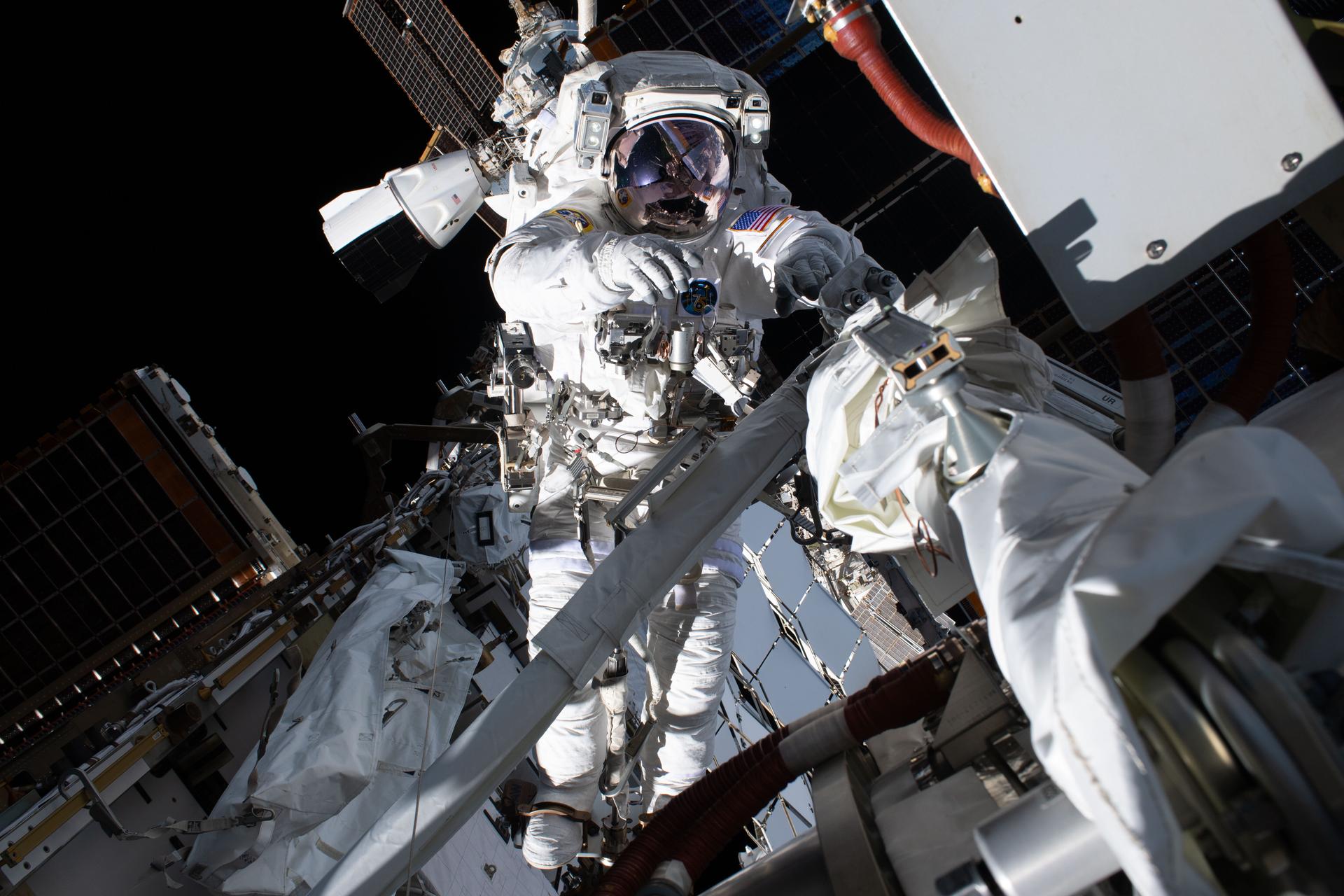
During U.S. spacewalk 94, NASA astronauts Mike Fincke and Zena Cardman will exit the station’s Quest airlock to prepare the 2A power channel for future installation of International Space Station Roll-Out Solar Arrays. Once installed, the array will provide additional power for the orbital laboratory, including critical support of its safe and controlled deorbit.
Fincke will serve as spacewalk crew member 1 and will wear a suit with red stripes, while Cardman will serve as spacewalk crew member 2 and will wear an unmarked suit. This spacewalk will be Cardman’s first and Fincke’s 10th, tying him for the most spacewalks by a NASA astronaut.
The second spacewalk is scheduled to begin at 7:10 a.m. on Jan. 15 and last about 6 hours and 30 minutes. NASA will provide live coverage beginning at 5:40 a.m. on NASA+, Amazon Prime, and the agency’s YouTube channel.
During U.S. spacewalk 95, two NASA astronauts will replace a high-definition camera on camera port 3, install a new navigational aid for visiting spacecraft, called a planar reflector, on the Harmony module’s forward port, and relocate an early ammonia servicer jumper — a flexible hose assembly that connects parts of a fluid system — along with other jumpers on the station’s S6 and S4 truss.
NASA will announce which astronauts are scheduled for the second spacewalk after the Jan. 8 spacewalk.
The spacewalks will be the 278th and 279th in support of space station assembly, maintenance and upgrades. Also, they are the first two International Space Station spacewalks of 2026, and the first by Expedition 74.
Learn more about International Space Station research and operations at:
-end-
Josh Finch / Jimi Russell
Headquarters, Washington
202-358-1100
joshua.a.finch@nasa.gov / james.j.russell@nasa.gov
Sandra Jones
Johnson Space Center, Houston
281-483-5111
sandra.p.jones@nasa.gov
1 min read
2025 marks another year pushing the boundaries of scientific research aboard the International Space Station. This past year, over 750 investigations were conducted aboard the space station, supported by crewed missions and resupply vehicles delivering essential cargo and experiments to the orbiting laboratory. This year’s research included testing DNA’s ability to store data, producing vital nutrients on demand, demonstrating technology for space debris removal and satellite maintenance, advancing next-generation medicines, and more. Astronauts visited the space station from across the globe to continue research benefiting humanity on Earth and paving the way for future exploration missions, including NASA’s Artemis program to return humanity to the Moon. On Nov. 2, 2025, NASA and its international partners surpassed 25 years of continuous human presence aboard the space station, showcasing humanity’s dedication to space exploration and scientific discovery.
Over a million images were taken aboard the space station this year, documenting groundbreaking research, observing Earth from space, and even capturing comets and other celestial phenomenon. Rewind and look back at a photo recap of 2025 aboard the space station.
NASA astronauts will conduct a pair of spacewalks in January outside of the International Space Station to prepare for the installation of a roll-out solar array and complete other tasks. Experts from NASA will preview the spacewalks in a briefing at 2 p.m. EST Tuesday, Jan. 6, at NASA’s Johnson Space Center in Houston.
Watch NASA’s live coverage of the news conference on the agency’s YouTube channel. Learn how to stream NASA content through a variety of online platforms, including social media.
Participants include:
Media interested in participating in person or by phone must contact the NASA Johnson newsroom no later than 10 a.m., Monday, Jan. 5, by calling 281-483-5111 or emailing jsccommu@mail.nasa.gov. To ask questions by phone, reporters must dial into the news conference no later than 15 minutes prior to the start of the call. Questions may also be submitted on social media using #AskNASA. NASA’s media accreditation policy is available online.
On Thursday, Jan. 8, NASA astronauts Mike Fincke and Zena Cardman will exit the station’s Quest airlock to prepare the 2A power channel for future installation of International Space Station Roll-Out Solar Arrays. Once installed, the array will provide additional power for the orbital laboratory, including critical support of its safe and controlled deorbit. This spacewalk will be Cardman’s first and Fincke’s 10th, tying him for the most spacewalks by a NASA astronaut.
On Thursday, Jan. 15, two NASA astronauts will replace a high-definition camera on camera port 3, install a new navigational aid for visiting spacecraft, called a planar reflector, on the Harmony module’s forward port, and relocate an early ammonia servicer jumper — a flexible hose assembly that connects parts of a fluid system — along with other jumpers on the station’s S6 and S4 truss.
NASA will announce the astronauts planned for the second spacewalk and start times for both events closer to the operations.
The spacewalks will be the 278th and 279th in support of space station assembly, maintenance and upgrades. They also are the first two International Space Station spacewalks of 2026, and the first by Expedition 74.
Learn more about International Space Station research and operations at:
-end-
Josh Finch / Jimi Russell
Headquarters, Washington
202-358-1100
joshua.a.finch@nasa.gov / james.j.russell@nasa.gov
Sandra Jones / Joseph Zakrzewski
Johnson Space Center, Houston
281-483-5111
sandra.p.jones@nasa.gov / joseph.a.zakrzewski@nasa.gov

With a second Trump Administration at the helm in 2025, NASA marked significant progress toward the Artemis II test flight early next year, which is the first crewed mission around the Moon in more than 50 years, as well as built upon its momentum toward a human return to the lunar surface in preparation to send the first astronauts — Americans — to Mars.
As part of the agency’s Golden Age of innovation and exploration, NASA and its partners landed two robotic science missions on the Moon; garnered more signatories for the Artemis Accords with 59 nations now agreeing to safe, transparent, and responsible lunar exploration; as well as advanced a variety of medical and technological experiments for long-duration space missions like hand-held X-ray equipment and navigation capabilities.
NASA also led a variety of science discoveries, including launching a joint satellite mission with India to regularly monitor Earth’s land and ice-covered surfaces, as well as identifying and tracking the third interstellar object in our solar system; achieved 25 continuous years of human presence aboard the International Space Station; and, for the first time, flew a test flight of the agency’s X-59 supersonic plane that will help revolutionize air travel.
Sean Duffy, named by President Trump, is serving as the acting administrator while NASA awaits confirmation of Jared Isaacman to lead the agency. Isaacman’s nomination hearing took place in early December, and his nomination was passed out of committee with bipartisan support. The full Senate will consider Isaacman’s nomination soon. President Trump also nominated Matt Anderson to serve as deputy administrator, and Greg Autry to serve as chief financial officer, both of whom are awaiting confirmation hearings. NASA named Amit Kshatriya to associate administrator, the agency’s highest-ranking civil servant position.
Key accomplishments by NASA in 2025 include:
Astronauts exploring Moon, Mars is on horizon
Under Artemis, NASA will send astronauts on increasingly difficult missions to explore more of the Moon for scientific discovery, economic benefits, and to build upon our foundation for the first crewed mission to Mars. The Artemis II test flight is the first flight with crew under NASA’s Artemis campaign and is slated to launch in early 2026. The mission will help confirm systems and hardware for future lunar missions, including Artemis III’s astronaut lunar landing.
NASA also introduced 10 new astronaut candidates in September, selected from more than 8,000 applicants. The class is undertaking nearly two years of training for future missions to low Earth orbit, the Moon, and Mars.
Progress to send the first crews around the Moon and on the lunar surface under Artemis includes:
Building on previous missions and planning for the future, NASA will conduct more science and technology demonstrations on and around the Moon than ever before. Work toward effort included:

Technological and scientific steps toward humanity’s next giant leap on the Red Planet include:
Through the Artemis Accords, seven new nations have joined the United States, led by NASA and the U.S. Department of State, in a voluntary commitment to the safe, transparent, and responsible exploration of the Moon, Mars, and beyond. With nearly 60 signatories, more countries are expected to sign in the coming months and years.
Finally, NASA engaged the public to join its missions to the Moon and Mars through a variety of activities. The agency sought names from people around the world to fly their name on a SD card aboard Orion during the Artemis II mission. NASA also sponsored a global challenge to design the spacecraft’s zero gravity indicator, announcing 25 finalists this year for the mascot design. Artemis II crew members are expected to announce a winner soon.
NASA’s gold standard science benefits humanity
In addition to conducting science at the Moon and Mars to further human exploration in the solar system, the agency continues its quest in the search for life, and its scientific work defends the planet from asteroids, advances wildfire monitoring from its satellites, studies the Sun, and more.
Astrobiology
Planetary Defense
Heliophysics
In addition to launching the NISAR mission, here are other key science moments:
25 years of continuous presence in low Earth orbit
In 2025, the International Space Station celebrated 25 years of continuous human presence, a milestone achievement underscoring its role as a beacon of global cooperation in space. The orbital laboratory supported thousands of hours of groundbreaking research in microgravity in 2025, advancing commercial space development and preparing for future human exploration of the Moon and Mars.
Research aboard the International Space Station continues to benefit life on Earth and support deep space exploration.
Additional notable space operations accomplishments included:
NASA has worked with commercial companies to advance development of privately owned and operated space stations in low Earth orbit from which the agency, along with other customers, can purchase services and stimulate the growth of commercial activities in microgravity. This work is done in advance of the International Space Station’s retirement in 2030.
Among the many achievements made by our partners, recent advancements include:

Pioneering aviation research
This year saw a major triumph for NASA’s aviation researchers, as its X-59 one-of-a-kind quiet supersonic aircraft made its historic first flight Oct 28. NASA test pilot Nils Larson flew the X-59 for 67 minutes up to an altitude of about 12,000 feet and an approximate top speed of 230 mph, precisely as planned. The flight capped off a year of engine testing including afterburner testing, taxi testing, and simulated flights from the ground — all to make sure first flight went safely and smoothly. The X-59 team will now focus on preparing for a series of flight tests where the aircraft will operate at higher altitudes and supersonic speeds. This flight test phase will ensure the X-59 meets performance and safety expectations. NASA’s Quesst mission also began testing the technologies that they will use to measure the X-59’s unique shock waves and study its acoustics during future mission phases.
Researchers also made other major strides to further aviation technologies that will benefit the public and first responders, including live flight testing of a new portable airspace management system with the potential to greatly improve air traffic awareness during wildland fire operations.
During the past year, the agency’s aeronautics researchers also:

Technologies that advance exploration, support growing space economies
From spinoff technologies on Earth to accelerating development of technologies in low Earth orbit and at the Moon and Mars, NASA develops, demonstrates, and transfer new space technologies that benefit the agency, private companies, and other government agencies and missions.
Accomplishments by NASA and our partners in 2025 included:
Harnessing NASA’s brand power in real life, online
As one of the most recognized global brands and most followed on social media, NASA amplified its reach through force-multiplying engagement activities that generate excitement and support for the agency’s missions and help foster a Golden Age of innovators and explorers.
From collaborations with sport organizations and players to partnerships with world-renowned brands, these activities provide low-cost, high-impact avenues to engage an ever-expanding audience and reinforce NASA’s position as the world’s premier space agency. Engagement highlights from 2025 include:
In 2025, NASA also consolidated its social media accounts to improve clarity, compliance, and strategic alignment. After streamlining the number of active accounts, the agency grew its total following on these accounts by more than eight million, reaching nearly 367 million followers.
Other digital highlights included:
Among agency awards:
Learn more about NASA’s missions online at:
-end-
Bethany Stevens / Cheryl Warner
Headquarters, Washington
202-358-1600
bethany.c.stevens@nasa.gov / cheryl.m.warner@nasa.gov
ALL’INTERVENTO A MUSO DURO DEL NUOVO MINISTRO DEGLI ESTERI QUIN GANG , IL GOVERNO USA ABBASSA I TONI E CERCA DI RAFFREDDARE LA POLEMICA. SI RIVELA LA TIGRE DI CARTA PROFETIZZATA DA MAO.
Il tono minaccioso e la lista delle posizioni criticabili della Cina rispetto alla guerra Ucraina ( mancata condanna della Russia all’ONU, rafforzamento della collaborazione economica russo-cinese, possibilità di invio di armi e munizioni ai russi) si sono dissolte come neve al sole.
Il tono irritante del dipartimento di stato e i solenni avvertimenti a non toccare Taiwan anche. Lo sceriffo si é reso conto di avere a che fare con un osso duro ed é diventato più conciliante. Niente più oscure minacce di ritorsioni: qua la mano !
Nel link sottostante troverete il testo che Biden finse di snobbare, inducendo molti alla imitazione, e che adesso dovrà imparare a memoria. E’ il decalogo cinese per essere coerenti col concetto di pace.
https://corrieredellacollera.wordpress.com/wp-admin/post.php?post=35641&action=edit
In effetti, la storia degli Stati Uniti é caratterizzata dalla violenza e dall’espansione il suo budget assomma al 40% di quello di tutti i paesi del mondo messi insieme ed hanno 800 basi militari sparse in paesi esteri, senza contare le flotte. Difficile dire che lo fanno per la pace.
Aver fatto notare queste verità che sono sotto gli occhi di tutti, la Cina si é vista sbeffeggiare dal presidente Joe Biden che ha snobbato il documento, implacabile ma pacato. Poco dopo il nuovo ministro degli Esteri cinese, ha cambiato il tono ed ha dichiarato che se gli USA continueranno con questi comportamenti miranti a soggiogare, prima psicologicamente, poi economicamente, la Cina, ” lo scontro sarebbe inevitabile”. Una notizia d’agenzia ha fatto circolare la cifra dei coscritti possibili: 20 milioni.
Gli USA – che sono già stati impressionati dal richiamo alle armi di trecentomila uomini fatto dalla Russia e memori della definizione di “unwise” data da Henri Kissinger all’atteggiamento bullesco di affrontare due crisi in contemporanea – hanno cambiato tono e smesso di cercare di stanare la Cina. Ancor oggi non sono riusciti a capire fino a che punto il celeste impero sia coinvolto con l’impero del male. Il timone punta a neutrale.
XI JINPING ha infatti confermato che non c’é stata nessuna cessione di armi ai duellanti, non ha dedicato una sola riga all’Europa e si é concentrato sui temi anticinesi degli USA: Taiwan, TIK TOK vessata quotidianamente, Huawei, le strumentali campagne per i diritti umani a favore degli Uiguri ( una delle sedici etnie presenti in Cina); la costruzione di una catena strategica attorno alla Cina ( AUKUS) , mirante a mortificarla nel suo mare, l’appoggio dato alla Filippine per il contenzioso per le isole Spratly, il riarmo accelerato giapponese. Tutte questioni sollevate ( o risollevate) dagli USA nell’ultimo anno miranti a indebolire XI.
La superiorità intellettuale cinese ha fatto fronte a tutte questi ostacoli affrontati senza ai usare toni aggressivi.
In questo secondo link troverete un estratto di un documento americano che tratta a un dipresso degli stessi temi del cinese, ma lo fa concentrandosi sulla Russia, al punto che affronta la situazione globale senza mai nominare Cina e India, nel tentativo di affrontare un avversario alla volta. Forse pensano che i cinesi siano tanto sciocchi da non averci pensato.
https://corrieredellacollera.wordpress.com/wp-admin/post.php?post=35317&action=edit
L’ultimo link é al più completo documento Rand sulla Russia: Extending Russia ci ho messo un pò a capire che intendevano l’espansione delle spese russe a causa di guerre e rivolte ( indicate analiticamente) fino al punto da provocarne il crollo. Ed é qui che risalta il concetto di competitive advantage, ossia ottenere un vantaggio competitivo provocando una proxy war ( guerra per procura). Non si sono resi conto che , a partire da oggi, molti, sentendo parlare di competition la prenderanno per un sinonimo di guerra. Dovranno spolverare il vocabolario.
https://www.rand.org/pubs/research_reports/RR3063.html