Artemis III Orion Crew and Service Modules Joined


The International Space Station hosts hundreds of science experiments at a time. Some experiments can take hours to perform, and researchers need to account for astronauts’ limited time. Fully automated devices, like Redwire’s ADvanced Space Experiment Processors (ADSEPs), have been designed to conduct more space science with less crew time.
Within each ADSEP facility there are three to four “mini-laboratories”, called cassettes, that allow multiple studies with different needs to be performed at the same time. The latest model, ADSEP-4 can accommodate four cassettes and features imagery capabilities. Since 2017, ADSEPs have conducted and supported two dozen investigations aboard space station with new ones on the horizon.
The latest ADSEP investigations are related to growing seed crystals in space, which can be used to reformulate existing drugs or develop entirely new therapeutics. Previous experiments have shown that the unique microgravity environment allows the growth of larger and higher quality crystals. With Redwire’s Pharmaceutical In-Space Laboratory (PIL-BOX), a cassette-based system that uses the ADSEP facility, researchers can grow improved, space-grown seed crystals.
Notable PIL-BOX experiments sponsored by the ISS National Laboratory have focused on cancer research. The ADSEP-PIL-10 investigation, currently being conducted in orbit in collaboration with the Aspera Biomedicines, works to crystallize cancer-blocking and cancer-promoting molecules with the goal of creating an oral cancer medication. ADSEP-PIL-15 crystalized cancer-treating medicines to help refine production, quality, and stability of these cancer drugs. A recent technology demonstration, ADSEP- ICC (Industrial Crystallization Cassette), tested a larger cassette to expand ADSEP function and scale crystallization production for commercial use.
ADSEPs are not limited to crystal growth and can also be used for culturing cells and tissues, studying organisms, and researching materials-sciences. In 2021, ADSEP-UMAMI studied how bobtail squid interacted with beneficial microbes in the space environment. This research found that symbiotic interactions with microbes can lessen a host animal’s stress responses caused by spaceflight and accelerate developmental pathways such as growing neurons and tissues. These findings give insight into the importance of symbiotic relationships in closed ecosystems like spacecraft and have implications for astronauts and their own beneficial bacteria during space missions.
The automation and versatility of ADSEPs permit a wide array of science experiments to be conducted aboard the orbiting laboratory, leading to findings that inform future space missions and are beneficial to people on Earth.

The International Space Station hosts hundreds of science experiments at a time. Some experiments can take hours to perform, and researchers need to account for astronauts’ limited time. Fully automated devices, like Redwire’s ADvanced Space Experiment Processors (ADSEPs), have been designed to conduct more space science with less crew time.
Within each ADSEP facility there are three to four “mini-laboratories”, called cassettes, that allow multiple studies with different needs to be performed at the same time. The latest model, ADSEP-4 can accommodate four cassettes and features imagery capabilities. Since 2017, ADSEPs have conducted and supported two dozen investigations aboard space station with new ones on the horizon.
The latest ADSEP investigations are related to growing seed crystals in space, which can be used to reformulate existing drugs or develop entirely new therapeutics. Previous experiments have shown that the unique microgravity environment allows the growth of larger and higher quality crystals. With Redwire’s Pharmaceutical In-Space Laboratory (PIL-BOX), a cassette-based system that uses the ADSEP facility, researchers can grow improved, space-grown seed crystals.
Notable PIL-BOX experiments sponsored by the ISS National Laboratory have focused on cancer research. The ADSEP-PIL-10 investigation, currently being conducted in orbit in collaboration with the Aspera Biomedicines, works to crystallize cancer-blocking and cancer-promoting molecules with the goal of creating an oral cancer medication. ADSEP-PIL-15 crystalized cancer-treating medicines to help refine production, quality, and stability of these cancer drugs. A recent technology demonstration, ADSEP- ICC (Industrial Crystallization Cassette), tested a larger cassette to expand ADSEP function and scale crystallization production for commercial use.
ADSEPs are not limited to crystal growth and can also be used for culturing cells and tissues, studying organisms, and researching materials-sciences. In 2021, ADSEP-UMAMI studied how bobtail squid interacted with beneficial microbes in the space environment. This research found that symbiotic interactions with microbes can lessen a host animal’s stress responses caused by spaceflight and accelerate developmental pathways such as growing neurons and tissues. These findings give insight into the importance of symbiotic relationships in closed ecosystems like spacecraft and have implications for astronauts and their own beneficial bacteria during space missions.
The automation and versatility of ADSEPs permit a wide array of science experiments to be conducted aboard the orbiting laboratory, leading to findings that inform future space missions and are beneficial to people on Earth.


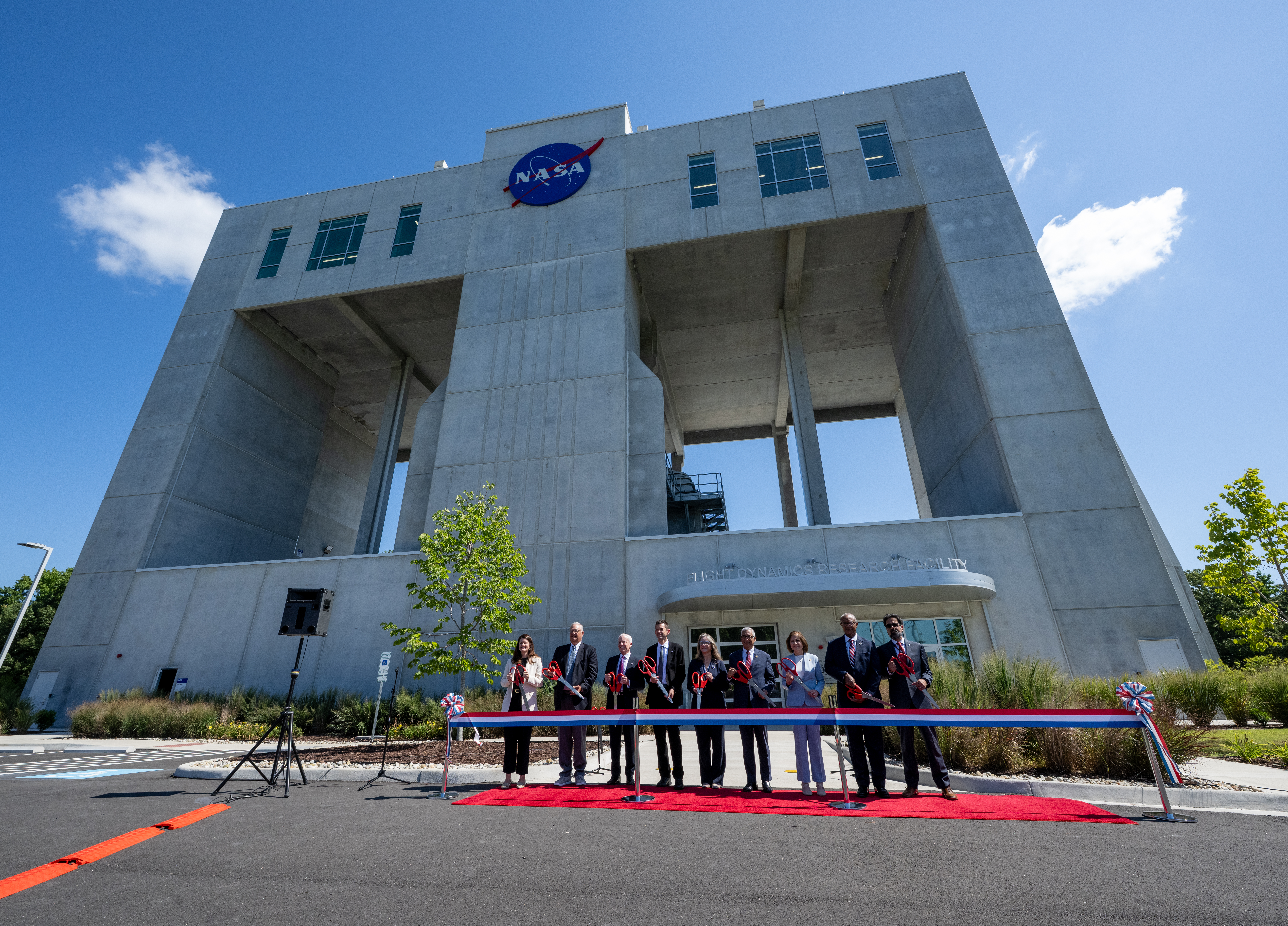
NASA opened its newest wind tunnel, the Flight Dynamics Research Facility, Friday, providing a critical resource for the agency and its partners to test the safety and performance of future generations of aircraft, rockets, and space exploration vehicles.
Located at NASA’s Langley Research Center in Hampton, Virginia, the Flight Dynamics Research Facility will support advances in aircraft safety, X‑plane development, drone research, and spacecraft technology. The facility will enable both free‑flight and mounted testing of a wide range of scale-model vehicles designed to travel through an atmosphere, from airplanes to space capsules returning to Earth.
“The Flight Dynamics Research Facility is NASA’s first major new wind tunnel in more than 40 years and gives us a powerful new platform to test the ideas and technologies that will shape the future of aviation and exploration,” said NASA Administrator Jared Isaacman. “America has led in air and space because we were willing to take on hard problems, challenge assumptions, and build what didn’t exist before. This facility gives the talented team at Langley, and our partners across government, industry, and universities, the tools to keep pushing the boundaries of what’s possible and ensure America remains the world leader in air and space.”
A ribbon-cutting ceremony at NASA Langley marked the start of a new chapter in flight research. Agency leaders, partners, and Virginia officials emphasized how the Flight Dynamics Research Facility’s state-of-the-art capabilities will shape the future of flight and exploration.
“The opening of the Flight Dynamics Research Facility represents a significant advancement for NASA and for the nation,” said Dr. Trina Dyal, NASA Langley center director. “By bringing modernized testing capabilities under one roof, we are enabling transformative research that will ensure the United States remains at the forefront of aeronautics and exploration.”
Built through a partnership with the U.S. General Services Administration (GSA), the facility replaces aging infrastructure with an energy-efficient facility that reduces maintenance costs and provides the flexibility needed for future research. The Flight Dynamics Research Facility is part of a broader, long-term collaboration between the agencies, representing the fourth new building GSA has delivered to NASA under Langley’s 20-year campus revitalization plan.
“GSA is proud to partner with NASA in delivering the Flight Dynamics Research Facility, a state-of-the-art asset that will power the next generation of American dominance in aeronautics and space exploration,” said Edward C. Forst, GSA administrator. “This facility reflects what we do best: provide the advanced, expertly designed installations that federal agencies need to carry out their missions. With these new capabilities, NASA will be better equipped to test bold ideas, validate new designs, and advance technologies that will serve the nation for decades to come.”
The Flight Dynamics Research Facility combines and improves upon the capabilities of two historic NASA Langley wind tunnels – the 20-Foot Vertical Spin Tunnel and the 12-Foot Low-Speed Tunnel. The 25,000-square-foot building features a vertical wind tunnel with improved airflow, modern digital systems, and flexible testing capabilities that will allow researchers to study how aircraft, spacecraft, parachutes, and other vehicles behave during flight.
The facility’s 20-foot diameter test chamber is much larger than those of its NASA Langley predecessors, allowing for more air to pass around test models and improving data accuracy. Its increased size also allows for the use of larger, more detailed models during testing.
The Flight Dynamics Research Facility’s top airspeed of 117 miles per hour is twice as fast as the old facilities, enabling free-flight tests of heavier scale models. This will allow simulations of full-scale vehicles flying at higher altitudes – a critical capability for operations such as studying the stability of aircraft or reentry capsules coming back from space.
The facility’s wind power comes from four 750-horsepower motors, each with an integrated, 14-foot diameter, eight-bladed fan. The fan blades are made of lightweight carbon fiber, enabling rapid, precise airspeed adjustments during free‑flight tests.
The Flight Dynamics Research Facility illustrates the powerful synergy between NASA’s aeronautics and space exploration efforts, with each driving innovation in the other. The facility will drive experimental research across a wide range of flight systems, advancing the development of autonomous flight vehicles, drones, commercial and military aircraft, and X‑planes.
As NASA prepares for a sustained human presence on the lunar surface through the Artemis program and the development of a Moon Base, the facility will play a key role in testing vehicle designs for entry, descent, and landing that will help reduce mission risk and support the safe return of crews to Earth. NASA also will be able to use the wind tunnel to help design aircraft for Mars and other destinations in our solar system where atmospheric flight is possible.
With the Flight Dynamics Research Facility now open, NASA is entering a new era in flight research – one that will shape the aircraft and spacecraft of tomorrow, strengthen industry partnerships, and extend the agency’s legacy of pioneering aerospace leadership.
The facility is managed under the Aerosciences Evaluation and Test Capabilities portfolio in the Aeronautics Division of NASA’s Research and Technology Mission Directorate.
Learn more about the Flight Dynamics Research Facility at:
-end-
Camille Gallo / Rob Margetta
Headquarters, Washington
202-358-1600
camille.m.gallo@nasa.gov / robert.j.margetta@nasa.gov
Kimiko Booker / Brittny McGraw
NASA Langley, Hampton, Virginia
757-506-5939 / 757-769-3763
kimiko.s.booker@nasa.gov / brittny.v.mcgraw@nasa.gov
NASA astronaut Deniz Burnham will embark on her first mission to the International Space Station, serving as an Expedition 76 flight engineer.
Burnham will launch aboard the Roscosmos Soyuz MS-30 spacecraft with cosmonauts Dmitri Petelin and Konstantin Borisov. Launch is targeted for March 2027, from the Baikonur Cosmodrome in Kazakhstan, and the trio will spend about seven months aboard the orbiting laboratory.
During her expedition, Burnham will conduct scientific investigations and technology demonstrations to help prepare humans for future exploration missions to the Moon and Mars and to benefit people on Earth.
Selected as a NASA astronaut in 2021, Burnham graduated with the agency’s 23rd astronaut class in 2024. Born at Incirlik Air Base in Adana, Turkey, Burnham moved frequently while growing up in a military family. She was living in Wasilla, Alaska, at the time of her selection.
A former intern at NASA’s Ames Research Center in California’s Silicon Valley, Burnham earned a bachelor’s degree in chemical engineering from the University of California, San Diego, and a master’s degree in mechanical engineering from the University of Southern California in Los Angeles. An experienced leader in the energy industry, she spent more than a decade managing onsite drilling operations on oil rigs across North America. Burnham also served in the U.S. Navy Reserves as an engineering duty officer. She is a licensed private pilot with ratings for airplane single engine land and sea, instrument airplane, and rotorcraft-helicopter.
For more than 25 years, people have lived and worked continuously aboard the International Space Station, advancing scientific knowledge and making research breakthroughs not possible on Earth. The space station helps NASA understand and overcome the challenges of human spaceflight, expand commercial opportunities in low Earth orbit, and build on the foundation for long-duration missions to the Moon, as part of the Artemis program, and to Mars.
To learn more about International Space Station research, operations, and its crews, visit:
-end-
Joshua Finch
Headquarters, Washington
202-358-1100
joshua.a.finch@nasa.gov
Anna Schneider
Johnson Space Center, Houston
281-483-5111
anna.c.schneider@nasa.gov
NASA astronaut Deniz Burnham will embark on her first mission to the International Space Station, serving as an Expedition 76 flight engineer.
Burnham will launch aboard the Roscosmos Soyuz MS-30 spacecraft with cosmonauts Dmitri Petelin and Konstantin Borisov. Launch is targeted for March 2027, from the Baikonur Cosmodrome in Kazakhstan, and the trio will spend about seven months aboard the orbiting laboratory.
During her expedition, Burnham will conduct scientific investigations and technology demonstrations to help prepare humans for future exploration missions to the Moon and Mars and to benefit people on Earth.
Selected as a NASA astronaut in 2021, Burnham graduated with the agency’s 23rd astronaut class in 2024. Born at Incirlik Air Base in Adana, Turkey, Burnham moved frequently while growing up in a military family. She was living in Wasilla, Alaska, at the time of her selection.
A former intern at NASA’s Ames Research Center in California’s Silicon Valley, Burnham earned a bachelor’s degree in chemical engineering from the University of California, San Diego, and a master’s degree in mechanical engineering from the University of Southern California in Los Angeles. An experienced leader in the energy industry, she spent more than a decade managing onsite drilling operations on oil rigs across North America. Burnham also served in the U.S. Navy Reserves as an engineering duty officer. She is a licensed private pilot with ratings for airplane single engine land and sea, instrument airplane, and rotorcraft-helicopter.
For more than 25 years, people have lived and worked continuously aboard the International Space Station, advancing scientific knowledge and making research breakthroughs not possible on Earth. The space station helps NASA understand and overcome the challenges of human spaceflight, expand commercial opportunities in low Earth orbit, and build on the foundation for long-duration missions to the Moon, as part of the Artemis program, and to Mars.
To learn more about International Space Station research, operations, and its crews, visit:
-end-
Joshua Finch
Headquarters, Washington
202-358-1100
joshua.a.finch@nasa.gov
Anna Schneider
Johnson Space Center, Houston
281-483-5111
anna.c.schneider@nasa.gov


Editor’s Note: This advisory was updated on Aug. 10, 2026, to reflect the assigned crew members and coverage times for U.S. spacewalk 97, scheduled to take place on Tuesday, Aug. 18.
Editor’s Note: The advisory was updated on Aug. 7, 2026, with a date change for U.S. spacewalk 97, which is now scheduled for Tuesday, Aug. 18. Read more on the International Space Station blog.
Editor’s note: This media advisory was updated July 27, 2026 to reflect an updated start time for the spacewalk on Thursday, Aug. 6.
NASA will provide coverage as astronauts venture outside the International Space Station during three spacewalks in August to continue upgrading solar arrays, replace a communications antenna, and connect power and data cables in support of space station operations.
Experts will preview the upcoming spacewalks during a news conference at 2 p.m. EDT, Thursday, July 30, from NASA’s Johnson Space Center in Houston.
NASA will stream these events through a variety of platforms. Learn where to watch online:
NASA participants in the news conference include:
United States-based media interested in attending in person must contact the Johnson newsroom no later than 3 p.m., Wednesday, July 29, at jsccommu@mail.nasa.gov. Media joining by phone should request dial-in details by the same deadline. To ask a question, media must dial in no later than 15 minutes before the start of the news conference.
Thursday, Aug. 6
NASA astronauts Jessica Meir and Anil Menon will exit the Quest airlock to install hardware that will modify the station’s 3B power channel and prepare it for the future installation of an International Space Station Roll-Out Solar Array (IROSA). The solar array, scheduled for delivery later this year, will be the seventh IROSA and will provide additional power to support critical station operations, including its safe and controlled deorbit.
Watch NASA’s live coverage of U.S. spacewalk 96 beginning at 7 a.m. The spacewalk is expected to start at 8:35 a.m. and last about six and a half hours.
This spacewalk will be the sixth for Meir and the first for Menon. Meir will serve as spacewalk crew member 1 and will wear a suit with red stripes. Menon will serve as crew member 2 and will wear an unmarked suit.
Tuesday, Aug. 18
During U.S. spacewalk 97, NASA astronaut Anil Menon and ESA (European Space Agency) astronaut Sophie Adenot will exit the station’s Quest airlock to replace a Space-to-Ground antenna on the orbital complex. The antenna is a critical communications link NASA uses to transmit data, enabling high-speed communications between the Mission Control Center in Houston and the space station.
Watch NASA’s live coverage beginning at 7 a.m. The spacewalk is expected to start at approximately 8:35 a.m. and last about six and a half hours.
Menon will serve as spacewalk crew member 1, and Adenot will serve as crew member 2. The spacewalk will be Menon’s second and Adenot’s first. Adenot will become the first French woman to conduct a spacewalk.
Tuesday, Aug. 25
The U.S. spacewalk 98 crew members will connect power channel cables and data relay systems as part of ongoing maintenance, including preparations for the space station’s future deorbit. The astronauts also will replace a navigational aid used for spacecraft docking on the Harmony module’s forward port.
NASA will share additional details about U.S. spacewalk 98, including timing, assigned crew members, and coverage information, closer to the operation.
The spacewalks will be the 281st, 282nd, and 283rd conducted in support of space station assembly, maintenance, and upgrades.
To learn more about International Space Station research, operations, and its crews, visit:
-end-
Joshua Finch / Jimi Russell
Headquarters, Washington
202-358-1100
joshua.a.finch@nasa.gov / james.j.russell@nasa.gov
Sandra Jones / Anna Schneider
Johnson Space Center, Houston
281-483-5111
sandra.p.jones@nasa.gov / anna.c.schneider@nasa.gov
Editor’s Note: This advisory was updated on Aug. 10, 2026, to reflect the assigned crew members and coverage times for U.S. spacewalk 97, scheduled to take place on Tuesday, Aug. 18.
Editor’s Note: The advisory was updated on Aug. 7, 2026, with a date change for U.S. spacewalk 97, which is now scheduled for Tuesday, Aug. 18. Read more on the International Space Station blog.
Editor’s note: This media advisory was updated July 27, 2026 to reflect an updated start time for the spacewalk on Thursday, Aug. 6.
NASA will provide coverage as astronauts venture outside the International Space Station during three spacewalks in August to continue upgrading solar arrays, replace a communications antenna, and connect power and data cables in support of space station operations.
Experts will preview the upcoming spacewalks during a news conference at 2 p.m. EDT, Thursday, July 30, from NASA’s Johnson Space Center in Houston.
NASA will stream these events through a variety of platforms. Learn where to watch online:
NASA participants in the news conference include:
United States-based media interested in attending in person must contact the Johnson newsroom no later than 3 p.m., Wednesday, July 29, at jsccommu@mail.nasa.gov. Media joining by phone should request dial-in details by the same deadline. To ask a question, media must dial in no later than 15 minutes before the start of the news conference.
Thursday, Aug. 6
NASA astronauts Jessica Meir and Anil Menon will exit the Quest airlock to install hardware that will modify the station’s 3B power channel and prepare it for the future installation of an International Space Station Roll-Out Solar Array (IROSA). The solar array, scheduled for delivery later this year, will be the seventh IROSA and will provide additional power to support critical station operations, including its safe and controlled deorbit.
Watch NASA’s live coverage of U.S. spacewalk 96 beginning at 7 a.m. The spacewalk is expected to start at 8:35 a.m. and last about six and a half hours.
This spacewalk will be the sixth for Meir and the first for Menon. Meir will serve as spacewalk crew member 1 and will wear a suit with red stripes. Menon will serve as crew member 2 and will wear an unmarked suit.
Tuesday, Aug. 18
During U.S. spacewalk 97, NASA astronaut Anil Menon and ESA (European Space Agency) astronaut Sophie Adenot will exit the station’s Quest airlock to replace a Space-to-Ground antenna on the orbital complex. The antenna is a critical communications link NASA uses to transmit data, enabling high-speed communications between the Mission Control Center in Houston and the space station.
Watch NASA’s live coverage beginning at 7 a.m. The spacewalk is expected to start at approximately 8:35 a.m. and last about six and a half hours.
Menon will serve as spacewalk crew member 1, and Adenot will serve as crew member 2. The spacewalk will be Menon’s second and Adenot’s first. Adenot will become the first French woman to conduct a spacewalk.
Tuesday, Aug. 25
The U.S. spacewalk 98 crew members will connect power channel cables and data relay systems as part of ongoing maintenance, including preparations for the space station’s future deorbit. The astronauts also will replace a navigational aid used for spacecraft docking on the Harmony module’s forward port.
NASA will share additional details about U.S. spacewalk 98, including timing, assigned crew members, and coverage information, closer to the operation.
The spacewalks will be the 281st, 282nd, and 283rd conducted in support of space station assembly, maintenance, and upgrades.
To learn more about International Space Station research, operations, and its crews, visit:
-end-
Joshua Finch / Jimi Russell
Headquarters, Washington
202-358-1100
joshua.a.finch@nasa.gov / james.j.russell@nasa.gov
Sandra Jones / Anna Schneider
Johnson Space Center, Houston
281-483-5111
sandra.p.jones@nasa.gov / anna.c.schneider@nasa.gov
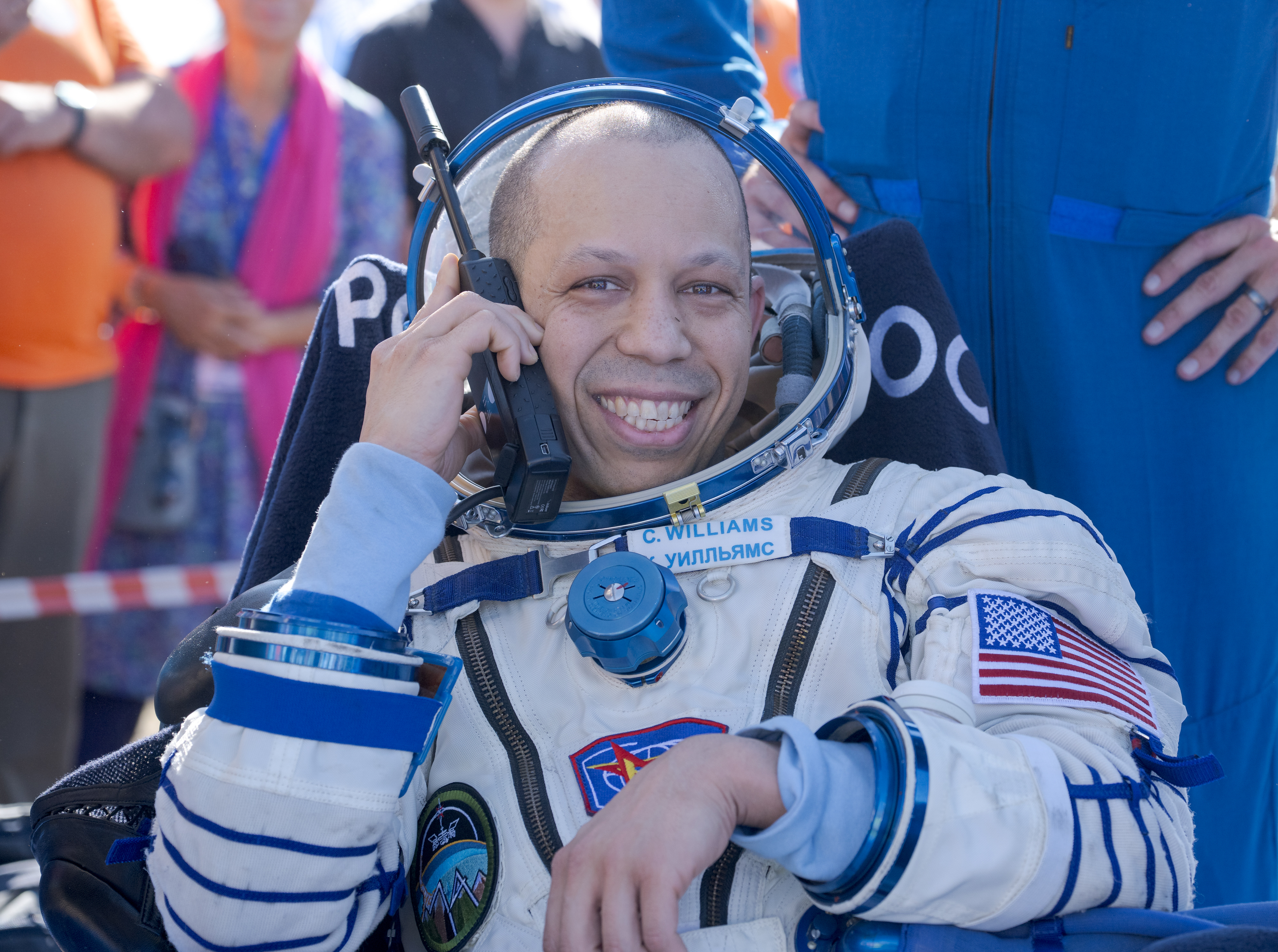
Concluding an eight-month science mission aboard the International Space Station, NASA astronaut Chris Williams returned to Earth on Sunday alongside Roscosmos cosmonauts Sergey Kud-Sverchkov and Sergei Mikaev.
The crew made its safe, parachute-assisted landing at 5:27 a.m. CDT (3:27 p.m., Kazakhstan time), southeast of Dzhezkazgan, after departing the space station at 2:03 a.m., aboard the Soyuz MS-28 spacecraft.
The crew was in space for 241 days, orbiting the Earth 3,856 times and traveling more than 102 million miles. They launched to the International Space Station on Nov. 27, 2025. The mission was the first for Williams and Mikaev and the second for Kud-Sverchkov.
While aboard the orbiting laboratory, Williams supported a wide range of scientific investigations and technology demonstrations. He helped advance research for new cancer treatments and improved in-space manufacturing of materials used in high-performance computers and electronics. Williams also completed two spacewalks to prep for space station power system upgrades and to replace a faulty joint on the Canadarm2 robotic arm. The crew’s work aboard the space station helps improve life on Earth and prepare for future human missions to the Moon and Mars.
Following post-landing medical checks, the crew members will fly by helicopter to Karaganda, Kazakhstan, where recovery teams are based. Williams then will board a NASA aircraft bound for the agency’s Johnson Space Center in Houston.
For more than 25 years, people have lived and worked continuously aboard the International Space Station, advancing scientific knowledge and making research breakthroughs not possible on Earth. The space station helps NASA understand and overcome the challenges of human spaceflight, expand commercial opportunities in low Earth orbit, and build on the foundation for long-duration missions to the Moon, as part of the Artemis program, and to Mars.
To learn more about International Space Station research, operations, and its crews, visit:
-end-
Joshua Finch / Jimi Russell
Headquarters, Washington
202-358-1100
joshua.a.finch@nasa.gov / james.j.russell@nasa.gov
Leah Cheshier / Anna Schneider
Johnson Space Center, Houston
281-483-5111
leah.d.cheshier@nasa.gov / anna.c.schneider@nasa.gov
Concluding an eight-month science mission aboard the International Space Station, NASA astronaut Chris Williams returned to Earth on Sunday alongside Roscosmos cosmonauts Sergey Kud-Sverchkov and Sergei Mikaev.
The crew made its safe, parachute-assisted landing at 5:27 a.m. CDT (3:27 p.m., Kazakhstan time), southeast of Dzhezkazgan, after departing the space station at 2:03 a.m., aboard the Soyuz MS-28 spacecraft.
The crew was in space for 241 days, orbiting the Earth 3,856 times and traveling more than 102 million miles. They launched to the International Space Station on Nov. 27, 2025. The mission was the first for Williams and Mikaev and the second for Kud-Sverchkov.
While aboard the orbiting laboratory, Williams supported a wide range of scientific investigations and technology demonstrations. He helped advance research for new cancer treatments and improved in-space manufacturing of materials used in high-performance computers and electronics. Williams also completed two spacewalks to prep for space station power system upgrades and to replace a faulty joint on the Canadarm2 robotic arm. The crew’s work aboard the space station helps improve life on Earth and prepare for future human missions to the Moon and Mars.
Following post-landing medical checks, the crew members will fly by helicopter to Karaganda, Kazakhstan, where recovery teams are based. Williams then will board a NASA aircraft bound for the agency’s Johnson Space Center in Houston.
For more than 25 years, people have lived and worked continuously aboard the International Space Station, advancing scientific knowledge and making research breakthroughs not possible on Earth. The space station helps NASA understand and overcome the challenges of human spaceflight, expand commercial opportunities in low Earth orbit, and build on the foundation for long-duration missions to the Moon, as part of the Artemis program, and to Mars.
To learn more about International Space Station research, operations, and its crews, visit:
-end-
Joshua Finch / Jimi Russell
Headquarters, Washington
202-358-1100
joshua.a.finch@nasa.gov / james.j.russell@nasa.gov
Leah Cheshier / Anna Schneider
Johnson Space Center, Houston
281-483-5111
leah.d.cheshier@nasa.gov / anna.c.schneider@nasa.gov

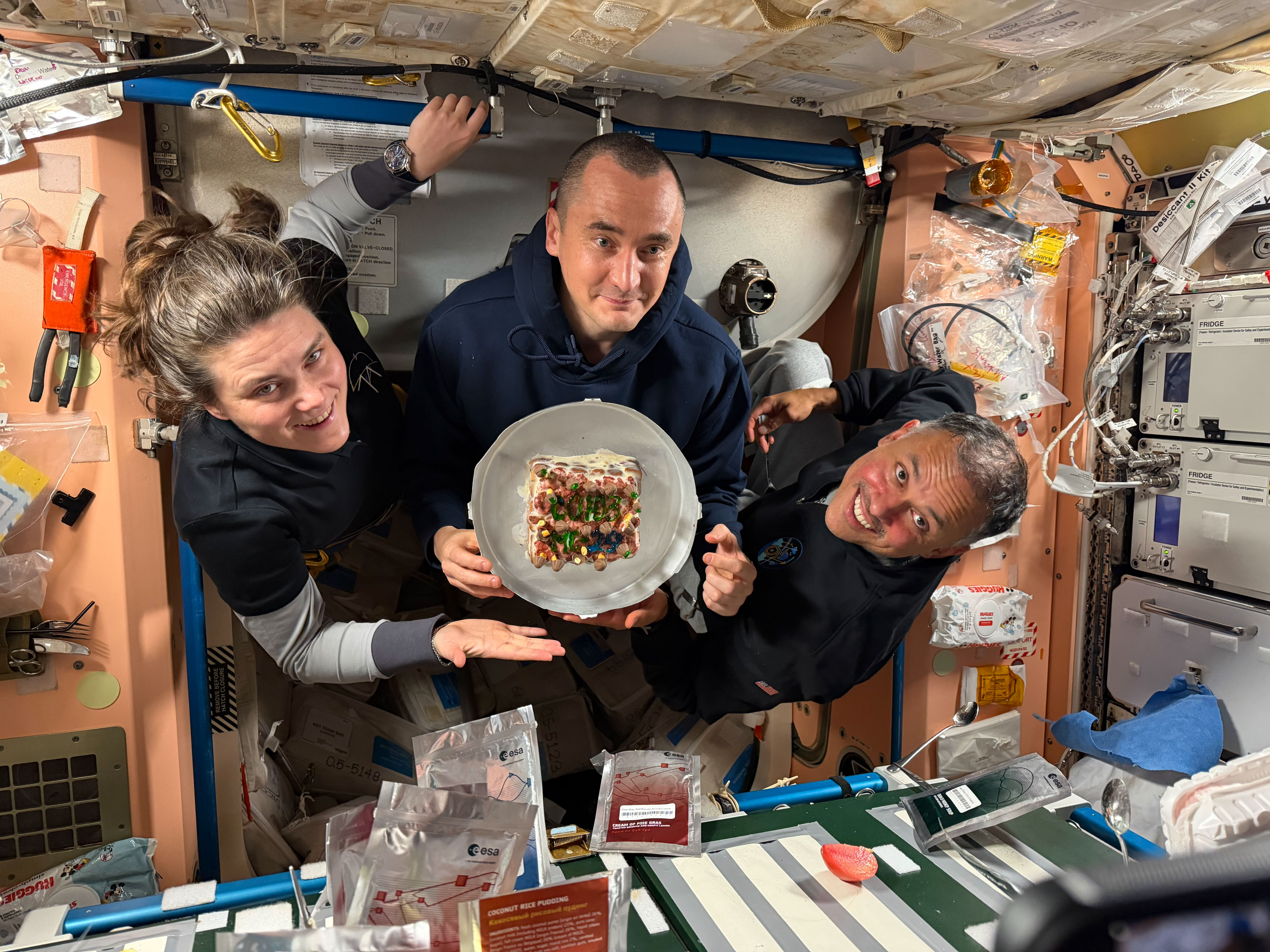
From left, Expedition 74 flight engineers Anna Kikina and Pyotr Dubrov of Roscosmos, and Anil Menon of NASA pose for a July 18, 2026, photo while holding a cake celebrating their recent arrival aboard the International Space Station. The trio arrived at the space station on July 14, 2026, after launching from the Baikonur Cosmodrome in Kazakhstan earlier the same day.
Kikina, Dubrov, and Menon are in the second week of their planned eight-and-a-half-month mission. They are using their new skills to conduct space research while still familiarizing themselves with living and working in space.
Keep up with space station activity on the International Space Station blog.
Image credit: NASA/Chris Williams
From left, Expedition 74 flight engineers Anna Kikina and Pyotr Dubrov of Roscosmos, and Anil Menon of NASA pose for a July 18, 2026, photo while holding a cake celebrating their recent arrival aboard the International Space Station. The trio arrived at the space station on July 14, 2026, after launching from the Baikonur Cosmodrome in Kazakhstan earlier the same day.
Kikina, Dubrov, and Menon are in the second week of their planned eight-and-a-half-month mission. They are using their new skills to conduct space research while still familiarizing themselves with living and working in space.
Keep up with space station activity on the International Space Station blog.
Image credit: NASA/Chris Williams


After eight months aboard the International Space Station for his first mission, NASA astronaut Chris Williams is preparing to return to Earth. During his assignment, Williams contributed to research for new cancer treatments, advanced the production of materials to improve computers and electronics, ventured into the vacuum of space to complete two spacewalks, and much more. Williams’ work aboard the space station helped to improve life on Earth and prepare for future missions to the Moon and Mars.
Here are some of the research highlights from his mission:
NASA astronaut Chris Williams and ESA (European Space Agency) astronaut Sophie Adenot work to process DNA-inspired materials that could advance new cancer treatments for people on Earth. In space, these rod-shaped materials form more evenly and consistently, which may improve their performance and readiness for treatments on Earth. While there have been major advancements in cancer therapies, many treatments can affect the whole body and cause side effects without fully treating solid tumors. This research aims to enable targeted cancer therapies that reach deep into tumors, stay in the body longer, and release medicine in a more controlled way.
Learn more about DNA Nano Therapeutics-3.
NASA astronaut Chris Williams conducts research to grow semiconductor crystals in space. In microgravity, researchers can grow more crystals of the desired size than can be produced on Earth. Previous research shows that space-grown crystals can offer increased performance to help advance technologies like high-performance computers, artificial intelligence, and medical devices. This research lays the groundwork for commercial semiconductor manufacturing in space and advances the semiconductor industry.
Learn more about In-Space Production of Semimetal-Semiconductor Composite Bulk Crystals in Microgravity (SUBSA-InSPA-SSCug).
NASA astronaut Chris Williams looks out of a cupola window at a red aurora glowing above the Earth. Since the 1960s, astronauts have photographed Earth from space to help scientists monitor the planet’s changing landscapes, natural disasters, and other features over time. Along the way, astronauts also have captured images of celestial objects such as comets, auroras, and the Milky Way.
NASA astronaut Chris Williams works with a special freezer aboard the International Space Station that keeps research samples at ultra-cold temperatures until they can return to Earth. Throughout each mission, astronauts collect biological samples like blood and urine to help scientists understand how long-duration spaceflight affects the human body. Observing crew members during their space missions and studying these frozen samples back on Earth helps NASA protect astronaut health during future missions to the Moon, Mars, and beyond.
Learn more about the Minus Eighty-Degree Laboratory Freezer for the International Space Station (MELFI) and Human Research.
NASA astronauts Jack Hathaway and Chris Williams watch from the cupola windows as Northrop Grumman’s Cygnus XL cargo spacecraft approaches the International Space Station. The two played key roles in the capture of the spacecraft, which delivered approximately 11,000 pounds of supplies, including fresh food, life support equipment, and scientific research as part of NASA’s Northrop Grumman Commercial Resupply Services 24 mission. Cargo missions help keep the space station operating and provide astronauts with the supplies they need to live, work, and conduct research in orbit.
NASA astronaut Chris Williams works on an investigation that tests the use of ultraviolet light to help prevent the formation of microbial colonies, called biofilms. Biofilms can clog and contaminate water systems, damage equipment, and pose health risks to astronauts. This research aims to keep surfaces cleaner and safeguard systems during long-duration space missions. Using UV light for sanitation also could reduce the need for chemical disinfectants in space, decreasing the risk of chemical exposure and eliminating difficulties in transporting or storing supplies.
Learn more about Germicidal Ultraviolet Light Biofilm Inhibition (GULBI).
NASA astronaut Chris Williams ventured outside the International Space Station for two spacewalks during his mission. In June, he helped make repairs to Canadarm2, a robotic arm that captures cargo spacecraft and deploys external research. In March, Williams prepared the orbiting laboratory for new solar arrays to be added to the station in a future spacewalk. Once installed, the final set of International Space Station Roll Out Solar Arrays (IROSA) will complete the full suite of additional solar power, increasing the station’s power generation by about 30% and enhancing support for scientific research and daily operations. The same solar array technology also powered NASA’s Double Asteroid Redirection Test and could support future missions to the Moon and Mars.
Learn more about the space station’s IROSAs.
NASA astronaut Chris Williams works with hardware to support the development of new cancer and disease treatments by studying the growth of protein crystals for pharmaceuticals. In space, protein crystals form higher-quality structures than they do on Earth, allowing researchers to better understand how to target and treat disease. Here, Williams works with a project that aims to develop a new formula for a cancer treatment that could be taken orally. Growing protein crystals in space paves the way for more commercial companies to create new therapies that could improve patient outcomes on Earth.
Learn more about the Pharmaceutical In-space Laboratory (ADSEP-PIL-10).
NASA astronaut Chris Williams works with equipment that tests the performance of small robotic arms in space. Some experiments and operations require very precise movements, where tiny errors can significantly impact results. Understanding how microgravity affects delicate robotic operations helps researchers improve designs for future automated systems that can perform operations while astronauts focus on the most critical tasks.
Learn more about the Test facility for lab-aUtomation System in Kibo (TUSK).


After eight months aboard the International Space Station for his first mission, NASA astronaut Chris Williams is preparing to return to Earth. During his assignment, Williams contributed to research for new cancer treatments, advanced the production of materials to improve computers and electronics, ventured into the vacuum of space to complete two spacewalks, and much more. Williams’ work aboard the space station helped to improve life on Earth and prepare for future missions to the Moon and Mars.
Here are some of the research highlights from his mission:
NASA astronaut Chris Williams and ESA (European Space Agency) astronaut Sophie Adenot work to process DNA-inspired materials that could advance new cancer treatments for people on Earth. In space, these rod-shaped materials form more evenly and consistently, which may improve their performance and readiness for treatments on Earth. While there have been major advancements in cancer therapies, many treatments can affect the whole body and cause side effects without fully treating solid tumors. This research aims to enable targeted cancer therapies that reach deep into tumors, stay in the body longer, and release medicine in a more controlled way.
Learn more about DNA Nano Therapeutics-3.
NASA astronaut Chris Williams conducts research to grow semiconductor crystals in space. In microgravity, researchers can grow more crystals of the desired size than can be produced on Earth. Previous research shows that space-grown crystals can offer increased performance to help advance technologies like high-performance computers, artificial intelligence, and medical devices. This research lays the groundwork for commercial semiconductor manufacturing in space and advances the semiconductor industry.
Learn more about In-Space Production of Semimetal-Semiconductor Composite Bulk Crystals in Microgravity (SUBSA-InSPA-SSCug).
NASA astronaut Chris Williams looks out of a cupola window at a red aurora glowing above the Earth. Since the 1960s, astronauts have photographed Earth from space to help scientists monitor the planet’s changing landscapes, natural disasters, and other features over time. Along the way, astronauts also have captured images of celestial objects such as comets, auroras, and the Milky Way.
NASA astronaut Chris Williams works with a special freezer aboard the International Space Station that keeps research samples at ultra-cold temperatures until they can return to Earth. Throughout each mission, astronauts collect biological samples like blood and urine to help scientists understand how long-duration spaceflight affects the human body. Observing crew members during their space missions and studying these frozen samples back on Earth helps NASA protect astronaut health during future missions to the Moon, Mars, and beyond.
Learn more about the Minus Eighty-Degree Laboratory Freezer for the International Space Station (MELFI) and Human Research.
NASA astronauts Jack Hathaway and Chris Williams watch from the cupola windows as Northrop Grumman’s Cygnus XL cargo spacecraft approaches the International Space Station. The two played key roles in the capture of the spacecraft, which delivered approximately 11,000 pounds of supplies, including fresh food, life support equipment, and scientific research as part of NASA’s Northrop Grumman Commercial Resupply Services 24 mission. Cargo missions help keep the space station operating and provide astronauts with the supplies they need to live, work, and conduct research in orbit.
NASA astronaut Chris Williams works on an investigation that tests the use of ultraviolet light to help prevent the formation of microbial colonies, called biofilms. Biofilms can clog and contaminate water systems, damage equipment, and pose health risks to astronauts. This research aims to keep surfaces cleaner and safeguard systems during long-duration space missions. Using UV light for sanitation also could reduce the need for chemical disinfectants in space, decreasing the risk of chemical exposure and eliminating difficulties in transporting or storing supplies.
Learn more about Germicidal Ultraviolet Light Biofilm Inhibition (GULBI).
NASA astronaut Chris Williams ventured outside the International Space Station for two spacewalks during his mission. In June, he helped make repairs to Canadarm2, a robotic arm that captures cargo spacecraft and deploys external research. In March, Williams prepared the orbiting laboratory for new solar arrays to be added to the station in a future spacewalk. Once installed, the final set of International Space Station Roll Out Solar Arrays (IROSA) will complete the full suite of additional solar power, increasing the station’s power generation by about 30% and enhancing support for scientific research and daily operations. The same solar array technology also powered NASA’s Double Asteroid Redirection Test and could support future missions to the Moon and Mars.
Learn more about the space station’s IROSAs.
NASA astronaut Chris Williams works with hardware to support the development of new cancer and disease treatments by studying the growth of protein crystals for pharmaceuticals. In space, protein crystals form higher-quality structures than they do on Earth, allowing researchers to better understand how to target and treat disease. Here, Williams works with a project that aims to develop a new formula for a cancer treatment that could be taken orally. Growing protein crystals in space paves the way for more commercial companies to create new therapies that could improve patient outcomes on Earth.
Learn more about the Pharmaceutical In-space Laboratory (ADSEP-PIL-10).
NASA astronaut Chris Williams works with equipment that tests the performance of small robotic arms in space. Some experiments and operations require very precise movements, where tiny errors can significantly impact results. Understanding how microgravity affects delicate robotic operations helps researchers improve designs for future automated systems that can perform operations while astronauts focus on the most critical tasks.
Learn more about the Test facility for lab-aUtomation System in Kibo (TUSK).

Media are invited to NASA’s Langley Research Center in Hampton, Virginia, on Friday, July 31, to attend a media tour and ribbon-cutting ceremony for the Flight Dynamics Research Facility, the agency’s first new wind tunnel in more than 40 years.
The event will include a brief media availability with:
This event is in person only and open to members of the media who are United States citizens or lawful permanent residents. Information about timing will be shared closer to the event. NASA’s media accreditation policy is available online.
Media requesting to participate in person must RSVP no later than 5 p.m. EDT on Wednesday, July 29. Media RSVPs must be sent to Kimiko Booker, kimiko.s.booker@nasa.gov, and Brittny McGraw, brittny.v.mcgraw@nasa.gov, with the following information:
The wind tunnel opening marks a major milestone in the evolution of NASA and the nation’s aeronautics and space research capabilities. The state-of-the-art facility will support research and technology development that will advance NASA’s aeronautics, exploration, and science goals, including establishing a sustained human presence on the lunar surface through the Artemis program and the development of a Moon Base.
Learn more about the Flight Dynamics Research Facility at:
-end-
Camille Gallo / Rob Margetta
Headquarters, Washington
202-358-1600
camille.m.gallo@nasa.gov / robert.j.margetta@nasa.gov
Kimiko Booker / Brittny McGraw
NASA Langley, Hampton, Va.
757-506-5939 / 757-769-3763
kimiko.s.booker@nasa.gov / brittny.v.mcgraw@nasa.gov
Editor’s Note: This advisory was updated on July 23, 2026, to reflect changes to the mission timeline.
NASA astronaut Chris Williams and Roscosmos cosmonauts Sergey Kud-Sverchkov and Sergei Mikaev are wrapping up their 241‑day mission aboard the International Space Station.
The crew and its Soyuz MS-28 spacecraft will undock from the orbiting laboratory’s Rassvet module at 3:03 a.m. EDT Sunday, July 26, heading for a parachute-assisted landing at 6:25 a.m. (3:25 p.m. local time) on the steppe of Kazakhstan, southeast of Dzhezkazgan.
NASA’s live return coverage will stream through a variety of platforms. Learn where to watch online:
Williams and his crewmates will complete 3,856 orbits and travel more than 102 million miles before returning to Earth. The flight marks the first mission for Williams and Mikaev and the second for Kud‑Sverchkov.
After landing, the crew will fly by helicopter to Karaganda, Kazakhstan, where recovery teams are based. Williams then will return to NASA’s Johnson Space Center in Houston, while Kud‑Sverchkov and Mikaev head back to their training base in Star City, Russia.
NASA’s live return coverage is as follows (all times Eastern and subject to change based on real-time operations):
Saturday, July 25
9:40 a.m. – Coverage of the Space Station Expedition 74/75 change of command ceremony begins.
Kud‑Sverchkov will transfer command of the orbital complex to NASA astronaut Jessica Meir. Expedition 75 officially begins when Soyuz MS‑28 undocks.
11:10 p.m. – Coverage of crew farewells and hatch closing begins.
11:30 p.m. – Hatch closing
Sunday, July 26
2:30 a.m. – Coverage of undocking begins.
3:03 a.m. – Undocking
5:15 a.m. – Coverage of deorbit and landing begins.
5:31 a.m. – Deorbit burn
6:25 a.m. – Landing
For more than 25 years, people have lived and worked continuously aboard the International Space Station, advancing scientific knowledge and making research breakthroughs not possible on Earth. The space station helps NASA understand and overcome the challenges of human spaceflight, expand commercial opportunities in low Earth orbit, and build on the foundation for long-duration missions to the Moon, as part of the Artemis program, and to Mars.
To learn more about International Space Station research, operations, and its crews, visit:
-end-
Joshua Finch / Jimi Russell
Headquarters, Washington
202-358-1100
joshua.a.finch@nasa.gov / james.j.russell@nasa.gov
Leah Cheshier / Anna Schneider
Johnson Space Center, Houston
281-483-5111
leah.d.cheshier@nasa.gov / anna.c.schneider@nasa.gov
Editor’s Note: This advisory was updated on July 23, 2026, to reflect changes to the mission timeline.
NASA astronaut Chris Williams and Roscosmos cosmonauts Sergey Kud-Sverchkov and Sergei Mikaev are wrapping up their 241‑day mission aboard the International Space Station.
The crew and its Soyuz MS-28 spacecraft will undock from the orbiting laboratory’s Rassvet module at 3:03 a.m. EDT Sunday, July 26, heading for a parachute-assisted landing at 6:25 a.m. (3:25 p.m. local time) on the steppe of Kazakhstan, southeast of Dzhezkazgan.
NASA’s live return coverage will stream through a variety of platforms. Learn where to watch online:
Williams and his crewmates will complete 3,856 orbits and travel more than 102 million miles before returning to Earth. The flight marks the first mission for Williams and Mikaev and the second for Kud‑Sverchkov.
After landing, the crew will fly by helicopter to Karaganda, Kazakhstan, where recovery teams are based. Williams then will return to NASA’s Johnson Space Center in Houston, while Kud‑Sverchkov and Mikaev head back to their training base in Star City, Russia.
NASA’s live return coverage is as follows (all times Eastern and subject to change based on real-time operations):
Saturday, July 25
9:40 a.m. – Coverage of the Space Station Expedition 74/75 change of command ceremony begins.
Kud‑Sverchkov will transfer command of the orbital complex to NASA astronaut Jessica Meir. Expedition 75 officially begins when Soyuz MS‑28 undocks.
11:10 p.m. – Coverage of crew farewells and hatch closing begins.
11:30 p.m. – Hatch closing
Sunday, July 26
2:30 a.m. – Coverage of undocking begins.
3:03 a.m. – Undocking
5:15 a.m. – Coverage of deorbit and landing begins.
5:31 a.m. – Deorbit burn
6:25 a.m. – Landing
For more than 25 years, people have lived and worked continuously aboard the International Space Station, advancing scientific knowledge and making research breakthroughs not possible on Earth. The space station helps NASA understand and overcome the challenges of human spaceflight, expand commercial opportunities in low Earth orbit, and build on the foundation for long-duration missions to the Moon, as part of the Artemis program, and to Mars.
To learn more about International Space Station research, operations, and its crews, visit:
-end-
Joshua Finch / Jimi Russell
Headquarters, Washington
202-358-1100
joshua.a.finch@nasa.gov / james.j.russell@nasa.gov
Leah Cheshier / Anna Schneider
Johnson Space Center, Houston
281-483-5111
leah.d.cheshier@nasa.gov / anna.c.schneider@nasa.gov


4 min read
An aircraft powered by a megawatt-class hybrid-electric engine developed in collaboration with NASA and built by GE Aerospace, demonstrated flight of an innovation that can inform new generations of fuel-saving aircraft power systems.
Mounted to a Saab 340B aircraft, the engine flew at Farnborough International Air Show in the United Kingdom. It was the public debut of a system that has in recent months made historic test flights, becoming the first hybrid electric-powered aircraft to fly above 30,000 feet.
“This achievement reflects what NASA does best in aeronautics: we explore bold possibilities, validate them through rigorous research and testing, and work with industry to turn breakthrough ideas into technologies that bring real value for the American people,” said Laurie Grindle, director of the Aeronautics Division within the agency’s Research and Technology Mission Directorate at NASA Headquarters in Washington.
The testing leveraged work done through NASA’s former Electrified Powertrain Flight Demonstration project and the agency’s ongoing Subsonic Vehicle Technologies and Tools project – years of collaborative research that included key testing at NASA test facilities.
The engine integrates electric motors, a gas turbine, and energy storage capabilities. It was designed to demonstrate the capacity to power an aircraft around the size of a regional-class jet, reducing fuel burn and costs without sacrificing performance. The unit’s technology and designs are expected to be used to help develop future hybrid systems that could lower airline operating costs.
The demonstration flight came after years of rapid development for the technology. For NASA, it also validates work that stretches back to a time when hybrid aviation propulsion seemed almost beyond the horizon of possibility.

LAURIE A. GRINDLE
Director of the Aeronautics Division within the agency's Research and Technology Mission Directorate
“This is the culmination of more than 15 years of work, and we did that because it’s going to have an impact for aircraft that will help reduce energy use and help U.S. companies and the public,” said Ralph Jansen, aerospace engineer at NASA’s Glenn Research Center in Cleveland. “It’s about having a vision that no one believes can happen and then doing the work to define and execute the research and development needed to make it happen.”
This accomplishment was possible because of the collaborative effort of hundreds of people working on Electrified Powertrain Flight Demonstration and Subsonic Vehicle Technologies and Tools projects across NASA centers, in conjunction with GE Aerospace and its partner companies.
In recent years, aviation has seen a boom in small aircraft and drones powered by electrical systems drawing from batteries. But large passenger and cargo planes require complex engines capable of supplying massive amounts of power. So more than a decade ago when NASA began contemplating hybrid systems, just the possibility of using electric motors to supplement some energy was a daunting engineering challenge.
NASA spent about seven years performing preliminary research, working with small businesses and other partners to consider technological obstacles and the potential commercial viability of hybrid systems. During that time, the agency addressed several barriers to implementation including the power, thermal, and battery technology, and the integration of the power system, engine, and aircraft.
Through the agency’s Electrified Powertrain Flight Demonstration award, GE Aerospace and NASA worked with researchers to develop lighter and more efficient power systems and shrink key components – sometimes dramatically.
NASA and GE Aerospace also leveraged agency facilities and resources to further their research. In 2022, GE Aerospace tested an integrated version of its propulsion system at NASA’s Electric Aircraft Testbed at the agency’s Neil A. Armstrong Test Facility in Sandusky, Ohio. Testing allowed the system to operate in conditions simulating 45,000 feet in altitude, the range in which commercial single-aisle aircraft fly.
The team added components, including electric motors, power converters, propellers, and a GE Aerospace commercial engine, followed by more ground tests and eventual flight tests. For the researchers who’d spent years on the concept, seeing the engine powering an aircraft in flight was a major step in a long journey.
“I’ve got to say, I was pretty touched seeing it fly. It was just awesome,” Jansen said. “It’s just like a regular plane, which is probably the best thing of all.”
NASA’s current support for this research is through the Aeronautics Division of its Research and Technology Mission Directorate.

NASA and its partners will discuss the upcoming crew rotation mission to the International Space Station during a pair of news conferences on Monday, Aug. 3, from the agency’s Johnson Space Center in Houston.
Mission leadership will provide an overview of NASA’s SpaceX Crew‑13 mission at 12 p.m. EDT. Next, crew members will discuss their training and mission preparations at 2 p.m. This is Crew-13’s final media availability prior to traveling to the agency’s Kennedy Space Center in Florida for launch.
NASA will stream these events live. Learn where to watch online:
The Crew-13 mission will carry NASA astronauts Jessica Watkins and Luke Delaney, CSA (Canadian Space Agency) astronaut Joshua Kutryk, and Roscosmos cosmonaut Sergey Teteryatnikov to the orbiting laboratory. The crew will launch aboard a SpaceX Dragon spacecraft on the company’s Falcon 9 rocket from Space Launch Complex 40 at Cape Canaveral Space Force Station in Florida no earlier than mid-September.
International media attending in person must email the NASA Johnson newsroom at jsccommu@mail.nasa.gov by 5 p.m., Tuesday, July 21. United States-based media attending in person must respond by 5 p.m., Thursday, July 30. Media joining virtually must respond by 10 a.m. the day of the event. NASA’s media accreditation policy is available online.
Briefing participants are as follows (all times Eastern and subject to change based on real-time operations):
12 p.m.: Mission Overview News Conference
2 p.m.: Crew-13 News Conference
Following the news conference, crew members will be available for limited media interviews. All interview requests must be submitted by 5 p.m. on July 30, to the NASA Johnson newsroom at: jsccommu@mail.nasa.gov.
This will be the second flight to the space station for Watkins, who was selected as a NASA astronaut in 2017. Watkins grew up in Lafayette, Colorado, and earned an undergraduate degree in geological and environmental sciences from Stanford University, as well as a doctorate in geology from the University of California, Los Angeles. As a geologist, she studied the Martian surface and was a member of the Curiosity rover science team at NASA’s Jet Propulsion Laboratory in Southern California. Watkins first launched to the space station as a crew member aboard NASA’s SpaceX Crew-4 mission, spending a total of 170 days in space across space station Expeditions 67/68 in 2022. She will be the first NASA astronaut to launch aboard a SpaceX Dragon spacecraft twice.
Selected as a NASA astronaut in 2021, Delaney earned a bachelor’s degree in mechanical engineering at the University of North Florida and a master’s degree in aerospace engineering at the Naval Postgraduate School. The Florida native is a distinguished naval aviator who participated in exercises throughout the Asia Pacific region and conducted missions in support of Operation Enduring Freedom. As a test pilot, Delaney evaluated developmental aircraft systems and served as a test pilot instructor. He also worked as a research pilot at NASA’s Langley Research Center in Hampton, Virginia, where he supported airborne science missions. This is the first spaceflight for Delaney.
The Crew-13 mission also is the first spaceflight for Kutryk. Prior to his selection as a CSA astronaut in 2017, he served as a CF-18 fighter pilot, flying missions in support of Canada’s NATO, U.N., and North American Aerospace Defense Command commitments. A native of Fort Saskatchewan, Alberta, Kutryk also worked as an experimental and operational test pilot at the Aerospace Engineering Test Establishment in Cold Lake, Alberta. Kutryk received a bachelor’s degree in mechanical engineering from the Royal Military College of Canada in Kingston, Ontario, and he is a distinguished graduate of the United States Air Force Test Pilot school in Edwards, California. He has master’s degrees in space studies, flight test engineering, and defense studies.
This mission will be Teteryatnikov’s first trip to the orbiting laboratory. He graduated from the Naval Academy, St. Petersburg, Russia, in 2011 as an engineer specializing in ship power plant operations. Before his selection as a test cosmonaut, Teteryatnikov served in various naval engineering roles, including undersea vessels and specialized engine room operations. He was selected for the Gagarin Research and Test Cosmonaut Training Center Cosmonaut Corps in 2021 and has served as a test cosmonaut since 2023.
For more information about the mission, visit:
https://www.nasa.gov/mission/nasas-spacex-crew-13
-end-
Joshua Finch / Jimi Russell
Headquarters, Washington
202-358-1100
joshua.a.finch@nasa.gov / james.j.russell@nasa.gov
Leah Cheshier / Anna Schneider
Johnson Space Center, Houston
281-483-5111
leah.d.cheshier@nasa.gov / anna.c.schneider@nasa.gov

NASA and its partners will discuss the upcoming crew rotation mission to the International Space Station during a pair of news conferences on Monday, Aug. 3, from the agency’s Johnson Space Center in Houston.
Mission leadership will provide an overview of NASA’s SpaceX Crew‑13 mission at 12 p.m. EDT. Next, crew members will discuss their training and mission preparations at 2 p.m. This is Crew-13’s final media availability prior to traveling to the agency’s Kennedy Space Center in Florida for launch.
NASA will stream these events live. Learn where to watch online:
The Crew-13 mission will carry NASA astronauts Jessica Watkins and Luke Delaney, CSA (Canadian Space Agency) astronaut Joshua Kutryk, and Roscosmos cosmonaut Sergey Teteryatnikov to the orbiting laboratory. The crew will launch aboard a SpaceX Dragon spacecraft on the company’s Falcon 9 rocket from Space Launch Complex 40 at Cape Canaveral Space Force Station in Florida no earlier than mid-September.
International media attending in person must email the NASA Johnson newsroom at jsccommu@mail.nasa.gov by 5 p.m., Tuesday, July 21. United States-based media attending in person must respond by 5 p.m., Thursday, July 30. Media joining virtually must respond by 10 a.m. the day of the event. NASA’s media accreditation policy is available online.
Briefing participants are as follows (all times Eastern and subject to change based on real-time operations):
12 p.m.: Mission Overview News Conference
2 p.m.: Crew-13 News Conference
Following the news conference, crew members will be available for limited media interviews. All interview requests must be submitted by 5 p.m. on July 30, to the NASA Johnson newsroom at: jsccommu@mail.nasa.gov.
This will be the second flight to the space station for Watkins, who was selected as a NASA astronaut in 2017. Watkins grew up in Lafayette, Colorado, and earned an undergraduate degree in geological and environmental sciences from Stanford University, as well as a doctorate in geology from the University of California, Los Angeles. As a geologist, she studied the Martian surface and was a member of the Curiosity rover science team at NASA’s Jet Propulsion Laboratory in Southern California. Watkins first launched to the space station as a crew member aboard NASA’s SpaceX Crew-4 mission, spending a total of 170 days in space across space station Expeditions 67/68 in 2022. She will be the first NASA astronaut to launch aboard a SpaceX Dragon spacecraft twice.
Selected as a NASA astronaut in 2021, Delaney earned a bachelor’s degree in mechanical engineering at the University of North Florida and a master’s degree in aerospace engineering at the Naval Postgraduate School. The Florida native is a distinguished naval aviator who participated in exercises throughout the Asia Pacific region and conducted missions in support of Operation Enduring Freedom. As a test pilot, Delaney evaluated developmental aircraft systems and served as a test pilot instructor. He also worked as a research pilot at NASA’s Langley Research Center in Hampton, Virginia, where he supported airborne science missions. This is the first spaceflight for Delaney.
The Crew-13 mission also is the first spaceflight for Kutryk. Prior to his selection as a CSA astronaut in 2017, he served as a CF-18 fighter pilot, flying missions in support of Canada’s NATO, U.N., and North American Aerospace Defense Command commitments. A native of Fort Saskatchewan, Alberta, Kutryk also worked as an experimental and operational test pilot at the Aerospace Engineering Test Establishment in Cold Lake, Alberta. Kutryk received a bachelor’s degree in mechanical engineering from the Royal Military College of Canada in Kingston, Ontario, and he is a distinguished graduate of the United States Air Force Test Pilot school in Edwards, California. He has master’s degrees in space studies, flight test engineering, and defense studies.
This mission will be Teteryatnikov’s first trip to the orbiting laboratory. He graduated from the Naval Academy, St. Petersburg, Russia, in 2011 as an engineer specializing in ship power plant operations. Before his selection as a test cosmonaut, Teteryatnikov served in various naval engineering roles, including undersea vessels and specialized engine room operations. He was selected for the Gagarin Research and Test Cosmonaut Training Center Cosmonaut Corps in 2021 and has served as a test cosmonaut since 2023.
For more information about the mission, visit:
https://www.nasa.gov/mission/nasas-spacex-crew-13
-end-
Joshua Finch / Jimi Russell
Headquarters, Washington
202-358-1100
joshua.a.finch@nasa.gov / james.j.russell@nasa.gov
Leah Cheshier / Anna Schneider
Johnson Space Center, Houston
281-483-5111
leah.d.cheshier@nasa.gov / anna.c.schneider@nasa.gov


NASA researchers recently put a new wing design, appearing long and thin with a lightweight structural design, through a series of grueling tests to find its structural limits. What they found left them encouraged about the wing’s potential, even when they pushed it past its intended limits.
The 15-foot Structural Wing Experiment Evaluating Truss-bracing (SWEET-15) test article is part of NASA’s research to develop future ultra-efficient aircraft. The design incorporates a long wing supported by an aerodynamic strut, based on NASA’s earlier Transonic Truss‑Braced Wing concept.
The research team is working to understand whether SWEET-15’s design and its new lightweight structural designs could help commercial airliners save fuel. But first, they need to understand how it behaves under the kinds of force wings experience in flight.

The SWEET-15 design originated with combining five different advanced composite manufacturing and assembly technologies that enabled the novel structural design. The 15-foot-long test article was then designed and fabricated at NASA’s Langley Research Center in Hampton, Virginia, before traveling to NASA’s Armstrong Flight Research Center in Edwards, California, for testing.
Over several months, NASA engineers intentionally bent the test wing in the Flight Loads Laboratory at NASA Armstrong. Numerous strain and load sensors, including fiber-optic strain sensors, were placed throughout the structure to track how the wing responded as forces increased.
The data from the sensors confirmed the predictions made by NASA’s computer models. According to initial findings, the wing withstood the anticipated in-flight forces without issue. The results provided the team with confidence in the new manufacturing approaches and methods for connecting wing parts used in SWEET-15, which could support future efficient aircraft designs. The manufacturing approach, developed at NASA Langley used the Integrated Structural Assembly of Advanced Composites robot, aims to produce lighter and stronger composite structures for aerospace vehicles.

The test concluded with a deliberate test-to-failure, where engineers increased loads beyond the wing’s design limits to determine how and where it would fail. The structure ultimately failed at roughly 127% of its design limit load, with visible damage appearing near the back edge of the wing and in the upper wing cover. This element of testing provided valuable insight into how the joints connecting the wing to its main strut and a secondary one, called a jury strut, behave under forces beyond the expected flight envelope.
This marks the first time a representative composite truss-braced wing configuration has undergone this type of structural evaluation. It was made possible only through NASA collaboration across centers and projects, with researchers utilizing agency resources such as the Fiber Optic Sensing System developed to gather data on both aircraft and spacecraft.

To prepare for the testing, engineers at NASA Langley designed, analyzed, and manufactured the wing and completed safety preparations and lab setup.
Researchers will now analyze the data collected during testing to inform future airframe designs and support NASA’s ongoing efforts to develop more efficient aviation technologies.
The work is being conducted through NASA’s Subsonic Flight Demonstrator project in the agency’s Research Technology Mission Directorate. The successful testing of multiple innovative components marks a milestone in NASA’s aeronautics research.
To learn more, visit:
https://www.nasa.gov/aeronautics/


Testing new aerospace concepts in flight remains one of NASA’s most effective ways to advance knowledge and reduce risk.
The Dale Reed Subscale Flight Research Laboratory at NASA’s Armstrong Flight Research Center in Edwards, California, supports this mission by using small, remotely piloted and autonomous aircraft as cost‑effective platforms to mature innovative ideas, accelerate learning, and enable smoother transitions to full‑scale flight.
When experiments require a flight platform, several NASA remotely piloted aircraft are available: the Alta‑X quadrotor; the Dryden Remotely Operated Integrated Drone (DROID) with its 10‑foot wingspan; and the Multi‑Use Cub, a 14‑foot‑span fixed‑wing aircraft with an expandable payload capacity for flight experiments. For electric vertical takeoff and landing testing, the HQ‑90 quadrotor provides an additional option.
Once aircraft and experiments are cleared for operations, laboratory pilots support the mission, including ground operations and flight activities.

Each staff member serves as an experienced and certified subscale aircraft pilot and is prepared to fly unique one-of-a-kind or modified commercial aircraft wherever the mission requires.
NASA’s FireSense project conducted flights in the Geneva State Forest, located about 100 miles south of Montgomery, Alabama. NASA Armstrong flight research staff integrated the instrument onto an Alta-X drone and tested the system before deployment. Two team members then transported the drone and sensor to the forest, prepared the vehicle for flight, and operated it during the mission. The NASA sensor was flown on the drone to demonstrate how remotely piloted aircraft can gather localized weather data that influences smoke movement and fire behavior. This information may help operational agencies improve wildfire decision-making and better allocate firefighters and resources.
Other missions occur closer to NASA Armstrong, such as the Enhancing Parachutes by Instrumenting the Canopy (EPIC) project. EPIC involved air‑launching a capsule containing a parachute and flexible sensor from the Alta‑X. Laboratory staff piloted the flights, supported flight operations, and worked with the EPIC team to design and integrate the parachute‑drop mechanism and safety system into the aircraft.
These tests demonstrated that a flexible sensor could help researchers study supersonic parachutes. Continuation of this work can help fill gaps in computer models, making supersonic parachutes safer and more reliable for delivering science instruments and payloads to Mars.

The Dale Reed Subscale Flight Research Laboratory uses rapid design and testing capabilities to help small aircraft fly big ideas. These concepts could lead to future breakthroughs that support NASA’s missions across aeronautics, science, and exploration.
For decades, NASA and its partners have advanced Automatic Collision Avoidance Technology. The research demonstrated an autopilot could detect and recover from an imminent ground collision – a capability now helping save lives in high‑performance U.S. military jets. NASA Armstrong had key roles in that work and developed a simplified version, the Automatic Ground Collision Avoidance System, which was installed on the DROID for testing.
The system demonstrated on the DROID — developed to assist general aviation pilots as well as remotely piloted and autonomous aircraft — performed well and led to further research toward a version that provides alerts and steering cues. The NASA Armstrong Technology Transfer Office is working to license the technology for U.S. businesses to develop the system as a commercial product.
The Prandtl‑D (Preliminary Research Aerodynamic Design to Lower Drag) flying‑wing glider was also designed, fabricated, and flown at NASA Armstrong. Researchers found that its twisted wing design could reduce drag and generate thrust at the wingtips, advancing concepts that may support greater fuel economy for future aircraft. The original Prandtl‑D is now part of the Smithsonian National Air and Space Museum collection in Washington, and the Prandtl-D3 is at the California Science Center in Los Angeles. Researchers continue developing the next generation of the design in the laboratory.
A wide range of capabilities in the laboratory help transform promising concepts into flight-ready test structures. These include rapid prototyping using traditional and advanced 3D manufacturing techniques, as well as composite and conventional fabrication processes. The team of engineers and technicians also provides custom component design and specialized fabrication to meet unique research needs.
The laboratory supports electrical and mechanical design, hardware and software integration, and the safety and flight-readiness processes required for successful missions. Additional technical facilities, such as the Experimental Fabrication Branch and the Environmental Laboratory at NASA Armstrong, further enhance these capabilities. Together, they support development, testing, and validation activities that advance NASA’s aeronautics and exploration goals.


In honor of America’s 250th birthday, two of NASA’s most iconic aircraft got a fresh coat of red, white, and blue paint ahead of a flyover in Washington on July 4, 2026, with other NASA aircraft.
An F-15 and an F/A-18 from NASA’s Armstrong Flight Research Center in Edwards, California, recently were repainted in patriotic colors as a tribute to the past and a salute to the future.
The red, white, and blue commemorative paint and Freedom 250 logo will remain on these aircraft for at least the next year, so be sure to catch these at local air shows and events.
Follow along on social media and at https://www.nasa.gov/freedom250/ to learn more about where to spot the aircraft (dependent upon availability and flying schedules):
Check out more images here: https://www.nasa.gov/gallery/freedom-250/


3 min read

No one wants to get into an uncomfortable aircraft. NASA research could help the emerging industry of air taxis —small, vertical-takeoff-and-landing aircraft meant for short trips — understand the relationship between comfort and willingness to fly.
That’s where NASA comes in, with data that can help identify how to plan air taxi rides that can keep travelers feeling good.
NASA was able to gather that data by putting its own employees through some rough virtual flights. At the agency’s Armstrong Flight Research Center in Edwards, California, volunteers have been strapping into a virtual reality motion simulator to experience the sudden shifts and tilts that tomorrow’s air taxis could encounter, showing researchers those moments feel from a passenger’s point of view.
Their reactions are giving NASA new insight into how aircraft motion influences comfort and confidence in flight — for instance, that certain kinds of large, sudden motions can be especially bothersome. Using that data, the team developed new models linking those sudden motions to passengers’ willingness to fly. The models can help guide future aircraft design and flight operations, letting producers know what maneuvers will be too jarring for future air taxi riders.
Large, sudden movements can also come from gusting winds or landings. The NASA data allows researchers to estimate when passengers may begin to feel uncomfortable as motion increases, giving them the ability to shape aircraft designs and operations to minimize the impact of those situations.
“Through this study and others, we are starting to identify passenger comfort thresholds for aggressive flight motion,” said Curtis Hanson, NASA Armstrong lead researcher for this effort. “We can begin to make predictions about how air taxis should fly so that most passengers will find the experience enjoyable and want to ride again, which will benefit the public and the industry.”
In the simulator, each participant experienced four levels of their aircraft pitching up and down, tilting from side-to-side, rotating, or accelerating quickly into a climb or a dive during flights from downtown San Francisco to Alcatraz Island in California. Even moderate changes in these motions reduced comfort for some participants, while others remained comfortable at higher levels. Participants rated each flight on a five-point scale and identified which motions felt uncomfortable.
Participants were asked whether they would take a real air taxi flight with motion they find uncomfortable. Their answers suggested that today’s travelers may be less tolerant of rough motion than airline passengers 50 years ago, based on comparisons with earlier NASA ride-quality research.
This latest feedback builds on a multiyear NASA study to better understand air taxi passenger comfort. The overall research effort found clear relationships between specific aircraft motions and how comfortable people feel during flight.
This work is currently led under the Subsonic Vehicle Technologies and Tools project in NASA’s Research and Technology Mission Directorate and contributes to the agency’s advanced air mobility research.

2 min read

NASA flight photographers capture history from a perspective few ever experience, getting a rare bird’s-eye view of the agency’s missions in action. Their photos document key NASA research and give the public a front-row seat to the work happening behind the scenes.
Jim Ross, a photographer at NASA’s Armstrong Flight Research Center in Edwards, California, flew over Washington during the Fourth of July celebration to document a NASA flyover commemorating America’s 250th birthday. He’s captured some of the agency’s most exhilarating milestones, like early SR-71 flights, the delivery flight of Space Shuttle Endeavour to Los Angeles, and first flights of NASA’s X-59 quiet supersonic research aircraft.
“I grew up in Bozeman, Montana, when it was still considered a small town, so if someone told that little kid that he would be flying in a F-18 over the National Mall, he would have never believed it,” Ross said. “I love documenting history, and having the opportunity to capture flights and launches has kept me doing it for almost 37 years.”
Ross began his aviation photography career in 1989 when he joined the staff at NASA Armstrong (then Dryden). He became the photo lead in 1997, a title he retains.
Check out his images from the flyover here: https://www.nasa.gov/gallery/freedom-250/


3 min read

Flight testing is a team sport. For nearly 80 years, teams at NASA’s Armstrong Flight Research Center in Edwards, California, have used flight testing to push the limits of aerodynamics and advance aviation.
Earlier this year, NASA’s Crossflow Attenuated Natural Laminar Flow (CATNLF) initiative tested a wing concept that would maximize the smooth flow of air known as laminar flow, which could lower fuel costs for future airliners. During flight testing, researchers strapped a scale-model CATNLF wing to the bottom of a NASA F-15 aircraft.
Here’s what a day of CATNLF flight testing looked like.

Ground crews ready the aircraft for the mission. If the operation involves a chase plane — a second aircraft to monitor the test flight — it would also be prepared, along with its crew.
Pilots, engineers, maintenance techs, project leads, researchers, photographers, and videographers meet to review the flight’s goals, weather reports, and final details.

Researchers head to the control room to complete day-of checks, confirming all communications, displays, and instruments are functioning.
Pilots suit up in life support, including custom‑fit pressure suits, harnesses, helmets, and masks. If a photographer, videographer, or flight test engineer will be in the aircraft’s back seat, they do the same.
The pilot completes preflight checks with the crew chief and technicians for the aircraft’s electrical systems. The pilot and the crew chief sign a flight preparedness report confirming the aircraft is ready to fly.
Inside the control room, the team prepares to monitor the flight using the same set of test cards, a step-by-step plan for the flight.
The pilot and backseat crew member climb into their seats, strap in, and secure any gear they’ve brought for the test. The pilot completes preflight ground checks.
The pilot communicates with the control tower and taxis to the runway. Control room teams at NASA Armstrong monitor the aircraft via radio.
The pilot accelerates down the runway and, at the proper speed, pulls back on the stick to take off. Once airborne, the pilot coordinates with air traffic control at Edwards Air Force Base and the NASA Armstrong control room while flying to the designated test area.

At the test location, the team coordinates with the pilot on altitude, speed, and maneuvers. The test conductor relays each task, and the pilot completes them one-by-one. The pilot and control room monitor the performance of the hardware, instruments, aircraft, or software throughout the sequence. After completing the test points, the pilot returns to base.
The pilot lands and taxis to the ramp at NASA Armstrong, where the crew chief meets the jet. After the pilot exits, the aircraft is towed into the hangar for maintenance.
The pilot, project team, and mission controlstaff return to the briefing room tocapture lessons learned and document items for follow-up.
Teams download flight data for analysis. If two flights are scheduled, preparations begin immediately for the second.