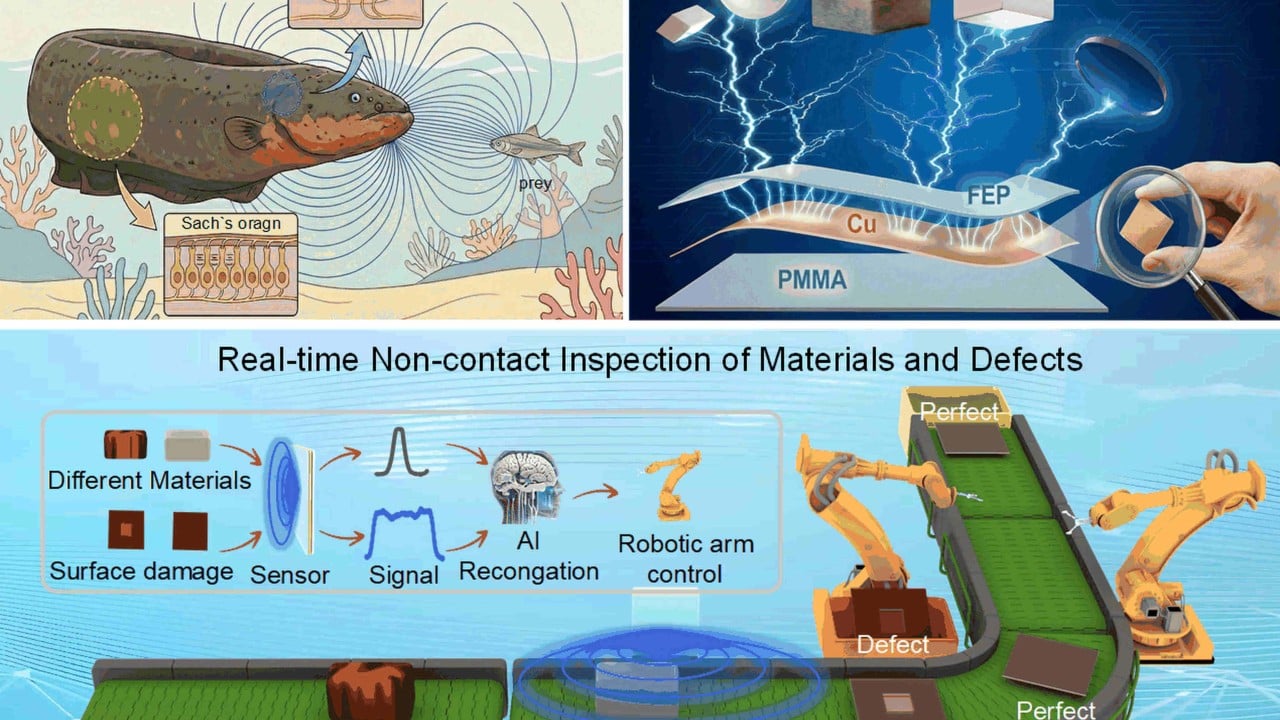
Electric eels hunt in pitch-black, murky waters by generating electric fields around their bodies. Now, Chinese scientists have mimicked this natural radar, giving robots the ability to “feel” objects without making physical contact.
“We want the machine to sense an approaching target – distinguish its material and surface condition – before any physical contact,” said Zhang Weiqiang, a professor at Xidian University, in a video interview last week.
The team’s work was published last month in...
Picture a fisherman hauling in his nets on a calm morning at sea, when his smartwatch suddenly vibrates with an alert: “Magnetic anomaly detected – possible submarine passing 500 metres below.”
Far‑fetched as it sounds, Chinese scientists have just taken a decisive step towards making that scenario real.
A team from the Hefei Institutes of Physical Science and the Ningbo Institute of Materials Technology and Engineering, both under the Chinese Academy of Sciences (CAS), has created a Hall‑effect...
A research team at Zhejiang University (ZJU) has cracked a molecular puzzle, turning ordinary yeast into a powerful factory for an expensive cancer drug and boosting its production by a thousand times.
The anticancer drug vinblastine has long been sourced exclusively from the Madagascar periwinkle (Catharanthus roseus) plant. But it takes up to 2 tonnes of dried leaves to yield just 1 gram (0.03 ounce) of vinblastine, making it more expensive than gold by weight. This extreme scarcity has kept...

 Accedi