Vista elenco

Ricevuto — 22 Maggio 2026 Aeronautics News

Keeping NASA Flying: Ground Crews Ensure Aircraft Readiness

22 Maggio 2026 ore 17:45

4 min read

Preparations for Next Moonwalk Simulations Underway (and Underwater)
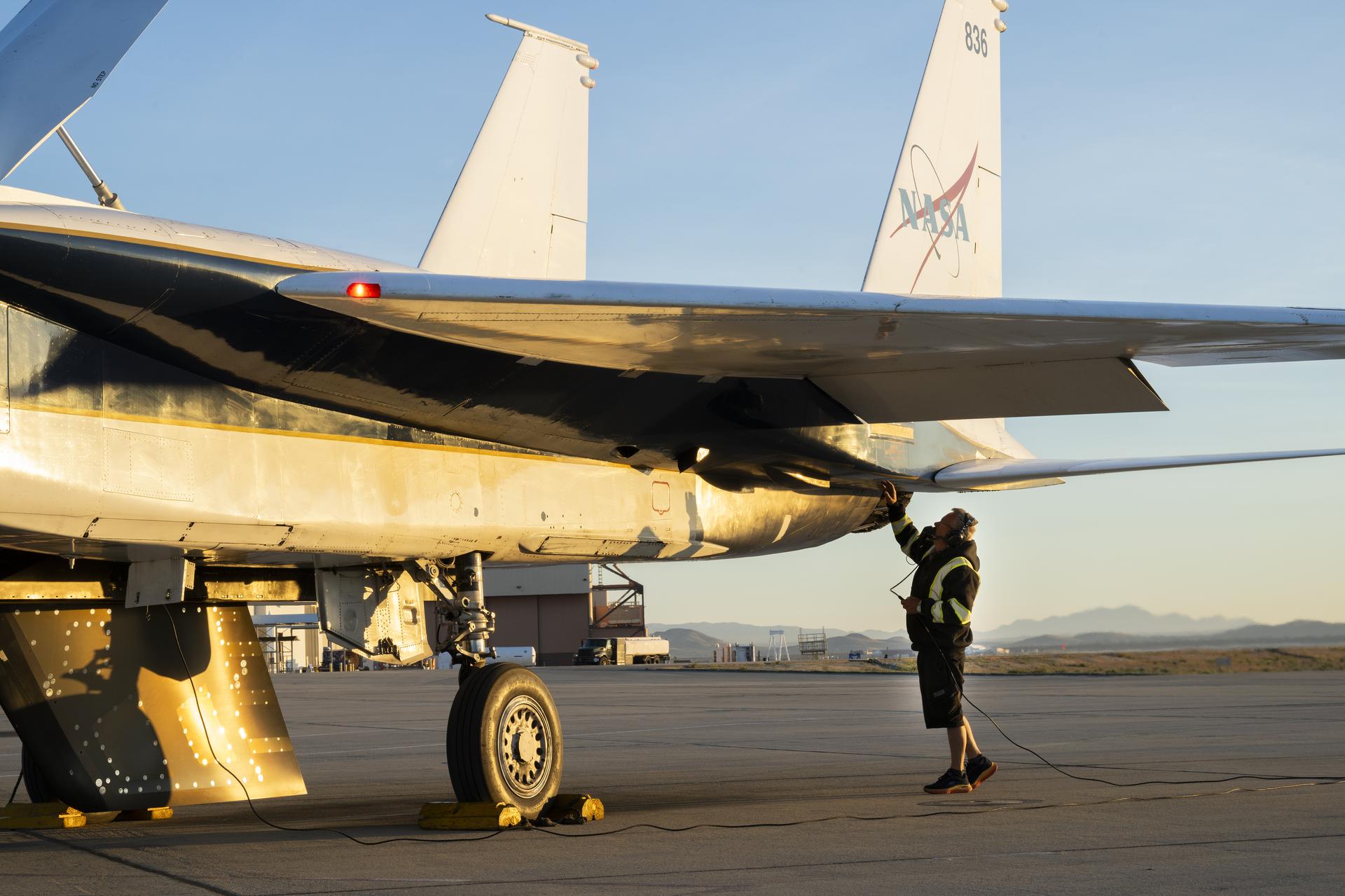
The back of a white jet aircraft’s wing and tails are seen in this image. One wheel and an attached test object, shaped like a wing, hangs from the bottom of the jet. A man in a black jacket, with yellow reflective coating, stands underneath and raises one hand to the aircraft. The man is wearing ear protection. Desert sand and mountains are seen in the background.
NASA crew chief Walt Kondracki checks an F-15 aircraft Tuesday, March 17, 2026, at NASA’s Armstrong Flight Research Center in Edwards, California. Ground crews, made of various roles, maintain the aircraft to be ready for each mission.
NASA/Carla Escamilla

From high‑speed research flights to high‑altitude science campaigns, NASA depends on aircraft that perform at their best and the ground crews who keep them mission ready.

At NASA’s Armstrong Flight Research Center in Edwards, California, specially trained maintenance crews are essential to keeping the agency’s aircraft flying safely and reliably.

This year, NASA added two F-15s and a Pilatus PC-12 to its fleet at Armstrong. These aircraft – alongside platforms such as the high-altitude ER-2s and NASA’s newest X-plane, the X-59 – reflect a wide range of capabilities. The maintenance staff is responsible for keeping each one mission ready.
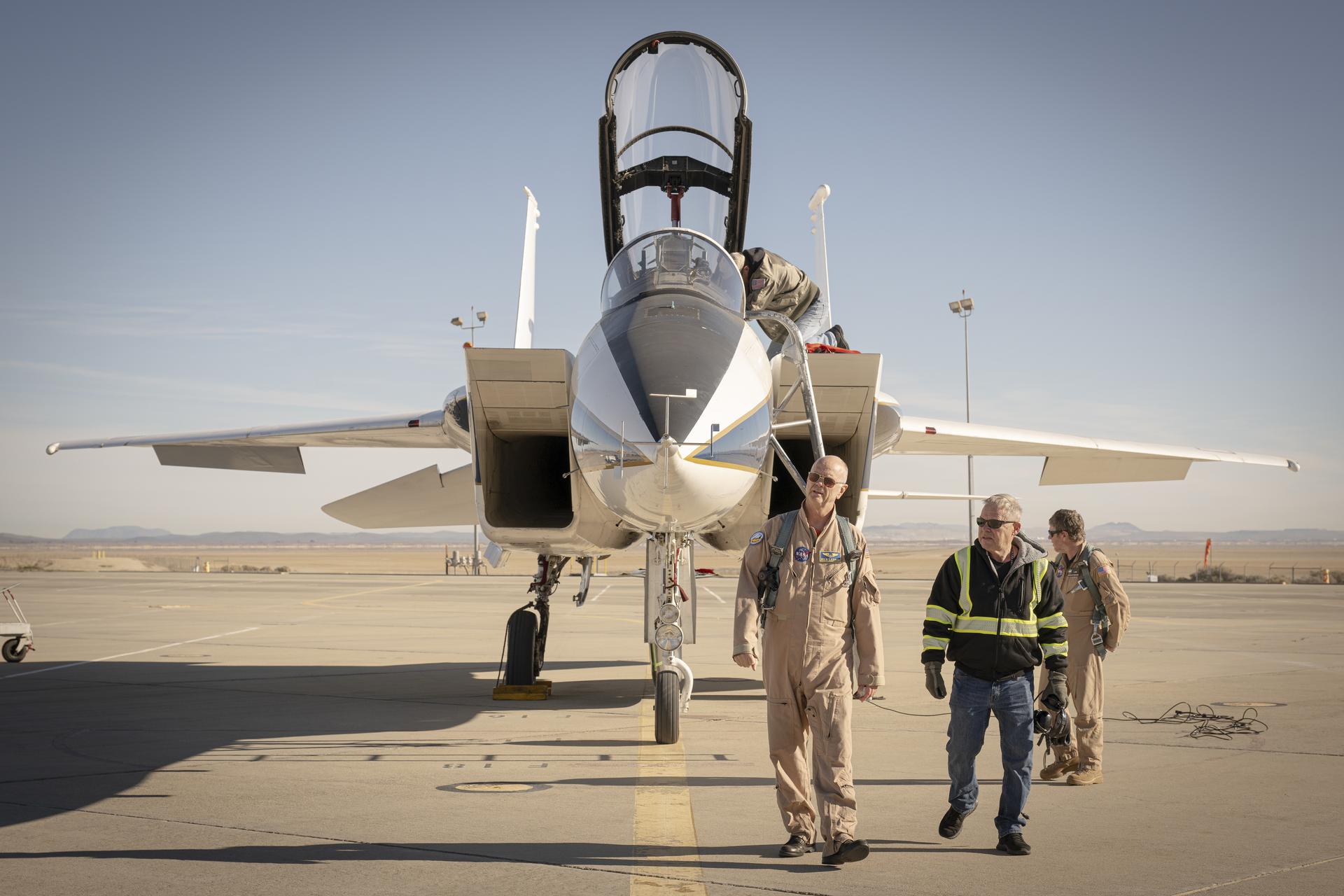
Three men, two wearing tan flight suits, and one wearing a black jacket with stripes of reflective yellow coating, walk to the right side of a jet aircraft. The aircraft faces forward and the canopy is open. Two wheels, intakes, wings, and tails are in view of the white aircraft. The aircraft sits on a concrete ramp with desert sand and mountains in the background.
NASA pilot Nils Larson, left, walks next to crew chief Walt Kondracki, right, by an F-15 aircraft Tuesday, Jan. 13, 2026, at NASA’s Armstrong Flight Research Center in Edwards, California. In the background, NASA mechanic Tim Logan secures the cockpit inside of the F-15, and flight test engineer A.J. Jaffe stands to the right.
NASA/Christopher LC Clark

“That’s the beauty of our Armstrong maintenance teams. They adapt to any type of change,” said Jose “Manny” Rodriguez, NASA Armstrong Gulfstream G-IV crew chief. “One day you could have an instrument being loaded, and the next day it may be aircraft reconfiguration, all while other aircraft systems may need fixing. They adapt and they overcome any situation.”

Each aircraft supports a specific mission, whether it’s conducting science research, serving as a support or chase aircraft, or assisting NASA rocket launches. The aircraft fly at different speeds, carry specialized hardware, and require maintenance crews to stay agile with fast-paced changes.

To ensure NASA can make aeronautics and science advancements safely, the crews work continuously, checking on the ejection seats, filling the tanks with fuel, and changing out brakes, wheels, wiring, and hardware constantly, all of which can degrade with each flight.
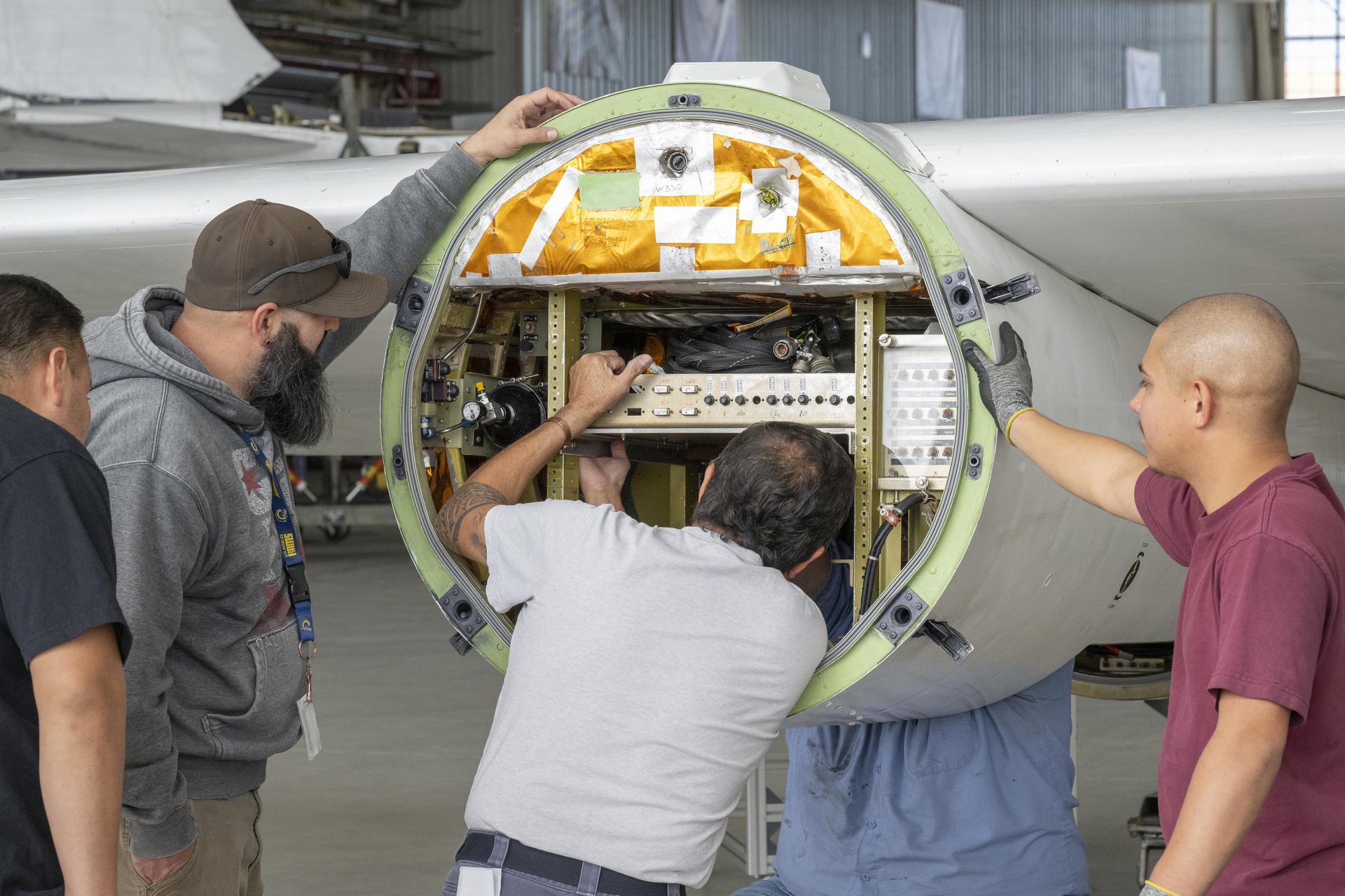
Four men surround a round object attached to an aircraft wing with shelves and wiring inside. One man’s arms are inside of the object, and he is adjusting a gold-colored piece of metal equipment. The other men watch as he works on the hardware.
From left, NASA avionics technician Jesse Orellana; quality assurance employee Jose Prieto; mechanic Francisco Rodriguez; and mechanic Vincent Moreno work on an ER-2 aircraft Monday, Jan. 26, 2026, at NASA’s Armstrong Flight Research Center in Edwards, California.
NASA/Christopher LC Clark

On any given day, an aircraft may be flight-ready for a mission, undergoing scheduled maintenance or modifications, or down for longer-term care.

There are typically multiple NASA Armstrong aircraft in the air in one day. Currently, the center’s C-20A is flying in Peru and Panama, the X-59 is often  flying twice per day with a chase plane, and the center’s ER-2 is flying in Colorado, supporting the Geological Earth Mapping Experiment (GEMx). All this work is happening at the same time, and Armstrong’s skilled maintenance staff is prepping and fixing aircraft as needed along the way.

The team includes mechanics with both military and civilian backgrounds, and the job involves a lot of on-the-job training.

Maintenance crews are composed of:

  • a crew chief – the person in charge of the airplane
  • an avionics technician, who specializes in navigation, communication, and flight control systems
  • quality assurance personnel, who oversee the work being done
  • additional mechanics assigned to each airplane

After the maintenance crew ensures the aircraft is in the best condition possible, the team tows it out to the flightline, and it becomes ready for operations. The NASA pilot assigned to the mission will walk around the aircraft with the assigned crew chief for a final safety check before flight.

“There is a crew chief assigned to every aircraft,” Rodriguez said. “The crew chief is responsible for the integrity of that aircraft, and at the end of the day, his signature and the pilot’s together are what constitutes that the aircraft is safe for flight.”

Maintenance crews track each flight to help ensure it completes the mission without returning early. If an aircraft does return to base early, the maintenance team stands ready. When it lands, the crew is right there again, helping the research team complete the mission and fixing whatever is needed to stay nimble and ready for the next flight.

“It’s difficult at times to work with different airplanes from both the civilian and military sides, but it’s very rewarding to see that we have the capability and the expertise to keep these aircraft flying,” Rodriguez said.
Keep Exploring

Discover More Topics From NASA

NASA Announces Realignment to Accelerate Mission Delivery

22 Maggio 2026 ore 16:01


NASA meatball
Credit: NASA

Editor’s Note: This advisory was updated May 22, 2026 to include a retirement.

NASA announced Friday an agencywide realignment to increase mission focus and move out on the National Space Policy. These changes position the agency to better deliver on the nation’s highest‑priority objectives with speed and efficiency.

During the Ignition event in late March, NASA Administrator Jared Isaacman and agency leaders outlined the most pressing objectives to deliver on the next chapter of American leadership in space. President Trump’s Executive Order Ensuring American Space Superiority, otherwise known as the National Space Policy, directed NASA to focus talent and resources on objectives including accelerating the Artemis program, establishing a Moon Base, developing a nuclear space reactor, igniting the orbital economy, and expanding missions of science and discovery.

To support the agency’s ambitious short- and long-term goals, NASA is taking action to increase specialization at centers and integrate mission directorates, elevating delivery of technically excellent work. Some of these actions include:

  • Center directors will continue reporting to Associate Administrator Amit Kshatriya, empowered to foster the unique capabilities of each center, and strengthen investments in infrastructure and the health of their workforce.
  • Mission directorates will now report directly to the administrator, ensuring focus on the mission and enabling them to leverage resources across centers, industry, and international partnerships with greater speed and efficiency.
  • The associate administrator also now serves as NASA chief engineer, reinforcing the agency’s technical backbone and ensuring continuity and autonomy in critical engineering decisions.
  • The agency continues to focus on rebuilding core competencies, insourcing contractors to civil servants where appropriate, strengthening the intern pipeline, and leveraging the agency’s joint recruitment initiative with the U.S. Office of Personnel Management, NASA Force, to build a strong, sustainable workforce for generations to come.

“This initiative reflects NASA’s extreme focus on executing the mission in direct support of the National Space Policy. We are focusing resources on the most pressing objectives only NASA is capable of undertaking and liberating the workforce from unnecessary bureaucracy and obstacles that impede progress. We aim to rebuild competencies and instill a culture that attracts the best and brightest capable of pursuing the most demanding engineering challenges and moving safely and urgently,” said Isaacman. “There will be no reduction in force, no program cancellations, no closures, but we will achieve cost savings through more efficient execution and taking an active role in delivering the outcomes the world has been waiting for from NASA. This is how we deliver on the mission, meet the moment, and continue to make history on behalf of the American people.”

Mission directorate realignment is as follows:

  • Human Spaceflight Mission Directorate (HSMD): With human spaceflight operational to both low Earth orbit and the Moon, the Exploration Systems Development Mission Directorate and Space Operations Mission Directorate will unify as HSMD.
  • Research and Technology Mission Directorate (RTMD): NASA will integrate the Aeronautics Research Mission Directorate and Space Technology Mission Directorate into the new RTMD. As a combined research, space technology, and aeronautics organization charged with nuclear power and propulsion development, RTMD will ensure NASA has the capabilities needed for the mission of today and the future.
  • Science Mission Directorate (SMD): Remains unchanged and continues to provide the foundation for NASA’s world‑leading scientific discovery.

Additional leadership roles, in alphabetical order, include:

  • John Bailey, associate administrator, Mission Support Directorate
  • Kevin Coggins, director, SCaN (Space Communications and Navigation), RTMD
  • Wesley Deadrick, director, Katherine Johnson IV&V Facility
  • Jamie Dunn, director, NASA’s Goddard Space Flight Center
  • Carlos García-Galán, program manager, Moon Base, HSMD
  • Dr. Lori Glaze, associate administrator, HSMD
  • Laurie Grindle, director, Aeronautics Division, RTMD
  • Marvin Horne, deputy assistant administrator for Procurement
  • Brian Hughes, director, NASA’s Kennedy Space Center
  • Kathleen Karika, associate administrator, Office of International and Interagency Relations, OIIR
  • Dr. James Kenyon, associate administrator, RTMD
  • Kelvin Manning, deputy associate administrator, HSMD
  • Meredith McKay, deputy associate administrator, OIIR
  • Dave Mitchell, special assignment lead for NASA Headquarters Relocation
  • Joel Montalbano, deputy associate administrator, HSMD
  • Bradley Niese, associate administrator for Procurement
  • Eli Ouder, acting deputy associate administrator, Mission Support Directorate
  • Jeremy Parsons, program manager, Artemis, HSMD
  • Bob Pearce to retire as head of ARMD after an amazing 36-year career at NASA
  • Wanda Peters, deputy associate administrator, RTMD
  • Dawn Schaible, director, NASA’s Glenn Research Center
  • Cynthia Simmons, deputy director, NASA’s Goddard Space Flight Center
  • Steve Sinacore, acting director, Space Reactor Office; program manager for SR-1, LR-1, RTMD
  • Adam Steltzner, chief engineer for Special Projects
  • Greg Stover, director, Advanced Research and Technology Division, RTMD
  • Dana Weigel, program manager, Low Earth Orbit, HSMD

Leadership at unlisted centers remains unchanged.

For more, please visit:

https://www.nasa.gov/nasa-leadership

-end-

Bethany Stevens / Camille Gallo
Headquarters, Washington
202-358-1600
bethany.c.stevens@nasa.gov / camille.m.gallo@nasa.gov

❌