Vista elenco

NASA Celebrates Decade of University Innovation in Aeronautics 

24 Aprile 2026 ore 15:04

8 min read

Preparations for Next Moonwalk Simulations Underway (and Underwater)

Artist illustration of a digital laptop and graduation cap and ULI, 10 Years graphic.

For 10 years, a NASA initiative has helped the agency produce breakthrough aeronautical innovations while fostering the aviation workforce of tomorrow – and the University Leadership Initiative (ULI) is still flying high, making awards with the potential to change 21st century air travel. 

Through ULI, NASA has supported more than 1,100 students at 100 schools, allowing them to pursue advancements in top priority areas for U.S. aviation, including high-speed flight, advanced air mobility, future airspace management and safety, and electrified propulsion.  

Many of those students have used their ULI experience as a springboard to careers in aviation. And many of their ideas — such as designing more efficient wings or building supersonic aircraft that can change shape in flight — are either being investigated further by industry or the technologies adopted outright.  

As it celebrates a decade of success, NASA’s ULI team is looking forward to leveraging student innovations with new awards in 2026 and beyond. 

“Through ULI we’re building the workforce of the future and fostering the skill sets we so desperately need to compete globally,” said John Cavolowsky, director of NASA’s Transformative Aeronautics Concepts Program at NASA Headquarters in Washington. 

Through ULI we're building the workforce of the future and fostering the skill set we so desperately need to compete globally.

john cavolowsky

john cavolowsky

Director, Transformative Aeronautics Concepts Program

What makes ULI unique from other NASA research projects, and especially appealing to universities, is that it provides the opportunity for university students and faculty to propose what research to conduct.  

Usually, NASA determines the research it needs and then does the work itself or through partnerships and contracts. But with ULI, the agency shares its goals and universities consider how they can best help realize them.  

“There are no better ways in my mind to help develop that talent within the students than to engage them in identifying big problems and then give them the resources they need to use their creativity to solve them,” Cavolowsky said.  

ULI history 

NASA’s relationship with academia and reliance on its research proficiency is written into NASA’s DNA going back to the days of the National Advisory Committee for Aeronautics, from which NASA was formed in 1958. 

“For more than a century we have leaned on the brilliance and the capabilities of universities to help us think,” Cavolowsky said. “With ULI we can ensure they continue to bring their fresh ideas and young energy to the work we do at NASA Aeronautics.”  

ULI evolved from an earlier project called Leading Edge Aeronautics Research for NASA (LEARN). NASA selected five LEARN teams in 2015 to pursue truly outside of the box ideas that showed promise but needed additional study.  

One of those teams, for example, sought to take a cue from migrating flocks of birds by asking if airliners could save fuel by cruising in a giant ‘V’ formation. The numbers were intriguing and simple flight tests proved the concept, although the idea never made it to practice. 

Slightly retooled but keeping the innovative spirit of LEARN, ULI was officially announced in 2016 and a year later NASA selected five teams of university professors and students to contribute solutions to the biggest aeronautical challenges of the 21st century. 

A decade later, NASA has made a total of $220 million in awards to 33 teams over eight rounds of solicitations 

Smooth flying 

One of the earliest selected ULI teams was led by James Coder, who at the time was an aerospace engineering professor at the University of Tennessee in Knoxville. His team worked on technology that would smooth the airflow around a wing to make it more efficient. 

Technically known as slotted natural laminar flow (SNLF) wings, Coder has called the idea a potential game changer for commercial airliners. The more efficient wing would mean less drag on an airplane, which in turn could help airlines save money on fuel. 

Coder credits ULI for not only helping to prove the technology’s effectiveness – with the aid of wind tunnel testing at NASA’s Ames Research Center in California – but for providing students with an experience they couldn’t get elsewhere. 
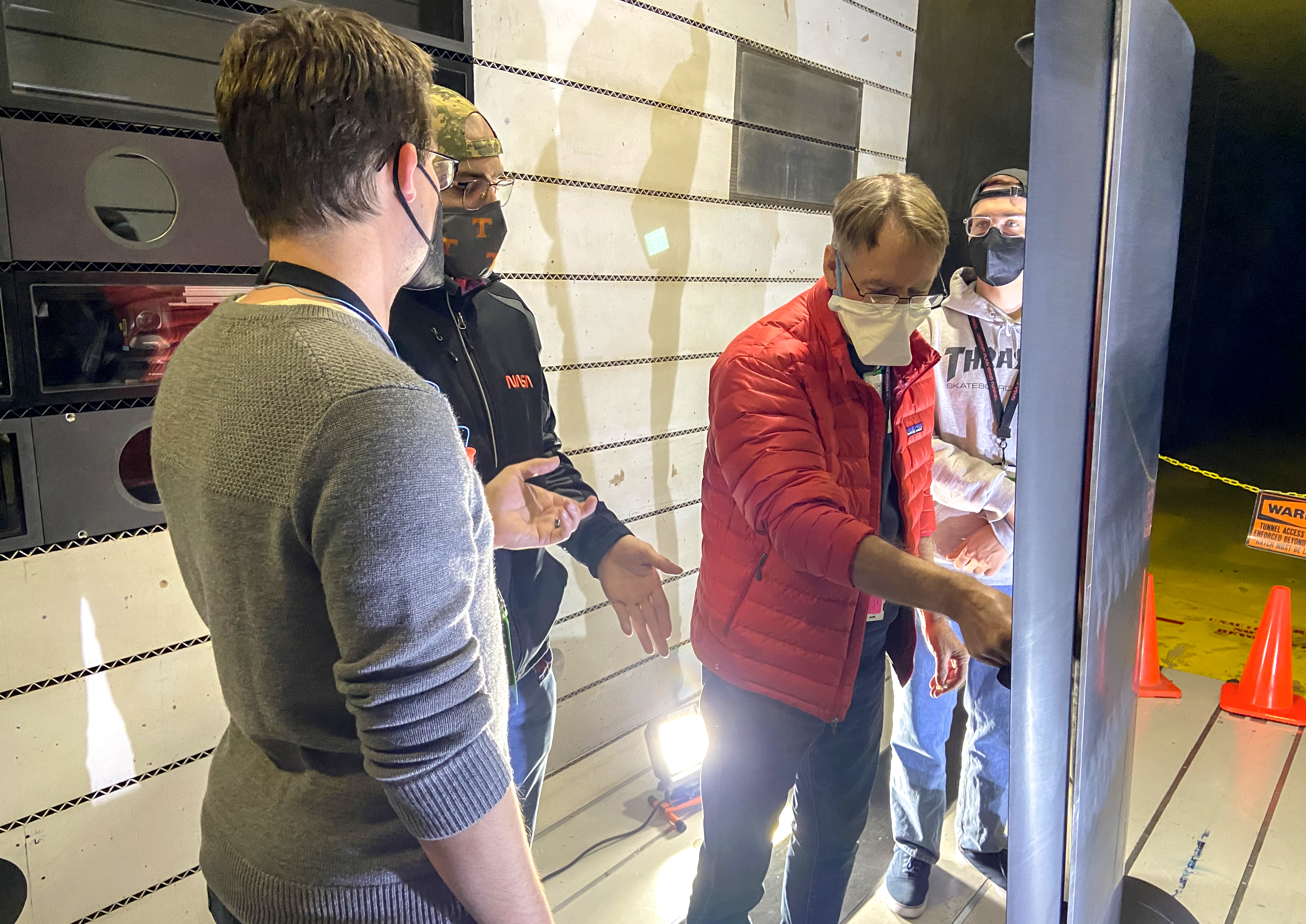
Four men wearing masks stand around a section of an airplane wing mounted vertically inside a NASA wind tunnel as part of a University Leadership Initiative project.
Three University of Tennessee/Knoxville students and co-investigator Dan Somers (in red jacket) prepare a slotted laminar flow wing section for testing in a wind tunnel at NASA’s Ames Research Center in California.
University of Tennessee/Knoxville

“After 10 years industry remains interested in the SNLF technology and I am optimistic for good reason about its future,” Coder said. “And project alumni have gone on to do many wonderful things and leverage what they did and learned through the ULI.” 

With ULI experience prominent on their resumes, several of the students on Coder’s team wound up with jobs in industry – such as Boeing and Lockheed Martin – and government labs. One is currently a NASA Pathways intern working on his PhD. 

Now at Pennsylvania State University, Coder remains a strong advocate for ULI. 

“It goes above and beyond simple workforce development,” he said. “We recognized early on the value-add of ULI is the students themselves. While we could have just trained students en masse, we wanted to put them in the front seat of technical leadership on the project. I think this was a very successful strategy that benefited the project and the students as they embarked on their careers.” 

Mighty morphing 

Forrest Carpenter is another example of a student whose ULI support led to work after graduation – in this case at NASA.  

“Working on the ULI project was an incredible experience, one I will always be thankful for and will remember fondly,” Carpenter said. “I think the project challenged me to be something more than ‘just an engineer;’ really helping my professional development and giving me a clearer focus on my passion.”  

As a student at Texas A&M, he was part of a team selected by NASA in 2017 to research a novel idea in which a supersonic aircraft could alter its shape to fly more efficiently based on the atmospheric conditions in real time. Dimitris Lagoudas, now the university’s interim department head for aerospace engineering, led the team.  
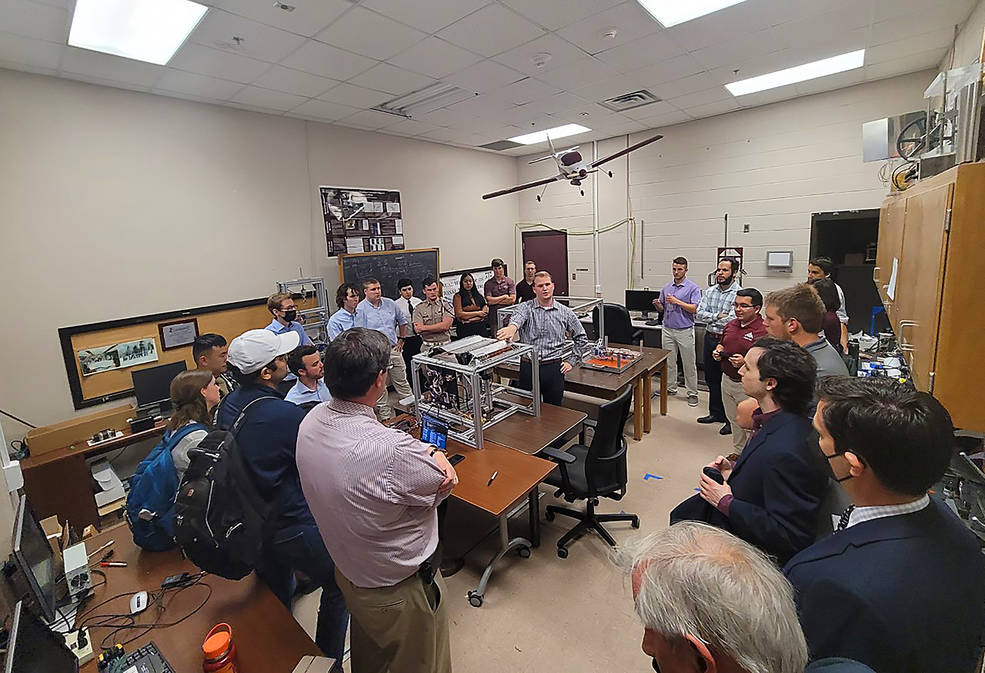
A group of university students and faculty gather around a laboratory workbench.
Members of a University Leadership Initiative round one team led by Texas A&M University participate in a status update meeting with NASA prior to their final review in 2022.
Texas A&M University / Jonathan Weaver-Rosen

A laser shooting out ahead of the aircraft would take measurements of the oncoming air and then the aircraft’s computer would command patches of shape memory alloys and other mechanisms to morph the aircraft’s outer shape. 

One possible application of the technology could be in contributing to the reduction of the loudness of a sonic boom, expanding on the science behind NASA’s X-59 quiet supersonic technology demonstrator that seeks to reduce the sonic boom to a sonic thump.  

“My main research role on the team was performing Computational Fluid Dynamics simulations of the various geometries we were looking at, including a pre-production version of X-59,” Carpenter said.  

His work on the idea continues. A follow-on NASA project, GoSWIFT, will flight test the core technologies Carpenter and his ULI team worked on at Texas A&M. Only this time, Carpenter is the co-lead for the tests, which are targeted to take place at NASA’s Armstrong Flight Research Center in California in the near future.  

Carpenter’s enthusiasm for his work and gratitude for how ULI led to his career with NASA resonates with many other ULI alumni.  

“The number of students impacted, and how they were impacted, by a long-term project like ULI is huge,” Carpenter said. “NASA’s involvement in this kind of activity can only strengthen the research done in this country and to help inspire and develop the next generation of our workforce.”  

ULI is supported by the Transformative Aeronautics Concepts Program within NASA’s Aeronautics Research Mission Directorate, which publishes ULI solicitations and other opportunities to collaborate with the agency’s aeronautical innovators. 

About the Author

Jim Banke

Jim Banke

Managing Editor/Senior Writer

Jim Banke is a veteran aviation and aerospace communicator with more than 40 years of experience as a writer, producer, consultant, and project manager based at Cape Canaveral, Florida. He is part of NASA Aeronautics' Strategic Communications Team and is Managing Editor for the Aeronautics topic on nasa.gov. In 2007 he was recognized with a Distinguished Public Service Medal, NASA's highest honor for a non-government employee.
Keep Exploring

Discover More Topics From NASA

Meta Transitions PyTorch to the Linux Foundation, Further Accelerating AI/ML Open Source Collaboration

12 Settembre 2022 ore 15:25

PyTorch Foundation to foster an ecosystem of vendor-neutral projects alongside founding members AMD, AWS, Google Cloud, Meta, Microsoft Azure, and NVIDIA 

DUBLIN – September 12, 2022 –  The Linux Foundation, a global nonprofit organization enabling innovation through open source, today announced PyTorch is moving to the Linux Foundation from Meta where it will live under the newly-formed PyTorch Foundation. Since its release in 2016, over 2400 contributors and 18,0000 organizations have adopted the PyTorch machine learning framework for use in academic research and production environments. The Linux Foundation will work with project maintainers, its developer community, and initial founding members of PyTorch to support the ecosystem at its new home.

Projects like PyTorch—that have the potential to become a foundational platform for critical technology—benefit from a neutral home. As part of the Linux Foundation, PyTorch and its community will benefit from many programs and support infrastructure like training and certification programs, research, and local to global events. Working inside and alongside the Linux Foundation, PyTorch will have access to the LFX collaboration portal—enabling mentorships and helping the PyTorch community identify future leaders, find potential hires, and observe shared project dynamics. 

“Growth around AI/ML and Deep Learning has been nothing short of extraordinary—and the community embrace of PyTorch has led to it becoming one of the five-fastest growing open source software projects in the world,” said Jim Zemlin, executive director for the Linux Foundation. “Bringing PyTorch to the Linux Foundation where its global community will continue to thrive is a true honor. We are grateful to the team at Meta—where PyTorch was incubated and grown into a massive ecosystem—for trusting the Linux Foundation with this crucial effort.”

“Some AI news: we’re moving PyTorch, the open source AI framework led by Meta researchers, to become a project governed under the Linux Foundation. PyTorch has become one of the leading AI platforms with more than 150,000 projects on GitHub built on the framework. The new PyTorch Foundation board will include many of the AI leaders who’ve helped get the community where it is today, including Meta and our partners at AMD, Amazon, Google, Microsoft, and NVIDIA. I’m excited to keep building the PyTorch community and advancing AI research,” said Mark Zuckerberg, Founder & CEO, Meta.

The Linux Foundation has named Dr. Ibrahim Haddad, its Vice President of Strategic Programs, as the Executive Director of the PyTorch Foundation.  The PyTorch Foundation will support a strong member ecosystem with a diverse governing board including founding members: AMD, Amazon Web Services (AWS), Google Cloud, Meta, Microsoft Azure and NVIDIA. The project will promote continued advancement of the PyTorch ecosystem through its thriving maintainer and contributor communities. The PyTorch Foundation will ensure the transparency and governance required of such critical open source projects, while also continuing to support its unprecedented growth.

Member Quotes

AMD

“Open software is critical to advancing HPC, AI and ML research, and we’re ready to bring our experience with open software platforms and innovation to the PyTorch Foundation,” said Brad McCredie, corporate vice president, Data Center and Accelerated Processing, AMD. “AMD Instinct accelerators and ROCm software power important HPC and ML sites around the world, from exascale supercomputers at research labs to major cloud deployments showcasing the convergence of HPC and AI/ML. Together with other foundation members, we will support the acceleration of science and research that can make a dramatic impact on the world.”

Amazon Web Services

“AWS is committed to democratizing data science and machine learning, and PyTorch is a foundational open source tool that furthers that goal,” said Brian Granger, senior principal technologist at AWS. “The creation of the PyTorch Foundation is a significant step forward for the PyTorch community. Working alongside The Linux Foundation and other foundation members, we will continue to help build and grow PyTorch to deliver more value to our customers and the PyTorch community at large.”

Google Cloud

“At Google Cloud we’re committed to meeting our customers where they are in their digital transformation journey and that means ensuring they have the power of choice,” said Andrew Moore, vice president and general manager of Google Cloud AI and industry solutions. “We’re participating in the PyTorch Foundation to further demonstrate our commitment of choice in ML development. We look forward to working closely on its mission to drive adoption of AI tooling by building an ecosystem of open source projects with PyTorch along with our continued investment in JAX and Tensorflow.”

Microsoft Azure

“We’re honored to participate in the PyTorch Foundation and partner with industry leaders to make open source innovation with PyTorch accessible to everyone,” Eric Boyd, CVP, AI Platform, Microsoft, said. “Over the years, Microsoft has invested heavily to create an optimized environment for our customers to create, train and deploy their PyTorch workloads on Azure. Microsoft products and services run on trust, and we’re committed to continuing to deliver innovation that fosters a healthy open source ecosystem that developers love to use. We look forward to helping the global AI community evolve, expand and thrive by providing technical direction based on our latest AI technologies and research.”

NVIDIA

“PyTorch was developed from the beginning as an open source framework with first-class support on NVIDIA Accelerated Computing”, said Ian Buck, General Manager and Vice President of Accelerated Computing at NVIDIA. “NVIDIA is excited to be an originating member of the PyTorch Foundation to encourage community adoption and to ensure using PyTorch on the NVIDIA AI platform delivers excellent performance with the best experience possible.”

Additional Resources:

  • Visit pytorch.org to learn more about the project and the PyTorch Foundation
  • Read Jim Zemlin’s blog discussing the PyTorch transition
  • Read Meta AI’s blog about transitioning PyTorch to the Linux Foundation
  • Read this blog from Soumith Chintala, PyTorch Lead Maintainer and AI Researcher at Meta, about the future of the project
  • Join Soumith Chintala and Dr. Ibahim Haddad for a fireside chat on Thursday, September 15, at 3pm GMT / 11am ET / 8am PT
  • Learn more about PyTorch training opportunities from the Linux Foundation
  • Follow PyTorch on Facebook, LinkedIn, Spotify, Twitter, and YouTube

About the Linux Foundation

Founded in 2000, the Linux Foundation and its projects are supported by more than 3,000 members. The Linux Foundation is the world’s leading home for collaboration on open source software, hardware, standards, and data. Linux Foundation projects are critical to the world’s infrastructure including Linux, Kubernetes, Node.js, ONAP, Hyperledger, RISC-V, PyTorch, and more. The Linux Foundation’s methodology focuses on leveraging best practices and addressing the needs of contributors, users, and solution providers to create sustainable models for open collaboration. For more information, please visit us at linuxfoundation.org.

###

The Linux Foundation has registered trademarks and uses trademarks. For a list of trademarks of The Linux Foundation, please see our trademark usage page:  https://www.linuxfoundation.org/trademark-usage. Linux is a registered trademark of Linus Torvalds.

Media Contact

Dan Whiting

for the Linux Foundation

202-531-9091

dwhiting@linuxfoundation.org

The post Meta Transitions PyTorch to the Linux Foundation, Further Accelerating AI/ML Open Source Collaboration appeared first on Linux Foundation.

❌