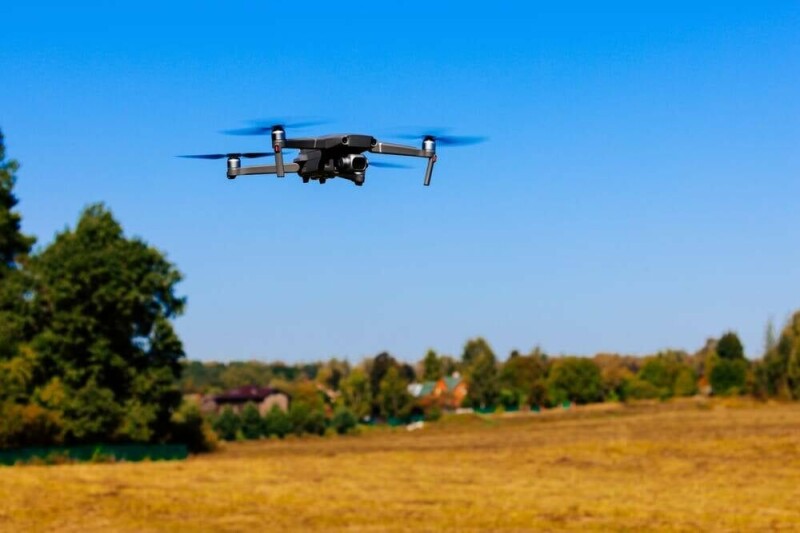
The US Army has awarded a contract to defense biz L3Harris for its Vampire counter-drone system to support an urgent requirement to protect against hostile airborne threats. As drones continue to be a danger to ground forces, the Army’s order, worth up to $106 million, will form part of its layered defense approach against remotely operated and autonomous aerial vehicles. The Vampire system is described by the firm as a completely self-contained platform that delivers a precision strike capability against drones and remotely piloted aircraft. It can be fitted to vehicles, such as mounting on the back of a truck, and combines a telescopic mast with an electro-optical/infrared (EO/IR) stabilized targeting system. It also has a launcher for a variety of what the military likes to call effectors – projectiles or missiles that typically go bang. In the case of Vampire, this will often be the Advanced Precision Kill Weapon System (APKWS), comprising US-made Hydra 70 2.75-inch (70 mm) rockets with an added laser homing capability. This seems to have become the (relatively) low-cost weapon of choice for downing certain types of drones, and is now being fitted to British Typhoon fighter jets deployed to the middle east, for example. However, L3Harris says that Vampire has a modular plug-in design that allows for the rapid addition of other sensors, effectors, and radio management systems. The system can engage aerial targets up to six kilometers (3.8 miles) away. Its laser designator can highlight targets, while also coordinating with other platforms, allowing for a distributed approach to target engagement. “We’ve worked with the Army to understand their needs for new counter-UxS systems that can be quickly assembled, delivered, set-up and fired,” said L3Harris president, for Targeting & Sensor Systems, Tom Kirkland. “Vampire is effective at hunting and engaging drone threats affordably, which enables US armed forces to sustain reliable defense of its personnel and infrastructure.” We asked L3Harris how many systems the US Army will be getting for its $106 million. The company says it developed Vampire at the beginning of the war in Ukraine to provide a low-cost solution to help eliminate Russian drone threats. It has since ramped up production at a new production line in Huntsville, Alabama, in a response to the growing need it sees from the US and allies to counter the drone threat. L3Harris says the system has so far logged more than 350,000 operational hours in support of European combat operations since 2023. ®
The team behind the AI Octopus Euro 2024 predictor has updated its simulator for the 2026 FIFA World Cup, this time allowing users to throw natural-language scenarios at the model and see how the tournament might shake out. "Sensible questions work – a red card, a key injury, a heat wave, a squad switching base camp – but so do the daft ones, e.g. 'What if the tournament were played with rugby rules?'" said Luzmo CTO and co-founder Haroen Vermylen. The system is simple: enter a scenario in a prompt box, and the predictor spits out how the results might go. The raw data includes squad quality based on player information, heat and altitude factors, injury data, and so on. A Monte Carlo simulation of the tournament is used to generate win/lose/draw probabilities, and the score line is derived from 5,000 match runs. The engine behind the Euro 2024 AI Octopus was written in TypeScript. This time around, the team used Rust. "We moved to Rust to also be able to run things more quickly, as now there is a real-time component to this," Vermylen told The Register. "Before it could run for five minutes or so. Now we want the predictions to actually come out within two to three seconds of actual simulation time." OpenAI models parse the request and generate summaries, and an agent is used to create or transform scenarios, call the calculation engine, answer questions, and so on. A user doesn't need to be a data scientist to ask questions and understand the answers. It's certainly rapid, recalculating the results based on suggested scenarios (even one in which we pondered the effect of politically dubious emissions from a certain world leader). Not that all scenarios will work. Vermylen told us that filtering was in place to ignore profanities and "to avoid scenarios that would just be harmful to certain groups." And then there is the age-old issue of an AI parser simply not understanding the prompt. Clarity is key. Using natural language is a great alternative to a UI with settings and sliders, but that ease of use can result in misunderstandings. As the tournament progresses, the data will be refined. At the time of writing, the baseline reckons that Spain will beat England in the final. Spain currently has an 18 percent chance of lifting the trophy and a 26.8 percent chance of reaching the finals. Those figures can, of course, be altered by feeding in scenarios. For example, we asked: "What if the Spanish team eats a bad paella?" Spain's chance of winning the tournament then dropped to 1.5 percent, with France as the projected champion. We also asked it what would happen if we replaced the England team with Register writers. Suffice to say that scenario did not end well. We asked Vermylen what was next. "The Olympics would be nice… or the Eurovision. We'd like to give the United Kingdom a win." ®
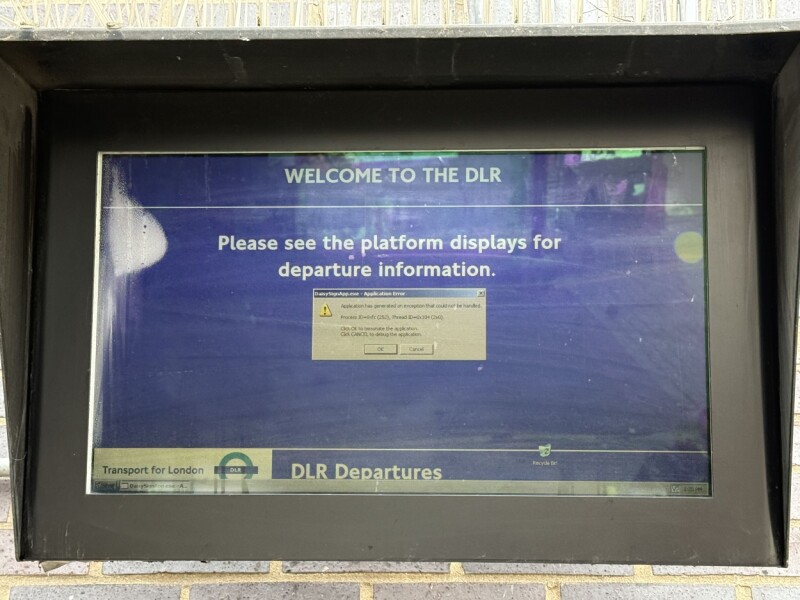
BORK!BORK!BORK! We're big fans of retro computing here at Vulture Central, and so it is with a certain delight that we can report XP-era Windows has been spotted disgracing itself on London's Docklands Light Railway. Spotted by Register reader Tim Hayward, the wonderfully named DaisySignApp.exe has thrown up an application error. While the Windows shell might be shorn of all of XP's fripperies, the Recycle Bin icon hints at the operating system's origins. Hayward reckoned that XP was stalking the DLR, but it could also be Windows Server 2003. Support for Windows Server 2003 finally ended in 2015. XP was sunset in 2014, so the DLR display is rather out of date. Then again, as any IT administrator would admit, if something isn't broken, there's no point fixing it, no matter how much Microsoft would encourage them to. In this case, it is unlikely that the operating system is at fault (although one could argue that it should handle a misbehaving application more discreetly), and DaisySignApp.exe should be dealing with its own dirty laundry rather than throwing an exception in commuters' faces at Limehouse station. Limehouse connects London's Docklands Light Railway (DLR) to the UK's National Rail services. It was one of the first DLR stations and predates the borked operating system by more than a decade. Indeed, at the time of the DLR's opening in 1987, Microsoft was preparing to inflict Windows 2.0 upon the world – the delights of later versions and the company's GUI dominance were still a few years in the future. The DLR also seemed like a glimpse into the future back in the 1980s. However, a fair chunk of its underpinnings, such as formerly disused railway viaducts, hark back to an earlier era. Anyone looking at today's iteration of Windows might wonder how much of it dates back to what's on display at Limehouse. ®
UPDATED SpaceX priced its blockbuster initial public offering at $135 a share on Friday, raising $75 billion and valuing Elon Musk's rocket biz at roughly $1.78 trillion. Retail investors piled in to get a handful of Musk's magic beans, sending shares up 19% on the first day, valuing the company at over $2.1 trillion, and turning the South African native into the world's first trillionaire based on his stakes in both SpaceX and Tesla. The haul for the space exploration and satellite company could rise to about $86 billion if underwriters exercise their option to buy more stock, making it the largest IPO in US history. The company confirmed [PDF] that 555.6 million shares of Class A common stock were sold in the offering, with another 83.3 million available to underwriters. SpaceX is a loss-making company. In its Form S-1, filed with the US Securities and Exchange Commission, it divided operations into Space (Falcon 9 and the like), Connectivity (Starlink), and AI. Only the Connectivity segment is turning a profit, to the tune of $4.4 billion in 2025, while the others continue to rack up losses. Making a profit from AI continues to elude many companies – SpaceX is not the only entity where investment exceeds revenue, and Starship remains a work in progress. In the company's Form S-1, SpaceX reported a net loss of $4.9 billion on revenue of $18.7 billion in 2025. The IPO values the company at more than 90 times that revenue. According to The Financial Times, the IPO was heavily oversubscribed – orders exceeded the number of shares on offer by more than three times. Retail investors also ordered more than $100 billion of shares, and were allocated between 20 and 25 percent of the shares sold. The record-breaking IPO reflects investor appetite for AI-related companies, as well as a bet that SpaceX's estimate of a $28.5 trillion total addressable market, including $22.7 trillion in "Enterprise Applications," proves realistic. Skeptics may recall that promises and assurances associated with Elon Musk rarely survive contact with reality. In addition to his trillion-dollar net worth, Musk may also be in line for a vast Tesla payout if the carmaker hits targets including a sharp rise in valuation and the delivery of a million robots over the next decade. ®
BORK!BORK!BORK! Windows swings for a six but smacks the stumps instead as the baleful glow of a Blue Screen of Death (BSOD) adorns Worcestershire County Cricket Club. We were worried that, with recent editions of Windows, the traditional white monospaced text on a blue background of a BSOD was becoming a thing of the past. Thankfully, Worcestershire County Cricket Club, founded in 1865, is keeping the old ways alive with a BSOD to bring a tear to many a system administrator's eye. Spotted by Register reader Rhodri Howell, Windows has been felled by a DRIVER_POWER_STATE_FAILURE, probably due to a bit of hardware not waking up when Windows asked it to, or the driver experiencing an unexpected teatime. The screens on top of the club's sign are usually there to beam messages at attendees, but in this case, it looks like at least one is a bit poorly, which might have contributed to Windows throwing in the towel or, to use cricket terminology, conceding. For the uninitiated, cricket is a team sport in which a ball is thrown at an individual called a "batter'" who defends several sticks in the ground called a "wicket." The sport is notable for a variant called a "test," which can last for several days, involve multiple games, and still end up in a draw. Windows, on the other hand, is an operating system more than capable of knocking an administrator for six and lobbing the odd googly or two at the unwary. The word "test" is also something that doesn't seem to trouble Microsoft so much these days, at least if what the company has delivered in recent months is anything to go by. No amount of shin pads or even the toughest of boxes is sufficient to ward off an eyewatering Windows update. Microsoft's current CEO, Satya Nadella, is a fan of the sport, and so the sight of Windows disgracing itself above Worcestershire County Cricket Club's signage (and the three black pears of the county's emblem) is doubly distressing. As the saying goes: "It's just not cricket." ®
Datacenters got you down? Worried that even the most innocuous questions will spin up AI models running in water-guzzling, energy-sucking, planet-destroying hyperscalers? You need CrankGPT. No, we’re not talking about surrendering to AI psychosis: we’re talking about a literal hand-cranked machine loaded with a voice agent that can respond to questions and even translate speech into other languages, provided someone keeps the power flowing. There’s an onboard custom-built capacitor board to store some juice, mind you, but it only provides around 20 seconds of crank-free runtime before you’ve gotta keep crankin’ to keep it alive. That, and it takes a bit of time to get it running - according to the documentation website, it’s a 30-second process “from the moment you start cranking to the moment you’re having a conversation with CrankGPT.” According to the AI expert duo behind the device, computer scientist Katrin Tomanek and former Google Advanced Technology and Projects Group technical project lead Alex Kauffmann, CrankGPT still delivers impressive results despite the need to perform some hard physical labor for your tokens (though we’d argue some exercise for your AI might not be a bad thing). “Asking Claude to add two numbers for you is like swatting a fly with a wrecking ball,” Kauffmann told The Register in an email. This tongue-in-cheek demonstration, Kauffmann said, may be a bit of light fun, but it’s an exercise in demonstrating what his and Tomanek’s AI company, Squeez, is all about: small, private specialized AI models that, in a pinch, might not even need very much energy or a connection to the web to operate. “Squeez produces customized, efficient, and private models that can run on small, inexpensive hardware to solve specific problems,” Kauffmann explained, citing tasks like voice recognition for someone with a strong accent or speech impediment, or specially-trained, local AIs that are subject matter experts in topics like gardening or auto repair, but won’t touch subjects outside their wheelhouse. Contrary to the flashy dot-com for CrankGPT the pair have set up, Kauffmann told me, Squeez has no plans to pursue spin cycle class-powered AI stacks for dev teams, though he said if anyone wants to foot the bill, he'd be happy to give it a shot. "Off-the-shelf bike generators are shockingly expensive and they're fussy to build," Kauffmann said. Still, "a good biker can maintain a steady 120W output, so a class of twenty could power a Blackwell." Speaking of wheelhouses, what’s inside that box? If there’s a tiny computer in a 3D-printed box with a crank attached, there’s a good possibility it’s going to be a Raspberry Pi, and that’s the case here. CrankGPT’s brain is built on a stock RPi 5 with 8 GB of RAM and a cooling fan HAT, and audio input and output are handled by a dedicated I/O HAT designed for voice assistants running RPis. Power comes from the aforementioned crank, which is actually an off-the-shelf 20W switchable voltage hand crank unit built for emergency USB device charging, and is stored in the custom capacitor unit the duo built. “The neatest part of the whole thing is that you can actually feel the inference,” Kauffmann told us. “The amount of resistance the crank presents varies depending on the amount of work the board is doing, so when it's really working (generating words for instance), the crank becomes much harder to turn than when it's idling waiting for you to say something.” As for software, the device is running the most stripped-down, bare bones instance of DietPi the pair could compile, which is able to boot into a functional userspace in about three seconds. The voice agent is the truly original piece of work done for the project, as detailed in the documentation page, and was built entirely from scratch. “We wanted to understand the system end to end and have as few dependencies as possible,” the documentation page notes. It’s available on GitHub for those interested in trying it out. Speech recognition is handled by the Moonshine automatic speech recognition engine, chosen for its speed, while text-to-speech synthesis is handled by Piper, chosen again for its low-resource edge inference capabilities. As for the models running on the thinking itself, there are a few that are behind CrankGPT, with Liquid LFM2 1.2B providing a general-purpose voice agent, and Gemma 3 1B being used for translation. CrankGPT can switch between translation and various prompts (e.g., general question answering and games like two truths and a lie) via a knob on the side of the enclosure. “It’s entirely configurable,” Kauffmann told us. “We added a couple of physical inputs (the knob, a button, a switch) to make experimentation easier.” Kauffmann added that he and Tomanek were surprised by how well the translation function worked. “We did no fine tuning, it's just a two-line prompt and it works really well for high-coverage languages,” he explained. While the demonstration focuses on audio prompts and responses, Kauffmann explained that the device supports all sorts of different models, with the only real limitation being inference time and the amount of hand cranking one wants to do to get their response. “We’ve generated images (small), made poetry (bad), and written code using the same setup,” the CrankGPT makers wrote in their documentation, all with “a hand crank, a little computer, and a small stack of speech and language models running locally.” If you’re interested in building your own CrankGPT model, keep an eye on the documentation page we linked earlier in this story, as Kauffmann told us he and Tomanek are planning to release all the plans and schematics in the coming days, while the aforementioned custom voice agent is already available for tinkering. “It's a pretty straightforward setup, the only tricky part is that SBCs like the Raspberry Pi will sometimes draw enough current to trigger a little generator's overcurrent protection,” Kauffmann told us. If you have a spare $300 lying around (that’s what Kauffmann estimates the RAM pricing surge has driven the build cost up to, from the $150 he spent when building CrankGPT last year), then you, too, may soon be able to build your own completely off-grid, standalone AI box so you can keep chatting with your favorite micro LLM if and when its bigger cousins knock the grid offline. ®

 Accedi