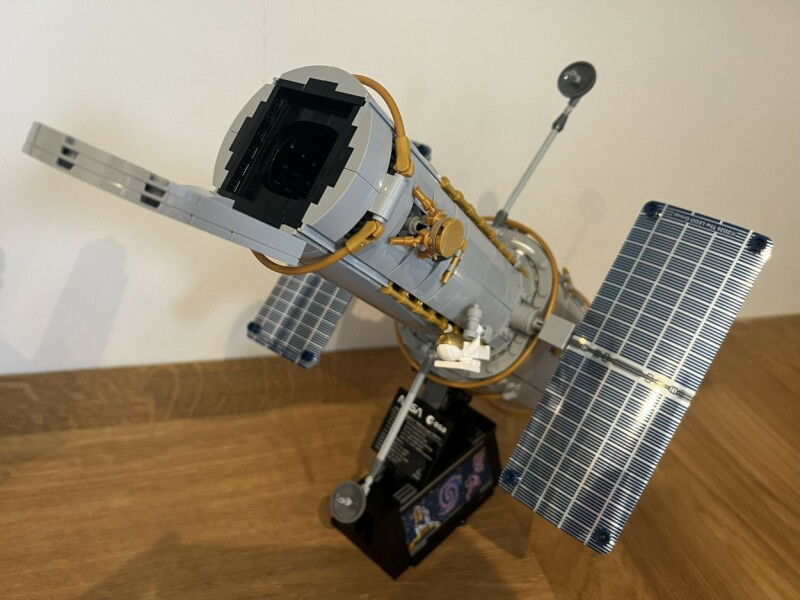
Lego has released its largest Hubble Space Telescope yet – a model built at approximately minifig scale that dwarfs the observatory included with its Space Shuttle Discovery set. The first thing to say about this set is that there is an awful lot of grey. This is perhaps the greatest weakness of an otherwise excellent set and feels a little penny-pinching on the part of the Danish brick botherer. Lego has produced several versions of Hubble over the years. There is a version to fit in the payload bay of its large Space Shuttle Discovery set, and a much smaller incarnation on a plinth in the Women of NASA set. Both are retired, so scratching that Hubble itch with a current official set means dropping £119.99 on the Icons Hubble Space Telescope. It's a large set. According to Lego, the 1,252-piece set measures 32 cm tall, 38 cm long (with the aperture door open), and 38 cm wide. An astronaut minifigure is included to indicate the model's approximate scale – a shame there's just one, since the servicing missions had a pair of spacewalkers – along with a power tool. There is also a stand featuring some of Hubble's iconic imagery and a plaque with more information, including the dates of the Space Shuttle servicing missions. Lego has not included replacement instruments to recreate the various servicing activities. Inside are Lego representations of Hubble's instruments and systems, including its gyroscopes, primary mirror, and secondary mirror. Outside are posable solar arrays and antennas, along with an aperture door that opens. Some parts are a little fiddly, and the set is aimed at ages 18+. That seems a little on the high side, but this isn't something you'd want a young child trying to build. The level of detail is impressive, considering the nature of Lego components, but it is difficult to avoid all that grey plastic. The Hubble Space Telescope included with the Space Shuttle Discovery Icons set uses silver bricks, which makes the choice of grey plastic feel cheap in comparison. And then there are the stickers. Thankfully, there aren't too many, but printed parts are readily available, and Lego uses its own, so why make builders fiddle with sticker alignment? And then there are the solar arrays, which are single-sided and feel a little cheap compared with the arrays on some of the MOCs The Register has built over the years. Still, these are minor niggles in what is otherwise a fun build lasting 6-12 hours. The set is an excellent addition to the Icons range, but such is the affection for Hubble that details matter. The set also acknowledges Hubble's 35th anniversary, celebrated in April 2025, with a "35" decal on the back of the astronaut minifigure. The real thing continues to orbit, although its days are likely numbered. The Lego version is likely to endure until a careless elbow knocks it off the shelf, or a creative builder decides to repurpose its components for an orbital animal amusement park. Which, after all, is the whole point. ®
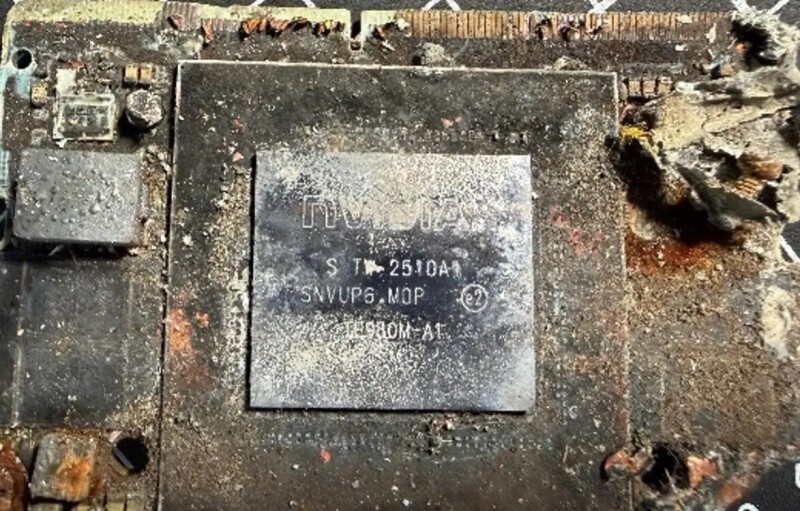
Sanctions and Nvidia’s exit from Russia in 2022 haven’t stopped its Jetson Orin hardware from turning up in Russian weaponry, according to Ukrainian military intelligence. The Defense Ministry’s Intelligence Directorate (GUR) reported this week that it spotted an Nvidia Jetson Orin module in the remains of a Russian S-71 Monochrome cruise missile. The S-71M is an air-launched weapon with autonomous capabilities that can reportedly search for and engage targets using optical sensors and onboard computing. “The use of this component may indicate the use of artificial intelligence technologies in the missile,” GUR said. That assumption makes sense, as information on the S-71M suggests that it can operate with user oversight or entirely autonomously. Photos included with the GUR announcement show a heavily scorched Nvidia chip with the identifier TE980M-A1 stamped onto its surface, indicating that the chip is a Jetson Orin NX 16GB unit that Nvidia released in early 2023. It’s a capable chip, but not exactly datacenter-class hardware - Orin systems are designed precisely for use cases like autonomous systems. Nvidia used to have offices in Russia and do business there, but it closed up shop in Ukraine’s bellicose neighbor in 2022 following Moscow’s decision to go to war with Kyiv. That was prior to the introduction of the TE980M-A1, meaning it must have reached Russian hands through another channel after Nvidia stopped direct sales to the country in early 2022. In other words, whatever sanctions the US has enacted or business decisions Nvidia has made, its hardware is still turning up in Russian weaponry used to target Ukrainians. The one good thing about the entire affair, according to GUR, is the fact that the recovered hardware proves Russian tech manufacturing still isn’t up to snuff. According to Nvidia, Orin modules are consumer grade and are sold to all sorts of different people for all sorts of purposes, with military applications not being among their intended design. The chips aren’t supposed to be available in Russia, either, a spokesperson told The Register, adding that there are plenty of ways for Russia to get ahold of the chips that are out of its control. “Pre-owned Jetsons are available through many reseller channels,” Nvidia told us. “Although we cannot track products after they are sold, if we determine that any customer is violating U.S. export controls, we will take appropriate action." US export controls have restricted exports of advanced chips to Russia and China. Chipmakers have responded to China-specific restrictions by producing hardware designed to comply with US export rules, while third parties have allegedly used smuggling to get restricted higher-end components into China. It’s not clear how the Nvidia component ended up in Russian hands. GUR’s latest disclosures also document Chinese-made electronics in Russian weapons. However the salvaged chip made its way to Russia, GUR said its evidence shows that current export control regimes aren’t working. “The discovery of Nvidia Jetson in a new Russian missile once again demonstrates the need for increased sanctions pressure and coordination of the efforts of the civilized world,” the intelligence agency said. ®
President Trump has ordered the US Navy to draw up plans to replace electromagnetic aircraft catapults and weapons elevators with old-fashioned steam and hydraulic systems. America’s commander-in-chief issued a presidential memorandum directing the secretary of defense, in consultation with the secretary of the Navy, to come up with a plan to replace the Electromagnetic Aircraft Launch System (EMALS) on the future USS Doris Miller (CVN-81) with the older steam-powered system. The same note stipulated the replacement of the electromagnetic Advanced Weapons Elevators with the hydraulic versions used in older carriers. These directives were part of a broader memorandum aimed at shaking up shipbuilding for the US Navy, which is often seen as glacial and moribund. EMALS was introduced on the USS Gerald R Ford (CVN-78), which was the first of an improved design of US aircraft carriers. It basically uses a linear induction motor to accelerate an aircraft along the flight deck, in place of the old-fashioned system that employs a steam piston. The premise of EMALS is that it doesn’t require a head of steam, and as it is electromagnetic, it should be easy to adjust the power to match the size and weight of aircraft being launched. However, the technology has had a few teething problems, as reported by The Register previously, and these have even led to the Gerald R Ford being unable to launch aircraft at all. The Advanced Weapons Elevators, which also use linear motors, have likewise proven problematic. Earlier this year, it was reported that there was a study underway to review the Ford-class carrier design and determine whether it should be altered for the next two in the class. “We are looking at 82 and 83 to review the costs, the designs, the systems, to make sure that they make sense, and they have all the systems and requirements that we want going forward,” then-secretary of the Navy John Phelan is quoted as saying. One of the concerns was said to be with the sortie generation rate of the Gerald R Ford – the number of takeoffs possible - which was promised to be higher with EMALS. We asked the White House if this directive would apply to all subsequent US carriers, but a spokesperson simply referred us to the announcement, which mentions only CVN-81. The rest of the president’s memorandum takes aim at naval shipbuilding in America. One directive is to establish a fifth naval shipyard to increase submarine and aircraft carrier repair capacity. Trump is also sanctioning foreign involvement in building up to three ship classes of US Navy vessels. His memorandum directs the secretary of defense to come up with “a new competitive acquisition approach” for surface combatants to perform anti‑submarine warfare, surface warfare, and convoy escort duties, plus Consolidated Cargo Replenishment at Sea (CONSOL) tankers and Roll-On, Roll-Off vessels – the latter typically used for transporting tanks and other military vehicles. The president proposes using a similar approach to the memorandum of understanding (MoU) between the US and Finland with regard to acquiring icebreaker ships last year. This will allow foreign suppliers to take part in US Navy procurement, provided they agree to build a new shipyard in America or assume ownership or a majority stake in an existing one, and construct all ships after the first two in US shipyards. Tellingly, the memorandum states that the US Navy “shall not impose iterative design changes upon the original mature parent designs within the above programs,” and that no changes from the original designs shall be made without the approval of the secretary of defense. Last year, the Trump administration canned the Constellation-class frigate program, which had been based on an Italian design to reduce technical risk, after so many changes were made that the US design had just 15 percent commonality with the original and the program was years behind schedule. ®
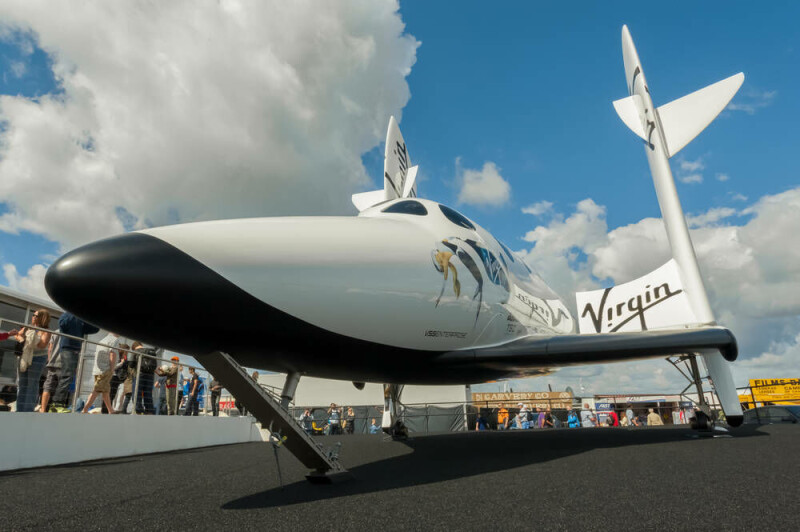
Virgin Galactic has delayed its return to commercial spaceflight until February 2027, and plans to raise ticket prices later this year. The delay was disclosed alongside the company's financial results, which showed a net loss of $56 million for the second quarter of 2026, down from $67 million a year earlier. Revenue for the quarter was $0.1 million, compared to $0.4 million in 2025. According to CEO Michael Colglazier, demand exceeded the number of seats offered in the first $750,000 batch, prompting the company to prepare another at a higher price. Those customers will, however, have to wait a little longer. Colglazier said: "Our first ship is now expected to enter commercial service in February 2027 rather than the fourth quarter of 2026." He blamed the delay on the extra time needed to "complete avionics and systems installations." During an earnings call, Colglazier said: "No single issue is driving the schedule push. Rather, we have experienced modest time duration extensions across hundreds of relatively small but important installation tasks involved in the first build of our new spaceship." In response to an analyst question, Colglazier elaborated: "The number of those kind of 'Oh, we did not expect this to not fit just perfectly,' coming in is higher than we had allotted for. That just has started to accumulate on us. It really picked up at the tail end of July. For a bit, we thought we could manage that end, but the team just needed more time to do it the correct way." Integrated vehicle ground testing is expected to begin later in August, followed by flight testing in October. A second spaceship is due to join the fleet in March 2027, and the company expects to stop burning cash and "deliver positive quarterly cash flow within 2027." When Virgin Galactic reopened suborbital ticket sales in April, it charged $750,000 for a seat, up from the $600,000 price it cited in 2023. That was a substantial jump from the $100,000 envisaged more than two decades ago, when Sir Richard Branson announced plans for a scaled-up version of Burt Rutan's SpaceShipOne. At the time, the company said commercial flights would resume by the end of 2026. Virgin Galactic's last commercial flight took place in 2024, after which the company paused operations to focus on its next generation of spacecraft. Virgin Galactic is not alone in pausing its space-tourism service. Earlier this year, rival Blue Origin announced that New Shepard flights would pause for "no less than two years" while it worked on its crewed lunar program. ® Updated 8/18 at 10:19 GMT: A previous version of this story said that the program was "grounded," but the more appropriate term is "paused."
A JCB has set a new world land speed record, passing 406 mph (653 kph) at Utah's Bonneville Salt Flats. The JCB in question isn't a digger or a dumper, but a hydrogen-powered racer known as the JCB Hydromax, driven by retired Royal Air Force fighter pilot Wing Commander Andy Green. It set the record for the fastest a hydrogen-powered internal combustion car has ever travelled, averaging 406.320 mph (653.909 kph) across two runs at the salt flats this week. JCB says the Hydromax is powered by two production-based engines derived from those used in its commercial machinery. The engines are made at JCB's factory in Foston, Derbyshire, and deliver a combined 1,600 bhp. The firm began a £100 million ($135 million) hydrogen engine investment program in 2021, arguing that battery power is practical for smaller machinery but less suited to heavy equipment requiring long operating hours and rapid refueling. It was given permission to sell hydrogen engines by licensing authorities across Europe last year. Another European engineering company, Bosch, is investing in hydrogen power and disclosed some of its plans back in 2023. However, JCB conceds that the two engines in the Hydromax were "extensively rebuilt to suit the demands of breaking the speed record," fitted with spark plugs designed for a Le Mans 24 Hour engine, for example. Burning hydrogen produces no carbon dioxide at the tailpipe, although a combustion engine can still generate nitrogen oxides. JCB estimates that a full record run consumed just over 2 kg (4.4 pounds) of hydrogen and produced 18 liters (about 5 gallons) of water. Beneath the bodywork is a steel-frame chassis similar to that of a conventional racing car, built with a minimal amount of high-strength tubing. The driver sits in a composite monocoque sub-chassis under a drag racing-style steel roll cage. One of the engines is located behind the driver's position and spins the rear wheels, while the other is located in front and drives the front wheels via a front-facing gearbox. Wing Commander Green is no stranger to land speed records. He was at the controls of the ThrustSSC vehicle when it broke the sound barrier on land, and also drove JCB's Dieselmax when it set the world diesel land speed record. According to JCB, its chairman, Anthony Bamford, led the hydrogen engine project and came up with the idea of a bid for the hydrogen world land speed record. "Twenty years ago we came to Bonneville with JCB Dieselmax and showed what British engineering could do with diesel power. Today we have done it again, this time with engines powered by hydrogen," Bamford said. "It shows hydrogen works, and it works today at the highest level with zero emissions." The Fédération Internationale de l'Automobile (FIA), motorsport's global governing body, officiated the attempt and has confirmed the 653.909 kph (406.320 mph) record. ®
Twitch has given streamers a switch to stop their channel content being fed into Amazon's generative AI machinery, but naturally it is turned on by default. The Amazon-owned streaming platform has added a "Training for Generative AI" control to channel settings, allowing streamers to opt out of having their content used for future GenAI model improvements. With the setting enabled, Twitch says channel content – including livestreams, videos on demand, clips, highlights, text, images, and chat messages – may be used to train Amazon's generative AI models. The benefits aren't confined to Twitch either, as the company says the resulting models may also be used elsewhere in the Amazon empire. For example, Twitch says audio from streams could be used to refine speech-to-text models, improving captions on Twitch as well as "across Amazon." Streamers who would rather not contribute their channels to Amazon's AI ambitions can opt out, but they'll need to do it themselves. Twitch has helpfully enabled the setting by default. Twitch chief product officer Mike Minton offered a refreshingly uncomplicated explanation for that decision during a livestream discussing the changes: "If it was opt-in, nobody would opt in," he said. "That's honestly the answer. So it's going to be on by default." The new control also doesn't mark the beginning of Amazon using Twitch material to build AI. According to Ars Technica, Minton confirmed at an event hosted by The Information in 2024 that Amazon was already using Twitch data to train AI models. What's changed is that Twitch users now have a dedicated way to tell it to stop using their content for future generative AI training. There are some wrinkles, naturally. The channel owner's setting determines whether messages posted in its chat can be used, so opting out on your own channel does not protect what you type in somebody else's if that streamer leaves training enabled. And Twitch's wording is conspicuously forward-looking: opting out means content won't be used for "future" GenAI model improvements. The company doesn't say that flicking the switch somehow extracts anything that has already made its way into a model. The Register has asked Amazon which of its AI models have been trained on Twitch content, how long it has been using the data, and whether opting out has any effect on material already used for training. We've also asked whether models trained on Twitch content are used in products available to Amazon customers or third parties. For now, Twitch creators finally have a way to keep their content off Amazon's generative AI training menu. All they have to do is find the switch Amazon would plainly rather they left alone. ®
BORK!BORK!BORK! "Everything is better with pickles," trumpets a Wendy's sign. Everything is also better with a helping of bork, if the screen is to be believed. Spotted by an eagle-eyed Register reader in Vancouver, the display shows something amiss with Windows Phone Link – although why a PC encouraging customers to drop dollars on a Dill Pickle Chicken Sandwich needs the app is anyone's guess. The error itself usually comes up when something running Windows has been a bit careless with stack memory. Perhaps there's been a stack overflow, a software conflict, or a memory shortage. The usual fix is to reach for the power button or perform a restart. The more technically minded might try to diagnose the whoopsie and fix it without a boot cycle, although had a more technically minded person set up the system in the first place, it's unlikely that the PhoneExperienceHost.exe application would have reared its ugly head in this way. Phone Link connects a Windows PC to an Android phone or iPhone. The theory goes that users can keep track of mobile notifications, send and receive messages, or deal with calls from their Windows desktop. It arrived with Windows 10 as Your Phone before Microsoft renamed it Phone Link and continued adding features. Ordinarily, the service doesn't use much in the way of memory or CPU. However, something has clearly upset the instance here, much as an excess of dill pickles might disagree with the customer. While we're sure the foodstuffs on offer are excellent (although our reader told us they were only popping in for a Frosty Dairy Dessert rather than anything slapped with a dill pickle), we might give the chicken sandwich a miss this time. Even Windows appears less than keen. ®

 Accedi