Vista elenco

NASA’s COFFIES Uses AI to Predict Storm-Causing Active Regions on Sun 

14 Agosto 2026 ore 19:00

5 min read

NASA’s COFFIES Uses AI to Predict Storm-Causing Active Regions on Sun 

As humanity looks to the Moon and stars for future exploration, predicting space weather — conditions in space primarily driven by the Sun — is more important than ever. 

Now, a team of astrophysicists and data scientists with NASA’s COFFIES (Consequence Of Fields and Flows in the Interior and Exterior of the Sun) has developed a novel machine-learning model capable of predicting the emergence of active regions on the Sun up to 12 hours before they appear. 

The Sun is constantly churning. Intense concentrations of localized magnetic fields can suddenly break through the solar surface, forming sunspots. Space weather forecasters then collectively number and track sunspots since they are visible manifestations of active regions, which serve as the main engines behind severe space weather events such as solar flares and coronal mass ejections. These eruptions send waves of high-energy radiation and charged particles across space, creating storms that can threaten astronauts, disable satellites, and disrupt radio communications on Earth. 
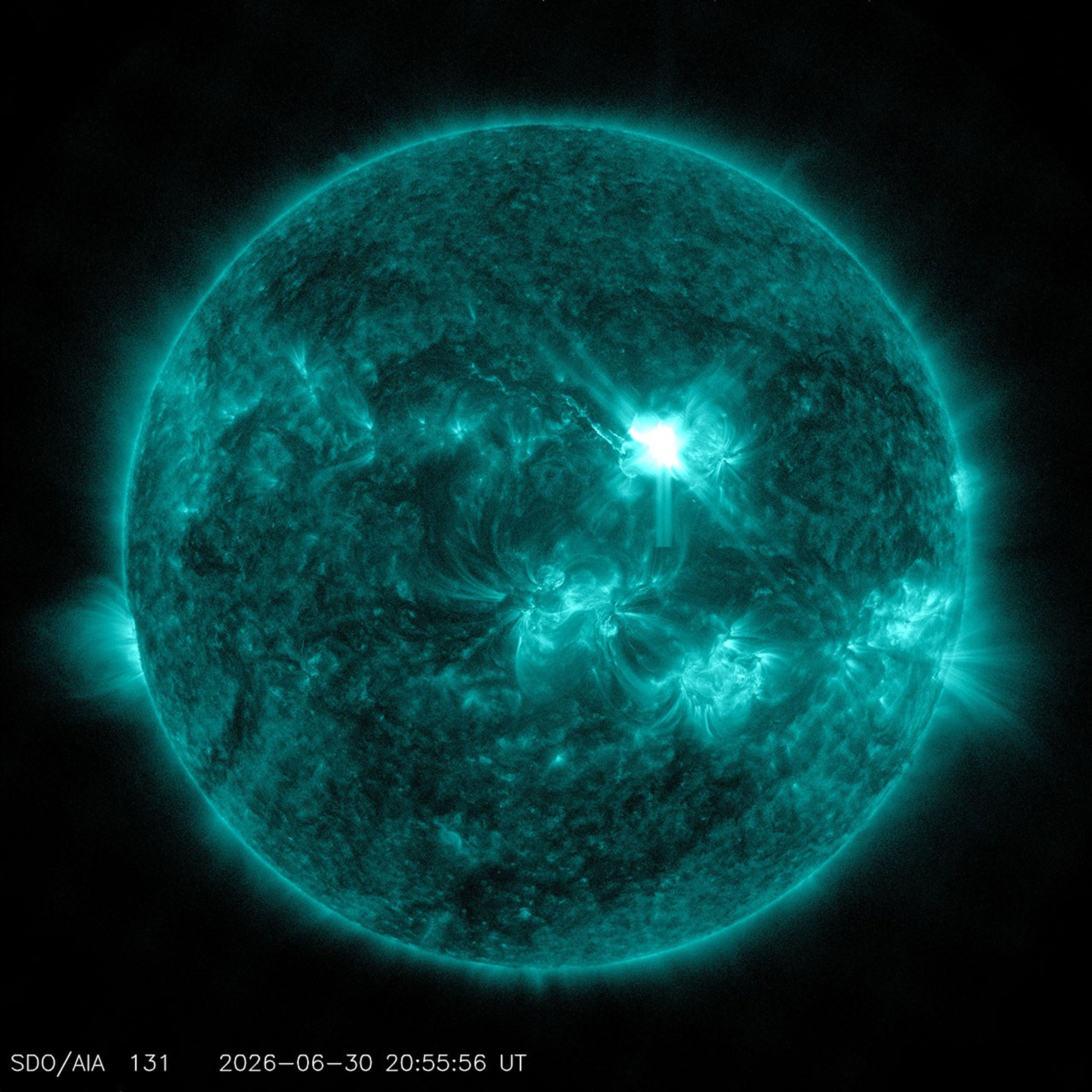
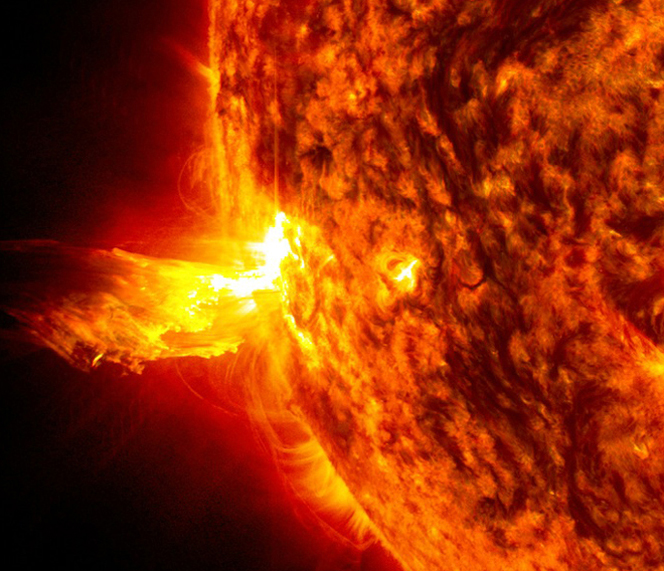
The Sun appears in shades of teal with some brighter and darker regions, set against a black background. In the upper right part of the Sun is a bright flash of white, a solar flare.
NASA’s Solar Dynamics Observatory captured this image of a solar flare — seen as the bright flash in the upper right — on June 30, 2026. The image shows a subset of extreme ultraviolet light that highlights the extremely hot material in flares and which is colorized in teal.
NASA’s Goddard Space Flight Center/SDO 

By bridging expertise across different scientific institutions, COFFIES, a NASA DRIVE (Diversify, Realize, Integrate, Venture, Educate) Science Center, brought together a team of researchers from New Jersey Institute of Technology (NJIT), Princeton University, and NASA’s Ames Research Center in California’s Silicon Valley. The team turned to advanced artificial intelligence architectures — which dictate how data is processed and used to produce reliable predictions or actions — to capture subtle, time-based pattern changes on the solar surface before an active region took shape. By analyzing data captured by the agency’s Solar Dynamics Observatory and using NASA Ames’ supercomputing resources, this new approach, published in the Journal of Geophysical Research: Machine Learning and Computation, looks at fluctuations in acoustic waves caused by sunspot regions when the regions form beneath the solar surface and begin the journey upward to emerge on the surface. 

“We cannot directly see the magnetic structure while it is still rising through the solar interior. Instead, we must look for indirect effects — very small changes in the magnetic field and in the pattern of acoustic waves continually traveling through the Sun,” said Alexander Kosovichev, a COFFIES co-investigator at NJIT. “The developed technique identifies precursors associated with an emerging active region in slight changes of the Sun’s acoustic power — more like a slight change in rhythm within a very noisy orchestra.” 

This video is an example of what scientists use when analyzing the solar surface. This particular time frame tracks the magnetic field on the Sun’s surface during the emergence of active region AR11158 in February 2011. The blue square grid highlights a target area on the Sun. The squares on the right side translates the data from the target grid area to show opposing magnetic polarities, indicated by the warm and cool-colored tones. The first column of blocks shows targeted areas at original resolution, the middle column displays data as 2D maps, and the right column plots changes in magnetic polarity over time as 1D curves. By watching these blocks, scientists can see signs of active region emergence, such as drops in acoustic waves and rises in magnetic fields.
NASA’s COFFIES DRIVE Science Center/Irina Kitiashvili and Spiridon Kasapis

To develop current operational forecasts, the National Oceanic and Atmospheric Administration’s Space Weather Prediction Center and the United States Air Force monitor active regions that are already visible on the Sun to analyze the regions’ characteristics and estimate the probability of solar flares.

The COFFIES team aims to revolutionize this process. The AI model the team developed a specialized early detection system to handle very long sequences of data — called sliding-window transformer architecture — to use observations to find tiny reductions in the Sun’s acoustic activity and magnetic field, signals that scientists struggled to capture until now. These reductions form patterns that the AI model uses to predict active regions several hours before they become visible on the solar surface. Instead of looking at all activity on the solar surface at once, like earlier deep learning approaches have done, this new model moves a fixed-size “viewing window” across a long timeline of the Sun’s activity to focus on recent data while remembering overall patterns. This method allows forecasters the ability to predict approximate locations of emerging sunspots, rather than relying on counting already visible sunspots. 

This promising AI architecture shows how deep machine learning can contribute to heliophysics — the field studying the nature of the Sun and how it influences the very nature of space and the planets that exist there. While the model is not ready for operational real-time forecasting, the team plans to validate the approach across many more known solar events to fine-tune the model. 

NASA’s real-time space weather monitoring 

As NASA focuses on sending humans to explore the Moon with the Artemis missions and sending the first crewed missions to Mars, monitoring and forecasting space weather is important for ensuring the safety of our astronauts and the equipment they rely on. This predictive leap from the COFFIES team could prove vital for safeguarding technology and deep-space explorers from the volatile environment of our solar system.

NASA’s Moon to Mars Space Weather Analysis Office monitors space weather 7 days a week. This important work helps decision makers not only protect people and equipment but maintain the services our modern society relies on every day. NASA’s space weather monitoring is also critical for safeguarding astronauts as they journey to the Moon and onward to Mars.
NASA/Lacey Young

Teams across NASA and NOAA collaborate to transition research capabilities into actual 360-degree space weather monitoring operational tools — including NASA’s Space Radiation Analysis Group, Moon to Mars Space Weather Analysis Office (M2M SWAO), and Community Coordinated Modeling Center as well as NOAA’s Space Weather Prediction Center. Sunspot region emergence prediction capabilities, especially of the Sun’s far side, could provide new information that supplements current models used by these teams.  

“The COFFIES AI model is exciting to our team because it could provide us with new capabilities towards predicting potential flaring locations ahead of time,” said Michelangelo Romano, M2M SWAO deputy director. “With this heads up, we can provide additional support to NASA missions.”

NASA’s COFFIES is one of three DRIVE Science Centers created to encourage collaborative science by establishing centers that are made of multidisciplinary teams from several institutions across the U.S. These pioneering facilities employ modelers, theoreticians, computer scientists, and observers to study important mysteries of our star and its influence, a branch of science known as heliophysics.  

The COFFIES team focuses on the interconnected processes behind the Sun’s activity. Understanding the Sun’s interior and magnetic variability is key to advancing our understanding of the Sun’s 11-year activity cycle and fine-tuning space weather forecasting tools.  

About the Author

Desiree Apodaca

Desiree Apodaca

NASA’s Heliophysics Missions Communications Lead

Keep Exploring

Discover More Topics From NASA

For West Virginia Engineer, Home Is Where the Heart Is… and NASA, Too

13 Agosto 2026 ore 21:03
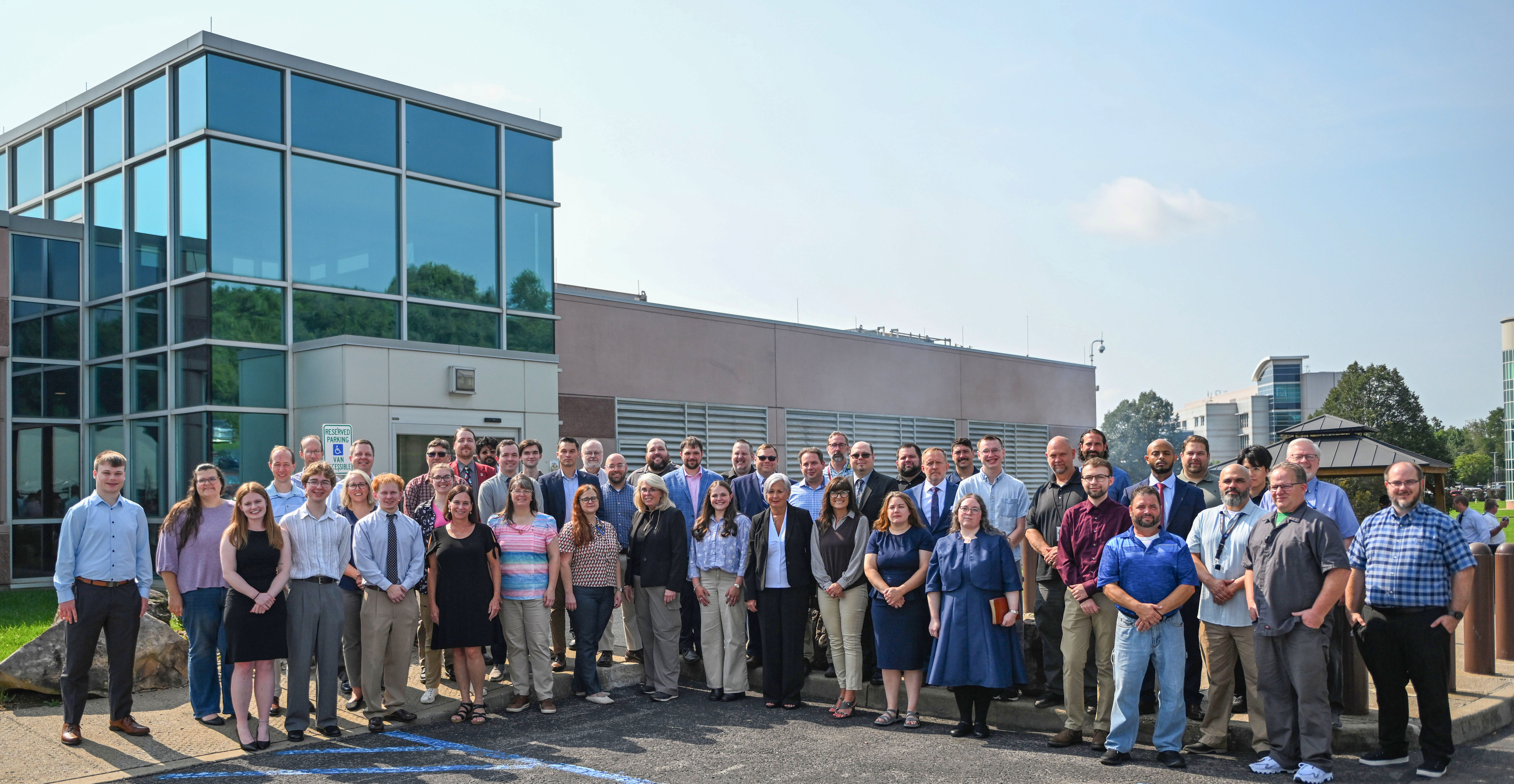
New civil servants pose together.
NASA’s Katherine Johnson Independent Verification and Validation Facility (IV&V) held a swearing-in ceremony for civil servants on Monday, Aug. 10, 2026, at the facility in Fairmont, West Virginia. In total, 51 new employees were hired at IV&V as part of NASA Administrator Jared Isaacman’s directive to strengthen NASA’s technical core competencies.

Growing up in Grafton, West Virginia, engrossed in Star Wars and all things science fiction, Fletcher Newell had an early interest in space exploration. That interest only grew when, in 2013, his fourth-grade class took a field trip to a nearby NASA facility he had not yet heard of – NASA’s Katherine Johnson Independent Verification & Validation Facility, located in Fairmont, West Virginia. Thirteen years later, Newell and 48 of his colleagues at the facility were sworn in as NASA civil servants during a ceremony on Aug. 10.

“I had always admired NASA from afar,” said Newell, who started working at IV&V as a systems engineer contractor in early 2025. “To my surprise, the agency was doing impactful work in my backyard.”
 
During high school, he began cultivating programming skills that would lay the foundation for his future. A self-professed computer aficionado, Newell taught himself how to code. In algebra class, he discovered that his graphing calculator was programmable, leading him to create basic scripts. He quickly moved to popular software applications, learning how they were built in order to develop his own programs. Artificial intelligence was still on the brink of becoming mainstream, but he was already asking himself, “What are the more interesting things we can teach computers to do?” As a junior in 2019, the precocious programmer merged his talents with his passion for space after being accepted into IV&V’s high school internship program.
Newell created a database for engineering methods, processing hundreds of documents to facilitate the work of his colleagues from a procedural aspect.

“Working as a high school intern really elevated my fascination for NASA,” he said.
 
Following graduation in 2020, Newell headed west to Stanford University in Palo Alto, California, majoring in, naturally, computer science, with a focus on AI and machine learning when both were scaling rapidly across industries and in everyday usage.
 
Instead of pursuing internships in the neighboring Silicon Valley – widely considered the global center for technological innovation – he returned to West Virginia for three consecutive summers, cutting his teeth at the Fairmont facility.

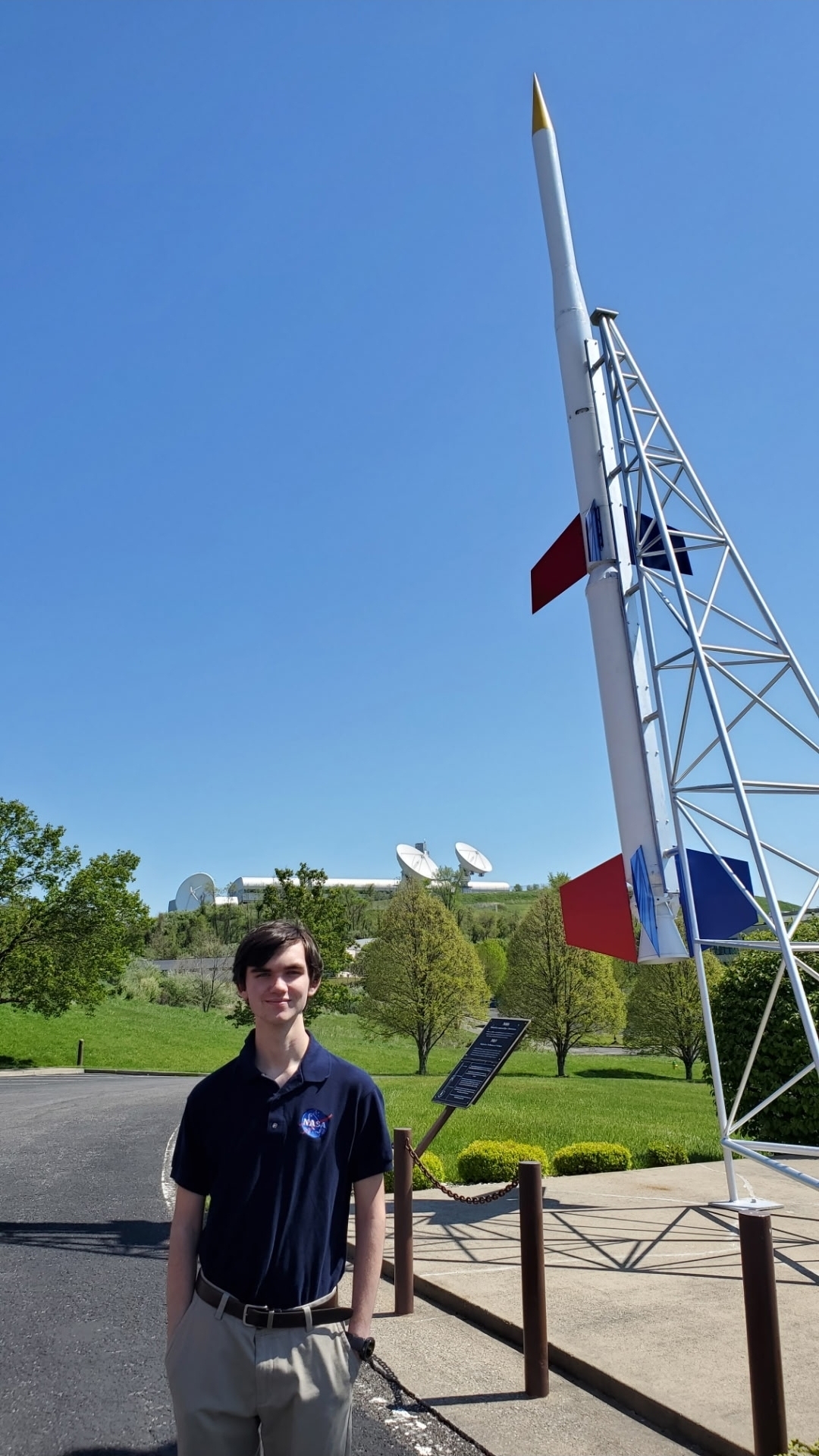
Fletcher Newell stands in front of a sounding rocket.
Fletcher Newell stands in front of the Katherine Johnson Independent Verification & Validation Facility in Fairmont, West Virginia, as a high school intern in 2019.
Photo courtesy: Fletcher Newell

He began researching AI safety as engineers learned how to give spacecraft more onboard autonomy and have them learn on their own. Later, he was on a team responsible for assessing the safety of Terrain Relative Navigation, a vision-based guidance technology that could enable spacecraft to land on planetary surfaces without GPS. During his final internship, generative AI – which creates content based on user prompts – was becoming widespread, and he worked on teams exploring how to responsibly integrate it into mission assurance.
 
Newell also performed research about autonomous space docking at Stanford’s Center for AI Safety, resulting in two publications. Following his undergraduate education, he remained at Stanford to earn a master’s in computer science.
 
When it came time to enter the workforce, one organization was atop his list. A contractor opportunity opened up at IV&V, and he leapt at the chance.
 
“I enjoyed the work at IV&V back in high school and college,” he said. “There’s nothing better than pursuing what aligns with your interests.”
 
As a systems engineer, he has worked primarily on mission safety and security, identifying and resolving system defects and vulnerabilities for such spacecraft as Space Reactor-1 (SR-1) Freedom, Orion, Gateway, and the Human Landing System, all while helping guide NASA’s responsible adoption and development of AI systems.
 
His colleagues took notice of their junior member’s contributions, resulting in Newell being named IV&V Engineer of the Year in 2025 less than a year into the job after identifying more than 70 issues in Gateway – and later SR-1 Freedom – with clear mission impact and, as noted in his award citation, developing a reputation for clearly articulating their implications.
 
“During his internships and now as a full-time engineer, Fletcher has consistently demonstrated exceptional talent, curiosity, and a passion for our mission,” said Wes Deadrick, IV&V director. “He could have gone almost anywhere after Stanford. The fact that he chose to come home to build his career supporting NASA through the IV&V Program makes me incredibly proud.”
 
The Aug. 10 ceremony for Newell and his colleagues was part of NASA’s workforce directive to bring core, mission-critical positions into the civil service, from early-career professionals to seasoned technical experts.
 
“It’s an investment in NASA’s future, giving us the opportunity to bring exceptionally talented people into the civil service while strengthening long-term technical capabilities that support our nation’s most challenging missions,” said Deadrick. “At IV&V, initiatives like this help ensure we continue providing independent expertise and mission assurance that our customers depend on.”
 
For Newell, as he takes this next step in his professional progression as a civil servant computer engineer, he looks forward to expanding on his responsibilities, especially to help NASA return to the Moon. He is currently helping identify safety and security issues, including ones that could impact crew safety and lead to the loss of spacecraft control, related to the agency’s lunar endeavors.
 
“At IV&V, teams are ensuring every major lunar vehicle and system will be ready to safely embark on their missions, not just for flying around the Moon, but also for putting American boots on the surface and eventually establishing and working on a Moon Base,” he said.
 
More than a decade after taking that field trip and now working on some of NASA’s high-priority missions, Newell readily admits he didn’t always envision staying in West Virginia.
 
“It was a little strange coming back, but I was continually getting to do amazing things at an amazing organization in a place I already know,” Newell said. “And that’s really cool.”

❌