It's about time: the General Conference on Weights and Measures looks set to end leap seconds in an effort to reach horological harmony. Since 1972, 27 leap seconds have been added to Coordinated Universal Time (UTC) to keep it in step with the astronomical time scale UT1, which is based on Earth's fluctuating rotation. The proposal would increase the permitted difference between UTC and UT1 from 0.9 seconds to one hour, avoiding leap-second adjustments for centuries. Earth's rotation has also sped up in recent years, raising the possibility of a negative leap second – removing a second rather than adding one. That has never been done before. Experts have estimated a 30 percent probability that global systems will need a negative leap second by 2035 to keep the two time measures in step. That could pose problems for computer systems designed to handle added seconds but not removed ones. Many national bodies support the proposal, which is expected to pass. If approved, the change would take effect on May 20, 2027. Setnam Shemar, principal scientist at the UK's National Physical Laboratory, said the proposal would avoid the risks associated with leap seconds for centuries. "Leap seconds can be difficult to implement reliably, and if not applied correctly, they can cause differences in time across networks, potentially leading to the failure of systems such as mobile phone networks or electricity grids. These risks could increase if a negative leap second had to be implemented for the first time. "Previously, leap seconds were added to UTC to keep it within 0.9 seconds of UT1. From 20 May 2027, a difference of up to 1 hour will be allowed before intervention is needed, ensuring the continuity of UTC for several centuries or more. "The relationship between UTC and UT1 is important for some applications, such as astronomy and celestial navigation. The decision would not sever that link: UT1 will continue to be monitored, and its difference from UTC will continue to be disseminated through established international services." ®
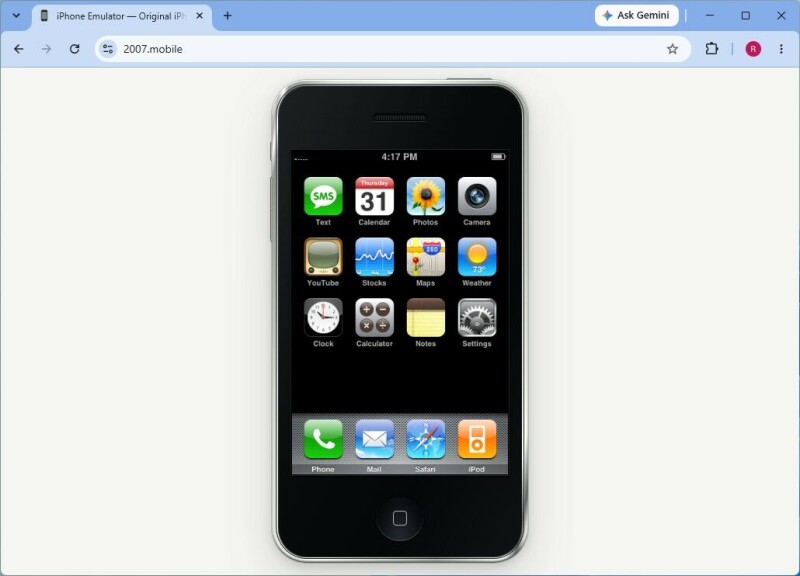
A browser-based emulator for the original iPhone is the latest project to tap into the rich vein of nostalgia running through the tech industry. While far from a complete implementation, the emulation does enough to evoke happier times, before Apple burdened its mobile operating system with frills and complexities, and spent years (and multiple operating system updates) making the Podcasts app steadily more broken. The browser-based emulation (and we use the term carefully; anyone expecting all the functionality of yesteryear will be sorely disappointed) shows an original iPhone as it debuted in 2007. The buttons are where you remember them, the screen is ringed by bezels that wouldn't pass muster today, and the skeuomorphic icons are all present and correct. There's even the browser, though it doesn't do much yet. Even a gentle prod shows how incomplete this implementation is. Some apps work well, such as Calculator, while others - Contacts - struggle, and anything that needs an online connection fails, including loading today's web in 2007's Safari. It does, however, recall how simple things were almost 20 years ago, when the iPhone first appeared, and it joins an array of old-time systems that can be fired up (or at least look like they are) in a browser. Want a look at Apple's abandoned System 7 replacement? Step this way. Perhaps an XP-like implementation? No problem. It would be churlish to dwell on the emulation's deficiencies. For now, it's arguably more curiosity than anything else: Apple didn't launch the App Store until 2008, so third-party apps would be off the table, at least until a later version of iOS landed. Running it in a browser is undoubtedly convenient, though. Alternatives such as Light Touch offer a fuller implementation, but they demand more than a handy Chrome instance on a Windows device to open a portal back to a brighter time. So, fire up 2006's Nintendo Wii, pop on that CD of Back to Black, and relive the excitement of switching on the very first iPhone. Although perhaps give that other 2007 icon, Windows Vista, a bit of a swerve… ®
There ain't no party like a tap-in party, as nobody ever said. And so it is that one of Luxembourg's mostly redundant tap-in / tap-out terminals is amusing itself by putting on a light show for passing passengers. The terminal is an INIT unit, rolled out on the country's public transport network and now mostly idle since fares were zeroed out in 2020. First Class and cross-border trips still attract a charge, but for everything else (trains, trams, and buses) there is no fee. Eagle-eyed Register reader Dominic spotted the terminal doing its thing at the Rout Bréck / Pafendall rail station in Luxembourg City. "Maybe it's got bored," he suggested, "and is trying to attract attention by cycling through video test patterns." Perhaps. Or perhaps it's the first wave of the AI takeover – activating unwitting undercover agents via the medium of flashing lights and colors (we've seen The Ipcress File – we know how it works), or maybe, just maybe, the terminal has got itself into a self-test boot loop and is awaiting an engineer who is probably in no rush to attend. After all, flashing screen or no flashing screen, nobody will bother to tap in and tap out when transport is free. The mundane reality is that this is indeed an INIT PROXmobile terminal with its knickers in a twist. It looks like it is going through a cycle to check out the performance of the LCD screen; checking that the red, green, and blue subpixels are working ok, showing a solid white screen, and then a grid pattern to check contrast and alignment are all tippety-top. And then it should boot into whatever it is supposed to be doing. However, that is, alas, not running quite as expected, so it goes back to the start of the diagnostic test. The terminals are managed remotely, so an alarm is doubtless going off somewhere to inform an administrator that something is amiss. Unless this really was some guerrilla marketing for Luxembourg's rave scene. The next Holy Rave was on Friday (October 9). Or perhaps loud music in dark rooms is not your thing? A flashing screen at a train station could therefore be a worthy substitute. ®

 Accedi