Vista elenco

NASA Webb, Hubble Reveal History of Relic of Milky Way’s Formation
16 Giugno 2026 ore 19:15
 
7 Min Read

NASA Webb, Hubble Reveal History of Relic of Milky Way’s Formation

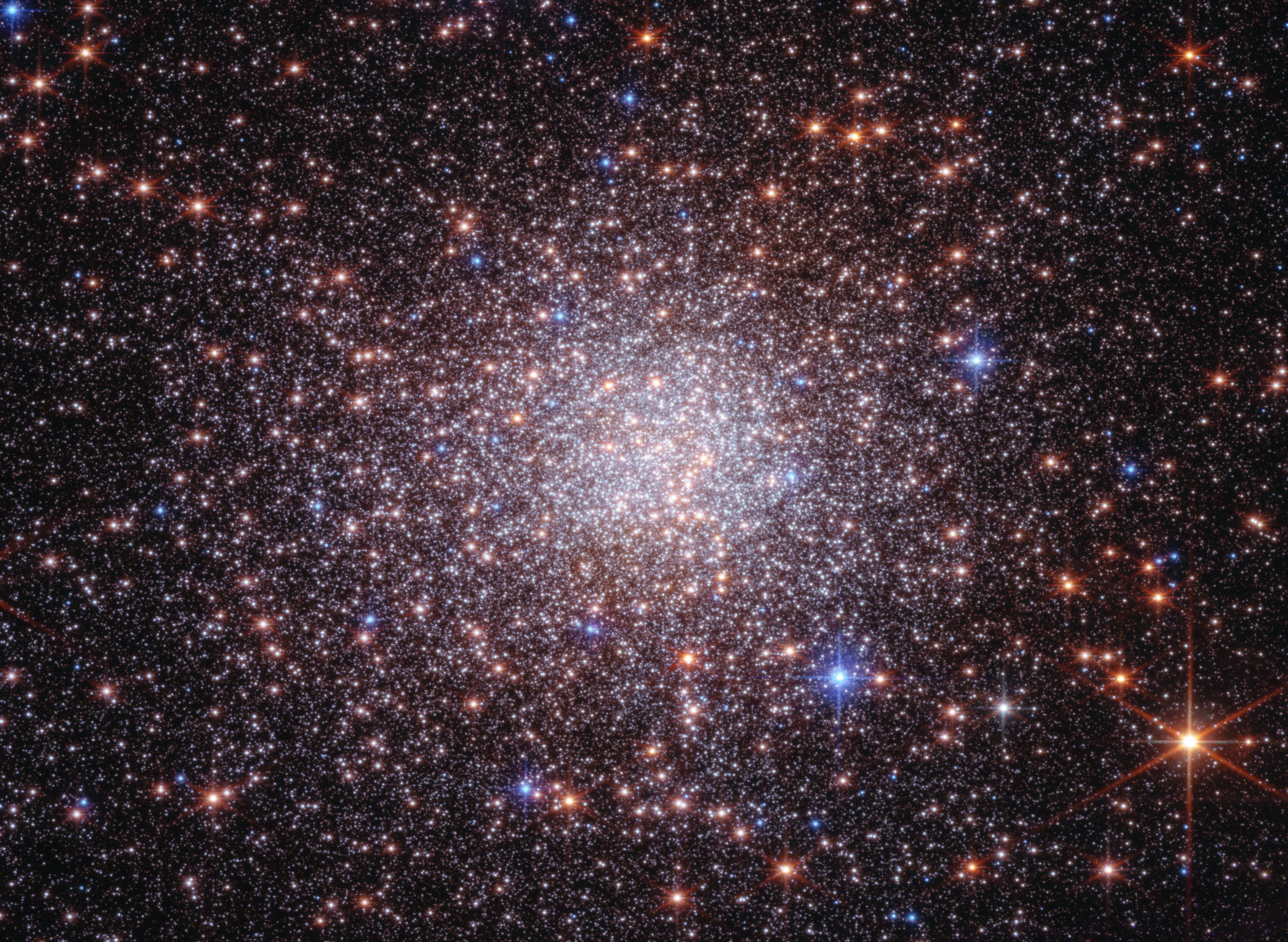
A dramatically crowded starfield that looks like a just-shaken snow globe. The black background of space, which is clearer at the edges, is covered by thousands of tiny white, orange, and blue points of light, which are stars. The stars are most concentrated in the center, forming a roughly circular orb, and sparser at the edges of the image. Several larger orange stars, particularly those largest near the edges of the frame, have prominent diffraction spikes.
New observations from Webb combined with multiple observations from Hubble prove that Terzan 5 is a self-contained, self-enriching stellar system that contains up to four distinct star populations. It orbits within our Milky Way galaxy’s central bulge.
Credits:
Image: NASA, ESA, CSA, STScI, Giorgia Zullo (University of Bologna), Francesco Ferraro (University of Bologna); Image Processing: Alyssa Pagan (STScI)

Researchers using two of humanity’s most powerful observatories — NASA’s James Webb and Hubble Space Telescopes — have definitively shown that Terzan 5 is not a globular star cluster as it was once classified, offering new insight into how galaxies like our own form and evolve over time. A globular star cluster typically has only one ancient star population. New data not only confirms the existence of two distinct populations of stars in Terzan 5, but also provides evidence for two more recent rounds of star formation. Although located within the crowded bulge of our Milky Way, our galaxy’s central, spherical region of older stars, Terzan 5 was massive enough to maintain its separate identity while lighter weight systems spread out and mixed to form the bulge billions of years ago. It’s like a lump in an otherwise well-mixed cake batter.

“Webb’s new near-infrared observations, cross-referenced with Hubble’s archival observations, have given us a much clearer picture of the history of Terzan 5,” said Giorgia Zullo, who led the research and is a PhD student at the University of Bologna in Italy.

These results were presented at a press conference Tuesday at the 248th meeting of the American Astronomical Society in Pasadena, and were published in Astronomy & Astrophysics.

Image: Bulge Fossil Fragment Terzan 5 (Webb and Hubble Image)

A dramatically crowded starfield that looks like a just-shaken snow globe. The black background of space, which is clearer at the edges, is covered by thousands of tiny white, orange, and blue points of light, which are stars. The stars are most concentrated in the center, forming a roughly circular orb, and sparser at the edges of the image. Several larger orange stars, particularly those largest near the edges of the frame, have prominent diffraction spikes.
New observations from Webb combined with multiple observations from Hubble prove that Terzan 5 is a self-contained, self-enriching stellar system that contains up to four distinct star populations. It orbits within our Milky Way galaxy’s central bulge.
Image: NASA, ESA, CSA, STScI, Giorgia Zullo (University of Bologna), Francesco Ferraro (University of Bologna); Image Processing: Alyssa Pagan (STScI)

Four generations of stars

Discovered in 1968 by astronomer Azop Terzan, Terzan 5 resembles a globular cluster in many ways. However, in 2009 this system was discovered to harbor two distinct populations of stars. In 2016 Hubble provided the first estimate of their ages, showing that one formed roughly 12 billion years ago — as the Milky Way itself was assembling — and the other about 5 billion years ago, just before Earth started forming. This pointed to a more complex history than a typical globular cluster.

Studying Terzan 5 is complicated by its location in a region of our galaxy crowded with stars and heavily obscured by dust. This is where Webb stepped in. Its infrared view allowed the research team to peer through the dust and catalog many more stars, and fainter stars, than previous work. By measuring star colors and brightnesses, astronomers can classify them into populations of different ages and chemistries.

Webb was able to measure these key properties for every star within the field of view in the sky — both stars within Terzan 5 and unrelated foreground stars. To isolate the stars of Terzan 5, the team relied on the power and longevity of Hubble. The 12-year separation allowed the team to measure very small movements of individual stars, known as proper motions, to determine which stars belong to Terzan 5 and which are part of the Milky Way bulge.

By combining data from both Webb and Hubble, the researchers found strong evidence for two more stellar populations, one that formed 3.8 billion years ago and another only 2.5 billion years ago. They also were able to determine the ages of the previously known stellar populations with unprecedented precision, finding that they formed 12.5 billion and 4.7 billion years ago.

With the previously known two generations of stars, astronomers could not rule out the possibility that Terzan 5 interacted with another object, like a globular cluster or a giant molecular cloud, becoming enriched with new gas and dust that set off a second round of star formation. With four stellar generations, those explanations are ruled out.

Measurements of the stellar composition of Terzan 5 populations made at the W. M. Keck Observatory and European Southern Observatory’s Very Large Telescope also point toward very distinct populations. “Along with the ages of these populations, the cluster preserves a fossil record of progressive enrichment of heavy elements by supernovae,” said co-author R. Michael Rich, a research astronomer at the University of California, Los Angeles.

Terzan 5 formed multiple generations of stars because it was able to retain the necessary raw materials. There is evidence of powerful supernova explosions in Terzan 5 that forged heavier elements that were swept up by subsequent generations of stars. In lighter weight systems, the force of the explosions themselves could have ejected the resulting elements as well as sweeping out leftover gas and dust. The progenitor of Terzan 5 had enough mass to retain those stars’ ejections, allowing new generations of stars to form over billions of years.

‘Bulge fossil fragment’

The results show that Terzan 5 is most likely the remnant of a much more massive stellar system that initially formed 12.5 billion years ago. Terzan 5 is extraordinary because it survived — and never merged or fully “mixed in” with the Milky Way’s bulge. “For some reason, this peculiar clump of stars formed separately from the bulge and was not destroyed as the bulge itself formed,” said Francesco R. Ferraro, a professor at the University of Bologna and principal investigator of the Webb observations. “Terzan 5 is what we now call a bulge fossil fragment because it resembles the primordial clumps that contributed to the formation of the bulge.”

To date, there’s one other known cosmic object like Terzan 5. Liller 1 was the second to be reclassified from a globular star cluster to a bulge fossil fragment. It also contains multiple generations of stars. There may be more objects like it. Between 40 to 50 additional globular clusters that orbit within the bulge will be examined by Ferraro’s team to determine if their stellar populations are all the same, like globular clusters, or have several generations, like bulge fossil fragments. 

Video: Zoom to See Terzan 5 Near Our Milky Way Galaxy’s Bulge

Zoom in to Terzan 5, a star cluster that lies within the crowded central region of our Milky Way galaxy known as the bulge. The scene starts with a ground-based image of our Milky Way bulge and zooms in on and circles Terzan 5, ending with the composite image of the star system from the James Webb and Hubble Space Telescopes.
Video: NASA, ESA, CSA, Alyssa Pagan (STScI); Acknowledgment: ESO, Pan-STARRS, DSS2, Akira Fujii

Potential parallels for galaxy formation near, far

Ultimately, this research may improve what we know about how the central bulges of galaxies form over hundreds of millions of years. “Based on observations and in-depth simulations, we think that galaxies in the early universe had huge disks of gas that fragmented into clumps and formed stars. These clumps migrated to the center of the galaxies, and many merged to form their bulges,” said Barbara Lanzoni, a co-author and associate professor at the University of Bologna. For example, Webb has turned up several examples of “clumpy” galaxies that were actively forming when the universe was only a few hundred million years old, like the clumps in the Firefly Sparkle galaxy. “Terzan 5 may provide direct evidence that can help explain how bulges formed in galaxies throughout the universe,” Lanzoni said.

The James Webb Space Telescope is the world’s premier space science observatory. Webb is solving mysteries in our solar system, looking beyond to distant worlds around other stars, and probing the mysterious structures and origins of our universe and our place in it. Webb is an international program led by NASA with its partners, ESA (European Space Agency) and CSA (Canadian Space Agency).

The Hubble Space Telescope has been operating for over three decades and continues to make ground-breaking discoveries that shape our fundamental understanding of the universe. Hubble is a project of international cooperation between NASA and ESA (European Space Agency). NASA’s Goddard Space Flight Center in Greenbelt, Maryland, manages the telescope and mission operations. Lockheed Martin Space, based in Denver, also supports mission operations at Goddard. The Space Telescope Science Institute in Baltimore, which is operated by the Association of Universities for Research in Astronomy, conducts Hubble science operations for NASA.

To learn more about Webb, visit:

https://science.nasa.gov/webb

To learn more about Hubble, visit:

https://science.nasa.gov/hubble

Downloads & Related Information

The following sections contain links to download this article’s images and videos in all available resolutions followed by related information links, media contacts, and if available, research paper and Spanish translation links.

Related Images & Videos

A dramatically crowded starfield that looks like a just-shaken snow globe. The black background of space, which is clearer at the edges, is covered by thousands of tiny white, orange, and blue points of light, which are stars. The stars are most concentrated in the center, forming a roughly circular orb, and sparser at the edges of the image. Several larger orange stars, particularly those largest near the edges of the frame, have prominent diffraction spikes.

Bulge Fossil Fragment Terzan 5 (Webb and Hubble Image)

New observations from Webb combined with multiple observations from Hubble prove that Terzan 5 is a self-contained, self-enriching stellar system that contains up to four distinct star populations. It orbits within our Milky Way galaxy’s central bulge.

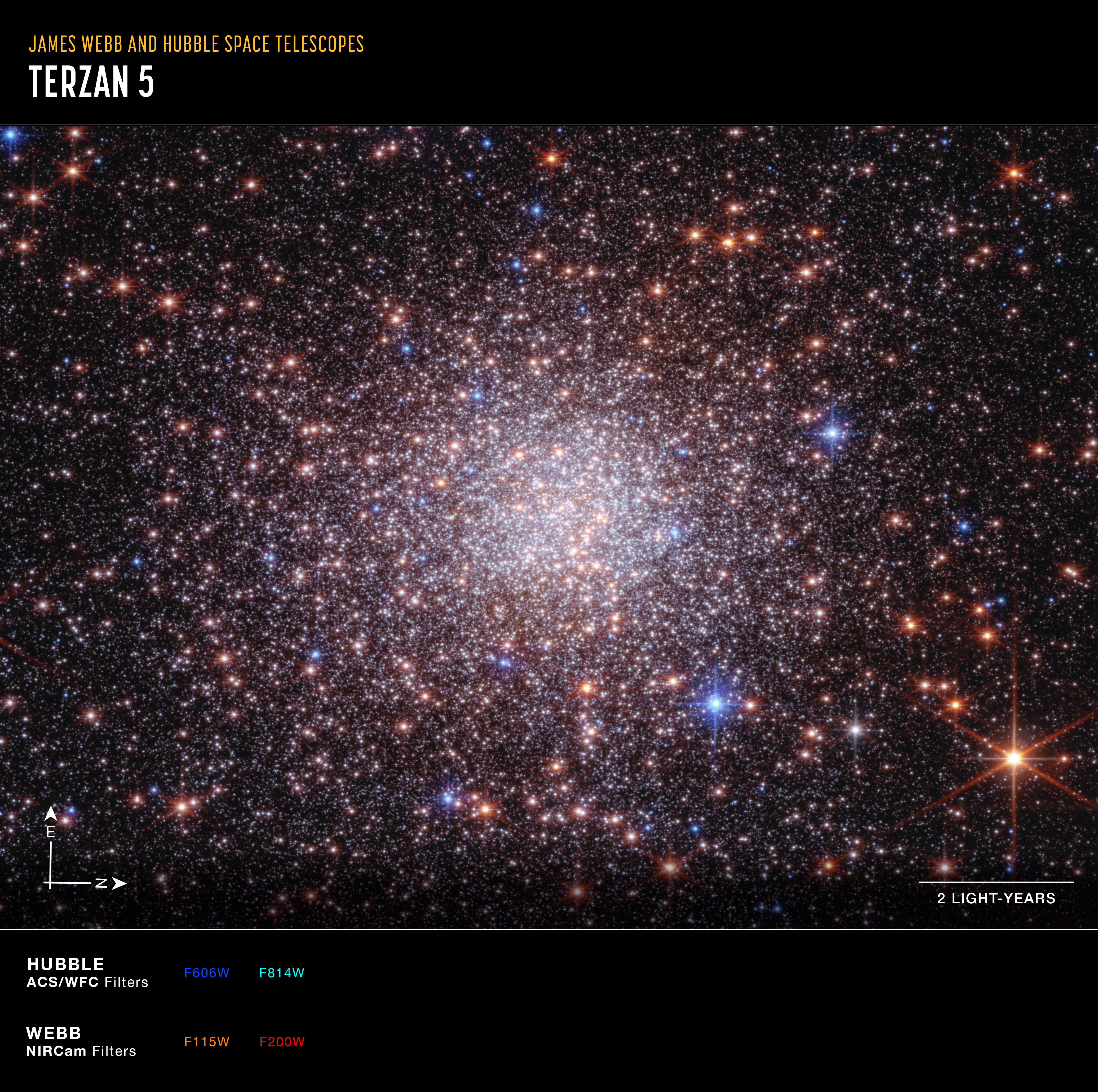
Image titled u201cJames Webb and Hubble Space Telescopes; Terzan 5,u201d with compass arrows and color key. A dramatically crowded starfield that looks like a just-shaken snow globe. The black background of space is covered by thousands of tiny white, orange, and blue points of light, which are stars. The stars are most concentrated in the center, forming a roughly circular orb. At the bottom left are compass arrows indicating the orientation of the image on the sky. The east arrow points toward 12 ou2019clock. The north arrow points toward 3 ou2019clock. At the bottom right is a scale bar labeled 2 light-years. The length of the scale bar is about one seventh of the total image. Below the image is a color key showing which Hubble ACS/WFC and Webb NIRCam filters were used to create the image, and which visible-light color is assigned to each filter. Hubble ACS filters, from left to right: F606W is blue and F814W is teal. Webb NIRCam filters: F115W is orange, F200W is red.

Terzan 5 (Webb and Hubble Compass Image)

This image of bulge fossil fragment Terzan 5 was captured by the James Webb and Hubble space telescopes. Webb’s data are from its NIRCam (Near-Infrared Camera) and Hubble’s from its Advanced Camera for Surveys (ACS). The image shows a scale bar, compass arrows, and co…
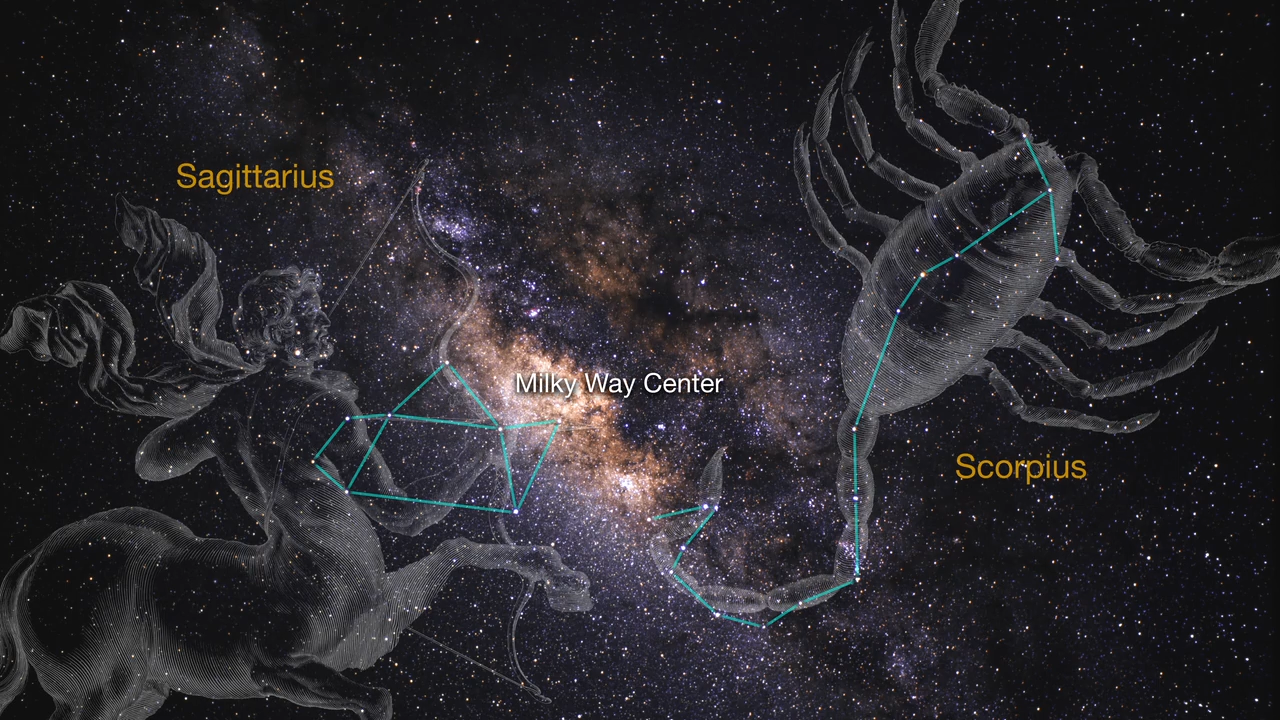
Telescope image shows the Milky Way. The Milky Wayu2019s central region runs from top left to bottom right and has dark lanes of dust overlapping bright regions of stars. At the center is a label, Milky Way Center. The entire image is mostly black with pinpoints of light throughout. Thin blue lines connect several stars of two constellations, including the shape of a teapot representing Sagittarius at left and a long, arced line representing Scorpius at right. On the left, a large illustration of a centaur represents Sagittarius, with the teapot over his right arm. On the right, a large illustration of a scorpion represents Scorpius, with the line running throughout the center of its body.

Zoom to See Terzan 5 Near Our Milky Way Galaxy’s Bulge

Zoom in to Terzan 5, a star cluster that lies within the crowded central region of our Milky Way galaxy known as the bulge. The scene starts with a ground-based image of our Milky Way bulge and zooms in on and circles Terzan 5, ending with the composite image of the star system f…

Related Links

Read more: Hubble’s star clusters

Explore more: ViewSpace | Forms of light: the Cluster Omega Centauri

Watch: Globular Clusters, Stellar Pockets

Watch: Sorting the Stars in Omega Centauri

Webb: News | Images | Science | Home Page

Hubble: News | Images | Science | Home Page


Share

Details

Last Updated
Jun 16, 2026
Contact
Media

Laura Betz
NASA’s Goddard Space Flight Center
Greenbelt, Maryland
laura.e.betz@nasa.gov

Christine Pulliam
Space Telescope Science Institute
Baltimore, Maryland

Claire Blome
Space Telescope Science Institute
Baltimore, Maryland
NASA’s Quantum Lab Aboard Space Station Gets Chilly Upgrade

16 Giugno 2026 ore 18:50
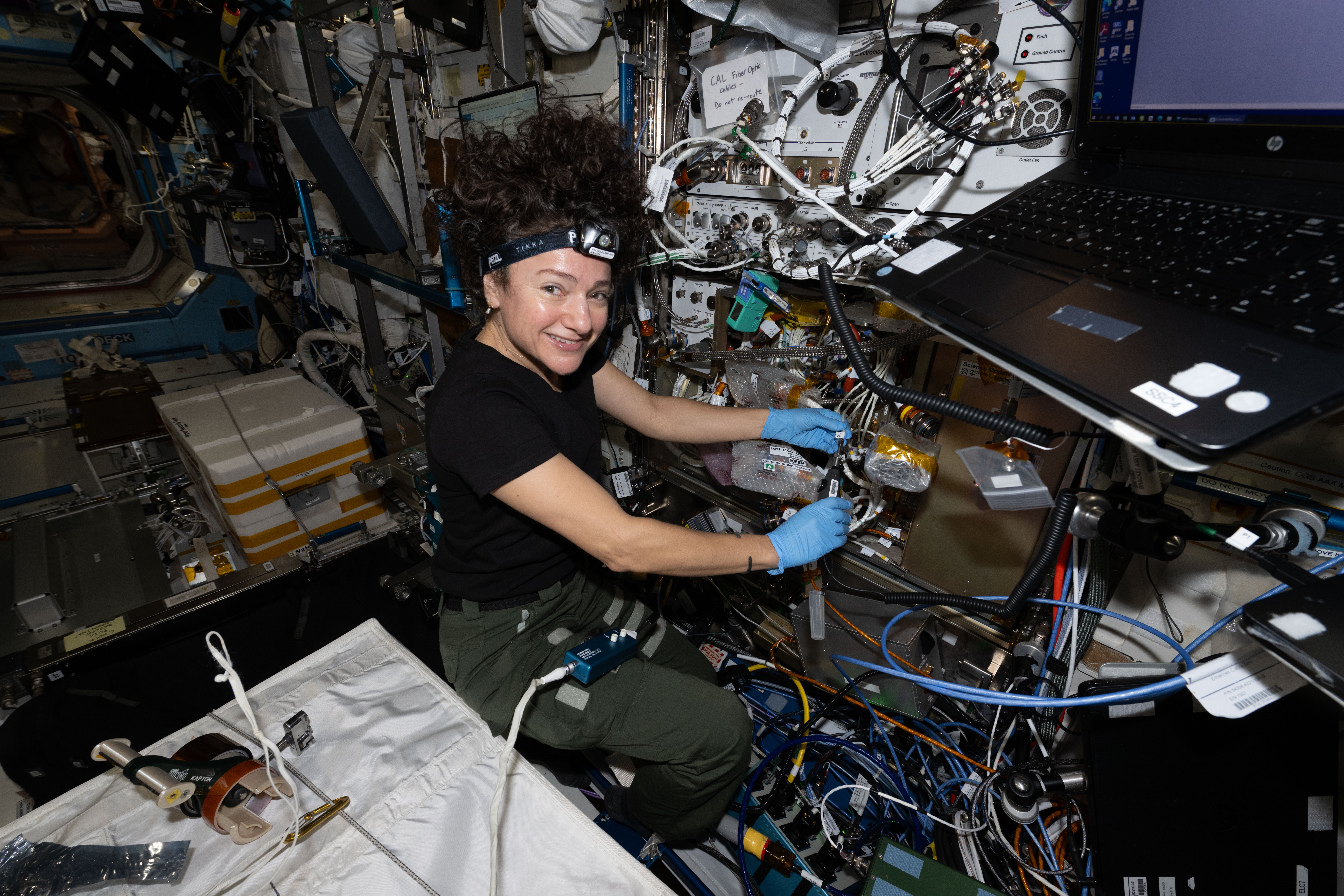
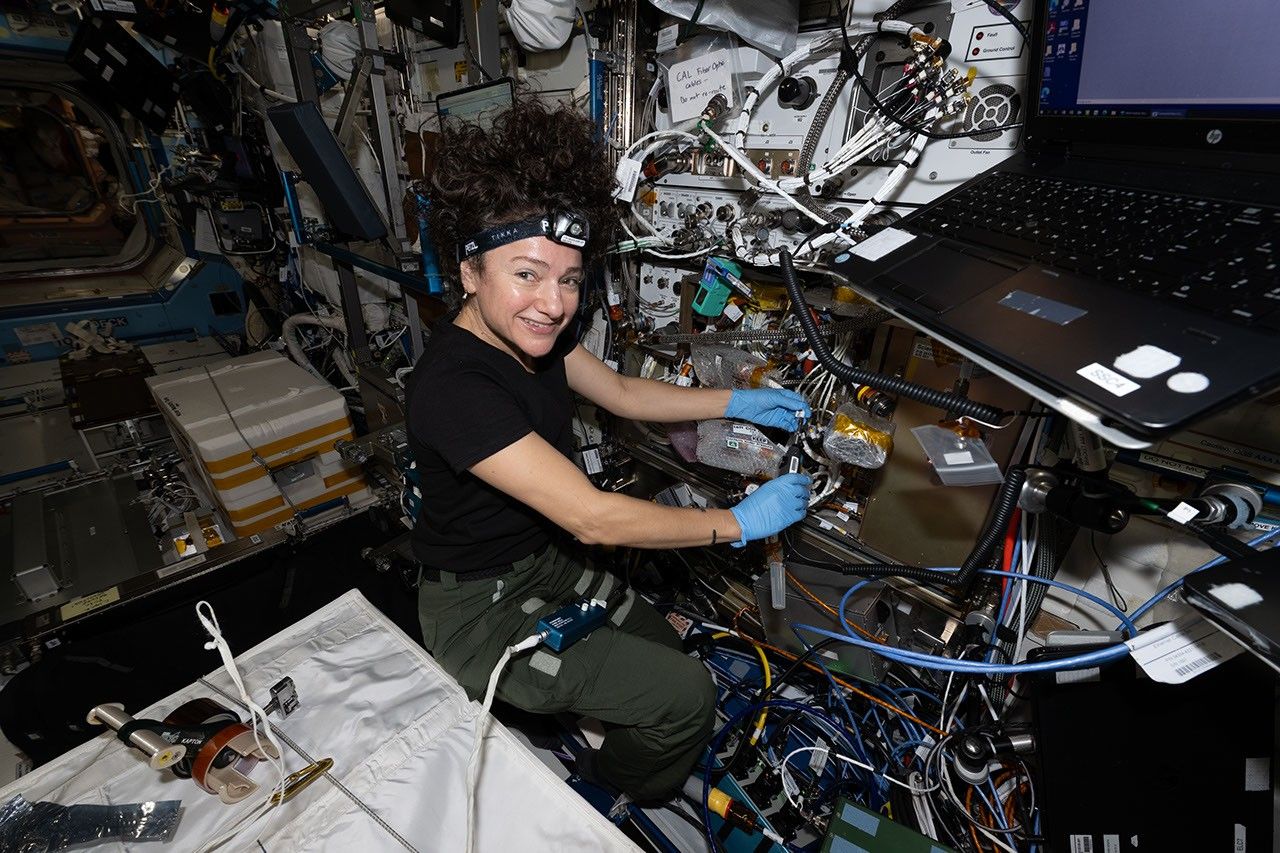
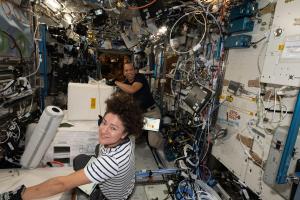
Astronaut Jessica Meir inspects optical fibers while installing hardware updates to NASA’s Cold Atom Lab, or CAL, aboard the International Space Station on May 8, 2026. About the size of a minifridge, CAL enables researchers to explore quantum physics.
NASA

Astronauts aboard the International Space Station have switched on NASA’s newly upgraded Cold Atom Lab, a one-of-a-kind facility designed to improve how scientists explore the fundamental workings of matter and develop new quantum technologies. By leveraging the unique environment of microgravity in space, the lab can accomplish cutting-edge science impossible to do anywhere else.

Quantum science is the study of matter at the smallest scales, like atoms, electrons, and single particles of light. While it’s easy to imagine atoms as billiard balls bouncing off one another, they also exhibit wave-like behavior, can exist simultaneously in two places at once, and may even pass through one another.

About the size of a minifridge and operated from Earth, the Cold Atom Lab chills atoms to temperatures below minus 459 degrees Fahrenheit (minus 237 degrees Celsius). At this extreme cold, just above absolute zero, atoms form a large quantum object called a Bose‑Einstein condensate, or BEC, a collection of matter waves that is a fifth state of matter beyond solids, liquids, gases, and plasma. This object follows the rules of quantum mechanics despite being much larger than subatomic particles, and the microgravity of low Earth orbit helps make the waves even larger.

“At the coldest temperatures, matter behaves drastically different from anything we have experienced,” said Jason Williams, project scientist for Cold Atom Lab at NASA’s Jet Propulsion Laboratory in Southern California, which built the facility. “The wavelike nature of matter dominates, and ultracold matter can behave in ways that are not only unexpected, but that also enable extremely precise measurements of time, gravity, and motion. The lab has lots of tools — especially with this latest upgrade — to let us probe the nature of the universe.”

The project supports five international teams studying fundamental physics. It also tests the space-readiness of quantum tools that could support future Earth science and space exploration missions.

How it works

The heart of the Cold Atom Lab is a complex set of instruments called its science module. An upgraded module launched on April 11 as part of a Commercial Resupply Services mission to the space station, enabling new kinds of experiments.

For each experiment, a strip of rubidium or potassium metal is heated to as high as 750 F (400 C) — hot enough to form a gas within the facility’s vacuum chamber. Lasers tuned to specific frequencies are then fired at the gas, draining the energy from these atoms, and cooling them by slowing them down. Once this gas has completed the laser-cooling stage, a magnetic trap captures and holds the gas in place. Through a series of complex techniques, the laboratory reduces an atom cloud’s energy further, bringing it close to a standstill and maximizing its time in microgravity.

While facilities for studying ultracold gases exist on Earth, the Cold Atom Lab can study quantum gases in microgravity for longer periods of time and at even lower temperatures. Conducting these experiments in low gravity allows scientists to study larger quantum waves that also interact for longer times with gravity. To harness these benefits, the Cold Atom Lab essentially shrinks an atom physics lab, typically the size of an entire room filled with lasers and tabletop mirrors, to fit within an experiment rack aboard the space station.

“As the first project to create Bose-Einstein condensates in orbit, we’re demonstrating that we can make quantum technology work reliably in space,” said Ethan Elliott, deputy project scientist for Cold Atom Lab at JPL. “In the previous century, there was a quantum revolution that led to lasers, cellphones, and MRIs for medical imaging. We’re performing quantum 2.0 — direct manipulation of large quantum states — and we hope for similar gains in quantum tech by advancing this science in orbit.”

The latest upgrade is the fourth since the Cold Atom Lab arrived at the space station in 2018. Key improvements include a newly designed magnetic trap that changes the shape of the quantum gas clouds, allowing scientists to test different properties related to their atoms. The upgrade also features redesigned metal strips that act as sources for those gas clouds.

“It’s the closest thing we have to controlling the boundary of the quantum world,” said Kamal Oudrhiri, project manager of Cold Atom Lab at JPL, referring to those low temperatures. “This new upgrade pushes that boundary even further.”

The upgrade, Oudrhiri added, “demonstrates NASA’s ability to maintain U.S. leadership in space-based quantum technologies while maturing future quantum instruments, such as matter-wave interferometers for fundamental physics missions, positioning, navigation, timing, and gravity sensing of Earth, the Moon, and beyond.”

More about Cold Atom Lab

Managed by Caltech in Pasadena, JPL designed, built, and operates the Cold Atom Lab, which is sponsored by the Biological and Physical Sciences division of NASA’s Science Mission Directorate at the agency’s headquarters in Washington. The division pioneers scientific discovery and enables exploration by using space environments to conduct investigations that are not possible on Earth. Studying biological and physical phenomena under extreme conditions allows researchers to advance the fundamental scientific knowledge required to go farther and stay longer in space, while also benefiting life on Earth. 

To learn more about Cold Atom Lab, visit:

https://nasa.gov/cold-atom-laboratory/

Media Contact

Andrew Good
Jet Propulsion Laboratory, Pasadena, Calif.
818-393-2433
andrew.c.good@jpl.nasa.gov

2026-039

NASA’s Quantum Lab Aboard Space Station Gets Chilly Upgrade

16 Giugno 2026 ore 18:50
Astronaut Jessica Meir inspects optical fibers while installing hardware updates to NASA’s Cold Atom Lab, or CAL, aboard the International Space Station on May 8, 2026. About the size of a minifridge, CAL enables researchers to explore quantum physics.
NASA

Astronauts aboard the International Space Station have switched on NASA’s newly upgraded Cold Atom Lab, a one-of-a-kind facility designed to improve how scientists explore the fundamental workings of matter and develop new quantum technologies. By leveraging the unique environment of microgravity in space, the lab can accomplish cutting-edge science impossible to do anywhere else.

Quantum science is the study of matter at the smallest scales, like atoms, electrons, and single particles of light. While it’s easy to imagine atoms as billiard balls bouncing off one another, they also exhibit wave-like behavior, can exist simultaneously in two places at once, and may even pass through one another.

About the size of a minifridge and operated from Earth, the Cold Atom Lab chills atoms to temperatures below minus 459 degrees Fahrenheit (minus 237 degrees Celsius). At this extreme cold, just above absolute zero, atoms form a large quantum object called a Bose‑Einstein condensate, or BEC, a collection of matter waves that is a fifth state of matter beyond solids, liquids, gases, and plasma. This object follows the rules of quantum mechanics despite being much larger than subatomic particles, and the microgravity of low Earth orbit helps make the waves even larger.

“At the coldest temperatures, matter behaves drastically different from anything we have experienced,” said Jason Williams, project scientist for Cold Atom Lab at NASA’s Jet Propulsion Laboratory in Southern California, which built the facility. “The wavelike nature of matter dominates, and ultracold matter can behave in ways that are not only unexpected, but that also enable extremely precise measurements of time, gravity, and motion. The lab has lots of tools — especially with this latest upgrade — to let us probe the nature of the universe.”

The project supports five international teams studying fundamental physics. It also tests the space-readiness of quantum tools that could support future Earth science and space exploration missions.

How it works

The heart of the Cold Atom Lab is a complex set of instruments called its science module. An upgraded module launched on April 11 as part of a Commercial Resupply Services mission to the space station, enabling new kinds of experiments.

For each experiment, a strip of rubidium or potassium metal is heated to as high as 750 F (400 C) — hot enough to form a gas within the facility’s vacuum chamber. Lasers tuned to specific frequencies are then fired at the gas, draining the energy from these atoms, and cooling them by slowing them down. Once this gas has completed the laser-cooling stage, a magnetic trap captures and holds the gas in place. Through a series of complex techniques, the laboratory reduces an atom cloud’s energy further, bringing it close to a standstill and maximizing its time in microgravity.

While facilities for studying ultracold gases exist on Earth, the Cold Atom Lab can study quantum gases in microgravity for longer periods of time and at even lower temperatures. Conducting these experiments in low gravity allows scientists to study larger quantum waves that also interact for longer times with gravity. To harness these benefits, the Cold Atom Lab essentially shrinks an atom physics lab, typically the size of an entire room filled with lasers and tabletop mirrors, to fit within an experiment rack aboard the space station.

“As the first project to create Bose-Einstein condensates in orbit, we’re demonstrating that we can make quantum technology work reliably in space,” said Ethan Elliott, deputy project scientist for Cold Atom Lab at JPL. “In the previous century, there was a quantum revolution that led to lasers, cellphones, and MRIs for medical imaging. We’re performing quantum 2.0 — direct manipulation of large quantum states — and we hope for similar gains in quantum tech by advancing this science in orbit.”

The latest upgrade is the fourth since the Cold Atom Lab arrived at the space station in 2018. Key improvements include a newly designed magnetic trap that changes the shape of the quantum gas clouds, allowing scientists to test different properties related to their atoms. The upgrade also features redesigned metal strips that act as sources for those gas clouds.

“It’s the closest thing we have to controlling the boundary of the quantum world,” said Kamal Oudrhiri, project manager of Cold Atom Lab at JPL, referring to those low temperatures. “This new upgrade pushes that boundary even further.”

The upgrade, Oudrhiri added, “demonstrates NASA’s ability to maintain U.S. leadership in space-based quantum technologies while maturing future quantum instruments, such as matter-wave interferometers for fundamental physics missions, positioning, navigation, timing, and gravity sensing of Earth, the Moon, and beyond.”

More about Cold Atom Lab

Managed by Caltech in Pasadena, JPL designed, built, and operates the Cold Atom Lab, which is sponsored by the Biological and Physical Sciences division of NASA’s Science Mission Directorate at the agency’s headquarters in Washington. The division pioneers scientific discovery and enables exploration by using space environments to conduct investigations that are not possible on Earth. Studying biological and physical phenomena under extreme conditions allows researchers to advance the fundamental scientific knowledge required to go farther and stay longer in space, while also benefiting life on Earth. 

To learn more about Cold Atom Lab, visit:

https://nasa.gov/cold-atom-laboratory/

Media Contact

Andrew Good
Jet Propulsion Laboratory, Pasadena, Calif.
818-393-2433
andrew.c.good@jpl.nasa.gov

2026-039

NASA’s Quantum Lab Aboard Space Station Gets Chilly Upgrade

16 Giugno 2026 ore 18:50
Astronaut Jessica Meir inspects optical fibers while installing hardware updates to NASA’s Cold Atom Lab, or CAL, aboard the International Space Station on May 8, 2026. About the size of a minifridge, CAL enables researchers to explore quantum physics.
NASA

Astronauts aboard the International Space Station have switched on NASA’s newly upgraded Cold Atom Lab, a one-of-a-kind facility designed to improve how scientists explore the fundamental workings of matter and develop new quantum technologies. By leveraging the unique environment of microgravity in space, the lab can accomplish cutting-edge science impossible to do anywhere else.

Quantum science is the study of matter at the smallest scales, like atoms, electrons, and single particles of light. While it’s easy to imagine atoms as billiard balls bouncing off one another, they also exhibit wave-like behavior, can exist simultaneously in two places at once, and may even pass through one another.

About the size of a minifridge and operated from Earth, the Cold Atom Lab chills atoms to temperatures below minus 459 degrees Fahrenheit (minus 237 degrees Celsius). At this extreme cold, just above absolute zero, atoms form a large quantum object called a Bose‑Einstein condensate, or BEC, a collection of matter waves that is a fifth state of matter beyond solids, liquids, gases, and plasma. This object follows the rules of quantum mechanics despite being much larger than subatomic particles, and the microgravity of low Earth orbit helps make the waves even larger.

“At the coldest temperatures, matter behaves drastically different from anything we have experienced,” said Jason Williams, project scientist for Cold Atom Lab at NASA’s Jet Propulsion Laboratory in Southern California, which built the facility. “The wavelike nature of matter dominates, and ultracold matter can behave in ways that are not only unexpected, but that also enable extremely precise measurements of time, gravity, and motion. The lab has lots of tools — especially with this latest upgrade — to let us probe the nature of the universe.”

The project supports five international teams studying fundamental physics. It also tests the space-readiness of quantum tools that could support future Earth science and space exploration missions.

How it works

The heart of the Cold Atom Lab is a complex set of instruments called its science module. An upgraded module launched on April 11 as part of a Commercial Resupply Services mission to the space station, enabling new kinds of experiments.

For each experiment, a strip of rubidium or potassium metal is heated to as high as 750 F (400 C) — hot enough to form a gas within the facility’s vacuum chamber. Lasers tuned to specific frequencies are then fired at the gas, draining the energy from these atoms, and cooling them by slowing them down. Once this gas has completed the laser-cooling stage, a magnetic trap captures and holds the gas in place. Through a series of complex techniques, the laboratory reduces an atom cloud’s energy further, bringing it close to a standstill and maximizing its time in microgravity.

While facilities for studying ultracold gases exist on Earth, the Cold Atom Lab can study quantum gases in microgravity for longer periods of time and at even lower temperatures. Conducting these experiments in low gravity allows scientists to study larger quantum waves that also interact for longer times with gravity. To harness these benefits, the Cold Atom Lab essentially shrinks an atom physics lab, typically the size of an entire room filled with lasers and tabletop mirrors, to fit within an experiment rack aboard the space station.

“As the first project to create Bose-Einstein condensates in orbit, we’re demonstrating that we can make quantum technology work reliably in space,” said Ethan Elliott, deputy project scientist for Cold Atom Lab at JPL. “In the previous century, there was a quantum revolution that led to lasers, cellphones, and MRIs for medical imaging. We’re performing quantum 2.0 — direct manipulation of large quantum states — and we hope for similar gains in quantum tech by advancing this science in orbit.”

The latest upgrade is the fourth since the Cold Atom Lab arrived at the space station in 2018. Key improvements include a newly designed magnetic trap that changes the shape of the quantum gas clouds, allowing scientists to test different properties related to their atoms. The upgrade also features redesigned metal strips that act as sources for those gas clouds.

“It’s the closest thing we have to controlling the boundary of the quantum world,” said Kamal Oudrhiri, project manager of Cold Atom Lab at JPL, referring to those low temperatures. “This new upgrade pushes that boundary even further.”

The upgrade, Oudrhiri added, “demonstrates NASA’s ability to maintain U.S. leadership in space-based quantum technologies while maturing future quantum instruments, such as matter-wave interferometers for fundamental physics missions, positioning, navigation, timing, and gravity sensing of Earth, the Moon, and beyond.”

More about Cold Atom Lab

Managed by Caltech in Pasadena, JPL designed, built, and operates the Cold Atom Lab, which is sponsored by the Biological and Physical Sciences division of NASA’s Science Mission Directorate at the agency’s headquarters in Washington. The division pioneers scientific discovery and enables exploration by using space environments to conduct investigations that are not possible on Earth. Studying biological and physical phenomena under extreme conditions allows researchers to advance the fundamental scientific knowledge required to go farther and stay longer in space, while also benefiting life on Earth. 

To learn more about Cold Atom Lab, visit:

https://nasa.gov/cold-atom-laboratory/

Media Contact

Andrew Good
Jet Propulsion Laboratory, Pasadena, Calif.
818-393-2433
andrew.c.good@jpl.nasa.gov

2026-039

New Coral Study Identifies Areas Where Reefs Are Hanging On

16 Giugno 2026 ore 17:31
New research has identified areas around the world where cooler currents and other favorable conditions are helping to protect coral from the worst effects of global warming.
❌