❌

Vista elenco

Passion Meets Precision at NASA’s Flight Research Lab

16 Settembre 2026 ore 23:06

4 min read

Preparations for Next Moonwalk Simulations Underway (and Underwater)

One man communicates with a hand-held radio, as two other men wait to the side for the go-ahead command to fly an experiment on a drone.
Derek Abramson, Dale Reed Subscale Flight Research Laboratory chief engineer, left, communicates with the Edwards Air Force Base air traffic control tower for approval to fly the Alta-X drone near NASA’s Armstrong Flight Research Center in Edwards, California, on Thursday, Aug. 27, 2026. Justin Link, small uncrewed aircraft pilot, second from left, and laboratory chief pilot Justin Hall await flight clearance. Researchers at NASA’s Johnson Space Center in Houston developed the advanced guidance and navigation system known as the Safe and Precise Landing – Integrated Capabilities Evolution (SPLICE) experiment, which is installed on the Alta-X. SPLICE will help spacecraft land precisely and detect and avoid potential hazards, which is critical for NASA missions to the Moon and to Mars.
NASA/Ryan Kline

Long before they helped shape NASA’s future aerospace breakthroughs, Derek Abramson, Justin Hall, and Justin Link were in their garages and homes building radio‑controlled aircraft, testing new ideas, and flying their creations at hobby events. That early passion now fuels the work of NASA’s Dale Reed Subscale Flight Research Laboratory at the agency’s Armstrong Flight Research Center in Edwards, California.

At NASA Armstrong’s subscale flight lab, the team turns that lifelong enthusiasm into mission-focused innovation. The laboratory supports research that ranges from advanced navigation systems for future landings on the Moon and Mars to emerging aeronautics concepts that need quick, low-cost evaluation. NASA’s small, remotely piloted and autonomous aircraft allow engineers to explore ideas that could be difficult, risky or expensive to test at full scale.

Skilled team

Abramson, Hall, and Link play key roles in that work. Abramson serves as the laboratory’s chief engineer. Hall is the chief pilot. Link is a drone pilot. Together, they integrate emerging aerospace technologies with the lab’s subscale aircraft fleet and, when needed, design and build aircraft or flight experiments to evaluate new concepts.

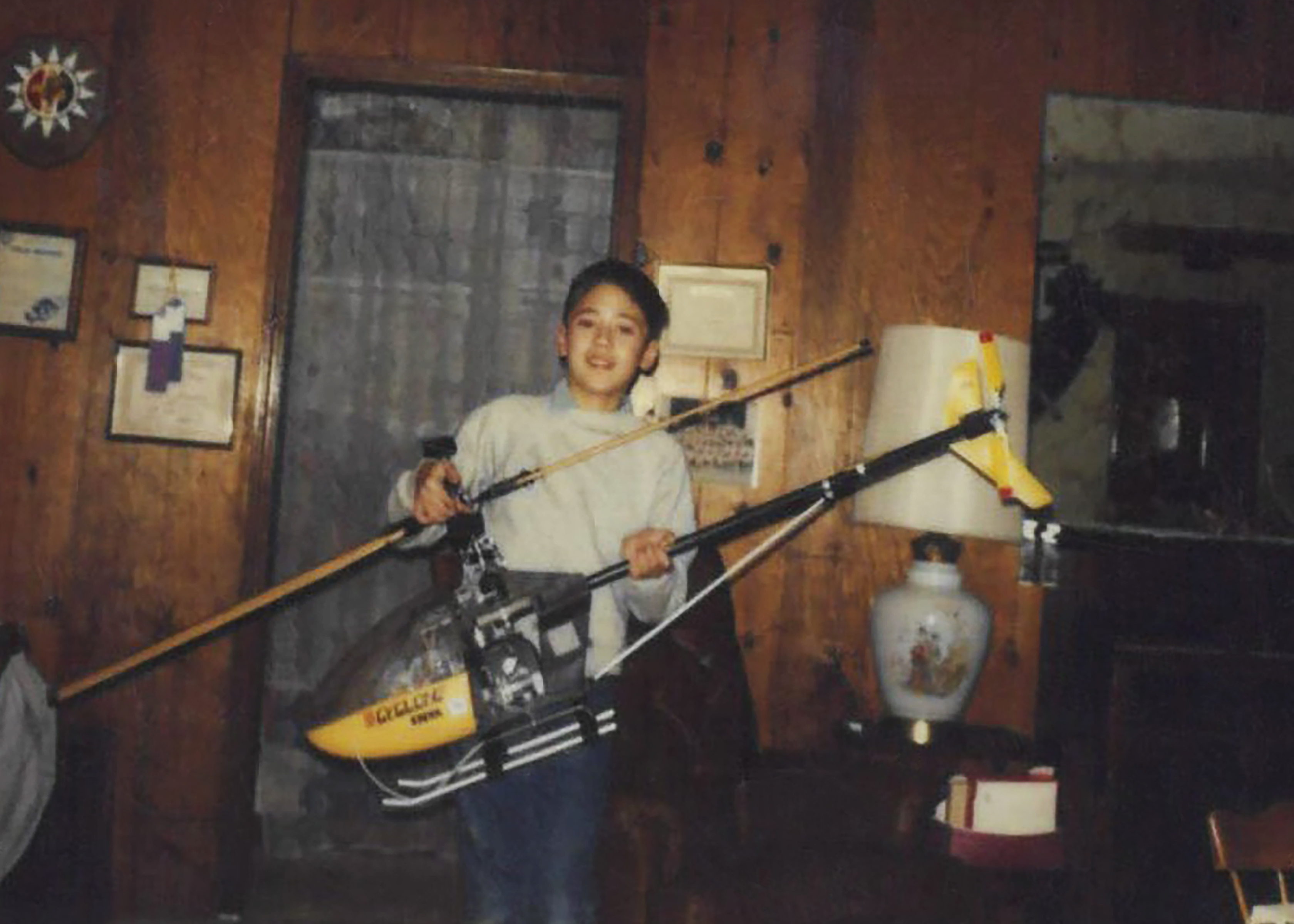
A boy holds a large radio-controlled black-and-yellow helicopter.
Derek Abramson, chief engineer at the Dale Reed Subscale Flight Research Laboratory at NASA’s Armstrong Flight Research Center in Edwards, California, is shown with his Kalt Cyclone radio-controlled helicopter in the mid-1980s. Abramson loved flying this aircraft as a child, and he has been an aviation enthusiast for as long as he can remember.
Derek Abramson

Abramson’s expertise, built through service in the U.S. Navy and the aerospace industry, centers on technical oversight, management, and system design. Hall is known for creative approaches to problem solving and uses practical methods to address technical challenges and maintain flight safety. Link specializes in designing and fabricating research vehicles and draws on extensive hands-on experience to understand what works, and what does not, in flight. 

On weekends, the team often tinkers in their garages or hangars building radio-control aircraft, researching hobby trends, or exploring new technologies. You might see them flying their creations at hobby events or attending trade shows. Their passion for flight brought Abramson, Hall, and Link together years before they one-by-one joined NASA more than a decade ago, though each discovered that spark in a different way.

Early influences

Abramson’s interest began as a child with rubber-band powered stick and tissue aircraft and radio-controlled models. His early aviation pursuits led to his first solo flight while in high school and a pilot’s license. In the Navy, he worked on multiple aircraft, including EA-6B and the F-18, as an avionics technician. As an engineer, he supported the B-1 and CV-22 Osprey aircraft flight tests. As an intern at NASA Armstrong, he used his operational and engineering experience on remotely piloted and autonomous aircraft.

Hall’s interest grew after seeing historic aircraft including the Mach 3 SR-71 fly over his elementary school playground and watching Space Shuttle Challenger land from above his dad’s shoulders. He has built and flown model and remotely piloted aircraft for as long as he can remember. His reputation flying radio-controlled hobby aircraft at fly-ins and trade events led to an offer to fly subscale aircraft at NASA.

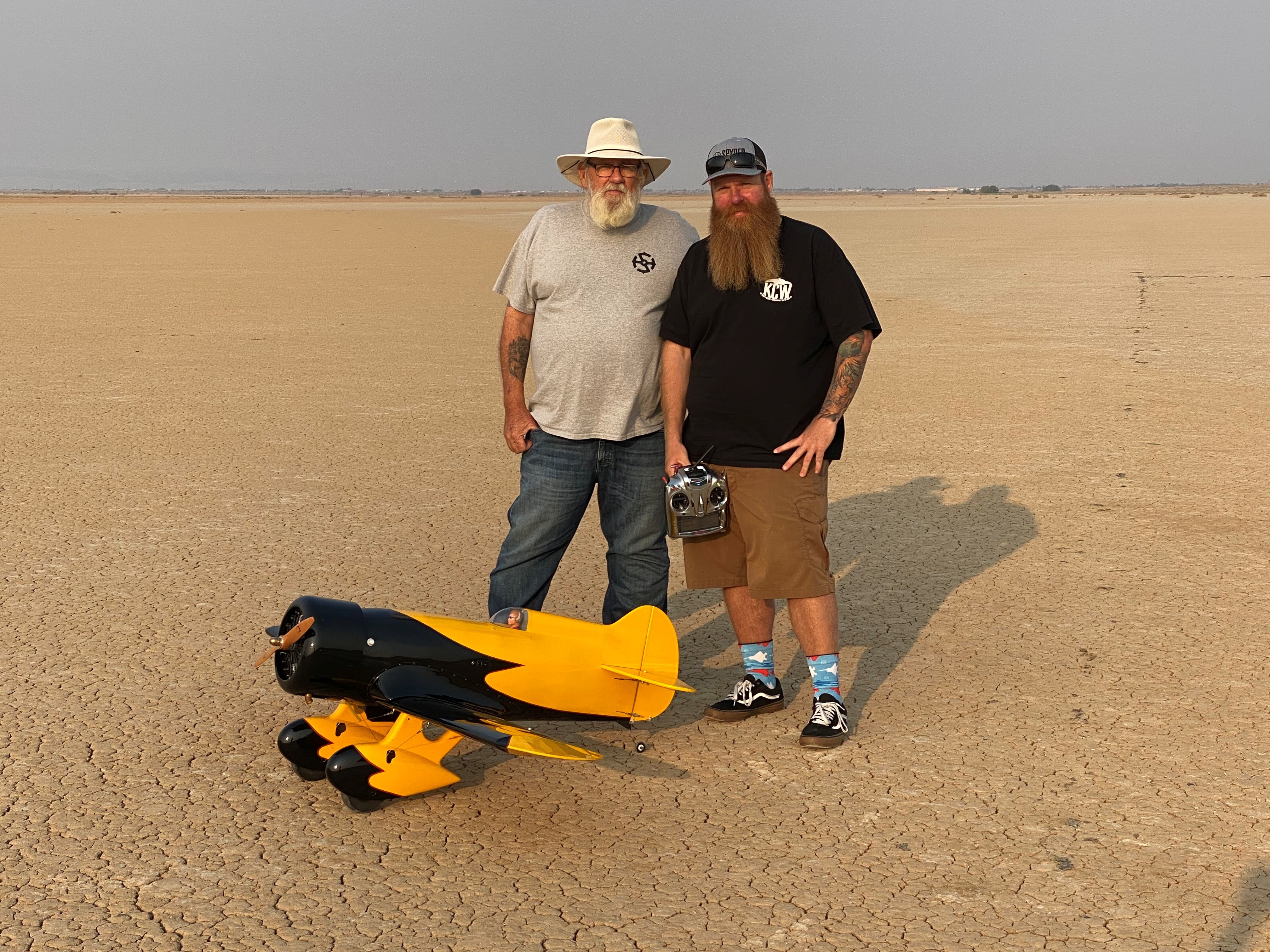
Two men stand by a yellow and black radio-controlled aircraft.
Justin Hall, chief pilot at the Dale Reed Subscale Flight Research Laboratory at NASA’s Armstrong Flight Research Center in Edwards, California, stands in front of a radio-controlled aircraft with his dad, David Hall, in August 2020. David Hall built the Gee Bee aircraft years earlier but was unable to fly it due to his health. He asked his son to fly the aircraft so he could see it in the air, which Justin did the day of this photo. Shortly afterward, David Hall passed away.
Justin Hall
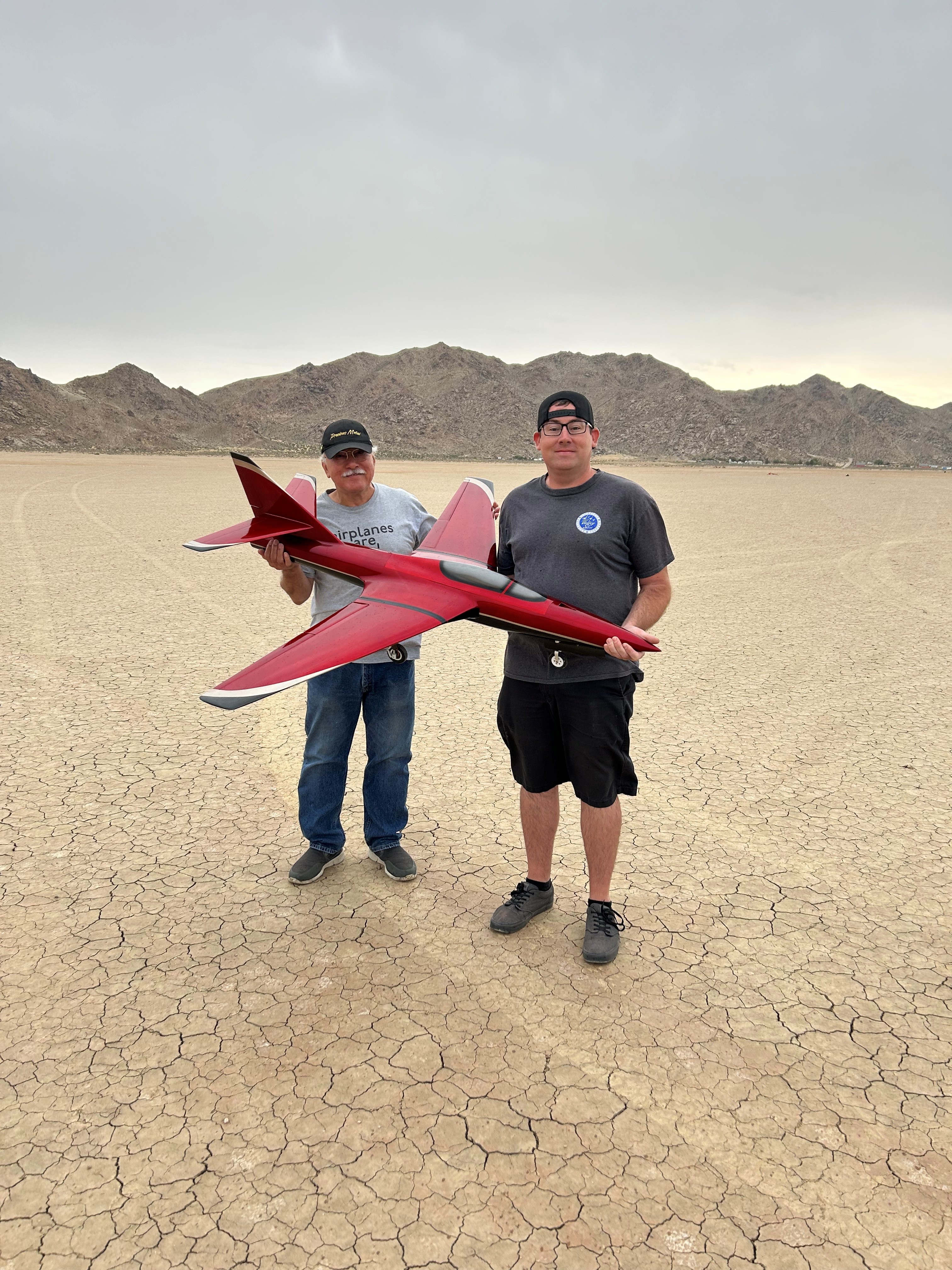
Two men hold a large radio-controlled aircraft. The aircraft is red with white and black stripes.
Justin link, drone pilot at the Dale Reed Subscale Flight Research Laboratory at NASA’s Armstrong Flight Research Center in Edwards, California, and his dad, Don Link, hold a Firebird radio-controlled aircraft on the day of its first flight in September 2023. It was a project they worked on together. Don Link reduced the dimensions of the original larger-scale model aircraft and drew the plans, while Justin Link manufactured composite molds and built the aircraft from scratch.
Justin Link

Link was five years old when he built balsa-wood aircraft with his dad and flew them in a field near their home. As he grew older, his hobby expanded to include radio-controlled cars, boats, helicopters, and aircraft. Aviation runs deep in Link’s family. His great grandfather served in the U.S. Army Air Corps, his grandfathers served in the U.S. Air Force, and his dad was an Air Force avionics technician. Link raced sailplanes, competed with scaled warbird aircraft, and was encouraged by family and friends to pursue an aviation profession. He has worked with large drones for more than 11 years, focusing on research and development, composite materials, and specialized fabrication methods.

Together, the team applies its experience and knowledge in rapid design, fabrication, integration and flight testing to bring new ideas to flight. Their work continues to support NASA’s missions across aeronautics, science, and exploration.

Data Broker Radaris Loses Domains in Privacy Fight

16 Settembre 2026 ore 20:14

The consumer data broker Radaris.com has long had a reputation for ignoring requests to remove personal information from its vast empire of people-search services online. That reputation caught up with the company recently in a lawsuit alleging Radaris violated a New Jersey privacy law that provides for hefty fines against data brokers that publish personal information on state law enforcement officials. In the face of repeated stonewalling and prevarication by attorneys for Radaris, the judge in the case ordered that radaris.com and more than a dozen other data broker domains be transferred to the plaintiffs.
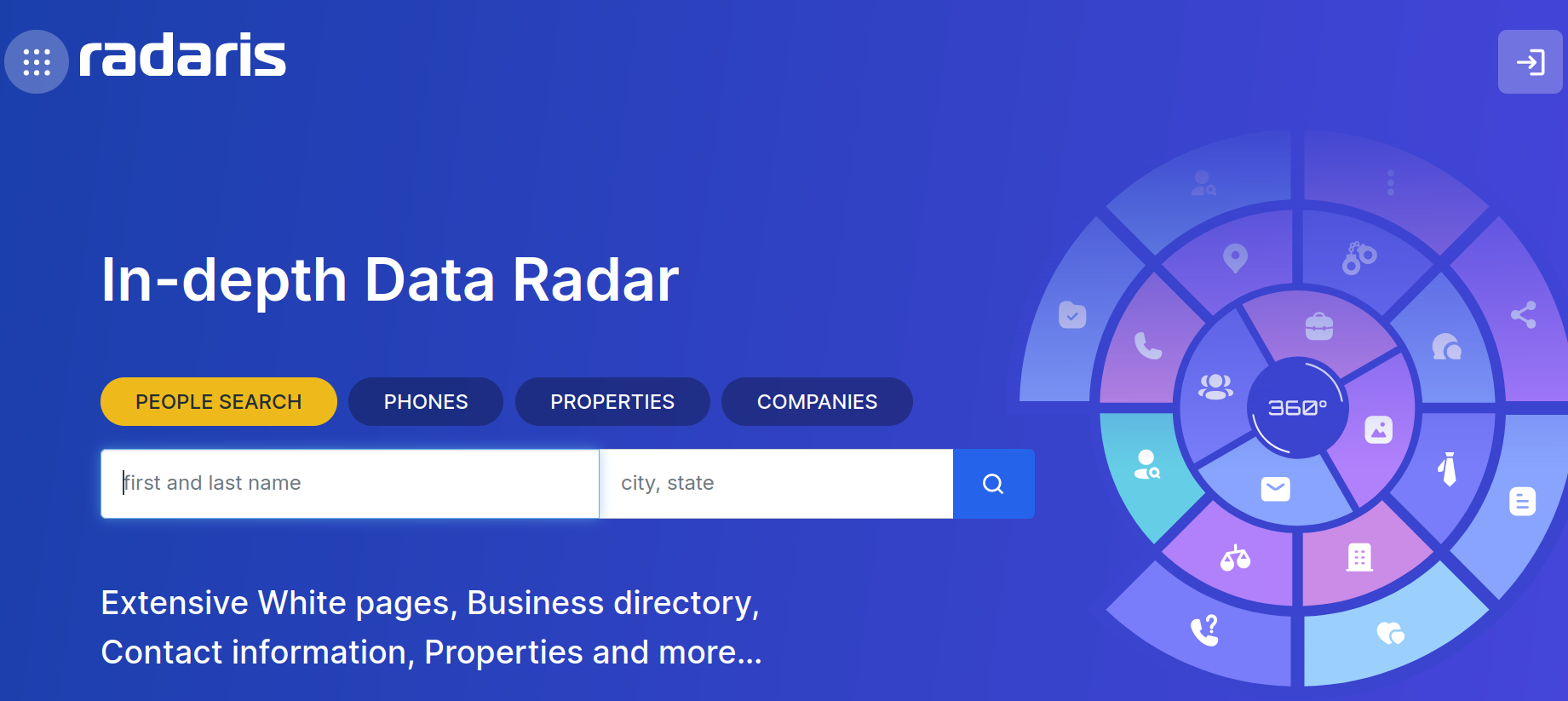
The radaris.com website, prior to the domain transfer to Atlas.

In February 2024, Radaris was sued by Atlas Data Privacy Corp, a company that has been pursuing data brokers alleged to be violating a New Jersey statute called Daniel’s Law. The statute allows state law enforcement officials, government personnel, judges and their families to have their information completely removed from commercial data brokers and people-search services, and provides for fines of $1,000 per violation against companies that ignore removal requests.

Less than a month after Atlas sued Radaris, KrebsOnSecurity published a deep dive into the Radaris co-founders — Igor and Dmitry Lubarsky (also spelled Lybarsky) — Russian-born brothers living in Massachusetts who operate a dizzying array of people-search companies as well as a number of Russian language dating services and affiliate programs.

Attorneys for the Lubarsky brothers threatened to sue for defamation if the story wasn’t removed and an apology issued. Their attorney asserted that our reporting was wildly inaccurate, and that the true owners of the company were Ukrainians living in Ukraine.
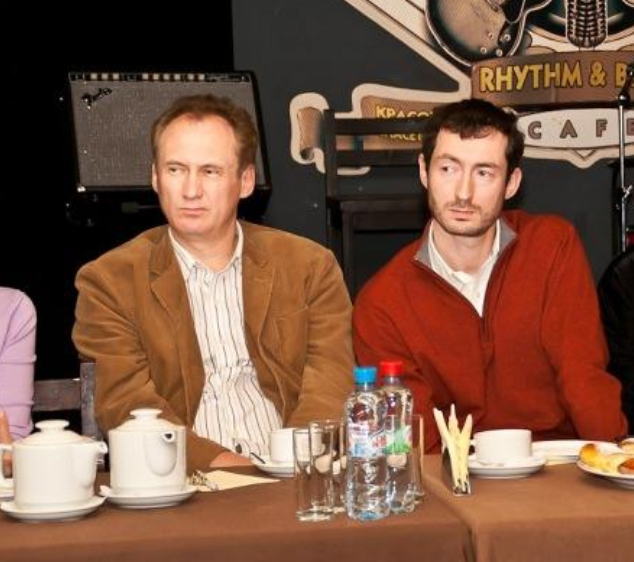
The Lubarsky brothers Dmitry or “Dan” (left) and Gary/Igor.

KrebsOnSecurity doubled down and showed how the Lubarsky brothers built and operated Radaris and other data broker companies using a fictitious CEO’s name. Our follow-up story noted that Radaris’s attorney — a lawyer with the Boston Law Group named Val Gurvits — admitted his clients had invented the CEO pseudonym “Gary Norden,” and that Radaris also had issued multiple press releases over the years that quoted the fake CEO while seeking money from potential investors.

Attorneys for Radaris waited until the last minute to appear in court and contest what was all but certain to be a default judgment in favor of the plaintiffs, and then told the court that Atlas had failed to serve the real owners and operators of Radaris and several of its sister data broker companies.

Atlas re-filed the lawsuit in June 2025, this time dramatically expanding the number of Radaris family data brokers accused of violating Daniel’s Law. Matt Adkisson, president and CEO of Atlas, said Radaris turned to a tried-and-true playbook: Delaying in court until the last possible minute, and playing shell games with Radaris’s true country of origin and the individuals listed as owners and operators of these sites.

“We refer to this period as their island-hopping phase. Privacy policies changed constantly, and new entities kept appearing from places like the Marshall Islands, the British Virgin Islands, and Seychelles,” Adkisson told KrebsOnSecurity. “Behind the scenes, it felt like a shell game. Defense lawyers told the court that certain entities merely operated the domains and were the proper parties to sue. But by the time a judgment neared, those entities would be discarded and new entities would appear. Meanwhile, the lawyers claimed the other entities that actually owned the domains should not be held responsible.”

Adkisson said when the defendants updated their terms of service to state that Radaris was suddenly managed by a company in the Marshall Islands, Atlas hired an investigator in that country and soon learned the brand new entity that Radaris claimed was managing the company didn’t even exist yet.

Mr. Gurvits stepped forward as Radaris’s attorney in a class action lawsuit the company temporarily lost in 2017 because it never contested the claim in court. When the plaintiffs told the judge they couldn’t collect on the $7.5 million default judgment, the court ordered the domain registry Verisign to transfer the radaris.com domain name to the plaintiffs.

Mr. Gurvits appealed that verdict, arguing the lawsuit hadn’t named the actual owners of the Radaris domain name — a Cyprus company called Bitseller Expert Limited — and thus taking the domain away would be a violation of their due process rights.

The judge in the 2017 case ruled in Radaris’ favor — halting the domain transfer — and told the plaintiffs they could refile their complaint. Soon after, the operator of Radaris changed from Bitseller to Andtop Company, an entity formed (PDF) in the Marshall Islands in Oct. 2020. The plaintiffs never re-filed their lawsuit.
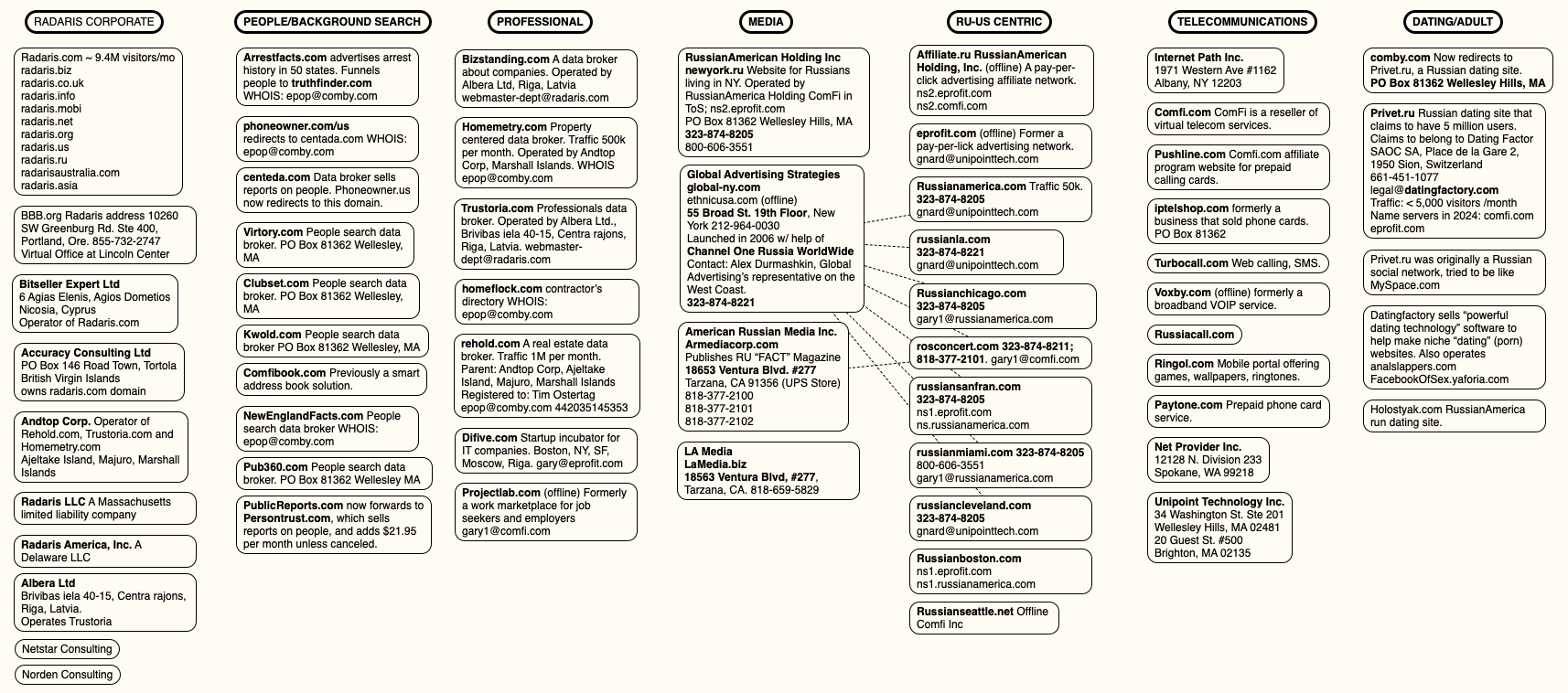
A mind map of various entities tied to Radaris and the company’s co-founders. Click to enlarge.

“That seemed to be their modus operandi,” said Raj Parikh, a partner at PEM Law in New Jersey who handles most of the Daniel’s Law litigation for Atlas. “In the past, they won by attrition. Plaintiffs’ attorneys tired of the procedural games and just gave up. That strategy worked for a decade, and it probably would have worked in this case too, since any financial recovery from foreign actors will be difficult. But we were acutely aware of the threat this website posed to law enforcement officers and other public officials in New Jersey, and decided early on to commit whatever time and resources were necessary to remove that threat.”

On August 26, the judge in the New Jersey case found the defendants were given multiple chances to appear and defend the claims against them but had failed to do so. Mr. Gurvits declined to comment on the case, saying it had been assigned to another attorney, a Mr. Victor Worms. In response to questions, Mr. Worms asserted the New Jersey court transferred Radaris.com to Atlas as part of a default judgment against Radaris.com, which is not a legal entity.

“We have made a motion to vacate that default judgment on the grounds that it is void since a non-entity has no legal capacity to sue or be sued,” Worms replied. “We also intend to pursue all appropriate appeals because we believe the transfer of Radaris.com amounts to a forfeiture in violation of various constitutional principles.”

While radaris.com still comes up prominently in results when searching online for U.S. residents by name, the domain no longer sells detailed personal dossiers on millions of Americans. Its homepage now displays a notice from Atlas, as well as links to our previous reporting on Radaris.

EMAIL CONFIRMATIONS

Atlas told KrebsOnSecurity that it has obtained more than 10,000 emails and documents in the course of litigation, and that those messages confirm our previous reporting on the owners and operators of Radaris and its myriad companies.

Atlas said the emails clearly establish that the nominal legal vehicles — Radaris America, Inc.; Bitseller Expert Limited; Digital Orbit Corp; Core Solutions Group Inc; Lucky Solutions Inc; Virtura Corp; Veripages Inc.; Nuform Solutions Inc.; Growth Data Advisors Inc.; Property Experts, Inc — are all administered by the same three or four people from the same mailboxes, share one bank or payment card set, and are all managed from one virtual office address.

“The corpus establishes, with documentary evidence generated independently by banks, payment processors, hosting providers, registrars, software-as-a-service vendors and the operators’ own systems, that radaris.com and at least twenty-five other people-search websites are one operation run by a small Boston-area group whose administrative, financial and technical functions sit on the difive.com mail domain and its successors (centerex.com, scienteco.com, eprofit.com, realmo.com, pub360.com),” reads a summary shared by Atlas.

Atlas said the emails show Radaris.com earns approximately $42,000 a month, while Veripages.com earns around $45,000 monthly via its partnership with the Lifetime Value Company, a marketing and advertising firm whose brands include PeopleLooker, PeopleSmart, NumberGuru, and Bumper, a car history site.

According to Atlas, the emails also showed the Radaris family of websites earns as much as $25,000 each month from their partnership with Onerep, a company that claims to help people remove their information from people-search sites. In March 2024, KrebsOnSecurity revealed how the Belarusian founder of Onerep had launched and operated dozens of people-search sites over the years and was continuing to operate one of them (Nuwber), effectively spreading the disease and selling the cure.

The domain radaris.com now redirects to this notice from Atlas about the court-ordered domain transfer.

The domain radaris.com now redirects to this notice from Atlas about the court-ordered domain transfer.

All told, the New Jersey court has so far transferred 14 domain names from the Radaris family of companies to Atlas. Radaris.com now redirects to a notice of the court-ordered domain transfer.

THE ROAD AHEAD

The Radaris family of companies is still potentially facing fines of $1,000 per alleged violation of Daniel’s Law. For the time being, however, Daniel’s Law is facing a constitutional challenge from virtually all of the 150 other consumer data broker firms being sued by Atlas.

The data broker industry responded by having at least 70 of the Atlas lawsuits moved to federal court, challenging the New Jersey statute as overly broad and a violation of the First Amendment. The U.S. Court of Appeals for the Third Circuit has not yet issued a decision on the constitutional challenge, but either way the case is widely expected to be appealed all the way to the U.S. Supreme Court.

Meanwhile, at least 14 other states have now passed laws modeled after the New Jersey statute, with more states considering similar measures. However, West Virginia’s Daniel’s Law was ruled facially unconstitutional under the First Amendment by a federal district court in August 2025.

Justin Sherman is a privacy expert and author of the forthcoming book “The Middlemen,” which examines how the data broker industry powers modern surveillance. Sherman said federal lawmakers have long faced intense lobbying by the technology industry against more restrictive U.S. data privacy laws, but that many powerful industries are now working against passing comprehensive data privacy legislation.

“These days at the federal level, add in the intense amount of lobbying against these laws from social media companies, big tech, cryptocurrency firms, and now AI proponents in the mix who claim that limiting their data scraping is somehow going to collapse the whole U.S. economy under Chinese rule,” he said.

Sherman said people-search companies will continue to thrive unless and until Congress enacts meaningful consumer privacy and data protection laws that are relevant to life in the 21st century. That’s because virtually all state privacy laws exempt records that might be considered “public” or “government” documents, including voting registries, property filings, marriage certificates, motor vehicle records, criminal records, court documents, death records, professional licenses, bankruptcy filings, and more.

At least 25 states have passed or implemented laws requiring age verification for residents seeking to access adult content online, but there is no federal law that limits how the companies that are scanning everyone’s drivers license can use, share or keep the data provided. Had such restrictions been enshrined in law, we may have avoided the recent breach at IDScan.net, which exposed the drivers license information on more than 153 million Americans when the records were briefly turned into a point-and-click identity theft service on the dark web.

“The average person can look at Daniel’s Law and have a perfectly normal reaction, which is that everyone should be covered, not just police and judges,” Sherman said. “But we don’t need more wake-up calls. We’ve had eight million wake-up calls already on the need for better privacy laws. The lack of comprehensive federal privacy law is not for a lack of knowledge, and anyone claiming otherwise is either not reading the news or kidding themselves.”

unifont @ Savannah: Unifont 18.0.01 Released

16 Settembre 2026 ore 18:36

16 September 2026 Unifont 18.0.01 is now available.  This release is aligned with Unicode 18.0.0, adding almost 400 new glyphs.

Download this release from GNU server mirrors at:

     https://ftpmirror ... /unifont-18.0.01/

or if that fails,

     https://ftp.gnu.o ... /unifont-18.0.01/

or, as a last resort,

     ftp://ftp.gnu.org ... /unifont-18.0.01/

These files are also available on the unifoundry.com website:

     https://unifoundr ... /unifont-18.0.01/

Font files are in the subdirectory

     https://unifoundr ... 0.01/font-builds/

A more detailed description of font changes is available at

      https://unifoundr ... nifont/index.html

and of utility program changes at

      https://unifoundr ... nt-utilities.html

Information about Hangul modifications is at

      https://unifoundr ... hangul/index.html

and

      http://unifoundry ... l-generation.html

Enjoy!
Paul Hardy, GNU Unifont Maintainer

Thunderbird 156 Released with OAuth Improvements, OpenPGP Updates, and Major Linux Fixes

Thunderbird 156 Released with OAuth Improvements, OpenPGP Updates, and Major Linux Fixes

The Thunderbird team has officially released Thunderbird 156, bringing another round of new features, security improvements, authentication enhancements, and reliability fixes to the popular open-source email client. Released on September 15, 2026, the update is available for Linux alongside Windows and macOS.

Thunderbird 156 is not a dramatic redesign of the desktop mail client. Instead, it concentrates on improving areas that matter to everyday users and system administrators, including OAuth authentication, OpenPGP, POP3, IMAP, Exchange Web Services, SMTP, attachments, calendars, enterprise policies, and security.

For Linux users in particular, the release delivers several fixes affecting common mail protocols and account configurations while retaining support for Linux environments using GTK+ 3.14 or newer.

Thunderbird 156 Arrives on Linux

Thunderbird 156 follows version 154, which arrived in August with features including optional system tray operation and Microsoft Graph support for Microsoft 365.

Version 156 continues the project's monthly release cycle with a more targeted collection of authentication, security, compatibility, and reliability improvements.

According to Thunderbird's official release notes, version 156 requires:

  • Linux: GTK+ 3.14 or newer
  • Windows: Windows 10 or newer
  • macOS: macOS 10.15 or newer

Thunderbird 156 was officially released on September 15.

Linux distribution availability will vary because distributions can package Thunderbird according to their own schedules. Users receiving Thunderbird through another packaging channel may therefore see version 156 at a different time.

Custom OAuth Support Expands

One of the most significant areas of development in Thunderbird 156 is OAuth authentication.

Thunderbird now supports custom OAuth configurations containing an issuer ID and client secret for IMAP and POP3 accounts. Custom OAuth support has also been extended specifically to POP3.

OAuth has become increasingly important as email providers move away from conventional username-and-password authentication toward token-based authentication.

For Thunderbird, broader custom OAuth support means users and organizations have greater flexibility when connecting the client to mail services that don't fit Thunderbird's predefined provider configurations.

This can be particularly useful in enterprise environments, self-hosted infrastructure, and organizations operating their own identity systems.

Exchange Custom OAuth Setup Fixed

Exchange users receive an important related correction.

Umberto Eco alla Convenzione nazionale de L'Ulivo. Milano, 24 marzo 1996

💾

Scheda integrale: https://shorturl.at/aaBw2

Abstract: L'intervento di Umberto Eco alla Convenzione nazionale de L'Ulivo, svoltasi al Palatrussardi di Milano dal 23 al 24 marzo 1996

Archivio Audiovisivo del Movimento Operaio e Democratico
aamod.it
facebook • facebook.com/archivioaamod
instagram • instagram.com/archivioaamod
twitter • twitter.com/archivioaamod

Il Massimo del Gelato festeggia il suo 25° anniversario

di: admin
16 Settembre 2026 ore 11:33

Da 25 anni il gusto prende colore grazie a voi.
Si farà festa con un evento speciale al Bobino Milano.

Venticinque anni di gusto, colore e passione meritano di essere festeggiati come si deve.
Il Massimo del Gelato celebra l’importante traguardo del suo 25° anniversario con un
evento speciale, in programma giovedì 24 settembre 2026, a partire dalle ore 18:30,
presso il Bobino Milano in Piazzale Stazione Genova, 4.


L’evento nasce come un momento di ringraziamento dedicato a tutti coloro che, nel
corso degli anni, hanno scelto Il Massimo del Gelato come punto di riferimento in città.
Per l’occasione, nella terrazza dello storico locale “Bobino”
a Milano verrà allestito uno
spazio dedicato: qui i partecipanti non solo potranno riscattare il proprio gelato in
omaggio, ma avranno anche la possibilità di accompagnare l’esperienza con un piacevole
aperitivo, con flute e un buffet pensato per l’occasione.

–

COME PARTECIPARE ALL’EVENTO :

Fai il tuo ACCREDITO NOMINALE su questo link :
https://www.infomilano.news/eventi/25annidimassimodelgelato

–

Il programma della serata:
Un gelato in omaggio per tutti i partecipanti registrati;
Un photobooth per immortalare la serata e portare a casa un ricordo dell’
evento;
Musica e sorprese pensati per rendere la serata ancora più coinvolgente.
Un piacevole aperitivo da godersi nella terrazza del locale.
Questi 25 anni rappresentano molto più di un semplice anniversario: sono il risultato
della fiducia e dell’affetto delle persone che hanno scelto Il Massimo del Gelato ogni
giorno. Con questo evento Massimo e Alessio Travani vogliono dire semplicemente
grazie e condividere insieme un nuovo, dolcissimo capitolo della loro storia.


Il Massimo Del Gelato

Via Lodovico Castelvetro 18, Milano
IG: massimodelgelato

L'articolo Il Massimo del Gelato festeggia il suo 25° anniversario proviene da InfoMilano.news.

Cinema in Festa: a Milano biglietti a 3,50 euro dal 21 al 24 settembre 2026

di: admin
16 Settembre 2026 ore 11:25

Quattro giornate dedicate al grande schermo con un prezzo davvero speciale.

Da lunedì 21 a giovedì 24 settembre 2026 torna Cinema in Festa, l’iniziativa che consente di assistere ai film in programmazione nelle sale aderenti acquistando il biglietto a soli 3,50 euro.


L’appuntamento coincide con l’avvio della nuova stagione cinematografica e coinvolge numerosi cinema di Milano e dell’hinterland. La promozione non riguarda soltanto alcuni titoli selezionati: il prezzo agevolato viene applicato ai film della normale programmazione delle sale partecipanti, comprese le produzioni internazionali.

Quattro giorni di cinema a soli 3,50 euro


Nato nel 2022 dalla collaborazione tra ANEC e ANICA, Cinema in Festa è realizzato con il sostegno del Ministero della Cultura e con la collaborazione dell’Accademia del Cinema Italiano – Premi David di Donatello.
Il progetto prevede ogni anno due appuntamenti, tradizionalmente organizzati nei mesi di giugno e settembre. L’edizione di settembre 2026 rappresenta l’ultimo appuntamento del progetto quinquennale, che arriva quest’anno alla sua conclusione.
Dal 21 al 24 settembre sarà quindi possibile scegliere tra i film proposti dalle sale aderenti e acquistare il biglietto al prezzo di 3,50 euro per ogni spettacolo. In caso di acquisto online, le singole strutture potrebbero applicare eventuali costi aggiuntivi legati alla prevendita.


I cinema aderenti a Milano
Anche a Milano Cinema in Festa coinvolge numerose realtà, dai grandi multisala alle sale indipendenti, fino ad alcuni dei cinema storici più conosciuti della città.


Tra le strutture che hanno partecipato all’edizione di giugno e che figurano tra quelle coinvolte nell’iniziativa milanese troviamo Anteo Palazzo del Cinema, Anteo CityLife, Arcobaleno Filmcenter, Ariosto Spaziocinema, Beltrade, Centrale Multisala, Cinelandia Milano Certosa, Cineteca Milano Arlecchino, Cineteca Milano MIC, Colosseo Multisala, Ducale Multisala, Eliseo Multisala, Il Cinemino, Martinitt Cinema Teatro, Mexico, Notorious Cinemas Gloria, Notorious Cinemas Merlata Bloom, Orfeo Multisala, Palestrina, Plinius e UCI Cinemas Bicocca.

Per l’edizione di settembre è comunque opportuno controllare preventivamente la programmazione e verificare l’effettiva partecipazione del singolo cinema prima di procedere con l’acquisto, poiché l’adesione viene definita autonomamente da ciascuna struttura.
L’iniziativa si estende inoltre all’hinterland milanese, con cinema presenti, tra gli altri, ad Assago, Bellinzago Lombardo, Cerro Maggiore, Cesano Boscone, Cinisello Balsamo, Cologno Monzese, Gorgonzola, Legnano, Magenta, Melzo, Paderno Dugnano, Pioltello, Rho, Rozzano, San Donato Milanese, San Giuliano Milanese e Sesto San Giovanni.


Quali film rientrano nella promozione
Uno degli aspetti più interessanti di Cinema in Festa è proprio la possibilità di scegliere liberamente tra i titoli della normale programmazione delle sale partecipanti. Il biglietto promozionale non è quindi riservato a un genere specifico né a una selezione limitata di pellicole.
L’appuntamento di settembre cade inoltre in un periodo particolarmente ricco per gli appassionati di cinema, grazie all’arrivo delle nuove uscite della stagione autunnale e di diversi titoli internazionali attesi sul grande schermo.
Per scoprire quali film saranno disponibili e individuare il cinema aderente più comodo è possibile consultare il programma ufficiale di Cinema in Festa, dove vengono pubblicate le sale partecipanti e le relative proiezioni.

L'articolo Cinema in Festa: a Milano biglietti a 3,50 euro dal 21 al 24 settembre 2026 proviene da InfoMilano.news.

❌