Astronomers have used NASA’s Chandra X-ray Observatory to break down the cause of a remarkable formation of radio waves they have nicknamed the “Treble Clef” because its distinct shape strongly resembles the musical symbol.
The researchers discovered the Treble Clef is likely caused by an outburst from a supermassive black hole, followed by a collision of two galaxy clusters. A paper describing the findings, led by Andrea Botteon of the National Institute for Astrophysics, or INAF, in Italy, published Wednesday in the Astronomy & Astrophysics journal.
An explanation for the Treble Clef has been particularly difficult to find because the formation lies almost directly behind the plane of the Milky Way, meaning that stars, gas, and dust from our home galaxy largely block the view from Earth. However, by using telescopes that can peer through the intervening material, a team of researchers was able to identify what is responsible for this uncommon structure.
NASA’s Chandra and the German Extended RÖntgen Survey with an Imaging Telescope Array (eROSITA) X-ray telescope found diffuse, hot gas at the location of the Treble Clef, showing that a galaxy cluster hosts the object. The researchers also determined the galaxy cluster is, in fact, two clusters in the process of merging. Galaxy clusters are some of the largest structures in the universe, containing hundreds of individual galaxies and huge reservoirs of superheated gas.
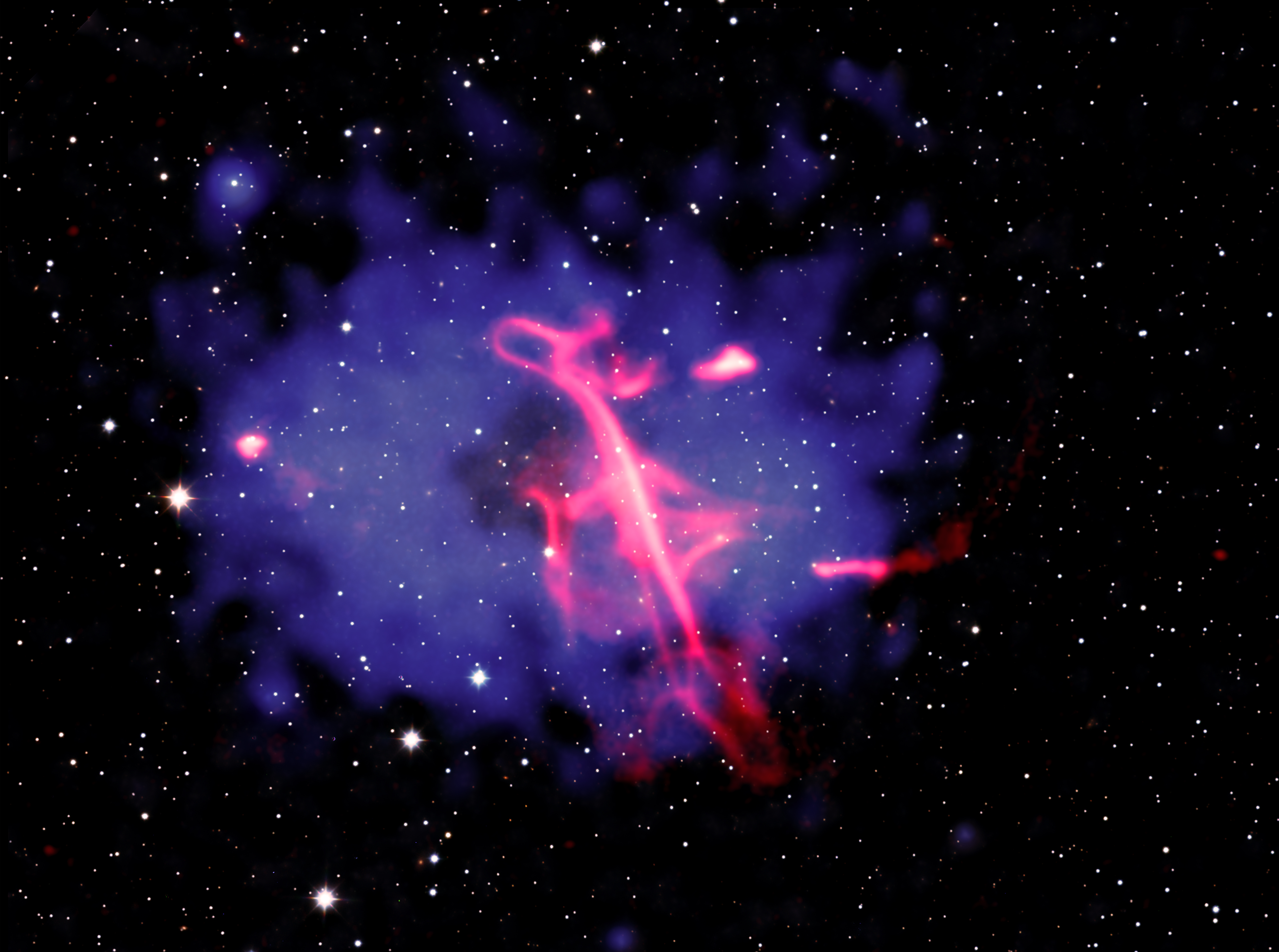
This new composite image of the Treble Clef and its cluster shows the multimillion-degree gas detected in X-rays by Chandra and eROSITA in blue, with some of the Chandra data derived from a special technique the authors used to highlight important features in the Chandra data. Radio data shown in red from the LOw Frequency ARray (LOFAR), a large network of radio telescopes in Europe reveals the doppelganger of the musical notation. The final piece of the combined image comes from infrared data obtained by the United Kingdom Infrared Telescope, appearing mostly white.
The authors concluded that the Treble Clef likely formed in a two-stage process. First, an earlier outburst from a supermassive black hole in the galaxy cluster’s center drove clouds of charged particles and magnetic fields away at close to the speed of light. This led to a type of cosmic crescendo and initially produced bright radio waves that later faded as the particles lost energy. Next, the collision between the two clusters compressed or reenergized the cloud, which became brighter again in radio waves. Shock waves — similar to the sonic booms from supersonic jets — from the collision may have played a role in this reenergizing process.
To reveal evidence for the cluster collision in the Chandra data, the authors used a special technique that examined how much the cluster’s hot gas deviates from a symmetrical shape. Most of the hot gas is symmetrical and shaped approximately like an oval. The authors removed this symmetrical oval shape from the original X-ray image. The remaining X-ray emission in the residual image shows t is brightest on the left and right, and faintest in the center. The new composite image combines both the original X-ray and the residual X-ray images.
The brighter X-rays in the residual image, toward the left and right of the cluster’s center, imply that the collision between the two clusters likely occurred along the left-right direction as seen in the image. The researchers think the direct collision between the two clusters occurred a few hundred million years ago, and the clusters are now moving away from each other.
The resemblance to a treble clef is a case of pareidolia, the phenomenon when people see familiar shapes in random data, since there is no scientific connection to the musical notation.
NASA’s Marshall Space Flight Center in Huntsville, Alabama, manages the Chandra program. The Smithsonian Astrophysical Observatory’s Chandra X-ray Center controls science operations from Cambridge, Massachusetts, and flight operations from Burlington, Massachusetts.
This release features a composite image of a remarkable radio wave formation that strongly resembles a treble clef musical symbol, hovering in the midst of two colliding galaxy clusters.
Here, galaxies in the galaxy clusters, plus foreground and background stars and galaxies, blanket the image with specks of light set against the blackness of space. At the center of the frame is a large, oval, blue-purple cloud with ragged edges. This is a multimillion-degree gas cloud in the two clusters detected in X-rays by Chandra and eROSITA, the Extended RÖntgen Survey with an Imaging Telescope Array.
In the middle of the purple field, tilting slightly to our left, is what appears to be a giant treble clef, loosely drawn with a neon pink marker. Like the musical notation for which it’s named, the formation has a strong vertical stroke with a continuous, fluid line swooping back and forth as it moves from top to bottom.
This radio wave formation appears to be the result of a two-stage process. First, charged particles and magnetic fields were driven from a supermassive black hole, producing bright radio waves. Those waves faded and lost energy over time, before being reenergized and compressed when the two galaxy clusters collided.
In Booz Allen’s isolated OT lab, AI models met every objective across eight scenarios and reached an industrial control network from a perimeter compromise in just over 16 minutes.
Meta is building a massive data center on the northeast edge of El Paso, Texas, on the New Mexico border. Paul Ratje for ProPublica and The Texas Tribune
Last December, New Mexico officials celebrated publication of a plan to address climate change, designed to dramatically reduce the state’s greenhouse gas emissions by 2050. A few months later, just across the state line in Texas, El Paso city officials adopted their own such plan with a similar ambition.
Each report cost millions of dollars to draft, but neither one took into account how the construction of data centers could upend climate goals in both places.
Work is underway in Doña Ana County in southern New Mexico on one of the largest data center developments in the country: Project Jupiter, built by Austin-based Oracle. Twenty miles away in El Paso, construction is underway on another massive data center, this one built by Meta Platforms.
A third, larger data center project is planned less than a 30-minute drive from the Meta site, on the Fort Bliss Army post in east El Paso.
The data centers are “going to undo a lot of the very expensive and very meaningful work a lot of people are doing,” New Mexico state climatologist Dave DuBois told El Paso Matters.
The sites are among a wave of data centers under construction across the country, driven by the rapidly escalating demand for artificial intelligence services like Claude and ChatGPT. Such projects have drawn intense scrutiny in recent months, as residents and elected officials have questioned their impact on communities’ water supplies, household electric bills and air quality. Texas alone has 596 data centers that are either in operation or planned across Texas as of early September, according to research by The Texas Tribune.
But the projects located in this population center of 1.2 million, which encompasses El Paso and parts of southern New Mexico, are particularly notable because of their combined scope. When fully built out, the three data centers, each with its own power plant, will emit millions of tons of greenhouse gas emissions, equivalent to the planet-warming emissions released by more than two million cars in a year.
They will also release air pollutants like particulate matter and nitrogen oxides, which directly affect local air quality and human health. The Meta and Project Jupiter data centers are expected to release these kinds of pollutants at relatively low levels, according to paperwork submitted to state regulators. But even a small increase in air pollution can still negatively impact communities close to and downwind of the data center sites, said Shaolei Ren, a professor of electrical and computer engineering at University of California, Riverside.
“The health impacts can be significant for local communities,” Ren said.
Because Project Jupiter, Meta and the Fort Bliss data centers are in two different states, and because there is no single federal regulation governing climate change or emissions, regulators have largely considered the projects’ impacts separately.
“We’ve never had a national climate law passed by Congress,” said Ari Peskoe, director of the Electricity Law Initiative at Harvard Law School. “And so what we’ve had in this country are primarily state and local efforts.”
The result is that officials in one state have little say over a project happening minutes away from them.
Texas and New Mexico also take different approaches to dealing with climate change. New Mexico has codified greenhouse gas reduction targets into state law; Texas has not.
A truck sprays water for dust suppression at the construction site of Project Jupiter in Santa Teresa, New Mexico.
New Mexico state Rep. Sarah Silva, a Democrat, represents the community of Chaparral, directly across the state line from Meta’s data center site in northeast El Paso. Her state has the power to regulate air quality and impose noise requirements, but only in New Mexico, not at a Texas construction site, even if it’s only a few hundred yards away.
Likewise, residents living in west El Paso across the state line from Project Jupiter have no say in the project despite sharing an aquifer that crosses the state boundary. Emissions do not remain within the state where they originate, Silva said.
“This is why we need federal regulation,” said Silva. “How do we knit something together that makes sense for our region when actually this is the job of the federal government?”
Though they profess a desire to mitigate the impacts of climate change, local governments in El Paso and Doña Ana counties green-lit these projects in a part of the country seeing rapidly rising temperatures. The counties offered Meta and Project Jupiter tax incentives in exchange for corporate investment in their communities, job creation and, hopefully, the ability to attract more technology companies to the region.
State officials have also provided incentives. More than a decade ago, Texas legislators approved a data center sales tax break, which exempts the facilities from paying sales tax on equipment they purchase, a decision that could now cost the state $3.2 billion in revenue over the next two years, according to The Texas Tribune.
New Mexico lawmakers declined to advance a bill creating a similar tax break for data centers in 2021. But in 2025, they passed an unrelated law allowing large facilities such as Project Jupiter to generate their own electricity using natural gas. The law exempts these private power systems, known as microgrids, from renewable energy requirements, even as New Mexico requires electric utilities to source 50% of the power they sell from clean energy by 2030.
The power plants that keep data centers running typically produce large amounts of emissions like carbon dioxide and methane that drive global climate change over time. Combined, the plants proposed for Project Jupiter and Meta’s data center could emit up to 10 million tons of planet-warming emissions annually. Comparatively, the region spanning El Paso County and neighboring Hudspeth County released 8.4 million tons of greenhouse gases in 2019. (The Army has shared scant information about the Fort Bliss data center, so it’s not clear what level of emissions the facility will produce.)
“This does add to our greenhouse gas emissions in a massive way,” said Gunnar Schade, an associate professor of atmospheric sciences at Texas A&M University. “This is a huge source.”
Homes in Chaparral, New Mexico, sit adjacent to Meta’s data center, just over the state border in El Paso, Texas.
An Unprecedented Amount of Energy
Silva, the New Mexico representative, was initially supportive of Project Jupiter, in part seeing it as an opportunity to create long-term jobs. Last year, she voted in favor of a bill that included an amendment — tacked on by state Sen. Michael Padilla, a Democrat from Albuquerque — that allows facilities like Project Jupiter, which aren’t connected to the local power grid, a 20-year exemption from clean energy laws, allowing them to generate all their electricity with fossil fuels.
“We worked this bill pretty much the entire session, but it did not quite get done. So, we found a piece of legislation that was very similar,” Padilla said in an interview last year. “That’s the legislative process. You have to be very creative to get your work done.”
But Silva soon soured on the project out of concern that it won’t employ enough local workers and because it won’t rely on zero-emission renewable energy. Oracle has said the data center will have 750 full-time employees when it’s up and running. The company told Doña Ana County officials in early September that nearly 3,700 people had worked at the site during construction up to that point.
Silva and other state lawmakers have said they voted for Padilla’s bill without realizing the broader implications for a data center project in the southern part of the state.
“State regulators, state legislators, I think, were so caught off guard at the speed at which these hyperscale data centers showed up in all of our communities almost simultaneously,” Silva said. “I would support a moratorium.”
New Mexico state Rep. Sarah Silva was initially supportive of Project Jupiter but has soured on the project over time.
The amount of energy Project Jupiter needs is unprecedented in the region: The data center will receive electricity from an on-site power plant made up of fuel cells built by a company called Bloom Energy. Bloom has said the plant will have the ability to produce up to 2.45 gigawatts of electricity — enough to power around 1.5 million homes and more than El Paso Electric has ever supplied to its 465,000 residential and commercial customers at one time, according to the utility’s corporate reports.
New Mexico Gov. Michelle Lujan Grisham, a Democrat, has specifically lauded Oracle’s promise to use fuel cells for electricity instead of natural gas turbines, which would have used more water and produced more air pollution. However, an air permit — a state-granted license that authorizes industrial facilities to emit a predetermined amount of pollution — would allow the fuel cells to produce up to 8.8 million tons of greenhouse gas emissions per year. Lujan Grisham didn’t address questions from El Paso Matters about the impact of these additional climate emissions.
The Meta power plant in El Paso could release up to 1.3 million tons of climate emissions every year, according to an estimate calculated by El Paso Matters based on El Paso Electric regulatory filings and the Environmental Protection Agency’s emissions factors. Nancy L. Seidman, a senior adviser with the Regulatory Assistance Project, a nonpartisan nonprofit focused on energy policy, confirmed the emissions estimate is sound.
“Regulators should weigh all emissions and other impacts like water usage, noise and local air pollution, which can affect public health, when they make decisions about data center projects,” Seidman wrote in an email to El Paso Matters. “This is particularly important when projects are phased over time, so that an accurate account can be made of the total, holistic impacts.”
The data center planned for Fort Bliss is expected to use 3 gigawatts of electricity that would likely be supplied by natural gas turbines, according to officials with the Department of Defense, who shared details with reporters during a briefing in April. The Army has issued few other details about the project because it is still in “exclusive negotiations” with the developer, Carlyle Group, a large publicly traded private equity firm.
Carlyle Group did not respond to a request for comment.
“These are cities in terms of their electricity consumption,” Peskoe, of Harvard Law School, said of AI hyperscale data center campuses such as Oracle’s and Meta’s. The facilities are cropping up so fast that “the pace of this and the scale of this — I think there’s no real parallel, at least for 50, 60, 70 years, but probably ever for the U.S. power industry.”
Facilities in New Mexico seeking a state air permit are required by law to disclose estimated amounts of air pollutants and greenhouse gas emissions the project will release. And the state Environment Department has spent months evaluating Project Jupiter’s air permit application, which was submitted in April. A spokesperson for the environmental department didn’t respond to emailed questions.
By contrast, the Texas Commission on Environmental Quality only requires project developers to disclose information about pollutants that affect local air quality, and not about greenhouse gas emissions, which are what contribute to climate change.
So when El Paso Electric sought an air permit last fall for the Meta data center’s natural gas power plant, the utility didn’t have to share estimated greenhouse gas emissions. The Texas commission approved the permit 20 days after it was filed, following an expedited review.
Meta directed questions about its data center’s power plant to El Paso Electric. The electric company declined to share estimates of the plant’s greenhouse gas emissions but said in a statement that the Texas environmental commission had reviewed and authorized the Meta power plant “under a standard permit, which is specifically for projects with limited and well-controlled emissions.” The statement said the facility will “operate in compliance with state and federal standards.”
A spokesperson for the agency said, “All Standard Permits have gone through formal notice and comment procedures and have been adopted by the Commission in a public meeting.”
These plants will be releasing large amounts of greenhouse gases even as climate change has become increasingly evident in the El Paso metro area, which sits where Texas’ westernmost boundary meets New Mexico and northern Mexico. El Paso’s temperatures have risen faster than those of almost any other city in the U.S. since 1970, according to Climate Central, a nonprofit that quantifies climate shifts throughout the United States. Drought driven by climate change has amplified the impact of wind storms that fill the air in El Paso with hazardous dust in the spring and summertime.
This year has been the hottest on record in El Paso through the first nine months of 2026, according to the National Weather Service. Similar records have been set across the state line in New Mexico.
“If we started to do these kinds of things — having big data centers with natural-gas-fired turbines — it’s kind of like bringing back a lot of the retired plants that were more dirty, like coal,” said DuBois, the New Mexico state climatologist.
Fernando Berjano, El Paso’s climate coordinator, wouldn’t comment specifically on effects resulting from the data centers in the region, but he said the kinds of power plants tied to them produce greenhouse gases that will make it harder for the city to meet its climate goals, as well as produce air pollutants.
If emissions increase in the El Paso area, “that has an impact on air quality, that has an impact on pollution,” Berjano said, “which is something that we all know is not good.”
Construction at the Project Jupiter data center in Santa Teresa, New Mexico
The Road Ahead for Data Centers
Although construction is already underway on the Project Jupiter and Meta data centers, regulatory hurdles remain for both facilities. The public hearing on the Project Jupiter air permit was scheduled to begin Sept. 14, but the New Mexico Supreme Court delayed it when opponents filed lawsuits challenging the state’s approval process and the facility’s use of groundwater.
The state Supreme Court last month lifted the stay. New Mexico more recently appointed an examiner to preside over the hearing that would authorize the facility’s emissions. Other legal challenges are making their way through the court system.
In Texas, El Paso Electric is still waiting for the state’s Public Utility Commission to approve construction of the power plant planned next to Meta’s data center, a decision that could come later this year.
Officials with both Project Jupiter and Meta have said they are taking steps to help mitigate the climate effects of their projects and plan to develop clean energy projects elsewhere to create new electricity sources and offset the greenhouse gases their data center power plants will release. Oracle also maintains that its emissions will be lower than what it sought in its air permit application and that it plans to get to net zero greenhouse emissions by 2031.
“Oracle is committed to building Project Jupiter responsibly and incorporating community feedback into our planning,” the company said in a statement.
Protesters rally against the construction of data centers in their region.
The road ahead for data centers is unclear. Even once-supportive officials have softened or changed course: Last year, Lujan Grisham, New Mexico’s governor, said Project Jupiter “reaffirms New Mexico’s leadership in global trade, advanced manufacturing, and digital infrastructure.” In Texas, Gov. Greg Abbott at one point called his state “the epicenter of AI development.”
Now, amid growing opposition to Project Jupiter, Lujan Grisham recently said she takes seriously residents’ concerns about the data center “and expects any data center operating in New Mexico to meet the state’s rigorous environmental standards and use water responsibly.” This summer, Abbott called on the Texas Public Utility Commission to ensure the projects pay for their own infrastructure and don’t lead to higher electricity costs for residents. He also recommended the state Legislature pass a number of regulations related to data centers next year, many concerning water and electricity usage, and recently told the Texas Water Development Board to penalize data centers that do not report their water usage.
Abbott’s new edicts do not address air pollution or climate change, nor the effects that a data center project in one state can have on another.
Texas Democratic state Rep. Joe Moody, whose district includes much of west and northeast El Paso, near two of the data center projects, said Abbott’s proposals will likely shape the Texas Legislature’s debate over data-center-related policies next year but called them just a starting point.
“In the governor’s directives, we’re not talking about local control and local autonomy to make decisions on these projects,” he said. “And I do think that that’s a whole other lane of conversation that we’re going to get into next session.”

 Accedi