Vista elenco

NASA Challenge Tests Wheel Designs for Moon Base Mobility

17 Agosto 2026 ore 17:09
5 Min Read

NASA Challenge Tests Wheel Designs for Moon Base Mobility

NASA engineers, NASA Robotics Academy students, and teams from the Rock and Roll with NASA Challenge pose with the wheel prototypes at NASA’s Johnson Space Center Rock Yard in Houston on July 31, 2026.
Credits: NASA/Luna Posadas Nava
NASA engineers, NASA Robotics Academy students, and teams from the Rock and Roll with NASA Challenge pose with the wheel prototypes at NASA’s Johnson Space Center Rock Yard in Houston on July 31, 2026.
NASA/Luna Posadas Nava

As NASA prepares to establish the Moon Base, advancing surface mobility will be key to helping crews and robotic systems travel farther across the lunar surface. 

To help advance that capability, the Rock and Roll with NASA Challenge invited public innovators to design and build next-generation lunar rover wheels. 

Five teams from 128 submissions and 49 countries advanced to the final phase of the competition, where they tested their prototypes on July 31 at NASA’s Johnson Space Center in Houston. 

The Huff Helo lunar wheel prototype is tested at Johnson Space Center’s Rock Yard.
NASA/Luna Posadas Nava

The challenge sought lightweight, durable, and scalable wheels that could support longer-duration lunar surface operations. The designs also needed to be compliant enough to absorb impacts, maintain traction at higher speeds, and withstand the harsh lunar environment. 

“Every additional kilometer a rover can reliably travel will expand how far we can explore, what science we can achieve, and what infrastructure we can build,” said Ed Herrera, robotics engineer at Johnson and co-leader of the challenge project. 

NASA Johnson uses ground prototypes to test mobility technologies, while lunar terrain vehicles will be delivered to the lunar surface through the Commercial Lunar Payload Services initiative. For the challenge, the wheels were fitted to MicroChariot, a 45-kilogram test rover, and put through a series of courses at Johnson’s Rock Yard to evaluate their performance across different types of terrain. 

NASA Robotics Academy students navigate the lunar wheel prototype Scotch Pad Tyres fitted on the MicroChariot rover at Johnson’s Rock Yard.
NASA/Luna Posadas Nava

“Crowdsourcing gives us an opportunity to look beyond traditional approaches for lunar wheel design,” Herrera said. “The more wheel technologies we can develop and understand, the more options we have to meet the needs of different vehicles, terrains, and missions on the Moon and Mars.” 

Those ideas were reflected in five distinctly different designs. 

The HTR Variable Flex Lunar Wheel created by Hellenic Technology of Robotics SA uses an internal system designed to vary the wheel’s stiffness depending on terrain and vehicle needs. The team adapted technology it had been developing for terrestrial wheels for about a decade. 

The Hiper Wheel created by Hyperbola uses tensioned cables and a corigated structure that provides spring-like behavior, allowing the wheel to flex without relying on traditional radial spokes. 

The Huff Helo Flexible Titanium Wheel created by Huff Helo Inc. uses formed titanium sheet metal as both structure and spring. During testing, the team found that the strength of the design also made the wheel more rigid, causing it to bounce over some obstacles rather than conform to the terrain. 

The Payne Aviation Wheel created by Deborah and Craige Payne took inspiration from aviation and history. Its designer, an aircraft mechanic, combined a pneumatic approach with ideas from early automobile tire designs. 

The winning Scotch Pad Tyres team poses with their prototype and MicroChariot at Johnson’s Rock Yard.
NASA/Luna Posadas Nava

The winning Scotch Pad Tyres concept came from an Australian mechanical engineer Daniel Bloomfield and his son Isaac Bloomfield. Their prototype uses a Nomex-based tire structure supported around an aluminum hub. The soft material allows the tire to deform around terrain, while internal support helps it maintain its shape. A treated outer surface of epoxy and corundum grit was integrated to improve traction. 

The Rock Yard testing also demonstrated why different terrains may require different approaches. Loose material can affect traction, while rocks and slopes place different demands on wheels such as vehicle stability. 

The HTR Variable Flex Lunar Wheel prototype sits alongside NASA’s Space Exploration Vehicle at Johnson’s Rock Yard.
NASA/Luna Posadas Nava

As lunar exploration expands, different vehicles will require different combinations of speed, load capacity, durability, and terrain performance. 

Seeking that variety was part of the challenge design. The design options gave engineers different technologies to consider and potentially advance. 

“This challenge brought in new ideas from outside traditional industries and helped us identify wheel technologies that may be suitable for longer-duration surface operations,” said Lucien Junkin, robotics engineer at Johnson and co-leader of the challenge project. 

The next phase could evaluate how the wheels respond to lunar-like dust, vacuum, and extreme temperatures in Johnson’s thermal vacuum chambers. Engineers could also assess the designs over longer distances and at different sizes and loads. 

“Mobility is key to everything we want to do on the Moon,” Junkin said. “The farther we want to explore, the more we need to advance the wheel technologies that can get us there.” 

The Common Robotics Project of the Robotic Systems Technology Branch within Johnson’s Engineering Directorate conducted the Rock and Roll with NASA Challenge. NASA’s Center of Excellence for Collaborative Innovation, part of the Prizes, Challenges, and Crowdsourcing Program within the Research and Technology Mission Directorate, managed the challenge contract. Students in NASA’s Robotics Academy helped prepare hardware and support the competition, while engineers from NASA’s Glenn Research Center in Cleveland supported reviews of concepts and proposals. HeroX administered the challenge on behalf of NASA.  

About the Author

Sumer Loggins

Sumer Loggins

Keep Exploring

Discover More Topics From NASA

NASA’s 737 Reveals New Paint

13 Agosto 2026 ore 21:41

1 min read

Preparations for Next Moonwalk Simulations Underway (and Underwater)

A large, white aircraft sits on a concrete surface after being painted with new NASA logos in red, white and blue.
A newly painted NASA 737 aircraft sits on a ramp in Oklahoma on Thursday, Aug. 13, 2026.
NASA/Carla Escamilla

NASA’s 737 aircraft was painted this week in Oklahoma as it progresses with modifications for use as a reduced gravity test aircraft for the agency. NASA’s Armstrong Flight Research Center in Edwards, California, took ownership of the aircraft from the United States Air Force in June. 

The aircraft will perform lunar-gravity parabolic flights to validate astronaut lunar suits and associated crew systems required to support Artemis mission objectives. These flights will happen at NASA’s Johnson Space Center in Houston for reduced-gravity operations, with NASA Armstrong oversight.

In addition, the aircraft will serve as a key asset for systems‑integration research for flight testing autonomy, sensors, and other digital systems.

Share

Details

Last Updated
Aug 13, 2026
Editor
Dede Dinius
Contact

NASA’s 737 Reveals New Paint

13 Agosto 2026 ore 21:41

1 min read

Preparations for Next Moonwalk Simulations Underway (and Underwater)

A large, white aircraft sits on a concrete surface after being painted with new NASA logos in red, white and blue.
A newly painted NASA 737 aircraft sits on a ramp in Oklahoma on Thursday, Aug. 13, 2026.
NASA/Carla Escamilla

NASA’s 737 aircraft was painted this week in Oklahoma as it progresses with modifications for use as a reduced gravity test aircraft for the agency. NASA’s Armstrong Flight Research Center in Edwards, California, took ownership of the aircraft from the United States Air Force in June. 

The aircraft will perform lunar-gravity parabolic flights to validate astronaut lunar suits and associated crew systems required to support Artemis mission objectives. These flights will happen at NASA’s Johnson Space Center in Houston for reduced-gravity operations, with NASA Armstrong oversight.

In addition, the aircraft will serve as a key asset for systems‑integration research for flight testing autonomy, sensors, and other digital systems.

Share

Details

Last Updated
Aug 13, 2026
Editor
Dede Dinius
Contact

NASA Astronaut Chris Williams, Crewmates Return from Space Station

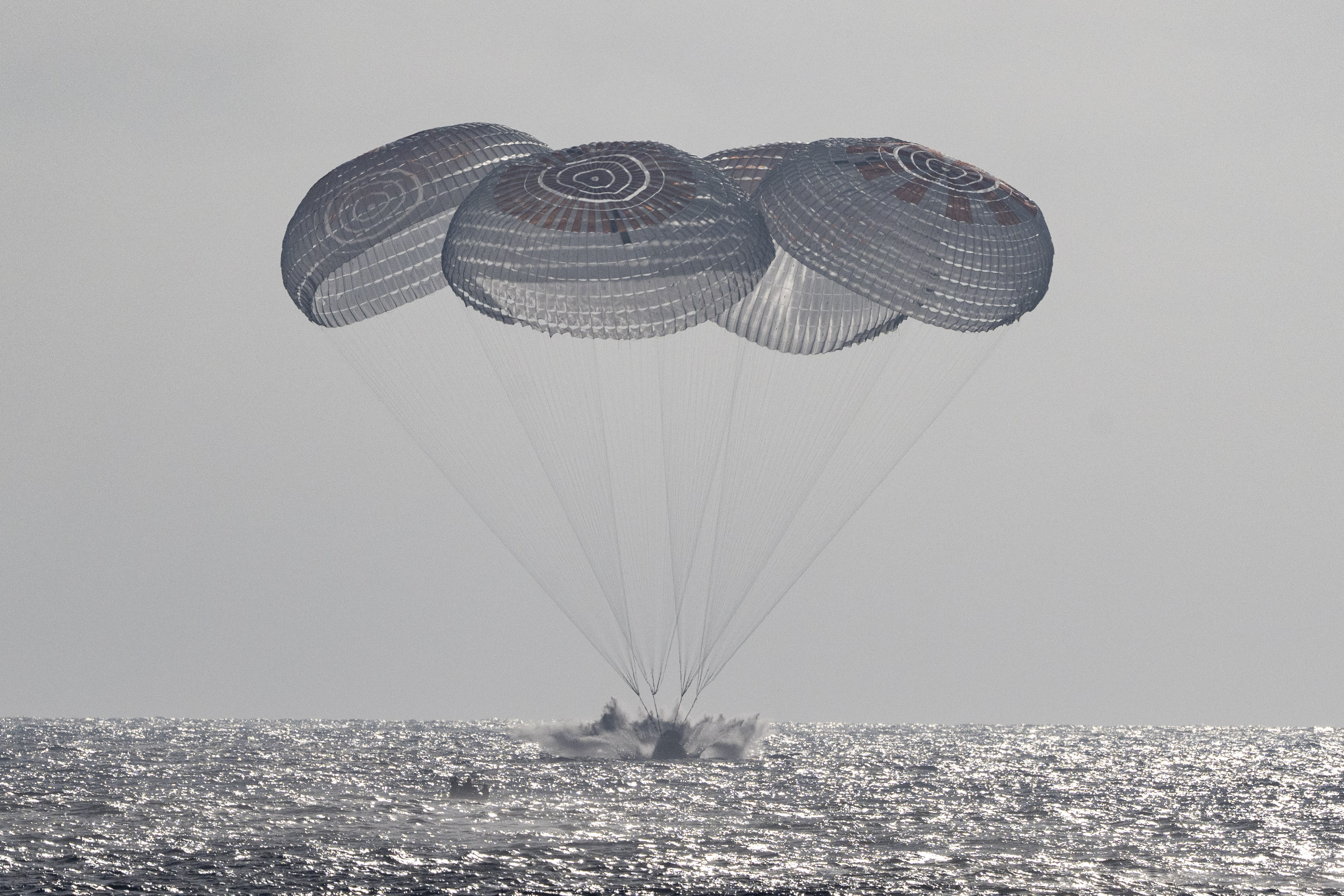
The Soyuz MS-28 spacecraft is seen as it lands in a remote area near the town of Zhezkazgan, Kazakhstan
The Soyuz MS-28 spacecraft is seen as it lands in a remote area near the town of Zhezkazgan, Kazakhstan with Expedition 74 NASA astronaut Chris Williams, and Roscosmos cosmonauts Sergey Kud-Sverchkov, and Sergei Mikaev aboard, Sunday, July 26, 2026. 
NASA/Bill Ingalls

Concluding an eight-month science mission aboard the International Space Station, NASA astronaut Chris Williams returned to Earth on Sunday alongside Roscosmos cosmonauts Sergey Kud-Sverchkov and Sergei Mikaev.

The crew made its safe, parachute-assisted landing at 5:27 a.m. CDT (3:27 p.m., Kazakhstan time), southeast of Dzhezkazgan, after departing the space station at 2:03 a.m., aboard the Soyuz MS-28 spacecraft.

The crew was in space for 241 days, orbiting the Earth 3,856 times and traveling more than 102 million miles. They launched to the International Space Station on Nov. 27, 2025. The mission was the first for Williams and Mikaev and the second for Kud-Sverchkov.

While aboard the orbiting laboratory, Williams supported a wide range of scientific investigations and technology demonstrations. He helped advance research for new cancer treatments and improved in-space manufacturing of materials used in high-performance computers and electronics. Williams also completed two spacewalks to prep for space station power system upgrades and to replace a faulty joint on the Canadarm2 robotic arm. The crew’s work aboard the space station helps improve life on Earth and prepare for future human missions to the Moon and Mars.

Following post-landing medical checks, the crew members will fly by helicopter to Karaganda, Kazakhstan, where recovery teams are based. Williams then will board a NASA aircraft bound for the agency’s Johnson Space Center in Houston.

For more than 25 years, people have lived and worked continuously aboard the International Space Station, advancing scientific knowledge and making research breakthroughs not possible on Earth. The space station helps NASA understand and overcome the challenges of human spaceflight, expand commercial opportunities in low Earth orbit, and build on the foundation for long-duration missions to the Moon, as part of the Artemis program, and to Mars.

To learn more about International Space Station research, operations, and its crews, visit:

www.nasa.gov/station

-end-

Joshua Finch / Jimi Russell
Headquarters, Washington
202-358-1100
joshua.a.finch@nasa.gov / james.j.russell@nasa.gov

Leah Cheshier / Anna Schneider
Johnson Space Center, Houston
281-483-5111
leah.d.cheshier@nasa.gov / anna.c.schneider@nasa.gov
Share

Details

Last Updated
Jul 26, 2026
Editor
Jennifer M. Dooren

NASA Astronaut Chris Williams, Crewmates Return from Space Station

26 Luglio 2026 ore 12:59
The Soyuz MS-28 spacecraft is seen as it lands in a remote area near the town of Zhezkazgan, Kazakhstan
The Soyuz MS-28 spacecraft is seen as it lands in a remote area near the town of Zhezkazgan, Kazakhstan with Expedition 74 NASA astronaut Chris Williams, and Roscosmos cosmonauts Sergey Kud-Sverchkov, and Sergei Mikaev aboard, Sunday, July 26, 2026. 
NASA/Bill Ingalls

Concluding an eight-month science mission aboard the International Space Station, NASA astronaut Chris Williams returned to Earth on Sunday alongside Roscosmos cosmonauts Sergey Kud-Sverchkov and Sergei Mikaev.

The crew made its safe, parachute-assisted landing at 5:27 a.m. CDT (3:27 p.m., Kazakhstan time), southeast of Dzhezkazgan, after departing the space station at 2:03 a.m., aboard the Soyuz MS-28 spacecraft.

The crew was in space for 241 days, orbiting the Earth 3,856 times and traveling more than 102 million miles. They launched to the International Space Station on Nov. 27, 2025. The mission was the first for Williams and Mikaev and the second for Kud-Sverchkov.

While aboard the orbiting laboratory, Williams supported a wide range of scientific investigations and technology demonstrations. He helped advance research for new cancer treatments and improved in-space manufacturing of materials used in high-performance computers and electronics. Williams also completed two spacewalks to prep for space station power system upgrades and to replace a faulty joint on the Canadarm2 robotic arm. The crew’s work aboard the space station helps improve life on Earth and prepare for future human missions to the Moon and Mars.

Following post-landing medical checks, the crew members will fly by helicopter to Karaganda, Kazakhstan, where recovery teams are based. Williams then will board a NASA aircraft bound for the agency’s Johnson Space Center in Houston.

For more than 25 years, people have lived and worked continuously aboard the International Space Station, advancing scientific knowledge and making research breakthroughs not possible on Earth. The space station helps NASA understand and overcome the challenges of human spaceflight, expand commercial opportunities in low Earth orbit, and build on the foundation for long-duration missions to the Moon, as part of the Artemis program, and to Mars.

To learn more about International Space Station research, operations, and its crews, visit:

www.nasa.gov/station

-end-

Joshua Finch / Jimi Russell
Headquarters, Washington
202-358-1100
joshua.a.finch@nasa.gov / james.j.russell@nasa.gov

Leah Cheshier / Anna Schneider
Johnson Space Center, Houston
281-483-5111
leah.d.cheshier@nasa.gov / anna.c.schneider@nasa.gov
Share

Details

Last Updated
Jul 26, 2026
Editor
Jennifer M. Dooren

NASA Sets Briefings for SpaceX Crew-13 Mission to Space Station

20 Luglio 2026 ore 22:00
The SpaceX Crew-13 members are pictured in their pressure suits seated inside a mockup Dragon spacecraft during a preflight training session at the company's headquarters in Hawthorne, California. From left are, Roscosmos Sergey Teteryatnikov, NASA astronauts Luke Delaney and Jessica Watkins, and CSA (Canadian Space Agency) astronaut Joshua Kutryk.
NASA’s SpaceX Crew-13 members are pictured in their pressure suits seated inside a mockup Dragon spacecraft during a preflight training session at the company’s headquarters in Hawthorne, California. From left are Roscosmos Sergey Teteryatnikov, NASA astronauts Luke Delaney and Jessica Watkins, and CSA (Canadian Space Agency) astronaut Joshua Kutryk.
Credit: SpaceX

NASA and its partners will discuss the upcoming crew rotation mission to the International Space Station during a pair of news conferences on Monday, Aug. 3, from the agency’s Johnson Space Center in Houston.

Mission leadership will provide an overview of NASA’s SpaceX Crew‑13 mission at 12 p.m. EDT. Next, crew members will discuss their training and mission preparations at 2 p.m. This is Crew-13’s final media availability prior to traveling to the agency’s Kennedy Space Center in Florida for launch.

NASA will stream these events live. Learn where to watch online:

https://www.nasa.gov/live

The Crew-13 mission will carry NASA astronauts Jessica Watkins and Luke Delaney, CSA (Canadian Space Agency) astronaut Joshua Kutryk, and Roscosmos cosmonaut Sergey Teteryatnikov to the orbiting laboratory. The crew will launch aboard a SpaceX Dragon spacecraft on the company’s Falcon 9 rocket from Space Launch Complex 40 at Cape Canaveral Space Force Station in Florida no earlier than mid-September.

International media attending in person must email the NASA Johnson newsroom at jsccommu@mail.nasa.gov by 5 p.m., Tuesday, July 21. United States-based media attending in person must respond by 5 p.m., Thursday, July 30. Media joining virtually must respond by 10 a.m. the day of the event. NASA’s media accreditation policy is available online.

Briefing participants are as follows (all times Eastern and subject to change based on real-time operations):

12 p.m.: Mission Overview News Conference

  • Joel Montalbano, deputy associate administrator, Human Spaceflight Mission Directorate, NASA Headquarters
  • Dana Weigel, manager, Low Earth Orbit Program, NASA Johnson
  • Mathieu Caron, director, Astronauts, Life Sciences, and Space Medicine, CSA
  • Julianna Scheiman, director, NASA Science and Dragon Programs, SpaceX

2 p.m.: Crew-13 News Conference

  • Jessica Watkins, commander, NASA
  • Luke Delaney, pilot, NASA
  • Joshua Kutryk, mission specialist, CSA
  • Sergey Teteryatnikov, mission specialist, Roscosmos

Following the news conference, crew members will be available for limited media interviews. All interview requests must be submitted by 5 p.m. on July 30, to the NASA Johnson newsroom at: jsccommu@mail.nasa.gov.

This will be the second flight to the space station for Watkins, who was selected as a NASA astronaut in 2017. Watkins grew up in Lafayette, Colorado, and earned an undergraduate degree in geological and environmental sciences from Stanford University, as well as a doctorate in geology from the University of California, Los Angeles. As a geologist, she studied the Martian surface and was a member of the Curiosity rover science team at NASA’s Jet Propulsion Laboratory in Southern California. Watkins first launched to the space station as a crew member aboard NASA’s SpaceX Crew-4 mission, spending a total of 170 days in space across space station Expeditions 67/68 in 2022. She will be the first NASA astronaut to launch aboard a SpaceX Dragon spacecraft twice.

Selected as a NASA astronaut in 2021, Delaney earned a bachelor’s degree in mechanical engineering at the University of North Florida and a master’s degree in aerospace engineering at the Naval Postgraduate School. The Florida native is a distinguished naval aviator who participated in exercises throughout the Asia Pacific region and conducted missions in support of Operation Enduring Freedom. As a test pilot, Delaney evaluated developmental aircraft systems and served as a test pilot instructor. He also worked as a research pilot at NASA’s Langley Research Center in Hampton, Virginia, where he supported airborne science missions. This is the first spaceflight for Delaney.

The Crew-13 mission also is the first spaceflight for Kutryk. Prior to his selection as a CSA astronaut in 2017, he served as a CF-18 fighter pilot, flying missions in support of Canada’s NATO, U.N., and North American Aerospace Defense Command commitments. A native of Fort Saskatchewan, Alberta, Kutryk also worked as an experimental and operational test pilot at the Aerospace Engineering Test Establishment in Cold Lake, Alberta. Kutryk received a bachelor’s degree in mechanical engineering from the Royal Military College of Canada in Kingston, Ontario, and he is a distinguished graduate of the United States Air Force Test Pilot school in Edwards, California. He has master’s degrees in space studies, flight test engineering, and defense studies.

This mission will be Teteryatnikov’s first trip to the orbiting laboratory. He graduated from the Naval Academy, St. Petersburg, Russia, in 2011 as an engineer specializing in ship power plant operations. Before his selection as a test cosmonaut, Teteryatnikov served in various naval engineering roles, including undersea vessels and specialized engine room operations. He was selected for the Gagarin Research and Test Cosmonaut Training Center Cosmonaut Corps in 2021 and has served as a test cosmonaut since 2023.

For more information about the mission, visit:

https://www.nasa.gov/mission/nasas-spacex-crew-13

-end-

Joshua Finch / Jimi Russell
Headquarters, Washington
202-358-1100
joshua.a.finch@nasa.gov / james.j.russell@nasa.gov

Leah Cheshier / Anna Schneider
Johnson Space Center, Houston
281-483-5111
leah.d.cheshier@nasa.gov / anna.c.schneider@nasa.gov
Share

Details

Last Updated
Jul 20, 2026
Editor
Jessica Taveau

NASA Sets Briefings for SpaceX Crew-13 Mission to Space Station

20 Luglio 2026 ore 22:00
The SpaceX Crew-13 members are pictured in their pressure suits seated inside a mockup Dragon spacecraft during a preflight training session at the company's headquarters in Hawthorne, California. From left are, Roscosmos Sergey Teteryatnikov, NASA astronauts Luke Delaney and Jessica Watkins, and CSA (Canadian Space Agency) astronaut Joshua Kutryk.
NASA’s SpaceX Crew-13 members are pictured in their pressure suits seated inside a mockup Dragon spacecraft during a preflight training session at the company’s headquarters in Hawthorne, California. From left are Roscosmos Sergey Teteryatnikov, NASA astronauts Luke Delaney and Jessica Watkins, and CSA (Canadian Space Agency) astronaut Joshua Kutryk.
Credit: SpaceX

NASA and its partners will discuss the upcoming crew rotation mission to the International Space Station during a pair of news conferences on Monday, Aug. 3, from the agency’s Johnson Space Center in Houston.

Mission leadership will provide an overview of NASA’s SpaceX Crew‑13 mission at 12 p.m. EDT. Next, crew members will discuss their training and mission preparations at 2 p.m. This is Crew-13’s final media availability prior to traveling to the agency’s Kennedy Space Center in Florida for launch.

NASA will stream these events live. Learn where to watch online:

https://www.nasa.gov/live

The Crew-13 mission will carry NASA astronauts Jessica Watkins and Luke Delaney, CSA (Canadian Space Agency) astronaut Joshua Kutryk, and Roscosmos cosmonaut Sergey Teteryatnikov to the orbiting laboratory. The crew will launch aboard a SpaceX Dragon spacecraft on the company’s Falcon 9 rocket from Space Launch Complex 40 at Cape Canaveral Space Force Station in Florida no earlier than mid-September.

International media attending in person must email the NASA Johnson newsroom at jsccommu@mail.nasa.gov by 5 p.m., Tuesday, July 21. United States-based media attending in person must respond by 5 p.m., Thursday, July 30. Media joining virtually must respond by 10 a.m. the day of the event. NASA’s media accreditation policy is available online.

Briefing participants are as follows (all times Eastern and subject to change based on real-time operations):

12 p.m.: Mission Overview News Conference

  • Joel Montalbano, deputy associate administrator, Human Spaceflight Mission Directorate, NASA Headquarters
  • Dana Weigel, manager, Low Earth Orbit Program, NASA Johnson
  • Mathieu Caron, director, Astronauts, Life Sciences, and Space Medicine, CSA
  • Julianna Scheiman, director, NASA Science and Dragon Programs, SpaceX

2 p.m.: Crew-13 News Conference

  • Jessica Watkins, commander, NASA
  • Luke Delaney, pilot, NASA
  • Joshua Kutryk, mission specialist, CSA
  • Sergey Teteryatnikov, mission specialist, Roscosmos

Following the news conference, crew members will be available for limited media interviews. All interview requests must be submitted by 5 p.m. on July 30, to the NASA Johnson newsroom at: jsccommu@mail.nasa.gov.

This will be the second flight to the space station for Watkins, who was selected as a NASA astronaut in 2017. Watkins grew up in Lafayette, Colorado, and earned an undergraduate degree in geological and environmental sciences from Stanford University, as well as a doctorate in geology from the University of California, Los Angeles. As a geologist, she studied the Martian surface and was a member of the Curiosity rover science team at NASA’s Jet Propulsion Laboratory in Southern California. Watkins first launched to the space station as a crew member aboard NASA’s SpaceX Crew-4 mission, spending a total of 170 days in space across space station Expeditions 67/68 in 2022. She will be the first NASA astronaut to launch aboard a SpaceX Dragon spacecraft twice.

Selected as a NASA astronaut in 2021, Delaney earned a bachelor’s degree in mechanical engineering at the University of North Florida and a master’s degree in aerospace engineering at the Naval Postgraduate School. The Florida native is a distinguished naval aviator who participated in exercises throughout the Asia Pacific region and conducted missions in support of Operation Enduring Freedom. As a test pilot, Delaney evaluated developmental aircraft systems and served as a test pilot instructor. He also worked as a research pilot at NASA’s Langley Research Center in Hampton, Virginia, where he supported airborne science missions. This is the first spaceflight for Delaney.

The Crew-13 mission also is the first spaceflight for Kutryk. Prior to his selection as a CSA astronaut in 2017, he served as a CF-18 fighter pilot, flying missions in support of Canada’s NATO, U.N., and North American Aerospace Defense Command commitments. A native of Fort Saskatchewan, Alberta, Kutryk also worked as an experimental and operational test pilot at the Aerospace Engineering Test Establishment in Cold Lake, Alberta. Kutryk received a bachelor’s degree in mechanical engineering from the Royal Military College of Canada in Kingston, Ontario, and he is a distinguished graduate of the United States Air Force Test Pilot school in Edwards, California. He has master’s degrees in space studies, flight test engineering, and defense studies.

This mission will be Teteryatnikov’s first trip to the orbiting laboratory. He graduated from the Naval Academy, St. Petersburg, Russia, in 2011 as an engineer specializing in ship power plant operations. Before his selection as a test cosmonaut, Teteryatnikov served in various naval engineering roles, including undersea vessels and specialized engine room operations. He was selected for the Gagarin Research and Test Cosmonaut Training Center Cosmonaut Corps in 2021 and has served as a test cosmonaut since 2023.

For more information about the mission, visit:

https://www.nasa.gov/mission/nasas-spacex-crew-13

-end-

Joshua Finch / Jimi Russell
Headquarters, Washington
202-358-1100
joshua.a.finch@nasa.gov / james.j.russell@nasa.gov

Leah Cheshier / Anna Schneider
Johnson Space Center, Houston
281-483-5111
leah.d.cheshier@nasa.gov / anna.c.schneider@nasa.gov
Share

Details

Last Updated
Jul 20, 2026
Editor
Jessica Taveau
❌