❌

Vista elenco

I Am Artemis: Allison Mjoen

16 Ottobre 2026 ore 16:24
3 Min Read

I Am Artemis: Allison Mjoen

Portrait of Allison Mjoen inside the Vehicle Assembly Building

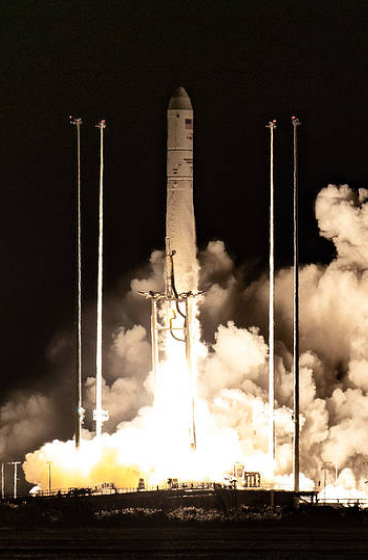
As the supercooled propellant flowed into the core stage, and NASA’s SLS (Space Launch System) rocket roared to life, Allison Mjoen and her family watched with awe and pride. Mjoen, NASA’s operations manager for the agency’s Exploration Ground Systems Program, helped shape the systems and ground operations that will one day send humans back to the Moon. Over her 20-year career at NASA’s Kennedy Space Center in Florida, she supported missions across the Space Shuttle Program, the International Space Station, and now she is applying that experience to Artemis.

April 1, 2026, was a bright, crystal-clear day along the Florida Space Coast. The sunlight seemed to sharpen every color along the horizon. As Mjoen and her children counted down and the crowd’s voices rose around them, the rumble of the SLS rocket intensified beneath their feet. For her children, it was the chance to see what their mom had helped make possible. For Mjoen, it was a moment she would never forget.

That moment also offered a pause for reflection on the work that led her there. As the spacecraft offline operations manager, Mjoen coordinates the work that happens long before launch day. By supporting the ground systems’ senior vehicle operations manager, Matt Czech, she develops integration plans and oversees ground operations for Artemis vehicle processing, focusing on booster and Orion spacecraft operations.
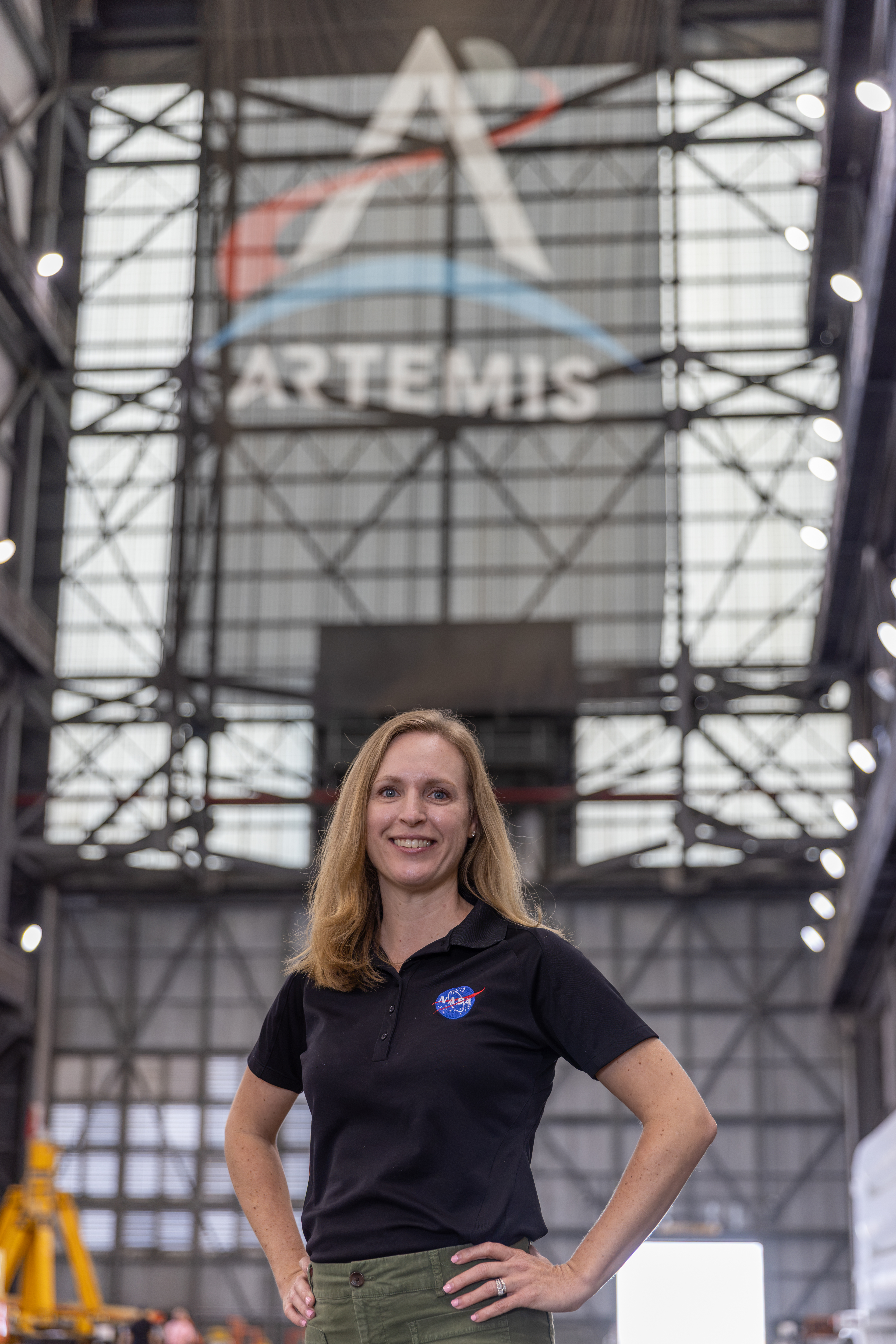
Allison Mjoen poses for a photo inside the Vehicle Assembly Building.
Allison Mjoen, NASA’s operations manager for the agency’s Exploration Ground Systems Program, helped shape the systems and ground operations that will one day send humans back to the Moon.
NASA/Amber Jean Notvest

Mjoen began her career as a flight crew systems engineer with United Space Alliance supporting the Space Shuttle Program. Her team handled mission-specific cabin configurations, including the food, spacesuits, cargo, and payloads astronauts needed aboard the shuttle.

After the Space Shuttle Program retired, she supported the International Space Station Program as a payload integration engineer. In this role, she connected experiment investigators with the organizations developing their hardware. She later worked in the Project Office on the Test and Operations Support Contract before joining NASA’s Operations Project Engineering Office, where she served as the Spacecraft Payloads Integration and Evolution Element lead for Artemis I.

“Early on, I thought every decision had to be perfect, but everything is an opportunity to learn, especially the tasks that seem unrelated at the time. It’s about staying curious, working hard, building relationships, and trusting that each step is preparing you for the next one.
Allison Mjoen

Allison Mjoen

Operations Manager, NASA's Exploration Ground Systems

That preparation took on new meaning when she first supported integrated firing room operations as a certified operations project engineer during Artemis I. Earning the certification was a milestone. Applying it during real time operations brought a new level of responsibility.

“Every decision and communication directly supported the integrated team’s ability to execute safely and properly implement the test procedure,” said Mjoen.

Working at the integration console underscored the importance of preparation, collaboration and trust — lessons she carries into her work coordinating across teams today.

“I get to collaborate everyday with incredibly talented and dedicated people who are all working toward the same goal. It’s especially rewarding to know that our collective efforts directly contribute to the success of the mission.”

Allison Mjoen

Allison Mjoen

Operations Manager, NASA's Exploration Ground Systems

For Mjoen, the shared experience is part of what makes Artemis so important. As the Artemis program continues, she looks forward to another moment families will be able to share as astronauts return to the lunar surface.

“That single moment captured the imagination of people around the world and showed what is possible when we come together for a bold goal,” she said of the first Apollo Moon landing. “Artemis is creating that kind of moment for a whole new generation, and this time to stay.”
About the Author

Matina Douzenis

Communication Strategist

Keep Exploring

Discover More Topics From NASA

I Am Artemis: Allison Mjoen

16 Ottobre 2026 ore 16:24
3 Min Read

I Am Artemis: Allison Mjoen

Portrait of Allison Mjoen inside the Vehicle Assembly Building

As the supercooled propellant flowed into the core stage, and NASA’s SLS (Space Launch System) rocket roared to life, Allison Mjoen and her family watched with awe and pride. Mjoen, NASA’s operations manager for the agency’s Exploration Ground Systems Program, helped shape the systems and ground operations that will one day send humans back to the Moon. Over her 20-year career at NASA’s Kennedy Space Center in Florida, she supported missions across the Space Shuttle Program, the International Space Station, and now she is applying that experience to Artemis.

April 1, 2026, was a bright, crystal-clear day along the Florida Space Coast. The sunlight seemed to sharpen every color along the horizon. As Mjoen and her children counted down and the crowd’s voices rose around them, the rumble of the SLS rocket intensified beneath their feet. For her children, it was the chance to see what their mom had helped make possible. For Mjoen, it was a moment she would never forget.

That moment also offered a pause for reflection on the work that led her there. As the spacecraft offline operations manager, Mjoen coordinates the work that happens long before launch day. By supporting the ground systems’ senior vehicle operations manager, Matt Czech, she develops integration plans and oversees ground operations for Artemis vehicle processing, focusing on booster and Orion spacecraft operations.

Allison Mjoen poses for a photo inside the Vehicle Assembly Building.
Allison Mjoen, NASA’s operations manager for the agency’s Exploration Ground Systems Program, helped shape the systems and ground operations that will one day send humans back to the Moon.
NASA/Amber Jean Notvest

Mjoen began her career as a flight crew systems engineer with United Space Alliance supporting the Space Shuttle Program. Her team handled mission-specific cabin configurations, including the food, spacesuits, cargo, and payloads astronauts needed aboard the shuttle.

After the Space Shuttle Program retired, she supported the International Space Station Program as a payload integration engineer. In this role, she connected experiment investigators with the organizations developing their hardware. She later worked in the Project Office on the Test and Operations Support Contract before joining NASA’s Operations Project Engineering Office, where she served as the Spacecraft Payloads Integration and Evolution Element lead for Artemis I.

“Early on, I thought every decision had to be perfect, but everything is an opportunity to learn, especially the tasks that seem unrelated at the time. It’s about staying curious, working hard, building relationships, and trusting that each step is preparing you for the next one.

Allison Mjoen

Allison Mjoen

Operations Manager, NASA's Exploration Ground Systems

That preparation took on new meaning when she first supported integrated firing room operations as a certified operations project engineer during Artemis I. Earning the certification was a milestone. Applying it during real time operations brought a new level of responsibility.

“Every decision and communication directly supported the integrated team’s ability to execute safely and properly implement the test procedure,” said Mjoen.

Working at the integration console underscored the importance of preparation, collaboration and trust — lessons she carries into her work coordinating across teams today.

“I get to collaborate everyday with incredibly talented and dedicated people who are all working toward the same goal. It’s especially rewarding to know that our collective efforts directly contribute to the success of the mission.”

Allison Mjoen

Allison Mjoen

Operations Manager, NASA's Exploration Ground Systems

For Mjoen, the shared experience is part of what makes Artemis so important. As the Artemis program continues, she looks forward to another moment families will be able to share as astronauts return to the lunar surface.

“That single moment captured the imagination of people around the world and showed what is possible when we come together for a bold goal,” she said of the first Apollo Moon landing. “Artemis is creating that kind of moment for a whole new generation, and this time to stay.”

About the Author

Matina Douzenis

Communication Strategist

Keep Exploring

Discover More Topics From NASA

I Am Artemis: Allison Mjoen

16 Ottobre 2026 ore 16:24
3 Min Read

I Am Artemis: Allison Mjoen

Portrait of Allison Mjoen inside the Vehicle Assembly Building

As the supercooled propellant flowed into the core stage, and NASA’s SLS (Space Launch System) rocket roared to life, Allison Mjoen and her family watched with awe and pride. Mjoen, NASA’s operations manager for the agency’s Exploration Ground Systems Program, helped shape the systems and ground operations that will one day send humans back to the Moon. Over her 20-year career at NASA’s Kennedy Space Center in Florida, she supported missions across the Space Shuttle Program, the International Space Station, and now she is applying that experience to Artemis.

April 1, 2026, was a bright, crystal-clear day along the Florida Space Coast. The sunlight seemed to sharpen every color along the horizon. As Mjoen and her children counted down and the crowd’s voices rose around them, the rumble of the SLS rocket intensified beneath their feet. For her children, it was the chance to see what their mom had helped make possible. For Mjoen, it was a moment she would never forget.

That moment also offered a pause for reflection on the work that led her there. As the spacecraft offline operations manager, Mjoen coordinates the work that happens long before launch day. By supporting the ground systems’ senior vehicle operations manager, Matt Czech, she develops integration plans and oversees ground operations for Artemis vehicle processing, focusing on booster and Orion spacecraft operations.

Allison Mjoen poses for a photo inside the Vehicle Assembly Building.
Allison Mjoen, NASA’s operations manager for the agency’s Exploration Ground Systems Program, helped shape the systems and ground operations that will one day send humans back to the Moon.
NASA/Amber Jean Notvest

Mjoen began her career as a flight crew systems engineer with United Space Alliance supporting the Space Shuttle Program. Her team handled mission-specific cabin configurations, including the food, spacesuits, cargo, and payloads astronauts needed aboard the shuttle.

After the Space Shuttle Program retired, she supported the International Space Station Program as a payload integration engineer. In this role, she connected experiment investigators with the organizations developing their hardware. She later worked in the Project Office on the Test and Operations Support Contract before joining NASA’s Operations Project Engineering Office, where she served as the Spacecraft Payloads Integration and Evolution Element lead for Artemis I.

“Early on, I thought every decision had to be perfect, but everything is an opportunity to learn, especially the tasks that seem unrelated at the time. It’s about staying curious, working hard, building relationships, and trusting that each step is preparing you for the next one.

Allison Mjoen

Allison Mjoen

Operations Manager, NASA's Exploration Ground Systems

That preparation took on new meaning when she first supported integrated firing room operations as a certified operations project engineer during Artemis I. Earning the certification was a milestone. Applying it during real time operations brought a new level of responsibility.

“Every decision and communication directly supported the integrated team’s ability to execute safely and properly implement the test procedure,” said Mjoen.

Working at the integration console underscored the importance of preparation, collaboration and trust — lessons she carries into her work coordinating across teams today.

“I get to collaborate everyday with incredibly talented and dedicated people who are all working toward the same goal. It’s especially rewarding to know that our collective efforts directly contribute to the success of the mission.”

Allison Mjoen

Allison Mjoen

Operations Manager, NASA's Exploration Ground Systems

For Mjoen, the shared experience is part of what makes Artemis so important. As the Artemis program continues, she looks forward to another moment families will be able to share as astronauts return to the lunar surface.

“That single moment captured the imagination of people around the world and showed what is possible when we come together for a bold goal,” she said of the first Apollo Moon landing. “Artemis is creating that kind of moment for a whole new generation, and this time to stay.”
About the Author

Matina Douzenis

Communication Strategist

Keep Exploring

Discover More Topics From NASA

BAE Systems Security Incident Stalls Notices From US Bankruptcy Courts

16 Ottobre 2026 ore 13:46

A cyber incident affecting contractor BAE Systems has knocked out the Bankruptcy Noticing Center, halting notices nationwide for a week.

The post BAE Systems Security Incident Stalls Notices From US Bankruptcy Courts appeared first on SecurityWeek.

What Life Is Like in Kyiv as Russia Tries to Make It Unlivable

A day in the Ukrainian capital, a new kind of battlefield far from the front, where daily life means assessing — and accepting — deadly risks.

A destroyed garage on Oct. 7 after an attack on an industrial complex that killed two security guards in Kyiv.

What Life Is Like in Kyiv as Russia Tries to Make It Unlivable

A day in the Ukrainian capital, a new kind of battlefield far from the front, where daily life means assessing — and accepting — deadly risks.

A destroyed garage on Oct. 7 after an attack on an industrial complex that killed two security guards in Kyiv.

TSMC sends scouts to check whether America's datacenters can deliver

15 Ottobre 2026 ore 15:15
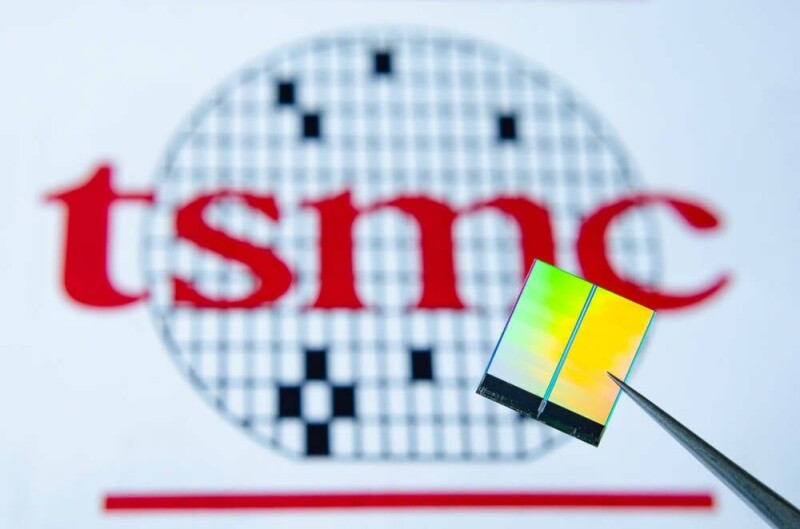
TSMC is dispatching personnel to check out US datacenter construction and power availability as it plans billions of dollars in additional chipmaking capacity. The Taiwanese chipmaking giant warned of pressure on consumer markets during its third-quarter earnings call, while maintaining that AI demand - at least for now - continues to outstrip supply. "Looking ahead, we continue to observe consumer and price-sensitive end market segments are being challenged due to the impact of rising component prices and macroeconomic uncertainties. As such, we are being prudent in our business planning going into 2027," said chairman and CEO C.C. Wei. Wei said AI demand remained strong, with CPUs for agentic workloads and networking chips adding to the need for silicon. "Therefore, semiconductors will remain essential in the AI mega trend. The value of semiconductors in the global supply chain is set to continue to increase in our view," he stated. TSMC expects capital expenditure of $60 billion to $64 billion this year. Spending across 2026-2028 is expected to exceed the total for 2023-2025 as it expands capacity for customers. Those plans depend on more than customers ordering chips: the datacenters housing them also need power, networking, memory, and other infrastructure. TSMC is checking how those pieces are coming together before committing to expanding capacity further. TSMC is planning roughly 20 leading-edge manufacturing and advanced-packaging facilities in Taiwan and overseas over the next several years, and Wei said the contract manufacturer is also focusing on capacity optimization across production nodes to generate more wafer output. One analyst on the earnings call asked whether power shortages, datacenter construction delays, advanced-packaging constraints, or limited supplies of high-bandwidth memory (HBM) could hold back projected growth. Wei said TSMC factors these constraints into its capacity planning. "We put every possibility we can, talking about the cloud service providers, capex, datacenter build-out, financial, power supply, and also other component supply, all into our consideration. "We make our own judgment, and then based on our assessment of the demand, we still think the demand is higher than the supply, and we are working very hard to narrow the gap." However, he declined to directly answer a question about whether he expected tightness in the wafer supply to be greater next year than this year, saying "the demand is extremely robust and getting higher and higher." Wei said preparations for A14, TSMC's next-generation process marketed as 1.4 nm, were underway. He expects it to become a bigger business than the current 2 nm generation. Risk production – an initial manufacturing phase ahead of commercial ramp-up – is scheduled for 2027, followed by volume production in 2028. For the third quarter ended September 30, 2026, TSMC reported revenue of $46.72 billion, an increase of 41.2 percent on the same period a year ago. Looking to the fourth quarter, the company expects another jump in revenue, to between $52.3 billion and $54.3 billion. At the midpoint, that would represent roughly 58 percent year-on-year growth. ®

Why Russia Sees a Window to Bomb Ukraine Into Submission This Winter

15 Ottobre 2026 ore 14:45
Moscow is not winning on the battlefield. Instead, it is seizing an opening to inflict immense human suffering in Ukrainian cities.

© Genya Savilov/Agence France-Presse — Getty Images

Firefighters at the site of a strike on an apartment building in Kyiv on Wednesday.

Why Russia Sees a Window to Bomb Ukraine Into Submission This Winter

15 Ottobre 2026 ore 14:45
Moscow is not winning on the battlefield. Instead, it is seizing an opening to inflict immense human suffering in Ukrainian cities.

© Genya Savilov/Agence France-Presse — Getty Images

Firefighters at the site of a strike on an apartment building in Kyiv on Wednesday.

Why Does Saudi Arabia Struggle to Stop Houthi Attacks?

15 Ottobre 2026 ore 16:06
The Saudi military has expensive equipment, but the missiles and drones used by the Yemeni militia are difficult to detect and stop.

© Fayez Nureldine/Agence France-Presse — Getty Images

A military parade marked Saudi National Day in Riyadh last month.

New motherboards, old RAM, plenty of life left in yesterday's PCs

14 Ottobre 2026 ore 17:00
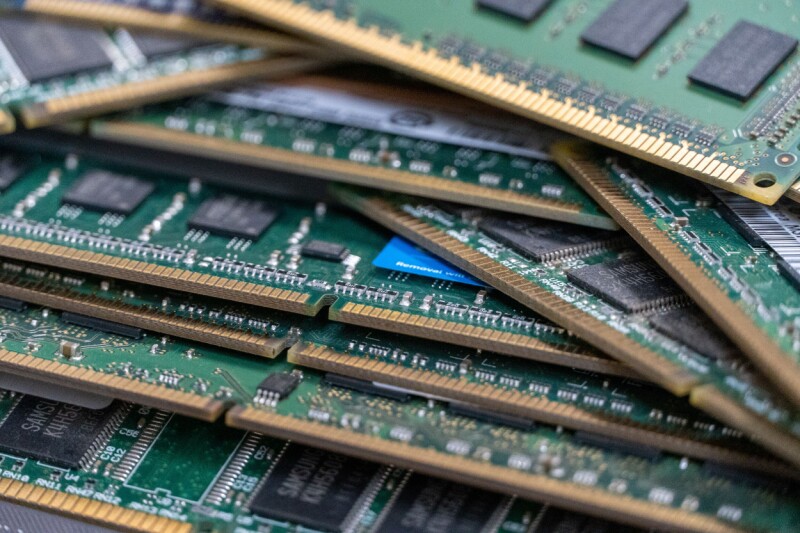
Gigabyte recently announced new motherboards that use DDR4 RAM, a standard that launched in 2014, and other vendors support even older standards in brand-new kit. Earlier this year, AMD released a Ryzen 7 5800X3D anniversary edition to mark ten years of AM4. For AM4 processors, Gigabyte offers the new B450M H ARGB, with two DDR4 slots, and the B550 X-Eagle with four slots. Those who prefer Intel chippery can now buy a B760M Aorus Elite. This is notable because of the age of the DDR4 spec. In case you lose track of these things, The Register first described the new DDR4 spec back in 2012, and a few months later urged the keen to wait a year or two. DDR5 supports higher transfer rates, and The Reg predicted its arrival in 2017. The DDR5 standard was agreed in 2020, with mainstream PC adoption following in 2021. Over in the People's Republic of China, several vendors will sell you new DDR3 motherboards for 15-year-old server CPUs, such as Huananzhi's X79-4D or X79 Supreme, or the Machinist X79 V2.82H. These use Intel's LGA-2011 socket – named for the number of pins, but coincidentally launched in 2011. This Chinese SMZDM community discussion is about whether the circa 15-year-old Xeon E5 is still worth buying – a CPU The Reg covered in 2012. This is partly due to the current price rises and component shortages induced by large-scale, cloud-based LLMs – but also "training" those "open-weight" models that run on your own kit. Those too are constructed in giant datacenters stuffed full of GPUs, ingesting all the human-written material they can get their hands on, rarely asking for consent. And not just stuff put online either. Once you wipe the sluggish, bloated commercial OS from your computer's storage, you discover two things. First, you don't need the latest hardware any more. Secondly, the older the PC (or Mac), the better the chances that it will work fine with Linux – or indeed the other FOSS OSes out there. Current and recent hardware is the most problematic for FOSS developers because most manufacturers prioritize Windows testing, while restricted documentation and proprietary drivers can complicate open source support for new hardware. Together, these things mean that if you're happy without high-powered local LLMs, or three-digit frame rates, second-hand kit is more usable than ever. (For those who can't do without one or two Windows-only apps that won't run under Wine, we remind you that desktop VMware is free now… and for better desktop integration, we looked at WinApps and WinBoat earlier this year.) The Reg FOSS desk is based in the British Isles, close enough to order stuff inexpensively from the UK. We've been using online vendors of depreciated ex-corporate kit for decades: we've bought several machines from Morgan Computers, and occasionally from Tier1 Online and Bargain Hardware. Other vendors are available. There are also special-purpose price-comparison sites, such as LowCostMiniPCs.com, which searches other sales sites for bargains. When we were based in Czechia, we bought a few things from GigaComputer, and we know of others we didn't try, such as Refurbed.cz. Other such European sites include Computershop.eu. The usability of kit that can only officially run Windows 10 was the entire point of the End of 10 campaign. Microsoft cites security benefits for Windows 11's hardware requirements, but in this vulture's opinion, those benefits don't justify excluding an entire generation of otherwise capable hardware. Keeping older hardware in service is welcome. If digital sovereignty gives organizations another reason to consider open source alternatives, so much the better. ®

Microsoft plans multi-gigawatt rollout of next-gen Azure Maia AI accelerator racks

13 Ottobre 2026 ore 15:30
Microsoft has lifted the lid on the next generation of its Azure Maia custom AI chips, saying it will usher in a new phase of its compute infrastructure where everything is closely integrated to meet the demands of agentic inference. The Redmond giant says its Azure Maia 200, announced earlier this year, is now serving production workloads and that a successor is already planned for 2027. Azure Maia 300 is described as "a complete intelligent system" designed for the new types of AI workloads emerging today. Microsoft claims a full 96-accelerator configuration will deliver up to seven times Maia 200's rack-scale token throughput, while offering 40 percent more tokens per megawatt than leading GPU-based systems. Its next-gen chip is created with an inference-first architecture optimized for long-context, memory-intensive and decode-heavy AI workloads, according to a blog post by Microsoft's EVP for Cloud and AI, Scott Guthrie. The firm envisions it being deployed in rack-scale systems comprising up to 96 accelerators, while each Maia 300 will feature eight HBM4 memory stacks providing up to 18 TB/s of peak memory bandwidth, the better to support execution of large models and long-context workloads. This sounds similar to the kind of rack-scale AI equipment that has already been developed by Nvidia for its GPU accelerators, and more recently by AMD with its Helion and Helios infrastructure, all designed to make the most of their own specific silicon and software stacks. Microsoft says that Maia 300 is "built as a complete system, with software, silicon, physical rack infrastructure, networking, and datacenters co-designed to operate as a single platform to meet the demands of cloud-scale agentic inference." It insists that this system-level approach is necessary for agentic workloads, which involve multi-step execution, long-context decoding and tool use, and "change the computational profile and arithmetic intensity of inference." The growing emphasis on in-house integration contrasts with Microsoft's 2024 "AI Access Principles," which stressed partnerships across its technology stack. The firm even complained to the European Commission's competition authorities that Google had a competitive advantage because of its approach. "Only one company – Google," said Microsoft at the time, "is vertically integrated in a manner that provides it with strength and independence at every AI layer from chips to a thriving mobile app store. Everybody else must rely on partnerships to innovate and compete." Microsoft now has its own AI chips, rack-scale designs, and internally developed MAI models, giving it more control over its stack. It plans to scale Azure Maia to "multi-gigawatt deployments" starting in 2027. We asked Microsoft for comment. Guthrie said that the firm will share more details on its strategy at next month's Microsoft Ignite 2026 event in San Francisco. ®

Ukraine Says It Received No Intelligence About Strikes 2 Nights in a Row

Asked about apparent U.S. threats to cut off intelligence sharing with Kyiv, which can warn of Russian aerial attacks, President Trump said information continued to flow.

© Mauricio Lima for The New York Times

A resident collecting belongings from an apartment building that was struck in Kharkiv, Ukraine, on Tuesday.

AMD unveils Helion racks for AI agents at OCP summit

12 Ottobre 2026 ore 17:51
AMD is expanding its rack-scale AI lineup with a design to run AI agents, offering CPU-only configurations or integrated CPU/GPU deployments, and liquid-cooled or air-cooled versions. Revealed at the Open Compute Project (OCP) Summit 2026 in San Jose, California, the chipmaker's new rack reference design is named Helion, while its existing system carries the moniker Helios, which we can't help feeling is inviting confusion a little. Helion offers an OCP-compliant blueprint for agentic AI infrastructure built around AMD's CPUs and accelerators. AMD launched Helios earlier this year for frontier-scale AI training and large-scale inference. Helion's enterprise configuration instead combines agent execution and inference within a single rack. Customers can opt for a CPU-only hyperscale configuration or an enterprise configuration with a mix of CPU and GPU blades. Depending on configuration, AMD advertises up to 32,768 of AMD's "Zen 6" CPU cores, delivered via compute nodes fitted with 256-core versions of its Venice Epyc processor, up to 16 of its Instinct MI350P GPU accelerators, and up to 102 Tbps of networking bandwidth. The CPU-only hyperscale version offers dedicated capacity for agent execution and connections to separate model inference infrastructure, while the enterprise configuration combines agent execution, GPU inference, and supporting workloads in one rack. Both configurations offer dense, balanced, or high-performance CPU blades. For dense deployments, EPYC 9006 chips rated at 400 W are used, while performance blades sport a version of the chip with just 96 cores but clocked at 5 GHz. Balanced blades use 256-core processors rated at 600 W. There are also GPU inference blades, with eight Instinct MI350P GPUs in a 5U server, plus general-purpose blades, intended for database and storage servers or technical compute workloads. AMD SVP for Compute and Enterprise AI Dan McNamara said agentic AI is not a single workload, spanning enterprise applications and complex workflows, each with different compute requirements. "To do that takes optimized compute and infrastructure that can adapt to different workloads. With AMD Helion, we are bringing Epyc performance, open software and flexible rack designs together so our partners can build systems around customer needs and make efficient use of available power," he added. AMD says it plans to contribute the Helion specifications to OCP, making them available to the community for further development and adoption. Partner-built Helion configurations are scheduled for November 2026. In its announcement, AMD cites Cisco, Dell, HPE, Foxconn, Lenovo, Supermicro, and others as on board with the new kit. ®

❌