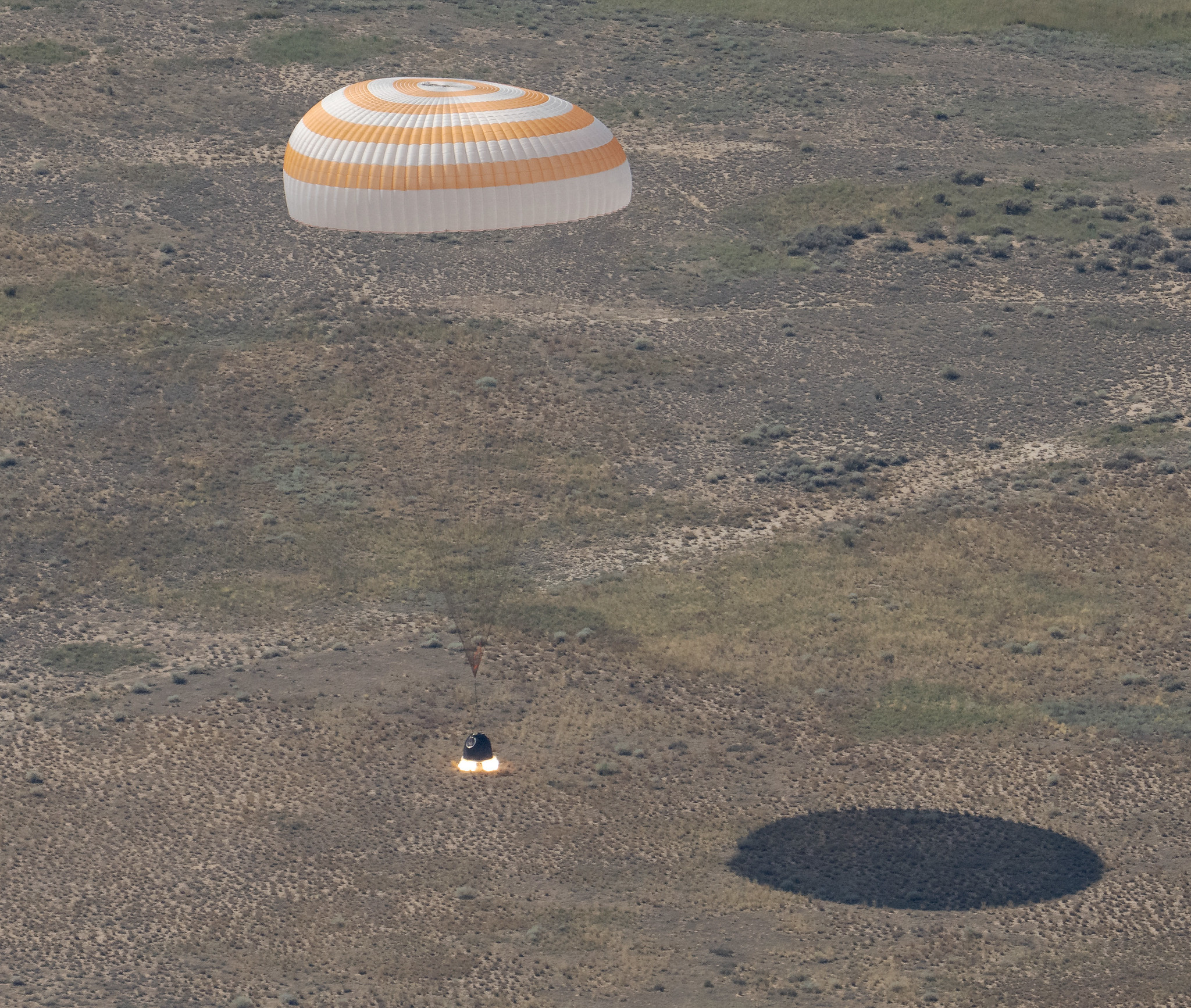
The Soyuz MS-28 spacecraft is seen as it lands in a remote area near the town of Zhezkazgan, Kazakhstan with Expedition 74 NASA astronaut Chris Williams, and Roscosmos cosmonauts Sergey Kud-Sverchkov, and Sergei Mikaev aboard, Sunday, July 26, 2026.
NASA/Bill Ingalls
Concluding an eight-month science mission aboard the International Space Station, NASA astronaut Chris Williams returned to Earth on Sunday alongside Roscosmos cosmonauts Sergey Kud-Sverchkov and Sergei Mikaev.
The crew made its safe, parachute-assisted landing at 5:27 a.m. CDT (3:27 p.m., Kazakhstan time), southeast of Dzhezkazgan, after departing the space station at 2:03 a.m., aboard the Soyuz MS-28 spacecraft.
The crew was in space for 241 days, orbiting the Earth 3,856 times and traveling more than 102 million miles. They launched to the International Space Station on Nov. 27, 2025. The mission was the first for Williams and Mikaev and the second for Kud-Sverchkov.
While aboard the orbiting laboratory, Williams supported a wide range of scientific investigations and technology demonstrations. He helped advance research for new cancer treatments and improved in-space manufacturing of materials used in high-performance computers and electronics. Williams also completed two spacewalks to prep for space station power system upgrades and to replace a faulty joint on the Canadarm2 robotic arm. The crew’s work aboard the space station helps improve life on Earth and prepare for future human missions to the Moon and Mars.
Following post-landing medical checks, the crew members will fly by helicopter to Karaganda, Kazakhstan, where recovery teams are based. Williams then will board a NASA aircraft bound for the agency’s Johnson Space Center in Houston.
For more than 25 years, people have lived and worked continuously aboard the International Space Station, advancing scientific knowledge and making research breakthroughs not possible on Earth. The space station helps NASA understand and overcome the challenges of human spaceflight, expand commercial opportunities in low Earth orbit, and build on the foundation for long-duration missions to the Moon, as part of the Artemis program, and to Mars.
To learn more about International Space Station research, operations, and its crews, visit:
The Soyuz MS-28 spacecraft is seen as it lands in a remote area near the town of Zhezkazgan, Kazakhstan with Expedition 74 NASA astronaut Chris Williams, and Roscosmos cosmonauts Sergey Kud-Sverchkov, and Sergei Mikaev aboard, Sunday, July 26, 2026.
NASA/Bill Ingalls
Concluding an eight-month science mission aboard the International Space Station, NASA astronaut Chris Williams returned to Earth on Sunday alongside Roscosmos cosmonauts Sergey Kud-Sverchkov and Sergei Mikaev.
The crew made its safe, parachute-assisted landing at 5:27 a.m. CDT (3:27 p.m., Kazakhstan time), southeast of Dzhezkazgan, after departing the space station at 2:03 a.m., aboard the Soyuz MS-28 spacecraft.
The crew was in space for 241 days, orbiting the Earth 3,856 times and traveling more than 102 million miles. They launched to the International Space Station on Nov. 27, 2025. The mission was the first for Williams and Mikaev and the second for Kud-Sverchkov.
While aboard the orbiting laboratory, Williams supported a wide range of scientific investigations and technology demonstrations. He helped advance research for new cancer treatments and improved in-space manufacturing of materials used in high-performance computers and electronics. Williams also completed two spacewalks to prep for space station power system upgrades and to replace a faulty joint on the Canadarm2 robotic arm. The crew’s work aboard the space station helps improve life on Earth and prepare for future human missions to the Moon and Mars.
Following post-landing medical checks, the crew members will fly by helicopter to Karaganda, Kazakhstan, where recovery teams are based. Williams then will board a NASA aircraft bound for the agency’s Johnson Space Center in Houston.
For more than 25 years, people have lived and worked continuously aboard the International Space Station, advancing scientific knowledge and making research breakthroughs not possible on Earth. The space station helps NASA understand and overcome the challenges of human spaceflight, expand commercial opportunities in low Earth orbit, and build on the foundation for long-duration missions to the Moon, as part of the Artemis program, and to Mars.
To learn more about International Space Station research, operations, and its crews, visit:
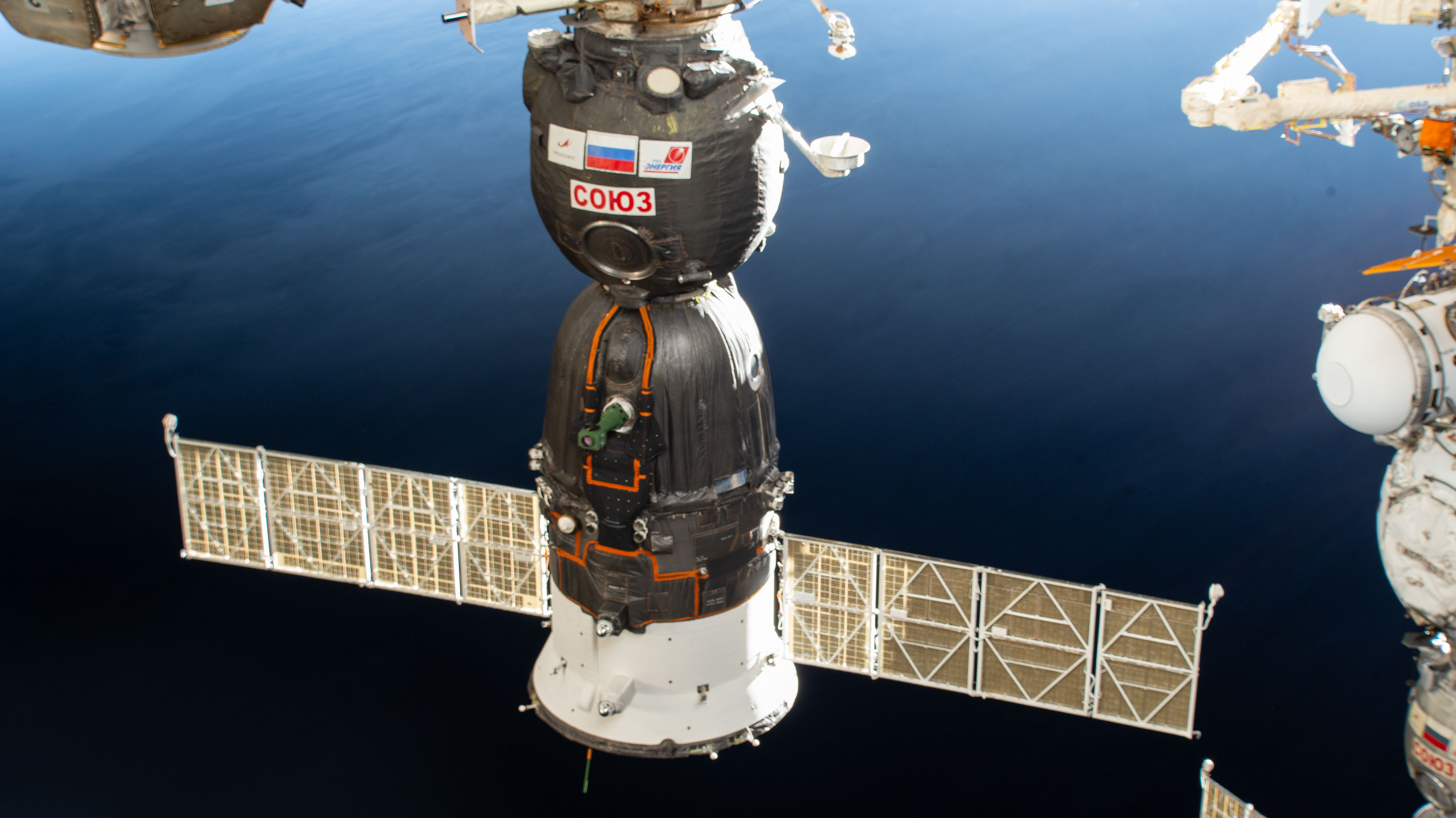
The Roscosmos Soyuz MS 28 spacecraft is pictured in November 2025 shortly after docking to the International Space Station’s Rassvet module.
Credit: NASA
Editor’s Note: This advisory was updated on July 23, 2026, to reflect changes to the mission timeline.
NASA astronaut Chris Williams and Roscosmos cosmonauts Sergey Kud-Sverchkov and Sergei Mikaev are wrapping up their 241‑day mission aboard the International Space Station.
The crew and its Soyuz MS-28 spacecraft will undock from the orbiting laboratory’s Rassvet module at 3:03 a.m. EDT Sunday, July 26, heading for a parachute-assisted landing at 6:25 a.m. (3:25 p.m. local time) on the steppe of Kazakhstan, southeast of Dzhezkazgan.
NASA’s live return coverage will stream through a variety of platforms. Learn where to watch online:
Williams and his crewmates will complete 3,856 orbits and travel more than 102 million miles before returning to Earth. The flight marks the first mission for Williams and Mikaev and the second for Kud‑Sverchkov.
After landing, the crew will fly by helicopter to Karaganda, Kazakhstan, where recovery teams are based. Williams then will return to NASA’s Johnson Space Center in Houston, while Kud‑Sverchkov and Mikaev head back to their training base in Star City, Russia.
NASA’s live return coverage is as follows (all times Eastern and subject to change based on real-time operations):
Saturday, July 25
9:40 a.m. – Coverage of the Space Station Expedition 74/75 change of command ceremony begins.
Kud‑Sverchkov will transfer command of the orbital complex to NASA astronaut Jessica Meir. Expedition 75 officially begins when Soyuz MS‑28 undocks.
11:10 p.m. – Coverage of crew farewells and hatch closing begins.
11:30 p.m. – Hatch closing
Sunday, July 26
2:30 a.m. – Coverage of undocking begins.
3:03 a.m. – Undocking
5:15 a.m. – Coverage of deorbit and landing begins.
5:31 a.m. – Deorbit burn
6:25 a.m. – Landing
For more than 25 years, people have lived and worked continuously aboard the International Space Station, advancing scientific knowledge and making research breakthroughs not possible on Earth. The space station helps NASA understand and overcome the challenges of human spaceflight, expand commercial opportunities in low Earth orbit, and build on the foundation for long-duration missions to the Moon, as part of the Artemis program, and to Mars.
To learn more about International Space Station research, operations, and its crews, visit:
The Roscosmos Soyuz MS 28 spacecraft is pictured in November 2025 shortly after docking to the International Space Station’s Rassvet module.
Credit: NASA
Editor’s Note: This advisory was updated on July 23, 2026, to reflect changes to the mission timeline.
NASA astronaut Chris Williams and Roscosmos cosmonauts Sergey Kud-Sverchkov and Sergei Mikaev are wrapping up their 241‑day mission aboard the International Space Station.
The crew and its Soyuz MS-28 spacecraft will undock from the orbiting laboratory’s Rassvet module at 3:03 a.m. EDT Sunday, July 26, heading for a parachute-assisted landing at 6:25 a.m. (3:25 p.m. local time) on the steppe of Kazakhstan, southeast of Dzhezkazgan.
NASA’s live return coverage will stream through a variety of platforms. Learn where to watch online:
Williams and his crewmates will complete 3,856 orbits and travel more than 102 million miles before returning to Earth. The flight marks the first mission for Williams and Mikaev and the second for Kud‑Sverchkov.
After landing, the crew will fly by helicopter to Karaganda, Kazakhstan, where recovery teams are based. Williams then will return to NASA’s Johnson Space Center in Houston, while Kud‑Sverchkov and Mikaev head back to their training base in Star City, Russia.
NASA’s live return coverage is as follows (all times Eastern and subject to change based on real-time operations):
Saturday, July 25
9:40 a.m. – Coverage of the Space Station Expedition 74/75 change of command ceremony begins.
Kud‑Sverchkov will transfer command of the orbital complex to NASA astronaut Jessica Meir. Expedition 75 officially begins when Soyuz MS‑28 undocks.
11:10 p.m. – Coverage of crew farewells and hatch closing begins.
11:30 p.m. – Hatch closing
Sunday, July 26
2:30 a.m. – Coverage of undocking begins.
3:03 a.m. – Undocking
5:15 a.m. – Coverage of deorbit and landing begins.
5:31 a.m. – Deorbit burn
6:25 a.m. – Landing
For more than 25 years, people have lived and worked continuously aboard the International Space Station, advancing scientific knowledge and making research breakthroughs not possible on Earth. The space station helps NASA understand and overcome the challenges of human spaceflight, expand commercial opportunities in low Earth orbit, and build on the foundation for long-duration missions to the Moon, as part of the Artemis program, and to Mars.
To learn more about International Space Station research, operations, and its crews, visit:
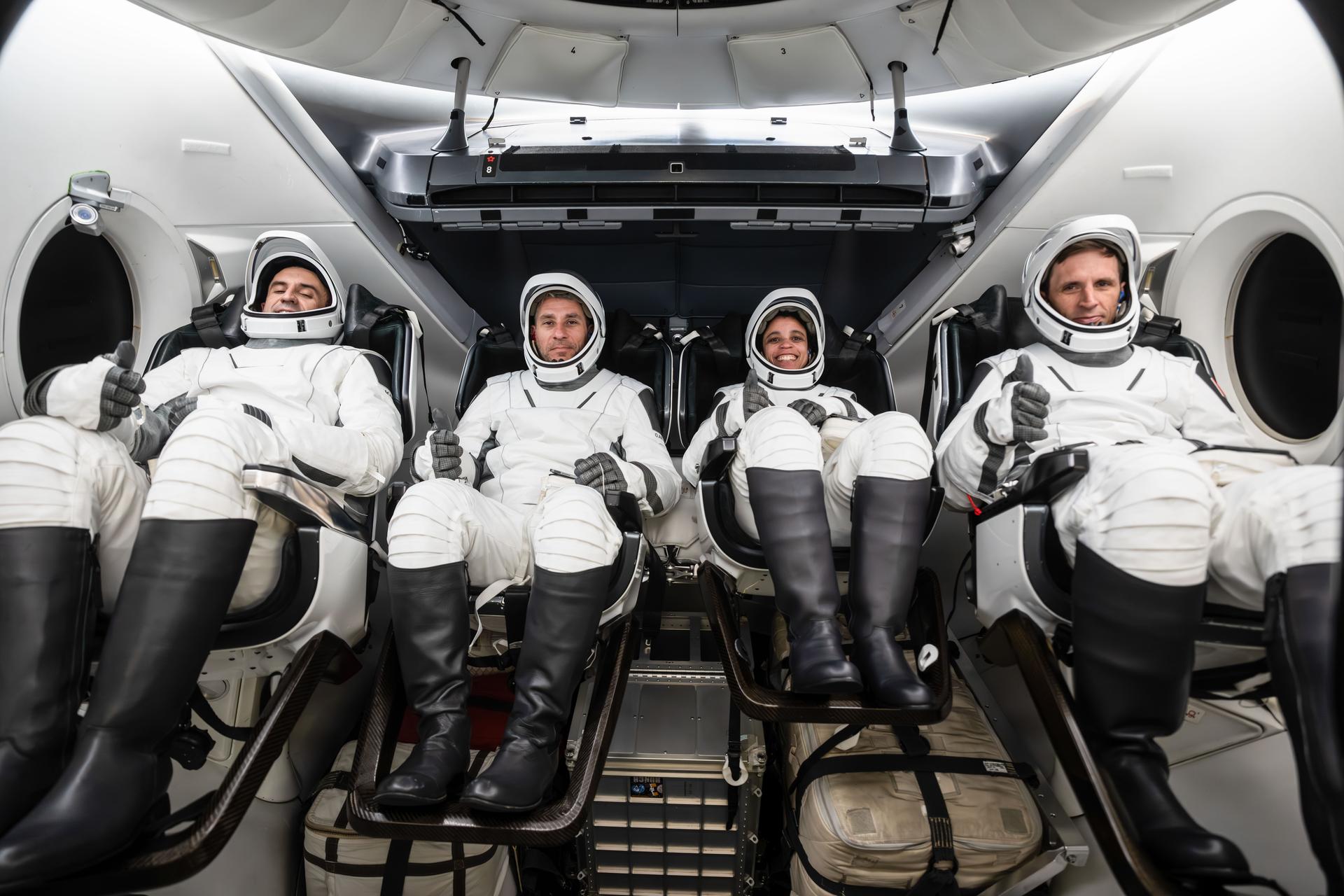
NASA’s SpaceX Crew-13 members are pictured in their pressure suits seated inside a mockup Dragon spacecraft during a preflight training session at the company’s headquarters in Hawthorne, California. From left are Roscosmos Sergey Teteryatnikov, NASA astronauts Luke Delaney and Jessica Watkins, and CSA (Canadian Space Agency) astronaut Joshua Kutryk.
Credit: SpaceX
NASA and its partners will discuss the upcoming crew rotation mission to the International Space Station during a pair of news conferences on Monday, Aug. 3, from the agency’s Johnson Space Center in Houston.
Mission leadership will provide an overview of NASA’s SpaceX Crew‑13 mission at 12 p.m. EDT. Next, crew members will discuss their training and mission preparations at 2 p.m. This is Crew-13’s final media availability prior to traveling to the agency’s Kennedy Space Center in Florida for launch.
NASA will stream these events live. Learn where to watch online:
The Crew-13 mission will carry NASA astronauts Jessica Watkins and Luke Delaney, CSA (Canadian Space Agency) astronaut Joshua Kutryk, and Roscosmos cosmonaut Sergey Teteryatnikov to the orbiting laboratory. The crew will launch aboard a SpaceX Dragon spacecraft on the company’s Falcon 9 rocket from Space Launch Complex 40 at Cape Canaveral Space Force Station in Florida no earlier than mid-September.
International media attending in person must email the NASA Johnson newsroom at jsccommu@mail.nasa.gov by 5 p.m., Tuesday, July 21. United States-based media attending in person must respond by 5 p.m., Thursday, July 30. Media joining virtually must respond by 10 a.m. the day of the event. NASA’s media accreditation policy is available online.
Briefing participants are as follows (all times Eastern and subject to change based on real-time operations):
12 p.m.: Mission Overview News Conference
Joel Montalbano, deputy associate administrator, Human Spaceflight Mission Directorate, NASA Headquarters
Dana Weigel, manager, Low Earth Orbit Program, NASA Johnson
Mathieu Caron, director, Astronauts, Life Sciences, and Space Medicine, CSA
Julianna Scheiman, director, NASA Science and Dragon Programs, SpaceX
Following the news conference, crew members will be available for limited media interviews. All interview requests must be submitted by 5 p.m. on July 30, to the NASA Johnson newsroom at: jsccommu@mail.nasa.gov.
This will be the second flight to the space station for Watkins, who was selected as a NASA astronaut in 2017. Watkins grew up in Lafayette, Colorado, and earned an undergraduate degree in geological and environmental sciences from Stanford University, as well as a doctorate in geology from the University of California, Los Angeles. As a geologist, she studied the Martian surface and was a member of the Curiosity rover science team at NASA’s Jet Propulsion Laboratory in Southern California. Watkins first launched to the space station as a crew member aboard NASA’s SpaceX Crew-4 mission, spending a total of 170 days in space across space station Expeditions 67/68 in 2022. She will be the first NASA astronaut to launch aboard a SpaceX Dragon spacecraft twice.
Selected as a NASA astronaut in 2021, Delaney earned a bachelor’s degree in mechanical engineering at the University of North Florida and a master’s degree in aerospace engineering at the Naval Postgraduate School. The Florida native is a distinguished naval aviator who participated in exercises throughout the Asia Pacific region and conducted missions in support of Operation Enduring Freedom. As a test pilot, Delaney evaluated developmental aircraft systems and served as a test pilot instructor. He also worked as a research pilot at NASA’s Langley Research Center in Hampton, Virginia, where he supported airborne science missions. This is the first spaceflight for Delaney.
The Crew-13 mission also is the first spaceflight for Kutryk. Prior to his selection as a CSA astronaut in 2017, he served as a CF-18 fighter pilot, flying missions in support of Canada’s NATO, U.N., and North American Aerospace Defense Command commitments. A native of Fort Saskatchewan, Alberta, Kutryk also worked as an experimental and operational test pilot at the Aerospace Engineering Test Establishment in Cold Lake, Alberta. Kutryk received a bachelor’s degree in mechanical engineering from the Royal Military College of Canada in Kingston, Ontario, and he is a distinguished graduate of the United States Air Force Test Pilot school in Edwards, California. He has master’s degrees in space studies, flight test engineering, and defense studies.
This mission will be Teteryatnikov’s first trip to the orbiting laboratory. He graduated from the Naval Academy, St. Petersburg, Russia, in 2011 as an engineer specializing in ship power plant operations. Before his selection as a test cosmonaut, Teteryatnikov served in various naval engineering roles, including undersea vessels and specialized engine room operations. He was selected for the Gagarin Research and Test Cosmonaut Training Center Cosmonaut Corps in 2021 and has served as a test cosmonaut since 2023.
NASA’s SpaceX Crew-13 members are pictured in their pressure suits seated inside a mockup Dragon spacecraft during a preflight training session at the company’s headquarters in Hawthorne, California. From left are Roscosmos Sergey Teteryatnikov, NASA astronauts Luke Delaney and Jessica Watkins, and CSA (Canadian Space Agency) astronaut Joshua Kutryk.
Credit: SpaceX
NASA and its partners will discuss the upcoming crew rotation mission to the International Space Station during a pair of news conferences on Monday, Aug. 3, from the agency’s Johnson Space Center in Houston.
Mission leadership will provide an overview of NASA’s SpaceX Crew‑13 mission at 12 p.m. EDT. Next, crew members will discuss their training and mission preparations at 2 p.m. This is Crew-13’s final media availability prior to traveling to the agency’s Kennedy Space Center in Florida for launch.
NASA will stream these events live. Learn where to watch online:
The Crew-13 mission will carry NASA astronauts Jessica Watkins and Luke Delaney, CSA (Canadian Space Agency) astronaut Joshua Kutryk, and Roscosmos cosmonaut Sergey Teteryatnikov to the orbiting laboratory. The crew will launch aboard a SpaceX Dragon spacecraft on the company’s Falcon 9 rocket from Space Launch Complex 40 at Cape Canaveral Space Force Station in Florida no earlier than mid-September.
International media attending in person must email the NASA Johnson newsroom at jsccommu@mail.nasa.gov by 5 p.m., Tuesday, July 21. United States-based media attending in person must respond by 5 p.m., Thursday, July 30. Media joining virtually must respond by 10 a.m. the day of the event. NASA’s media accreditation policy is available online.
Briefing participants are as follows (all times Eastern and subject to change based on real-time operations):
12 p.m.: Mission Overview News Conference
Joel Montalbano, deputy associate administrator, Human Spaceflight Mission Directorate, NASA Headquarters
Dana Weigel, manager, Low Earth Orbit Program, NASA Johnson
Mathieu Caron, director, Astronauts, Life Sciences, and Space Medicine, CSA
Julianna Scheiman, director, NASA Science and Dragon Programs, SpaceX
Following the news conference, crew members will be available for limited media interviews. All interview requests must be submitted by 5 p.m. on July 30, to the NASA Johnson newsroom at: jsccommu@mail.nasa.gov.
This will be the second flight to the space station for Watkins, who was selected as a NASA astronaut in 2017. Watkins grew up in Lafayette, Colorado, and earned an undergraduate degree in geological and environmental sciences from Stanford University, as well as a doctorate in geology from the University of California, Los Angeles. As a geologist, she studied the Martian surface and was a member of the Curiosity rover science team at NASA’s Jet Propulsion Laboratory in Southern California. Watkins first launched to the space station as a crew member aboard NASA’s SpaceX Crew-4 mission, spending a total of 170 days in space across space station Expeditions 67/68 in 2022. She will be the first NASA astronaut to launch aboard a SpaceX Dragon spacecraft twice.
Selected as a NASA astronaut in 2021, Delaney earned a bachelor’s degree in mechanical engineering at the University of North Florida and a master’s degree in aerospace engineering at the Naval Postgraduate School. The Florida native is a distinguished naval aviator who participated in exercises throughout the Asia Pacific region and conducted missions in support of Operation Enduring Freedom. As a test pilot, Delaney evaluated developmental aircraft systems and served as a test pilot instructor. He also worked as a research pilot at NASA’s Langley Research Center in Hampton, Virginia, where he supported airborne science missions. This is the first spaceflight for Delaney.
The Crew-13 mission also is the first spaceflight for Kutryk. Prior to his selection as a CSA astronaut in 2017, he served as a CF-18 fighter pilot, flying missions in support of Canada’s NATO, U.N., and North American Aerospace Defense Command commitments. A native of Fort Saskatchewan, Alberta, Kutryk also worked as an experimental and operational test pilot at the Aerospace Engineering Test Establishment in Cold Lake, Alberta. Kutryk received a bachelor’s degree in mechanical engineering from the Royal Military College of Canada in Kingston, Ontario, and he is a distinguished graduate of the United States Air Force Test Pilot school in Edwards, California. He has master’s degrees in space studies, flight test engineering, and defense studies.
This mission will be Teteryatnikov’s first trip to the orbiting laboratory. He graduated from the Naval Academy, St. Petersburg, Russia, in 2011 as an engineer specializing in ship power plant operations. Before his selection as a test cosmonaut, Teteryatnikov served in various naval engineering roles, including undersea vessels and specialized engine room operations. He was selected for the Gagarin Research and Test Cosmonaut Training Center Cosmonaut Corps in 2021 and has served as a test cosmonaut since 2023.

 Accedi