Vista elenco

APOD: 2026 August 16 – Milky Way over Yellowstone

16 Agosto 2026 ore 06:05

APOD

Astronomy Picture of the Day

Discover the cosmos! Each day a different image or photograph of our fascinating universe is featured, along with a brief explanation written by a professional astronomer.
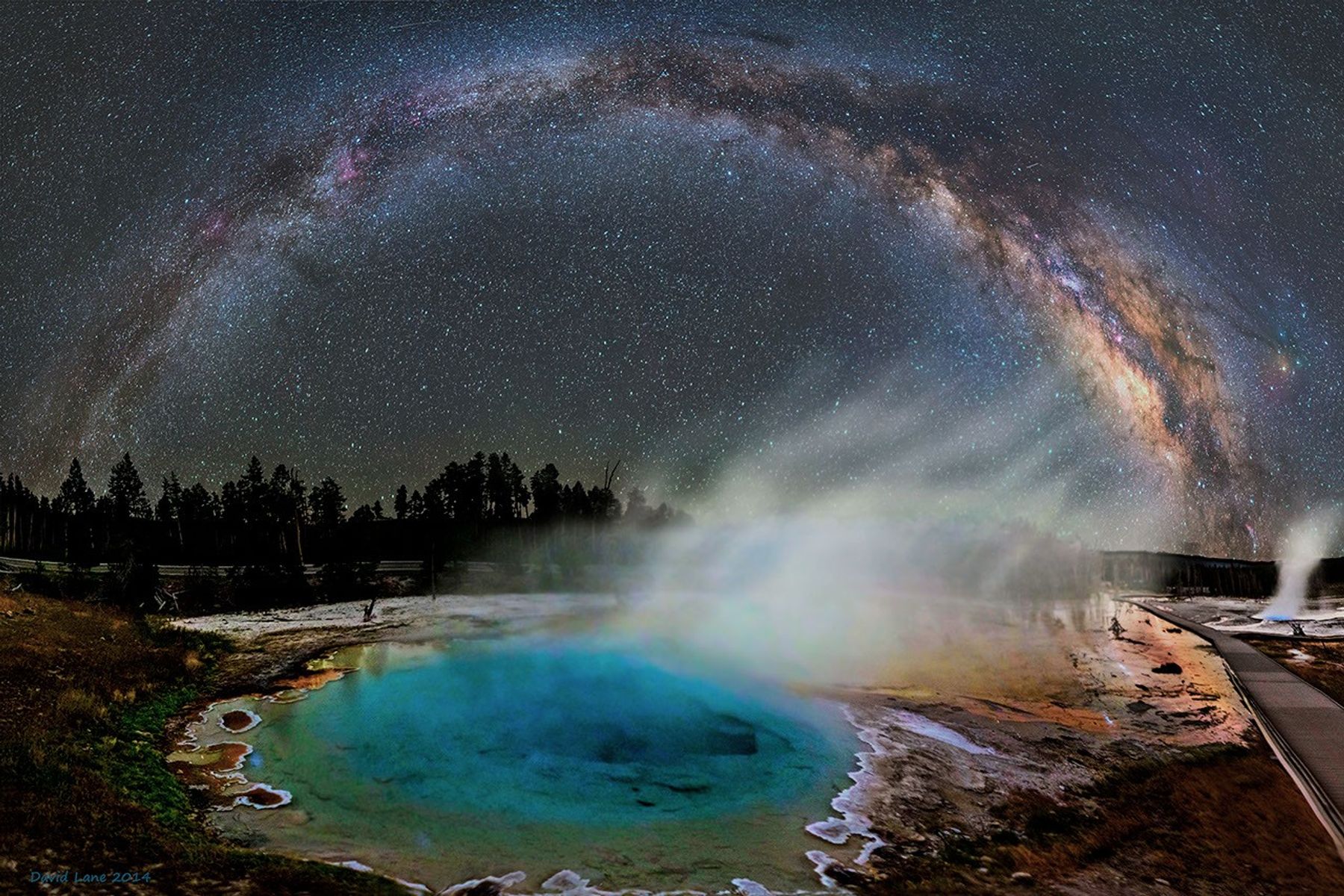
A composite image of the night sky above the old faithful guyser in Yelowstone National Park.

Milky Way over Yellowstone

Explanation: The Milky Way was not created by an evaporating lake. The colorful pool of water, about 10 meters across, is known as Silex Spring and is located in Yellowstone National Park in Wyoming, USA. Illuminated artificially, the colors are caused by layers of bacteria that grow in the hot spring. Steam rises off the spring, heated by underground magma associated with the Yellowstone Hotspot. Unrelated and far in the distance, the central band of our Milky Way Galaxy arches high overhead, a band lit by billions of stars. The picture features a 16-image panorama taken in 2014. If the Yellowstone Hotspot causes another supervolcanic eruption as it did about 640,000 years ago, a large part of North America would be affected.

Growing Gallery: Solar Eclipse of 2026 August 12
Tomorrow’s picture: a golden crown

Date August 16, 2026
Credit & Copyright: Dave Lane
Authors & editors: Robert Nemiroff, Jerry Bonnell, Cecilia Chirenti, Keighley Rockcliffe
A service of: ASD at NASA / GSFC,
NASA Science Activation & Michigan Tech. U.

APOD: 2026 August 15 – Bright Perseids from Sweden

15 Agosto 2026 ore 06:05

APOD

Astronomy Picture of the Day

Discover the cosmos! Each day a different image or photograph of our fascinating universe is featured, along with a brief explanation written by a professional astronomer.

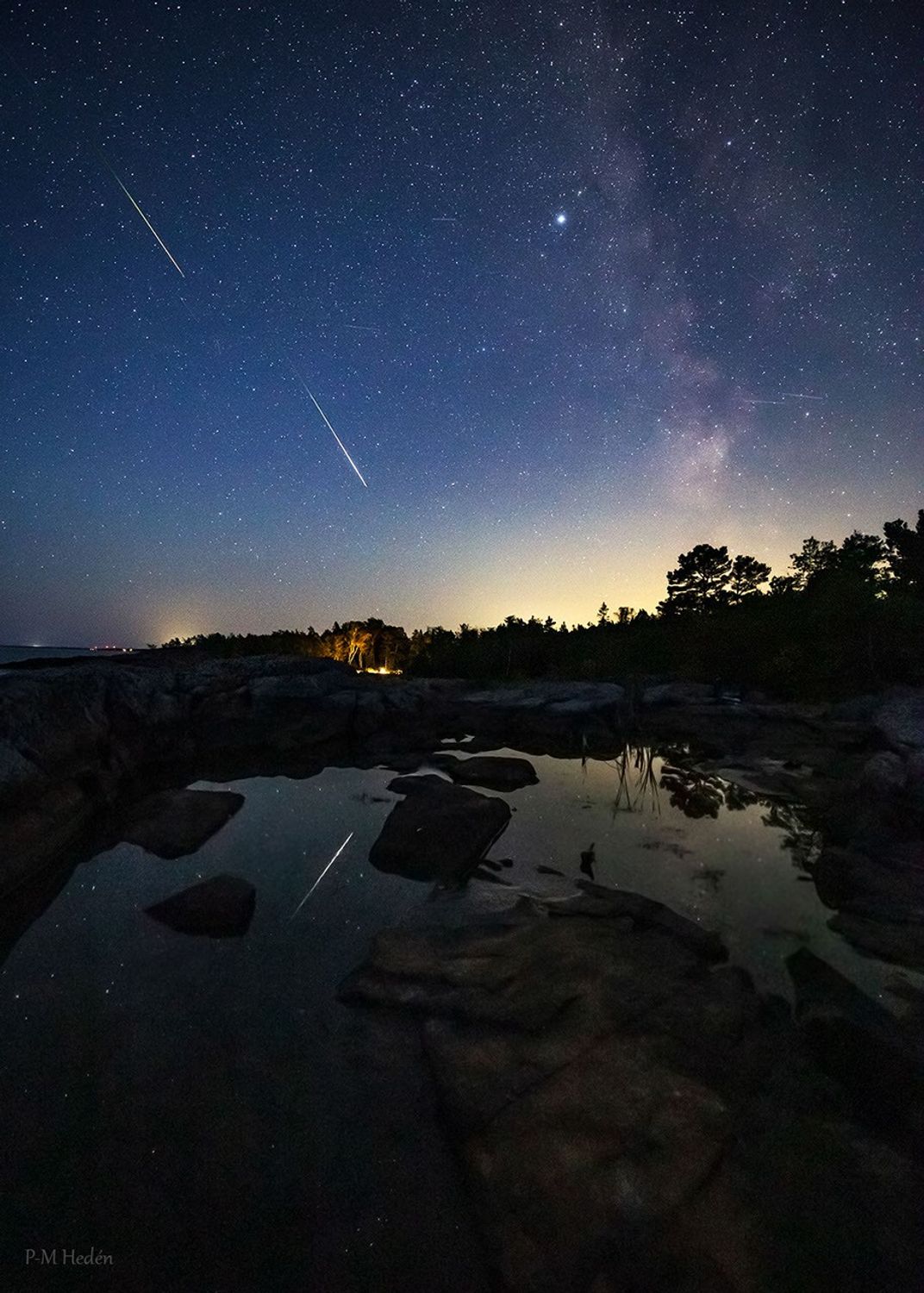
Two meteors flash through the night sky.  One is reflected in the water below.

Bright Perseids from Sweden

Explanation: Known for its bright and fast meteors, the annual Perseid Meteor Shower comes to planet Earth’s skies from a radiant in the heroic constellation Perseus. The popular northern summer celestial spectacle is created as grains of dust cast off along the orbit of periodic comet 109P/Swift-Tuttle vaporize in Earth’s dense atmosphere, tracing brief, but beautiful streaks through the night. Taken near the shower’s peak of activity on August 12, this composite image recorded two bright perseid meteors and one meteor’s watery reflection from a location near the coastal village of Grisslehamn, Sweden. Almost as bright as Altair, brightest star on the scene, the meteors appear along with the faint, diffuse background of the Milky Way. This year, the shower’s peak activity coincided with a New Moon, so perseid meteor flashes were undiminished by bright moonlight. And for many skywatchers, this night of bright perseid meteors followed their viewing of the silhouette of the New Moon in a much anticipated solar eclipse.

Growing Gallery: Solar Eclipse of 2026 August 12
Tomorrow’s picture: Milky Way over Yellowstone

Date August 15, 2026
Credit & Copyright: P-M Hedén (Clear Skies, TWAN)
Authors & editors: Jerry Bonnell, Cecilia Chirenti, Robert Nemiroff, Keighley Rockcliffe
A service of: ASD at NASA / GSFC,
NASA Science Activation & Michigan Tech. U.

APOD: 2026 August 14 – Total Solar Eclipse from Greenland

14 Agosto 2026 ore 06:05

APOD

Astronomy Picture of the Day

Discover the cosmos! Each day a different image or photograph of our fascinating universe is featured, along with a brief explanation written by a professional astronomer.

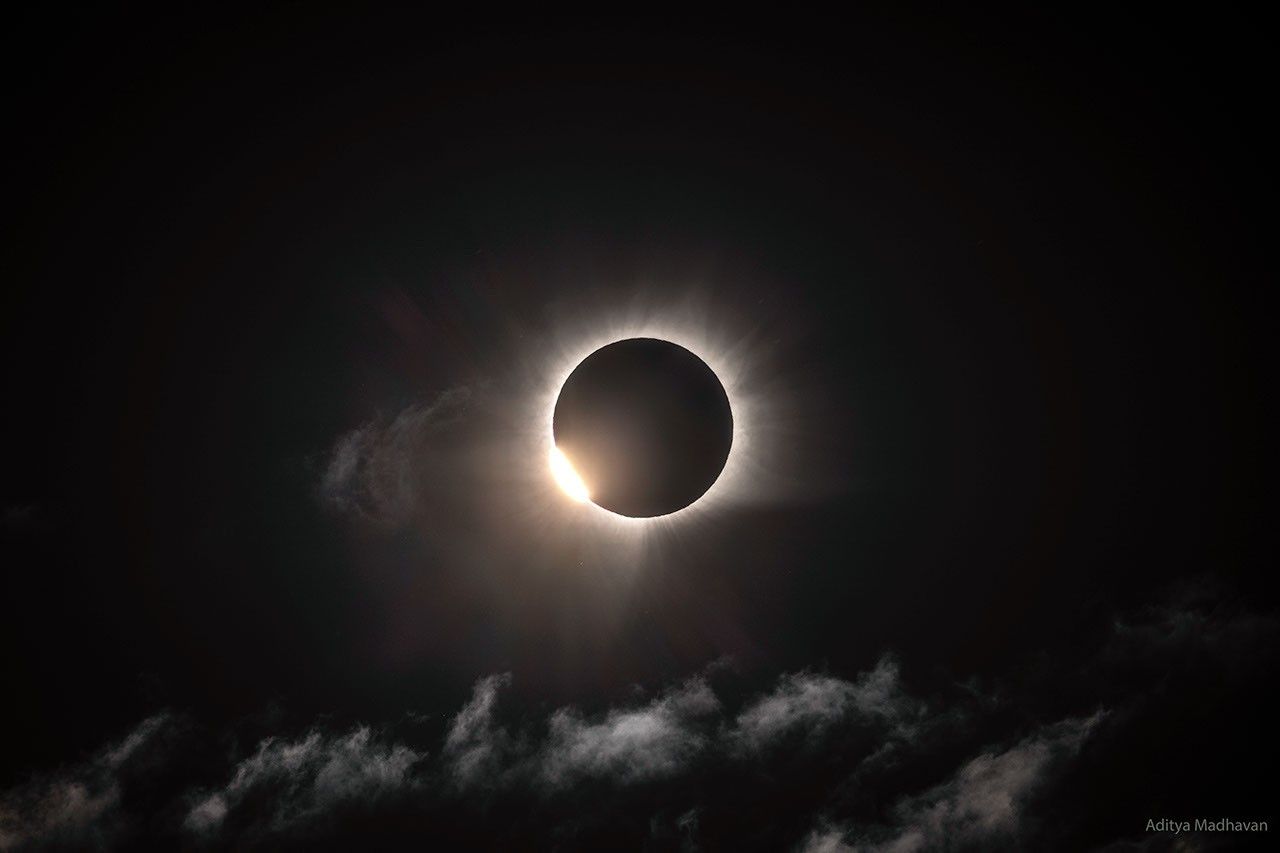
Total Solar Eclipse from Greenland

Explanation: On August 12, the Moon’s shadow reached out to touch our fair planet. Beginning in the Arctic Ocean, it swept along a narrow track that led the dark lunar umbra across parts of Greenland, Iceland, the Atlantic, Portugal, and northern Spain. And for a moment, denizens of Earth who found themselves with clear skies under the shadow of the Moon could witness a total solar eclipse. After dodging the weather by sea and making a landing along Rype Fjord on the Greenland east coast (at 71.07055N, 27.71252W), this hard-won snapshot was captured at 17:33:26 UTC. That’s near the initial reach of clearing skies along the path of totality, so the image is likely one of the first unobstructed views of the totally eclipsed Sun. Through a break in the clouds, the stunning photo also records one of this eclipse’s transient diamond rings and the magnificent solar corona emerging near the moment totality began.

More spectacular eclipse images: Solar Eclipse of 2026 August 12
Tomorrow’s picture: perhaps a Perseid

Date August 14, 2026
Credit & Copyright: Aditya Madhavan
Authors & editors: Jerry Bonnell, Cecilia Chirenti, Robert Nemiroff, Keighley Rockcliffe
A service of: ASD at NASA / GSFC,
NASA Science Activation & Michigan Tech. U.
❌