Forse in pochi ci avevano pensato, ma dal momento che gli agenti AI navigano sul Web per raccogliere informazioni e compiere operazioni per conto degli utenti, potrebbe essere una buona idea mascherarne le attività per evitare di fornire contesti non voluti a siti web e servizi di cui non sappiamo granché. Bitdefender ha infatti presentato […]
The consumer data broker Radaris.com has long had a reputation for ignoring requests to remove personal information from its vast empire of people-search services online. That reputation caught up with the company recently in a lawsuit alleging Radaris violated a New Jersey privacy law that provides for hefty fines against data brokers that publish personal information on state law enforcement officials. In the face of repeated stonewalling and prevarication by attorneys for Radaris, the judge in the case ordered that radaris.com and more than a dozen other data broker domains be transferred to the plaintiffs.
The radaris.com website, prior to the domain transfer to Atlas.
In February 2024, Radaris was sued by Atlas Data Privacy Corp, a company that has been pursuing data brokers alleged to be violating a New Jersey statute called Daniel’s Law. The statute allows state law enforcement officials, government personnel, judges and their families to have their information completely removed from commercial data brokers and people-search services, and provides for fines of $1,000 per violation against companies that ignore removal requests.
Less than a month after Atlas sued Radaris, KrebsOnSecurity published a deep dive into the Radaris co-founders — Igor and Dmitry Lubarsky (also spelled Lybarsky) — Russian-born brothers living in Massachusetts who operate a dizzying array of people-search companies as well as a number of Russian language dating services and affiliate programs.
Attorneys for the Lubarsky brothers threatened to sue for defamation if the story wasn’t removed and an apology issued. Their attorney asserted that our reporting was wildly inaccurate, and that the true owners of the company were Ukrainians living in Ukraine.
The Lubarsky brothers Dmitry or “Dan” (left) and Gary/Igor.
KrebsOnSecurity doubled down and showed how the Lubarsky brothers built and operated Radaris and other data broker companies using a fictitious CEO’s name. Our follow-up story noted that Radaris’s attorney — a lawyer with the Boston Law Group named Val Gurvits — admitted his clients had invented the CEO pseudonym “Gary Norden,” and that Radaris also had issued multiple press releases over the years that quoted the fake CEO while seeking money from potential investors.
Attorneys for Radaris waited until the last minute to appear in court and contest what was all but certain to be a default judgment in favor of the plaintiffs, and then told the court that Atlas had failed to serve the real owners and operators of Radaris and several of its sister data broker companies.
Atlas re-filed the lawsuit in June 2025, this time dramatically expanding the number of Radaris family data brokers accused of violating Daniel’s Law. Matt Adkisson, president and CEO of Atlas, said Radaris turned to a tried-and-true playbook: Delaying in court until the last possible minute, and playing shell games with Radaris’s true country of origin and the individuals listed as owners and operators of these sites.
“We refer to this period as their island-hopping phase. Privacy policies changed constantly, and new entities kept appearing from places like the Marshall Islands, the British Virgin Islands, and Seychelles,” Adkisson told KrebsOnSecurity. “Behind the scenes, it felt like a shell game. Defense lawyers told the court that certain entities merely operated the domains and were the proper parties to sue. But by the time a judgment neared, those entities would be discarded and new entities would appear. Meanwhile, the lawyers claimed the other entities that actually owned the domains should not be held responsible.”
Adkisson said when the defendants updated their terms of service to state that Radaris was suddenly managed by a company in the Marshall Islands, Atlas hired an investigator in that country and soon learned the brand new entity that Radaris claimed was managing the company didn’t even exist yet.
Mr. Gurvits stepped forward as Radaris’s attorney in a class action lawsuit the company temporarily lost in 2017 because it never contested the claim in court. When the plaintiffs told the judge they couldn’t collect on the $7.5 million default judgment, the court ordered the domain registry Verisign to transfer the radaris.com domain name to the plaintiffs.
Mr. Gurvits appealed that verdict, arguing the lawsuit hadn’t named the actual owners of the Radaris domain name — a Cyprus company called Bitseller Expert Limited — and thus taking the domain away would be a violation of their due process rights.
The judge in the 2017 case ruled in Radaris’ favor — halting the domain transfer — and told the plaintiffs they could refile their complaint. Soon after, the operator of Radaris changed from Bitseller to Andtop Company, an entity formed (PDF) in the Marshall Islands in Oct. 2020. The plaintiffs never re-filed their lawsuit.
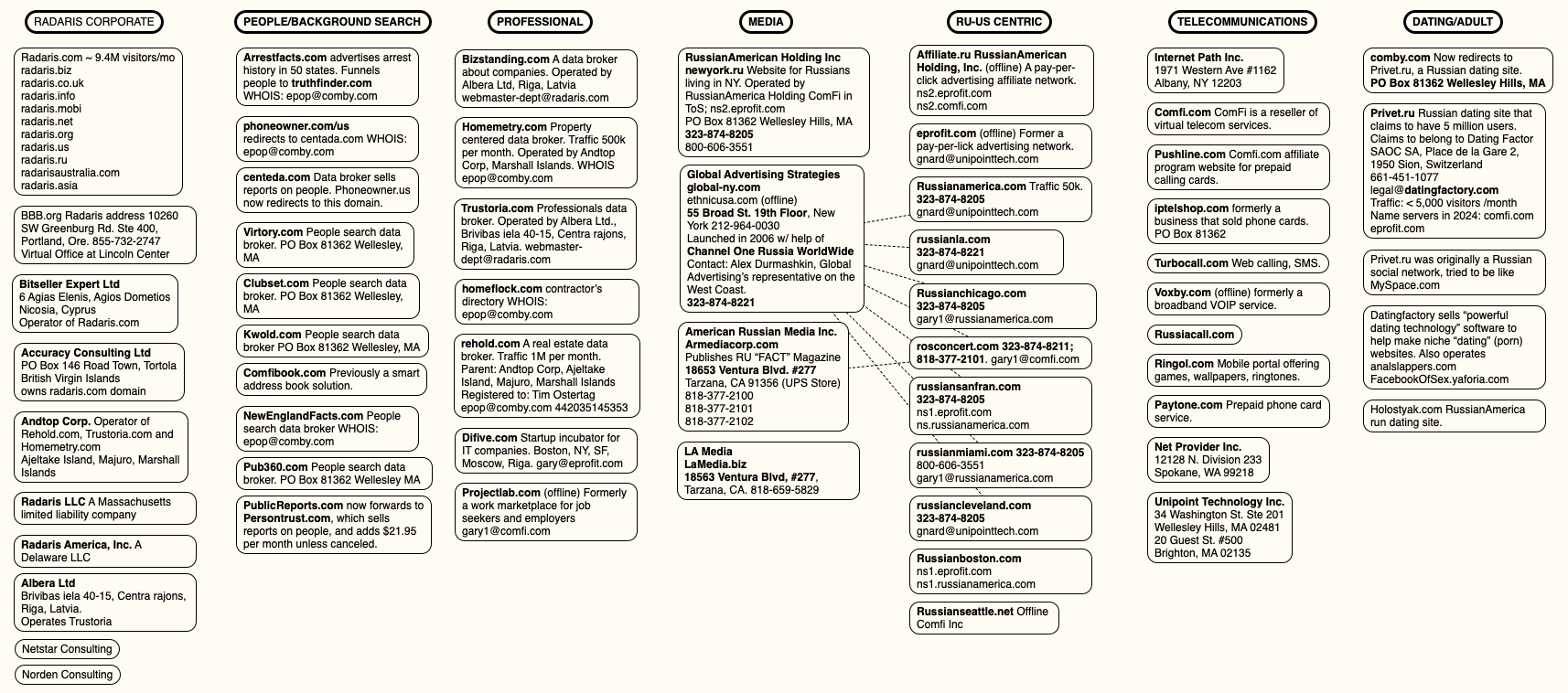
A mind map of various entities tied to Radaris and the company’s co-founders. Click to enlarge.
“That seemed to be their modus operandi,” said Raj Parikh, a partner at PEM Law in New Jersey who handles most of the Daniel’s Law litigation for Atlas. “In the past, they won by attrition. Plaintiffs’ attorneys tired of the procedural games and just gave up. That strategy worked for a decade, and it probably would have worked in this case too, since any financial recovery from foreign actors will be difficult. But we were acutely aware of the threat this website posed to law enforcement officers and other public officials in New Jersey, and decided early on to commit whatever time and resources were necessary to remove that threat.”
On August 26, the judge in the New Jersey case found the defendants were given multiple chances to appear and defend the claims against them but had failed to do so. Mr. Gurvits declined to comment on the case, saying it had been assigned to another attorney, a Mr. Victor Worms. In response to questions, Mr. Worms asserted the New Jersey court transferred Radaris.com to Atlas as part of a default judgment against Radaris.com, which is not a legal entity.
“We have made a motion to vacate that default judgment on the grounds that it is void since a non-entity has no legal capacity to sue or be sued,” Worms replied. “We also intend to pursue all appropriate appeals because we believe the transfer of Radaris.com amounts to a forfeiture in violation of various constitutional principles.”
While radaris.com still comes up prominently in results when searching online for U.S. residents by name, the domain no longer sells detailed personal dossiers on millions of Americans. Its homepage now displays a notice from Atlas, as well as links to our previous reporting on Radaris.
EMAIL CONFIRMATIONS
Atlas told KrebsOnSecurity that it has obtained more than 10,000 emails and documents in the course of litigation, and that those messages confirm our previous reporting on the owners and operators of Radaris and its myriad companies.
Atlas said the emails clearly establish that the nominal legal vehicles — Radaris America, Inc.; Bitseller Expert Limited; Digital Orbit Corp; Core Solutions Group Inc; Lucky Solutions Inc; Virtura Corp; Veripages Inc.; Nuform Solutions Inc.; Growth Data Advisors Inc.; Property Experts, Inc — are all administered by the same three or four people from the same mailboxes, share one bank or payment card set, and are all managed from one virtual office address.
“The corpus establishes, with documentary evidence generated independently by banks, payment processors, hosting providers, registrars, software-as-a-service vendors and the operators’ own systems, that radaris.com and at least twenty-five other people-search websites are one operation run by a small Boston-area group whose administrative, financial and technical functions sit on the difive.com mail domain and its successors (centerex.com, scienteco.com, eprofit.com, realmo.com, pub360.com),” reads a summary shared by Atlas.
Atlas said the emails show Radaris.com earns approximately $42,000 a month, while Veripages.com earns around $45,000 monthly via its partnership with the Lifetime Value Company, a marketing and advertising firm whose brands include PeopleLooker, PeopleSmart, NumberGuru, and Bumper, a car history site.
According to Atlas, the emails also showed the Radaris family of websites earns as much as $25,000 each month from their partnership with Onerep, a company that claims to help people remove their information from people-search sites. In March 2024, KrebsOnSecurity revealed how the Belarusian founder of Onerep had launched and operated dozens of people-search sites over the years and was continuing to operate one of them (Nuwber), effectively spreading the disease and selling the cure.
The domain radaris.com now redirects to this notice from Atlas about the court-ordered domain transfer.
All told, the New Jersey court has so far transferred 14 domain names from the Radaris family of companies to Atlas. Radaris.com now redirects to a notice of the court-ordered domain transfer.
THE ROAD AHEAD
The Radaris family of companies is still potentially facing fines of $1,000 per alleged violation of Daniel’s Law. For the time being, however, Daniel’s Law is facing a constitutional challenge from virtually all of the 150 other consumer data broker firms being sued by Atlas.
The data broker industry responded by having at least 70 of the Atlas lawsuits moved to federal court, challenging the New Jersey statute as overly broad and a violation of the First Amendment. The U.S. Court of Appeals for the Third Circuit has not yet issued a decision on the constitutional challenge, but either way the case is widely expected to be appealed all the way to the U.S. Supreme Court.
Meanwhile, at least 14 other states have now passed laws modeled after the New Jersey statute, with more states considering similar measures. However, West Virginia’s Daniel’s Law was ruled facially unconstitutional under the First Amendment by a federal district court in August 2025.
Justin Sherman is a privacy expert and author of the forthcoming book “The Middlemen,” which examines how the data broker industry powers modern surveillance. Sherman said federal lawmakers have long faced intense lobbying by the technology industry against more restrictive U.S. data privacy laws, but that many powerful industries are now working against passing comprehensive data privacy legislation.
“These days at the federal level, add in the intense amount of lobbying against these laws from social media companies, big tech, cryptocurrency firms, and now AI proponents in the mix who claim that limiting their data scraping is somehow going to collapse the whole U.S. economy under Chinese rule,” he said.
Sherman said people-search companies will continue to thrive unless and until Congress enacts meaningful consumer privacy and data protection laws that are relevant to life in the 21st century. That’s because virtually all state privacy laws exempt records that might be considered “public” or “government” documents, including voting registries, property filings, marriage certificates, motor vehicle records, criminal records, court documents, death records, professional licenses, bankruptcy filings, and more.
At least 25 states have passed or implemented laws requiring age verification for residents seeking to access adult content online, but there is no federal law that limits how the companies that are scanning everyone’s drivers license can use, share or keep the data provided. Had such restrictions been enshrined in law, we may have avoided the recent breach at IDScan.net, which exposed the drivers license information on more than 153 million Americans when the records were briefly turned into a point-and-click identity theft service on the dark web.
“The average person can look at Daniel’s Law and have a perfectly normal reaction, which is that everyone should be covered, not just police and judges,” Sherman said. “But we don’t need more wake-up calls. We’ve had eight million wake-up calls already on the need for better privacy laws. The lack of comprehensive federal privacy law is not for a lack of knowledge, and anyone claiming otherwise is either not reading the news or kidding themselves.”
Dalle scorte domestiche ai social network: ciò che comunichiamo senza accorgercene
Essere discreti non riguarda soltanto il modo in cui ci vestiamo.
Una persona può utilizzare uno zaino urbano, muoversi in modo naturale e non attirare particolare attenzione, ma allo stesso tempo comunicare una grande quantità di informazioni attraverso ciò che trasporta, ciò che racconta e ciò che pubblica online.
Nelle prime due parti dello Speciale AIP dedicato al Grey Man abbiamo analizzato il concetto e la sua applicazione pratica.
Ora dobbiamo affrontare una domanda diversa:
Che cosa stiamo comunicando agli altri senza rendercene conto?
Per un prepper, questa domanda può riguardare:
scorte;
acqua;
energia;
equipaggiamento;
competenze;
spostamenti;
abitudini familiari;
presenza digitale.
Ed è qui che il Grey Man incontra un altro concetto importante: l’OPSEC.
Il NIST descrive l’OPSEC come un processo sistematico volto a proteggere informazioni generalmente non classificate che potrebbero rivelare capacità e intenzioni. Il processo comprende l’identificazione delle informazioni critiche, l’analisi delle minacce e delle vulnerabilità, la valutazione del rischio e l’applicazione di contromisure appropriate. Unterintelligence and Security Agency sottolinea che l’OPSEC protegge informazioni critiche, classificate o non classificate, che potrebbero essere utilizzate contro un’organizzazione, invitando a osservare le proprie attività anche dal punto di vista di un possibile avversario. Grey Man e OPSEC non sono sinonimi.
Il Grey Man riguarda principalmente la gestione della propria presenza percepibile.
L’OPSEC riguarda la protezione di informazioni e indicatori rilevanti.
I due concetti possono però incontrarsi.
Uno zaino tattico può suggerire la presenza di equipaggiamento.
Una power station trasportata apertamente comunica disponibilità di energia.
Una conversazione può rivelare l’esistenza di scorte.
Una fotografia pubblicata online può mostrare dove vengono conservate.
Concetto AIP
La discrezione non consiste nel mentire. Consiste nel non distribuire informazioni prive di utilità per chi le riceve.
Le informazioni apparentemente innocue
Una singola informazione può sembrare irrilevante.
Il problema nasce quando diverse informazioni vengono raccolte e combinate.
Immaginiamo una persona che nel corso del tempo pubblichi:
una fotografia della propria power station;
un video della dispensa;
immagini dell’impianto fotovoltaico;
un post nel quale annuncia una settimana di vacanza;
fotografie dalle quali è riconoscibile l’abitazione;
immagini del veicolo;
informazioni sulla composizione della famiglia.
Ogni contenuto, preso singolarmente, può apparire innocuo.
Nel loro insieme, però, questi elementi possono ricostruire risorse, abitudini e vulnerabilità.
La metodologia OPSEC considera proprio il valore degli indicatori e delle informazioni che, pur non essendo necessariamente segreti, possono essere raccolti e interpretati. o del blackout
Immaginiamo un blackout urbano prolungato.
Durante le prime ore, molte persone utilizzano telefoni, torce e batterie portatili.
Con il passare del tempo, la disponibilità di energia diminuisce.
Alcuni negozi restano chiusi.
Le comunicazioni diventano più difficili.
La possibilità di ricaricare un telefono acquista maggiore valore.
Una persona attraversa il quartiere trasportando una power station costosa, pannelli solari pieghevoli e diversi dispositivi elettronici chiaramente visibili.
Non sta facendo nulla di sbagliato.
Tuttavia comunica:
di possedere energia;
di avere attrezzatura di valore;
di conoscere sistemi alternativi di alimentazione;
di disporre probabilmente di altre risorse.
Il principio Grey Man suggerirebbe, quando possibile, di ridurre l’esposizione non necessaria dell’attrezzatura.
Questo non significa rifiutare di aiutare gli altri.
Significa decidere consapevolmente come, quando e in quale misura rendere visibili le proprie capacità.
Le risorse comunicano
Una famiglia può rivelare involontariamente la propria preparazione attraverso:
taniche di carburante visibili;
grandi quantità d’acqua trasportate apertamente;
pannelli solari;
generatori;
antenne;
apparati radio;
confezioni di alimenti in grandi quantità;
attrezzature lasciate in vista;
conversazioni con vicini o conoscenti.
Non tutto può o deve essere nascosto.
L’obiettivo non è rendere segreta la propria abitazione.
È imparare a chiedersi:
Questa informazione deve essere visibile a chiunque?
In alcuni casi la risposta sarà sì.
In altri no.
La sicurezza nasce anche dalla possibilità di scegliere consapevolmente.
Il Grey Man digitale
Oggi la discrezione fisica rappresenta soltanto una parte del problema.
Una persona può muoversi in modo ordinario per strada e contemporaneamente aver pubblicato online:
fotografie della propria abitazione;
l’inventario delle scorte;
il modello della power station;
la disposizione dei pannelli fotovoltaici;
dettagli del sistema di sicurezza;
la targa del veicolo;
il luogo nel quale trascorre i fine settimana;
le date delle vacanze;
la posizione di un terreno o di un rifugio.
La CISA raccomanda di prestare attenzione alle informazioni condivise online e di gestire le impostazioni dei social network per migliorare privacy e sicurezza. Raccomanda inoltre di limitare la quantità di informazioni personali pubblicate, evitando dati che possano rendere una persona più vulnerabile, come indirizzi o informazioni sulle proprie abitudini. r moderno, discrezione fisica e sicurezza digitale devono quindi procedere insieme.
A cosa serve passare inosservati per strada se online abbiamo già pubblicato l’inventario della nostra preparazione?
Prima di pubblicare
Prima di condividere una fotografia o un video può essere utile chiedersi:
Sullo sfondo è visibile un indirizzo?
È riconoscibile l’ingresso dell’abitazione?
Sono visibili targhe, documenti o numeri di serie?
Il contenuto rivela la posizione di attrezzature?
Sto mostrando quantità significative di risorse?
Sto comunicando che la casa resterà vuota?
Le fotografie pubblicate in momenti diversi possono essere combinate?
Sto esponendo informazioni relative ad altre persone?
Non è necessario smettere di utilizzare i social network.
È necessario utilizzarli con maggiore consapevolezza.
Anche le conversazioni sono informazioni
Molte informazioni vengono comunicate semplicemente parlando.
Durante un’emergenza, frasi come:
“Abbiamo scorte per tre mesi”;
“Ho un generatore in garage”;
“Conserviamo centinaia di litri d’acqua”;
“Se succede qualcosa andremo nella casa in montagna”;
possono rivelare più di quanto sia necessario.
Questo non significa mentire.
Non significa nemmeno rifiutare ogni dialogo.
Significa comprendere che non tutte le informazioni devono essere condivise con chiunque.
Grey Man e cooperazione
Una delle interpretazioni più problematiche del Grey Man presenta la società come una massa ostile dalla quale nascondersi.
Questa visione è riduttiva.
Durante molte emergenze, vicini, volontari, associazioni e cittadini diventano risorse decisive.
La cooperazione permette di condividere:
informazioni;
competenze;
assistenza;
trasporti;
sorveglianza;
risorse.
La discrezione non dovrebbe degenerare nell’isolamento.
Un prepper responsabile dovrebbe saper distinguere tra:
informazioni che possono essere condivise;
informazioni che è opportuno proteggere;
persone affidabili;
relazioni ancora da costruire;
aiuto sostenibile;
richieste capaci di mettere in difficoltà il proprio nucleo familiare.
Il Grey Man può essere utile durante uno spostamento o in una situazione confusa.
In una comunità stabile e affidabile, invece, la cooperazione può offrire una protezione superiore a quella ottenibile da un individuo isolato.
Principio AIP
La resilienza non nasce soltanto da ciò che possediamo. Nasce anche dalle relazioni che costruiamo prima dell’emergenza.
Quando la discrezione non è la scelta giusta
Non tutte le emergenze richiedono di passare inosservati.
Durante un soccorso, un’evacuazione organizzata o una ricerca, essere visibili può salvare la vita.
In ambiente naturale, colori facilmente individuabili possono facilitare il ritrovamento.
Durante un incendio, un’alluvione o un incidente, segnalare chiaramente la propria posizione può essere prioritario.
Un volontario, un soccorritore o un addetto alla sicurezza deve spesso essere riconoscibile.
Anche chi necessita di assistenza deve rendersi visibile e comunicare chiaramente la propria condizione.
Regola fondamentale
Prima di cercare di passare inosservati, occorre chiedersi se essere riconosciuti o localizzati possa invece aumentare la sicurezza.
Il contesto italiano
Gran parte dei contenuti online dedicati al Grey Man nasce negli Stati Uniti e riflette scenari e modelli sociali non sempre sovrapponibili ai nostri.
In Italia, la normalità può cambiare radicalmente tra:
un centro storico;
una periferia urbana;
un piccolo paese;
una stazione ferroviaria;
un evento sportivo;
una zona montana;
un centro di accoglienza temporaneo;
un’area colpita da terremoto o alluvione.
Non è sufficiente tradurre consigli stranieri.
Occorre interpretarli alla luce:
del territorio;
della cultura;
delle normative;
delle abitudini;
degli scenari realistici italiani.
La preparazione non dovrebbe trasformare una persona in un personaggio.
Dovrebbe permetterle di affrontare meglio la realtà nella quale vive.
Non invisibili, ma consapevoli
La vera forza del Grey Man non consiste nel diventare irriconoscibili.
Consiste nel controllare meglio le informazioni che comunichiamo.
Abbigliamento, equipaggiamento, comportamento, conversazioni e presenza digitale raccontano continuamente qualcosa di noi.
Non possiamo impedire ogni forma di osservazione.
E non dovremmo vivere nascosti.
Possiamo però decidere con maggiore consapevolezza:
cosa mostrare;
a chi mostrarlo;
quando farlo;
quali informazioni proteggere;
quando collaborare;
quando essere visibili;
quando ridurre la nostra esposizione.
Il Grey Man non è un travestimento.
Non è un colore.
Non è uno zaino.
Non è una tecnica infallibile.
È, nella sua interpretazione più utile, una forma di disciplina personale basata sull’adattamento, sulla consapevolezza situazionale e sulla gestione delle informazioni.
Essere preparati non significa necessariamente sembrare preparati.
Ma significa sapere perché si è scelto di mostrare — o di non mostrare — qualcosa.
Conclusione dello Speciale AIP
Nel corso della serie abbiamo seguito tre passaggi.
Comprendere
Il Grey Man non è invisibilità, ma gestione della rilevanza e adattamento al contesto.
Applicare
La discrezione dipende dalla comprensione della linea di base, del flusso, del comportamento e di ciò che l’equipaggiamento comunica.
Proteggere
Le informazioni possono essere rivelate dall’aspetto, dalle risorse, dalle conversazioni e dalla presenza digitale.
Il principio conclusivo è semplice:
La discrezione è utile soltanto quando aumenta realmente la sicurezza.
Nota metodologica
Il riferimento all’OPSEC non implica che la Grey Man Theory costituisca una dottrina militare ufficiale.
I due concetti vengono messi in relazione esclusivamente per evidenziare l’importanza della gestione consapevole delle informazioni e degli indicatori comunicati involontariamente.
Questo articolo ha finalità esclusivamente informative ed educative. I principi descritti devono essere adattati al contesto e non devono ostacolare l’azione delle autorità, dei soccorritori o l’accesso all’assistenza in caso di emergenza.
Gli strumenti di AI per lo sviluppo software promettono di aumentare la produttività degli sviluppatori, ma una recente analisi indipendente riaccende il dibattito sulla sicurezza dei dati affidati agli assistenti di coding. Al centro della vicenda c’è Grok Build, il tool a riga di comando di xAI, accusato di aver trasmesso (in chiaro) ai server […]

 Accedi