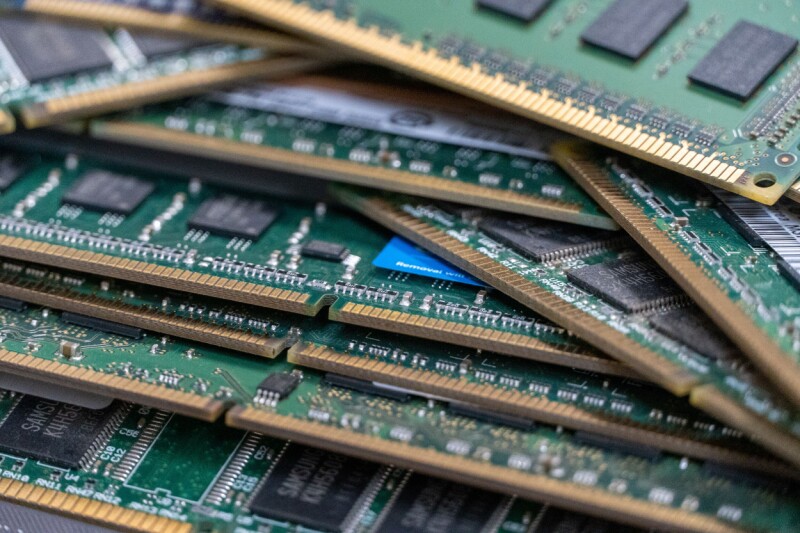
Gigabyte recently announced new motherboards that use DDR4 RAM, a standard that launched in 2014, and other vendors support even older standards in brand-new kit. Earlier this year, AMD released a Ryzen 7 5800X3D anniversary edition to mark ten years of AM4. For AM4 processors, Gigabyte offers the new B450M H ARGB, with two DDR4 slots, and the B550 X-Eagle with four slots. Those who prefer Intel chippery can now buy a B760M Aorus Elite. This is notable because of the age of the DDR4 spec. In case you lose track of these things, The Register first described the new DDR4 spec back in 2012, and a few months later urged the keen to wait a year or two. DDR5 supports higher transfer rates, and The Reg predicted its arrival in 2017. The DDR5 standard was agreed in 2020, with mainstream PC adoption following in 2021. Over in the People's Republic of China, several vendors will sell you new DDR3 motherboards for 15-year-old server CPUs, such as Huananzhi's X79-4D or X79 Supreme, or the Machinist X79 V2.82H. These use Intel's LGA-2011 socket – named for the number of pins, but coincidentally launched in 2011. This Chinese SMZDM community discussion is about whether the circa 15-year-old Xeon E5 is still worth buying – a CPU The Reg covered in 2012. This is partly due to the current price rises and component shortages induced by large-scale, cloud-based LLMs – but also "training" those "open-weight" models that run on your own kit. Those too are constructed in giant datacenters stuffed full of GPUs, ingesting all the human-written material they can get their hands on, rarely asking for consent. And not just stuff put online either. Once you wipe the sluggish, bloated commercial OS from your computer's storage, you discover two things. First, you don't need the latest hardware any more. Secondly, the older the PC (or Mac), the better the chances that it will work fine with Linux – or indeed the other FOSS OSes out there. Current and recent hardware is the most problematic for FOSS developers because most manufacturers prioritize Windows testing, while restricted documentation and proprietary drivers can complicate open source support for new hardware. Together, these things mean that if you're happy without high-powered local LLMs, or three-digit frame rates, second-hand kit is more usable than ever. (For those who can't do without one or two Windows-only apps that won't run under Wine, we remind you that desktop VMware is free now… and for better desktop integration, we looked at WinApps and WinBoat earlier this year.) The Reg FOSS desk is based in the British Isles, close enough to order stuff inexpensively from the UK. We've been using online vendors of depreciated ex-corporate kit for decades: we've bought several machines from Morgan Computers, and occasionally from Tier1 Online and Bargain Hardware. Other vendors are available. There are also special-purpose price-comparison sites, such as LowCostMiniPCs.com, which searches other sales sites for bargains. When we were based in Czechia, we bought a few things from GigaComputer, and we know of others we didn't try, such as Refurbed.cz. Other such European sites include Computershop.eu. The usability of kit that can only officially run Windows 10 was the entire point of the End of 10 campaign. Microsoft cites security benefits for Windows 11's hardware requirements, but in this vulture's opinion, those benefits don't justify excluding an entire generation of otherwise capable hardware. Keeping older hardware in service is welcome. If digital sovereignty gives organizations another reason to consider open source alternatives, so much the better. ®
Microsoft has lifted the lid on the next generation of its Azure Maia custom AI chips, saying it will usher in a new phase of its compute infrastructure where everything is closely integrated to meet the demands of agentic inference. The Redmond giant says its Azure Maia 200, announced earlier this year, is now serving production workloads and that a successor is already planned for 2027. Azure Maia 300 is described as "a complete intelligent system" designed for the new types of AI workloads emerging today. Microsoft claims a full 96-accelerator configuration will deliver up to seven times Maia 200's rack-scale token throughput, while offering 40 percent more tokens per megawatt than leading GPU-based systems. Its next-gen chip is created with an inference-first architecture optimized for long-context, memory-intensive and decode-heavy AI workloads, according to a blog post by Microsoft's EVP for Cloud and AI, Scott Guthrie. The firm envisions it being deployed in rack-scale systems comprising up to 96 accelerators, while each Maia 300 will feature eight HBM4 memory stacks providing up to 18 TB/s of peak memory bandwidth, the better to support execution of large models and long-context workloads. This sounds similar to the kind of rack-scale AI equipment that has already been developed by Nvidia for its GPU accelerators, and more recently by AMD with its Helion and Helios infrastructure, all designed to make the most of their own specific silicon and software stacks. Microsoft says that Maia 300 is "built as a complete system, with software, silicon, physical rack infrastructure, networking, and datacenters co-designed to operate as a single platform to meet the demands of cloud-scale agentic inference." It insists that this system-level approach is necessary for agentic workloads, which involve multi-step execution, long-context decoding and tool use, and "change the computational profile and arithmetic intensity of inference." The growing emphasis on in-house integration contrasts with Microsoft's 2024 "AI Access Principles," which stressed partnerships across its technology stack. The firm even complained to the European Commission's competition authorities that Google had a competitive advantage because of its approach. "Only one company – Google," said Microsoft at the time, "is vertically integrated in a manner that provides it with strength and independence at every AI layer from chips to a thriving mobile app store. Everybody else must rely on partnerships to innovate and compete." Microsoft now has its own AI chips, rack-scale designs, and internally developed MAI models, giving it more control over its stack. It plans to scale Azure Maia to "multi-gigawatt deployments" starting in 2027. We asked Microsoft for comment. Guthrie said that the firm will share more details on its strategy at next month's Microsoft Ignite 2026 event in San Francisco. ®
Asked about apparent U.S. threats to cut off intelligence sharing with Kyiv, which can warn of Russian aerial attacks, President Trump said information continued to flow.
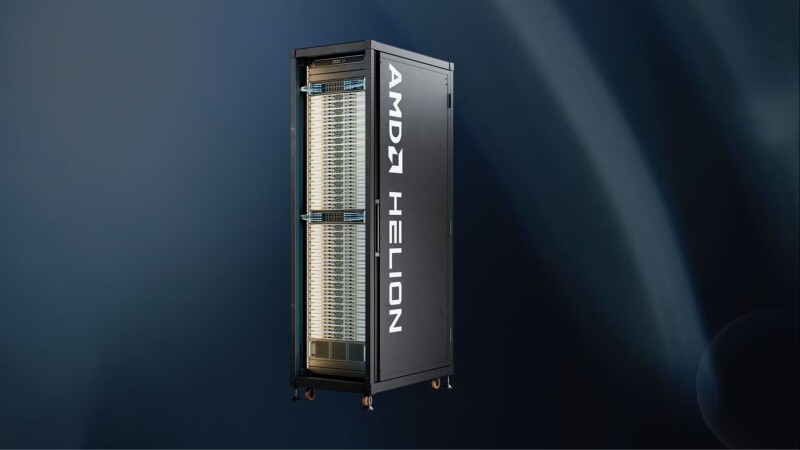
AMD is expanding its rack-scale AI lineup with a design to run AI agents, offering CPU-only configurations or integrated CPU/GPU deployments, and liquid-cooled or air-cooled versions. Revealed at the Open Compute Project (OCP) Summit 2026 in San Jose, California, the chipmaker's new rack reference design is named Helion, while its existing system carries the moniker Helios, which we can't help feeling is inviting confusion a little. Helion offers an OCP-compliant blueprint for agentic AI infrastructure built around AMD's CPUs and accelerators. AMD launched Helios earlier this year for frontier-scale AI training and large-scale inference. Helion's enterprise configuration instead combines agent execution and inference within a single rack. Customers can opt for a CPU-only hyperscale configuration or an enterprise configuration with a mix of CPU and GPU blades. Depending on configuration, AMD advertises up to 32,768 of AMD's "Zen 6" CPU cores, delivered via compute nodes fitted with 256-core versions of its Venice Epyc processor, up to 16 of its Instinct MI350P GPU accelerators, and up to 102 Tbps of networking bandwidth. The CPU-only hyperscale version offers dedicated capacity for agent execution and connections to separate model inference infrastructure, while the enterprise configuration combines agent execution, GPU inference, and supporting workloads in one rack. Both configurations offer dense, balanced, or high-performance CPU blades. For dense deployments, EPYC 9006 chips rated at 400 W are used, while performance blades sport a version of the chip with just 96 cores but clocked at 5 GHz. Balanced blades use 256-core processors rated at 600 W. There are also GPU inference blades, with eight Instinct MI350P GPUs in a 5U server, plus general-purpose blades, intended for database and storage servers or technical compute workloads. AMD SVP for Compute and Enterprise AI Dan McNamara said agentic AI is not a single workload, spanning enterprise applications and complex workflows, each with different compute requirements. "To do that takes optimized compute and infrastructure that can adapt to different workloads. With AMD Helion, we are bringing Epyc performance, open software and flexible rack designs together so our partners can build systems around customer needs and make efficient use of available power," he added. AMD says it plans to contribute the Helion specifications to OCP, making them available to the community for further development and adoption. Partner-built Helion configurations are scheduled for November 2026. In its announcement, AMD cites Cisco, Dell, HPE, Foxconn, Lenovo, Supermicro, and others as on board with the new kit. ®

 Accedi