Power Up: Roll Out Solar Arrays Boost Space Station Power Supply
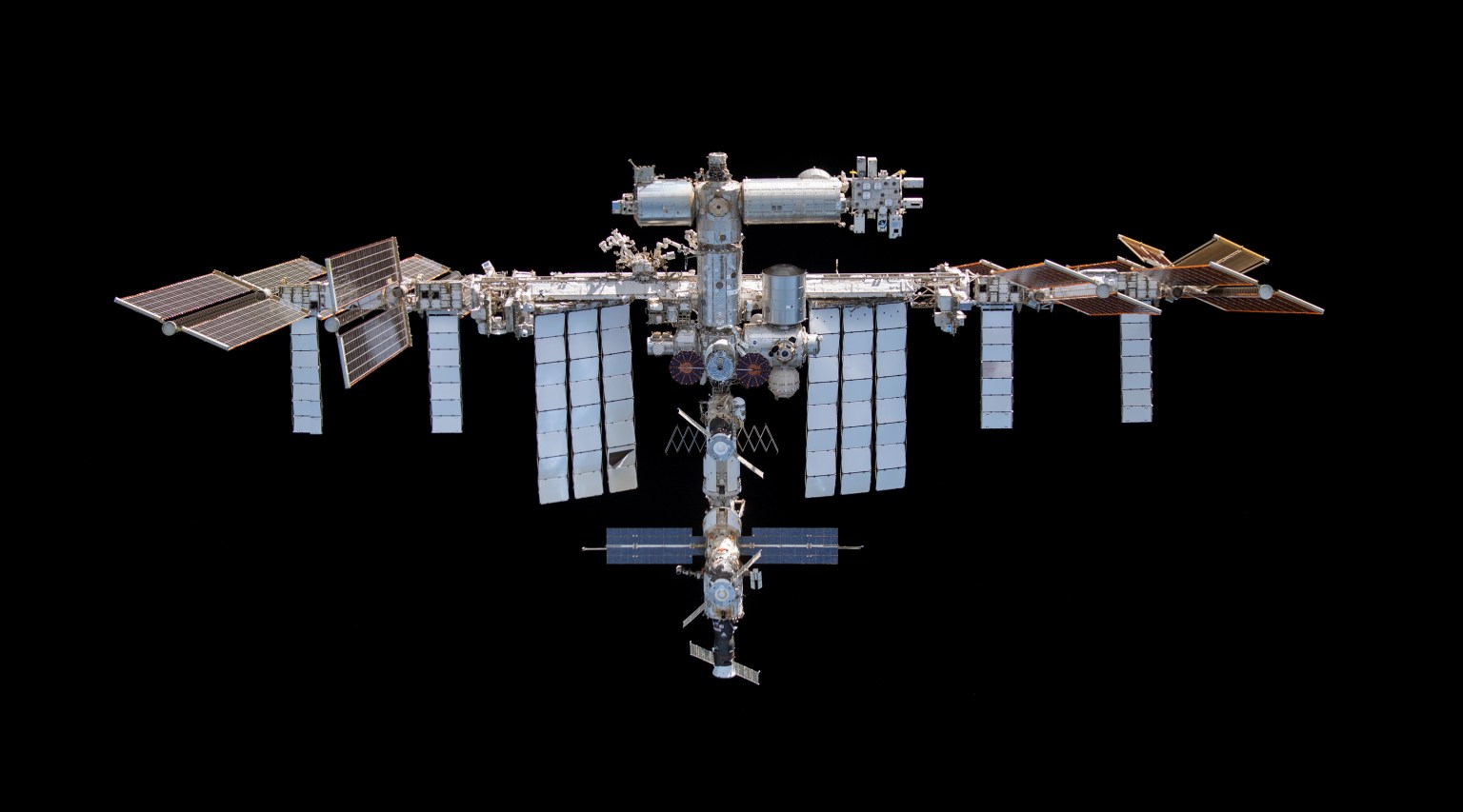
From the International Space Station’s unique position 250 miles above Earth, the Sun is a vital source of energy. Solar power supports the station’s life support systems, daily activities, and hundreds of research investigations that improve life on Earth and prepare humans for deep space exploration. Over the past five years, NASA augmented the station’s power generation and distribution capability with next-generation International Space Station Roll Out Solar Arrays (IROSAs).
An International Space Station Roll Out Solar Array deploys in 2022.
NASA
In 2017, a technology demonstration conducted aboard the space station tested the effectiveness of the arrays. The lightweight, compact design launches as a cylinder and unfurls like a yoga mat after installation. This advanced design reduces mass and volume at launch and uses an autonomous, self-deploying system that minimizes risks during rollout.
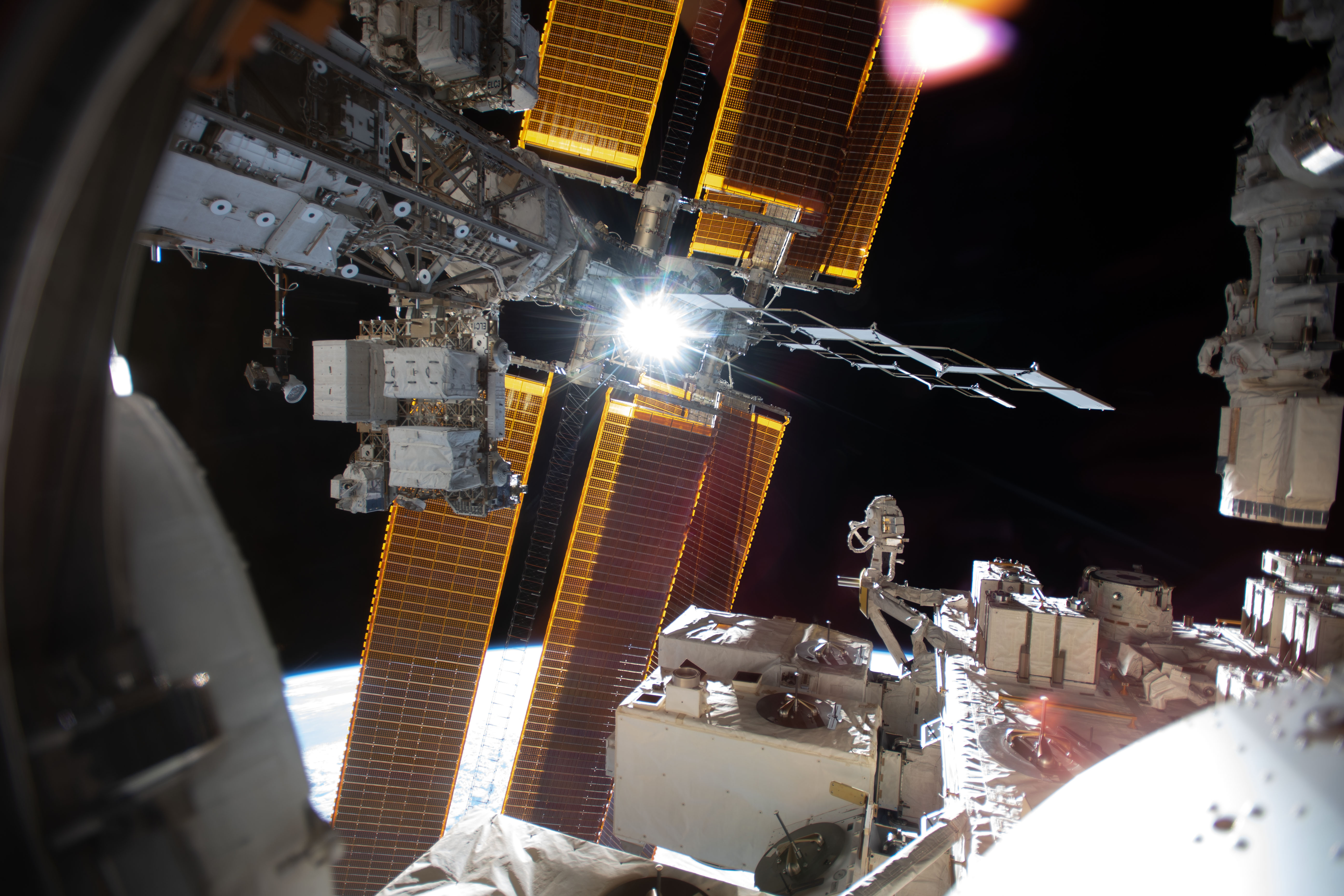
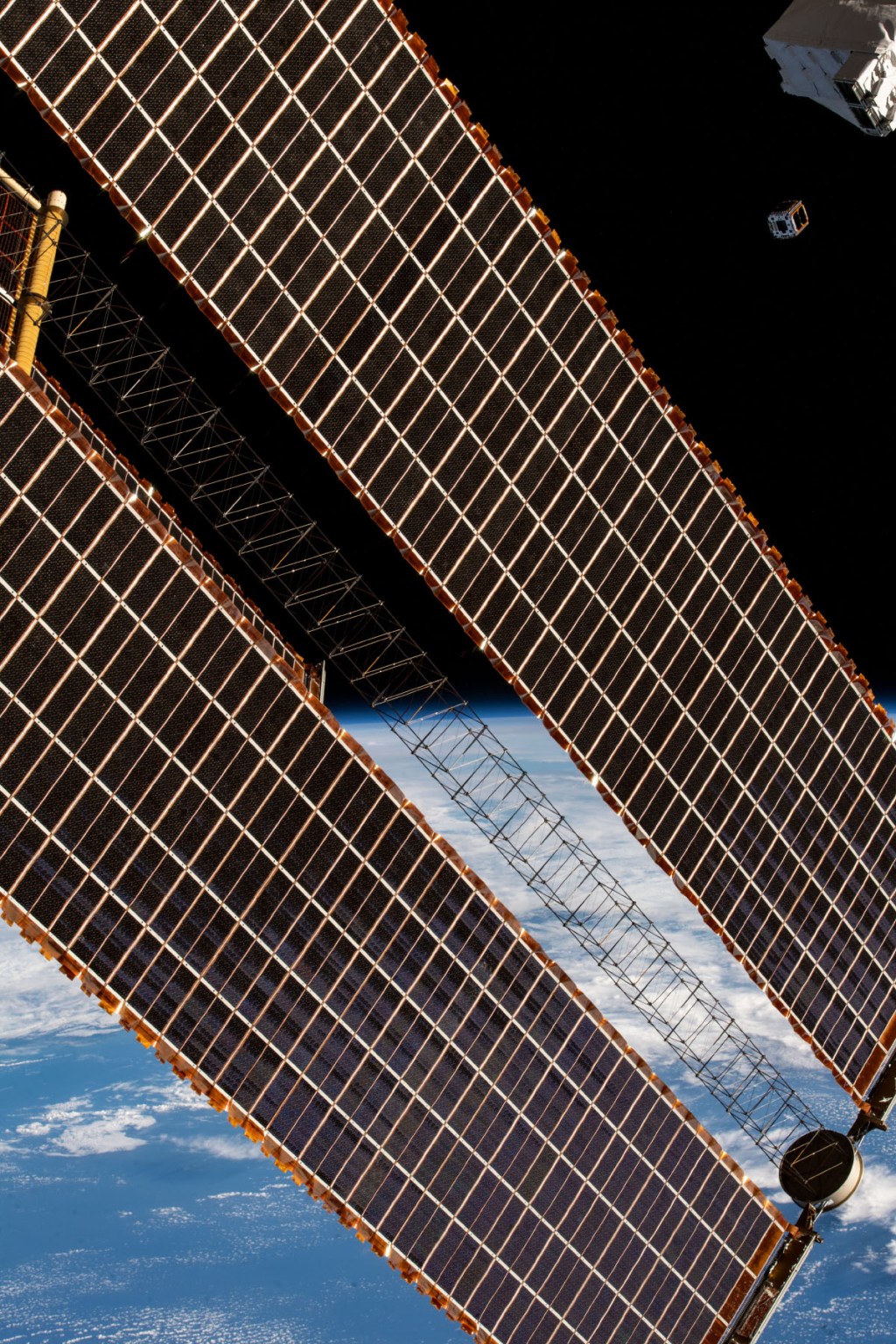
Sunlight flares across the International Space Station’s solar arrays.
NASA
The IROSAs were designed, manufactured, and tested by Redwire under a contract with Boeing and are about half the size of the station’s legacy arrays. Despite being smaller, the arrays are capable of producing about 28 kilowatts of additional power.
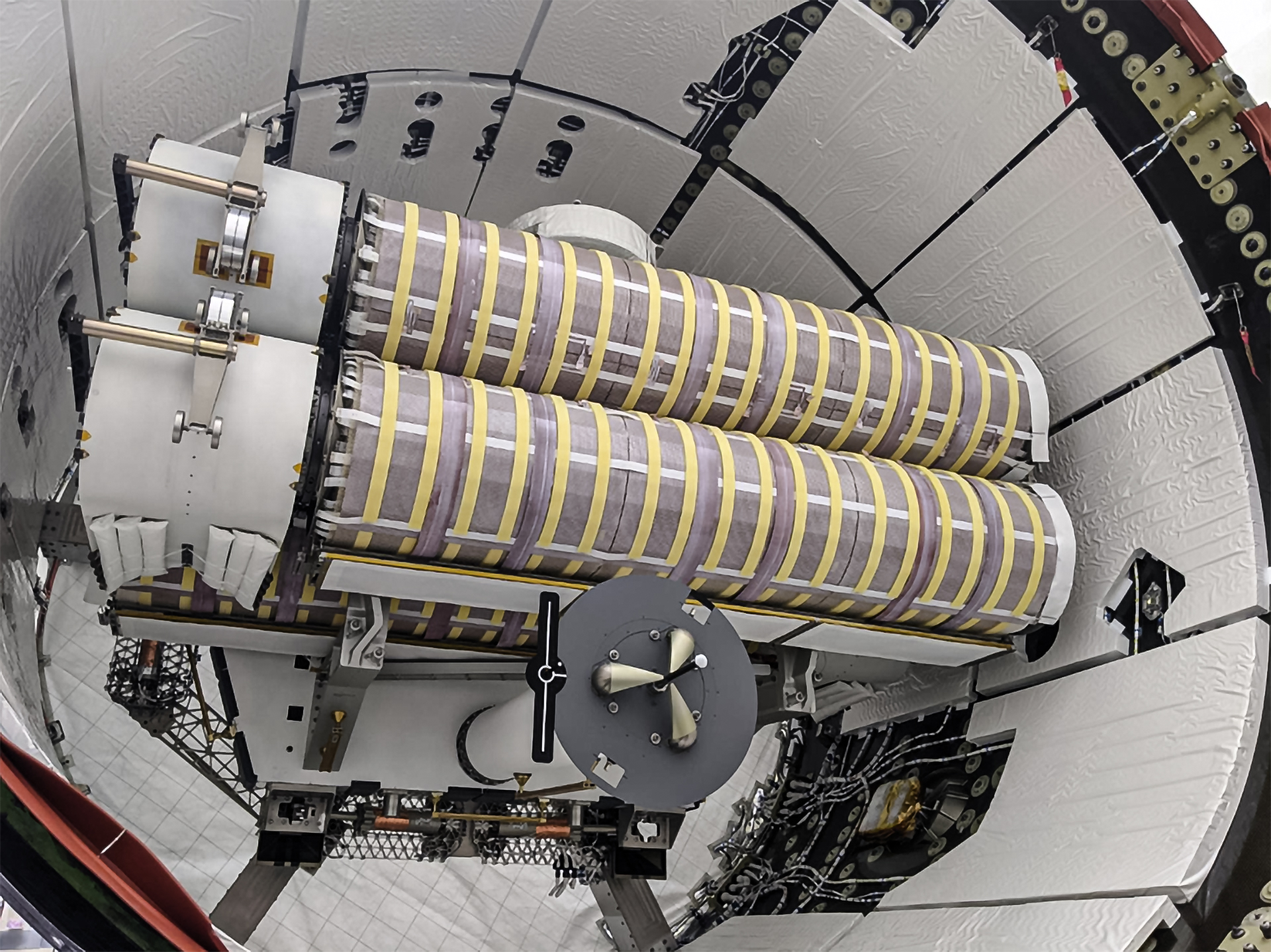
The first two International Space Station Roll Out Solar Arrays loaded in a SpaceX Dragon’s trunk before delivery to the orbiting laboratory during the company’s 22nd commercial resupply services mission for NASA in 2021.
SpaceX
Six IROSAs were installed outside of the space station between 2021 and 2023. In 2023, power projections prompted a request for another set of IROSAs, which launched in Dragon spacecraft’s trunk during the SpaceX 35th commercial resupply services mission to space station for NASA. Together, the eight IROSAs will increase power by more than 160kW for research and operations.
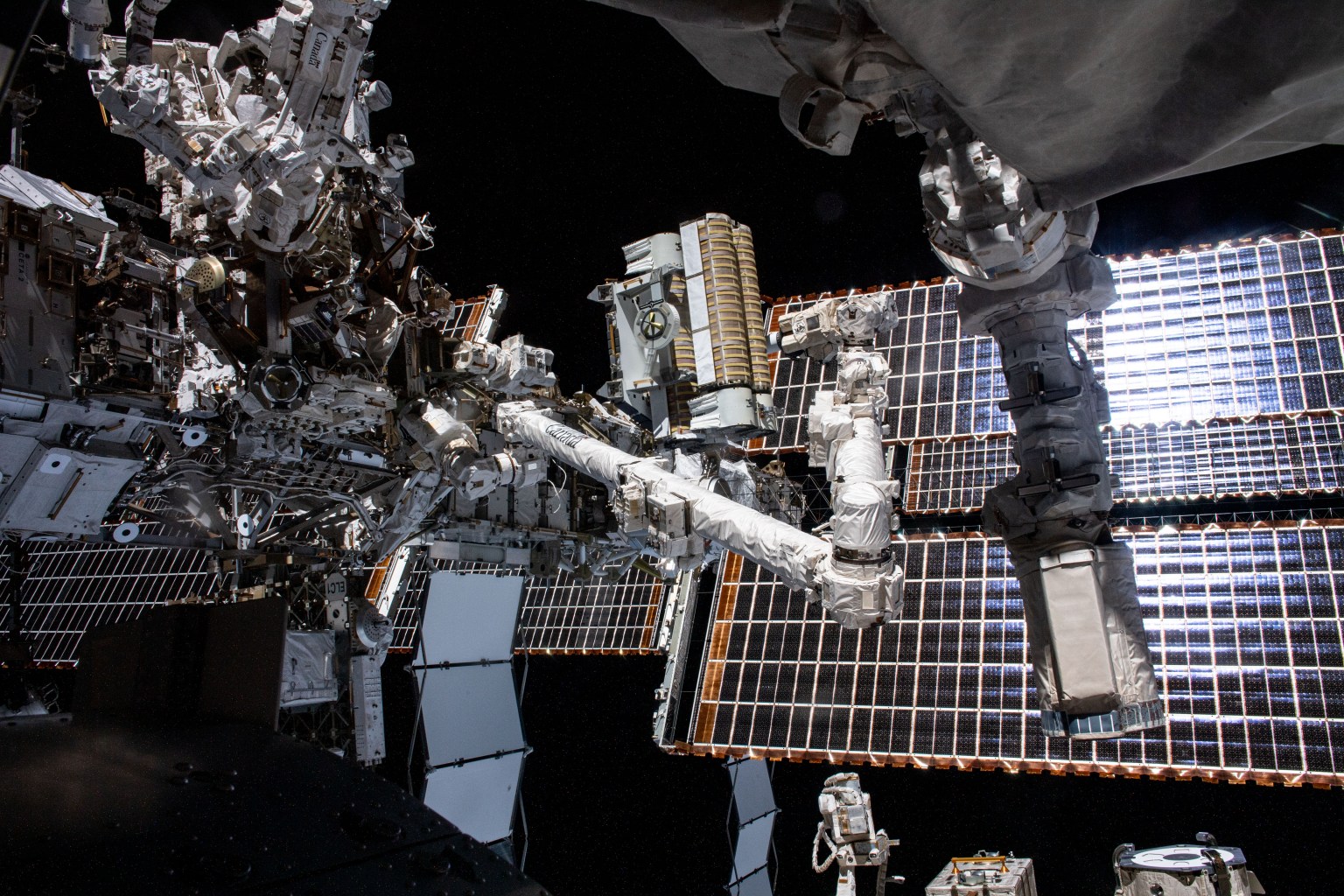
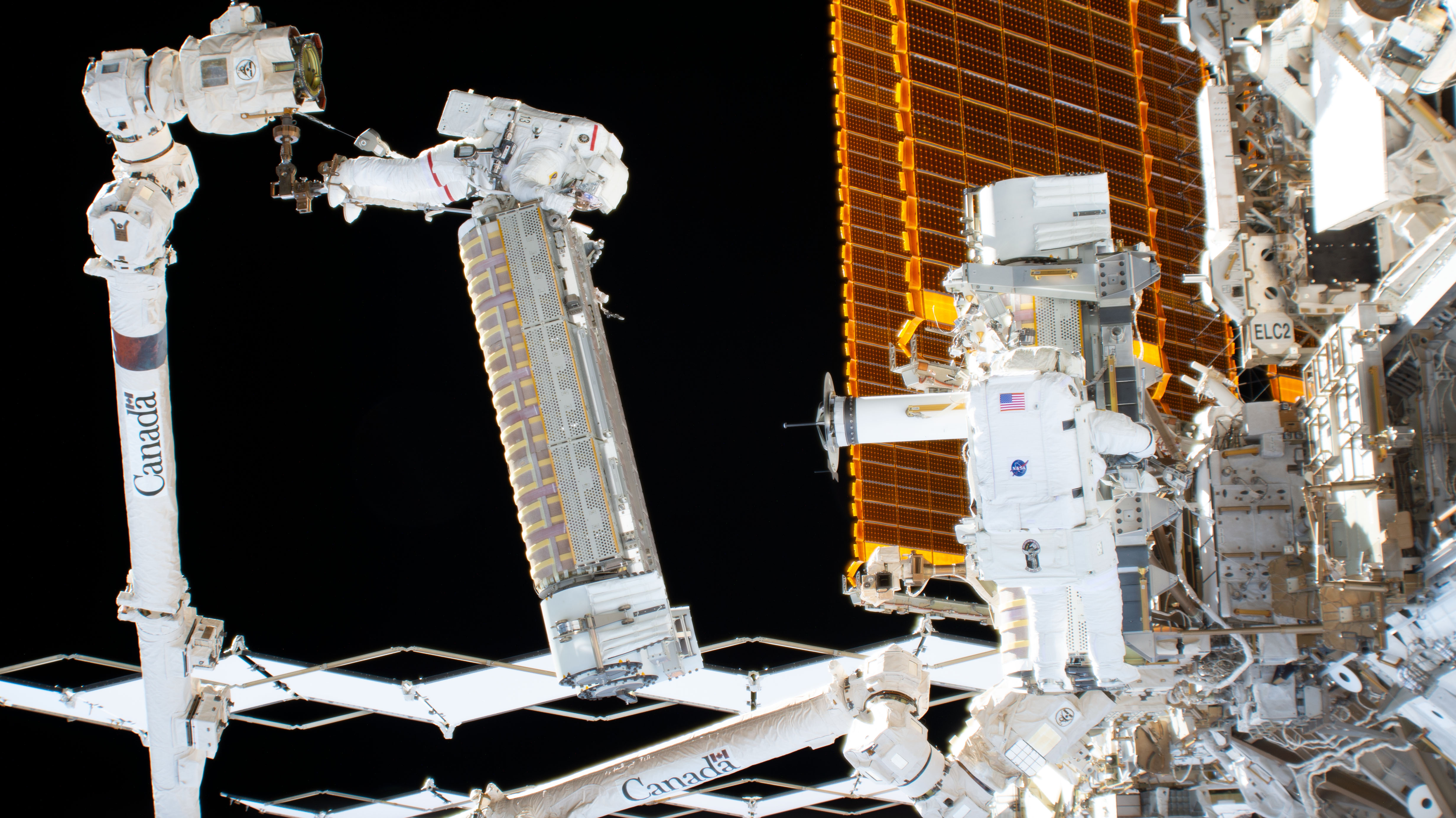
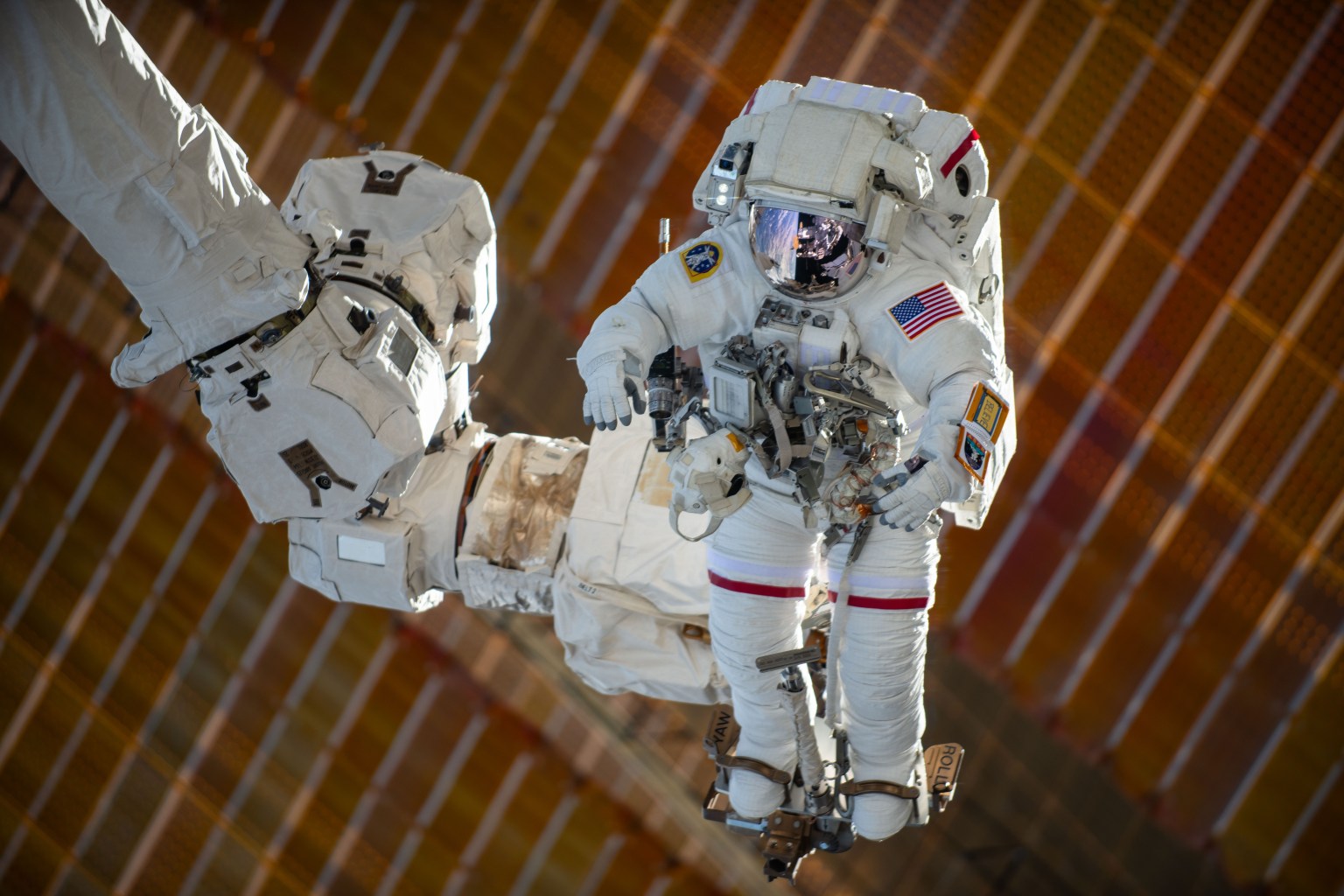
NASA astronauts perform a spacewalk to install an International Space Station Roll Out Solar Array with the assistance of the Canadarm2 robotic arm in 2022.
NASA
With the full upgrade in place, the space station’s revitalized power system not only supports NASA’s legacy in low Earth orbit but also helps advance technology that will extend the agency’s reach into the solar system. From planetary defense demonstrations, like the Double Asteroid Redirection Test, to future human exploration efforts, the space station is an essential testbed for the technologies needed for expeditions beyond Earth’s orbit.
Power Up: Roll Out Solar Arrays Boost Space Station Power Supply
From the International Space Station’s unique position 250 miles above Earth, the Sun is a vital source of energy. Solar power supports the station’s life support systems, daily activities, and hundreds of research investigations that improve life on Earth and prepare humans for deep space exploration. Over the past five years, NASA augmented the station’s power generation and distribution capability with next-generation International Space Station Roll Out Solar Arrays (IROSAs).
An International Space Station Roll Out Solar Array deploys in 2022.
NASA
In 2017, a technology demonstration conducted aboard the space station tested the effectiveness of the arrays. The lightweight, compact design launches as a cylinder and unfurls like a yoga mat after installation. This advanced design reduces mass and volume at launch and uses an autonomous, self-deploying system that minimizes risks during rollout.
Sunlight flares across the International Space Station’s solar arrays.
NASA
The IROSAs were designed, manufactured, and tested by Redwire under a contract with Boeing and are about half the size of the station’s legacy arrays. Despite being smaller, the arrays are capable of producing about 28 kilowatts of additional power.
The first two International Space Station Roll Out Solar Arrays loaded in a SpaceX Dragon’s trunk before delivery to the orbiting laboratory during the company’s 22nd commercial resupply services mission for NASA in 2021.
SpaceX
Six IROSAs were installed outside of the space station between 2021 and 2023. In 2023, power projections prompted a request for another set of IROSAs, which launched in Dragon spacecraft’s trunk during the SpaceX 35th commercial resupply services mission to space station for NASA. Together, the eight IROSAs will increase power by more than 160kW for research and operations.
NASA astronauts perform a spacewalk to install an International Space Station Roll Out Solar Array with the assistance of the Canadarm2 robotic arm in 2022.
NASA
With the full upgrade in place, the space station’s revitalized power system not only supports NASA’s legacy in low Earth orbit but also helps advance technology that will extend the agency’s reach into the solar system. From planetary defense demonstrations, like the Double Asteroid Redirection Test, to future human exploration efforts, the space station is an essential testbed for the technologies needed for expeditions beyond Earth’s orbit.
Power Up: Roll Out Solar Arrays Boost Space Station Power Supply
From the International Space Station’s unique position 250 miles above Earth, the Sun is a vital source of energy. Solar power supports the station’s life support systems, daily activities, and hundreds of research investigations that improve life on Earth and prepare humans for deep space exploration. Over the past five years, NASA augmented the station’s power generation and distribution capability with next-generation International Space Station Roll Out Solar Arrays (IROSAs).
An International Space Station Roll Out Solar Array deploys in 2022.
NASA
In 2017, a technology demonstration conducted aboard the space station tested the effectiveness of the arrays. The lightweight, compact design launches as a cylinder and unfurls like a yoga mat after installation. This advanced design reduces mass and volume at launch and uses an autonomous, self-deploying system that minimizes risks during rollout.
Sunlight flares across the International Space Station’s solar arrays.
NASA
The IROSAs were designed, manufactured, and tested by Redwire under a contract with Boeing and are about half the size of the station’s legacy arrays. Despite being smaller, the arrays are capable of producing about 28 kilowatts of additional power.
The first two International Space Station Roll Out Solar Arrays loaded in a SpaceX Dragon’s trunk before delivery to the orbiting laboratory during the company’s 22nd commercial resupply services mission for NASA in 2021.
SpaceX
Six IROSAs were installed outside of the space station between 2021 and 2023. In 2023, power projections prompted a request for another set of IROSAs, which launched in Dragon spacecraft’s trunk during the SpaceX 35th commercial resupply services mission to space station for NASA. Together, the eight IROSAs will increase power by more than 160kW for research and operations.
NASA astronauts perform a spacewalk to install an International Space Station Roll Out Solar Array with the assistance of the Canadarm2 robotic arm in 2022.
NASA
With the full upgrade in place, the space station’s revitalized power system not only supports NASA’s legacy in low Earth orbit but also helps advance technology that will extend the agency’s reach into the solar system. From planetary defense demonstrations, like the Double Asteroid Redirection Test, to future human exploration efforts, the space station is an essential testbed for the technologies needed for expeditions beyond Earth’s orbit.
A NASA Dynamic Aviation A200 aircraft will conduct low-flying research flights over farmland near Transit, Texas, from Thursday, Oct. 22, through Monday, Nov. 9. These flights will measure gaseous and particulate emissions from animal feeding operations.
A photo of the Dynamic Aviation A200 aircraft, which will conduct low-flying research flights over farmland near Transit, Texas, to measure emissions in October and November 2026.
Dynamic Aviation
Agricultural emissions represent an important and understudied part of Earth’s land and atmosphere systems. The FarmFlux mission will deploy more than a dozen sensors to measure ozone, methane, ammonia, particulates, and other pollutants rising from crop lands and livestock farms and their interaction with the Earth’s atmosphere. The mission is jointly led by NASA’s Goddard Space Flight Center in Greenbelt, Maryland; Colorado State University; and Boston University.
Additional low-altitude research flights with a NASA P-3 Orion aircraft are scheduled for the March to July 2027 growing season in the Midwest and California’s Central Valley with a focus on cropland.
For more information about the FarmFlux mission, visit:
NASA’s Freedom 250 F-5 team, including NASA Administrator Jared Isaacman, performs a flyover during the national anthem at an NFL game between the Cleveland Browns and the Carolina Panthers at Huntington Bank Field, Sept. 27, 2026, in Cleveland.
Credit: NASA/Jordan Cochran
As part of the agency’s Inspiration Tour flyover, NASA Administrator Jared Isaacman will pilot one of three F-5 fighter jets to kick off the New York Jets vs. Cleveland Browns game in East Rutherford, New Jersey, on Sunday, Oct. 11.
NASA team members will engage with fans at the agency’s Experience Zone, located at the Jets Tailgate Zone outside the stadium, from 10 a.m. to 1 p.m. EDT before the game. Fans can learn more about NASA’s return to the Moon under the agency’s Artemis dome, enjoy interactive games, and capture photos with a large, inflatable SLS (Space Launch System) rocket.
Isaacman will be available for limited media interviews during the game. To arrange interviews, please contact Camille Gallo at: camille.m.gallo@nasa.gov or 202-531-8057.
With stops across the nation, NASA’s Inspiration Tour convenes academic, industry, and public sector stakeholders to connect the agency with the people, technologies, and organizations that drive American leadership in space.
The tour will culminate in MAX POWER, a public exposition of American air and space innovation, Saturday, Nov. 7, and Sunday, Nov. 8, on and near the agency’s Kennedy Space Center in Florida. Held in honor of America’s historic 250th anniversary, the multi-day, family-friendly event will showcase the next-generation aircraft, spacecraft, autonomous vehicles, and technologies that will help define the future of transportation in air and space.
For more information about MAX POWER and the agency’s missions, visit:
Preparations for Next Moonwalk Simulations Underway (and Underwater)
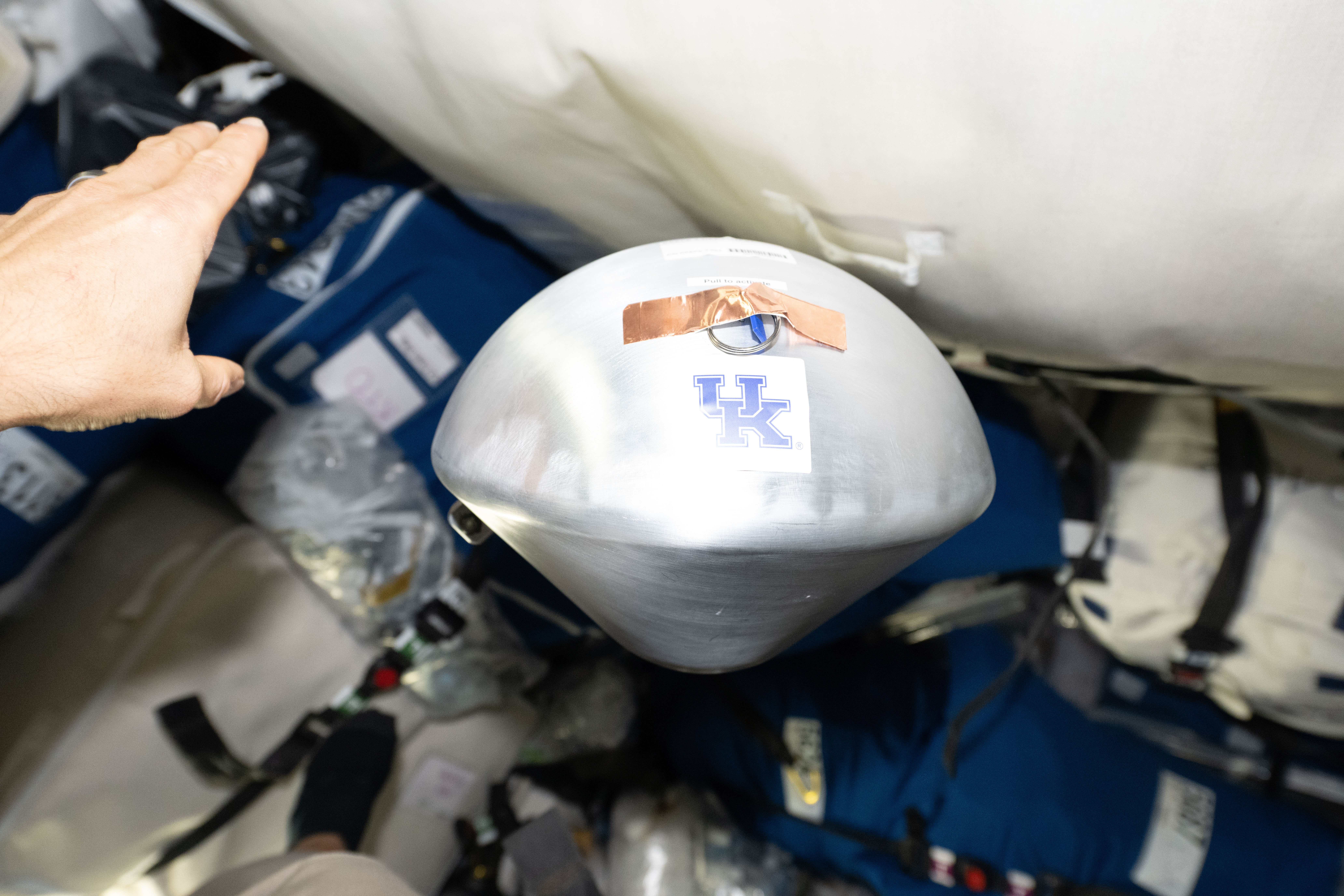
A KREPE-3 capsule floats inside the Northrup Grumman Cygnus XL 24 cargo spacecraft on October 7. Inside the capsule is a 3-D printed heat shield designed by researchers at NASA’s Johnson Space Center in Houston.
NASA
NASA is testing heat shields that can keep astronauts safe as they return from missions to the Moon and Mars in an unusual way: by taking out the trash.
When Northrop Grumman 24th cargo resupply mission for NASA undocked from the International Space Station, it carried a fleet of 12 small, experimental capsules designed to test the next generation of thermal protection materials that could serve as the foundation for future heat shields.
The experiment, called the Kentucky Reentry Probe Experiment (KREPE-3), is the third in a series of low-cost, high-impact missions that use the final moments of the cargo spacecraft’s lifespan to gather valuable data.
The experiment is a collaboration among the University of Kentucky, the state of Kentucky, NASA’s Established Program to Stimulate Competitive Research (EPSCoR), several NASA centers, and other federal and commercial partners.
“KREPE-3 is a great example of the goals of NASA’s EPSCoR program,” said David Berger, EPSCoR program manager at NASA’s Headquarters in Washington. “We are supporting the next generation of scientists and engineers as they develop unique projects that benefit their education and NASA’s mission goals.”
Trash to treasure
Before the mission’s Cygnus XL spacecraft departed the station, astronauts packed it with waste and activated the 12 small capsules carried inside. Designed by University of Kentucky students, the capsules include sensors that will measure temperature, pressure, motion, magnetic field, and light during re-entry.
As the vehicle harmlessly breaks apart in Earth’s atmosphere on its planned route, the capsules will eject and begin collecting data on how each set of experimental heat shield materials performs. Satellite signals will transfer live data to researchers, offering insights into how larger heat shields could protect future cargo or crew.
“It’s a smart way to get flight data on materials that are still in development,” said Keith Peterson, a materials engineer at NASA’s Ames Research Center in California’s Silicon Valley. “We’re essentially hitching a ride on a vehicle that’s already coming back to Earth.”
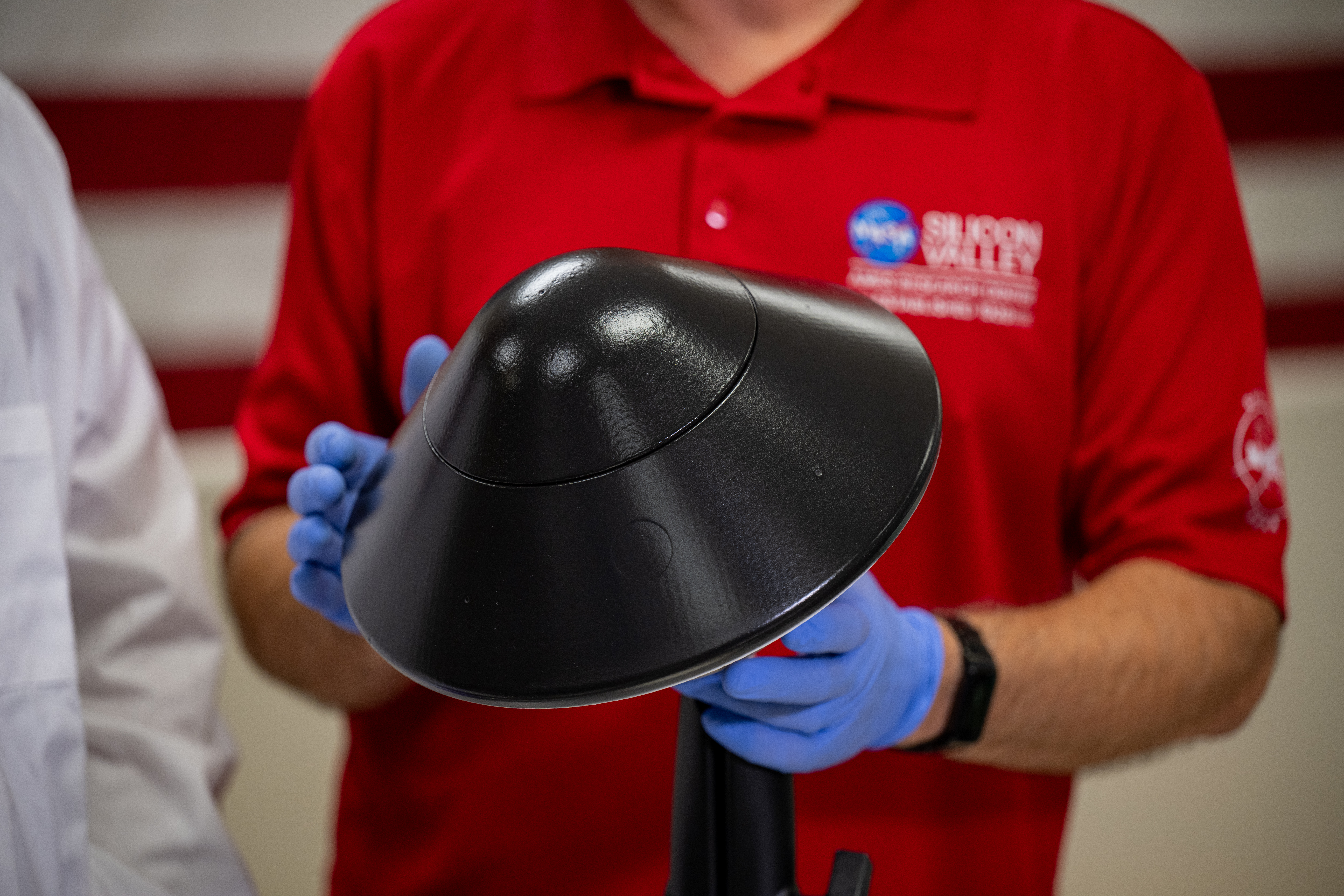
Close up of an Ames-produced thermal protection system (TPS) (heat shield) for the Kentucky Re-Entry Probe Experiment (KREPE) in the Sensors & TPS Advanced Research Laboratories (STAR Labs) N242.
NASA/Brandon Torres-Navarrete
Heating up innovation
The capsules will carry a variety of thermal protective components, including proven technology such as the ceramic tile material used on the space shuttle. Others will test new options, such as a 3D-printed heat shield from the Additive Manufacturing of Thermal Protective Systems project developed at NASA Johnson and Oak Ridge National Laboratory.
Researchers at NASA Ames are contributing several materials to KREPE-3, including two capsules that will fly a next-generation family of protective coverings known as Materials Engineered for Re-entry using Innovative Needling Operations (MERINO). Made from layers of carbon and phenolic fibers stitched together like felt, the materials are more flexible, faster to produce, and less expensive than traditional protective substances – making them promising candidates for Mars missions. Thanks to Mars’ thinner atmosphere, missions to land on the Red Planet involve lower heat loads and allow for lighter protection.
A third capsule will combine those protective coverings with other elements. The Kentucky Instrumented Conical Hypersonic Experiment will utilize a dual-cone shape. It combines a tungsten tip attached to a cone layered with carbon and hear-resistant plastic fibers, and an aft cone wrapped in MERINO. This unique design will validate computer models against real-world data.
Another capsule is shaped like the protective aeroshell that will protect NASA’s upcoming mission, Dragonfly, as it arrives at Saturn’s moon, Titan, and will test the dynamic stability of the design. It is covered in Phenolic Impregnated Carbon Ablator, a material developed at NASA Ames that has applications for commercial vehicles and flew on NASA’s Stardust, Mars Science Laboratory, and Mars 2020 missions.
One capsule will test a deployable heat shield called Adaptable Deployable Entry and Placement Technology, which is shaped like an umbrella to increase surface area and slow descent. At full scale, Adaptable Deployable Entry design could be folded, making it ideal for deploying payloads that are larger than the rockets that launch them into flight.
While some capsules are testing new materials to carry missions to Mars, others are testing new shapes and designs that will further research and understanding of computer modeling and sensor design — technologies that could open doors to another generation of re-entry design innovation.
Additional capsules developed by domestic and international partners will test a variety of known and new materials, including a heat flux sensor developed at the University of Stuttgart in Germany, that will help researchers measure how heat moves across a surface during re-entry.
“We’re pushing the boundaries of what heat shields can do,” said Peterson. “And we’re testing them in a way that’s fast, affordable, and incredibly effective.”
Preparations for Next Moonwalk Simulations Underway (and Underwater)
A KREPE-3 capsule floats inside the Northrup Grumman Cygnus XL 24 cargo spacecraft on October 7. Inside the capsule is a 3-D printed heat shield designed by researchers at NASA’s Johnson Space Center in Houston.
NASA
NASA is testing heat shields that can keep astronauts safe as they return from missions to the Moon and Mars in an unusual way: by taking out the trash.
When Northrop Grumman 24th cargo resupply mission for NASA undocked from the International Space Station, it carried a fleet of 12 small, experimental capsules designed to test the next generation of thermal protection materials that could serve as the foundation for future heat shields.
The experiment, called the Kentucky Reentry Probe Experiment (KREPE-3), is the third in a series of low-cost, high-impact missions that use the final moments of the cargo spacecraft’s lifespan to gather valuable data.
The experiment is a collaboration among the University of Kentucky, the state of Kentucky, NASA’s Established Program to Stimulate Competitive Research (EPSCoR), several NASA centers, and other federal and commercial partners.
“KREPE-3 is a great example of the goals of NASA’s EPSCoR program,” said David Berger, EPSCoR program manager at NASA’s Headquarters in Washington. “We are supporting the next generation of scientists and engineers as they develop unique projects that benefit their education and NASA’s mission goals.”
Trash to treasure
Before the mission’s Cygnus XL spacecraft departed the station, astronauts packed it with waste and activated the 12 small capsules carried inside. Designed by University of Kentucky students, the capsules include sensors that will measure temperature, pressure, motion, magnetic field, and light during re-entry.
As the vehicle harmlessly breaks apart in Earth’s atmosphere on its planned route, the capsules will eject and begin collecting data on how each set of experimental heat shield materials performs. Satellite signals will transfer live data to researchers, offering insights into how larger heat shields could protect future cargo or crew.
“It’s a smart way to get flight data on materials that are still in development,” said Keith Peterson, a materials engineer at NASA’s Ames Research Center in California’s Silicon Valley. “We’re essentially hitching a ride on a vehicle that’s already coming back to Earth.”
Close up of an Ames-produced thermal protection system (TPS) (heat shield) for the Kentucky Re-Entry Probe Experiment (KREPE) in the Sensors & TPS Advanced Research Laboratories (STAR Labs) N242.
NASA/Brandon Torres-Navarrete
Heating up innovation
The capsules will carry a variety of thermal protective components, including proven technology such as the ceramic tile material used on the space shuttle. Others will test new options, such as a 3D-printed heat shield from the Additive Manufacturing of Thermal Protective Systems project developed at NASA Johnson and Oak Ridge National Laboratory.
Researchers at NASA Ames are contributing several materials to KREPE-3, including two capsules that will fly a next-generation family of protective coverings known as Materials Engineered for Re-entry using Innovative Needling Operations (MERINO). Made from layers of carbon and phenolic fibers stitched together like felt, the materials are more flexible, faster to produce, and less expensive than traditional protective substances – making them promising candidates for Mars missions. Thanks to Mars’ thinner atmosphere, missions to land on the Red Planet involve lower heat loads and allow for lighter protection.
A third capsule will combine those protective coverings with other elements. The Kentucky Instrumented Conical Hypersonic Experiment will utilize a dual-cone shape. It combines a tungsten tip attached to a cone layered with carbon and hear-resistant plastic fibers, and an aft cone wrapped in MERINO. This unique design will validate computer models against real-world data.
Another capsule is shaped like the protective aeroshell that will protect NASA’s upcoming mission, Dragonfly, as it arrives at Saturn’s moon, Titan, and will test the dynamic stability of the design. It is covered in Phenolic Impregnated Carbon Ablator, a material developed at NASA Ames that has applications for commercial vehicles and flew on NASA’s Stardust, Mars Science Laboratory, and Mars 2020 missions.
One capsule will test a deployable heat shield called Adaptable Deployable Entry and Placement Technology, which is shaped like an umbrella to increase surface area and slow descent. At full scale, Adaptable Deployable Entry design could be folded, making it ideal for deploying payloads that are larger than the rockets that launch them into flight.
While some capsules are testing new materials to carry missions to Mars, others are testing new shapes and designs that will further research and understanding of computer modeling and sensor design — technologies that could open doors to another generation of re-entry design innovation.
Additional capsules developed by domestic and international partners will test a variety of known and new materials, including a heat flux sensor developed at the University of Stuttgart in Germany, that will help researchers measure how heat moves across a surface during re-entry.
“We’re pushing the boundaries of what heat shields can do,” said Peterson. “And we’re testing them in a way that’s fast, affordable, and incredibly effective.”
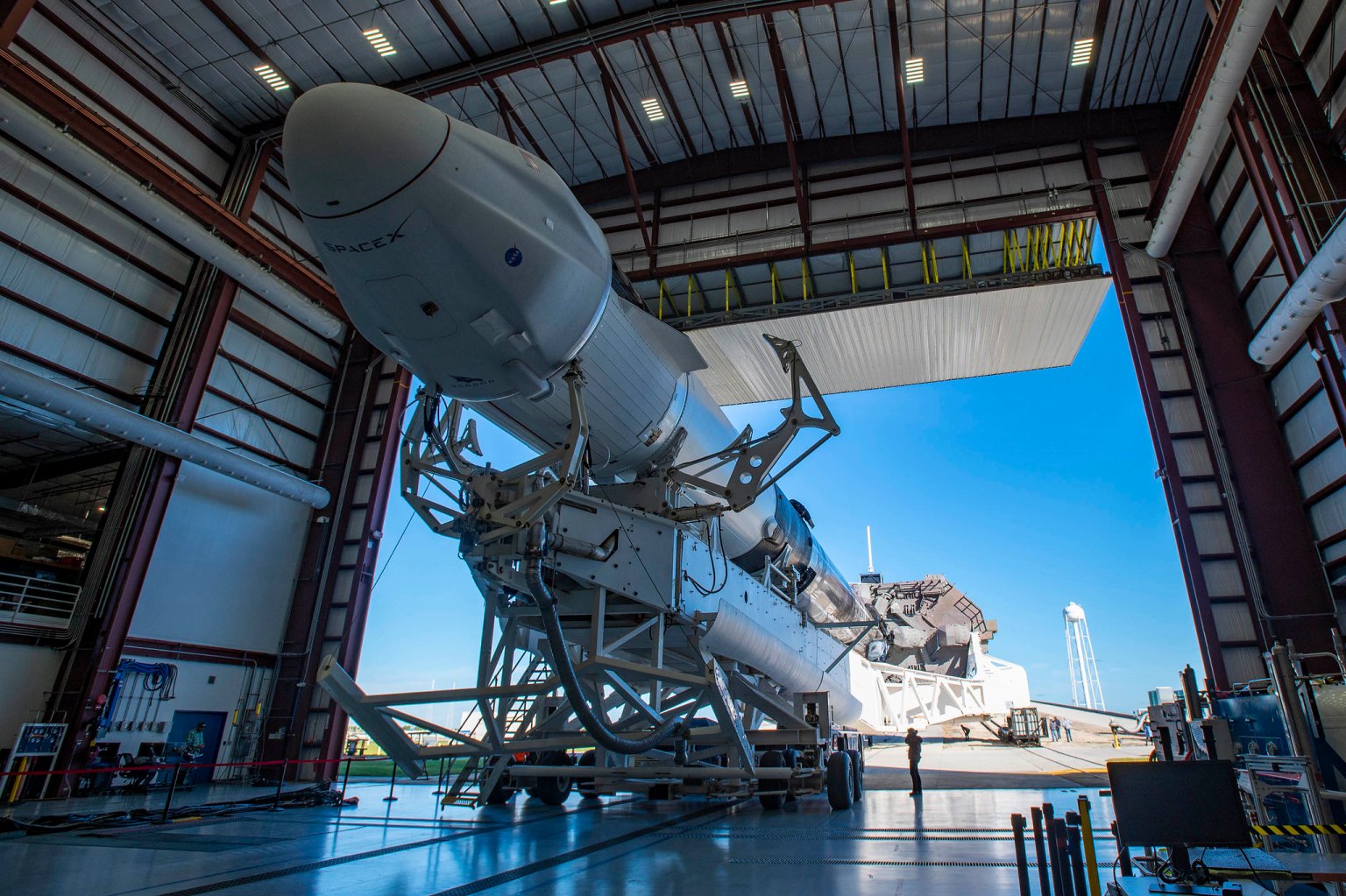
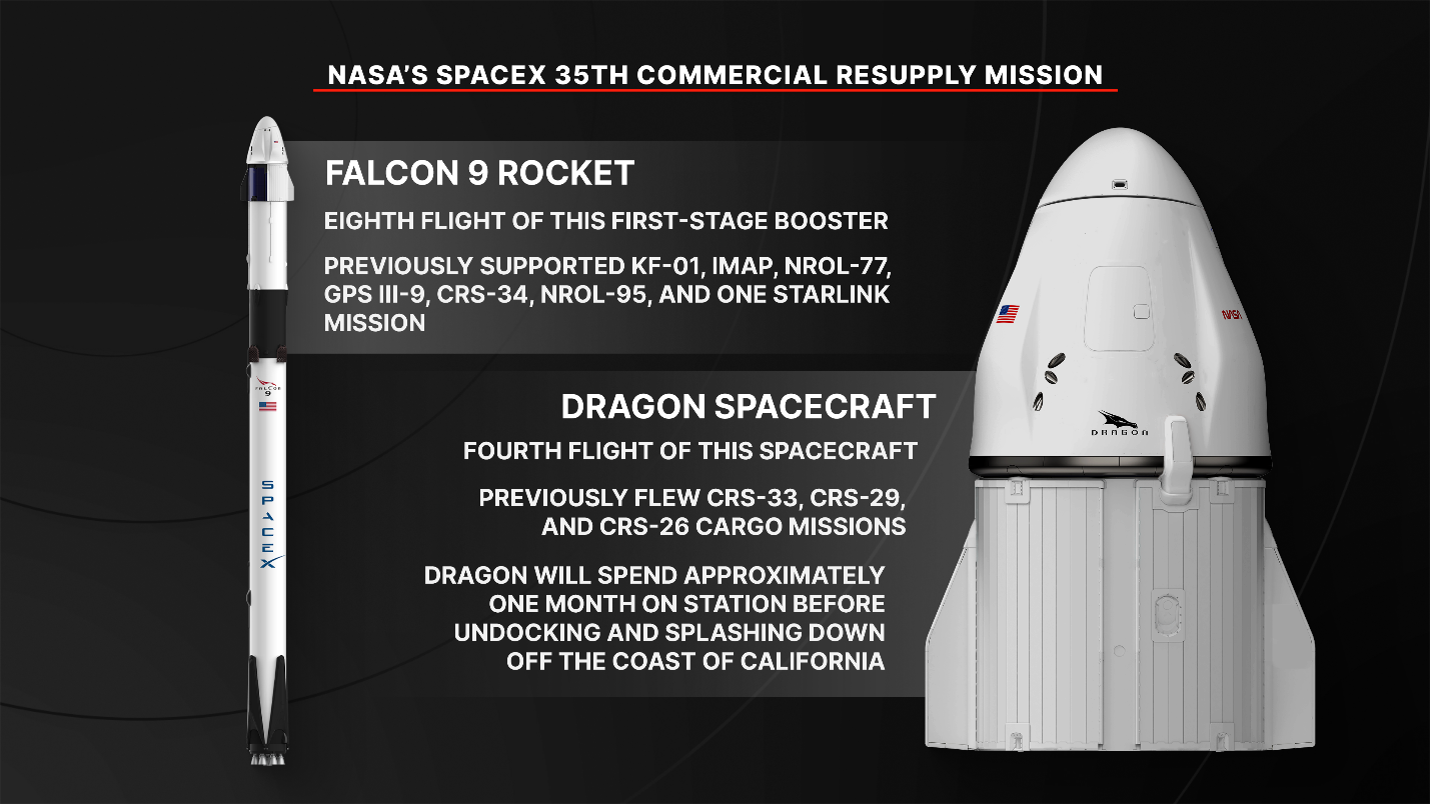
NASA’s SpaceX 35th commercial resupply mission will launch on the company’s Dragon spacecraft on the SpaceX Falcon 9 rocket to deliver research and supplies to the International Space Station.
NASA
NASA and SpaceX are targeting no earlier than Tuesday, Oct. 13 to launch scientific investigations, supplies, and equipment to the International Space Station.
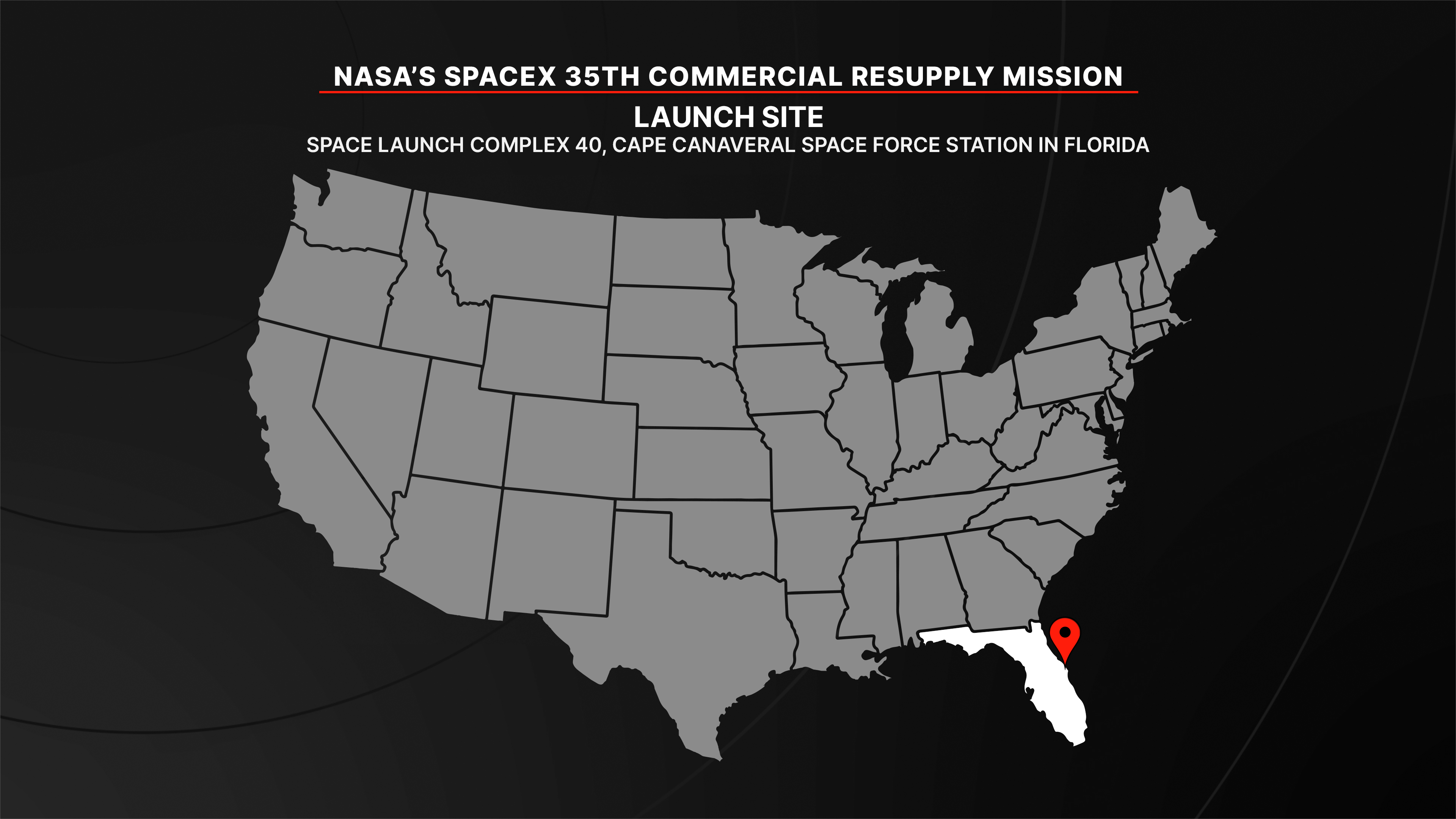
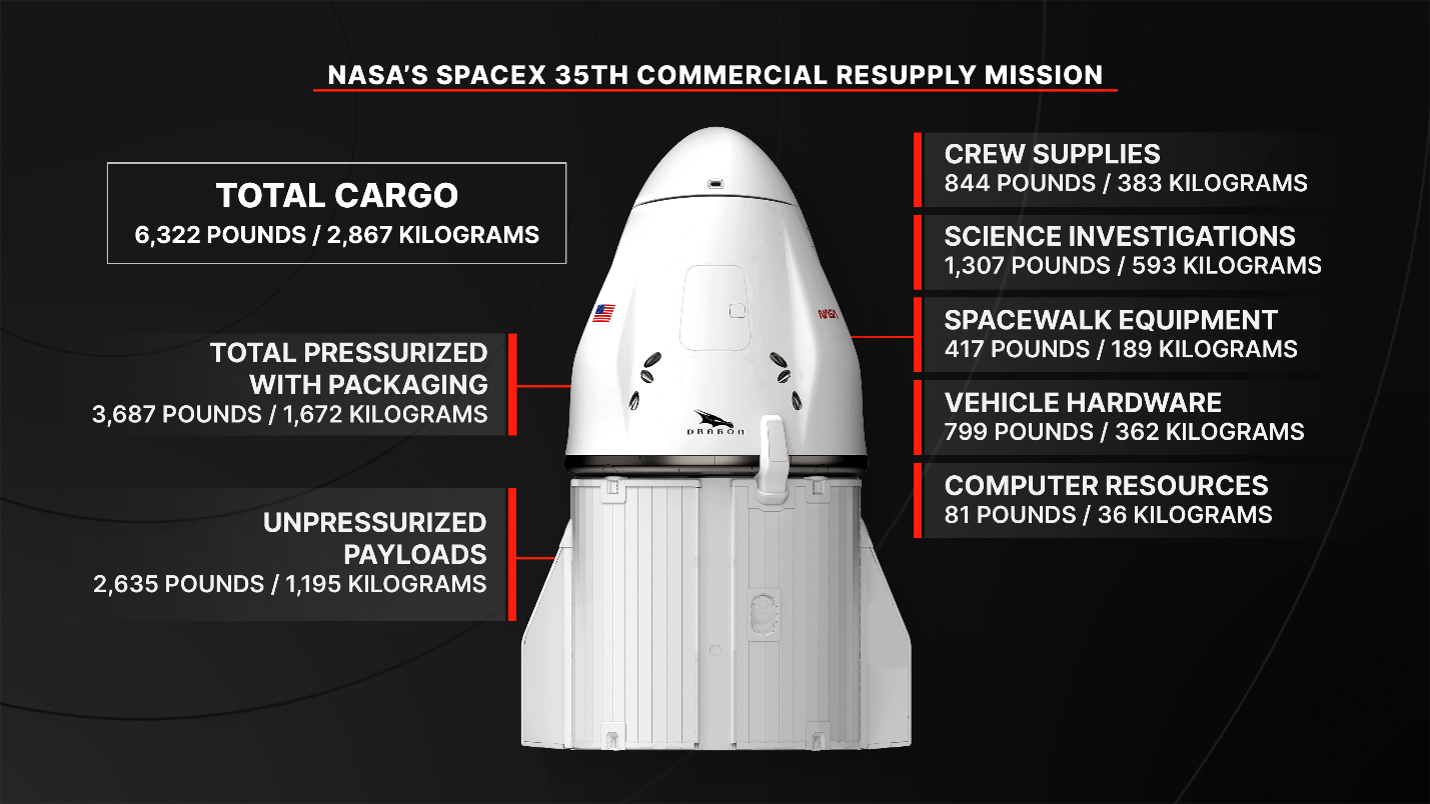
Loaded with more than 6,300 pounds of supplies, the SpaceX Dragon spacecraft will lift off aboard the company’s Falcon 9 rocket from Space Launch Complex 40 at Cape Canaveral Space Force Station in Florida. Following its arrival to the orbital complex, Dragon will autonomously dock to the space-facing port of the space station’s Harmony module.
NASA will stream launch and docking coverage through a variety of platforms. Learn where to watch online:
NASA’s SpaceX 35th commercial resupply mission will launch from Launch Complex 40 at Cape Canaveral Space Force Station in Florida.
NASA
For more than 25 years, the International Space Station has supported research by scientists from more than 110 countries, enabling more than 4,000 experiments in microgravity. Research conducted aboard the station helps advance long-duration missions to the Moon as part of the Artemis program and to Mars, while also providing multiple benefits to humanity.
Science Highlights
In addition to cargo for the crew aboard the space station, Dragon will deliver several new science experiments, including:
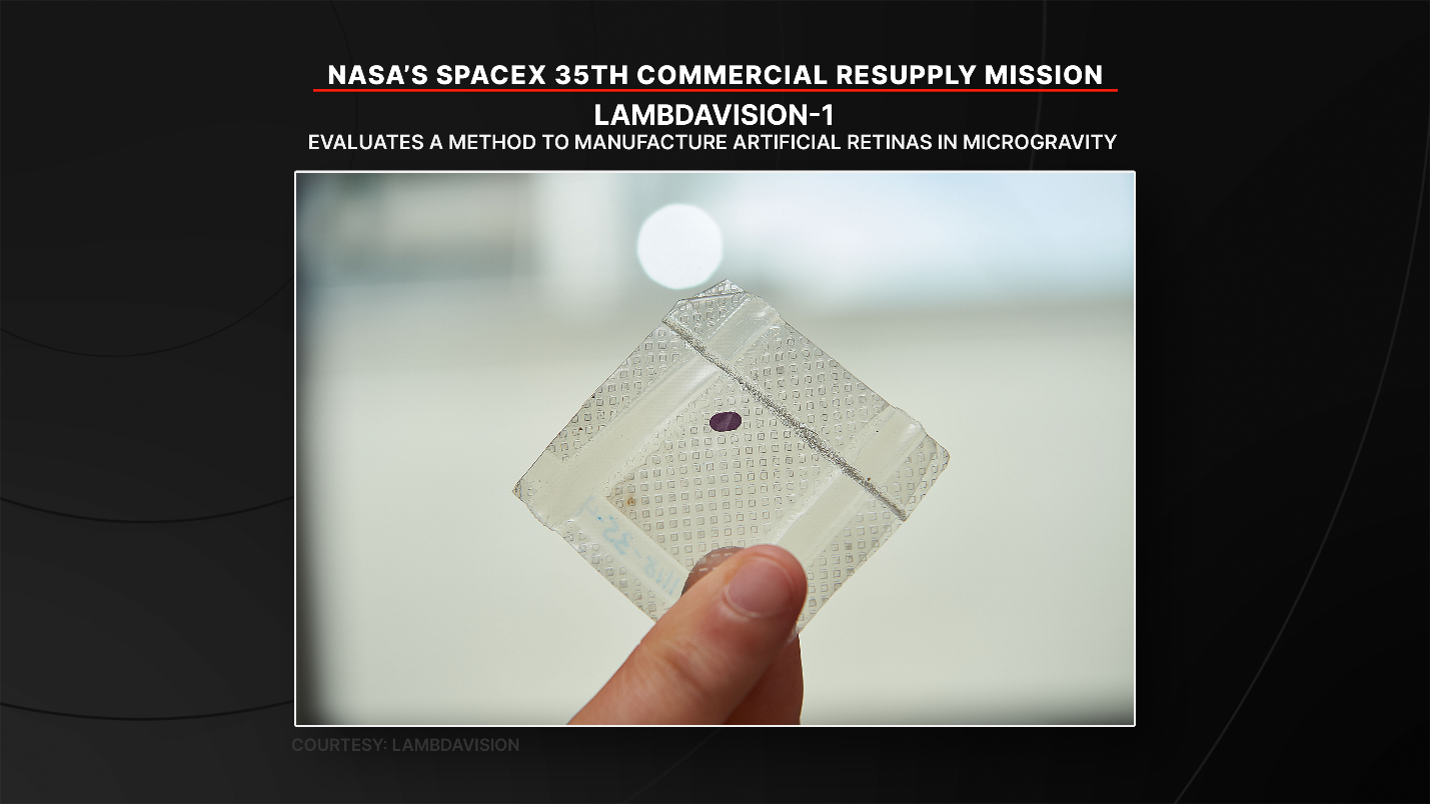
Lambda-Vision-1 studies artificial retinas in microgravity and could help patients with incurable retinal diseases on Earth.
NASA
With LambdaVision-1, NASA is testing how to manufacture artificial eye retinas in microgravity, building them one thin layer at a time. Reduced settling in microgravity may create more uniform, stable layers, potentially improving implants’ performance. These artificial retinas could help restore vision for patients with currently incurable retinal diseases on Earth.
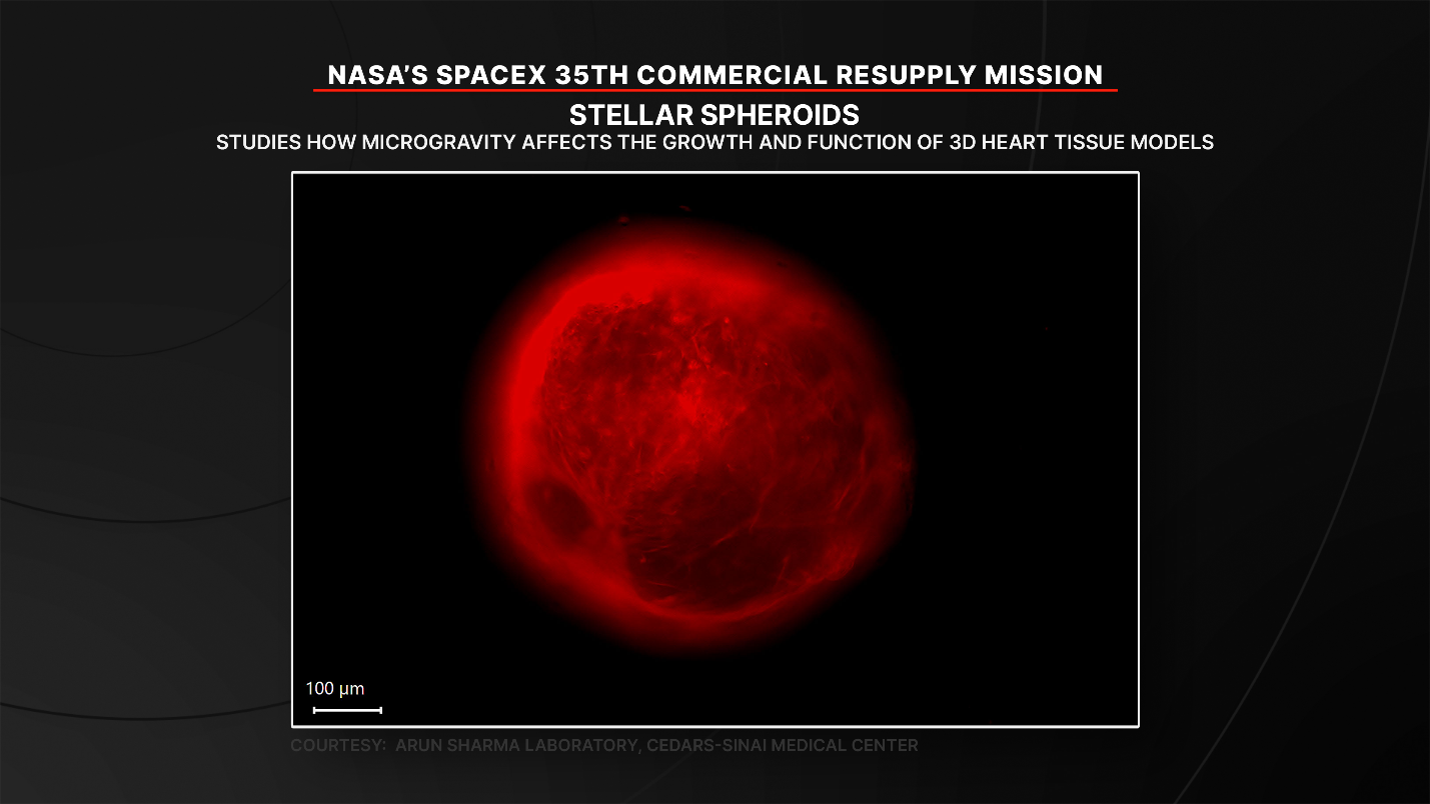
Stellar Spheroids examines growth and function of 3D heart tissues models in microgravity. Credit: NASA
NASA
NASA will use the Stellar Spheroids experiment to study how microgravity affects the growth and function of 3D human heart tissue models. Researchers will assess whether microgravity improves the formation of advanced vascular networks. Results could help researchers develop more realistic heart tissue models for disease research and support larger‑scale drug testing on future space missions.
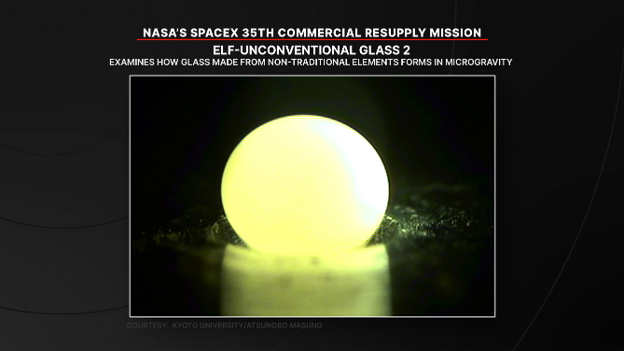
ELF-Unconventional Glass 2 studies how glass forms in microgravity when made from non-traditional elements.
NASA
Using non-traditional elements, ELF-Unconventional Glass 2 studies how glass forms in microgravity. Researchers will observe molten behavior in space, then return solid samples to Earth for detailed analysis. These unconventional glasses could offer higher strength, improved optical capabilities, and greater durability for spacecraft, habitats, and other exploration technologies.
MINDS seeks to reveal new targets to treat diseases like Alzheimer’s, Parkinson’s, and multiple sclerosis.
NASA
The MINDS experiment studies brain organoids to better understand inflammation linked to neurodegenerative diseases. The investigation uses “organoid villages,” which combine cells from multiple people to better represent patient diversity. Results could help identify new treatment targets for diseases like Alzheimer’s, Parkinson’s, and multiple sclerosis.
Arrival and Return
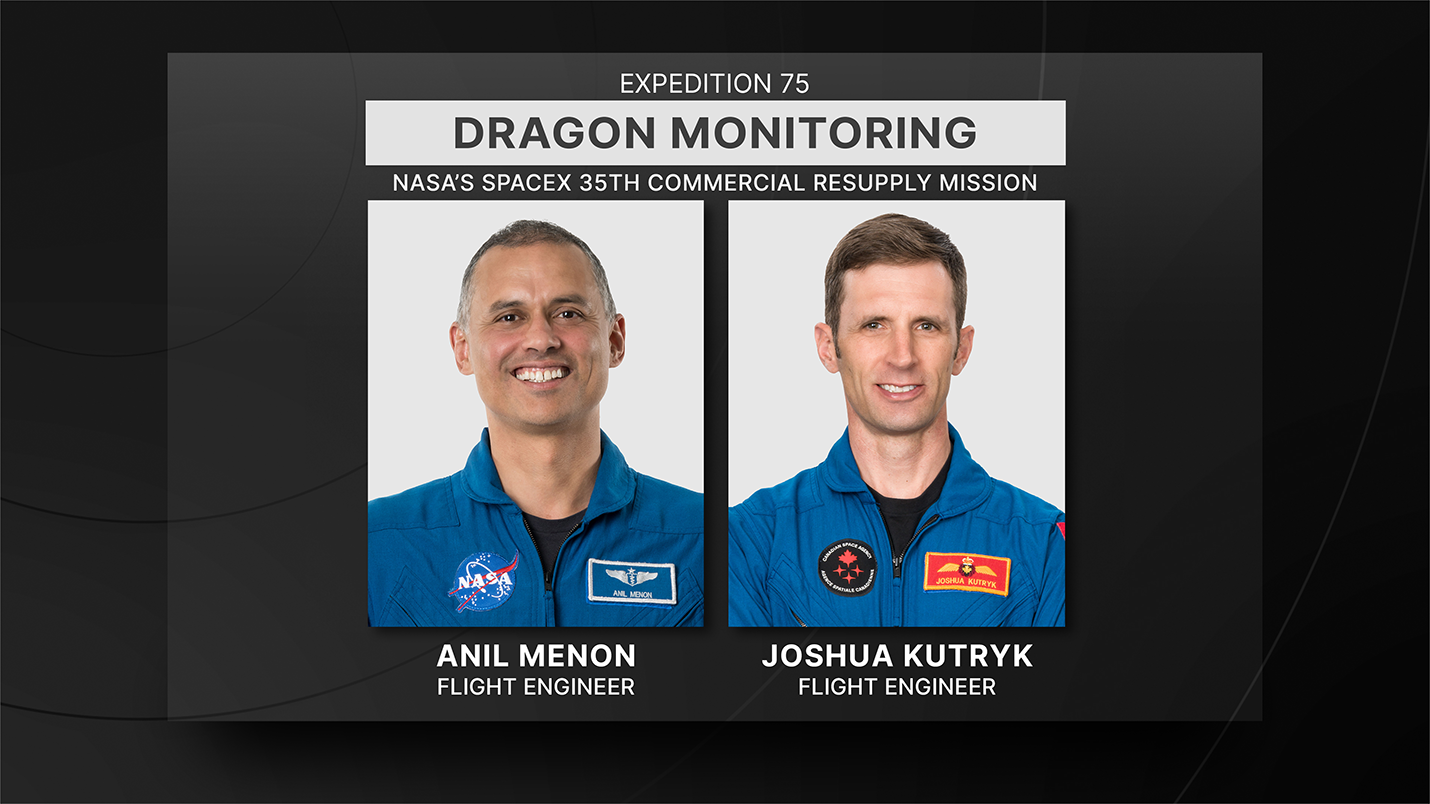
NASA astronaut Anil Menon and CSA (Canadian Space Agency) astronaut Joshua Kutryk will monitor the arrival of the SpaceX Dragon cargo spacecraft from the International Space Station.
NASA astronaut Anil Menon and CSA (Canadian Space Agency) astronaut Joshua Kutryk will monitor the Dragon spacecraft’s arrival. It will remain docked to the orbiting laboratory for about a month before splashing down in the Pacific Ocean, returning critical science and hardware to teams on Earth.
Cargo Highlights
NASA’s SpaceX 35th commercial resupply mission will launch on the company’s Dragon spacecraft on the SpaceX Falcon 9 rocket to deliver research and supplies to the International Space Station
NASA
Launch
International Space Station Roll-Out Solar Arrays (IROSA) – The final pair of IROSAs that will be installed on the space station, completing the augmentation of its power system to support critical operations, including its safe and controlled deorbit.
Collapsible Continency Urinal and supporting hardware – A demonstration and test unit supporting NASA’s Artemis III mission.
Canadarm2 joint flight support equipment – A large foam clamshell will fly empty to return the failed robotic arm joint that was replaced during a June 30 spacewalk. After its return to Earth, teams will analyze the joint on the ground.
Additional equipment launching includes a toilet dose pump, a toilet pretreat quality sensor, and a robot micro-conical tool used for space station maintenance and utilization tasks with external replacement units and payloads.
Return
When Dragon returns in mid‑November, it will bring back the failed joint on the Canadarm2 for analysis and refurbishment, a spacesuit for ground refurbishment, a fluid- and pressure-control pump assembly from the urine processor, and a filtration unit for the water processor assembly.
For twenty-five years, an Italian hacker collective has built communications infrastructure designed to survive censorship, surveillance and police raids. On August 26, the United States designated it a terrorist organization.…
Join us in this revelry by printing this stuff yourself. Give it to a friend, leave it at a bus stop, wheat paste it behind a dumpster, fill your personal…
Join us in this revelry by printing this stuff yourself. Give it to a friend, leave it at a bus stop, wheat paste it behind a dumpster, fill your personal…
Dispatches From the Rural Edge “The county estimated between 500 and 3,000 unhoused people. The shelter had 25 beds.” We told our friends we would check back on them in…
Outline: S: This is Sprout C: and this is Charyan, and we are the hosts of Molotov Now!, on The Channel Zero Podcast Network, thank you for joining us on…
mk: Hello and welcome to the And Its Enemies, a podcast about. Queer and Neurodivergent Kids Living Out Anarchy and Youth Liberation Here at The Child and Its Enemies, we…
Dalle 18 Concerto di Chiusura Estiva con: DIVULGATOR, FINAL STRUGGLE, CAGED, DAMN CITY, KRYSTO, CANNIBE, ANGOSSA, MY OWN VOICE, RIPUDIO a Seguire DJ SET by ATTRAKKO DOMENICA 28 GIUGNO DUB
Apertura cancelli della morte dalle 21:00 in poi con: Noise trail immersion (post black metal)Deadly carnage (post metal)Deadfloor maniacs (math rock)Lateral sin (progressive modern metal) Aftershow: Raven lynx (metal ‘n’ bass)
7 MAGGIO 1972 – 7 MAGGIO 2026 A Cinquantaquattro anni dall’assassinio del compagno Franco Serantini “ANARCHICO VENTENNE COLPITO A MORTE DALLA POLIZIA MENTRE SI OPPONEVA AD UN COMIZIO FASCISTA” GIOVEDÌ 7 MAGGIO ORE 18 IN PIAZZA SERANTINI (S. Silvestro)

 Accedi