The UK government has set up an advisory board for its digital ID project, intended "to challenge the government on emerging ideas or policy decisions to ensure the system works for everyone," says the Cabinet Office. The board includes David Rogers, an Internet of Things security expert and CEO of security consultancy Copper Horse. He is no stranger to government advisory panels, having previously sat on a group formed in 2020 to consider telecoms diversification. A year later, as chairman of the GSMA's fraud and security group, he backed the then-Conservative government's Product Security and Telecommunications Infrastructure Act 2022. Rogers has provided El Reg with comments over the years, and in 2014 discussed iPhone 6 biometric security, arguing that better usability would cut data loss overall because most people found PIN locks too cumbersome. Justine Roberts, founder and chief executive of UK parenting forum Mumsnet, is also on the board. The site experienced a data breach in 2019 due to a cloud migration affecting 46 user accounts, leading Roberts to apologize. More recently, some Mumsnet posters have been unimpressed by the government's digital ID plans, with one responding to the prime minister's October 2025 announcement with "Honestly, who is he kidding?" and "Desperate stuff to justify this authoritative bs." During the public consultation, some posters promoted the Sex Matters campaign to let Brits include their sex in their digital IDs. Another board member, Victor Dominello, has relevant experience as the minister who launched New South Wales' digital driver's license in 2019, saying it was more secure than the physical equivalent. In 2022, a researcher at security company Dvuln found numerous security flaws in the Service NSW app that hosts the license and other government services, although the state government said these did not pose a risk to customer information. Other members include John Fallon, former chief executive of Pearson and the lead non-executive board member of the Cabinet Office; Anne-Marie Imafidon, who runs social enterprise Stemettes, which encourages people to consider jobs in tech and science; and digital regulation lawyer Emma Wright. The board will meet quarterly for as long as the digital ID program lasts. The government is also setting up engagement exercises with the digital verification and financial services sectors. It is currently running a People's Panel with around 100 to 120 participants meeting in Birmingham and on Zoom to hear from experts and ministers before producing recommendations, in return for £550 in cash or vouchers. ®
National Savings & Investments (NS&I) is looking for a new chief executive to take charge of the state-backed savings institution as it attempts to steer a troubled £3 billion digital transformation program back on course. The government-owned bank has launched a search for a permanent successor to former chief executive Dax Harkins, who left earlier this year amid a scandal involving hundreds of millions of pounds in unclaimed funds owed to the estates of deceased customers. Whoever takes the job will get a salary of up to £220,000, a troubled digital transformation program, and what could be described as a challenging in-tray. While the recruitment notice highlights NS&I's 164-year history and its 24 million customers, it also acknowledges that the organization is wrestling with problems that extend well beyond attracting deposits. "Whilst NS&I is successfully meeting its targets for savings and funding for the Government, and service levels to most customers, it is undergoing a major transformation programme and has experienced significant operational failings recently," the job ad states. The successful candidate will take responsibility for Project Rainbow, NS&I's long-running modernization effort that Parliament's Public Accounts Committee tore into earlier this year. In February, MPs branded the program a "full-spectrum disaster" after costs ballooned from an original estimate of around £1.7 billion to approximately £3 billion. The committee concluded that NS&I lacked the capability to deliver the overhaul, had spent £43 million on consultants, and still did not have a credible integrated plan despite five years of work. MPs also questioned how a program originally expected to cost around £1.7 billion had risen to £3 billion while key elements remained unfinished. The new boss will be expected to turn that around. The advert promises "end-to-end accountability for transformation and performance of the organisation," handing the next chief exec responsibility for delivering a program that has already attracted intense scrutiny from Parliament. NS&I is also placing unusual emphasis on crisis management. Candidates are expected to demonstrate experience delivering "a major change/transformation programme within consumer facing industries, at scale," alongside a track record of managing operational issues, reputation management, and recovery. The advert goes further, stating it is "crucial that a highly capable, credible CEO is appointed to lead the organisation through these challenges and re-establish NS&I's reputation and standing as a trusted, efficient and effective national institution." Whoever lands the job will be tasked with proving that one of the government's most heavily criticized IT overhauls can still be rescued before Parliament decides the next chapter of Project Rainbow deserves an equally colorful nickname. ®
di Alessandro Baldacci [E’ uscito da poco nella collana “Adamàs” di La Vita Felice Esopianeti, il nuovo libro di poesia di Alessandro Baldacci, seconda parte di una trilogia dedicata ai “ragazzi selvaggi” Kaspar Hauser e Victor. Proponiamo un testo]. Itard «Io non vengo alla festa, …
Preparations for Next Moonwalk Simulations Underway (and Underwater)
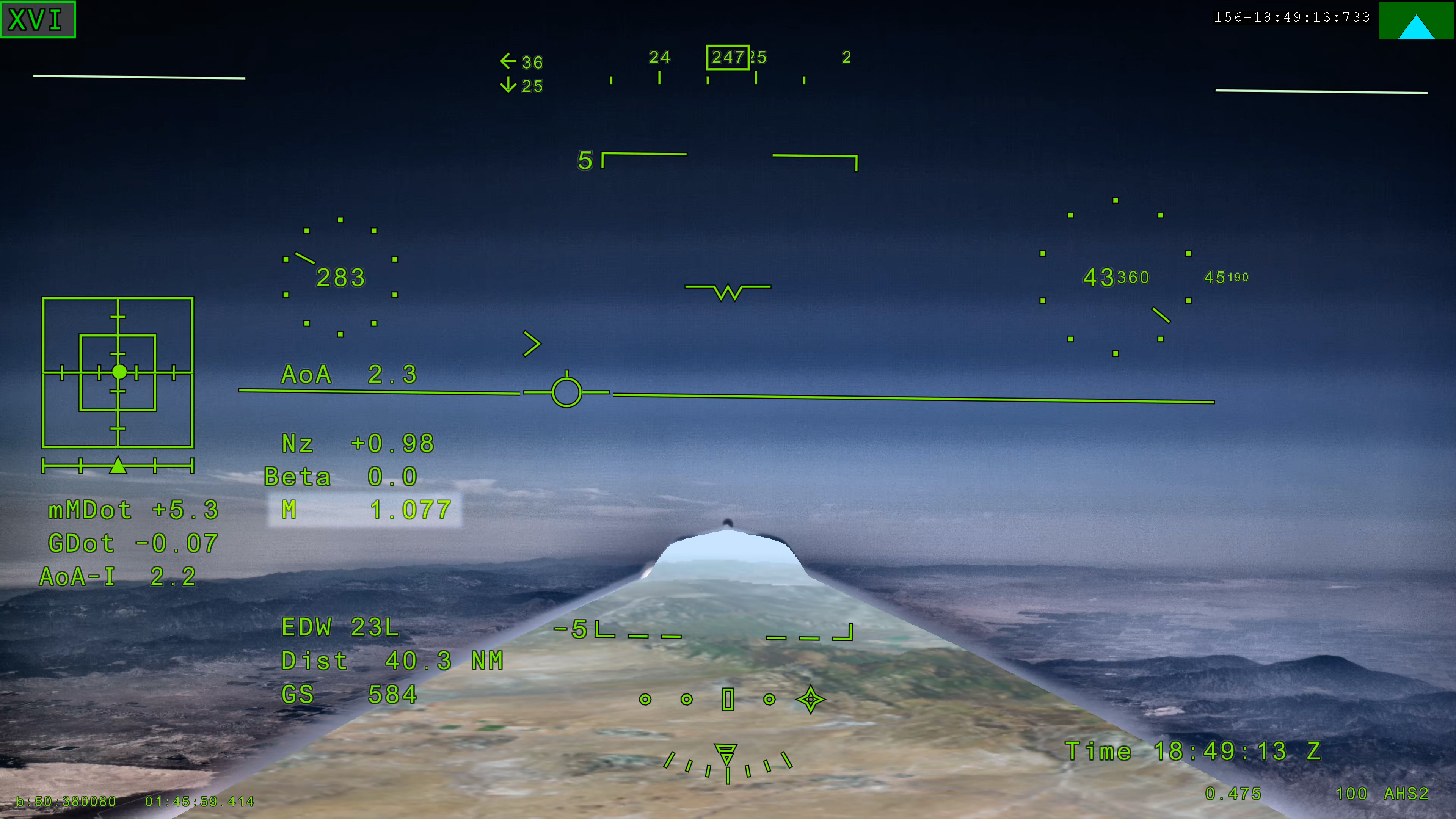
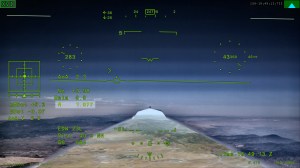
NASA’s X-59 eXternal Vision System shows Mach 1.077 on Friday, June 5, 2026, marking the aircraft’s first time reaching supersonic speed in support of NASA’s Quesst mission. The moment represents a milestone for the aircraft as it transitions to include test flights faster than the speed of sound.
NASA
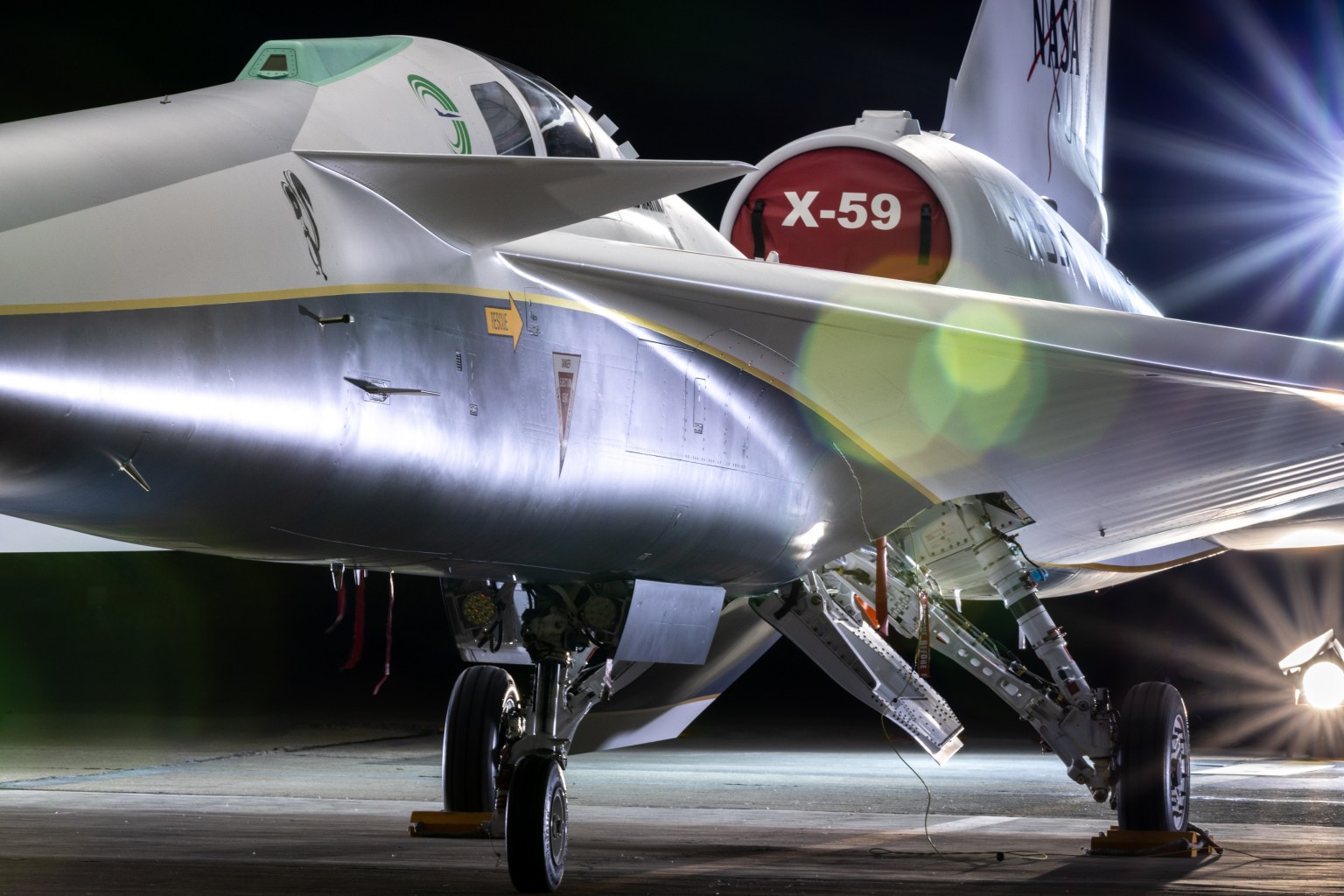
NASA’s experimentalX-59 aircraft marked a major milestone Friday, June 5, when it flew faster than the speed of sound for the first time, setting the stage for demonstrating its quiet supersonic capabilities later this year.
NASA test pilot Jim “Clue” Less took off and landed at Edwards Air Force Base in California, reaching a top speed of approximately Mach 1.1 (713 mph) and altitude of 43,400 feet. The X-59’s flight began at 11:08 a.m. PDT and lasted 81 minutes, with the team focusing on flying qualities at both subsonic and then supersonic speeds.
In the coming days, we expect to take the next step and push to Mach 1.4
jared isaacman
NASA Administrator
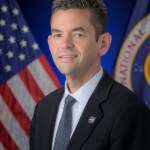
”X-59 is getting ready for its quiet supersonic debut. Since the aircraft’s first flight on Oct. 28, 2025, the team has made tremendous progress, flying 16 times in the last 90 days and getting into a steady test rhythm. In the coming days, we expect to take the next step and push to Mach 1.4,” said NASA Administrator Jared Isaacman “I’m grateful to the NASA team and Lockheed Martin Skunk Works for their help getting us to this point, and I hope this is the first of many collaborations as we rebuild NASA’s X-plane portfolio.”
The X-59 is designed to fly at supersonic speeds while creating only a quiet thump instead of a loud sonic boom. For this flight, a NASA F‑15 chase plane flew nearby to monitor the X‑59. The loud sonic booms from the F-15 obscured any sound made by the X-59.
“The X-59’s first supersonic flight is a testament to America’s enduring leadership in science, engineering, and aerospace innovation,” said Michael Kratsios, Assistant to the President for Science and Technology and Director of the Office of Science and Technology Policy. “This achievement comes as the Trump Administration continues work to unleash supersonic flight and enable American ingenuity.”
This first supersonic flight is a significant milestone, but an event even more critical to the mission is upcoming. In just days, the aircraft is expected to make its first “mission conditions” flight, reaching a cruising speed of Mach 1.4 (925 mph) and altitude of approximately 55,000 feet. The X-59 also will be accompanied by a chase plane for this flight.
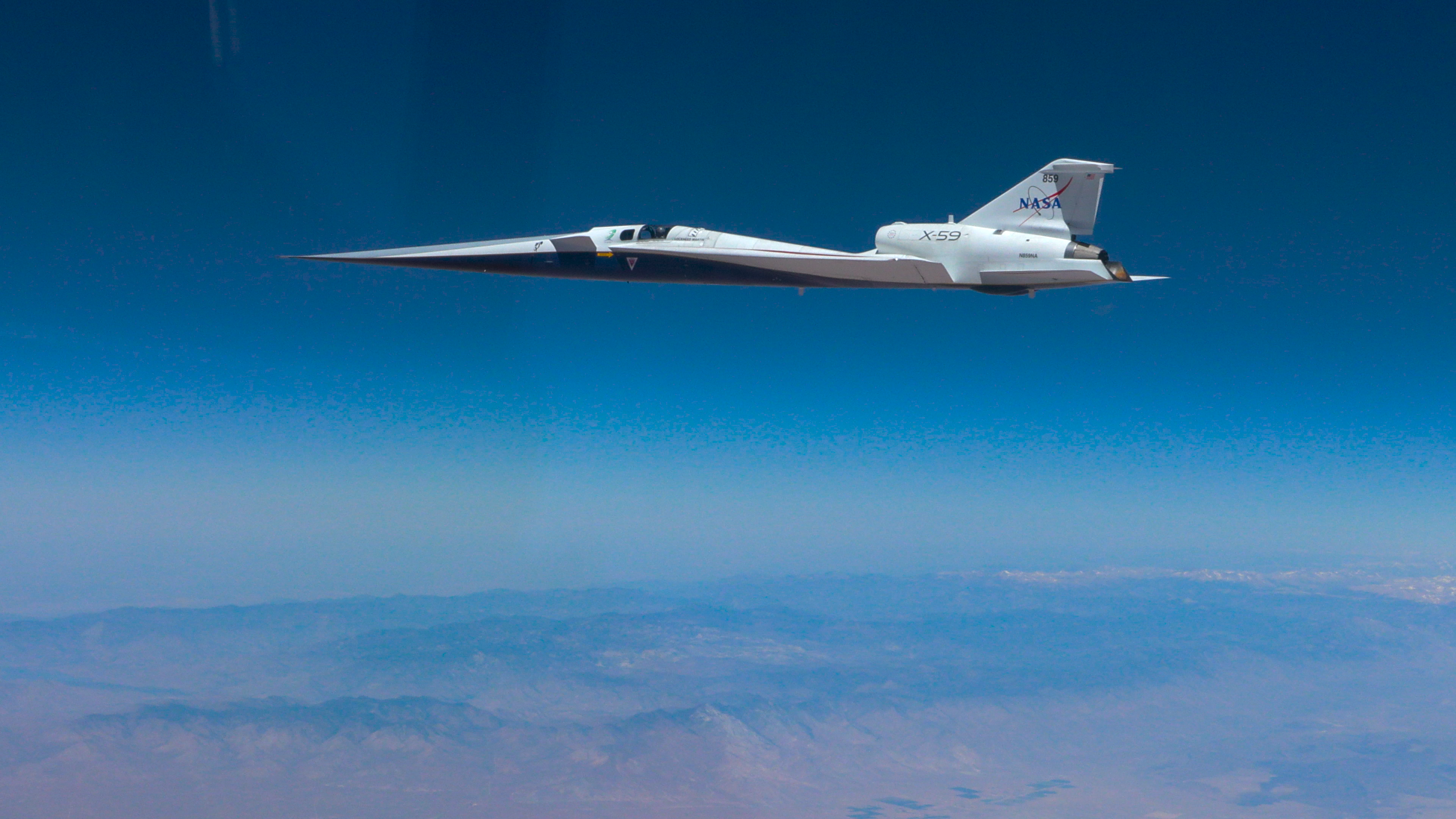
NASA’s X-59 quiet supersonic research aircraft completed its first supersonic flight Friday, June 5, 2026, marking the first time the aircraft exceeded the speed of sound in support of NASA’s Quesst mission. The milestone represents a major step in flight testing as the aircraft expands into the supersonic portion of its flight envelope.
NASA / Lori Losey
This speed and altitude are the base conditions for the X-59 when it will eventually fly over several U.S. communities enabling NASA to gather data about how people may perceive its quiet thump. NASA will share this data with U.S. and international regulators to help establish new data-driven noise standards to enable a future viable market for supersonic commercial flight over land.
For the last several months, the X-59 has been participating in an ongoing series of flights where the plane has been flying at a wide range of speeds and altitudes – a process known as envelope expansion. These tests are the first phase of the X-59’s flight testing. They are focused on performance and involve chase plane monitoring. When the aircraft completes this phase it will enter another, focused on its sound profile in order to verify its quiet thump capability.
The X-59 is the centerpiece of NASA’s Quesst mission, which aims to demonstrate quiet supersonic flight and help enable commercial supersonic flight over land worldwide. These advancements will help travelers reach their preferred destinations faster, spending less time in the air.
Through Quesst’s development of the X-59, NASA also will deliver design tools and technology for quiet supersonic airliners that will achieve the high speeds desired by commercial operators without disturbing people on the ground. NASA will validate design tools through ground and flight testing, providing U.S. aircraft manufacturers the ability to explore new quiet supersonic concepts, and provide them with confidence that their resulting designs will meet quiet flight requirements.
NASA’s X-59 quiet supersonic research aircraft completed its first supersonic flight Friday, June 5, 2026, marking the first time the aircraft exceeded the s...
Preparations for Next Moonwalk Simulations Underway (and Underwater)
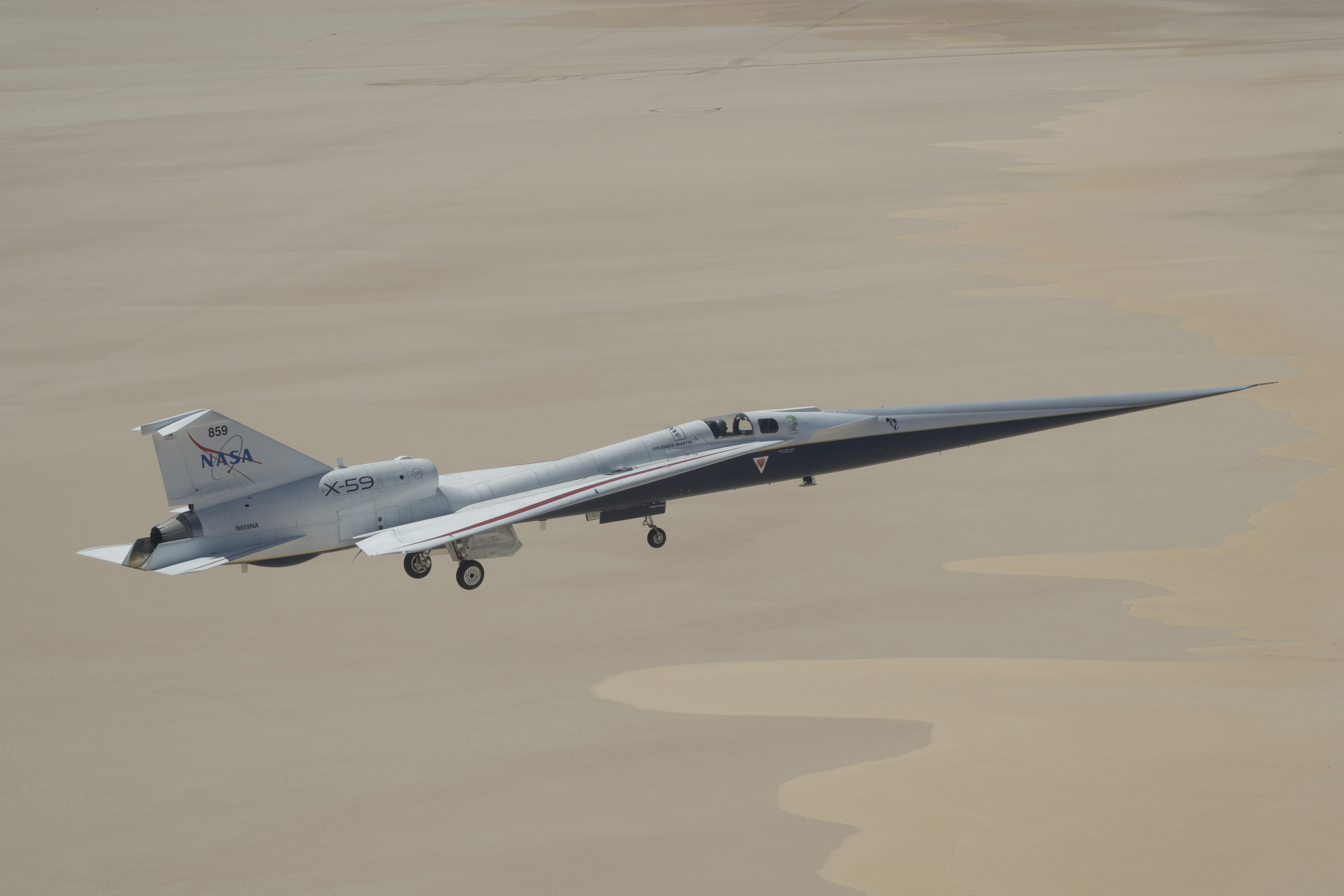
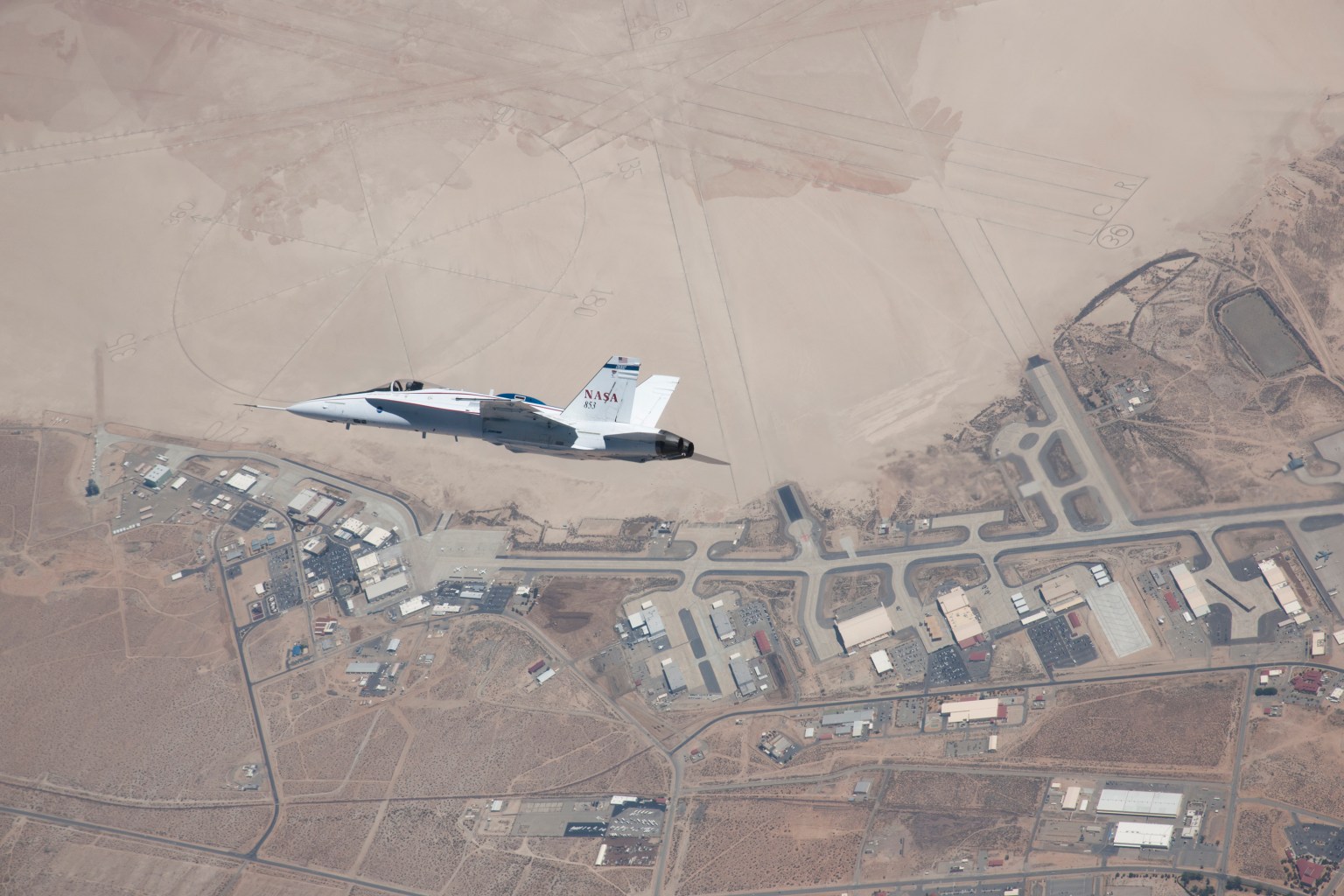
NASA’s X-59 quiet supersonic research aircraft flies over Rogers Dry Lake near NASA’s Armstrong Flight Research Center in Edwards, California, on Tuesday, May 12, 2026. NASA continues expanding the aircraft’s flight envelope through a series of lower-altitude and slower-speed flights ahead of upcoming flight tests at speeds faster than the speed of sound.
NASA/Jim Ross
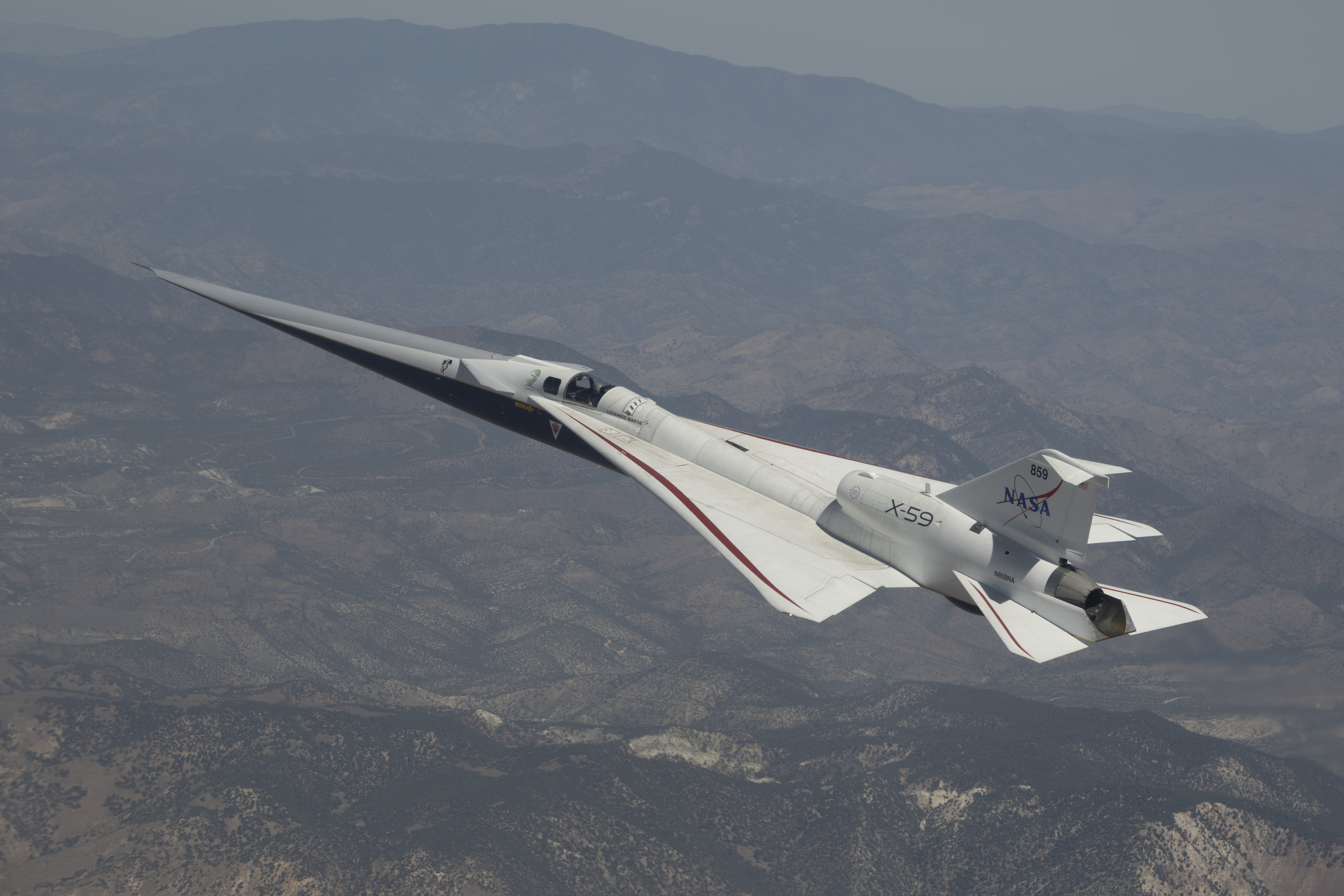
NASA’s X-59 quiet supersonic research aircraft is preparing for some of its most significant flights yet. The X-plane is about to begin a new block of test flights that will include its first time flying faster than the speed of sound and other mission-critical objectives.
“What comes next is the first time this one-of-a-kind aircraft will fly supersonic,” said Cathy Bahm, project manager for NASA’s Low Boom Flight Demonstrator. “We are starting toward the mission conditions test point that X-59 was designed for.”
After months of flights, the X-59 team reviewed their progress in late May and now look toward the aircraft’s next series of flight tests, including higher altitudes and faster speeds. This will give engineers a look at how the X-59 handles under required operational conditions for NASA’s Quesst mission to eventually gather data on quiet supersonic flight.
The team expects the X-59 to fly supersonic – over 630 mph – for the first time at approximately 43,000 feet altitude during a series of test flights in early June, a major milestone for the aircraft. After that, it will conduct a “mission conditions” flight, where it will hit Mach 1.4 (925 mph) at approximately 55,000 feet. That speed and altitude are important because they’re NASA’s performance targets for the X-59 to eventually fly over U.S. communities to demonstrate quiet supersonic flight and collect feedback data about the aircraft’s quiet sonic “thump” from the public.
While the X-59 is designed to fly at supersonic speeds without producing a loud sonic boom, these early flights are not yet intended to demonstrate its quiet supersonic capabilities. The X-59 will be accompanied by a traditional supersonic chase plane, so any quiet thump it produces in the current phase of testing will be obscured by louder, traditional sonic booms from the chase. In supersonic flights this summer, the chase aircraft will also be outfitted with a specialized shock-sensing probe to take initial measurements of the X-59’s shock waves.
Completed flights
The X-59’s first block of flights successfully met several test goals, generating data for its team to analyze. After making its first flight in October 2025, it entered a scheduled period of maintenance before returning to the skies in March 2026. It has since completed 14 additional flights, marking milestones including:
Its first gear swing, or the retraction of its landing gear to show off its sleek design for the first time.
Reaching altitudes up to 43,000 feet and near supersonic speeds at Mach 0.95, approximately 627 mph.
Marking its first dual-flight day and then making those increasingly routine as the X-59 team increased flight cadence.
After a period of moving higher and faster, transitioning into lower and slower test flight conditions so engineers could gather information on the X-59’s behavior across a range of flight conditions.
Data collected during the X-59’s first block of test flights helped teams better assess critical systems, including fuel, hydraulics, environmental controls, and the eXternal Vision System, which is the aircraft’s unique series of cameras that feed into a monitor that allows the pilot to see forward instead of using a traditional windshield. Teams monitored how the aircraft behaved during takeoff, landing, and throughout flight. Strain gauges installed throughout the X-59 collected detailed information on the forces it experienced, and how its structure responded to them.
NASA’s X-59 quiet supersonic research aircraft flies above mountains near NASA’s Armstrong Flight Research Center in Edwards, California, on Tuesday, May 12, 2026. NASA continues expanding the aircraft’s flight envelope to evaluate how it performs across a range of flight conditions ahead of upcoming flight tests at speeds faster than the speed of sound in support of the agency’s Quesst mission.
NASA/Jim Ross
Next steps
During the X-59’s upcoming flights, pilots will run through test points while engineers watch the aircraft’s performance — but now in supersonic flight conditions.
“Flying at supersonic speeds is a major milestone for the X-59 team,” Bahm said. “Every step of envelope expansion brings us closer to demonstrating the quiet supersonic capability that is at the heart of the Quesst mission. Completing the first mission-conditions flight is especially meaningful – it’s the moment where we begin validating the aircraft in the environment it was designed for.”
In addition to reaching mission condition during this block of flight tests, the X-59 will also achieve its maximum speed of Mach 1.6 (1,218 mph) and altitude of 60,000 feet.
But just because the aircraft can go that fast doesn’t mean it always will fly supersonic. Testing will continue, including a mix of subsonic and lower-altitude flights so the team can continue monitoring it in varied conditions.
“These flights not only deepen our confidence in the X-59’s performance – they mark our progression toward the future phases of the mission that will ultimately help shape the future of supersonic travel,” Bahm said.
All flights so far and in the upcoming test block are part of Phase 1 of the X-59’s Quesst mission, focused on proving the performance and airworthiness of the aircraft. Some of those flights will include early deployment of equipment, including a probe mounted to one of NASA’s F-15 research aircraft that can measure the X-59’s unique shock wave signature.
Data gathered during those early probing flights will allow engineers to prepare for a new stage of work set to begin later this year: Quesst Phase 2, when teams will begin to measure the aircraft’s supersonic flight signature to verify that it’s producing a quiet supersonic thump, as designed.
“Aviation pioneer Otto Lilienthal said, ‘To design a flying machine is nothing. To build one is something. But to fly is everything.’ The 15 X-59 flights we’ve accomplished since March have been everything to this team and the mission,” Bahm said. “Every flight has pushed the boundaries of what’s possible, steadily expanding the envelope and strengthening our confidence in the aircraft.”
But, she said, rather than focusing on past progress, the team is already looking ahead.
“As we look ahead to the upcoming flights, we’re poised to open the envelope even further – moving boldly toward the mission test point this aircraft was built to achieve,” Bahm said. “Flying supersonic and reaching these milestones isn’t just progress; it’s the realization of years of perseverance, innovation, and teamwork. Each step brings us closer to Phase 2, and to the future of commercial supersonic flight.”
NASA’s X-59 quiet supersonic research aircraft is gearing up for some of its most significant flights yet as teams continue expanding the aircraft’s flight e...
Preparations for Next Moonwalk Simulations Underway (and Underwater)
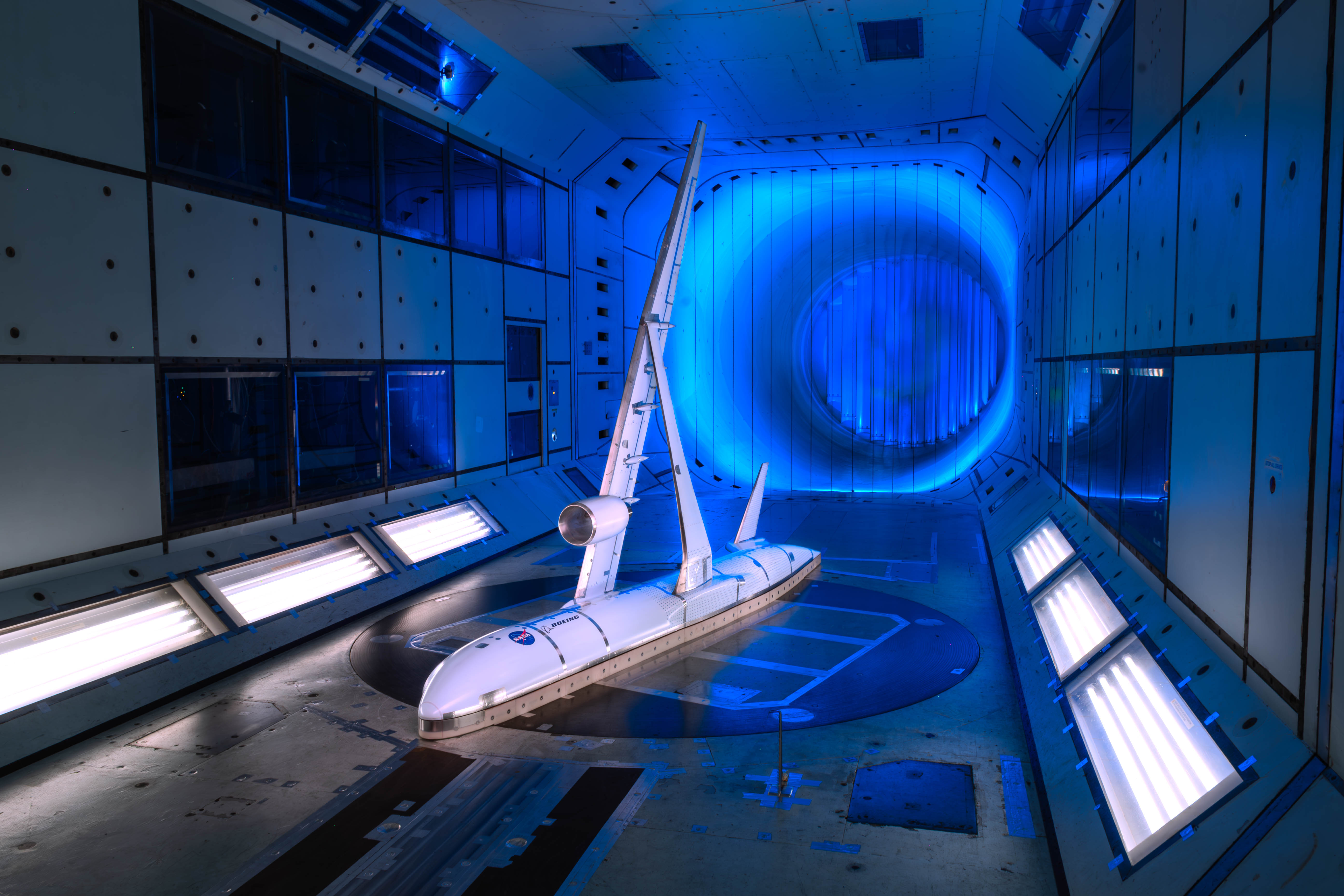
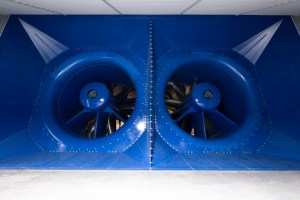
A scale model of Boeing’s Subsonic Ultra Green Aircraft Research concept undergoes testing in a 5-meter wind tunnel operated by the company QinetiQ in December 2025.
QinetiQ
NASA and Boeing have completed wind tunnel testing to study an innovative advanced aircraft design intended to improve aerodynamic efficiency.
A truss-braced wing configuration, involving a long, thin wing with aerodynamically shaped structural supports, has the potential to reduce fuel and operational costs for future airliners, which is why NASA has collaborated with Boeing to advance the design.
But this kind of wing would be much more than a simple tweak to existing designs – for an aircraft the size of a passenger jet, it would be a revolutionary redesign, requiring extensive study from NASA and Boeing.
The most recent round of testing used a complex wind tunnel model to collect data on how air flows around a truss-braced wing model and the forces that would be exerted on such a wing in flight.
The test used a semispan model – essentially half an aircraft mounted on a wind tunnel floor. The model has features built in to simulate the mechanisms that increase the amount of lift a wing produces. By adjusting the model’s slats, flaps, and other moving control surfaces, the team can configure it to the low speed, high-lift settings of takeoff and landing conditions.
The model is part of a collaboration to test what’s known as Boeing’s Subsonic Ultra Green Aircraft Research (SUGAR) concept.
In December, teams completed testing of the model wind tunnel operated by the company QinetiQ in Farnborough, England. This large wind tunnel uses pressurized conditions to predict airplane behavior in takeoff and landing conditions.
The large size of the tunnel gives the model fidelity to better predict the behavior of a plane in flight. This capability allowed the team to confidently assess aerodynamic performance.
NASA and Boeing research teams analyzed data in real time to ensure the model performed as expected. Researchers are still reviewing the full results, but the test has already added valuable information to a growing body of research aimed at reducing fuel use in future aircraft designs.
The testing was just the latest stop for this research. NASA and Boeing have tested the concept at multiple NASA facilities to collect data as they work to build a comprehensive understanding of this advanced airframe concept.
This collaboration serves as an example of how NASA serves as an incubator for breakthrough technology with profound commercial applications. The transonic truss-braced wing concept originated from NASA aeronautics-supported research and NASA and Boeing engineers have worked together, test-by-test, to move this wing design from an idea to a practical reality.
The work began in NASA’s Advanced Air Vehicles Program and continues as part of the Subsonic Flight Demonstrator project under the Integrated Aviation Systems Program in the agency’s Aeronautics Research Mission Directorate.
Preparations for Next Moonwalk Simulations Underway (and Underwater)
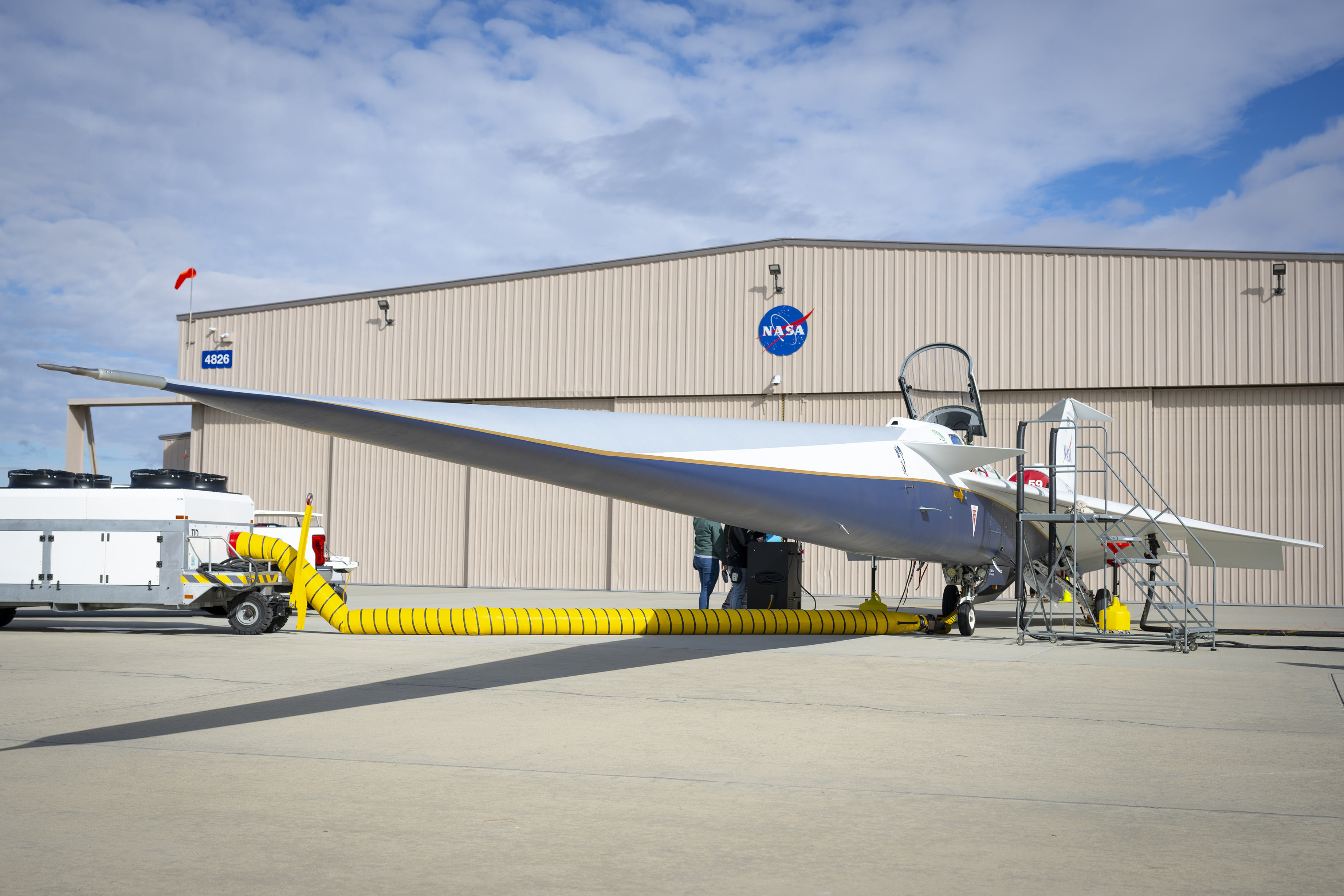
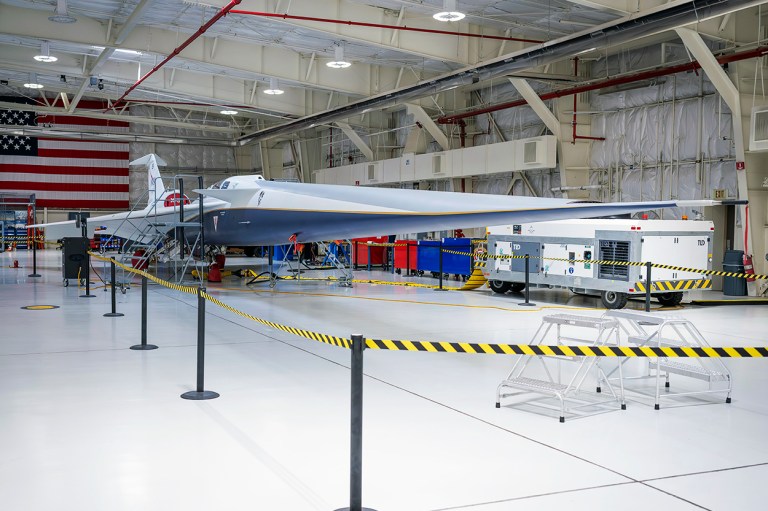
NASA’s X-59 quiet supersonic airplane sits parked in front of its new hangar home at the agency’s Armstrong Flight Research Center in California. The facility originally was constructed in 1968 and for nearly 60 years has hosted a number of research aircraft and programs.
NASA/Christopher LC Clark
There’s no sign reading “home sweet home” in the hangar where the X‑59 now sits, but the sentiment is unmistakable among those tending to the quiet supersonic aircraft.
Located at NASA’s Armstrong Flight Research Center in Edwards, California, the X-59 hangar was built in 1968 but looks like new thanks to a full renovation and modernization. While the X-59 was being assembled in Palmdale, California, workers at NASA Armstrong gutted the hangar, adding new electrical wiring, a fire suppression system, office space, air conditioning, and other safety features.
“The whole team is incredibly proud of what we’ve accomplished in preparing this new home for the X-59,” said Bryan Watters, the NASA project manager at Armstrong who led the renovation effort. “The fact we could take a 1960s hangar and modernize it for use by a 2020’s X-plane is very special.”
The X-59 is the centerpiece of NASA’s Quesst mission to enable a new era of commercial supersonic air travel over land by reducing the sound of typically loud sonic booms to a much quieter sonic thump.
From the beginning of the program, knowing the X-59 would eventually need a new residence at NASA Armstrong, Quesst managers were on the hunt for somewhere to house the quiet supersonic demonstrator.
Like anyone looking for the ideal place to call home, the team made sure there would be enough space for the airplane and all its support equipment. But with the experimental jet measuring at just under 100 feet long and 30 feet wide, there were few options.
“We had to find a hangar that was long enough so that part of the X-59 wouldn’t hang outside, exposed to the elements,” Watters said.
Building 4826, as the hangar is officially designated, turned out to be the choice spot. “It was basically stripped down and gutted so that essentially it was just structural steel with siding. From that state it was rebuilt,” Watters said.
The feature they are perhaps most proud of is the hangar’s new floor. Covering more than 32,000 square feet, it is coated with epoxy that prevents any spills from seeping into the concrete.
From the hangar’s office windows, the view of the hangar floor can include the F-15 research jets that will be used as chase planes to support X-59 flights in the coming months. The renovation faced challenges along the way, chief among them being supply chain issues stemming from the COVID-19 pandemic. But there were some incredible, unforgettable moments too.
Circa 1990
Nov. 2025
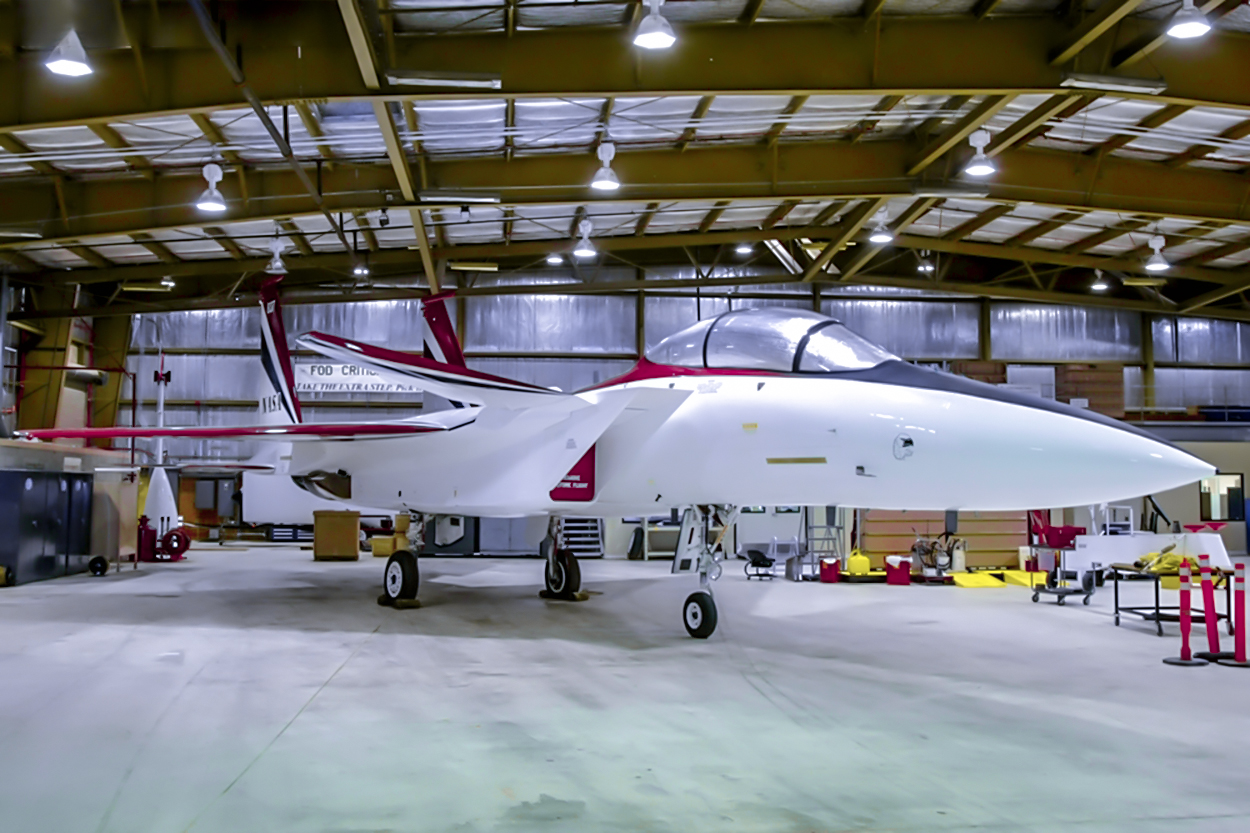
On loan to NASA from the Air Force, an F-15 Eagle fighter jet was the focus of the Short Takeoff and Landing/Maneuver Technology Demonstrator research program, which concluded in 1991. The aircraft is seen here inside Building 4826, a hangar at NASA’s Armstrong Flight Research Center that was renovated and began use in 2025 as home for the X-59 quiet supersonic technology demonstrator.
NASA
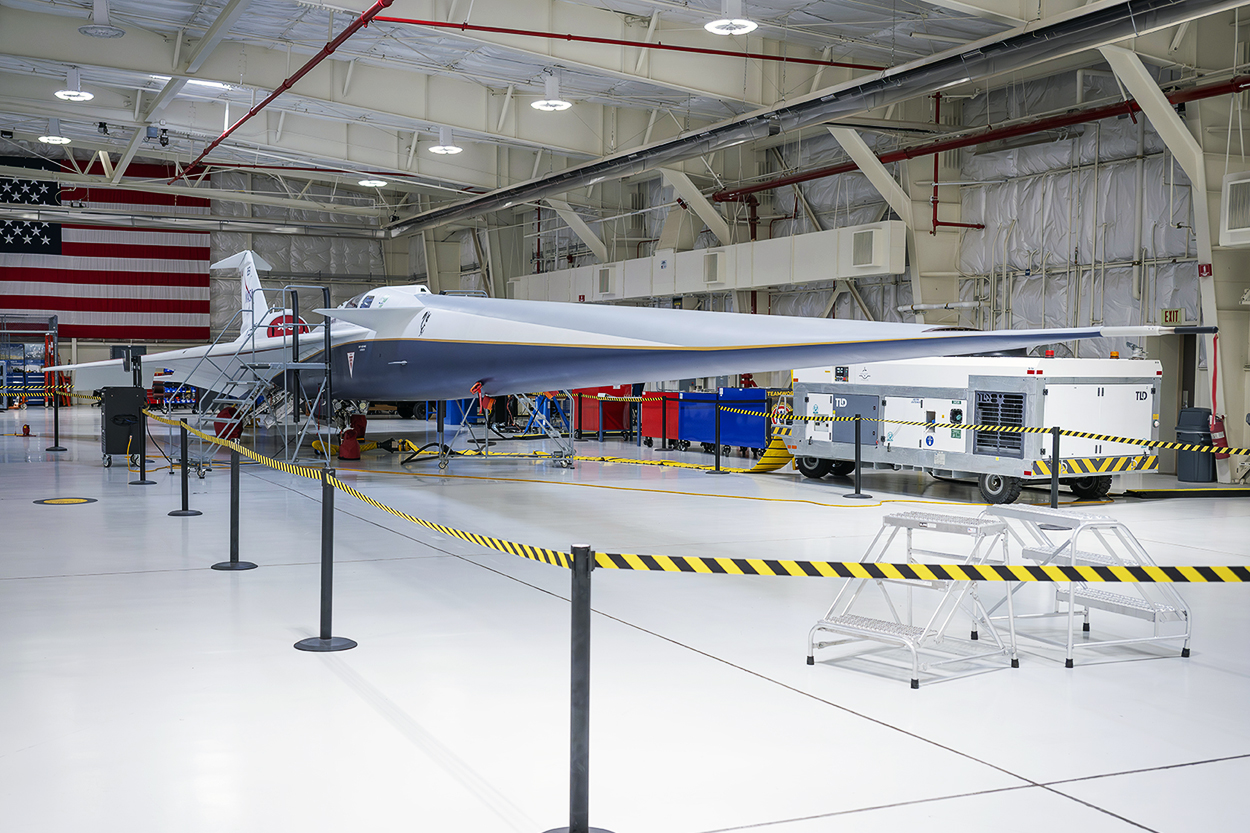
NASA’s X-59 quiet supersonic technology demonstrator aircraft is seen parked inside its new hangar home at the agency’s Armstrong Flight Research Center in California.
NASA/Christopher LC Clark
On loan to NASA from the Air Force, an F-15 Eagle fighter jet was the focus of the Short Takeoff and Landing/Maneuver Technology Demonstrator research program, which concluded in 1991. The aircraft is seen here inside Building 4826, a hangar at NASA’s Armstrong Flight Research Center that was renovated and began use in 2025 as home for the X-59 quiet supersonic technology demonstrator.
NASA
NASA’s X-59 quiet supersonic technology demonstrator aircraft is seen parked inside its new hangar home at the agency’s Armstrong Flight Research Center in California.
NASA/Christopher LC Clark
Circa 1990
Nov. 2025
past and present
Hangar Updated to Continue Hosting Historic Research
This NASA hangar at Armstrong Flight Research Center originally was constructed in 1968 and since then has hosted a number of history-making programs. Compare the two images above to see how the hangar looked during the late 1980s when it hosted an F-15 research aircraft (left), and beginning in 2025 after it had been renovated and modernized to host the X-59 quite supersonic technology demonstrator aircraft.
Moved in
With X-59 now flying regularly and comfortably settled into its new digs, the Quesst team is gauging its performance on the way to quiet supersonic flight.
“This is truly a great time for Quesst and the X-59,” said Cathy Bahm, NASA’s project manager for the Low Boom Flight Demonstrator. “It’s also still a little surreal to be able to just walk down from your office and see the airplane in our hangar.”
For more than a year, the hangar refurbishment team worked through every detail of the X-59’s new home to make sure it would be safe and sound. But actually seeing the aircraft occupy that space is an adjustment for them, too.
“We’ve looked at X-59 models on our desk for years and then, you know, there’s the real thing right in front of us, in a hangar that we renovated,” Watters said.
A real thing in the hangar – and streaking across the California desert sky. The X-59’s transition from an idea into a working aircraft is a testament to the teams that help build out every aspect of its infrastructure.
NASA’s X-59 is supported under the agency’s Aeronautics Research Mission Directorate.
About the Author
Jim Banke
Managing Editor/Senior Writer
Jim Banke is a veteran aviation and aerospace communicator with more than 40 years of experience as a writer, producer, consultant, and project manager based at Cape Canaveral, Florida. He is part of NASA Aeronautics' Strategic Communications Team and is Managing Editor for the Aeronautics topic on nasa.gov. In 2007 he was recognized with a Distinguished Public Service Medal, NASA's highest honor for a non-government employee.
In this episode of The Quiet Crew, you’ll meet civil engineer Bryan Watters and learn about his role on the Quesst mission. Bryan has been supporting the mis...
Se ci riflettiamo un attimo troviamo una similitudine tra Internet e l’oceano: entrambi hanno uno strato superficiale maggiormente noto ed uno strato profondo ed oscuro, per la maggior parte inesplorato. In questo articolo daremo un’occhiata al Surface Web, al Deep Web ed al Dark Web e descriveremo brevemente le differenze tra loro. Cos’è il Surface… Leggi tutto »Differenze tra Deep Web e Dark Web: cosa dobbiamo sapere

 Accedi