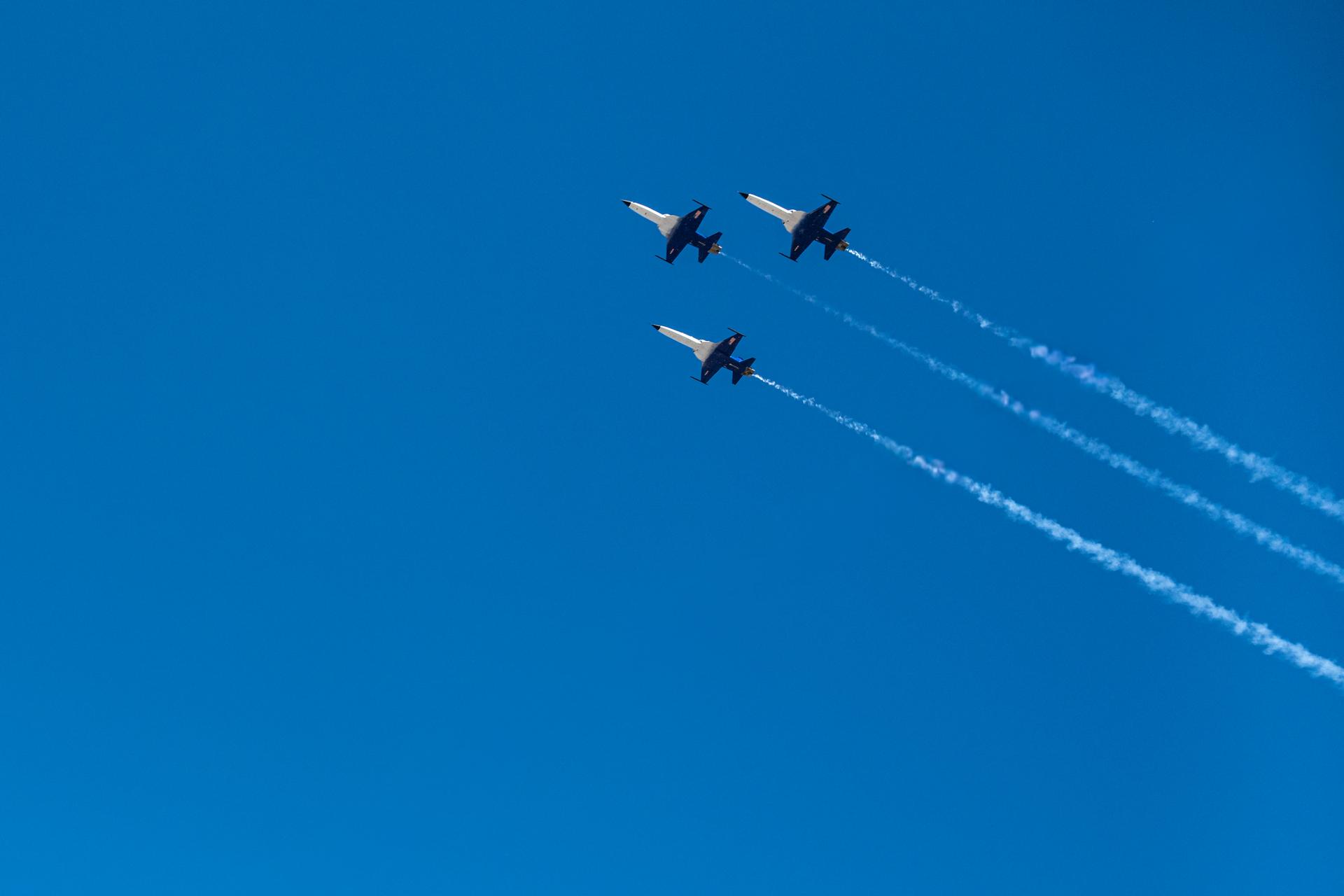
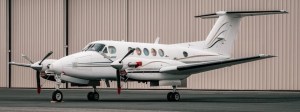
NASA’s Freedom 250 F-5 team, including NASA Administrator Jared Isaacman, performs a flyover during the national anthem at an NFL game between the Cleveland Browns and the Carolina Panthers at Huntington Bank Field, Sept. 27, 2026, in Cleveland.
Credit: NASA/Jordan Cochran
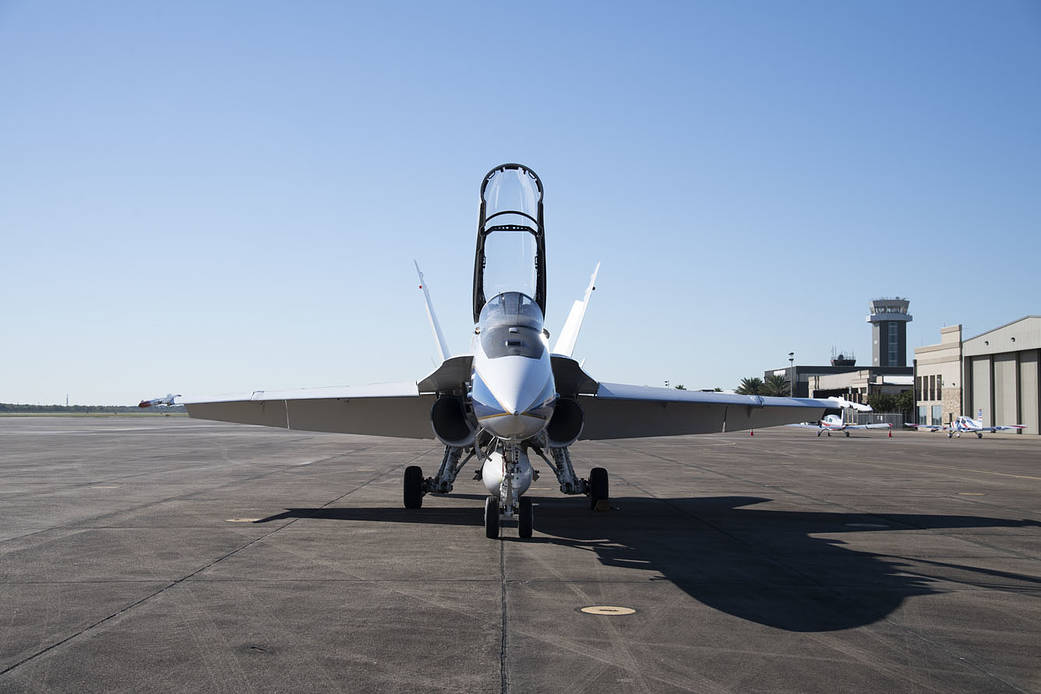
As part of the agency’s Inspiration Tour flyover, NASA Administrator Jared Isaacman will pilot one of three F-5 fighter jets to kick off the New York Jets vs. Cleveland Browns game in East Rutherford, New Jersey, on Sunday, Oct. 11.
NASA team members will engage with fans at the agency’s Experience Zone, located at the Jets Tailgate Zone outside the stadium, from 10 a.m. to 1 p.m. EDT before the game. Fans can learn more about NASA’s return to the Moon under the agency’s Artemis dome, enjoy interactive games, and capture photos with a large, inflatable SLS (Space Launch System) rocket.
Isaacman will be available for limited media interviews during the game. To arrange interviews, please contact Camille Gallo at: camille.m.gallo@nasa.gov or 202-531-8057.
With stops across the nation, NASA’s Inspiration Tour convenes academic, industry, and public sector stakeholders to connect the agency with the people, technologies, and organizations that drive American leadership in space.
The tour will culminate in MAX POWER, a public exposition of American air and space innovation, Saturday, Nov. 7, and Sunday, Nov. 8, on and near the agency’s Kennedy Space Center in Florida. Held in honor of America’s historic 250th anniversary, the multi-day, family-friendly event will showcase the next-generation aircraft, spacecraft, autonomous vehicles, and technologies that will help define the future of transportation in air and space.
For more information about MAX POWER and the agency’s missions, visit:
Illustration by Joel Kimmel for ProPublica and The Texas Tribune. Reference image: ZUMA Press Wire/Reuters Connect.
In the summer of 2023, after he was impeached on charges of abusing his office for personal gain, Texas Attorney General Ken Paxton was suspended and barred from conducting any official business for more than three months while awaiting trial in the state Senate.
So, he traveled.
Paxton, a Republican who is now running for U.S. Senate, took at least 17 trips over three months, including to resort destinations Park City, Utah, and Vail, Colorado. He visited the Oklahoma town where he owns a vacation lodge and a Utah community with a golf resort, where he later bought four condominiums.
State police joined him each time, costing taxpayers tens of thousands of dollars for trips unrelated to his job as attorney general. The Texas Senate ultimately acquitted him on the impeachment charges.
But Paxton’s use of the taxpayer-funded detail did not begin or end there. In fact, it stands out compared with his predecessor, fellow elected officials in Texas and other state attorneys general, ProPublica and The Texas Tribune found.
Paxton has traveled frequently out of state while listing little on his official calendar, The Associated Press reported last week. ProPublica and the Tribune’s analysis, which included reviewing every publicly available document Paxton’s office says it possesses about his travel, discloses for the first time how few of his trips had a listed business purpose: just 1 in 6.
It also found Paxton’s security has cost taxpayers far more than has previously been reported.
Since assuming office in 2015, Paxton has taken nearly 1,000 trips with a state-funded security detail, costing $3.3 million. The newsrooms’ review of Paxton’s travel records, obtained through the state’s Public Information Act, could only connect 138 of those trips and $553,000 in security costs to state business.
Records detailing the purpose of Paxton’s visits to 36 states and 19 countries do not appear to exist in most cases. These include a trip to a small town in Hawaii months before his family’s blind trust bought land there; 24 trips to Utah, where the trust owns five properties; and 53 trips to Florida, where Paxton and the trust have two houses and a townhome.
“If you’ve got all these extra trips, it becomes ethically and morally problematic,” said Chris Toth, former executive director of the National Association of Attorneys General, who has also criticized Paxton’s conduct on other issues. “The ethical question is whether a legitimate security function has effectively become a taxpayer-funded subsidy.”
Texas law allows the Department of Public Safety to provide security for key state leaders, including the attorney general, but does not require officials to use it. In fact, Paxton himself hasn’t used it in at least two dozen cases while traveling on official business.
Paxton has dismissed opponents’ attacks that he has used the perks of office to benefit himself and has not answered questions about how he vastly increased his wealth as a public servant.
He also did not answer detailed questions for this story. ProPublica and the Tribune sent Paxton a spreadsheet detailing travel for which there was no record that he was on state business and asked him to provide additional information if the trips were not personal. Neither Paxton nor his office provided such records. Instead, his office provided a general statement.
“Throughout his career, Ken Paxton has faced numerous security threats stemming from his courageous work as Attorney General fighting on behalf of the people of Texas,” his office said in the statement. “Those threats are a direct result of him taking on the cartels terrorizing Texans and some of the nation’s most dangerous violent criminals.”
Paxton’s office directed additional questions to DPS.
A DPS spokesperson declined to answer the newsrooms’ questions, saying the agency does not comment on its security arrangements.
Logs from the Texas Department of Public Safety security detail assigned to Attorney General Ken Paxton show multiple out-of-state trips while he was suspended from office in 2023.Obtained and highlighted by ProPublica and The Texas Tribune
An Outlier Among Peers
To analyze Paxton’s travel, ProPublica and the Tribune reviewed DPS logs for his security detail and records from the attorney general’s office, including airfare and lodging receipts, per diems and his daily calendars.
The records available for his predecessor, Greg Abbott, show a stark difference: Abbott traveled mostly within the state as attorney general, and his security cost $203,000 during his last three years in the office. Adjusted for inflation, Abbott’s security detail cost $7,400 per month. Paxton’s has averaged $24,300.
Because the state keeps records only for a limited time, Abbott’s travel expenses and his daily calendars as attorney general no longer exist, so the news organizations could not determine how many of his trips were for business.
Records are available, however, for Abbott’s security costs as governor and for Lt. Gov. Dan Patrick. Both are also offered state police security and have been in their current roles as long as Paxton.
When compared, the records show Paxton has taken 82 more out-of-state trips with a security detail than Abbott and nearly as many as the governor and lieutenant governor combined.
Though DPS security detail records are available for state leaders’ full tenure, Abbott’s office only provided calendars that document business-related activity for his first six years in office. More than two-thirds of the governor’s international trips during those years had a listed business purpose, compared with just two of 25 for Paxton during his full tenure. The governor’s office said it planned to release the remaining five years on Tuesday but only provided five months, saying it needed more time.
The attorney general’s records do not show a business purpose for travel to Albania, Aruba, Australia, Costa Rica, the Czech Republic, the Dominican Republic, England, Estonia, Finland, Greece, Hungary, Italy, Malta, Mexico, Poland, South Africa or Taiwan.
The share of Paxton’s travel with a documented business purpose peaked early in his tenure, in 2018 and 2019, at 30%, the newsrooms’ analysis found. That aligns with the governor’s share of business travel during that period.
Since then, Paxton has taken fewer trips that are documented as state business while increasingly traveling out of state. Last year, just five of Paxton’s 91 trips with the security detail had a listed business purpose. Forty-one were outside Texas.
In some cases, Paxton has taken business trips without a DPS detail, an analysis of records from the department and the attorney general’s office shows. They include a 2019 meeting in Nashville, Tennessee, with that state’s attorney general to discuss opioid litigation and a 2021 visit with unnamed U.S. senators in North Carolina. There is also no record of Paxton taking the detail on political fundraising trips to Florida and the Bahamas.
But Paxton has traveled with security to other campaign-related activities, including one that came just two days after he was acquitted in the impeachment trial. Paxton boarded a Maine-bound private plane owned by a North Texas businessman to tape an episode of Tucker Carlson’s show, according to campaign finance records. During the interview, he hinted that he’d challenge U.S. Sen. John Cornyn in the 2026 Republican primary.
“Everything is on the table for me,” Paxton said when Carlson suggested he should run.
In his interview with Carlson, Paxton said it was unfair that he was automatically suspended before he could clear his name. He said he was eager to get back to work and that he was “reenergized to do the things the voters sent me to do.”
Paxton should pay for his own security on trips where there is no benefit for Texans, like vacations and campaign events, said Richard Briffault, a professor at Columbia Law School who has written about government ethics.
“There’s no reason for the taxpayers to be paying for things that they would not be paying for if he had stayed home,” Briffault said. “That’s a misuse of public funds.”
State officials said there are no records of Paxton or his campaign reimbursing Texas for security costs.
Of the 10 most populous states, Texas and New York confirmed that they provide security for their attorneys general, while Florida law allows its top lawyer to receive a detail upon request. North Carolina does not. Attorneys general offices for the remaining six states did not respond to requests for comment.
Former Oregon Attorney General Ellen Rosenblum said she never used a security detail during her 12 years in office, which ended in 2024. The Democrat said that Paxton’s higher profile might create a greater need for protection, but his extensive out-of-state travel without a documented business purpose raises questions about his workload.
“Was he minding the store? There’s a lot of work to be done at the office,” Rosenblum said.
Travel and Real Estate
Some of Paxton’s travel to four states with a security detail has overlapped with locations where he or his family’s trust has purchased 10 properties since 2021. A recent ProPublica and Tribune analysis found he owns or co-owns 15 properties with a market value of about $11 million.
In June 2021, Paxton attended an attorneys general conference in Maui. The security detail listed the destination as Lahaina, a small community on the Hawaiian island’s west coast. Four months later, Paxton’s family trust purchased an oceanview lot in a residential neighborhood there for $410,000, land records show.
The 7,000-square-foot lot remains vacant but has proved to be a savvy investment, now assessed at $1.2 million by Maui County.
Paxton set up the trust with his estranged wife, State Sen. Angela Paxton, who declined to be interviewed but said through a spokesperson that she has not been involved in her husband’s business dealings since 2024, when she filed for divorce. The Paxtons’ friend, Chip Loper, runs the trust. He did not respond to requests for comment.
Paxton has also gone to the Salt Lake City area 19 times, twice for listed business purposes. He visited three times — once on business — in the months leading up to his family trust’s July 2021 purchase of a plot in the ski town of Eden. The trust bought a mountainside lot on about two-thirds of an acre for $315,000 in cash, the seller told the newsrooms. It also remains undeveloped.
During his suspension in August 2023, Paxton visited St. George, Utah, a small city in the state’s southwest corner. Nearby is the Black Desert Resort, which hosts an annual PGA Tour golf tournament. Paxton purchased one condo at the resort in 2025 and three more in February. Paxton took out mortgages totaling $1.9 million for them, according to legal documents filed with the local county.
Paxton has visited Florida more than any other state, 53 times. Two of those trips have a documented business purpose. Between 2021 and 2022, Paxton purchased two homes in Ocala, known for its horse breeding industry, and a townhome in Dunedin, on the Gulf of Mexico near Tampa.
Paxton also traveled with the detail twice to Broken Bow, Oklahoma, where he purchased a $1.5 million vacation lodge in 2022. He visited in June 2023, during his suspension. Then again the following December. He traveled to the neighboring town of Idabel in 2023 and 2024. None of the trips had a listed business purpose.
Records that show travel with a security detail do not list the attorney general’s name but rather the position. State officials familiar with the travel records said the two temporary attorneys general appointed during Paxton’s suspension did not take the trips listed on the state police travel logs.
The attorney general’s office has said that Paxton’s work to secure large legal settlements with drugmakers and tech companies requires routine travel. Such travel is noted in calendars reviewed by ProPublica and the Tribune. Even so, more than 800 trips lack a documented business purpose.
Paul Nolette, a Marquette University political science professor who studies attorneys general, said that the role has become more expansive in recent years as states increasingly collaborate on big lawsuits. That could lead to more travel, he said. Nolette added these officials deserve occasional vacations like everyday Americans.
But given repeated accusations from Democrats and Republicans alike about Paxton’s ethics, Nolette said it is difficult to give him the benefit of the doubt that he’s constantly working while leaving the state so frequently.
“It just raises more red flags about how he’s using the office to do things that may not give the best bang for the buck for Texans,” Nolette said.
Paxton has not commented publicly about his use of the taxpayer-funded detail. During a podcast interview in November, Houston lawyer Tony Buzbee, who led his impeachment defense, asked the attorney general where he liked to travel.
“I love Jackson Hole. I like Park City. I like the mountains. I also like beaches,” Paxton responded. “I like places in Florida, places in California, even though I don’t like to admit I go to California. But it’s beautiful to see them.”
NASA Testing Aims at Supercooled Large Droplet Aviation Safety
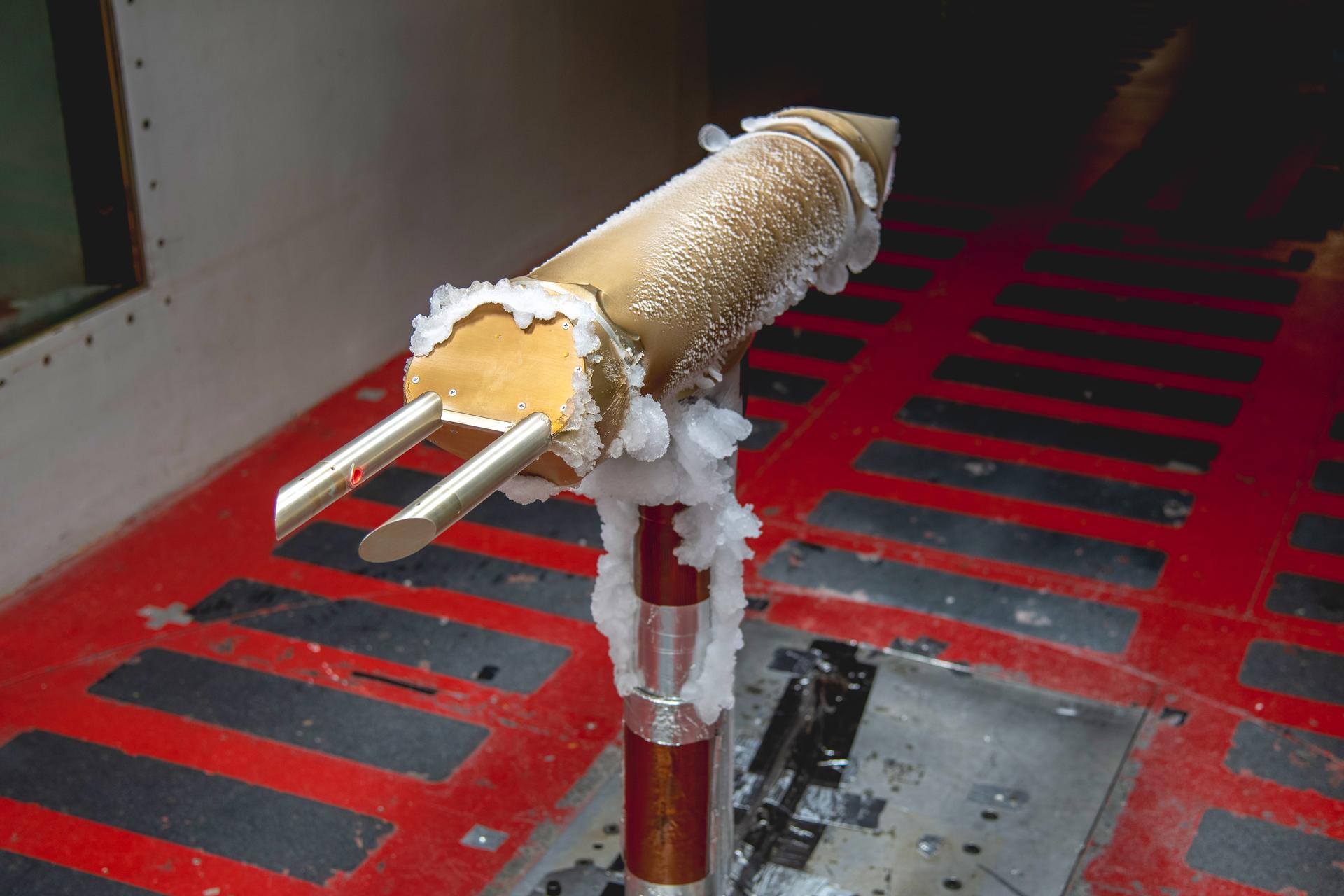
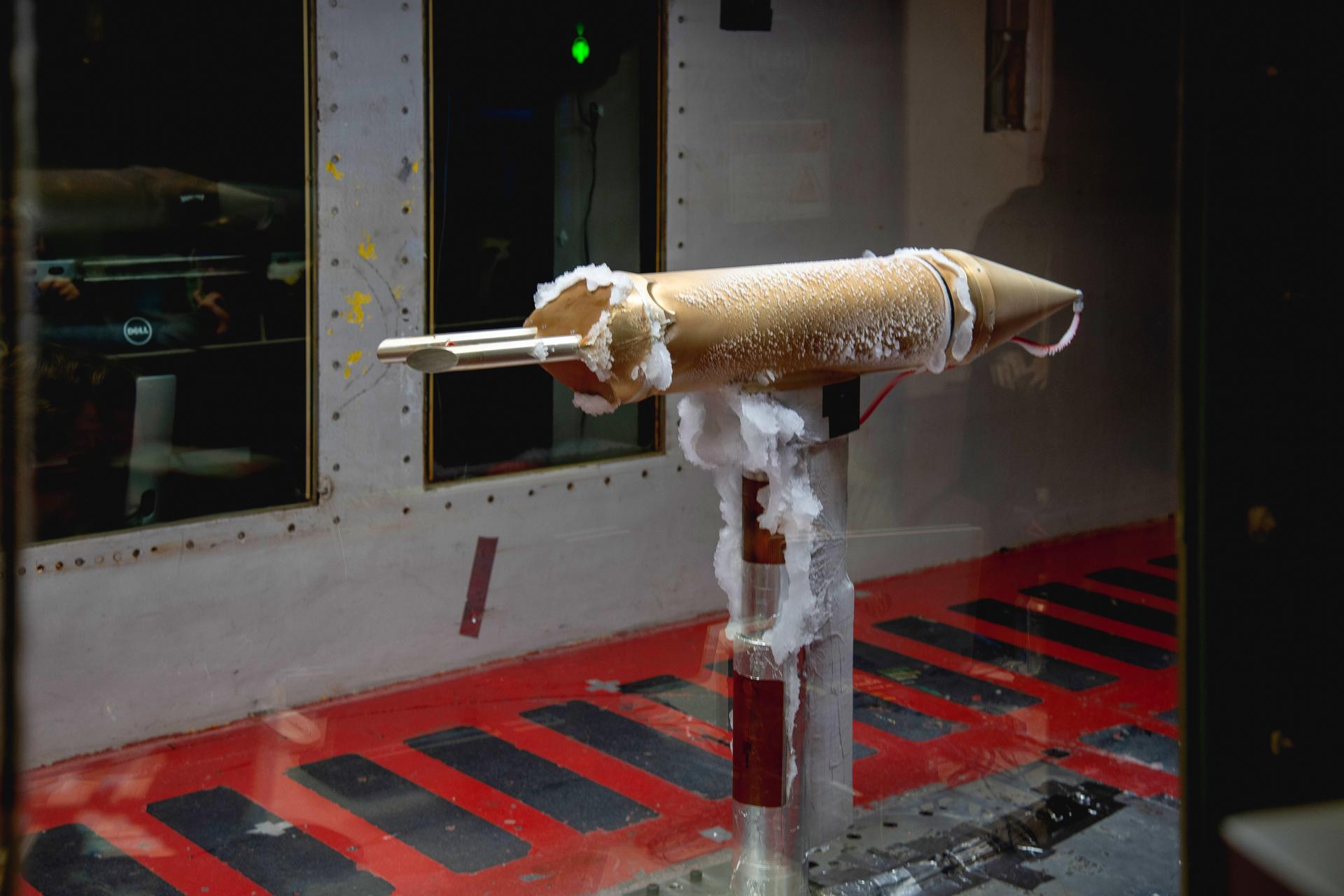
Ice collection seen on un-heated sections of the 1D2D-X ice drop detection probe in the test section of the IRT (Icing Research Tunnel). Drop Size Probe testing – SFD (Subsonic Flight Demonstrator) of SLD (Supercooled Large Drop) Instrumentation Test in IRT (Icing Research Tunnel) – Particle Size Distribution Entry, June 8-11, 2026 Large Drop Testing in IRT
Credits: NASA/Quentin Schwinn
NASA is leveraging its expertise and enhancing its test facilities to help address a rare but persistent aviation hazard: icing that occurs when aircraft encounter unusually large, very cold water droplets in clouds.
The problem, known as “supercooled large droplet icing,” occurs when aircraft fly through clouds containing unusually large drops of water that are very cold but remain liquid. When a plane passes through those drops, they can rapidly freeze to surfaces that are not protected from ice buildup.
With a series of tests in the Icing Research Tunnel at Glenn Research Center in Cleveland, NASA researchers are helping U.S. industry better understand the phenomenon.
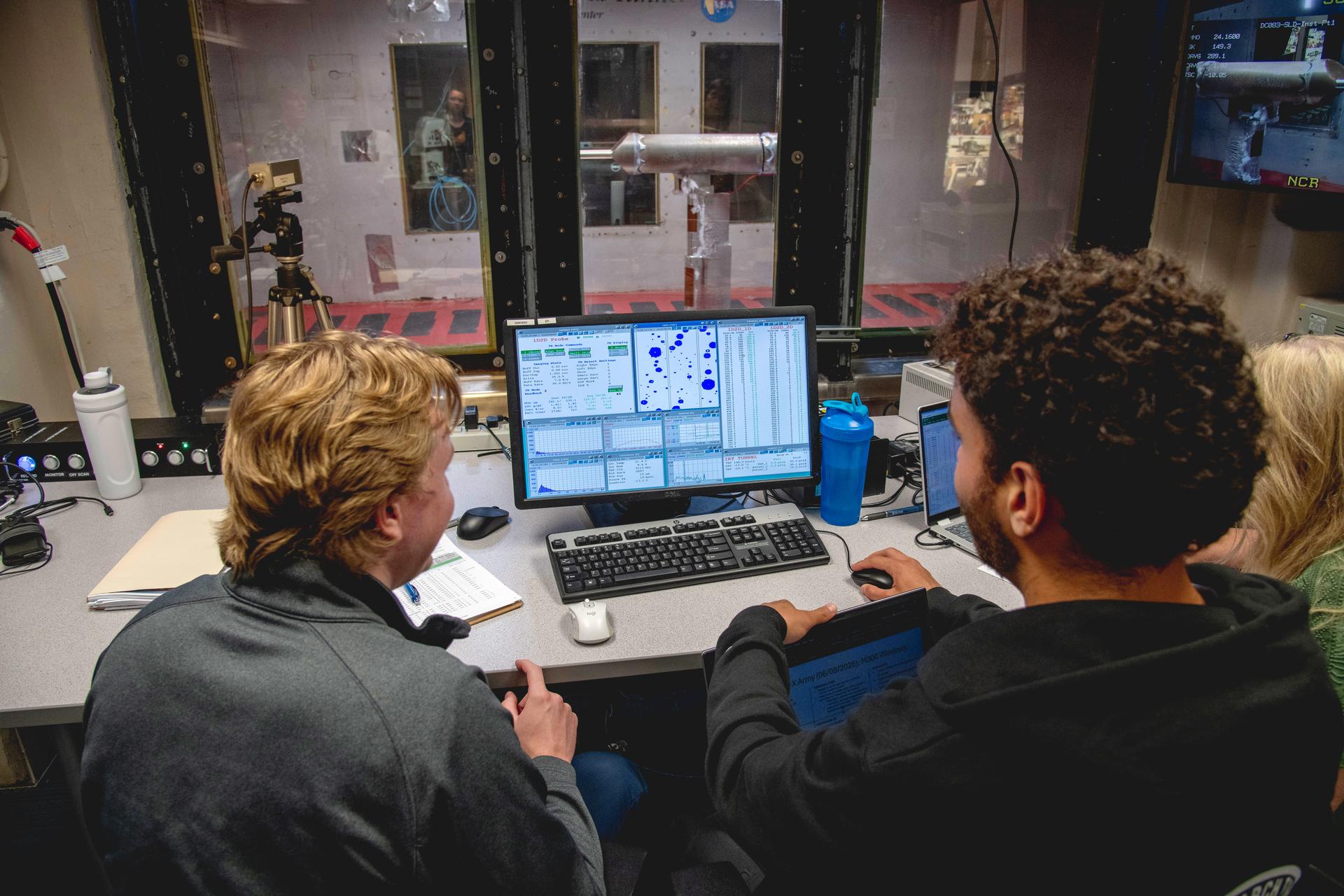
SFD (Subsonic Flight Demonstrator) of SLD (Supercooled Large Drop) Instrumentation Test – Particle Size Measurement in the IRT (Icing Research Tunnel), June 8-11, 2026. Drop size shown on computer from Drop Sizing Probe seen in the IRT test section.
NASA/Quentin Schwinn
Supercooled water is common in clouds – droplets can go below 32 degrees Farenheit but not freeze unless they encounter dust or other tiny particles around which they can crystalize. Aircraft are designed to encounter typical icing conditions where droplets range from 2 to 100 microns in diameter (for comparison, a human hair is about 70 microns wide). But in rarer cases, clouds can contain supercooled large drops up to 2,000 microns in diameter (if you’ve ever been caught in freezing rain, you’ve encountered these droplets at ground level). These much larger droplets can hit or splash to the aft of an aircraft, including areas behind conventional ice protection systems.
The aviation industry relies on engineering tools to help design their aircraft. Current tools work well for typical clouds, but engineers have questions about how well they account for the physics of supercooled large drops. To help answer those questions, NASA is working to enhance the equipment it uses to generate and measure experimental clouds for testing in the Icing Research Tunnel.
Ice collection seen on un-heated sections of the ice drop detection probe in the test section of the IRT (Icing Research Tunnel). Drop Size Probe testing – SFD (Subsonic Flight Demonstrator) of SLD (Supercooled Large Drop) Instrumentation Test in IRT (Icing Research Tunnel) – Particle Size Distribution Entry, June 8-11, 2026
NASA/Quentin Schwinn
NASA researchers have experimented with brand new probes that help calibrate the sizes of the drops in the clouds the tunnel produces. The probes can “see” drops larger than 45 microns and perform a real-time analysis of their sizes. NASA will compare these results, a laborious technique of post-processing droplet size image data from the tunnel. The results will be mated to results from a different probe that measures droplets smaller than 45 microns. With this, the complete droplet size spectrum is known.
The test campaign marks an important milestone for the Subsonic Flight Demonstrator project, part of NASA’s Research and Technology Mission Directorate. Detailed analysis of the collected data continues, and NASA’s project team will share results with the broader aerospace community once complete.
Preparations for Next Moonwalk Simulations Underway (and Underwater)
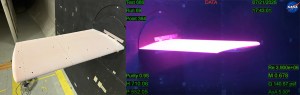
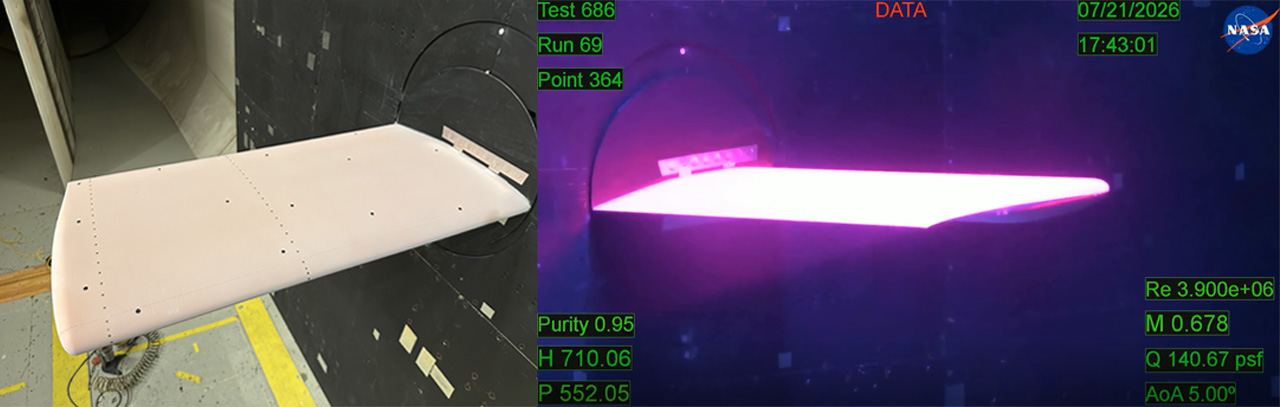
Left: The Benchmark Supercritical Wing not illuminated in unsteady Pressure Sensitive Paint inside the Transonic Dynamics Tunnel at NASA’s Langley Research Center. Right: The Benchmark Supercritical Wing illuminated in unsteady Pressure Sensitive Paint during testing inside the Transonic Dynamics Tunnel at NASA’s Langley Research Center.
Left: NASA/Sarah Peak | Right: NASA
Groundbreaking tests at NASA’s Langley Research Center in Hampton, Virginia, are paving the way for new wind tunnel capabilities for designing the aircraft technologies of the future.
In a first-of-its-kind test in NASA Langley’s Transonic Dynamics Tunnel, researchers used unsteady Pressure Sensitive Paint to study how air flows around a standard wind tunnel model known as the Benchmark Supercritical Wing. As the team observed the test, the paint’s special capabilities made the model wing glow pink-purple when exposed to special ultraviolet lights, while high-speed cameras captured every detail.
The test combined two valuable NASA tools. NASA’s benchmark wings don’t represent a particular type of aircraft, rather they are meant as universal models to help researchers improve computer modeling using wind tunnel data.
Unsteady pressure sensitive paint is a specialized coating that varies in brightness according to how much pressure the air flow applies to the wing. High-speed cameras capture those changes, providing data for computer models. For years, NASA researchers at centers including Langley and the agency’s Ames Research Center in California’s Silicon Valley have been working to integrate the paint into wind tunnel tests for aircraft and rockets. NASA researchers consider the paint a vital tool and expect to find many more wind tunnel applications in the future.
This test marked the technique’s first use on a large-scale, freely moving model in a low‑oxygen environment, an achievement made possible by the Transonic Dynamic Tunnel’s unique testing capabilities.
This milestone opens the door for upcoming tests on flexible aircraft models that are designed to bend and adapt during flight to improve efficiency. It also lays the foundation for better simulations and designs as NASA advances the future of flight.
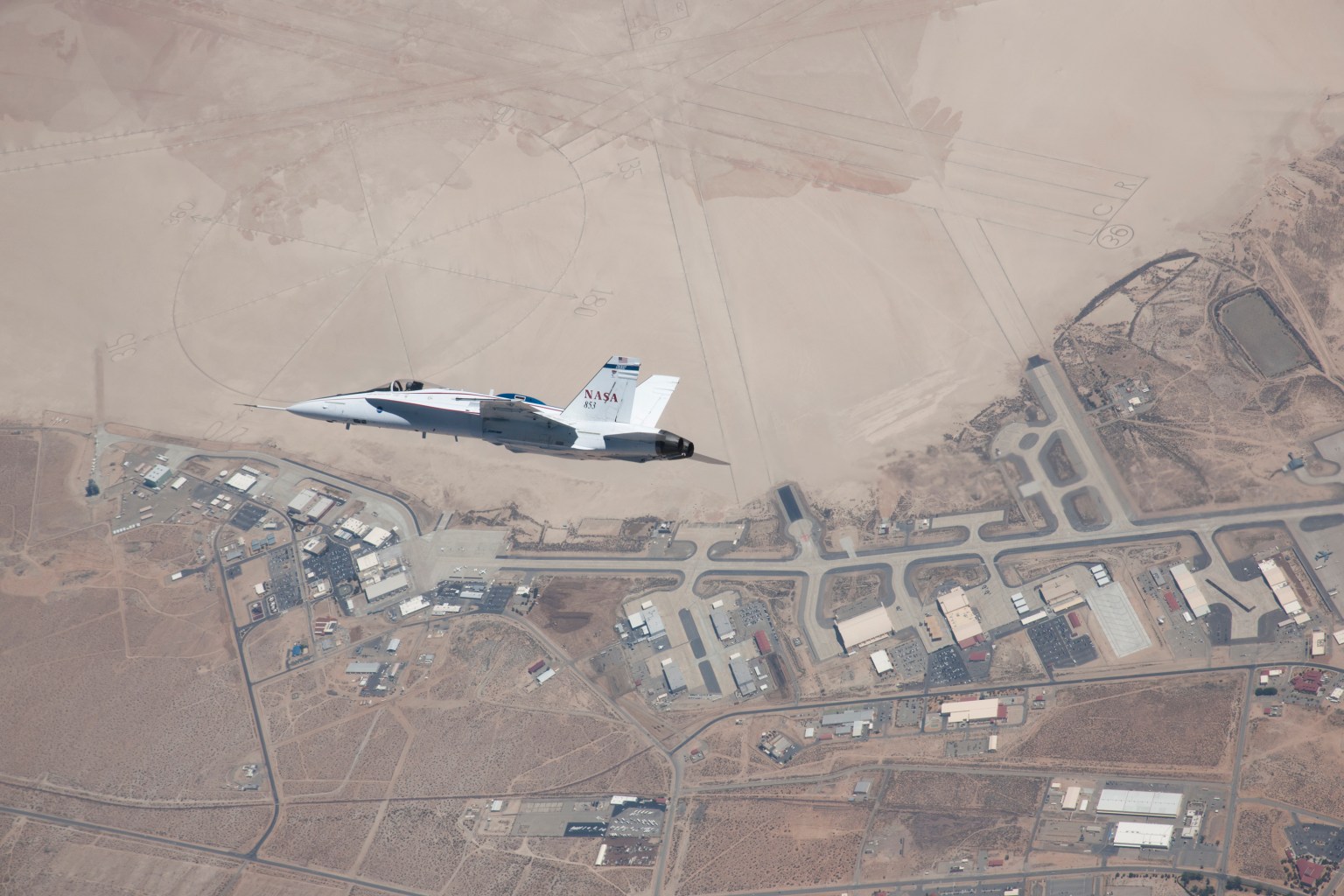
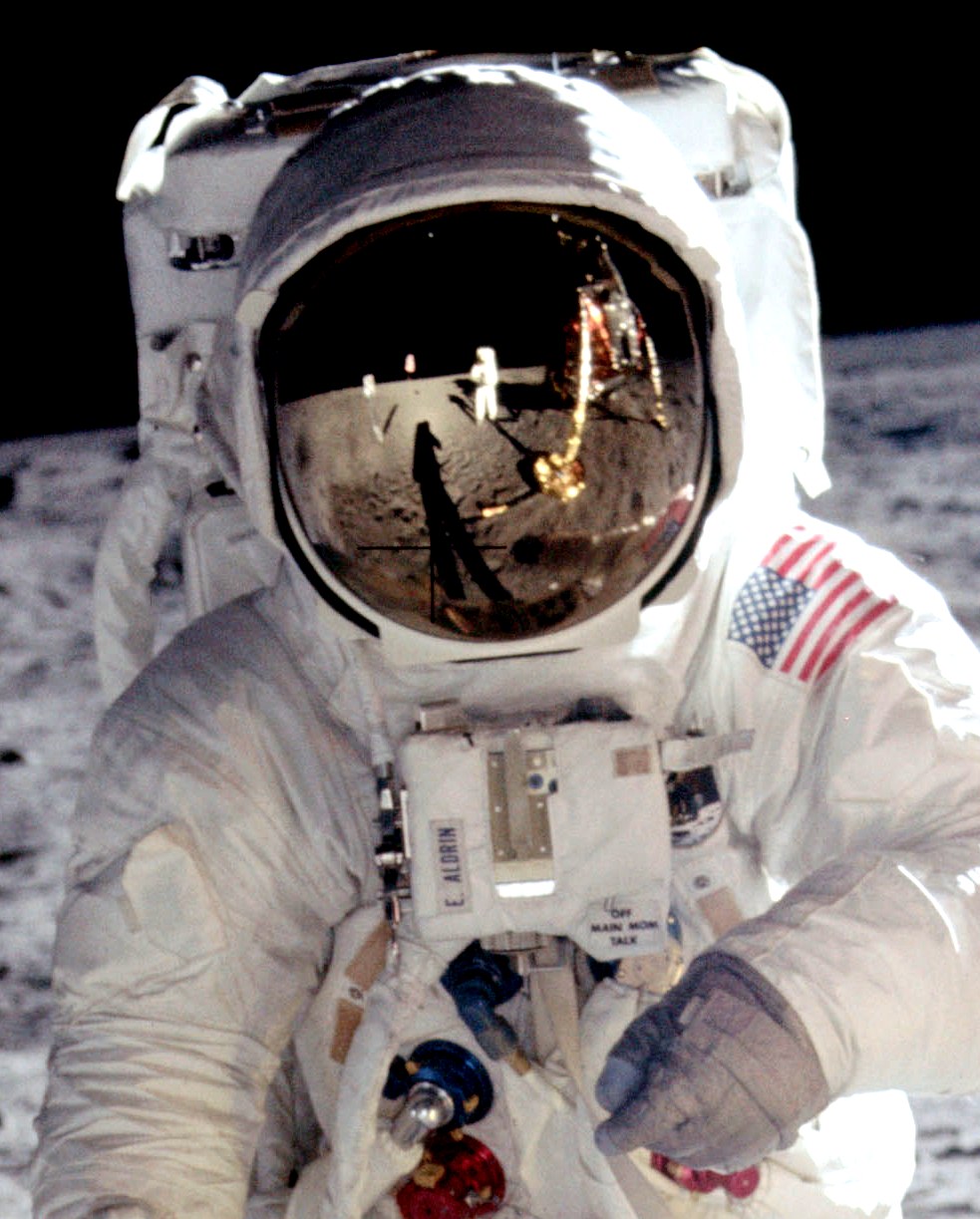
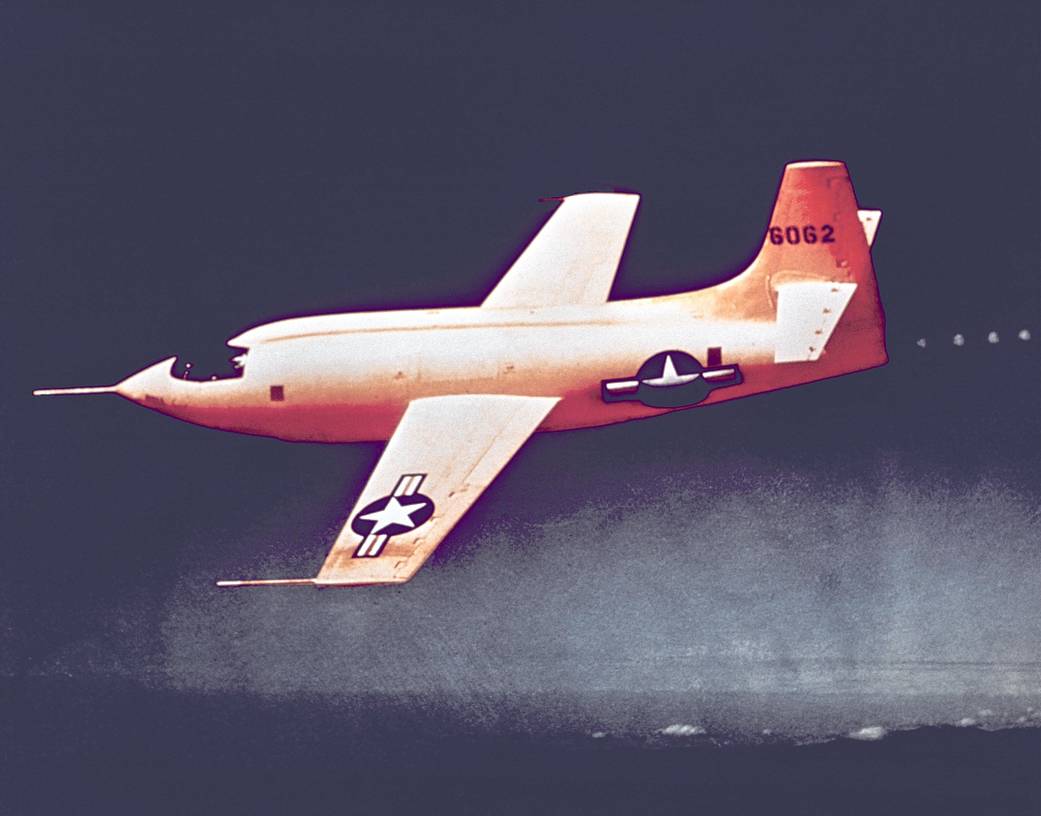
On Sept. 30, 1946, five National Advisory Committee of Aeronautics (NACA) engineers arrived at Muroc Army Airfield in California’s high desert to achieve supersonic flight for the first time. In less than two years, NACA flew the X-1 aircraft faster than the speed of sound, marking an important milestone in aviation history.
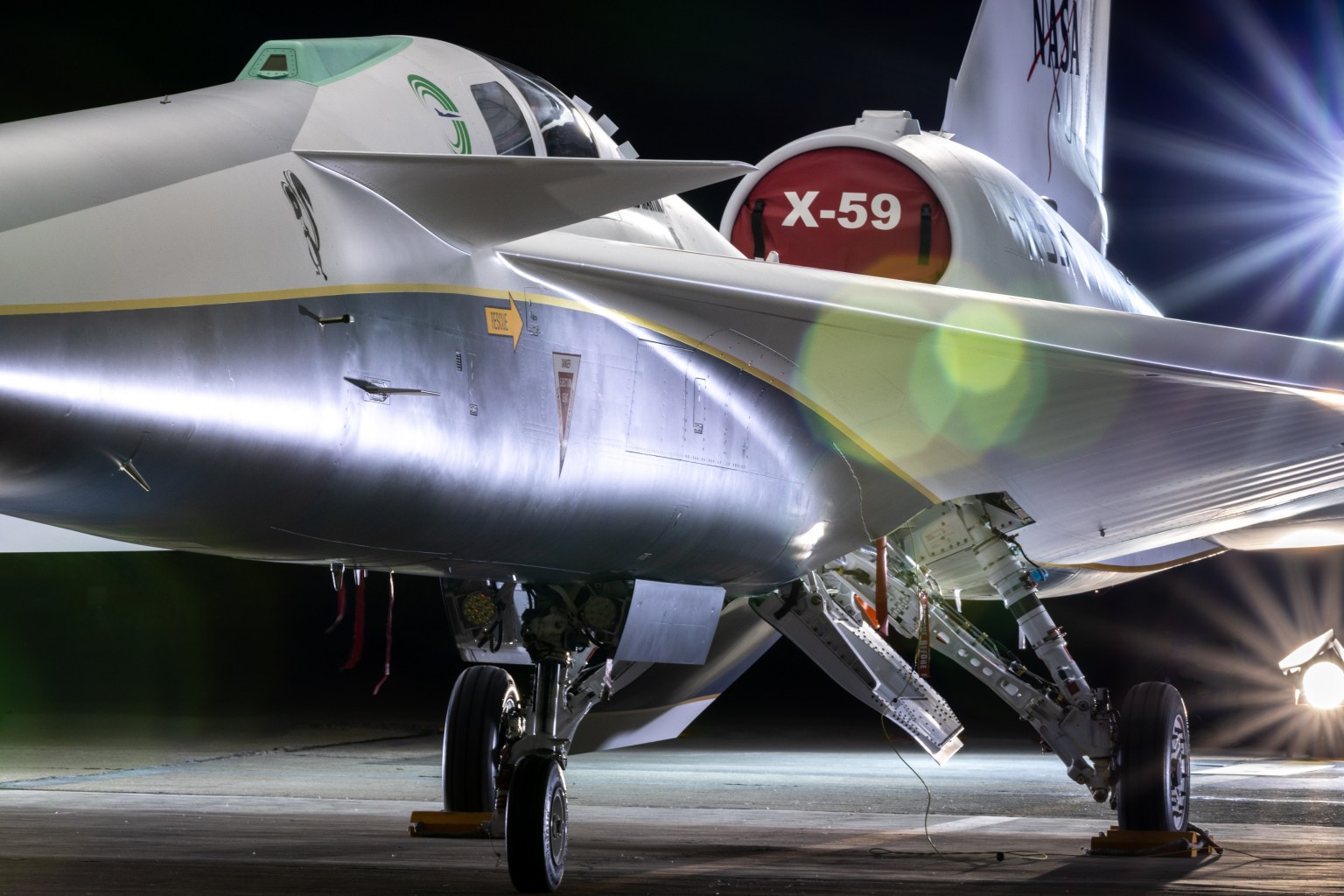
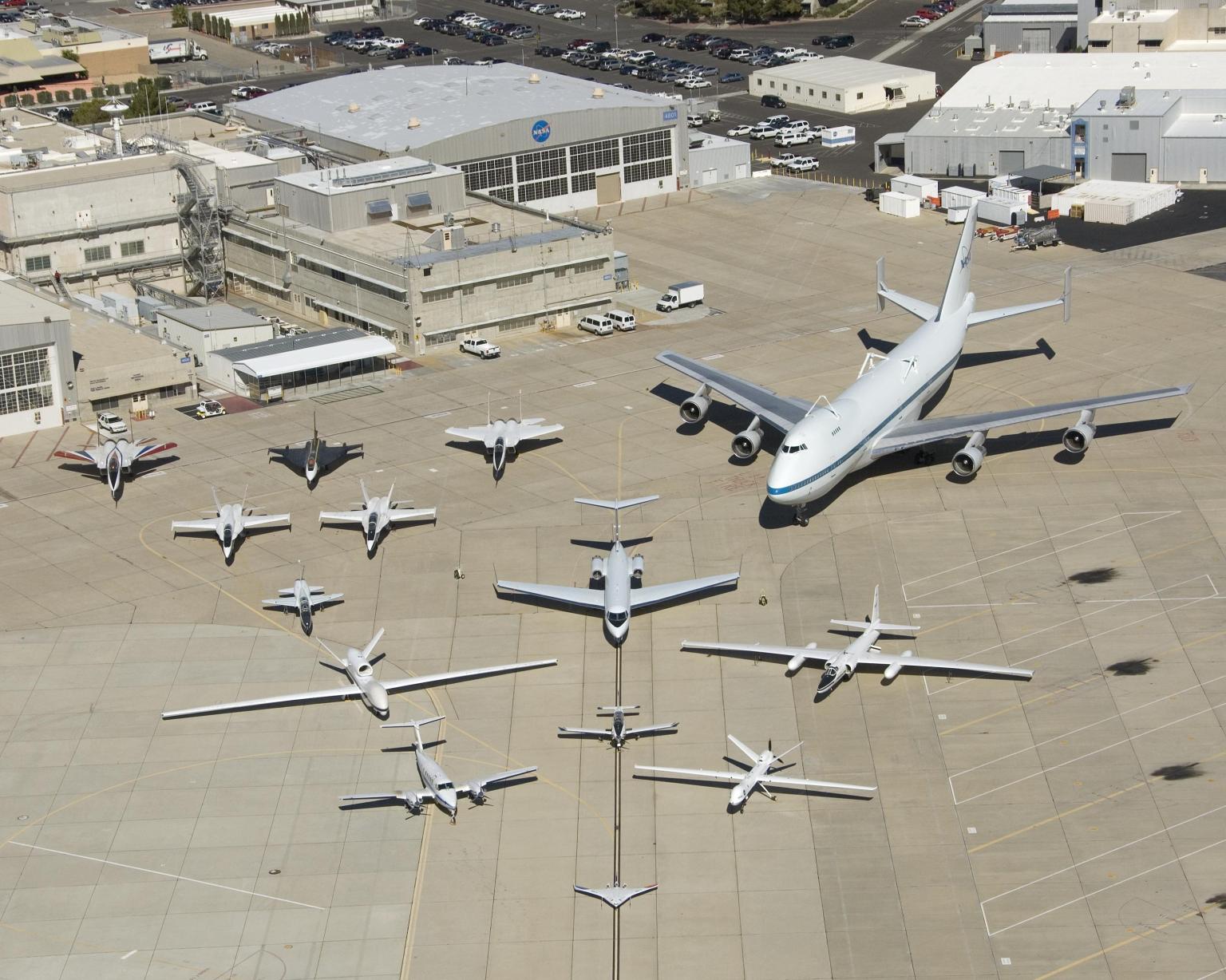
Fast forward 80 years, and that former NACA outpost is now NASA’s Armstrong Flight Research Center in Edwards, California, flying the X-59 supersonic X-plane in the same skies to demonstrate that supersonic flight doesn’t have to come with a boom.
Over Armstrong’s 80-year history, the center has supported milestone missions ranging from space shuttle landings to SR-71 flights, shaping the evolution of science, aeronautics, and space research.
This Southern California NASA center is poised to lead the next era of aeronautics and human spaceflight, advancing technologies that will define the future of flight.
Fast facts
NASA Administrator Jared Isaacman recently named Armstrong as the agency’s Center of Excellence for Flight Test and Aircraft Operations, recognizing the center’s unmatched rigor in executing unique missions only NASA can fly.
To support NASA’s Artemis missions and return to the Moon, Armstrong uses research aircraft such as a 737 for astronaut suit testing, the G-III for Artemis II heat-shield data collection, and an F/A-18 aircraft that tested the autopilot for the SLS (Space Launch System) rocket.
NASA’s aeronautics centerpiece, the X-59, is undergoing rigorous testing and a series of flights at Armstrong to prepare for upcoming quiet supersonic demonstrations over U.S. communities.
NASA Armstrong has transformed commercial and military aviation — from early supersonic flight research to digital fly-by-wire — and continues working with other government agencies, industry, and academia to make flying safer, more autonomous, and more efficient.
The center plays a vital role in global science by flying aircraft like the ER-2, C-20A, and Gulfstream G-III/IV/V to collect critical data on wildfires, glacier melt, pollution, minerals, and more.
Behind these achievements are the engineers, pilots, technicians, and mission support teams who continue to push the boundaries of what’s possible.
Red, White, and Boom, the U.S. Air Force Test Center’s celebration of America’s 250th anniversary and NASA Armstrong’s commemoration of its 80th year, was Fr...
Preparations for Next Moonwalk Simulations Underway (and Underwater)
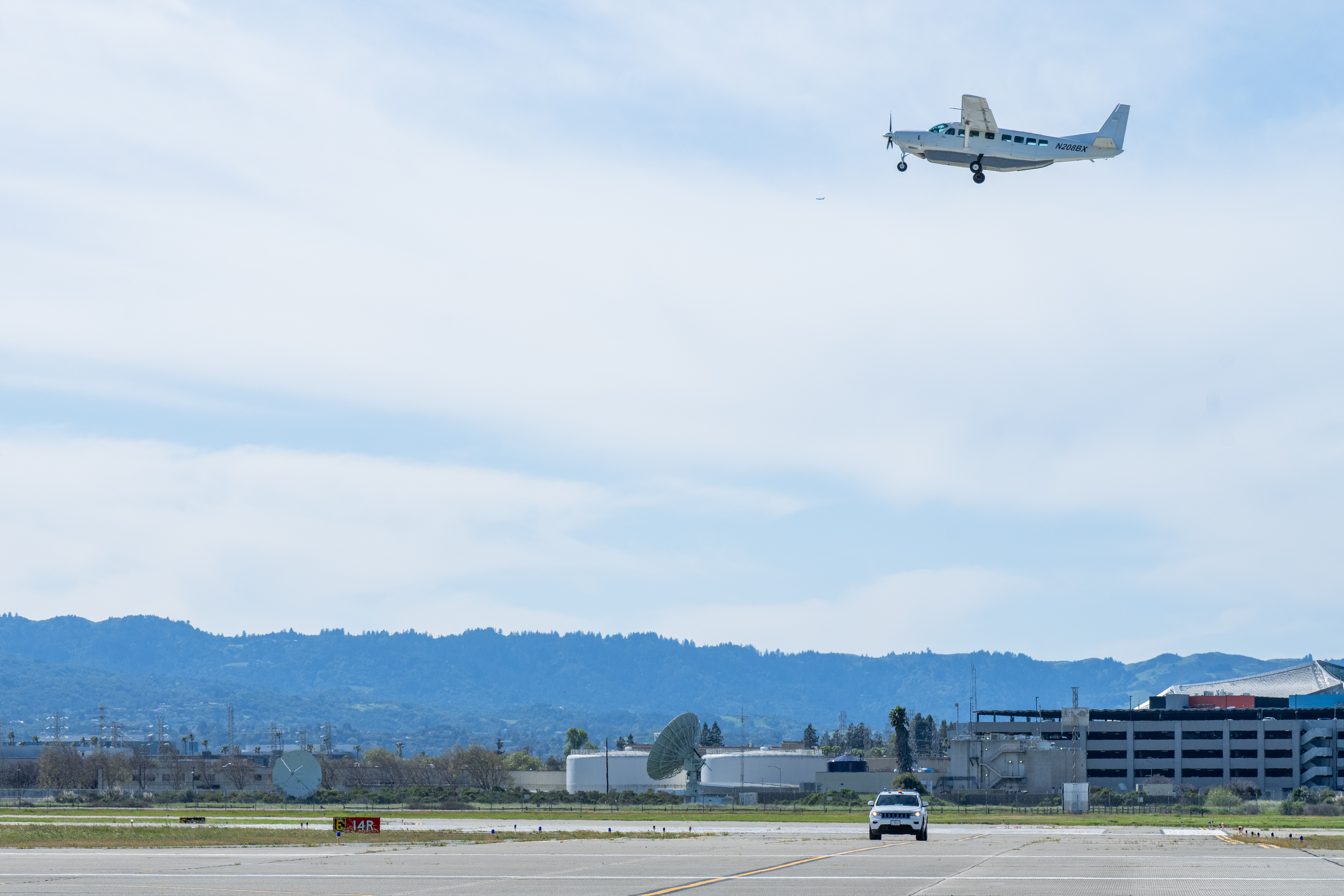
Testing at NASA’s Ames Research Center in California’s Silicon Valley in March 2026 demonstrated autonomous technology that could identify an incursion – a vehicle, wayward suitcase, or other runway obstacle that could impact an aircraft’s safe landing.
NASA/Brandon Torres-Navarrete
NASA’s researchers know that when you settle into your seat on a commercial flight, you expect a smooth takeoff, views over the clouds, a steady descent, and hopefully an early arrival at your destination. But when your flight gets delayed on the tarmac instead of lifting off, or it ends up in a holding pattern rather than landing on time, things start to change. Your experience goes from smooth to anxiety-inducing as you worry about making your connection or getting home in time for dinner.
Large airports are among the busiest, most complex environments in aviation, with aircraft, ground crews, and service vehicles sharing crowded taxiways. Researchers at NASA’s Ames Research Center in California’s Silicon Valley recently worked with Boeing to advance three types of field tests – digital taxi information, safe taxiway, and safe runways – that could lead to safer, more efficient runway environments at airports.
During the digital taxi tests, pilots were given taxiway guidance directly on cockpit displays or tablets, instead of verbally from air traffic controllers. Aircraft autonomously followed digital routes while researchers monitored a suite of sensors designed to identify vehicles or other aircraft impeding the taxi path and runway. The system reduced pilot and air traffic controller workloads and the risk of verbal errors.
Safe runway technology testing can also improve situational awareness for approaching aircraft. While preparing to land a Boeing aircraft during testing, the same sensors successfully flagged a vehicle on the runway, providing additional awareness to ensure pilots could avoid potential collisions or other safety concerns.
Together, these NASA capabilities aim to reduce miscommunication, ease pilot workloads, and keep airport traffic moving smoothly. Future testing will integrate the sensor and digital taxi systems into a simulated air traffic control environment to evaluate how the technologies can benefit overall management of the airspace.
For years, NASA has worked to improve your experience when flying by developing new technologies to modernize the commercial airline system. Key NASA technologies streamline and digitize the flying experience – from the departure gate, to the skies, to your safe arrival at your destination.
“Aviation safety is key to NASA’s research,” said Parimal Kopardekar, director of NASA’s Airspace Operations and Safety project. “Technology that can provide additional autonomy and support a future airspace with multiple aircraft operating in harmony is key to advancing the National Airspace System.”
NASA’s research innovations continue after your flight takes off. Modern flights constantly respond to shifting weather, turbulence, and traffic. Even small changes in direction or altitude can affect when a plane arrives. These changes can force flights into holding patterns while air traffic controllers attempt to rebalance the busy airspace.
NASA’s air traffic management researchers have been working for years to reduce those situations. In a 2025 collaborative effort with Boeing, United Airlines, and international partners, NASA evaluated real‑time trajectory sharing on domestic and transoceanic flights.
During that testing, a United Airlines Boeing 737 aircraft shared frequent flight information with airline operations centers and air traffic control. NASA used the data to understand how frequently those updates should be sent and what details matter most for generating accurate arrival predictions. Better information helps controllers sequence traffic more precisely, which means fewer holding patterns and more direct descents for passengers.
Digital rerouting technology could reduce workloads for controllers, suggesting new routes to prevent or avoid delays without the back-and-forth needed to adjust flight paths manually.
NASA
Pre-departure rerouting technology and digital exchange tools developed at NASA allow dispatchers and controllers to see the same digital picture of flights preparing to depart.
When a better route becomes available, controllers could coordinate the change digitally instead of relying on verbal communication between pilots, controllers, and dispatchers. The technology could lead to fewer delays, reduced fuel consumption, and more predictable operations for passengers.
NASA has now transferred the routing technology to the Federal Aviation Administration (FAA) and airlines will continue to test it. These tools build on decades of NASA contributions to national airspace modernization.
In coordination with the FAA, NASA has advanced automation concepts, improved how arrival and departure flows are managed, and introduced data‑driven software that commercial airlines use every day.
By working closely with airlines, manufacturers, and global partners, NASA is helping to improve every phase of flight to make air travel safer and more reliable, now and in the future.
Preparations for Next Moonwalk Simulations Underway (and Underwater)
Derek Abramson, Dale Reed Subscale Flight Research Laboratory chief engineer, left, communicates with the Edwards Air Force Base air traffic control tower for approval to fly the Alta-X drone near NASA’s Armstrong Flight Research Center in Edwards, California, on Thursday, Aug. 27, 2026. Justin Link, small uncrewed aircraft pilot, second from left, and laboratory chief pilot Justin Hall await flight clearance. Researchers at NASA’s Johnson Space Center in Houston developed the advanced guidance and navigation system known as the Safe and Precise Landing – Integrated Capabilities Evolution (SPLICE) experiment, which is installed on the Alta-X. SPLICE will help spacecraft land precisely and detect and avoid potential hazards, which is critical for NASA missions to the Moon and to Mars.
NASA/Ryan Kline
Long before they helped shape NASA’s future aerospace breakthroughs, Derek Abramson, Justin Hall, and Justin Link were in their garages and homes building radio‑controlled aircraft, testing new ideas, and flying their creations at hobby events. That early passion now fuels the work of NASA’s Dale Reed Subscale Flight Research Laboratory at the agency’s Armstrong Flight Research Center in Edwards, California.
At NASA Armstrong’s subscale flight lab, the team turns that lifelong enthusiasm into mission-focused innovation. The laboratory supports research that ranges from advanced navigation systems for future landings on the Moon and Mars to emerging aeronautics concepts that need quick, low-cost evaluation. NASA’s small, remotely piloted and autonomous aircraft allow engineers to explore ideas that could be difficult, risky or expensive to test at full scale.
Skilled team
Abramson, Hall, and Link play key roles in that work. Abramson serves as the laboratory’s chief engineer. Hall is the chief pilot. Link is a drone pilot. Together, they integrate emerging aerospace technologies with the lab’s subscale aircraft fleet and, when needed, design and build aircraft or flight experiments to evaluate new concepts.
Derek Abramson, chief engineer at the Dale Reed Subscale Flight Research Laboratory at NASA’s Armstrong Flight Research Center in Edwards, California, is shown with his Kalt Cyclone radio-controlled helicopter in the mid-1980s. Abramson loved flying this aircraft as a child, and he has been an aviation enthusiast for as long as he can remember.
Derek Abramson
Abramson’s expertise, built through service in the U.S. Navy and the aerospace industry, centers on technical oversight, management, and system design. Hall is known for creative approaches to problem solving and uses practical methods to address technical challenges and maintain flight safety. Link specializes in designing and fabricating research vehicles and draws on extensive hands-on experience to understand what works, and what does not, in flight.
On weekends, the team often tinkers in their garages or hangars building radio-control aircraft, researching hobby trends, or exploring new technologies. You might see them flying their creations at hobby events or attending trade shows. Their passion for flight brought Abramson, Hall, and Link together years before they one-by-one joined NASA more than a decade ago, though each discovered that spark in a different way.
Early influences
Abramson’s interest began as a child with rubber-band powered stick and tissue aircraft and radio-controlled models. His early aviation pursuits led to his first solo flight while in high school and a pilot’s license. In the Navy, he worked on multiple aircraft, including EA-6B and the F-18, as an avionics technician. As an engineer, he supported the B-1 and CV-22 Osprey aircraft flight tests. As an intern at NASA Armstrong, he used his operational and engineering experience on remotely piloted and autonomous aircraft.
Hall’s interest grew after seeing historic aircraft including the Mach 3 SR-71 fly over his elementary school playground and watching Space Shuttle Challenger land from above his dad’s shoulders. He has built and flown model and remotely piloted aircraft for as long as he can remember. His reputation flying radio-controlled hobby aircraft at fly-ins and trade events led to an offer to fly subscale aircraft at NASA.
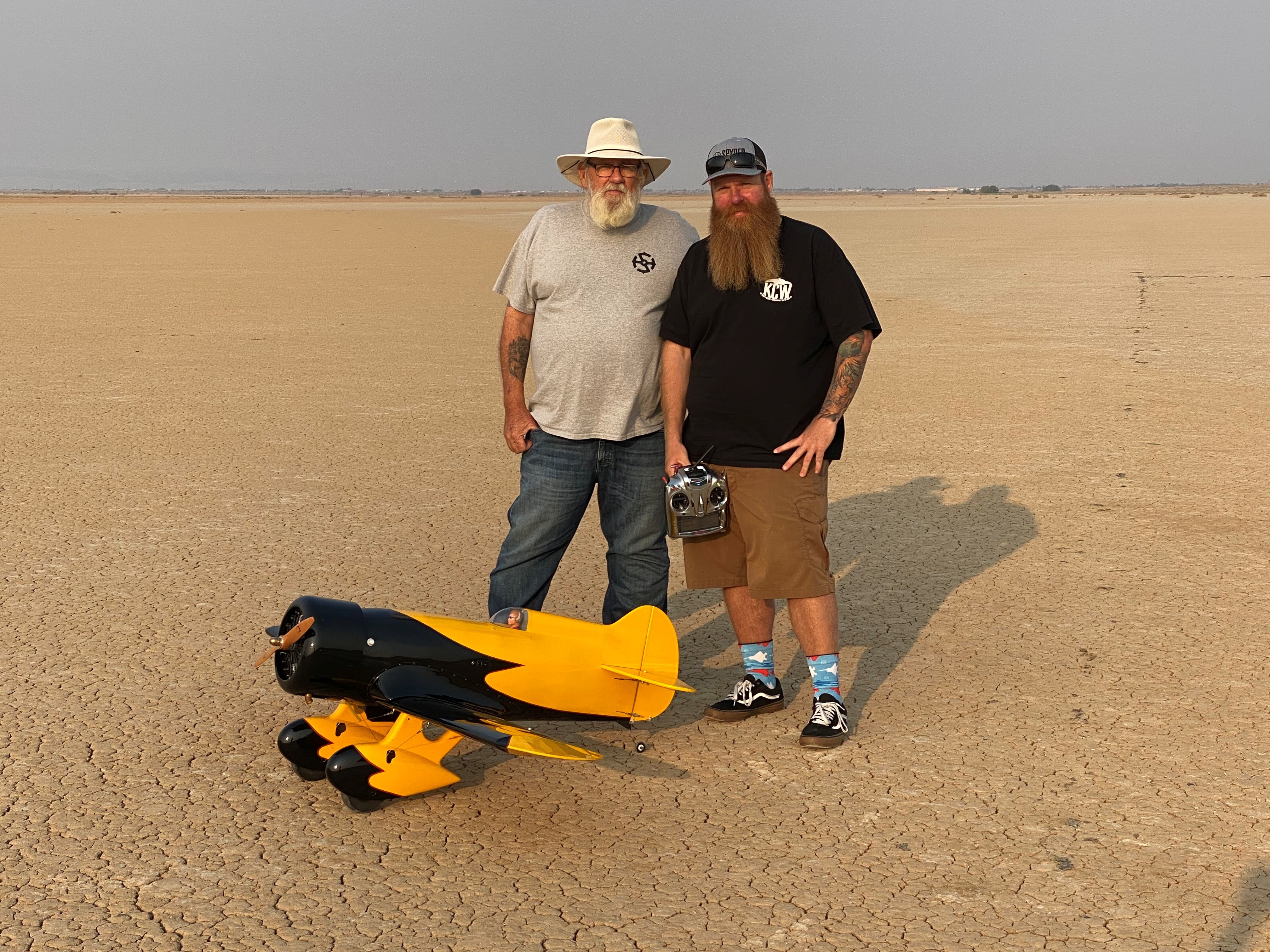
Justin Hall, chief pilot at the Dale Reed Subscale Flight Research Laboratory at NASA’s Armstrong Flight Research Center in Edwards, California, stands in front of a radio-controlled aircraft with his dad, David Hall, in August 2020. David Hall built the Gee Bee aircraft years earlier but was unable to fly it due to his health. He asked his son to fly the aircraft so he could see it in the air, which Justin did the day of this photo. Shortly afterward, David Hall passed away.
Justin Hall
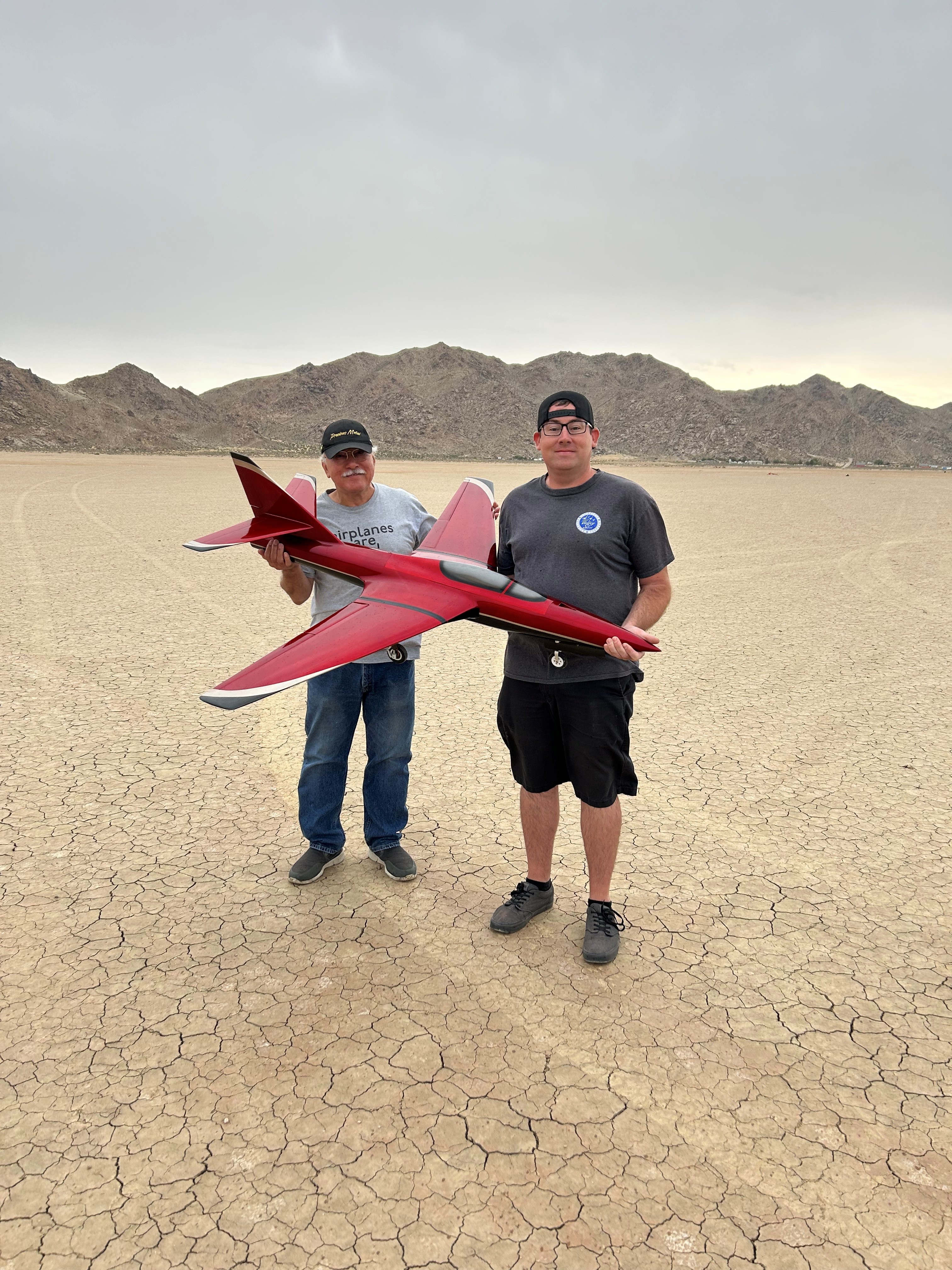
Justin link, drone pilot at the Dale Reed Subscale Flight Research Laboratory at NASA’s Armstrong Flight Research Center in Edwards, California, and his dad, Don Link, hold a Firebird radio-controlled aircraft on the day of its first flight in September 2023. It was a project they worked on together. Don Link reduced the dimensions of the original larger-scale model aircraft and drew the plans, while Justin Link manufactured composite molds and built the aircraft from scratch.
Justin Link
Link was five years old when he built balsa-wood aircraft with his dad and flew them in a field near their home. As he grew older, his hobby expanded to include radio-controlled cars, boats, helicopters, and aircraft. Aviation runs deep in Link’s family. His great grandfather served in the U.S. Army Air Corps, his grandfathers served in the U.S. Air Force, and his dad was an Air Force avionics technician. Link raced sailplanes, competed with scaled warbird aircraft, and was encouraged by family and friends to pursue an aviation profession. He has worked with large drones for more than 11 years, focusing on research and development, composite materials, and specialized fabrication methods.
Together, the team applies its experience and knowledge in rapid design, fabrication, integration and flight testing to bring new ideas to flight. Their work continues to support NASA’s missions across aeronautics, science, and exploration.
PyTorch Foundation to foster an ecosystem of vendor-neutral projects alongside founding members AMD, AWS, Google Cloud, Meta, Microsoft Azure, and NVIDIA
DUBLIN – September 12, 2022 – The Linux Foundation, a global nonprofit organization enabling innovation through open source, today announced PyTorch is moving to the Linux Foundation from Meta where it will live under the newly-formed PyTorch Foundation. Since its release in 2016, over 2400 contributors and 18,0000 organizations have adopted the PyTorch machine learning framework for use in academic research and production environments. The Linux Foundation will work with project maintainers, its developer community, and initial founding members of PyTorch to support the ecosystem at its new home.
Projects like PyTorch—that have the potential to become a foundational platform for critical technology—benefit from a neutral home. As part of the Linux Foundation, PyTorch and its community will benefit from many programs and support infrastructure like training and certification programs, research, and local to global events. Working inside and alongside the Linux Foundation, PyTorch will have access to the LFX collaboration portal—enabling mentorships and helping the PyTorch community identify future leaders, find potential hires, and observe shared project dynamics.
“Growth around AI/ML and Deep Learning has been nothing short of extraordinary—and the community embrace of PyTorch has led to it becoming one of the five-fastest growing open source software projects in the world,” said Jim Zemlin, executive director for the Linux Foundation. “Bringing PyTorch to the Linux Foundation where its global community will continue to thrive is a true honor. We are grateful to the team at Meta—where PyTorch was incubated and grown into a massive ecosystem—for trusting the Linux Foundation with this crucial effort.”
“Some AI news: we’re moving PyTorch, the open source AI framework led by Meta researchers, to become a project governed under the Linux Foundation. PyTorch has become one of the leading AI platforms with more than 150,000 projects on GitHub built on the framework. The new PyTorch Foundation board will include many of the AI leaders who’ve helped get the community where it is today, including Meta and our partners at AMD, Amazon, Google, Microsoft, and NVIDIA. I’m excited to keep building the PyTorch community and advancing AI research,” said Mark Zuckerberg, Founder & CEO, Meta.
The Linux Foundation has named Dr. Ibrahim Haddad, its Vice President of Strategic Programs, as the Executive Director of the PyTorch Foundation. The PyTorch Foundation will support a strong member ecosystem with a diverse governing board including founding members: AMD, Amazon Web Services (AWS), Google Cloud, Meta, Microsoft Azure and NVIDIA. The project will promote continued advancement of the PyTorch ecosystem through its thriving maintainer and contributor communities. The PyTorch Foundation will ensure the transparency and governance required of such critical open source projects, while also continuing to support its unprecedented growth.
Member Quotes
AMD
“Open software is critical to advancing HPC, AI and ML research, and we’re ready to bring our experience with open software platforms and innovation to the PyTorch Foundation,” said Brad McCredie, corporate vice president, Data Center and Accelerated Processing, AMD. “AMD Instinct accelerators and ROCm software power important HPC and ML sites around the world, from exascale supercomputers at research labs to major cloud deployments showcasing the convergence of HPC and AI/ML. Together with other foundation members, we will support the acceleration of science and research that can make a dramatic impact on the world.”
Amazon Web Services
“AWS is committed to democratizing data science and machine learning, and PyTorch is a foundational open source tool that furthers that goal,” said Brian Granger, senior principal technologist at AWS. “The creation of the PyTorch Foundation is a significant step forward for the PyTorch community. Working alongside The Linux Foundation and other foundation members, we will continue to help build and grow PyTorch to deliver more value to our customers and the PyTorch community at large.”
Google Cloud
“At Google Cloud we’re committed to meeting our customers where they are in their digital transformation journey and that means ensuring they have the power of choice,” said Andrew Moore, vice president and general manager of Google Cloud AI and industry solutions. “We’re participating in the PyTorch Foundation to further demonstrate our commitment of choice in ML development. We look forward to working closely on its mission to drive adoption of AI tooling by building an ecosystem of open source projects with PyTorch along with our continued investment in JAX and Tensorflow.”
Microsoft Azure
“We’re honored to participate in the PyTorch Foundation and partner with industry leaders to make open source innovation with PyTorch accessible to everyone,” Eric Boyd, CVP, AI Platform, Microsoft, said. “Over the years, Microsoft has invested heavily to create an optimized environment for our customers to create, train and deploy their PyTorch workloads on Azure. Microsoft products and services run on trust, and we’re committed to continuing to deliver innovation that fosters a healthy open source ecosystem that developers love to use. We look forward to helping the global AI community evolve, expand and thrive by providing technical direction based on our latest AI technologies and research.”
NVIDIA
“PyTorch was developed from the beginning as an open source framework with first-class support on NVIDIA Accelerated Computing”, said Ian Buck, General Manager and Vice President of Accelerated Computing at NVIDIA. “NVIDIA is excited to be an originating member of the PyTorch Foundation to encourage community adoption and to ensure using PyTorch on the NVIDIA AI platform delivers excellent performance with the best experience possible.”
Additional Resources:
Visit pytorch.org to learn more about the project and the PyTorch Foundation
Founded in 2000, the Linux Foundation and its projects are supported by more than 3,000 members. The Linux Foundation is the world’s leading home for collaboration on open source software, hardware, standards, and data. Linux Foundation projects are critical to the world’s infrastructure including Linux, Kubernetes, Node.js, ONAP, Hyperledger, RISC-V, PyTorch, and more. The Linux Foundation’s methodology focuses on leveraging best practices and addressing the needs of contributors, users, and solution providers to create sustainable models for open collaboration. For more information, please visit us at linuxfoundation.org.
###
The Linux Foundation has registered trademarks and uses trademarks. For a list of trademarks of The Linux Foundation, please see our trademark usage page: https://www.linuxfoundation.org/trademark-usage. Linux is a registered trademark of Linus Torvalds.

 Accedi